
Resistance and Ohm's law
Why is the heating wire of a toaster made of thin special metal, while the conductors of an extension cord are thick copper?
Prior knowledge
- Current is measured with an ammeter connected in series with the component, and voltage with a voltmeter connected in parallel with itchapter Measurements in an electric circuit
- The direction of an electric current is agreed to be from the positive terminal to the negative terminal, and in a metal the current is the motion of free electronschapter Electric circuit, current and voltage
Core path: follow the steps in order. Tasks marked Optional give extra practice. Optional tasks: 6.
Think about it
When the toaster is on, the same electric current flows in the copper conductors of the extension cord and in the heating wire of the toaster. The extension cord stays cool in the hand, but the thin wire of the toaster glows orange. The conductors of the extension cord are thick copper, the wire of the toaster is thin nichrome.
What property of a component decides how large a current a given voltage produces in it, and what does this property depend on?
Optional Review: connecting the meters
Predict
Make your predictions before investigating 2 questions
Prediction 1: current of a filament lamp
Prediction 2: length of the wire
Investigate
Choose a component, adjust the voltage and read the meters. Mark the readings on the graph and see what kind of characteristic curve the component gets.
Simulation
How to use
Choose the Component: resistor, filament lamp or constantan wire. Adjust the voltage $U$ of the voltage source. The voltmeter shows the voltage across the component and the ammeter the current through it. Mark point adds the readings to the $(I, U)$ graph; the graph shows the points of the chosen component, and Clear graph removes them. The length and cross-sectional area of the wire affect only the constantan wire, and the wire is drawn to scale. The purple dots show the agreed direction of the current from the positive terminal to the negative terminal; they move faster the larger the current is. Speed changes only their pace.
Assumptions of the model
The meters are ideal: the resistance of the ammeter is zero and no current flows through the voltmeter, so the meters do not change the circuit. The temperature of the resistor and the constantan wire stays the same, so their resistance does not change with the voltage; the resistivity of constantan changes very little with temperature. The model of the filament lamp imitates the behaviour of an ordinary $3\,\text{V}$ lamp: the wire heats up as the voltage rises, and its resistance grows from the cold-lamp value $1.0\,\Omega$ to $12.0\,\Omega$. The readings are values of the model, not measurements.
How the calculation works
The meters show the voltage $U$ and the current $I = U : R$. The resistance of the resistor is $R = 10\,\Omega$. The resistance of the wire is $R = \rho l : A$, where the resistivity of constantan is $\rho = 5.0 \cdot 10^{-7}\,\Omega\cdot\text{m}$ and $A$ is converted to square metres, $1\,\text{mm}^2 = 10^{-6}\,\text{m}^2$. The resistance of the lamp depends on the voltage:
$$R = R_\text{c} + (R_\text{r} - R_\text{c}) \left(\frac{U}{U_\text{r}}\right)^{0.6}$$
where the cold resistance is $R_\text{c} = 1.0\,\Omega$, the rated resistance $R_\text{r} = 12.0\,\Omega$ and the rated voltage $U_\text{r} = 3.0\,\text{V}$. The formula is a model that imitates the behaviour of a real lamp, not a law of physics. The faint curve is calculated from the same formulas at voltages 0–$3.0\,\text{V}$.
Experiment 1: characteristic curve of a resistor
The component is a resistor. Change only the voltage and record the current at at least three voltages, for example $0.5\,\text{V}$, $1.5\,\text{V}$ and $3.0\,\text{V}$. Mark the same readings on the graph with the Mark point button. Calculate $U : I$ for each row.
Initial state: component: resistor, voltage = $0{.}5\,\text{V}$. Kept constant: component. Varied: voltage.
| voltage | $I$ $(\text{A})$ |
|---|
Calculate the resistance of the resistor $R = U : I$ from one row of your table. Answer in ohms.
Hint 1: a guiding question
Choose a row where the voltage and the current are not zero, for example $U = 1.5\,\text{V}$.
Hint 2: what is the connection
Resistance is the voltage divided by the current, not the current divided by the voltage.
Hint 3: an intermediate step
$R = 1.50\,\text{V} : 0.150\,\text{A}$.
Show the solution
Given
from the table, for example, $U = 1.50\,\text{V}$ and $I = 0.150\,\text{A}$ (values of the model)
Find
the resistance $R$ of the resistor in ohms
Principle
Resistance is the ratio of the voltage across a component to the current through it. The ammeter is in series with the resistor and the voltmeter in parallel, so the readings refer to the resistor itself.
Formula
$R = \dfrac{U}{I}$
Conversions
Not needed: the voltage is in volts and the current in amperes, and $1\,\text{V/A} = 1\,\Omega$.
Substitution
Answer
$10.0\,\Omega$
Three significant figures like the meter readings.
Reasonableness
Every row gives the same result: $0.5\,\text{V} : 0.050\,\text{A} = 10\,\Omega$ and $3.0\,\text{V} : 0.300\,\text{A} = 10\,\Omega$. A constant ratio means that the current is directly proportional to the voltage, as Ohm's law says.
Experiment 2: characteristic curve of a filament lamp
Test prediction 1. The component is now a filament lamp. Change only the voltage and record the current at at least the voltages $1.5\,\text{V}$ and $3.0\,\text{V}$, and at smaller ones too if you wish. Mark the readings on the graph and compare the curve with the straight line of the resistor. Calculate $U : I$ for every row.
Initial state: component: filament lamp, voltage = $1{.}5\,\text{V}$. Kept constant: component. Varied: voltage.
| voltage | $I$ $(\text{A})$ |
|---|
Experiment 3: length of the wire
Test prediction 2. The component is the constantan wire, the voltage is $1.5\,\text{V}$ and the cross-sectional area $0.20\,\text{mm}^2$. Change only the length of the wire and record the current at at least the lengths $1.00\,\text{m}$ and $2.00\,\text{m}$. Calculate the resistance $U : I$ for every row.
Initial state: component: constantan wire, voltage = $1{.}5\,\text{V}$, length of wire = $0{.}5\,\text{m}$, wire area = $0{.}2\,\text{mm}^2$. Kept constant: component, voltage, wire area. Varied: length of wire.
| length of wire | $I$ $(\text{A})$ |
|---|
Optional Experiment 4: thickness of the wire
The length of the wire is now $1.00\,\text{m}$ and the voltage $1.5\,\text{V}$. Change only the cross-sectional area and record the current at at least the values $0.10\,\text{mm}^2$, $0.20\,\text{mm}^2$ and $0.40\,\text{mm}^2$. How does the resistance $U : I$ change when the cross-sectional area doubles?
Initial state: component: constantan wire, voltage = $1{.}5\,\text{V}$, length of wire = $1\,\text{m}$, wire area = $0{.}1\,\text{mm}^2$. Kept constant: component, voltage, length of wire. Varied: wire area.
| wire area | $I$ $(\text{A})$ |
|---|
Conclusion: when does $U : I$ stay constant?
Based on your tables, write: for which component did the ratio $U : I$ stay the same regardless of the voltage, and for which did it change? Why did the ratio change for the lamp? How did the resistance of the wire depend on its length?
Model answer
For the resistor $U : I$ was $10\,\Omega$ at every voltage, for example $1.50\,\text{V} : 0.150\,\text{A} = 10.0\,\Omega$. So the current is directly proportional to the voltage, and the resistor obeys Ohm's law; its characteristic curve is a straight line through the origin. For the lamp the ratio grew with the voltage: $8.3\,\Omega$ at $1.5\,\text{V}$ and $12.0\,\Omega$ at $3.0\,\text{V}$, and the characteristic curve bends. The greater the voltage, the hotter the wire gets, and the resistance of a hot metal is greater. The resistance of the constantan wire doubled when the length doubled: $2.50\,\Omega$ at $1.00\,\text{m}$ and $5.00\,\Omega$ at $2.00\,\text{m}$. The values are values of the model: in the model the meters are ideal and the temperature of the resistor and the wire stays the same.
Assess your own answer
Tick the points your own answer already contains.
Review the theory summary and practise with the exercises.
Theory summary
Key idea
Resistance tells how strongly a component opposes current
When a voltage is connected across the terminals of a component, an electric current flows through it. The same voltage produces a different current in different components: in a short thick copper wire the current is large, in a long thin heating wire it is small. The resistance $R$ of a component tells how strongly it opposes electric current. It is defined as the ratio of voltage to current, $R = U : I$. The greater the resistance, the smaller the current a given voltage produces. The unit of resistance is the ohm, $1\,\Omega = 1\,\text{V/A}$: a component has a resistance of one ohm when a voltage of one volt makes a current of one ampere flow through it.
A component made to have a certain resistance is called a resistor. Its circuit symbol is a rectangle. Resistance is determined by measuring the voltage across the component and the current through it at the same time. The ammeter is connected in series with the component so that the same current flows through both, and the voltmeter in parallel with the component, across its terminals. When the measurement is repeated at several voltages, we can see whether the ratio $U : I$ stays the same.
Where resistance comes from
In a metal, the positive ions form a regular lattice, and the free electrons move among them. When there is a voltage between the ends of a conductor, the electrons drift along the conductor, but they keep colliding with the vibrating ions. The collisions slow the electrons down: this is the cause of resistance. In the collisions electrical energy is changed into internal energy of the conductor, so the conductor warms up. In a long conductor an electron collides more often on its way, so the resistance is greater. In a thick conductor more electrons travel side by side, so the resistance is smaller. When a metal gets hot, the ions vibrate more strongly and there are more collisions. This is why the resistance of a metal conductor increases as the temperature rises.
Ohm's law and resistivity
The resistance is the ratio of the voltage across a component to the current through it:
$$R = \frac{U}{I}$$
where $R$ is the resistance ($\Omega$), $U$ the voltage across the component ($\text{V}$) and $I$ the current through it ($\text{A}$).
Ohm's law: the current through a metal conductor is directly proportional to its voltage when the temperature of the conductor stays the same. Then the resistance is constant, and
$$U = R I$$
When the voltage doubles, the current doubles too. Ohm's law is not a general law of nature but a property of many conducting materials: it holds for metals and resistors at a constant temperature, but not, for example, for a filament lamp, whose wire heats up, nor for a diode.
Characteristic curve
The characteristic curve of a component is a graph that shows how the voltage across the component and the current through it depend on each other. When the current $I$ is on the horizontal axis and the voltage $U$ on the vertical axis, the characteristic curve of a resistor that obeys Ohm's law is a straight line through the origin, and the slope of the line is the resistance $R$. The characteristic curve of a filament lamp is curved. The tungsten wire of the lamp gets hotter the greater the current through it, and the resistance of a hot wire is greater. At every point of the curve, however, the resistance is the ratio $U : I$, that is, the slope of the straight line drawn from the origin to the point, not the steepness of the curve at that point.
Resistivity
The resistance of a uniform conductor of one material is directly proportional to the length $l$ of the conductor and inversely proportional to its cross-sectional area $A$:
$$R = \rho \frac{l}{A}$$
where $R$ is the resistance of the conductor ($\Omega$), $l$ its length ($\text{m}$), $A$ its cross-sectional area ($\text{m}^2$) and $\rho$ the resistivity of the material ($\Omega\cdot\text{m}$). A wire twice as long is like two wires one after the other, so the resistance doubles. A wire with twice the cross-sectional area is like two wires side by side, so the current can take two routes and the resistance is halved. The cross-sectional area is often given in square millimetres, and $1\,\text{mm}^2 = (10^{-3}\,\text{m})^2 = 10^{-6}\,\text{m}^2$.
Resistivity is a property of a material: it tells how poorly the material conducts electricity. The resistivity of metals increases as the temperature rises. The resistivity of constantan changes very little with temperature, which is why it is used to make precise resistors. Heating wires are made of nichrome because of its high resistivity. The values in the table are in $\Omega\cdot\text{m}$ at room temperature ($20\,{}^\circ\text{C}$).
| material | resistivity $\rho$ |
|---|---|
| silver | $1.6 \cdot 10^{-8}$ |
| copper | $1.7 \cdot 10^{-8}$ |
| aluminium | $2.7 \cdot 10^{-8}$ |
| iron | $1.0 \cdot 10^{-7}$ |
| constantan | $5.0 \cdot 10^{-7}$ |
| nichrome | $1.1 \cdot 10^{-6}$ |
The resistivity of copper is small, so thick copper conductors let current flow with almost no voltage drop. The wire of a toaster is nichrome, whose resistivity is more than 60 times that of copper, and the wire is also thin. So its resistance is large, and it is the wire that gets hot.
Common misconception
Many conclude from the formula $R = U : I$ that the resistance increases when the voltage increases. The resistance of a resistor, however, does not depend on the voltage: when the voltage doubles, the current doubles too, and the ratio stays the same. Resistance depends on the material, length, thickness and temperature of the conductor. The resistance of a filament lamp increases with the voltage only because a larger current heats the wire.
Another misconception is that current is used up in a resistor. After the resistor the current is as large as before it, because charge does not disappear on the way. In a resistor electrical energy is changed into internal energy, not current.
Summary
- Resistance $R = U : I$ tells how strongly a component opposes electric current. The unit is the ohm, $1\,\Omega = 1\,\text{V/A}$.
- Resistance is measured with an ammeter in series with the component and a voltmeter in parallel with it.
- Ohm's law: the current through a metal conductor is directly proportional to the voltage when the temperature stays the same, $U = RI$.
- The characteristic curve shows how the voltage across a component and the current through it depend on each other. The curve of a resistor is a straight line through the origin, that of a filament lamp is curved, because the resistance of a hot wire is greater.
- The resistance of a conductor is $R = \rho l : A$: it grows with length, falls with thickness and depends on the resistivity $\rho$ of the material.
Optional Return to your predictions
Compare your predictions with the model values of the experiments. Then return to the opening question: why is the wire of a toaster made of thin nichrome and the conductors of an extension cord of thick copper? Use the words resistance and resistivity.
Would you change your prediction?
Apply
Worked example
Problem
A resistor with a resistance of $12\,\Omega$ is to be made from constantan wire with a cross-sectional area of $0.20\,\text{mm}^2$. How long a wire is needed? The resistivity of constantan is $5.0 \cdot 10^{-7}\,\Omega\cdot\text{m}$.
Step 1/7
Given and find. $R = 12\,\Omega$, $A = 0.20\,\text{mm}^2$ and $\rho = 5.0 \cdot 10^{-7}\,\Omega\cdot\text{m}$. We want the length $l$ of the wire.
Step 2/7
Principle. The wire is uniform and of one material, so its resistance is proportional to its length and inversely proportional to its cross-sectional area. The resistivity of constantan stays almost the same even if the wire warms up in use, so the table value will do.
Step 3/7
Rearranged formula. We solve for the length by multiplying the equation on both sides by $A$ and dividing by $\rho$:
$$\begin{aligned} R &= \rho \frac{l}{A} \\ l &= \frac{R A}{\rho} \end{aligned}$$
Step 4/7
Unit conversions. The cross-sectional area in square metres:
Step 5/7
Substitution. $$\begin{aligned} l &= \frac{R A}{\rho} \\ &= \frac{12\,\Omega \cdot 0.20 \cdot 10^{-6}\,\text{m}^2}{5.0 \cdot 10^{-7}\,\Omega\cdot\text{m}} \\ &= 4.8\,\text{m} \end{aligned}$$
Step 6/7
Result. The wire needed is $4.8\,\text{m}$ long. The result is given to two significant figures, because the resistance, the cross-sectional area and the resistivity are given to two figures.
Step 7/7
Reasonableness. One metre of this wire has a resistance of
so $12\,\Omega$ needs just under five metres: $12\,\Omega : 2.5\,\Omega = 4.8$. The units work out: $\Omega \cdot \text{m}^2 : (\Omega\cdot\text{m}) = \text{m}$. At a voltage of $6.0\,\text{V}$ the finished resistor would pass a current of $6.0\,\text{V} : 12\,\Omega = 0.50\,\text{A}$.
Optional Find the error
Optional Apply to a new situation
A wall socket is $18\,\text{m}$ from the fuse box. The current flows from the fuse box to the socket along one copper conductor and returns along another, so the total length of conductor along the path of the current is $36\,\text{m}$. The cross-sectional area of the conductor is $1.5\,\text{mm}^2$ and the resistivity of copper $1.7 \cdot 10^{-8}\,\Omega\cdot\text{m}$.
What is the resistance of this $36\,\text{m}$ of conductor? Answer in ohms.
Hint 1: a guiding question
Which formula gives the resistance of a conductor from its material and dimensions? Which length is substituted into the formula?
Hint 2: what is the connection
$R = \rho l : A$, where $l = 36\,\text{m}$. The cross-sectional area must be converted to square metres.
Hint 3: an intermediate step
so
Show the solution
Given
copper $\rho = 1.7 \cdot 10^{-8}\,\Omega\cdot\text{m}$; length of conductor $l = 2 \cdot 18\,\text{m} = 36\,\text{m}$; cross-sectional area $A = 1.5\,\text{mm}^2$
Find
the resistance $R$ of the conductor path in ohms
Principle
The conductor is uniform copper, so its resistance is proportional to its length and inversely proportional to its cross-sectional area. The current flows through the outgoing and the return conductor one after the other, so the length is taken as the total of both.
Formula
$R = \rho \dfrac{l}{A}$
Conversions
Substitution
Answer
$0.41\,\Omega$
Two significant figures like the resistivity and the cross-sectional area.
Reasonableness
One metre of this conductor has about $0.011\,\Omega$, so $36\,\text{m}$ is just under half an ohm. The resistance is small, as expected of a conductor: with a current of $10\,\text{A}$ the conductors lose a voltage of only $10\,\text{A} \cdot 0.408\,\Omega \approx 4\,\text{V}$ of the mains $230\,\text{V}$.
Check your understanding
Exit ticket
Answer on your own first and only then open the answer.
- The voltage across a component is $9.0\,\text{V}$, and a current of $0.060\,\text{A}$ flows through it. What is the resistance of the component?
Answer
$R$$= U : I$$= 9.0\,\text{V} : 0.060\,\text{A}$$= 150\,\Omega$ - The length of a copper wire is halved and its cross-sectional area is doubled. How does the resistance of the wire change?
Answer
The resistance falls to a quarter, because $R = \rho l : A$: half the length halves the resistance and double the cross-sectional area halves it again.
1. Concept
2. Characteristic curve from measurement points
The graph shows the measurement points of a resistor, when the voltage was changed and the current measured. Fit a line through the origin to the points and determine the resistance of the resistor from the slope of the line. Answer in ohms.
Hint 1: a guiding question
Why does the line pass through the origin? What quantity is the slope of an $(I, U)$ graph?
Hint 2: what is the connection
Read the slope from two points of the fitted line, not from two neighbouring measurement points. The origin is one point.
Hint 3: an intermediate step
The fitted line passes through the voltage $2.2\,\text{V}$ at the current $0.100\,\text{A}$: $R = 2.2\,\text{V} : 0.100\,\text{A}$.
Show the solution
Given
five measurement points on an $(I, U)$ graph; current $0.020$–$0.100\,\text{A}$, voltage $0.47$–$2.21\,\text{V}$
Find
the resistance $R$ of the resistor in ohms
Principle
The resistor obeys Ohm's law, so $U = RI$: the characteristic curve is a straight line whose slope is $R$. The line passes through the origin, because with no voltage no current flows. In real data sets the measurement points are usually not exactly on the same line because of measurement uncertainty, so the line is fitted to all the points.
Reading the graph
The line drawn through the origin passes among the points, some of the points lie above it and some below. We read a point of the line far from the origin: at the current $0.100\,\text{A}$ the voltage of the line is $2.2\,\text{V}$. The other point is the origin $(0$; $0)$.
Formula
$R = \dfrac{\Delta U}{\Delta I}$
Conversions
Not needed: the voltage is in volts and the current in amperes.
Substitution
Answer
$22\,\Omega$
Two significant figures, because the voltage is read from the fitted line to about $0.05\,\text{V}$.
Reasonableness
Single points give almost the same value: $0.86\,\text{V} : 0.040\,\text{A} \approx 22\,\Omega$ and $1.74\,\text{V} : 0.080\,\text{A} \approx 22\,\Omega$. The value is of the order of magnitude of an ordinary resistor.
Suggestion: one answer does not show everything you can do, but review the theory summary and do the core exercises.
Optional 3. Explain and transfer
A long extension cord uses thicker copper conductors than a short one, even if the appliances are the same. Explain why, using the concepts resistance and resistivity.
Model answer
The resistance of a conductor is $R = \rho l : A$. In a long extension cord there is more conductor, so the resistance of a conductor of the same thickness would be greater: a conductor twice as long, twice the resistance. The resistance of a conductor must be small so that the conductor does not heat up dangerously and so that the voltage is left for the appliance and not for the cord. When the cross-sectional area is increased in the same proportion as the length, the resistance stays unchanged. Conductors are made of copper, because its resistivity $1.7 \cdot 10^{-8}\,\Omega\cdot\text{m}$ is one of the smallest among metals.
Assess your own answer
Tick the points your own answer already contains.
Review the theory summary and practise with the exercises.
Exercises
Level 1 · basic practice 5 exercises
One formula or one step of reasoning. Core exercises first, the rest is extra practice.
- Exercise 3-1Core
A kettle is connected to a voltage of $230\,\text{V}$, and a current of $8.7\,\text{A}$ flows through its heating element. What is the resistance of the heating element?
Answer
$26\,\Omega$
Show the solution
Given
the voltage across the heating element $U = 230\,\text{V}$ and the current $I = 8.7\,\text{A}$
Find
the resistance $R$ of the heating element in ohms
Principle
Resistance is the ratio of the voltage across a component to the current through it. The given values refer to the same resistor at the same moment, while the kettle is on, so the ratio gives the resistance of the element at its operating temperature.
Formula
$R = \dfrac{U}{I}$
Conversions
Not needed: the voltage is in volts and the current in amperes, and $1\,\text{V/A} = 1\,\Omega$.
Substitution
$R$$= \dfrac{230\,\text{V}}{8.7\,\text{A}}$$= 26.44\,\Omega$Answer
$26\,\Omega$
Two significant figures like the current $8.7\,\text{A}$.
Reasonableness
Estimate: $230\,\text{V} : 10\,\text{A} = 23\,\Omega$; the current is a little under $10\,\text{A}$, so the resistance is a little over $23\,\Omega$. Check with Ohm's law: $26.44\,\Omega \cdot 8.7\,\text{A} = 230\,\text{V}$.
- Exercise 3-2Core
The resistance of a resistor in an electronic circuit is $220\,\Omega$, and a current of $15\,\text{mA}$ flows through it.
How large is the voltage across the resistor? Answer in volts.
Answer
$3.3\,\text{V}$
Show the solution
Given
the resistance of the resistor $R = 220\,\Omega$ and the current $I = 15\,\text{mA}$
Find
the voltage $U$ across the resistor in volts
Principle
The resistor obeys Ohm's law, so the voltage is the product of the resistance and the current. The same equation follows from the definition of resistance $R = U : I$ by multiplying both sides by the current.
Formula
$R = \dfrac{U}{I}$, so $U = R I$
Conversions
$I$$= 15\,\text{mA}$$= 15 \cdot 10^{-3}\,\text{A}$$= 0.015\,\text{A}$Substitution
$U$$= 220\,\Omega \cdot 0.015\,\text{A}$$= 3.3\,\text{V}$Answer
$3.3\,\text{V}$
Two significant figures like the current $15\,\text{mA}$.
Reasonableness
An ohm times an ampere is a volt, so the unit is correct. Estimate: $200\,\Omega \cdot 0.015\,\text{A} = 3\,\text{V}$, and the exact result is a little larger, as it should be. In electronics, voltages of a few volts like this are common.
- Exercise 3-3
The total resistance of the heating wires of a car's rear window is $1.2\,\Omega$, and they are connected to the car's voltage of $12\,\text{V}$.
How large a current flows through the wires?
Answer
$10\,\text{A}$
Show the solution
Given
the resistance of the heating wires $R = 1.2\,\Omega$ and the voltage $U = 12\,\text{V}$
Find
the current $I$ through the wires in amperes
Principle
The current in a heating wire follows from the definition of resistance when the voltage and the resistance are known. The given resistance applies to the wires in use.
Formula
$R = \dfrac{U}{I}$, so $I = \dfrac{U}{R}$
Conversions
Not needed: the voltage is in volts and the resistance in ohms, and $1\,\text{V}/\Omega = 1\,\text{A}$.
Substitution
$I$$= \dfrac{12\,\text{V}}{1.2\,\Omega}$$= 10\,\text{A}$Answer
$10\,\text{A}$
Two significant figures like the voltage and the resistance.
Reasonableness
The resistance is small, so the current is large. Check: $1.2\,\Omega \cdot 10\,\text{A} = 12\,\text{V}$. The rear window heater is indeed one of the biggest electricity users in a car, and it has a fuse of its own.
- Exercise 3-4
A conductor of a copper cable has a length of $25\,\text{m}$ and a cross-sectional area of $2.5\,\text{mm}^2$. The resistivity of copper is $1.7 \cdot 10^{-8}\,\Omega\cdot\text{m}$.
What is the resistance of the conductor? Answer in ohms.
Answer
$0.17\,\Omega$
Show the solution
Given
copper conductor, $l = 25\,\text{m}$, $A = 2.5\,\text{mm}^2$, $\rho = 1.7 \cdot 10^{-8}\,\Omega\cdot\text{m}$
Find
the resistance $R$ of the conductor in ohms
Principle
The conductor is uniform copper, so its resistance is directly proportional to its length and inversely proportional to its cross-sectional area. The constant of proportionality is the resistivity of copper.
Formula
$R = \rho \dfrac{l}{A}$
Conversions
$A$$= 2.5\,\text{mm}^2$$= 2.5 \cdot (10^{-3}\,\text{m})^2$$= 2.5 \cdot 10^{-6}\,\text{m}^2$Substitution
$R$$= \dfrac{1.7 \cdot 10^{-8}\,\Omega\cdot\text{m} \cdot 25\,\text{m}}{2.5 \cdot 10^{-6}\,\text{m}^2}$$= 0.17\,\Omega$Answer
$0.17\,\Omega$
Two significant figures like the data.
Reasonableness
Units: $\Omega\cdot\text{m} \cdot \text{m} : \text{m}^2 = \Omega$. The resistance of an electric cable should indeed be small, under an ohm, so that the cable does not heat up. One metre of this conductor has a resistance of $0.0068\,\Omega$, and $25 \cdot 0.0068\,\Omega = 0.17\,\Omega$.
- Exercise 3-5
There is a voltage of $5.0\,\text{V}$ between the electrodes of a moisture sensor pushed into the soil of a flowerpot, and a current of $2.0\,\text{mA}$ flows through the soil.
What is the resistance of the soil between the electrodes? Answer in kilohms.
Answer
$2.5\,\text{k}\Omega$
Show the solution
Given
the voltage between the electrodes $U = 5.0\,\text{V}$ and the current $I = 2.0\,\text{mA}$
Find
the resistance $R$ of the soil in kilohms
Principle
Between the electrodes the soil is a component of the circuit, and its resistance is the ratio of the voltage to the current at the same moment.
Formula
$R = \dfrac{U}{I}$
Conversions
$I$$= 2.0\,\text{mA}$$= 2.0 \cdot 10^{-3}\,\text{A}$Finally $1\,\text{k}\Omega = 1000\,\Omega$.
Substitution
$R$$= \dfrac{5.0\,\text{V}}{2.0 \cdot 10^{-3}\,\text{A}}$$= 2500\,\Omega$$= 2.5\,\text{k}\Omega$Answer
$2.5\,\text{k}\Omega$
Two significant figures like the voltage and the current.
Reasonableness
The current is only milliamperes, so the resistance is large, thousands of ohms. Moist soil conducts electricity better than dry soil, so as the soil dries the resistance increases and the current decreases: this is how the sensor works.
Level 2 · applied practice 4 exercises
Two steps, working with measured data, a unit conversion or rearranging a formula. Core exercises first, the rest is extra practice.
- Exercise 3-6Core
The voltage across a resistor is $6.0\,\text{V}$ and a current of $0.25\,\text{A}$ flows through it. The voltage is raised to $9.0\,\text{V}$, and the temperature of the resistor stays the same.
How large a current now flows through the resistor?
Answer
$0.38\,\text{A}$
Show the solution
Given
at first $U_1 = 6.0\,\text{V}$ and $I_1 = 0.25\,\text{A}$; at the end $U_2 = 9.0\,\text{V}$; the temperature stays the same
Find
the current $I_2$ at the voltage $9.0\,\text{V}$
Principle
The temperature of the resistor stays the same, so it obeys Ohm's law and its resistance is the same at both voltages. The resistance is calculated from the first measurement and used for the second.
Formula
$R = \dfrac{U_1}{I_1}$ and $I_2 = \dfrac{U_2}{R}$
Conversions
Not needed: the voltages are in volts and the current in amperes.
Substitution
$R$$= \dfrac{6.0\,\text{V}}{0.25\,\text{A}}$$= 24\,\Omega$$I_2$$= \dfrac{9.0\,\text{V}}{24\,\Omega}$$= 0.375\,\text{A}$Answer
$0.38\,\text{A}$
Two significant figures like the voltages and the current $0.25\,\text{A}$.
Reasonableness
The voltage becomes 1.5 times as large ($9.0\,\text{V} : 6.0\,\text{V} = 1.5$), so by Ohm's law the current also becomes 1.5 times as large: $1.5 \cdot 0.25\,\text{A} = 0.375\,\text{A}$. The result is the same.
- Exercise 3-7Core
The graph shows the characteristic curve of a filament lamp.
What is the resistance of the lamp when the voltage across it is $1.0\,\text{V}$? Read the value you need from the graph.
Answer
$6.7\,\Omega$
Show the solution
Given
the characteristic curve of a filament lamp as an $(I, U)$ graph; the voltage $U = 1.0\,\text{V}$
Find
the resistance $R$ of the lamp at the voltage $1.0\,\text{V}$
Principle
Resistance is the ratio of voltage to current at the same point of the curve. The lamp does not obey Ohm's law, so the resistance must be read exactly at this voltage, not from the steepness of the curve nor from another point.
Reading the graph
On the vertical axis we find $U = 1.0\,\text{V}$ and go horizontally to the curve. The point on the curve is at $I = 0.15\,\text{A}$ on the horizontal axis, halfway between the grid lines $0.10\,\text{A}$ and $0.20\,\text{A}$.
Formula
$R = \dfrac{U}{I}$
Conversions
Not needed: the voltage is in volts and the current in amperes.
Substitution
$R$$= \dfrac{1.0\,\text{V}}{0.15\,\text{A}}$$= 6.67\,\Omega$Answer
$6.7\,\Omega$
Two significant figures, because the current is read from the graph to about $0.005\,\text{A}$.
Reasonableness
The resistance of the lamp increases as the wire gets hotter. At the voltage $3.0\,\text{V}$ the curve gives $0.25\,\text{A}$ and a resistance of $12\,\Omega$, so at a smaller voltage the value $6.7\,\Omega$ is sensibly smaller.
- Exercise 3-8
A copper conductor $50\,\text{m}$ long is to be run to an outbuilding. The resistance of the conductor may be at most $0.50\,\Omega$. The resistivity of copper is $1.7 \cdot 10^{-8}\,\Omega\cdot\text{m}$.
What is the smallest cross-sectional area the conductor must have? Answer in square millimetres.
Answer
$1.7\,\text{mm}^2$
Show the solution
Given
copper conductor, $l = 50\,\text{m}$, $\rho = 1.7 \cdot 10^{-8}\,\Omega\cdot\text{m}$; resistance at most $R = 0.50\,\Omega$
Find
the smallest cross-sectional area $A$ in square millimetres
Principle
The resistance of a uniform conductor is inversely proportional to its cross-sectional area, so the largest allowed resistance gives the smallest allowed cross-sectional area.
Formula
$R = \rho \dfrac{l}{A}$, so $A = \dfrac{\rho l}{R}$
Conversions
The result comes out in square metres, and
$1\,\text{m}^2$$= (10^3\,\text{mm})^2$$= 10^6\,\text{mm}^2$Substitution
$A$$= \dfrac{1.7 \cdot 10^{-8}\,\Omega\cdot\text{m} \cdot 50\,\text{m}}{0.50\,\Omega}$$= 1.7 \cdot 10^{-6}\,\text{m}^2$$= 1.7 \cdot 10^{-6} \cdot 10^6\,\text{mm}^2$$= 1.7\,\text{mm}^2$Answer
$1.7\,\text{mm}^2$
Two significant figures like the data.
Reasonableness
Units: $\Omega\cdot\text{m} \cdot \text{m} : \Omega = \text{m}^2$. Check:
$1.7 \cdot 10^{-8}\,\Omega\cdot\text{m} \cdot 50\,\text{m} : (1.7 \cdot 10^{-6}\,\text{m}^2)$$= 0.50\,\Omega$Conductors in homes are typically $1.5$–$2.5\,\text{mm}^2$, so the result is of the usual size.
- Exercise 3-9
A constantan wire has a diameter of $0.40\,\text{mm}$ and a length of $2.0\,\text{m}$. The resistivity of constantan is $5.0 \cdot 10^{-7}\,\Omega\cdot\text{m}$. What is the resistance of the wire?
Answer
$8.0\,\Omega$
Show the solution
Given
constantan wire, diameter $d = 0.40\,\text{mm}$, length $l = 2.0\,\text{m}$, $\rho = 5.0 \cdot 10^{-7}\,\Omega\cdot\text{m}$
Find
the resistance $R$ of the wire in ohms
Principle
The wire is uniform, so $R = \rho l : A$. The cross-section is a circle, so the cross-sectional area is calculated from the radius, which is half the diameter.
Formula
$A$$= \pi r^2$$= \pi \left(\dfrac{d}{2}\right)^2$$R = \dfrac{\rho l}{A}$
Conversions
$d$$= 0.40\,\text{mm}$$= 0.40 \cdot 10^{-3}\,\text{m}$so $r = 0.20 \cdot 10^{-3}\,\text{m}$.
Substitution
$A$$= \pi \cdot (0.20 \cdot 10^{-3}\,\text{m})^2$$= 1.257 \cdot 10^{-7}\,\text{m}^2$$R$$= \dfrac{5.0 \cdot 10^{-7}\,\Omega\cdot\text{m} \cdot 2.0\,\text{m}}{1.257 \cdot 10^{-7}\,\text{m}^2}$$= 7.96\,\Omega$Answer
$8.0\,\Omega$
Two significant figures like the diameter, the length and the resistivity.
Reasonableness
The cross-sectional area is about $0.13\,\text{mm}^2$, a little more than that of the thinnest wire in the simulation ($0.10\,\text{mm}^2$). In the simulation $1.00\,\text{m}$ of wire with a cross-sectional area of $0.10\,\text{mm}^2$ has $5.0\,\Omega$, so $2.0\,\text{m}$ of slightly thicker wire has a little under $10\,\Omega$.
Level 3 · challenging 3 exercises
Optional: application, two ideas together or a new situation where you reason for yourself.
- Exercise 3-10
The resistance of a copper wire is $0.80\,\Omega$. The wire is drawn on a drawing bench to twice its original length. The amount of copper, that is, the volume of the wire, does not change, and the wire stays uniform.
What is the resistance of the stretched wire? Explain why the resistance changes by more than the length.
Answer
$3.2\,\Omega$
Show the solution
Given
original resistance $R_1 = 0.80\,\Omega$; the length doubles, $l_2 = 2 l_1$; the volume is conserved
Find
the resistance $R_2$ of the stretched wire
Principle
The wire is of the same material and uniform, so $R = \rho l : A$. The volume $V = A l$ stays the same, so when the length doubles, the cross-sectional area is halved. Both changes increase the resistance: the length doubles it, and the half-size cross-sectional area doubles it again. So the resistance changes more than the length.
Formula
$R_1 = \rho \dfrac{l_1}{A_1}$ and $R_2 = \rho \dfrac{l_2}{A_2}$, where $l_2 = 2 l_1$ and $A_2 = \dfrac{A_1}{2}$, so
$R_2$$= \rho \dfrac{2 l_1}{A_1 / 2}$$= 4 R_1$Conversions
Not needed: the resistances are in ohms, and the comparison is made with ratios.
Substitution
$R_2$$= 4 \cdot 0.80\,\Omega$$= 3.2\,\Omega$Answer
$3.2\,\Omega$
Two significant figures like the original resistance.
Reasonableness
The volume is conserved: $2 l_1 \cdot \tfrac{1}{2} A_1 = l_1 A_1$. If the cross-sectional area stayed the same, the result would be only $1.6\,\Omega$; the thinning brings the second doubling. The resistivity does not change, because the material is the same.
- Exercise 3-11
A student measured the current through a nichrome wire at different lengths, when the voltage across the wire was $2.00\,\text{V}$ all the time and the cross-sectional area $0.20\,\text{mm}^2$. At the lengths $0.40\,\text{m}$, $0.80\,\text{m}$, $1.20\,\text{m}$ and $1.60\,\text{m}$ the currents were $0.91\,\text{A}$, $0.46\,\text{A}$, $0.30\,\text{A}$ and $0.23\,\text{A}$. Determine the resistivity of nichrome from the measurements. Answer in the unit $\mu\Omega\cdot\text{m}$ ($1\,\mu\Omega\cdot\text{m} = 10^{-6}\,\Omega\cdot\text{m}$).
Answer
$1.1\,\mu\Omega\cdot\text{m}$
Show the solution
Given
nichrome wire, $A = 0.20\,\text{mm}^2$, $U = 2.00\,\text{V}$; measurements of $l$ and $I$: $0.40\,\text{m}$ and $0.91\,\text{A}$, $0.80\,\text{m}$ and $0.46\,\text{A}$, $1.20\,\text{m}$ and $0.30\,\text{A}$, $1.60\,\text{m}$ and $0.23\,\text{A}$
Find
the resistivity $\rho$ of nichrome in $\mu\Omega\cdot\text{m}$
Principle
The resistance for each length is $R = U : I$. The resistance of a uniform wire is $R = \rho l : A$, so $R$ is directly proportional to the length and the ratio $R : l$ is the constant $\rho : A$. In real data sets the points are usually not exactly on the same line because of measurement uncertainty, so all the measurements are used.
Formula
$R = \dfrac{U}{I}$ and $R = \rho \dfrac{l}{A}$, so $\rho = \dfrac{R}{l} \cdot A$
Conversions
$A$$= 0.20\,\text{mm}^2$$= 0.20 \cdot 10^{-6}\,\text{m}^2$Finally $10^{-6}\,\Omega\cdot\text{m} = 1\,\mu\Omega\cdot\text{m}$.
Substitution
The resistances are $2.00\,\text{V} : 0.91\,\text{A} = 2.20\,\Omega$, $4.35\,\Omega$, $6.67\,\Omega$ and $8.70\,\Omega$, and the ratios $R : l$ are $5.49$, $5.43$, $5.56$ and $5.43\,\Omega/\text{m}$. The slope of the line fitted through the origin is $5.47\,\Omega/\text{m}$, so
$\rho$$= 5.47\,\tfrac{\Omega}{\text{m}} \cdot 0.20 \cdot 10^{-6}\,\text{m}^2$$= 1.09 \cdot 10^{-6}\,\Omega\cdot\text{m}$Answer
$1.1\,\mu\Omega\cdot\text{m}$
Two significant figures like the cross-sectional area and the currents $0.30\,\text{A}$ and $0.23\,\text{A}$.
Reasonableness
The result is the same as the table value for nichrome, $1.1 \cdot 10^{-6}\,\Omega\cdot\text{m}$. The resistance becomes four times as large when the length becomes four times as large ($2.20\,\Omega$ and $8.70\,\Omega$), so the proportionality holds.
- Exercise 3-12
The resistance of the filament lamp of a torch is measured with a multimeter when the lamp is at room temperature: $1.0\,\Omega$. When the lamp is lit at a voltage of $3.0\,\text{V}$, a current of $0.25\,\text{A}$ flows through it.
How large a current flows through the lamp at the moment of switching on, when the wire is still cold? Explain why a filament lamp most often burns out right when it is switched on.
Answer
$3.0\,\text{A}$
Show the solution
Given
the resistance of the cold lamp $R_\text{cold} = 1.0\,\Omega$; in use $U = 3.0\,\text{V}$ and $I = 0.25\,\text{A}$
Find
the current $I_\text{cold}$ at the moment of switching on at the voltage $3.0\,\text{V}$
Principle
At the moment of switching on, the wire is still at room temperature, so its resistance is the value for the cold lamp. The wire heats up only after current has flowed through it for a moment. The current follows from the definition of resistance.
Formula
$R_\text{cold}$$= \dfrac{U}{I_\text{cold}}$so
$I_\text{cold}$$= \dfrac{U}{R_\text{cold}}$Conversions
Not needed: the voltage is in volts and the resistance in ohms.
Substitution
$I_\text{cold}$$= \dfrac{3.0\,\text{V}}{1.0\,\Omega}$$= 3.0\,\text{A}$Answer
$3.0\,\text{A}$
Two significant figures like the voltage and the resistance.
Reasonableness
The resistance of the lit lamp is $3.0\,\text{V} : 0.25\,\text{A} = 12\,\Omega$, which is 12 times the cold value, so the switch-on current is 12 times the operating current $0.25\,\text{A}$. This large current heats the thin wire very quickly, and the thinnest part of the wire heats up most, because there the resistance per unit length is greatest. That is why the wire most often breaks right when the lamp is switched on.
Photographs
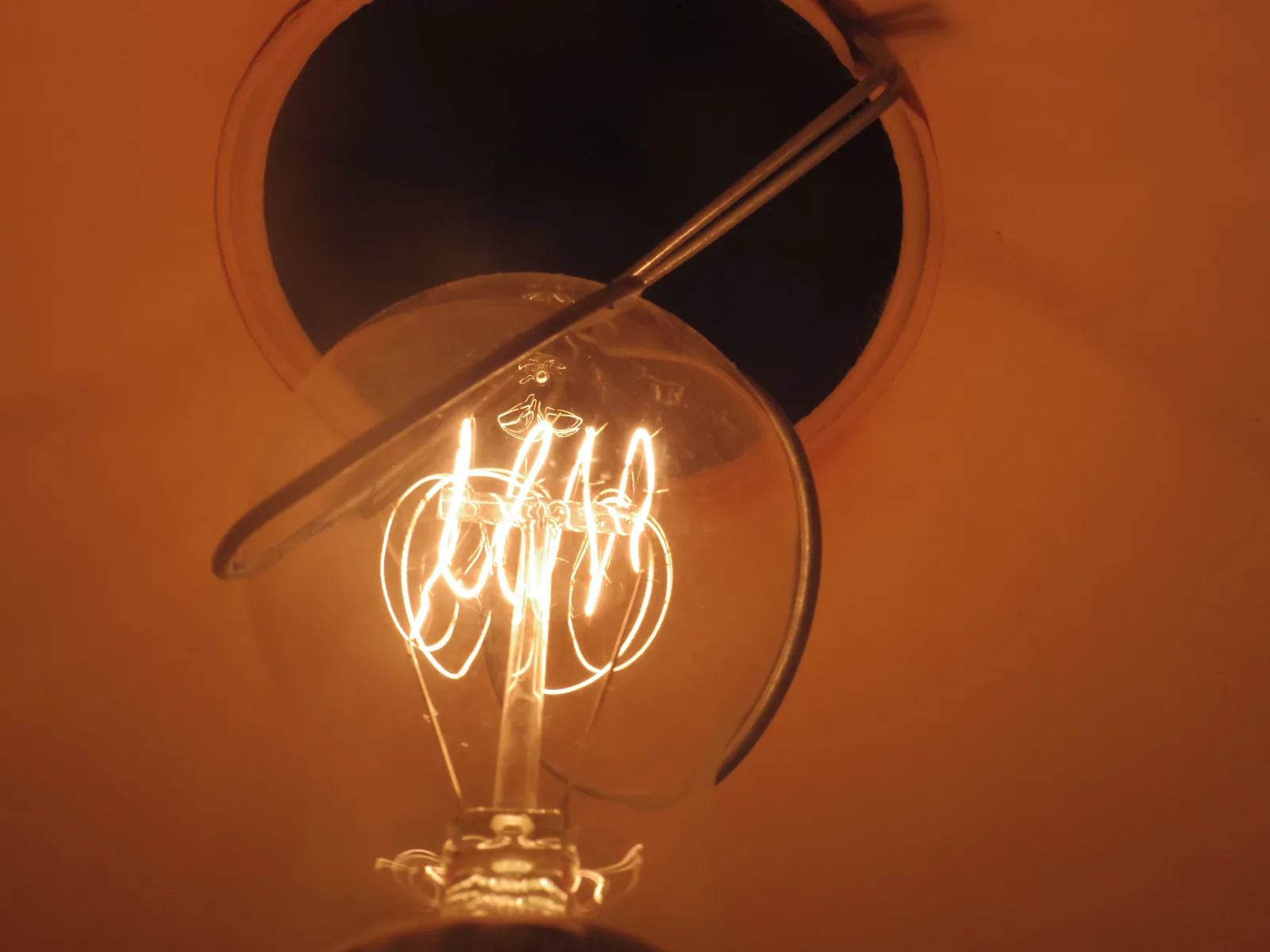
- Quad coiled filament incandescent light bulb. WClarke. source, CC BY-SA 4.0
