
Measurements in an electric circuit
Why is an ammeter connected to a circuit in a different way from a voltmeter, and what happens if the connections get mixed up?
Prior knowledge
- Electric current is a flow of charge through the cross-section of a conductor, and its unit is the amperechapter Electric circuit, current and voltage
- Voltage is a quantity between two points, and its unit is the voltchapter Electric circuit, current and voltage
- A measurement result always has an uncertainty, and the resolution is the smallest step that the measuring instrument can showchapter Measuring and the reliability of a measurement
Core path: follow the steps in order. Tasks marked Optional give extra practice. Optional tasks: 5.
Think about it
On the physics lab bench there is a circuit in which a battery, a lamp and a resistor are one after another, and a multimeter with two test leads. The task sounds easy: measure the current and the voltage of the lamp. However, the places of the test leads and the position of the selector decide what the display tells: a wrongly connected meter can change how the circuit works.
How are an ammeter and a voltmeter connected to a circuit, and why exactly in that way?
Optional Review: current and voltage
Predict
Make your predictions before investigating 2 questions
Prediction 1: current before and after the lamp
Prediction 2: a voltmeter in series
Investigate
Choose the places of the test leads and the position of the selector. Follow the reading of the display and the lamp.
Simulation
How to use
Meter connection chooses where the test leads are touched: in series into either gap of the upper wire, or in parallel with the lamp, the resistor or the battery. Selector chooses the quantity and the measuring range like the rotary switch of a real multimeter; on the current range $10\,\text{A}$ the red lead moves to its own jack. Batteries changes the number of batteries. The display shows the reading with the resolution of the range, or OL when the value is over the range. The purple arrows show the direction of the current from the positive terminal of the battery to the negative terminal when current flows in the circuit.
Assumptions of the model
The batteries are ideal: the voltage of each is $1.5\,\text{V}$ regardless of the current. The resistance of the lamp is constant $15\,\Omega$ in the model, although the resistance of a real filament lamp increases as it warms up, and the resistance of the resistor is $30\,\Omega$. The resistance of the meter itself is $10\,\text{M}\Omega$ on the voltage ranges, $1.0\,\Omega$ on the range $200\,\text{mA}$ and $0.010\,\Omega$ on the range $10\,\text{A}$. When a larger current than the range can show passes through the meter, the fuse blows and the meter is disconnected from the circuit; in the model a new fuse is in place as soon as the connection or the selector is changed. The readings are values calculated by the model, not measurements.
How the calculation works
The model solves the current and the voltages of the circuit by means of the resistances, as in the chapter Resistance and Ohm's law, and the meter is in the circuit as one component with its own resistance. That is why on the range $200\,\text{mA}$ the current is $97.8\,\text{mA}$ and not $100\,\text{mA}$: the resistance of the meter itself decreases the current slightly, whereas on the range $10\,\text{A}$ the difference does not show. The reading of the display is rounded to the resolution of the range: $0.001\,\text{V}$, $0.01\,\text{V}$, $0.1\,\text{mA}$ or $0.01\,\text{A}$. In the model the lamp is lit when its power is at least $4\,\text{mW}$.
Experiment 1: the place of the ammeter
Test prediction 1. The selector is on the range $200\,\text{mA}$ and there are three batteries. Change only the connection of the meter: record the reading at least in the places in series before the lamp and in series between the lamp and the resistor. Finally also try in parallel with the lamp: what happens to the lamp, what does the meter show and what happens to the meter?
Initial state: connection: in series before the lamp, selector: current, range $200\,\text{mA}$, batteries: three batteries. Kept constant: selector, batteries. Varied: connection.
| connection | $I$ $(\text{mA})$ | lamp |
|---|
Experiment 2: a voltmeter in parallel and in series
Test prediction 2. The selector is on the range $20\,\text{V}$ and there are three batteries. Change only the connection of the meter: record the reading at least in the places in parallel with the lamp and in series before the lamp, preferably also in parallel with the battery. In which connection is the lamp lit, and what voltage does the meter show in each?
Initial state: connection: in parallel with the lamp, selector: voltage, range $20\,\text{V}$, batteries: three batteries. Kept constant: selector, batteries. Varied: connection.
| connection | $U$ $(\text{V})$ | lamp |
|---|
Optional Experiment 3: measuring range
The meter is in parallel with the lamp, and there are three batteries. Change only the position of the selector: record the reading on the ranges $20\,\text{V}$ and $2\,\text{V}$. How many decimals does the display show on each range? Then move the meter in parallel with the resistor on the range $2\,\text{V}$: what does the display tell, and what must be done then?
Initial state: connection: in parallel with the lamp, selector: voltage, range $20\,\text{V}$, batteries: three batteries. Kept constant: batteries. Varied: selector.
| selector | $U$ $(\text{V})$ | lamp |
|---|
Conclusion: how the meters are connected
Write on the basis of your tables: how did the reading of the ammeter depend on its place in a circuit without branches? What happened when the voltmeter was in parallel with the lamp, and what when it was in series? Explain the observations with the resistances of the meters.
Model answer
The ammeter showed $97.8\,\text{mA}$ both before the lamp and between the lamp and the resistor: in a circuit without branches the same charge passes through every component, so the current is the same at every point. In parallel with the lamp the voltmeter showed $1.50\,\text{V}$, and the lamp was lit, because hardly any current passes through the large resistance of the meter past the lamp. Connected in series, the same meter showed $4.50\,\text{V}$, and the lamp went out: the large resistance of the meter decreased the current of the whole circuit to almost zero, and almost the whole voltage of the battery was left between the terminals of the meter. If the ammeter was connected in parallel with the lamp, the lamp went out, because the current passed through the meter of small resistance past the lamp. That is why an ammeter is connected in series and a voltmeter in parallel. The values are calculated by the model.
Assess your own answer
Tick the points your own answer already contains.
Review the theory summary and practise with the exercises.
Theory summary
Key idea
An ammeter is connected in series
An ammeter measures how large an electric current passes through it. That is why the current to be measured has to pass through the meter: the circuit is opened at the point whose current we want to know, and the meter is placed in the gap. The meter is then in series with the other components. In a circuit without branches the current is the same at every point, because charge neither disappears nor accumulates anywhere. A lamp changes electrical energy into light and internal energy of the filament, but it does not use up current. An ammeter can therefore be connected at any point of a circuit without branches, and it always shows the same reading.
A voltmeter is connected in parallel
Voltage is a quantity between two points (chapter Electric circuit, current and voltage). A voltmeter measures the voltage between the two points that its leads are touched to. The voltage of a lamp is measured by touching both terminals of the lamp: the circuit is not opened, but the meter comes in parallel with the lamp. The red lead of the meter is touched to the terminal that is closer to the positive terminal of the battery, so the reading is positive.
The multimeter
In a laboratory, current and voltage are usually measured with a multimeter: the same device measures, depending on the position of the selector, voltage, current and often other quantities too. The black lead always belongs in the jack COM. The red lead belongs in the jack $\text{V}\ \text{mA}$ when measuring voltage and small currents and in the jack $10\,\text{A}$ when measuring large currents. The selector chooses both the quantity and the measuring range, which is the largest value that the meter shows in this position. On the range $20\,\text{V}$ the display shows at most $19.99\,\text{V}$; at a larger voltage the display shows OL (overload), which means that the value is over the measuring range.
Choosing the measuring range
On a smaller range the display shows more decimals. On the range $20\,\text{V}$ the voltage of a lamp appears as $1.50\,\text{V}$, on the range $2\,\text{V}$ as $1.500\,\text{V}$: the last digit tells the resolution, that is the smallest step that the display can take. That is why we measure on the smallest range on which the reading still fits. When the order of magnitude is not known, we start from the largest range and move to a smaller one. When measuring current, this is also a safety matter, because too large a current blows the fuse of the meter.
The meter affects the circuit
Every component has a resistance, which describes how strongly it opposes an electric current; the quantity is made more precise in the chapter Resistance and Ohm's law. The resistance of an ammeter connected in series is very small, so that the meter hardly decreases the current that it measures. The resistance of a voltmeter connected in parallel is very large, for example $10\,\text{M}\Omega$, so that hardly any current passes through the meter past the component. An ideal meter would not change the circuit at all; a real one changes it a little, which is one source of measurement uncertainty.
A wrongly connected meter changes the circuit a lot. If an ammeter is connected in parallel with a lamp, the current passes almost entirely through the meter of small resistance past the lamp: the lamp goes out, and the current can grow so large that the fuse of the meter blows. When the fuse has blown, the meter is out of the circuit and the lamp lights up again. A current path that bypasses a component like this is called a short circuit. If, on the other hand, a voltmeter is connected in series, its large resistance decreases the current of the whole circuit to almost zero: the lamp goes out, and the meter shows approximately the voltage of the battery.
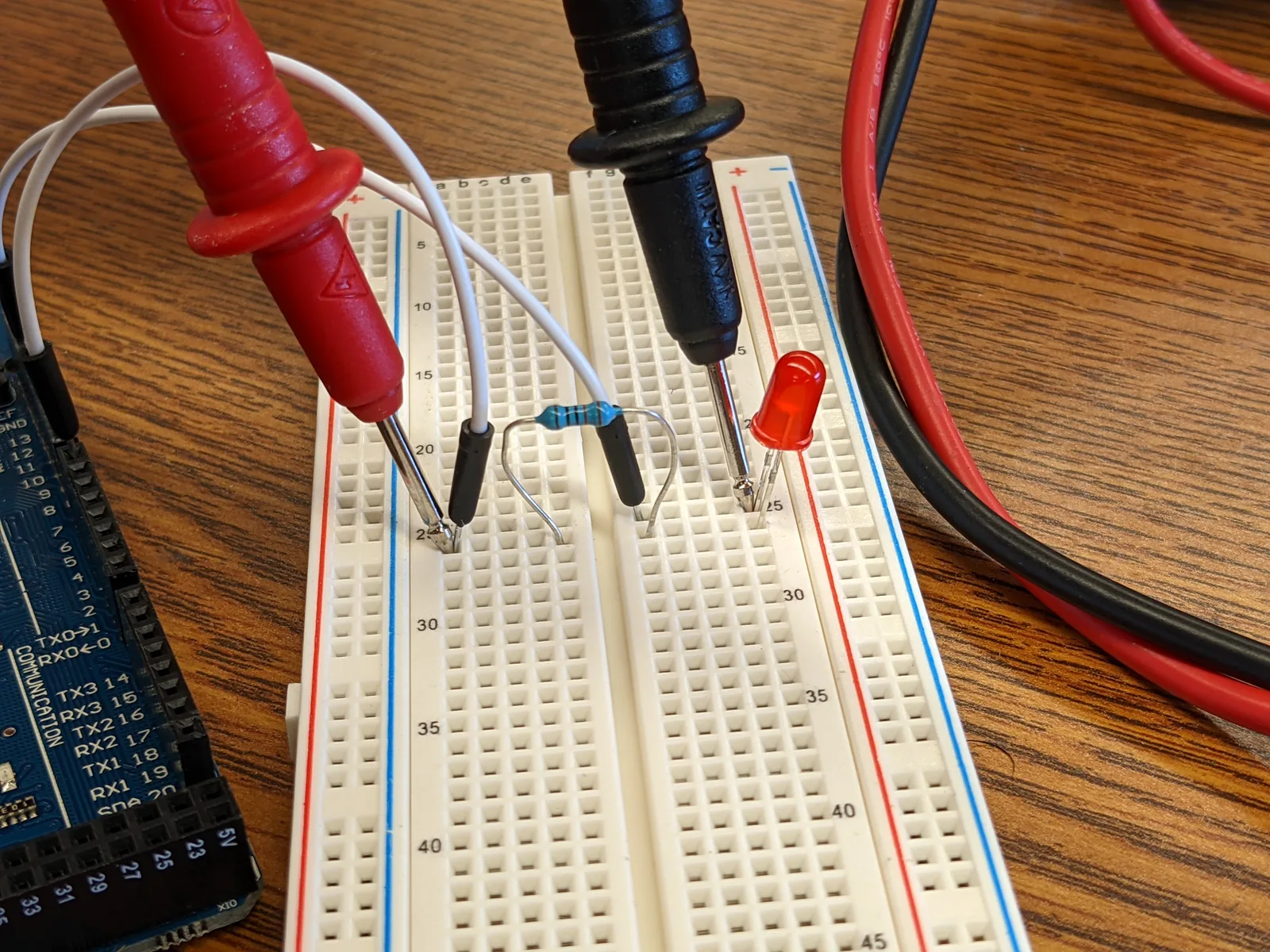
Error limit of a multimeter
The error limit given by the manufacturer
The reading of a meter is not exactly the true value of the quantity being measured. The manufacturer of a digital meter gives in the manual for every range an error limit in the form $\pm(p + n\ \text{digits})$: the error limit is a percentage $p$ of the reading plus $n$ steps of the last digit. The error limit given by the manufacturer tells how much the reading of a meter that is in order and used according to the instructions can at most differ from the true value. However, the total uncertainty of a measurement can also be affected by the measuring method, the effect of the meter on the circuit and other sources of error.
| Range | Resolution | Error limit |
|---|---|---|
| voltage $2\,\text{V}$ | $0.001\,\text{V}$ | $\pm(0.5\,\% + 2\ \text{digits})$ |
| voltage $20\,\text{V}$ | $0.01\,\text{V}$ | $\pm(0.5\,\% + 2\ \text{digits})$ |
| current $200\,\text{mA}$ | $0.1\,\text{mA}$ | $\pm(1.0\,\% + 2\ \text{digits})$ |
| current $10\,\text{A}$ | $0.01\,\text{A}$ | $\pm(2.0\,\% + 3\ \text{digits})$ |
Calculating the error limit
The error limit of a reading $x$ is
$$\Delta x = p \cdot x + n \cdot r$$
where $\Delta x$ is the error limit, $x$ the reading, $p$ the percentage given by the manufacturer as a decimal number ($0.5\,\% = 0.005$), $n$ the number of digits and $r$ the resolution of the range. The result is written in the form $x \pm \Delta x$, for example $U = 4.50\,\text{V} \pm 0.04\,\text{V}$. The notation is the same as for an error estimate, but here $\Delta x$ is the meter's own error limit, not the uncertainty of the whole measurement. The accuracy of different measurements is compared with the relative error limit
$$\frac{\Delta x}{x}$$
which is a pure number and is usually given as a percentage.
Why the smallest suitable range
If the ranges have the same $p$ and the same $n$, as this meter's voltage ranges do, the percentage part $p \cdot x$ is the same on all of them, but the share of the digits $n \cdot r$ decreases to a tenth when we move to a range ten times smaller. When the reading is small compared with the range, the share of the digits dominates: a current of $0.02\,\text{A}$ on the range $10\,\text{A}$ is almost a guess, because three steps of the last digit are already $0.03\,\text{A}$.
Common misconception
Many people think that the largest measuring range is always the best, because on it the meter does not go over the range and the fuse does not blow. It is right to start from the largest range when the order of magnitude is not known, but the final reading is taken from the smallest range on which the value fits. On a large range the last digit is coarse, and the error limit of a small value can be as large as the reading itself. Another common mistake is to connect an ammeter in parallel with a component in the same way as a voltmeter. An ammeter is always connected in series.
Summary
- An ammeter is connected in series: the circuit is opened and the meter is placed in the gap. In a circuit without branches the current is the same at every point.
- A voltmeter is connected in parallel, that is between the two points whose voltage is measured.
- The selector of a multimeter chooses the quantity and the measuring range; OL means that the value is over the range. The black lead belongs in the jack COM.
- We measure on the smallest range on which the reading fits; the measurement of an unknown value is started from the largest range.
- The resistance of an ammeter is very small and that of a voltmeter very large. Wrongly connected, an ammeter makes a short circuit and a voltmeter stops the current.
- The error limit is $\Delta x = p \cdot x + n \cdot r$ and the relative error limit is $\tfrac{\Delta x}{x}$.
Optional Return to your predictions
Compare your predictions with the readings of the experiments. Then return to the question at the beginning: why are an ammeter and a voltmeter connected to a circuit in different ways?
Would you change your prediction?
Apply
Worked example
Problem
The voltage of a lamp is measured twice with a multimeter. On the range $20\,\text{V}$ the display shows $1.50\,\text{V}$ and on the range $2\,\text{V}$ the display shows $1.500\,\text{V}$. The error limit of both ranges is $\pm(0.5\,\% + 2\ \text{digits})$. How large is the error limit of the reading on each range, and which range should be chosen?
Step 1/7
Given and asked. The readings $U_{20} = 1.50\,\text{V}$ (resolution $r_{20} = 0.01\,\text{V}$) and $U_2 = 1.500\,\text{V}$ (resolution $r_2 = 0.001\,\text{V}$), $p = 0.5\,\%$ and $n = 2$. We are asked for the error limits $\Delta U_{20}$ and $\Delta U_2$.
Step 2/7
Principle. The manufacturer's error limit is a share of the reading plus two steps of the last digit. The reading is the same on both ranges, so the ranges differ only in their resolution.
Step 3/7
Formula solved. The formula gives the error limit directly when the resolution of each range is substituted:
$$\begin{aligned} \Delta U_{20} &= p \cdot U_{20} + n \cdot r_{20} \\ \Delta U_2 &= p \cdot U_2 + n \cdot r_2 \end{aligned}$$
Step 4/7
Unit conversions. The percentage is written as a decimal number: $p = 0.5\,\% = 0.005$. No other conversions are needed, because the readings and the resolutions are in volts.
Step 5/7
Substitution. $$\begin{aligned} &\Delta U_{20} \\ &= 0.005 \cdot 1.50\,\text{V} + 2 \cdot 0.01\,\text{V} \\ &= 0.0275\,\text{V} \\[6pt] &\Delta U_2 \\ &= 0.005 \cdot 1.500\,\text{V} + 2 \cdot 0.001\,\text{V} \\ &= 0.0095\,\text{V} \end{aligned}$$
Step 6/7
Result. On the range $20\,\text{V}$ the voltage is $1.50\,\text{V} \pm 0.03\,\text{V}$ and on the range $2\,\text{V}$ $1.500\,\text{V} \pm 0.010\,\text{V}$. The relative error limits are $2\,\%$ and $0.67\,\%$. Like an error estimate, an error limit is rounded to one significant figure, or to two if the first figure is 1. The range $2\,\text{V}$ should be chosen: its error limit is about a third.
Step 7/7
Reasonableness. The percentage part is the same on both ranges, $0.0075\,\text{V}$. The difference comes entirely from the share of the digits, which on the range $20\,\text{V}$ is ten times larger, $0.02\,\text{V}$ instead of $0.002\,\text{V}$. A smaller range cannot be less accurate when the reading fits on it and the percentage part of the ranges is the same.
Optional Find the error
Apply to a new situation
The current of an LED is first measured on the range $10\,\text{A}$ of a multimeter, because a friend says it is the safest. The display shows $0.02\,\text{A}$. The resolution of the range is $0.01\,\text{A}$ and the error limit $\pm(2.0\,\% + 3\ \text{digits})$.
What percentage of the reading is the error limit?
Hint 1: a guiding question
The error limit consists of the percentage part and the share of the digits. Which of them is larger here?
Hint 2: what is the connection
One digit is the resolution of the range $0.01\,\text{A}$, so three digits is $0.03\,\text{A}$. The percentage part is $0.020 \cdot 0.02\,\text{A}$.
Hint 3: an intermediate step
divide this by the reading $0.02\,\text{A}$.
Show the solution
Given
reading $I = 0.02\,\text{A}$ on the range $10\,\text{A}$, resolution $r = 0.01\,\text{A}$, error limit $\pm(2.0\,\% + 3\ \text{digits})$
Find
the relative error limit $\tfrac{\Delta I}{I}$ as a percentage
Principle
The manufacturer's error limit is a percentage of the reading plus three steps of the last digit. When the reading is very small compared with the range, the share of the digits does not decrease with the reading, so it dominates the error limit.
Formula
$\Delta I = p \cdot I + n \cdot r$, so
$$\frac{\Delta I}{I} = \frac{p \cdot I + n \cdot r}{I}$$
Conversions
$p = 2.0\,\% = 0.020$; the currents are in amperes.
Substitution
so
Answer
about $150\,\%$; the reading $0.02\,\text{A}$ is given with one significant figure, so the result is only an order of magnitude.
Reasonableness
Already three steps, $0.03\,\text{A}$, are larger than the whole reading, so the error limit must be over $100\,\%$. The reading therefore tells almost nothing about the current. On the range $200\,\text{mA}$ the same current could appear for example as $18.6\,\text{mA}$, and the error limit would be $0.186\,\text{mA} + 0.2\,\text{mA} = 0.386\,\text{mA}$, or about $2\,\%$: when the order of magnitude is known, one moves to the smallest suitable range.
Check your understanding
Exit ticket
Answer on your own first and only then open the answer.
- You measure the voltage of a resistor on the range $2\,\text{V}$, and OL appears on the display. What does the reading mean, and what do you do?
Answer
OL means that the voltage is larger than the largest value of the range, $1.999\,\text{V}$. Next turn the selector to the larger range $20\,\text{V}$ and read the reading there.
- A multimeter shows the reading $3.00\,\text{V}$ on the range $20\,\text{V}$. The error limit is $\pm(0.5\,\% + 2\ \text{digits})$ and the resolution $0.01\,\text{V}$. How large is the error limit?
Answer
$\Delta U$$= 0.005 \cdot 3.00\,\text{V} + 2 \cdot 0.01\,\text{V}$$= 0.015\,\text{V} + 0.02\,\text{V}$$= 0.035\,\text{V}$$\approx 0.04\,\text{V}$
1. Connecting an ammeter
2. Error limit of a reading
The voltage of a lamp is measured on the range $2\,\text{V}$, and the display shows $0.846\,\text{V}$. The resolution of the range is $0.001\,\text{V}$ and the error limit $\pm(0.5\,\% + 2\ \text{digits})$.
How large is the error limit of the reading? Give the answer in millivolts.
Hint 1: a guiding question
The error limit is a percentage of the reading plus two steps of the last digit.
Hint 2: what is the connection
The percentage part is $0.005 \cdot 0.846\,\text{V}$ and the share of the digits $2 \cdot 0.001\,\text{V}$.
Hint 3: an intermediate step
$\Delta U = 0.00423\,\text{V} + 0.002\,\text{V}$; convert the result to millivolts by multiplying by a thousand.
Show the solution
Given
reading $U = 0.846\,\text{V}$ on the range $2\,\text{V}$, resolution $r = 0.001\,\text{V}$, error limit $\pm(0.5\,\% + 2\ \text{digits})$
Find
the error limit $\Delta U$ in millivolts
Principle
The manufacturer's error limit is a share of the reading plus two steps of the last digit. One digit is the resolution of the range, here $0.001\,\text{V}$.
Formula
$\Delta U = p \cdot U + n \cdot r$
Conversions
$p = 0.5\,\% = 0.005$; finally $1\,\text{V} = 1000\,\text{mV}$.
Substitution
Answer
$6\,\text{mV}$
One significant figure, because an error limit is rounded like an error estimate (calculator value $6.23\,\text{mV}$).
Reasonableness
Half a percent of a little less than a volt is a little over $4\,\text{mV}$, and two steps add $2\,\text{mV}$. The relative error limit is less than a percent, as it should be on the smallest suitable range.
Suggestion: one answer does not show everything you can do, but review the theory summary and do the core exercises.
Optional 3. Explain: the resistance of the meter itself
Why must the resistance of a good voltmeter be very large and that of a good ammeter very small? Explain for each what happens in the meter and in the circuit when the meter is connected correctly.
Model answer
A voltmeter is connected in parallel with the component, so a parallel path past the component forms through it. If the resistance of the meter were small, part of the current would pass through the meter, the current and the voltage of the component would change, and the meter would show a different value than without the meter. A large resistance, for example $10\,\text{M}\Omega$, keeps the current of the meter so small that the circuit practically does not change. An ammeter, on the other hand, is connected in series, so the whole current to be measured passes through it. If its resistance were large, it would decrease exactly the current that is being measured, and part of the voltage of the battery would be left across the meter. A small resistance keeps this effect small: in the simulation the meter of the range $200\,\text{mA}$ decreased the current by only about $2\,\%$. An ideal meter would not change the circuit at all, but a real meter always changes it a little, which is one source of measurement uncertainty.
Assess your own answer
Tick the points your own answer already contains.
Review the theory summary and practise with the exercises.
Exercises
Level 1 · basic practice 5 exercises
One formula or one step of reasoning. Core exercises first, the rest is extra practice.
- Exercise 2-1Core
The voltage of a car battery is measured with a multimeter on the range $20\,\text{V}$, and the display shows $12.46\,\text{V}$. On this range the resolution is $0.01\,\text{V}$, and according to the manual the error limit is $\pm(0.5\,\% + 2\ \text{digits})$.
How large is the error limit of the reading? Give the answer in volts.
Answer
$0.08\,\text{V}$
Show the solution
Given
reading $U = 12.46\,\text{V}$ on the range $20\,\text{V}$, resolution $r = 0.01\,\text{V}$, error limit $\pm(0.5\,\% + 2\ \text{digits})$
Find
the error limit $\Delta U$ of the reading in volts
Principle
The error limit given by the manufacturer consists of two parts: a share of the reading and a few steps of the last digit. One "digit" means the resolution of the range, that is the smallest step that the display can take, here $0.01\,\text{V}$.
Formula
$\Delta U = p \cdot U + n \cdot r$
Conversions
$p = 0.5\,\% = 0.005$; no other conversions are needed, because the reading and the resolution are in volts.
Substitution
$\Delta U$$= 0.005 \cdot 12.46\,\text{V} + 2 \cdot 0.01\,\text{V}$$= 0.0623\,\text{V} + 0.02\,\text{V}$$= 0.0823\,\text{V}$Answer
$0.08\,\text{V}$
One significant figure, because an error limit is rounded like an error estimate (calculator value $0.0823\,\text{V}$).
Reasonableness
The percentage part is about half of a hundredth of $12\,\text{V}$, that is about $0.06\,\text{V}$, and two steps add $0.02\,\text{V}$: altogether about $0.08\,\text{V}$. The error limit is less than a percent of the reading, which suits a good meter.
- Exercise 2-2Core
The current of an LED strip is measured on the range $200\,\text{mA}$ of a multimeter, and the display shows $146.3\,\text{mA}$. On this range the resolution is $0.1\,\text{mA}$, and the error limit is $\pm(1.0\,\% + 2\ \text{digits})$.
How large is the error limit of the reading? Give the answer in milliamperes.
Answer
$1.7\,\text{mA}$
Show the solution
Given
reading $I = 146.3\,\text{mA}$ on the range $200\,\text{mA}$, resolution $r = 0.1\,\text{mA}$, error limit $\pm(1.0\,\% + 2\ \text{digits})$
Find
the error limit $\Delta I$ of the reading in milliamperes
Principle
The error limit is a percentage of the reading plus two steps of the last digit. On the range $200\,\text{mA}$ the last digit is a tenth of a milliampere, so one step is $0.1\,\text{mA}$.
Formula
$\Delta I = p \cdot I + n \cdot r$
Conversions
$p = 1.0\,\% = 0.010$; the reading and the resolution are already in milliamperes.
Substitution
$\Delta I$$= 0.010 \cdot 146.3\,\text{mA} + 2 \cdot 0.1\,\text{mA}$$= 1.463\,\text{mA} + 0.2\,\text{mA}$$= 1.663\,\text{mA}$Answer
$1.7\,\text{mA}$
Two significant figures, because the first figure of the error limit is 1.
Reasonableness
A percent of $146\,\text{mA}$ is about $1.5\,\text{mA}$, and the share of the digits $0.2\,\text{mA}$ is smaller, because the reading is close to the upper limit of the range. The result is a little over a percent of the reading.
- Exercise 2-3
The voltage of a power adapter is measured to be $8.00\,\text{V}$, and the error limit of the reading is $0.06\,\text{V}$.
How large is the relative error limit? Give the answer as a percentage.
Answer
$0.8\,\%$
Show the solution
Given
reading $U = 8.00\,\text{V}$, error limit $\Delta U = 0.06\,\text{V}$
Find
the relative error limit $s$ as a percentage
Principle
The relative error limit tells what part of the reading the error limit is. It makes the accuracy of measurements of different sizes comparable.
Formula
$s = \dfrac{\Delta U}{U}$
Conversions
Not needed: both are in volts, and the unit cancels. The result is multiplied by a hundred to get it as a percentage.
Substitution
$s$$= \dfrac{0.06\,\text{V}}{8.00\,\text{V}}$$= 0.0075$$= 0.75\,\%$Answer
$0.8\,\%$
One significant figure like the error limit $0.06\,\text{V}$.
Reasonableness
A percent of $8\,\text{V}$ would be $0.08\,\text{V}$; the error limit $0.06\,\text{V}$ is a little smaller, so the result must be a little under $1\,\%$, and $0.8\,\%$ is.
- Exercise 2-4
In a circuit a battery, a lamp and a resistor are one after another, and the circuit has no branches. An ammeter connected in series between the battery and the lamp shows $0.180\,\text{A}$. The meter is moved between the lamp and the resistor.
What does the meter show now? Assume that moving the meter does not change the circuit. Give the answer in amperes.
Answer
$0.180\,\text{A}$
Show the solution
Given
a circuit without branches in which a battery, a lamp and a resistor are one after another; current between the battery and the lamp $I = 0.180\,\text{A}$
Find
the reading of the ammeter between the lamp and the resistor in amperes
Principle
In a circuit without branches the current is the same at every point: charge neither disappears nor accumulates anywhere, so the same amount of charge passes through every cross-section in a second. A lamp changes electrical energy into light and internal energy of the filament, but it does not use up current.
Formula
$I_\text{after} = I_\text{before}$
Conversions
Not needed: the current is in amperes.
Substitution
$I_\text{after} = 0.180\,\text{A}$
Answer
$0.180\,\text{A}$
Three significant figures like the reading of the meter.
Reasonableness
If a smaller current passed after the lamp, more and more charge would accumulate in the lamp all the time, and that is not observed. In the simulation the ammeter showed the same reading at both points.
- Exercise 2-5
The voltage of a new AA battery is measured on the range $2\,\text{V}$ and the reading is $1.587\,\text{V}$. On this range the resolution is $0.001\,\text{V}$ and the error limit $\pm(0.5\,\% + 2\ \text{digits})$.
How large is the error limit of the reading? Give the answer in volts.
Answer
$0.010\,\text{V}$
Show the solution
Given
reading $U = 1.587\,\text{V}$ on the range $2\,\text{V}$, resolution $r = 0.001\,\text{V}$, error limit $\pm(0.5\,\% + 2\ \text{digits})$
Find
the error limit $\Delta U$ of the reading in volts
Principle
The manufacturer's error limit is a share of the reading plus two steps of the last digit. On the range $2\,\text{V}$ the display has three decimals, so the step is $0.001\,\text{V}$.
Formula
$\Delta U = p \cdot U + n \cdot r$
Conversions
$p = 0.5\,\% = 0.005$; the reading and the resolution are in volts.
Substitution
$\Delta U$$= 0.005 \cdot 1.587\,\text{V} + 2 \cdot 0.001\,\text{V}$$= 0.007935\,\text{V} + 0.002\,\text{V}$$= 0.009935\,\text{V}$Answer
$0.010\,\text{V}$
Or $10\,\text{mV}$: the calculator value $0.009935\,\text{V}$ rounds to one significant figure as $0.01\,\text{V}$, and because the first figure is 1, the error limit is given with two figures.
Reasonableness
Half a percent of $1.6\,\text{V}$ is about $8\,\text{mV}$, and two steps add $2\,\text{mV}$: altogether about $10\,\text{mV}$. On the range $20\,\text{V}$ the share of the digits alone would be $20\,\text{mV}$, so the small range is clearly more accurate here.
Level 2 · applied practice 4 exercises
Two steps, working with measured data, a unit conversion or rearranging a formula. Core exercises first, the rest is extra practice.
- Exercise 2-6Core
The current of a small motor is measured on the range $10\,\text{A}$ of a multimeter, and the display shows $0.35\,\text{A}$. On this range the resolution is $0.01\,\text{A}$ and the error limit $\pm(2.0\,\% + 3\ \text{digits})$.
What percentage of the reading is the error limit?
Answer
$11\,\%$
Show the solution
Given
reading $I = 0.35\,\text{A}$ on the range $10\,\text{A}$, resolution $r = 0.01\,\text{A}$, error limit $\pm(2.0\,\% + 3\ \text{digits})$
Find
the relative error limit $\dfrac{\Delta I}{I}$ as a percentage
Principle
First the error limit is calculated from the manufacturer's statement: a share of the reading and three steps of the last digit. Then the error limit is compared with the reading. When the reading is small compared with the range, the share of the digits is large.
Formula
$\Delta I = p \cdot I + n \cdot r$, so
$\dfrac{\Delta I}{I}$$= \dfrac{p \cdot I + n \cdot r}{I}$Conversions
$p = 2.0\,\% = 0.020$; all currents are in amperes.
Substitution
$\Delta I$$= 0.020 \cdot 0.35\,\text{A} + 3 \cdot 0.01\,\text{A}$$= 0.007\,\text{A} + 0.03\,\text{A}$$= 0.037\,\text{A}$so
$\dfrac{\Delta I}{I}$$= \dfrac{0.037\,\text{A}}{0.35\,\text{A}}$$= 0.106$$= 10.6\,\%$Answer
about $11\,\%$, two significant figures, because the first digit is 1.
Reasonableness
Three steps, that is $0.03\,\text{A}$, are already almost a tenth of the reading $0.35\,\text{A}$, and the percentage part adds a little. The current $0.35\,\text{A}$ does not fit on the range $200\,\text{mA}$, so $10\,\text{A}$ is the smallest suitable range here; the error limit is still almost $11\,\%$, because the reading is small compared with the range, and a more accurate range for large currents would help.
- Exercise 2-7Core
A student records the current of a lamp as $0.0875\,\text{A}$. The student measured the current on the range $200\,\text{mA}$ of a multimeter, whose resolution is $0.1\,\text{mA}$ and error limit $\pm(1.0\,\% + 2\ \text{digits})$.
How large is the error limit of the reading? Give the answer in amperes.
Answer
$0.0011\,\text{A}$
Show the solution
Given
reading $I = 0.0875\,\text{A}$ on the range $200\,\text{mA}$, resolution $r = 0.1\,\text{mA}$, error limit $\pm(1.0\,\% + 2\ \text{digits})$
Find
the error limit $\Delta I$ of the reading in amperes
Principle
The error limit is a share of the reading plus two steps of the last digit. The reading and the resolution are given in different units, so they are converted to the same unit before adding.
Formula
$\Delta I = p \cdot I + n \cdot r$
Conversions
$p$$= 1.0\,\%$$= 0.010$$r$$= 0.1\,\text{mA}$$= 0.1 \cdot 0.001\,\text{A}$$= 0.0001\,\text{A}$Substitution
$\Delta I$$= 0.010 \cdot 0.0875\,\text{A} + 2 \cdot 0.0001\,\text{A}$$= 0.000875\,\text{A} + 0.0002\,\text{A}$$= 0.001075\,\text{A}$Answer
$0.0011\,\text{A}$
Or about $1.1\,\text{mA}$, two significant figures, because the first figure of the error limit is 1.
Reasonableness
The display shows $87.5\,\text{mA}$; a percent of it is about $0.9\,\text{mA}$ and two steps $0.2\,\text{mA}$, altogether about $1.1\,\text{mA}$. If the resolution were not converted to amperes, one would get the absurd result $0.2\,\text{A}$, which is larger than the current itself.
- Exercise 2-8
The voltage of the same battery is measured twice. On the range $2\,\text{V}$ (resolution $0.001\,\text{V}$) the display shows $1.234\,\text{V}$ and on the range $20\,\text{V}$ (resolution $0.01\,\text{V}$) $1.23\,\text{V}$. On both ranges the error limit is $\pm(0.5\,\% + 2\ \text{digits})$.
How many times as large is the error limit of the range $20\,\text{V}$ compared with the error limit of the range $2\,\text{V}$?
Answer
$3.2$
Show the solution
Given
on the range $2\,\text{V}$ the reading $U_2 = 1.234\,\text{V}$ and the resolution $r_2 = 0.001\,\text{V}$; on the range $20\,\text{V}$ the reading $U_{20} = 1.23\,\text{V}$ and the resolution $r_{20} = 0.01\,\text{V}$; for both the error limit $\pm(0.5\,\% + 2\ \text{digits})$
Find
the ratio of the error limits $\dfrac{\Delta U_{20}}{\Delta U_2}$ as a pure number
Principle
The percentage part is almost the same on both ranges, because the reading is the same. The difference comes from the share of the digits: on the larger range the last digit is ten times coarser.
Formula
$\Delta U = p \cdot U + n \cdot r$, so
$\dfrac{\Delta U_{20}}{\Delta U_2}$$= \dfrac{p \cdot U_{20} + n \cdot r_{20}}{p \cdot U_2 + n \cdot r_2}$Conversions
$p = 0.5\,\% = 0.005$; the voltages are in volts.
Substitution
$\Delta U_2$$= 0.005 \cdot 1.234\,\text{V} + 2 \cdot 0.001\,\text{V}$$= 0.00817\,\text{V}$$\Delta U_{20}$$= 0.005 \cdot 1.23\,\text{V} + 2 \cdot 0.01\,\text{V}$$= 0.02615\,\text{V}$so
$\dfrac{\Delta U_{20}}{\Delta U_2}$$= \dfrac{0.02615\,\text{V}}{0.00817\,\text{V}}$$= 3.20$Answer
$3.2$
; the ratio is calculated from the unrounded error limits, and because they are estimates, two figures are enough: the error limit of the range $20\,\text{V}$ is about three times as large.
Reasonableness
If the error limit consisted of digits only, the ratio would be $10$; if of the percentage part only, it would be $1$. The result is between these, closer to the small end, because the percentage part $0.006\,\text{V}$ on the range $2\,\text{V}$ is larger than the share of the digits $0.002\,\text{V}$.
- Exercise 2-9
A student wants to measure the voltage of a lamp, but by mistake connects the voltmeter in series with the lamp in a circuit that has only a $9.0\,\text{V}$ battery, a lamp and the meter. The resistance of the voltmeter is very large compared with the resistance of the lamp. The lamp goes out.
What does the voltmeter show? Give the answer in volts.
Answer
$9.0\,\text{V}$
Show the solution
Given
voltage of the battery $9.0\,\text{V}$; a voltmeter in series with the lamp; the resistance of the meter is very large compared with the resistance of the lamp; the lamp goes out
Find
the reading of the voltmeter $U_\text{m}$ in volts
Principle
A voltmeter lets through only a very small current, so connected in series it decreases the current of the whole circuit to almost zero. Then hardly any voltage is left across the lamp, because the voltage of the lamp is its resistance times the almost zero current, and the whole voltage of the battery is left between the terminals of the meter.
Formula
$U_\text{m} + U_\text{lamp} = U_\text{battery}$ and $U_\text{lamp} \approx 0$, so $U_\text{m} \approx U_\text{battery}$
Conversions
Not needed: the voltage is in volts.
Substitution
$U_\text{m} \approx 9.0\,\text{V}$
Answer
about $9.0\,\text{V}$, two significant figures like the voltage of the battery.
Reasonableness
In the simulation the voltmeter connected in series showed the voltage of the battery $4.50\,\text{V}$, and the lamp went out. The reading cannot be larger than the voltage of the battery, and because the current is almost zero, it is hardly smaller either.
Level 3 · challenging 3 exercises
Optional: application, two ideas together or a new situation where you reason for yourself.
- Exercise 2-10
The manual of a multimeter says that on the range $200\,\text{mA}$ a voltage of $1.0\,\text{mV}$ is left across the meter for every milliampere passing through the meter.
The meter is in series with a lamp and a resistor in a circuit where the voltage of the batteries is $4.5\,\text{V}$, and it shows $97.8\,\text{mA}$.
What percentage of the voltage of the battery is left across the ammeter? Assume that the battery is ideal.
Answer
$2.2\,\%$
Show the solution
Given
the voltage left across the meter $1.0\,\text{mV}$ per milliampere on the range $200\,\text{mA}$, reading of the meter $I = 97.8\,\text{mA}$, voltage of the batteries $U_0 = 4.5\,\text{V}$, an ideal battery
Find
the share of the voltage left across the meter, $\dfrac{U_\text{m}}{U_0}$, as a percentage
Principle
The resistance of a real ammeter is not zero, so a small voltage is left across the meter. According to the manual it grows in the same proportion as the current passing through the meter. This voltage is taken away from the lamp and the resistor, so the meter decreases the current of the circuit slightly.
Formula
$U_\text{m} = k \cdot I$, where $k = 1.0\,\tfrac{\text{mV}}{\text{mA}}$, so
$\dfrac{U_\text{m}}{U_0}$$= \dfrac{k \cdot I}{U_0}$Conversions
$U_0$$= 4.5\,\text{V}$$= 4.5 \cdot 1000\,\text{mV}$$= 4500\,\text{mV}$Substitution
$U_\text{m}$$= 1.0\,\tfrac{\text{mV}}{\text{mA}} \cdot 97.8\,\text{mA}$$= 97.8\,\text{mV}$so
$\dfrac{U_\text{m}}{U_0}$$= \dfrac{97.8\,\text{mV}}{4500\,\text{mV}}$$= 0.0217$$= 2.17\,\%$Answer
$2.2\,\%$
Two significant figures like the voltage drop $1.0\,\text{mV}$ per milliampere and the voltage of the batteries $4.5\,\text{V}$.
Reasonableness
About $100\,\text{mA}$ gives about $100\,\text{mV}$, that is $0.1\,\text{V}$, and $0.1\,\text{V} : 4.5\,\text{V} \approx 0.022$. The meter takes a few percent of the voltage from the circuit, so it decreases the current by the same amount: without the meter the current would be about $100\,\text{mA}$, which fits the readings of the simulation $97.8\,\text{mA}$ and $0.10\,\text{A}$.
- Exercise 2-11
Two students measure the voltage of the same power supply on the range $20\,\text{V}$ (resolution $0.01\,\text{V}$).
Meter A shows $5.02\,\text{V}$, and its error limit is $\pm(0.5\,\% + 2\ \text{digits})$. The cheaper meter B shows $5.14\,\text{V}$, and its error limit is $\pm(1.5\,\% + 3\ \text{digits})$. The readings differ by $0.12\,\text{V}$.
How large is the sum of the error limits of the meters? Can it be said on the basis of the difference of the readings that one meter is faulty? Give the sum in volts.
Answer
$0.15\,\text{V}$
Show the solution
Given
meter A: reading $U_\text{A} = 5.02\,\text{V}$, error limit $\pm(0.5\,\% + 2\ \text{digits})$; meter B: reading $U_\text{B} = 5.14\,\text{V}$, error limit $\pm(1.5\,\% + 3\ \text{digits})$; for both resolution $r = 0.01\,\text{V}$; difference of the readings $0.12\,\text{V}$
Find
the sum of the error limits $\Delta U_\text{A} + \Delta U_\text{B}$ in volts, and whether the difference can be taken as evidence of a fault
Principle
According to the manufacturer, the true value is within its own error limit of each reading. The readings are in agreement if their intervals overlap, that is if the difference is smaller than the sum of the error limits. Then the difference cannot be shown to be due to a fault in the meters.
Formula
$\Delta U = p \cdot U + n \cdot r$, so
$\Delta U_\text{A} + \Delta U_\text{B}$$= p_\text{A} \cdot U_\text{A} + n_\text{A} \cdot r + p_\text{B} \cdot U_\text{B} + n_\text{B} \cdot r$Conversions
$p_\text{A} = 0.5\,\% = 0.005$ and $p_\text{B} = 1.5\,\% = 0.015$; the voltages are in volts.
Substitution
$\Delta U_\text{A}$$= 0.005 \cdot 5.02\,\text{V} + 2 \cdot 0.01\,\text{V}$$= 0.0451\,\text{V}$$\Delta U_\text{B}$$= 0.015 \cdot 5.14\,\text{V} + 3 \cdot 0.01\,\text{V}$$= 0.1071\,\text{V}$so
$\Delta U_\text{A} + \Delta U_\text{B}$$= 0.0451\,\text{V} + 0.1071\,\text{V}$$= 0.1522\,\text{V}$Answer
$0.15\,\text{V}$
Two significant figures, because the first figure of the sum of the error limits is 1. The difference of the readings $0.12\,\text{V}$ is smaller than $0.15\,\text{V}$, so the intervals $4.97$–$5.07\,\text{V}$ and $5.03$–$5.25\,\text{V}$ overlap: on the basis of the difference neither meter can be said to be faulty. However, this does not prove that the meters would always show the same.
Reasonableness
The error limit of the cheaper meter is more than twice as large, as its larger percentage and number of digits lead one to expect. The difference $0.12\,\text{V}$ is about $2\,\%$ of the reading, which is of the same order of magnitude as the error limit of meter B.
- Exercise 2-12
A student wants to measure the current passing through a lamp. The student turns the selector of a multimeter to the current range $200\,\text{mA}$ and presses the test leads to both terminals of the lamp, in the same way as when measuring voltage. The circuit has only a battery and a lamp.
The lamp goes out for a moment and then lights up again, and the display of the meter stays at zero.
Explain what happened in the circuit and why the lamp went out only for a moment, and tell how the current should have been measured.
Answer
An ammeter was connected in parallel with the lamp. Its resistance is very small, so the current passed through the meter past the lamp and became large: the lamp went out until the fuse of the meter blew. The blown fuse interrupted the current through the meter, so the meter was left out of the circuit: the lamp lit up again and the display stayed at zero. An ammeter is connected in series: the circuit is opened and the meter is placed in the gap.
Show the solution
Find
what happened in the circuit, why the lamp went out only for a moment and the display stayed at zero, and how the current of the lamp should have been measured
Principle
On the current range the resistance of a multimeter is very small, so that the meter connected in series would not change the current of the circuit. Inside the meter there is a fuse, which blows and interrupts the current path of the meter when too large a current passes through the meter.
Model answer
The student connected the ammeter in parallel with the lamp, although an ammeter is connected in series. A parallel path of very small resistance formed between the terminals of the lamp, so almost the whole current passed through the meter past the lamp. The lamp went out, because no current passed through it any more. Because on the path from the battery through the meter back to the battery there was hardly anything limiting the current, the current grew much larger than the measuring range $200\,\text{mA}$, and the fuse of the meter blew. The blown fuse interrupted the current through the meter, so the meter was left out of the circuit: the battery and the lamp again formed just a closed circuit, and the lamp lit up again. The display stayed at zero, because no current passes through the meter until the fuse is replaced. When measuring correctly, the circuit is opened, for example between the battery and the lamp, and the ammeter is placed in the gap, so the same current passes through the battery, the meter and the lamp. If the size of the current is not known, we start from the range $10\,\text{A}$ and move the red lead to the jack that belongs to it.
Self-assessment
In my answer I
- say that the ammeter was connected in parallel with the lamp, although it belongs in series
- explain that the small resistance of the meter directed the current past the lamp, which is why the lamp went out
- explain that the current grew so large that the fuse of the meter blew, after which the meter was out of the circuit, the lamp lit up again and the display stayed at zero
- tell that the circuit is opened and the meter is placed in the gap, so that the same current passes through the meter and the lamp.
