
Circuit, electric current and voltage
Why does the lamp of a torch light at the same moment as you press the switch, although the electrons in the wire move more slowly than a snail?
Prior knowledge
- Energy is neither lost nor created from nothing, it changes from one form to anotherchapter Forms of energy and conservation of energy
Core path: follow the steps in order. Tasks marked Optional give extra practice. Optional tasks: 2.
Think about it
You press the switch of a torch, and the lamp lights at the same moment. Inside the torch the batteries, the switch and the lamp are joined by metal strips. The lamp has been on for many evenings, and the batteries have gradually run down.
What actually moves in the wires of the torch, and what is used up from the battery when the lamp is lit?
Optional Recap: conservation of energy
Predict
Make your predictions before investigating 2 questions
Prediction 1: before and after the lamp
Prediction 2: a second lamp in the same loop
Investigate
The wire in the simulation is full of free electrons. Close and open the switch, change the number of batteries and lamps, and measure how much charge passes through points $A$ and $B$.
Simulation
How to use
Choose the number of batteries (each $1.5\,\text{V}$), the number of lamps, and whether the switch is closed or open. Press Measure: for $10.0\,\text{s}$ the simulation counts the blue dots that pass through cross-sections $A$ and $B$, and shows the charges $Q_A$ and $Q_B$ under the picture. Cross-section $A$ is in the upper wire before the lamps and $B$ in the return wire at the right edge after the lamps. Changing a setting and Reset clear the measurement. Speed changes only the pace of the picture; a measurement always lasts $10.0\,\text{s}$ of simulation time.
Assumptions of the model
The values are model values calculated by the simulation. One blue dot represents a group of electrons with a total charge of $0.05\,\text{C}$, that is about $3 \cdot 10^{17}$ electrons. The motion of the electrons is greatly exaggerated in the picture: in reality they move along the wire less than a millimetre per second. In the model every lamp resists the current in the same way regardless of voltage; the current of a real filament lamp grows with voltage clearly more slowly. The resistance of the wires and batteries themselves is ignored. In the model charge is neither created nor lost anywhere in the circuit, so $Q_A = Q_B$ is a property of the model and not a separate measurement; measured with real ammeters the result is the same.
How the calculation works
The meter counts the dots that pass through the cross-section and multiplies their number by the charge of a dot, $0.05\,\text{C}$. You calculate the current yourself with $I = Q/t$, where $t = 10.0\,\text{s}$. The brightness of a lamp grows with the power of the lamp.
Experiment 1: charge before and after the lamp
The initial state selects one lamp and a closed switch. Choose the number of batteries, press Measure and wait until the measurement is complete. Record the measurement only then. Repeat with one, two and three batteries.
Initial state: batteries = $1$, lamps = $1$, switch: closed. Kept constant: lamps, switch. Varied: batteries.
| batteries | $Q_\text{A}$ $(\text{C})$ | $Q_\text{B}$ $(\text{C})$ |
|---|
From the charge $Q_A$ in the row of the table with two batteries, calculate the electric current through the lamp. The measurement lasted $10.0\,\text{s}$. Give the answer in amperes.
Hint 1: a guiding question
Current tells how large a charge passes through the cross-section in one second.
Hint 2: what is the connection
Use the formula $I = \tfrac{Q}{t}$, where $Q$ is the charge in the table and $t = 10.0\,\text{s}$.
Hint 3: an intermediate step
$I = \tfrac{Q_A}{10.0\,\text{s}}$, where $Q_A$ is the charge of the two-battery row in coulombs.
Show the solution
Given
from the table, the charge in the two-battery row $Q_A = 2.00\,\text{C}$ (model value) and the measuring time $t = 10.0\,\text{s}$
Find
the electric current $I$ through the lamp in $\text{A}$
Principle
Electric current is the charge passing through a cross-section per unit time. Cross-section $A$ is in the same loop as the lamp, and no charge is used up, so the current through it is the same as the current through the lamp.
Formula
$I = \dfrac{Q_A}{t}$
Conversions
The charge is in coulombs and the time in seconds, so the current comes directly in amperes.
Substitution
Answer
$0.200\,\text{A}$
Three significant figures like the charge $2.00\,\text{C}$ and the time $10.0\,\text{s}$.
Reasonableness
The charge $Q_B = 2.00\,\text{C}$ at point $B$ gives the same current, so the lamp does not use up charge. With one battery the current was $0.100\,\text{A}$ and with three $0.300\,\text{A}$, so in this model double the voltage gave double the current. The current of a torch lamp is usually just a few tenths of an ampere.
Experiment 2: a second lamp
The initial state selects two batteries and a closed switch. Measure first with one lamp and then with two lamps: each time press Measure, wait until the measurement is complete, and record the measurement. Also look at how brightly the lamps shine.
Initial state: batteries = $2$, lamps = $1$, switch: closed. Kept constant: batteries, switch. Varied: lamps.
| lamps | $Q_\text{A}$ $(\text{C})$ | $Q_\text{B}$ $(\text{C})$ |
|---|
Conclusion
Use your measurements to explain whether electric current is used up in a lamp. Use the words charge, electric current and energy, and tell what affected the size of the current.
Model answer
In experiment 1 the same charge passed through points $A$ and $B$ in every row in the model's values: $1.00\,\text{C}$ with one battery, $2.00\,\text{C}$ with two and $3.00\,\text{C}$ with three in the time $10.0\,\text{s}$. The current $I = \tfrac{Q}{t}$ was therefore, for example, $0.200\,\text{A}$ with two batteries on both sides of the lamp. Electric current is not used up in the lamp: every electron that enters the lamp leaves it and returns to the battery. In the lamp the form of energy changes, when the electrical energy brought by the charge changes into light and internal energy of the filament, which is transferred to the surroundings as heat. A higher voltage gave a larger current. In experiment 2 a second lamp in the same loop decreased the charge to $1.00\,\text{C}$ both at $A$ and at $B$, so the current decreased by the same amount in the whole loop.
Assess your own answer
Tick the points your own answer already contains.
Review the theory summary and practise with the exercises.
Theory summary
Key idea
All matter consists of atoms that contain positively charged protons and negatively charged electrons. Charges act on each other through the electric interaction: charges of the same sign repel each other and charges of opposite sign attract each other. In an ordinary object there are as many protons as electrons, so the object is electrically neutral. When charges are made to move in the same direction, an electric current arises. Electric current is thus the motion of charge, and through it the electric interaction transfers energy from a battery to a lamp.
Conductors and insulators
A substance in which charges are able to move is a conductor. In metals some of the electrons are not bound to a single atom but move freely between the metal ions. These are called free electrons. This is why copper, aluminium and other metals conduct electricity well. A substance in which charges are not able to move is an insulator: plastic, rubber, glass and dry wood. An electric wire has a copper conductor surrounded by a plastic insulating sheath. The insulator prevents the current from flowing where it should not flow.
Electric circuit
A lamp is lit only when it is part of a closed electric circuit: from a voltage source, such as a battery, a wire leads to the lamp and from the lamp a wire back to the other terminal of the voltage source. A switch opens and closes the circuit. When the switch is opened, a break appears in the circuit, and the current stops flowing in the whole circuit at the same moment. Current is not created in the battery and is not used up in the lamp. The same current passes through the lamp as through every other point of the circuit, and the same charge returns to the battery. The lamp does not use up charge but changes electrical energy into light and internal energy of the filament, which is transferred to the surroundings as heat.
Direction of current and motion of the electrons
The conventional direction of current is the direction in which a positive charge would move: in the external circuit from the positive terminal of the voltage source to the negative terminal. In a metal conductor, however, it is the negative electrons that move, and they travel in the opposite direction, from the negative terminal to the positive terminal. The conventional direction dates from the time before the electron was discovered, and it is still used in all circuit diagrams. The electrons move slowly along the wire, typically less than a millimetre per second. The lamp still lights at once, because the wire is full of free electrons from the start. When the circuit is closed, an electric field is established in the whole wire at nearly the speed of light, and all the free electrons start to move at the same time, also in the filament of the lamp.
Circuit diagram
An electric circuit is drawn as a circuit diagram, where every component has its own symbol. In a battery the long thin line is the positive terminal and the short thick line the negative terminal. A lamp is a circle with a cross inside, and a resistor is a rectangle. Meters are drawn as circles with the letter of the meter inside: the ammeter $\text{A}$ and the voltmeter $\text{V}$. Wires are drawn as straight horizontal and vertical lines. The junction of two wires is marked with a dot.
A diagram shows which components are connected to each other, not what the devices look like or how long the wires are. The same electric circuit can therefore be drawn as many correct-looking diagrams. What matters is that in the diagram the current passes through the same components in the same order as in the real circuit. The direction of current is marked next to a wire with an arrow from the positive terminal to the negative terminal.
Electric current
Electric current tells how large a charge passes through the cross-section of a conductor per unit time:
$$I = \frac{Q}{t}$$
where $I$ is the electric current ($\text{A}$), $Q$ the charge that has passed through the cross-section ($\text{C}$) and $t$ the time ($\text{s}$). The unit of charge is the coulomb $\text{C}$ and the unit of current the ampere $\text{A}$. The current is $1\,\text{A}$ when a charge of $1\,\text{C}$ passes through the cross-section every second, that is $1\,\text{A} = 1\,\text{C/s}$. When the current is known, the charge that has passed is obtained as the product $Q = It$.
Charge and the number of electrons
The charge of an electron is $-e$, where $e$ is the elementary charge, the smallest charge that occurs free. When $N$ electrons pass through a cross-section, the charge that has passed is the sum of their charges:
$$Q = N e$$
where $Q$ is the magnitude of the charge ($\text{C}$), $N$ the number of electrons and $e = 1.602 \cdot 10^{-19}\,\text{C}$ the elementary charge. A charge of one coulomb therefore requires about $6.24 \cdot 10^{18}$ electrons. This is why electrons are not counted one by one, but current is measured in amperes.
Voltage
A battery does not give charge to the circuit, because the charge circulates in the circuit and returns to the battery. The battery gives energy to the charge, and the lamp changes that energy into light and internal energy of the filament, which is transferred to the surroundings as heat. Voltage tells how much energy is transferred per unit of charge when the charge passes between two points:
$$U = \frac{E}{Q}$$
where $U$ is the voltage ($\text{V}$), $E$ the energy transferred ($\text{J}$) and $Q$ the charge ($\text{C}$). The unit of voltage is the volt $\text{V}$, and $1\,\text{V} = 1\,\text{J/C}$. The voltage $1.5\,\text{V}$ of an AA battery means that every coulomb that passes from the battery to the lamp brings $1.5\,\text{J}$ of energy to the lamp, when the resistance of the wires and the battery itself is ignored. The greater the voltage, the more energy the same charge transfers.
Typical values
Voltages and currents vary a lot in everyday devices. The values in the tables are orders of magnitude.
| Voltage source | Voltage |
|---|---|
| AA battery | $1.5\,\text{V}$ |
| phone battery | $3.7\,\text{V}$ |
| car battery | $12\,\text{V}$ |
| Device | Current |
|---|---|
| indicator LED | $0.02\,\text{A}$ |
| torch lamp | $0.3\,\text{A}$ |
| phone charger | $2\,\text{A}$ |
Common misconception
Many think that a lamp uses up electric current, so that after the lamp less current would flow in the wire than before the lamp. This is not so: the same charge that enters the lamp leaves it and returns to the battery, so the current is equal on both sides of the lamp. The lamp changes the electrical energy carried by the charge into light and internal energy of the filament. Another misconception is that the electrons leave the battery and travel all the way to the lamp before the lamp lights. But the wire is already full of free electrons, and they start to move everywhere in the circuit at the same time.
Summary
- Electric current is the motion of charge. In a metal conductor the free electrons move; in an insulator the charges are not able to move.
- Current flows only in a closed electric circuit. The same current passes through the lamp and returns to the battery: current is not used up. What is used up from the battery is energy, not charge.
- Electric current is $I = \tfrac{Q}{t}$, the unit is the ampere, $1\,\text{A} = 1\,\text{C/s}$. Charge is $Q = Ne$, where $e = 1.602 \cdot 10^{-19}\,\text{C}$.
- Voltage is the energy transferred per unit of charge, $U = \tfrac{E}{Q}$, the unit is the volt, $1\,\text{V} = 1\,\text{J/C}$.
- The conventional direction of current in the external circuit is from the positive terminal to the negative terminal; the electrons move in the opposite direction.
- In a circuit diagram components are drawn with symbols and wires as straight lines. A switch is drawn open (lever lifted) or closed (lever in contact).
Optional Back to your predictions
Compare your predictions with the measurements. Did your idea of what is used up in the lamp change? Also return to the torch at the start: what is used up from the battery when the lamp is lit for many evenings?
Would you change your prediction?
Apply
Worked example
Problem
A current of $0.25\,\text{A}$ passes through a torch lamp, and the lamp is lit for $12\,\text{min}$. How large a charge passes through the lamp during this time?
Step 1/7
Given and asked. The current is $I = 0.25\,\text{A}$ and the time $t = 12\,\text{min}$. We are asked the charge $Q$ that passed through the lamp.
Step 2/7
Principle. Current tells how large a charge passes through the lamp in a second. The current stays the same all the time, so the charge is obtained from the definition of current $I = \tfrac{Q}{t}$.
Step 3/7
Formula solved. We solve the charge by multiplying both sides of the equation by the time:
$$\begin{aligned} I &= \frac{Q}{t} \\ Q &= I t \end{aligned}$$
Step 4/7
Unit conversions. An ampere is a coulomb per second, so the time is changed into seconds:
Step 5/7
Substitution. We substitute the values with their units, and $1\,\text{A}\cdot\text{s} = 1\,\text{C}$:
$$\begin{aligned} Q &= I t \\ &= 0.25\,\text{A}\cdot 720\,\text{s} \\ &= 180\,\text{C} \end{aligned}$$
Step 6/7
Result. The charge that passes through the lamp is $Q = 180\,\text{C}$, to two significant figures $1.8 \cdot 10^{2}\,\text{C}$ like the initial values $0.25\,\text{A}$ and $12\,\text{min}$.
Step 7/7
Reasonableness. Every second a quarter of a coulomb passes through the lamp, and in $720\,\text{s}$ a quarter of the number $720$ is $180$. In electrons the charge is $180\,\text{C} : (1.602 \cdot 10^{-19}\,\text{C}) \approx 1.1 \cdot 10^{21}$ electrons, an enormous number, but there are many more of them in the wire.
Find the error
Apply to a new situation
The voltage of the battery of an electric scooter is $36\,\text{V}$. During a ride an average current of $8.0\,\text{A}$ passes through the motor, and the ride lasts $25\,\text{min}$.
How much energy does the battery transfer to the motor during the ride? Give the answer in kilojoules.
Hint 1: a guiding question
First find out how large a charge passes through the motor during the ride. Current is coulombs per second.
Hint 2: what is the connection
The charge is $Q = It$ when the time is in seconds: $25\,\text{min} = 25 \cdot 60\,\text{s}$. Voltage tells the energy for each coulomb.
Hint 3: an intermediate step
finally change the joules into kilojoules.
Show the solution
Given
battery voltage $U = 36\,\text{V}$, current $I = 8.0\,\text{A}$, time $t = 25\,\text{min}$
Find
the energy $E$ transferred from the battery to the motor, in kilojoules
Principle
The current stays the same on average, so the charge that passed through the motor is $Q = It$. Voltage tells how much energy each coulomb transfers, so the energy is the product of voltage and charge, $E = UQ$.
Formula
$Q = It$ and $E = UQ$, so $E = UIt$
Conversions
finally $1\,\text{kJ} = 1000\,\text{J}$.
Substitution
Answer
$4.3 \cdot 10^{2}\,\text{kJ}$
Two significant figures like the current $8.0\,\text{A}$, the voltage $36\,\text{V}$ and the time $25\,\text{min}$.
Reasonableness
An estimate with round numbers: about $300\,\text{J}$ per second ($36 \cdot 8 \approx 300$) and about $1500\,\text{s}$ gives about $450\,000\,\text{J}$. The result is of the same order of magnitude. It is about $0.12\,\text{kWh}$, which suits the battery of a scooter, whose energy is a few hundred watt-hours.
Check your understanding
Exit ticket
Answer on your own first and only then open the answer.
- What is a conductor and what is an insulator? Give one example of each from an electric wire.
Answer
In a conductor the charges are able to move, for example the free electrons in the copper of a wire. In an insulator the charges are not able to move; the plastic sheath of a wire is an insulator.
- What does it mean that the voltage of a battery is $1.5\,\text{V}$? How much energy does the battery transfer when a charge of $4.0\,\text{C}$ passes through it?
Answer
Every coulomb that passes from the battery into the circuit gets $1.5\,\text{J}$ of energy, because $1\,\text{V} = 1\,\text{J/C}$. For a charge of $4.0\,\text{C}$ the energy is
$E$$= UQ$$= 1.5\,\text{V}\cdot 4.0\,\text{C}$$= 6.0\,\text{J}$ - In which direction do the electrons move in the wire outside the lamp, and in which direction does the conventional direction of current point?
Answer
In the external circuit the electrons move from the negative terminal of the battery to the positive terminal. The conventional direction of current is the opposite, from the positive terminal to the negative terminal.
1. Concept
2. Calculation
A phone charger gives the phone a current of $2.0\,\text{A}$ for $45\,\text{min}$.
How large a charge passes through the charging cable during this time? Give the answer in coulombs.
Hint 1: a guiding question
Current tells how many coulombs pass in a second. What is the time in seconds?
Hint 2: what is the connection
and the charge is $Q = It$.
Hint 3: an intermediate step
$Q = 2.0\,\text{A}\cdot 2700\,\text{s}$.
Show the solution
Given
current $I = 2.0\,\text{A}$, time $t = 45\,\text{min}$
Find
the charge $Q$ that passed through the charging cable, in $\text{C}$
Principle
The current stays the same throughout the charging, so the charge that has passed is obtained from the definition of current: current is charge per unit time.
Formula
$I = \dfrac{Q}{t}$, so $Q = It$
Conversions
Substitution
Answer
$5.4 \cdot 10^{3}\,\text{C}$
Two significant figures like the current $2.0\,\text{A}$ and the time $45\,\text{min}$.
Reasonableness
Every second $2\,\text{C}$ passes, and $45$ minutes contain $2700$ seconds, so the charge is twice the number of seconds. In ampere-hours it is
about a third of the charge of the battery of an ordinary phone.
Practise unit conversions in the level 2 tasks.
3. Circuit diagram
Exercises
Level 1 · basic practice 5 exercises
One formula or one step of reasoning. Core exercises first, the rest is extra practice.
- Exercise 1-1Core
A charge of $45\,\text{C}$ passes through the filament of a lamp in $30\,\text{s}$. How large is the electric current through the lamp?
Answer
$1.5\,\text{A}$
Show the solution
Given
charge $Q = 45\,\text{C}$, time $t = 30\,\text{s}$
Find
the electric current $I$ in $\text{A}$
Principle
Electric current tells how large a charge passes through the cross-section of a conductor per unit time. Both the charge that has passed and the time are known, so the current is obtained directly from the definition of current.
Formula
$I = \dfrac{Q}{t}$
Conversions
The charge is in coulombs and the time in seconds, so the current comes directly in amperes, because $1\,\text{A} = 1\,\text{C/s}$.
Substitution
$I$$= \dfrac{45\,\text{C}}{30\,\text{s}}$$= 1.5\,\text{A}$Answer
$1.5\,\text{A}$
Two significant figures like the charge $45\,\text{C}$ and the time $30\,\text{s}$.
Reasonableness
The charge is one and a half times the number of seconds, so $1.5\,\text{C}$ passes every second. Check by multiplying: $1.5\,\text{A}\cdot 30\,\text{s} = 45\,\text{C}$. The current is greater than in a torch lamp ($0.3\,\text{A}$) and of the same order as in a car brake light bulb, where $21\,\text{W} : 12\,\text{V} = 1.75\,\text{A}$.
- Exercise 1-2Core
A current of $0.50\,\text{A}$ passes through an electric motor for $40\,\text{s}$. How large a charge passes through the motor during this time?
Answer
$20\,\text{C}$
Show the solution
Given
current $I = 0.50\,\text{A}$, time $t = 40\,\text{s}$
Find
the charge $Q$ that passed through the motor, in $\text{C}$
Principle
Current tells how large a charge passes in a second. The current stays the same all the time, so the charge that has passed is obtained by solving it from the definition of current.
Formula
$I = \dfrac{Q}{t}$, so $Q = It$
Conversions
The current is in amperes and the time in seconds, so the charge comes in coulombs, because $1\,\text{A}\cdot\text{s} = 1\,\text{C}$.
Substitution
$Q$$= 0.50\,\text{A}\cdot 40\,\text{s}$$= 20\,\text{C}$Answer
$20\,\text{C}$
Two significant figures like the current $0.50\,\text{A}$ and the time $40\,\text{s}$.
Reasonableness
Half a coulomb passes every second, so in $40\,\text{s}$ the charge is half of the number $40$, that is $20\,\text{C}$. The charge corresponds to about $20 \cdot 6.2 \cdot 10^{18} \approx 1.2 \cdot 10^{20}$ electrons. For comparison, the current $0.50\,\text{A}$ is a usual current of a small motor, and it is greater than the $0.3\,\text{A}$ of a torch lamp.
- Exercise 1-3
A battery transfers $54\,\text{J}$ of energy to a charge of $6.0\,\text{C}$ that passes through it. How large is the voltage of the battery?
Answer
$9.0\,\text{V}$
Show the solution
Given
energy transferred $E = 54\,\text{J}$, charge $Q = 6.0\,\text{C}$
Find
the voltage $U$ of the battery in $\text{V}$
Principle
Voltage tells how much energy is transferred per unit of charge. The energy transferred from the battery to the charge and the charge are known, so the voltage is obtained as their quotient.
Formula
$U = \dfrac{E}{Q}$
Conversions
The energy is in joules and the charge in coulombs, so the voltage comes in volts, because $1\,\text{V} = 1\,\text{J/C}$.
Substitution
$U$$= \dfrac{54\,\text{J}}{6.0\,\text{C}}$$= 9.0\,\text{V}$Answer
$9.0\,\text{V}$
Two significant figures like the charge $6.0\,\text{C}$ and the energy $54\,\text{J}$.
Reasonableness
Every coulomb gets $9\,\text{J}$ from the battery, and for six coulombs that makes $6 \cdot 9\,\text{J} = 54\,\text{J}$. Shops sell exactly $9\,\text{V}$ batteries, so the result is believable.
- Exercise 1-4
A charge of $150\,\text{C}$ passes from the $12\,\text{V}$ battery of a car through the starter motor. How much energy does the battery transfer to the motor?
Answer
$1.8 \cdot 10^{3}\,\text{J}$
Show the solution
Given
battery voltage $U = 12\,\text{V}$, charge passing from the battery $Q = 150\,\text{C}$
Find
the energy $E$ transferred from the battery to the motor, in $\text{J}$
Principle
Voltage is the energy transferred per unit of charge. When we know how many joules each coulomb transfers and how many coulombs pass, the energy is obtained by solving it from the definition of voltage.
Formula
$U = \dfrac{E}{Q}$, so $E = UQ$
Conversions
The voltage is in volts and the charge in coulombs, so the energy comes in joules, because $1\,\text{V}\cdot\text{C} = 1\,\text{J}$.
Substitution
$E$$= 12\,\text{V}\cdot 150\,\text{C}$$= 1800\,\text{J}$Answer
$1.8 \cdot 10^{3}\,\text{J}$
That is $1.8\,\text{kJ}$, two significant figures like the voltage $12\,\text{V}$.
Reasonableness
Every coulomb brings $12\,\text{J}$ to the motor. A hundred coulombs would bring $1200\,\text{J}$ and one and a half times that charge $1800\,\text{J}$. Starting takes only a moment, so an energy of a few kilojoules is a sensible order of magnitude.
- Exercise 1-5
A current of $0.080\,\text{A}$ passes through an indicator lamp. How long does it take for a charge of $2.4\,\text{C}$ to pass through the indicator lamp?
Answer
$30\,\text{s}$
Show the solution
Given
current $I = 0.080\,\text{A}$, charge passing $Q = 2.4\,\text{C}$
Find
the time $t$ in $\text{s}$
Principle
Current tells how large a charge passes in a second. When the current stays the same, the time needed is obtained by solving it from the definition of current.
Formula
$I = \dfrac{Q}{t}$, so $t = \dfrac{Q}{I}$
Conversions
The charge is in coulombs and the current in amperes, so the time comes in seconds, because $1\,\text{C} : 1\,\text{A} = 1\,\text{s}$.
Substitution
$t$$= \dfrac{2.4\,\text{C}}{0.080\,\text{A}}$$= 30\,\text{s}$Answer
$30\,\text{s}$
Two significant figures like the charge $2.4\,\text{C}$ and the current $0.080\,\text{A}$.
Reasonableness
$0.08\,\text{C}$ passes every second, so in ten seconds $0.8\,\text{C}$ and in thirty seconds $2.4\,\text{C}$. A small current needs a long time to carry the same charge, as it should.
Level 2 · applied practice 4 exercises
Two steps, working with measured data, a unit conversion or rearranging a formula. Core exercises first, the rest is extra practice.
- Exercise 1-6Core
A current of $20\,\text{mA}$ passes through the LED indicator of a bicycle rear light, and the light is on for $1.5\,\text{h}$.
How large a charge passes through the light? Give the answer in coulombs.
Answer
$108\,\text{C} \approx 1.1 \cdot 10^{2}\,\text{C}$
Show the solution
Given
current $I = 20\,\text{mA}$, time $t = 1.5\,\text{h}$
Find
the charge $Q$ that passed through the light, in coulombs
Principle
The current stays the same all the time, so the charge that has passed is the product of current and time according to the definition of current. A coulomb is an ampere-second, so the current and the time are first changed into base units.
Formula
$I = \dfrac{Q}{t}$, so $Q = It$
Conversions
$20\,\text{mA}$$= 20 \cdot 0.001\,\text{A}$$= 0.020\,\text{A}$$1.5\,\text{h}$$= 1.5 \cdot 3600\,\text{s}$$= 5400\,\text{s}$Substitution
$Q$$= 0.020\,\text{A}\cdot 5400\,\text{s}$$= 108\,\text{C}$Answer
$108\,\text{C} \approx 1.1 \cdot 10^{2}\,\text{C}$
Two significant figures like the current $20\,\text{mA}$ and the time $1.5\,\text{h}$.
Reasonableness
The current is small, $0.02\,\text{C}$ per second, but an hour has $3600$ seconds. In an hour $72\,\text{C}$ passes, and in an hour and a half one and a half times as much, that is $108\,\text{C}$. If the hours were not changed into seconds, the result would be only $0.03\,\text{C}$, which would be far too little.
- Exercise 1-7Core
A current of $0.16\,\text{A}$ passes through a lamp. How many electrons pass through the lamp in one second? The elementary charge is $e = 1.602 \cdot 10^{-19}\,\text{C}$.
Answer
$1.0 \cdot 10^{18}$
Show the solution
Given
current $I = 0.16\,\text{A}$, time $t = 1.0\,\text{s}$, elementary charge $e = 1.602 \cdot 10^{-19}\,\text{C}$
Find
the number $N$ of electrons passing through the lamp in a second
Principle
Current tells how large a charge passes in a second, so we first get the charge that has passed, $Q = It$. The magnitude of the charge of each electron is the elementary charge $e$, so the charge is the number of electrons times the elementary charge.
Formula
$Q = It$ and $Q = Ne$, so $Ne = It$ and $N = \dfrac{It}{e}$
Conversions
The current is in amperes and the time in seconds, so the charge comes in coulombs and no conversions are needed.
Substitution
$N$$= \dfrac{0.16\,\text{A}\cdot 1.0\,\text{s}}{1.602 \cdot 10^{-19}\,\text{C}}$$= \dfrac{0.16\,\text{C}}{1.602 \cdot 10^{-19}\,\text{C}}$$\approx 9.99 \cdot 10^{17}$Answer
rounded to two significant figures: about $1.0 \cdot 10^{18}$ electrons, like the current $0.16\,\text{A}$.
Reasonableness
One coulomb requires about $6.2 \cdot 10^{18}$ electrons. A sixth of that is about $1 \cdot 10^{18}$, and $0.16\,\text{C}$ is just about a sixth of a coulomb. The units cancel, so the result is a pure number, as it should be.
- Exercise 1-8
The voltage of a phone battery is $3.7\,\text{V}$, and when fully charged the battery can deliver a charge of $3000\,\text{mAh}$. The unit $\text{mAh}$ means the charge that passes when a current of $1\,\text{mA}$ flows for one hour.
How much energy can the full battery transfer to the circuits of the phone? Give the answer in kilojoules.
Answer
$40\,\text{kJ}$
Show the solution
Given
battery voltage $U = 3.7\,\text{V}$, charge delivered by the battery $Q = 3000\,\text{mAh}$
Find
the energy $E$ transferred by the battery, in kilojoules
Principle
Voltage tells how much energy each coulomb transfers, so the energy is the product of voltage and charge. The charge is given in the unit $\text{mAh}$, which is current times time, so it is first changed into coulombs.
Formula
$U = \dfrac{E}{Q}$, so $E = UQ$
Conversions
$3000\,\text{mAh}$$= 3000 \cdot 0.001\,\text{A}\cdot 3600\,\text{s}$$= 10\,800\,\text{C}$the answer is finally changed into kilojoules, $1\,\text{kJ} = 1000\,\text{J}$.
Substitution
$E$$= 3.7\,\text{V}\cdot 10\,800\,\text{C}$$= 39\,960\,\text{J}$$= 39.96\,\text{kJ}$$\approx 40\,\text{kJ}$Answer
$40\,\text{kJ}$
Two significant figures like the voltage $3.7\,\text{V}$.
Reasonableness
An estimate with round numbers: about $4\,\text{J}$ for each coulomb and about $10\,000\,\text{C}$ gives about $40\,000\,\text{J}$. The energy is enough for a phone for a day. The same energy could be obtained by lifting a $40\,\text{kg}$ object about $100\,\text{m}$, which illustrates that a surprisingly large amount of energy fits in a battery.
- Exercise 1-9
The graph shows how the current through an electric device changes with time. How large a charge passes through the device between the times $0\,\text{s}$ and $60\,\text{s}$?
Answer
$11\,\text{C}$
Show the solution
Given
a graph of current $I$ as a function of time $t$ between $0\,\text{s}$ and $60\,\text{s}$
Find
the charge $Q$ that passed through the device, in $\text{C}$
Principle
When the current stays constant for some time, the charge that has passed is the product of current and time, $Q = It$. The current varies, so the graph is divided into parts where the current is constant, and the charges of the parts are added. In the graph each product $It$ is the area of a rectangle under the current line.
Reading the graph
From $0\,\text{s}$ to $20\,\text{s}$ the current is $0.40\,\text{A}$, so the first part lasts $t_1 = 20\,\text{s}$. From $20\,\text{s}$ to $50\,\text{s}$ the current is $0.10\,\text{A}$, so the second part lasts $t_2 = 30\,\text{s}$. After the time $50\,\text{s}$ the current is zero and no charge passes.
Formula
$Q = Q_1 + Q_2$, where $Q_1 = I_1 t_1$ and $Q_2 = I_2 t_2$, so $Q = I_1 t_1 + I_2 t_2$
Conversions
The currents are in amperes and the times in seconds, so no conversions are needed.
Substitution
$Q$$= 0.40\,\text{A}\cdot 20\,\text{s} + 0.10\,\text{A}\cdot 30\,\text{s}$$= 8.0\,\text{C} + 3.0\,\text{C}$$= 11\,\text{C}$Answer
$11\,\text{C}$
Two significant figures like the currents read from the graph.
Reasonableness
If the current had been the greater value $0.40\,\text{A}$ for the whole $50\,\text{s}$, the charge would be $20\,\text{C}$, and if the smaller value $0.10\,\text{A}$, the charge would be $5.0\,\text{C}$. The result $11\,\text{C}$ is between these, as it should be.
Level 3 · challenging 3 exercises
Optional: application, two ideas together or a new situation where you reason for yourself.
- Exercise 1-10
The side of an AA battery says $2.0\,\text{Ah}$. The unit ampere-hour $\text{Ah}$ means the charge that passes when a current of $1\,\text{A}$ flows for one hour.
For how many hours can the battery keep a torch lamp on, if the current of the lamp is $0.25\,\text{A}$ all the time?
Answer
$8.0\,\text{h}$
Show the solution
Given
charge of the battery $Q = 2.0\,\text{Ah}$, current of the lamp $I = 0.25\,\text{A}$
Find
the time $t$ for which the lamp is lit, in hours
Principle
The ampere-hour is a unit of charge: it is current times time, just as the coulomb is ampere times second. When the current stays constant, the lamp is lit until the whole charge has passed from the battery, so the time is obtained from the definition of current.
Formula
$I = \dfrac{Q}{t}$, so $t = \dfrac{Q}{I}$
Conversions
$2.0\,\text{Ah}$$= 2.0\,\text{A}\cdot 3600\,\text{s}$$= 7200\,\text{C}$the answer is finally changed into hours by dividing the number of seconds by $3600$, because $1\,\text{h} = 3600\,\text{s}$.
Substitution
$t$$= \dfrac{7200\,\text{C}}{0.25\,\text{A}}$$= 28\,800\,\text{s}$$= 8.0\,\text{h}$Answer
$8.0\,\text{h}$
Two significant figures like the charge $2.0\,\text{Ah}$ and the current $0.25\,\text{A}$.
Reasonableness
The same result is obtained directly from the ampere-hours: $2.0\,\text{Ah} : 0.25\,\text{A} = 8.0\,\text{h}$, because the amperes cancel. The current is a quarter of an ampere, so the battery lasts four times as many hours as it has ampere-hours. A few evenings of use with a torch is a usual experience.
- Exercise 1-11
A small $9.0\,\text{V}$ battery can deliver a charge of $0.50\,\text{Ah}$, and an AA battery with a voltage of $1.5\,\text{V}$ a charge of $2.5\,\text{Ah}$. The AA battery thus delivers a charge five times as large.
How many times more energy can the $9.0\,\text{V}$ battery still transfer than the AA battery?
Answer
$1.2$
Show the solution
Given
the $9.0\,\text{V}$ battery: $U_1 = 9.0\,\text{V}$, $Q_1 = 0.50\,\text{Ah}$; the AA battery: $U_2 = 1.5\,\text{V}$, $Q_2 = 2.5\,\text{Ah}$
Find
the ratio of the energies, that is how many times greater the energy $E_1$ of the $9.0\,\text{V}$ battery is than the energy $E_2$ of the AA battery
Principle
The energy transferred by a battery depends on both the charge and the voltage, because voltage tells the energy per unit of charge. We calculate the energy of each, $E = UQ$, and compare them with one division. A larger charge alone does not decide, because each coulomb of the AA battery transfers less energy.
Formula
$E_1 = U_1 Q_1$ and $E_2 = U_2 Q_2$, so the ratio is
$\dfrac{E_1}{E_2}$$= \dfrac{U_1 Q_1}{U_2 Q_2}$Conversions
$0.50\,\text{Ah}$$= 0.50\,\text{A}\cdot 3600\,\text{s}$$= 1800\,\text{C}$$2.5\,\text{Ah}$$= 2.5\,\text{A}\cdot 3600\,\text{s}$$= 9000\,\text{C}$Substitution
$E_1$$= 9.0\,\text{V}\cdot 1800\,\text{C}$$= 16\,200\,\text{J}$$E_2$$= 1.5\,\text{V}\cdot 9000\,\text{C}$$= 13\,500\,\text{J}$so
$\dfrac{E_1}{E_2}$$= \dfrac{16\,200\,\text{J}}{13\,500\,\text{J}}$$= 1.2$Answer
$1.2$
Times, two significant figures like the initial values.
Reasonableness
The voltage is $9.0\,\text{V}$ : $1.5\,\text{V}$, that is six times greater, but the charge is five times smaller. Six fifths is $1.2$, the same result without conversions. The smaller battery can thus transfer slightly more energy, although its charge is much smaller.
- Exercise 1-12
A bicycle light has two $1.5\,\text{V}$ batteries in a row, a switch and a lamp. In addition, the current through the lamp is to be measured with an ammeter connected into the same loop. Draw the circuit diagram of the circuit on paper and mark the conventional direction of current in it. Tell how you drew the diagram.
Answer
One closed loop: two battery cells in a row (the positive terminal of the first to the negative terminal of the second), a switch, a lamp and an ammeter in the same loop; the arrow of the current from the positive terminal through the circuit to the negative terminal.
Show the solution
Find
the circuit diagram of a bicycle light with two batteries in a row, a switch, a lamp and an ammeter in the same loop, and the conventional direction of current
Principle
A circuit diagram shows which components are connected to each other and in which order the current passes through them. A battery is drawn with a long thin line (positive terminal) and a short thick line (negative terminal), a lamp as a circle with a cross, and an ammeter as a circle with an A. An ammeter measures the current passing through it, so it is connected into the same loop as the lamp. In the external circuit the current flows from the positive terminal to the negative terminal.
Model answer
I drew one rectangular loop. On its left edge go two battery cells in a row so that the negative terminal of the upper cell is attached to the positive terminal of the lower cell and the positive terminal of the upper cell points up. On the top edge I drew a closed switch (lever in contact) and a lamp, and on the right edge an ammeter. The wires are straight horizontal and vertical lines, and all the components are in the same loop, so the same current passes through each of them. The arrow of the current points from the positive terminal along the top edge through the switch and the lamp to the ammeter and from there along the bottom edge to the negative terminal. The order of the components in the loop could also be different, because the current is the same at every point of the loop.
Photographs
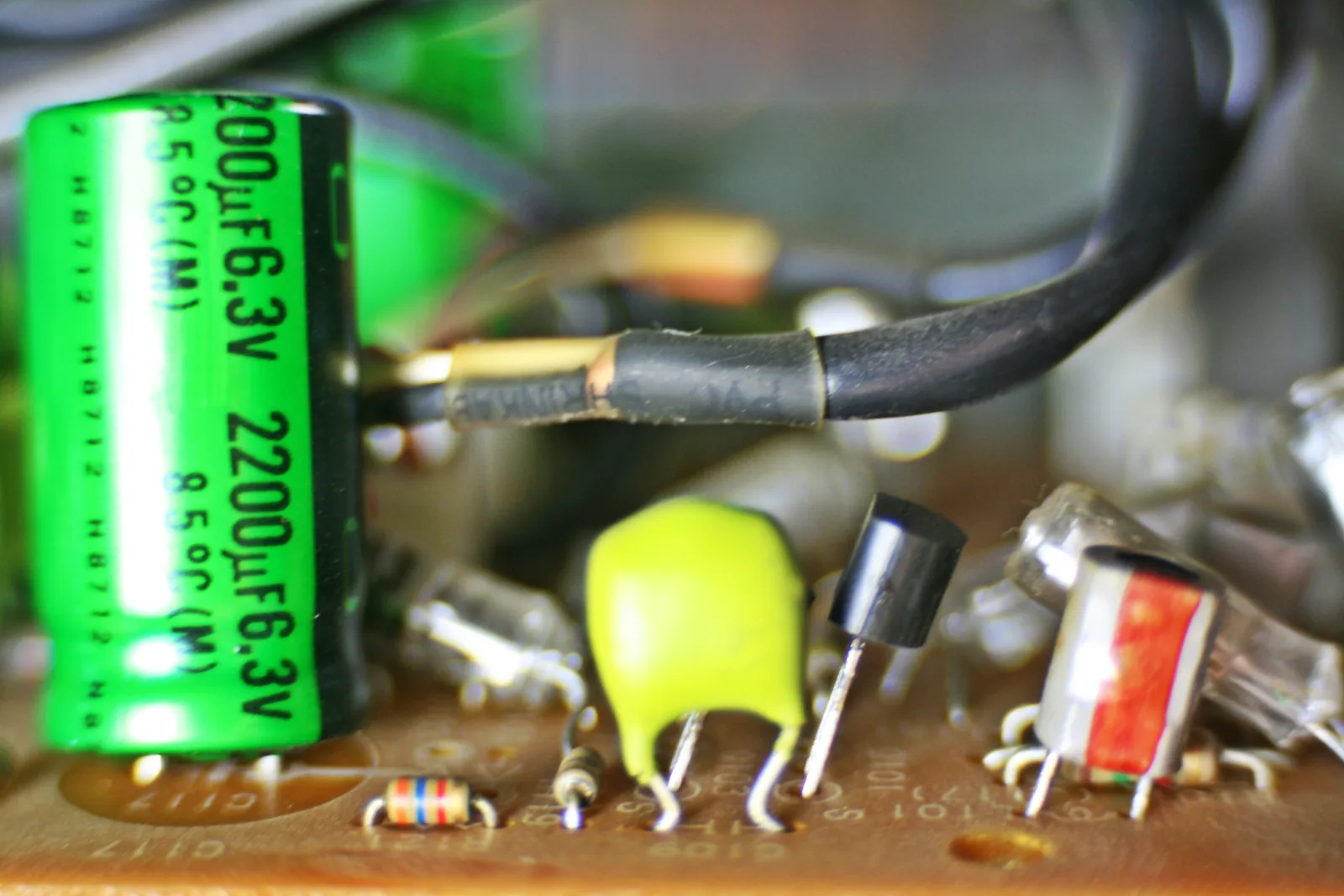
- Macro circuit board. Ingo Dierking. source, CC BY-SA 4.0
