
Spring force and spring energy
Why does a pinball launcher shoot the ball faster the further its spring is compressed?
Prior knowledge
- In periodic motion an object moves back and forth on both sides of the equilibrium positionchapter Describing oscillation: period, frequency and amplitude
- Two objects exert forces of equal magnitude and opposite direction on each otherchapter Interaction and force: Newton's first and third laws
- A stretched spring has elastic potential energychapter Kinetic energy, potential energy and mechanical energy
- Fitting a straight line to measurement points and reading the gradientchapter Graphing and fitting a straight line
Core path: follow the steps in order. Tasks marked Optional give extra practice. Optional tasks: 3.
Think about it
In a pinball machine the ball is shot onto the playing field by a launcher. The player pulls the plunger knob back, which compresses the plunger's spring, and lets go. A short pull sends the ball out gently, a long pull so fast that the ball goes round the whole field. When you hold the knob still, you can feel the spring in your hand.
In which direction does the spring push the plunger, and how much more energy is stored in the spring when the compression is doubled?
Optional Recap: Newton's third law
Predict
Make your predictions before investigating 3 questions
Prediction 1: compressed spring
Prediction 2: double the displacement
Prediction 3: energy of the spring
Investigate
A trolley is attached to a spring on a frictionless track, and a hand holds it still. Move the trolley, change the spring and follow the forces, the readings and the graph.
Simulation
How to use
Choose the position $x$ of the trolley with the slider and the spring from the Spring menu. At the equilibrium position $x = 0$ the spring is at its rest length; $x > 0$ stretches and $x < 0$ compresses the spring. A point stays on the graph for every position you choose, and the current point is red. Clear the graph removes the points of the chosen spring. The readings update at once.
Assumptions of the model
The values are model values calculated by the simulation. The track is frictionless, and the trolley is at rest because the hand holds it still. The picture shows only the horizontal forces on the trolley; the weight and the support force of the track cancel each other. The spring constants of the springs are model values that are not shown. In the model the spring obeys its law over the whole range of the controls, and it cannot be stretched permanently.
How the calculation works
For a horizontal spring the origin is at the equilibrium position, where the spring is at its rest length, and the $x$-axis points to the right. The force of the spring on the trolley is $F = -kx$. The trolley is at rest, so the force of the hand on the trolley is $F_\text{k} = -F = kx$ (the subscripts k and v come from the Finnish words käsi, hand, and venyttävä, stretching). The trolley pulls or pushes the spring with a force of equal magnitude, so the force that stretches the spring is $F_\text{v} = kx$; when the spring is compressed it is negative. The vertical axis of the graph shows $F_\text{v}$. The elastic potential energy is $E_\text{p} = \tfrac{1}{2}kx^2$, the area of the triangle of the graph. The length of the force arrows is $6$ pixels per newton.
Experiment 1: direction and magnitude of the force
Test predictions 1 and 2. The initial state chooses spring B. Change only the position $x$ of the trolley and record a measurement first with the spring compressed at $-0.10$ and $-0.05\,\text{m}$, then stretched at $0.05$, $0.10$ and $0.20\,\text{m}$. At each position look at which way the arrows point.
Initial state: spring: B, position $x$ = $0\,\text{m}$. Kept constant: spring. Varied: position $x$.
| position $x$ | force of the spring $F$ $(\text{N})$ | force of the hand $F_\text{k}$ $(\text{N})$ |
|---|
Experiment 2: energy of the spring
Test prediction 3. The initial state chooses spring B. Record a measurement at $0.05$, $0.10$ and $0.20\,\text{m}$ and each time look at the coloured triangle of the graph. Finally record the position $-0.10\,\text{m}$ as well and compare the energy with that at $0.10\,\text{m}$.
Initial state: spring: B, position $x$ = $0\,\text{m}$. Kept constant: spring. Varied: position $x$.
| position $x$ | stretching force $F_\text{v}$ $(\text{N})$ | $E_\text{p}$ $(\text{J})$ |
|---|
Optional Experiment 3: a stiff and a soft spring
The initial state puts the trolley at $x = 0.10\,\text{m}$. Change only the spring and record a measurement with springs A, B and C. Finally compare which spring has the largest force at the same extension.
Initial state: position $x$ = $0{.}1\,\text{m}$, spring: A. Kept constant: position $x$. Varied: spring.
| spring | stretching force $F_\text{v}$ $(\text{N})$ |
|---|
Calculate the spring constant of spring C from the readings in the table.
Hint 1: a guiding question
What do the force $F_\text{v}$ on the vertical axis of the graph and the extension $x$ tell you about the spring constant?
Hint 2: what is the connection
The stretching force is $F_\text{v} = kx$, so $k = \dfrac{F_\text{v}}{x}$.
Hint 3: an intermediate step
For spring C the table gives $F_\text{v} = 8.0\,\text{N}$ when $x = 0.10\,\text{m}$.
Show the solution
Given
readings of spring C from the simulation: extension $x = 0.10\,\text{m}$ and stretching force $F_\text{v} = 8.0\,\text{N}$ (model values)
Find
the spring constant $k$ of spring C in $\text{N/m}$
Principle
The trolley is at rest, so the force that stretches the spring is equal to the magnitude of the spring force, and it is directly proportional to the extension. The constant of proportionality is the spring constant.
Formula
$F_\text{v} = kx$, so $k = \dfrac{F_\text{v}}{x}$
Conversions
The extension is already in metres, so no conversions are needed.
Substitution
Answer
$80\,\text{N/m}$
Two significant figures like the reading $8.0\,\text{N}$.
Reasonableness
Spring C gave the largest force at the same extension, so its spring constant must be the largest: for springs A and B the readings give $\tfrac{2.0\,\text{N}}{0.10\,\text{m}} = 20\,\text{N/m}$ and $\tfrac{5.0\,\text{N}}{0.10\,\text{m}} = 50\,\text{N/m}$. The points of spring C lie on the steepest straight line of the graph.
Conclusion
Use your measurements to explain in which direction the force of the spring points when the spring is stretched and when it is compressed, how its magnitude depends on the displacement, and how the elastic potential energy changes when the extension is doubled.
Model answer
In the table the force of the spring is negative when $x > 0$ and positive when $x < 0$: the force of spring B is $+5.0\,\text{N}$ at $-0.10\,\text{m}$ and $-5.0\,\text{N}$ at $0.10\,\text{m}$. So the force always points towards the equilibrium position, and the force of the hand is opposite to it. The magnitude of the force grows in direct proportion to the displacement: $0.05\,\text{m}$ gives $2.5\,\text{N}$, $0.10\,\text{m}$ gives $5.0\,\text{N}$ and $0.20\,\text{m}$ gives $10\,\text{N}$. The elastic potential energy in the values of the model is $0.063\,\text{J}$, $0.250\,\text{J}$ and $1.00\,\text{J}$, so double the extension gives four times the energy. The triangle of the graph is then twice as wide and twice as tall. Compressed by $0.10\,\text{m}$ the energy is the same $0.250\,\text{J}$ as when stretched.
Assess your own answer
Tick the points your own answer already contains.
Review the theory summary and practise with the exercises.
Theory summary
Key idea
A spring pulls back towards the equilibrium position
In the chapter Describing oscillation: period, frequency and amplitude an object moved back and forth on both sides of the equilibrium position. Now we find out what kind of force always pulls the object back towards the equilibrium position. Consider a trolley attached to a horizontal spring. When the spring is at its rest length, it exerts no force on the trolley, and the trolley can be at rest. This point is the equilibrium position of the trolley. Let the $x$-axis point along the spring with its origin at the equilibrium position. The position $x$ of the trolley is then its displacement from the equilibrium position: to the right of the equilibrium position $x > 0$ and to the left $x < 0$.
When the trolley is pulled to the right, the spring stretches and pulls the trolley to the left. When the trolley is pushed to the left, the spring is compressed and pushes the trolley to the right. In both cases the force of the spring points towards the equilibrium position, that is opposite to the displacement. This is why the force of a spring is also called a restoring force.
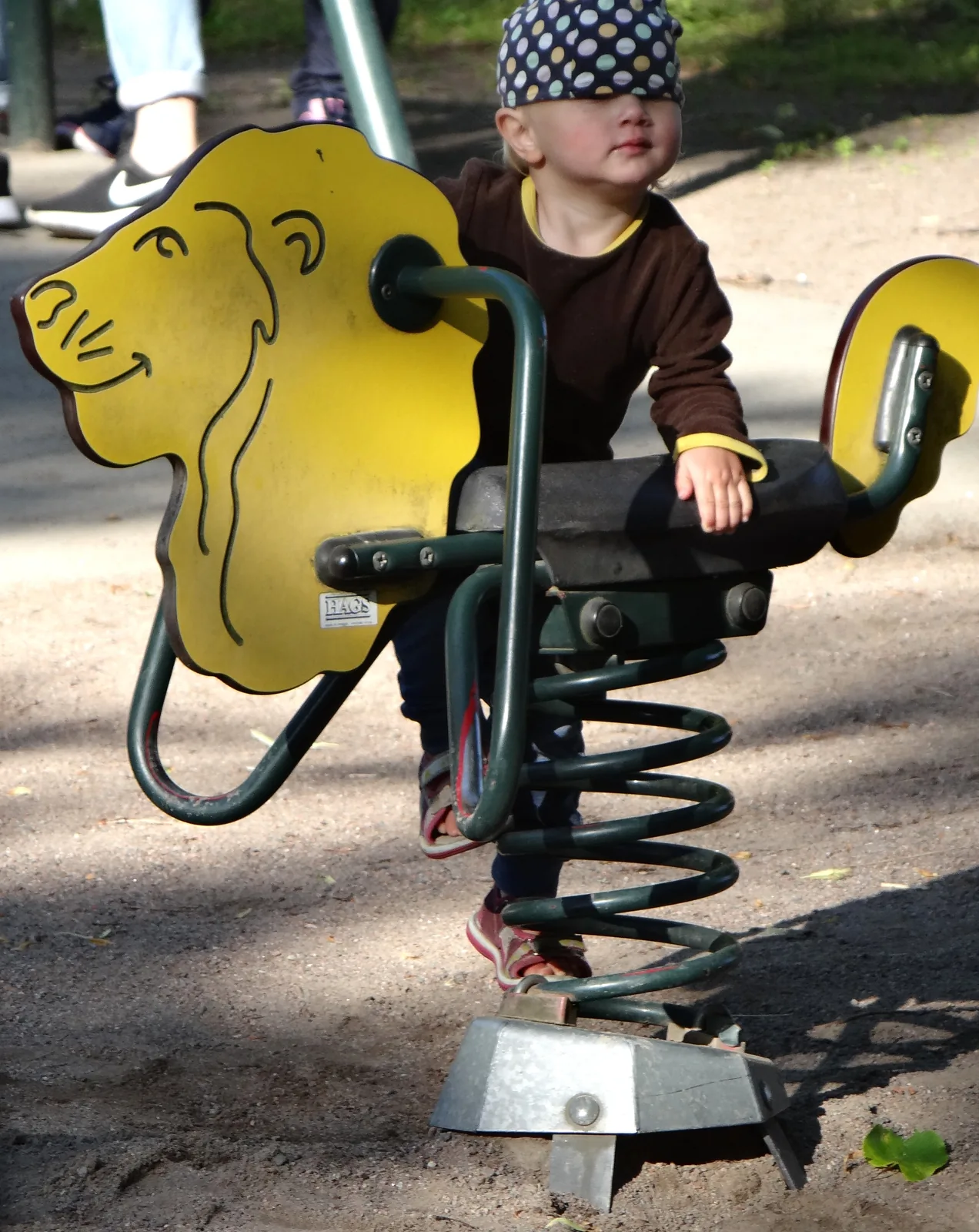
Harmonic force
When a spring is neither stretched nor compressed too much, the magnitude of the spring force is directly proportional to the displacement: double the displacement gives double the force. A force whose magnitude is directly proportional to the displacement of an object from the equilibrium position and which always points towards the equilibrium position is called a harmonic force. The force of a spring is its most common example. The restoring force of a pendulum is also approximately harmonic for small swings. In the chapter The mass–spring oscillator and the pendulum we see what kind of motion a harmonic force produces.
The force of the spring and the force that stretches the spring
When a hand stretches a spring, two objects interact: the hand pulls the spring, and the spring pulls the hand. By Newton's third law these forces are equal in magnitude and opposite in direction, but they act on different objects. The force $\overline{F}_\text{v}$ that stretches the spring acts on the spring (the subscript v comes from the Finnish venyttävä, stretching, as in the simulation). The spring force $\overline{F}$ acts on the hand or on the object at the end of the spring. So only the spring force is drawn in the free-body diagram of the object.
When the trolley is held still at displacement $x$, a hand pulls or pushes the trolley, and the trolley pulls or pushes the spring with a force of equal magnitude. The force of the hand and the force of the spring on the trolley cancel each other. A force meter used to stretch the spring shows the magnitude of the stretching force, and it is equal to the magnitude of the spring force.
Harmonic force
When the origin of the $x$-axis is at the point where the spring is at its rest length, and $x$ is the extension or compression of the spring from its rest length, the $x$-component of the force that the spring exerts on an object is
$$F = -kx$$
where $F$ is the force of the spring on the object ($\text{N}$), $x$ the extension or compression of the spring from its rest length ($\text{m}$) and $k$ the spring constant of the spring ($\text{N/m}$). The minus sign gives the direction: the force is always opposite to the displacement. When $x > 0$, $F < 0$, and when $x < 0$, $F > 0$. The magnitude of the force is $k|x|$. The spring constant tells the stiffness of the spring, that is how many newtons of force are needed per metre of extension. The spring of a car's suspension can have tens of kilonewtons per metre, the spring of a toy only a few newtons per metre. For a horizontal spring the rest-length position is also the equilibrium position of the object, so the displacement from the equilibrium position is then $x$. The law holds only when the spring is neither stretched too much nor compressed too much.
The spring constant from a measurement
The spring constant is determined by measuring. Weights are hung from the spring, and for each weight the extension $x$ of the spring is measured. A weight hanging at rest pulls the spring with a force equal to the weight $mg$ of the weight. This is the force stretching the spring, whose magnitude is
$$F_\text{v} = kx$$
where $F_\text{v}$ is the stretching force ($\text{N}$) and $x$ the extension ($\text{m}$). The measurement points are plotted in an $(x, F_\text{v})$ coordinate system and a straight line is fitted to them. In real data series the measurement points do not usually lie exactly on one line because of measurement uncertainty. The line passes through the origin, because without a stretching force the spring is at its rest length. The gradient (slope) of the line is the spring constant $k$.
The gradient is read from two points of the fitted line, not from two measurement points. In the example data of the graph the line passes through the points $(0.025\,\text{m}$; $1.0\,\text{N})$ and $(0.100\,\text{m}$; $4.0\,\text{N})$, so $k = \tfrac{3.0\,\text{N}}{0.075\,\text{m}} = 40\,\text{N/m}$. The points are chosen far apart, so that the uncertainty of the reading affects the result little. You can make the same measurement yourself in the laboratory investigation Determining the spring constant (page in Finnish).
Elastic potential energy
In the chapter Kinetic energy, potential energy and mechanical energy it was stated that a stretched spring has elastic potential energy. Now its magnitude can be calculated. When a spring is stretched slowly from its rest length to extension $x$, the stretching force does work, and the work is stored in the spring as potential energy. The work of a constant force, $W = Fs$, is the area of a rectangle in an $(s, F)$ graph (chapter Conservation of mechanical energy and the work–energy principle). The stretching force is not constant, however, but grows steadily from zero to $kx$. So the work is the triangle between the $(x, F_\text{v})$ graph and the $x$-axis, with base $x$ and height $kx$. The elastic potential energy is
$$E_\text{p} = \frac{1}{2}kx^2$$
where $E_\text{p}$ is the elastic potential energy ($\text{J}$), $k$ the spring constant ($\text{N/m}$) and $x$ the extension or compression ($\text{m}$). At the rest length the elastic potential energy is zero.
The triangle for double the extension is twice as wide and twice as tall, so four triangles of the original size fit in it. So the potential energy grows with the square of the extension, even though the force grows only in direct proportion. Because $x$ is squared, the energy is the same when the spring is stretched or compressed by the same amount. The units agree: $\tfrac{\text{N}}{\text{m}}\cdot\text{m}^2 = \text{N}\cdot\text{m} = \text{J}$.
Common misconception
Many people think the force of the spring and the force stretching the spring are the same force. They are a Newton's third law pair: the stretching force acts on the spring and the spring force on the object, so only the spring force is drawn in the free-body diagram of the object. Another mistake is to read the minus sign in the expression $F = -kx$ as meaning that the force is always negative or small. The minus sign only gives the direction: the force points against the displacement, towards the equilibrium position, and is positive when $x < 0$. A third mistake is to assume that double the extension doubles the elastic potential energy. The force doubles, but the energy becomes four times as large, because it depends on the square of the extension.
Summary
- A harmonic force is directly proportional to the displacement of an object from the equilibrium position and always points towards the equilibrium position: $F = -kx$.
- The minus sign gives the direction: the force is opposite to the displacement.
- The spring constant $k$ tells the stiffness of the spring. It is the gradient of the $(x, F_\text{v})$ graph, read from two points of the fitted line.
- The force stretching a spring acts on the spring and the spring force on the object: they are a Newton's third law pair.
- The elastic potential energy is the area of the triangle under the $(x, F_\text{v})$ graph, $E_\text{p} = \tfrac{1}{2}kx^2$. Double the extension gives four times the energy.
Optional Return to your predictions
Compare your predictions with the measurements and the theory. Also return to the pinball machine at the start: in which direction does the spring push the plunger, and how much more energy is stored in the spring when the compression is doubled?
Would you change your prediction?
Apply
Worked example
Problem
A fisherman weighs a fish with a spring balance. When a fish of mass $1.20\,\text{kg}$ hangs at rest from the hook of the balance, the spring of the balance has stretched $3.0\,\text{cm}$. What is the spring constant of the spring, and how much elastic potential energy is stored in the spring? The masses of the spring and the hook are neglected.
Step 1/7
Given and find. Mass of the fish $m = 1.20\,\text{kg}$, extension of the spring $x = 3.0\,\text{cm}$ and $g = 9.81\,\text{m/s}^2$. We are asked for the spring constant $k$ and the elastic potential energy $E_\text{p}$.
Step 2/7
Principle. Choose the fish as the object. The Earth (weight $\overline{G}$) and the spring (spring force $\overline{F}$) act on it. The fish is at rest, so the forces cancel each other, and the magnitude of the spring force is $mg$. By Newton's third law the fish pulls the spring with a force of equal magnitude, so the force stretching the spring is $F_\text{v} = mg$. From this and the extension we get the spring constant. In the free-body diagram the $y$-axis points up.
Step 3/7
Rearranged formula. The equation of motion is read from the free-body diagram: $F - mg = 0$, so the force stretching the spring is $F_\text{v} = kx = mg$. The spring constant is solved from this, and the energy is obtained from the extension:
$$\begin{aligned} k &= \frac{mg}{x} \\ E_\text{p} &= \frac{1}{2}kx^2 \end{aligned}$$
Step 4/7
Unit conversions. The extension is converted to metres:
Step 5/7
Substitution. Substitute the values with their units:
$$\begin{aligned} k &= \frac{mg}{x} \\ \phantom{k} &= \frac{1.20\,\text{kg}\cdot 9.81\,\text{m/s}^2}{0.030\,\text{m}} \\ \phantom{k} &= 392.4\,\text{N/m} \\[4pt] E_\text{p} &= \tfrac{1}{2}kx^2 \\ \phantom{E_\text{p}} &= \tfrac{1}{2}\cdot 392.4\,\tfrac{\text{N}}{\text{m}} \\ &\phantom{E_\text{p} =}\cdot (0.030\,\text{m})^2 \\ \phantom{E_\text{p}} &= 0.1766\,\text{J} \end{aligned}$$
Step 6/7
Result. The spring constant is $k \approx 3.9 \cdot 10^{2}\,\text{N/m}$ and the elastic potential energy $E_\text{p} \approx 0.18\,\text{J}$, to two significant figures like the extension $3.0\,\text{cm}$.
Step 7/7
Reasonableness. The energy can also be calculated from the triangle of the $(x, F_\text{v})$ graph:
the same result. A spring of about $400\,\text{N/m}$ stretches a centimetre under a force of about $4\,\text{N}$, which suits a balance used to weigh fish of a few kilograms. The energy is small because the extension is small.
The spring constant from a measurement
Made-up example data
To measure a spring constant, weights are hung from the spring and the extension $x$ of the spring is measured with a ruler. When a weight hangs at rest, it pulls the spring with a force equal to its weight, so the stretching force is $F_\text{v} = mg$. The table and the graph are made-up example data.
| $m$ (g) | $50$ | $100$ | $150$ | $200$ | $250$ | $300$ |
|---|---|---|---|---|---|---|
| $F_\text{v}$ (N) | $0.49$ | $0.98$ | $1.47$ | $1.96$ | $2.45$ | $2.94$ |
| $x$ (cm) | $1.7$ | $3.2$ | $5.0$ | $6.4$ | $8.3$ | $9.8$ |
Fit a straight line through the origin to the points of the graph by eye (place a ruler on the picture) and determine the spring constant of the spring from the gradient of the line.
Hint 1: a guiding question
Which quantity is the gradient of the line when the vertical axis shows the stretching force and the horizontal axis the extension?
Hint 2: what is the connection
Choose two points on the line that are far apart, for example the origin and the point where $x = 10.0\,\text{cm}$. Do not use two measurement points.
Hint 3: an intermediate step
The line passes almost through the point $(10.0\,\text{cm}$; $3.0\,\text{N})$. Convert the centimetres to metres before dividing.
Show the solution
Given
the stretching forces $F_\text{v} = mg$ of six weights and the extensions $x$ of the spring in the table and the graph (example data), $g = 9.81\,\text{m/s}^2$
Find
the spring constant $k$ in $\text{N/m}$
Principle
A weight hanging at rest pulls the spring with a force equal to its weight. The stretching force is directly proportional to the extension, $F_\text{v} = kx$, so the points of the $(x, F_\text{v})$ graph lie close to a straight line through the origin, and the gradient of the line is the spring constant. The line passes through the origin because without a weight the spring does not stretch.
Reading the graph
Because of measurement uncertainty the points do not lie exactly on one line, so the line is fitted so that there are points on both sides of it. The fitted line passes through the origin and the point $(10.0\,\text{cm}$; $3.0\,\text{N})$. The gradient is read from these two points on the line, not from measurement points.
Formula
Conversions
Substitution
Answer
$k \approx 30\,\text{N/m}$
Two significant figures, because the force $3.0\,\text{N}$ read from the graph is given to two figures.
Reasonableness
Check from the table: the $300\,\text{g}$ weight gives $\tfrac{2.94\,\text{N}}{0.098\,\text{m}} = 30\,\text{N/m}$. For the smallest weight the relative uncertainty of the extension $1.7\,\text{cm}$ is the largest, so the line is more reliable than a single point. A spring of about $30\,\text{N/m}$ is a soft school measuring spring: $1\,\text{N}$ stretches it about $3\,\text{cm}$.
Find the error
Apply to a new situation
The spring of a pinball launcher has a spring constant of $250\,\text{N/m}$. The player pulls the plunger $6.0\,\text{cm}$ back, so that the spring is compressed by the same distance, and lets go. The spring sets the plunger and the $80\,\text{g}$ ball in front of it in motion, and the ball leaves the plunger when the spring is at its rest length. Friction, the mass of the plunger and the tilt of the table are neglected.
At what speed does the ball leave?
Hint 1: a guiding question
Into what does the elastic potential energy change when the spring returns to its rest length?
Hint 2: what is the connection
The elastic potential energy changes into the kinetic energy of the ball: $\tfrac{1}{2}kx^2 = \tfrac{1}{2}mv^2$.
Hint 3: an intermediate step
Solve $v = x\sqrt{\dfrac{k}{m}}$ and convert the centimetres and grams to SI units.
Show the solution
Given
spring constant $k = 250\,\text{N/m}$, compression $x = 6.0\,\text{cm}$, mass of the ball $m = 80\,\text{g}$; the ball is initially at rest
Find
the launch speed $v$ of the ball in $\text{m/s}$
Principle
There is no friction, the mass of the plunger is neglected and the table is horizontal, so mechanical energy is conserved: the elastic potential energy changes entirely into the kinetic energy of the ball. The ball leaves when the spring is at its rest length, when the energy of the spring is zero.
Formula
$\tfrac{1}{2}kx^2 = \tfrac{1}{2}mv^2$, so $v = x\sqrt{\dfrac{k}{m}}$
Conversions
Substitution
Answer
$3.4\,\text{m/s}$
Two significant figures like the compression $6.0\,\text{cm}$ and the mass $80\,\text{g}$.
Reasonableness
The energy of the spring is
and the kinetic energy of the ball is
the same. About $12\,\text{km/h}$ is a believable launch speed for a pinball. Double the compression would give four times the energy and double the speed.
Check your understanding
Exit ticket
Answer on your own first and only then open the answer.
- Spring A is stiffer than spring B. Which spring has the steeper $(x, F_\text{v})$ graph, and why?
Answer
Spring A's. The gradient of the graph is the spring constant $k$, and stretching a stiffer spring the same distance needs a larger force, so its line rises more steeply.
- A spring whose spring constant is $200\,\text{N/m}$ is first compressed $0.10\,\text{m}$ and then stretched $0.10\,\text{m}$. In which situation is more elastic potential energy stored in it?
Answer
The energy is the same,
$E_\text{p}$$= \tfrac{1}{2}\cdot 200\,\tfrac{\text{N}}{\text{m}}\cdot(0.10\,\text{m})^2$$= 1.0\,\text{J}$in both, because the displacement is squared and its sign does not matter. The direction of the force, on the other hand, is opposite.
- A hand stretches a spring. Which two forces form a Newton's third law pair here, and which objects do they act on?
Answer
The force of the hand on the spring, that is the force stretching the spring $\overline{F}_\text{v}$, acts on the spring, and the force of the spring on the hand $\overline{F}$ acts on the hand. They are equal in magnitude and opposite in direction, but because they act on different objects, they do not cancel each other.
1. Concept
2. Sign and magnitude
An object at the end of a spring is acted on by a spring force $F = -6.0\,\text{N}$ when the object is at $x = 0.12\,\text{m}$. The spring is horizontal, and the origin is at the equilibrium position, where the spring is at its rest length.
How large is the spring force $F$, with its sign, when the object is at $x = -0.20\,\text{m}$?
Hint 1: a guiding question
First calculate the spring constant from the readings of the first situation.
Hint 2: what is the connection
$F = -kx$, so $k = -\dfrac{F}{x}$.
Hint 3: an intermediate step
$k = 50\,\text{N/m}$. Then substitute $x = -0.20\,\text{m}$ into the expression $F = -kx$.
Show the solution
Given
$F_1 = -6.0\,\text{N}$ at $x_1 = 0.12\,\text{m}$; new position $x_2 = -0.20\,\text{m}$; horizontal spring, origin at the equilibrium position, that is at the rest length of the spring
Find
the spring force $F_2$ with its sign, in $\text{N}$
Principle
The force of the spring is harmonic: $F = -kx$, and the spring constant is the same at both positions. The spring constant is obtained from the first situation. The sign tells the direction.
Formula
$F_1 = -kx_1$, so $k = -\dfrac{F_1}{x_1}$, and $F_2 = -kx_2$
Conversions
The quantities are in SI units, so no conversions are needed.
Substitution
Answer
$F_2 = +10\,\text{N}$
That is $10\,\text{N}$ in the positive direction of the $x$-axis, two significant figures like the initial data.
Reasonableness
The object is on the negative side of the equilibrium position, so the force must point in the positive direction, towards the equilibrium position. The displacement is $\tfrac{0.20}{0.12} \approx 1.7$ times as large, and so is the magnitude of the force: $1.7 \cdot 6.0\,\text{N} = 10\,\text{N}$.
Suggestion: one answer does not show everything you can do, but review the theory summary and do the core exercises.
3. Draw it yourself
A box of mass $6.0\,\text{kg}$ is pulled along a horizontal floor by a horizontal spring so that the box slides at a constant speed. The kinetic friction of the floor on the box is $18\,\text{N}$, and the spring constant of the spring is $120\,\text{N/m}$. Draw the free-body diagram of the box on paper: the box as a rectangle and each force from its point of application. Write the equations of motion and calculate how much the spring has stretched.
Model diagram
The Earth, the floor and the spring act on the box. The weight $\overline{G}$ points down from the centre, and the support force of the floor $\overline{N}$ up from the lower surface. The spring force $\overline{F}$ pulls the box horizontally in the direction of the pull, and kinetic friction $\overline{F}_\mu$ points against it from the corner of the lower surface. The force that stretches the spring is not drawn, because it acts on the spring. The speed is constant, so the forces cancel each other. With $x$ pointing in the direction of the pull and $y$ up: $y$: $N - mg = 0$, so $N = 6.0\,\text{kg}\cdot 9.81\,\text{m/s}^2 \approx 59\,\text{N}$. $x$: $kx - F_\mu = 0$, so $x = \dfrac{F_\mu}{k} = \dfrac{18\,\text{N}}{120\,\text{N/m}} = 0.15\,\text{m}$. The spring has stretched $15\,\text{cm}$.
Assess your own answer
Tick the points your own answer already contains.
Review the theory summary and practise with the exercises.
Review the chapter's concepts
Cards you mark Review later collect in your review deck.
- Equilibrium position
- The position in which the net force on the oscillator is zero.
- Displacement
- The oscillator's distance from the equilibrium position, with its direction.
- Spring constant
- A quantity that describes the stiffness of a spring; the larger $k$, the stiffer the spring.
- Harmonic force
- A restoring force directly proportional to the displacement and directed towards the equilibrium position.
- Mass–spring oscillator
- An oscillating system made of a spring and an object attached to it.$$T = 2\pi\sqrt{\dfrac{m}{k}}$$
- Spring potential energy
- The energy stored in a stretched or compressed spring.$$E_{\text{p}} = \tfrac{1}{2}kx^2$$
Exercises
Level 1 · basic practice 5 exercises
One formula or one step of reasoning. Core exercises first, the rest is extra practice.
- Exercise 8-1Core
The handle of a gym machine is attached to a return spring whose spring constant is $250\,\text{N/m}$. The exerciser pulls the handle so that the spring stretches $0.12\,\text{m}$, and holds the handle still.
How large is the force of the spring on the handle?
Answer
$30\,\text{N}$
Show the solution
Given
spring constant $k = 250\,\text{N/m}$, extension $x = 0.12\,\text{m}$, handle at rest
Find
the magnitude $F$ of the spring force in $\text{N}$
Principle
The force of the spring is a harmonic force: its magnitude is directly proportional to the extension, and it points towards the equilibrium position, here along the spring back towards the machine. For the magnitude the absolute value of the expression is enough.
Formula
$F = -kx$, so the magnitude of the force is $|F| = kx$
Conversions
The quantities are in SI units, so no conversions are needed.
Substitution
$|F|$$= 250\,\tfrac{\text{N}}{\text{m}}\cdot 0.12\,\text{m}$$= 30\,\text{N}$Answer
$30\,\text{N}$
Towards the machine, two significant figures like the extension $0.12\,\text{m}$.
Reasonableness
$30\,\text{N}$ corresponds to the weight of about $3\,\text{kg}$, which is a light but noticeable resistance in a gym machine. The unit $\tfrac{\text{N}}{\text{m}}\cdot\text{m} = \text{N}$ is the unit of force.
- Exercise 8-2Core
A spring at the edge of a trampoline stretches $0.050\,\text{m}$ when a force of $450\,\text{N}$ stretches it. What is the spring constant of the spring?
Answer
$9000\,\text{N/m}$
Show the solution
Given
stretching force $F_\text{v} = 450\,\text{N}$, extension $x = 0.050\,\text{m}$
Find
the spring constant $k$ in $\text{N/m}$
Principle
The force stretching a spring is directly proportional to the extension when the spring is not stretched too much. The constant of proportionality is the spring constant, which tells how many newtons are needed per metre of extension.
Formula
$F_\text{v} = kx$, so $k = \dfrac{F_\text{v}}{x}$
Conversions
The quantities are in SI units, so no conversions are needed.
Substitution
$k$$= \dfrac{450\,\text{N}}{0.050\,\text{m}}$$= 9000\,\text{N/m}$Answer
$9000\,\text{N/m}$
Or $9.0 \cdot 10^{3}\,\text{N/m}$, two significant figures like the extension $0.050\,\text{m}$.
Reasonableness
A trampoline spring must be stiff, because a jumper landing stretches many springs at the same time with forces of hundreds of newtons. A centimetre of extension needs $90\,\text{N}$, which feels like a stiff spring.
- Exercise 8-3
An exerciser stretches a hand spring whose spring constant is $180\,\text{N/m}$ so that the spring extends $0.15\,\text{m}$. How much elastic potential energy is stored in the spring?
Answer
$2.0\,\text{J}$
Show the solution
Given
spring constant $k = 180\,\text{N/m}$, extension $x = 0.15\,\text{m}$
Find
the elastic potential energy $E_\text{p}$ in $\text{J}$
Principle
When a spring is stretched, the stretching force does work, which is stored in the spring as potential energy. The force grows steadily from zero to $kx$, so the energy is the area of the triangle of the $(x, F_\text{v})$ graph.
Formula
$E_\text{p} = \tfrac{1}{2}kx^2$
Conversions
The quantities are in SI units, so no conversions are needed.
Substitution
$E_\text{p}$$= \tfrac{1}{2}\cdot 180\,\tfrac{\text{N}}{\text{m}}\cdot(0.15\,\text{m})^2$$= \tfrac{1}{2}\cdot 180\,\tfrac{\text{N}}{\text{m}}\cdot 0.0225\,\text{m}^2$$= 2.025\,\text{J}$Answer
$2.0\,\text{J}$
Two significant figures like the extension $0.15\,\text{m}$.
Reasonableness
At the end of the extension the force is $180\,\tfrac{\text{N}}{\text{m}}\cdot 0.15\,\text{m} = 27\,\text{N}$. The area of the triangle gives the same result: $\tfrac{1}{2}\cdot 27\,\text{N}\cdot 0.15\,\text{m} \approx 2.0\,\text{J}$. The energy corresponds to lifting an object of about $2\,\text{kg}$ by $10\,\text{cm}$.
- Exercise 8-4
The graph shows the force $F_\text{v}$ stretching a spring as a function of the extension $x$ of the spring. Read two points of the line from the graph.
What is the spring constant of the spring?
Answer
$60\,\text{N/m}$
Show the solution
Given
the line of the graph, the force $F_\text{v}$ stretching the spring as a function of the extension $x$
Find
the spring constant $k$ in $\text{N/m}$
Principle
The stretching force is directly proportional to the extension, $F_\text{v} = kx$, so the graph is a straight line through the origin, and its gradient is the spring constant.
Reading the graph
The line passes through the origin and the grid point $(0.20\,\text{m}$; $12\,\text{N})$. These two points of the line, far apart, are chosen so that the uncertainty of the reading has little effect.
Formula
$k$$= \dfrac{\Delta F_\text{v}}{\Delta x}$Conversions
The values of the graph are in newtons and metres, so no conversions are needed.
Substitution
$k$$= \dfrac{12\,\text{N} - 0\,\text{N}}{0.20\,\text{m} - 0\,\text{m}}$$= 60\,\text{N/m}$Answer
$60\,\text{N/m}$
Two significant figures, to which the grid values of the graph can be read.
Reasonableness
Another point of the line gives the same: at $0.10\,\text{m}$ the force is $6\,\text{N}$, and $\tfrac{6\,\text{N}}{0.10\,\text{m}} = 60\,\text{N/m}$. The order of magnitude fits: an extension of $10\,\text{cm}$ needs $6\,\text{N}$, which corresponds to the weight of a mass of about $0.6\,\text{kg}$, and such an extension can be measured with a ruler.
- Exercise 8-5
The spring constant of the spring of a fisherman's spring balance is $40\,\text{N/m}$.
How much does the spring stretch when a force of $6.0\,\text{N}$ stretches it? Give the answer in metres.
Answer
$0.15\,\text{m}$
Show the solution
Given
spring constant $k = 40\,\text{N/m}$, stretching force $F_\text{v} = 6.0\,\text{N}$
Find
the extension $x$ in $\text{m}$
Principle
The force stretching a spring is directly proportional to the extension. When the force and the spring constant are known, the extension is obtained by solving it from the expression.
Formula
$F_\text{v} = kx$, so $x = \dfrac{F_\text{v}}{k}$
Conversions
The quantities are in SI units, so no conversions are needed.
Substitution
$x$$= \dfrac{6.0\,\text{N}}{40\,\text{N/m}}$$= 0.15\,\text{m}$Answer
$0.15\,\text{m}$
Two significant figures like the force $6.0\,\text{N}$ and the spring constant $40\,\text{N/m}$.
Reasonableness
A spring constant of $40\,\text{N/m}$ means that $4\,\text{N}$ stretches the spring $10\,\text{cm}$, so $6\,\text{N}$ stretches it $15\,\text{cm}$. The unit $\tfrac{\text{N}}{\text{N/m}} = \text{m}$.
Level 2 · applied practice 4 exercises
Two steps, working with measured data, a unit conversion or rearranging a formula. Core exercises first, the rest is extra practice.
- Exercise 8-6Core
A spring is stretched $8.0\,\text{cm}$, and the force meter then reads $6.0\,\text{N}$. How much elastic potential energy is stored in the spring?
Answer
$0.24\,\text{J}$
Show the solution
Given
extension $x = 8.0\,\text{cm}$, stretching force $F_\text{v} = 6.0\,\text{N}$ at the end of the extension
Find
the elastic potential energy $E_\text{p}$ in $\text{J}$
Principle
The reading of the force meter is the stretching force. From it and the extension we first get the spring constant. The elastic potential energy is the work of the stretching force, the area of the triangle of the $(x, F_\text{v})$ graph.
Formula
$F_\text{v} = kx$, so $k = \dfrac{F_\text{v}}{x}$, and $E_\text{p} = \tfrac{1}{2}kx^2$
Conversions
$x$$= 8.0\,\text{cm}$$= 8.0 \cdot 0.01\,\text{m}$$= 0.080\,\text{m}$Substitution
$k$$= \dfrac{6.0\,\text{N}}{0.080\,\text{m}}$$= 75\,\text{N/m}$$E_\text{p}$$= \tfrac{1}{2}\cdot 75\,\tfrac{\text{N}}{\text{m}}\cdot(0.080\,\text{m})^2$$= 0.24\,\text{J}$Answer
$0.24\,\text{J}$
Two significant figures like the force $6.0\,\text{N}$ and the extension $8.0\,\text{cm}$.
Reasonableness
The area of the triangle gives the same directly:
$\tfrac{1}{2}F_\text{v}x$$= \tfrac{1}{2}\cdot 6.0\,\text{N}\cdot 0.080\,\text{m}$$= 0.24\,\text{J}$Without the half the result would be $0.48\,\text{J}$, but the force was not $6.0\,\text{N}$ the whole way; it grew from zero.
- Exercise 8-7Core
The spring of a toy gun is compressed $6.0\,\text{cm}$, which stores $0.90\,\text{J}$ of elastic potential energy in it. What is the spring constant of the spring?
Answer
$500\,\text{N/m}$
Show the solution
Given
compression $x = 6.0\,\text{cm}$, elastic potential energy $E_\text{p} = 0.90\,\text{J}$
Find
the spring constant $k$ in $\text{N/m}$
Principle
The elastic potential energy of a compressed spring depends on the square of the compression in the same way as that of a stretched spring on the extension. When the energy and the compression are known, the spring constant is solved from the expression for the energy.
Formula
$E_\text{p} = \tfrac{1}{2}kx^2$, so $k = \dfrac{2E_\text{p}}{x^2}$
Conversions
$x$$= 6.0\,\text{cm}$$= 6.0 \cdot 0.01\,\text{m}$$= 0.060\,\text{m}$Substitution
$k$$= \dfrac{2\cdot 0.90\,\text{J}}{(0.060\,\text{m})^2}$$= \dfrac{1.80\,\text{J}}{0.0036\,\text{m}^2}$$= 500\,\text{N/m}$Answer
$500\,\text{N/m}$
Or $5.0 \cdot 10^{2}\,\text{N/m}$, two significant figures like the energy and the compression.
Reasonableness
Check:
$\tfrac{1}{2}\cdot 500\,\tfrac{\text{N}}{\text{m}}\cdot(0.060\,\text{m})^2$$= 0.90\,\text{J}$A fully compressed spring pushes with a force of $500\,\tfrac{\text{N}}{\text{m}}\cdot 0.060\,\text{m} = 30\,\text{N}$, which suits a toy gun that a child can cock. The unit
$\tfrac{\text{J}}{\text{m}^2}$$= \tfrac{\text{N}\cdot\text{m}}{\text{m}^2}$$= \text{N/m}$ - Exercise 8-8
A spring whose spring constant is $150\,\text{N/m}$ is stretched $3.0\,\text{cm}$. The extension is increased to $9.0\,\text{cm}$. By how much does the elastic potential energy of the spring increase?
Answer
$0.54\,\text{J}$
Show the solution
Given
spring constant $k = 150\,\text{N/m}$, initial extension $x_1 = 3.0\,\text{cm}$, final extension $x_2 = 9.0\,\text{cm}$
Find
the increase $\Delta E_\text{p}$ in the elastic potential energy in $\text{J}$
Principle
The elastic potential energy depends on the extension from the rest length, not on the change in the extension. The increase is the difference between the energies of the final and initial states. In the graph it is the difference between the areas of two triangles.
Formula
$\Delta E_\text{p}$$= \tfrac{1}{2}kx_2^2 - \tfrac{1}{2}kx_1^2$$= \tfrac{1}{2}k\left(x_2^2 - x_1^2\right)$Conversions
$x_1$$= 3.0\,\text{cm}$$= 0.030\,\text{m}$$x_2$$= 9.0\,\text{cm}$$= 0.090\,\text{m}$Substitution
$\Delta E_\text{p}$$= \tfrac{1}{2}\cdot 150\,\tfrac{\text{N}}{\text{m}}\cdot\left((0.090\,\text{m})^2 - (0.030\,\text{m})^2\right)$$= 75\,\tfrac{\text{N}}{\text{m}}\cdot 0.0072\,\text{m}^2$$= 0.54\,\text{J}$Answer
$0.54\,\text{J}$
Two significant figures like the extensions.
Reasonableness
At the start the energy is $0.0675\,\text{J}$ and at the end $0.6075\,\text{J}$, nine times as much, because the extension became three times as large. If $\tfrac{1}{2}k(\Delta x)^2$ had been calculated, the result would be only $0.27\,\text{J}$, which is too little: the last centimetres are stretched with an already large force.
- Exercise 8-9
The forces stretching two springs A and B are shown as a function of the extension in the same graph. First determine the spring constant of spring A from the graph. Spring A is stretched $0.080\,\text{m}$.
How much elastic potential energy is stored in it?
Answer
$0.19\,\text{J}$
Show the solution
Given
the $(x, F_\text{v})$ graphs of springs A and B; extension of spring A $x = 0.080\,\text{m}$
Find
the elastic potential energy $E_\text{p}$ of spring A in $\text{J}$
Principle
The spring constant of spring A is the gradient of its graph. The elastic potential energy is the work of the stretching force, that is the triangle between the graph and the $x$-axis up to the extension $0.080\,\text{m}$.
Reading the graph
The steeper, solid line is spring A. It passes through the origin and the grid point $(0.10\,\text{m}$; $6.0\,\text{N})$, so its gradient is
$k_\text{A}$$= \tfrac{6.0\,\text{N}}{0.10\,\text{m}}$$= 60\,\text{N/m}$Formula
$E_\text{p} = \tfrac{1}{2}k_\text{A}x^2$, where the spring constant $k_\text{A}$ is the gradient of the graph
Conversions
The values of the graph are in newtons and metres, so no conversions are needed.
Substitution
$E_\text{p}$$= \tfrac{1}{2}\cdot 60\,\tfrac{\text{N}}{\text{m}}\cdot(0.080\,\text{m})^2$$= \tfrac{1}{2}\cdot 60\,\tfrac{\text{N}}{\text{m}}\cdot 0.0064\,\text{m}^2$$= 0.192\,\text{J}$Answer
$0.19\,\text{J}$
Two significant figures, to which the values of the graph can be read.
Reasonableness
As the area of a triangle: at extension $0.080\,\text{m}$ the force of spring A is $60\,\tfrac{\text{N}}{\text{m}}\cdot 0.080\,\text{m} = 4.8\,\text{N}$, and $\tfrac{1}{2}\cdot 4.8\,\text{N}\cdot 0.080\,\text{m} = 0.19\,\text{J}$. The gentler spring B would have less energy at the same extension, because its triangle is lower.
Level 3 · challenging 3 exercises
Optional: application, two ideas together or a new situation where you reason for yourself.
- Exercise 8-10
A car rests on four identical springs. When passengers with a total mass of $300\,\text{kg}$ get in, the springs are compressed a further $3.0\,\text{cm}$. The elasticity of the tyres is ignored. Assume that the extra load is shared equally by the four springs.
What is the spring constant of one spring? Give the answer in $\text{kN/m}$.
Answer
$25\,\text{kN/m}$
Show the solution
Given
mass of the passengers $\Delta m = 300\,\text{kg}$, extra compression of the springs $\Delta x = 3.0\,\text{cm}$, four identical springs; $g = 9.81\,\text{m/s}^2$
Find
the spring constant $k$ of one spring in $\text{kN/m}$
Principle
The springs are already compressed by the weight of the car itself, but for a harmonic force the force is directly proportional to the compression, so the change in the force is proportional to the change in the compression: $F_2 - F_1 = k(x_2 - x_1) = k\,\Delta x$. The car is at rest before and after, so the increase in the forces of the springs cancels the weight of the passengers. The load is shared equally, so one spring carries a quarter of it.
Formula
$4k\,\Delta x = \Delta m\, g$, so $k = \dfrac{\Delta m\, g}{4\,\Delta x}$
Conversions
$\Delta x$$= 3.0\,\text{cm}$$= 3.0 \cdot 0.01\,\text{m}$$= 0.030\,\text{m}$finally $1\,\text{kN/m} = 1000\,\text{N/m}$
Substitution
$k$$= \dfrac{300\,\text{kg}\cdot 9.81\,\text{m/s}^2}{4\cdot 0.030\,\text{m}}$$= \dfrac{2943\,\text{N}}{0.12\,\text{m}}$$= 24\,525\,\text{N/m}$$= 24.525\,\text{kN/m}$Answer
$25\,\text{kN/m}$
Two significant figures like the compression $3.0\,\text{cm}$.
Reasonableness
A spring constant of tens of kilonewtons per metre is typical for a car's suspension. If the whole $1200\,\text{kg}$ car loaded the same springs, they would be compressed about $12\,\text{cm}$, which is a believable suspension travel. The mass of the car itself was not needed, because only the changes in the force and the compression are involved.
- Exercise 8-11
A jumping toy has a vertical spring whose spring constant is $200\,\text{N/m}$. The toy is pressed against a table so that the spring is compressed $3.0\,\text{cm}$, and a suction cup holds it in place. When the suction cup lets go, the spring launches the $50\,\text{g}$ toy straight up. Assume that all of the elastic potential energy changes into the gravitational potential energy of the toy; air resistance and the mass of the spring are neglected.
How high does the toy rise from its starting point?
Answer
$0.18\,\text{m}$
Show the solution
Given
spring constant $k = 200\,\text{N/m}$, compression $x = 3.0\,\text{cm}$, mass of the toy $m = 50\,\text{g}$; $g = 9.81\,\text{m/s}^2$
Find
the height of rise $h$ from the starting point in $\text{m}$
Principle
Air resistance and the mass of the spring are neglected, so mechanical energy is conserved. At the starting point the toy is at rest, and the energy is the elastic potential energy of the compressed spring. At the highest point the toy is momentarily at rest, so all the energy is gravitational potential energy, taking the zero level at the starting point.
Formula
$\tfrac{1}{2}kx^2 = mgh$, so $h = \dfrac{kx^2}{2mg}$
Conversions
$x$$= 3.0\,\text{cm}$$= 0.030\,\text{m}$$m$$= 50\,\text{g}$$= 50 \cdot 0.001\,\text{kg}$$= 0.050\,\text{kg}$Substitution
$h$$= \dfrac{200\,\tfrac{\text{N}}{\text{m}}\cdot(0.030\,\text{m})^2}{2\cdot 0.050\,\text{kg}\cdot 9.81\,\text{m/s}^2}$$= \dfrac{0.18\,\text{J}}{0.981\,\text{N}}$$= 0.1835\,\text{m}$Answer
$0.18\,\text{m}$
Or about $18\,\text{cm}$, two significant figures like the compression $3.0\,\text{cm}$ and the mass $50\,\text{g}$.
Reasonableness
The energy of the spring is $0.090\,\text{J}$, and lifting a $50\,\text{g}$ toy $18\,\text{cm}$ needs
$0.050\,\text{kg}\cdot 9.81\,\text{m/s}^2\cdot 0.1835\,\text{m}$$\approx 0.090\,\text{J}$A jump of a few tens of centimetres is typical for such a toy; in reality some of the energy goes into the oscillation of the spring and the toy and into air resistance, so the toy rises a little less.
- Exercise 8-12
A trolley of mass $0.50\,\text{kg}$ is on a horizontal frictionless track between two springs. One end of the left spring is attached to the left wall and one end of the right spring to the right wall, and at the equilibrium position both springs are at their rest length. The spring constant of the left spring is $30\,\text{N/m}$ and that of the right spring $50\,\text{N/m}$. The trolley is moved $4.0\,\text{cm}$ to the right and released.
What is the net force on the trolley immediately after it is released?
Answer
$3.2\,\text{N}$
Show the solution
Given
$m = 0.50\,\text{kg}$, spring constant of the left spring $k_1 = 30\,\text{N/m}$, of the right $k_2 = 50\,\text{N/m}$, displacement $x = 4.0\,\text{cm}$ to the right, frictionless track; $g = 9.81\,\text{m/s}^2$
Find
the net force $\Sigma F$ on the trolley in $\text{N}$
Principle
The Earth, the track and the two springs act on the trolley. The left spring is stretched and pulls the trolley to the left, the right one is compressed and pushes it to the left: both harmonic forces point towards the equilibrium position, so they are added. In the vertical direction the weight and the support force cancel each other.
Free-body diagram
The trolley as a rectangle, $x$ to the right and $y$ up. The spring forces $\overline{F}_1$ and $\overline{F}_2$ both point to the left.
Formula
$x$:
$\Sigma F$$= F_1 + F_2$$= -k_1x - k_2x$$= -(k_1 + k_2)\,x$and the magnitude of the net force is $|\Sigma F| = (k_1 + k_2)\,x$
Conversions
$x$$= 4.0\,\text{cm}$$= 4.0 \cdot 0.01\,\text{m}$$= 0.040\,\text{m}$Substitution
$|\Sigma F|$$= \left(30\,\tfrac{\text{N}}{\text{m}} + 50\,\tfrac{\text{N}}{\text{m}}\right)\cdot 0.040\,\text{m}$$= 80\,\tfrac{\text{N}}{\text{m}}\cdot 0.040\,\text{m}$$= 3.2\,\text{N}$Answer
$3.2\,\text{N}$
To the left, towards the equilibrium position, two significant figures like the displacement $4.0\,\text{cm}$.
Reasonableness
Each spring alone would give $1.2\,\text{N}$ and $2.0\,\text{N}$, and the forces have the same direction, so the sum $3.2\,\text{N}$ is larger than either. The net force is harmonic like the force of a single $80\,\text{N/m}$ spring; the mass was not needed.
Photographs
- Boy in Park - Suomenlinna Fortress - Helsinki - Finland (Flickr 35147400504). Adam Jones. source, CC BY-SA 2.0
