
Centripetal acceleration and the equation of motion in a circle
Why does a car slide off the road on a slippery bend?
Prior knowledge
- Tangential speed $v = \tfrac{2\pi r}{T}$ and the changing direction of the velocity in circular motionchapter Moving in a circle: period and speed
- Drawing a free-body diagram and the equations of motion $\Sigma F_x = m a_x$ and $\Sigma F_y = m a_y$chapter Free-body diagrams and the combined effect of forces
- Static friction is at most $\mu_0 N$chapter Weight, friction and the inclined plane
Core path: follow the steps in order. Tasks marked Optional give extra practice. Optional tasks: 4.
Think about it
On a slippery winter day a car comes into a bend a little too fast. The driver turns the steering wheel, but the car ends up in a snowbank. The passenger felt in the bend as if something pressed him outwards against the door.
What force keeps a car in a bend, and is the force pressing outwards real?
Optional Review: velocity in circular motion
Predict
Make your predictions before investigating 3 questions
Prediction 1: the speed doubles
Prediction 2: when the grip fails
Optional Prediction 3: a light and a heavy car
Investigate
A car goes round a horizontal circular path. On the left is the path seen from above, on the right the free-body diagram of the car seen from behind and a comparison of the friction needed with the maximum static friction.
Simulation
How to use
Choose the tangential speed $v$ and the radius $r$ of the path with the sliders, and the Mass of the car and the Surface of the road. Press Start and the car starts to go round the path. If the friction needed is greater than the maximum static friction, the car starts to slide. Reset puts the car back on the path. The readings update at once, also when the car is standing still. Animation speed slows down or speeds up the animation without changing the readings.
Assumptions of the model
The values are model values calculated by the simulation. The road is horizontal, air resistance and rolling resistance are neglected, and the forces on the tyres are added together into one support force and one friction force. The coefficients of static friction are model values: dry asphalt $\mu_0 = 0.80$, wet asphalt $0.50$ and ice $0.10$. When the grip fails, in the model the road still gives its maximum friction $\mu_0 mg$ perpendicular to the velocity of the car, so the car turns less than the path. For clarity the car and the arrows are drawn larger than to scale, and the path is always the same size in the picture.
How the calculation works
The centripetal acceleration is $a_\text{n} = \tfrac{v^2}{r}$, and the car stays on the path if the friction of the road gives the net force $m\tfrac{v^2}{r}$ towards the centre. In the vertical direction $N = mg$, and $g = 9.81\,\text{m/s}^2$. The maximum static friction is $\mu_0 N = \mu_0 mg$. If $m\tfrac{v^2}{r} \le \mu_0 mg$, the friction is $F_\mu = m\tfrac{v^2}{r}$; otherwise $F_\mu = \mu_0 mg$, and the car slides off the path.
Experiment 1: the speed grows
Test predictions 1 and 2. The initial state chooses a radius of $50\,\text{m}$, a mass of $1500\,\text{kg}$ and dry asphalt. Change only the tangential speed $v$. Record a measurement at the speeds $5$, $10$, $15$ and $20\,\text{m/s}$. Finally set the speed to $25\,\text{m/s}$ and then to $30\,\text{m/s}$, press Start for each, and compare how the car moves.
Initial state: radius $r$ = $50\,\text{m}$, mass $m$ = $1500\,\text{kg}$, road surface: dry asphalt, speed $v$ = $10\,\text{m/s}$. Kept constant: radius $r$, mass $m$, road surface. Varied: speed $v$.
| speed $v$ | $a_\text{n}$ $(\text{m/s}^2)$ | friction needed $(\text{N})$ | max. static friction $(\text{N})$ | grip (1 = enough) |
|---|
According to the table, the grip is enough at a speed of $15\,\text{m/s}$ but not at $20\,\text{m/s}$. Calculate the greatest tangential speed at which the car can still stay on this path on dry asphalt.
Hint 1: a guiding question
At the limit speed the friction needed is exactly equal to the maximum static friction. Which forces act on the car in the horizontal and the vertical direction?
Hint 2: what is the connection
In the vertical direction $N = mg$. In the horizontal direction $\mu_0 mg = m\dfrac{v^2}{r}$.
Hint 3: an intermediate step
The mass cancels: $v = \sqrt{\mu_0 g r}$, where $\mu_0 = 0.80$ and $r = 50\,\text{m}$.
Show the solution
Given
radius $r = 50\,\text{m}$, mass $m = 1500\,\text{kg}$, coefficient of static friction of dry asphalt $\mu_0 = 0.80$ (model value); $g = 9.81\,\text{m/s}^2$
Find
the greatest tangential speed $v$ in $\text{m/s}$
Principle
The car is in uniform circular motion, so by Newton's second law the net force is $m\tfrac{v^2}{r}$ towards the centre. The only horizontal force is the static friction of the road, which can be at most $\mu_0 N$. At the limit speed the friction is at its maximum.
Force diagram
The car seen from behind as a rectangle, the centre of the bend on the right, $x$ towards the centre and $y$ up. The weight $\overline{G}$ from the centre downwards, the support force $\overline{N}$ from the bottom face upwards and equally long, and the maximum static friction $\overline{F}_\mu$ from the corner of the bottom face towards the centre. The acceleration separately towards the centre.
Formula
$y$: $N - mg = 0$ and $x$: $\mu_0 N = m\dfrac{v^2}{r}$, so $\mu_0 mg = m\dfrac{v^2}{r}$ and $v = \sqrt{\mu_0 g r}$
Conversions
The quantities are in SI units, so no conversions are needed, and the mass cancels.
Substitution
Answer
$19.8\,\text{m/s}$
Or about $71\,\text{km/h}$. The third figure is included because the limit is just below $20\,\text{m/s}$: the speed $20\,\text{m/s}$ in the table exceeds it.
Reasonableness
The result agrees with the table: at a speed of $15\,\text{m/s}$ the grip is enough and at $20\,\text{m/s}$ it is not. Check: at a speed of $19.8\,\text{m/s}$ the friction needed is
the same as the maximum static friction.
Optional Experiment 2: the mass changes
Test prediction 3. The initial state chooses a radius of $50\,\text{m}$, dry asphalt and a speed of $19\,\text{m/s}$, which is close to the limit. Change only the mass and record a measurement at all three masses.
Initial state: radius $r$ = $50\,\text{m}$, road surface: dry asphalt, speed $v$ = $19\,\text{m/s}$, mass $m$ = $1000\,\text{kg}$. Kept constant: radius $r$, road surface, speed $v$. Varied: mass $m$.
| mass $m$ | friction needed $(\text{N})$ | max. static friction $(\text{N})$ | grip (1 = enough) |
|---|
Conclusion
Using your measurements, explain how the friction needed depends on the speed, and why the car drifts over the outer edge of the path when the grip fails.
Model answer
In the table the friction needed grows with the square of the speed: at a speed of $10\,\text{m/s}$ it is $3.0\,\text{kN}$ and at $20\,\text{m/s}$ $12\,\text{kN}$, so double the speed requires four times the friction. In the values of the model the maximum static friction on dry asphalt is $11.8\,\text{kN}$. At a speed of $15\,\text{m/s}$ $6.75\,\text{kN}$ is needed and the grip is enough, but at $20\,\text{m/s}$ the friction needed is greater than the road can give. The friction points towards the centre and turns the car. When it is not enough, the car turns less than the path does, and goes straighter the greater the speed, and drifts over the outer edge of the path. A force pushing outwards is not needed to explain the motion.
Assess your own answer
Tick the points your own answer already contains.
Review the theory summary and practise with the exercises.
Theory summary
Key idea
The direction of the velocity changes, so the object accelerates
In the chapter Moving in a circle: period and speed you learned that in uniform circular motion an object goes round a circular path at a constant speed. The magnitude of the velocity, the tangential speed $v$, stays the same, but the direction of the velocity keeps changing: the velocity $\overline{v}$ always points along the tangent of the path. Velocity is a vector, so a change of direction is also a change of velocity. When the velocity changes, the object has an acceleration. So in uniform circular motion the object accelerates even though its speed does not change.
In the figure, the velocity of the object is first $\overline{v}_1$ and a moment later $\overline{v}_2$. When the arrows are drawn from the same point, the arrow between their tips is the change of velocity $\Delta\overline{v}$. It points towards the centre of the path. Acceleration is the change of velocity per unit of time, so the acceleration also points to the centre.
Centripetal acceleration points to the centre
In uniform circular motion the acceleration is perpendicular to the velocity and, at every point of the path, points towards the centre of the circle. It is called centripetal acceleration $\overline{a}_\text{n}$ (also known as normal acceleration). The subscript n comes from the fact that the acceleration lies along the normal of the path, the line perpendicular to the tangent. Since the acceleration has no component along the velocity, the speed neither increases nor decreases: the acceleration changes only the direction of the velocity.
The net force points to the centre
By Newton's second law, the net force $\Sigma\overline{F}$ has the same direction as the acceleration. So in uniform circular motion the sum of the forces acting on the object points towards the centre of the path. This net force pointing to the centre is called the centripetal force. Without it the object would continue in a straight line along the tangent of the path, as Newton's first law says.
The centripetal force is not a new kind of force, and it is not drawn in the free-body diagram as an arrow of its own. It is the sum of the real forces, and the situation tells which forces make it up. When a car drives round a bend on a horizontal road and air resistance is neglected, the only horizontal force on the car is the friction of the road on the tyres, so the friction points towards the centre of the bend. For a stone whirled on a string, it is the tension of the string; for a rider on a fairground ride, the forces of the seat and the support.
In the free-body diagram the car is drawn from behind, so the centre of the bend is on the left. In the vertical direction the car does not accelerate, so the support force $\overline{N}$ and the weight $\overline{G}$ cancel each other. The friction force $\overline{F}_\mu$ is left as the net force. If the road is slippery, static friction is not enough for this. Then the car turns less than the road does and drifts towards the outside of the bend, although nothing pushes it outwards.
Centripetal acceleration
When an object moves in uniform circular motion, the magnitude of its centripetal acceleration is
$$a_\text{n} = \frac{v^2}{r}$$
where $a_\text{n}$ is the centripetal acceleration ($\text{m/s}^2$), $v$ the tangential speed ($\text{m/s}$) and $r$ the radius of the path ($\text{m}$). The acceleration grows with the square of the speed: when the speed doubles, the acceleration becomes four times as large. At the same speed a tight bend, that is a small radius, gives a large acceleration. If the period $T$ is known, the tangential speed is first found from the formula $v = \tfrac{2\pi r}{T}$.
Why exactly the square of the speed? The speed has an effect twice. At a greater speed the velocity arrow is longer, so the same turn of direction means a larger change of velocity $\Delta\overline{v}$. In addition, the object goes round the arc faster, so the velocity turns through the same angle in a shorter time. Both factors grow with the speed, so the acceleration grows with the square of the speed. At the same speed, in a bend of smaller radius the direction of the velocity turns faster, so the acceleration is larger.
In the graph, with a radius of $50\,\text{m}$ the centripetal acceleration is only $2.0\,\text{m/s}^2$ at a speed of $10\,\text{m/s}$, but already $8.0\,\text{m/s}^2$ at $20\,\text{m/s}$. With double the radius, $100\,\text{m}$, it is half as large at the same speed, $4.0\,\text{m/s}^2$.
Newton's second law in circular motion
By Newton's second law, in uniform circular motion the magnitude of the sum of the forces acting on an object is
$$\Sigma F = m\,\frac{v^2}{r}$$
where $\Sigma F$ is the net force pointing to the centre ($\text{N}$) and $m$ the mass of the object ($\text{kg}$). The calculation goes as in the chapter Free-body diagrams and the combined effect of forces: first draw the free-body diagram and choose one axis to point towards the centre of the path. Then the forces pointing towards the centre are positive, those pointing away are negative, and their sum is $m\tfrac{v^2}{r}$. Perpendicular to the plane of the path the object does not accelerate, so in that direction the sum of the forces is zero.
Crest and dip
When a car drives over the top of a hill at a steady speed, it is for a moment on a circular path whose centre is below the road. The acceleration then points down, so the weight is greater than the support force of the road: $G - N = m\tfrac{v^2}{r}$. The support force is smaller than the weight, and the passenger feels light. The greater the speed, the smaller the support force. If $\tfrac{v^2}{r}$ grows equal to $g$, the support force is zero. If it grows greater than $g$, the car leaves the road for a moment.
At the bottom of a dip the centre is above the road, and the acceleration points up. Then the support force has to be greater than the weight: $N - G = m\tfrac{v^2}{r}$. That is why in a dip of a roller coaster the passenger is pressed into the seat and feels heavy. In both cases the weight is the same $mg$. Only the support force changes so that the net force points towards the centre of the arc.
Common misconception
Many people think that in circular motion a centrifugal force acts outwards on the object, keeping it on the path or throwing it out of the bend. There is no such force: no object pulls or pushes the car or the passenger outwards. When the car turns, the body of the passenger tends to continue straight on. The door presses against the passenger and pushes inwards, towards the centre of the bend, and this is felt as being pressed outwards. When the grip fails, the car does not fly out along the radius but continues straighter than the road bends. Another mistake is to draw the centripetal force in the free-body diagram as an arrow of its own. The centripetal force is the sum of real forces, such as friction or tension.
Summary
- In uniform circular motion the tangential speed is constant but the direction of the velocity changes, so the object accelerates.
- The centripetal acceleration points towards the centre of the path, and its magnitude is $a_\text{n} = \tfrac{v^2}{r}$.
- The sum of the forces on the object, the centripetal force, points towards the centre: $\Sigma F = m\tfrac{v^2}{r}$. It is the sum of real forces, not a force of its own.
- In a bend the centripetal force is given by the friction of the road, on a string by the tension. At the top of a hill the support force is smaller than the weight, at the bottom of a dip greater.
- There is no centrifugal force. When the force towards the centre is not enough, the object continues straighter than the path bends.
Optional Return to your predictions
Compare your predictions with the measurements and the theory. Also return to the passenger at the beginning: what force really acted on him in the bend, and in which direction did it point?
Would you change your prediction?
Apply
Worked example
Problem
A car of mass $1200\,\text{kg}$ drives round a bend of a horizontal road at a steady speed of $54\,\text{km/h}$. The radius of the bend is $45\,\text{m}$. How large a friction force must the road exert on the car, and how large must the coefficient of static friction between the tyres and the road be at least? Air resistance and rolling resistance are neglected, and the forces on the tyres are added together.
Step 1/7
Given and find. $m = 1200\,\text{kg}$, $v = 54\,\text{km/h}$, $r = 45\,\text{m}$ and $g = 9.81\,\text{m/s}^2$. We want the friction force $F_\mu$ of the road and the smallest coefficient of static friction $\mu_0$.
Step 2/7
Principle. Choose the car as the object. The forces on it come from the Earth (weight $\overline{G}$) and the road (support force $\overline{N}$ and friction $\overline{F}_\mu$). The car is in uniform circular motion, so by Newton's second law the net force points towards the centre of the bend and has the magnitude $m\tfrac{v^2}{r}$. The only horizontal force is friction, so it points towards the centre. The tyres do not slide sideways, so the friction is static friction, at most $\mu_0 N$. In the free-body diagram the car is seen from behind with the centre of the bend on the right, the $x$-axis towards the centre and the $y$-axis up.
Step 3/7
Rearranged formula. The equations of motion are read from the diagram and the asked quantities are solved:
$$\begin{aligned} &x\text{:}\ \ F_\mu = m\frac{v^2}{r} \\ &y\text{:}\ \ N - mg = 0 \\ &F_\mu \le \mu_0 N = \mu_0 mg \\ &\mu_0 \ge \frac{v^2}{gr} \end{aligned}$$
Step 4/7
Unit conversions. The speed is converted to $\text{m/s}$:
Step 5/7
Substitution. Substitute the values with their units:
$$\begin{aligned} F_\mu &= m\frac{v^2}{r} \\ \phantom{F_\mu} &= 1200\,\text{kg}\cdot\frac{(15\,\text{m/s})^2}{45\,\text{m}} \\ \phantom{F_\mu} &= 6000\,\text{N} \\[4pt] \mu_0 &\ge \frac{v^2}{gr} \\ \phantom{\mu_0} &= \frac{(15\,\text{m/s})^2}{9.81\,\text{m/s}^2\cdot 45\,\text{m}} \\ \phantom{\mu_0} &\approx 0.510 \end{aligned}$$
Step 6/7
Result. The friction force of the road is $F_\mu \approx 6.0\,\text{kN}$ towards the centre of the bend, and the coefficient of static friction must be at least $0.51$, with two significant figures like the speed $54\,\text{km/h}$ and the radius $45\,\text{m}$.
Step 7/7
Reasonableness. The centripetal acceleration is
about half of the free-fall acceleration, so the friction must be about half of the weight, $11.8\,\text{kN}$. On dry asphalt the coefficient of static friction is about $0.8$, so the car stays in the bend. On wet asphalt, where the coefficient can be about $0.5$, the grip is at its limit, and on ice it would fail. The mass cancels, so the requirement on the coefficient is the same for a light and a heavy car.
Find the error
Choose the right free-body diagram
Apply to a new situation
A roller-coaster car goes through the bottom of a dip at a steady speed. At the bottom the radius of the arc of the track is $12.0\,\text{m}$. At the bottom the seat presses the passenger with a force three times as large as his weight.
How large is the speed of the car at the bottom of the dip?
Hint 1: a guiding question
Draw the free-body diagram of the passenger. Which forces act on him in the vertical direction, and in which direction does he accelerate at the bottom of the dip?
Hint 2: what is the connection
The support force of the seat is $N = 3mg$. Choose $y$ up towards the centre of the arc: $N - mg = m\dfrac{v^2}{r}$.
Hint 3: an intermediate step
$3mg - mg = m\dfrac{v^2}{r}$, so $v^2 = 2gr$.
Show the solution
Given
radius of the arc $r = 12.0\,\text{m}$, support force of the seat $N = 3G = 3mg$, steady speed; $g = 9.81\,\text{m/s}^2$
Find
the speed $v$ of the car in $\text{m/s}$
Principle
At the bottom of the dip the passenger is for a moment on a circular path whose centre is above. By Newton's second law the net force points up towards the centre and equals $m\tfrac{v^2}{r}$. In the vertical direction the weight and the support force of the seat act on the passenger.
Force diagram
The passenger as a rectangle on the seat, $y$ up. The weight $\overline{G}$ from the centre downwards and the support force $\overline{N}$ of the seat from the bottom face upwards, three times the length of the weight. The acceleration separately as a thin orange arrow up towards the centre of the arc.
Formula
$y$: $N - mg = m\dfrac{v^2}{r}$ and $N = 3mg$, so $2mg = m\dfrac{v^2}{r}$ and $v = \sqrt{2gr}$
Conversions
The quantities are in SI units, so no conversions are needed, and the mass cancels.
Substitution
Answer
$15.3\,\text{m/s}$
Three significant figures like the radius $12.0\,\text{m}$.
Reasonableness
$15.3\,\text{m/s}$ is about $55\,\text{km/h}$, a normal roller-coaster speed. The centripetal acceleration is
and in addition the seat has to give the weight: $3mg$ altogether, as in the task.
Check your understanding
Exit ticket
Answer on your own first and only then open the answer.
- A car turns sharply to the left, and the passenger feels pressed against the door on the right. What force really acts on the passenger in the horizontal direction, and in which direction does it point?
Answer
The door (and the seat) pushes the passenger to the left, towards the centre of the bend. The body of the passenger tends to continue straight on, so the door comes against him and gives him the centripetal force. There is no centrifugal force pushing outwards: the feeling comes from the body continuing straight on if the door did not turn it.
- A car drives the same bend first at a speed of $40\,\text{km/h}$ and then at $120\,\text{km/h}$. How many times as large is the centripetal acceleration the second time?
Answer
The speed triples, and $a_\text{n} = \tfrac{v^2}{r}$ grows with the square of the speed, so the acceleration is $3^2 = 9$ times as large. At the same time the friction of the road has to be nine times as large, and that is why a high speed easily takes the car out of the bend.
- Why does the passenger of a car feel light when the car drives fast over the top of a hill?
Answer
At the top the car and the passenger accelerate down towards the centre of the arc, so the support force of the seat must be smaller than the weight: $N = m\left(g - \tfrac{v^2}{r}\right)$. The weight does not change, but the seat presses the passenger less, and this is felt as lightness.
1. Concept
2. Calculating
A child of mass $30\,\text{kg}$ sits on a roundabout $2.0\,\text{m}$ from the centre. The roundabout makes one revolution in $4.0\,\text{s}$.
How large is the sum of the forces on the child?
Hint 1: a guiding question
First calculate the tangential speed of the child from the period.
Hint 2: what is the connection
$v = \dfrac{2\pi r}{T}$ and $\Sigma F = m\dfrac{v^2}{r}$.
Hint 3: an intermediate step
Show the solution
Given
$m = 30\,\text{kg}$, $r = 2.0\,\text{m}$, period $T = 4.0\,\text{s}$
Find
the sum of the forces $\Sigma F$ in $\text{N}$
Principle
The roundabout turns steadily, so the child is in uniform circular motion. The tangential speed is found from the period, and by Newton's second law the sum of the forces is $m\tfrac{v^2}{r}$ towards the centre.
Formula
$v = \dfrac{2\pi r}{T}$ and $\Sigma F = m\dfrac{v^2}{r}$
Conversions
The quantities are in SI units, so no conversions are needed.
Substitution
Answer
$150\,\text{N}$
Or $1.5 \cdot 10^{2}\,\text{N}$ towards the centre, two significant figures like the radius $2.0\,\text{m}$ and the period $4.0\,\text{s}$.
Reasonableness
The force is about half of the weight of the child, $294\,\text{N}$, because the centripetal acceleration $4.9\,\text{m/s}^2$ is about half of the free-fall acceleration. The seat and the support can give this force, but the child has to hold on.
Suggestion: one answer does not show everything you can do, but review the theory summary and do the core exercises.
3. Draw it yourself
An ice hockey puck of mass $0.17\,\text{kg}$ is tied with a string to a peg fixed in the ice. The puck slides on the ice along a horizontal circle of radius $0.50\,\text{m}$ at a steady speed of $1.5\,\text{m/s}$. Friction and air resistance are neglected. Draw the free-body diagram of the puck seen from the side on paper: the puck as a rectangle and each force from its point of application. Write the equations of motion and calculate the tension of the string.
Model diagram
The Earth, the ice and the string act on the puck. The weight $\overline{G}$ points down from the centre, and the support force $\overline{N}$ of the ice up from the bottom face. The tension $\overline{T}$ of the string points along the string towards the peg, that is towards the centre of the circle. There are no other forces: there is no centrifugal force, and the centripetal force is not drawn separately, because here it is the tension itself. The puck is in uniform circular motion, so the net force points to the centre. When $x$ points towards the centre and $y$ up: $y$: $N - mg = 0$, so $N = 0.17\,\text{kg}\cdot 9.81\,\text{m/s}^2 \approx 1.7\,\text{N}$. $x$: $T = m\dfrac{v^2}{r} = 0.17\,\text{kg}\cdot\dfrac{(1.5\,\text{m/s})^2}{0.50\,\text{m}} \approx 0.77\,\text{N}$. The tension is under half of the weight.
Assess your own answer
Tick the points your own answer already contains.
Review the theory summary and practise with the exercises.
Review the chapter's concepts
Cards you mark Review later collect in your review deck.
- Centripetal acceleration
- The acceleration towards the centre of the circle.$$a_{\text{n}} = \dfrac{v^2}{r}$$
Exercises
Level 1 · basic practice 5 exercises
One formula or one step of reasoning. Core exercises first, the rest is extra practice.
- Exercise 4-1Core
A car drives round the bend of a motorway slip road at a steady speed of $20\,\text{m/s}$. The radius of the bend is $80\,\text{m}$.
How large is the centripetal acceleration of the car?
Answer
$5.0\,\text{m/s}^2$
Show the solution
Given
tangential speed $v = 20\,\text{m/s}$, radius of the bend $r = 80\,\text{m}$
Find
the centripetal acceleration $a_\text{n}$ in $\text{m/s}^2$
Principle
The car drives round the bend at a steady speed, so it is in uniform circular motion. The direction of the velocity changes, and the acceleration points towards the centre of the bend. Its magnitude depends only on the tangential speed and the radius.
Formula
$a_\text{n} = \dfrac{v^2}{r}$
Conversions
The speed is in $\text{m/s}$ and the radius in metres, so no conversions are needed.
Substitution
$a_\text{n}$$= \dfrac{(20\,\text{m/s})^2}{80\,\text{m}}$$= \dfrac{400\,\text{m}^2/\text{s}^2}{80\,\text{m}}$$= 5.0\,\text{m/s}^2$Answer
$5.0\,\text{m/s}^2$
Towards the centre of the bend, two significant figures like the speed $20\,\text{m/s}$ and the radius $80\,\text{m}$.
Reasonableness
The acceleration is about half of the free-fall acceleration $9.81\,\text{m/s}^2$. A passenger feels it as a clear sideways push, but on a dry road the grip is enough for it. The unit $\tfrac{\text{m}^2/\text{s}^2}{\text{m}} = \text{m/s}^2$ is the unit of acceleration.
- Exercise 4-2Core
A runner runs round a bend of a running track whose radius is $36.5\,\text{m}$. Her speed stays the same in the bend, $8.00\,\text{m/s}$.
How large is the centripetal acceleration of the runner?
Answer
$1.75\,\text{m/s}^2$
Show the solution
Given
tangential speed $v = 8.00\,\text{m/s}$, radius of the bend $r = 36.5\,\text{m}$
Find
the centripetal acceleration $a_\text{n}$ in $\text{m/s}^2$
Principle
The speed of the runner stays the same, but the direction of the velocity turns in the bend. So the runner is in uniform circular motion, and the acceleration points towards the centre of the bend.
Formula
$a_\text{n} = \dfrac{v^2}{r}$
Conversions
The quantities are in SI units, so no conversions are needed.
Substitution
$a_\text{n}$$= \dfrac{(8.00\,\text{m/s})^2}{36.5\,\text{m}}$$= \dfrac{64.0\,\text{m}^2/\text{s}^2}{36.5\,\text{m}}$$= 1.7534\,\text{m/s}^2$Answer
$1.75\,\text{m/s}^2$
Three significant figures like the speed $8.00\,\text{m/s}$ and the radius $36.5\,\text{m}$.
Reasonableness
The acceleration is less than a fifth of the free-fall acceleration, so the runner can produce it with the friction between the shoes and the track by leaning the body a little. The cornering speeds of sprinters are of the same order of magnitude.
- Exercise 4-3
A stone of mass $0.50\,\text{kg}$ whirls on the end of a string along a horizontal circular path. The radius of the path is $1.2\,\text{m}$ and the tangential speed of the stone $4.0\,\text{m/s}$.
How large is the net force on the stone?
Answer
$6.7\,\text{N}$
Show the solution
Given
$m = 0.50\,\text{kg}$, $r = 1.2\,\text{m}$, $v = 4.0\,\text{m/s}$, horizontal path
Find
the net force $\Sigma F$ on the stone in $\text{N}$
Principle
The stone is in uniform circular motion, so its acceleration is the centripetal acceleration towards the centre. By Newton's second law the net force is the product of the mass and the acceleration, and it points in the same direction.
Formula
$\Sigma F = m a_\text{n}$ and $a_\text{n} = \dfrac{v^2}{r}$, so $\Sigma F = m\dfrac{v^2}{r}$
Conversions
The quantities are in SI units, so no conversions are needed.
Substitution
$\Sigma F$$= 0.50\,\text{kg}\cdot\dfrac{(4.0\,\text{m/s})^2}{1.2\,\text{m}}$$= 0.50\,\text{kg}\cdot 13.33\,\text{m/s}^2$$= 6.667\,\text{N}$Answer
$6.7\,\text{N}$
Towards the centre of the path, two significant figures like the given data.
Reasonableness
The weight of the stone is about $4.9\,\text{N}$, so the horizontal net force is slightly greater than the weight. The string also supports the stone, so the tension of the string is still greater, about $\sqrt{6.7^2 + 4.9^2}\,\text{N} \approx 8.3\,\text{N}$. This is clearly felt in the hand but easy to hold. The unit $\text{kg}\cdot\text{m/s}^2 = \text{N}$.
- Exercise 4-4
A car drives in a roundabout whose radius is $25\,\text{m}$. An acceleration sensor shows that the centripetal acceleration of the car is $2.5\,\text{m/s}^2$.
How large is the tangential speed of the car?
Answer
$7.9\,\text{m/s}$
Show the solution
Given
centripetal acceleration $a_\text{n} = 2.5\,\text{m/s}^2$, radius $r = 25\,\text{m}$
Find
the tangential speed $v$ in $\text{m/s}$
Principle
In a roundabout the car goes round a circle. If the speed is steady, the motion is uniform circular motion, and the centripetal acceleration depends on the tangential speed and the radius.
Formula
$a_\text{n} = \dfrac{v^2}{r}$, so $v^2 = a_\text{n} r$ and $v = \sqrt{a_\text{n} r}$
Conversions
The quantities are in SI units, so no conversions are needed.
Substitution
$v$$= \sqrt{2.5\,\text{m/s}^2\cdot 25\,\text{m}}$$= \sqrt{62.5\,\text{m}^2/\text{s}^2}$$= 7.906\,\text{m/s}$Answer
$7.9\,\text{m/s}$
Two significant figures like the acceleration and the radius.
Reasonableness
$7.9\,\text{m/s}$ is about $28\,\text{km/h}$, a normal speed in a roundabout. Check: $\tfrac{(7.9\,\text{m/s})^2}{25\,\text{m}} \approx 2.5\,\text{m/s}^2$.
- Exercise 4-5
The radius of the drum of a washing machine is $0.25\,\text{m}$. During the spin cycle the tangential speed of a garment at the rim of the drum is $15\,\text{m/s}$.
How large is the centripetal acceleration of the garment?
Answer
$900\,\text{m/s}^2$
Show the solution
Given
radius of the drum $r = 0.25\,\text{m}$, tangential speed of the garment $v = 15\,\text{m/s}$
Find
the centripetal acceleration $a_\text{n}$ in $\text{m/s}^2$
Principle
In the spin cycle the drum turns steadily, so a garment at the rim of the drum is in uniform circular motion and accelerates towards the axis of the drum.
Formula
$a_\text{n} = \dfrac{v^2}{r}$
Conversions
The quantities are in SI units, so no conversions are needed.
Substitution
$a_\text{n}$$= \dfrac{(15\,\text{m/s})^2}{0.25\,\text{m}}$$= \dfrac{225\,\text{m}^2/\text{s}^2}{0.25\,\text{m}}$$= 900\,\text{m/s}^2$Answer
$900\,\text{m/s}^2$
Or $9.0 \cdot 10^{2}\,\text{m/s}^2$, two significant figures like the radius $0.25\,\text{m}$ and the speed $15\,\text{m/s}$.
Reasonableness
The acceleration is about $90$ times the free-fall acceleration. The wall of the drum pushes the garment towards the axis with a correspondingly large force, but the water escapes through the holes of the drum and nothing keeps it on the circular path. That is why the water separates from the clothes.
Level 2 · applied practice 4 exercises
Two steps, working with measured data, a unit conversion or rearranging a formula. Core exercises first, the rest is extra practice.
- Exercise 4-6Core
A cyclist rides through the bottom of a dip in an underpass at a steady speed of $8.0\,\text{m/s}$. The combined mass of the cyclist and the bicycle is $80\,\text{kg}$, and at the bottom of the dip the radius of the arc of the road is $16\,\text{m}$. Air resistance and rolling resistance are neglected.
How large is the support force of the road on the bicycle at the bottom of the dip? Give the answer in kilonewtons.
Answer
$1.1\,\text{kN}$
Show the solution
Given
combined mass $m = 80\,\text{kg}$, speed $v = 8.0\,\text{m/s}$, radius of the arc at the bottom of the dip $r = 16\,\text{m}$; $g = 9.81\,\text{m/s}^2$; air resistance and rolling resistance are neglected
Find
the support force $N$ of the road in $\text{kN}$
Principle
At the bottom of the dip the cyclist and the bicycle are for a moment on a circular path whose centre is above the road. By Newton's second law the net force points up towards the centre and equals $m\tfrac{v^2}{r}$. In the vertical direction only the weight and the support force of the road act on them, so the support force must be greater than the weight.
Force diagram
The cyclist and the bicycle as one object, a rectangle on the road, $y$ up. The weight $\overline{G}$ from the centre downwards and the support force $\overline{N}$ of the road from the bottom face upwards, longer than the weight. The acceleration separately as a thin orange arrow up towards the centre of the arc.
Formula
$y$: $N - mg = m\dfrac{v^2}{r}$, so $N = m\left(g + \dfrac{v^2}{r}\right)$
Conversions
The quantities are in SI units; the result is finally converted to kilonewtons, $1\,\text{kN} = 1000\,\text{N}$.
Substitution
$N$$= 80\,\text{kg}\cdot\left(9.81\,\text{m/s}^2 + \dfrac{(8.0\,\text{m/s})^2}{16\,\text{m}}\right)$$= 80\,\text{kg}\cdot 13.81\,\text{m/s}^2$$= 1104.8\,\text{N}$$= 1.1048\,\text{kN}$Answer
$1.1\,\text{kN}$
Upwards, two significant figures like the speed $8.0\,\text{m/s}$ and the radius $16\,\text{m}$.
Reasonableness
The weight is $80\,\text{kg}\cdot 9.81\,\text{m/s}^2 \approx 785\,\text{N}$, and the support force is about $1.4$ times it, because $\tfrac{v^2}{r} = 4.0\,\text{m/s}^2$ is about $0.4$ times $g$. The cyclist feels pressed into the saddle. At the top of a hill at the same speed the support force would correspondingly be smaller than the weight.
- Exercise 4-7Core
A playground roundabout turns steadily so that one revolution lasts $5.0\,\text{s}$. A child sits at the edge of the roundabout, $3.0\,\text{m}$ from the centre.
How large is the centripetal acceleration of the child?
Answer
$4.7\,\text{m/s}^2$
Show the solution
Given
period $T = 5.0\,\text{s}$, distance from the centre $r = 3.0\,\text{m}$
Find
the centripetal acceleration $a_\text{n}$ of the child in $\text{m/s}^2$
Principle
The roundabout turns steadily, so the child is in uniform circular motion. By the chapter Moving in a circle: period and speed, the tangential speed is the length of one revolution divided by the period, and the centripetal acceleration is found from the tangential speed.
Formula
$v = \dfrac{2\pi r}{T}$ and $a_\text{n} = \dfrac{v^2}{r}$
Conversions
The quantities are in SI units, so no conversions are needed.
Substitution
$v$$= \dfrac{2\pi\cdot 3.0\,\text{m}}{5.0\,\text{s}}$$= 3.770\,\text{m/s}$$a_\text{n}$$= \dfrac{(3.770\,\text{m/s})^2}{3.0\,\text{m}}$$= 4.737\,\text{m/s}^2$Answer
$4.7\,\text{m/s}^2$
Towards the centre of the roundabout, two significant figures like the period $5.0\,\text{s}$ and the radius $3.0\,\text{m}$.
Reasonableness
The acceleration is about half of the free-fall acceleration, so the child has to hold on firmly. Closer to the centre, with the same period, both the tangential speed and the acceleration would be smaller.
- Exercise 4-8
A car of mass $1200\,\text{kg}$ drives over a hill at a steady speed of $12\,\text{m/s}$. At the top of the hill the radius of the arc of the road is $30\,\text{m}$. Air resistance and rolling resistance are neglected.
How large is the support force of the road on the car at the top? Give the answer in kilonewtons.
Answer
$6.0\,\text{kN}$
Show the solution
Given
$m = 1200\,\text{kg}$, $v = 12\,\text{m/s}$, radius of the arc at the top $r = 30\,\text{m}$; $g = 9.81\,\text{m/s}^2$; air resistance and rolling resistance are neglected
Find
the support force $N$ of the road in $\text{kN}$
Principle
At the top of the hill the car is for a moment on a circular path whose centre is below the road. By Newton's second law the net force points down towards the centre and equals $m\tfrac{v^2}{r}$. In the vertical direction only the weight and the support force act on the car, so the weight is greater than the support force.
Force diagram
The car as a rectangle on the road, $y$ up. The weight $\overline{G}$ from the centre downwards and the support force $\overline{N}$ of the road from the bottom face upwards, shorter than the weight. The acceleration separately as a thin orange arrow down towards the centre of the arc.
Formula
$y$: $N - mg = -m\dfrac{v^2}{r}$, so $N = m\left(g - \dfrac{v^2}{r}\right)$
Conversions
The quantities are in SI units; the result is finally converted to kilonewtons, $1\,\text{kN} = 1000\,\text{N}$.
Substitution
$N$$= 1200\,\text{kg}\cdot\left(9.81\,\text{m/s}^2 - \dfrac{(12\,\text{m/s})^2}{30\,\text{m}}\right)$$= 1200\,\text{kg}\cdot 5.01\,\text{m/s}^2$$= 6012\,\text{N}$$= 6.012\,\text{kN}$Answer
$6.0\,\text{kN}$
Upwards, two significant figures like the speed $12\,\text{m/s}$ and the radius $30\,\text{m}$.
Reasonableness
The weight of the car is $11.8\,\text{kN}$, and the support force is only about half of it, so the passengers feel light. The support force is still positive, because $\tfrac{v^2}{r} = 4.8\,\text{m/s}^2$ is smaller than $g$: the car does not leave the road.
- Exercise 4-9
A hammer thrower whirls a hammer of mass $7.26\,\text{kg}$ before the throw. Assume that the hammer goes round a horizontal circle of radius $1.8\,\text{m}$ and one revolution lasts $0.50\,\text{s}$.
How large is the net force on the hammer? Give the answer in kilonewtons.
Answer
$2.1\,\text{kN}$
Show the solution
Given
$m = 7.26\,\text{kg}$, radius $r = 1.8\,\text{m}$, period $T = 0.50\,\text{s}$, the path is a horizontal circle
Find
the net force $\Sigma F$ on the hammer in $\text{kN}$
Principle
In the model the hammer is in uniform circular motion, so by Newton's second law the net force points towards the centre of the circle and equals $m\tfrac{v^2}{r}$. The tangential speed is found from the period.
Formula
$v = \dfrac{2\pi r}{T}$ and $\Sigma F = m\dfrac{v^2}{r}$
Conversions
The quantities are in SI units; the result is finally converted to kilonewtons, $1\,\text{kN} = 1000\,\text{N}$.
Substitution
$v$$= \dfrac{2\pi\cdot 1.8\,\text{m}}{0.50\,\text{s}}$$= 22.62\,\text{m/s}$$\Sigma F$$= 7.26\,\text{kg}\cdot\dfrac{(22.62\,\text{m/s})^2}{1.8\,\text{m}}$$= 2064\,\text{N}$$= 2.064\,\text{kN}$Answer
$2.1\,\text{kN}$
Towards the centre, two significant figures like the radius $1.8\,\text{m}$ and the period $0.50\,\text{s}$.
Reasonableness
The force is almost $30$ times the weight of the hammer, $71\,\text{N}$, so the thrower has to lean strongly backwards. Because the force is so much greater than the weight, the wire is almost horizontal, and the model of a horizontal circle is reasonable.
Level 3 · challenging 3 exercises
Optional: application, two ideas together or a new situation where you reason for yourself.
- Exercise 4-10
An icy road bends horizontally, and the radius of the bend is $60\,\text{m}$. The coefficient of static friction between the tyres and the ice is $0.10$. Air resistance and rolling resistance are neglected.
What is the greatest speed at which a car can go through the bend without sliding? Give the answer in $\text{km/h}$.
Answer
$28\,\text{km/h}$
Show the solution
Given
radius of the bend $r = 60\,\text{m}$, coefficient of static friction $\mu_0 = 0.10$, horizontal road; $g = 9.81\,\text{m/s}^2$; air resistance and rolling resistance are neglected
Find
the greatest speed $v$ in $\text{km/h}$
Principle
In a bend the only horizontal force on the car is the static friction of the road, and by Newton's second law it must be $m\tfrac{v^2}{r}$ towards the centre. Static friction can be at most $\mu_0 N$. At the greatest speed the friction is at its maximum.
Force diagram
The car seen from behind as a rectangle, the centre of the bend on the right, $x$ towards the centre and $y$ up. The weight $\overline{G}$ from the centre downwards, the support force $\overline{N}$ from the bottom face upwards and equally long, and the maximum static friction $\overline{F}_\mu$ from the corner of the bottom face towards the centre, one tenth of the length of the weight. The acceleration separately towards the centre.
Formula
$y$: $N - mg = 0$ and $x$: $\mu_0 N = m\dfrac{v^2}{r}$, so $\mu_0 mg = m\dfrac{v^2}{r}$ and $v = \sqrt{\mu_0 g r}$
Conversions
The result is finally converted to $\text{km/h}$:
$1\,\text{m/s}$$= \dfrac{0.001\,\text{km}}{\tfrac{1}{3600}\,\text{h}}$$= 3.6\,\text{km/h}$Substitution
$v$$= \sqrt{0.10\cdot 9.81\,\text{m/s}^2\cdot 60\,\text{m}}$$= \sqrt{58.86\,\text{m}^2/\text{s}^2}$$= 7.672\,\text{m/s}$$= 7.672\cdot 3.6\,\text{km/h}$$= 27.62\,\text{km/h}$Answer
$28\,\text{km/h}$
Two significant figures like the radius $60\,\text{m}$ and the coefficient $0.10$.
Reasonableness
On ice a bend must be taken very slowly, and on dry asphalt ($\mu_0 \approx 0.8$) the same bend could be taken at $\sqrt{8} \approx 2.8$ times the speed, about $78\,\text{km/h}$. The mass cancelled, so even a heavy car does not stay in the bend any better.
- Exercise 4-11
A puck of mass $0.40\,\text{kg}$ is tied with a string to a peg fixed to a table, and it slides on the smooth table along a horizontal circle of radius $0.80\,\text{m}$. The string breaks if its tension exceeds $25\,\text{N}$. Friction is neglected.
What is the greatest rotation frequency the puck can have?
Answer
$1.4\,\text{Hz}$
Show the solution
Given
$m = 0.40\,\text{kg}$, $r = 0.80\,\text{m}$, greatest tension of the string $T_\text{max} = 25\,\text{N}$, the table is smooth and horizontal
Find
the greatest rotation frequency $f$ in $\text{Hz}$
Principle
The puck is in uniform circular motion. In the plane of the table only the tension of the string acts on it, so by Newton's second law the tension is $m\tfrac{v^2}{r}$ towards the peg. The greater the speed, the greater the tension, so the greatest allowed tension gives the greatest speed. The rotation frequency $f$ is the number of revolutions per second, so in one second the puck travels the distance $f \cdot 2\pi r$, that is $v = 2\pi r f$.
Force diagram
The puck seen from the side as a rectangle on the table, the peg on the right, $x$ towards the peg and $y$ up. The weight $\overline{G}$ from the centre downwards, the support force $\overline{N}$ of the table from the bottom face upwards and equally long, and the tension $\overline{T}$ of the string from the right side towards the peg. The acceleration separately towards the peg.
Formula
$x$: $T = m\dfrac{v^2}{r}$, where $T$ is the tension of the string, so $v = \sqrt{\dfrac{T r}{m}}$; $v = 2\pi r f$, so $f = \dfrac{v}{2\pi r}$
Conversions
The quantities are in SI units, so no conversions are needed; $1\,\text{Hz} = 1\,\text{1/s}$.
Substitution
$v$$= \sqrt{\dfrac{25\,\text{N}\cdot 0.80\,\text{m}}{0.40\,\text{kg}}}$$= \sqrt{50\,\text{m}^2/\text{s}^2}$$= 7.071\,\text{m/s}$$f$$= \dfrac{7.071\,\text{m/s}}{2\pi\cdot 0.80\,\text{m}}$$= 1.407\,\text{Hz}$Answer
$1.4\,\text{Hz}$
Two significant figures like the mass, the radius and the strength of the string.
Reasonableness
The puck makes a little over one revolution per second, and the period is about $0.71\,\text{s}$, which is possible when whirled by hand. The tension grows with the square of the speed, so a small increase in the frequency would soon break the string.
- Exercise 4-12
A road designer dimensions a horizontal bend for a speed of $80\,\text{km/h}$. For safety, the friction of the road should not have to give the car a sideways force greater than $0.25$ times the weight of the car, so that the grip is enough also on a wet road. Air resistance and rolling resistance are neglected.
How large must the radius of the bend be at least?
Answer
$200\,\text{m}$
Show the solution
Given
design speed $v = 80\,\text{km/h}$, sideways friction at most $0.25\,mg$, horizontal road; $g = 9.81\,\text{m/s}^2$; air resistance and rolling resistance are neglected
Find
the smallest radius $r$ of the bend in $\text{m}$
Principle
In a bend the only horizontal force on the car is the friction of the road, and by Newton's second law it must be $m\tfrac{v^2}{r}$ towards the centre. The smaller the radius, the greater the friction needed, so the smallest allowed radius is found when the friction is the greatest allowed.
Force diagram
The car seen from behind as a rectangle, the centre of the bend on the right, $x$ towards the centre and $y$ up. The weight $\overline{G}$ from the centre downwards, the support force $\overline{N}$ from the bottom face upwards and equally long, and the friction $\overline{F}_\mu$ from the corner of the bottom face towards the centre, a quarter of the length of the weight. The acceleration separately towards the centre.
Formula
$y$: $N - mg = 0$ and $x$: $F_\mu = m\dfrac{v^2}{r}$. The condition $F_\mu \le 0.25\,mg$ gives $m\dfrac{v^2}{r} \le 0.25\,mg$, so $r \ge \dfrac{v^2}{0.25\,g}$
Conversions
$v$$= 80\,\text{km/h}$$= \dfrac{80\cdot 1000\,\text{m}}{3600\,\text{s}}$$= 22.22\,\text{m/s}$Substitution
$r$$= \dfrac{(22.22\,\text{m/s})^2}{0.25\cdot 9.81\,\text{m/s}^2}$$= \dfrac{493.8\,\text{m}^2/\text{s}^2}{2.4525\,\text{m/s}^2}$$= 201.4\,\text{m}$Answer
$200\,\text{m}$
Or $2.0 \cdot 10^{2}\,\text{m}$, two significant figures like the speed $80\,\text{km/h}$ and the coefficient $0.25$.
Reasonableness
The radii of the bends of country roads are hundreds of metres, so the result is believable. The radius grows with the square of the speed: for $120\,\text{km/h}$ a radius $2.25$ times as large would be needed, about $450\,\text{m}$. The mass cancelled, so the same radius is enough for all cars.
Photographs
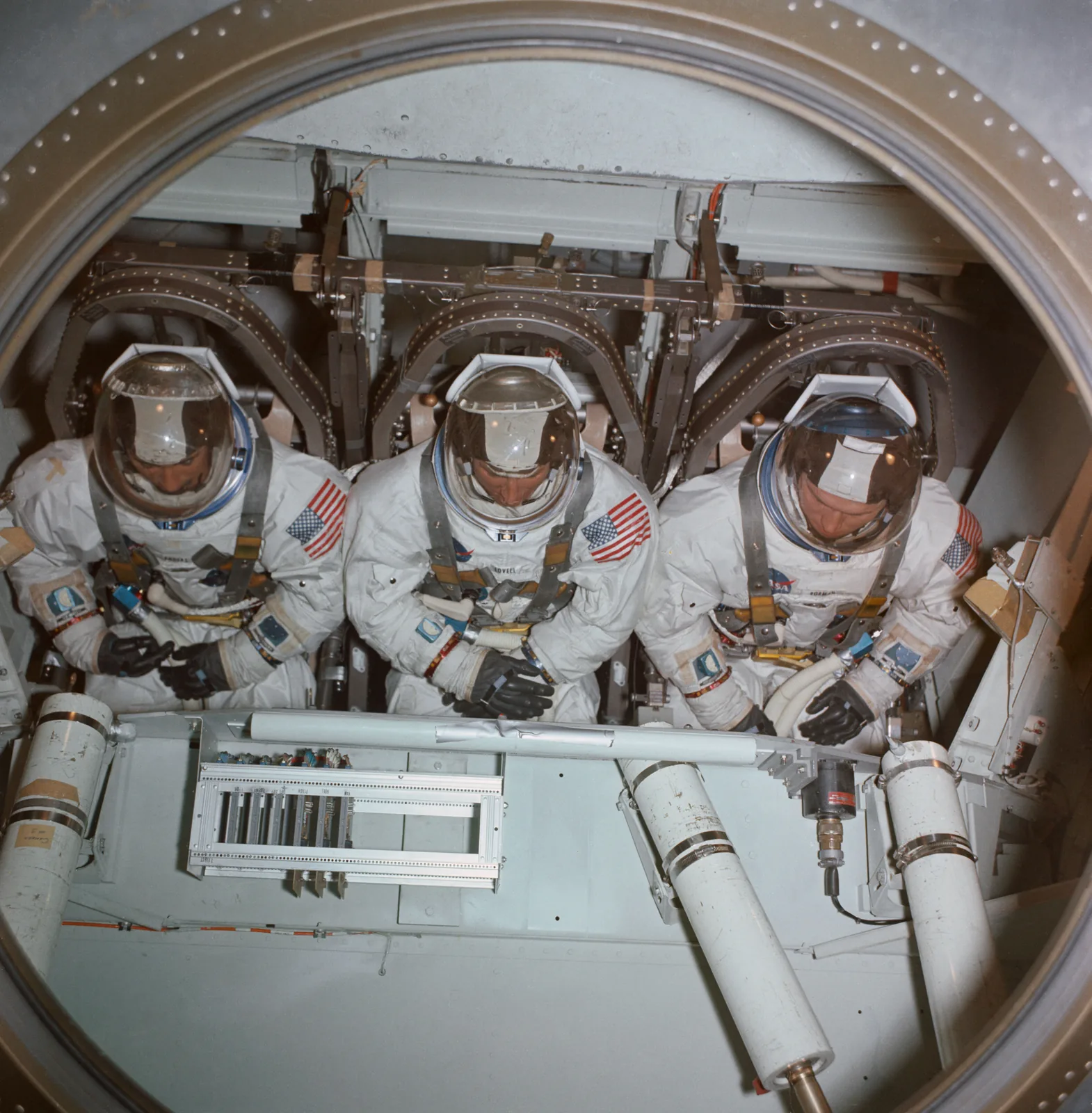
- Apollo 8 prime crew inside centrifuge gondola (S68-53194). NASA. source, public domain