
The gravitational force between bodies
Why does a dropped apple rush towards the Earth, while the Earth does not seem to move towards the apple at all?
Prior knowledge
- In an interaction, bodies exert forces of equal magnitude and opposite directions on each otherchapter Interaction and force: Newton's first and third laws
- The weight of a body is $G = mg$, and on the Earth's surface $g = 9.81\,\text{m/s}^2$chapter Weight, friction and the inclined plane
- In uniform circular motion a body has a centripetal acceleration $a_\text{n} = \tfrac{v^2}{r}$ towards the centre of the pathchapter Centripetal acceleration and the equation of motion in a circle
Core path: follow the steps in order. Tasks marked Optional give extra practice. Optional tasks: 4.
Think about it
On a September evening, a dull thud is heard from under an apple tree at regular intervals as a ripe apple comes loose and falls onto the lawn. The apple starts from rest and accelerates downwards, towards the Earth. Isaac Newton pondered exactly this kind of situation and asked whether the same pull that makes the apple fall reaches all the way to the Moon.
If the Earth pulls the apple, does the apple also pull the Earth? And if it does, why does the Earth not move towards the apple?
Optional Review: acceleration in circular motion
Predict
Make your predictions before investigating 2 questions
Prediction 1: which pulls more?
Prediction 2: moving farther away
Investigate
Two boulders in space. Change the masses and the distance, and compare the force arrows with each other and the acceleration arrows with each other.
Simulation
How to use
The sliders change the masses $m_1$ and $m_2$ of the boulders and the distance $r$ between their centres. The red arrows above the boulders are the gravitational forces $\overline{F}_1$ and $\overline{F}_2$ acting on the boulders, and the orange arrows below them are the accelerations $\overline{a}_1$ and $\overline{a}_2$ of the boulders. The bars in the top right corner show the scale of the arrows. The scale changes when the forces or accelerations change a lot, but arrows of the same colour are always on the same scale. The graph collects a point from every distance you have visited; the points disappear when you change a mass or press Clear graph.
Assumptions of the model
The boulders are uniform stone spheres with a density of $3000\,\text{kg/m}^3$, drawn to scale. A spherically symmetric body attracts another as if its mass were at its centre, so the distance is measured between the centres. There are no other bodies nearby, so only the gravitation between the boulders acts on them. The picture shows the forces and accelerations at one instant: the boulders do not move, because with such tiny accelerations they would shift at most about $0.3\,\text{mm}$ in a minute. The numbers are values calculated by the model, not measurements.
How the calculation works
The magnitude of the force is calculated from Newton's law of gravitation $F = \gamma \tfrac{m_1 m_2}{r^2}$, where $\gamma = 6.674 \cdot 10^{-11}\,\tfrac{\text{N}\cdot\text{m}^2}{\text{kg}^2}$ and the masses are converted to kilograms ($1\,\text{t} = 1000\,\text{kg}$). $F_1$ is the magnitude of the force acting on boulder 1 and $F_2$ that on boulder 2. The accelerations come from Newton's second law: $a_1 = \tfrac{F_1}{m_1}$ and $a_2 = \tfrac{F_2}{m_2}$. The forces are shown in micronewtons, $1\,\mu\text{N} = 10^{-6}\,\text{N}$, and the accelerations in nanometres per second squared, $1\,\text{nm/s}^2 = 10^{-9}\,\text{m/s}^2$.
Experiment 1: only the mass of the second boulder changes
Test prediction 1. The mass of boulder 1, $m_1 = 10\,\text{t}$, and the distance $r = 4.0\,\text{m}$ stay constant. Change only the mass $m_2$ and record the forces and accelerations for at least two masses, for example $2\,\text{t}$, $6\,\text{t}$ and $10\,\text{t}$. Compare the forces $F_1$ and $F_2$ with each other. What happens to the accelerations?
Initial state: mass of boulder 1, $m_1$ = $10\,\text{t}$, mass of boulder 2, $m_2$ = $2\,\text{t}$, distance $r$ = $4\,\text{m}$. Kept constant: mass of boulder 1, $m_1$, distance $r$. Varied: mass of boulder 2, $m_2$.
| mass of boulder 2, $m_2$ | $F_1$ $(\mu\text{N})$ | $F_2$ $(\mu\text{N})$ | $a_1$ $(\text{nm/s}^2)$ | $a_2$ $(\text{nm/s}^2)$ |
|---|
Experiment 2: only the distance changes
Test prediction 2. The mass of each boulder is $10\,\text{t}$ and stays constant. Change only the distance $r$ and record the force at at least three distances, for example $3.0\,\text{m}$, $6.0\,\text{m}$ and $9.0\,\text{m}$. At the same time, watch what kind of graph the points form.
Initial state: mass of boulder 1, $m_1$ = $10\,\text{t}$, mass of boulder 2, $m_2$ = $10\,\text{t}$, distance $r$ = $3\,\text{m}$. Kept constant: mass of boulder 1, $m_1$, mass of boulder 2, $m_2$. Varied: distance $r$.
| distance $r$ | $F_1$ $(\mu\text{N})$ |
|---|
How many times as large is the force at a distance of $3.0\,\text{m}$ as the force at a distance of $6.0\,\text{m}$? Calculate from the readings in your table.
Show the solution
Given
simulation readings $F(3.0\,\text{m}) = 742\,\mu\text{N}$ and $F(6.0\,\text{m}) = 185\,\mu\text{N}$, when $m_1 = m_2 = 10\,\text{t}$
Find
the ratio of the forces $\tfrac{F(3.0\,\text{m})}{F(6.0\,\text{m})}$, without a unit
Principle
The masses stay the same, so the ratio tells how the distance alone affects the force. The ratio of two values of the same quantity is calculated by dividing the readings by each other.
Formula
ratio $= \dfrac{F(3.0\,\text{m})}{F(6.0\,\text{m})}$
Conversions
None needed: both forces are in micronewtons, and the unit cancels.
Substitution
ratio $= \dfrac{742\,\mu\text{N}}{185\,\mu\text{N}} = 4.01$
Answer
$4.0$
: the force at the shorter distance is four times as large. Two significant figures are enough, because the readings are rounded to three figures.
Reasonableness
By the law of gravitation $F \propto \tfrac{1}{r^2}$, so halving the distance from $6.0\,\text{m}$ to $3.0\,\text{m}$ makes the force $2^2 = 4$ times as large. Also $F r^2$ is the same in both:
Optional Newton's Moon test
Statistical data · NASA, Moon Fact Sheet and Earth Fact Sheet (nssdc.gsfc.nasa.gov), read in 2026
Newton tested his law of gravitation by comparing the accelerations of the apple and the Moon. If the Earth's pull weakens with the square of the distance, the Moon's acceleration should be $\tfrac{1}{60^2}$ of the acceleration due to gravity, because the Moon is about $60$ Earth radii from the Earth's centre.
| quantity | value |
|---|---|
| radius of the Earth $R$ | $6378\,\text{km}$ |
| mean distance of the Moon from the Earth's centre $r$ | $384\,400\,\text{km}$ |
| orbital period of the Moon $T$ | $27.32\,\text{d}$ |
| gravitational field strength on the Earth's surface $g$ | $9.80\,\text{m/s}^2$ |
The acceleration of the Moon can be calculated from its orbit as in the chapter Centripetal acceleration and the equation of motion in a circle, when the orbit is assumed to be a circle.
Calculate the centripetal acceleration of the Moon $a_\text{n} = \tfrac{v^2}{r}$, when the orbital speed of the Moon is $v = \tfrac{2\pi r}{T}$. Give the answer in $\text{mm/s}^2$.
Hint 1: a guiding question
First convert the distance to metres and the period to seconds: $1\,\text{d} = 24 \cdot 3600\,\text{s}$.
Hint 2: what is the connection
Substituting $v = \tfrac{2\pi r}{T}$ gives $a_\text{n} = \tfrac{4\pi^2 r}{T^2}$.
Hint 3: an intermediate step
Show the solution
Given
mean distance of the Moon $r = 384\,400\,\text{km}$, orbital period $T = 27.32\,\text{d}$; for comparison $g = 9.80\,\text{m/s}^2$ and $R = 6378\,\text{km}$
Find
the centripetal acceleration of the Moon $a_\text{n}$ in $\text{mm/s}^2$
Principle
The Moon moves round the Earth at a nearly constant speed along a nearly circular path, so it has a centripetal acceleration towards the Earth's centre. The orbital speed is obtained from the distance and the time of one revolution.
Formula
$a_\text{n} = \tfrac{v^2}{r}$ and $v = \tfrac{2\pi r}{T}$, so $a_\text{n} = \dfrac{4\pi^2 r}{T^2}$
Conversions
finally $1\,\text{m/s}^2 = 1000\,\text{mm/s}^2$
Substitution
Answer
$2.72\,\text{mm/s}^2$
Three significant figures as in the distance and the period.
Reasonableness
The prediction of the inverse-square law is
The values differ by less than one per cent, so the same pull of the Earth that makes the apple fall is enough to explain the motion of the Moon.
Conclusion: forces, accelerations and distance
Based on your tables, write: how do the forces acting on the boulders compare with each other? Why are the accelerations of the boulders different, and which boulder's acceleration stayed the same in experiment 1? How does the force change when the distance doubles or triples?
Model answer
In experiment 1 an equal force acted on both boulders every time: $83.4\,\mu\text{N}$ when $m_2 = 2\,\text{t}$ and $250\,\mu\text{N}$ when $m_2 = 6\,\text{t}$. The force grew in the same proportion as $m_2$. The acceleration $a = \tfrac{F}{m}$ was greater for the lighter boulder. The acceleration of boulder 2 stayed the same, $41.7\,\text{nm/s}^2$, although its mass changed: when the mass grows, the force grows in the same proportion, so the acceleration of a body does not depend on its own mass. In experiment 2 the force fell to a quarter when the distance doubled ($742\,\mu\text{N}$ and $185\,\mu\text{N}$) and to a ninth when it tripled ($82.4\,\mu\text{N}$). The product $F r^2$ stayed the same, so the force is inversely proportional to the square of the distance. The numbers are values calculated by the model.
Assess your own answer
Tick the points your own answer already contains.
Review the theory summary and practise with the exercises.
Theory summary
Key idea
In the 17th century Isaac Newton concluded that the same interaction that makes an apple fall also keeps the Moon in its orbit. This interaction is called gravitation: every body that has mass attracts every other body. You and your desk attract each other, and so do two students sitting side by side. In everyday life we do not notice this, because the force is very small unless one of the bodies is enormous. The gravitational force between two people of $70\,\text{kg}$ and $60\,\text{kg}$ one metre apart is only about $0.28\,\mu\text{N}$. The pull of the Earth on the same person is almost $700\,\text{N}$.
Gravitation is an interaction, so Newton's third law applies to it. The Earth pulls the apple with a force $\overline{F}_1$, and the apple pulls the Earth with a force $\overline{F}_2$ of equal magnitude and opposite direction. The larger body does not pull the smaller one harder than the smaller pulls the larger: the forces are always equal, $F_1 = F_2$.
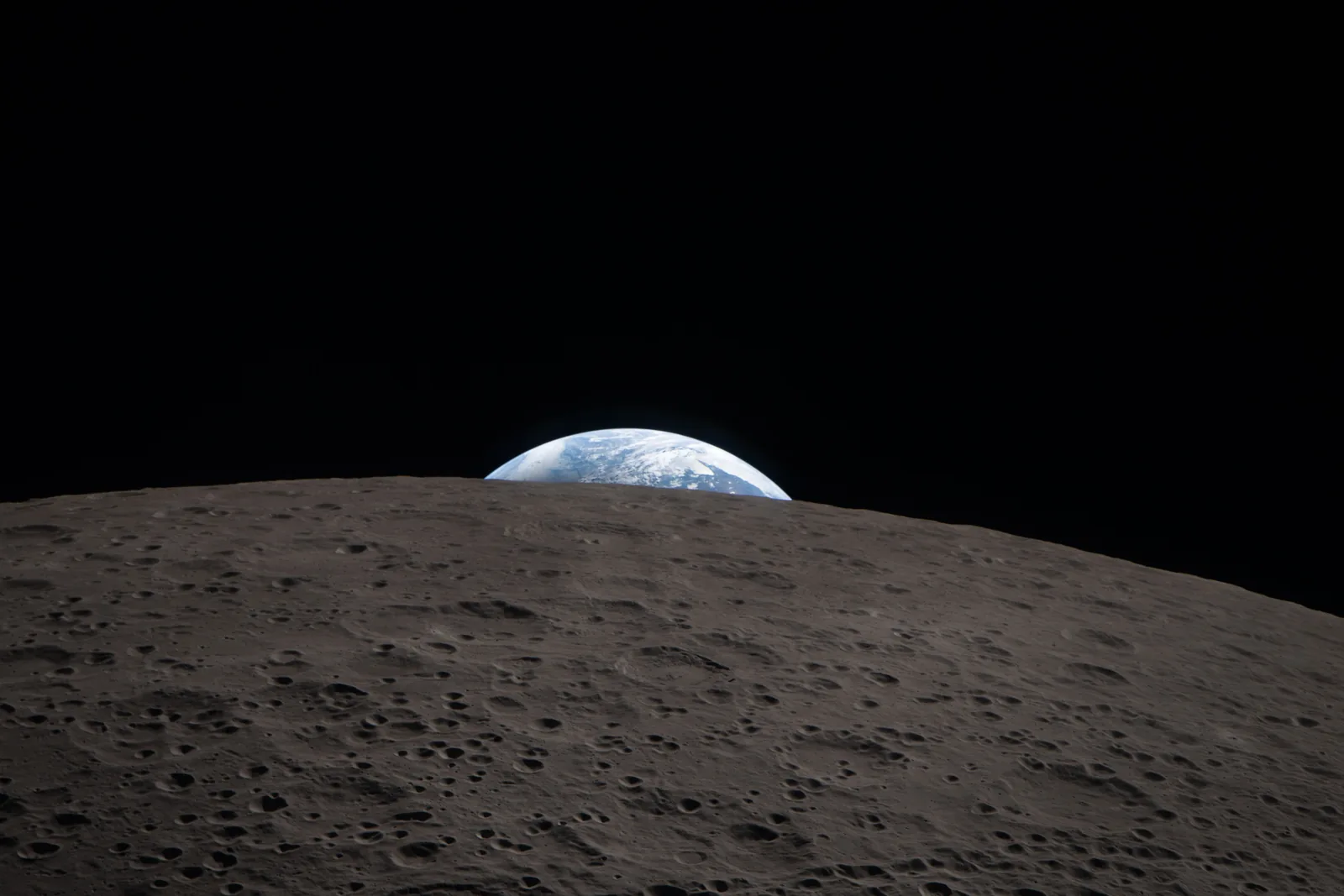
The difference is in the accelerations. By Newton's second law the acceleration of a body is $a = \tfrac{F}{m}$. When a force of about $1.96\,\text{N}$ acts on an apple of $0.20\,\text{kg}$, the acceleration of the apple is about $9.8\,\text{m/s}^2$. The same force gives the Earth, whose mass is $5.97 \cdot 10^{24}\,\text{kg}$, an acceleration of about $3 \cdot 10^{-25}\,\text{m/s}^2$. The Earth really does move towards the apple, but so little that it cannot be measured.
Newton's law of gravitation
The gravitational force between two bodies is greater the greater the masses of the bodies, and smaller the farther apart they are. Newton's law of gravitation says that the force is directly proportional to each mass and inversely proportional to the square of the distance (an inverse-square law):
$$F = \gamma \frac{m_1 m_2}{r^2}$$
where $F$ is the magnitude of the gravitational force acting on each body (N), $m_1$ and $m_2$ are the masses of the bodies (kg), $r$ is the distance between the centres of the bodies (m) and $\gamma$ is the gravitational constant, $\gamma = 6.674 \cdot 10^{-11}\,\tfrac{\text{N}\cdot\text{m}^2}{\text{kg}^2}$. (Many English books write the gravitational constant as G; in this book G is the weight of a body, so the constant is written γ.) The force acts on each body towards the other body. Henry Cavendish first measured the constant in 1798 from the attraction between lead spheres.
The law holds as such for point masses. It also holds for uniform spheres and other spherically symmetric bodies, such as planets and stars, when $r$ is measured between the centres: such a body attracts outside bodies as if its whole mass were at its centre. The distance of a person standing on the Earth's surface from the Earth's centre is therefore the radius of the Earth.
The distance is squared in the formula. When the distance doubles, the force falls to a quarter, and when the distance triples, to a ninth. When one mass doubles, the force doubles too. The gravitational force decreases quickly as the distance grows, but it never becomes exactly zero. The graph shows the force when the mass of each body is $10\,\text{t}$.
Weight and the gravitational field
The weight $G = mg$ of a body is the gravitational force the Earth exerts on it. When the mass of the Earth is $M$ and its radius $R$, the law of gravitation gives the same force, so $mg = \gamma \tfrac{Mm}{R^2}$. The mass $m$ of the body cancels, and the acceleration due to gravity is left as $g = \gamma \tfrac{M}{R^2}$. This is why all bodies fall with the same acceleration on the Earth's surface when air resistance is ignored: a greater force acts on a heavier body, but it is also harder to accelerate.
Gravitational field strength
The Earth changes its surroundings so that at every point a certain pull is ready: a force $\overline{F} = m\overline{g}$ acts on a body brought there. This is called the gravitational field of the Earth. The field strength at a distance $r$ from the centre of a body is
$$g = \gamma \frac{M}{r^2}$$
where $M$ is the mass of the body that creates the field (kg) and $r$ is the distance from its centre (m). The direction of the field is towards the centre of the body, and the unit of the field strength is $\text{m/s}^2$. If only gravitation acts on a body, its acceleration by Newton's second law is $a = \tfrac{F}{m} = \tfrac{mg}{m} = g$. The gravitational field strength is therefore the same thing as the acceleration of a freely falling body at that point.
The field on different celestial bodies
The field strengths in the table have been calculated from the formula $g = \gamma \tfrac{M}{R^2}$ using the masses and equatorial radii from NASA's Planetary Fact Sheet. The value $9.80\,\text{m/s}^2$ for the Earth is calculated without the effect of the Earth's rotation; the measured value is slightly different, and the tasks of this book use the value $9.81\,\text{m/s}^2$. The mass of a body is the same everywhere, but its weight depends on the field of which celestial body it is in.
| Body | mass $M$ (kg) | radius $R$ (km) | $g$ ($\text{m/s}^2$) |
|---|---|---|---|
| Moon | $7.35 \cdot 10^{22}$ | $1738$ | $1.62$ |
| Mars | $6.42 \cdot 10^{23}$ | $3396$ | $3.71$ |
| Earth | $5.97 \cdot 10^{24}$ | $6378$ | $9.80$ |
| Jupiter | $1.90 \cdot 10^{27}$ | $71\,492$ | $24.8$ |
| Sun | $1.99 \cdot 10^{30}$ | $695\,700$ | $274$ |
The acceleration due to gravity measured on the Earth's surface varies between $9.78\text{–}9.83\,\text{m/s}^2$, because the Earth rotates and is slightly flattened. In this book the value $g = 9.81\,\text{m/s}^2$ is used when the acceleration due to gravity on the Earth's surface is needed.
Gravitation in the universe
Gravitation is the weakest of the fundamental interactions, but on large scales it is decisive. Electric forces are much stronger, but positive and negative charges cancel each other's effects, so large bodies are nearly electrically neutral. Gravitation, on the other hand, is always attractive: every mass adds to the pull, and nothing cancels it. In addition, the effect of gravitation reaches far, because $\tfrac{1}{r^2}$ becomes smaller but never becomes zero.
The early universe was an almost uniform cloud of gas. Places where there was slightly more matter than average pulled the surrounding matter harder, so they became denser still. The condensations grew into gas clouds whose central parts collapsed under their own weight. As it collapsed, the gas became denser and hotter, until nuclear reactions started in its centre and a star was born. The matter left in the flat disc around the star gathered into planets. Gravitation also gathers stars into galaxies and galaxies into clusters of galaxies, and it keeps the planets in their orbits around their star.
Common misconception
"The Earth pulls the Moon harder than the Moon pulls the Earth, because the Earth is much bigger." Gravitation is an interaction, so by Newton's third law the forces are always equal and opposite. The difference in mass shows in the accelerations: the same force accelerates the lighter body more. Another common belief is that gravitation ends above the atmosphere. In fact it only weakens as the distance grows: for example, at a height of $300\,\text{km}$ the field strength is still about $8.9\,\text{m/s}^2$.
Summary
- All bodies attract each other with the gravitational force $F = \gamma \tfrac{m_1 m_2}{r^2}$, where $r$ is the distance between the centres and $\gamma = 6.674 \cdot 10^{-11}\,\tfrac{\text{N}\cdot\text{m}^2}{\text{kg}^2}$.
- The gravitational forces between two bodies are equal and opposite; the lighter body accelerates more.
- When the distance doubles, the force falls to a quarter.
- The gravitational field strength $g = \gamma \tfrac{M}{r^2}$ is the acceleration of a freely falling body, with the unit $\text{m/s}^2$; the weight of a body is $G = mg$.
- Gravitation is always attractive and reaches far, so it gathers matter into stars, planets and galaxies.
Optional Return to your predictions
Compare your predictions with the values of the model in the experiments and with the law of gravitation. Then return to the opening question: does the apple pull the Earth, and why does the Earth not move towards the apple?
Would you change your prediction?
Apply
Worked example
Problem
With what force do the Earth and the Moon attract each other? The mass of the Earth is $5.97 \cdot 10^{24}\,\text{kg}$, the mass of the Moon $7.35 \cdot 10^{22}\,\text{kg}$ and the mean distance between their centres $3.84 \cdot 10^{5}\,\text{km}$.
Step 1/7
Given and find. Mass of the Earth $M = 5.97 \cdot 10^{24}\,\text{kg}$, mass of the Moon $m = 7.35 \cdot 10^{22}\,\text{kg}$, distance $r = 3.84 \cdot 10^{5}\,\text{km}$ and gravitational constant $\gamma = 6.674 \cdot 10^{-11}\,\tfrac{\text{N}\cdot\text{m}^2}{\text{kg}^2}$. We want the magnitude $F$ of the gravitational force.
Step 2/7
Principle. The Earth and the Moon are almost spherically symmetric, so the force between them can be calculated with Newton's law of gravitation when $r$ is the distance between the centres. By Newton's third law the same force acts on both the Moon and the Earth.
Step 3/7
Formula solved. The asked force is already solved for:
$$F = \gamma \frac{M m}{r^2}$$
Step 4/7
Unit conversions. The distance is converted to metres:
The masses are already in kilograms.
Step 5/7
Substitution. Substitute the values with their units:
$$\begin{aligned} F &= \gamma \frac{M m}{r^2} \\ &= 6.674 \cdot 10^{-11}\,\tfrac{\text{N}\cdot\text{m}^2}{\text{kg}^2} \\ &\quad \cdot \frac{5.97 \cdot 10^{24}\,\text{kg} \cdot 7.35 \cdot 10^{22}\,\text{kg}}{(3.84 \cdot 10^{8}\,\text{m})^2} \\ &\approx 1.99 \cdot 10^{20}\,\text{N} \end{aligned}$$
Step 6/7
Answer. The Earth and the Moon attract each other with a force $F \approx 1.99 \cdot 10^{20}\,\text{N}$. The answer is given to three significant figures, because the masses and the distance are given to three figures.
Step 7/7
Reasonableness. With rounded numbers
so the order of magnitude is right. The force is enormous, but the acceleration of the Moon is still only
because the mass of the Moon is large.
Optional Find the error
Apply to a new situation
A space probe rises straight up from the Earth's surface.
At what height above the Earth's surface is the Earth's gravitational field strength half of its value at the surface? The radius of the Earth is $6378\,\text{km}$. Give the answer in kilometres.
Hint 1: a guiding question
How does the field strength depend on the distance $r$ from the Earth's centre? Write the condition $g(r) = \tfrac{1}{2} g(R)$ using the formula $g = \gamma \tfrac{M}{r^2}$.
Hint 2: what is the connection
$\gamma \tfrac{M}{r^2} = \tfrac{1}{2} \gamma \tfrac{M}{R^2}$, so $r^2 = 2R^2$, that is, $r = \sqrt{2}\,R$. The height above the surface is $h = r - R$.
Hint 3: an intermediate step
Show the solution
Given
radius of the Earth $R = 6378\,\text{km}$; the field strength at height $h$ is half of its value at the surface
Find
the height $h$ above the Earth's surface in kilometres
Principle
The Earth's gravitational field strength is $g = \gamma \tfrac{M}{r^2}$, where $r$ is the distance from the Earth's centre, because the Earth attracts as if its mass were at its centre. On the surface $r = R$, at height $h$ it is $r = R + h$. The mass of the Earth is not needed, because it cancels.
Formula
so $(R + h)^2 = 2R^2$ and $h = (\sqrt{2} - 1) R$
Conversions
None needed: the radius is in kilometres, and the answer is asked in kilometres.
Substitution
Answer
$2640\,\text{km}$
To three significant figures; with four figures of the radius the result would be $2642\,\text{km}$.
Reasonableness
Check:
The height is smaller than the radius of the Earth, which fits the fact that twice the distance from the centre would already reduce the field to a quarter.
Check your understanding
Exit ticket
Answer on your own first and only then open the answer.
- How large is the gravitational force between two bodies of mass $1.0\,\text{kg}$ when their centres are $1.0\,\text{m}$ apart?
Answer
$F$$= \gamma \tfrac{m_1 m_2}{r^2}$$= 6.674 \cdot 10^{-11}\,\tfrac{\text{N}\cdot\text{m}^2}{\text{kg}^2} \cdot \tfrac{1.0\,\text{kg} \cdot 1.0\,\text{kg}}{(1.0\,\text{m})^2}$$\approx 6.7 \cdot 10^{-11}\,\text{N}$The numerical value of the gravitational constant is exactly the magnitude of this force in newtons, and the force is so small that it is not noticed in everyday life.
- Why do a heavy and a light stone fall in a vacuum with the same acceleration, although a greater gravitational force acts on the heavier one?
Answer
The gravitational force $F = \gamma \tfrac{Mm}{R^2}$ is directly proportional to the mass $m$ of the stone, but the inertia of the stone also grows with its mass. The acceleration
$a$$= \tfrac{F}{m}$$= \gamma \tfrac{M}{R^2}$$= g$therefore does not depend on the mass of the stone.
1. Mass and weight
2. Change of the force
The gravitational force between two bodies is $12\,\text{N}$. The mass of one body is tripled, and the distance between the centres of the bodies is doubled.
How large is the gravitational force now? Give the answer in newtons.
Hint 1: a guiding question
How does the force change when only the mass is tripled? And when only the distance is doubled?
Hint 2: what is the connection
$F \propto m_1 m_2$ and $F \propto \tfrac{1}{r^2}$, so the new force is $F' = F \cdot \tfrac{3}{2^2}$.
Hint 3: an intermediate step
$F' = 12\,\text{N} \cdot \tfrac{3}{4}$.
Show the solution
Given
original force $F = 12\,\text{N}$; second mass $3m_2$; distance $2r$
Find
the new gravitational force $F'$ in newtons
Principle
By Newton's law of gravitation the force is directly proportional to each mass and inversely proportional to the square of the distance. When the ratio of the new and old forces is calculated, $\gamma$, $m_1$, $m_2$ and $r$ cancel.
Formula
so $F' = \dfrac{3}{4} F$
Conversions
None needed: the force is in newtons, and the ratio has no unit.
Substitution
Answer
$9.0\,\text{N}$
Two significant figures as in the force $12\,\text{N}$.
Reasonableness
Tripling the mass alone would give $36\,\text{N}$ and doubling the distance alone $3.0\,\text{N}$. Together the effects almost cancel, so the force is a little smaller than at the start, as $9.0\,\text{N}$ is.
Suggestion: one answer does not show everything you can do, but review the theory summary and do the core exercises.
3. Gravitation and the structures of the universe
Gravitation is the weakest of the fundamental interactions. Explain why it is gravitation that has gathered stars and galaxies out of gas, although the electric interaction is much stronger.
Model answer
Gravitation is always attractive: every mass adds to the pull, and nothing cancels it. In the electric interaction positive and negative charges cancel each other's effects, so large bodies and gas clouds are nearly neutral and the electric force does not gather them together. Gravitation also reaches far, because $F \propto \tfrac{1}{r^2}$ becomes smaller but never becomes zero. When there is a place in the gas where there is slightly more matter than usual, it pulls its surroundings harder and keeps growing. In this way the condensations grew into clouds that collapsed into stars, and the stars gathered into galaxies.
Assess your own answer
Tick the points your own answer already contains.
Review the theory summary and practise with the exercises.
Review the chapter's concepts
Cards you mark Review later collect in your review deck.
- Gravitational force
- The force with which two objects with mass attract each other.
- Gravitational constant
- A constant of nature that sets the strength of the gravitational interaction.$$\gamma \approx 6.67 \cdot 10^{-11}\,\text{N}\cdot\text{m}^2/\text{kg}^2$$
- Gravitational field
- The region around an object with mass in which another object feels a gravitational force.
- Gravitational field strength
- The gravitational force on an object per unit mass.$$g = \dfrac{F}{m}$$
Exercises
Level 1 · basic practice 5 exercises
One formula or one step of reasoning. Core exercises first, the rest is extra practice.
- Exercise 5-1Core
Two students sit next to each other on a bench. Their masses are $70\,\text{kg}$ and $55\,\text{kg}$, and the distance between their centres of mass is $0.80\,\text{m}$.
How large is the gravitational force between them? Treat the students as point masses and give the answer in micronewtons ($1\,\mu\text{N} = 10^{-6}\,\text{N}$).
Answer
$0.40\,\mu\text{N}$
Show the solution
Given
masses $m_1 = 70\,\text{kg}$ and $m_2 = 55\,\text{kg}$, distance between the centres of mass $r = 0.80\,\text{m}$, gravitational constant $\gamma = 6.674 \cdot 10^{-11}\,\tfrac{\text{N}\cdot\text{m}^2}{\text{kg}^2}$
Find
the gravitational force $F$ between the students in micronewtons
Principle
All bodies attract each other according to Newton's law of gravitation. When the students are treated as point masses, the distance is measured between their centres of mass, and the same force acts on each of them.
Formula
$F = \gamma \dfrac{m_1 m_2}{r^2}$
Conversions
The masses and the distance are in SI units. Finally $1\,\mu\text{N} = 10^{-6}\,\text{N}$.
Substitution
$F$$= 6.674 \cdot 10^{-11}\,\tfrac{\text{N}\cdot\text{m}^2}{\text{kg}^2} \cdot \dfrac{70\,\text{kg} \cdot 55\,\text{kg}}{(0.80\,\text{m})^2}$$= 4.015 \cdot 10^{-7}\,\text{N}$$= 0.4015\,\mu\text{N}$Answer
$0.40\,\mu\text{N}$
Two significant figures as in the masses and in the distance $0.80\,\text{m}$.
Reasonableness
The force corresponds to the weight of a particle of mass about $0.04\,\text{mg}$, so it is not noticed in everyday life. The order of magnitude is the same as in the example of the chapter, where the force between two people one metre apart was about $0.28\,\mu\text{N}$; here the distance is smaller, so the force is slightly greater.
- Exercise 5-2Core
Two cruise ships lie side by side in a harbour, with masses $5.0 \cdot 10^{7}\,\text{kg}$ and $3.0 \cdot 10^{7}\,\text{kg}$. The distance between the ships' centres of mass is $200\,\text{m}$.
With what gravitational force do the ships attract each other? Treat the ships as point masses.
Answer
$2.5\,\text{N}$
Show the solution
Given
masses of the ships $m_1 = 5.0 \cdot 10^{7}\,\text{kg}$ and $m_2 = 3.0 \cdot 10^{7}\,\text{kg}$, distance between the centres of mass $r = 200\,\text{m}$, $\gamma = 6.674 \cdot 10^{-11}\,\tfrac{\text{N}\cdot\text{m}^2}{\text{kg}^2}$
Find
the gravitational force $F$ between the ships in newtons
Principle
The ships attract each other according to Newton's law of gravitation. In the task the ships are treated as point masses. In reality the ships are as long as the distance between them, so the result is only an estimate of the order of magnitude.
Formula
$F = \gamma \dfrac{m_1 m_2}{r^2}$
Conversions
None needed: the masses are in kilograms and the distance in metres.
Substitution
$F$$= 6.674 \cdot 10^{-11}\,\tfrac{\text{N}\cdot\text{m}^2}{\text{kg}^2} \cdot \dfrac{5.0 \cdot 10^{7}\,\text{kg} \cdot 3.0 \cdot 10^{7}\,\text{kg}}{(200\,\text{m})^2}$$= 2.503\,\text{N}$Answer
$2.5\,\text{N}$
Two significant figures as in the masses.
Reasonableness
With rounded numbers
$7 \cdot 10^{-11} \cdot \tfrac{1.5 \cdot 10^{15}}{4 \cdot 10^{4}}\,\text{N}$$\approx 2.6\,\text{N}$Even between enormous ships the pull is only of the order of the weight of a body of $250\,\text{g}$, and compared with the forces of ropes and water it is negligible.
- Exercise 5-3
The mass of the planet Mercury is $3.30 \cdot 10^{23}\,\text{kg}$ and its radius is $2.44 \cdot 10^{6}\,\text{m}$. How large is the gravitational field strength on the surface of Mercury?
Answer
$3.70\,\text{m/s}^2$
Show the solution
Given
mass of Mercury $M = 3.30 \cdot 10^{23}\,\text{kg}$ and radius $R = 2.44 \cdot 10^{6}\,\text{m}$, $\gamma = 6.674 \cdot 10^{-11}\,\tfrac{\text{N}\cdot\text{m}^2}{\text{kg}^2}$
Find
the gravitational field strength $g$ on the surface of Mercury
Principle
The planet is approximately spherically symmetric, so it attracts as if its mass were at its centre. On the surface the distance from the centre is the radius of the planet.
Formula
$g = \gamma \dfrac{M}{R^2}$
Conversions
None needed: the mass is in kilograms and the radius in metres, so the result is in $\text{m/s}^2$.
Substitution
$g$$= 6.674 \cdot 10^{-11}\,\tfrac{\text{N}\cdot\text{m}^2}{\text{kg}^2} \cdot \dfrac{3.30 \cdot 10^{23}\,\text{kg}}{(2.44 \cdot 10^{6}\,\text{m})^2}$$= 3.699\,\text{m/s}^2$Answer
$3.70\,\text{m/s}^2$
Three significant figures as in the mass and the radius.
Reasonableness
Mercury is smaller and lighter than the Earth, so the field must be weaker than $9.81\,\text{m/s}^2$. The result is almost the same as on Mars ($3.71\,\text{m/s}^2$), which is larger than Mercury but also more massive.
- Exercise 5-4
A rover that has landed on Mars has a mass of $1025\,\text{kg}$. The mass of Mars is $6.42 \cdot 10^{23}\,\text{kg}$ and its radius is $3.40 \cdot 10^{6}\,\text{m}$.
With what gravitational force does Mars attract the rover on its surface? Give the answer in kilonewtons.
Answer
$3.80\,\text{kN}$
Show the solution
Given
mass of the rover $m = 1025\,\text{kg}$, mass of Mars $M = 6.42 \cdot 10^{23}\,\text{kg}$ and radius $R = 3.40 \cdot 10^{6}\,\text{m}$, $\gamma = 6.674 \cdot 10^{-11}\,\tfrac{\text{N}\cdot\text{m}^2}{\text{kg}^2}$
Find
the gravitational force $F$ exerted by Mars on the rover in kilonewtons
Principle
Mars is approximately spherically symmetric, so the force between it and the rover is obtained from the law of gravitation when the distance is the radius of Mars.
Formula
$F = \gamma \dfrac{M m}{R^2}$
Conversions
The quantities are in SI units. Finally $1\,\text{kN} = 1000\,\text{N}$.
Substitution
$F$$= 6.674 \cdot 10^{-11}\,\tfrac{\text{N}\cdot\text{m}^2}{\text{kg}^2} \cdot \dfrac{6.42 \cdot 10^{23}\,\text{kg} \cdot 1025\,\text{kg}}{(3.40 \cdot 10^{6}\,\text{m})^2}$$= 3799\,\text{N}$$= 3.799\,\text{kN}$Answer
$3.80\,\text{kN}$
Three significant figures as in the mass and radius of Mars.
Reasonableness
Another route: the weight of the rover on Mars is
$mg$$= 1025\,\text{kg} \cdot 3.71\,\text{m/s}^2$$\approx 3800\,\text{N}$which is only about two fifths of its weight on the Earth ($10.1\,\text{kN}$).
- Exercise 5-5
The gravitational force between two spacecraft is $36\,\mu\text{N}$. The spacecraft move apart so that the distance between their centres triples.
How large is the gravitational force now? Give the answer in micronewtons.
Answer
$4.0\,\mu\text{N}$
Show the solution
Given
original force $F = 36\,\mu\text{N}$; the distance grows from $r$ to $3r$, the masses stay the same
Find
the new gravitational force $F'$ in micronewtons
Principle
By Newton's law of gravitation the force is inversely proportional to the square of the distance. When the masses do not change, the ratio of the forces depends only on the ratio of the distances.
Formula
$\dfrac{F'}{F}$$= \dfrac{r^2}{(3r)^2}$$= \dfrac{1}{9}$so $F' = \dfrac{F}{9}$
Conversions
None needed: the force stays in micronewtons.
Substitution
$F'$$= \dfrac{36\,\mu\text{N}}{9}$$= 4.0\,\mu\text{N}$Answer
$4.0\,\mu\text{N}$
Two significant figures as in the force $36\,\mu\text{N}$.
Reasonableness
The force decreases as the spacecraft move apart, to less than a third ($12\,\mu\text{N}$), because the distance is raised to the second power in the formula.
Level 2 · applied practice 4 exercises
Two steps, working with measured data, a unit conversion or rearranging a formula. Core exercises first, the rest is extra practice.
- Exercise 5-6Core
In a laboratory the gravitational force between two lead spheres of equal mass is measured. When the distance between the centres of the spheres is $0.40\,\text{m}$, the force is $0.60\,\mu\text{N}$.
What is the mass of each sphere?
Answer
$38\,\text{kg}$
Show the solution
Given
distance between the centres of the spheres $r = 0.40\,\text{m}$, force $F = 0.60\,\mu\text{N}$, equal masses $m_1 = m_2 = m$, $\gamma = 6.674 \cdot 10^{-11}\,\tfrac{\text{N}\cdot\text{m}^2}{\text{kg}^2}$
Find
the mass $m$ of each sphere
Principle
The lead spheres are uniform spheres, so the law of gravitation holds when $r$ is the distance between the centres. Because the masses are equal, the law contains the product $m \cdot m = m^2$, from which the mass is solved.
Formula
$F = \gamma \dfrac{m^2}{r^2}$, so $m = r\sqrt{\dfrac{F}{\gamma}}$
Conversions
$F$$= 0.60\,\mu\text{N}$$= 0.60 \cdot 10^{-6}\,\text{N}$Substitution
$m$$= 0.40\,\text{m} \cdot \sqrt{\dfrac{0.60 \cdot 10^{-6}\,\text{N}}{6.674 \cdot 10^{-11}\,\tfrac{\text{N}\cdot\text{m}^2}{\text{kg}^2}}}$$= 0.40\,\text{m} \cdot 94.82\,\tfrac{\text{kg}}{\text{m}}$$= 37.93\,\text{kg}$Answer
$38\,\text{kg}$
Two significant figures as in the force and the distance.
Reasonableness
Check by substituting back:
$6.674 \cdot 10^{-11} \cdot \tfrac{38^2}{0.40^2}\,\text{N}$$\approx 6.0 \cdot 10^{-7}\,\text{N}$The density of lead is about $11\,300\,\text{kg/m}^3$, so the radius of a sphere of $38\,\text{kg}$ is about $9\,\text{cm}$: the spheres fit easily at a distance of $0.40\,\text{m}$ from each other.
- Exercise 5-7Core
On the surface of Venus the gravitational field strength is $8.87\,\text{m/s}^2$, and the radius of Venus is $6052\,\text{km}$.
How many times as large is the mass of Venus as the mass of the Earth, $5.97 \cdot 10^{24}\,\text{kg}$?
Answer
$0.815$
Show the solution
Given
on the surface of Venus $g = 8.87\,\text{m/s}^2$, radius $R = 6052\,\text{km}$, mass of the Earth $M_\text{E} = 5.97 \cdot 10^{24}\,\text{kg}$, $\gamma = 6.674 \cdot 10^{-11}\,\tfrac{\text{N}\cdot\text{m}^2}{\text{kg}^2}$
Find
the ratio of the mass of Venus to the mass of the Earth, $\tfrac{M}{M_\text{E}}$, without a unit
Principle
The gravitational field strength on the surface of a spherically symmetric planet is $g = \gamma \tfrac{M}{R^2}$, so the mass of the planet can be solved from the measured $g$ and the radius. The mass is then compared with the mass of the Earth by dividing.
Formula
$g = \gamma \dfrac{M}{R^2}$, so $M = \dfrac{g R^2}{\gamma}$ and the ratio is
$\dfrac{M}{M_\text{E}}$$= \dfrac{g R^2}{\gamma M_\text{E}}$Conversions
$R$$= 6052\,\text{km}$$= 6052 \cdot 10^{3}\,\text{m}$$= 6.052 \cdot 10^{6}\,\text{m}$Substitution
$R^2$$= (6.052 \cdot 10^{6}\,\text{m})^2$$= 3.6627 \cdot 10^{13}\,\text{m}^2$$g R^2$$= 8.87\,\text{m/s}^2 \cdot 3.6627 \cdot 10^{13}\,\text{m}^2$$= 3.2488 \cdot 10^{14}\,\text{m}^3/\text{s}^2$$M$$= \dfrac{g R^2}{\gamma}$$= \dfrac{3.2488 \cdot 10^{14}\,\text{m}^3/\text{s}^2}{6.674 \cdot 10^{-11}\,\tfrac{\text{N}\cdot\text{m}^2}{\text{kg}^2}}$$= 4.868 \cdot 10^{24}\,\text{kg}$$\dfrac{M}{M_\text{E}}$$= \dfrac{4.868 \cdot 10^{24}\,\text{kg}}{5.97 \cdot 10^{24}\,\text{kg}}$$= 0.8154$Answer
$0.815$
Three significant figures as in the field strength $8.87\,\text{m/s}^2$.
Reasonableness
Venus is almost the size of the Earth and its field is a little weaker than the Earth's, so its mass must be a little smaller than the Earth's. According to NASA's table the mass of Venus is $4.87 \cdot 10^{24}\,\text{kg}$, which agrees with the result.
- Exercise 5-8
A space probe of mass $1200\,\text{kg}$ leaves the Earth for Mars.
At what height above the Earth's surface is the gravitational force exerted by the Earth on the probe $1.00\,\text{kN}$? The mass of the Earth is $5.97 \cdot 10^{24}\,\text{kg}$ and its radius $6378\,\text{km}$. Give the answer in kilometres.
Answer
$15\,500\,\text{km}$
Show the solution
Given
mass of the probe $m = 1200\,\text{kg}$, force $F = 1.00\,\text{kN}$, mass of the Earth $M = 5.97 \cdot 10^{24}\,\text{kg}$ and radius $R = 6378\,\text{km}$, $\gamma = 6.674 \cdot 10^{-11}\,\tfrac{\text{N}\cdot\text{m}^2}{\text{kg}^2}$
Find
the height $h$ above the Earth's surface in kilometres
Principle
The Earth attracts the probe as if its mass were at its centre, so the law of gravitation first gives the distance $r$ from the Earth's centre. The height above the surface is this distance minus the radius of the Earth.
Formula
$F = \gamma \dfrac{M m}{r^2}$, so
$r$$= \sqrt{\dfrac{\gamma M m}{F}}$$h$$= r - R$$= \sqrt{\dfrac{\gamma M m}{F}} - R$Conversions
$F = 1.00\,\text{kN} = 1000\,\text{N}$;
$R$$= 6378\,\text{km}$$= 6.378 \cdot 10^{6}\,\text{m}$finally $1\,\text{km} = 1000\,\text{m}$
Substitution
The numerator is
$\gamma M m$$= 6.674 \cdot 10^{-11}\,\tfrac{\text{N}\cdot\text{m}^2}{\text{kg}^2} \cdot 5.97 \cdot 10^{24}\,\text{kg} \cdot 1200\,\text{kg}$$= 4.7812 \cdot 10^{17}\,\text{N}\cdot\text{m}^2$so
$r$$= \sqrt{\dfrac{4.7812 \cdot 10^{17}\,\text{N}\cdot\text{m}^2}{1000\,\text{N}}}$$= 2.1866 \cdot 10^{7}\,\text{m}$$h$$= 2.1866 \cdot 10^{7}\,\text{m} - 6.378 \cdot 10^{6}\,\text{m}$$= 1.5488 \cdot 10^{7}\,\text{m}$$= 15\,488\,\text{km}$Answer
$15\,500\,\text{km}$
Three significant figures as in the force $1.00\,\text{kN}$.
Reasonableness
On the Earth's surface the weight of the probe is $1200\,\text{kg} \cdot 9.81\,\text{m/s}^2 \approx 11.8\,\text{kN}$. The force $1.00\,\text{kN}$ is about $\tfrac{1}{11.8}$ of that, so the distance from the centre must be $\sqrt{11.8} \approx 3.4$ Earth radii: $3.4 \cdot 6378\,\text{km} \approx 21\,900\,\text{km}$, which agrees with the value of $r$.
- Exercise 5-9
An airliner flies at a height of $11.0\,\text{km}$.
By what percentage is the Earth's gravitational field strength smaller there than on the Earth's surface? The radius of the Earth is $6378\,\text{km}$.
Answer
$0.344\,\%$
Show the solution
Given
flight altitude $h = 11.0\,\text{km}$, radius of the Earth $R = 6378\,\text{km}$
Find
by what percentage the field strength $g_h$ is smaller than the surface value $g_0$
Principle
The Earth's gravitational field strength is inversely proportional to the square of the distance from the Earth's centre. When the ratio $\tfrac{g_h}{g_0}$ is calculated, $\gamma$ and the mass of the Earth cancel, so they are not needed.
Formula
$\dfrac{g_h}{g_0}$$= \dfrac{\gamma \tfrac{M}{(R + h)^2}}{\gamma \tfrac{M}{R^2}}$$= \left(\dfrac{R}{R + h}\right)^2$so the relative change is $1 - \left(\dfrac{R}{R + h}\right)^2$
Conversions
None needed: the radius and the altitude are both in kilometres, and the unit cancels. Finally the ratio is converted to a percentage by multiplying by $100\,\%$.
Substitution
$1 - \left(\dfrac{6378\,\text{km}}{6378\,\text{km} + 11.0\,\text{km}}\right)^2$$= 1 - 0.996560$$= 0.003440$$= 0.3440\,\%$Answer
$0.344\,\%$
Three significant figures as in the altitude $11.0\,\text{km}$.
Reasonableness
At small heights the change is about
$\tfrac{2h}{R}$$= \tfrac{22.0}{6378}$$\approx 0.345\,\%$At cruising altitude the field strength is still about $9.78\,\text{m/s}^2$, so gravity does not disappear even at flight altitude.
Level 3 · challenging 3 exercises
Optional: application, two ideas together or a new situation where you reason for yourself.
- Exercise 5-10
A space probe flies from the Earth straight towards the Moon.
At what point are the gravitational forces exerted on the probe by the Earth and the Moon equal? The mass of the Earth is $5.97 \cdot 10^{24}\,\text{kg}$, the mass of the Moon $7.35 \cdot 10^{22}\,\text{kg}$ and the distance between their centres $3.84 \cdot 10^{5}\,\text{km}$. Give the distance of the point from the Earth's centre in kilometres.
Answer
$346\,000\,\text{km}$
Show the solution
Given
mass of the Earth $M = 5.97 \cdot 10^{24}\,\text{kg}$, mass of the Moon $m_\text{M} = 7.35 \cdot 10^{22}\,\text{kg}$, distance between the centres $d = 3.84 \cdot 10^{5}\,\text{km}$
Find
the distance $x$ from the Earth's centre at which the forces exerted on the probe by the Earth and the Moon are equal
Principle
When the probe is between the Earth and the Moon, its distance from the Earth's centre is $x$ and from the Moon's centre $d - x$. Each force is obtained from the law of gravitation, and they are set equal; the mass of the probe and $\gamma$ cancel.
Formula
$\gamma \dfrac{M m}{x^2}$$= \gamma \dfrac{m_\text{M} m}{(d - x)^2}$so
$\dfrac{d - x}{x}$$= \sqrt{\dfrac{m_\text{M}}{M}}$$x$$= \dfrac{d}{1 + \sqrt{\tfrac{m_\text{M}}{M}}}$Conversions
None needed: the distance can be kept in kilometres, because the answer is asked in kilometres, and in the ratio of the masses the unit cancels.
Substitution
$\sqrt{\dfrac{7.35 \cdot 10^{22}\,\text{kg}}{5.97 \cdot 10^{24}\,\text{kg}}}$$= 0.11096$$x$$= \dfrac{3.84 \cdot 10^{5}\,\text{km}}{1.11096}$$= 3.456 \cdot 10^{5}\,\text{km}$Answer
$346\,000\,\text{km}$
That is, $3.46 \cdot 10^{5}\,\text{km}$, three significant figures as in the masses and the distance.
Reasonableness
The point is about $90\,\%$ of the way to the Moon, which makes sense because the mass of the Earth is about $81$ times the mass of the Moon: the forces are equal when the distance to the Earth is $\sqrt{81} = 9$ times the distance to the Moon. Here $\tfrac{345\,600}{38\,400} \approx 9.0$.
- Exercise 5-11
A distant exoplanet has the same mean density as the Earth, but its radius is twice the radius of the Earth.
How large is the gravitational field strength on the surface of the planet, when on the Earth's surface it is $9.81\,\text{m/s}^2$? Assume both planets to be spherically symmetric.
Answer
$19.6\,\text{m/s}^2$
Show the solution
Given
radius of the planet $R_\text{p} = 2R$, the same mean density $\rho$ as the Earth, on the Earth's surface $g = 9.81\,\text{m/s}^2$
Find
the gravitational field strength $g_\text{p}$ on the surface of the planet
Principle
The field on the surface of a spherically symmetric planet is $g = \gamma \tfrac{M}{R^2}$. When the density is the same, the mass is the density times the volume of the sphere, $M = \rho \cdot \tfrac{4}{3}\pi R^3$, so the mass grows with the cube of the radius while the denominator grows only with the square. Then $g$ is directly proportional to the radius.
Formula
$g$$= \gamma \dfrac{\rho \cdot \tfrac{4}{3}\pi R^3}{R^2}$$= \tfrac{4}{3}\pi\gamma\rho R$so
$\dfrac{g_\text{p}}{g}$$= \dfrac{R_\text{p}}{R}$$g_\text{p}$$= \dfrac{R_\text{p}}{R}\, g$Conversions
None needed: the ratio of the radii has no unit.
Substitution
$g_\text{p}$$= \dfrac{2R}{R} \cdot 9.81\,\text{m/s}^2$$= 19.62\,\text{m/s}^2$Answer
$19.6\,\text{m/s}^2$
Three significant figures as in the value for the Earth, $9.81\,\text{m/s}^2$.
Reasonableness
By another route: twice the radius with the same density gives a mass $2^3 = 8$ times as great, and the square of the distance grows by a factor $2^2 = 4$, so the field is $\tfrac{8}{4} = 2$ times as strong. The result lies between the field of Jupiter ($24.8\,\text{m/s}^2$) and the field of the Earth.
- Exercise 5-12
Which pulls the Earth harder, the Sun or the Moon, and how many times as hard? The mass of the Sun is $1.99 \cdot 10^{30}\,\text{kg}$ and the distance of its centre from the Earth's centre $1.50 \cdot 10^{8}\,\text{km}$. The mass of the Moon is $7.35 \cdot 10^{22}\,\text{kg}$ and its distance $3.84 \cdot 10^{5}\,\text{km}$. Give the ratio of the force exerted on the Earth by the Sun to the force exerted on it by the Moon.
Answer
$177$
Show the solution
Given
mass of the Sun $M_\text{S} = 1.99 \cdot 10^{30}\,\text{kg}$ and distance $r_\text{S} = 1.50 \cdot 10^{8}\,\text{km}$; mass of the Moon $M_\text{M} = 7.35 \cdot 10^{22}\,\text{kg}$ and distance $r_\text{M} = 3.84 \cdot 10^{5}\,\text{km}$
Find
the ratio $\tfrac{F_\text{S}}{F_\text{M}}$ of the forces exerted on the Earth by the Sun and the Moon
Principle
Each force is obtained from Newton's law of gravitation when the distances are measured between the centres. In the ratio $\gamma$ and the mass of the Earth cancel, so only the masses and distances are needed.
Formula
$\dfrac{F_\text{S}}{F_\text{M}}$$= \dfrac{\gamma \tfrac{M_\text{S} m}{r_\text{S}^2}}{\gamma \tfrac{M_\text{M} m}{r_\text{M}^2}}$$= \dfrac{M_\text{S}}{M_\text{M}} \cdot \left(\dfrac{r_\text{M}}{r_\text{S}}\right)^2$Conversions
None needed: the distances are both in kilometres, and the units cancel.
Substitution
$\dfrac{F_\text{S}}{F_\text{M}}$$= \dfrac{1.99 \cdot 10^{30}\,\text{kg}}{7.35 \cdot 10^{22}\,\text{kg}} \cdot \left(\dfrac{3.84 \cdot 10^{5}\,\text{km}}{1.50 \cdot 10^{8}\,\text{km}}\right)^2$$= 2.707 \cdot 10^{7} \cdot 6.554 \cdot 10^{-6}$$= 177.4$Answer
The Sun attracts the Earth about $177$ times as strongly as the Moon does; three significant figures as in the data.
Reasonableness
The mass of the Sun is about $27$ million times as great, but it is about $390$ times farther away, which reduces the force by a factor $390^2 \approx 150\,000$: $\tfrac{2.7 \cdot 10^{7}}{1.5 \cdot 10^{5}} \approx 180$. The Sun holds the Earth in its orbit, although the Moon is much closer.
Photographs
- A Breathtaking Earthset from Orion (art002e021278). NASA. source, public domain