
Satellites and planets in circular orbits
Why does the International Space Station ISS not fall to the Earth, and why do the astronauts float inside it?
Prior knowledge
- In uniform circular motion a body has a centripetal acceleration $a_\text{n} = \tfrac{v^2}{r}$ towards the centre, and the speed is $v = \tfrac{2\pi r}{T}$chapter Centripetal acceleration and the equation of motion in a circle
- The gravitational force between two bodies is $F = \gamma \tfrac{Mm}{r^2}$, and the acceleration of free fall at distance $r$ is $g = \tfrac{\gamma M}{r^2}$chapter The gravitational force between bodies
Core path: follow the steps in order. Tasks marked Optional give extra practice. Optional tasks: 3.
Think about it
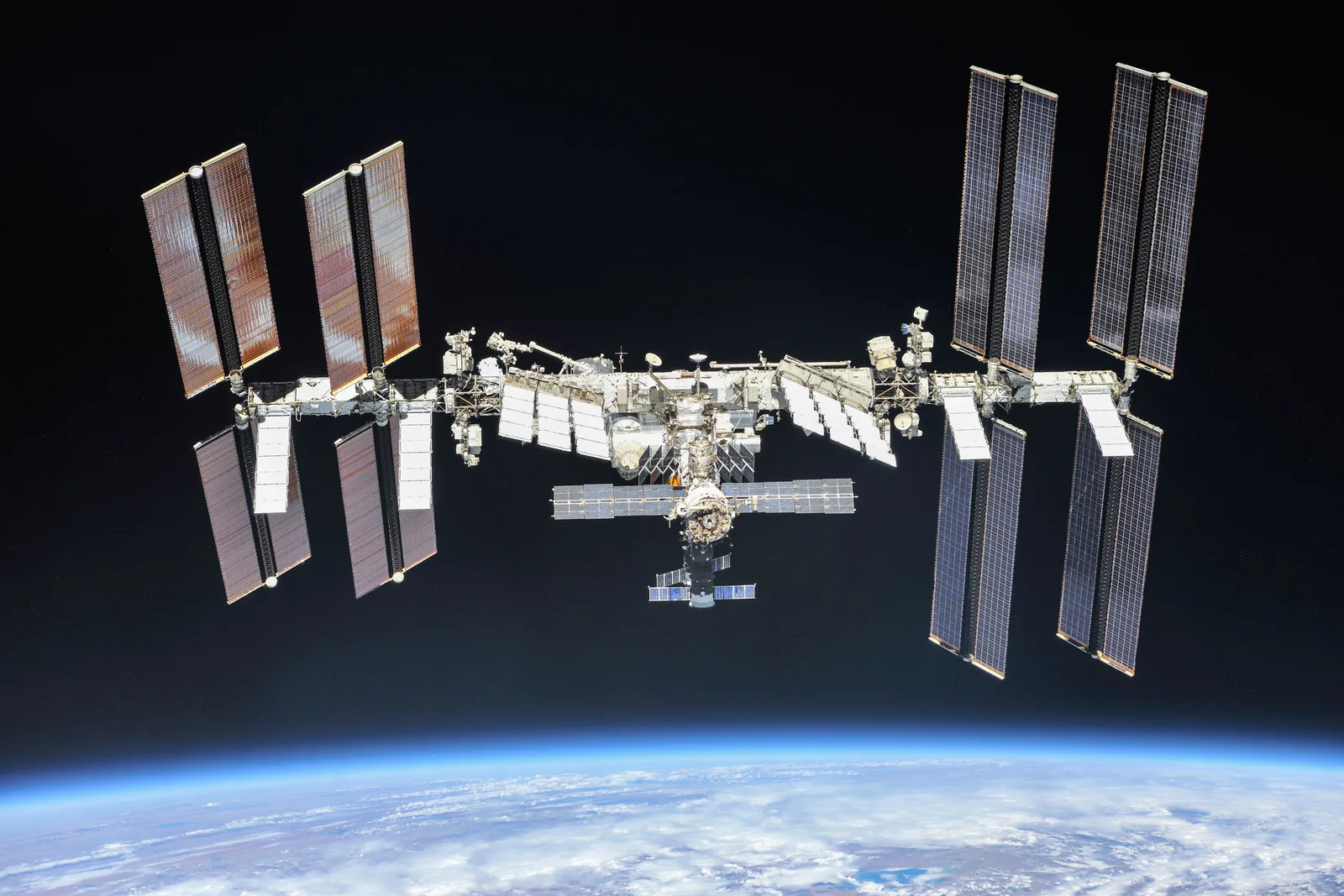
The International Space Station ISS orbits the Earth at an altitude of about $420\,\text{km}$, and you can see it as a bright moving point in the Finnish sky too. The station has a mass of about $420\,000\,\text{kg}$, yet it does not fall, although nothing holds it up. Inside the station, astronauts, tools and drops of water float in the air.
What keeps the ISS in its orbit, and why do the astronauts float inside it?
Optional Review: net force in circular motion
Predict
Make your predictions before investigating 3 questions
Prediction 1: speed too low
Prediction 2: a light and a heavy satellite
Prediction 3: why does the astronaut float?
Investigate
Launch a satellite horizontally and watch what kind of orbit the gravity of the Earth draws for it.
Simulation
How to use
Choose the launch altitude and the mass of the satellite and adjust the launch speed $v$. Launch sends the satellite from the highest point of its orbit horizontally to the right. The black line is the orbit of the satellite and the dashed line is a circle whose radius is the distance at the moment of launch. The graph on the right (below, on a phone) shows the altitude $h$ of the satellite above the surface as a function of how many degrees the satellite has gone round the Earth; the dashed line is the launch altitude. When the orbit is a circle, the graph is a horizontal line. After the first revolution the readings show the lowest and highest altitude of the orbit and the orbital period $T$. When you change any value, the satellite returns to its starting point. Speed changes only the pace of the animation: a revolution takes a few seconds on the screen, and the time $t$ is simulated time.
Assumptions of the model
Only the gravitational force of the Earth $F = \gamma \tfrac{Mm}{r^2}$ acts on the satellite, towards the centre of the Earth, where $M = 5.97 \cdot 10^{24}\,\text{kg}$ and the radius of the Earth is $R = 6371\,\text{km}$. Air resistance, the gravity of the Moon and the Sun and the motion of the Earth are not in the model, so, for example, an orbit that descends to an altitude of $155\,\text{km}$ would not last in reality. The Earth stays in place, because the satellite is much lighter. At the distance of the Moon the satellite is a test body: the real Moon's own mass would move the Earth too. All readings are values of the model.
How the calculation works
The orbit is not drawn ready-made; the motion is calculated in small time steps. At each step the acceleration $\tfrac{F}{m} = \tfrac{\gamma M}{r^2}$ towards the centre of the Earth is calculated, and the position and velocity are updated with it (the velocity Verlet method, step $\tfrac{1}{1500}$ of the orbital period of the local circular orbit). The orbital period $T$ is the time in which the satellite goes once round the Earth. The length of the red force arrow is the same for all masses at the moment of launch and decreases like $\tfrac{1}{r^2}$; the magnitude of the force is shown in the readings. The length of the blue velocity arrow is proportional to the speed.
Experiment 1: at what speed is the orbit a circle?
Test prediction 1. The launch altitude is $400\,\text{km}$ and the mass stays constant; change only the launch speed. First launch the satellite at the speed $7.00\,\text{km/s}$, then, for example, at the speeds $7.60$, $8.00$ and $7.70\,\text{km/s}$. After each launch, record the lowest and highest altitude of the orbit. Find the speed at which they are almost equal.
Initial state: launch altitude $h$: $400\,\text{km}$, mass of the satellite $m$: $1000\,\text{kg}$, launch speed $v$: $7.00\,\text{km/s}$. Kept constant: launch altitude $h$, mass of the satellite $m$. Varied: launch speed $v$.
| launch speed $v$ | lowest altitude $(\text{km})$ | highest altitude $(\text{km})$ |
|---|
At what launch speed does the satellite orbit in a circle at an altitude of $400\,\text{km}$? Answer in kilometres per second to two decimal places.
Hint 1: a guiding question
When the speed is too low, the lowest altitude stays below $400\,\text{km}$; when it is too high, the highest altitude rises above $400\,\text{km}$. In which direction must the speed be changed?
Hint 2: what is the connection
Halve the interval: if $7.60\,\text{km/s}$ is too low and $7.70\,\text{km/s}$ too high, try $7.65\,\text{km/s}$ and continue from there.
Hint 3: an intermediate step
A circular orbit is obtained when the gravitational force is exactly the force required by the circular motion: $\gamma \tfrac{Mm}{r^2} = \tfrac{mv^2}{r}$. You can check the result by calculating $v = \sqrt{\tfrac{\gamma M}{r}}$ with $r = 6771\,\text{km}$.
Show the solution
Given
launch altitude $h = 400\,\text{km}$; in the simulation $M = 5.97 \cdot 10^{24}\,\text{kg}$ and $R = 6371\,\text{km}$; $\gamma = 6.674 \cdot 10^{-11}\,\tfrac{\text{N}\cdot\text{m}^2}{\text{kg}^2}$
Find
the launch speed $v$ of the circular orbit in km/s
Principle
In the simulation the circular orbit is found at the speed at which the lowest and highest altitudes of the orbit are equal. The result can be checked by calculation: only gravity acts on the satellite, so it is the net force of the circular motion, $\gamma \tfrac{Mm}{r^2} = \tfrac{mv^2}{r}$.
Formula
$\gamma \tfrac{Mm}{r^2} = \tfrac{mv^2}{r}$, from which the mass $m$ cancels and $v = \sqrt{\dfrac{\gamma M}{r}}$, where $r = R + h$
Conversions
Substitution
so
Answer
$7.67\,\text{km/s}$
To two decimal places, because the step of the speed slider of the simulation is $0.01\,\text{km/s}$.
Reasonableness
In the simulation at the speed $7.67\,\text{km/s}$ the lowest altitude is about $396\,\text{km}$ and the highest $400\,\text{km}$, and at the speed $7.68\,\text{km/s}$ the highest altitude rises to about $432\,\text{km}$, so the speed of the circular orbit lies between these. The result is slightly greater than the $7.66\,\text{km/s}$ of the ISS in the example, because the orbit is $20\,\text{km}$ lower.
Experiment 2: does the mass of the satellite matter?
Test prediction 2. The launch altitude is $400\,\text{km}$ and the launch speed $7.67\,\text{km/s}$; change only the mass of the satellite. Launch each satellite and, after the first revolution, record the lowest and highest altitude, the orbital period and the gravitational force.
Initial state: launch altitude $h$: $400\,\text{km}$, launch speed $v$ = $7{.}67\,\text{km/s}$, mass of the satellite $m$: $1\,\text{kg}$. Kept constant: launch altitude $h$, launch speed $v$. Varied: mass of the satellite $m$.
| mass of the satellite $m$ | lowest altitude $(\text{km})$ | highest altitude $(\text{km})$ | $T$ $(\text{min})$ | $F$ $(\text{N})$ |
|---|
Real orbits
Statistical data · NASA: International Space Station Facts and Figures and Moon Fact Sheet (2024); GPS.gov: Space Segment (2024); the orbital period of a geostationary orbit is the rotation period of the Earth, that is, the sidereal day.
The table gives the orbital radius $r$ (distance from the centre of the Earth) and the orbital period $T$ of four satellites of the Earth in nearly circular orbits.
| Satellite | $r$ (km) | $T$ |
|---|---|---|
| ISS | $6790$ | $92.9\,\text{min}$ |
| GPS satellite | $26\,560$ | $11\,\text{h}\;58\,\text{min}$ |
| geostationary satellite | $42\,164$ | $23\,\text{h}\;56\,\text{min}$ |
| Moon | $384\,400$ | $27.32\,\text{d}$ |
Calculate the orbital speed of the GPS satellite from the values in the table. Answer in kilometres per second.
Hint 1: a guiding question
In one revolution the satellite travels the circumference of the circle. What is the circumference?
Hint 2: what is the connection
$v = \tfrac{2\pi r}{T}$. Convert the orbital period into seconds first.
Hint 3: an intermediate step
$r = 2.656 \cdot 10^{7}\,\text{m}$.
Show the solution
Given
orbital radius of the GPS satellite $r = 26\,560\,\text{km}$ and orbital period $T = 11\,\text{h}\;58\,\text{min}$ from the table
Find
the orbital speed $v$ in km/s
Principle
The orbit is nearly a circle, and the satellite moves at a constant speed, covering the circumference $2\pi r$ of the circle in one revolution, in the orbital period $T$.
Formula
$v = \dfrac{2\pi r}{T}$
Conversions
Substitution
Answer
$3.87\,\text{km/s}$
Three significant figures as in the orbital period $11\,\text{h}\;58\,\text{min}$.
Reasonableness
The GPS satellite is about four times farther from the centre of the Earth than the ISS ($26\,560\,\text{km} : 6790\,\text{km} \approx 3.9$), and its speed is about half of the speed of the ISS, $7.65\,\text{km/s}$. The circular-orbit model $v = \sqrt{\tfrac{\gamma M}{r}}$ gives $3.873\,\text{km/s}$ for the same radius, almost the same value.
Conclusion: what decides a circular orbit?
On the basis of your tables, write: what happened to the orbit when the launch speed was too low or too high, and at what speed was the orbit a circle? Did the mass of the satellite affect the orbit, although the gravitational force changed? What force keeps the satellite in a circular orbit?
Model answer
When the launch speed was $7.00\,\text{km/s}$, the satellite hit the Earth, and at the speed $7.60\,\text{km/s}$ it descended to an altitude of about $155\,\text{km}$ and returned to the launch altitude. At the speed $8.00\,\text{km/s}$ it rose to an altitude of about $1700\,\text{km}$. The circular orbit was obtained at about the speed $7.67\,\text{km/s}$, when the lowest and highest altitudes were almost equal. In experiment 2 all masses followed the same orbit in about $92.4\,\text{min}$, although the gravitational force grew with the mass ($8.69\,\text{N}$, $8.69\,\text{kN}$, $3.65\,\text{MN}$). The satellite is kept in its orbit by the gravitational force of the Earth, which is the only force and therefore the net force: in a circular orbit it is exactly the force $\tfrac{mv^2}{r}$ required by the circular motion. Because both are proportional to the mass, the mass does not affect the orbital speed. The values are values of the model.
Assess your own answer
Tick the points your own answer already contains.
Review the theory summary and practise with the exercises.
Theory summary
Key idea
A body that goes round another body under gravity is called a satellite. The Moon is a natural satellite of the Earth; the ISS and weather satellites are built by people. The path along which a satellite goes round is called an orbit. In space practically only one force acts on a satellite: the gravitational force of the Earth, which points towards the centre of the Earth. Because it is the only force, it is also the net force. In the chapter Centripetal acceleration and the equation of motion in a circle we found that in uniform circular motion the net force points to the centre of the path and gives the body its centripetal acceleration. In a circular orbit the gravitational force does exactly this: it is perpendicular to the velocity, so it does not change the speed but turns the direction of the velocity all the time.
So a satellite falls towards the Earth all the time, but it never hits it. Without gravity it would continue straight ahead along the tangent of the orbit. Gravity bends the path, and when the speed is just right, the path curves at the same rate as the surface of the Earth curves away beneath the satellite. Then the distance from the centre of the Earth stays the same and the orbit is a circle.
If the speed is lower, gravity turns the path more sharply than a circle would require: the satellite descends lower and then returns to the starting altitude, or hits the Earth if the speed is much too low. If the speed is higher, the path curves more gently and the satellite rises farther away before returning. In these cases the orbit is not a circle but an ellipse, and the model of uniform circular motion does not describe it.
Orbital speed in a circular orbit
When a satellite of mass $m$ goes round a central body in a circular orbit, the gravitational force is the only force and therefore the net force. According to Newton's second law it must be equal to the force required by the circular motion, $m a_\text{n} = \tfrac{m v^2}{r}$:
$$\gamma \frac{M m}{r^2} = \frac{m v^2}{r}$$
where $\gamma = 6.674 \cdot 10^{-11}\,\tfrac{\text{N}\cdot\text{m}^2}{\text{kg}^2}$ is the gravitational constant (many English books write it as G), $M$ is the mass of the central body ($\text{kg}$), $m$ is the mass of the satellite ($\text{kg}$), $r$ is the orbital radius ($\text{m}$) and $v$ is the orbital speed of the satellite ($\text{m/s}$). The orbital radius is measured from the centre of the central body: for a satellite of the Earth $r = R + h$, where $R = 6371\,\text{km}$ is the radius of the Earth and $h$ is the altitude of the satellite above the surface.
The mass $m$ of the satellite is on both sides of the equation and cancels. When the equation is multiplied by $r$ and divided by the mass $m$, we get $v^2 = \tfrac{\gamma M}{r}$, so the orbital speed in a circular orbit is
$$v = \sqrt{\frac{\gamma M}{r}}$$
The orbital speed depends only on the mass $M$ of the central body and on the orbital radius $r$, not on the mass of the satellite. A heavy space station and a small CubeSat orbit at the same altitude at the same speed. The farther away a satellite orbits, the lower its orbital speed.
In one revolution the satellite travels the circumference $2\pi r$ of the circle, so the orbital period follows from the relation $v = \tfrac{2\pi r}{T}$ of the chapter Centripetal acceleration and the equation of motion in a circle:
$$T = \frac{2\pi r}{v}$$
where $T$ is the orbital period ($\text{s}$). The orbit of a faraway satellite is longer and its speed lower, so the orbital period grows quickly as the distance grows: the ISS goes round the Earth in about an hour and a half, the Moon in about $27\,\text{d}$. When the radius and the orbital period of a satellite are measured, the same equation can also be solved for the mass $M$ of the central body. This is how, for example, the masses of the Earth, the Sun and Mars have been determined.
Geostationary orbit
A geostationary satellite orbits above the equator in the same direction as the Earth rotates, and its orbital period is the same as the rotation period of the Earth, $23\,\text{h}\;56\,\text{min}$. It therefore seems to stay in place in the sky, and a satellite dish can be aimed at it once. Because the orbital period determines the orbital radius, all geostationary satellites orbit at the same altitude, about $35\,800\,\text{km}$.
Weightlessness
On a space station the astronauts float, and a scale would show zero. The reason is not the absence of gravity. At the altitude of the ISS, $420\,\text{km}$, the acceleration due to the gravitational force is $\tfrac{\gamma M}{r^2} \approx 8.6\,\text{m/s}^2$, about $88\,\%$ of the value at the surface of the Earth. On an astronaut of mass $70\,\text{kg}$ there acts a weight of about $605\,\text{N}$, that is, the gravitational force $F$ of the Earth, whereas at the surface it would be $687\,\text{N}$.
The station and the astronaut are in free fall: only gravity acts on each, and each gets the same acceleration towards the Earth. Because they fall in the same way, the floor does not press on the astronaut and a scale does not have to support them, so the support force is zero. Weightlessness (apparent weightlessness) is a state in which only gravity acts on a body and it falls freely: the support force is zero, although the weight acts all the time.
The same state can be experienced for a moment on the Earth too: during a jump, in a freely falling lift, or in an aeroplane whose engines are adjusted so that it flies along the path of a projectile. Weightlessness is not explained by any "centrifugal force" cancelling gravity. If some force cancelled gravity, the net force would be zero, and the station would continue straight ahead and would not orbit the Earth.
When the circular model holds
The model of uniform circular motion is a simplification. It describes the motion of a satellite well when
- the central body is much more massive than the satellite, so it can be considered to stay in place,
- the gravity of other bodies and air resistance are so small that only the gravity of the central body acts,
- the speed of the satellite is exactly the circular-orbit speed of the radius of its orbit, so that the distance from the centre stays constant.
Many real orbits are nearly circles. The distance of the Earth from the Sun varies by only about $3\,\%$ of the mean distance, so the circular model describes the orbit of the Earth well. The distance of the Moon from the Earth varies by about $11\,\%$, so the model gives a good approximation for the Moon. The orbit of Halley's comet, in contrast, is very elongated, and the circular model does not suit it at all.
| Body | nearest distance | greatest distance |
|---|---|---|
| Earth | $147.1\,\text{million km}$ | $152.1\,\text{million km}$ |
| Moon | $363\,300\,\text{km}$ | $405\,500\,\text{km}$ |
| Halley's comet | $88\,\text{million km}$ | $5250\,\text{million km}$ |
The distances of the Earth and Halley's comet are measured from the Sun, the distance of the Moon from the Earth. Source: NASA, Planetary Fact Sheets (Earth, Moon) and orbital data of Halley's comet, 2024.
Small deviations from the model show up in precise measurements. The orbital speed of the Moon calculated from measured values, $1.023\,\text{km/s}$, is about $0.5\,\%$ greater than the $1.018\,\text{km/s}$ given by the model, because the mass of the Moon is about $\tfrac{1}{81}$ of the mass of the Earth: the Earth and the Moon go round their common centre of mass, and the Earth does not stay in place. At the altitude of the ISS thin air brakes the station and its orbit slowly descends, so the station is raised with engines regularly.
Common misconception
"There is no gravity in space, which is why astronauts float." This is wrong. At the altitude of the ISS gravity is almost as strong as at the surface of the Earth, and it is exactly what keeps the station in its orbit. Without gravity the station would fly straight away. The astronauts float because they and the station fall freely with the same acceleration.
Another error is to put the altitude $h$ into the formula $v = \sqrt{\tfrac{\gamma M}{r}}$ instead of the distance from the centre of the Earth, $r = R + h$. For the ISS this would give a speed of about $31\,\text{km/s}$, four times the real one. A third error is to think that a heavy satellite has to orbit faster: a greater mass experiences a greater gravitational force, but it also needs a greater force to turn, so the mass cancels.
Summary
- Only the gravitational force of the central body acts on a satellite. It is the net force, which in a circular orbit gives the centripetal acceleration: $\gamma \tfrac{Mm}{r^2} = \tfrac{mv^2}{r}$.
- The orbital speed in a circular orbit is $v = \sqrt{\tfrac{\gamma M}{r}}$ and the orbital period $T = \tfrac{2\pi r}{v}$. The mass of the satellite has no effect, and a satellite orbiting farther away is slower and has a longer orbital period.
- The orbital radius is measured from the centre of the central body: $r = R + h$.
- Weightlessness is free fall: gravity acts, but the support force is zero.
- The circular model holds when the central body is much more massive than the satellite, other forces are small and the orbit is nearly a circle.
Optional Return to your predictions
Compare your predictions with the values of the model in the experiments and with the theory. Then return to the opening question: what keeps the ISS in its orbit, and why do the astronauts float inside it?
Would you change your prediction?
Apply
Worked example
Problem
The International Space Station ISS orbits the Earth in a nearly circular orbit at an altitude of about $420\,\text{km}$. Calculate the orbital speed and the orbital period of the station. The mass of the Earth is $M = 5.97 \cdot 10^{24}\,\text{kg}$ and its radius $R = 6371\,\text{km}$. Air resistance is ignored.
Step 1/7
Given and find. Altitude $h = 420\,\text{km}$, mass of the Earth $M = 5.97 \cdot 10^{24}\,\text{kg}$ and radius $R = 6371\,\text{km}$, gravitational constant $\gamma = 6.674 \cdot 10^{-11}\,\tfrac{\text{N}\cdot\text{m}^2}{\text{kg}^2}$. Find the orbital speed $v$ and the orbital period $T$.
Step 2/7
Principle. When air resistance is ignored, only the gravitational force of the Earth acts on the station. It is therefore the net force and, in a circular orbit, gives the centripetal acceleration towards the centre of the Earth: $\gamma \tfrac{Mm}{r^2} = \tfrac{mv^2}{r}$. The orbital radius is measured from the centre of the Earth, so $r = R + h$.
Step 3/7
Formula solved. The mass of the station cancels:
$$\begin{aligned} r &= R + h \\ v &= \sqrt{\frac{\gamma M}{r}} \\ T &= \frac{2\pi r}{v} \end{aligned}$$
Step 4/7
Conversions. Distances in metres:
so $r = 6.791 \cdot 10^{6}\,\text{m}$.
Step 5/7
Substitution. $$\begin{aligned} &v = \sqrt{\frac{\gamma M}{r}} \\ &\gamma M = 6.674 \cdot 10^{-11}\,\tfrac{\text{N}\cdot\text{m}^2}{\text{kg}^2} \\ &\quad \cdot 5.97 \cdot 10^{24}\,\text{kg} \\ &\quad = 3.98438 \cdot 10^{14}\,\text{m}^3/\text{s}^2 \\ &v = \sqrt{\frac{3.98438 \cdot 10^{14}\,\text{m}^3/\text{s}^2}{6.791 \cdot 10^{6}\,\text{m}}} \\ &= 7659.7\,\text{m/s} \\[6pt] &T = \frac{2\pi r}{v} \\ &= \frac{2\pi \cdot 6.791 \cdot 10^{6}\,\text{m}}{7659.7\,\text{m/s}} \\ &= 5570.6\,\text{s} \end{aligned}$$
Step 6/7
Answer. The orbital speed is $v \approx 7.66\,\text{km/s}$ and the orbital period $T \approx 5570\,\text{s} \approx 92.8\,\text{min}$. The results are given to three significant figures, like the mass of the Earth $5.97 \cdot 10^{24}\,\text{kg}$.
Step 7/7
Reasonableness. According to NASA the ISS goes round the Earth in about $92.9\,\text{min}$, so the model is very close to the measured value. Right at the surface of the Earth the speed of a circular orbit would be
the ISS is slightly farther away, so its speed is slightly lower, as it should be.
Optional Find the error
Apply to a new situation
The Hubble Space Telescope orbits the Earth in a nearly circular orbit, and according to NASA its orbital period is about $95.4\,\text{min}$.
At what altitude above the surface does Hubble orbit? The mass of the Earth is $5.97 \cdot 10^{24}\,\text{kg}$ and its radius $6371\,\text{km}$. Answer in kilometres.
Hint 1: a guiding question
You now know the orbital period, not the speed. Which two equations connect the speed, the radius and the orbital period in a circular orbit?
Hint 2: what is the connection
Put $v = \tfrac{2\pi r}{T}$ into the equation $v^2 = \tfrac{\gamma M}{r}$ and solve $r^3 = \tfrac{\gamma M T^2}{4\pi^2}$.
Hint 3: an intermediate step
so
Finally remember to subtract the radius of the Earth.
Show the solution
Given
orbital period $T = 95.4\,\text{min}$, mass of the Earth $M = 5.97 \cdot 10^{24}\,\text{kg}$ and radius $R = 6371\,\text{km}$, $\gamma = 6.674 \cdot 10^{-11}\,\tfrac{\text{N}\cdot\text{m}^2}{\text{kg}^2}$
Find
the altitude above the surface $h$ in kilometres
Principle
Only the gravitational force of the Earth acts on the telescope, so it is the net force of the circular motion: $\gamma \tfrac{Mm}{r^2} = \tfrac{mv^2}{r}$. In addition, in uniform circular motion $v = \tfrac{2\pi r}{T}$. When the speed is substituted, an equation for the radius $r$ remains.
Formula
from which
$h = r - R$
Conversions
Substitution
so
Answer
about $544\,\text{km}$, three significant figures as in the orbital period $95.4\,\text{min}$.
Reasonableness
The orbital period of Hubble is slightly longer than the $92.9\,\text{min}$ of the ISS, so it must orbit slightly higher than the ISS ($420\,\text{km}$), as the result says. Check: at the radius $6915\,\text{km}$ the orbital speed is
and $\sqrt{\tfrac{\gamma M}{r}}$ gives the same value.
Check your understanding
Exit ticket
Answer on your own first and only then open the answer.
- On a space station an astronaut floats, although their weight is almost as large as at the surface of the Earth. Why does the astronaut float?
Answer
The astronaut and the station are in free fall: only gravity acts on each, and each gets the same acceleration towards the Earth. The floor therefore does not press on the astronaut, and the support force is zero. This is weightlessness; gravity acts all the time.
- Name one situation in which the model of uniform circular motion does not suit the description of the orbit of a body, and give a reason.
Answer
For example Halley's comet: its distance from the Sun varies from about $88\,\text{million km}$ to about $5250\,\text{million km}$, so the orbit is very elongated and not a circle. The model does not suit either if the speed of a satellite is not the circular-orbit speed of its orbit or if air resistance clearly brakes it.
1. Orbital speed and distance
2. The mass of Mars from the orbit of its moon
The moon of Mars, Phobos, orbits Mars in a nearly circular orbit of radius $9376\,\text{km}$, and its orbital period is $7\,\text{h}\;39\,\text{min}$. Calculate the mass of Mars in kilograms. Write the power of ten with the e notation: for example, $5.00 \cdot 10^{23}$ is written 5.00e23.
Hint 1: a guiding question
Only the gravity of Mars acts on Phobos. Which equation says that the gravitational force is the net force of the circular motion?
Hint 2: what is the connection
$\gamma \tfrac{Mm}{r^2} = \tfrac{mv^2}{r}$ and $v = \tfrac{2\pi r}{T}$, so $M = \tfrac{4\pi^2 r^3}{\gamma T^2}$.
Hint 3: an intermediate step
$r = 9.376 \cdot 10^{6}\,\text{m}$.
Show the solution
Given
orbital radius of Phobos $r = 9376\,\text{km}$ and orbital period $T = 7\,\text{h}\;39\,\text{min}$, $\gamma = 6.674 \cdot 10^{-11}\,\tfrac{\text{N}\cdot\text{m}^2}{\text{kg}^2}$
Find
the mass of Mars $M$
Principle
Only the gravitational force of Mars acts on Phobos, so it is the net force of the circular motion: $\gamma \tfrac{Mm}{r^2} = \tfrac{mv^2}{r}$. Phobos is much lighter than Mars, so Mars stays practically in place. The speed is obtained from the orbital period: $v = \tfrac{2\pi r}{T}$.
Formula
from which $M = \dfrac{4\pi^2 r^3}{\gamma T^2}$
Conversions
Substitution
so
Answer
$6.43 \cdot 10^{23}\,\text{kg}$
Three significant figures as in the orbital period $7\,\text{h}\;39\,\text{min}$.
Reasonableness
According to NASA the mass of Mars is $6.42 \cdot 10^{23}\,\text{kg}$, about a tenth of the mass of the Earth, $5.97 \cdot 10^{24}\,\text{kg}$. Mars is a smaller planet than the Earth, so the result is of the right order of magnitude. Units:
because $1\,\text{N} = 1\,\tfrac{\text{kg}\cdot\text{m}}{\text{s}^2}$.
Suggestion: one answer does not show everything you can do, but review the theory summary and do the core exercises.
3. Draw and explain
On paper, draw a free-body diagram of a satellite orbiting the Earth in a circular orbit when the satellite is at the highest point of its orbit. Mark beside the satellite also its velocity and acceleration. Then use the diagram to explain why the satellite does not fall to the Earth, although gravity pulls it all the time.
Model diagram
Only one force acts on the satellite, the gravitational force of the Earth $\overline{F}$, which starts from the centre of the satellite towards the centre of the Earth, here straight down. There are no other forces: no air resistance, no force along the direction of motion and no centrifugal force. The velocity $\overline{v}$ is along the tangent of the orbit and the acceleration $\overline{a}_\text{n}$ points in the direction of the net force, towards the centre of the Earth. The satellite falls towards the Earth all the time, but at the same time it moves sideways so fast that the orbit curves at the same rate as the surface of the Earth: the distance from the centre does not change. The gravitational force is the net force of the circular motion, $\gamma \tfrac{Mm}{r^2} = \tfrac{mv^2}{r}$.
Assess your own answer
Tick the points your own answer already contains.
Review the theory summary and practise with the exercises.
Review the chapter's concepts
Cards you mark Review later collect in your review deck.
- Revolution
- One full turn on a circular path.
- Satellite
- An object that orbits another object because of gravity.
- Orbit
- The path a satellite or celestial body follows around its central body.
- Orbital period
- The time for one full orbit around the central body.
- Geostationary orbit
- A circular orbit above the equator on which a satellite's period is one day, so it seems to stay still in the sky.
Exercises
Level 1 · basic practice 5 exercises
One formula or one step of reasoning. Core exercises first, the rest is extra practice.
- Exercise 6-1Core
The weather satellite NOAA-20 orbits the Earth in a nearly circular orbit of radius $7196\,\text{km}$. The mass of the Earth is $5.97 \cdot 10^{24}\,\text{kg}$. Calculate the orbital speed of the satellite. Give the answer in kilometres per second.
Answer
$7.44\,\text{km/s}$
Show the solution
Given
orbital radius $r = 7196\,\text{km}$, mass of the Earth $M = 5.97 \cdot 10^{24}\,\text{kg}$, $\gamma = 6.674 \cdot 10^{-11}\,\tfrac{\text{N}\cdot\text{m}^2}{\text{kg}^2}$
Find
the orbital speed $v$ in kilometres per second
Principle
Only the gravitational force of the Earth acts on the satellite, so it is the net force of the circular motion: $\gamma \tfrac{Mm}{r^2} = \tfrac{mv^2}{r}$. The mass of the satellite cancels.
Formula
$\gamma \dfrac{Mm}{r^2}$$= \dfrac{mv^2}{r}$from which $v = \sqrt{\dfrac{\gamma M}{r}}$
Conversions
$r$$= 7196\,\text{km}$$= 7.196 \cdot 10^{6}\,\text{m}$finally $1\,\text{km/s} = 1000\,\text{m/s}$.
Substitution
$\gamma M$$= 6.674 \cdot 10^{-11}\,\tfrac{\text{N}\cdot\text{m}^2}{\text{kg}^2} \cdot 5.97 \cdot 10^{24}\,\text{kg}$$= 3.984 \cdot 10^{14}\,\text{m}^3/\text{s}^2$so
$v$$= \sqrt{\dfrac{3.984 \cdot 10^{14}\,\text{m}^3/\text{s}^2}{7.196 \cdot 10^{6}\,\text{m}}}$$= 7441\,\text{m/s}$$= 7.441\,\text{km/s}$Answer
$7.44\,\text{km/s}$
Three significant figures as in the mass of the Earth $5.97 \cdot 10^{24}\,\text{kg}$.
Reasonableness
NOAA-20 orbits at an altitude of about $825\,\text{km}$, that is, higher than the ISS, whose speed is about $7.66\,\text{km/s}$. A satellite orbiting farther away is slower, so a slightly lower speed is expected.
- Exercise 6-2Core
A GPS satellite orbits the Earth in a circular orbit of radius $26\,560\,\text{km}$ at the speed $3.87\,\text{km/s}$.
How long is the orbital period of the satellite? Give the answer in hours.
Answer
$12.0\,\text{h}$
Show the solution
Given
orbital radius $r = 26\,560\,\text{km}$, orbital speed $v = 3.87\,\text{km/s}$
Find
the orbital period $T$ in hours
Principle
The satellite moves at a constant speed, and in one revolution it travels the circumference $2\pi r$ of the circle in the orbital period $T$.
Formula
$v = \dfrac{2\pi r}{T}$, from which $T = \dfrac{2\pi r}{v}$
Conversions
$r$$= 26\,560\,\text{km}$$= 2.656 \cdot 10^{7}\,\text{m}$$v$$= 3.87\,\text{km/s}$$= 3870\,\text{m/s}$finally $1\,\text{h} = 3600\,\text{s}$.
Substitution
$T$$= \dfrac{2\pi \cdot 2.656 \cdot 10^{7}\,\text{m}}{3870\,\text{m/s}}$$= 43\,122\,\text{s}$$= 43\,122 : 3600\,\text{h}$$= 11.98\,\text{h}$Answer
$12.0\,\text{h}$
Three significant figures as in the speed $3.87\,\text{km/s}$.
Reasonableness
GPS satellites go round the Earth twice a day, so an orbital period of about $12\,\text{h}$ is right. The circumference of the circle is about $1.7 \cdot 10^{5}\,\text{km}$, and at a speed of about $4\,\text{km/s}$ it takes about $4 \cdot 10^{4}\,\text{s}$, that is, over $11\,\text{h}$.
- Exercise 6-3
A geostationary communications satellite orbits the Earth in a circular orbit of radius $42\,164\,\text{km}$. The mass of the Earth is $5.97 \cdot 10^{24}\,\text{kg}$. Calculate the centripetal acceleration of the satellite.
Answer
$0.224\,\text{m/s}^2$
Show the solution
Given
orbital radius $r = 42\,164\,\text{km}$, mass of the Earth $M = 5.97 \cdot 10^{24}\,\text{kg}$, $\gamma = 6.674 \cdot 10^{-11}\,\tfrac{\text{N}\cdot\text{m}^2}{\text{kg}^2}$
Find
the centripetal acceleration $a_\text{n}$
Principle
Only the gravitational force acts on the satellite, so it is the net force. According to Newton's second law $\gamma \tfrac{Mm}{r^2} = m a_\text{n}$, so the centripetal acceleration is the same as the acceleration due to the gravitational force at that distance.
Formula
$\gamma \dfrac{Mm}{r^2} = m a_\text{n}$, from which $a_\text{n} = \dfrac{\gamma M}{r^2}$
Conversions
$r$$= 42\,164\,\text{km}$$= 4.2164 \cdot 10^{7}\,\text{m}$Substitution
$\gamma M$$= 6.674 \cdot 10^{-11}\,\tfrac{\text{N}\cdot\text{m}^2}{\text{kg}^2} \cdot 5.97 \cdot 10^{24}\,\text{kg}$$= 3.984 \cdot 10^{14}\,\text{m}^3/\text{s}^2$so
$a_\text{n}$$= \dfrac{3.984 \cdot 10^{14}\,\text{m}^3/\text{s}^2}{(4.2164 \cdot 10^{7}\,\text{m})^2}$$= 0.2241\,\text{m/s}^2$Answer
$0.224\,\text{m/s}^2$
Three significant figures as in the mass of the Earth.
Reasonableness
The satellite is about $6.6$ times farther from the centre of the Earth than the surface, so the acceleration is about $\tfrac{9.81\,\text{m/s}^2}{6.6^2} \approx 0.23\,\text{m/s}^2$. Unit:
$\tfrac{\text{N}\cdot\text{m}^2}{\text{kg}^2} \cdot \tfrac{\text{kg}}{\text{m}^2}$$= \tfrac{\text{N}}{\text{kg}}$$= \text{m/s}^2$ - Exercise 6-4
The Moon orbits the Earth in a nearly circular orbit of radius $384\,400\,\text{km}$, and its orbital period is $27.3\,\text{d}$. Calculate the orbital speed of the Moon. Give the answer in kilometres per second.
Answer
$1.02\,\text{km/s}$
Show the solution
Given
orbital radius $r = 384\,400\,\text{km}$, orbital period $T = 27.3\,\text{d}$
Find
the orbital speed $v$ of the Moon in kilometres per second
Principle
The Moon orbits in a nearly circular orbit at a nearly constant speed, so in the orbital period $T$ it travels the circumference $2\pi r$ of the circle.
Formula
$v = \dfrac{2\pi r}{T}$
Conversions
$r$$= 384\,400\,\text{km}$$= 3.844 \cdot 10^{8}\,\text{m}$$T$$= 27.3 \cdot 24 \cdot 3600\,\text{s}$$= 2.3587 \cdot 10^{6}\,\text{s}$finally $1\,\text{km/s} = 1000\,\text{m/s}$.
Substitution
$v$$= \dfrac{2\pi \cdot 3.844 \cdot 10^{8}\,\text{m}}{2.3587 \cdot 10^{6}\,\text{s}}$$= 1024\,\text{m/s}$$= 1.024\,\text{km/s}$Answer
$1.02\,\text{km/s}$
Three significant figures as in the orbital period $27.3\,\text{d}$.
Reasonableness
The Moon is about $57$ times farther away than the ISS ($384\,400 : 6790 \approx 57$), so according to the circular model its speed should be about $\tfrac{1}{\sqrt{57}} \approx \tfrac{1}{7.5}$ of the speed of the ISS, $7.66\,\text{km/s}$, that is, about $1.0\,\text{km/s}$.
- Exercise 6-5
A probe orbiting the Moon follows a circular orbit of radius $1847\,\text{km}$. The mass of the Moon is $7.35 \cdot 10^{22}\,\text{kg}$. Calculate the orbital speed of the probe. Give the answer in kilometres per second.
Answer
$1.63\,\text{km/s}$
Show the solution
Given
orbital radius $r = 1847\,\text{km}$, mass of the Moon $M = 7.35 \cdot 10^{22}\,\text{kg}$, $\gamma = 6.674 \cdot 10^{-11}\,\tfrac{\text{N}\cdot\text{m}^2}{\text{kg}^2}$
Find
the orbital speed $v$ of the probe in kilometres per second
Principle
Only the gravitational force of the Moon acts on the probe, so it is the net force of the circular motion; the central body is now the Moon.
Formula
$\gamma \dfrac{Mm}{r^2}$$= \dfrac{mv^2}{r}$from which $v = \sqrt{\dfrac{\gamma M}{r}}$
Conversions
$r$$= 1847\,\text{km}$$= 1.847 \cdot 10^{6}\,\text{m}$finally $1\,\text{km/s} = 1000\,\text{m/s}$.
Substitution
$\gamma M$$= 6.674 \cdot 10^{-11}\,\tfrac{\text{N}\cdot\text{m}^2}{\text{kg}^2} \cdot 7.35 \cdot 10^{22}\,\text{kg}$$= 4.905 \cdot 10^{12}\,\text{m}^3/\text{s}^2$so
$v$$= \sqrt{\dfrac{4.905 \cdot 10^{12}\,\text{m}^3/\text{s}^2}{1.847 \cdot 10^{6}\,\text{m}}}$$= 1630\,\text{m/s}$$= 1.630\,\text{km/s}$Answer
$1.63\,\text{km/s}$
Three significant figures as in the mass of the Moon $7.35 \cdot 10^{22}\,\text{kg}$.
Reasonableness
The mass of the Moon is about $\tfrac{1}{81}$ of the mass of the Earth and the orbital radius about $0.27$ times the orbital radius of the ISS, so the speed is about
$7.7\,\text{km/s} \cdot \sqrt{\tfrac{1}{81 \cdot 0.27}}$$\approx 1.6\,\text{km/s}$
Level 2 · applied practice 4 exercises
Two steps, working with measured data, a unit conversion or rearranging a formula. Core exercises first, the rest is extra practice.
- Exercise 6-6Core
A satellite orbits the Earth in a circular orbit at the speed $5.00\,\text{km/s}$. The mass of the Earth is $5.97 \cdot 10^{24}\,\text{kg}$ and its radius $6371\,\text{km}$.
At what altitude above the surface does the satellite orbit? Give the answer in kilometres.
Answer
$9570\,\text{km}$
Show the solution
Given
orbital speed $v = 5.00\,\text{km/s}$, mass of the Earth $M = 5.97 \cdot 10^{24}\,\text{kg}$ and radius $R = 6371\,\text{km}$, $\gamma = 6.674 \cdot 10^{-11}\,\tfrac{\text{N}\cdot\text{m}^2}{\text{kg}^2}$
Find
the altitude above the surface $h$ in kilometres
Principle
The gravitational force is the only force on the satellite and therefore the net force of the circular motion. From the equation we first solve the orbital radius $r$, which is measured from the centre of the Earth, and the altitude is $h = r - R$.
Formula
$\gamma \dfrac{Mm}{r^2}$$= \dfrac{mv^2}{r}$from which $r = \dfrac{\gamma M}{v^2}$ and $h = r - R$
Conversions
$v$$= 5.00\,\text{km/s}$$= 5000\,\text{m/s}$$R$$= 6371\,\text{km}$$= 6.371 \cdot 10^{6}\,\text{m}$Substitution
$\gamma M$$= 6.674 \cdot 10^{-11}\,\tfrac{\text{N}\cdot\text{m}^2}{\text{kg}^2} \cdot 5.97 \cdot 10^{24}\,\text{kg}$$= 3.984 \cdot 10^{14}\,\text{m}^3/\text{s}^2$so
$r$$= \dfrac{3.984 \cdot 10^{14}\,\text{m}^3/\text{s}^2}{(5000\,\text{m/s})^2}$$= 1.5938 \cdot 10^{7}\,\text{m}$so
$h$$= 1.5938 \cdot 10^{7}\,\text{m} - 6.371 \cdot 10^{6}\,\text{m}$$= 9.567 \cdot 10^{6}\,\text{m}$$= 9567\,\text{km}$Answer
$9570\,\text{km}$
Three significant figures as in the speed $5.00\,\text{km/s}$.
Reasonableness
The speed $5.00\,\text{km/s}$ lies between the $7.66\,\text{km/s}$ of the ISS and the $3.87\,\text{km/s}$ of a GPS satellite, and so does the orbital radius $15\,900\,\text{km}$ ($6790\,\text{km}$ and $26\,560\,\text{km}$). Check:
$\sqrt{\tfrac{\gamma M}{r}}$$= \sqrt{\tfrac{3.984 \cdot 10^{14}}{1.594 \cdot 10^{7}}}\,\text{m/s}$$\approx 5000\,\text{m/s}$ - Exercise 6-7Core
A probe orbiting Mars follows a circular orbit at an altitude of $400\,\text{km}$ above the surface of Mars. The mass of Mars is $6.42 \cdot 10^{23}\,\text{kg}$ and its radius $3390\,\text{km}$. Calculate the orbital speed of the probe. Give the answer in kilometres per second.
Answer
$3.36\,\text{km/s}$
Show the solution
Given
altitude $h = 400\,\text{km}$, mass of Mars $M = 6.42 \cdot 10^{23}\,\text{kg}$ and radius $R = 3390\,\text{km}$, $\gamma = 6.674 \cdot 10^{-11}\,\tfrac{\text{N}\cdot\text{m}^2}{\text{kg}^2}$
Find
the orbital speed $v$ in kilometres per second
Principle
Only the gravitational force of Mars acts on the probe, so it is the net force of the circular motion. The orbital radius is measured from the centre of Mars: $r = R + h$.
Formula
$\gamma \dfrac{Mm}{r^2}$$= \dfrac{mv^2}{r}$from which $v = \sqrt{\dfrac{\gamma M}{R + h}}$
Conversions
$r$$= 3390\,\text{km} + 400\,\text{km}$$= 3790\,\text{km}$$= 3.790 \cdot 10^{6}\,\text{m}$finally $1\,\text{km/s} = 1000\,\text{m/s}$.
Substitution
$\gamma M$$= 6.674 \cdot 10^{-11}\,\tfrac{\text{N}\cdot\text{m}^2}{\text{kg}^2} \cdot 6.42 \cdot 10^{23}\,\text{kg}$$= 4.285 \cdot 10^{13}\,\text{m}^3/\text{s}^2$so
$v$$= \sqrt{\dfrac{4.285 \cdot 10^{13}\,\text{m}^3/\text{s}^2}{3.790 \cdot 10^{6}\,\text{m}}}$$= 3362\,\text{m/s}$$= 3.362\,\text{km/s}$Answer
$3.36\,\text{km/s}$
Three significant figures as in the mass of Mars $6.42 \cdot 10^{23}\,\text{kg}$.
Reasonableness
At the same altitude around the Earth the speed is about $7.7\,\text{km/s}$. The mass of Mars is only about a tenth of the mass of the Earth and its radius about a half, so the speed must be clearly lower:
$7.7\,\text{km/s} \cdot \sqrt{0.107 \cdot \tfrac{6771}{3790}}$$\approx 3.4\,\text{km/s}$ - Exercise 6-8
At the surface of the Moon the acceleration of free fall is $1.62\,\text{m/s}^2$ and the radius of the Moon is $1737\,\text{km}$.
What speed is needed for a probe to orbit the Moon in a circular orbit just above its surface? The Moon has no atmosphere. Give the answer in kilometres per second.
Answer
$1.68\,\text{km/s}$
Show the solution
Given
acceleration of free fall at the surface of the Moon $g = 1.62\,\text{m/s}^2$ and radius $R = 1737\,\text{km}$; no atmosphere
Find
the speed $v$ of the circular orbit just above the surface of the Moon
Principle
Only the gravitational force of the Moon acts on the probe, and it is the net force of the circular motion. At the surface the acceleration due to the gravitational force is $\tfrac{\gamma M}{R^2} = g$ (chapter The gravitational force between bodies), so the mass of the Moon is not needed: the centripetal acceleration must be $g$.
Formula
$m g = \dfrac{m v^2}{R}$, from which $v = \sqrt{g R}$
Conversions
$R$$= 1737\,\text{km}$$= 1.737 \cdot 10^{6}\,\text{m}$finally $1\,\text{km/s} = 1000\,\text{m/s}$.
Substitution
$v$$= \sqrt{1.62\,\text{m/s}^2 \cdot 1.737 \cdot 10^{6}\,\text{m}}$$= 1677\,\text{m/s}$$= 1.677\,\text{km/s}$Answer
$1.68\,\text{km/s}$
Three significant figures as in the acceleration of free fall $1.62\,\text{m/s}^2$.
Reasonableness
The result is slightly greater than the $1.63\,\text{km/s}$ of the level 1 probe, which orbits $110\,\text{km}$ higher: a body orbiting lower is faster. Unit:
$\sqrt{\tfrac{\text{m}}{\text{s}^2} \cdot \text{m}}$$= \tfrac{\text{m}}{\text{s}}$ - Exercise 6-9
An astronaut of mass $75\,\text{kg}$ works on a space station at an altitude of $410\,\text{km}$. The mass of the Earth is $5.97 \cdot 10^{24}\,\text{kg}$ and its radius $6371\,\text{km}$.
How large is the gravitational force acting on the astronaut, although the astronaut is weightless?
Answer
$650\,\text{N}$
Show the solution
Given
mass of the astronaut $m = 75\,\text{kg}$, altitude $h = 410\,\text{km}$, mass of the Earth $M = 5.97 \cdot 10^{24}\,\text{kg}$ and radius $R = 6371\,\text{km}$, $\gamma = 6.674 \cdot 10^{-11}\,\tfrac{\text{N}\cdot\text{m}^2}{\text{kg}^2}$
Find
the gravitational force $F$ acting on the astronaut
Principle
Weightlessness does not mean that gravity is absent: the gravitational force of the Earth acts on the astronaut, and it is calculated from the law of gravitation at the distance $r = R + h$ from the centre of the Earth. The floating is due to free fall, not to the absence of a force.
Formula
$F = \gamma \dfrac{M m}{r^2}$, where $r = R + h$
Conversions
$r$$= 6371\,\text{km} + 410\,\text{km}$$= 6781\,\text{km}$$= 6.781 \cdot 10^{6}\,\text{m}$Substitution
$\gamma M$$= 6.674 \cdot 10^{-11}\,\tfrac{\text{N}\cdot\text{m}^2}{\text{kg}^2} \cdot 5.97 \cdot 10^{24}\,\text{kg}$$= 3.984 \cdot 10^{14}\,\text{m}^3/\text{s}^2$so
$F$$= \dfrac{3.984 \cdot 10^{14}\,\text{m}^3/\text{s}^2 \cdot 75\,\text{kg}}{(6.781 \cdot 10^{6}\,\text{m})^2}$$= 649.9\,\text{N}$Answer
$650\,\text{N}$
That is, $6.5 \cdot 10^{2}\,\text{N}$, two significant figures as in the mass $75\,\text{kg}$.
Reasonableness
At the surface of the Earth the same astronaut weighs $75\,\text{kg} \cdot 9.81\,\text{m/s}^2 \approx 736\,\text{N}$. On the station the force is about $88\,\%$ of this, because the distance from the centre is only about $6\,\%$ greater: $\left(\tfrac{6371}{6781}\right)^2 \approx 0.88$.
Level 3 · challenging 3 exercises
Optional: application, two ideas together or a new situation where you reason for yourself.
- Exercise 6-10
Mars rotates once about its axis in $24\,\text{h}\;37\,\text{min}$. A communications satellite orbiting Mars is to stay all the time above the same point of the surface, like a geostationary satellite above the Earth. The mass of Mars is $6.42 \cdot 10^{23}\,\text{kg}$ and its radius $3390\,\text{km}$.
At what altitude above the surface of Mars must the satellite orbit? Give the answer in kilometres.
Answer
$1.70 \cdot 10^{4}\,\text{km}$
Show the solution
Given
rotation period of Mars $T = 24\,\text{h}\;37\,\text{min}$, mass $M = 6.42 \cdot 10^{23}\,\text{kg}$ and radius $R = 3390\,\text{km}$, $\gamma = 6.674 \cdot 10^{-11}\,\tfrac{\text{N}\cdot\text{m}^2}{\text{kg}^2}$
Find
the altitude of the satellite above the surface of Mars $h$ in kilometres
Principle
For the satellite to stay above the same point of the surface, its orbital period must be the rotation period of Mars, and it must orbit above the equator in the same direction as Mars rotates. The gravitational force is the net force of the circular motion of the satellite, and the speed is $v = \tfrac{2\pi r}{T}$.
Formula
$\dfrac{\gamma M}{r}$$= v^2$$= \dfrac{4\pi^2 r^2}{T^2}$from which
$r$$= \sqrt[3]{\dfrac{\gamma M T^2}{4\pi^2}}$$h = r - R$
Conversions
$T$$= 24 \cdot 3600\,\text{s} + 37 \cdot 60\,\text{s}$$= 88\,620\,\text{s}$$R$$= 3390\,\text{km}$$= 3.390 \cdot 10^{6}\,\text{m}$Substitution
$\gamma M T^2$$= 6.674 \cdot 10^{-11}\,\tfrac{\text{N}\cdot\text{m}^2}{\text{kg}^2} \cdot 6.42 \cdot 10^{23}\,\text{kg} \cdot (88\,620\,\text{s})^2$$= 3.3650 \cdot 10^{23}\,\text{m}^3$so
$r$$= \sqrt[3]{\dfrac{3.3650 \cdot 10^{23}\,\text{m}^3}{4\pi^2}}$$= \sqrt[3]{8.524 \cdot 10^{21}\,\text{m}^3}$$= 2.0427 \cdot 10^{7}\,\text{m}$so
$h$$= 2.0427 \cdot 10^{7}\,\text{m} - 3.390 \cdot 10^{6}\,\text{m}$$= 1.7037 \cdot 10^{7}\,\text{m}$$= 17\,037\,\text{km}$Answer
about $1.70 \cdot 10^{4}\,\text{km}$, that is, $17\,000\,\text{km}$, three significant figures as in the mass of Mars $6.42 \cdot 10^{23}\,\text{kg}$.
Reasonableness
The geostationary orbit of the Earth is at an altitude of about $35\,800\,\text{km}$. The rotation period of Mars is almost the same as that of the Earth, but its mass is only about a tenth, so the same orbital period is reached at a smaller radius: $r \propto \sqrt[3]{M}$ gives $42\,164\,\text{km} \cdot \sqrt[3]{0.107} \approx 20\,000\,\text{km}$, which agrees with the orbital radius obtained, $r = 20\,400\,\text{km}$.
- Exercise 6-11
Thin air brakes a space station, and its nearly circular orbit descends over weeks from an altitude of $400\,\text{km}$ to an altitude of $398\,\text{km}$. The mass of the Earth is $5.97 \cdot 10^{24}\,\text{kg}$ and its radius $6371\,\text{km}$.
Does the orbital speed of the station increase or decrease, and by how much? Give the change in the orbital speed in metres per second (an increase as positive). Do not round intermediate results before the subtraction.
Answer
$1.13\,\text{m/s}$
Show the solution
Given
altitude before $h_1 = 400\,\text{km}$ and after $h_2 = 398\,\text{km}$, mass of the Earth $M = 5.97 \cdot 10^{24}\,\text{kg}$ and radius $R = 6371\,\text{km}$, $\gamma = 6.674 \cdot 10^{-11}\,\tfrac{\text{N}\cdot\text{m}^2}{\text{kg}^2}$
Find
the change in the orbital speed $\Delta v = v_2 - v_1$ in metres per second
Principle
The orbit stays nearly a circle all the time, so at both altitudes the orbital speed is the circular-orbit speed determined by gravity. Braking lowers the orbit, and the circular-orbit speed is greater lower down, so the station ends up moving faster.
Formula
$v = \sqrt{\dfrac{\gamma M}{r}}$, so
$\Delta v$$= \sqrt{\dfrac{\gamma M}{R + h_2}} - \sqrt{\dfrac{\gamma M}{R + h_1}}$Conversions
$r_1$$= 6771\,\text{km}$$= 6.771 \cdot 10^{6}\,\text{m}$$r_2$$= 6769\,\text{km}$$= 6.769 \cdot 10^{6}\,\text{m}$and $\gamma M = 3.98438 \cdot 10^{14}\,\text{m}^3/\text{s}^2$. The two speeds are almost equal and their difference is only about one metre per second, so intermediate results are not rounded before the subtraction: the speeds are calculated to two decimal places and only then subtracted.
Substitution
$v_1$$= \sqrt{\dfrac{3.98438 \cdot 10^{14}\,\text{m}^3/\text{s}^2}{6.771 \cdot 10^{6}\,\text{m}}}$$= 7671.03\,\text{m/s}$$v_2$$= \sqrt{\dfrac{3.98438 \cdot 10^{14}\,\text{m}^3/\text{s}^2}{6.769 \cdot 10^{6}\,\text{m}}}$$= 7672.17\,\text{m/s}$so
$\Delta v$$= 7672.17\,\text{m/s} - 7671.03\,\text{m/s}$$= 1.13\,\text{m/s}$Answer
The orbital speed increases by about $1.13\,\text{m/s}$. Three significant figures, because the difference of $2\,\text{km}$ between the altitudes is exact and the change has been calculated without rounding intermediate results.
Reasonableness
The radius decreases by only $2\,\text{km}$, about $0.03\,\%$, so the change in speed is small: $1.13\,\text{m/s}$ is about $0.015\,\%$ of the speed $7671\,\text{m/s}$, which fits such a small change in radius. The sign is positive, although the air brakes the station: the orbit descends, and lower down gravity requires a greater speed.
- Exercise 6-12
The Earth rotates once about its axis in a day.
How short would the rotation period of the Earth have to be for a person standing at the equator to be weightless? The mass of the Earth is $5.97 \cdot 10^{24}\,\text{kg}$ and its radius $6371\,\text{km}$, and the shape of the Earth is assumed to be a sphere. Give the answer in minutes.
Answer
$84.4\,\text{min}$
Show the solution
Given
mass of the Earth $M = 5.97 \cdot 10^{24}\,\text{kg}$ and radius $R = 6371\,\text{km}$, $\gamma = 6.674 \cdot 10^{-11}\,\tfrac{\text{N}\cdot\text{m}^2}{\text{kg}^2}$; the Earth is assumed to be a sphere
Find
the rotation period $T$ at which a person standing at the equator would be weightless, in minutes
Principle
As the Earth rotates, the person goes round a circle of radius $R$. The person is weightless when the ground does not press on them, that is, the support force is zero: then the gravitational force alone is exactly enough to be the net force of the circular motion, as for a satellite in a circular orbit.
Formula
$\gamma \dfrac{Mm}{R^2}$$= \dfrac{mv^2}{R}$$v = \dfrac{2\pi R}{T}$, so
$\dfrac{\gamma M}{R}$$= \dfrac{4\pi^2 R^2}{T^2}$$T = 2\pi\sqrt{\dfrac{R^3}{\gamma M}}$
Conversions
$R$$= 6371\,\text{km}$$= 6.371 \cdot 10^{6}\,\text{m}$finally $1\,\text{min} = 60\,\text{s}$.
Substitution
$\gamma M$$= 6.674 \cdot 10^{-11}\,\tfrac{\text{N}\cdot\text{m}^2}{\text{kg}^2} \cdot 5.97 \cdot 10^{24}\,\text{kg}$$= 3.984 \cdot 10^{14}\,\text{m}^3/\text{s}^2$so
$T$$= 2\pi\sqrt{\dfrac{(6.371 \cdot 10^{6}\,\text{m})^3}{3.984 \cdot 10^{14}\,\text{m}^3/\text{s}^2}}$$= 5062\,\text{s}$$= 5062 : 60\,\text{min}$$= 84.36\,\text{min}$Answer
about $84.4\,\text{min}$, three significant figures as in the mass of the Earth.
Reasonableness
This is the orbital period of a satellite orbiting at the surface level, and the ISS orbits only a little higher, with a period of $92.8\,\text{min}$, so the result is of the right order of magnitude and slightly shorter, as it should be. The real rotation period, about $24\,\text{h}$, is about $17$ times longer, so we are far from weightlessness.
Photographs
- The International Space Station photographed from a Soyuz spacecraft (iss056e201248). NASA/Roscosmos. source, public domain (NASA)