
Moving in a circle: period and speed
Why does a child standing at the edge of a roundabout rush along much faster than a child standing next to the centre pole, even though both complete a turn equally fast?
Prior knowledge
- Velocity is a vector with a magnitude and a direction, and in uniform motion an object travels the same distance in every equal time intervalchapter Position, velocity and uniform motion as graphs
- If the sum of the forces acting on an object is zero, the object is at rest or in uniform motion in a straight linechapter Interaction and force: Newton's first and third laws
- Acceleration tells how quickly the velocity of an object changeschapter Acceleration and uniformly accelerated motion
Core path: follow the steps in order. Tasks marked Optional give extra practice. Optional tasks: 6.
Think about it
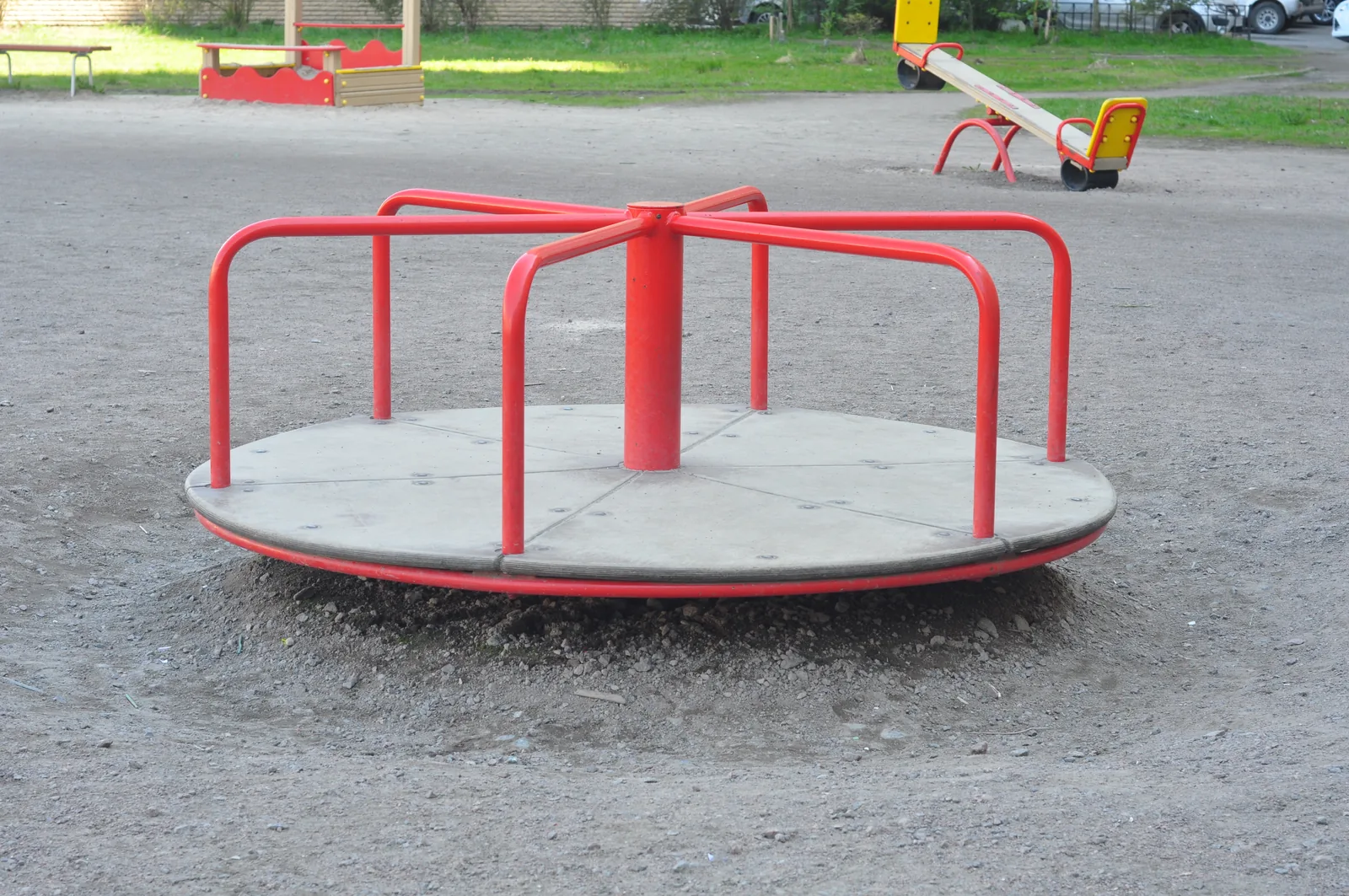
A playground roundabout turns steadily. Aino stands right at the edge, Eetu next to the centre pole. Both complete a turn in the same time, but Aino feels the wind on her face and has to hold the rail with both hands, while Eetu stands almost relaxed. When Aino's grip slips, she falls onto the sand.
If every part of the roundabout completes a turn equally fast, why does the edge move faster, and in which direction does the one who loses their grip go?
Optional Recall: motion without a net force
Predict
Make your predictions before investigating 2 questions
Prediction 1: the string breaks
Prediction 2: at the edge or in the middle
Investigate
Spin a puck tied to a string on the ice, cut the string and compare the velocity vectors. The panel on the right or below shows how the velocity changes.
Simulation
How to use
Adjust the radius $r$ of the path and the period $T$ and press Start. The blue arrow at the puck is the velocity $\overline{v}$. The option Show earlier velocities leaves in the picture the positions and velocities of the puck at twelve equal time intervals over the last lap. While the puck circles, the same button changes into Cut the string, which releases the puck; the puck stops at the side of the rink, and the readout shows the angle $\alpha$ between the path and the direction of the string and the speed $v_\text{cut}$ after the break. The panel Change of velocity draws the velocity $\overline{v}_1$ from one twelfth of a lap ago and the present velocity $\overline{v}_2$ from the same point; the black arrow is the change of velocity $\Delta\overline{v}$. When you change a control, the puck returns to the start. Animation speed changes only the pace of the animation, not any reading; a slow pace helps in choosing the point of the cut.
Assumptions of the model
The puck slides on horizontal ice without friction and air resistance. The string keeps the puck on a circular path, and the speed stays the same: the motion is uniform circular motion. When the string breaks, no force acts on the puck horizontally, so it continues in a straight line at constant velocity. The vertical forces, the weight and the support force of the ice, cancel each other and are not drawn. The arrows in the panel Change of velocity have a scale of their own: the velocity vector is always drawn equally long, so the panel shows the change of direction relative to the speed. All numbers are values of the model.
How the calculation works
The rotation frequency is $f = \tfrac{1}{T}$ and the speed $v = \tfrac{2\pi r}{T}$. At every moment the position of the puck is calculated on a circle of radius $r$ so that one turn takes the time $T$. The distance travelled is $s = v t$, and $N$ is the number of full turns before the break. After the break the position is the point of the break plus $\overline{v}\,\Delta t$. The angle $\alpha$ is calculated from the real displacement of the puck after the break and the direction of the string at the moment of the break, and $v_\text{cut}$ is the length of the displacement divided by the elapsed time. In the panel, $|\Delta\overline{v}|$ is the length of the vector $\overline{v}_2 - \overline{v}_1$ when the velocities are $\Delta t = \tfrac{T}{12}$ apart.
Experiment 1: the string breaks
Test prediction 1. The period stays constant. Choose a radius, press Start and then, at the point you want, press the same button, which now says Cut the string. Cut the string at clearly different points of the path, for example when the puck is at the top and at the left of the path, and observe in which direction the puck leaves at each point. When the puck has stopped at the side, record the measurement: the table gets the angle $\alpha$ between the path and the direction of the string, the speed $v$ before the break and the speed $v_\text{cut}$ after it. Measure at different cutting points with at least two different radii to see whether the direction of departure depends on the cutting point or on the radius; changing the radius returns the puck to the start.
Initial state: radius of the path $r$ = $2\,\text{m}$, period $T$ = $4\,\text{s}$. Kept constant: period $T$. Varied: radius of the path $r$.
| radius of the path $r$ | $\alpha$ $(^\circ)$ | $v$ $(\text{m/s})$ | $v_\text{cut}$ $(\text{m/s})$ |
|---|
Experiment 2: the radius changes
Test prediction 2. The period is $4.0\,\text{s}$ and stays constant. Change only the radius and record the speed at least at the radii $1.0\,\text{m}$ and $2.0\,\text{m}$, and if you like also at $3.0\,\text{m}$. Start now and then and compare the length of the blue arrow.
Initial state: radius of the path $r$ = $1\,\text{m}$, period $T$ = $4\,\text{s}$. Kept constant: period $T$. Varied: radius of the path $r$.
| radius of the path $r$ | $v$ $(\text{m/s})$ | $s$ $(\text{m})$ | $t$ $(\text{s})$ |
|---|
Optional Experiment 3: the period changes
Keep the radius $2.0\,\text{m}$ constant and change the period. Record the rotation frequency and the speed, for example at the periods $2\,\text{s}$, $4\,\text{s}$ and $8\,\text{s}$. How does the speed change when the period doubles?
Initial state: radius of the path $r$ = $2\,\text{m}$, period $T$ = $2\,\text{s}$. Kept constant: radius of the path $r$. Varied: period $T$.
| period $T$ | $f$ (1/s) | $v$ $(\text{m/s})$ |
|---|
Conclusion: direction and speed
On the basis of your tables, write: in which direction did the puck leave when the string broke, and did its speed change? How did the speed depend on the radius when the period stayed the same? Why does the velocity of the puck change on a circular path even though the speed is constant?
Model answer
Wherever the string broke, the path of the puck made an angle of $90.0^\circ$ with the direction of the string: the puck left along the tangent of the path, and its speed stayed the same as the speed before the break, for example $3.14\,\text{m/s}$ at the radius $2.0\,\text{m}$. When the period was $4.0\,\text{s}$, the speed was $1.57\,\text{m/s}$ at the radius $1.0\,\text{m}$ and $3.14\,\text{m/s}$ at the radius $2.0\,\text{m}$: a doubled radius gave a doubled speed, because the circumference $2\pi r$ doubles and the time is the same. On a circular path the direction of the velocity turns all the time, so the velocity changes ($|\Delta\overline{v}|$ is not zero) even though the speed is constant; after the break $\Delta\overline{v}$ was zero. The numbers are values of the model, and in the model there is no friction on the ice.
Assess your own answer
Tick the points your own answer already contains.
Review the theory summary and practise with the exercises.
Theory summary
Key idea
An object is in circular motion when its path is a circle: the object stays at the same distance from the centre of the path all the time. This distance is the radius $r$ of the path. A child on a roundabout, a car going round a roundabout and a satellite orbiting the Earth are in circular motion, or almost. If an object travels the same distance in every equal time interval, the magnitude of its velocity, that is, its speed, stays the same. The motion is then uniform circular motion. In this chapter we look only at uniform circular motion.
The velocity points along the tangent
Velocity is a vector $\overline{v}$ with a magnitude and a direction. At every moment the velocity points in the direction in which the object is just then moving. On a circular path this direction is the direction of the tangent of the path, which is perpendicular to the radius drawn from the centre. As the object goes round, the direction of the tangent turns all the time. In uniform circular motion the velocity vectors are therefore all equally long but point in different directions: the magnitude of the velocity stays the same, but the velocity changes.
When the string breaks
A puck tied to a string circles a peg on the ice. The string pulls the puck towards the peg and turns its direction of motion all the time. If the string breaks, no force acts on the puck horizontally any more: the friction of the ice is assumed small, and the vertical forces, the weight and the support force of the ice, cancel each other. By Newton's first law the puck then continues in uniform motion in a straight line with the velocity it had at the moment of the break. The puck therefore leaves along the tangent of the path, not straight away from the peg. In the same way, water drops flying off the rim of a spinning umbrella leave along the tangent.
A change of direction is a change of velocity
The change of velocity $\Delta\overline{v}$ is seen when two successive velocity vectors are drawn starting from the same point. The change $\Delta\overline{v}$ is the vector that must be added to $\overline{v}_1$ to get $\overline{v}_2$. On a circular path the vectors are equally long but their directions differ, so $\Delta\overline{v}$ is not zero when the time interval is shorter than one revolution. Acceleration means a change of velocity, not only a change of speed. In uniform circular motion an object is therefore accelerating, and by Newton's second law a net force that is not zero acts on it. This net force points to the side of the centre of the circle, that is, to the inside of the path, not outwards. The magnitude of the acceleration is calculated in the chapter Centripetal acceleration and the equation of motion in a circle.
Speed
Uniform circular motion is described by the period $T$, which is the time in which the object goes round the path once. Its reciprocal is the rotation frequency $f$, which tells how many revolutions the object makes per unit of time:
$$f = \frac{1}{T}$$
where $f$ is the rotation frequency ($\tfrac{1}{\text{s}}$) and $T$ the period ($\text{s}$). When the period is $T = 0.50\,\text{s}$, the object makes $2.0$ revolutions per second, that is, $f = 2.0\,\tfrac{1}{\text{s}}$. The rotation frequency is also often given in revolutions per minute. For example, $45\,\tfrac{1}{\text{min}}$ is converted by substituting $1\,\text{min} = 60\,\text{s}$, which gives $45\,\tfrac{1}{\text{min}} = \tfrac{45}{60\,\text{s}} = 0.75\,\tfrac{1}{\text{s}}$.
In one revolution the object travels a distance equal to the circumference $2\pi r$ of the circle, and this takes the period $T$. Because the speed is constant, the magnitude of the velocity on the circular path, the speed along the path, is the distance travelled divided by the time:
$$v = \frac{2\pi r}{T} = 2\pi r f$$
where $v$ is the speed ($\text{m/s}$), $r$ the radius of the path ($\text{m}$), $T$ the period ($\text{s}$) and $f$ the rotation frequency ($\tfrac{1}{\text{s}}$). The latter form is obtained by replacing $\tfrac{1}{T}$ with the rotation frequency $f$.
The formula answers the opening question. All parts of the roundabout complete a turn in the same time $T$, but the child at the edge goes round a bigger circle. The speed is directly proportional to the radius when the period is the same: a child standing twice as far from the centre travels twice the distance in the same time, so the speed is doubled. At the same radius, halving the period doubles the speed.
Common misconception
Many think that in uniform circular motion the velocity does not change, because the speedometer shows the same reading all the time. The speedometer, however, shows only the magnitude of the velocity, that is, the speed. Velocity is a vector, and its direction turns all the time, so the velocity changes and the object is accelerating. Without a net force the object would not stay on the circular path but would continue in a straight line.
Another mistake is to think that when the string breaks the object flies straight away from the centre. No force pushes the object outwards. When the string stops pulling, the object continues in the direction of its velocity at that moment, that is, along the tangent of the path.
Common mistakes in calculations are substituting the diameter in place of the radius in the formula $v = \tfrac{2\pi r}{T}$ and substituting the rotation frequency in revolutions per minute without converting it to revolutions per second.
Summary
- In circular motion the path of an object is a circle of radius $r$. In uniform circular motion the speed stays the same.
- The velocity $\overline{v}$ is at every moment along the tangent of the path. Its direction changes all the time, so the velocity changes and the object is accelerating, even though the speed is constant.
- When no net force acts on the object any more, it continues in a straight line along the tangent of the path.
- The period $T$ is the time of one revolution, and the rotation frequency $f = \tfrac{1}{T}$ is the number of revolutions per unit of time.
- The speed $v = \tfrac{2\pi r}{T} = 2\pi r f$ is directly proportional to the radius when the period is the same.
Optional Return to your predictions
Compare your predictions with the values of the model and the formula $v = \tfrac{2\pi r}{T}$. Then return to the opening question: why does Aino move faster than Eetu at the edge of the roundabout, and in which direction does she go when her grip slips?
Would you change your prediction?
Apply
Worked example
Problem
The diameter of the drum of a washing machine is $46\,\text{cm}$. In the spin cycle the drum turns $1200$ revolutions per minute. What is the speed of a sock pressed against the wall of the drum?
Step 1/7
Given and find. The diameter of the drum is $d = 46\,\text{cm}$ and the rotation frequency $f = 1200\,\tfrac{1}{\text{min}}$. We want the speed $v$ of the sock.
Step 2/7
Principle. The sock turns with the drum on its wall, so it is in uniform circular motion whose radius is the radius of the drum, $r = \tfrac{d}{2}$. In one revolution the sock travels the circumference $2\pi r$, and there are $f$ revolutions per unit of time, so the speed is $v = 2\pi r f$.
Step 3/7
Rearranged formula. Substitute the radius using the diameter:
$$\begin{aligned} v &= 2\pi r f, \quad r = \frac{d}{2} \\ v &= \pi d f \end{aligned}$$
Step 4/7
Unit conversions. The diameter is
The rotation frequency is
Step 5/7
Substitution. $$\begin{aligned} v &= \pi d f \\ &= \pi \cdot 0.46\,\text{m} \cdot 20\,\tfrac{1}{\text{s}} \\ &= 28.90\,\text{m/s} \end{aligned}$$
Step 6/7
Result. The speed of the sock is about $29\,\text{m/s}$. The result is given with two significant figures, because the diameter $46\,\text{cm}$ is given with two figures.
Step 7/7
Reasonableness. The circumference of the drum is $\pi \cdot 0.46\,\text{m} \approx 1.45\,\text{m}$, and the drum turns $20$ revolutions per second, so the sock travels about $20 \cdot 1.45\,\text{m} \approx 29\,\text{m}$ per second. The period is $T = \tfrac{1}{f} = 0.050\,\text{s}$, and the formula
gives the same $28.9\,\text{m/s}$. That is about
the order of magnitude of motorway speed, which fits a fast spin cycle.
Optional Find the error
Optional Apply to a new situation
The Earth orbits the Sun along an almost circular path whose radius is $1.50 \cdot 10^{11}\,\text{m}$. One revolution takes $365$ days.
What is the speed of the Earth? Give the answer in km/s.
Hint 1: a guiding question
How long a distance does the Earth travel in one revolution, and how many seconds are there in $365$ days?
Hint 2: what is the connection
$v = \dfrac{2\pi r}{T}$, where $T = 365 \cdot 24 \cdot 3600\,\text{s}$.
Hint 3: an intermediate step
$T = 3.1536 \cdot 10^{7}\,\text{s}$, so
Finally convert metres to kilometres.
Show the solution
Given
radius of the path $r = 1.50 \cdot 10^{11}\,\text{m}$, period $T = 365\,\text{d}$
Find
the speed $v$ of the Earth in $\text{km/s}$
Principle
The Earth orbits the Sun along an almost circular path at an almost constant speed, so it can be modelled as uniform circular motion. In one revolution it travels the circumference $2\pi r$ of its path in the time $T$.
Formula
$$v = \frac{2\pi r}{T}$$
Conversions
Finally $1\,\text{m} = 0.001\,\text{km}$.
Substitution
Answer
$29.9\,\text{km/s}$
Three significant figures like the radius of the path $1.50 \cdot 10^{11}\,\text{m}$.
Reasonableness
The circumference of the path is about $9.4 \cdot 10^{8}\,\text{km}$, and a year has about $3.2 \cdot 10^{7}\,\text{s}$, so the speed is about $30\,\text{km}$ per second, or over $100\,000\,\text{km/h}$. The Earth thus moves about a hundred times faster than a passenger aeroplane, which fits the orbit of a planet.
Check your understanding
Exit ticket
Answer on your own first and only then open the answer.
- A roundabout makes $15$ revolutions per minute. What is its rotation frequency in $\tfrac{1}{\text{s}}$ and its period?
Answer
$f$$= 15\,\tfrac{1}{\text{min}}$$= \dfrac{15}{60\,\text{s}}$$= 0.25\,\tfrac{1}{\text{s}}$$T$$= \dfrac{1}{f}$$= \dfrac{1}{0.25\,\tfrac{1}{\text{s}}}$$= 4.0\,\text{s}$ - Point A of a rotating disc is $3.0\,\text{cm}$ from the axis and point B $9.0\,\text{cm}$ from it. How many times as great is the speed of B as that of A?
Answer
Three times as great. The points have the same period, and the speed $v = \tfrac{2\pi r}{T}$ is then directly proportional to the radius. The ratio of the distances is thus the ratio of the speeds:
$\dfrac{9.0\,\text{cm}}{3.0\,\text{cm}}$$= 3.0$
1. Concept
2. Speed
The diameter of the disc of an angle grinder is $125\,\text{mm}$, and the disc turns $11\,000$ revolutions per minute.
What is the speed of the edge of the disc? Give the answer in m/s.
Hint 1: a guiding question
What is the radius of the disc in metres, and how many revolutions per second does the disc make?
Hint 2: what is the connection
$v = 2\pi r f$, where $r = \tfrac{d}{2}$, so $v = \pi d f$.
Hint 3: an intermediate step
Show the solution
Given
diameter of the disc $d = 125\,\text{mm}$, rotation frequency $f = 11\,000\,\tfrac{1}{\text{min}}$
Find
the speed $v$ of the edge of the disc in $\text{m/s}$
Principle
The edge of the disc is in uniform circular motion whose radius is half of the diameter. In every revolution the edge travels a distance equal to the circumference $2\pi r = \pi d$, and there are $f$ revolutions per unit of time.
Formula
$v = 2\pi r f$ and $r = \tfrac{d}{2}$, so
$$v = \pi d f$$
Conversions
Substitution
Answer
$72.0\,\text{m/s}$
Three significant figures like the diameter $125\,\text{mm}$.
Reasonableness
The circumference is about $0.4\,\text{m}$, and the disc makes about $180$ revolutions per second, so the edge travels about $0.4\,\text{m} \cdot 180 \approx 72\,\text{m}$ per second, or about $260\,\text{km/h}$. Grinding discs are marked with the maximum permitted speed, typically $80\,\text{m/s}$, so the result is plausible.
Suggestion: one answer does not show everything you can do, but review the theory summary and do the core exercises.
Optional 3. Explain and transfer
A hammer thrower swings the hammer by its handle and lets go. Seen from above, the hammer moves in an almost circular path before the release.
In which direction does the hammer leave at the moment of release, and why must the thrower time the release correctly for the hammer to land in the sector?
Model answer
The velocity of the hammer is at every moment along the tangent of the path. When the thrower lets go, the wire stops pulling the hammer towards the centre, and no force acts horizontally any more (air resistance is small). By Newton's first law the hammer continues horizontally with the velocity it had at the moment of release, that is, along the tangent, not straight away from the thrower. Because the direction of the tangent turns all the time during a revolution, the hammer flies into the sector only if the release takes place at the point of the path where the tangent points into the sector.
Assess your own answer
Tick the points your own answer already contains.
Review the theory summary and practise with the exercises.
Review the chapter's concepts
Cards you mark Review later collect in your review deck.
- Circular motion
- Motion along a circular path.
- Speed along the path
- The speed of an object moving along a circular path.$$v = \dfrac{2\pi r}{T}$$
Exercises
Level 1 · basic practice 5 exercises
One formula or one step of reasoning. Core exercises first, the rest is extra practice.
- Exercise 3-1Core
A child standing at the edge of a playground roundabout moves along a circular path of radius $2.5\,\text{m}$. The roundabout makes one turn in $6.0\,\text{s}$.
What is the speed of the child?
Answer
$2.6\,\text{m/s}$
Show the solution
Given
radius of the path $r = 2.5\,\text{m}$, period $T = 6.0\,\text{s}$
Find
the speed $v$ of the child in $\text{m/s}$
Principle
The roundabout turns steadily, so the child is in uniform circular motion. In one revolution the child travels the circumference $2\pi r$ in the time $T$, so the speed is the distance divided by the time.
Formula
$v = \dfrac{2\pi r}{T}$
Conversions
None needed: the radius is in metres and the time in seconds.
Substitution
$v$$= \dfrac{2\pi \cdot 2.5\,\text{m}}{6.0\,\text{s}}$$= \dfrac{15.71\,\text{m}}{6.0\,\text{s}}$$= 2.618\,\text{m/s}$Answer
$2.6\,\text{m/s}$
Two significant figures like the radius $2.5\,\text{m}$ and the period $6.0\,\text{s}$.
Reasonableness
The circumference is about $16\,\text{m}$, and it is travelled in six seconds, so the speed is just under $3\,\text{m/s}$, or about $9\,\text{km/h}$: faster than brisk walking, which fits the edge of a roundabout.
- Exercise 3-2Core
The tip of the blade of a table fan is $0.20\,\text{m}$ from the axis, and the blades rotate at the rotation frequency $15\,\tfrac{1}{\text{s}}$.
What is the speed of the tip of the blade?
Answer
$19\,\text{m/s}$
Show the solution
Given
distance of the tip from the axis $r = 0.20\,\text{m}$, rotation frequency $f = 15\,\tfrac{1}{\text{s}}$
Find
the speed $v$ of the tip of the blade in $\text{m/s}$
Principle
The tip of the blade is in uniform circular motion whose radius is the distance of the tip from the axis. In every revolution the tip travels the distance $2\pi r$, and there are $f$ revolutions per second, so the distance travelled per second is $2\pi r f$.
Formula
$v = 2\pi r f$
Conversions
None needed: $\text{m} \cdot \tfrac{1}{\text{s}} = \text{m/s}$.
Substitution
$v$$= 2\pi \cdot 0.20\,\text{m} \cdot 15\,\tfrac{1}{\text{s}}$$= 1.257\,\text{m} \cdot 15\,\tfrac{1}{\text{s}}$$= 18.85\,\text{m/s}$Answer
$19\,\text{m/s}$
Two significant figures like the radius $0.20\,\text{m}$ and the rotation frequency $15\,\tfrac{1}{\text{s}}$.
Reasonableness
A check the other way, through the period:
$T$$= \dfrac{1}{f}$$= \dfrac{1}{15\,\tfrac{1}{\text{s}}}$$= 0.0667\,\text{s}$so
$v$$= \dfrac{2\pi \cdot 0.20\,\text{m}}{0.0667\,\text{s}}$$= 18.85\,\text{m/s}$the same as above. The order of magnitude fits: the circumference is about $1.3\,\text{m}$, and $15$ revolutions per second gives about $19\,\text{m}$ per second, or about $70\,\text{km/h}$.
- Exercise 3-3
The sails of an old windmill make one turn in $4.0\,\text{s}$ in steady wind. What is the rotation frequency of the sails?
Answer
$0.25\,\tfrac{1}{\text{s}}$
Show the solution
Given
period $T = 4.0\,\text{s}$
Find
the rotation frequency $f$ in $\tfrac{1}{\text{s}}$
Principle
The rotation frequency tells how many revolutions are made per second. When one revolution takes the time $T$, $\tfrac{1}{T}$ of a revolution is made per second, so the rotation frequency is the reciprocal of the period.
Formula
$f = \dfrac{1}{T}$
Conversions
None needed: the period is in seconds, so $f$ is obtained in $\tfrac{1}{\text{s}}$.
Substitution
$f$$= \dfrac{1}{4.0\,\text{s}}$$= 0.25\,\tfrac{1}{\text{s}}$Answer
$0.25\,\tfrac{1}{\text{s}}$
Two significant figures like the period $4.0\,\text{s}$.
Reasonableness
One revolution takes $4\,\text{s}$, so a quarter of a revolution is made in a second. In a minute the sails turn $0.25 \cdot 60 = 15$ revolutions, which is a usual pace for a windmill.
- Exercise 3-4
An ice hockey player swings a puck at the end of a string on the ice along a circular path of radius $1.5\,\text{m}$, and the speed of the puck is $3.0\,\text{m/s}$. The string breaks.
How far from the centre of the path is the puck $2.0\,\text{s}$ after the break? The ice is frictionless, and the puck does not hit anything.
Answer
$6.2\,\text{m}$
Show the solution
Given
radius of the path $r = 1.5\,\text{m}$, speed $v = 3.0\,\text{m/s}$, time after the break $t = 2.0\,\text{s}$
Find
the distance $d$ of the puck from the centre of the path in $\text{m}$
Principle
When the string breaks, no force acts on the puck horizontally, so the puck continues straight with the velocity it had at the moment of the break. The velocity is along the tangent of the path, that is, perpendicular to the radius, so the puck moves along the tangent the distance $s = vt$. From the centre to the point of the break the distance is $r$, and from there onwards perpendicular to it the distance is $s$, so by the Pythagorean theorem $d^2 = r^2 + s^2$.
Formula
$d = \sqrt{r^2 + (vt)^2}$
Conversions
None needed: the radius is in metres, the time in seconds and the speed in $\text{m/s}$.
Substitution
$d$$= \sqrt{(1.5\,\text{m})^2 + (3.0\,\text{m/s} \cdot 2.0\,\text{s})^2}$$= \sqrt{2.25\,\text{m}^2 + 36\,\text{m}^2}$$= 6.185\,\text{m}$Answer
$6.2\,\text{m}$
Two significant figures like the data $1.5\,\text{m}$, $3.0\,\text{m/s}$ and $2.0\,\text{s}$.
Reasonableness
The puck travels straight $s = 6.0\,\text{m}$, and the distance from the centre is slightly greater than this, because the starting point is already $1.5\,\text{m}$ away. If the puck left outwards in the direction of the radius, the distance would be $r + s = 7.5\,\text{m}$; along the tangent it is smaller than this, as the result $6.2\,\text{m}$ is.
- Exercise 3-5
The International Space Station orbits the Earth along an almost circular path of radius $6.78 \cdot 10^{6}\,\text{m}$. One revolution takes $5.55 \cdot 10^{3}\,\text{s}$.
What is the speed of the space station? Give the answer in m/s.
Answer
$7680\,\text{m/s}$
Show the solution
Given
radius of the path $r = 6.78 \cdot 10^{6}\,\text{m}$, period $T = 5.55 \cdot 10^{3}\,\text{s}$
Find
the speed $v$ of the space station in $\text{m/s}$
Principle
The station orbits the Earth along an almost circular path at a constant speed, so it is in uniform circular motion. In one revolution it travels the circumference $2\pi r$ of its path in the time $T$.
Formula
$v = \dfrac{2\pi r}{T}$
Conversions
None needed: the radius is in metres and the time in seconds.
Substitution
$v$$= \dfrac{2\pi \cdot 6.78 \cdot 10^{6}\,\text{m}}{5.55 \cdot 10^{3}\,\text{s}}$$= \dfrac{4.260 \cdot 10^{7}\,\text{m}}{5.55 \cdot 10^{3}\,\text{s}}$$= 7676\,\text{m/s}$Answer
$7680\,\text{m/s}$
That is, $7.68 \cdot 10^{3}\,\text{m/s}$, three significant figures like the radius and the period.
Reasonableness
The period is about $93\,\text{min}$, or an hour and a half, and the circumference of the path is about $43\,000\,\text{km}$; the distance divided by the time is about $7.7\,\text{km}$ per second. That is almost $28\,000\,\text{km/h}$, which corresponds to the well-known speed of satellites in low orbit.
Level 2 · applied practice 4 exercises
Two steps, working with measured data, a unit conversion or rearranging a formula. Core exercises first, the rest is extra practice.
- Exercise 3-6Core
A single record is played on a record player. It turns $45$ revolutions per minute. The edge of the record is $8.5\,\text{cm}$ from its centre.
What is the speed of the edge of the record?
Answer
$0.40\,\text{m/s}$
Show the solution
Given
rotation frequency $f = 45\,\tfrac{1}{\text{min}}$, distance of the edge from the centre $r = 8.5\,\text{cm}$
Find
the speed $v$ of the edge of the record in $\text{m/s}$
Principle
The edge of the record is in uniform circular motion whose radius is the distance of the edge from the centre. In every revolution the edge travels the distance $2\pi r$, and there are $f$ revolutions per unit of time.
Formula
$v = 2\pi r f$
Conversions
$r$$= 8.5\,\text{cm}$$= 8.5 \cdot 0.01\,\text{m}$$= 0.085\,\text{m}$$f$$= 45\,\tfrac{1}{\text{min}}$$= \dfrac{45}{60\,\text{s}}$$= 0.75\,\tfrac{1}{\text{s}}$Substitution
$v$$= 2\pi \cdot 0.085\,\text{m} \cdot 0.75\,\tfrac{1}{\text{s}}$$= 0.5341\,\text{m} \cdot 0.75\,\tfrac{1}{\text{s}}$$= 0.4006\,\text{m/s}$Answer
$0.40\,\text{m/s}$
Two significant figures like the radius $8.5\,\text{cm}$ and the rotation frequency $45\,\tfrac{1}{\text{min}}$.
Reasonableness
The circumference of the record is about $53\,\text{cm}$, and the record turns just under one revolution per second, so the edge travels about $40\,\text{cm}$ per second. That is the order of slow walking, which fits a record player. Without converting the minutes the result would have been $60$ times as great.
- Exercise 3-7Core
The diameter of a Ferris wheel is $40\,\text{m}$. A gondola at the rim of the wheel moves along a circular path at a constant speed of $0.35\,\text{m/s}$.
How long does one revolution take? Give the answer in minutes.
Answer
$6.0\,\text{min}$
Show the solution
Given
diameter $d = 40\,\text{m}$, speed of the gondola $v = 0.35\,\text{m/s}$
Find
the period $T$ in minutes
Principle
The gondola is in uniform circular motion whose radius is half of the diameter. The speed is the distance $2\pi r$ of one revolution divided by the period, so the period is obtained by solving it from the formula of the speed.
Formula
$v = \dfrac{2\pi r}{T}$, so $T = \dfrac{2\pi r}{v}$, where $r = \dfrac{d}{2}$
Conversions
$r$$= \dfrac{40\,\text{m}}{2}$$= 20\,\text{m}$Finally seconds are converted to minutes by substituting $1\,\text{s} = \tfrac{1}{60}\,\text{min}$.
Substitution
$T$$= \dfrac{2\pi \cdot 20\,\text{m}}{0.35\,\text{m/s}}$$= \dfrac{125.66\,\text{m}}{0.35\,\text{m/s}}$$= 359.0\,\text{s}$$= 359.0 \cdot \tfrac{1}{60}\,\text{min}$$= 5.98\,\text{min}$Answer
$6.0\,\text{min}$
Two significant figures like the speed $0.35\,\text{m/s}$ and the diameter $40\,\text{m}$.
Reasonableness
The circumference is about $126\,\text{m}$, and the gondola goes round it at about a third of a metre per second, so a revolution takes about $360\,\text{s}$. A revolution of a Ferris wheel usually takes a few minutes, so the result is plausible.
- Exercise 3-8
In a laboratory centrifuge the bottom of a test tube is $9.5\,\text{cm}$ from the axis of rotation and moves at the speed $45\,\text{m/s}$.
How many revolutions per minute does the centrifuge make? Give the answer in 1/min.
Answer
$4.5 \cdot 10^{3}\,\tfrac{1}{\text{min}}$
Show the solution
Given
distance from the axis $r = 9.5\,\text{cm}$, speed $v = 45\,\text{m/s}$
Find
the rotation frequency $f$ in $\tfrac{1}{\text{min}}$
Principle
The bottom of the test tube is in uniform circular motion. In a second it travels the distance $v$, and one revolution is $2\pi r$, so the number of revolutions per second is the distance divided by the length of one revolution.
Formula
$v = 2\pi r f$, so $f = \dfrac{v}{2\pi r}$
Conversions
$r$$= 9.5\,\text{cm}$$= 9.5 \cdot 0.01\,\text{m}$$= 0.095\,\text{m}$Finally
$1\,\tfrac{1}{\text{s}}$$= \tfrac{1}{\frac{1}{60}\,\text{min}}$$= 60\,\tfrac{1}{\text{min}}$Substitution
$f$$= \dfrac{45\,\text{m/s}}{2\pi \cdot 0.095\,\text{m}}$$= \dfrac{45\,\text{m/s}}{0.5969\,\text{m}}$$= 75.39\,\tfrac{1}{\text{s}}$$= 75.39 \cdot 60\,\tfrac{1}{\text{min}}$$= 4523\,\tfrac{1}{\text{min}}$Answer
about $4.5 \cdot 10^{3}\,\tfrac{1}{\text{min}}$, that is, $4500$ revolutions per minute, two significant figures like the speed $45\,\text{m/s}$ and the radius $9.5\,\text{cm}$.
Reasonableness
The circumference is about $0.6\,\text{m}$, so $45\,\text{m}$ per second is about $75$ revolutions per second. Laboratory centrifuges typically turn thousands of revolutions per minute, so the result is plausible.
- Exercise 3-9
The tip of a wind turbine blade is $52\,\text{m}$ from the axis and moves at the speed $65\,\text{m/s}$.
What is the speed at the point of the same blade that is $20\,\text{m}$ from the axis?
Answer
$25\,\text{m/s}$
Show the solution
Given
distance of the tip $r_1 = 52\,\text{m}$ and speed $v_1 = 65\,\text{m/s}$, distance of the other point $r_2 = 20\,\text{m}$
Find
the speed $v_2$ of the point in $\text{m/s}$
Principle
The blade is rigid, so all its points complete a revolution in the same time $T$. By the formula $v = \tfrac{2\pi r}{T}$ the speed is then directly proportional to the distance from the axis.
Formula
$T$$= \dfrac{2\pi r_1}{v_1}$$= \dfrac{2\pi r_2}{v_2}$so $v_2 = \dfrac{r_2}{r_1}\, v_1$
Conversions
None needed: the unit of the distances cancels, and the speed is already in $\text{m/s}$.
Substitution
$v_2$$= \dfrac{20\,\text{m}}{52\,\text{m}} \cdot 65\,\text{m/s}$$= 0.3846 \cdot 65\,\text{m/s}$$= 25.0\,\text{m/s}$Answer
$25\,\text{m/s}$
Two significant figures like the distances and the speed of the tip.
Reasonableness
The point is at less than half the distance of the tip, so its speed is less than half of the $65\,\text{m/s}$ of the tip. The period is
$T$$= \tfrac{2\pi \cdot 52\,\text{m}}{65\,\text{m/s}}$$= 5.03\,\text{s}$and $\tfrac{2\pi \cdot 20\,\text{m}}{5.03\,\text{s}} = 25\,\text{m/s}$ gives the same result.
Level 3 · challenging 3 exercises
Optional: application, two ideas together or a new situation where you reason for yourself.
- Exercise 3-10
Two runners run side by side in a bend of a track that is a semicircle.
The path of the inner runner is a circular arc of radius $36.5\,\text{m}$, and the speed of the inner runner is $7.0\,\text{m/s}$. The arc of the outer runner has the radius $40.2\,\text{m}$, and the arcs are concentric.
How great must the speed of the outer runner be for the runners to stay side by side throughout the bend?
Answer
$7.7\,\text{m/s}$
Show the solution
Given
inner arc $r_1 = 36.5\,\text{m}$, speed of the inner runner $v_1 = 7.0\,\text{m/s}$, outer arc $r_2 = 40.2\,\text{m}$; the arcs are concentric semicircles
Find
the speed $v_2$ of the outer runner in $\text{m/s}$
Principle
Runners who run side by side are all the time on the same radius as seen from the common centre, so they run the semicircle in the same time $t$. Each is in uniform circular motion, and the distance of half a revolution is $\pi r$. When the time is the same, the speed is directly proportional to the radius.
Formula
$t$$= \dfrac{\pi r_1}{v_1}$$= \dfrac{\pi r_2}{v_2}$so $v_2 = \dfrac{r_2}{r_1}\, v_1$
Conversions
None needed: the unit of the radii cancels.
Substitution
$v_2$$= \dfrac{40.2\,\text{m}}{36.5\,\text{m}} \cdot 7.0\,\text{m/s}$$= 1.1014 \cdot 7.0\,\text{m/s}$$= 7.710\,\text{m/s}$Answer
$7.7\,\text{m/s}$
Two significant figures like the speed of the inner runner $7.0\,\text{m/s}$.
Reasonableness
The outer arc is about $10\,\%$ longer, so the speed must also be about $10\,\%$ greater. For both, the duration of the bend is
$t$$= \tfrac{\pi \cdot 36.5\,\text{m}}{7.0\,\text{m/s}}$$= 16.4\,\text{s}$because staying side by side means that both arrive at the end of the bend at the same time. In a race the starting positions of the outer lanes are staggered forwards so that arcs of different lengths even out; in this task the runners start side by side and no staggering is needed.
- Exercise 3-11
A car drives round a roundabout at a constant speed of $36\,\text{km/h}$.
What is the magnitude of the change of velocity $|\Delta\overline{v}|$ of the car while it goes round a quarter of the circle? Give the answer in m/s.
Answer
$14\,\text{m/s}$
Show the solution
Given
speed $v = 36\,\text{km/h}$, the car goes round a quarter of the circle
Find
the magnitude of the change of velocity $|\Delta\overline{v}|$ in $\text{m/s}$
Principle
The speed stays the same, but the velocity is always along the tangent of the path, perpendicular to the radius. In a quarter of a revolution the radius turns $90^\circ$, so the velocity also turns $90^\circ$: $\overline{v}_1$ and $\overline{v}_2$ are perpendicular to each other. When they are drawn from the same point, the change $\Delta\overline{v} = \overline{v}_2 - \overline{v}_1$ is the hypotenuse of a right triangle whose legs are $v$ and $v$.
Formula
$|\Delta\overline{v}|^2 = v^2 + v^2$, so $|\Delta\overline{v}| = \sqrt{2}\, v$
Conversions
$v$$= 36\,\tfrac{\text{km}}{\text{h}}$$= \dfrac{36 \cdot 1000\,\text{m}}{3600\,\text{s}}$$= 10\,\text{m/s}$Substitution
$|\Delta\overline{v}|$$= \sqrt{2} \cdot 10\,\text{m/s}$$= 14.14\,\text{m/s}$Answer
$14\,\text{m/s}$
Two significant figures like the speed $36\,\text{km/h}$.
Reasonableness
The speed did not change at all, but the change of velocity is greater than the speed itself, because the direction turned through a right angle. In half a revolution the velocity would turn to the opposite direction, and the change would be $2v = 20\,\text{m/s}$; the result for a quarter of a revolution lies between these, as it should.
- Exercise 3-12
The radius of the front sprocket of a bicycle is $10.0\,\text{cm}$ and the radius of the rear sprocket $4.0\,\text{cm}$. The chain moves at the same speed on the rim of both sprockets. The rear sprocket and the rear wheel turn together, and the radius of the rear wheel is $0.34\,\text{m}$.
The cyclist pedals so that the front sprocket rotates at the rotation frequency $1.0\,\tfrac{1}{\text{s}}$.
What is the speed of the bicycle when the tyre does not slip against the ground? Give the answer in km/h.
Answer
$19\,\text{km/h}$
Show the solution
Given
radius of the front sprocket $r_\text{f} = 10.0\,\text{cm}$, radius of the rear sprocket $r_\text{r} = 4.0\,\text{cm}$, radius of the rear wheel $R = 0.34\,\text{m}$, rotation frequency of the front sprocket $f_\text{f} = 1.0\,\tfrac{1}{\text{s}}$; the tyre does not slip
Find
the speed $u$ of the bicycle in $\text{km/h}$
Principle
The chain moves on the rim of both sprockets at the same speed $v_\text{c}$, so $2\pi r_\text{f} f_\text{f} = 2\pi r_\text{r} f_\text{r}$. The rear wheel turns at the same frequency $f_\text{r}$ as the rear sprocket. When the tyre does not slip, the point of the tyre touching the ground is momentarily at rest relative to the ground, so in one revolution the bicycle advances the circumference $2\pi R$ of the tyre, and the speed is $u = 2\pi R f_\text{r}$.
Formula
$f_\text{r}$$= \dfrac{r_\text{f}}{r_\text{r}}\, f_\text{f}$$u = 2\pi R f_\text{r}$, so
$u$$= 2\pi R\, \dfrac{r_\text{f}}{r_\text{r}}\, f_\text{f}$Conversions
The unit of the radii of the sprockets cancels. Finally
$1\,\text{m/s}$$= \dfrac{0.001\,\text{km}}{\frac{1}{3600}\,\text{h}}$$= 3.6\,\tfrac{\text{km}}{\text{h}}$Substitution
$f_\text{r}$$= \dfrac{10.0\,\text{cm}}{4.0\,\text{cm}} \cdot 1.0\,\tfrac{1}{\text{s}}$$= 2.5\,\tfrac{1}{\text{s}}$$u$$= 2\pi \cdot 0.34\,\text{m} \cdot 2.5\,\tfrac{1}{\text{s}}$$= 5.341\,\text{m/s}$$= 5.341 \cdot 3.6\,\tfrac{\text{km}}{\text{h}}$$= 19.23\,\tfrac{\text{km}}{\text{h}}$Answer
$19\,\text{km/h}$
Two significant figures like the radius of the rear sprocket $4.0\,\text{cm}$ and the radius of the rear wheel $0.34\,\text{m}$.
Reasonableness
In one turn of the pedals the rear wheel turns $2.5$ revolutions, and one revolution of the wheel takes the bicycle about $2.1\,\text{m}$ forward, so about $5.3\,\text{m}$ is covered per second. A calm pedalling pace gives a usual cycling speed of about $20\,\text{km/h}$, so the result is plausible.
Photographs
- Manually powered carousel on a playground in Saint-Petersburg. Reda Kerbouche. source, CC BY-SA 4.0
