
Lasers and quantum structures
Why does the light of a laser pointer cross a dark classroom as a narrow beam and show on the wall as a small dot, while the light of a torch spreads into a large, dim patch?
Prior knowledge
- An atom emits or absorbs a photon whose energy is the difference of the levels, $hf = E_\text{u} - E_\text{l}$chapter Energy levels of the hydrogen atom and the Bohr model
- In a confined space, such as a fixed string, standing waves can have only certain wavelengths, and the states of an electron resemble themchapter The wave-mechanical model of the atom and orbitals
- The colour of the light of an LED and a laser diode is determined by the energy gap of the semiconductorchapter Light from an LED and measuring the Planck constant
Core path: follow the steps in order. Tasks marked Optional give extra practice. Optional tasks: 5.
Think about it
In a darkened classroom, a laser pointer and a torch are aimed at the same wall from five metres away. The light of the laser pointer shows on the wall as a bright red dot a few millimetres across. The light of the torch spreads into a dim patch a metre wide, although the torch emits light at many times the power. The power of the laser pointer is only about $1\,\text{mW}$.
What makes the light of a laser such a narrow, single-coloured beam, and how is such light produced?
Optional Review: the photon of a transition
Predict
Make your predictions before investigating 2 questions
Prediction 1: the pumping is increased
Prediction 2: only two levels
Investigate
Choose the laser medium and the mirrors and adjust the pump power. Follow the colours of the atoms in the rod, the bars of the levels and the power of the beam in the graph.
Simulation
How to use
Laser medium chooses a three-level medium, such as ruby, or a two-level medium. Mirrors puts the mirrors of the resonator in place or removes them. The slider changes the pump power $P_\text{p}$ between $0$ and $5.0\,\text{W}$. In the rod, orange atoms are on the upper laser level and blue ones on the lower. At the bottom left, bars show what share of the atoms is on each level, and the dashed line marks $50\,\%$. On the right, the graph shows the power of the beam $P_\text{out}$ as a function of the pump power: the faint curve is the curve of the model and the dot is the present state. Stop stops the animation, and Speed changes only its pace.
Assumptions of the model
The model calculates the steady state that the laser settles into within a few milliseconds; the animation only illustrates it. The lifetime of the upper laser level is $1.0\,\text{ms}$. In a three-level medium the pumping lifts atoms to the short-lived level $E_3$, from which they move at once to the level $E_2$, so there are no atoms on the level $E_3$. With the mirrors, the laser starts when $N_2 - N_1$ exceeds $10\,\%$ of the number of atoms; this corresponds to the light lost through the mirror and elsewhere. Without mirrors the threshold is not reached. In a two-level medium the pump light excites and stimulates with equal probability. The heating of the medium is ignored. The values are calculated by the model, not measured.
How the calculation works
The pumping rate is $W = \tfrac{P_\text{p}}{1\,\text{W} \cdot \tau}$, where $\tau = 1.0\,\text{ms}$. In the steady state, atoms are pumped to the upper level as fast as they leave it. With three levels, before the threshold
$$N_2 = \frac{W\tau}{1 + W\tau},$$
and with two levels $N_2 = \tfrac{W\tau}{1 + 2W\tau}$, which always stays below $50\,\%$. When the laser works, $N_2$ stays at the threshold value $55\,\%$, and the energy pumped beyond it goes into the beam: $P_\text{out} = 100\,\text{mW} \cdot (W\tau N_1 - N_2)$, when $N_1$ and $N_2$ are shares.
Experiment 1: a three-level laser
Test prediction 1. The laser medium is three-level and the mirrors are in place; change only the pump power. Record at least the powers $1.0\,\text{W}$, $1.5\,\text{W}$, $2.0\,\text{W}$ and $3.0\,\text{W}$. Also follow how $N_2$ changes when the beam appears.
Initial state: laser medium: three levels, mirrors: in place, pump power $P_\text{p}$ = $1{.}0\,\text{W}$. Kept constant: laser medium, mirrors. Varied: pump power $P_\text{p}$.
| pump power $P_\text{p}$ | $N_2$ $(\%)$ | inversion | $P_\text{out}$ $(\text{mW})$ |
|---|
Experiment 2: a two-level medium
Test prediction 2. The laser medium is now two-level, and the mirrors are in place. Record at least the powers $1.0\,\text{W}$, $2.0\,\text{W}$ and $5.0\,\text{W}$. What value does the share $N_2$ approach?
Initial state: laser medium: two levels, mirrors: in place, pump power $P_\text{p}$ = $1{.}0\,\text{W}$. Kept constant: laser medium, mirrors. Varied: pump power $P_\text{p}$.
| pump power $P_\text{p}$ | $N_2$ $(\%)$ | inversion | $P_\text{out}$ $(\text{mW})$ |
|---|
Optional Experiment 3: without mirrors
Remove the mirrors and repeat the experiment with the three-level medium. Record at least the powers $2.0\,\text{W}$ and $5.0\,\text{W}$. Does a population inversion appear? What about a laser beam?
Initial state: laser medium: three levels, mirrors: no mirrors, pump power $P_\text{p}$ = $2{.}0\,\text{W}$. Kept constant: laser medium, mirrors. Varied: pump power $P_\text{p}$.
| pump power $P_\text{p}$ | $N_2$ $(\%)$ | inversion | $P_\text{out}$ $(\text{mW})$ |
|---|
Conclusion: when does a laser work?
On the basis of your tables, write: when does a laser start to emit a beam, and why can a laser not be made of a two-level medium?
Model answer
In a three-level medium no beam appears at the pump powers $1.0\,\text{W}$ and below; then $N_2 \leq 50\,\%$ and there is no inversion. After the threshold, in the model from about $1.22\,\text{W}$ on, the power of the beam grows steadily: $12.5\,\text{mW}$, $35\,\text{mW}$ and $80\,\text{mW}$ at the powers $1.5\,\text{W}$, $2.0\,\text{W}$ and $3.0\,\text{W}$. At the same time $N_2$ stops at $55\,\%$, because stimulated emission empties the upper level as fast as the pumping fills it, and the extra pump power goes into the beam. In a two-level medium $N_2$ stays below $50\,\%$ ($33.3\,\%$, $40.0\,\%$, $45.5\,\%$), because the pump light makes excited atoms emit just as likely as it excites atoms in the ground state. Without inversion light is not amplified. According to the optional experiment 3, inversion alone is not enough: without mirrors the light does not pass through the medium enough times. The values are calculated by the model.
Assess your own answer
Tick the points your own answer already contains.
Review the theory summary and practise with the exercises.
The colours of quantum dots
Made-up example data · An invented example data set that follows the typical values of cadmium selenide quantum dots.
In a laboratory there are five bottles with the same substance, cadmium selenide, as quantum dots. The bottles differ from one another only in the size of the dots. When the bottles are lit with an ultraviolet lamp, they glow in different colours:
| Diameter $d$ (nm) | Wavelength $\lambda$ (nm) |
|---|---|
| $2.0$ | $480$ |
| $3.0$ | $530$ |
| $4.0$ | $570$ |
| $5.0$ | $600$ |
| $6.0$ | $620$ |
The energy gap of a large cadmium selenide crystal is $1.74\,\text{eV}$.
Theory summary
Key idea
Atom and photon: three events
In the chapter Energy levels of the hydrogen atom and the Bohr model, an atom absorbs a photon whose energy is the difference of two levels, or emits one when it drops to a lower level. An excited atom usually emits its photon by itself, at a random moment and in a random direction. This is spontaneous emission. The light of a lamp and of an LED is produced this way, so the photons of different atoms leave in different directions and out of step.
In 1917 Albert Einstein concluded that there is also a third event. When a photon whose energy is exactly the difference of the levels $E_2 - E_1$ hits an excited atom, it can make the atom drop to the lower level at once. This is stimulated emission. The incoming photon is not absorbed; a second photon is created beside it with the same energy, that is the same wavelength, the same direction of travel and the same phase. One photon becomes two identical ones, two become four, and so on. The laser is based on this amplification of light: the word comes from the English light amplification by stimulated emission of radiation.
Population inversion
A photon that makes an excited atom emit can be absorbed when it hits an atom in the ground state. Which happens more often depends on which level has more atoms. Normally almost all atoms are in the ground state, so a photon is much more likely to be absorbed than multiplied, and light becomes weaker in matter. Light is amplified only if the upper level has more atoms than the lower one, $N_2 > N_1$. This state is called population inversion. Heating does not produce it: even in warm matter the lower level always has more atoms than the upper one.
Inversion is made by pumping, that is by bringing energy to the atoms with light, an electric discharge or an electric current. Two levels are not enough, because the photons of the pump light cause stimulated emission in atoms of the upper level just as likely as they excite atoms of the ground state: at most half of the atoms can be brought to the upper level. That is why a laser medium has at least three levels. In ruby, the green light of the pump lamp lifts atoms to a short-lived level $E_3$, from which they move quickly and without light to the level $E_2$. The level $E_2$ is long-lived: an atom stays in it for a few milliseconds on average, hundreds of thousands of times longer than in an ordinary excited state ($10^{-8}\,\text{s}$). So more atoms have time to collect on the level $E_2$ than are left in the ground state.
Mirrors make light into a beam
The laser medium is between two mirrors. One mirror reflects all the light, the other for example $99\,\%$, and lets the rest through. A photon travelling along the axis between the mirrors passes through the medium hundreds of times and creates stimulated copies of itself on the way. Photons leaving sideways exit the medium and do not have time to multiply. So only light along the axis is amplified, and a beam comes out through the partly transmitting mirror. A laser starts to work only when the pumping is so strong that the amplification makes up for the light lost through the mirror and elsewhere. This limit of the pumping is called the threshold.
Laser light is monochromatic because all the photons are produced in the same transition. It is directional because only light along the axis is amplified, and the beam spreads only a little. It is also coherent: the waves are in step, because each stimulated photon copies the phase of the incoming photon. The light of a torch contains many wavelengths, and it leaves in different directions and out of step. A laser diode works in the same way: an electric current pumps a semiconductor, and the cleaved ends of the crystal act as mirrors.
Quantum structures: size determines the energy levels
The energy gap of a semiconductor is the smallest energy that its electron can get from light or give up as light, and it determines the colour of an LED (chapter Light from an LED and measuring the Planck constant). In a large crystal the energy gap depends only on the material. In the chapter The wave-mechanical model of the atom and orbitals, the states of an electron were compared with the standing waves of a string: the allowed vibrations of a shorter string are higher and farther apart. The same happens when electrons are confined in a structure only a few nanometres in size. The allowed energies move apart, and the energy gap grows as the structure gets smaller. Such structures are called quantum structures. A thin layer is a quantum well, and a nanocrystal confined in every direction is a quantum dot.
So the colour of a quantum dot can be chosen by its size, even though the material is the same. A quantum dot made of cadmium selenide with a diameter of $2\,\text{nm}$ emits cyan light, and a dot with a diameter of $6\,\text{nm}$ emits red light. The energy gap of a large cadmium selenide crystal is $1.74\,\text{eV}$, which corresponds to dark red light at the edge of the visible range, about $713\,\text{nm}$. Making the dot smaller thus moves the light towards shorter wavelengths. The Nobel Prize in Chemistry 2023 was awarded for the discovery and production of quantum dots.
Applications of quantum structures
In a quantum dot display, blue backlight hits quantum dots, which absorb it and emit pure green or red light in the same way as in the fluorescence of the chapter Spectra reveal the energy levels of atoms. Most laser diodes are quantum well lasers, in which the thickness of the well selects the wavelength. Quantum dot layers are being studied for solar cells, and by the size of the dots they can be tuned to absorb the wanted part of the spectrum of the Sun.
The basic unit of a quantum computer is the qubit: a quantum system that has two states and can also be in a combination of them, a superposition. Qubits are made, for example, of electrons confined in the quantum dots of a semiconductor and of superconducting circuits. Such a circuit behaves like an artificial atom with its own quantised energy levels. In Finland, superconducting quantum computers are being built by VTT and IQM. The states of a qubit are sensitive, so the circuits are cooled close to absolute zero and shielded from disturbances of the environment.
Laser photons
All the photons of a laser are produced in the same transition, so the energy and wavelength of each photon are
$$\begin{aligned} hf &= E_2 - E_1 \\ \lambda &= \frac{hc}{E_2 - E_1} \end{aligned}$$
where $E_2$ is the energy of the upper and $E_1$ of the lower laser level, $h = 6.626 \cdot 10^{-34}\,\text{J}\,\text{s}$ is the Planck constant, $f$ the frequency of the light, $c = 2.998 \cdot 10^{8}\,\text{m/s}$ the speed of light and $\lambda$ the wavelength.
Because the photons are identical, the power of a laser is the number of photons leaving per second multiplied by the energy of one photon:
$$P = \frac{N}{t} \cdot hf$$
where $P$ is the power of the laser and $N$ the number of photons leaving in the time $t$. The number of photons per second is thus $\tfrac{N}{t} = \tfrac{P}{hf}$. Energies are often calculated in electronvolts and converted to joules by substituting $1\,\text{eV} = 1.602 \cdot 10^{-19}\,\text{J}$.
With the same power, a laser of a longer wavelength emits more photons, because one photon carries less energy. In the graph, a red laser pointer of $1.0\,\text{mW}$ emits about $3.3 \cdot 10^{15}$ photons per second and a violet one of equal power about $2.0 \cdot 10^{15}$.
Common misconception
Many think that laser light is dangerous because its photons would be especially energetic. But the energy of a photon depends only on the wavelength: the photon energy $1.91\,\text{eV}$ of a red laser pointer is the same as that of any light of $650\,\text{nm}$, and the photons of violet light of $405\,\text{nm}$ are more energetic, whether they come from a laser or from a lamp. The danger of a laser is that the whole power travels in a narrow beam, which the lens of the eye focuses on the retina into a very small spot.
Another mistake is to think that in stimulated emission the atom absorbs a photon and emits two. The incoming photon is not absorbed but continues on its way. The energy of the new photon comes from the excited atom, which drops from the level $E_2$ to the level $E_1$, so energy is conserved.
Summary
- An excited atom can emit a photon by itself (spontaneous emission) or under the influence of an incoming photon (stimulated emission). Stimulated emission produces a photon with the energy, direction and phase of the incoming photon.
- Light is amplified only when the upper laser level has more atoms than the lower one, $N_2 > N_1$ (population inversion). It is obtained by pumping a medium that has at least three levels and a long-lived upper laser level.
- Between the mirrors, light along the axis passes through the medium many times and is amplified; the laser works when the pumping exceeds the threshold. Laser light is monochromatic, directional and coherent.
- The energy of the photons of a laser is $hf = E_2 - E_1$, and the power is $P = \tfrac{N}{t} \cdot hf$.
- In quantum structures the electrons are confined in a space of nanometre size, and the energy gap grows as the structure gets smaller: a smaller quantum dot emits a shorter wavelength. Applications are quantum dot displays, quantum well lasers, research on solar cells and the qubits of quantum computers.
Optional Tunnelling
Tunnelling
According to classical physics, a ball whose energy is not enough to get over a hill rolls back. In quantum physics, the probability of detecting an electron does not end at the edge of a barrier but decreases quickly inside the barrier. If the barrier is very thin, the probability behind the barrier remains small but not zero: the electron can be found behind the barrier even though its energy is smaller than the energy needed to cross the barrier. This is called tunnelling. The probability decreases extremely steeply as the barrier gets thicker and higher, so tunnelling is significant only for barriers of the order of nanometres.
In a scanning tunnelling microscope, a sharp metal tip is brought about a nanometre from a surface. The current of electrons tunnelling between the tip and the surface changes strongly with the distance, so the tip can be used to image single atoms. A bit is written into a memory cell of flash memory by moving electrons through a thin insulating layer by tunnelling. In superconducting qubits the current passes through a thin insulating layer by tunnelling; the Nobel Prize in Physics 2025 was awarded for the discovery of quantum tunnelling and the quantisation of energy in such circuits. Alpha decay, discussed in the chapter The atomic nucleus and radioactive decay, is also tunnelling.
Optional Return to your predictions
Compare your predictions with the values of the model. Then return to the question at the start: why is the light of a laser a narrow, single-coloured beam, while the light of a torch spreads?
Would you change your prediction?
Apply
Worked example
Problem
The energy difference of the levels of the laser transition of a helium–neon laser is $1.96\,\text{eV}$, and the power of the laser is $1.0\,\text{mW}$. How many photons does the laser emit per second?
Step 1/7
Given and asked. The energy difference of the levels is $E_2 - E_1 = 1.96\,\text{eV}$ and the power is $P = 1.0\,\text{mW}$. We are asked for the number of photons leaving per second, $\tfrac{N}{t}$.
Step 2/7
Principle. All the photons of a laser are produced in the same transition, so the energy of each is $hf = E_2 - E_1$. The power is the number of photons per second multiplied by the energy of one photon.
Step 3/7
Formula solved. We substitute the difference of the levels for the energy of the photon and solve the number of photons per second:
$$\begin{aligned} P &= \frac{N}{t} \cdot (E_2 - E_1) \\ \frac{N}{t} &= \frac{P}{E_2 - E_1} \end{aligned}$$
Step 4/7
Unit conversions. The power is
and the energy difference is converted to joules by substituting $1\,\text{eV} = 1.602 \cdot 10^{-19}\,\text{J}$:
Step 5/7
Substitution. $$\begin{aligned} \frac{N}{t} &= \frac{P}{E_2 - E_1} \\ &= \frac{1.0 \cdot 10^{-3}\,\text{W}}{3.1399 \cdot 10^{-19}\,\text{J}} \\ &= 3.1848 \cdot 10^{15}\,\tfrac{1}{\text{s}} \end{aligned}$$
Step 6/7
Result. The laser emits about $3.2 \cdot 10^{15}$ photons per second. The result is given with two significant figures, because the power $1.0\,\text{mW}$ is given with two.
Step 7/7
Reasonableness. The unit is correct, because
The energy difference corresponds to the wavelength
the familiar red light of a helium–neon laser. According to the graph, a laser of $1.0\,\text{mW}$ emits about $3.3 \cdot 10^{15}$ photons per second at the wavelength $650\,\text{nm}$, so a slightly smaller number at a slightly shorter wavelength is credible.
Optional Find the error
Apply to a new situation
In industry, metal is cut with a fibre laser whose beam has the power $1.0\,\text{kW}$ and the wavelength $1070\,\text{nm}$. The laser is pumped with the light of laser diodes whose wavelength is $976\,\text{nm}$. Each pump photon can produce at most one laser photon, and the energy difference stays in the fibre as heat.
At least how much heat is produced in the fibre per second? Give the answer in watts.
Hint 1: a guiding question
First calculate how much pump power is needed at least. When each pump photon produces one laser photon, there are equally many photons per second.
Hint 2: what is the connection
With the same number of photons per second, the power is proportional to the energy of a photon $\tfrac{hc}{\lambda}$: $P_\text{p} = P_\text{L} \cdot \tfrac{\lambda_\text{L}}{\lambda_\text{p}}$.
Hint 3: an intermediate step
the heat produced equals the difference of the pump power and the power of the beam.
Show the solution
Given
power of the beam $P_\text{L} = 1.0\,\text{kW}$, wavelength of the laser light $\lambda_\text{L} = 1070\,\text{nm}$, wavelength of the pump light $\lambda_\text{p} = 976\,\text{nm}$; one pump photon produces at most one laser photon
Asked
the heat produced in the fibre per second, that is the heating power $P_\text{heat}$ in watts, the smallest possible value
Principle
Energy is conserved: the power of the pump light divides into the beam and heat. The least heat is produced when each pump photon produces a laser photon. Then there are equally many photons per second, and since $P = \tfrac{N}{t} \cdot \tfrac{hc}{\lambda}$, the powers are in the same ratio as the energies of the photons.
Formula
so
$$P_\text{heat} = P_\text{p} - P_\text{L} = P_\text{L} \left(\frac{\lambda_\text{L}}{\lambda_\text{p}} - 1\right)$$
Conversions
The wavelengths are in the same unit, so their ratio can be calculated in nanometres.
Substitution
Answer
$96\,\text{W}$
Two significant figures like the power of the beam $1.0\,\text{kW}$.
Reasonableness
The energies of the pump photon and the laser photon are $1.27\,\text{eV}$ and $1.16\,\text{eV}$, so they differ by about $10\,\%$, and the heat produced is about a tenth of the power of the beam. In reality not all the pump photons produce a laser photon, so more heat is produced, and that is why the fibre is cooled.
Check your understanding
Exit ticket
Answer on your own first and only then open the answer.
- Why does the second mirror of a laser let part of the light through, although the light has to pass between the mirrors many times to be amplified?
Answer
The light that gets through is the beam of the laser. A mirror reflects most of the light, for example $99\,\%$, so the light passes through the medium many times and is amplified, and the rest comes out as a beam. Light between two fully reflecting mirrors could not be used.
- Name one application of quantum structures and tell what in it depends on the size of the structure.
Answer
For example a quantum dot display: the size of the dots selects the colour of the light they emit, because the energy gap of a smaller dot is larger. In a quantum well laser the thickness of the well selects the wavelength, and in the quantum dot layers of solar cells the size of the dots selects which part of the spectrum of the Sun the layer absorbs.
1. Stimulated emission
2. The wavelength of laser light
The energy of the upper laser level of an imaginary laser medium is $-3.12\,\text{eV}$ and that of the lower level $-5.45\,\text{eV}$. Calculate the wavelength of the laser light. Use the values $h = 6.626 \cdot 10^{-34}\,\text{J}\,\text{s}$, $c = 2.998 \cdot 10^{8}\,\text{m/s}$ and $1\,\text{eV} = 1.602 \cdot 10^{-19}\,\text{J}$. Give the answer in nanometres.
Hint 1: a guiding question
The energy of a laser photon is the difference of the levels $E_2 - E_1$, not the energy of either level.
Hint 2: what is the connection
Hint 3: an intermediate step
Show the solution
Given
energy of the upper laser level $E_2 = -3.12\,\text{eV}$, of the lower $E_1 = -5.45\,\text{eV}$, $h = 6.626 \cdot 10^{-34}\,\text{J}\,\text{s}$, $c = 2.998 \cdot 10^{8}\,\text{m/s}$ and $1\,\text{eV} = 1.602 \cdot 10^{-19}\,\text{J}$
Asked
the wavelength of the laser light $\lambda$ in nanometres
Principle
All the photons of a laser are produced in the transition from the upper laser level to the lower. Energy is conserved, so the energy of each photon is the difference of the levels, $\tfrac{hc}{\lambda} = E_2 - E_1$.
Formula
$\dfrac{hc}{\lambda} = E_2 - E_1$, from which
$$\lambda = \frac{hc}{E_2 - E_1}$$
Conversions
finally $1\,\text{m} = 10^{9}\,\text{nm}$.
Substitution
Answer
$532\,\text{nm}$
Three significant figures like the energy difference $2.33\,\text{eV}$.
Reasonableness
The photon energy $2.33\,\text{eV}$ is within the photon energies of visible light, $1.7$–$3.3\,\text{eV}$, and $532\,\text{nm}$ is green light, the wavelength of green laser pointers. The points of the graph, $405\,\text{nm}$ ($3.06\,\text{eV}$) and $650\,\text{nm}$ ($1.91\,\text{eV}$), bracket the result sensibly.
Practise calculating the energy and the wavelength of a photon in the tasks of level 1.
3. The colour of a quantum dot
Two quantum dots are made of the same material, but one glows blue and the other red. Explain in three or four sentences what causes the difference and which of the dots is smaller.
Model answer
In a quantum dot, the electrons are confined in a space a few nanometres in size. In the same way as the standing waves of a shorter string are higher, in a smaller dot the allowed energies of an electron are farther apart and the energy gap is larger. The energy of the photon emitted by the dot equals the energy gap, and the energy of a photon of blue light is greater than that of red light. So the dot that glows blue is smaller.
Assess your own answer
Tick the points your own answer already contains.
Review the theory summary and practise with the exercises.
Exercises
Level 1 · basic practice 5 exercises
One formula or one step of reasoning. Core exercises first, the rest is extra practice.
- Exercise 7-1Core
The wavelength of the red light of a helium–neon laser is $633\,\text{nm}$. Calculate the energy of one laser photon in electronvolts ($h = 6.626 \cdot 10^{-34}\,\text{J}\,\text{s}$, $c = 2.998 \cdot 10^{8}\,\text{m/s}$, $1\,\text{eV} = 1.602 \cdot 10^{-19}\,\text{J}$).
Answer
$1.96\,\text{eV}$
Show the solution
Given
wavelength of the laser light $\lambda = 633\,\text{nm}$, $h = 6.626 \cdot 10^{-34}\,\text{J}\,\text{s}$, $c = 2.998 \cdot 10^{8}\,\text{m/s}$, $1\,\text{eV} = 1.602 \cdot 10^{-19}\,\text{J}$
Find
the energy $E$ of one laser photon in electronvolts
Principle
All the photons of a laser are produced in the same transition, so they have the same energy, and the energy of one photon depends only on the wavelength of the light.
Formula
$E = hf$ and $f = \tfrac{c}{\lambda}$, so $E = \dfrac{hc}{\lambda}$
Conversions
$\lambda$$= 633\,\text{nm}$$= 633 \cdot 10^{-9}\,\text{m}$Finally joules are converted to electronvolts by substituting $1\,\text{eV} = 1.602 \cdot 10^{-19}\,\text{J}$.
Substitution
$E$$= (6.626 \cdot 10^{-34}\,\text{J}\,\text{s} \cdot 2.998 \cdot 10^{8}\,\text{m/s}) : (633 \cdot 10^{-9}\,\text{m})$$= 3.1382 \cdot 10^{-19}\,\text{J}$$= \dfrac{3.1382 \cdot 10^{-19}}{1.602 \cdot 10^{-19}}\,\text{eV}$$= 1.9589\,\text{eV}$Answer
$1.96\,\text{eV}$
Three significant figures like the wavelength $633\,\text{nm}$.
Reasonableness
The energies of photons of visible light are about $1.7$–$3.3\,\text{eV}$, and red light is at the low-energy end of the range, like the result. The photon of the red line of hydrogen, $656\,\text{nm}$, has the energy $1.89\,\text{eV}$; at a slightly shorter wavelength the energy is slightly greater.
- Exercise 7-2Core
Optical fibre links use laser diodes whose light has the wavelength $1550\,\text{nm}$. Calculate the energy of one photon in electronvolts ($h = 6.626 \cdot 10^{-34}\,\text{J}\,\text{s}$, $c = 2.998 \cdot 10^{8}\,\text{m/s}$, $1\,\text{eV} = 1.602 \cdot 10^{-19}\,\text{J}$).
Answer
$0.800\,\text{eV}$
Show the solution
Given
wavelength $\lambda = 1550\,\text{nm}$, $h = 6.626 \cdot 10^{-34}\,\text{J}\,\text{s}$, $c = 2.998 \cdot 10^{8}\,\text{m/s}$, $1\,\text{eV} = 1.602 \cdot 10^{-19}\,\text{J}$
Find
the energy $E$ of one photon in electronvolts
Principle
Light consists of photons, and the energy of one photon is inversely proportional to the wavelength of the light.
Formula
$E = \dfrac{hc}{\lambda}$
Conversions
$\lambda$$= 1550\,\text{nm}$$= 1550 \cdot 10^{-9}\,\text{m}$Finally joules to electronvolts by substituting $1\,\text{eV} = 1.602 \cdot 10^{-19}\,\text{J}$.
Substitution
$E$$= \dfrac{1.9865 \cdot 10^{-25}\,\text{J}\,\text{m}}{1550 \cdot 10^{-9}\,\text{m}}$$= 1.2816 \cdot 10^{-19}\,\text{J}$$= \dfrac{1.2816 \cdot 10^{-19}}{1.602 \cdot 10^{-19}}\,\text{eV}$$= 0.80000\,\text{eV}$when
$hc$$= 6.626 \cdot 10^{-34}\,\text{J}\,\text{s} \cdot 2.998 \cdot 10^{8}\,\text{m/s}$$= 1.9865 \cdot 10^{-25}\,\text{J}\,\text{m}$Answer
$0.800\,\text{eV}$
Three significant figures like the constants; the wavelength $1550\,\text{nm}$ is given with at least three.
Reasonableness
The wavelength is more than twice the wavelength of visible red light, so the energy is less than half of the about $1.9\,\text{eV}$ of a red photon. The photon is infrared, and its energy is smaller than the lower limit of visible light, $1.7\,\text{eV}$, as it should be.
- Exercise 7-3
The energy difference of the levels of the laser transition of a ruby laser is $1.79\,\text{eV}$. Calculate the wavelength of the laser light in nanometres ($h = 6.626 \cdot 10^{-34}\,\text{J}\,\text{s}$, $c = 2.998 \cdot 10^{8}\,\text{m/s}$, $1\,\text{eV} = 1.602 \cdot 10^{-19}\,\text{J}$).
Answer
$693\,\text{nm}$
Show the solution
Given
energy difference of the levels of the laser transition $E_2 - E_1 = 1.79\,\text{eV}$, $h = 6.626 \cdot 10^{-34}\,\text{J}\,\text{s}$, $c = 2.998 \cdot 10^{8}\,\text{m/s}$, $1\,\text{eV} = 1.602 \cdot 10^{-19}\,\text{J}$
Find
the wavelength $\lambda$ of the laser light in nanometres
Principle
Energy is conserved: when an ion drops from the upper laser level to the lower, its energy decreases by the difference of the levels, and exactly this energy is carried away by one photon.
Formula
$\dfrac{hc}{\lambda} = E_2 - E_1$, from which $\lambda = \dfrac{hc}{E_2 - E_1}$
Conversions
$E_2 - E_1$$= 1.79\,\text{eV}$$= 1.79 \cdot 1.602 \cdot 10^{-19}\,\text{J}$$= 2.8676 \cdot 10^{-19}\,\text{J}$finally $1\,\text{m} = 10^{9}\,\text{nm}$.
Substitution
$\lambda$$= (6.626 \cdot 10^{-34}\,\text{J}\,\text{s} \cdot 2.998 \cdot 10^{8}\,\text{m/s}) : (2.8676 \cdot 10^{-19}\,\text{J})$$= \dfrac{1.9865 \cdot 10^{-25}\,\text{J}\,\text{m}}{2.8676 \cdot 10^{-19}\,\text{J}}$$= 6.9274 \cdot 10^{-7}\,\text{m}$$= 692.74\,\text{nm}$Answer
$693\,\text{nm}$
Three significant figures like the energy difference $1.79\,\text{eV}$.
Reasonableness
The result is at the red end of visible light, and the light of a ruby laser is dark red with a wavelength of about $694\,\text{nm}$. The energy $1.79\,\text{eV}$ is at the low end of the range of visible light, $1.7$–$3.3\,\text{eV}$, which fits red light.
- Exercise 7-4
The energy of one light pulse of a pulsed laser is $3.0\,\text{mJ}$, and the wavelength of the light is $1064\,\text{nm}$.
How many photons are there in the pulse ($h = 6.626 \cdot 10^{-34}\,\text{J}\,\text{s}$, $c = 2.998 \cdot 10^{8}\,\text{m/s}$)?
Answer
$1.6 \cdot 10^{16}$
Show the solution
Given
energy of the pulse $E = 3.0\,\text{mJ}$, wavelength $\lambda = 1064\,\text{nm}$, $h = 6.626 \cdot 10^{-34}\,\text{J}\,\text{s}$, $c = 2.998 \cdot 10^{8}\,\text{m/s}$
Find
the number of photons $N$ in the pulse
Principle
All the photons of a laser are identical, so the energy of the pulse is the number of photons multiplied by the energy of one photon $\tfrac{hc}{\lambda}$.
Formula
$E = N \cdot \dfrac{hc}{\lambda}$, from which $N = \dfrac{E\lambda}{hc}$
Conversions
$E$$= 3.0\,\text{mJ}$$= 3.0 \cdot 10^{-3}\,\text{J}$$\lambda$$= 1064\,\text{nm}$$= 1064 \cdot 10^{-9}\,\text{m}$Substitution
$N$$= (3.0 \cdot 10^{-3}\,\text{J} \cdot 1064 \cdot 10^{-9}\,\text{m}) : (6.626 \cdot 10^{-34}\,\text{J}\,\text{s} \cdot 2.998 \cdot 10^{8}\,\text{m/s})$$= \dfrac{3.192 \cdot 10^{-9}\,\text{J}\,\text{m}}{1.9865 \cdot 10^{-25}\,\text{J}\,\text{m}}$$= 1.6069 \cdot 10^{16}$Answer
$1.6 \cdot 10^{16}$
Photons, two significant figures like the energy of the pulse $3.0\,\text{mJ}$.
Reasonableness
The energy of one photon is
$\tfrac{1.9865 \cdot 10^{-25}\,\text{J}\,\text{m}}{1064 \cdot 10^{-9}\,\text{m}}$$\approx 1.9 \cdot 10^{-19}\,\text{J}$and
$1.6 \cdot 10^{16} \cdot 1.9 \cdot 10^{-19}\,\text{J}$$\approx 3 \cdot 10^{-3}\,\text{J}$as it should be. The unit cancels, so the result is a pure number.
- Exercise 7-5
A laser emits $4.0 \cdot 10^{15}$ photons per second, and the energy of each photon is $2.33\,\text{eV}$. Calculate the power of the laser in milliwatts ($1\,\text{eV} = 1.602 \cdot 10^{-19}\,\text{J}$).
Answer
$1.5\,\text{mW}$
Show the solution
Given
photons per second $\tfrac{N}{t} = 4.0 \cdot 10^{15}\,\tfrac{1}{\text{s}}$, energy of a photon $hf = 2.33\,\text{eV}$, $1\,\text{eV} = 1.602 \cdot 10^{-19}\,\text{J}$
Find
the power $P$ of the laser in milliwatts
Principle
Power is the energy leaving per second. The photons of a laser are identical, so the power is the number of photons per second multiplied by the energy of one photon.
Formula
$P = \dfrac{N}{t} \cdot hf$
Conversions
$hf$$= 2.33\,\text{eV}$$= 2.33 \cdot 1.602 \cdot 10^{-19}\,\text{J}$$= 3.7327 \cdot 10^{-19}\,\text{J}$finally $1\,\text{W} = 1000\,\text{mW}$.
Substitution
$P$$= 4.0 \cdot 10^{15}\,\tfrac{1}{\text{s}} \cdot 3.7327 \cdot 10^{-19}\,\text{J}$$= 1.4931 \cdot 10^{-3}\,\text{W}$$= 1.4931\,\text{mW}$Answer
$1.5\,\text{mW}$
Two significant figures like the number of photons $4.0 \cdot 10^{15}$.
Reasonableness
The power of laser pointers is typically $1$–$5\,\text{mW}$, so the result is credible. According to the graph, a green laser of $1.0\,\text{mW}$ ($532\,\text{nm}$, $2.33\,\text{eV}$) emits $2.7 \cdot 10^{15}$ photons per second; about one and a half times as many photons corresponds to about one and a half times the power.
Level 2 · applied practice 4 exercises
Two steps, working with measured data, a unit conversion or rearranging a formula. Core exercises first, the rest is extra practice.
- Exercise 7-6Core
A neodymium laser is pumped with a laser diode whose light has the wavelength $808\,\text{nm}$, and the laser emits light with the wavelength $1064\,\text{nm}$. Each pump photon produces at most one laser photon.
At most what percentage of the energy of a pump photon can end up as the energy of a laser photon?
Answer
$75.9\,\%$
Show the solution
Given
wavelength of the pump light $\lambda_\text{p} = 808\,\text{nm}$, wavelength of the laser light $\lambda_\text{L} = 1064\,\text{nm}$; one pump photon produces at most one laser photon
Find
the greatest share $\eta$ of the energy of a pump photon that ends up as the energy of a laser photon, as a percentage
Principle
When one pump photon produces one laser photon, the energy of the laser photon is what ends up in it, and the rest stays in the medium as heat. The energy of a photon is $\tfrac{hc}{\lambda}$, so the share is the ratio of the energies of the photons.
Formula
$\eta$$= \dfrac{hc / \lambda_\text{L}}{hc / \lambda_\text{p}}$from which
$\eta$$= \dfrac{\lambda_\text{p}}{\lambda_\text{L}}$Conversions
None are needed: the wavelengths are in the same unit, and $hc$ cancels. Finally the share is converted to a percentage by multiplying by $100\,\%$.
Substitution
$\eta$$= \dfrac{808\,\text{nm}}{1064\,\text{nm}}$$= 0.75940$$= 75.940\,\%$Answer
$75.9\,\%$
Three significant figures like the wavelength $808\,\text{nm}$.
Reasonableness
The share is below $100\,\%$, because the wavelength of the laser photon is longer and its energy therefore smaller than that of the pump photon. As energies, $\tfrac{1.17\,\text{eV}}{1.53\,\text{eV}} \approx 0.76$, the same result. The real efficiency is lower still, because not all pump photons produce a laser photon.
- Exercise 7-7Core
The wavelength of a red laser pointer is $650\,\text{nm}$ and that of a violet one $405\,\text{nm}$. The power of both is $5.0\,\text{mW}$.
How many times more photons per second does the red laser pointer emit than the violet one?
Answer
$1.60$
Show the solution
Given
wavelength of the red laser pointer $\lambda_\text{r} = 650\,\text{nm}$, of the violet one $\lambda_\text{v} = 405\,\text{nm}$, the power of both $P = 5.0\,\text{mW}$
Find
how many times more photons per second the red one emits, that is the ratio $\tfrac{N_\text{r}}{N_\text{v}}$
Principle
Power is the number of photons per second multiplied by the energy of a photon $\tfrac{hc}{\lambda}$. With the same power there are more photons the smaller the energy of one photon is, that is the longer the wavelength.
Formula
$\dfrac{N}{t} = \dfrac{P\lambda}{hc}$, so for lasers with the same power and time the ratio of the numbers of photons is
$\dfrac{N_\text{r}}{N_\text{v}}$$= \dfrac{\lambda_\text{r}}{\lambda_\text{v}}$Conversions
None are needed: the power, $h$ and $c$ cancel, and the wavelengths are in the same unit.
Substitution
$\dfrac{N_\text{r}}{N_\text{v}}$$= \dfrac{650\,\text{nm}}{405\,\text{nm}}$$= 1.6049$Answer
$1.60$
So the red one emits about $1.60$ times as many photons; three significant figures like the wavelengths.
Reasonableness
From the graph, lasers of $1.0\,\text{mW}$ emit $3.27 \cdot 10^{15}$ and $2.04 \cdot 10^{15}$ photons per second, and $3.27 : 2.04 \approx 1.60$. The ratio is greater than one, because the energy of a red photon ($1.91\,\text{eV}$) is smaller than that of a violet one ($3.06\,\text{eV}$).
- Exercise 7-8
A quantum dot with a diameter of $6.0\,\text{nm}$ emits light with the wavelength $620\,\text{nm}$. The photon energy of a smaller quantum dot made of the same material is $0.35\,\text{eV}$ greater. Calculate the wavelength of the light of the smaller dot in nanometres ($h = 6.626 \cdot 10^{-34}\,\text{J}\,\text{s}$, $c = 2.998 \cdot 10^{8}\,\text{m/s}$, $1\,\text{eV} = 1.602 \cdot 10^{-19}\,\text{J}$).
Answer
$528\,\text{nm}$
Show the solution
Given
wavelength of the light of the larger dot $\lambda_\text{large} = 620\,\text{nm}$, the photon energy of the smaller dot is $\Delta E = 0.35\,\text{eV}$ greater, $h = 6.626 \cdot 10^{-34}\,\text{J}\,\text{s}$, $c = 2.998 \cdot 10^{8}\,\text{m/s}$, $1\,\text{eV} = 1.602 \cdot 10^{-19}\,\text{J}$
Find
the wavelength $\lambda$ of the light of the smaller dot in nanometres
Principle
The energy of a photon is $\tfrac{hc}{\lambda}$. We calculate the photon energy of the larger dot, add $0.35\,\text{eV}$ to it and calculate the wavelength from the new energy. The energy gap of the smaller dot is larger, so its photon energy is greater.
Formula
$E_\text{large}$$= \dfrac{hc}{\lambda_\text{large}}$$\dfrac{hc}{\lambda}$$= E_\text{large} + \Delta E$from which
$\lambda$$= \dfrac{hc}{E_\text{large} + \Delta E}$Conversions
$\lambda_\text{large}$$= 620\,\text{nm}$$= 620 \cdot 10^{-9}\,\text{m}$energies in electronvolts and joules by substituting $1\,\text{eV} = 1.602 \cdot 10^{-19}\,\text{J}$; finally $1\,\text{m} = 10^{9}\,\text{nm}$.
Substitution
$E_\text{large}$$= \dfrac{1.9865 \cdot 10^{-25}\,\text{J}\,\text{m}}{620 \cdot 10^{-9}\,\text{m}}$$= 3.2040 \cdot 10^{-19}\,\text{J}$$= 2.0000\,\text{eV}$$E_\text{large} + \Delta E$$= 2.0000\,\text{eV} + 0.35\,\text{eV}$$= 2.3500\,\text{eV}$$= 2.3500 \cdot 1.602 \cdot 10^{-19}\,\text{J}$$= 3.7647 \cdot 10^{-19}\,\text{J}$$\lambda$$= \dfrac{1.9865 \cdot 10^{-25}\,\text{J}\,\text{m}}{3.7647 \cdot 10^{-19}\,\text{J}}$$= 5.2766 \cdot 10^{-7}\,\text{m}$$= 527.66\,\text{nm}$Answer
$528\,\text{nm}$
Three significant figures like the wavelength $620\,\text{nm}$.
Reasonableness
The smaller dot emits a shorter wavelength, green light, as quantum dots should. In the table of quantum dots, the dot of $3.0\,\text{nm}$ emits light with the wavelength $530\,\text{nm}$, so the smaller dot is of this order of size.
- Exercise 7-9
One pulse of a pulsed laser has $2.7 \cdot 10^{17}$ photons with the wavelength $1064\,\text{nm}$. The duration of the pulse is $10\,\text{ns}$. Calculate the average power of the pulse in megawatts ($h = 6.626 \cdot 10^{-34}\,\text{J}\,\text{s}$, $c = 2.998 \cdot 10^{8}\,\text{m/s}$).
Answer
$5.0\,\text{MW}$
Show the solution
Given
photons in the pulse $N = 2.7 \cdot 10^{17}$, wavelength $\lambda = 1064\,\text{nm}$, duration of the pulse $t = 10\,\text{ns}$, $h = 6.626 \cdot 10^{-34}\,\text{J}\,\text{s}$, $c = 2.998 \cdot 10^{8}\,\text{m/s}$
Find
the average power $P$ of the pulse in megawatts
Principle
The energy of the pulse is the number of photons multiplied by the energy of one photon, and the average power is the energy divided by the time in which it leaves.
Formula
$E = N \cdot \dfrac{hc}{\lambda}$ and $P = \dfrac{E}{t}$, from which $P = \dfrac{N hc}{\lambda t}$
Conversions
$\lambda$$= 1064\,\text{nm}$$= 1064 \cdot 10^{-9}\,\text{m}$$t$$= 10\,\text{ns}$$= 10 \cdot 10^{-9}\,\text{s}$finally $1\,\text{MW} = 10^{6}\,\text{W}$.
Substitution
$E$$= 2.7 \cdot 10^{17} \cdot \dfrac{1.9865 \cdot 10^{-25}\,\text{J}\,\text{m}}{1064 \cdot 10^{-9}\,\text{m}}$$= 2.7 \cdot 10^{17} \cdot 1.8670 \cdot 10^{-19}\,\text{J}$$= 0.050409\,\text{J}$$P$$= \dfrac{0.050409\,\text{J}}{10 \cdot 10^{-9}\,\text{s}}$$= 5.0409 \cdot 10^{6}\,\text{W}$$= 5.0409\,\text{MW}$Answer
$5.0\,\text{MW}$
Two significant figures like the number of photons $2.7 \cdot 10^{17}$ and the duration $10\,\text{ns}$.
Reasonableness
The energy of the pulse is only about $50\,\text{mJ}$, but it leaves in so short a time that the power is of the order of megawatts. That is exactly why short pulses can be used to drill and cut hard materials. Unit: $\tfrac{\text{J}}{\text{s}} = \text{W}$.
Level 3 · challenging 3 exercises
Optional: application, two ideas together or a new situation where you reason for yourself.
- Exercise 7-10
The rod of a ruby laser has $1.0 \cdot 10^{19}$ chromium ions, and the laser transition ends in the ground state. The wavelength of the green light of the pump lamp is $550\,\text{nm}$, and each absorbed pump photon lifts one ion to the upper laser level.
Estimate how much energy of the pump light the ions must absorb at least for a population inversion to appear. Assume that the ions do not have time to decay during the pumping. Give the answer in joules ($h = 6.626 \cdot 10^{-34}\,\text{J}\,\text{s}$, $c = 2.998 \cdot 10^{8}\,\text{m/s}$).
Answer
$1.8\,\text{J}$
Show the solution
Given
number of chromium ions $N = 1.0 \cdot 10^{19}$, wavelength of the pump light $\lambda = 550\,\text{nm}$, one pump photon lifts one ion to the upper laser level, the laser transition ends in the ground state, $h = 6.626 \cdot 10^{-34}\,\text{J}\,\text{s}$, $c = 2.998 \cdot 10^{8}\,\text{m/s}$
Find
the smallest absorbed pump energy $E$ in joules
Principle
In a population inversion the upper laser level has more ions than the lower. Because the lower laser level is the ground state, more than half of the ions have to be lifted to the upper level, that is at least $\tfrac{N}{2}$, and each needs one pump photon. By assumption the ions do not decay in the middle of the pumping.
Formula
$E$$= \dfrac{N}{2} \cdot \dfrac{hc}{\lambda}$Conversions
$\lambda$$= 550\,\text{nm}$$= 550 \cdot 10^{-9}\,\text{m}$Substitution
$E$$= \dfrac{1.0 \cdot 10^{19}}{2} \cdot \dfrac{1.9865 \cdot 10^{-25}\,\text{J}\,\text{m}}{550 \cdot 10^{-9}\,\text{m}}$$= 5.0 \cdot 10^{18} \cdot 3.6118 \cdot 10^{-19}\,\text{J}$$= 1.8059\,\text{J}$Answer
$1.8\,\text{J}$
Two significant figures like the number of ions $1.0 \cdot 10^{19}$; the inversion requires slightly more than this.
Reasonableness
The estimate is a lower limit: in reality the ions decay already during the pumping and only a small part of the light of a flash lamp is absorbed, so the lamp has to produce much more energy. That is why a three-level ruby laser needs a powerful flash lamp. One pump photon, $3.6 \cdot 10^{-19}\,\text{J}$ or $2.25\,\text{eV}$, is green light, as it should be.
- Exercise 7-11
In a green laser pointer, the light of an infrared laser diode ($808\,\text{nm}$, power $1.0\,\text{W}$) pumps a crystal that emits laser light with the wavelength $1064\,\text{nm}$. A second crystal always combines two $1064\,\text{nm}$ photons into one $532\,\text{nm}$ photon.
At most how many green photons per second can the laser pointer emit, when each pump photon produces at most one $1064\,\text{nm}$ photon ($h = 6.626 \cdot 10^{-34}\,\text{J}\,\text{s}$, $c = 2.998 \cdot 10^{8}\,\text{m/s}$)?
Answer
$2.0 \cdot 10^{18}$
Show the solution
Given
wavelength of the pump light $\lambda_\text{p} = 808\,\text{nm}$ and power $P = 1.0\,\text{W}$; one pump photon produces at most one photon of $1064\,\text{nm}$; two photons of $1064\,\text{nm}$ combine into one photon of $532\,\text{nm}$; $h = 6.626 \cdot 10^{-34}\,\text{J}\,\text{s}$, $c = 2.998 \cdot 10^{8}\,\text{m/s}$
Find
the greatest number of green photons per second $\tfrac{N_\text{g}}{t}$
Principle
First we calculate the number of pump photons per second from the power and the energy of a photon. At most as many infrared photons can be produced, and two infrared photons make one green one, so there are at most half as many green photons as pump photons. Energy is conserved: the energy of two photons of $1064\,\text{nm}$ equals that of one photon of $532\,\text{nm}$.
Formula
$\dfrac{N_\text{p}}{t}$$= \dfrac{P\lambda_\text{p}}{hc}$$\dfrac{N_\text{g}}{t}$$= \dfrac{1}{2} \cdot \dfrac{N_\text{p}}{t}$from which
$\dfrac{N_\text{g}}{t}$$= \dfrac{P\lambda_\text{p}}{2hc}$Conversions
$\lambda_\text{p}$$= 808\,\text{nm}$$= 808 \cdot 10^{-9}\,\text{m}$the power is already in watts.
Substitution
$\dfrac{N_\text{g}}{t}$$= \dfrac{1.0\,\text{W} \cdot 808 \cdot 10^{-9}\,\text{m}}{2 \cdot 1.9865 \cdot 10^{-25}\,\text{J}\,\text{m}}$$= \dfrac{4.0675 \cdot 10^{18}}{2}\,\tfrac{1}{\text{s}}$$= 2.0338 \cdot 10^{18}\,\tfrac{1}{\text{s}}$Answer
$2.0 \cdot 10^{18}$
Green photons per second, two significant figures like the power $1.0\,\text{W}$.
Reasonableness
The total power of the green photons would be at most
$2.0 \cdot 10^{18}\,\tfrac{1}{\text{s}} \cdot \tfrac{1.9865 \cdot 10^{-25}\,\text{J}\,\text{m}}{532 \cdot 10^{-9}\,\text{m}}$$\approx 0.76\,\text{W}$less than the pump power $1.0\,\text{W}$, as conservation of energy requires. The green power of a real laser pointer is only milliwatts, because the conversions are much weaker than this ideal case.
- Exercise 7-12
The energy difference of the two states of a superconducting qubit corresponds to a photon with the frequency $5.0\,\text{GHz}$.
How many times greater is the energy of a photon of red light ($650\,\text{nm}$) than the energy difference of the states of the qubit ($c = 2.998 \cdot 10^{8}\,\text{m/s}$)?
Answer
$9.2 \cdot 10^{4}$
Show the solution
Given
frequency of the photon corresponding to the energy difference of the states of the qubit $f_\text{q} = 5.0\,\text{GHz}$, wavelength of the red light $\lambda = 650\,\text{nm}$, $c = 2.998 \cdot 10^{8}\,\text{m/s}$
Find
the ratio of the energies $\tfrac{E_\text{light}}{E_\text{q}}$
Principle
The energy of both photons is $hf$, so the ratio of the energies is the ratio of the frequencies, and the Planck constant cancels. The frequency of the red light is obtained from the wavelength, $f = \tfrac{c}{\lambda}$.
Formula
$\dfrac{E_\text{light}}{E_\text{q}}$$= \dfrac{hc / \lambda}{h f_\text{q}}$from which
$\dfrac{E_\text{light}}{E_\text{q}}$$= \dfrac{c}{\lambda f_\text{q}}$Conversions
$f_\text{q}$$= 5.0\,\text{GHz}$$= 5.0 \cdot 10^{9}\,\text{Hz}$$\lambda$$= 650\,\text{nm}$$= 650 \cdot 10^{-9}\,\text{m}$Substitution
$\dfrac{E_\text{light}}{E_\text{q}}$$= \dfrac{2.998 \cdot 10^{8}\,\text{m/s}}{650 \cdot 10^{-9}\,\text{m} \cdot 5.0 \cdot 10^{9}\,\text{Hz}}$$= \dfrac{2.998 \cdot 10^{8}}{3.25 \cdot 10^{3}}$$= 9.2246 \cdot 10^{4}$Answer
about $9.2 \cdot 10^{4}$, that is about $92\,000$ times greater, two significant figures like the frequency $5.0\,\text{GHz}$.
Reasonableness
The frequency of red light is about $4.6 \cdot 10^{14}\,\text{Hz}$, and
$\tfrac{4.6 \cdot 10^{14}\,\text{Hz}}{5.0 \cdot 10^{9}\,\text{Hz}}$$\approx 9 \cdot 10^{4}$The energy difference of the qubit is only about $2 \cdot 10^{-5}\,\text{eV}$, so even a small thermal motion or disturbance can change its state; that is why qubits are cooled close to absolute zero. Unit: $\tfrac{\text{m/s}}{\text{m} \cdot \text{Hz}} = 1$.
Photographs
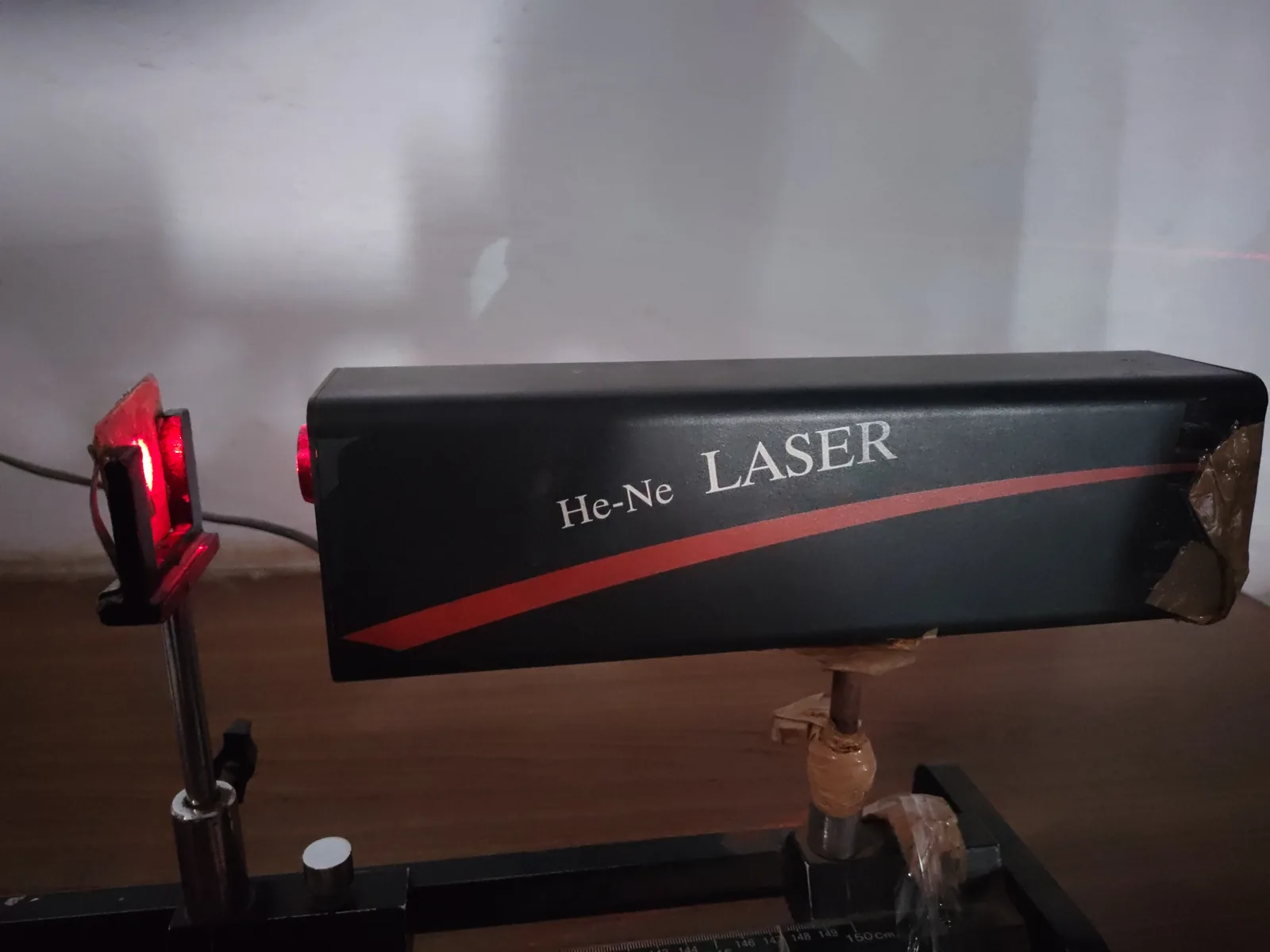
- Helium-Neon (He-Ne) laser. 2007siddharthsingh2006. source, CC0 1.0
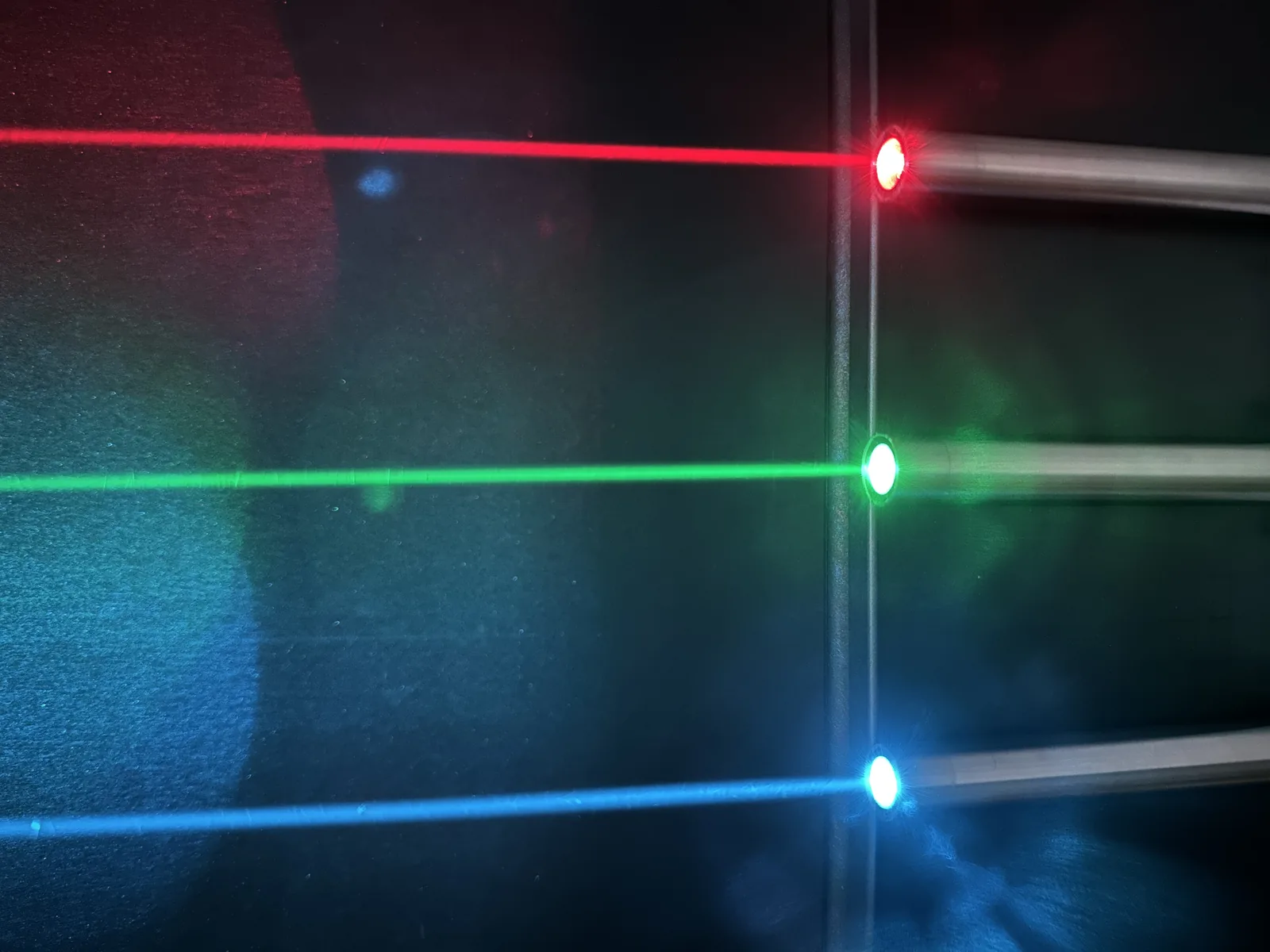
- RGB Laser Pointer. PANG KA KIT. source, CC BY-SA 4.0

