
Light from an LED and measuring the Planck constant
Why does a blue LED need a higher voltage than a red LED to light up?
Prior knowledge
- The energy of a photon is $E = hf = \tfrac{hc}{\lambda}$, and $1\,\text{eV} = 1.602 \cdot 10^{-19}\,\text{J}$ is the energy that an electron receives in a voltage of $1\,\text{V}$chapter The photoelectric effect and the photon
- When an electron moves from a higher energy level to a lower one, a photon is created whose energy is the difference of the energies of the levelschapter Spectra reveal the energy levels of atoms
- The states and energies of the electrons of an atom are quantisedchapter The wave-mechanical model of the atom and orbitals
Core path: follow the steps in order. Tasks marked Optional give extra practice. Optional tasks: 4.
Think about it
A red, a green and a blue LED are connected in parallel to the same adjustable voltage source, and the voltage is raised slowly from zero. The LEDs do not light up at the same time, although their voltage is the same at every moment.
What decides the voltage at which an LED lights up, and how can the Planck constant be measured from this?
Optional Review: the energy of a photon
Predict
Make your predictions before investigating 2 questions
Prediction 1: the same voltage, different colours
Prediction 2: current as a function of voltage
Investigate
Choose an LED and adjust its voltage. Watch at what voltage the current starts to flow and the LED lights up. Every voltage you try leaves a point on the graph.
Simulation
How to use
Choose an LED from the menu and adjust the voltage $U$ between the terminals of the LED with the slider. The ammeter ($\text{A}$) shows the current $I$ through the LED and the voltmeter ($\text{V}$) the voltage of the LED. The LED glows in its own colour, the brighter the greater the current, and the wavy lines are the photons it emits. On the right (on a phone, below) is the graph $(U, I)$: every voltage you try stays on it as a point in the colour of the LED, and the large point is the present state. Clear the graph removes the points. The graph does not show currents above $30\,\text{mA}$, and the readouts then show a warning.
Assumptions of the model
An adjustable voltage source and a protective resistor set the voltage of the LED; the slider shows the reading of the voltmeter directly. In the model the current is practically zero when the voltage is smaller than the threshold voltage of the LED, and above it grows linearly. For all the LEDs of the model the current grows equally steeply above the threshold voltage, which corresponds to a resistance of $18\,\Omega$. The threshold voltages of the model are slightly smaller than $\tfrac{hc}{e\lambda}$, as in real LEDs. The curve of a real LED is slightly curved also above the threshold voltage, and its threshold voltage changes a little with temperature. The readouts are values calculated by the model.
How the calculation works
The current is calculated from the equation $I = \tfrac{s}{R} \ln\!\left(1 + \exp\tfrac{U - U_\text{k}}{s}\right)$, where $s = 0.035\,\text{V}$, $R = 18\,\Omega$ and $U_\text{k}$ is the threshold voltage of the LED. When $U$ is clearly greater than $U_\text{k}$, the equation is approximately $I = \tfrac{U - U_\text{k}}{R}$: a line that cuts the voltage axis at $U = U_\text{k}$. When $U$ is clearly smaller than $U_\text{k}$, the current is vanishingly small.
Experiment 1: the same voltage, six LEDs
Test prediction 1. The voltage is locked at $2.20\,\text{V}$; change only the LED. Record the current for each of the six LEDs, at least three. Which LEDs light up, and what is their order?
Initial state: LED: red, voltage = $2{.}2\,\text{V}$. Kept constant: voltage. Varied: LED (peak wavelength).
| LED (peak wavelength) | $I$ $(\text{mA})$ |
|---|
Experiment 2: the threshold voltage of a red LED
Test prediction 2. The red LED has been chosen; change only the voltage. Record the current at least at the voltages $1.50$; $1.70$; $1.80$; $1.90$; $2.00$; $2.10$; $2.20$; $2.30$ and $2.40\,\text{V}$. At what voltage does the current start to grow steeply?
Initial state: LED: red, voltage = $1{.}5\,\text{V}$. Kept constant: LED (peak wavelength). Varied: voltage.
| voltage | $I$ $(\text{mA})$ |
|---|
Draw a graph $(U, I)$ of your measurements on paper or in Graphical Analysis Pro. Fit a line to the points where the current grows linearly (about $2.0$–$2.4\,\text{V}$) and extend it to the voltage axis.
What is the threshold voltage of the red LED? Answer in volts.
Hint 1: a guiding question
The threshold voltage is the voltage at which the extension of the straight part of the graph cuts the voltage axis, that is, the point $I = 0$.
Hint 2: what is the connection
On the straight part the current grows by about $5.6\,\text{mA}$ for every $0.10\,\text{V}$ added, so the slope is about $55\,\tfrac{\text{mA}}{\text{V}}$.
Hint 3: an intermediate step
At the voltage $2.40\,\text{V}$ the current is $28.9\,\text{mA}$. According to the line, the current falls to zero when the voltage is reduced by $28.9\,\text{mA} : 55.5\,\tfrac{\text{mA}}{\text{V}}$.
Show the solution
Given
the readings of the model for the red LED from the table: $2.00\,\text{V}$: $6.73\,\text{mA}$; $2.10\,\text{V}$: $12.23\,\text{mA}$; $2.20\,\text{V}$: $17.78\,\text{mA}$; $2.30\,\text{V}$: $23.33\,\text{mA}$; $2.40\,\text{V}$: $28.89\,\text{mA}$; at the voltages $1.90\,\text{V}$ and below the current is less than $2\,\text{mA}$
Asked
the threshold voltage $U_\text{k}$ in volts
Principle
Above the threshold voltage the current of the LED grows almost linearly. The threshold voltage is defined as the voltage at which the extension of this straight part cuts the voltage axis ($I = 0$). The points of the curved beginning do not belong to the line, so they are left out of the fit.
Reading the graph
The points in the range $2.00$–$2.40\,\text{V}$ are on a line, and the points below $1.90\,\text{V}$ curve towards zero. Two points far from each other are chosen from the line, $(2.10\,\text{V}$; $12.23\,\text{mA})$ and $(2.40\,\text{V}$; $28.89\,\text{mA})$.
Formula
the slope is $k = \dfrac{I_2 - I_1}{U_2 - U_1}$ and the line is $I = k\,(U - U_\text{k})$; at $I = I_2$ we get $U_\text{k} = U_2 - \dfrac{I_2}{k}$
Conversions
None are needed: the milliamperes cancel when the current is divided by the slope in the unit $\tfrac{\text{mA}}{\text{V}}$.
Substitution
so
Answer
$1.88\,\text{V}$
To a hundredth of a volt like the voltage readings.
Reasonableness
The energy of a photon of red light is $1240\,\text{eV}\,\text{nm} : 630\,\text{nm} \approx 1.97\,\text{eV}$, so the threshold voltage must be close to $1.97\,\text{V}$. The value obtained is about $0.1\,\text{V}$ smaller, as in real LEDs. In the table the current is also almost zero just below this voltage.
Conclusion: what decides the lighting up?
Write on the basis of your tables: in what order did the LEDs light up at the same voltage? How did the current of the red LED change as the voltage grew? Explain with the energy of a photon why an LED of a shorter wavelength needs a greater voltage.
Model answer
At the voltage $2.20\,\text{V}$ the current of the red LED was $17.8\,\text{mA}$, that of the orange one $13.9\,\text{mA}$, that of the yellow one $11.1\,\text{mA}$ and that of the green one only $0.11\,\text{mA}$; the blue and violet ones did not conduct at all. The shorter the wavelength, the greater the voltage that was needed. The current of the red LED was almost zero up to about $1.9\,\text{V}$ and then grew linearly, by about $5.6\,\text{mA}$ for every $0.10\,\text{V}$. The extension of the straight part cut the voltage axis at about $1.88\,\text{V}$: that is the threshold voltage of the red LED. Explanation: the voltage $U$ gives an electron the energy $eU$, and the electron creates a photon only when this energy is approximately the energy of the photon, $hf$. The energy of a photon of a shorter wavelength is greater, so the threshold voltage is also greater. The values are calculated by the model.
Assess your own answer
Tick the points your own answer already contains.
Review the theory summary and practise with the exercises.
The Planck constant from the data of six LEDs
Simulated example data · threshold voltages of the model of this chapter's simulation, not the results of a real measurement
The table contains the threshold voltages of the six LEDs of the simulation. They have been determined in the same way as in experiment 2: for each LED the straight part of its graph $(U, I)$ has been extended to the voltage axis. If your school has a set of LEDs and measuring equipment, you can measure your own values and use them.
| LED | $\lambda$ (nm) | $U_\text{k}$ (V) |
|---|---|---|
| red | 630 | 1.88 |
| orange | 605 | 1.95 |
| yellow | 590 | 2.00 |
| green | 525 | 2.30 |
| blue | 470 | 2.52 |
| violet | 405 | 2.95 |
Process the data in Graphical Analysis Pro:
- In the start window choose Manual Entry and type the columns $\lambda$ and $U_\text{k}$ with their units into the table.
- Add the frequency column with the choice New Calculated Column. Write an expression that divides the speed of light $2.998 \cdot 10^8\,\text{m/s}$ by the wavelength in metres: remember that $1\,\text{nm} = 10^{-9}\,\text{m}$.
- Choose $f$ for the horizontal axis of the graph and $U_\text{k}$ for the vertical axis.
- Fit a line with the graph tools using the choices Curve Fit, Linear and Apply. The $m$ of the result box is the slope $k$; the program uses a decimal point.
Calculate the Planck constant from the slope of the fitted line. The elementary charge is $e = 1.602 \cdot 10^{-19}\,\text{C}$. Answer in the unit $\text{J}\,\text{s}$, for example in the form 6.5e-34.
Hint 1: a guiding question
From the equation $eU_\text{k} = hf$ we get $U_\text{k} = \tfrac{h}{e}\,f$. Which quantity is the slope of the graph $(f, U_\text{k})$?
Hint 2: what is the connection
The slope is $k = \tfrac{h}{e}$, so $h = ek$. Check that the frequencies are of the order of $10^{14}\,\text{Hz}$.
Hint 3: an intermediate step
The slope of the fit is about $4.05 \cdot 10^{-15}\,\text{V}\,\text{s}$. Multiply it by the elementary charge.
Show the solution
Given
from the table, the peak wavelengths of the six LEDs $405$–$630\,\text{nm}$ and the threshold voltages $1.88$–$2.95\,\text{V}$; $c = 2.998 \cdot 10^8\,\text{m/s}$, $e = 1.602 \cdot 10^{-19}\,\text{C}$
Asked
the Planck constant $h$ in the unit $\text{J}\,\text{s}$
Principle
At the threshold voltage the energy received by an electron is approximately the energy of a photon, $eU_\text{k} \approx hf$, so the points $(f, U_\text{k})$ are approximately on a line whose slope is $\tfrac{h}{e}$. The points are not exactly on the same line, so the line is fitted to all six points. An almost equal deviation for all the LEDs shifts the line but does not change the slope.
Reading the graph
The frequencies are $4.76$; $4.96$; $5.08$; $5.71$; $6.38$ and $7.40 \cdot 10^{14}\,\text{Hz}$. The linear fit gives the slope $m = 4.054 \cdot 10^{-15}\,\tfrac{\text{V}}{\text{Hz}}$ and the constant term $b = -0.050\,\text{V}$.
Formula
$f = \dfrac{c}{\lambda}$ and $k = \dfrac{h}{e}$, so $h = ek$
Conversions
wavelengths to metres, for example $630\,\text{nm} = 630 \cdot 10^{-9}\,\text{m}$, whereby
the unit of the slope is $\tfrac{\text{V}}{\text{Hz}} = \text{V}\,\text{s}$
Substitution
Answer
$6.49 \cdot 10^{-34}\,\text{J}\,\text{s}$
Three significant figures like the threshold voltages.
Reasonableness
A check from the farthest points:
the same as in the fit. The result differs from the accepted value $6.626 \cdot 10^{-34}\,\text{J}\,\text{s}$ by about $-2.0\,\%$. The constant term $-0.05\,\text{V}$ is small compared with the threshold voltages, so the line passes almost through the origin, as the equation $eU_\text{k} = hf$ predicts.
Theory summary
Key idea
An LED is a semiconductor component
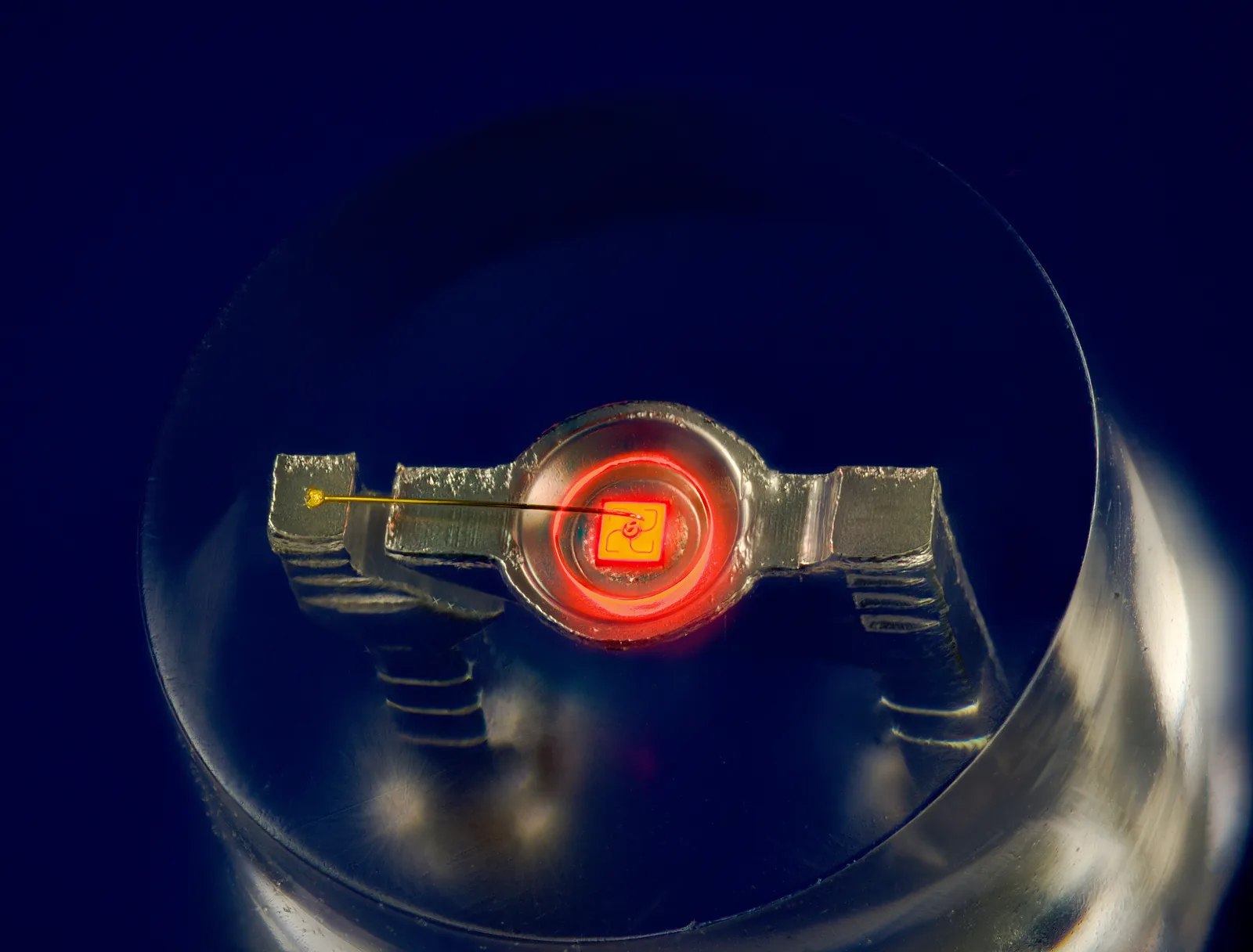
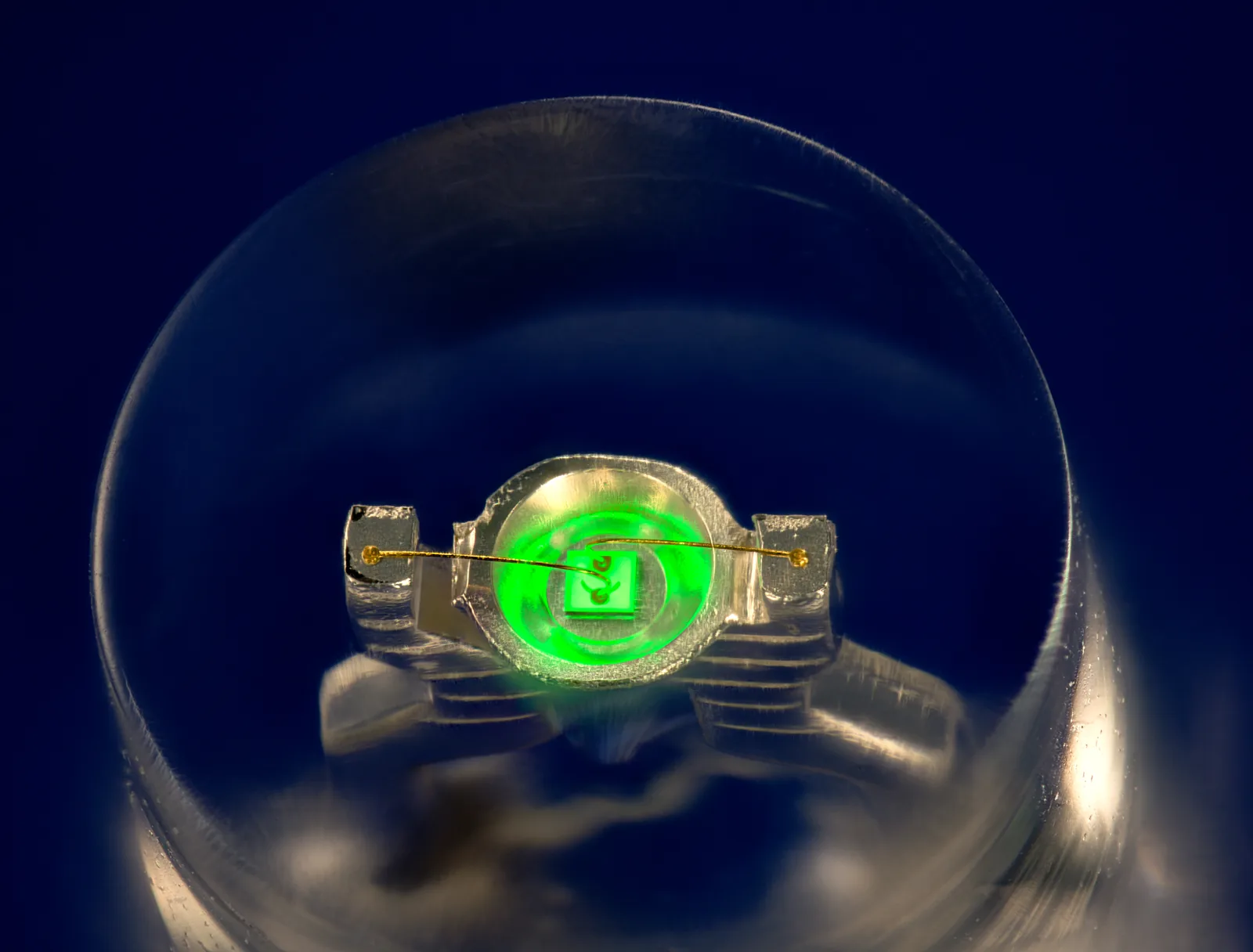
An LED, or light-emitting diode, is a diode made of a semiconductor: it lets an electric current through in one direction only and emits light when the current flows. In the chapter Spectra reveal the energy levels of atoms we saw that the electron of a single atom has only certain energy levels. In a solid the atoms are so close to each other that their energy levels merge into wide energy bands. In a semiconductor, between the almost full valence band and the almost empty conduction band there is an energy gap $E_\text{g}$: an energy interval in which an electron cannot have a state.
The electron falls into a hole, and a photon is born
An LED is made of two different semiconductors. In the conduction band of one, the n region, there are free electrons. In the valence band of the other, the p region, there are empty places for electrons, called holes. When a current flows through the LED, electrons and holes meet at the interface between the regions. An electron falls from the conduction band into a hole of the valence band and gives up its energy as one photon. The energy of the photon is approximately equal to the energy gap, $hf \approx E_\text{g}$. So the colour of an LED depends on the semiconductor material: in the semiconductor of a red LED the energy gap is about $1.9\,\text{eV}$, and in that of a blue LED about $2.6\,\text{eV}$.
Threshold voltage
When an electron passes across a voltage $U$, the electric field does work $eU$ on it, where $e$ is the elementary charge. This is exactly how the electronvolt was defined in the chapter The photoelectric effect and the photon. For an electron to be able to create a photon whose energy is $E_\text{g}$, it must receive at least approximately this energy from the voltage source. This is why an LED hardly conducts a current or emits light at a small voltage. The current starts to grow steeply when the voltage reaches the threshold voltage $U_\text{k}$ of the LED, for which $eU_\text{k} \approx E_\text{g} \approx hf$. The photon of blue light needs more energy than that of red light, so the threshold voltage of a blue LED is greater.
A voltage greater than the threshold voltage increases the current, that is, more electrons pass through the LED every second and more photons are created. The energy of a single photon does not grow, however, because it is decided by the energy gap. The extra energy turns into heat in the LED. So the colour of an LED stays the same when the voltage grows; only the brightness of the light grows.
LED, laser diode and incandescent lamp
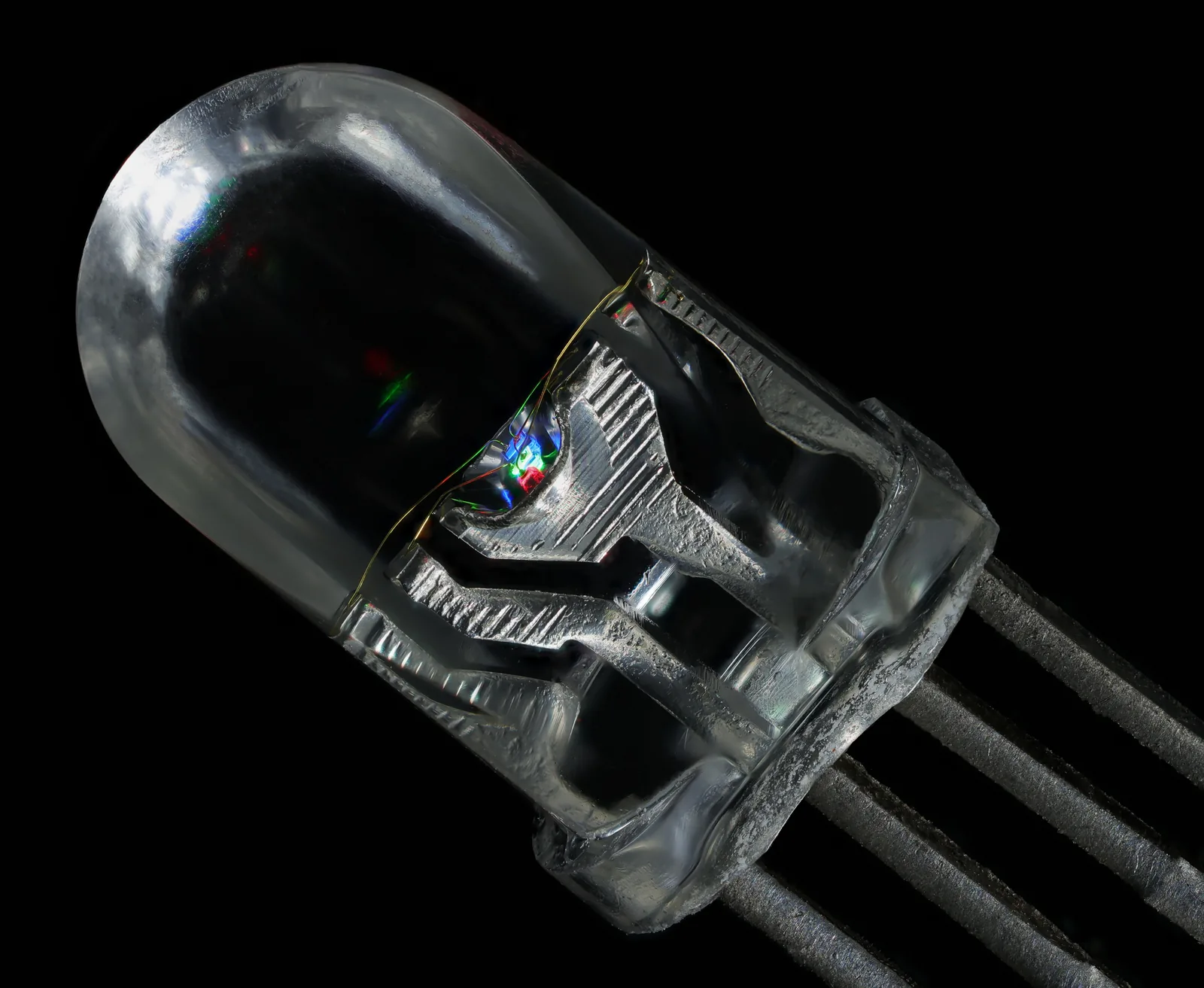
Light sources can be compared by measuring their spectra with a spectrometer, as in the chapter Spectra reveal the energy levels of atoms. The hot filament of an incandescent lamp emits a continuous spectrum that contains all the wavelengths of visible light. The spectrum of an LED is a narrow band whose width is typically $20$–$40\,\text{nm}$, because the energies of the electrons and holes vary a little at the edges of the bands. The wavelength given for an LED is the wavelength of the peak of its spectrum. A laser diode is a semiconductor diode like an LED, in which the light is amplified: its spectrum is a very narrow line, about $1\,\text{nm}$ wide, and the light travels as a narrow beam. We return to the operation of the laser in the chapter Lasers and quantum structures. Never look into the beam of a laser diode.
Threshold voltage and photon energy
Threshold voltage and wavelength
When the threshold voltage of an LED is reached, the energy that an electron receives from the voltage source is approximately the energy of one photon:
$$eU_\text{k} \approx hf = \frac{hc}{\lambda}$$
where $e = 1.602 \cdot 10^{-19}\,\text{C}$ is the elementary charge, $U_\text{k}$ the threshold voltage of the LED ($\text{V}$), $h = 6.626 \cdot 10^{-34}\,\text{J}\,\text{s}$ the Planck constant, $f$ the frequency of the light ($\text{Hz}$), $c = 2.998 \cdot 10^8\,\text{m/s}$ the speed of light and $\lambda$ the wavelength of the peak of the spectrum of the LED ($\text{m}$). For a red LED, $\lambda = 630\,\text{nm}$, this gives the threshold voltage $U_\text{k} \approx \tfrac{hc}{e\lambda}$. In the chapter The photoelectric effect and the photon we calculated $hc = 1240\,\text{eV}\,\text{nm}$, and because $1\,\text{eV} = e \cdot 1\,\text{V}$, we have $\tfrac{hc}{e} = 1240\,\text{V}\,\text{nm}$. Thus $U_\text{k} \approx 1240\,\text{V}\,\text{nm} : 630\,\text{nm} = 1.97\,\text{V}$. The measured threshold voltage is usually a little smaller, for example $1.88\,\text{V}$. The energy of a photon in electronvolts is approximately the same number as the threshold voltage in volts, because $1\,\text{eV}$ is the energy that an electron receives in a voltage of $1\,\text{V}$.
Determining the threshold voltage
The threshold voltage is measured by connecting the LED in series with a protective resistor and an ammeter to an adjustable voltage source, and a voltmeter across the terminals of the LED. The voltage is increased gradually, and the current is recorded at each voltage. In the $(U, I)$ graph the current is at first almost zero and then grows almost linearly. The threshold voltage is obtained when the line fitted to the straight part of the graph is extended to the voltage axis, where $I = 0$. This method is more repeatable than searching for the voltage at which the LED seems to start to glow, because the sensitivity of the eye varies with colour and from person to person.
The Planck constant from the slope
From the equation $eU_\text{k} = hf$ we get the threshold voltage as a function of frequency:
$$U_\text{k} = \frac{h}{e}\,f$$
When the threshold voltages of several LEDs of different colours are plotted as a graph $(f, U_\text{k})$, the points are approximately on a line whose slope is $k = \tfrac{h}{e}$. The Planck constant is obtained from the slope:
$$h = ek$$
where $k$ is the slope of the fitted line ($\tfrac{\text{V}}{\text{Hz}} = \text{V}\,\text{s}$) and $e$ the elementary charge; $\text{C} \cdot \text{V}\,\text{s} = \text{J}\,\text{s}$. The slope is read from the fitted line, not from two measured points. In Graphical Analysis Pro the line is fitted with the choices Curve Fit and Linear, and the $m$ of the result box is the slope.
In real series of measurements the measured points are usually not exactly on the same line because of measurement uncertainty. In addition, the line usually does not pass exactly through the origin: in the data of the figure it cuts the vertical axis about $0.05\,\text{V}$ below zero. The measured threshold voltage is not exactly $\tfrac{hf}{e}$: the electrons also receive a little extra energy from thermal motion, and the threshold voltage is defined as the extension of the line. The difference is typically about $0.1\,\text{V}$. When the difference is almost the same for all the LEDs, it shifts the line but does not change its slope. This is why the Planck constant is determined from the line of many LEDs and not from one LED. The width of the spectrum of the LED also brings uncertainty: the wavelength of the peak is known only to within a few nanometres.
Common misconception
Many people think that by increasing the voltage of an LED its light becomes bluer, because the electrons receive more energy. The energy of a photon is decided by the energy gap of the semiconductor, however, not by the voltage. A voltage greater than the threshold voltage increases the current, so more photons are created and the LED shines brighter, but the energy of every photon is still approximately $E_\text{g}$. The extra energy heats the LED. So blue light cannot be obtained from a red LED at any voltage, and too large a current only breaks the LED.
Another mistake is to think that the measurement has failed if the line of the graph $(f, U_\text{k})$ does not pass through the origin. The measured threshold voltage differs from the value $\tfrac{hf}{e}$ by almost the same amount for all the LEDs. The difference shifts the line up or down but does not change its slope $\tfrac{h}{e}$, from which the Planck constant is obtained.
Summary
- In an LED an electron falls from the conduction band of the semiconductor into a hole of the valence band and creates one photon whose energy is approximately equal to the energy gap: $hf \approx E_\text{g}$.
- An LED starts to conduct and emit light when the voltage reaches the threshold voltage: $eU_\text{k} \approx hf = \tfrac{hc}{\lambda}$. An LED of a shorter wavelength needs a greater threshold voltage.
- The threshold voltage is obtained by extending the straight part of the $(U, I)$ graph to the voltage axis.
- The slope of the graph $(f, U_\text{k})$ is $k = \tfrac{h}{e}$, so $h = ek$. The line does not have to pass through the origin.
- The spectrum of an incandescent lamp is continuous, that of an LED a narrow band and that of a laser diode a very narrow line.
Optional Return to your predictions
Compare your predictions with the values of the model in the experiments and with the equation $eU_\text{k} \approx hf$. Then return to the question at the beginning: why does a blue LED need a higher voltage than a red one to light up?
Would you change your prediction?
Apply
Worked example
Problem
A group measured the threshold voltages of five LEDs of different colours and fitted a line to the points $(f, U_\text{k})$. The fitted line passes through the points $(4.50 \cdot 10^{14}\,\text{Hz}$; $1.74\,\text{V})$ and $(7.50 \cdot 10^{14}\,\text{Hz}$; $2.96\,\text{V})$. The elementary charge is $e = 1.602 \cdot 10^{-19}\,\text{C}$. What value did the group get for the Planck constant?
Step 1/7
Given and asked. The points of the fitted line are $(f_1, U_1) = (4.50 \cdot 10^{14}\,\text{Hz}$; $1.74\,\text{V})$ and $(f_2, U_2) = (7.50 \cdot 10^{14}\,\text{Hz}$; $2.96\,\text{V})$, and the elementary charge is $e = 1.602 \cdot 10^{-19}\,\text{C}$. We are asked for the Planck constant $h$.
Step 2/7
Principle. At the threshold voltage the energy received by an electron is approximately the energy of a photon, $eU_\text{k} \approx hf$, so the slope of the graph $(f, U_\text{k})$ is $k = \tfrac{h}{e}$. The slope is calculated from two points of the fitted line that are far from each other, not from individual measured points.
Step 3/7
Formula solved. The slope is $k = \tfrac{U_2 - U_1}{f_2 - f_1}$, and $h$ is solved from the equation $k = \tfrac{h}{e}$:
$$h = ek = \frac{e\,(U_2 - U_1)}{f_2 - f_1}$$
Step 4/7
Unit conversions. None are needed: the voltages are in volts and the frequencies in hertz. From the units,
because $1\,\text{C} \cdot 1\,\text{V} = 1\,\text{J}$ and $1\,\text{Hz} = 1\,\tfrac{1}{\text{s}}$.
Step 5/7
Substitution. The differences are
$$\begin{aligned} h &= \frac{e\,(U_2 - U_1)}{f_2 - f_1} \\ &= \frac{1.602 \cdot 10^{-19}\,\text{C} \cdot 1.22\,\text{V}}{3.00 \cdot 10^{14}\,\tfrac{1}{\text{s}}} \\ &= 6.515 \cdot 10^{-34}\,\text{J}\,\text{s} \end{aligned}$$
Step 6/7
Answer. The value of the group for the Planck constant is $h = 6.52 \cdot 10^{-34}\,\text{J}\,\text{s}$. The result is given with three significant figures, because the difference of the voltages, $1.22\,\text{V}$, and the difference of the frequencies, $3.00 \cdot 10^{14}\,\text{Hz}$, have three significant figures.
Step 7/7
Reasonableness. The accepted value of the Planck constant is $6.626 \cdot 10^{-34}\,\text{J}\,\text{s}$, and the result of the group differs from it by $(6.515 - 6.626) : 6.626 \approx -1.7\,\%$. The difference is small when the threshold voltages and wavelengths are known only to within a few per cent. An estimate with round numbers:
and
Optional Find the error
Apply to a new situation
The remote control of a television has an LED whose light the eye cannot see. Its threshold voltage is measured to be $1.30\,\text{V}$. Use the values $h = 6.626 \cdot 10^{-34}\,\text{J}\,\text{s}$, $c = 2.998 \cdot 10^8\,\text{m/s}$ and $e = 1.602 \cdot 10^{-19}\,\text{C}$. Estimate the wavelength of the radiation of the LED. Answer in nanometres.
Hint 1: a guiding question
At the threshold voltage the energy that an electron receives from the voltage source is approximately the energy of one photon.
Hint 2: what is the connection
Solve the wavelength $\lambda$ from the equation $eU_\text{k} = \tfrac{hc}{\lambda}$.
Hint 3: an intermediate step
so $\lambda = \tfrac{hc}{eU_\text{k}}$. Finally convert metres to nanometres.
Show the solution
Given
threshold voltage $U_\text{k} = 1.30\,\text{V}$, $h = 6.626 \cdot 10^{-34}\,\text{J}\,\text{s}$, $c = 2.998 \cdot 10^8\,\text{m/s}$, $e = 1.602 \cdot 10^{-19}\,\text{C}$
Asked
the wavelength $\lambda$ of the radiation of the LED in nanometres
Principle
An LED starts to emit radiation when the energy $eU_\text{k}$ that an electron receives from the voltage source is approximately the energy $\tfrac{hc}{\lambda}$ of one photon. The same principle applies to invisible infrared as to visible light. Because the measured threshold voltage is usually slightly smaller than $\tfrac{hf}{e}$, the result is an estimate.
Formula
$eU_\text{k} = \dfrac{hc}{\lambda}$, so $\lambda = \dfrac{hc}{eU_\text{k}}$
Conversions
because $1\,\text{C} \cdot 1\,\text{V} = 1\,\text{J}$; the result from metres to nanometres, $1\,\text{m} = 10^{9}\,\text{nm}$
Substitution
so
Answer
about $954\,\text{nm}$, three significant figures like the voltage $1.30\,\text{V}$.
Reasonableness
With round numbers $1240\,\text{V}\,\text{nm} : 1.30\,\text{V} \approx 950\,\text{nm}$. The wavelength is over $700\,\text{nm}$, so the radiation is infrared, which the eye cannot see, as the problem says. The real wavelength should be slightly shorter, because the measured threshold voltage is usually slightly smaller than $\tfrac{hf}{e}$: the LEDs of remote controls typically emit at a wavelength of about $940\,\text{nm}$.
Check your understanding
Exit ticket
Answer on your own first and only then open the answer.
- The wavelength of a violet laser diode is $405\,\text{nm}$. Estimate its threshold voltage.
Answer
At the threshold voltage $eU_\text{k} \approx \tfrac{hc}{\lambda}$, so $U_\text{k} \approx \tfrac{hc}{e\lambda}$. First we calculate
$hc$$= 1.9865 \cdot 10^{-25}\,\text{J}\,\text{m}$$e\lambda$$= 1.602 \cdot 10^{-19}\,\text{C} \cdot 405 \cdot 10^{-9}\,\text{m}$$= 6.488 \cdot 10^{-26}\,\text{C}\,\text{m}$so
$U_\text{k}$$\approx 1.9865 \cdot 10^{-25}\,\text{J}\,\text{m} : 6.488 \cdot 10^{-26}\,\text{C}\,\text{m}$$= 3.06\,\text{V}$Each electron must receive from the voltage source approximately the energy of one photon, $3.06\,\text{eV}$; the measured threshold voltage is usually slightly smaller than this.
- The wavelength of the light source is needed in measuring the Planck constant. Why is the wavelength of a laser diode known more accurately than that of an LED?
Answer
The spectrum of a laser diode is a very narrow line, about $1\,\text{nm}$ wide, so its wavelength is almost unambiguous. The spectrum of an LED is a band $20$–$40\,\text{nm}$ wide, so the wavelength of the peak given as its wavelength is less accurate, and the uncertainty is transferred to the frequency $f = \tfrac{c}{\lambda}$.
1. A greater voltage
2. The Planck constant from a graph
The graph shows the threshold voltages of LEDs measured by another group as a function of frequency, and a line fitted to them. Read two points from the line and determine the Planck constant. The elementary charge is $e = 1.602 \cdot 10^{-19}\,\text{C}$. Answer in the unit $\text{J}\,\text{s}$.
Hint 1: a guiding question
Choose two points far from each other on the line, where the line passes through the intersection of grid lines.
Hint 2: what is the connection
The slope is $k = \tfrac{\Delta U_\text{k}}{\Delta f}$, and the Planck constant is $h = ek$. Remember the factor $10^{14}$ of the frequency axis.
Hint 3: an intermediate step
The line passes through the points $(4.6 \cdot 10^{14}\,\text{Hz}$; $1.80\,\text{V})$ and $(7.0 \cdot 10^{14}\,\text{Hz}$; $2.80\,\text{V})$.
Show the solution
Given
the fitted line of the graph and $e = 1.602 \cdot 10^{-19}\,\text{C}$
Asked
the Planck constant $h$ in the unit $\text{J}\,\text{s}$
Principle
At the threshold voltage $eU_\text{k} \approx hf$, so the slope of the graph $(f, U_\text{k})$ is $\tfrac{h}{e}$. The slope is read from the fitted line at two points far from each other, not from the measured points.
Reading the graph
The line passes through intersections of grid lines at $(4.6 \cdot 10^{14}\,\text{Hz}$; $1.80\,\text{V})$ and $(7.0 \cdot 10^{14}\,\text{Hz}$; $2.80\,\text{V})$. The spacing of the horizontal grid is $0.2 \cdot 10^{14}\,\text{Hz}$ and that of the vertical grid $0.1\,\text{V}$.
Formula
so $h = \dfrac{e\,(U_2 - U_1)}{f_2 - f_1}$
Conversions
The readings of the frequency axis in hertz: $4.6 \cdot 10^{14}\,\text{Hz}$ and $7.0 \cdot 10^{14}\,\text{Hz}$; $\text{C} \cdot \tfrac{\text{V}}{\text{Hz}} = \text{J}\,\text{s}$
Substitution
so
Answer
$6.7 \cdot 10^{-34}\,\text{J}\,\text{s}$
Two significant figures, because the difference of the frequencies $2.4 \cdot 10^{14}\,\text{Hz}$ is read to two figures.
Reasonableness
The accepted value is $6.626 \cdot 10^{-34}\,\text{J}\,\text{s}$, and the result differs from it by less than $1\,\%$. With the accepted value the line would rise by $1\,\text{V}$ over the frequency interval
and in the graph the interval is $2.4 \cdot 10^{14}\,\text{Hz}$.
Suggestion: one answer does not show everything you can do, but review the theory summary and do the core exercises.
Optional 3. Explain: the blue and the red LED
Explain with energy why a blue LED needs a greater voltage than a red one to light up. Mention in your explanation the electron, the energy gap and the photon.
Model answer
In an LED an electron falls from the conduction band into a hole of the valence band and creates one photon whose energy is approximately equal to the energy gap $E_\text{g}$ of the semiconductor. The voltage $U$ gives every electron that passes through the LED the energy $eU$, so photons can be created only when $eU$ is approximately the energy $hf$ of a photon. The wavelength of blue light is shorter than that of red light, so the energy $\tfrac{hc}{\lambda}$ of its photon is greater: about $2.6\,\text{eV}$ instead of about $2.0\,\text{eV}$ for red. The energy gap of the semiconductor of a blue LED is therefore greater, and its threshold voltage is about $2.5\,\text{V}$, whereas that of a red one is about $1.9\,\text{V}$.
Assess your own answer
Tick the points your own answer already contains.
Review the theory summary and practise with the exercises.
Exercises
Level 1 · basic practice 5 exercises
One formula or one step of reasoning. Core exercises first, the rest is extra practice.
- Exercise 6-1Core
The threshold voltage of an orange LED is $1.95\,\text{V}$. The elementary charge is $e = 1.602 \cdot 10^{-19}\,\text{C}$.
How much energy does an electron receive from the voltage source when it passes across this voltage? Give the answer in joules.
Answer
$3.12 \cdot 10^{-19}\,\text{J}$
Show the solution
Given
threshold voltage $U_\text{k} = 1.95\,\text{V}$, elementary charge $e = 1.602 \cdot 10^{-19}\,\text{C}$
Asked
the energy $E$ that the electron receives from the voltage source, in joules
Principle
When a charge $q$ passes across a voltage $U$, the electric field does work $qU$ on it. The magnitude of the charge of an electron is the elementary charge $e$, so it receives the energy $eU$ from the voltage source. This is exactly the energy available in the LED for creating a photon.
Formula
$E = eU_\text{k}$
Conversions
None are needed: $1\,\text{C} \cdot 1\,\text{V} = 1\,\text{J}$.
Substitution
$E$$= 1.602 \cdot 10^{-19}\,\text{C} \cdot 1.95\,\text{V}$$= 3.1239 \cdot 10^{-19}\,\text{J}$Answer
$3.12 \cdot 10^{-19}\,\text{J}$
Three significant figures like the voltage $1.95\,\text{V}$.
Reasonableness
In electronvolts the energy is exactly $1.95\,\text{eV}$, because $1\,\text{eV}$ is the energy that an electron receives in a voltage of $1\,\text{V}$. It is of the order of the energy of a photon of orange light: $1240\,\text{eV}\,\text{nm} : 605\,\text{nm} \approx 2.0\,\text{eV}$.
- Exercise 6-2Core
The peak of the spectrum of a green LED is at the wavelength $525\,\text{nm}$. Use the values $h = 6.626 \cdot 10^{-34}\,\text{J}\,\text{s}$, $c = 2.998 \cdot 10^8\,\text{m/s}$ and $1\,\text{eV} = 1.602 \cdot 10^{-19}\,\text{J}$.
How great is the energy of a photon of this wavelength? Give the answer in electronvolts.
Answer
$2.36\,\text{eV}$
Show the solution
Given
wavelength $\lambda = 525\,\text{nm}$, $h = 6.626 \cdot 10^{-34}\,\text{J}\,\text{s}$, $c = 2.998 \cdot 10^8\,\text{m/s}$, $1\,\text{eV} = 1.602 \cdot 10^{-19}\,\text{J}$
Asked
the energy $E$ of the photon in electronvolts
Principle
The energy of light is quantised into photons, and the energy of one photon is $E = hf$. The frequency is obtained from the wavelength, because light travels at the speed $c = f\lambda$.
Formula
$E = hf$ and $f = \dfrac{c}{\lambda}$, so $E = \dfrac{hc}{\lambda}$
Conversions
$\lambda$$= 525\,\text{nm}$$= 525 \cdot 10^{-9}\,\text{m}$the result from joules to electronvolts by dividing by $1.602 \cdot 10^{-19}\,\tfrac{\text{J}}{\text{eV}}$
Substitution
$hc$$= 6.626 \cdot 10^{-34}\,\text{J}\,\text{s} \cdot 2.998 \cdot 10^8\,\text{m/s}$$= 1.9865 \cdot 10^{-25}\,\text{J}\,\text{m}$so
$E$$= \dfrac{1.9865 \cdot 10^{-25}\,\text{J}\,\text{m}}{525 \cdot 10^{-9}\,\text{m}}$$= 3.7838 \cdot 10^{-19}\,\text{J}$$= \dfrac{3.7838 \cdot 10^{-19}}{1.602 \cdot 10^{-19}}\,\text{eV}$$= 2.362\,\text{eV}$Answer
$2.36\,\text{eV}$
Three significant figures like the wavelength $525\,\text{nm}$.
Reasonableness
With round numbers $1240\,\text{eV}\,\text{nm} : 525\,\text{nm} \approx 2.4\,\text{eV}$. Green light is in the middle of the visible range, and the energy of its photon is between that of red, about $2.0\,\text{eV}$, and that of violet, about $3.1\,\text{eV}$.
- Exercise 6-3
The wavelength of the light of a red laser diode is $650\,\text{nm}$. The speed of light is $c = 2.998 \cdot 10^8\,\text{m/s}$.
What is the frequency of the light? Give the answer in hertz.
Answer
$4.61 \cdot 10^{14}\,\text{Hz}$
Show the solution
Given
wavelength $\lambda = 650\,\text{nm}$, speed of light $c = 2.998 \cdot 10^8\,\text{m/s}$
Asked
the frequency $f$ of the light in hertz
Principle
The light of a laser diode is electromagnetic wave motion that travels at the speed of light. The basic equation of wave motion, $c = f\lambda$, connects the frequency and the wavelength.
Formula
$c = f\lambda$, so $f = \dfrac{c}{\lambda}$
Conversions
$\lambda$$= 650\,\text{nm}$$= 650 \cdot 10^{-9}\,\text{m}$Substitution
$f$$= \dfrac{2.998 \cdot 10^8\,\text{m/s}}{650 \cdot 10^{-9}\,\text{m}}$$= 4.612 \cdot 10^{14}\,\tfrac{1}{\text{s}}$Answer
$4.61 \cdot 10^{14}\,\text{Hz}$
Three significant figures like the wavelength $650\,\text{nm}$.
Reasonableness
The frequencies of visible light are about $4 \cdot 10^{14}\,\text{Hz}$–$8 \cdot 10^{14}\,\text{Hz}$, and red light is at the low-frequency end of the range. An estimate:
$3 \cdot 10^8\,\text{m/s} : (6.5 \cdot 10^{-7}\,\text{m})$$\approx 4.6 \cdot 10^{14}\,\text{Hz}$ - Exercise 6-4
The energy gap of gallium arsenide is $1.42\,\text{eV}$. An LED made of it emits photons whose energy is approximately equal to the energy gap. Use the values $h = 6.626 \cdot 10^{-34}\,\text{J}\,\text{s}$, $c = 2.998 \cdot 10^8\,\text{m/s}$ and $1\,\text{eV} = 1.602 \cdot 10^{-19}\,\text{J}$.
What is the wavelength of the light of the LED? Give the answer in nanometres.
Answer
$873\,\text{nm}$
Show the solution
Given
energy gap $E_\text{g} = 1.42\,\text{eV}$, $h = 6.626 \cdot 10^{-34}\,\text{J}\,\text{s}$, $c = 2.998 \cdot 10^8\,\text{m/s}$, $1\,\text{eV} = 1.602 \cdot 10^{-19}\,\text{J}$
Asked
the wavelength $\lambda$ of the light of the LED in nanometres
Principle
In an LED an electron falls from the conduction band into a hole of the valence band and gives up its energy as one photon. The energy of the photon is approximately equal to the energy gap, $\tfrac{hc}{\lambda} \approx E_\text{g}$.
Formula
$\dfrac{hc}{\lambda} = E_\text{g}$, so $\lambda = \dfrac{hc}{E_\text{g}}$
Conversions
$E_\text{g}$$= 1.42\,\text{eV}$$= 1.42 \cdot 1.602 \cdot 10^{-19}\,\text{J}$$= 2.2748 \cdot 10^{-19}\,\text{J}$the result from metres to nanometres, $1\,\text{m} = 10^{9}\,\text{nm}$
Substitution
$hc$$= 6.626 \cdot 10^{-34}\,\text{J}\,\text{s} \cdot 2.998 \cdot 10^8\,\text{m/s}$$= 1.9865 \cdot 10^{-25}\,\text{J}\,\text{m}$so
$\lambda$$= \dfrac{1.9865 \cdot 10^{-25}\,\text{J}\,\text{m}}{2.2748 \cdot 10^{-19}\,\text{J}}$$= 8.733 \cdot 10^{-7}\,\text{m}$$= 873.3\,\text{nm}$Answer
$873\,\text{nm}$
Three significant figures like the energy gap $1.42\,\text{eV}$.
Reasonableness
With round numbers $1240\,\text{eV}\,\text{nm} : 1.42\,\text{eV} \approx 870\,\text{nm}$. The wavelength is over $700\,\text{nm}$, so the light is infrared. That fits, because the energy gap is smaller than the energy of a photon of red light, about $1.8\,\text{eV}$.
- Exercise 6-5
A student fitted to the threshold voltages of LEDs as a function of frequency a line whose slope is $k = 4.10 \cdot 10^{-15}\,\text{V}\,\text{s}$. The elementary charge is $e = 1.602 \cdot 10^{-19}\,\text{C}$.
What value did the student get for the Planck constant? Give the answer in the unit $\text{J}\,\text{s}$.
Answer
$6.57 \cdot 10^{-34}\,\text{J}\,\text{s}$
Show the solution
Given
slope of the fitted line $k = 4.10 \cdot 10^{-15}\,\text{V}\,\text{s}$, elementary charge $e = 1.602 \cdot 10^{-19}\,\text{C}$
Asked
the Planck constant $h$ in the unit $\text{J}\,\text{s}$
Principle
At the threshold voltage the energy received by an electron is approximately the energy of a photon, $eU_\text{k} = hf$. So the threshold voltage is a line with respect to the frequency, $U_\text{k} = \tfrac{h}{e} f$, whose slope is $\tfrac{h}{e}$.
Formula
$k = \dfrac{h}{e}$, so $h = ek$
Conversions
None are needed: $\text{C} \cdot \text{V}\,\text{s} = \text{J}\,\text{s}$, because $1\,\text{C} \cdot 1\,\text{V} = 1\,\text{J}$.
Substitution
$h$$= 1.602 \cdot 10^{-19}\,\text{C} \cdot 4.10 \cdot 10^{-15}\,\text{V}\,\text{s}$$= 6.568 \cdot 10^{-34}\,\text{J}\,\text{s}$Answer
$6.57 \cdot 10^{-34}\,\text{J}\,\text{s}$
Three significant figures like the slope $4.10 \cdot 10^{-15}\,\text{V}\,\text{s}$.
Reasonableness
The accepted value is $6.626 \cdot 10^{-34}\,\text{J}\,\text{s}$, and the result differs from it by $(6.568 - 6.626) : 6.626 \approx -0.9\,\%$. In a measurement based on threshold voltages a difference of a few per cent is usual, so the result is credible.
Level 2 · applied practice 4 exercises
Two steps, working with measured data, a unit conversion or rearranging a formula. Core exercises first, the rest is extra practice.
- Exercise 6-6Core
The peak of the spectrum of a blue LED is at the wavelength $470\,\text{nm}$. Use the values $h = 6.626 \cdot 10^{-34}\,\text{J}\,\text{s}$, $c = 2.998 \cdot 10^8\,\text{m/s}$ and $e = 1.602 \cdot 10^{-19}\,\text{C}$. Estimate how great a voltage must at least be connected to the LED for it to start to emit light. Give the answer in volts.
Answer
$2.64\,\text{V}$
Show the solution
Given
wavelength $\lambda = 470\,\text{nm}$, $h = 6.626 \cdot 10^{-34}\,\text{J}\,\text{s}$, $c = 2.998 \cdot 10^8\,\text{m/s}$, $e = 1.602 \cdot 10^{-19}\,\text{C}$
Asked
the smallest voltage, that is the threshold voltage $U_\text{k}$, in volts
Principle
An LED emits light only when each electron receives from the voltage source at least approximately the energy of one photon. At the threshold voltage the energy $eU_\text{k}$ of an electron is equal to the energy $\tfrac{hc}{\lambda}$ of a photon.
Formula
$eU_\text{k} = \dfrac{hc}{\lambda}$, so $U_\text{k} = \dfrac{hc}{e\lambda}$
Conversions
$\lambda$$= 470\,\text{nm}$$= 470 \cdot 10^{-9}\,\text{m}$$1\,\tfrac{\text{J}}{\text{C}} = 1\,\text{V}$
Substitution
$hc$$= 6.626 \cdot 10^{-34}\,\text{J}\,\text{s} \cdot 2.998 \cdot 10^8\,\text{m/s}$$= 1.9865 \cdot 10^{-25}\,\text{J}\,\text{m}$so
$e\lambda$$= 1.602 \cdot 10^{-19}\,\text{C} \cdot 470 \cdot 10^{-9}\,\text{m}$$= 7.5294 \cdot 10^{-26}\,\text{C}\,\text{m}$$U_\text{k}$$= \dfrac{1.9865 \cdot 10^{-25}\,\text{J}\,\text{m}}{7.5294 \cdot 10^{-26}\,\text{C}\,\text{m}}$$= 2.638\,\text{V}$Answer
about $2.64\,\text{V}$, three significant figures like the wavelength $470\,\text{nm}$.
Reasonableness
With round numbers $1240\,\text{V}\,\text{nm} : 470\,\text{nm} \approx 2.6\,\text{V}$. The voltage is greater than that of a red LED, about $1.9\,\text{V}$, because a photon of blue light needs more energy. The measured threshold voltage is usually about $0.1\,\text{V}$ smaller than this estimate.
- Exercise 6-7Core
The peak wavelength of an orange LED is $605\,\text{nm}$, and its threshold voltage is measured to be $1.95\,\text{V}$. Use the values $c = 2.998 \cdot 10^8\,\text{m/s}$ and $e = 1.602 \cdot 10^{-19}\,\text{C}$.
What value for the Planck constant is obtained from this one LED, when $eU_\text{k} = \tfrac{hc}{\lambda}$ is assumed? Give the answer in the unit $\text{J}\,\text{s}$.
Answer
$6.30 \cdot 10^{-34}\,\text{J}\,\text{s}$
Show the solution
Given
peak wavelength $\lambda = 605\,\text{nm}$, threshold voltage $U_\text{k} = 1.95\,\text{V}$, $c = 2.998 \cdot 10^8\,\text{m/s}$, $e = 1.602 \cdot 10^{-19}\,\text{C}$
Asked
the value of the Planck constant $h$ from the measurement of one LED, in the unit $\text{J}\,\text{s}$
Principle
We assume that at the threshold voltage the energy $eU_\text{k}$ received by an electron is exactly the energy $\tfrac{hc}{\lambda}$ of one photon. The Planck constant can be solved from the equation.
Formula
$eU_\text{k} = \dfrac{hc}{\lambda}$, so $h = \dfrac{eU_\text{k}\lambda}{c}$
Conversions
$\lambda$$= 605\,\text{nm}$$= 605 \cdot 10^{-9}\,\text{m}$$1\,\text{C} \cdot 1\,\text{V} = 1\,\text{J}$
Substitution
$eU_\text{k}$$= 1.602 \cdot 10^{-19}\,\text{C} \cdot 1.95\,\text{V}$$= 3.1239 \cdot 10^{-19}\,\text{J}$$eU_\text{k}\lambda$$= 3.1239 \cdot 10^{-19}\,\text{J} \cdot 605 \cdot 10^{-9}\,\text{m}$$= 1.8900 \cdot 10^{-25}\,\text{J}\,\text{m}$so
$h$$= \dfrac{1.8900 \cdot 10^{-25}\,\text{J}\,\text{m}}{2.998 \cdot 10^8\,\text{m/s}}$$= 6.304 \cdot 10^{-34}\,\text{J}\,\text{s}$Answer
$6.30 \cdot 10^{-34}\,\text{J}\,\text{s}$
Three significant figures like the voltage and the wavelength.
Reasonableness
The result is of the right order of magnitude but $(6.304 - 6.626) : 6.626 \approx -4.9\,\%$ smaller than the accepted value. The difference arises because the measured threshold voltage is slightly smaller than $\tfrac{hf}{e}$. This is why the Planck constant is determined from the slope of the line of many LEDs, which this almost constant difference does not affect.
- Exercise 6-8
A current of $20\,\text{mA}$ flows through a red LED, and the wavelength of its light is $630\,\text{nm}$. Assume that every electron passing through the LED creates one photon that gets out of the LED. Use the values $h = 6.626 \cdot 10^{-34}\,\text{J}\,\text{s}$, $c = 2.998 \cdot 10^8\,\text{m/s}$ and $e = 1.602 \cdot 10^{-19}\,\text{C}$.
How great is the light power of the LED? Give the answer in milliwatts.
Answer
$39\,\text{mW}$
Show the solution
Given
current $I = 20\,\text{mA}$, wavelength $\lambda = 630\,\text{nm}$, $h = 6.626 \cdot 10^{-34}\,\text{J}\,\text{s}$, $c = 2.998 \cdot 10^8\,\text{m/s}$, $e = 1.602 \cdot 10^{-19}\,\text{C}$; every electron creates one photon that gets out
Asked
the light power $P$ in milliwatts
Principle
The current tells how much charge passes every second, so the number of electrons per second is $N = \tfrac{I}{e}$. By the assumption, the same number of photons is created every second, and each carries away the energy $\tfrac{hc}{\lambda}$. The light power is the energy carried away by the photons per second.
Formula
$N = \dfrac{I}{e}$ and $P = N \cdot \dfrac{hc}{\lambda}$, so $P = \dfrac{Ihc}{e\lambda}$
Conversions
$I$$= 20\,\text{mA}$$= 0.020\,\text{A}$$\lambda$$= 630\,\text{nm}$$= 630 \cdot 10^{-9}\,\text{m}$finally $1\,\text{W} = 1000\,\text{mW}$
Substitution
$N$$= \dfrac{0.020\,\text{C/s}}{1.602 \cdot 10^{-19}\,\text{C}}$$= 1.2484 \cdot 10^{17}\,\tfrac{1}{\text{s}}$the energy of a photon is
$\dfrac{1.9865 \cdot 10^{-25}\,\text{J}\,\text{m}}{630 \cdot 10^{-9}\,\text{m}}$$= 3.1532 \cdot 10^{-19}\,\text{J}$so
$P$$= 1.2484 \cdot 10^{17}\,\tfrac{1}{\text{s}} \cdot 3.1532 \cdot 10^{-19}\,\text{J}$$= 0.03937\,\text{W}$$= 39.4\,\text{mW}$Answer
about $39\,\text{mW}$, two significant figures like the current $20\,\text{mA}$.
Reasonableness
The energy of a photon is about $2\,\text{eV}$, so the light power is about $2\,\text{V} \cdot 0.020\,\text{A} = 40\,\text{mW}$, as was obtained. A real LED emits less than this, because not all the electrons create a photon and some of the photons are absorbed inside the LED.
- Exercise 6-9
A white LED contains a blue LED whose photons have the wavelength $450\,\text{nm}$. It is covered by a phosphor that absorbs a blue photon and emits by fluorescence a yellow photon whose wavelength is $560\,\text{nm}$. Use the values $h = 6.626 \cdot 10^{-34}\,\text{J}\,\text{s}$, $c = 2.998 \cdot 10^8\,\text{m/s}$ and $1\,\text{eV} = 1.602 \cdot 10^{-19}\,\text{J}$.
How much energy per photon is left in the phosphor as heat? Give the answer in electronvolts.
Answer
$0.541\,\text{eV}$
Show the solution
Given
wavelength of the blue photon $\lambda_1 = 450\,\text{nm}$, wavelength of the yellow photon $\lambda_2 = 560\,\text{nm}$, $h = 6.626 \cdot 10^{-34}\,\text{J}\,\text{s}$, $c = 2.998 \cdot 10^8\,\text{m/s}$, $1\,\text{eV} = 1.602 \cdot 10^{-19}\,\text{J}$
Asked
the energy $\Delta E$ left as heat per photon, in electronvolts
Principle
In fluorescence (chapter Spectra reveal the energy levels of atoms) a substance absorbs a photon and emits a photon of lower energy. Energy is conserved, so the difference between the energies of the absorbed and the emitted photon is left in the phosphor as heat.
Formula
$\Delta E$$= \dfrac{hc}{\lambda_1} - \dfrac{hc}{\lambda_2}$Conversions
$\lambda_1 = 450 \cdot 10^{-9}\,\text{m}$, $\lambda_2 = 560 \cdot 10^{-9}\,\text{m}$; the energies from joules to electronvolts by dividing by $1.602 \cdot 10^{-19}\,\tfrac{\text{J}}{\text{eV}}$
Substitution
$\dfrac{hc}{\lambda_1}$$= \dfrac{1.9865 \cdot 10^{-25}\,\text{J}\,\text{m}}{450 \cdot 10^{-9}\,\text{m}}$$= 4.4144 \cdot 10^{-19}\,\text{J}$$= 2.7556\,\text{eV}$$\dfrac{hc}{\lambda_2}$$= \dfrac{1.9865 \cdot 10^{-25}\,\text{J}\,\text{m}}{560 \cdot 10^{-9}\,\text{m}}$$= 3.5473 \cdot 10^{-19}\,\text{J}$$= 2.2143\,\text{eV}$so
$\Delta E$$= 2.7556\,\text{eV} - 2.2143\,\text{eV}$$= 0.5413\,\text{eV}$Answer
$0.541\,\text{eV}$
Three significant figures like the wavelengths.
Reasonableness
With round numbers
$1240 : 450 - 1240 : 560$$\approx 2.76 - 2.21$$= 0.55$that is about $0.5\,\text{eV}$. The emitted photon has a longer wavelength than the absorbed one, so the difference must be positive, as it always is in fluorescence. About a fifth of the energy of the blue photon turns into heat.
Level 3 · challenging 3 exercises
Optional: application, two ideas together or a new situation where you reason for yourself.
- Exercise 6-10
A group measured the threshold voltages of four LEDs. Red LED: $\lambda = 625\,\text{nm}$, $U_\text{k} = 1.86\,\text{V}$. Yellow: $590\,\text{nm}$ and $1.97\,\text{V}$. Green: $520\,\text{nm}$ and $2.27\,\text{V}$. Blue: $465\,\text{nm}$ and $2.55\,\text{V}$. Use the values $c = 2.998 \cdot 10^8\,\text{m/s}$ and $e = 1.602 \cdot 10^{-19}\,\text{C}$. Determine the Planck constant by fitting a line to the points $(f, U_\text{k})$, for example with Graphical Analysis Pro. Give the answer in the unit $\text{J}\,\text{s}$.
Answer
$6.75 \cdot 10^{-34}\,\text{J}\,\text{s}$
Show the solution
Given
the peak wavelengths and threshold voltages of four LEDs: $625\,\text{nm}$ and $1.86\,\text{V}$, $590\,\text{nm}$ and $1.97\,\text{V}$, $520\,\text{nm}$ and $2.27\,\text{V}$, $465\,\text{nm}$ and $2.55\,\text{V}$; $c = 2.998 \cdot 10^8\,\text{m/s}$, $e = 1.602 \cdot 10^{-19}\,\text{C}$
Asked
the Planck constant $h$ in the unit $\text{J}\,\text{s}$
Principle
At the threshold voltage $eU_\text{k} \approx hf$, so the points $(f, U_\text{k})$ are approximately on a line whose slope is $\tfrac{h}{e}$. The points are usually not exactly on the same line because of measurement uncertainty, so the line is fitted to all the points. An almost equal deviation for all the LEDs shifts the line but does not change the slope.
Reading the graph
When the frequencies are calculated and the line is fitted in Graphical Analysis Pro with the choices Curve Fit and Linear, the result box shows $m = 4.212 \cdot 10^{-15}\,\tfrac{\text{V}}{\text{Hz}}$ and $b = -0.164\,\text{V}$.
Formula
$f = \dfrac{c}{\lambda}$ and $k = \dfrac{h}{e}$, so $h = ek$
Conversions
wavelengths to metres, for example $625\,\text{nm} = 625 \cdot 10^{-9}\,\text{m}$; $\tfrac{\text{V}}{\text{Hz}} = \text{V}\,\text{s}$
Substitution
$f_1$$= \dfrac{2.998 \cdot 10^8\,\text{m/s}}{625 \cdot 10^{-9}\,\text{m}}$$= 4.797 \cdot 10^{14}\,\text{Hz}$in the same way $f_2 = 5.081 \cdot 10^{14}\,\text{Hz}$, $f_3 = 5.765 \cdot 10^{14}\,\text{Hz}$ and $f_4 = 6.447 \cdot 10^{14}\,\text{Hz}$. From the slope of the fit,
$h$$= 1.602 \cdot 10^{-19}\,\text{C} \cdot 4.212 \cdot 10^{-15}\,\text{V}\,\text{s}$$= 6.748 \cdot 10^{-34}\,\text{J}\,\text{s}$Answer
$6.75 \cdot 10^{-34}\,\text{J}\,\text{s}$
Three significant figures like the threshold voltages.
Reasonableness
A check from the farthest points:
$(2.55\,\text{V} - 1.86\,\text{V}) : (1.650 \cdot 10^{14}\,\text{Hz})$$= 4.18 \cdot 10^{-15}\,\text{V}\,\text{s}$close to the value of the fit. The result differs from the accepted value $6.626 \cdot 10^{-34}\,\text{J}\,\text{s}$ by about $+1.8\,\%$, which is a usual accuracy for this method.
- Exercise 6-11
A student estimates the uncertainty of the Planck constant by drawing, for the points $(f, U_\text{k})$, the steepest and the gentlest line that still pass through the uncertainty bars of the points.
The slope of the steepest line is $4.25 \cdot 10^{-15}\,\text{V}\,\text{s}$ and that of the gentlest $3.95 \cdot 10^{-15}\,\text{V}\,\text{s}$. The elementary charge is $e = 1.602 \cdot 10^{-19}\,\text{C}$.
How great is the uncertainty $\Delta h$ of the Planck constant, when it is estimated as half the difference of the values given by these lines? Give the answer in the unit $\text{J}\,\text{s}$.
Answer
$\Delta h \approx 2.4 \cdot 10^{-35}\,\text{J}\,\text{s}$
Show the solution
Given
slope of the steepest line $k_\text{max} = 4.25 \cdot 10^{-15}\,\text{V}\,\text{s}$, of the gentlest $k_\text{min} = 3.95 \cdot 10^{-15}\,\text{V}\,\text{s}$, $e = 1.602 \cdot 10^{-19}\,\text{C}$
Asked
the uncertainty $\Delta h$ of the Planck constant in the unit $\text{J}\,\text{s}$
Principle
Each slope gives a value for the Planck constant, $h = ek$. The steepest and the gentlest line that fit the points bound an estimated interval in which the slope probably lies; the uncertainty is estimated as half the width of the interval.
Formula
$h_\text{max} = ek_\text{max}$ and $h_\text{min} = ek_\text{min}$, so
$\Delta h$$= \dfrac{h_\text{max} - h_\text{min}}{2}$$= \dfrac{e\,(k_\text{max} - k_\text{min})}{2}$Conversions
None are needed: $\text{C} \cdot \text{V}\,\text{s} = \text{J}\,\text{s}$.
Substitution
$k_\text{max} - k_\text{min}$$= 4.25 \cdot 10^{-15}\,\text{V}\,\text{s} - 3.95 \cdot 10^{-15}\,\text{V}\,\text{s}$$= 0.30 \cdot 10^{-15}\,\text{V}\,\text{s}$so
$\Delta h$$= 1.602 \cdot 10^{-19}\,\text{C} \cdot 0.30 \cdot 10^{-15}\,\text{V}\,\text{s} : 2$$= 2.403 \cdot 10^{-35}\,\text{J}\,\text{s}$Answer
$\Delta h \approx 2.4 \cdot 10^{-35}\,\text{J}\,\text{s}$
Two significant figures like the difference of the slopes $0.30 \cdot 10^{-15}\,\text{V}\,\text{s}$.
Reasonableness
The middle value is
$e \cdot 4.10 \cdot 10^{-15}\,\text{V}\,\text{s}$$= 6.57 \cdot 10^{-34}\,\text{J}\,\text{s}$so the result is $h = (6.6 \pm 0.2) \cdot 10^{-34}\,\text{J}\,\text{s}$. The uncertainty is about $4\,\%$, and the accepted value $6.626 \cdot 10^{-34}\,\text{J}\,\text{s}$ is within this interval.
- Exercise 6-12
An ultraviolet LED with the wavelength $365\,\text{nm}$ is used to check fluorescent markings. A current of $20\,\text{mA}$ flows through the LED, and it emits ultraviolet radiation with the power $15\,\text{mW}$. Use the values $h = 6.626 \cdot 10^{-34}\,\text{J}\,\text{s}$, $c = 2.998 \cdot 10^8\,\text{m/s}$ and $e = 1.602 \cdot 10^{-19}\,\text{C}$.
What percentage of the electrons passing through the LED create a photon that gets out of the LED?
Answer
$22\,\%$
Show the solution
Given
wavelength $\lambda = 365\,\text{nm}$, current $I = 20\,\text{mA}$, radiated power $P = 15\,\text{mW}$, $h = 6.626 \cdot 10^{-34}\,\text{J}\,\text{s}$, $c = 2.998 \cdot 10^8\,\text{m/s}$, $e = 1.602 \cdot 10^{-19}\,\text{C}$
Asked
the share of the number of photons that get out, of the number of electrons passing through the LED, as a percentage
Principle
The radiated power is the energy carried away by the photons per second, so the number of photons per second is the power divided by the energy of one photon. The current tells the number of electrons per second, $\tfrac{I}{e}$. One electron can create at most one photon, so the share is at most $100\,\%$.
Formula
$N_\text{f}$$= \dfrac{P}{hc/\lambda}$$= \dfrac{P\lambda}{hc}$$N_\text{e} = \dfrac{I}{e}$, so the share is
$\dfrac{N_\text{f}}{N_\text{e}}$$= \dfrac{P\lambda e}{hcI}$Conversions
$P = 15\,\text{mW} = 0.015\,\text{W}$, $I = 20\,\text{mA} = 0.020\,\text{A}$, $\lambda = 365 \cdot 10^{-9}\,\text{m}$; finally the share to a percentage by multiplying by $100\,\%$
Substitution
$N_\text{f}$$= \dfrac{0.015\,\text{J/s} \cdot 365 \cdot 10^{-9}\,\text{m}}{1.9865 \cdot 10^{-25}\,\text{J}\,\text{m}}$$= 2.756 \cdot 10^{16}\,\tfrac{1}{\text{s}}$$N_\text{e}$$= \dfrac{0.020\,\text{C/s}}{1.602 \cdot 10^{-19}\,\text{C}}$$= 1.2484 \cdot 10^{17}\,\tfrac{1}{\text{s}}$so
$\dfrac{N_\text{f}}{N_\text{e}}$$= \dfrac{2.756 \cdot 10^{16}}{1.2484 \cdot 10^{17}}$$= 0.2208$$= 22.1\,\%$Answer
about $22\,\%$, two significant figures like the power $15\,\text{mW}$ and the current $20\,\text{mA}$.
Reasonableness
The energy of a photon is $1240\,\text{eV}\,\text{nm} : 365\,\text{nm} \approx 3.4\,\text{eV}$, so if every electron created a photon, the radiated power would be about $3.4\,\text{V} \cdot 0.020\,\text{A} = 68\,\text{mW}$. The measured $15\,\text{mW}$ is about a fifth of that, as was obtained. The share is less than $100\,\%$, as it must be.
Photographs
- Red LED. Mister rf. source, CC BY-SA 4.0
- InGaN-based green LED. Mister rf. source, CC BY-SA 4.0
- LED 5mm RGB. Mister rf. source, CC BY-SA 4.0


