
The atomic nucleus and radioactive decay
Why does a small sample of americium in a smoke detector keep emitting particles, and what happens to an americium nucleus when a particle leaves?
Prior knowledge
- The energy of a photon is $E = hf = \tfrac{hc}{\lambda}$, and energy can be given in electronvoltschapter The photoelectric effect and the photon
- The energy of a photon created in a transition is the difference between the energy levelschapter Energy levels of the hydrogen atom and the Bohr model
Core path: follow the steps in order. Tasks marked Optional give extra practice. Optional tasks: 4.
Think about it
Almost every home has a smoke detector on the ceiling, and many contain a small sample of americium-241. Tens of thousands of alpha particles leave it every second. They ionise the air between two metal plates and make it slightly conducting. When smoke enters the chamber, the current decreases and the alarm sounds. The sample works like this for decades.
What happens to an americium nucleus when an alpha particle leaves, and why does the nucleus also give out gamma radiation?
Optional Review: energy levels and the photon
Predict
Make your predictions before investigating 2 questions
Prediction 1: an alpha particle leaves
Prediction 2: an electron leaves the nucleus
Investigate
Press Decay and follow where the nucleus moves on the chart of nuclides and what leaves it.
Simulation
How to use
Decay moves the series one step forward: on the right the nucleus emits a particle, and an arrow grows on the chart to the new cell. The horizontal axis of the chart is the neutron number $N$, the vertical axis is the atomic number $Z$ and the symbol of the element. With the slider you can jump straight to any step $k$ of the series ($0$–$14$). Reset returns to uranium-238. The readout shows the symbol of the nucleus, $Z$, $N$, $A$, the next mode of decay and the equation of the previous decay. Speed changes only the pace of the animation.
Assumptions of the model
The nuclei and decay modes of the series are data from the NuDat 3 database of the US National Nuclear Data Center, NNDC (ENSDF values). For each nucleus the most common mode of decay has been chosen; a few nuclei, such as bismuth-214, also decay in another way with a very small probability. Protactinium-234 is created in the series in its long-lived excited state, which decays by beta minus decay. The green cells are the stable nuclei of the region; bismuth-209 decays so slowly that it is practically stable. The picture of the nucleus is schematic: protons and neutrons do not stay in place in a nucleus, and the order of the nucleons means nothing. The moment when a single nucleus decays cannot be predicted; the model shows only where each decay leads, not how long it takes.
How the calculation works
The model does not calculate the decay but shows the data of the database. The neutron number in the readout is $N = A - Z$. In a decay equation the mass number and the charge number are conserved, and the element of the daughter nucleus is read from its atomic number.
Experiment 1: the decay series of uranium-238
Test the predictions. Start from uranium-238 ($k = 0$) and record every step: change the step one at a time, or press Decay and then record. Record at least the steps $0$–$5$. Compare consecutive rows: by how much do $Z$, $N$ and $A$ change in alpha decay and by how much in beta minus decay?
Initial state: series step $k$ = $0$. Kept constant: nothing. Varied: series step $k$.
| series step $k$ | $Z$ | $N$ | $A$ | decays next $by$ |
|---|
Conclusion: what do the decays do to a nucleus?
Using your table, write how $Z$, $N$ and $A$ change in alpha decay and in beta minus decay. Explain the changes by what leaves the nucleus.
Where does the series end?
Model answer
In alpha decay $Z$ and $N$ each decrease by two and $A$ by four, for example ${}^{238}_{92}\text{U} \to {}^{234}_{90}\text{Th}$, because a helium nucleus with two protons and two neutrons leaves the nucleus. In beta minus decay $Z$ increases by one, $N$ decreases by one and $A$ stays the same, for example ${}^{234}_{90}\text{Th} \to {}^{234}_{91}\text{Pa}$, because a neutron changes into a proton and the electron that is created leaves. On the chart, alpha takes the nucleus two cells down and to the left, beta one cell up and to the left. The series has $8$ alpha and $6$ beta decays, and it ends in stable lead-206, ${}^{206}_{82}\text{Pb}$. The data are from the NNDC database.
Assess your own answer
Tick the points your own answer already contains.
Review the theory summary and practise with the exercises.
The gamma spectrum of cobalt-60
Measured data · Gamma energies: NNDC NuDat 3 (ENSDF), measured values; the shape and height of the peaks are drawn schematically.
Cobalt-60 decays by beta minus decay into nickel-60, and after that the nickel nucleus emits gamma radiation. The figure shows the shape of a spectrum measured with a gamma detector: the number of photons as a function of the photon energy. The spectrum has two narrow peaks. According to the measured data, the nucleus emits both photons one after the other in almost every decay.
The nickel-60 nucleus is created in an excited state and returns to the ground state by emitting these two photons one after the other.
What is the energy of the excited state above the ground state? Give the answer in kiloelectronvolts.
Hint 1: a guiding question
Each photon takes away from the nucleus an energy equal to the difference between two levels.
Hint 2: what is the connection
The nucleus first drops from the excited state to an intermediate level and then from the intermediate level to the ground state. The photon energies equal these two drops.
Hint 3: an intermediate step
Read the energy of each peak from the figure and add the energies.
Show the solution
Given
the energies of the gamma photons $E_1 = 1173.2\,\text{keV}$ and $E_2 = 1332.5\,\text{keV}$, which the nucleus emits one after the other as it returns from the excited state to the ground state
Find
the energy $E^{\ast}$ of the excited state above the ground state in kiloelectronvolts
Reading the graph
The two peaks of the spectrum are at $1173.2\,\text{keV}$ and $1332.5\,\text{keV}$. There are no other peaks, so the nucleus emits only these two photon energies.
Principle
The energy of a nucleus is quantised, and each photon takes away the difference between two levels. Energy is conserved: the nucleus drops from the excited state to the intermediate level and from the intermediate level to the ground state, so the sum of the drops is the energy of the excited state above the ground state.
Formula
$E^{\ast} - E_\text{m} = E_1$ and $E_\text{m} - 0 = E_2$, from which $E^{\ast} = E_1 + E_2$
Conversions
None are needed, because the energies and the answer are in kiloelectronvolts.
Substitution
Answer
$2505.7\,\text{keV}$
Or about $2.51\,\text{MeV}$; the precision of the sum is one decimal place, like the photon energies.
Reasonableness
The result is greater than either photon energy, as it must be for a nucleus that returns to the ground state in two steps. According to the NNDC database, the excited state of nickel-60 is $2505.8\,\text{keV}$ above the ground state. The sum of the photons is less than that by under $0.1\,\text{keV}$, because when a photon leaves, the nucleus recoils and gains a little kinetic energy. The energies are hundreds of thousands of times greater than the electronvolts of the transitions of an atom.
Theory summary
Key idea
The nucleus is made of nucleons
Almost all of the mass of an atom is in the nucleus at its centre. The diameter of a nucleus is of the order of $10^{-15}$–$10^{-14}\,\text{m}$, while the diameter of an atom is about $10^{-10}\,\text{m}$: the nucleus is tens of thousands of times smaller than the atom. The nucleus is made of protons and neutrons, which have a common name, nucleons. The charge of a proton is $+e$, and a neutron is electrically neutral.
A nucleus is described by two numbers. The atomic number $Z$ is the number of protons, and it determines the element. The mass number $A$ is the number of nucleons, so the neutron number is $N = A - Z$. A nucleus is written ${}^{A}_{Z}\text{X}$, where X is the symbol of the element. Nuclei of the same element with different numbers of neutrons are called isotopes of the element: carbon-12 ${}^{12}_{6}\text{C}$ and carbon-14 ${}^{14}_{6}\text{C}$ are isotopes of carbon. A particular kind of nucleus is called a nuclide.
Why some nuclei decay
Protons repel each other electrically, but the nucleus is held together by the strong interaction. It pulls nucleons towards each other, but only over a very short distance, the size of a nucleus. Neutrons add attraction without adding repulsion, so stable heavy nuclei have more neutrons than protons.
Only certain combinations of protons and neutrons are stable. When nuclei are drawn on a chart of nuclides, with $N$ and $Z$ on the axes, the stable nuclei form a narrow band. A nucleus outside the band is unstable, or radioactive: over time it changes by itself into another nucleus and emits radiation. The moment when a single nucleus decays cannot be predicted; decay is random.
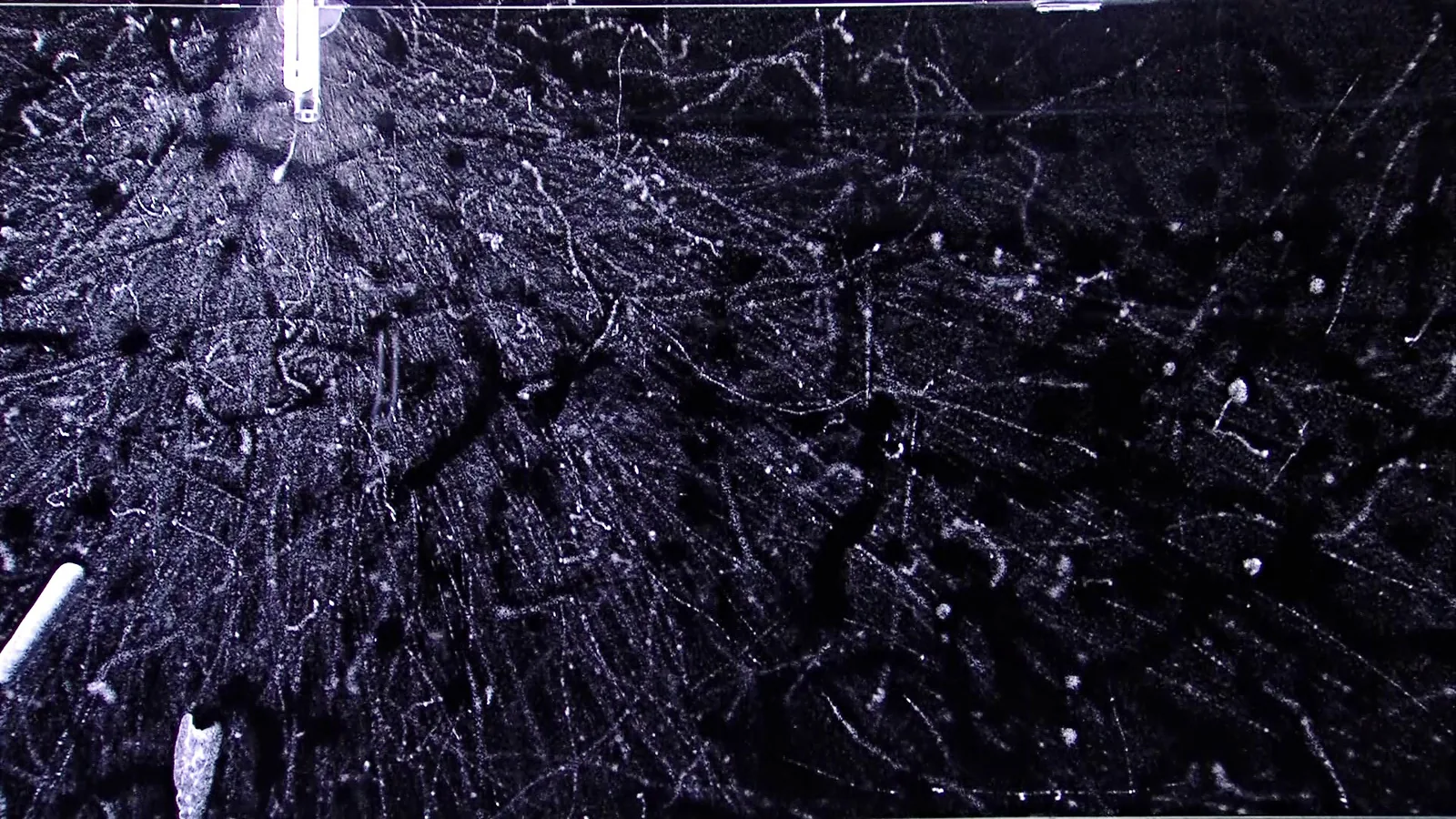
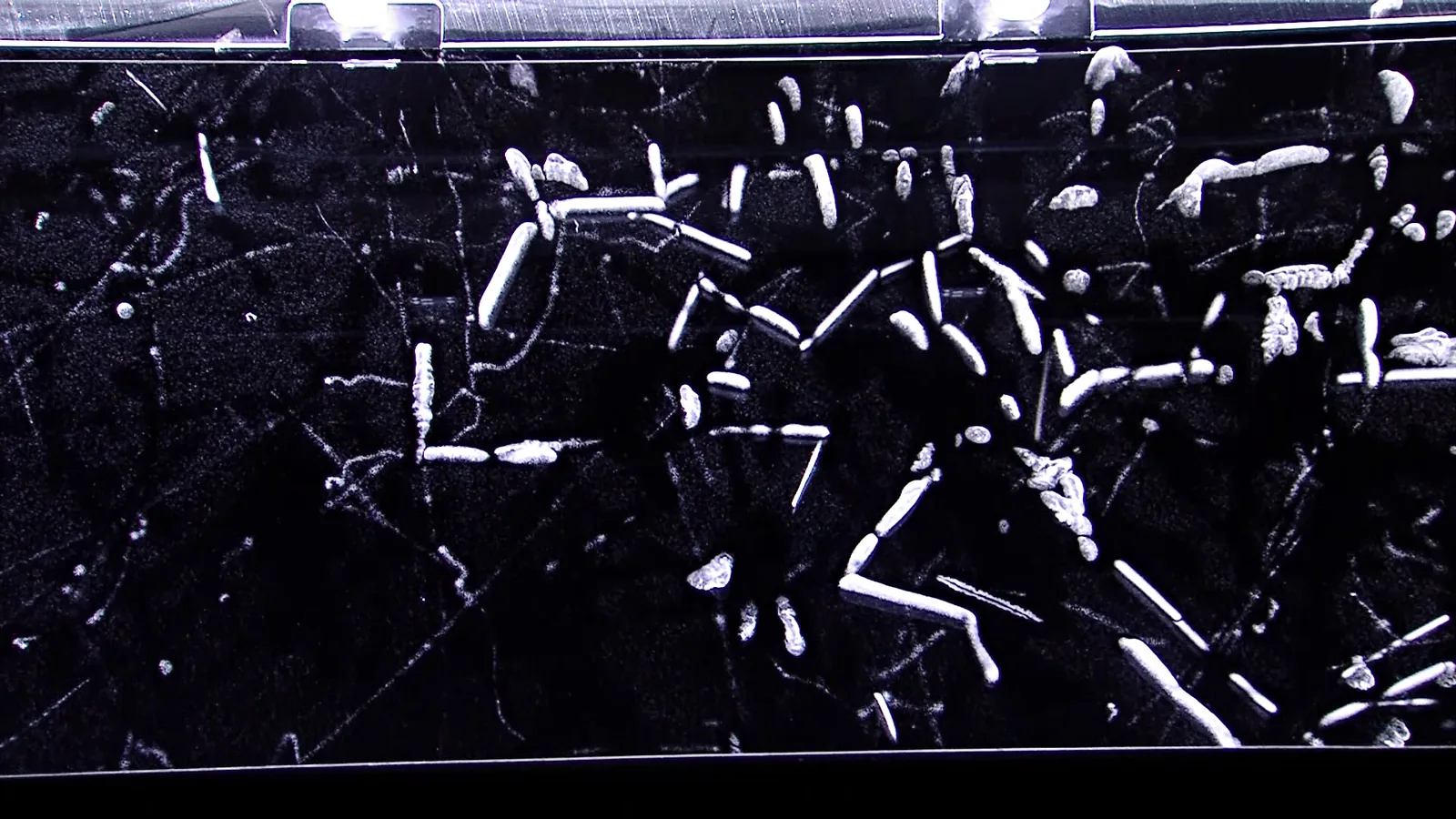
Alpha, beta and gamma decay
In alpha decay, an alpha particle, a helium nucleus ${}^{4}_{2}\text{He}$ with two protons and two neutrons, leaves the nucleus. It is typical of heavy nuclei such as uranium, radium and the americium of a smoke detector.
In beta decay, the nucleus has too many or too few neutrons compared with its protons. In beta minus decay, a neutron of the nucleus changes into a proton, and an electron and an antineutrino leave the nucleus. The electron was not in the nucleus beforehand; it is created in the decay. In beta plus decay, a proton changes into a neutron, and a positron, the antiparticle of the electron, and a neutrino leave the nucleus. Beta decay is caused by the weak interaction.
In gamma decay, a nucleus in an excited state, marked with an asterisk ${}^{A}_{Z}\text{X}^{\ast}$, moves to a lower energy level and emits a gamma photon. The nucleus stays the same nuclide. The excited state is often created in a previous alpha or beta decay, so gamma radiation follows them.
Energy levels of the nucleus and the gamma spectrum
The energy of a nucleus is quantised like the energy of the electrons of an atom. When a nucleus moves from a higher energy level to a lower one, the energy of the gamma photon that leaves is the difference between the levels, just as in a transition of the hydrogen atom in the chapter Energy levels of the hydrogen atom and the Bohr model. This is why the gamma spectrum of a nucleus is a line spectrum: each peak tells the difference of one pair of levels. The scale is different. Transitions of an atom are of the order of electronvolts, while the differences between the levels of a nucleus are typically hundreds of kiloelectronvolts or more, so hundreds of thousands of times larger.
For example, cobalt-60 decays by beta minus decay to an excited state of nickel-60 whose energy is $2505.8\,\text{keV}$ above the ground state. The nucleus returns to the ground state through an intermediate level at $1332.5\,\text{keV}$, and the gamma spectrum shows two lines: $1173.2\,\text{keV}$ and $1332.5\,\text{keV}$ (the NNDC NuDat 3 database, ENSDF values). The sum of the photon energies is less than the level energy by under $0.1\,\text{keV}$, because when a photon leaves, the nucleus recoils and gains a little kinetic energy. Alpha particles likewise have only certain energies. The energies of beta particles, on the other hand, are spread continuously, because the decay energy is shared between the electron and the antineutrino.
Decay equations
In a decay equation, both the mass number, the total number of nucleons, and the charge number, the sum of the subscripts, are conserved. The electron is written ${}^{0}_{-1}\text{e}$ and the positron ${}^{0}_{+1}\text{e}$, because their mass number is zero and their charge is $-e$ or $+e$. Alpha decay is
$${}^{A}_{Z}\text{X} \to {}^{A-4}_{Z-2}\text{Y} + {}^{4}_{2}\text{He}$$
beta minus decay
$${}^{A}_{Z}\text{X} \to {}^{A}_{Z+1}\text{Y} + {}^{0}_{-1}\text{e} + \bar{\nu}$$
beta plus decay
$${}^{A}_{Z}\text{X} \to {}^{A}_{Z-1}\text{Y} + {}^{0}_{+1}\text{e} + \nu$$
and gamma decay
$${}^{A}_{Z}\text{X}^{\ast} \to {}^{A}_{Z}\text{X} + \gamma$$
where X is the decaying parent nucleus, Y the daughter nucleus that is formed, $A$ the mass number, $Z$ the atomic number, $\bar{\nu}$ the antineutrino, $\nu$ the neutrino and $\gamma$ the gamma photon. The element of the daughter nucleus is read from the periodic table using its atomic number.
The energy of a gamma photon is the difference between the levels of the nucleus, and its wavelength is obtained from the photon energy:
$$\begin{aligned} E_\gamma &= E_\text{u} - E_\text{l} \\ \lambda &= \frac{hc}{E_\gamma} \end{aligned}$$
where $E_\text{u}$ and $E_\text{l}$ are the energies of the upper and the lower level, $h = 6.626 \cdot 10^{-34}\,\text{J}\,\text{s}$ is the Planck constant and $c = 2.998 \cdot 10^{8}\,\text{m/s}$ is the speed of light. Kiloelectronvolts are converted to joules by substituting $1\,\text{keV} = 1000\,\text{eV}$ and $1\,\text{eV} = 1.602 \cdot 10^{-19}\,\text{J}$.
Common misconception
Many people think that a beta particle is an electron that was already in the nucleus. There are no electrons in the nucleus: the electron and the antineutrino are created when a neutron changes into a proton. This is why the atomic number increases by one although a negative particle leaves the nucleus.
Another mistake is to think that gamma decay changes the element. A gamma photon carries away only energy: the numbers of protons and neutrons stay the same, and the nucleus only moves to a lower energy level. The element changes only in alpha and beta decay.
Summary
- A nucleus is made of nucleons: $Z$ protons and $N = A - Z$ neutrons. Isotopes of the same element have the same $Z$ but a different $N$.
- A radioactive nucleus decays by itself and at random. In alpha decay ${}^{4}_{2}\text{He}$ leaves ($Z - 2$, $A - 4$), in beta minus decay an electron and an antineutrino ($Z + 1$), in beta plus decay a positron and a neutrino ($Z - 1$).
- In a decay equation the mass number and the charge number are conserved.
- The energy of a nucleus is quantised. The energy of a gamma photon is the difference between the levels of the nucleus, $E_\gamma = E_\text{u} - E_\text{l}$, typically tens or hundreds of kiloelectronvolts or megaelectronvolts, so the gamma spectrum is a line spectrum.
Optional Return to your predictions
Compare your predictions with the data of the series. Then return to the question at the start: what nucleus is created when americium-241 ${}^{241}_{95}\text{Am}$ emits an alpha particle, and why can a gamma photon be created at the same time?
Would you change your prediction?
Apply
Worked example
Problem
Caesium-137 ${}^{137}_{55}\text{Cs}$ decays by beta minus decay. The daughter nucleus is usually formed in an excited state, which relaxes by emitting a gamma photon with an energy of $661.7\,\text{keV}$ (NNDC NuDat 3). What is the daughter nucleus, and what is the wavelength of the gamma photon?
Step 1/7
Given and asked. The parent nucleus is ${}^{137}_{55}\text{Cs}$, beta minus decay, the energy of the gamma photon is $E_\gamma = 661.7\,\text{keV}$, $h = 6.626 \cdot 10^{-34}\,\text{J}\,\text{s}$ and $c = 2.998 \cdot 10^{8}\,\text{m/s}$. We are asked for the atomic number $Z'$ and the mass number $A'$ of the daughter nucleus and for the wavelength $\lambda$ of the photon.
Step 2/7
Principle. In beta minus decay a neutron changes into a proton, so the mass number and the charge number are conserved when the electron ${}^{0}_{-1}\text{e}$ is counted. The energy of a gamma photon is the difference between an excited state and the ground state, and the energy of a photon is $\tfrac{hc}{\lambda}$.
Step 3/7
Formula solved. From the conservation laws and the photon energy:
$$\begin{aligned} A &= A' + 0, \quad Z = Z' - 1 \\ A' &= A, \quad Z' = Z + 1 \\ \lambda &= \frac{hc}{E_\gamma} \end{aligned}$$
Step 4/7
Unit conversions. The energy is converted to joules by substituting $1\,\text{keV} = 1000\,\text{eV}$ and $1\,\text{eV} = 1.602 \cdot 10^{-19}\,\text{J}$:
Step 5/7
Substitution. The numbers of the daughter nucleus and the wavelength:
$$\begin{aligned} A' &= 137, \quad Z' = 55 + 1 = 56 \\[6pt] hc &= 6.626 \cdot 10^{-34}\,\text{J}\,\text{s} \\ &\quad \cdot 2.998 \cdot 10^{8}\,\text{m/s} \\ &= 1.9865 \cdot 10^{-25}\,\text{J}\,\text{m} \\[6pt] \lambda &= \frac{1.9865 \cdot 10^{-25}\,\text{J}\,\text{m}}{1.0600 \cdot 10^{-13}\,\text{J}} \\ &= 1.8740 \cdot 10^{-12}\,\text{m} \end{aligned}$$
Step 6/7
Result. The atomic number $56$ is barium, so the daughter nucleus is ${}^{137}_{56}\text{Ba}$: ${}^{137}_{55}\text{Cs} \to {}^{137}_{56}\text{Ba} + {}^{0}_{-1}\text{e} + \bar{\nu}$. The wavelength is
four significant figures like the energy $661.7\,\text{keV}$.
Step 7/7
Reasonableness. On both sides of the equation the mass number is $137$ and the charge number is $55 = 56 - 1$. The wavelength of visible light, $500\,\text{nm}$, is about $270\,000$ times longer, so the photon energy is hundreds of thousands of times greater than that of a photon of visible light: this is the scale of the levels of a nucleus.
Optional Find the mistake
Apply to a new situation
Uranium-235 ${}^{235}_{92}\text{U}$ also decays in nature as a series that ends in stable lead-207, ${}^{207}_{82}\text{Pb}$. The series has only alpha and beta minus decays.
How many alpha decays are there in the series?
Hint 1: a guiding question
Which kind of decay changes the mass number, and by how much?
Hint 2: what is the connection
Beta minus decay does not change the mass number, so the whole change in the mass number comes from alpha decays, each by $4$.
Hint 3: an intermediate step
The mass number decreases by $235 - 207 = 28$. Divide this by the change of one alpha decay.
Show the solution
Given
initial nucleus ${}^{235}_{92}\text{U}$, final nucleus ${}^{207}_{82}\text{Pb}$; the series has only alpha and beta minus decays
Find
the number of alpha decays $n_\alpha$
Principle
The mass number is conserved in every decay. An alpha particle takes away four nucleons, but beta minus decay does not change the mass number, because the mass number of the electron is zero. So the whole change in the mass number comes from alpha decays.
Formula
$A_\text{initial} - A_\text{final} = 4 n_\alpha$, from which
Conversions
None are needed, because the mass numbers are counts.
Substitution
Answer
$7$
Alpha decays; the result is an exact integer, because nucleons are counted as pieces.
Reasonableness
Seven alpha decays would reduce the atomic number by $14$ to $78$. The atomic number of the final nucleus is $82$, so there must be $4$ beta minus decays, each increasing it by one: $92 - 14 + 4 = 82$. The series of uranium-238 likewise has $8$ alpha and $6$ beta decays.
Check your understanding
Exit ticket
Answer on your own first and only then open the answer.
- Polonium-210 ${}^{210}_{84}\text{Po}$ decays by alpha decay. Write the decay equation.
Answer
${}^{210}_{84}\text{Po} \to {}^{206}_{82}\text{Pb} + {}^{4}_{2}\text{He}$. The mass number is conserved ($210 = 206 + 4$) and the charge number is conserved ($84 = 82 + 2$); the atomic number $82$ is lead.
- How many protons and how many neutrons are there in a carbon-14 nucleus ${}^{14}_{6}\text{C}$, and what makes it an isotope of carbon?
Answer
There are $Z = 6$ protons and $N = A - Z = 14 - 6 = 8$ neutrons. It is carbon because it has six protons like all carbon nuclei; isotopes differ only in the number of neutrons.
1. Concept
2. The wavelength of a gamma photon
Hospital isotope examinations use the technetium isotope ${}^{99\text{m}}_{43}\text{Tc}$, which emits a gamma photon with an energy of $140.5\,\text{keV}$ (NNDC NuDat 3). Calculate the wavelength of the photon. Use the values $h = 6.626 \cdot 10^{-34}\,\text{J}\,\text{s}$, $c = 2.998 \cdot 10^{8}\,\text{m/s}$, $1\,\text{keV} = 1000\,\text{eV}$ and $1\,\text{eV} = 1.602 \cdot 10^{-19}\,\text{J}$. Give the answer in picometres ($1\,\text{pm} = 10^{-12}\,\text{m}$).
Hint 1: a guiding question
The energy of a photon is $E_\gamma = \tfrac{hc}{\lambda}$. Solve the wavelength.
Hint 2: what is the connection
First convert the energy to joules: $140.5 \cdot 1000 \cdot 1.602 \cdot 10^{-19}\,\text{J}$.
Hint 3: an intermediate step
Show the solution
Given
the energy of the gamma photon $E_\gamma = 140.5\,\text{keV}$, $h = 6.626 \cdot 10^{-34}\,\text{J}\,\text{s}$, $c = 2.998 \cdot 10^{8}\,\text{m/s}$, $1\,\text{keV} = 1000\,\text{eV}$ and $1\,\text{eV} = 1.602 \cdot 10^{-19}\,\text{J}$
Find
the wavelength $\lambda$ of the photon in picometres
Principle
Gamma radiation is electromagnetic radiation, so the energy and the wavelength of its photon are related as for a photon of visible light: the greater the energy, the shorter the wavelength.
Formula
$E_\gamma = \dfrac{hc}{\lambda}$, from which $\lambda = \dfrac{hc}{E_\gamma}$
Conversions
finally $1\,\text{m} = 10^{12}\,\text{pm}$.
Substitution
The product
Answer
$8.826\,\text{pm}$
Or about $8.83 \cdot 10^{-12}\,\text{m}$, four significant figures like the energy $140.5\,\text{keV}$.
Reasonableness
The caesium photon of the example, $661.7\,\text{keV}$, has about $4.7$ times more energy, and its wavelength of $1.874\,\text{pm}$ is about $4.7$ times shorter: $8.83 : 1.874 \approx 4.7$. The wavelength is much smaller than the size of an atom, $10^{-10}\,\text{m} = 100\,\text{pm}$, as it should be for gamma radiation.
Practise calculating the energy and the wavelength of a gamma photon in the tasks of levels 1 and 2.
Optional 3. Where does a beta particle come from?
There are no electrons in an atomic nucleus, but in beta minus decay an electron leaves the nucleus. Explain in three or four sentences where the electron comes from and why the atomic number of the daughter nucleus increases.
Model answer
In beta minus decay a neutron of the nucleus changes into a proton through the weak interaction. The change creates an electron and an antineutrino, which leave the nucleus; the electron was not in the nucleus beforehand. Because one proton is added to the nucleus, the atomic number increases by one and the element changes. The number of nucleons does not change, so the mass number stays the same, and charge is conserved, because the $+e$ of the proton and the $-e$ of the electron cancel each other.
Assess your own answer
Tick the points your own answer already contains.
Review the theory summary and practise with the exercises.
Exercises
Level 1 · basic practice 5 exercises
One formula or one step of reasoning. Core exercises first, the rest is extra practice.
- Exercise 8-1Core
The nucleus of uranium-235, the fuel of a nuclear power plant, is ${}^{235}_{92}\text{U}$. How many neutrons are there in the nucleus?
Answer
$143$
Show the solution
Given
the nucleus of uranium-235 ${}^{235}_{92}\text{U}$: mass number $A = 235$, atomic number $Z = 92$
Find
the number of neutrons $N$
Principle
The mass number is the number of all nucleons of the nucleus and the atomic number is the number of protons. The remaining nucleons are neutrons.
Formula
$A = Z + N$, from which $N = A - Z$
Conversions
None are needed, because the numbers are counts.
Substitution
$N = 235 - 92 = 143$
Answer
$143$
The result is the exact number of neutrons, because nucleons are counted as pieces.
Reasonableness
There are more neutrons than protons, as in heavy nuclei: $143 : 92 \approx 1.6$. Uranium-238 has three more neutrons, $146$, because isotopes have the same $Z$ but a different $N$.
- Exercise 8-2Core
Radon-222 ${}^{222}_{86}\text{Rn}$ in indoor air decays by alpha decay. What is the mass number of the daughter nucleus that is formed?
Answer
$218$
Show the solution
Given
the parent nucleus ${}^{222}_{86}\text{Rn}$, alpha decay; the alpha particle is ${}^{4}_{2}\text{He}$
Find
the mass number $A'$ of the daughter nucleus
Principle
In a decay equation the mass number is conserved: the nucleons of the parent nucleus are shared between the daughter nucleus and the alpha particle, which has four nucleons.
Formula
$A = A' + 4$, from which $A' = A - 4$
Conversions
None are needed, because the mass numbers are counts.
Substitution
$A' = 222 - 4 = 218$
Answer
$218$
The result is an exact integer. The daughter nucleus is polonium-218 ${}^{218}_{84}\text{Po}$, because at the same time $Z$ decreases by two.
Reasonableness
The equation ${}^{222}_{86}\text{Rn} \to {}^{218}_{84}\text{Po} + {}^{4}_{2}\text{He}$ balances: $222 = 218 + 4$ and $86 = 84 + 2$. The same step can be seen in the series of uranium-238, from radon to polonium.
- Exercise 8-3
Carbon-14 ${}^{14}_{6}\text{C}$ decays by beta minus decay. What is the atomic number of the daughter nucleus that is formed?
Answer
$7$
Show the solution
Given
the parent nucleus ${}^{14}_{6}\text{C}$, beta minus decay; the electron is ${}^{0}_{-1}\text{e}$
Find
the atomic number $Z'$ of the daughter nucleus
Principle
In beta minus decay a neutron changes into a proton and the electron that is created leaves. The charge number is conserved when the charge number $-1$ of the electron is counted; the antineutrino is neutral.
Formula
$Z = Z' + (-1)$, from which $Z' = Z + 1$
Conversions
None are needed, because the atomic numbers are counts.
Substitution
$Z' = 6 + 1 = 7$
Answer
$7$
The result is an exact integer. The atomic number $7$ is nitrogen, so the daughter nucleus is ${}^{14}_{7}\text{N}$.
Reasonableness
The mass number stays at $14$ and the charge number balances: $6 = 7 - 1$. Carbon-14 has eight neutrons and six protons, that is, more neutrons than suits a light stable nucleus, so beta minus decay moves it towards the band of stable nuclei.
- Exercise 8-4
The americium-241 of a smoke detector emits gamma photons with an energy of $59.54\,\text{keV}$ (NNDC NuDat 3). Calculate the wavelength of the photon in picometres ($1\,\text{pm} = 10^{-12}\,\text{m}$) ($h = 6.626 \cdot 10^{-34}\,\text{J}\,\text{s}$, $c = 2.998 \cdot 10^{8}\,\text{m/s}$, $1\,\text{keV} = 1000\,\text{eV}$, $1\,\text{eV} = 1.602 \cdot 10^{-19}\,\text{J}$).
Answer
$20.8\,\text{pm}$
Show the solution
Given
the energy of the gamma photon $E_\gamma = 59.54\,\text{keV}$, $h = 6.626 \cdot 10^{-34}\,\text{J}\,\text{s}$, $c = 2.998 \cdot 10^{8}\,\text{m/s}$, $1\,\text{keV} = 1000\,\text{eV}$, $1\,\text{eV} = 1.602 \cdot 10^{-19}\,\text{J}$
Find
the wavelength $\lambda$ of the photon in picometres
Principle
Gamma radiation is electromagnetic radiation, so the energy of a photon is $\tfrac{hc}{\lambda}$, as for a photon of visible light.
Formula
$E_\gamma = \dfrac{hc}{\lambda}$, from which $\lambda = \dfrac{hc}{E_\gamma}$
Conversions
$E_\gamma$$= 59.54\,\text{keV}$$= 59.54 \cdot 1000 \cdot 1.602 \cdot 10^{-19}\,\text{J}$$= 9.5383 \cdot 10^{-15}\,\text{J}$finally $1\,\text{m} = 10^{12}\,\text{pm}$.
Substitution
The product
$hc$$= 6.626 \cdot 10^{-34}\,\text{J}\,\text{s} \cdot 2.998 \cdot 10^{8}\,\text{m/s}$$= 1.9865 \cdot 10^{-25}\,\text{J}\,\text{m}$$\lambda$$= \dfrac{1.9865 \cdot 10^{-25}\,\text{J}\,\text{m}}{9.5383 \cdot 10^{-15}\,\text{J}}$$= 2.0826 \cdot 10^{-11}\,\text{m}$$= 20.826\,\text{pm}$Answer
$20.8\,\text{pm}$
Three significant figures; the energy is given with four figures, and $20.83\,\text{pm}$ is just as correct.
Reasonableness
The caesium photon of the example, $661.7\,\text{keV}$, has about $11$ times more energy, and its wavelength of $1.874\,\text{pm}$ is about $11$ times shorter: $20.8 : 1.874 \approx 11$. The wavelength is smaller than the diameter of an atom, about $100\,\text{pm}$.
- Exercise 8-5
Fluorine-18 ${}^{18}_{9}\text{F}$, used in PET imaging, decays by beta plus decay. How many neutrons are there in the daughter nucleus?
Answer
$10$
Show the solution
Given
the parent nucleus ${}^{18}_{9}\text{F}$, beta plus decay; the positron is ${}^{0}_{+1}\text{e}$
Find
the neutron number $N'$ of the daughter nucleus
Principle
In beta plus decay a proton changes into a neutron, and a positron and a neutrino leave the nucleus. The mass number is conserved, and the charge number is conserved when the charge number $+1$ of the positron is counted.
Formula
$A' = A$ and $Z = Z' + 1$, so $Z' = Z - 1$ and $N' = A' - Z' = A - (Z - 1)$
Conversions
None are needed, because the numbers are counts.
Substitution
$Z' = 9 - 1 = 8$ and $N' = 18 - 8 = 10$
Answer
$10$
The result is the exact number of neutrons. The daughter nucleus is oxygen-18 ${}^{18}_{8}\text{O}$.
Reasonableness
The parent nucleus has $18 - 9 = 9$ neutrons, and a proton changing into a neutron adds one: $9 + 1 = 10$. The equation ${}^{18}_{9}\text{F} \to {}^{18}_{8}\text{O} + {}^{0}_{+1}\text{e} + \nu$ balances: $18 = 18 + 0$ and $9 = 8 + 1$.
Level 2 · applied practice 4 exercises
Two steps, working with measured data, a unit conversion or rearranging a formula. Core exercises first, the rest is extra practice.
- Exercise 8-6Core
Two excited states of the nickel-60 nucleus are $2505.8\,\text{keV}$ and $1332.5\,\text{keV}$ above the ground state. The nucleus moves from the upper level to the lower one and emits a gamma photon. Calculate the wavelength of the photon in picometres ($h = 6.626 \cdot 10^{-34}\,\text{J}\,\text{s}$, $c = 2.998 \cdot 10^{8}\,\text{m/s}$, $1\,\text{keV} = 1000\,\text{eV}$, $1\,\text{eV} = 1.602 \cdot 10^{-19}\,\text{J}$).
Answer
$1.06\,\text{pm}$
Show the solution
Given
the levels of nickel-60 $E_\text{u} = 2505.8\,\text{keV}$ and $E_\text{l} = 1332.5\,\text{keV}$, $h = 6.626 \cdot 10^{-34}\,\text{J}\,\text{s}$, $c = 2.998 \cdot 10^{8}\,\text{m/s}$, $1\,\text{keV} = 1000\,\text{eV}$, $1\,\text{eV} = 1.602 \cdot 10^{-19}\,\text{J}$
Find
the wavelength $\lambda$ of the gamma photon in picometres
Principle
The energy of a nucleus is quantised. Energy is conserved, so the energy of the photon that leaves in a transition is the difference between the levels, as in transitions of an atom, and the energy of a photon is $\tfrac{hc}{\lambda}$.
Formula
$\dfrac{hc}{\lambda}$$= E_\text{u} - E_\text{l}$from which
$\lambda$$= \dfrac{hc}{E_\text{u} - E_\text{l}}$Conversions
$E_\text{u} - E_\text{l}$$= 2505.8\,\text{keV} - 1332.5\,\text{keV}$$= 1173.3\,\text{keV}$$= 1173.3 \cdot 1000 \cdot 1.602 \cdot 10^{-19}\,\text{J}$$= 1.8796 \cdot 10^{-13}\,\text{J}$finally $1\,\text{m} = 10^{12}\,\text{pm}$.
Substitution
The product
$hc$$= 6.626 \cdot 10^{-34}\,\text{J}\,\text{s} \cdot 2.998 \cdot 10^{8}\,\text{m/s}$$= 1.9865 \cdot 10^{-25}\,\text{J}\,\text{m}$$\lambda$$= \dfrac{1.9865 \cdot 10^{-25}\,\text{J}\,\text{m}}{1.8796 \cdot 10^{-13}\,\text{J}}$$= 1.0568 \cdot 10^{-12}\,\text{m}$$= 1.0568\,\text{pm}$Answer
$1.06\,\text{pm}$
Three significant figures; more precisely $1.057\,\text{pm}$, four figures like the energy difference $1173.3\,\text{keV}$.
Reasonableness
The measured gamma photon is $1173.2\,\text{keV}$, one of the two peaks of the gamma spectrum of cobalt-60; the difference of $0.1\,\text{keV}$ from the level difference $1173.3\,\text{keV}$ comes almost entirely from rounding of the levels (the exact level difference is $1173.24\,\text{keV}$), and the recoil of the nucleus takes only about $0.01\,\text{keV}$. The difference does not change the wavelength at three-figure precision. Its energy is a little smaller than the $1332.5\,\text{keV}$ of the other photon, so the wavelength is a little longer than its $0.931\,\text{pm}$, as it should be.
- Exercise 8-7Core
Bismuth-214 ${}^{214}_{83}\text{Bi}$ of the uranium series decays by beta minus decay, and the nucleus that is formed immediately decays by alpha decay.
What is the atomic number of the nucleus formed after these two decays?
Answer
$82$
Show the solution
Given
the parent nucleus ${}^{214}_{83}\text{Bi}$; first beta minus decay, then alpha decay
Find
the atomic number $Z''$ of the final nucleus
Principle
The charge number is conserved in both decays. In beta minus decay a neutron changes into a proton, so $Z$ increases by one; the alpha particle takes two protons, so $Z$ decreases by two.
Formula
$Z' = Z + 1$ and $Z'' = Z' - 2$, so $Z'' = Z + 1 - 2$
Conversions
None are needed, because the atomic numbers are counts.
Substitution
$Z' = 83 + 1 = 84$ and $Z'' = 84 - 2 = 82$
Answer
$82$
The result is an exact integer. The nucleus is lead-210 ${}^{210}_{82}\text{Pb}$, because the mass number decreases only in the alpha decay: $214 - 4 = 210$.
Reasonableness
The intermediate step is polonium-214 ${}^{214}_{84}\text{Po}$, and this is exactly how the series goes in the uranium series of the simulation, from step $9$ to step $11$. The two decays together reduce the atomic number by one: $+1 - 2 = -1$.
- Exercise 8-8
The energy of the gamma photon created in the decay of caesium-137 is $661.7\,\text{keV}$. The wavelength of green light is $550\,\text{nm}$.
How many times greater is the energy of the gamma photon than the energy of a photon of green light ($h = 6.626 \cdot 10^{-34}\,\text{J}\,\text{s}$, $c = 2.998 \cdot 10^{8}\,\text{m/s}$, $1\,\text{keV} = 1000\,\text{eV}$, $1\,\text{eV} = 1.602 \cdot 10^{-19}\,\text{J}$)?
Answer
$293\,000$
Show the solution
Given
the energy of the gamma photon $E_\gamma = 661.7\,\text{keV}$, the wavelength of green light $\lambda = 550\,\text{nm}$, $h = 6.626 \cdot 10^{-34}\,\text{J}\,\text{s}$, $c = 2.998 \cdot 10^{8}\,\text{m/s}$, $1\,\text{keV} = 1000\,\text{eV}$, $1\,\text{eV} = 1.602 \cdot 10^{-19}\,\text{J}$
Find
the ratio of the energies, how many times $E_\gamma$ is the energy $E_\text{g}$ of a green photon
Principle
The energy of each photon depends only on its wavelength or frequency. The energy of the green photon is calculated from the wavelength, and the comparison is made with one division in the same unit.
Formula
$E_\text{g} = \dfrac{hc}{\lambda}$, and the ratio asked for is
$\dfrac{E_\gamma}{E_\text{g}}$$= \dfrac{E_\gamma \lambda}{hc}$Conversions
$\lambda$$= 550\,\text{nm}$$= 550 \cdot 10^{-9}\,\text{m}$$E_\gamma$$= 661.7\,\text{keV}$$= 661.7 \cdot 1000\,\text{eV}$$= 661\,700\,\text{eV}$the energy of the green photon is converted to electronvolts by substituting $1\,\text{eV} = 1.602 \cdot 10^{-19}\,\text{J}$.
Substitution
The product
$hc$$= 6.626 \cdot 10^{-34}\,\text{J}\,\text{s} \cdot 2.998 \cdot 10^{8}\,\text{m/s}$$= 1.9865 \cdot 10^{-25}\,\text{J}\,\text{m}$$E_\text{g}$$= \dfrac{1.9865 \cdot 10^{-25}\,\text{J}\,\text{m}}{550 \cdot 10^{-9}\,\text{m}}$$= 3.6118 \cdot 10^{-19}\,\text{J}$$= 2.2545\,\text{eV}$$661\,700\,\text{eV} : 2.2545\,\text{eV} = 293\,500$
Answer
about $293\,000$, that is, $2.93 \cdot 10^{5}$ times greater, three significant figures like the wavelength $550\,\text{nm}$.
Reasonableness
An estimate with round numbers: $660\,000\,\text{eV} : 2\,\text{eV} \approx 330\,000$, the same order of magnitude. For this gamma line the difference between the levels of the nucleus is hundreds of thousands of times greater than the differences between the levels of the electrons of an atom, as the theory of the chapter says.
- Exercise 8-9
Thorium-232 ${}^{232}_{90}\text{Th}$ decays by alpha decay, and the nucleus that is formed decays twice in a row by beta minus decay.
How many neutrons are there in the nucleus formed after these three decays?
Answer
$138$
Show the solution
Given
the parent nucleus ${}^{232}_{90}\text{Th}$; alpha decay and after it two beta minus decays
Find
the neutron number $N$ of the final nucleus
Principle
The mass number and the charge number are conserved in every decay. Alpha decay decreases $Z$ by two and $A$ by four; beta minus decay increases $Z$ by one and does not change $A$.
Formula
$A_\text{final} = A - 4$, $Z_\text{final} = Z - 2 + 1 + 1$ and $N = A_\text{final} - Z_\text{final}$
Conversions
None are needed, because the numbers are counts.
Substitution
$A_\text{final} = 232 - 4 = 228$, $Z_\text{final} = 90 - 2 + 1 + 1 = 90$ and $N = 228 - 90 = 138$
Answer
$138$
The result is the exact number of neutrons. The nucleus is thorium-228 ${}^{228}_{90}\text{Th}$.
Reasonableness
The chain is ${}^{232}_{90}\text{Th} \to {}^{228}_{88}\text{Ra} \to {}^{228}_{89}\text{Ac} \to {}^{228}_{90}\text{Th}$. At the end we are in thorium again, but there are four fewer neutrons than at the start ($142 - 4 = 138$): the alpha particle took two, and each beta decay changed one neutron into a proton.
Level 3 · challenging 3 exercises
Optional: application, two ideas together or a new situation where you reason for yourself.
- Exercise 8-10
Thorium-232 ${}^{232}_{90}\text{Th}$ decays in nature as a series that ends in stable lead-208, ${}^{208}_{82}\text{Pb}$. The series has only alpha and beta minus decays.
How many beta minus decays are there in the series?
Answer
$4$
Show the solution
Given
initial nucleus ${}^{232}_{90}\text{Th}$, final nucleus ${}^{208}_{82}\text{Pb}$; the series has only alpha and beta minus decays
Find
the number of beta minus decays $n_\beta$
Principle
The mass number changes only in alpha decays, by four in each, so the change in the mass number gives the number of alpha decays $n_\alpha$. The atomic number decreases by two in every alpha decay and increases by one in every beta decay.
Formula
$A_\text{initial} - A_\text{final} = 4 n_\alpha$ and $Z_\text{final} = Z_\text{initial} - 2 n_\alpha + n_\beta$, from which $n_\beta = Z_\text{final} - Z_\text{initial} + 2 n_\alpha$
Conversions
None are needed, because the numbers are counts.
Substitution
$n_\alpha = \dfrac{232 - 208}{4} = 6$ and $n_\beta = 82 - 90 + 2 \cdot 6 = 4$
Answer
$4$
The number of beta minus decays is an exact integer.
Reasonableness
Check: $90 - 2 \cdot 6 + 4 = 82$ and $232 - 4 \cdot 6 = 208$. Alpha decays alone would take the atomic number to $78$, too low; beta decays raise it to lead. In the uranium series, too, there are fewer beta decays than alpha decays ($6$ and $8$).
- Exercise 8-11
The energy levels of an imaginary nucleus are $0$ (ground state), $0.40\,\text{MeV}$ and $1.00\,\text{MeV}$. The nucleus is at first on the top level, and it can return to the ground state directly or through the intermediate level.
What is the shortest wavelength that can appear in the gamma spectrum of the nucleus? Give the answer in picometres ($1\,\text{MeV} = 10^{6}\,\text{eV}$, $h = 6.626 \cdot 10^{-34}\,\text{J}\,\text{s}$, $c = 2.998 \cdot 10^{8}\,\text{m/s}$, $1\,\text{eV} = 1.602 \cdot 10^{-19}\,\text{J}$).
Answer
$1.24\,\text{pm}$
Show the solution
Given
the levels of the nucleus $0$, $0.40\,\text{MeV}$ and $1.00\,\text{MeV}$, the nucleus at first on the level $1.00\,\text{MeV}$; $h = 6.626 \cdot 10^{-34}\,\text{J}\,\text{s}$, $c = 2.998 \cdot 10^{8}\,\text{m/s}$, $1\,\text{MeV} = 10^{6}\,\text{eV}$, $1\,\text{eV} = 1.602 \cdot 10^{-19}\,\text{J}$
Find
the shortest wavelength $\lambda_\text{min}$ seen in the gamma spectrum, in picometres
Principle
The energy of every gamma photon is the difference between two levels. The possible transitions are $1.00 \to 0$ ($1.00\,\text{MeV}$), $1.00 \to 0.40$ ($0.60\,\text{MeV}$) and $0.40 \to 0$ ($0.40\,\text{MeV}$). Because $\lambda = \tfrac{hc}{E}$, the shortest wavelength comes from the greatest energy, that is, from the direct transition to the ground state.
Formula
$\dfrac{hc}{\lambda_\text{min}}$$= E_\text{max}$from which
$\lambda_\text{min}$$= \dfrac{hc}{E_\text{max}}$Conversions
$E_\text{max}$$= 1.00\,\text{MeV}$$= 1.00 \cdot 10^{6} \cdot 1.602 \cdot 10^{-19}\,\text{J}$$= 1.602 \cdot 10^{-13}\,\text{J}$finally $1\,\text{m} = 10^{12}\,\text{pm}$.
Substitution
The product
$hc$$= 6.626 \cdot 10^{-34}\,\text{J}\,\text{s} \cdot 2.998 \cdot 10^{8}\,\text{m/s}$$= 1.9865 \cdot 10^{-25}\,\text{J}\,\text{m}$$\lambda_\text{min}$$= \dfrac{1.9865 \cdot 10^{-25}\,\text{J}\,\text{m}}{1.602 \cdot 10^{-13}\,\text{J}}$$= 1.2400 \cdot 10^{-12}\,\text{m}$$= 1.2400\,\text{pm}$Answer
$1.24\,\text{pm}$
Three significant figures like the energy $1.00\,\text{MeV}$.
Reasonableness
The spectrum shows three lines, as any three levels give three transitions. The other two wavelengths are longer: $0.60\,\text{MeV}$ gives $\tfrac{1.24}{0.60}\,\text{pm} \approx 2.1\,\text{pm}$ and $0.40\,\text{MeV}$ about $3.1\,\text{pm}$.
- Exercise 8-12
An unknown nucleus X decays first by beta minus decay and the nucleus that is formed then by alpha decay. The end result is radon-222 ${}^{222}_{86}\text{Rn}$.
What is the atomic number of the nucleus X?
Answer
$87$
Show the solution
Given
the nucleus X decays first by beta minus decay and then by alpha decay; the end result is ${}^{222}_{86}\text{Rn}$
Find
the atomic number $Z_\text{X}$ of the nucleus X
Principle
The decays can be followed backwards, because the charge number is conserved in both. The alpha decay reduced the atomic number by two, so the atomic number of the intermediate nucleus was two greater; the beta minus decay increased it by one, so the atomic number of X was one smaller than that of the intermediate nucleus.
Formula
$Z_\text{Rn} = Z_\text{mid} - 2$ and $Z_\text{mid} = Z_\text{X} + 1$, from which $Z_\text{X} = Z_\text{Rn} + 2 - 1$
Conversions
None are needed, because the atomic numbers are counts.
Substitution
$Z_\text{mid} = 86 + 2 = 88$ and $Z_\text{X} = 88 - 1 = 87$
Answer
$87$
The result is an exact integer. The atomic number $87$ is francium, and the mass number is $222 + 4 = 226$, so X is ${}^{226}_{87}\text{Fr}$.
Reasonableness
Calculated forwards, ${}^{226}_{87}\text{Fr} \to {}^{226}_{88}\text{Ra} \to {}^{222}_{86}\text{Rn}$ balances: the mass number decreases only in the alpha decay, and the charge numbers are $87 + 1 = 88$ and $88 - 2 = 86$. The intermediate step radium-226 also decays to radon in the uranium series.
Photographs
- Beta radiation in a cloud chamber. Nuledo. source, CC BY-SA 4.0
- Alpha radiation in a cloud chamber. Nuledo. source, CC BY-SA 4.0

