
Thin-film interference
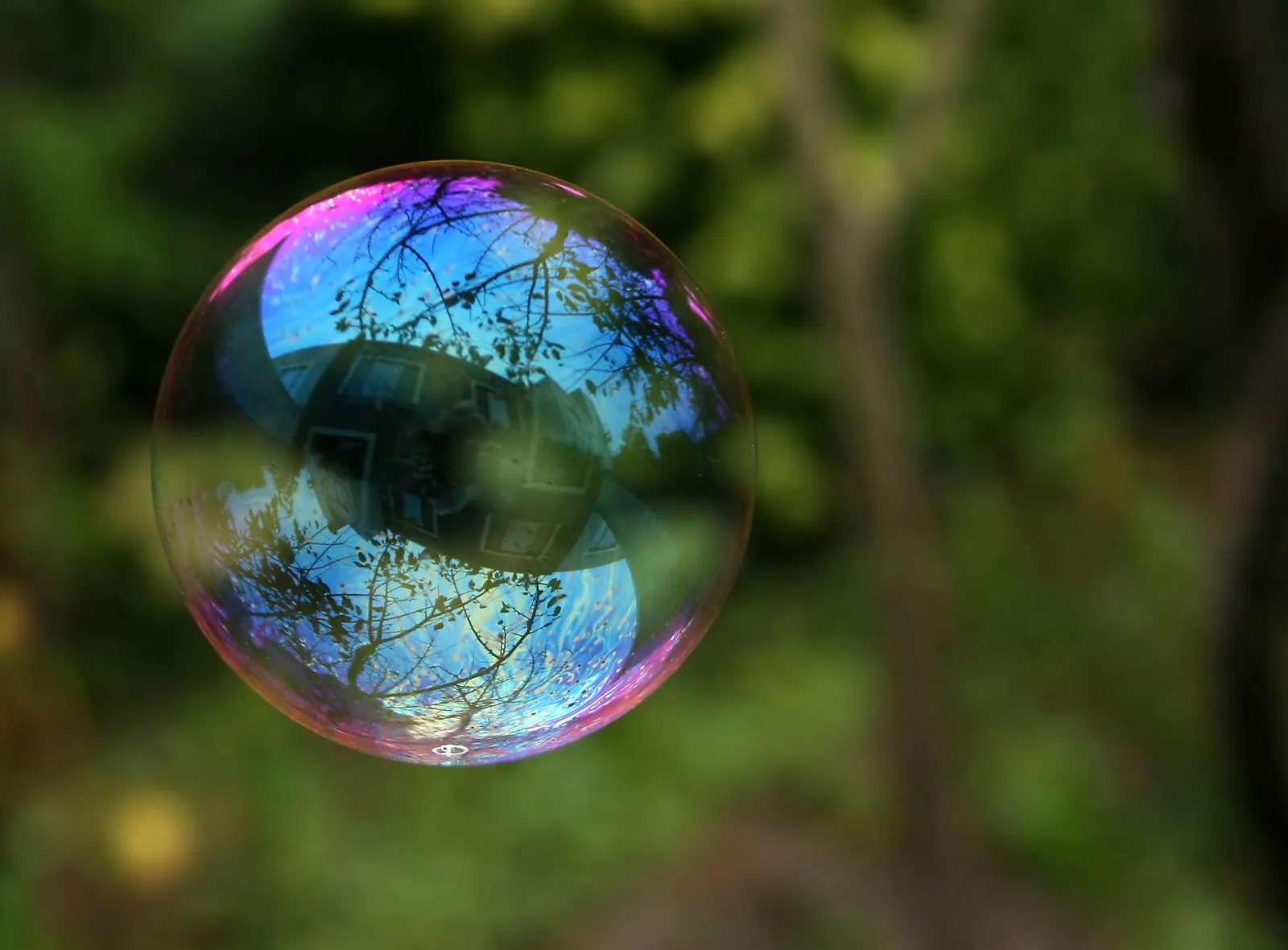
Why do bright bands of colour appear on the surface of a soap bubble, even though soapy water is colourless?
Prior knowledge
- Two waves that start in phase strengthen each other when their path difference is $k\lambda$ and weaken each other when it is $(k + \tfrac{1}{2})\lambda$chapter Interference and diffraction of light
- In a material, light travels at the speed $v = c : n$chapter Reflection and refraction of light
- A pulse on a rope is inverted when it reflects from a fixed endchapter Reflection and diffraction of waves
Core path: follow the steps in order. Tasks marked Optional give extra practice. Optional tasks: 4.
Think about it
Soapy water is colourless, and you can see through a thin soap film as through a window. Yet when the film reflects sunlight, bright bands of colour appear in it: red, green, blue and magenta. The bands move and change colour as the film drains. Similar colours can be seen in an oil film on a puddle and in the lens of a camera objective.
Where do the colours come from when the material of the film is itself colourless, and why do they change from one place to another?
Optional Recall: interference
Predict
Make your predictions before investigating 2 questions
Prediction 1: a very thin film
Prediction 2: a layer on glass
Investigate
Light arrives from air at normal incidence on a thin film. Change the thickness of the film and the wavelength and follow the sum of the two reflected waves.
Simulation
How to use
Choose the situation: a soap film in air or an $\text{MgF}_2$ coating on glass. Adjust the thickness $d$ of the film and the wavelength $\lambda$ under study. On the left the film is shown in cross-section; the rays are drawn slanted so that they can be told apart, although the model calculates normal incidence. A label shows which reflection inverts the wave. On the right are the reflected waves 1 and 2 and their sum at the chosen wavelength. The graph shows the reflected fraction $R$ over the whole visible range, and the box shows the colour of the reflected white light. The readout gives the state of the interference, the path difference $2nd$, the ratio $2nd : \lambda$, the number of inverting reflections and the reflected fraction $R$.
Assumptions of the model
Light arrives from air at normal incidence on the film. The refractive index of the soap film is $1.33$, and there is air on both sides of it. The coating has a refractive index of $1.38$ and lies on thick glass with a refractive index of $1.52$; the reflection from the back surface of the glass is not included. The refractive indices do not depend on the wavelength, and the film does not absorb light. The thickness of the film is exaggerated in the picture. The brightness of the colour box is scaled: the strongest reflection of the soap film and the reflection of bare glass appear white. The readings are values calculated by the model, not measurements.
How the calculation works
The path difference of wave 2 relative to wave 1 is $2nd$. Reflection from a material of higher refractive index inverts the wave. The amplitudes of the waves reflected at the two interfaces are calculated from the normal-incidence formula $r = (n_a - n_b) : (n_a + n_b)$, where a negative $r$ means inversion. The reflected fraction $R$ is calculated from the exact formula for a single layer, which also takes into account the weak waves reflected several times inside the film. Bare glass reflects $R = \left(\tfrac{1.52 - 1.00}{1.52 + 1.00}\right)^2 \approx 4.26\,\%$. The colour is obtained by calculating $R$ at every wavelength from $400$ to $700\,\text{nm}$ and combining the values with the sensitivity curves of the eye (CIE 1931) into a screen colour.
Experiment 1: thickness of a soap film
Test prediction 1. The situation is a soap film in air and the wavelength is $550\,\text{nm}$; change only the thickness $d$ of the film. Record at least the thicknesses $0$, $20$, $50$, $103$, $150$ and $207\,\text{nm}$. At which thicknesses do the waves strengthen each other and at which do they weaken each other?
Initial state: situation: soap film in air, film thickness $d$ = $0\,\text{nm}$, wavelength $\lambda$ = $550\,\text{nm}$. Kept constant: situation, wavelength $\lambda$. Varied: film thickness $d$.
| film thickness $d$ | $2nd : \lambda$ | $R$ $(\%)$ |
|---|
At which thickness between $0$ and $200\,\text{nm}$ does the soap film reflect light of $550\,\text{nm}$ most strongly? Give your answer in nanometres.
Hint 1: a guiding question
Find in the table and with the slider the thickness at which $R$ is greatest.
Hint 2: what is the connection
Also look at the ratio $2nd : \lambda$. What is its value at the strongest reflection?
Hint 3: an intermediate step
A soap film has one inverting reflection, so the reflection is strongest when $2nd = \tfrac{1}{2}\lambda$.
Show the solution
Given
refractive index of the soap film $n = 1.33$, air on both sides, wavelength $\lambda = 550\,\text{nm}$; readings of the simulation: $d = 50\,\text{nm}$: $R = 3.81\,\%$, $d = 103\,\text{nm}$: $R = 7.71\,\%$, $d = 150\,\text{nm}$: $R = 4.60\,\%$
Find
the thickness $d$ in nanometres at which the reflection is strongest
Principle
The reflection from the upper surface, from air into the film, inverts the wave; the reflection from the lower surface, from the film into air, does not. Because of the single inversion, the waves strengthen each other when the path difference is a half-integer number of wavelengths, and the thinnest such film is the one with $2nd = \tfrac{1}{2}\lambda$. In the simulation $R$ is greatest exactly where $2nd : \lambda = 0.5$.
Formula
$2nd = \tfrac{1}{2}\lambda$, so $d = \dfrac{\lambda}{4n}$
Conversions
Not needed: the wavelength and the thickness are both in nanometres, and the refractive index has no unit.
Substitution
Answer
$103\,\text{nm}$
Three significant figures like the refractive index $1.33$ and the wavelength $550\,\text{nm}$.
Reasonableness
The greatest reading of the simulation, $R = 7.71\,\%$, is at a thickness of $103\,\text{nm}$, and $R$ decreases on both sides of it. The thickness is about a fifth of the wavelength, as is fitting for a thin film. Check:
Experiment 2: coating on glass
Test prediction 2. The situation is an $\text{MgF}_2$ coating on glass and the wavelength is $550\,\text{nm}$; change only the thickness $d$ of the coating. Record at least the thicknesses $0$ (bare glass), $50$, $100$, $150$ and $199\,\text{nm}$. Compare the reflection with that of bare glass.
Initial state: situation: coating on glass, coating thickness $d$ = $0\,\text{nm}$, wavelength $\lambda$ = $550\,\text{nm}$. Kept constant: situation, wavelength $\lambda$. Varied: coating thickness $d$.
| coating thickness $d$ | $2nd : \lambda$ | $R$ $(\%)$ |
|---|
Experiment 3: colour of a film
The situation is a soap film in air with a thickness of $200\,\text{nm}$; change only the wavelength $\lambda$. Record at least the wavelengths $400$, $450$, $500$, $532$, $600$, $650$ and $700\,\text{nm}$. Which colours are reflected and which is missing? Also look at the colour box.
Initial state: situation: soap film in air, film thickness $d$ = $200\,\text{nm}$, wavelength $\lambda$ = $400\,\text{nm}$. Kept constant: situation, film thickness $d$. Varied: wavelength $\lambda$.
| wavelength $\lambda$ | $2nd : \lambda$ | $R$ $(\%)$ |
|---|
Conclusion: film thickness and colour
Using your tables, write: at which thicknesses does a soap film reflect light of $550\,\text{nm}$ most strongly and at which most weakly? Why does the coating behave differently? Where does the colour of a $200\,\text{nm}$ soap film come from?
Model answer
The soap film did not reflect at all when $d = 0$, and at a thickness of $207\,\text{nm}$ the reflection was again almost zero. The strongest reflection, $R = 7.71\,\%$, was at $103\,\text{nm}$, where $2nd : \lambda = 0.50$. In a soap film only the reflection from the upper surface inverts the wave, so a path difference of $\tfrac{1}{2}\lambda$ is constructive and $\lambda$ is destructive. In the coating both reflections invert the wave: bare glass reflected $4.26\,\%$, a $100\,\text{nm}$ coating only $1.26\,\%$, and a $199\,\text{nm}$ coating again $4.26\,\%$. The same condition $2nd = \tfrac{1}{2}\lambda$ is therefore destructive in the coating. In a $200\,\text{nm}$ soap film the path difference is $532\,\text{nm}$, so green light of $532\,\text{nm}$ was cancelled completely ($R = 0\,\%$), while violet light was reflected $5.83\,\%$ and red light $3.77\,\%$. The film looks magenta because green is missing. The values are calculated by the model.
Assess your own answer
Tick the points your own answer already contains.
Review the theory summary and practise with the exercises.
Theory summary
Key idea
Two reflections
In the chapter Interference and diffraction of light we saw that light is a wave motion and that two light waves can strengthen or weaken each other. A thin film is a transparent layer whose thickness is of the same order of magnitude as the wavelength of light, about $100$–$1000\,\text{nm}$: the wall of a soap bubble, an oil film on water or the coating of a lens. Of the light arriving at the film, a small part is reflected from the upper surface of the film and a small part from the lower surface. These two reflected waves travel in the same direction and interfere. In this chapter we consider only light that arrives at normal incidence on the film.
Path difference in the film
Wave 2, reflected from the lower surface, travels through the film and back, so it travels an extra distance $2d$, where $d$ is the thickness of the film. In the film light travels at the speed $c : n$, but its frequency does not change. The wavelength in the film is therefore $n$ times shorter than in air: for example, in a soap film ($n = 1.33$) a wavelength of $550\,\text{nm}$ shortens to $413.5\,\text{nm}$, because $550\,\text{nm} : 1.33 = 413.5\,\text{nm}$. The extra distance $2d$ therefore holds as many wavelengths as the distance $2nd$ does in air. The path difference between waves 1 and 2 is $2nd$ when the wavelength is measured in air.
A half-wavelength shift on reflection
The path difference alone does not decide the interference. In the chapter Reflection and diffraction of waves, a pulse on a rope was inverted when it reflected from a fixed end but not from a free end. A similar rule holds for light: when light is reflected at an interface beyond which there is a material of higher refractive index, the reflected wave is inverted, that is, a crest returns as a trough. This corresponds to a half-wavelength shift. When the material beyond the interface has a lower refractive index, the reflected wave is not inverted. In a soap film the reflection from the upper surface occurs from air into the film ($1.00 \to 1.33$), so wave 1 is inverted. The reflection from the lower surface occurs from the film into air ($1.33 \to 1.00$), so wave 2 is not inverted.
A very thin film is black
When a soap film is much thinner than the wavelength, the path difference is almost zero. However, wave 1 has been inverted and wave 2 has not, so the waves are in opposite phase and cancel each other. A very thin film does not reflect light, and it looks black. This is why a black spot appears at the top of a soap bubble just before it bursts. When the film is so thick that $2nd = \tfrac{1}{2}\lambda$, wave 2 lags half a wavelength behind, which corresponds to an inversion. The waves are then in phase and strengthen each other.
Why a film is colourful
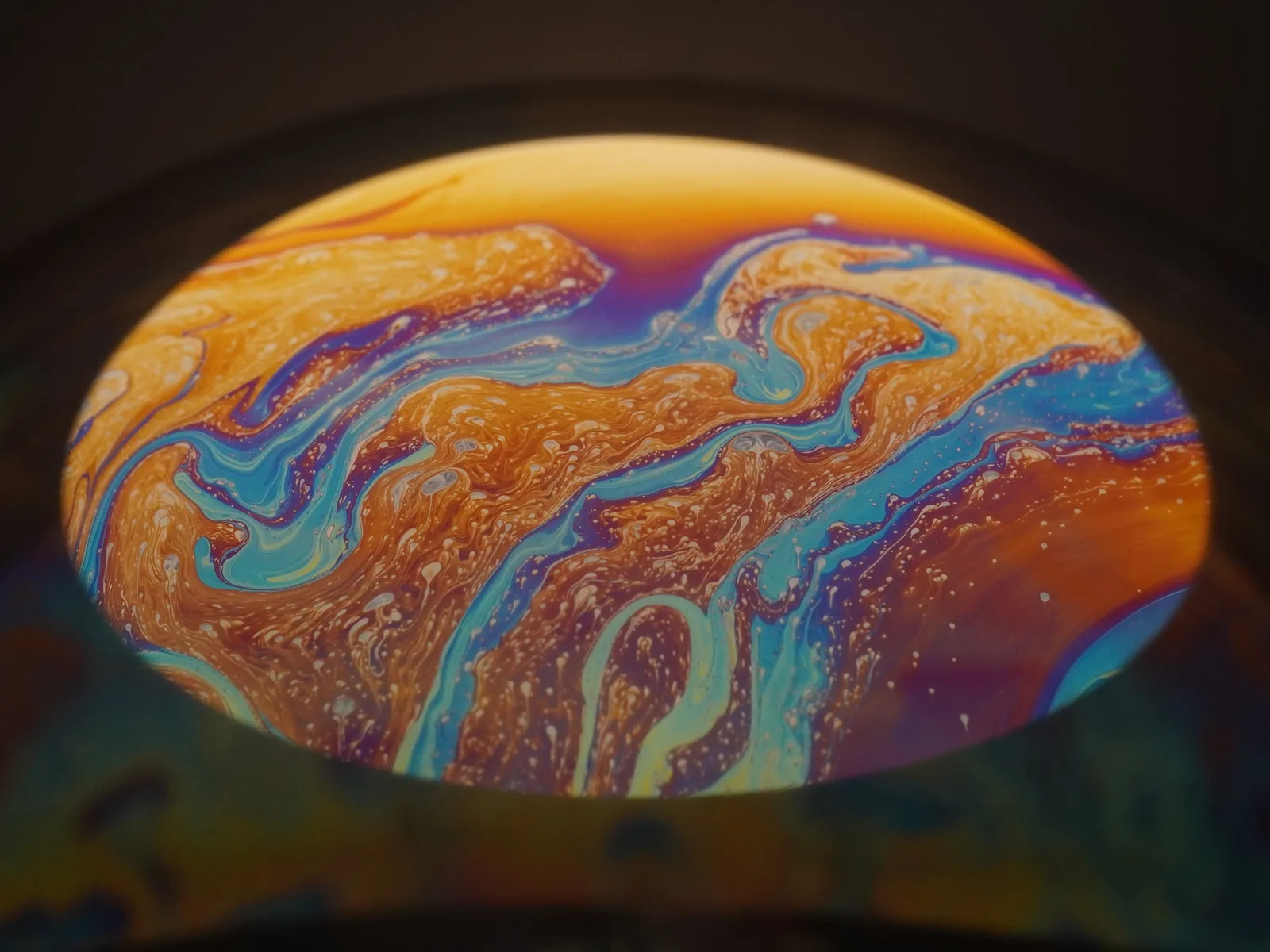
Sunlight is white light, which contains all the wavelengths of visible light, about $400$–$700\,\text{nm}$. In a film of a given thickness the path difference $2nd$ is constructive for some wavelengths and destructive for others. Part of the colours is then missing from the reflected light, and the film looks colourful. For example, in a soap film $200\,\text{nm}$ thick the path difference is $532\,\text{nm}$. Green light with a wavelength of $532\,\text{nm}$ is cancelled, but red and violet light are reflected, so the film looks magenta.
A soap bubble is not equally thick everywhere. Gravity drains the soapy water downwards, so the film thins at the top and thickens at the bottom. Each band of colour is a place where the film has the same thickness, and the bands move as the film drains and evaporates. In an oil film ($n \approx 1.5$) on the surface of water, the reflection from the upper surface occurs from air into oil and inverts the wave, and the reflection from the lower surface, from oil into water ($n = 1.33$), does not. The conditions are therefore the same as in a soap film. In a thick layer, such as window glass, no colours are seen. In a soap film as thick as $5\,\mu\text{m}$ there are $14$ strengthened wavelengths in the visible range, and between them there are almost as many weakened ones, so the colours mix into white.
Thin-film interference
When light arrives at normal incidence on a film, the path difference between the waves reflected from the two surfaces of the film is
$$\Delta s = 2nd$$
where $n$ is the refractive index of the film, $d$ the thickness of the film and $\lambda$ the wavelength of the light in air (almost the same as in vacuum). The conditions depend on how many of the reflections invert the wave. When there is a material of lower refractive index on both sides of the film, as with a soap film in air, only the reflection from the upper surface inverts the wave. Then
$$\begin{aligned} &\text{constructive:} \\ &2nd = (k + \tfrac{1}{2})\lambda \\[6pt] &\text{destructive:} \\ &2nd = k\lambda \end{aligned}$$
where $k = 0, 1, 2, \ldots$ When both reflections invert the wave, as in the coating of a lens whose refractive index lies between those of air and glass, the inversions cancel each other. The conditions then swap places: $2nd = k\lambda$ is constructive and $2nd = (k + \tfrac{1}{2})\lambda$ is destructive. The same holds when neither reflection inverts the wave.
Anti-reflection coating
Ordinary glass ($n = 1.52$) reflects about $4\,\%$ of light arriving at normal incidence from each of its surfaces. A camera objective has many lenses, so the reflections weaken the image and cause ghost images in it. In spectacles the reflection is seen as glare. An anti-reflection coating is a thin film evaporated onto the surface of the glass, for example magnesium fluoride $\text{MgF}_2$, whose refractive index is $1.38$ at a wavelength of $550\,\text{nm}$ (Dodge, Applied Optics, 1984). Both reflections of the coating occur at a material of higher refractive index ($1.00 \to 1.38 \to 1.52$), so the destructive condition is $2nd = (k + \tfrac{1}{2})\lambda$. For the thinnest coating $k = 0$, and its thickness is a quarter of the wavelength in the coating:
$$d = \frac{\lambda}{4n}$$
The coating is usually designed for the middle of the visible range, to which the eye is most sensitive. When $\lambda = 550\,\text{nm}$, the thickness is $99.6\,\text{nm}$, and the reflection from a surface falls from about $4.3\,\%$ to about $1.3\,\%$.
Complete cancellation would require the two reflected waves to be equally strong. At normal incidence this happens when the refractive index of the coating is $\sqrt{n_\text{glass}}$, for glass $\sqrt{1.52} \approx 1.23$. Durable coating materials do not have such a small refractive index, and $\text{MgF}_2$ is one of the closest. Nor does the coating cancel all wavelengths equally well: more violet and red is reflected than green, so a coated lens shines purple. Light does not disappear: the less of it is reflected, the more of it passes through the glass. Modern objectives often have many layers on top of each other.
Common misconception
Many people think that the colours of a soap bubble arise in the same way as the colours of a prism or a rainbow, by refraction in different directions. The colours of a bubble, however, arise from interference: a film of a given thickness strengthens some wavelengths and weakens others, and the colour depends on the thickness of the film. Another mistake is to forget the half-wavelength shift on reflection and conclude that a very thin film reflects strongly because the path difference is zero. A third mistake is to believe that an anti-reflection coating absorbs the reflected light. The coating is transparent: in destructive interference less light is reflected and more of it passes through the glass.
Summary
- The waves reflected from the two surfaces of a thin film interfere. When the light arrives at normal incidence, their path difference is $2nd$, because the wavelength in the film is $\lambda : n$.
- A reflected wave is inverted, that is, it gets a half-wavelength shift, when the light is reflected at a material of higher refractive index.
- A soap film in air has one shift: constructive $2nd = (k + \tfrac{1}{2})\lambda$, destructive $2nd = k\lambda$. A very thin film is therefore black.
- In white light a film looks colourful because some wavelengths cancel, and the colour changes with the thickness of the film.
- An anti-reflection coating has two shifts, and the thinnest destructive coating is $d = \lambda : (4n)$, for example $99.6\,\text{nm}$ for $\text{MgF}_2$ at a wavelength of $550\,\text{nm}$.
Optional Return to your predictions
Compare your predictions with the theory and the values of the model in the experiments. Then return to the opening question: where do the colours of a soap film come from, and why do they change from one place to another?
Would you change your prediction?
Apply
Worked example
Problem
The wall of a soap bubble is $380\,\text{nm}$ thick at one point, and the refractive index of soapy water is $1.33$. White light arrives at normal incidence on the film. Which wavelengths of visible light ($400$–$700\,\text{nm}$) are reflected most strongly?
Step 1/7
Given and find. The thickness of the film is $d = 380\,\text{nm}$ and the refractive index is $n = 1.33$, with air on both sides of the film. We are asked for the wavelengths $\lambda$ between $400$ and $700\,\text{nm}$ at which the interference is constructive.
Step 2/7
Principle. The reflection from the upper surface, from air into the film, inverts the wave; the reflection from the lower surface, from the film into air, does not. The reflections thus contain one half-wavelength shift, so the condition for constructive interference is $2nd = (k + \tfrac{1}{2})\lambda$. We calculate the wavelength for different values of $k$ and choose those in the visible range.
Step 3/7
Formula solved.
$$\begin{aligned} 2nd &= (k + \tfrac{1}{2})\lambda \\[6pt] \lambda &= \frac{2nd}{k + \frac{1}{2}} \end{aligned}$$
Step 4/7
Unit conversions. Not needed: the thickness and the wavelength are both in nanometres, and the refractive index has no unit.
Step 5/7
Substitution. $$\begin{aligned} \lambda &= \frac{2nd}{k + \frac{1}{2}} \\[6pt] k &= 1:\ \lambda = \frac{2 \cdot 1.33 \cdot 380\,\text{nm}}{1.5} \\ &= 673.9\,\text{nm} \\[6pt] k &= 2:\ \lambda = \frac{2 \cdot 1.33 \cdot 380\,\text{nm}}{2.5} \\ &= 404.3\,\text{nm} \end{aligned}$$
The path difference is $2nd = 1010.8\,\text{nm}$. For $k = 0$ we get $2021.6\,\text{nm}$ (infrared) and for $k = 3$ we get $288.8\,\text{nm}$ (ultraviolet), so these are not visible light.
Step 6/7
Result. The most strongly reflected light is red light with a wavelength of $674\,\text{nm}$ and violet light with a wavelength of $404\,\text{nm}$. The answers are given to three significant figures like the refractive index and the thickness. Between them the destructive condition $2nd = 2\lambda$ cancels blue-green light, $1010.8\,\text{nm} : 2 = 505\,\text{nm}$, so the film looks reddish purple at this point.
Step 7/7
Reasonableness. Check: $(1 + \tfrac{1}{2}) \cdot 673.9\,\text{nm} = 1010.8\,\text{nm}$ and $(2 + \tfrac{1}{2}) \cdot 404.3\,\text{nm} = 1010.8\,\text{nm}$. The two strengthened wavelengths are of consecutive orders, so exactly one weakened wavelength lies between them, as it should. In a thinner film there would be fewer strengthened wavelengths in the visible range, and in a thicker film more.
Optional Find the error
Apply to a new situation: an oil film on a puddle
A thin oil film with a refractive index of $1.47$ lies on the surface of a puddle ($n = 1.33$). Light arrives at normal incidence on the film. At one point the reflected white light lacks orange light with a wavelength of $600\,\text{nm}$. Assume that the film is the thinnest possible one that is not almost of zero thickness.
How thick is the film at this point? Give your answer in nanometres.
Hint 1: a guiding question
Which reflection inverts the wave: from air into oil ($1.00 \to 1.47$) or from oil into water ($1.47 \to 1.33$)?
Hint 2: what is the connection
There is one inverting reflection, as in a soap film, so the destructive condition is $2nd = k\lambda$. A film of almost zero thickness is $k = 0$, so now $k = 1$.
Hint 3: an intermediate step
$2nd = \lambda$, so
Show the solution
Given
refractive index of the oil $n = 1.47$, of water $1.33$, of air $1.00$, missing wavelength $\lambda = 600\,\text{nm}$, normal incidence
Find
the thickness $d$ of the oil film in nanometres
Principle
The reflection from the upper surface, from air into oil ($1.00 \to 1.47$), inverts the wave, but the reflection from the lower surface, from oil into water ($1.47 \to 1.33$), does not. Because of the single inversion, the waves weaken each other when the path difference is a whole number of wavelengths, $2nd = k\lambda$. The value $k = 0$ is a film of almost zero thickness, so the thinnest other film is given by $k = 1$.
Formula
$2nd = k\lambda$ and $k = 1$, so $d = \dfrac{\lambda}{2n}$
Conversions
Not needed: the wavelength and the thickness are both in nanometres, and the refractive index has no unit.
Substitution
Answer
$204\,\text{nm}$
Three significant figures like the refractive index $1.47$ and the wavelength $600\,\text{nm}$.
Reasonableness
Check:
The thickness is of the same order of magnitude as the wavelength of light, as it should be in a thin film. The film is a little thinner than a soap film that cancels the same colour, $600\,\text{nm} : (2 \cdot 1.33) = 226\,\text{nm}$, because the refractive index of oil is greater.
Check your understanding
Exit ticket
Answer on your own first and only then open the answer.
- Why does a black spot appear at the top of a soap bubble just before it bursts?
Answer
At the top the film has thinned to much less than the wavelength of light, so the path difference $2nd$ is almost zero. However, the wave reflected from the upper surface has been inverted and the wave reflected from the lower surface has not, so the waves are in opposite phase and cancel each other at all wavelengths. The film does not reflect light and looks black.
- Why does window glass not show colours like a soap film, although light is reflected from its two surfaces too?
Answer
Window glass is millimetres thick, that is, thousands of times thicker than the wavelength. Then there are very many wavelengths in the visible range that are strengthened, and between them just as many that are weakened. The colours mix, and the reflected light looks white.
1. Concept: inverting reflections
2. Calculate: colour of a film
The thickness of a soap film ($n = 1.33$) is $250\,\text{nm}$ at one point, and there is air on both sides of it. White light arrives at normal incidence on the film.
Which wavelength of visible light ($400$–$700\,\text{nm}$) is reflected most strongly? Give your answer in nanometres.
Hint 1: a guiding question
How many of the reflections invert the wave? What is then the condition for constructive interference?
Hint 2: what is the connection
The constructive condition is $2nd = (k + \tfrac{1}{2})\lambda$, so $\lambda = 2nd : (k + \tfrac{1}{2})$.
Hint 3: an intermediate step
$2nd = 665\,\text{nm}$. Try the values $k = 0, 1, 2$ and choose the one between $400$ and $700\,\text{nm}$.
Show the solution
Given
thickness of the film $d = 250\,\text{nm}$, refractive index $n = 1.33$, air on both sides, visible light $400$–$700\,\text{nm}$
Find
the most strongly reflected wavelength $\lambda$ in nanometres
Principle
The reflection from the upper surface, from air into the film, inverts the wave; the reflection from the lower surface, from the film into air, does not. Because of the single inversion, the waves strengthen each other when $2nd = (k + \tfrac{1}{2})\lambda$. We calculate $\lambda$ for $k = 0, 1, 2$ and choose the one in the visible range.
Formula
$2nd = (k + \tfrac{1}{2})\lambda$, so
Conversions
Not needed: the thickness and the wavelength are both in nanometres, and the refractive index has no unit.
Substitution
$k = 1$:
for $k = 0$ we get $1330\,\text{nm}$ (infrared) and for $k = 2$ we get $266\,\text{nm}$ (ultraviolet).
Answer
$443\,\text{nm}$
Three significant figures like the refractive index $1.33$ and the thickness $250\,\text{nm}$.
Reasonableness
Check:
The wavelength is in the blue-violet range, and the only visible wavelength that is cancelled is $665\,\text{nm}$, which is red, so the film looks bluish at this point.
Suggestion: one answer does not show everything you can do, but review the theory summary and do the core exercises.
Optional 3. Explain: the anti-reflection coating
Explain how the anti-reflection coating of a spectacle lens reduces reflection.
Where does the light that is not reflected go, and why does a coated lens shine faintly purple?
Model answer
The coating is a thin transparent film whose refractive index lies between those of air and glass. Light is reflected both from the upper surface of the coating and from the interface between the coating and the glass, and both reflections invert the wave, so the inversions cancel each other. When the thickness of the coating is $d = \lambda : (4n)$, the path difference is $2nd = \tfrac{1}{2}\lambda$, and the reflected waves are in opposite phase and weaken each other. The coating does not absorb light; the light that is not reflected passes through the lens to the eye. The coating is designed for the middle of the visible range, for green light. For violet and red light the path difference is not half a wavelength, so more of them is reflected, and the faint reflection looks purple.
Assess your own answer
Tick the points your own answer already contains.
Review the theory summary and practise with the exercises.
Exercises
Level 1 · basic practice 5 exercises
One formula or one step of reasoning. Core exercises first, the rest is extra practice.
- Exercise 14-1Core
The refractive index of a soap film is $1.33$, and at one point its thickness is $420\,\text{nm}$. Light arrives at normal incidence on the film.
What is the path difference between the waves reflected from the two surfaces of the film? Give your answer in nanometres.
Answer
$1120\,\text{nm}$
Show the solution
Given
refractive index of the soap film $n = 1.33$, thickness of the film $d = 420\,\text{nm}$, normal incidence
Find
the path difference $\Delta s$ between the waves reflected from the two surfaces, in nanometres
Principle
The wave reflected from the lower surface travels through the film and back, that is, an extra distance $2d$. In the film the wavelength is $n$ times shorter than in air, so the extra distance holds as many wavelengths as the distance $2nd$ does in air. At normal incidence the path difference is therefore $2nd$.
Formula
$\Delta s = 2nd$
Conversions
Not needed: the thickness is in nanometres, and the refractive index has no unit.
Substitution
$\Delta s$$= 2 \cdot 1.33 \cdot 420\,\text{nm}$$= 1117.2\,\text{nm}$Answer
$1120\,\text{nm}$
That is, $1.12\,\mu\text{m}$, three significant figures like the refractive index $1.33$ and the thickness $420\,\text{nm}$.
Reasonableness
The path difference is more than twice the thickness of the film, because the light travels through the film and back and the wavelength in the film is shorter. Without the refractive index the path difference would be $840\,\text{nm}$; the factor $1.33$ increases it by about a third, as in the result.
- Exercise 14-2Core
The wavelength of red laser light in air is $633\,\text{nm}$. What is the wavelength of the light in magnesium fluoride, whose refractive index is $1.38$?
Answer
$459\,\text{nm}$
Show the solution
Given
wavelength in air $\lambda = 633\,\text{nm}$, refractive index of magnesium fluoride $n = 1.38$
Find
the wavelength in magnesium fluoride $\lambda_n$ in nanometres
Principle
In a material light travels at the speed $v = c : n$, but its frequency $f$ does not change at an interface. Since $\lambda = v : f$, the wavelength shortens in the same ratio as the speed, that is, by the factor $n$.
Formula
$\lambda_n$$= \dfrac{v}{f}$$= \dfrac{c}{nf}$so $\lambda_n = \dfrac{\lambda}{n}$
Conversions
Not needed: the wavelength is in nanometres, and the refractive index has no unit.
Substitution
$\lambda_n$$= \dfrac{633\,\text{nm}}{1.38}$$= 458.70\,\text{nm}$Answer
$459\,\text{nm}$
Three significant figures like the wavelength $633\,\text{nm}$ and the refractive index $1.38$.
Reasonableness
The wavelength in the material is shorter than in air, because the refractive index is greater than one. The colour of the light still does not change, because the frequency stays the same. Check: $1.38 \cdot 458.70\,\text{nm} = 633\,\text{nm}$.
- Exercise 14-3
An $\text{MgF}_2$ coating ($n = 1.38$) is evaporated onto the glass of a camera lens so that light of wavelength $500\,\text{nm}$ is reflected as little as possible. The refractive index of the glass is $1.52$, and the light arrives at normal incidence.
How thick is the thinnest such coating?
Answer
$90.6\,\text{nm}$
Show the solution
Given
refractive index of the coating $n = 1.38$, of the glass $1.52$, wavelength $\lambda = 500\,\text{nm}$, normal incidence
Find
the thickness $d$ of the thinnest reflection-reducing coating, in nanometres
Principle
Both reflections occur at a material of higher refractive index ($1.00 \to 1.38 \to 1.52$), so both waves are inverted, and the inversions cancel each other. The waves then weaken each other when $2nd = (k + \tfrac{1}{2})\lambda$, and the thinnest coating is given by $k = 0$.
Formula
$2nd = \tfrac{1}{2}\lambda$, so $d = \dfrac{\lambda}{4n}$
Conversions
Not needed: the wavelength and the thickness are both in nanometres.
Substitution
$d$$= \dfrac{500\,\text{nm}}{4 \cdot 1.38}$$= 90.580\,\text{nm}$Answer
$90.6\,\text{nm}$
Three significant figures like the refractive index $1.38$ and the wavelength $500\,\text{nm}$.
Reasonableness
The coating is a quarter of the wavelength in the coating, $500\,\text{nm} : 1.38 = 362\,\text{nm}$, and $362\,\text{nm} : 4 \approx 91\,\text{nm}$. The result is a little smaller than the $99.6\,\text{nm}$ coating of the chapter for a wavelength of $550\,\text{nm}$, because the wavelength is shorter.
- Exercise 14-4
The refractive index of a soap film is $1.33$, and there is air on both sides of it. Light arrives at normal incidence on the film.
How thick is the thinnest film that reflects light of wavelength $600\,\text{nm}$ most strongly?
Answer
$113\,\text{nm}$
Show the solution
Given
refractive index of the soap film $n = 1.33$, air on both sides, wavelength $\lambda = 600\,\text{nm}$, normal incidence
Find
the thickness $d$ of the thinnest strongly reflecting film, in nanometres
Principle
The reflection from the upper surface, from air into the film, inverts the wave; the reflection from the lower surface, from the film into air, does not. Because of the single inversion, the waves strengthen each other when $2nd = (k + \tfrac{1}{2})\lambda$, and the thinnest such film is given by $k = 0$.
Formula
$2nd = \tfrac{1}{2}\lambda$, so $d = \dfrac{\lambda}{4n}$
Conversions
Not needed: the wavelength and the thickness are both in nanometres.
Substitution
$d$$= \dfrac{600\,\text{nm}}{4 \cdot 1.33}$$= 112.78\,\text{nm}$Answer
$113\,\text{nm}$
Three significant figures like the refractive index $1.33$ and the wavelength $600\,\text{nm}$.
Reasonableness
The same formula $d = \lambda : (4n)$ gives the strongest reflection in a soap film but the weakest in a coating, because the number of inverting reflections is different. The thickness is greater than the $103\,\text{nm}$ of the simulation for a wavelength of $550\,\text{nm}$, as it should be for a longer wavelength.
- Exercise 14-5
The refractive index of the plastic of a spectacle lens is $1.60$. At normal incidence a single-layer anti-reflection coating would cancel the reflection completely if the waves reflected from its two surfaces were equally strong.
What should the refractive index of the coating then be?
Answer
$1.26$
Show the solution
Given
refractive index of the plastic of the lens $n_\text{plastic} = 1.60$, normal incidence
Find
the refractive index $n_\text{c}$ of the ideal coating
Principle
The more the refractive indices at an interface differ, the stronger the reflected wave is. When the waves reflected from the upper and lower surfaces of the coating are equally strong, they can cancel each other completely. At normal incidence this happens when the refractive index of the coating is the square root of the refractive index of the lens material, as stated in the chapter: then $1.00 : n_\text{c} = n_\text{c} : n_\text{plastic}$.
Formula
$n_\text{c} = \sqrt{n_\text{plastic}}$
Conversions
Not needed: the refractive indices have no unit.
Substitution
$n_\text{c} = \sqrt{1.60} = 1.2649$
Answer
$1.26$
Three significant figures like the refractive index $1.60$.
Reasonableness
The refractive index of the coating lies between $1.00$ for air and $1.60$ for the plastic, so both reflections invert the wave. The result is a little greater than the $1.23$ calculated for ordinary glass, because the refractive index of the plastic is greater. Check: $1.2649 \cdot 1.2649 = 1.60$.
Level 2 · applied practice 4 exercises
Two steps, working with measured data, a unit conversion or rearranging a formula. Core exercises first, the rest is extra practice.
- Exercise 14-6Core
The thickness of a soap film ($n = 1.33$) is $240\,\text{nm}$ at one point, and there is air on both sides of it. White light arrives at normal incidence on the film.
Which wavelength of visible light ($400$–$700\,\text{nm}$) is missing from the reflected light?
Answer
$638\,\text{nm}$
Show the solution
Given
refractive index of the soap film $n = 1.33$, thickness $d = 240\,\text{nm}$, air on both sides, visible light $400$–$700\,\text{nm}$
Find
the wavelength $\lambda$ missing from the reflected light, in nanometres
Principle
The reflection from the upper surface, from air into the film, inverts the wave; the reflection from the lower surface, from the film into air, does not. Because of the single inversion, the waves weaken each other when the path difference is a whole number of wavelengths, $2nd = k\lambda$. We calculate $\lambda$ for $k = 1, 2$ and choose the visible one.
Formula
$2nd = k\lambda$, so $\lambda = \dfrac{2nd}{k}$
Conversions
Not needed: the thickness and the wavelength are both in nanometres.
Substitution
$k = 1$:
$\lambda$$= \dfrac{2 \cdot 1.33 \cdot 240\,\text{nm}}{1}$$= 638.4\,\text{nm}$for $k = 2$ we get $319.2\,\text{nm}$, which is ultraviolet.
Answer
$638\,\text{nm}$
Three significant figures like the refractive index $1.33$ and the thickness $240\,\text{nm}$.
Reasonableness
The missing light is red, so the film looks blue-green at this point. The result is close to, and greater than, the $532\,\text{nm}$ missing for the $200\,\text{nm}$ film of the chapter, as it should be for a thicker film: the missing wavelength grows in the same ratio as the thickness. The thickness is $1.2$ times as great, and $1.2 \cdot 532\,\text{nm}$ is $638.4\,\text{nm}$.
- Exercise 14-7Core
A glass lens ($n = 1.52$) has a $110\,\text{nm}$ thick $\text{MgF}_2$ coating ($n = 1.38$) on its surface. Light arrives at normal incidence on the coating.
For which wavelength of visible light ($400$–$700\,\text{nm}$) is the reflection from the coating weakest?
Answer
$607\,\text{nm}$
Show the solution
Given
refractive index of the coating $n = 1.38$, thickness $d = 110\,\text{nm}$, refractive index of the glass $1.52$, visible light $400$–$700\,\text{nm}$
Find
the most weakly reflected wavelength $\lambda$ in nanometres
Principle
Both reflections occur at a material of higher refractive index ($1.00 \to 1.38 \to 1.52$), so the inversions cancel each other. The waves weaken each other when $2nd = (k + \tfrac{1}{2})\lambda$. We calculate $\lambda$ for $k = 0, 1$ and choose the visible one.
Formula
$2nd = (k + \tfrac{1}{2})\lambda$, so
$\lambda$$= \dfrac{2nd}{k + \frac{1}{2}}$Conversions
Not needed: the thickness and the wavelength are both in nanometres.
Substitution
$k = 0$:
$\lambda$$= \dfrac{2 \cdot 1.38 \cdot 110\,\text{nm}}{0.5}$$= \dfrac{303.6\,\text{nm}}{0.5}$$= 607.2\,\text{nm}$for $k = 1$ we get $303.6\,\text{nm} : 1.5 = 202.4\,\text{nm}$, which is ultraviolet.
Answer
$607\,\text{nm}$
Three significant figures like the thickness $110\,\text{nm}$ and the refractive index $1.38$.
Reasonableness
For $k = 0$ the coating is a quarter-wave layer: $4 \cdot 1.38 \cdot 110\,\text{nm} = 607.2\,\text{nm}$. The coating is thicker than the $99.6\,\text{nm}$ designed for $550\,\text{nm}$, so it cancels a longer, orange wavelength.
- Exercise 14-8
An $\text{MgF}_2$ coating ($n = 1.38$) is made on glass ($n = 1.52$) so that it reflects light of wavelength $520\,\text{nm}$ as little as possible at normal incidence. The manufacturer wants a layer thicker than the thinnest possible.
How thick is the second thinnest coating that reflects this wavelength most weakly?
Answer
$283\,\text{nm}$
Show the solution
Given
refractive index of the coating $n = 1.38$, of the glass $1.52$, wavelength $\lambda = 520\,\text{nm}$, normal incidence
Find
the thickness $d$ of the second thinnest destructive coating, in nanometres
Principle
Both reflections invert the wave ($1.00 \to 1.38 \to 1.52$), so the inversions cancel each other, and the waves weaken each other when $2nd = (k + \tfrac{1}{2})\lambda$. The thinnest coating is $k = 0$, so the second thinnest is given by $k = 1$.
Formula
$2nd = (1 + \tfrac{1}{2})\lambda$, so $d = \dfrac{3\lambda}{4n}$
Conversions
Not needed: the wavelength and the thickness are both in nanometres.
Substitution
$d$$= \dfrac{3 \cdot 520\,\text{nm}}{4 \cdot 1.38}$$= \dfrac{1560\,\text{nm}}{5.52}$$= 282.61\,\text{nm}$Answer
$283\,\text{nm}$
Three significant figures like the refractive index $1.38$ and the wavelength $520\,\text{nm}$.
Reasonableness
The thinnest coating would be $520\,\text{nm} : (4 \cdot 1.38) = 94.2\,\text{nm}$, and the second thinnest is three times that, because the path difference increases by one wavelength, that is, by two half wavelengths. Check:
$2 \cdot 1.38 \cdot 282.61\,\text{nm}$$= 780\,\text{nm}$$= 1.5 \cdot 520\,\text{nm}$ - Exercise 14-9
In a beam splitter a thin titanium dioxide layer is made on glass ($n = 1.52$) so that it reflects light of wavelength $550\,\text{nm}$ as much as possible. Assume that the refractive index of the layer is $2.30$ and that the light arrives from air at normal incidence on the layer.
How thick is the thinnest such layer?
Answer
$59.8\,\text{nm}$
Show the solution
Given
refractive index of the layer $n = 2.30$, of the glass $1.52$, wavelength $\lambda = 550\,\text{nm}$, light from air at normal incidence
Find
the thickness $d$ of the thinnest strongly reflecting layer, in nanometres
Principle
The reflection from the upper surface, from air into the layer ($1.00 \to 2.30$), inverts the wave. At the lower surface the light is reflected from the layer into the glass ($2.30 \to 1.52$), that is, at a material of lower refractive index, so the wave is not inverted. Because of the single inversion, the conditions are the same as in a soap film: the waves strengthen each other when $2nd = (k + \tfrac{1}{2})\lambda$, and the thinnest layer is given by $k = 0$.
Formula
$2nd = \tfrac{1}{2}\lambda$, so $d = \dfrac{\lambda}{4n}$
Conversions
Not needed: the wavelength and the thickness are both in nanometres.
Substitution
$d$$= \dfrac{550\,\text{nm}}{4 \cdot 2.30}$$= 59.783\,\text{nm}$Answer
$59.8\,\text{nm}$
Three significant figures like the refractive index $2.30$ and the wavelength $550\,\text{nm}$.
Reasonableness
The layer is thinner than an $\text{MgF}_2$ coating of $99.6\,\text{nm}$ for the same wavelength, because the refractive index is greater and the wavelength in the layer is therefore shorter. The decisive point is that behind the lower surface there is a lower refractive index: the same quarter-wave thickness therefore strengthens the reflection instead of weakening it.
Level 3 · challenging 3 exercises
Optional: application, two ideas together or a new situation where you reason for yourself.
- Exercise 14-10
A soap film ($n = 1.33$) made in a vertical wire frame is lit with the yellow light of a sodium lamp, with wavelength $589\,\text{nm}$, arriving at normal incidence on the film.
Gravity thins the film at the top, and the topmost part of the film looks black. Below it bright and dark horizontal bands alternate, and the film gets thicker downwards.
How thick is the film at the second dark band, when the topmost black region is not counted as a band?
Answer
$443\,\text{nm}$
Show the solution
Given
refractive index of the soap film $n = 1.33$, air on both sides, wavelength $\lambda = 589\,\text{nm}$, normal incidence; the film thickens from top to bottom, and the topmost part is black
Find
the thickness $d$ of the film at the second dark band, in nanometres
Principle
The reflection from the upper surface inverts the wave and that from the lower surface does not, so the waves weaken each other when $2nd = k\lambda$. The black top is the value $k = 0$, where the film is much thinner than the wavelength. The film thickens downwards, so the next dark bands are in order $k = 1$ and $k = 2$; at the second dark band $k = 2$. The bright bands lie between the dark ones.
Formula
$2nd = 2\lambda$, so $d = \dfrac{\lambda}{n}$
Conversions
Not needed: the wavelength and the thickness are both in nanometres.
Substitution
$d$$= \dfrac{589\,\text{nm}}{1.33}$$= 442.86\,\text{nm}$Answer
$443\,\text{nm}$
Three significant figures like the refractive index $1.33$ and the wavelength $589\,\text{nm}$.
Reasonableness
The first dark band is at a thickness of $589\,\text{nm} : (2 \cdot 1.33) = 221\,\text{nm}$, and the second is twice that, because between consecutive dark bands the thickness always grows by the same amount, $\lambda : (2n)$. The thickness is less than a micrometre, as is fitting for a thin film.
- Exercise 14-11
A camera objective has four separate glass lenses, that is, eight surfaces at which light passes from air into glass or from glass into air. Each surface is coated so that it reflects $1.3\,\%$ of the light arriving at it at normal incidence.
Assume that the glass does not absorb light and that light reflected once no longer reaches the sensor.
What percentage of the light entering the objective gets through it?
Answer
$90\,\%$
Show the solution
Given
eight surfaces, each of which reflects $1.3\,\%$ of the light arriving at it; the glass does not absorb light, and reflected light does not return to the sensor
Find
the percentage of light that gets through the objective
Principle
Light does not disappear in the coating: what is not reflected goes through the surface. Through each surface therefore passes $98.7\,\%$ of the light arriving at it, since $100\,\% - 1.3\,\% = 98.7\,\%$. The next surface receives only the light that passed the previous one, so the fractions are multiplied together eight times.
Formula
$\dfrac{I_\text{out}}{I_0} = (1 - R)^8$
Conversions
$R = 1.3\,\% = 0.013$. Finally the fraction is multiplied by one hundred to give a percentage.
Substitution
$\dfrac{I_\text{out}}{I_0}$$= (1 - 0.013)^8$$= 0.987^8$$= 0.9006$$= 90.06\,\%$Answer
$90\,\%$
Two significant figures like the reflected fraction $1.3\,\%$.
Reasonableness
Estimate: the eight surfaces reflect altogether about $8 \cdot 1.3\,\% \approx 10\,\%$, so about $90\,\%$ gets through. Without coatings each surface would reflect about $4.26\,\%$, and only $(1 - 0.0426)^8 \approx 70.6\,\%$ would get through. The coatings thus increase the light reaching the sensor by about $19$ percentage points, that is, by a good quarter ($90.06 : 70.6 \approx 1.28$), and reduce ghost images.
- Exercise 14-12
A soap film ($n = 1.33$) is in air, and white light arrives at normal incidence on the film. In the visible range the film reflects most strongly the wavelengths $630\,\text{nm}$ and $450\,\text{nm}$, and there are no other strongly reflected wavelengths between them.
How thick is the film?
Answer
$592\,\text{nm}$
Show the solution
Given
refractive index of the soap film $n = 1.33$, air on both sides, most strongly reflected wavelengths $\lambda_1 = 630\,\text{nm}$ and $\lambda_2 = 450\,\text{nm}$, none between them
Find
the thickness $d$ of the film in nanometres
Principle
There is one inverting reflection, so the waves strengthen each other when $2nd = (k + \tfrac{1}{2})\lambda$. The same thickness strengthens both wavelengths. The shorter wavelength fits into the path difference more times, and since there are no others between them, its order is greater by one: $(k + \tfrac{1}{2})\lambda_1 = (k + \tfrac{3}{2})\lambda_2$. From this we first solve $k$ and then $d$.
Formula
$(k + \tfrac{1}{2})\lambda_1 = (k + \tfrac{3}{2})\lambda_2$, so
$k$$= \dfrac{\tfrac{3}{2}\lambda_2 - \tfrac{1}{2}\lambda_1}{\lambda_1 - \lambda_2}$thickness
$d$$= \dfrac{(k + \frac{1}{2})\lambda_1}{2n}$Conversions
Not needed: the wavelengths and the thickness are all in nanometres.
Substitution
$k$$= \dfrac{1.5 \cdot 450\,\text{nm} - 0.5 \cdot 630\,\text{nm}}{630\,\text{nm} - 450\,\text{nm}}$$= \dfrac{360\,\text{nm}}{180\,\text{nm}}$$= 2$so
$d$$= \dfrac{2.5 \cdot 630\,\text{nm}}{2 \cdot 1.33}$$= \dfrac{1575\,\text{nm}}{2.66}$$= 592.11\,\text{nm}$Answer
$592\,\text{nm}$
Three significant figures like the refractive index $1.33$ and the wavelengths.
Reasonableness
Check: $3.5 \cdot 450\,\text{nm} = 1575\,\text{nm}$ and $2.5 \cdot 630\,\text{nm} = 1575\,\text{nm}$, so the same path difference strengthens both. The other orders give $1575\,\text{nm} : 1.5 = 1050\,\text{nm}$ (infrared) and $1575\,\text{nm} : 4.5 = 350\,\text{nm}$ (ultraviolet), so in the visible range there really are only these two.
Photographs
- Reflection in a soap bubble edit. Brocken Inaglory, edited by Alvesgaspar. source, CC BY-SA 3.0
- Thin Film Interference Soap Bubble. Pksois23. source, CC BY-SA 4.0

