
Interference and diffraction of light
Why does the beam of a laser pointer draw a whole row of dots of light on the wall when it passes through a thin transparent film?
Prior knowledge
- The waves from two sources oscillating in the same phase reinforce each other when the path difference is a whole number of wavelengthschapter Interference of waves
- Light is electromagnetic wave motion, and the wavelength of visible light is $400$–$700\,\text{nm}$chapter Electromagnetic radiation and the black-body spectrum
- In a prism violet light is refracted most, because the refractive index of glass is largest for itchapter Dispersion: the prism and the rainbow
Core path: follow the steps in order. Tasks marked Optional give extra practice. Optional tasks: 5.
Think about it
In a physics lesson the teacher switches off the lights and aims the beam of a red laser pointer through a slide frame. The frame holds a thin transparent film that looks just like ordinary plastic. Instead of a single spot, a horizontal row of evenly spaced red dots appears on the wall.
How can one straight ray of light split into many directions, and what decides the positions of the dots?
Optional Recap: interference
Predict
Make your predictions before investigating 2 questions
Prediction 1: a denser grating
Prediction 2: the colour of the light
Investigate
A laser beam passes through a grating onto a screen. Change the line density of the grating, the wavelength of the light and the distance of the screen, and follow where the dots land.
Simulation
How to use
Adjust the line density $N$ of the grating, that is the number of lines per millimetre, the wavelength $\lambda$ of the laser and the distance $L$ from the grating to the screen. The picture is from above: the laser is on the left, the grating in front of it and the screen on the right. The scale of the screen shows the distance $x$ from the central maximum in centimetres. The arc shows the angle $\theta_1$ of the first order from the direction of the beam. A faint ray that does not hit the screen is a maximum that goes past the edge of the screen. From the readouts you see the grating spacing $d$, the angles and distances of the first two orders and the number of maxima.
Assumptions of the model
The laser beam arrives perpendicular to the grating, and the screen is perpendicular to the beam. The light has one wavelength. The picture is to scale: the screen is $1.80\,\text{m}$ wide. The model calculates only the directions of the maxima. The dimming of the dots of higher orders is only an illustration, not a calculated value, and the effect of the width of the slits is not shown in the model. The readouts are values calculated by the model, not measurements.
How the calculation works
The grating spacing is calculated from the line density:
$$d = \frac{1\,\text{mm}}{N}$$
The maximum of order $k$ is in the direction for which $d\sin\theta = k\lambda$. A maximum forms only when $k\lambda < d$, so the number of maxima is $2k_\text{max} + 1$, where $k_\text{max}$ is the largest whole number that satisfies this condition. On the screen the distance of a maximum from the central maximum is $x = L\tan\theta$.
Experiment 1: line density of the grating
Test prediction 1. The wavelength is $650\,\text{nm}$ and the distance of the screen is $1.00\,\text{m}$; change only the line density $N$. Record at least the values $300$, $600$ and $1000$. Follow the angle $\theta_1$ and the distance $x_1$.
Initial state: line density $N$ = $300\,\text{lines/mm}$, wavelength $\lambda$ = $650\,\text{nm}$, screen distance $L$ = $1{.}0\,\text{m}$. Kept constant: wavelength $\lambda$, screen distance $L$. Varied: line density $N$.
| line density $N$ | $\theta _1$ $(^\circ)$ | $x_1$ $(\text{cm})$ |
|---|
From the readings of the row $N = 600$, calculate the path difference $\Delta s = d\sin\theta_1$ of adjacent slits, when the grating spacing is $d = 1\,\text{mm} : 600$. Answer in nanometres and compare the result with the wavelength of the laser.
Hint 1: a guiding question
The grating spacing is $d = 1\,\text{mm} : 600$. How much is that in nanometres?
Hint 2: what is the connection
$1\,\text{mm} = 1\,000\,000\,\text{nm}$, so
Hint 3: an intermediate step
Multiply the grating spacing by the sine of the angle in the table: $1667\,\text{nm} \cdot \sin 22.95^\circ$.
Show the solution
Given
line density $N = 600$ lines per millimetre, reading of the simulation $\theta_1 = 22.95^\circ$, wavelength of the laser $\lambda = 650\,\text{nm}$
Find
the path difference $\Delta s$ of adjacent slits in the direction of the first-order maximum, in nanometres
Principle
When light arrives perpendicular to the grating, the path difference of rays leaving adjacent slits at angle $\theta$ is $d\sin\theta$. In the first-order maximum the waves should arrive in the same phase, so the path difference should be one wavelength.
Formula
$d = \dfrac{1\,\text{mm}}{N}$ and $\Delta s = d\sin\theta_1$
Conversions
$1\,\text{mm} = 1\,000\,000\,\text{nm}$, so
Substitution
Answer
$650\,\text{nm}$
Three significant figures like the wavelength; the path difference is exactly the wavelength of the laser.
Reasonableness
The other rows give the same: $3333\,\text{nm} \cdot \sin 11.24^\circ = 650\,\text{nm}$ and $1000\,\text{nm} \cdot \sin 40.54^\circ = 650\,\text{nm}$. In a denser grating $d$ is smaller, so $\sin\theta_1$ must be larger for the product to stay equal to the wavelength.
Experiment 2: wavelength
Test prediction 2. The grating has $600$ lines per millimetre and the distance of the screen is $1.00\,\text{m}$; change only the wavelength $\lambda$. Record at least blue $450\,\text{nm}$, green $532\,\text{nm}$ and red $650\,\text{nm}$.
Initial state: line density $N$ = $600\,\text{lines/mm}$, wavelength $\lambda$ = $450\,\text{nm}$, screen distance $L$ = $1{.}0\,\text{m}$. Kept constant: line density $N$, screen distance $L$. Varied: wavelength $\lambda$.
| wavelength $\lambda$ | $\theta _1$ $(^\circ)$ | $x_1$ $(\text{cm})$ |
|---|
Use the grating equation to calculate the angle at which the first-order maximum of green light ($532\,\text{nm}$) lies when the grating has $600$ lines per millimetre. Compare the result with the reading of the simulation.
Hint 1: a guiding question
First calculate the grating spacing $d = 1\,\text{mm} : 600$ in metres.
Hint 2: what is the connection
From the grating equation $\sin\theta_1 = \lambda : d$, when $k = 1$.
Hint 3: an intermediate step
Take the inverse sine of the result.
Show the solution
Given
line density $N = 600$ lines per millimetre, wavelength $\lambda = 532\,\text{nm}$, order $k = 1$
Find
the angle $\theta_1$ of the first-order maximum from the direction of the central maximum, in degrees
Principle
Light arrives perpendicular to the grating, so a maximum lies in a direction where the path difference $d\sin\theta$ of adjacent slits is a whole number of wavelengths. In the first order the path difference is one wavelength.
Formula
$d = \dfrac{1\,\text{mm}}{N}$ and $d\sin\theta_1 = k\lambda$, so
Conversions
$532\,\text{nm} = 532 \cdot 10^{-9}\,\text{m}$.
Substitution
Answer
$18.6^\circ$
Three significant figures like the wavelength $532\,\text{nm}$; the same as the reading of the simulation, $18.61^\circ$.
Reasonableness
The wavelength of green lies between that of blue, $450\,\text{nm}$, and that of red, $650\,\text{nm}$, and so does the angle:
Check: $1.667\,\mu\text{m} \cdot \sin 18.61^\circ = 0.532\,\mu\text{m}$.
Optional Extra experiment: distance of the screen
The grating has $300$ lines per millimetre and the wavelength is $650\,\text{nm}$; change only the distance $L$ of the screen. Record at least the values $0.50\,\text{m}$, $1.00\,\text{m}$ and $2.00\,\text{m}$. Does the angle $\theta_1$ change, and how does the distance $x_1$ change?
Initial state: line density $N$ = $300\,\text{lines/mm}$, wavelength $\lambda$ = $650\,\text{nm}$, screen distance $L$ = $0{.}5\,\text{m}$. Kept constant: line density $N$, wavelength $\lambda$. Varied: screen distance $L$.
| screen distance $L$ | $\theta _1$ $(^\circ)$ | $x_1$ $(\text{cm})$ | $x_2$ $(\text{cm})$ |
|---|
Conclusion: what decides the directions of the maxima
On the basis of your tables, write: how do the line density of the grating and the wavelength of the light affect the angle of the first-order maximum? Which quantity stayed the same in experiment 1 even though the grating changed?
Model answer
In experiment 1 a denser grating increased the angle: with a $300$-line grating $\theta_1 = 11.24^\circ$ and $x_1 = 19.9\,\text{cm}$, with a $600$-line grating $22.95^\circ$ and $42.4\,\text{cm}$ and with a $1000$-line grating $40.54^\circ$ and $85.5\,\text{cm}$. The product $d\sin\theta_1$ was $650\,\text{nm}$ in every row, that is the wavelength of the laser: in a maximum the path difference of adjacent slits is one wavelength. In experiment 2 a longer wavelength increased the angle: blue $450\,\text{nm}$ $15.66^\circ$, green $532\,\text{nm}$ $18.61^\circ$ and red $650\,\text{nm}$ $22.95^\circ$. So in a grating red light is deviated most, unlike in a prism. The results fit the condition $d\sin\theta = k\lambda$. The values are calculated by the model.
Assess your own answer
Tick the points your own answer already contains.
Review the theory summary and practise with the exercises.
Measurement: wavelength of a green laser
Made-up example data
Students measured the wavelength of a green laser pointer with a grating. The laser, the grating and the screen were set in a line so that the beam hit both the grating and the screen perpendicularly. The distance from the grating to the screen and the separations of the symmetric maxima were measured with a tape measure. Estimating the centre of a dot was the most uncertain part, so the measurement uncertainty of a separation was estimated as $0.3\,\text{cm}$. The uncertainty of the distance $x$ measured from the central maximum is then half of that, $\Delta x = 0.15\,\text{cm}$.
| quantity | value | measurement uncertainty |
|---|---|---|
| line density $N$ of the grating | $300$ lines per millimetre | (value from the manufacturer) |
| distance $L$ from the grating to the screen | $1.500\,\text{m}$ | $\Delta L = 0.005\,\text{m}$ |
| separation of maxima $+1$ and $-1$ | $48.4\,\text{cm}$ | $0.3\,\text{cm}$ |
| separation of maxima $+2$ and $-2$ | $101.2\,\text{cm}$ | $0.3\,\text{cm}$ |
Calculate the wavelength of the laser from the second-order maxima. Answer in nanometres. At the end of the solution, estimate how large the uncertainty of the result is.
Hint 1: a guiding question
The separation of maxima $+2$ and $-2$ is twice the distance $x_2$ of the second-order maximum from the central maximum.
Hint 2: what is the connection
First calculate the angle from the equation $\tan\theta_2 = x_2 : L$ and then the wavelength from the grating equation with $k = 2$.
Hint 3: an intermediate step
$d = 1 \cdot 10^{-3}\,\text{m} : 300$.
Show the solution
Given
line density $N = 300$ lines per millimetre, distance from the grating to the screen $L = 1.500\,\text{m}$ ($\Delta L = 0.005\,\text{m}$), separation of the maxima $\pm 2$ $101.2\,\text{cm}$, order $k = 2$, $\Delta x = 0.15\,\text{cm}$
Find
the wavelength $\lambda$ of the laser light in nanometres and its uncertainty
Principle
The beam arrives perpendicular to the grating, so the maxima obey the grating equation. The screen is perpendicular to the beam, so the angle comes from the right-angled triangle whose legs are $x_2$ and $L$. The farther maximum gives a smaller relative uncertainty, because its $x$ is larger.
Formula
$\tan\theta_2 = \dfrac{x_2}{L}$ and $d\sin\theta_2 = k\lambda$, so $\lambda = \dfrac{d\sin\theta_2}{k}$, where $d = \dfrac{1\,\text{mm}}{N}$
Conversions
Substitution
so
Uncertainty: the largest value is obtained when $x_2 = 50.75\,\text{cm}$ and $L = 1.495\,\text{m}$, and it is $536\,\text{nm}$; the smallest value, when $x_2 = 50.45\,\text{cm}$ and $L = 1.505\,\text{m}$, is $530\,\text{nm}$.
Answer
$533\,\text{nm}$
Uncertainty about $3\,\text{nm}$; three significant figures, because the uncertainty is of the order of a few nanometres.
Reasonableness
The stated wavelength of a green laser pointer, $532\,\text{nm}$, lies between $530$ and $536\,\text{nm}$. From the first-order maxima ($x_1 = 24.2\,\text{cm}$) the same method gives $531\,\text{nm}$ and the interval $526$–$536\,\text{nm}$, that is an uncertainty of about $5\,\text{nm}$: the farther maximum really does give a more accurate result.
Theory summary
Key idea
Light as a wave
In the chapter Interference of waves we saw that the waves from two sources of the same frequency, oscillating in the same phase, form a stable interference pattern. At places where the path difference $\Delta s$ of the waves is a whole number of wavelengths, the waves reinforce each other. At places where the path difference is half a wavelength more than a whole number, they weaken each other. Light is electromagnetic wave motion (chapter Electromagnetic radiation and the black-body spectrum), so light should interfere, too. However, the wavelength of visible light is only $400$–$700\,\text{nm}$, so the details of an interference pattern of light are very small.
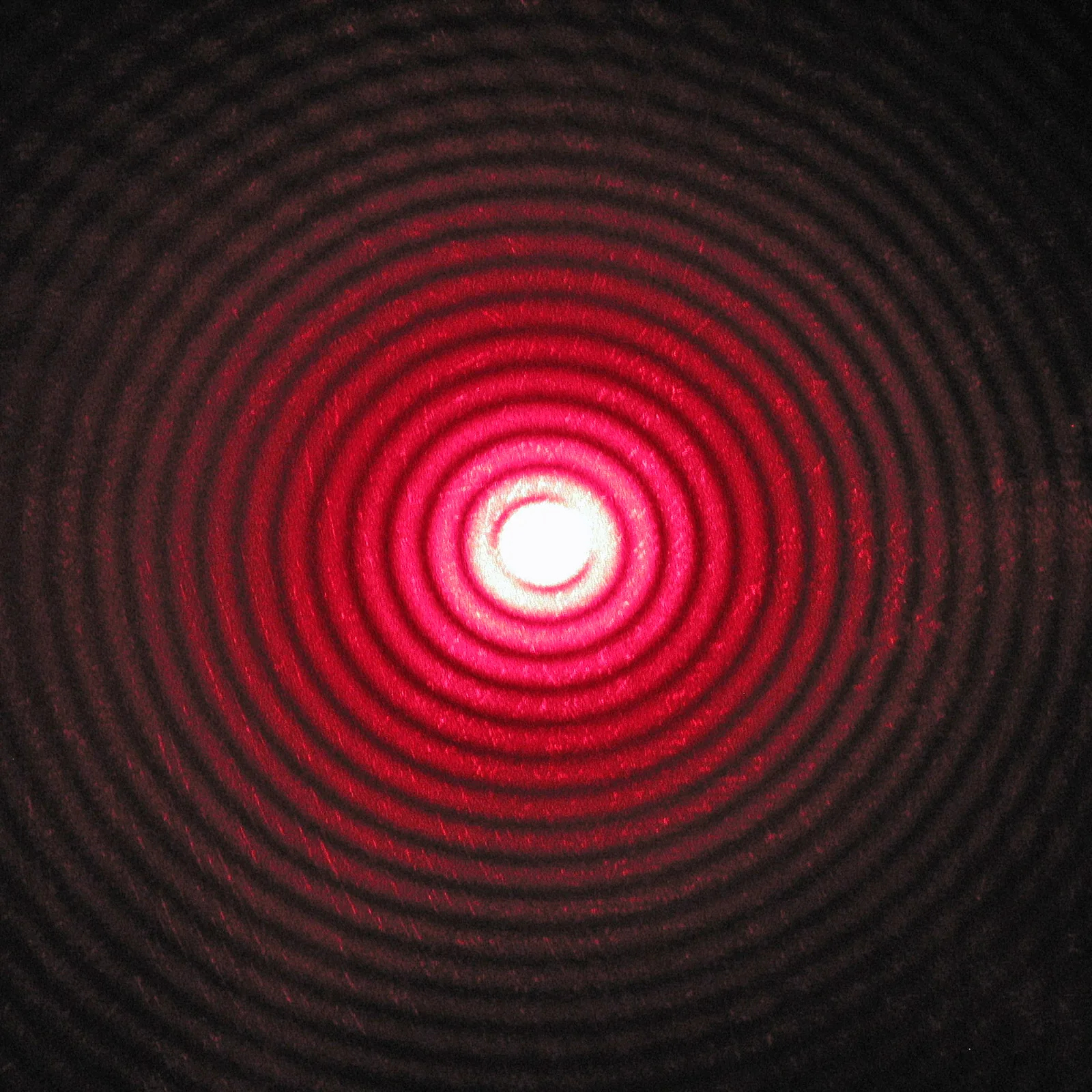
Coherent light
A stable pattern forms only when the sources are coherent: they have the same frequency, and their phase difference stays constant. Two ordinary lamps do not produce a pattern. The light of a lamp is emitted by countless atoms independently of each other, so the phase difference of the light of two lamps varies randomly and very rapidly. The places of constructive and destructive interference then keep swapping, and the eye sees only an even illumination. The light of a laser is coherent. Coherent sources can also be obtained by dividing the light of one source into two parts, for example with two slits.
Diffraction at a slit
When light passes through a narrow slit, it does not continue as a sharp beam but spreads out behind the slit, also into directions that would be in shadow. This is diffraction, which is familiar from water waves (chapter Reflection and diffraction of waves). Diffraction is strong when the width of the slit is of the order of the wavelength. The narrower the slit, the wider the light spreads: when the slit is narrowed, the bright central region on the screen widens instead of narrowing. Light coming through a window does not seem to bend, because the window is millions of times wider than the wavelength.
Young's double-slit experiment
At the beginning of the 19th century Thomas Young carried out an experiment that showed light to be a wave motion. He directed the same light at two narrow slits close together. Because of diffraction, the light spreads widely from each slit, and the waves from the slits overlap. Because the light at both slits comes from the same wavefront, the slits act as coherent sources. Evenly spaced bright and dark fringes form on the screen. In the middle there is a bright fringe, because the distance from each slit to that point is equal. In the next bright fringe the path difference is one wavelength. The dark fringes are the hallmark of interference: they receive less light from the two slits together than from either slit alone.
Grating
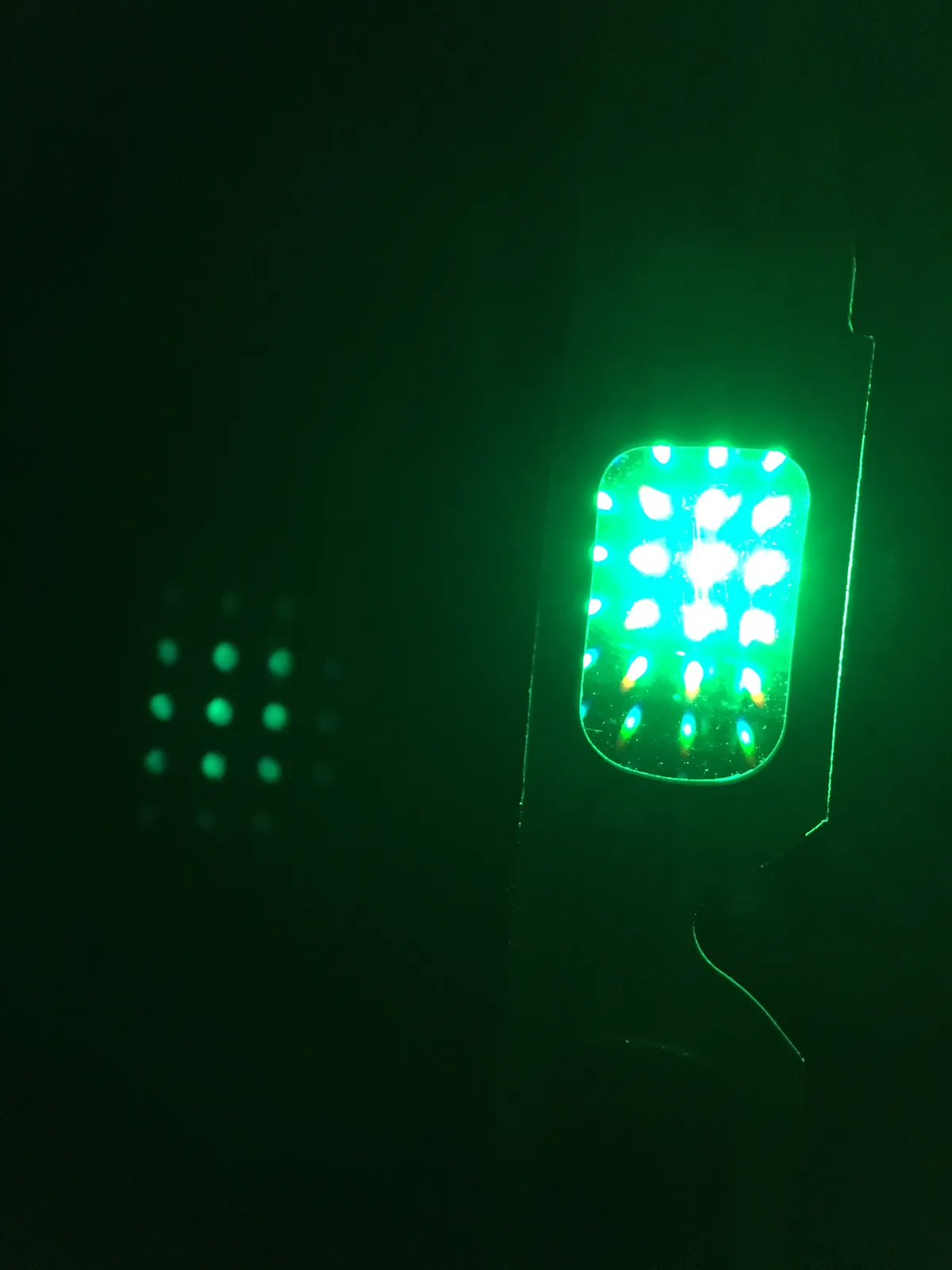
A diffraction grating is a plate or film with a large number of evenly spaced narrow slits or lines. The distance between adjacent slits is the grating spacing $d$. School gratings usually have $100$, $300$ or $600$ lines per millimetre. The bright maxima of a grating form in the same directions as the bright fringes of a double slit with the same slit spacing, that is in directions where the path difference of adjacent slits is a whole number of wavelengths. Then the wave from every slit arrives in the same phase. Even a little to the side, the waves from different slits are in different phases and cancel each other almost completely. That is why the maxima of a grating are narrow and bright, and almost dark between them. The light of a laser draws sharp dots on the screen, and the positions of the dots can be measured accurately.
White light in a grating
The longer the wavelength, the larger the path difference and therefore the larger the angle of deviation required by a maximum. All the colours of white light go in the same direction into the central maximum, so the central maximum is white. On both sides of it the light is spread into a spectrum: violet is deviated least and red most. In a prism the order is the opposite, because the refractive index is largest for violet light (chapter Dispersion: the prism and the rainbow). Farther from the central maximum the spectra of different orders partly overlap. In spectrometers the wavelengths of light are measured with a grating.
A CD as a reflection grating
The data track of a CD winds over the surface of the disc as a dense spiral, and the distance between adjacent turns of the track is $1.6\,\mu\text{m}$ (standard IEC 60908, 1999). On a DVD the distance is $0.74\,\mu\text{m}$ (standard ECMA-267, 2001). Light reflected from the surface of the disc behaves in the same way as light passing through a grating: the waves reflected from the evenly spaced tracks interfere, and each wavelength is reinforced in its own direction. That is why rainbow colours are seen on the surface of the disc, changing with the viewing angle. Such a grating is called a reflection grating.
Grating equation
When light arrives perpendicular to the grating, the path difference of rays leaving adjacent slits at angle $\theta$ comes from the right-angled triangle in the figure: $\Delta s = d\sin\theta$. The angle $\theta$ is measured from the direction of the incident light, that is from the direction of the central maximum. A maximum forms when the path difference is a whole number of wavelengths:
$$d \sin\theta = k\lambda$$
where $d$ is the grating spacing ($\text{m}$), $\theta$ the direction of the maximum relative to the direction of the incident light, $k = 0, 1, 2, \ldots$ the order of the maximum and $\lambda$ the wavelength of the light ($\text{m}$). The order $k = 0$ is the central maximum. On both sides of it there are similar maxima, so the orders on the other side are often written as negative.
Grating spacing from the line density
The manufacturer of a grating usually states how many lines the grating has per millimetre. If there are $N$ lines per millimetre, the distance between adjacent lines is
$$d = \frac{1\,\text{mm}}{N}$$
For example, when there are $300$ lines per millimetre, $d = 1\,\text{mm} : 300 = 1 \cdot 10^{-3}\,\text{m} : 300 = 3.33 \cdot 10^{-6}\,\text{m}$, that is $3.33\,\mu\text{m}$. The denser the grating, the smaller $d$ is and the larger the angle at which the maximum of the same order lies.
How many maxima form
The value of a sine is at most $1$, so the order must satisfy the condition $k\lambda < d$. At the limit $k\lambda = d$ the light would travel along the surface of the grating and would not hit the screen. For example, when the grating has $600$ lines per millimetre and the wavelength of the light is $650\,\text{nm}$, $d : \lambda = 1.667\,\mu\text{m} : 0.650\,\mu\text{m} = 2.56$. Maxima form in the orders $k = 0, \pm 1, \pm 2$, that is five of them.
The angle from the screen
The angle is usually not measured directly; instead, distances are measured on the screen. When the screen is perpendicular to the beam of the laser at distance $L$ from the grating and a maximum is at distance $x$ from the central maximum, the right-angled triangle in the figure gives
$$\tan\theta = \frac{x}{L}$$
The sine and the tangent are nearly equal only at small angles, so the angle is first calculated from the tangent and only then the sine of the angle. For example, when the grating has $600$ lines per millimetre and the wavelength of a green laser is $532\,\text{nm}$, $\theta_1 = 18.6^\circ$, and on a screen one metre away $x_1 = 33.7\,\text{cm}$.
Measuring the wavelength of a laser
A grating can be used to measure the wavelength of a laser in a school laboratory. The laser, the grating and the screen are set in a line so that the beam hits both the grating and the screen perpendicularly. With a tape measure, the distance $L$ from the grating to the screen and the separation of two symmetric maxima $+k$ and $-k$ are measured; half of the separation is $x$. Measuring the separation of two dots is more accurate than estimating the position of the central maximum. Never look into the beam of a laser pointer, and never aim it at anyone's eyes.
The largest uncertainty usually comes from deciding where the centre of a dot is. If $x$ can be measured with an uncertainty of, for example, $\Delta x = 0.2\,\text{cm}$, a maximum farther away gives a smaller relative uncertainty, because its $x$ is larger. The result is compared with the value stated by the manufacturer: the wavelength of a red laser pointer is usually about $650\,\text{nm}$ and that of a green one $532\,\text{nm}$.
Common misconception
Many assume that a grating bends blue and violet light the most, like a prism. In a grating it is the opposite: the direction of a maximum is decided by the condition $d\sin\theta = k\lambda$, so the longest wavelength, that is red light, is deviated most. In a prism violet is refracted most, because the refractive index of glass is largest for violet light. Another mistake is to think that a narrower slit makes the beam of light narrower. When the slit is of the order of the wavelength, diffraction spreads the light the more, the narrower the slit is.
Summary
- Light is a wave motion: the light of coherent sources interferes, and bright and dark places form on the screen.
- In diffraction light spreads out behind a narrow slit. The narrower the slit, the wider the light spreads.
- The maxima of a grating are in the directions for which $d\sin\theta = k\lambda$, and the grating spacing is $d = 1\,\text{mm} : N$.
- From distances measured on the screen, $\tan\theta = x : L$. This is how a grating is used to measure the wavelength of a laser.
- White light is spread by a grating into a spectrum in which red light is deviated most. A CD is a reflection grating.
Optional Return to your predictions
Compare your predictions with the theory and the values of the model in the experiments. Then return to the question at the start: why did the laser beam that passed through a transparent film draw a row of dots on the wall, and what decided the spacing of the dots?
Would you change your prediction?
Apply
Worked example
Problem
The beam of a red laser pointer hits perpendicularly a grating that has $300$ lines per millimetre. On a screen $2.00\,\text{m}$ from the grating, the first-order maxima $k = 1$ and $k = -1$ are $79.2\,\text{cm}$ apart. What is the wavelength of the laser light?
Step 1/7
Given and asked. Line density $N = 300$ lines per millimetre, distance of the screen $L = 2.00\,\text{m}$ and separation of the maxima $\pm 1$ $79.2\,\text{cm}$, so the first maximum is at distance $x = 39.6\,\text{cm}$ from the central maximum. The order is $k = 1$. The wavelength $\lambda$ is asked.
Step 2/7
Principle. The directions of the maxima obey the grating equation $d\sin\theta = k\lambda$, because the beam arrives perpendicular to the grating. The screen is perpendicular to the beam, so the angle comes from the right-angled triangle whose legs are $x$ and $L$. The grating spacing comes from the line density.
Step 3/7
Formula solved.
$$\begin{aligned} \tan\theta &= \frac{x}{L} \\[6pt] d\sin\theta &= k\lambda \\[6pt] \lambda &= \frac{d\sin\theta}{k} \end{aligned}$$
Step 4/7
Unit conversions. The grating spacing is
and the distance of the maximum is
Step 5/7
Substitution. $$\begin{aligned} \tan\theta &= \frac{x}{L} \\ &= \frac{0.396\,\text{m}}{2.00\,\text{m}} = 0.198 \\ \theta &= 11.20^\circ \\[6pt] \lambda &= \frac{d\sin\theta}{k} \\ &= \frac{3.333 \cdot 10^{-6}\,\text{m} \cdot \sin 11.20^\circ}{1} \\ &= 6.474 \cdot 10^{-7}\,\text{m} \end{aligned}$$
Step 6/7
Result. The wavelength is
with three significant figures like the distances $2.00\,\text{m}$ and $79.2\,\text{cm}$.
Step 7/7
Reasonableness. The wavelength of red light is about $620$–$750\,\text{nm}$, and the stated wavelength of a red laser pointer is usually about $650\,\text{nm}$, so the result is credible. The angle is small, so $\sin\theta$ is almost the same as $\tan\theta = 0.198$. A value calculated with the tangent, $660\,\text{nm}$, would be a little too large, as it should be, since the tangent is always larger than the sine.
Optional Find the error
Apply to a new situation: a DVD as a reflection grating
The distance between adjacent turns of the data track of a DVD is $0.74\,\mu\text{m}$ (standard ECMA-267, 2001). The beam of a red laser with a wavelength of $650\,\text{nm}$ hits the surface of the disc perpendicularly. Assume that the disc acts as a reflection grating whose grating spacing is the distance between the tracks.
At what angle to the incident beam is the first-order maximum reflected?
Hint 1: a guiding question
In a reflection grating the directions of the maxima obey the same grating equation as in a transmission grating. What is the grating spacing?
Hint 2: what is the connection
The grating spacing is $d = 0.74\,\mu\text{m}$, and in the first order $\sin\theta = \lambda : d$.
Hint 3: an intermediate step
Take the inverse sine of the result.
Show the solution
Given
distance between tracks $d = 0.74\,\mu\text{m}$ (ECMA-267, 2001), wavelength $\lambda = 650\,\text{nm}$, order $k = 1$, light perpendicular to the disc
Find
the angle $\theta$ of the first-order maximum to the incident beam, in degrees
Principle
Waves reflected from evenly spaced tracks interfere in the same way as waves from the slits of a grating. When light arrives perpendicularly, the path difference of waves reflected at angle $\theta$ from adjacent tracks is $d\sin\theta$, and a maximum forms when it is a whole number of wavelengths.
Formula
$d\sin\theta = k\lambda$, so $\theta = \sin^{-1}\dfrac{k\lambda}{d}$
Conversions
$650\,\text{nm} = 650 \cdot 10^{-9}\,\text{m}$ and $0.74\,\mu\text{m} = 0.74 \cdot 10^{-6}\,\text{m}$.
Substitution
Answer
$61^\circ$
Two significant figures like the track spacing $0.74\,\mu\text{m}$.
Reasonableness
The wavelength is almost as large as the track spacing, so the angle must be large. For a CD ($1.6\,\mu\text{m}$) the same maximum would be at an angle of only $24^\circ$. A second order from a DVD does not form, because
Check your understanding
Exit ticket
Answer on your own first and only then open the answer.
- A grating has $250$ lines per millimetre. What is the grating spacing?
Answer
$d$$= 1\,\text{mm} : 250$$= 1 \cdot 10^{-3}\,\text{m} : 250$$= 4.0 \cdot 10^{-6}\,\text{m}$$= 4.0\,\mu\text{m}$ - Why do two ordinary lamps not produce on a wall a pattern of bright and dark fringes, although a laser and a double slit do?
Answer
The light of two lamps is not coherent: the countless atoms of the lamps emit light independently of each other, so the phase difference of the lights varies randomly and very rapidly. The places of constructive and destructive interference keep swapping, and the eye sees an even illumination. In a double slit both slits get their light from the same wavefront, so their phase difference stays the same.
1. Concept: a narrow slit
2. Calculate: sodium light in a grating
The wavelength of the yellow light of a sodium lamp is $589\,\text{nm}$. The light hits perpendicularly a grating that has $500$ lines per millimetre.
At what angle from the direction of the central maximum is the second-order maximum? Answer in degrees.
Hint 1: a guiding question
First calculate the grating spacing $d = 1\,\text{mm} : 500$ in metres.
Hint 2: what is the connection
From the grating equation $\sin\theta = k\lambda : d$, where $k = 2$.
Hint 3: an intermediate step
Take the inverse sine of the result.
Show the solution
Given
wavelength $\lambda = 589\,\text{nm}$, line density $N = 500$ lines per millimetre, order $k = 2$
Find
the angle $\theta$ of the second-order maximum from the direction of the central maximum, in degrees
Principle
Light arrives perpendicular to the grating, so the maxima lie in directions where the path difference $d\sin\theta$ of adjacent slits is a whole number of wavelengths. In the second-order maximum the path difference is two wavelengths.
Formula
$d = \dfrac{1\,\text{mm}}{N}$ and $d\sin\theta = k\lambda$, so $\theta = \sin^{-1}\dfrac{k\lambda}{d}$
Conversions
$589\,\text{nm} = 589 \cdot 10^{-9}\,\text{m}$.
Substitution
Answer
$36.1^\circ$
Three significant figures like the wavelength $589\,\text{nm}$.
Reasonableness
The first-order maximum is at an angle of $17.13^\circ$. The angle of the second order is larger but not double, because it is the sine of the angle that doubles, not the angle. Check:
Suggestion: one answer does not show everything you can do, but review the theory summary and do the core exercises.
Optional 3. Explain: the colours of a CD
Explain why rainbow colours are seen on the surface of a CD in white light and why the colours change when the disc is tilted.
Model answer
The data track of a CD winds on the surface as an evenly spaced spiral, and the distance between adjacent turns is $1.6\,\mu\text{m}$. The disc acts as a reflection grating: waves reflected from the evenly spaced tracks interfere, and a wave is reinforced in the direction in which the path difference of waves reflected from adjacent tracks is a whole number of wavelengths. White light contains all the wavelengths of visible light, and each is reinforced in its own direction: a longer wavelength, that is red, at a larger angle than blue. So different colours reach the eye from different places and different angles. When the disc is tilted, the direction of the eye relative to the disc changes, and the maximum of another wavelength reaches the eye.
Assess your own answer
Tick the points your own answer already contains.
Review the theory summary and practise with the exercises.
Review the chapter's concepts
Cards you mark Review later collect in your review deck.
- Diffraction grating
- An optical component whose slits diffract light and split it into a spectrum.
Exercises
Level 1 · basic practice 5 exercises
One formula or one step of reasoning. Core exercises first, the rest is extra practice.
- Exercise 13-1Core
A grating has $300$ lines per millimetre. What is the grating spacing? Give the answer in micrometres.
Answer
$3.33\,\mu\text{m}$
Show the solution
Given
line density $N = 300$ lines per millimetre
Find
the grating spacing $d$ in micrometres
Principle
The grating spacing is the distance between adjacent lines. When $N$ evenly spaced lines fit into a millimetre, the spacing of the lines is a millimetre divided by the number of lines.
Formula
$d = \dfrac{1\,\text{mm}}{N}$
Conversions
$1\,\text{mm} = 1 \cdot 10^{-3}\,\text{m}$ and finally $1\,\mu\text{m} = 1 \cdot 10^{-6}\,\text{m}$.
Substitution
$d$$= \dfrac{1 \cdot 10^{-3}\,\text{m}}{300}$$= 3.333 \cdot 10^{-6}\,\text{m}$$= 3.333\,\mu\text{m}$Answer
$3.33\,\mu\text{m}$
Three significant figures like the line density $300$.
Reasonableness
The grating spacing is a few wavelengths of visible light ($3.33\,\mu\text{m} = 3330\,\text{nm}$), so diffraction and interference are clearly visible. Check:
$300 \cdot 3.333\,\mu\text{m}$$= 1000\,\mu\text{m}$$= 1\,\text{mm}$ - Exercise 13-2Core
Light from a red laser, with a wavelength of $650\,\text{nm}$, hits perpendicularly a grating whose grating spacing is $2.00\,\mu\text{m}$.
At what angle from the direction of the central maximum is the first-order maximum?
Answer
$19.0^\circ$
Show the solution
Given
wavelength $\lambda = 650\,\text{nm}$, grating spacing $d = 2.00\,\mu\text{m}$, order $k = 1$
Find
the angle $\theta$ of the first-order maximum in degrees
Principle
Light arrives perpendicular to the grating, so the directions of the maxima obey the grating equation: a maximum forms in the direction where the path difference $d\sin\theta$ of adjacent slits is a whole number of wavelengths.
Formula
$d\sin\theta = k\lambda$, so $\theta = \sin^{-1}\dfrac{k\lambda}{d}$
Conversions
$650\,\text{nm} = 650 \cdot 10^{-9}\,\text{m}$ and $2.00\,\mu\text{m} = 2.00 \cdot 10^{-6}\,\text{m}$.
Substitution
$\theta$$= \sin^{-1}\dfrac{1 \cdot 650 \cdot 10^{-9}\,\text{m}}{2.00 \cdot 10^{-6}\,\text{m}}$$= \sin^{-1} 0.325$$= 18.97^\circ$Answer
$19.0^\circ$
Three significant figures like the grating spacing $2.00\,\mu\text{m}$.
Reasonableness
The wavelength is about a third of the grating spacing, so $\sin\theta$ is about $0.33$ and the angle about $19^\circ$, clearly less than $90^\circ$. Check: $2.00\,\mu\text{m} \cdot \sin 18.97^\circ = 0.650\,\mu\text{m}$.
- Exercise 13-3
Light hits perpendicularly a grating whose grating spacing is $2.50\,\mu\text{m}$. The second-order maximum is at an angle of $30.0^\circ$ from the direction of the central maximum.
What is the wavelength of the light? Give the answer in nanometres.
Answer
$625\,\text{nm}$
Show the solution
Given
grating spacing $d = 2.50\,\mu\text{m}$, order $k = 2$, angle of the maximum $\theta = 30.0^\circ$
Find
the wavelength $\lambda$ of the light in nanometres
Principle
Light arrives perpendicular to the grating, so the direction of the maximum obeys the grating equation. In the second-order maximum the path difference of adjacent slits is two wavelengths.
Formula
$d\sin\theta = k\lambda$, so $\lambda = \dfrac{d\sin\theta}{k}$
Conversions
$2.50\,\mu\text{m} = 2.50 \cdot 10^{-6}\,\text{m}$ and finally $1\,\text{nm} = 1 \cdot 10^{-9}\,\text{m}$.
Substitution
$\lambda$$= \dfrac{2.50 \cdot 10^{-6}\,\text{m} \cdot \sin 30.0^\circ}{2}$$= \dfrac{2.50 \cdot 10^{-6}\,\text{m} \cdot 0.500}{2}$$= 6.25 \cdot 10^{-7}\,\text{m}$$= 625\,\text{nm}$Answer
$625\,\text{nm}$
Three significant figures like the grating spacing and the angle.
Reasonableness
The wavelength is in the range of visible light, $400$–$700\,\text{nm}$; $625\,\text{nm}$ is orange-red light. If the order had been forgotten, the result $1250\,\text{nm}$ would be infrared, so dividing by two is necessary. Check:
$2 \cdot 625\,\text{nm}$$= 1250\,\text{nm}$$= 2500\,\text{nm} \cdot 0.500$ - Exercise 13-4
A screen is $1.20\,\text{m}$ from a grating, perpendicular to the beam of a laser. The first-order maximum is $30.0\,\text{cm}$ from the central maximum on the screen.
At what angle from the direction of the central maximum is the maximum?
Answer
$14.0^\circ$
Show the solution
Given
distance from the grating to the screen $L = 1.20\,\text{m}$, distance of the first maximum from the central maximum $x = 30.0\,\text{cm}$
Find
the angle $\theta$ of the maximum from the direction of the central maximum in degrees
Principle
The screen is perpendicular to the laser beam, so the grating, the central maximum and the maximum form a right-angled triangle whose legs are $L$ and $x$. The tangent of the angle is the ratio of the opposite leg to the adjacent leg.
Formula
$\tan\theta = \dfrac{x}{L}$, so $\theta = \tan^{-1}\dfrac{x}{L}$
Conversions
$x$$= 30.0\,\text{cm}$$= 30.0 \cdot 0.01\,\text{m}$$= 0.300\,\text{m}$Substitution
$\theta$$= \tan^{-1}\dfrac{0.300\,\text{m}}{1.20\,\text{m}}$$= \tan^{-1} 0.250$$= 14.04^\circ$Answer
$14.0^\circ$
Three significant figures like the distances $1.20\,\text{m}$ and $30.0\,\text{cm}$.
Reasonableness
The maximum is a quarter of the distance of the screen to the side, so the angle must be clearly less than $45^\circ$, at which $x$ would equal $L$. Check: $1.20\,\text{m} \cdot \tan 14.04^\circ = 0.300\,\text{m}$.
- Exercise 13-5
The wavelength of the light of a helium-neon laser is $633\,\text{nm}$. When the light hits a grating perpendicularly, the first-order maximum is at an angle of $22.0^\circ$ from the direction of the central maximum.
What is the grating spacing? Give the answer in micrometres.
Answer
$1.69\,\mu\text{m}$
Show the solution
Given
wavelength $\lambda = 633\,\text{nm}$, order $k = 1$, angle of the maximum $\theta = 22.0^\circ$
Find
the grating spacing $d$ in micrometres
Principle
Light arrives perpendicular to the grating, so the direction of the maximum obeys the grating equation. In the first-order maximum the path difference of adjacent slits is one wavelength.
Formula
$d\sin\theta = k\lambda$, so $d = \dfrac{k\lambda}{\sin\theta}$
Conversions
$633\,\text{nm} = 633 \cdot 10^{-9}\,\text{m}$ and finally $1\,\mu\text{m} = 1 \cdot 10^{-6}\,\text{m}$.
Substitution
$d$$= \dfrac{1 \cdot 633 \cdot 10^{-9}\,\text{m}}{\sin 22.0^\circ}$$= \dfrac{633 \cdot 10^{-9}\,\text{m}}{0.3746}$$= 1.690 \cdot 10^{-6}\,\text{m}$$= 1.690\,\mu\text{m}$Answer
$1.69\,\mu\text{m}$
Three significant figures like the wavelength and the angle.
Reasonableness
The grating spacing must be larger than the wavelength for a first maximum to form, and $1.69\,\mu\text{m}$ is about $2.7$ times $0.633\,\mu\text{m}$. It corresponds to about $590$ lines per millimetre, which is a common school grating.
Level 2 · applied practice 4 exercises
Two steps, working with measured data, a unit conversion or rearranging a formula. Core exercises first, the rest is extra practice.
- Exercise 13-6Core
Light from a blue laser, with a wavelength of $450\,\text{nm}$, hits perpendicularly a grating with $600$ lines per millimetre. Behind the grating there is a screen so wide that all the maxima that form hit it.
How many dots of light are seen on the screen?
Answer
$7$
Show the solution
Given
wavelength $\lambda = 450\,\text{nm}$, line density $N = 600$ lines per millimetre
Find
the number of dots of light that form on the screen
Principle
Each maximum is one dot of light. According to the grating equation $\sin\theta = k\lambda : d$, and since the sine is at most $1$, a maximum forms only for orders for which $k\lambda < d$. On each side of the central maximum there are equally many maxima.
Formula
$d = \dfrac{1\,\text{mm}}{N}$ and $k < \dfrac{d}{\lambda}$; the number of dots is $2k_\text{max} + 1$, where $k_\text{max}$ is the largest whole number that satisfies the condition.
Conversions
$d$$= 1 \cdot 10^{-3}\,\text{m} : 600$$= 1.667 \cdot 10^{-6}\,\text{m}$$450\,\text{nm} = 450 \cdot 10^{-9}\,\text{m}$.
Substitution
$\dfrac{d}{\lambda}$$= \dfrac{1.667 \cdot 10^{-6}\,\text{m}}{450 \cdot 10^{-9}\,\text{m}}$$= 3.70$so $k_\text{max} = 3$ and the number of dots is $2 \cdot 3 + 1 = 7$.
Answer
$7$
Dots of light: the central maximum and the orders $\pm 1$, $\pm 2$ and $\pm 3$. The answer is a whole number, so no rounding is needed.
Reasonableness
In the third-order maximum
$\sin\theta$$= 3 \cdot 0.450 : 1.667$$= 0.81$that is $\theta = 54^\circ$, which is possible. In the fourth $\sin\theta = 1.08$, which is impossible, so a fourth-order maximum does not form.
- Exercise 13-7Core
Light from a red laser, with a wavelength of $650\,\text{nm}$, hits perpendicularly a grating with $100$ lines per millimetre. The screen is $2.50\,\text{m}$ from the grating, perpendicular to the beam.
How far from the central maximum is the first-order maximum on the screen? Give the answer in centimetres.
Answer
$16.3\,\text{cm}$
Show the solution
Given
wavelength $\lambda = 650\,\text{nm}$, line density $N = 100$ lines per millimetre, distance of the screen $L = 2.50\,\text{m}$, order $k = 1$
Find
the distance $x$ of the first maximum from the central maximum in centimetres
Principle
Light arrives perpendicular to the grating, so the angle of the maximum comes from the grating equation. The screen is perpendicular to the beam, so the position of the maximum comes from the right-angled triangle whose legs are $L$ and $x$.
Formula
$d = \dfrac{1\,\text{mm}}{N}$, $d\sin\theta = k\lambda$ and $\tan\theta = \dfrac{x}{L}$, so $\theta = \sin^{-1}\dfrac{k\lambda}{d}$ and $x = L\tan\theta$
Conversions
$d$$= 1 \cdot 10^{-3}\,\text{m} : 100$$= 1.00 \cdot 10^{-5}\,\text{m}$$650\,\text{nm} = 650 \cdot 10^{-9}\,\text{m}$ and finally $1\,\text{m} = 100\,\text{cm}$.
Substitution
$\theta$$= \sin^{-1}\dfrac{650 \cdot 10^{-9}\,\text{m}}{1.00 \cdot 10^{-5}\,\text{m}}$$= \sin^{-1} 0.0650$$= 3.727^\circ$$x$$= 2.50\,\text{m} \cdot \tan 3.727^\circ$$= 2.50\,\text{m} \cdot 0.06514$$= 0.1628\,\text{m}$$= 16.28\,\text{cm}$Answer
$16.3\,\text{cm}$
Three significant figures like the distance $2.50\,\text{m}$.
Reasonableness
The angle for a sparse grating is small, so
$\tan\theta$$\approx \sin\theta$$= 0.065$$x$$\approx 2.50\,\text{m} \cdot 0.065$$= 16\,\text{cm}$The spacing of the dots is easy to measure with a tape measure.
- Exercise 13-8
The beam of a green laser, with a wavelength of $532\,\text{nm}$, hits perpendicularly a grating whose line density is not known. On a screen $1.00\,\text{m}$ from the grating the first-order maxima $k = 1$ and $k = -1$ are $66.8\,\text{cm}$ apart.
How many lines per millimetre does the grating have?
Answer
$596$
Show the solution
Given
wavelength $\lambda = 532\,\text{nm}$, distance of the screen $L = 1.00\,\text{m}$, separation of the maxima $\pm 1$ $66.8\,\text{cm}$, order $k = 1$
Find
the line density $N$ of the grating, that is the number of lines per millimetre
Principle
The maxima are symmetric on both sides of the central maximum, so the first maximum is half of the separation of the dots from the central maximum. The angle comes from the right-angled triangle, the grating spacing from the grating equation and the line density from the grating spacing.
Formula
$\tan\theta = \dfrac{x}{L}$, $d\sin\theta = k\lambda$ and $d = \dfrac{1\,\text{mm}}{N}$, so $d = \dfrac{k\lambda}{\sin\theta}$ and $N = \dfrac{1\,\text{mm}}{d}$
Conversions
$x$$= 66.8\,\text{cm} : 2$$= 33.4\,\text{cm}$$= 33.4 \cdot 0.01\,\text{m}$$= 0.334\,\text{m}$$532\,\text{nm} = 532 \cdot 10^{-9}\,\text{m}$ and $1\,\text{mm} = 1 \cdot 10^{-3}\,\text{m}$.
Substitution
$\theta$$= \tan^{-1}\dfrac{0.334\,\text{m}}{1.00\,\text{m}}$$= 18.47^\circ$$d$$= \dfrac{532 \cdot 10^{-9}\,\text{m}}{\sin 18.47^\circ}$$= \dfrac{532 \cdot 10^{-9}\,\text{m}}{0.3168}$$= 1.679 \cdot 10^{-6}\,\text{m}$$N$$= \dfrac{1 \cdot 10^{-3}\,\text{m}}{1.679 \cdot 10^{-6}\,\text{m}}$$= 595.5$Answer
about $596$ lines per millimetre, three significant figures like the distances. The grating is probably the manufacturer's $600$-line-per-millimetre grating, and the difference is due to measurement uncertainty.
Reasonableness
With $600$ lines per millimetre the first maximum of green light is at an angle of $18.6^\circ$, which is close to the obtained $18.5^\circ$. Check: $1.679\,\mu\text{m} \cdot 0.3168 = 0.532\,\mu\text{m}$.
- Exercise 13-9
White light containing all wavelengths between $400$ and $700\,\text{nm}$ hits perpendicularly a grating with $300$ lines per millimetre. The screen is $1.00\,\text{m}$ from the grating, perpendicular to the light.
How wide is the first-order spectrum on the screen, that is how far apart are its violet and red edges? Give the answer in centimetres.
Answer
$9.39\,\text{cm}$
Show the solution
Given
wavelengths $\lambda_\text{v} = 400\,\text{nm}$ (violet edge) and $\lambda_\text{r} = 700\,\text{nm}$ (red edge), line density $N = 300$ lines per millimetre, distance of the screen $L = 1.00\,\text{m}$, order $k = 1$
Find
the width $\Delta x$ of the first-order spectrum on the screen in centimetres
Principle
Each wavelength is deviated to its own angle according to the grating equation, so the spectrum begins at the maximum of violet light and ends at the maximum of red light. Each position comes from a right-angled triangle, and the width is their difference.
Formula
$d = \dfrac{1\,\text{mm}}{N}$, $\theta = \sin^{-1}\dfrac{k\lambda}{d}$, $x = L\tan\theta$ and $\Delta x = x_\text{r} - x_\text{v}$
Conversions
$d$$= 1 \cdot 10^{-3}\,\text{m} : 300$$= 3.333 \cdot 10^{-6}\,\text{m}$wavelengths $400 \cdot 10^{-9}\,\text{m}$ and $700 \cdot 10^{-9}\,\text{m}$, finally $1\,\text{m} = 100\,\text{cm}$.
Substitution
$\theta_\text{v}$$= \sin^{-1}\dfrac{400 \cdot 10^{-9}\,\text{m}}{3.333 \cdot 10^{-6}\,\text{m}}$$= \sin^{-1} 0.120$$= 6.892^\circ$$\theta_\text{r}$$= \sin^{-1} 0.210$$= 12.12^\circ$$x_\text{v}$$= 1.00\,\text{m} \cdot \tan 6.892^\circ$$= 0.1209\,\text{m}$$x_\text{r}$$= 1.00\,\text{m} \cdot \tan 12.12^\circ$$= 0.2148\,\text{m}$$\Delta x$$= 0.2148\,\text{m} - 0.1209\,\text{m}$$= 0.0939\,\text{m}$$= 9.39\,\text{cm}$Answer
$9.39\,\text{cm}$
Three significant figures like the distance $1.00\,\text{m}$ and the wavelengths.
Reasonableness
At small angles $x$ is approximately proportional to the wavelength, so the width must be a little over $(700 - 400) : 700$, that is $43\,\%$, of the distance $21.5\,\text{cm}$ of the red maximum: $9.39\,\text{cm}$ is $44\,\%$, as it should be.
Level 3 · challenging 3 exercises
Optional: application, two ideas together or a new situation where you reason for yourself.
- Exercise 13-10
White light containing all wavelengths between $400$ and $700\,\text{nm}$ hits a grating perpendicularly. In the same direction as the red edge ($700\,\text{nm}$) of the second-order spectrum lies a third-order maximum of another wavelength.
What is this wavelength? What does the result tell about the second- and third-order spectra? Give the answer in nanometres.
Answer
$467\,\text{nm}$
Show the solution
Given
wavelength of the second order ($k = 2$) $\lambda_2 = 700\,\text{nm}$, third order $k = 3$, wavelengths of white light $400$–$700\,\text{nm}$
Find
the wavelength $\lambda_3$ whose third-order maximum is in the same direction, and what this tells about the spectra
Principle
In the same direction $\theta$ the left-hand side $d\sin\theta$ of the grating equation is the same for both wavelengths, so the right-hand sides are equal too. The grating spacing is not needed, because it cancels: the result holds for every grating.
Formula
$d\sin\theta = 2\lambda_2$ and $d\sin\theta = 3\lambda_3$, so $3\lambda_3 = 2\lambda_2$ and $\lambda_3 = \dfrac{2\lambda_2}{3}$
Conversions
Not needed: the wavelengths stay in nanometres, because the unit cancels in the ratio $2 : 3$.
Substitution
$\lambda_3$$= \dfrac{2 \cdot 700\,\text{nm}}{3}$$= 466.7\,\text{nm}$Answer
$467\,\text{nm}$
Three significant figures like the wavelength $700\,\text{nm}$. Blue $467\,\text{nm}$ is present in white light, and the third-order spectrum begins from violet, $400\,\text{nm}$, at an even smaller angle. So the red end of the second-order spectrum and the violet and blue part of the third-order spectrum overlap.
Reasonableness
The first- and second-order spectra do not overlap, because the second-order violet, $2 \cdot 400\,\text{nm} = 800\,\text{nm}$, is more than the first-order red, $700\,\text{nm}$. Between the second and third orders $3 \cdot 400\,\text{nm} = 1200\,\text{nm}$ is less than $2 \cdot 700\,\text{nm} = 1400\,\text{nm}$, so overlap is to be expected.
- Exercise 13-11
A student studies a CD as a reflection grating. She makes a hole in a cardboard screen and directs the beam of a red laser, with a wavelength of $650\,\text{nm}$, through the hole perpendicularly onto the surface of the disc. The screen is parallel to the disc, $10.0\,\text{cm}$ from it.
The first-order maxima reflected from the disc are seen on the screen on both sides of the hole, $89\,\text{mm}$ apart.
What is the distance between adjacent tracks of the disc? Give the answer in micrometres.
Answer
$1.6\,\mu\text{m}$
Show the solution
Given
wavelength $\lambda = 650\,\text{nm}$, distance of the screen from the disc $L = 10.0\,\text{cm}$, separation of the maxima $\pm 1$ $89\,\text{mm}$, order $k = 1$
Find
the track spacing $d$ in micrometres
Principle
The evenly spaced tracks of a CD act as a reflection grating: for light arriving perpendicularly the reflected maxima obey the same grating equation as in a transmission grating, and $d$ is the track spacing. The screen is parallel to the disc, that is perpendicular to the incident beam, so the angle comes from a right-angled triangle. The maximum is half of the separation of the dots from the hole.
Formula
$\tan\theta = \dfrac{x}{L}$ and $d\sin\theta = k\lambda$, so $d = \dfrac{k\lambda}{\sin\theta}$
Conversions
$x$$= 89\,\text{mm} : 2$$= 44.5\,\text{mm}$$= 4.45\,\text{cm}$for the angle it is enough that $x$ and $L$ are in the same unit. $650\,\text{nm} = 0.650\,\mu\text{m}$.
Substitution
$\theta$$= \tan^{-1}\dfrac{4.45\,\text{cm}}{10.0\,\text{cm}}$$= \tan^{-1} 0.445$$= 23.99^\circ$$d$$= \dfrac{1 \cdot 0.650\,\mu\text{m}}{\sin 23.99^\circ}$$= \dfrac{0.650\,\mu\text{m}}{0.4066}$$= 1.599\,\mu\text{m}$Answer
$1.6\,\mu\text{m}$
Two significant figures like the separation of the dots $89\,\text{mm}$.
Reasonableness
The track spacing given in the CD standard is $1.6\,\mu\text{m}$, so the measurement hits the mark. The track spacing is about $2.5$ times the wavelength, so there are only two orders on each side, and the first-order angle of $24^\circ$ is reasonable.
- Exercise 13-12
The line density of a grating is not known. When the beam of a red laser, with a wavelength of $650\,\text{nm}$, hits the grating perpendicularly, the first-order maximum on a screen $1.00\,\text{m}$ away is $19.9\,\text{cm}$ from the central maximum.
In the same set-up the first-order maximum of a green laser is $16.2\,\text{cm}$ from the central maximum.
What is the wavelength of the light of the green laser? Give the answer in nanometres.
Answer
$533\,\text{nm}$
Show the solution
Given
wavelength of the red laser $\lambda_\text{r} = 650\,\text{nm}$, distance of the screen $L = 1.00\,\text{m}$, distance of the first maximum of red $x_\text{r} = 19.9\,\text{cm}$ and of green $x_\text{g} = 16.2\,\text{cm}$, order $k = 1$
Find
the wavelength $\lambda_\text{g}$ of the green laser in nanometres
Principle
The grating is the same for both lasers, so the measurement of the red laser, whose wavelength is known, first gives the grating spacing; that is, the grating is calibrated. After that the wavelength of green light comes from the same grating equation. The angles come from right-angled triangles, because the screen is perpendicular to the beam.
Formula
$\tan\theta = \dfrac{x}{L}$ and $d\sin\theta = k\lambda$, so
$d$$= \dfrac{\lambda_\text{r}}{\sin\theta_\text{r}}$$\lambda_\text{g} = d\sin\theta_\text{g}$
Conversions
$x_\text{r}$$= 19.9 \cdot 0.01\,\text{m}$$= 0.199\,\text{m}$$x_\text{g} = 0.162\,\text{m}$ and $650\,\text{nm} = 650 \cdot 10^{-9}\,\text{m}$.
Substitution
$\theta_\text{r}$$= \tan^{-1}\dfrac{0.199\,\text{m}}{1.00\,\text{m}}$$= 11.25^\circ$$d$$= \dfrac{650 \cdot 10^{-9}\,\text{m}}{\sin 11.25^\circ}$$= \dfrac{650 \cdot 10^{-9}\,\text{m}}{0.1952}$$= 3.330 \cdot 10^{-6}\,\text{m}$$\theta_\text{g}$$= \tan^{-1} 0.162$$= 9.202^\circ$$\lambda_\text{g}$$= 3.330 \cdot 10^{-6}\,\text{m} \cdot \sin 9.202^\circ$$= 3.330 \cdot 10^{-6}\,\text{m} \cdot 0.1599$$= 5.326 \cdot 10^{-7}\,\text{m}$$= 532.6\,\text{nm}$Answer
$533\,\text{nm}$
Three significant figures like the distances $19.9\,\text{cm}$ and $16.2\,\text{cm}$.
Reasonableness
The stated wavelength of a green laser pointer is $532\,\text{nm}$, and the green maximum is closer to the central maximum than the red one, because a shorter wavelength is deviated less. The grating spacing $3.33\,\mu\text{m}$ corresponds to $300$ lines per millimetre, which is a common school grating.
Photographs
- Laser Interference. Wisky. source, CC BY-SA 3.0
- Diffraction Pattern Green Laser. Laurie. source, CC BY 4.0

