
Total internal reflection and optical fibre
Why can light travel in a glass fibre along the bed of the Baltic Sea from Helsinki to Germany without escaping on the way, even though glass is transparent?
Prior knowledge
- Light refracts at a boundary according to the law of refraction $n_1 \sin\alpha_1 = n_2 \sin\alpha_2$, and the angles are measured from the normalchapter Reflection and refraction of light
- In a substance light travels at the speed $v = c : n$chapter Reflection and refraction of light
Core path: follow the steps in order. Tasks marked Optional give extra practice. Optional tasks: 4.
Think about it
On the bed of the Baltic Sea runs a submarine cable, C-Lion1, from Helsinki to Rostock in Germany, $1172\,\text{km}$ long (Cinia, 2016). Inside it, information travels as pulses of light in glass fibres as thin as a hair. Glass is transparent, and there is no mirror on the surface of the fibre. Even so, the light does not escape from the fibre, although the cable winds along the shapes of the seabed.
What keeps light inside a transparent glass fibre over hundreds of kilometres?
Optional Recall: refraction
Predict
Make your predictions before investigating 2 questions
Prediction 1: steeper light
Prediction 2: air or cladding
Investigate
A laser points from the air at the end of the core of an optical fibre. Change the angle of the laser and the substance around the core, and watch whether the light stays in the core.
Simulation
How to use
Adjust the angle $\theta$ of the laser to the axis of the fibre and the refractive index $n_2$ of the substance around the core. The value $n_2 = 1.00$ means air and $n_2 = 1.46$ ordinary cladding glass. On the left the dashed line is the normal to the end face, that is the axis of the fibre. At the first point where the ray meets the wall of the core, the dashed line is the normal to the wall and the arc shows the angle of incidence $\alpha$. If light leaks, the rays that refract out can be seen in the surrounding substance, and the ray that continues in the core grows dim. The readout shows the angle of incidence $\alpha$, the critical angle $\alpha_\text{r}$ and whether the light stays in the core.
Assumptions of the model
The refractive index of the core is $n_1 = 1.48$, and the laser is in air, whose refractive index is $1.00$. The end of the fibre is flat and perpendicular to the axis. The core and the surrounding substance extend to the edges of the picture, and the fibre has no bends. The picture is not to scale: the core of a real fibre is only a few tens of micrometres thick. Light reflected from the end face is not drawn. The dimming of the leaking ray is only an illustration, not a calculated value. The readings are values calculated by the model, not measurements.
How the calculation works
At the end face the light refracts according to the law of refraction:
$$1.00 \cdot \sin\theta = n_1 \sin\theta_1$$
In the core the ray travels at an angle $\theta_1$ to the axis, so it meets the wall of the core at an angle of incidence $\alpha = 90^\circ - \theta_1$ measured from the normal to the wall. The critical angle is calculated from the equation $\sin\alpha_\text{r} = n_2 : n_1$. If $\alpha > \alpha_\text{r}$, the light is totally internally reflected at every impact. Otherwise part of the light refracts out at an angle $\beta$, for which $n_1 \sin\alpha = n_2 \sin\beta$.
Experiment 1: the angle of the laser
Test prediction 1. Around the core there is cladding glass with a refractive index of $1.46$; change only the angle $\theta$ of the laser. Record at least the angles $0^\circ$, $10^\circ$, $14^\circ$ and $15^\circ$. On every row compare the angle of incidence $\alpha$ with the critical angle $\alpha_\text{r}$ and look at the picture to see whether light leaks.
Initial state: angle of the laser $\theta$ = $0^\circ$, surrounding refractive index = $1{.}46$. Kept constant: surrounding refractive index. Varied: angle of the laser $\theta$.
| angle of the laser $\theta$ | $\alpha$ $(^\circ)$ | $\alpha _r$ $(^\circ)$ |
|---|
What is the largest whole number of degrees $\theta$ for which the light still stays in the core when there is cladding glass around it ($n_2 = 1.46$)?
Hint 1: a guiding question
The light stays in the core when the angle of incidence $\alpha$ at the wall is larger than the critical angle $\alpha_\text{r}$. Find in the table the point where $\alpha$ drops below the critical angle.
Hint 2: what is the connection
Increase the angle one degree at a time and watch the readout: does the light stay in the core or does it leak?
Hint 3: an intermediate step
Compare the rows $14^\circ$ and $15^\circ$: on which row is $\alpha > \alpha_\text{r}$?
Show the solution
Given
refractive index of the core $n_1 = 1.48$, refractive index of the cladding $n_2 = 1.46$, laser in air; readings of the simulation: $\theta = 14^\circ$: $\alpha = 80.59^\circ$, $\theta = 15^\circ$: $\alpha = 79.93^\circ$, critical angle $\alpha_\text{r} = 80.57^\circ$
Find
the largest whole angle $\theta$ in degrees for which the light stays in the core
Principle
Light is totally internally reflected from the wall of the core when the angle of incidence at the wall is larger than the critical angle. A steeper laser angle $\theta$ gives a larger angle $\theta_1$ to the axis in the core and therefore a smaller angle of incidence at the wall, $\alpha = 90^\circ - \theta_1$. The limit is where $\alpha$ drops below the critical angle.
Formula
$\sin\theta = n_1 \sin\theta_1$, where $\theta_1 = 90^\circ - \alpha$; at the limit $\alpha = \alpha_\text{r}$, so $\theta = \sin^{-1}\big(n_1 \sin(90^\circ - \alpha_\text{r})\big)$
Conversions
Not needed: the refractive indices have no units, and the angles are in degrees.
Substitution
so
Answer
$14^\circ$
The calculated limit is $14.03^\circ$, so at the angle $14^\circ$ the light stays in the core and at the angle $15^\circ$ it leaks, as the readings of the simulation show.
Reasonableness
The refractive indices of the core and the cladding are almost equal, so the critical angle is close to $90^\circ$ and only rays almost parallel to the axis stay in the core. The small allowed angle $14^\circ$ fits this: against air the limit would be much larger.
Experiment 2: the surrounding substance
Test prediction 2. The angle of the laser is $30^\circ$; change only the refractive index $n_2$ of the surrounding substance. Record at least the values $1.00$ (air), $1.33$ (water) and $1.46$ (cladding glass), and if you like also $1.40$. How does the critical angle change, and when does light start to leak?
Initial state: angle of the laser $\theta$ = $30^\circ$, surrounding refractive index = $1{.}0$. Kept constant: angle of the laser $\theta$. Varied: surrounding refractive index.
| surrounding refractive index | $\alpha _r$ $(^\circ)$ | $\alpha$ $(^\circ)$ |
|---|
Conclusion: when light stays in the fibre
On the basis of your tables, write: under what condition does light stay in the core? How does the angle of the laser affect the angle of incidence at the wall, and how does the refractive index of the surrounding substance affect the critical angle?
Model answer
Light stays in the core when the ray's angle of incidence at the wall of the core is larger than the critical angle, $\alpha > \alpha_\text{r}$. In experiment 1, as the angle of the laser grew, the angle of incidence at the wall decreased: at the angle $14^\circ$, $\alpha = 80.59^\circ$ was still larger than the critical angle $80.57^\circ$, but at the angle $15^\circ$, $\alpha = 79.93^\circ$, and light leaked. In experiment 2 the critical angle grew as the refractive index of the surrounding substance grew: $42.51^\circ$ against air, $63.98^\circ$ against water and $80.57^\circ$ against cladding glass. When the angle of incidence was $70.25^\circ$, the light stayed in the core against air and water but leaked against cladding glass. The smaller the difference between the refractive indices, the larger the critical angle and the closer to the axis the light has to travel. The values are calculated by the model.
Assess your own answer
Tick the points your own answer already contains.
Review the theory summary and practise with the exercises.
Theory summary
Key idea
Light going into an optically less dense substance
In the chapter Reflection and refraction of light we saw that light refracts at the boundary between two substances according to the law of refraction $n_1 \sin\alpha_1 = n_2 \sin\alpha_2$, and that part of the light is reflected. When light goes from a substance with a larger refractive index into one with a smaller refractive index, for example from water into air, it refracts away from the normal: the angle of refraction is larger than the angle of incidence. A ray coming from water at an angle of incidence of $30^\circ$ continues in the air at an angle of $41.7^\circ$ to the normal. When the angle of incidence is increased, the angle of refraction grows even faster and approaches $90^\circ$. At the same time the share of the light that is reflected grows.
The critical angle and total internal reflection
The angle of incidence at which the angle of refraction is $90^\circ$ is called the critical angle $\alpha_\text{r}$. At the critical angle the refracted ray travels along the boundary. When the angle of incidence is larger than the critical angle, the law of refraction gives no angle of refraction, because the sine would have to be greater than one. No light then gets into the second substance at all, and all of the light is reflected back according to the law of reflection. This is total internal reflection. At the boundary between water and air the critical angle is $48.8^\circ$. That is why a diver looking at the water surface at a slant from below sees it as a mirror in which the bottom can be seen.
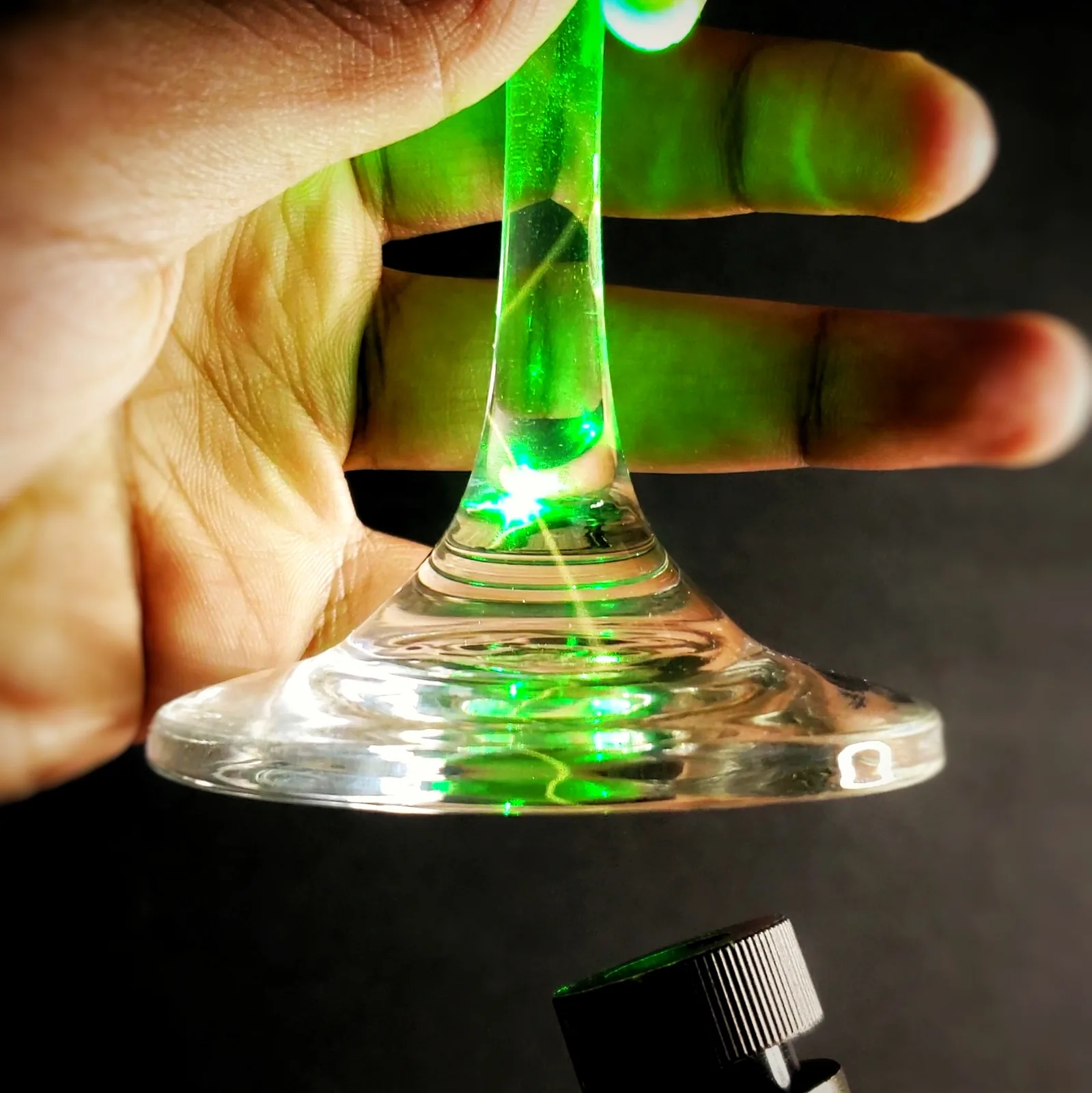
Only from a larger refractive index to a smaller one
Total internal reflection can happen only when light goes from a substance with a larger refractive index into one with a smaller refractive index. When light goes from air into water or glass, it refracts towards the normal, and a refracted ray exists at every angle of incidence. Then some of the light always gets into the second substance, even though the reflected share grows at large angles of incidence. In total internal reflection no light is lost: when the substance does not absorb light, the ray reflected from a smooth boundary carries away all the power of the incident ray. That is why total internal reflection is a better mirror than a metal surface, which absorbs some of the light.
Optical fibre
An optical fibre is a glass fibre as thin as a hair, with a core in the middle and a cladding around it. The refractive index of the core is slightly larger than that of the cladding, for example $1.48$ and $1.46$. Light that enters the end of the fibre almost parallel to its axis meets the boundary between the core and the cladding at a very shallow angle, that is at a large angle of incidence, which is larger than the critical angle. The light is totally internally reflected back into the core every time and travels along the fibre in a zigzag, even when the fibre bends gently. If light enters the end of the fibre at too steep an angle, it meets the boundary at an angle of incidence smaller than the critical angle, and at every impact part of it refracts into the cladding and is lost from the core. A sharp bend reduces the angle of incidence in the same way, so a fibre must not be folded into a tight bend.
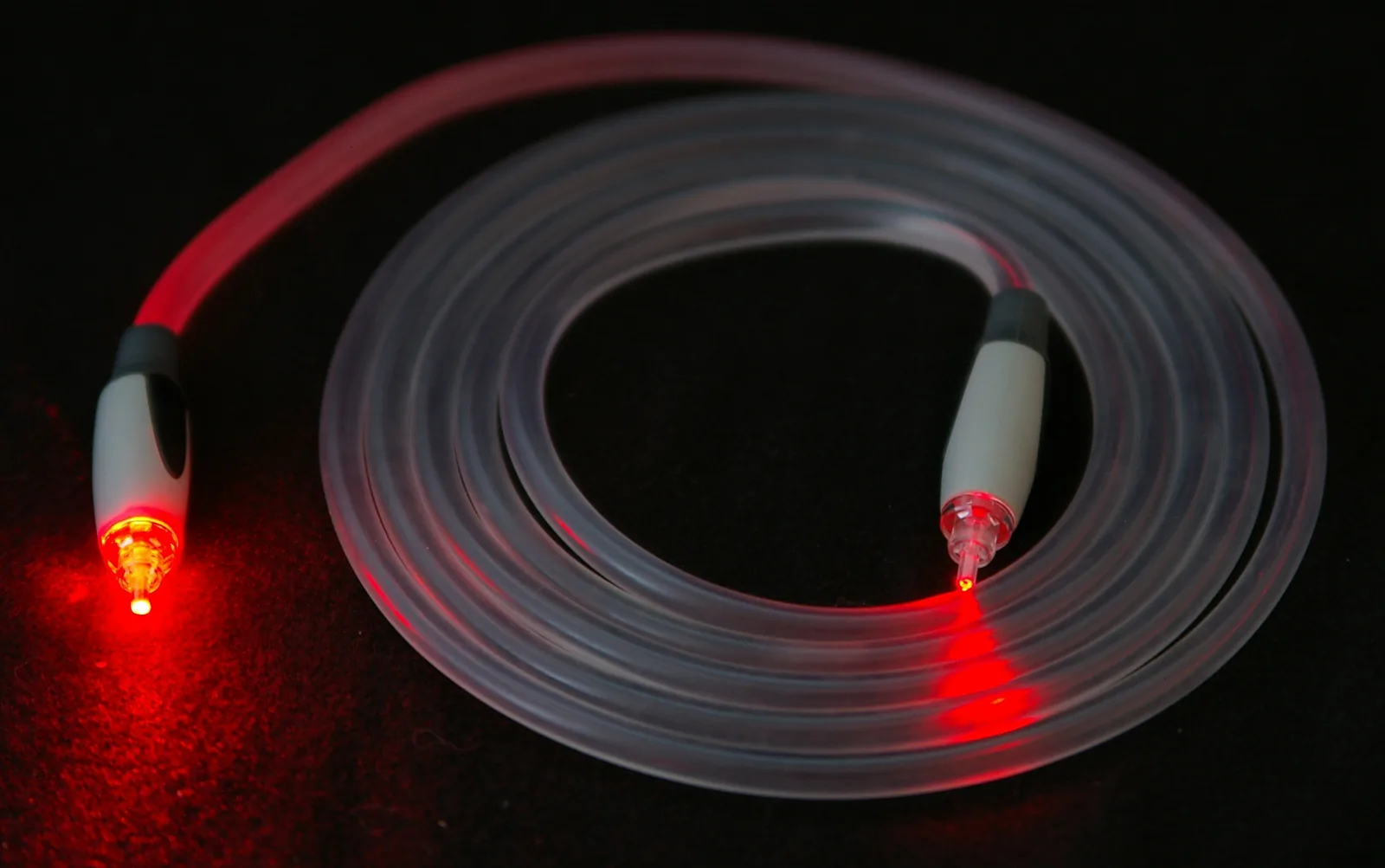
Why a fibre has a cladding
A bare glass rod keeps light inside even in air, and even light that arrives at a steeper angle, because the difference between the refractive indices of glass and air is large and the critical angle is therefore small. However, water, grease or another fibre that touches the surface of the glass changes the boundary, and light leaks out at the point of contact. The cladding keeps the reflecting boundary clean inside the fibre, and the plastic protective coating protects the glass from scratches. When the difference between the refractive indices of the core and the cladding is small, only rays almost parallel to the axis stay in the fibre. Their paths are almost equally long, so short light pulses spread out only a little on the way.
Information as light pulses
In telecommunications, information travels in a fibre as short light pulses. The light used is usually infrared light with a wavelength of about $1550\,\text{nm}$, because the silica glass of the fibre attenuates it least. The power of the light in a fibre drops to half only over a distance of about $15\,\text{km}$, so on long links the pulses are amplified only at intervals of about $50$–$100\,\text{km}$. For example, Cinia's submarine cable C-Lion1 runs along the bed of the Baltic Sea from Helsinki to Rostock in Germany, and its length is $1172\,\text{km}$ (Cinia, 2016). Light travels more slowly in glass than in a vacuum, so the fibre delays the signal slightly more than the distance alone would suggest.
Endoscope
A doctor's fibre endoscope has two bundles of fibres. One carries light into the body, and the other brings the image back. The thousands of fibres of the image bundle are in the same order at both ends of the bundle, and each fibre carries the light of one pixel. The bundle bends, so it can be used to see round a bend, for example into the stomach.
The sparkle of a diamond
The refractive index of diamond is $2.42$, so its critical angle against air is only $24.4^\circ$. The slanting lower faces of a cut diamond are tilted so that light coming from the top face meets them at an angle of incidence larger than the critical angle. The light is totally internally reflected and returns upwards towards the viewer. In a glass stone of the same shape the critical angle is $41.8^\circ$, so some of the same light refracts out below the stone, and the glass sparkles less.
Critical angle
At the critical angle the angle of refraction is $90^\circ$, and $\sin 90^\circ = 1$. When the critical angle is substituted into the law of refraction as the angle of incidence and $90^\circ$ as the angle of refraction, we get for the critical angle
$$\begin{aligned} n_1 \sin\alpha_\text{r} &= n_2 \sin 90^\circ \\[6pt] \sin\alpha_\text{r} &= \frac{n_2}{n_1} \end{aligned}$$
where $\alpha_\text{r}$ is the critical angle measured from the normal to the boundary, $n_1$ is the refractive index of the substance the light comes from and $n_2$ is the refractive index of the substance the light is going into. A critical angle exists only when $n_1 > n_2$: otherwise $n_2 : n_1 \ge 1$. When the angle of incidence is larger than the critical angle, the light is totally internally reflected. The larger the difference between the refractive indices, the smaller the critical angle, as the graph shows.
The travel time of light in a fibre
In a substance with refractive index $n$, light travels at the speed $v = c : n$ (chapter Reflection and refraction of light). A distance $s$ therefore takes the time
$$t = \frac{s}{v} = \frac{n s}{c}$$
where $c = 3.00 \cdot 10^8\,\text{m/s}$ is the speed of light in a vacuum. In the glass of a fibre $n \approx 1.47$, so light travels at about $2.04 \cdot 10^8\,\text{m/s}$, which is about two thirds of the speed of light in a vacuum. The formula gives the travel time of a ray along the axis of the fibre. A ray that zigzags travels a slightly longer distance and arrives slightly later.
Common misconception
Many people think that light can be totally internally reflected at any boundary as long as the angle of incidence is large enough, for example also when light goes from air into water. However, light going from air into water refracts towards the normal, and the refracted ray exists at every angle of incidence, so some of the light always gets into the water. Total internal reflection requires that the light goes from a substance with a larger refractive index into one with a smaller refractive index. Another mistake is to think that the inner surface of an optical fibre is mirrored. A fibre has no mirror surface: the core and the cladding are both transparent glass, and light stays in the core because the refractive index of the cladding is smaller and the angle of incidence is larger than the critical angle.
Summary
- When light goes from a substance with a larger refractive index into one with a smaller refractive index, it refracts away from the normal. At the critical angle $\alpha_\text{r}$ the angle of refraction is $90^\circ$.
- The critical angle follows from the equation $\sin\alpha_\text{r} = n_2 : n_1$ when $n_1 > n_2$. When the angle of incidence is larger than the critical angle, all of the light is reflected back: total internal reflection takes place.
- In an optical fibre the refractive index of the core is slightly larger than that of the cladding, and light travels in the core by total internal reflection. Light that arrives at too steep an angle leaks out.
- Fibres are used in data transmission, endoscopes and lamps. In a fibre light travels at the speed $v = c : n$, and the travel time is $t = n s : c$.
Optional Return to your predictions
Compare your predictions with the theory and with the values of the model in the experiments. Then return to the opening question: what keeps light in the fibre of a submarine cable, and why does a fibre have a cladding even though bare glass would reflect light against air even better?
Would you change your prediction?
Apply
Worked example
Problem
The core of an optical fibre has a refractive index of $1.48$ and the cladding $1.46$. What is the critical angle at the boundary between the core and the cladding? A ray travelling in the core meets the boundary at an angle of incidence of $83^\circ$. Does it stay in the core?
Step 1/7
Given and find. The refractive index of the core is $n_1 = 1.48$, that of the cladding is $n_2 = 1.46$ and the angle of incidence of the ray is $\alpha = 83^\circ$. We are asked for the critical angle $\alpha_\text{r}$ and whether the ray is totally internally reflected.
Step 2/7
Principle. Light goes from the core into the cladding, that is from a substance with a larger refractive index into one with a smaller refractive index, so a critical angle exists. At the critical angle the angle of refraction would be $90^\circ$, so the sine of the critical angle follows from the law of refraction. If the angle of incidence is larger than the critical angle, the ray is totally internally reflected.
Step 3/7
Formula solved.
$$\begin{aligned} n_1 \sin\alpha_\text{r} &= n_2 \sin 90^\circ \\[6pt] \sin\alpha_\text{r} &= \frac{n_2}{n_1} \\[6pt] \alpha_\text{r} &= \sin^{-1}\frac{n_2}{n_1} \end{aligned}$$
Step 4/7
Unit conversions. Not needed: the refractive indices are numbers without units, and the angle comes out in degrees.
Step 5/7
Substitution. $$\begin{aligned} \sin\alpha_\text{r} &= \frac{1.46}{1.48} \\ &= 0.9865 \\[6pt] \alpha_\text{r} &= \sin^{-1} 0.9865 \\ &= 80.57^\circ \end{aligned}$$
Step 6/7
Result. The critical angle is $\alpha_\text{r} \approx 80.6^\circ$, to three significant figures like the refractive indices. The angle of incidence $83^\circ$ is larger than the critical angle, so the ray is totally internally reflected and stays in the core.
Step 7/7
Reasonableness. The refractive indices are almost equal, so the ray refracts only a little into the cladding and the critical angle must be close to $90^\circ$, as in the result. At the boundary between glass and air the difference is much larger, and the critical angle is only about $42^\circ$. Check:
Optional Find the error
Apply to a new situation: the delay of a submarine cable
The submarine cable C-Lion1 is $1172\,\text{km}$ long (Cinia, 2016). Assume that the refractive index of the glass of the fibre is $1.47$ and that a light pulse travels along the axis of the fibre.
How long does it take the pulse to travel from Helsinki to Rostock? The speed of light in a vacuum is $3.00 \cdot 10^8\,\text{m/s}$. Give the answer in milliseconds.
Hint 1: a guiding question
Light travels more slowly in glass than in a vacuum. At what speed?
Hint 2: what is the connection
The speed in glass is $v = c : n$, and the travel time is $t = s : v = n s : c$.
Hint 3: an intermediate step
$t = 1.47 \cdot 1\,172\,000\,\text{m} : (3.00 \cdot 10^8\,\text{m/s})$. Convert the seconds to milliseconds.
Show the solution
Given
length of the cable $s = 1172\,\text{km}$, refractive index of the glass $n = 1.47$, speed of light in a vacuum $c = 3.00 \cdot 10^8\,\text{m/s}$
Find
the travel time $t$ of the light pulse in milliseconds
Principle
In glass light travels at a constant speed $v = c : n$, which is smaller than the speed of light in a vacuum. The pulse travels along the axis, so the distance it covers is the length of the cable, and the travel time is the distance divided by the speed.
Formula
$v = \dfrac{c}{n}$ and $t = \dfrac{s}{v}$, so $t = \dfrac{n s}{c}$
Conversions
At the end $1\,\text{s} = 1000\,\text{ms}$.
Substitution
Answer
$5.74\,\text{ms}$
Three significant figures like the refractive index $1.47$ and the speed of light.
Reasonableness
Light travels in glass at about $2 \cdot 10^8\,\text{m/s}$, that is $200\,\text{km}$ in a millisecond, so a distance of $1172\,\text{km}$ takes about $6\,\text{ms}$. In a vacuum the time would be $3.91\,\text{ms}$, and in glass it is $1.47$ times as long.
Check your understanding
Exit ticket
Answer on your own first and only then open the answer.
- The refractive index of a glass is $1.60$. What is the critical angle at the boundary between the glass and air?
Answer
$\sin\alpha_\text{r}$$= 1.00 : 1.60$$= 0.625$so $\alpha_\text{r} = 38.7^\circ$. Light is totally internally reflected when it goes from the glass into air at an angle of incidence larger than this.
- Why does a cut diamond sparkle more than a glass stone of the same shape?
Answer
The refractive index of diamond, $2.42$, is large, so its critical angle against air is only $24.4^\circ$. Inside the stone the light usually meets the slanting lower faces at an angle of incidence larger than the critical angle, is totally internally reflected and returns upwards towards the viewer. The critical angle of glass, $41.8^\circ$, is larger, so some of the light leaks out below the stone.
1. Concept: the condition for total internal reflection
2. Calculate: the critical angle of a lamp fibre
The core of the plastic fibre of a decorative lamp has a refractive index of $1.49$ and the cladding $1.40$.
What is the critical angle at the boundary between the core and the cladding? Give the answer in degrees.
Hint 1: a guiding question
The light goes from the core into the cladding. Which refractive index is $n_1$?
Hint 2: what is the connection
$\sin\alpha_\text{r} = n_2 : n_1$, where $n_1$ is the refractive index of the core.
Hint 3: an intermediate step
$\sin\alpha_\text{r} = 1.40 : 1.49$. Take the inverse sine of the result.
Show the solution
Given
refractive index of the core $n_1 = 1.49$, refractive index of the cladding $n_2 = 1.40$
Find
the critical angle $\alpha_\text{r}$ in degrees
Principle
The light goes from the core into the cladding, that is from a substance with a larger refractive index into one with a smaller refractive index, so a critical angle exists. At the critical angle the angle of refraction would be $90^\circ$, so the law of refraction $n_1 \sin\alpha_\text{r} = n_2 \sin 90^\circ$ gives the sine of the critical angle.
Formula
so
Conversions
Not needed: the refractive indices are numbers without units.
Substitution
Answer
$70.0^\circ$
Three significant figures like the refractive indices.
Reasonableness
The difference between the refractive indices, $0.09$, is larger than in an ordinary glass fibre, so the critical angle is smaller than the critical angle of about $80^\circ$ in a glass fibre, but much larger than the critical angle of about $42^\circ$ between glass and air. Check: $1.49 \cdot \sin 69.98^\circ = 1.40$.
Suggestion: one answer does not show everything you can do, but review the theory summary and do the core exercises.
Optional 3. Explain: the optical fibre
Explain how an optical fibre guides light even though it is transparent glass. Also explain why light that enters the end of the fibre at too steep an angle does not stay in the fibre.
Model answer
The refractive index of the core of a fibre is slightly larger than that of the cladding. Light travelling in the core meets the boundary between the core and the cladding at a large angle of incidence. When the angle of incidence is larger than the critical angle $\sin\alpha_\text{r} = n_2 : n_1$, there is no refracted ray, and all the light is reflected back into the core. In this way the light travels along the fibre, totally internally reflected again and again. If light enters the end of the fibre at a steep angle, it travels steeply in the core and meets the wall at a small angle of incidence. When the angle of incidence is smaller than the critical angle, part of the light refracts into the cladding at every impact and is lost from the core.
Assess your own answer
Tick the points your own answer already contains.
Review the theory summary and practise with the exercises.
Review the chapter's concepts
Cards you mark Review later collect in your review deck.
- Total internal reflection
- Light is reflected entirely back into the denser material when the critical angle is exceeded.
Exercises
Level 1 · basic practice 5 exercises
One formula or one step of reasoning. Core exercises first, the rest is extra practice.
- Exercise 12-1Core
A lamp at the bottom of a swimming pool sends light towards the water surface. The refractive index of water is $1.33$ and that of air $1.00$.
What is the critical angle at the boundary between water and air?
Answer
$48.8^\circ$
Show the solution
Given
refractive index of water $n_1 = 1.33$, refractive index of air $n_2 = 1.00$
Find
the critical angle $\alpha_\text{r}$ at the boundary between water and air, in degrees
Principle
The light of the lamp goes from water into air, that is from a substance with a larger refractive index into one with a smaller refractive index, so a critical angle exists. At the critical angle the angle of refraction is $90^\circ$, so the sine of the critical angle follows from the law of refraction $n_1 \sin\alpha_\text{r} = n_2 \sin 90^\circ$.
Formula
$\sin\alpha_\text{r}$$= \dfrac{n_2}{n_1}$so
$\alpha_\text{r}$$= \sin^{-1}\dfrac{n_2}{n_1}$Conversions
Not needed: the refractive indices are numbers without units, and the angle comes out in degrees.
Substitution
$\alpha_\text{r}$$= \sin^{-1}\dfrac{1.00}{1.33}$$= \sin^{-1} 0.7519$$= 48.75^\circ$Answer
$48.8^\circ$
Three significant figures like the refractive indices $1.33$ and $1.00$.
Reasonableness
The critical angle must lie between $0^\circ$ and $90^\circ$. The refractive index of water is smaller than that of glass ($1.50$, critical angle $41.8^\circ$), so the critical angle of water must be larger than that of glass, as in the result. Check: $1.33 \cdot \sin 48.75^\circ = 1.00$.
- Exercise 12-2Core
The refractive index of diamond is $2.42$. What is the critical angle at the boundary between diamond and air?
Answer
$24.4^\circ$
Show the solution
Given
refractive index of diamond $n_1 = 2.42$, refractive index of air $n_2 = 1.00$
Find
the critical angle $\alpha_\text{r}$ at the boundary between diamond and air, in degrees
Principle
The light goes from diamond into air, that is from a substance with a larger refractive index into one with a smaller refractive index, so a critical angle exists. At the critical angle the angle of refraction is $90^\circ$, and the law of refraction $n_1 \sin\alpha_\text{r} = n_2 \sin 90^\circ$ gives the sine of the critical angle.
Formula
$\sin\alpha_\text{r}$$= \dfrac{n_2}{n_1}$so
$\alpha_\text{r}$$= \sin^{-1}\dfrac{n_2}{n_1}$Conversions
Not needed: the refractive indices are numbers without units.
Substitution
$\alpha_\text{r}$$= \sin^{-1}\dfrac{1.00}{2.42}$$= \sin^{-1} 0.4132$$= 24.41^\circ$Answer
$24.4^\circ$
Three significant figures like the refractive indices.
Reasonableness
The refractive index of diamond is large, so the critical angle must be much smaller than that of water, $48.8^\circ$, or of glass, $41.8^\circ$, as in the result. The small critical angle explains why light is easily totally internally reflected inside a diamond and why a diamond sparkles. Check: $2.42 \cdot \sin 24.41^\circ = 1.00$.
- Exercise 12-3
The glass wall of an aquarium has a refractive index of $1.52$, and against its inner surface there is water with a refractive index of $1.33$.
What is the critical angle when light goes from the glass into the water?
Answer
$61.0^\circ$
Show the solution
Given
refractive index of glass $n_1 = 1.52$, refractive index of water $n_2 = 1.33$
Find
the critical angle $\alpha_\text{r}$ at the boundary between glass and water, in degrees, when light goes from the glass into the water
Principle
The refractive index of glass is larger than that of water, so light going from glass into water has a critical angle. At the critical angle the angle of refraction is $90^\circ$, and the law of refraction $n_1 \sin\alpha_\text{r} = n_2 \sin 90^\circ$ gives the sine of the critical angle.
Formula
$\sin\alpha_\text{r}$$= \dfrac{n_2}{n_1}$so
$\alpha_\text{r}$$= \sin^{-1}\dfrac{n_2}{n_1}$Conversions
Not needed: the refractive indices are numbers without units.
Substitution
$\alpha_\text{r}$$= \sin^{-1}\dfrac{1.33}{1.52}$$= \sin^{-1} 0.8750$$= 61.04^\circ$Answer
$61.0^\circ$
Three significant figures like the refractive indices.
Reasonableness
The refractive indices of glass and water are closer to each other than those of glass and air, so the critical angle must be larger than the critical angle between glass and air, about $41^\circ$, as in the result. Check: $1.52 \cdot \sin 61.04^\circ = 1.33$.
- Exercise 12-4
The refractive index of the glass of an optical fibre is $1.47$.
What is the speed of light in the glass of the fibre? The speed of light in a vacuum is $3.00 \cdot 10^8\,\text{m/s}$. Give the answer in kilometres per second.
Answer
$2.04 \cdot 10^5\,\text{km/s}$
Show the solution
Given
refractive index of the glass $n = 1.47$, speed of light in a vacuum $c = 3.00 \cdot 10^8\,\text{m/s}$
Find
the speed of light $v$ in the glass of the fibre, in kilometres per second
Principle
The refractive index tells how many times larger the speed of light in a vacuum is than the speed of light in the substance. Therefore light travels in glass at the speed $c : n$.
Formula
$n = \dfrac{c}{v}$, so $v = \dfrac{c}{n}$
Conversions
At the end $1\,\text{km} = 1000\,\text{m}$, so
$1\,\tfrac{\text{m}}{\text{s}}$$= \tfrac{1}{1000}\,\tfrac{\text{km}}{\text{s}}$Substitution
$v$$= \dfrac{3.00 \cdot 10^8\,\text{m/s}}{1.47}$$= 2.041 \cdot 10^8\,\text{m/s}$$= 2.041 \cdot 10^5\,\text{km/s}$Answer
$2.04 \cdot 10^5\,\text{km/s}$
Three significant figures like the refractive index $1.47$.
Reasonableness
The speed is about two thirds of the speed of light in a vacuum, $300\,000\,\text{km/s}$, as it should be for glass. It is smaller than $c$ because the refractive index is larger than one.
- Exercise 12-5
A light pulse travels in an optical fibre at the speed $2.0 \cdot 10^8\,\text{m/s}$.
How long does it take the pulse to travel along a fibre $100\,\text{km}$ long? Give the answer in milliseconds.
Answer
$0.50\,\text{ms}$
Show the solution
Given
speed of light in the fibre $v = 2.0 \cdot 10^8\,\text{m/s}$, length of the fibre $s = 100\,\text{km}$
Find
the travel time $t$ in milliseconds
Principle
The pulse travels in the fibre at a constant speed, so the travel time is the distance divided by the speed.
Formula
$v = \dfrac{s}{t}$, so $t = \dfrac{s}{v}$
Conversions
$s$$= 100\,\text{km}$$= 100 \cdot 1000\,\text{m}$$= 1.00 \cdot 10^5\,\text{m}$At the end $1\,\text{s} = 1000\,\text{ms}$.
Substitution
$t$$= \dfrac{1.00 \cdot 10^5\,\text{m}}{2.0 \cdot 10^8\,\text{m/s}}$$= 5.0 \cdot 10^{-4}\,\text{s}$$= 0.50\,\text{ms}$Answer
$0.50\,\text{ms}$
Two significant figures like the speed $2.0 \cdot 10^8\,\text{m/s}$.
Reasonableness
Light travels $200\,\text{km}$ in a fibre in a millisecond, so half of that distance, $100\,\text{km}$, takes half a millisecond. The time is short, as it should be at the speed of light.
Level 2 · applied practice 4 exercises
Two steps, working with measured data, a unit conversion or rearranging a formula. Core exercises first, the rest is extra practice.
- Exercise 12-6Core
The refractive index of the core of an optical fibre is $1.47$, and the critical angle at the boundary between the core and the cladding is $82.0^\circ$.
What is the refractive index of the cladding?
Answer
$1.46$
Show the solution
Given
refractive index of the core $n_1 = 1.47$, critical angle at the boundary between the core and the cladding $\alpha_\text{r} = 82.0^\circ$
Find
the refractive index $n_2$ of the cladding
Principle
Light goes from the core into the cladding, and at the critical angle the angle of refraction is $90^\circ$. The law of refraction $n_1 \sin\alpha_\text{r} = n_2 \sin 90^\circ$ gives a relation between the critical angle and the refractive indices, and the refractive index of the cladding can be solved from it.
Formula
$\sin\alpha_\text{r}$$= \dfrac{n_2}{n_1}$so $n_2 = n_1 \sin\alpha_\text{r}$
Conversions
Not needed: the refractive indices have no units, and the angle is in degrees.
Substitution
$n_2$$= 1.47 \cdot \sin 82.0^\circ$$= 1.47 \cdot 0.9903$$= 1.456$Answer
$1.46$
Three significant figures like the refractive index of the core $1.47$ and the angle $82.0^\circ$.
Reasonableness
The refractive index of the cladding must be smaller than that of the core for total internal reflection to be possible, and a critical angle close to $90^\circ$ means that the refractive indices are almost equal. The result $1.46$ is slightly smaller than $1.47$, as it should be.
- Exercise 12-7Core
In binoculars light is turned by a glass prism whose cross-section is a right-angled isosceles triangle. The light enters the prism through the long side face and meets the short side face (the leg face) inside the prism at an angle of incidence of $45^\circ$, and it must be totally internally reflected from it. There is air outside the prism.
What is the smallest refractive index the glass of the prism can have?
Answer
$1.41$
Show the solution
Given
angle of incidence on the short side face (the leg face) of the prism $\alpha = 45^\circ$, air outside the prism $n_2 = 1.00$
Find
the smallest refractive index $n$ of the glass of the prism for which the light is totally internally reflected
Principle
Light is totally internally reflected from glass into air when the angle of incidence is larger than the critical angle or equal to it. The critical angle can therefore be at most $45^\circ$. The critical angle decreases as the refractive index of the glass increases, so the smallest allowed refractive index is the one for which the critical angle is exactly $45^\circ$.
Formula
$\sin\alpha_\text{r} = \dfrac{n_2}{n}$, so at the limit $\alpha_\text{r} = \alpha$ we get $n = \dfrac{n_2}{\sin\alpha}$
Conversions
Not needed: the refractive indices have no units.
Substitution
$n$$= \dfrac{1.00}{\sin 45^\circ}$$= \dfrac{1.00}{0.7071}$$= 1.414$Answer
at least $1.41$, three significant figures like the refractive index of air $1.00$.
Reasonableness
The refractive index of ordinary glass is about $1.5$ and its critical angle against air about $42^\circ$, so an angle of incidence of $45^\circ$ exceeds it, and the glass prism of a pair of binoculars works as a mirror. Water ($1.33$) would not be enough, because its critical angle of $48.8^\circ$ is more than $45^\circ$.
- Exercise 12-8
The critical angle at the boundary between a transparent plastic rod and air was measured to be $42.0^\circ$.
What is the speed of light in the plastic? The speed of light in a vacuum is $3.00 \cdot 10^8\,\text{m/s}$. Give the answer in kilometres per second.
Answer
$2.01 \cdot 10^5\,\text{km/s}$
Show the solution
Given
critical angle at the boundary between the plastic and air $\alpha_\text{r} = 42.0^\circ$, refractive index of air $n_2 = 1.00$, speed of light in a vacuum $c = 3.00 \cdot 10^8\,\text{m/s}$
Find
the speed of light $v$ in the plastic, in kilometres per second
Principle
The refractive index of the plastic follows from the critical angle, because at the critical angle the angle of refraction in the air is $90^\circ$. The refractive index in turn tells how many times more slowly light travels in the plastic than in a vacuum.
Formula
$\sin\alpha_\text{r} = \dfrac{n_2}{n}$, so $n = \dfrac{n_2}{\sin\alpha_\text{r}}$, and $v = \dfrac{c}{n}$
Conversions
At the end $1\,\text{km} = 1000\,\text{m}$.
Substitution
$n$$= \dfrac{1.00}{\sin 42.0^\circ}$$= \dfrac{1.00}{0.6691}$$= 1.494$$v$$= \dfrac{3.00 \cdot 10^8\,\text{m/s}}{1.494}$$= 2.007 \cdot 10^8\,\text{m/s}$$= 2.007 \cdot 10^5\,\text{km/s}$Answer
$2.01 \cdot 10^5\,\text{km/s}$
Three significant figures like the critical angle $42.0^\circ$.
Reasonableness
The refractive index of the plastic, $1.49$, is of the same order as that of glass, so the speed of light is about two thirds of the speed of light in a vacuum, as in glass. The speed is smaller than $c$.
- Exercise 12-9
An optical fibre between two cities is $250\,\text{km}$ long, and the refractive index of the glass of the fibre is $1.46$.
How long does it take a light pulse travelling along the axis of the fibre to travel from one city to the other? The speed of light in a vacuum is $3.00 \cdot 10^8\,\text{m/s}$. Give the answer in milliseconds.
Answer
$1.22\,\text{ms}$
Show the solution
Given
length of the fibre $s = 250\,\text{km}$, refractive index of the glass $n = 1.46$, speed of light in a vacuum $c = 3.00 \cdot 10^8\,\text{m/s}$
Find
the travel time $t$ of the light pulse in milliseconds
Principle
In glass light travels at a constant speed $v = c : n$. The pulse travels along the axis of the fibre, so the distance it covers is the length of the fibre, and the travel time is the distance divided by the speed.
Formula
$v = \dfrac{c}{n}$ and $t = \dfrac{s}{v}$, so $t = \dfrac{n s}{c}$
Conversions
$s$$= 250\,\text{km}$$= 250 \cdot 1000\,\text{m}$$= 2.50 \cdot 10^5\,\text{m}$At the end $1\,\text{s} = 1000\,\text{ms}$.
Substitution
$t$$= \dfrac{1.46 \cdot 2.50 \cdot 10^5\,\text{m}}{3.00 \cdot 10^8\,\text{m/s}}$$= 1.217 \cdot 10^{-3}\,\text{s}$$= 1.217\,\text{ms}$Answer
$1.22\,\text{ms}$
Three significant figures like the refractive index $1.46$ and the length of the fibre $250\,\text{km}$.
Reasonableness
In a fibre light travels about $200\,\text{km}$ in a millisecond, so a distance of $250\,\text{km}$ takes a little over a millisecond. In a vacuum the time would be $0.833\,\text{ms}$, and in glass it is $1.46$ times as long.
Level 3 · challenging 3 exercises
Optional: application, two ideas together or a new situation where you reason for yourself.
- Exercise 12-10
A small lamp is at the bottom of a swimming pool at a depth of $1.80\,\text{m}$. The refractive index of water is $1.33$. Seen from above the pool in the dark, light from the lamp comes out of the water surface only from a circular area whose centre is directly above the lamp. Outside the circle the surface looks dark.
What is the radius of the circle?
Answer
$2.05\,\text{m}$
Show the solution
Given
depth of the lamp $h = 1.80\,\text{m}$, refractive index of water $n_1 = 1.33$, refractive index of air $n_2 = 1.00$
Find
the radius $r$ of the circle from which light comes out of the water surface
Principle
The rays from the lamp meet the water surface at a larger angle of incidence the farther from the point above the lamp they hit the surface. Light gets into the air only when the angle of incidence is smaller than the critical angle; at larger angles of incidence the light is totally internally reflected. At the edge of the circle the ray meets the surface exactly at the critical angle, and the normal to the surface is vertical, so the depth, the radius and the ray of light form a right-angled triangle.
Formula
$\sin\alpha_\text{r}$$= \dfrac{n_2}{n_1}$$\tan\alpha_\text{r} = \dfrac{r}{h}$, so $r = h \tan\alpha_\text{r}$
Conversions
Not needed: the depth is in metres, and the radius comes out in metres.
Substitution
$\alpha_\text{r}$$= \sin^{-1}\dfrac{1.00}{1.33}$$= 48.75^\circ$$r$$= 1.80\,\text{m} \cdot \tan 48.75^\circ$$= 1.80\,\text{m} \cdot 1.140$$= 2.053\,\text{m}$Answer
$2.05\,\text{m}$
Three significant figures like the depth $1.80\,\text{m}$ and the refractive index $1.33$.
Reasonableness
The critical angle is a little more than $45^\circ$, and at an angle of $45^\circ$ the radius would equal the depth. So the radius must be a little larger than $1.80\,\text{m}$, as in the result.
- Exercise 12-11
The refractive index of the core of an optical fibre is $1.480$ and that of the cladding $1.460$.
A short light pulse is sent into the fibre. Some of the light travels along the axis of the fibre, and some travels in a zigzag so that it meets the boundary between the core and the cladding exactly at the critical angle.
How much later does the zigzagging light arrive at the end of a straight fibre $1.00\,\text{km}$ long than the light along the axis? The speed of light in a vacuum is $3.00 \cdot 10^8\,\text{m/s}$. Give the answer in nanoseconds.
Answer
$68\,\text{ns}$
Show the solution
Given
refractive index of the core $n_1 = 1.480$, refractive index of the cladding $n_2 = 1.460$, length of the fibre $L = 1.00\,\text{km}$, speed of light in a vacuum $c = 3.00 \cdot 10^8\,\text{m/s}$
Find
the difference $\Delta t$ between the arrival times of the light that zigzags and the light that travels along the axis, in nanoseconds
Principle
Both travel in the core at the same speed $v = c : n_1$, but the path of the zigzagging light is longer. When the ray meets the wall at the critical angle, it travels at an angle of $90^\circ - \alpha_\text{r}$ to the axis. For each part $\Delta x$ of the distance along the axis, the ray's own path is $\Delta x : \sin\alpha_\text{r}$, so the whole path is $L : \sin\alpha_\text{r}$.
Formula
$t_1$$= \dfrac{n_1 L}{c}$$t_2$$= \dfrac{n_1 L}{c \sin\alpha_\text{r}}$$\sin\alpha_\text{r}$$= \dfrac{n_2}{n_1}$so
$\Delta t$$= t_2 - t_1$$= \dfrac{n_1 L}{c}\left(\dfrac{n_1}{n_2} - 1\right)$Conversions
$L$$= 1.00\,\text{km}$$= 1.00 \cdot 1000\,\text{m}$At the end $1\,\text{s} = 10^9\,\text{ns}$.
Substitution
$\Delta t$$= \dfrac{1.480 \cdot 1000\,\text{m}}{3.00 \cdot 10^8\,\text{m/s}} \cdot \left(\dfrac{1.480}{1.460} - 1\right)$$= 4.933 \cdot 10^{-6}\,\text{s} \cdot 0.01370$$= 6.758 \cdot 10^{-8}\,\text{s}$$= 67.58\,\text{ns}$Answer
$68\,\text{ns}$
Two significant figures, because the difference of the refractive indices $1.480 - 1.460 = 0.020$ is known to two significant figures.
Reasonableness
The path of the zigzagging light is only about $1.4\,\%$ longer, and the whole travel time is about $4.9\,\mu\text{s}$, so the difference is about $1.4\,\%$ of that, that is tens of nanoseconds. The difference grows with the distance, so on long links short pulses would spread out. That is why in telecommunications fibres the difference between the refractive indices of the core and the cladding is made very small.
- Exercise 12-12
A ray of light travelling in a bare glass rod ($n = 1.50$) meets the side of the rod at an angle of incidence of $60^\circ$. Against air the ray is totally internally reflected. However, a water drop ($n = 1.33$) sticks to the side of the rod exactly where the ray meets it.
At what angle to the normal does the ray continue in the water drop?
Answer
$77.6^\circ$
Show the solution
Given
refractive index of the glass $n_1 = 1.50$, refractive index of the water $n_2 = 1.33$, angle of incidence $\alpha_1 = 60^\circ$
Find
the angle of refraction $\alpha_2$ in the water drop, in degrees
Principle
First we check whether the ray is also totally internally reflected against water: the critical angle between glass and water is given by $\sin\alpha_\text{r} = 1.33 : 1.50$, so $\alpha_\text{r} = 62.46^\circ$. The angle of incidence $60^\circ$ is smaller than the critical angle, so the ray is not totally internally reflected but refracts into the water. The angle of refraction follows from the law of refraction. Against air the critical angle is only $41.8^\circ$, so against air the ray is totally internally reflected.
Formula
$n_1 \sin\alpha_1 = n_2 \sin\alpha_2$, so
$\alpha_2$$= \sin^{-1}\dfrac{n_1 \sin\alpha_1}{n_2}$Conversions
Not needed: the refractive indices have no units, and the angles are in degrees.
Substitution
$\alpha_2$$= \sin^{-1}\dfrac{1.50 \cdot \sin 60^\circ}{1.33}$$= \sin^{-1}\dfrac{1.299}{1.33}$$= \sin^{-1} 0.9767$$= 77.61^\circ$Answer
$77.6^\circ$
Three significant figures like the refractive indices.
Reasonableness
The light comes from a substance with a larger refractive index, so it refracts away from the normal: the angle of refraction is larger than the angle of incidence $60^\circ$, as in the result. The angle of incidence is close to the critical angle $62.46^\circ$, so the angle of refraction is close to $90^\circ$. This explains why water that sticks to the surface of a bare fibre lets light out.
Photographs
- Demostration of Total-Internal-Reflection(TIR) in a wine glass. Keerthi. source, CC BY 4.0
- Fiber optic illuminated. Hustvedt. source, CC BY-SA 3.0

