
Dispersion: the prism and the rainbow
Why is the red of a rainbow always on the outer edge and the violet on the inner edge, and why can you see a rainbow only when the sun is behind you?
Prior knowledge
- Light is refracted at a boundary according to the law of refraction $n_1 \sin\alpha_1 = n_2 \sin\alpha_2$, and $n = c : v$chapter Reflection and refraction of light
- The wavelengths of visible light are about $400$–$700\,\text{nm}$, and $c = f\lambda$chapter Electromagnetic radiation and the black-body spectrum
Core path: follow the steps in order. Tasks marked Optional give extra practice. Optional tasks: 4.
Think about it
After a summer shower there is a rainbow in the sky. Its outer edge is red and its inner edge violet, and sometimes a second, fainter arc appears outside it. The same colours appear when the sun shines through a glass prism or the crystal of a chandelier. Raindrops and glass are colourless, and sunlight is white.
Where do the colours of a rainbow come from, and why are they always in the same order?
Optional Recap: refraction
Predict
Make your predictions before investigating 2 questions
Prediction 1: which colour is deviated the most?
Prediction 2: where do you look for a rainbow?
Investigate
A narrow beam of white light hits a prism in a darkened room. Adjust the apex angle, the angle of incidence and the material, and follow how much each colour is deviated.
Simulation
How to use
Adjust the apex angle $A$ of the prism and the angle of incidence $\alpha_1$, and choose the material. The white ray arrives from the left and splits in the prism into seven coloured rays, which look white where they overlap. The spectrum falls on the screen on the right. The dashed lines are the normals of the surfaces and the extension of the incident ray: the angle between a coloured ray and the extension is the angle of deviation. The readings row shows the angles of deviation of red ($656\,\text{nm}$) and violet ($405\,\text{nm}$), their difference and the refractive indices.
Assumptions of the model
The model treats light as rays: a narrow beam hits the middle of the left side of the prism, and the direction of each colour is calculated from the law of refraction $n_1 \sin\alpha_1 = n_2 \sin\alpha_2$ at both surfaces. The prism is in air, and the refractive index of air is $1$. The refractive index comes from a curve fitted to the tabulated values of the material: the values for red and violet in crown glass and water are those in the table of the chapter. The part of the light reflected at the surfaces is not drawn. If a colour cannot leave through the second surface, its ray is drawn reflected back into the glass. The readings are values calculated by the model, not measurements.
How the calculation works
At the first surface $\sin\alpha_2 = \sin\alpha_1 : n$. Inside the glass $\alpha_3 = A - \alpha_2$, and at the second surface $\sin\alpha_4 = n \sin\alpha_3$. The angle of deviation is
$$\delta = \alpha_1 + \alpha_4 - A$$
and the difference between the colours is $\Delta\delta = \delta_\text{v} - \delta_\text{r}$. If $n \sin\alpha_3 > 1$, the colour cannot leave the prism.
Experiment 1: the apex angle increases
Test prediction 1. The prism is crown glass and the angle of incidence is $\alpha_1 = 50^\circ$; change only the apex angle $A$. Record at least the apex angles $30^\circ$, $40^\circ$, $50^\circ$, $60^\circ$ and $70^\circ$. Compare the angles of deviation of red and violet and their difference.
Initial state: apex angle $A$ = $30^\circ$, angle of incidence $\alpha _1$ = $50^\circ$, material: crown glass. Kept constant: angle of incidence $\alpha _1$, material. Varied: apex angle $A$.
| apex angle $A$ | deviation of red $(^\circ)$ | deviation of violet $(^\circ)$ | difference $(^\circ)$ |
|---|
Optional Experiment 2: angle of incidence and minimum deviation
The prism is crown glass and the apex angle is $A = 60^\circ$; change only the angle of incidence $\alpha_1$. Record at least the angles of incidence $40^\circ$, $45^\circ$, $50^\circ$, $55^\circ$, $60^\circ$, $70^\circ$ and $80^\circ$. Follow the angle of deviation of red, $\delta_\text{r}$.
Initial state: apex angle $A$ = $60^\circ$, angle of incidence $\alpha _1$ = $40^\circ$, material: crown glass. Kept constant: apex angle $A$, material. Varied: angle of incidence $\alpha _1$.
| angle of incidence $\alpha _1$ | deviation of red $(^\circ)$ | deviation of violet $(^\circ)$ |
|---|
Conclusion: the colours spread apart
Write, on the basis of your table: which colour is deviated the most and which the least? How does the difference $\Delta\delta$ between the colours change as the apex angle increases? What causes the differences? Finally, try freely how large the difference is for flint glass and for water when $A = 60^\circ$ and $\alpha_1 = 50^\circ$.
Model answer
Violet is deviated the most and red the least at every apex angle: for example, at an apex angle of $60^\circ$ the angles of deviation are $39.8^\circ$ and $38.4^\circ$. The difference grows with the apex angle: at $30^\circ$ it is $0.53^\circ$, at $60^\circ$ $1.40^\circ$ and at $70^\circ$ $4.4^\circ$. The differences arise because the refractive index of glass is greater for violet ($1.5302$) than for red ($1.5143$), so violet is refracted more at both surfaces. A greater apex angle increases the angle of incidence $\alpha_3$ at the second surface. When $\alpha_3$ approaches the critical angle of total internal reflection, a small difference between the colours in $\alpha_3$ becomes a large difference in $\alpha_4$, which is why the difference grows steeply between the apex angles $60^\circ$ and $70^\circ$. For flint glass the difference is $3.9^\circ$ and for water $0.85^\circ$, so dispersion is a property of the material. The values are calculated by the model.
Assess your own answer
Tick the points your own answer already contains.
Review the theory summary and practise with the exercises.
Theory summary
Key idea
The refractive index depends on wavelength
In the chapter Reflection and refraction of light the refractive index $n$ told how many times slower light travels in a material than in vacuum. Precise measurements show that the refractive index also depends on the wavelength of the light. In water and glass the refractive index is greater for violet light than for red, so violet light travels more slowly in them. In crown glass red light travels at about $198\,000\,\text{km/s}$ and violet at about $196\,000\,\text{km/s}$. The dependence of the refractive index on wavelength is called dispersion. The wavelengths in the table are vacuum wavelengths. At a boundary the frequency of light does not change, and colour is determined by frequency, so the colour stays the same even though the speed and wavelength change.
| colour | $\lambda\ (\text{nm})$ | water | crown glass |
|---|---|---|---|
| red | $656$ | $1.3315$ | $1.5143$ |
| yellow | $589$ | $1.3334$ | $1.5167$ |
| blue | $486$ | $1.3375$ | $1.5224$ |
| violet | $405$ | $1.3431$ | $1.5302$ |
Refractive indices of water at $20\,{}^\circ\text{C}$: M. Daimon and A. Masumura, Applied Optics 46, 2007. Refractive indices of N-BK7 crown glass: SCHOTT AG, optical glass catalogue, 2017.
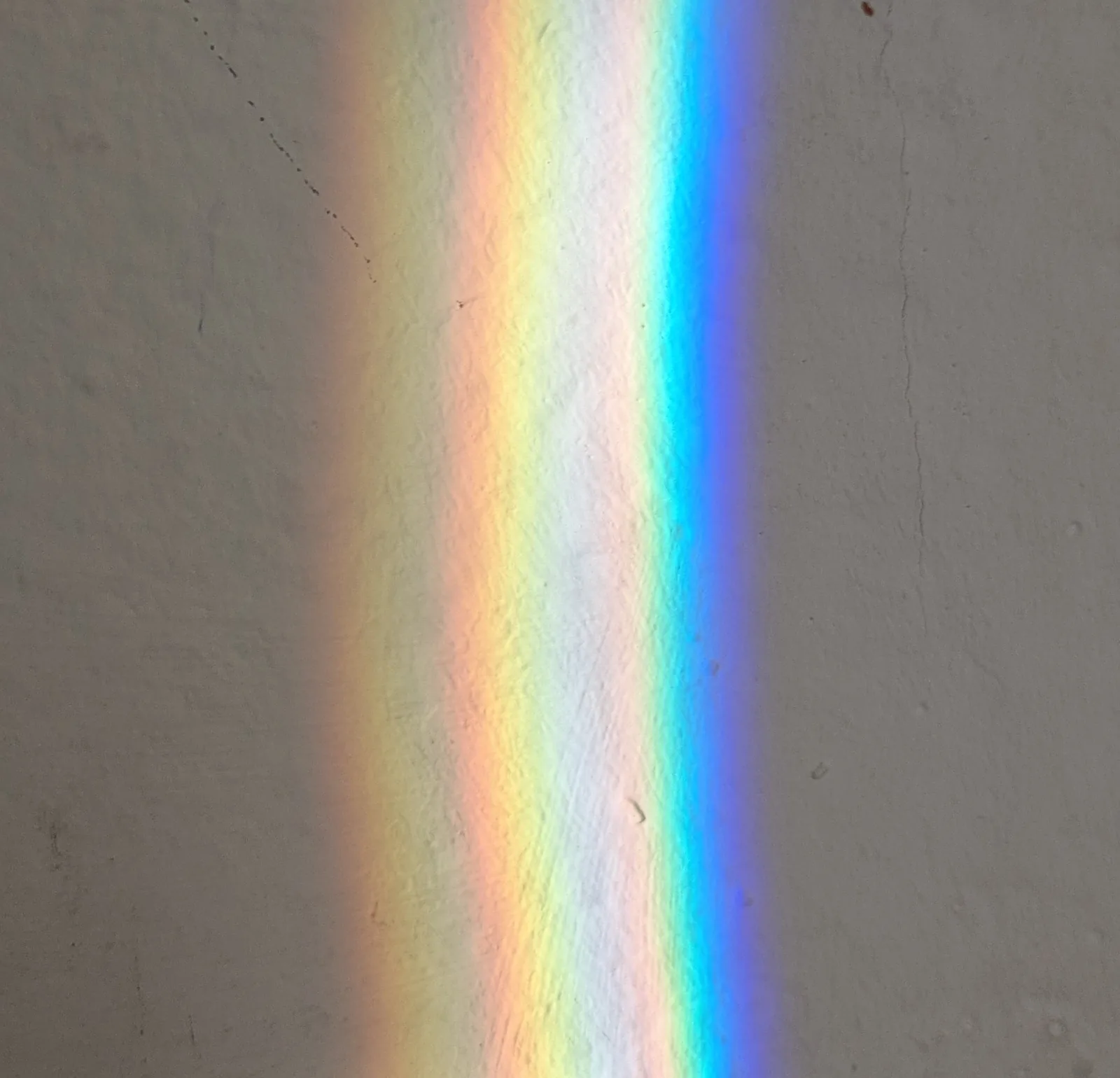
Why violet is slowed down more
The electric field of light makes the electrons of the material oscillate at the frequency of the light. The oscillating electrons emit light themselves, which combines with the incoming light, and the combined wave travels more slowly than light in vacuum. The response of the electrons depends on frequency. In water and glass it strengthens as the frequency increases towards the ultraviolet, which the material absorbs strongly. So high-frequency violet light is slowed down more than low-frequency red, and its refractive index is greater.
A prism splits white light
White light, such as sunlight, is a mixture of different wavelengths, that is, colours. When it enters glass at a slant, each colour is refracted according to the law of refraction but by a different amount: violet has the greatest refractive index, so it bends the most towards the normal. On leaving the second surface of a flat window pane of uniform thickness, the colours emerge again parallel to the original ray, so the colours are not noticed. The surfaces of a prism are slanted relative to each other, so at the second surface the colours are refracted still further apart. A fan of colours, a spectrum, comes out of the prism: red is deviated the least from its original direction and violet the most.
A prism does not colour light. In the 1660s Isaac Newton showed that when a single colour is separated from the spectrum and sent through a second prism, it is refracted but not split into new colours. A second prism turned the other way, on the other hand, gathers the spectrum back into white light. The colours were therefore already present in white light, and the prism only separates them from each other.
A rainbow forms in water droplets
A small raindrop is almost spherical. Sunlight is refracted into the droplet, reflected from the back surface of the droplet and refracted out of the lower part of the droplet. The light therefore returns towards the sun, but turned around. In both refractions violet is refracted more than red, so the colours separate. The direction in which the light leaves also depends on where the ray hits the droplet. However, the light is concentrated in one direction, because over a wide range of points of incidence the rays leave in almost the same direction: red at about $42^\circ$ and violet at about $40.6^\circ$ from the direction the sunlight came from. In this direction the droplet shines most brightly.
Why red is on the outer edge
When the sun is behind you, the sun's rays pass your head towards the antisolar point, which is below the horizon at the shadow of your own head. Red light reaches the eye from the droplets seen at $42^\circ$ from the direction of the antisolar point, and violet from those seen at $40.6^\circ$. Droplets at the same angle form a circle whose centre is the antisolar point. The circle of red is larger, so red is on the outer edge of the arc. Each droplet sends only one colour to the eye, and its other colours pass by the eye. That is why each viewer sees their own rainbow.
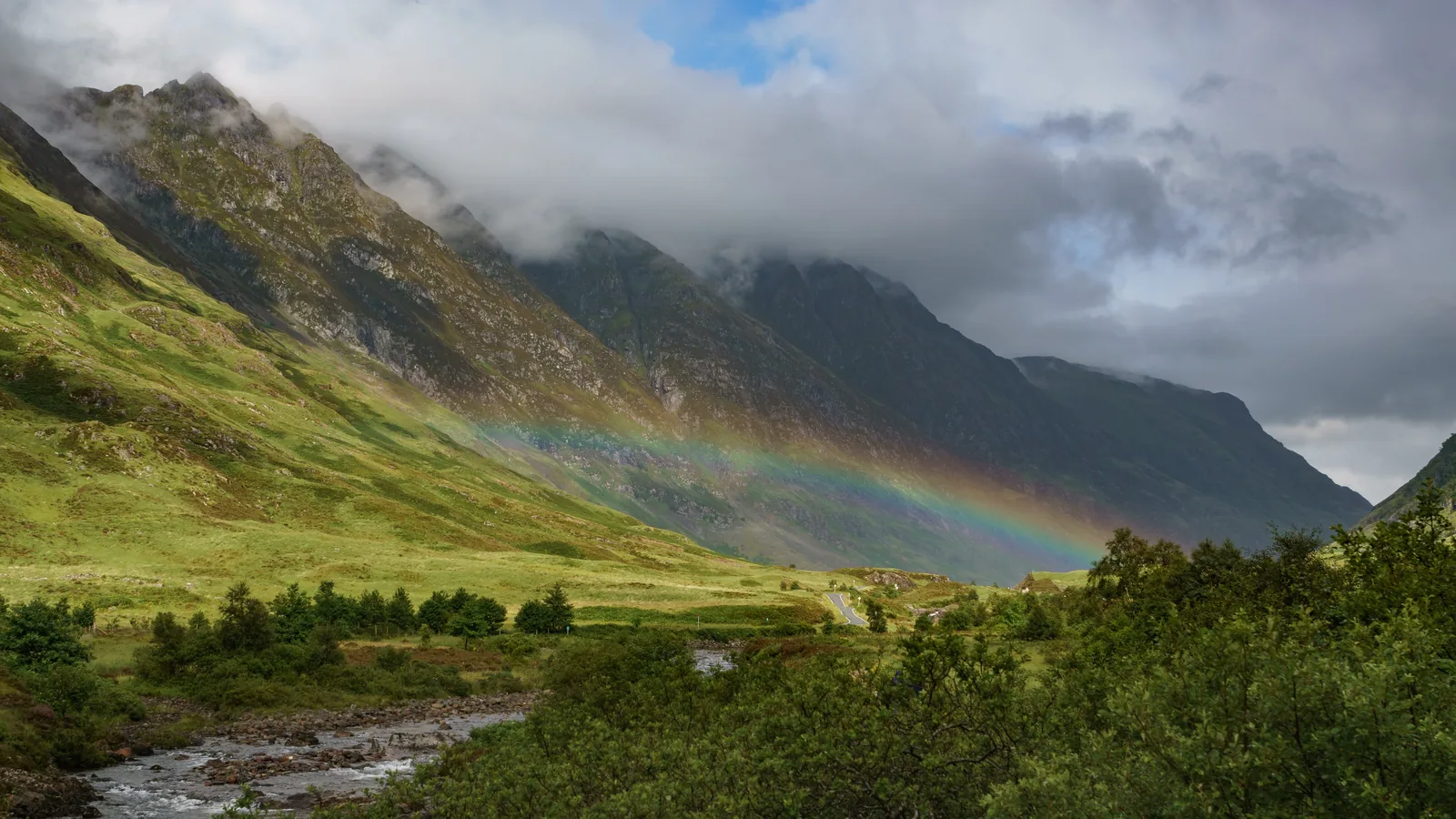
A rainbow is therefore seen only when the sun shines from behind you and there are droplets ahead. On level ground only the part of the arc above the horizon is visible. If the sun is at a height $h$ above the horizon, the antisolar point is the same distance below the horizon, and the top of the red arc is at a height $42^\circ - h$. When the sun is higher than $42^\circ$, the whole arc is below the horizon and cannot be seen from the ground. That is why rainbows are seen in midsummer in the morning and evening, when the sun is low.
The secondary bow
Outside the primary bow a fainter secondary bow is sometimes seen. In it the light is reflected twice inside the droplet, and the order of the colours is reversed: red is on the inner edge at about $50^\circ$ and violet on the outer edge at about $54^\circ$ from the direction of the antisolar point. At each reflection some of the light escapes from the droplet, so the secondary bow is fainter. The sky between the arcs is darker, because the droplets of the primary bow light only the inside of the arc and those of the secondary bow only the outside.
Law of refraction for different wavelengths
When light arrives from air in a material, each wavelength is refracted according to its own refractive index:
$$\sin \alpha_1 = n(\lambda) \sin \alpha_2$$
where $\alpha_1$ is the angle of incidence and $\alpha_2$ the angle of refraction, both measured from the normal, and $n(\lambda)$ is the refractive index of the material at wavelength $\lambda$. The refractive index of air is $1.0003$, so it is rounded to one; the general form is $n_1 \sin\alpha_1 = n_2 \sin\alpha_2$ (chapter Reflection and refraction of light). The speed of light in a material is $v = c : n(\lambda)$, where $c = 3.00 \cdot 10^8\,\text{m/s}$. In the graph the refractive index of crown glass decreases as the wavelength increases, most steeply at the violet end.
The angle of deviation of a prism
In a prism the ray is refracted twice, and the angles depend on each other:
$$\begin{aligned} &\alpha_2 + \alpha_3 = A \\[6pt] &\delta = \alpha_1 + \alpha_4 - A \end{aligned}$$
where $\alpha_1$ is the angle of incidence and $\alpha_2$ the angle of refraction at the first surface, $\alpha_3$ the angle of incidence from inside the glass at the second surface and $\alpha_4$ the angle of refraction on leaving, all measured from the normals. $A$ is the apex angle of the prism and $\delta$ the angle of deviation, the amount by which the ray is turned from its original direction. The first equation follows from the sum of the angles of a triangle, because the normals of the surfaces meet at an angle $180^\circ - A$. The second follows from the ray turning by $\alpha_1 - \alpha_2$ at the first surface and by $\alpha_4 - \alpha_3$ at the second. For violet $\alpha_4$ is greater than for red, so its angle of deviation is greater. The equations hold when the ray can leave through the second surface of the prism.
The angle of a rainbow
In the droplet the ray turns by $\alpha - \beta$ at the point of entry, by $180^\circ - 2\beta$ at the reflection and again by $\alpha - \beta$ at the point of exit. The total turning is therefore $180^\circ + 2\alpha - 4\beta$. The angle between the light leaving the droplet and the direction of the sun is $180^\circ$ minus the total turning, that is,
$$\theta = 4\beta - 2\alpha$$
where $\alpha$ is the angle of incidence at the surface of the droplet, $\beta$ the angle of refraction, $\sin\alpha = n \sin\beta$, and $\theta$ is the angle at which the light is seen from the direction of the antisolar point. The graph shows that $\theta$ depends on the angle of incidence but does not exceed $42.3^\circ$ when $n = 1.3315$. Near the peak the curve is almost horizontal, so over a wide range of angles of incidence the rays leave in almost the same direction, and a bright arc is seen in that direction. The rest of the light leaves at smaller angles, so the sky inside the arc is brighter. For violet ($n = 1.3431$) the greatest angle is $40.6^\circ$.
Common misconception
Many people think that a prism colours light or that the colours are created in the glass of the prism. The colours are already present in white light, and the prism separates them because the refractive index depends on wavelength. Another common mistake is to conclude that red is refracted the most because it has the longest wavelength. In water and glass it is the other way round: violet has the greatest refractive index, so violet is refracted and deviated the most. A third mistake is to think of a rainbow as an object at a particular place. A rainbow is a direction: it is always seen at $42^\circ$ from the antisolar point, so it moves with the viewer and its end cannot be reached.
Summary
- The refractive index depends on wavelength. This is called dispersion. In water and glass violet has the greatest refractive index and red the smallest, so violet is refracted the most.
- In a prism white light is refracted twice at slanted surfaces, and the colours separate into a spectrum. The angle of deviation is $\delta = \alpha_1 + \alpha_4 - A$, and violet is deviated the most.
- In a rainbow light is refracted into a droplet, reflected from its back surface and refracted out. Red is seen at about $42^\circ$ and violet at about $40.6^\circ$ from the antisolar point, so red is on the outer edge.
- A rainbow is seen when the sun is behind you and lower than $42^\circ$. In the secondary bow the light is reflected twice, and the colours are in the opposite order.
Optional Return to your predictions
Compare your predictions with the model's values from the experiment and with the theory. Then return to the opening question: why is the red of a rainbow on the outer edge and the violet on the inner edge, and why is a rainbow seen only with your back to the sun?
Would you change your prediction?
Apply
Worked example
Problem
A narrow beam of white light arrives from air at the surface of a crown-glass plate at an angle of incidence of $60.0^\circ$. What are the angles of refraction of red ($656\,\text{nm}$) and violet ($405\,\text{nm}$) light in the glass, and how large an angle arises between them? Use the refractive indices in the table.
Step 1/7
Given and find. Angle of incidence $\alpha_1 = 60.0^\circ$; from the table the refractive index of red light is $n_\text{r} = 1.5143$ and of violet $n_\text{v} = 1.5302$. We are asked for the angles of refraction $\alpha_\text{r}$ and $\alpha_\text{v}$ and their difference $\Delta\alpha = \alpha_\text{r} - \alpha_\text{v}$.
Step 2/7
Principle. Each colour obeys the law of refraction with its own refractive index. The light arrives from air, whose refractive index is rounded to $1$, so $\sin \alpha_1 = n \sin \alpha_2$. The angle of incidence is the same for both colours, because they travel in the same beam of white light.
Step 3/7
Formula solved.
$$\begin{aligned} \sin \alpha_1 &= n \sin \alpha_2 \\[6pt] \sin \alpha_2 &= \frac{\sin \alpha_1}{n} \end{aligned}$$
Step 4/7
Unit conversions. Not needed: the refractive index has no unit, and the angles are in degrees.
Step 5/7
Substitution. $$\begin{aligned} &\sin \alpha_\text{r} = \frac{\sin \alpha_1}{n_\text{r}} \\ &= \frac{\sin 60.0^\circ}{1.5143} \\ &= 0.57190 \\ &\alpha_\text{r} = 34.88^\circ \\[6pt] &\sin \alpha_\text{v} = \frac{\sin \alpha_1}{n_\text{v}} \\ &= \frac{\sin 60.0^\circ}{1.5302} \\ &= 0.56596 \\ &\alpha_\text{v} = 34.47^\circ \end{aligned}$$
Step 6/7
Result. The angle of refraction of red light is $34.9^\circ$ and of violet $34.5^\circ$, to three significant figures like the angle of incidence $60.0^\circ$. The angle between the rays is calculated from the unrounded angles:
Step 7/7
Reasonableness. Both angles of refraction are smaller than the angle of incidence, because light entering an optically denser material bends towards the normal. The angle of refraction of violet is smaller because its refractive index is greater. The difference is less than half a degree, so in glass of uniform thickness the colours separate only a little; the slanted second surface of a prism increases the difference.
Optional Find the error
Apply to a new situation: colours on the bottom of a swimming pool
Sunlight hits the surface of a still swimming pool at an angle of incidence of $60.0^\circ$. The pool is $2.00\,\text{m}$ deep. The refractive index of water is $1.3315$ for red light and $1.3431$ for violet.
How far apart do the red and violet light hit the bottom of the pool when the light reaches the surface at the same point? Give your answer in millimetres.
Hint 1: a guiding question
First calculate the angle of refraction of each colour in water. Which one is refracted more?
Hint 2: what is the connection
Once the angle of refraction $\beta$ is known, the ray travels a horizontal distance $x = h \tan\beta$ at depth $h$.
Hint 3: an intermediate step
$\beta_\text{r} = 40.57^\circ$ and $\beta_\text{v} = 40.15^\circ$, so $\Delta x = 2.00\,\text{m} \cdot (\tan 40.57^\circ - \tan 40.15^\circ)$.
Show the solution
Given
angle of incidence $\alpha = 60.0^\circ$, depth of the pool $h = 2.00\,\text{m}$, refractive index of red $n_\text{r} = 1.3315$, of violet $n_\text{v} = 1.3431$
Find
distance $\Delta x$ between the points where red and violet hit, in millimetres
Principle
Each colour is refracted at the surface according to the law of refraction $\sin\alpha = n \sin\beta$ with its own refractive index, because the refractive index depends on wavelength. In water light travels in a straight line, so the ray, the normal of the surface and the bottom form a right-angled triangle: the horizontal distance to the bottom is $x = h \tan\beta$.
Formula
$\sin\beta = \dfrac{\sin\alpha}{n}$ and $x = h \tan\beta$, so $\Delta x = h \left(\tan\beta_\text{r} - \tan\beta_\text{v}\right)$
Conversions
Finally $1\,\text{m} = 1000\,\text{mm}$.
Substitution
so $\beta_\text{r} = 40.573^\circ$;
so $\beta_\text{v} = 40.150^\circ$.
Answer
about $25\,\text{mm}$, two significant figures, because the result is the difference of two almost equal numbers, in which significant figures are lost.
Reasonableness
Violet is refracted more, so it hits closer to the point where the light enters the surface, and the difference is positive. Each colour travels horizontally about $2.00\,\text{m} \cdot 0.85 \approx 1.7\,\text{m}$, and the difference is less than $2\,\%$ of this, which fits the small difference in the refractive indices. That is why narrow coloured fringes appear on the bottom.
Check your understanding
Exit ticket
Answer on your own first and only then open the answer.
- White light passes at a slant through a flat window pane of uniform thickness. Why does the window not visibly split the light into colours, even though glass has dispersion?
Answer
Inside the glass the colours travel in slightly different directions, but the surfaces of a pane of uniform thickness are parallel. At the second surface each colour is refracted back to a direction parallel to the original ray, so the colours continue in the same direction, only slightly shifted sideways. The slanted surfaces of a prism, by contrast, increase the difference in direction.
- The sun shines from a height of $50^\circ$, and it is raining ahead. Can an observer standing on level ground see a rainbow?
Answer
No. The antisolar point is $50^\circ$ below the horizon, so the top of the red arc would be at a height of $42^\circ - 50^\circ = -8^\circ$, that is, below the horizon. A rainbow is seen from the ground only when the sun is lower than $42^\circ$.
1. Concept: why a prism splits light
2. Calculate: red and violet in water
The refractive index of water is $1.3315$ for red light and $1.3431$ for violet.
By how much is the speed of red light in water greater than that of violet? Give your answer in kilometres per second.
Hint 1: a guiding question
The speed of light in a material is obtained from the refractive index. With which formula?
Hint 2: what is the connection
$v = c : n$, where $c = 3.00 \cdot 10^8\,\text{m/s}$. Calculate the speed of each colour and subtract.
Hint 3: an intermediate step
Keep six figures in the intermediate results: $v_\text{r} = 225\,310\,\text{km/s}$ and $v_\text{v} = 223\,364\,\text{km/s}$.
Show the solution
Given
refractive index of red $n_\text{r} = 1.3315$, of violet $n_\text{v} = 1.3431$, speed of light in vacuum $c = 3.00 \cdot 10^8\,\text{m/s}$
Find
difference of the speeds $\Delta v = v_\text{r} - v_\text{v}$ in kilometres per second
Principle
The refractive index tells how many times slower light travels in a material than in vacuum, $n = c : v$. The refractive index depends on wavelength, so red and violet have different speeds in water.
Formula
$n = \dfrac{c}{v}$, so $v = \dfrac{c}{n}$, and
Conversions
because $1\,\text{km} = 1000\,\text{m}$.
Substitution
so
Answer
$1.95 \cdot 10^3\,\text{km/s}$
Three significant figures like the speed of light $3.00 \cdot 10^8\,\text{m/s}$.
Reasonableness
The difference is about $1\,\%$ of the speed, since the refractive indices also differ by about one per cent: $1.3431 : 1.3315 \approx 1.009$. Red is faster because its refractive index is smaller.
Suggestion: one answer does not show everything you can do, but review the theory summary and do the core exercises.
3. Explain: the order of the colours in a rainbow
Explain how a rainbow forms in water droplets and why red is on the outer edge of the arc and violet on the inner edge. Also explain why a rainbow is seen only when the sun is behind you.
Model answer
Sunlight is refracted into the droplet, reflected from the back surface of the droplet and refracted out, so the light returns towards the sun, turned around. The refractive index of water is greater for violet than for red, so the colours separate in the refractions: the droplets send out red light most strongly at about $42^\circ$ and violet at about $40.6^\circ$ from the direction the sunlight came from. Red light reaches the viewer's eye from the droplets seen at $42^\circ$ from the antisolar point, that is, from the direction of the shadow of your own head, and violet from the droplets seen at $40.6^\circ$. The circle of red is larger, so red is on the outer edge. Because light returns from the droplet towards the sun and the centre of the arc is the antisolar point, the arc is seen only with your back to the sun.
Assess your own answer
Tick the points your own answer already contains.
Review the theory summary and practise with the exercises.
Exercises
Level 1 · basic practice 5 exercises
One formula or one step of reasoning. Core exercises first, the rest is extra practice.
- Exercise 11-1Core
Red light arrives from air at the surface of a calm lake at an angle of incidence of $50.0^\circ$. The refractive index of water for red light is $1.332$.
What is the angle of refraction in the water?
Answer
$35.1^\circ$
Show the solution
Given
angle of incidence $\alpha_1 = 50.0^\circ$, refractive index of water for red light $n = 1.332$, the light arrives from air
Find
angle of refraction $\alpha_2$ in degrees
Principle
Light is refracted at the boundary according to the law of refraction. The light arrives from air, whose refractive index is rounded to $1$, so $\sin\alpha_1 = n \sin\alpha_2$. For red light we use the refractive index of red light, because the refractive index depends on wavelength.
Formula
$\sin\alpha_1 = n \sin\alpha_2$, so
$\sin\alpha_2$$= \dfrac{\sin\alpha_1}{n}$Conversions
Not needed: the refractive index has no unit, and the angles are in degrees.
Substitution
$\sin\alpha_2$$= \dfrac{\sin 50.0^\circ}{1.332}$$= 0.57511$so $\alpha_2 = 35.11^\circ$
Answer
$35.1^\circ$
Three significant figures like the angle of incidence $50.0^\circ$.
Reasonableness
The angle of refraction is smaller than the angle of incidence, because light slows down in water and bends towards the normal. The ratio
$\sin 50.0^\circ : \sin 35.1^\circ$$= 0.766 : 0.575$$\approx 1.33$is the refractive index of water.
- Exercise 11-2Core
The refractive index of crown glass for violet light is $1.530$.
At what speed does violet light travel in the glass? The speed of light in vacuum is $3.00 \cdot 10^8\,\text{m/s}$. Give your answer in kilometres per second.
Answer
$1.96 \cdot 10^5\,\text{km/s}$
Show the solution
Given
refractive index of crown glass for violet light $n = 1.530$, speed of light in vacuum $c = 3.00 \cdot 10^8\,\text{m/s}$
Find
speed $v$ of violet light in the glass in kilometres per second
Principle
The refractive index tells how many times slower light travels in a material than in vacuum. For violet light we use the refractive index of violet light.
Formula
$n = \dfrac{c}{v}$, so $v = \dfrac{c}{n}$
Conversions
$c$$= 3.00 \cdot 10^8\,\text{m/s}$$= 3.00 \cdot 10^5\,\text{km/s}$because $1\,\text{km} = 1000\,\text{m}$.
Substitution
$v$$= \dfrac{3.00 \cdot 10^5\,\text{km/s}}{1.530}$$= 196\,078\,\text{km/s}$Answer
$1.96 \cdot 10^5\,\text{km/s}$
That is, about $196\,000\,\text{km/s}$, three significant figures like the speed of light $3.00 \cdot 10^8\,\text{m/s}$.
Reasonableness
The speed is about two thirds of the speed of light in vacuum, as it should be in glass, because $1 : 1.53 \approx 0.65$. The speed of red light in glass is slightly greater, because its refractive index is smaller.
- Exercise 11-3
A student aims the beam of a green laser from air at the surface of a piece of glass at an angle of incidence of $45.0^\circ$ and measures an angle of refraction of $27.8^\circ$.
What is the refractive index of the glass for green light?
Answer
$1.52$
Show the solution
Given
angle of incidence $\alpha_1 = 45.0^\circ$, angle of refraction $\alpha_2 = 27.8^\circ$, the light arrives from air
Find
refractive index $n$ of the glass for green light (no unit)
Principle
Light is refracted at the boundary according to the law of refraction, and the refractive index of air is rounded to $1$. When both angles are known, the refractive index is obtained from the ratio of the sines of the angles. The result applies only to green light, because the refractive index depends on wavelength.
Formula
$\sin\alpha_1 = n \sin\alpha_2$, so
$n$$= \dfrac{\sin\alpha_1}{\sin\alpha_2}$Conversions
Not needed: the angles are in degrees, and the refractive index has no unit.
Substitution
$n$$= \dfrac{\sin 45.0^\circ}{\sin 27.8^\circ}$$= \dfrac{0.70711}{0.46639}$$= 1.516$Answer
$1.52$
Three significant figures like the measured angles.
Reasonableness
The refractive index of ordinary glass is about $1.5$, and the result lies between the table values for crown glass for red ($1.5143$) and blue ($1.5224$), which is where green light belongs. The refractive index is greater than $1$, because the light bent towards the normal.
- Exercise 11-4
The apex angle of a prism is $60.0^\circ$. A yellow ray enters the prism at an angle of incidence of $45.0^\circ$ and leaves the second surface at an angle of refraction of $52.0^\circ$.
What is the angle of deviation of the ray?
Answer
$37.0^\circ$
Show the solution
Given
apex angle of the prism $A = 60.0^\circ$, angle of incidence $\alpha_1 = 45.0^\circ$, angle of refraction of the emerging ray $\alpha_4 = 52.0^\circ$
Find
angle of deviation $\delta$ in degrees
Principle
In a prism the ray turns by $\alpha_1 - \alpha_2$ at the first surface and by $\alpha_4 - \alpha_3$ at the second. Because the geometry of the prism gives $\alpha_2 + \alpha_3 = A$, the total turning depends only on the outer angles and the apex angle.
Formula
$\delta = \alpha_1 + \alpha_4 - A$
Conversions
Not needed: all the angles are in degrees.
Substitution
$\delta$$= 45.0^\circ + 52.0^\circ - 60.0^\circ$$= 37.0^\circ$Answer
$37.0^\circ$
To one decimal like the angles.
Reasonableness
The angle of deviation is positive, that is, the ray turns towards the base of the prism, as it should in a prism. It is of the same order of magnitude as the angles of deviation of the crown-glass prism in the simulation of the chapter, about $38\text{–}40^\circ$ when the apex angle is $60^\circ$.
- Exercise 11-5
A ray of light enters a water droplet at an angle of incidence of $55.0^\circ$ and is refracted in the droplet to an angle of $38.0^\circ$. The ray is reflected once from the back surface of the droplet and refracted out.
At what angle from the direction of the antisolar point is this light seen?
Answer
$42.0^\circ$
Show the solution
Given
angle of incidence at the surface of the droplet $\alpha = 55.0^\circ$, angle of refraction $\beta = 38.0^\circ$, one reflection from the back surface of the droplet
Find
angle $\theta$ from the direction of the antisolar point in degrees
Principle
The ray turns by $\alpha - \beta$ at the point of entry, by $180^\circ - 2\beta$ at the reflection and by $\alpha - \beta$ at the point of exit. The total turning is $180^\circ + 2\alpha - 4\beta$, so the light leaves at $180^\circ$ minus the turning, measured from the direction the sunlight came from.
Formula
$\theta = 4\beta - 2\alpha$
Conversions
Not needed: the angles are in degrees.
Substitution
$\theta$$= 4 \cdot 38.0^\circ - 2 \cdot 55.0^\circ$$= 152.0^\circ - 110.0^\circ$$= 42.0^\circ$Answer
$42.0^\circ$
To one decimal like the angles.
Reasonableness
The result is close to the angle of a rainbow, $42^\circ$. From the angles the refractive index is
$\sin 55.0^\circ : \sin 38.0^\circ$$= 0.819 : 0.616$$\approx 1.33$which is the refractive index of water, so the situation is possible.
Level 2 · applied practice 4 exercises
Two steps, working with measured data, a unit conversion or rearranging a formula. Core exercises first, the rest is extra practice.
- Exercise 11-6Core
A short flash of white light is sent through a crown-glass optical fibre $5.00\,\text{km}$ long. The refractive index of the glass is $1.5143$ for red light and $1.5302$ for violet.
How much later does violet light arrive at the other end of the fibre than red? Assume that each colour travels in the fibre at speed $v = c : n$ and along the fibre. Give your answer in nanoseconds.
Answer
$265\,\text{ns}$
Show the solution
Given
length of the fibre $L = 5.00\,\text{km}$, refractive index of red $n_\text{r} = 1.5143$, of violet $n_\text{v} = 1.5302$, speed of light in vacuum $c = 3.00 \cdot 10^8\,\text{m/s}$
Find
difference $\Delta t$ in arrival times in nanoseconds
Principle
According to the assumption of the problem, each colour travels in the glass at speed $v = c : n$; a real short flash travels slightly more slowly at the group velocity, but that is ignored here. The refractive index depends on wavelength. The refractive index of violet is greater, so violet travels more slowly and arrives later. Each colour travels the same distance at a steady speed, so the travel time is $t = L : v$.
Formula
$v = \dfrac{c}{n}$ and $t = \dfrac{L}{v} = \dfrac{L n}{c}$, so
$\Delta t$$= t_\text{v} - t_\text{r}$$= \dfrac{L n_\text{v}}{c} - \dfrac{L n_\text{r}}{c}$Conversions
$L$$= 5.00\,\text{km}$$= 5.00 \cdot 1000\,\text{m}$$= 5000\,\text{m}$Finally $1\,\text{s} = 10^9\,\text{ns}$.
Substitution
$t_\text{v}$$= \dfrac{5000\,\text{m} \cdot 1.5302}{3.00 \cdot 10^8\,\text{m/s}}$$= 2.55033 \cdot 10^{-5}\,\text{s}$$t_\text{r}$$= \dfrac{5000\,\text{m} \cdot 1.5143}{3.00 \cdot 10^8\,\text{m/s}}$$= 2.52383 \cdot 10^{-5}\,\text{s}$so
$\Delta t$$= 2.55033 \cdot 10^{-5}\,\text{s} - 2.52383 \cdot 10^{-5}\,\text{s}$$= 2.650 \cdot 10^{-7}\,\text{s}$$= 265\,\text{ns}$Answer
$265\,\text{ns}$
Three significant figures like the difference of the refractive indices $0.0159$ and the length $5.00\,\text{km}$.
Reasonableness
Each travel time is about $25\,\mu\text{s}$, and the difference is about $1\,\%$ of it, as the ratio of the refractive indices $1.5302 : 1.5143 \approx 1.01$ leads us to expect. The intermediate results must be kept accurate: the difference of times rounded to three figures would come out wrong.
- Exercise 11-7Core
The apex angle of a glass prism is $60.0^\circ$, and the refractive index of the glass for yellow light is $1.52$. A yellow ray arrives from air at the first surface of the prism at an angle of incidence of $40.0^\circ$.
At what angle of incidence does the ray hit the second surface of the prism from inside the glass?
Answer
$35.0^\circ$
Show the solution
Given
apex angle $A = 60.0^\circ$, refractive index of the glass for yellow light $n = 1.52$, angle of incidence $\alpha_1 = 40.0^\circ$, the light arrives from air
Find
angle of incidence $\alpha_3$ at the second surface of the prism in degrees
Principle
At the first surface the ray is refracted according to the law of refraction, and the refractive index of air is rounded to $1$. Inside the glass the normals of the surfaces of the prism and the ray form a triangle, and the sum of its angles gives $\alpha_2 + \alpha_3 = A$.
Formula
$\sin\alpha_1 = n \sin\alpha_2$, so
$\sin\alpha_2$$= \dfrac{\sin\alpha_1}{n}$and $\alpha_2 + \alpha_3 = A$, so $\alpha_3 = A - \alpha_2$
Conversions
Not needed: the angles are in degrees, and the refractive index has no unit.
Substitution
$\sin\alpha_2$$= \dfrac{\sin 40.0^\circ}{1.52}$$= 0.42289$so $\alpha_2 = 25.02^\circ$, and
$\alpha_3$$= 60.0^\circ - 25.02^\circ$$= 34.98^\circ$Answer
$35.0^\circ$
Three significant figures like the angle of incidence $40.0^\circ$.
Reasonableness
The sum of the angles $\alpha_2$ and $\alpha_3$ is the apex angle $60.0^\circ$. At the second surface
$n \sin\alpha_3$$= 1.52 \cdot \sin 35.0^\circ$$= 0.87$$< 1$so the ray can leave, at an angle of refraction of about $61^\circ$.
- Exercise 11-8
The graph shows the refractive index $n$ of a flint glass as a function of the vacuum wavelength $\lambda$ of light.
At what speed does blue light of wavelength $450\,\text{nm}$ travel in this glass? The speed of light in vacuum is $3.00 \cdot 10^8\,\text{m/s}$. Read the refractive index from the graph and give your answer in kilometres per second.
Answer
$1.83 \cdot 10^5\,\text{km/s}$
Show the solution
Given
graph of the refractive index of flint glass as a function of wavelength, wavelength $\lambda = 450\,\text{nm}$, $c = 3.00 \cdot 10^8\,\text{m/s}$
Find
speed $v$ of blue light in the glass in kilometres per second
Principle
The refractive index depends on wavelength, so it is read from the graph at exactly the wavelength $450\,\text{nm}$. The speed of light in a material is $v = c : n$.
Reading the graph
At $450\,\text{nm}$ on the horizontal axis there is a measured point on the curve. From the point, reading horizontally to the vertical axis gives $n \approx 1.639$: the point lies between the grid lines $1.638$ and $1.640$, close to halfway between them.
Formula
$n = \dfrac{c}{v}$, so $v = \dfrac{c}{n}$
Conversions
$c$$= 3.00 \cdot 10^8\,\text{m/s}$$= 3.00 \cdot 10^5\,\text{km/s}$because $1\,\text{km} = 1000\,\text{m}$.
Substitution
$v$$= \dfrac{3.00 \cdot 10^5\,\text{km/s}}{1.639}$$= 183\,038\,\text{km/s}$Answer
$1.83 \cdot 10^5\,\text{km/s}$
Three significant figures like the speed of light $3.00 \cdot 10^8\,\text{m/s}$; a reading uncertainty of $\pm 0.001$ in the refractive index changes the speed by only about $0.1\,\%$.
Reasonableness
The refractive index of flint glass is greater than that of crown glass, so light travels more slowly in it than in crown glass (about $196\,000\text{–}198\,000\,\text{km/s}$). The speed is about $61\,\%$ of the speed of light in vacuum, because $1 : 1.64 \approx 0.61$.
- Exercise 11-9
On a summer evening the sun shines from a height of $25.0^\circ$, and it is raining ahead. The rays at the violet edge of the rainbow enter the droplets at an angle of incidence of $58.8^\circ$, and the refractive index of water for violet light is $1.343$. The light is reflected once from the back surface of the droplet.
How high above the horizon does the top of the violet arc appear to an observer standing on level ground?
Answer
$15.6^\circ$
Show the solution
Given
height of the sun $h = 25.0^\circ$, angle of incidence of the rays at the violet edge $\alpha = 58.8^\circ$, refractive index of water for violet light $n = 1.343$, one reflection from the back surface of the droplet
Find
height $h_\text{v}$ of the top of the violet arc above the horizon in degrees
Principle
At the surface of the droplet light is refracted according to the law of refraction, and the refractive index of air is rounded to $1$. The ray turns in two refractions and one reflection, so violet light is seen at the angle $\theta = 4\beta - 2\alpha$ from the direction of the antisolar point. The antisolar point is as far below the horizon as the sun is above it, so the top of the arc is at the height $\theta - h$.
Formula
$\sin\alpha = n \sin\beta$, so $\sin\beta = \dfrac{\sin\alpha}{n}$, $\theta = 4\beta - 2\alpha$ and $h_\text{v} = \theta - h$
Conversions
Not needed: the angles are in degrees.
Substitution
$\sin\beta$$= \dfrac{\sin 58.8^\circ}{1.343}$$= 0.63691$so $\beta = 39.56^\circ$;
$\theta$$= 4 \cdot 39.56^\circ - 2 \cdot 58.8^\circ$$= 158.25^\circ - 117.60^\circ$$= 40.65^\circ$$h_\text{v}$$= 40.65^\circ - 25.0^\circ$$= 15.65^\circ$Answer
$15.6^\circ$
To one decimal like the height of the sun $25.0^\circ$.
Reasonableness
The angle of violet, $40.6^\circ$, is smaller than that of red, $42^\circ$, so the violet edge is lower than the red one, whose top is at a height of about $17^\circ$. If the sun were higher than $40.6^\circ$, the top of the violet arc would be below the horizon.
Level 3 · challenging 3 exercises
Optional: application, two ideas together or a new situation where you reason for yourself.
- Exercise 11-10
The apex angle of a crown-glass prism is $50.0^\circ$. A narrow beam of white light enters the prism from air at an angle of incidence of $45.0^\circ$. The refractive index of the glass is $1.5143$ for red light and $1.5302$ for violet.
What is the angle between the red and violet rays leaving the prism? Calculate the angles of the intermediate steps to the nearest hundredth of a degree.
Answer
$0.96^\circ$
Show the solution
Given
apex angle $A = 50.0^\circ$, angle of incidence $\alpha_1 = 45.0^\circ$, refractive index of red $n_\text{r} = 1.5143$, of violet $n_\text{v} = 1.5302$, prism in air
Find
angle between the emerging rays $\Delta\delta = \delta_\text{v} - \delta_\text{r}$ in degrees
Principle
Each colour is refracted at both surfaces with its own refractive index, because the refractive index depends on wavelength. Both colours arrive from the same direction, so the angle between the emerging rays is the difference of the angles of deviation. From the geometry of the prism $\alpha_2 + \alpha_3 = A$ and $\delta = \alpha_1 + \alpha_4 - A$.
Formula
$\sin\alpha_2$$= \dfrac{\sin\alpha_1}{n}$$\alpha_3 = A - \alpha_2$, $\sin\alpha_4 = n \sin\alpha_3$ and $\delta = \alpha_1 + \alpha_4 - A$, so $\Delta\delta = \alpha_{4,\text{v}} - \alpha_{4,\text{r}}$
Conversions
Not needed: the angles are in degrees, and the refractive indices have no unit.
Substitution
Red:
$\sin\alpha_2$$= \dfrac{\sin 45.0^\circ}{1.5143}$$= 0.46695$$\alpha_2$$= 27.84^\circ$$\alpha_3$$= 50.0^\circ - 27.84^\circ$$= 22.16^\circ$$\sin\alpha_4$$= 1.5143 \cdot \sin 22.16^\circ$$= 0.57127$$\alpha_4 = 34.84^\circ$. Violet:
$\sin\alpha_2$$= \dfrac{\sin 45.0^\circ}{1.5302}$$= 0.46210$$\alpha_2 = 27.52^\circ$,
$\alpha_3$$= 22.48^\circ$$\sin\alpha_4$$= 1.5302 \cdot \sin 22.48^\circ$$= 0.58502$$\alpha_4 = 35.80^\circ$.
$\Delta\delta$$= 35.80^\circ - 34.84^\circ$$= 0.96^\circ$Answer
$0.96^\circ$
(with accurate intermediate values $0.966^\circ$), two significant figures, because the result is the difference of two almost equal angles.
Reasonableness
The angles of deviation are $\delta_\text{r} = 29.84^\circ$ and $\delta_\text{v} = 30.80^\circ$, and violet is deviated more, as it should be. The difference is greater than at one surface of glass of uniform thickness (about $0.3^\circ$), because the second surface of the prism increases it.
- Exercise 11-11
Red light enters near the edge of a water droplet at an angle of incidence of $80.0^\circ$. The refractive index of water for red light is $1.332$. The light is reflected once from the back surface of the droplet and refracted out.
At what angle from the direction of the antisolar point is this light seen? Is it seen inside or outside the red edge of the rainbow?
Answer
$30.7^\circ$
Show the solution
Given
angle of incidence $\alpha = 80.0^\circ$, refractive index of water for red light $n = 1.332$, one reflection from the back surface of the droplet
Find
angle $\theta$ from the direction of the antisolar point in degrees, and its comparison with the angle of the red edge, $42.3^\circ$
Principle
At the surface of the droplet light is refracted according to the law of refraction, and the refractive index of air is rounded to $1$. The ray turns in two refractions and one reflection, so the angle of the emerging light from the direction of the antisolar point is $\theta = 4\beta - 2\alpha$. The red edge of a rainbow is at an angle that no red ray exceeds.
Formula
$\sin\alpha = n \sin\beta$, so $\sin\beta = \dfrac{\sin\alpha}{n}$, and $\theta = 4\beta - 2\alpha$
Conversions
Not needed: the angles are in degrees.
Substitution
$\sin\beta$$= \dfrac{\sin 80.0^\circ}{1.332}$$= 0.73935$so $\beta = 47.676^\circ$, and
$\theta$$= 4 \cdot 47.676^\circ - 2 \cdot 80.0^\circ$$= 190.70^\circ - 160.0^\circ$$= 30.70^\circ$Answer
$30.7^\circ$
Three significant figures like the angle of incidence $80.0^\circ$. The angle is smaller than the angle of the red edge, $42.3^\circ$, so the light is seen inside the arc.
Reasonableness
The angle of red light cannot exceed $42.3^\circ$, and the result is smaller than that. Rays that hit near the edge like this light the sky inside the arc, which is therefore brighter than the sky outside the arc.
- Exercise 11-12
The rays that form the red edge of a rainbow enter the droplet at an angle of incidence of $59.5^\circ$ when the refractive index of water is $1.3315$. The rays of the violet edge enter at an angle of incidence of $58.8^\circ$ when the refractive index is $1.3431$.
Each is reflected once from the back surface of the droplet.
How wide is the rainbow in degrees, that is, what is the difference between the angles of the red and violet edges as seen from the antisolar point? Calculate the intermediate steps to the nearest thousandth of a degree.
Answer
$1.66^\circ$
Show the solution
Given
red edge: angle of incidence $\alpha_\text{r} = 59.5^\circ$, refractive index $n_\text{r} = 1.3315$; violet edge: $\alpha_\text{v} = 58.8^\circ$, $n_\text{v} = 1.3431$; one reflection from the back surface of the droplet
Find
width of the arc $\Delta\theta = \theta_\text{r} - \theta_\text{v}$ in degrees
Principle
The angle of the edge of each colour from the direction of the antisolar point follows from the geometry of the droplet, $\theta = 4\beta - 2\alpha$, when the angle of refraction $\beta$ is calculated from the law of refraction with its own refractive index. The width of the arc is the difference between the angles of the red and violet edges, because red is on the outer edge.
Formula
$\sin\beta = \dfrac{\sin\alpha}{n}$, $\theta = 4\beta - 2\alpha$ and $\Delta\theta = \theta_\text{r} - \theta_\text{v}$
Conversions
Not needed: the angles are in degrees.
Substitution
Red:
$\sin\beta_\text{r}$$= \dfrac{\sin 59.5^\circ}{1.3315}$$= 0.64711$$\beta_\text{r}$$= 40.324^\circ$$\theta_\text{r}$$= 4 \cdot 40.324^\circ - 2 \cdot 59.5^\circ$$= 42.296^\circ$Violet:
$\sin\beta_\text{v}$$= \dfrac{\sin 58.8^\circ}{1.3431}$$= 0.63686$$\beta_\text{v}$$= 39.558^\circ$$\theta_\text{v}$$= 4 \cdot 39.558^\circ - 2 \cdot 58.8^\circ$$= 40.632^\circ$$\Delta\theta$$= 42.296^\circ - 40.632^\circ$$= 1.664^\circ$Answer
about $1.66^\circ$, that is, rounded $1.7^\circ$: the result is the difference of two almost equal angles, so significant figures are lost.
Reasonableness
The width is about three times the apparent diameter of the sun, $0.5^\circ$, which fits experience: a rainbow is a narrow band. The angle of red is greater, so red is on the outer edge.
Photographs
- Dispersion of White Light Through a Prism. Aligatorigiganti. source, CC0 1.0
- Glen Coe Rainbow. Colin. source, CC BY-SA 4.0

