
Reflection and refraction of light
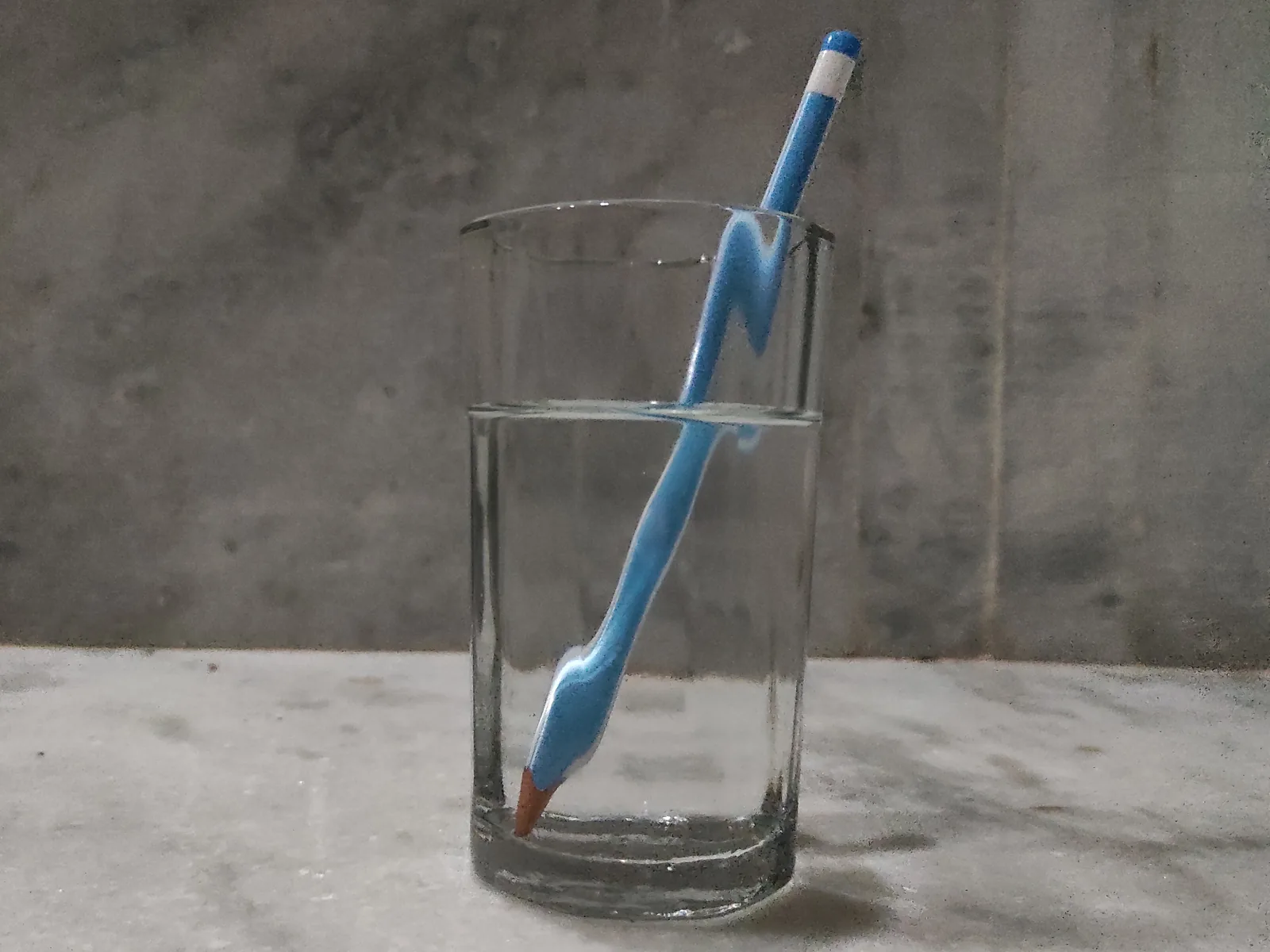
Why does a straw in a glass of water seem to break exactly at the surface of the water?
Prior knowledge
- Light is electromagnetic wave motion, and in a vacuum its speed is $c = 3.00 \cdot 10^{8}\,\text{m/s}$chapter Electromagnetic radiation and the black-body spectrum
- A wave is reflected so that the angle of reflection is equal to the angle of incidence, when the angles are measured from the normalchapter Reflection and diffraction of waves
Core path: follow the steps in order. Tasks marked Optional give extra practice. Optional tasks: 5.
Think about it
Put a straw in a glass of water and look at the glass obliquely from above: the straw seems to break at the surface of the water, and the part of it in the water seems to be shifted sideways. The bottom of a swimming pool seems to be closer than it is, and a still lake mirrors the trees on the shore. Spectacles, camera lenses and optical fibres are all based on what happens to light at the boundary of two materials.
What happens to light when it meets the surface of water, and why does a straw seem to break?
Optional Review: the law of reflection
Predict
Make your predictions before investigating 2 questions
Prediction 1: a ray into water
Prediction 2: double the angle of incidence
Investigate
A laser beam hits the boundary of two materials at the centre of a protractor disc. Choose the materials and the angle of incidence, and follow the reflected and the refracted ray.
Simulation
How to use
Choose the material above and the material below the boundary and adjust the angle of incidence $\alpha_1$. The laser is in the upper material, and the ray hits the boundary at the centre of the protractor disc. The dashed line is the normal of the boundary, and all angles are measured from it: $\alpha_1$ is the angle of incidence, $\beta$ the angle of reflection and $\alpha_2$ the angle of refraction. On the rim of the disc there is a mark every $10^\circ$ and a longer mark every $30^\circ$. The brighter and thicker the ray, the greater the share of the light that travels along it. In the readout you see the angles, their sines and the reflected share $R$.
Assumptions of the model
The model uses the refractive indices of yellow light (wavelength $589\,\text{nm}$): air $1.00$, water $1.33$, acrylic $1.49$, glass $1.52$ and diamond $2.42$. The boundary is flat and smooth, and the materials are uniform and transparent, so they do not absorb light. The reflected share is calculated for unpolarised light, and the rest of the light continues as the refracted ray. If the law of refraction gave $\sin\alpha_2 > 1$, there would be no refracted ray, and all the light is reflected (chapter Total internal reflection and the optical fibre). The readings are values calculated by the model, not measurements.
How the calculation works
The angle of reflection is $\beta = \alpha_1$ according to the law of reflection. The angle of refraction is found from the law of refraction $n_1 \sin\alpha_1 = n_2 \sin\alpha_2$:
$$\sin\alpha_2 = \frac{n_1 \sin\alpha_1}{n_2}$$
The reflected share $R$ is calculated from Fresnel's equations, which are not part of the upper secondary syllabus; for example, about $2\,\%$ of light arriving perpendicular from air to water is reflected. The refracted ray carries the share $100\,\% - R$.
Experiment 1: from air to water at different angles of incidence
Test predictions 1 and 2. Above is air and below is water; change only the angle of incidence. Record at least the angles of incidence $0^\circ$, $30^\circ$ and $60^\circ$, and if you like also $20^\circ$, $40^\circ$ and $80^\circ$. Compare the angle of reflection with the angle of incidence and the angle of refraction with the angle of incidence.
Initial state: material above: air, material below: water, angle of incidence $\alpha _1$ = $0^\circ$. Kept constant: material above, material below. Varied: angle of incidence $\alpha _1$.
| angle of incidence $\alpha _1$ | $\beta$ $(^\circ)$ | $\alpha_2$ $(^\circ)$ | $\sin\alpha_1$ | $\sin\alpha_2$ |
|---|
Experiment 2: different materials
Above is air and the angle of incidence is $50^\circ$; change only the material below. Record the angle of refraction when below there is water, acrylic, glass and diamond, and compare the angles of refraction with the refractive indices of the materials.
Initial state: material above: air, material below: water, angle of incidence $\alpha _1$ = $50^\circ$. Kept constant: material above, angle of incidence $\alpha _1$. Varied: material below.
| material below | $n_2$ | $\alpha_2$ $(^\circ)$ | $\sin\alpha_2$ |
|---|
Conclusion: reflection and refraction
What is the connection between the angle of reflection and the angle of incidence? For every row of experiment 1 (except $0^\circ$), calculate $\sin\alpha_1 : \sin\alpha_2$ and compare it with the ratio of the angles $\alpha_1 : \alpha_2$. Which of them stays the same? How does the angle of refraction in experiment 2 depend on the refractive index of the material below?
Model answer
On every row the angle of reflection is the same as the angle of incidence, $\beta = \alpha_1$. A ray arriving perpendicularly ($0^\circ$) continues straight into the water. Otherwise the ray is refracted towards the normal: $30^\circ \to 22.1^\circ$ and $60^\circ \to 40.6^\circ$. The ratio of the angles changes ($1.36$ and $1.48$), but on every row the ratio of the sines is $\sin\alpha_1 : \sin\alpha_2 = 1.33$, the same as the refractive index of water. In experiment 2 the angle of refraction decreases as the refractive index increases: $35.2^\circ$ in water, $30.9^\circ$ in acrylic, $30.3^\circ$ in glass and $18.5^\circ$ in diamond. On every row $n_2 \sin\alpha_2 = \sin 50^\circ = 0.766$. The regularity is the law of refraction $n_1 \sin\alpha_1 = n_2 \sin\alpha_2$. The values are calculated by the model.
Assess your own answer
Tick the points your own answer already contains.
Review the theory summary and practise with the exercises.
Measurement: the refractive index of acrylic
Made-up example data
A group did an experiment in the school laboratory in which the beam of a laser was directed from the air to the centre of the flat face of a semicircular acrylic block on a protractor disc. In the acrylic the light travels from the centre straight towards the curved surface, so it is not refracted at the curved surface, and the angle of refraction can be read from the protractor disc. The group read the angles to the nearest degree.
| $\alpha_1$ (°) | $\alpha_2$ (°) |
|---|---|
| $10$ | $7$ |
| $20$ | $13$ |
| $30$ | $20$ |
| $40$ | $26$ |
| $50$ | $31$ |
| $60$ | $36$ |
| $70$ | $39$ |
The group calculated the sines of the angles and drew a graph with Vernier Graphical Analysis, with $\sin\alpha_1$ on the vertical axis and $\sin\alpha_2$ on the horizontal axis. The program fitted the line $\sin\alpha_1 = A \sin\alpha_2 + B$ to the points and gave the slope $A = 1.489$, its uncertainty $\Delta A = 0.016$ and the constant term $B = -0.004$. In real series of measurements the data points do not usually lie exactly on one line because of measurement uncertainty.
Determine the refractive index of acrylic from the measurement. The refractive index of air is $1.00$.
Hint 1: a guiding question
Write the law of refraction so that $\sin\alpha_1$ is on the left-hand side of the equation. What is the slope then?
Hint 2: what is the connection
From the law of refraction $\sin\alpha_1 = \tfrac{n_2}{n_1} \sin\alpha_2$, so the slope is $A = n_2 : n_1$.
Hint 3: an intermediate step
$n_2 = A \cdot n_1 = 1.489 \cdot 1.00$.
Show the solution
Given
slope of the fitted line $A = 1.489$, $\Delta A = 0.016$, constant term $B = -0.004$, refractive index of air $n_1 = 1.00$
Find
the refractive index of acrylic $n_2$ (no unit)
Principle
From the law of refraction $n_1 \sin\alpha_1 = n_2 \sin\alpha_2$ we get $\sin\alpha_1 = \tfrac{n_2}{n_1} \sin\alpha_2$. When $\sin\alpha_1$ is plotted as a function of $\sin\alpha_2$, the points lie on a line through the origin whose slope is $n_2 : n_1$. The slope is read from the fitted line and not from individual points, because the line takes all the measurements into account. The constant term $B = -0.004$ is almost zero, as the model says it should be.
Reading the graph
The fitted line passes approximately through the origin and the point $(0.60$; $0.89)$, so the slope is about $0.89 : 0.60 \approx 1.48$; the exact value from the program is $A = 1.489$.
Formula
$A = \dfrac{n_2}{n_1}$, so $n_2 = A n_1$
Conversions
Not needed: the sines and the refractive indices have no unit.
Substitution
$n_2 = 1.489 \cdot 1.00 = 1.489$
Answer
$n_2 \approx 1.49$
Three significant figures, because the uncertainty of the slope, $0.016$, is of the size of the second decimal: $n_2 = 1.49 \pm 0.02$.
Reasonableness
The result is the same as the table value for acrylic, $1.49$. The ratio of the sines calculated from individual rows varies, for example $\sin 10^\circ : \sin 7^\circ = 1.42$ and $\sin 50^\circ : \sin 31^\circ = 1.49$, because a reading error of a degree is relatively large at small angles. The slope, which takes all the points into account, is therefore more reliable.
Optional The speed of light in acrylic
According to the previous measurement the refractive index of acrylic is $1.49$.
At what speed does light travel in acrylic? Give the answer in the form $\ldots \cdot 10^{8}\,\text{m/s}$, that is, write the coefficient as the answer.
Hint 1: a guiding question
What does the refractive index tell you about the speed of light in a material?
Hint 2: what is the connection
$n = c : v$, so $v = c : n$.
Hint 3: an intermediate step
$v = 3.00 \cdot 10^{8}\,\text{m/s} : 1.49$.
Show the solution
Given
refractive index of acrylic $n = 1.49$, speed of light in a vacuum $c = 3.00 \cdot 10^{8}\,\text{m/s}$
Find
the speed of light in acrylic $v$ in the form $\ldots \cdot 10^{8}\,\text{m/s}$
Principle
The refractive index tells how many times more slowly light travels in a material than in a vacuum, so the speed in the material follows from the definition of the refractive index.
Formula
$n = \dfrac{c}{v}$, so $v = \dfrac{c}{n}$
Conversions
Not needed: the refractive index has no unit, so $v$ comes out in the same unit as $c$.
Substitution
Answer
$v \approx 2.01 \cdot 10^{8}\,\text{m/s}$
So the answer is $2.01$; three significant figures like the refractive index.
Reasonableness
The speed is about two thirds of the speed in a vacuum, because $1 : 1.5 \approx 0.67$, and
Theory summary
Key idea
Light travels as rays
Light is electromagnetic wave motion (chapter Electromagnetic radiation and the black-body spectrum). In a uniform material such as air, water or glass, light travels in a straight line. The path of light is described by rays: a ray is a line that shows the direction in which light travels. When light meets the boundary between two materials, part of it is reflected back into the same material and part continues into the other material. Light that passes through the boundary usually changes direction: it is refracted. Angles are always measured from the normal of the boundary, the straight line that is perpendicular to the boundary at the point where the ray hits it. The angle between the incident ray and the normal is the angle of incidence $\alpha_1$, the angle of the reflected ray is the angle of reflection $\beta$, and the angle of the refracted ray is the angle of refraction $\alpha_2$.
The law of reflection
Light is reflected in the same way as the mechanical waves in the chapter Reflection and diffraction of waves: the angle of reflection is equal to the angle of incidence, and the incident ray, the reflected ray and the normal lie in the same plane. A smooth surface, such as a mirror or the still surface of water, reflects parallel rays as parallel rays, so an image can be seen in it. On a rough surface, such as paper, the normal points in a different direction at every point. The surface therefore reflects light in all directions, and the paper can be seen from any direction. The law of reflection still holds at every small point of the surface.
Light slows down in a material
In a vacuum light travels at the speed $c = 3.00 \cdot 10^{8}\,\text{m/s}$. In a material light travels more slowly. The refractive index $n$ of a material tells how many times more slowly: in water the speed of light is about $2.26 \cdot 10^{8}\,\text{m/s}$, so the refractive index of water is $1.33$. The refractive index of air is $1.0003$, so in air light travels almost as fast as in a vacuum. A material with a greater refractive index is optically denser. When light passes from one material to another, its frequency does not change, because the frequency is set by the source of the light. The speed does change, so the wavelength changes too according to the equation $v = f \lambda$: in water the wavelength is $1.33$ times shorter than in air.
Why light is refracted
Refraction is caused by the change in speed. In the figure, the wavefronts of a wave arriving obliquely at the boundary are parallel lines, and the ray is perpendicular to them. The left end of the front reaches the water first and slows down, while the right end still travels faster in the air. The front therefore turns, and in the water the wave travels in a new direction, closer to the normal. In the water the fronts are also closer together, because the wavelength is shorter. When light arrives perpendicular to the boundary, $\alpha_1 = 0^\circ$, every part of the front slows down at the same moment, and the direction does not change.
Towards the normal or away from it
When light passes into an optically denser material, for example from air into water, it is refracted towards the normal: the angle of refraction is smaller than the angle of incidence. When light passes into an optically less dense material, for example from water into air, it is refracted away from the normal. The path of light is reversible: if a ray travels from air into water along a certain path, a ray coming from the water into the air can travel the same path back. The greater the difference between the refractive indices, the more the ray is refracted at the same angle of incidence. This is why diamond, with a refractive index of $2.42$, bends light much more than water does.
Partial reflection
At a boundary, light always divides into a reflected part and a transmitted part. When light arrives perpendicular to glass from air, about $4\,\%$ of the light is reflected from each surface of the glass, and about $2\,\%$ from the surface of water. The greater the angle of incidence, that is, the more the light grazes the surface, the greater the share that is reflected. This is why the surface of a lake mirrors the trees on the shore in the evening, although the bottom can be seen when you look straight down. In the evening you can see a reflection of your own room in a window, because little light comes from outside and the light from the room that hits the glass is partly reflected back. The reflected and transmitted parts together equal the incident light when the material does not absorb light.
Apparent depth
When you look at a coin at the bottom of a swimming pool, the rays from the coin are refracted away from the normal at the surface of the water. The eye and the brain interpret the light as having come along a straight line. When the rays that reach the eye are extended backwards into the water, they seem to start from a point that is higher than the coin. This is why the pool looks shallower than it is, and the coin seems to be closer to the surface. For the same reason the part of a straw that is in the water seems to be raised when the glass is looked at obliquely from above through the surface, and the straw seems to break at the surface. Because you look obliquely, the raised part also appears shifted sideways.
Law of reflection and law of refraction
The law of reflection: the angle of reflection is equal to the angle of incidence,
$$\beta = \alpha_1$$
where $\beta$ is the angle of reflection and $\alpha_1$ the angle of incidence, both measured from the normal of the boundary.
The refractive index of a material is the ratio of the speed of light in a vacuum to the speed of light in the material:
$$n = \frac{c}{v}$$
where $c = 3.00 \cdot 10^{8}\,\text{m/s}$ is the speed of light in a vacuum and $v$ the speed of light in the material (m/s). The refractive index has no unit, and for materials transparent to visible light it is always greater than $1$.
The law of refraction, or Snell's law
When light passes from a material with refractive index $n_1$ into a material with refractive index $n_2$, the angle of incidence and the angle of refraction satisfy the equation
$$n_1 \sin \alpha_1 = n_2 \sin \alpha_2$$
where $\alpha_1$ is the angle of incidence and $\alpha_2$ the angle of refraction, both measured from the normal. The law follows from the turning of the wavefronts: the ratio of the sines of the angles is the same as the ratio of the speeds, $\sin\alpha_1 : \sin\alpha_2 = v_1 : v_2 = n_2 : n_1$. The law concerns the sines of the angles, not the angles: when the angle of incidence doubles, the angle of refraction does not double. In the graph the angle of refraction increases with the angle of incidence, but more and more slowly.
Refractive indices
The refractive index depends slightly on the wavelength of light (chapter Dispersion: the prism and the rainbow). The values in the table are for yellow light with a wavelength of $589\,\text{nm}$ and for the material at room temperature. The refractive indices of glass and acrylic vary with the quality.
| material | $n$ |
|---|---|
| air | $1.0003$ |
| water | $1.33$ |
| ethanol | $1.36$ |
| acrylic | $1.49$ |
| window glass | $1.52$ |
| diamond | $2.42$ |
Source: CRC Handbook of Chemistry and Physics, 97th edition, 2016; the values for glass and acrylic are typical values. In calculations the refractive index of air is taken to be $1.00$.
Common misconception
Many students measure the angle of incidence from the boundary instead of from the normal. If the ray and the surface of the water make an angle of $30^\circ$, the angle of incidence is $90^\circ - 30^\circ = 60^\circ$. Another mistake is to think that the angle of refraction is proportional to the angle of incidence. The law of refraction concerns the sines of the angles: from air into water at an angle of incidence of $30^\circ$ the angle of refraction is $22.1^\circ$, but at an angle of incidence of $60^\circ$ it is $40.6^\circ$ and not $44.2^\circ$. A third mistake is to believe that light is always refracted towards the normal. The direction depends on which material is optically denser: a ray coming from water into air is refracted away from the normal. A fourth mistake is to think that light is refracted because it "collides" with the surface. Light is refracted because its speed changes.
Summary
- At a boundary part of the light is reflected and part is refracted. Angles are measured from the normal of the boundary.
- The law of reflection: $\beta = \alpha_1$, and the incident ray, the reflected ray and the normal lie in the same plane.
- The refractive index $n = c : v$ tells how many times more slowly light travels in a material than in a vacuum.
- The law of refraction: $n_1 \sin\alpha_1 = n_2 \sin\alpha_2$. Into an optically denser material the ray is refracted towards the normal, into a less dense one away from the normal.
- Objects in water seem to be closer to the surface than they are, because the rays from them are refracted at the surface of the water.
Optional Return to your predictions
Compare your predictions with the theory and with the values of the model in the experiments. Then return to the question at the beginning: why does a straw in a glass of water seem to break at the surface of the water?
Would you change your prediction?
Apply
Worked example
Problem
A laser beam arrives from the air at the surface of the water in a tank at an angle of incidence of $55.0^\circ$. What is the angle of refraction in the water, and at what speed does light travel in the water? The refractive index of air is $1.00$ and that of water $1.33$.
Step 1/7
Given and find. Angle of incidence $\alpha_1 = 55.0^\circ$, refractive index of air $n_1 = 1.00$, refractive index of water $n_2 = 1.33$ and speed of light in a vacuum $c = 3.00 \cdot 10^{8}\,\text{m/s}$. We are asked for the angle of refraction $\alpha_2$ and the speed of light in water $v$.
Step 2/7
Principle. Light passes from air into water, so it is refracted at the boundary according to the law of refraction. Water is optically denser, so the ray is refracted towards the normal. The speed of light in water follows from the definition of the refractive index, $n = c : v$.
Step 3/7
Formula solved.
$$\begin{aligned} n_1 \sin\alpha_1 &= n_2 \sin\alpha_2 \\ \sin\alpha_2 &= \frac{n_1 \sin\alpha_1}{n_2} \\[6pt] n_2 &= \frac{c}{v} \;\Rightarrow\; v = \frac{c}{n_2} \end{aligned}$$
Step 4/7
Unit conversions. Not needed: the refractive indices have no unit, and the angle is in degrees. The speed comes out in the same unit as $c$, metres per second.
Step 5/7
Substitution. $$\begin{aligned} &\sin\alpha_2 = \frac{n_1 \sin\alpha_1}{n_2} \\ &= \frac{1.00 \cdot \sin 55.0^\circ}{1.33} \\ &= 0.6159 \\ &\alpha_2 = 38.02^\circ \\[6pt] &v = \frac{c}{n_2} \\ &= \frac{3.00 \cdot 10^{8}\,\text{m/s}}{1.33} \\ &= 2.256 \cdot 10^{8}\,\text{m/s} \end{aligned}$$
Step 6/7
Result. The angle of refraction is $\alpha_2 \approx 38.0^\circ$, and light travels in water at the speed $v \approx 2.26 \cdot 10^{8}\,\text{m/s}$. The results are given to three significant figures, like the angle of incidence $55.0^\circ$ and the refractive indices.
Step 7/7
Reasonableness. The ray is refracted towards the normal, because $38.0^\circ < 55.0^\circ$, as it should be when light passes into an optically denser material. The speed is smaller than $c$, and the ratio of the sines is the same as the ratio of the speeds: $\sin 55.0^\circ : \sin 38.0^\circ \approx 1.33$ and $3.00 : 2.26 \approx 1.33$.
Optional Find the error
Apply to a new situation: the wall of an aquarium
A ray from a lamp at the bottom of an aquarium hits the glass wall of the aquarium at an angle of incidence of $30.0^\circ$, passes through the glass of uniform thickness and continues into the air of the room. The refractive index of water is $1.33$, that of glass $1.52$ and that of air $1.00$.
What angle does the ray make with the normal of the glass surface in the air?
Hint 1: a guiding question
The ray is refracted twice: from water into glass and from glass into air. The surfaces of the glass are parallel, so both surfaces have the same normal. What is the connection between the two angles of the ray in the glass?
Hint 2: what is the connection
In the glass the ray travels straight, so its angle to the normal is the same at both surfaces. Then
Hint 3: an intermediate step
The refractive index of the glass cancels out: $\sin\alpha_3 = 1.33 \cdot \sin 30.0^\circ : 1.00$.
Show the solution
Given
angle of incidence in water $\alpha_1 = 30.0^\circ$, refractive index of water $n_1 = 1.33$, of glass $n_2 = 1.52$, of air $n_3 = 1.00$, glass of uniform thickness
Find
the angle between the ray and the normal in air, $\alpha_3$, in degrees
Principle
The ray is refracted twice according to the law of refraction, from water into glass and from glass into air. The surfaces of the glass are parallel, so they have the same normal, and the ray in the glass makes the same angle $\alpha_2$ with the normal of both surfaces. Therefore $n \sin\alpha$ is the same in all three materials, and the refractive index of the glass cancels out.
Formula
$n_1 \sin\alpha_1 = n_2 \sin\alpha_2$ and $n_2 \sin\alpha_2 = n_3 \sin\alpha_3$, so
Conversions
Not needed: the refractive indices have no unit, and the angles are in degrees.
Substitution
so $\alpha_3 = 41.68^\circ$
Answer
$\alpha_3 \approx 41.7^\circ$
Three significant figures like the angle of incidence $30.0^\circ$ and the refractive indices.
Reasonableness
As an intermediate step, in the glass $\sin\alpha_2 = 0.665 : 1.52 = 0.4375$ and $\alpha_2 = 25.9^\circ$, and from glass into air $1.52 \cdot 0.4375 = 0.665$, the same result. The angle in air is greater than in water, because air is optically less dense than water.
Check your understanding
Exit ticket
Answer on your own first and only then open the answer.
- A ray of light hits a plane mirror at an angle of incidence of $25^\circ$. What is the angle of reflection, and what is the angle between the incident and the reflected ray?
Answer
The angle of reflection is $\beta = \alpha_1 = 25^\circ$, and the angle between the rays is $25^\circ + 25^\circ = 50^\circ$, because the normal is halfway between the rays.
- Light travels in a material at the speed $2.25 \cdot 10^{8}\,\text{m/s}$. What is the refractive index of the material, and what material could it be?
Answer
$n$$= c : v$$= 3.00 \cdot 10^{8}\,\text{m/s} : 2.25 \cdot 10^{8}\,\text{m/s}$$= 1.33$so the material can be water.
1. Concept: why light is refracted
2. Calculate: the refractive index of oil
A laser beam arrives from the air into cooking oil. The angle of incidence is $50.0^\circ$ and the angle of refraction $31.4^\circ$. The refractive index of air is $1.00$.
What is the refractive index of the oil?
Hint 1: a guiding question
Which law connects the angle of incidence, the angle of refraction and the refractive indices?
Hint 2: what is the connection
$n_1 \sin\alpha_1 = n_2 \sin\alpha_2$, so $n_2 = n_1 \sin\alpha_1 : \sin\alpha_2$.
Hint 3: an intermediate step
$n_2 = 1.00 \cdot \sin 50.0^\circ : \sin 31.4^\circ$.
Show the solution
Given
angle of incidence $\alpha_1 = 50.0^\circ$, angle of refraction $\alpha_2 = 31.4^\circ$, refractive index of air $n_1 = 1.00$
Find
the refractive index of the oil $n_2$ (no unit)
Principle
The ray passes from air into oil and is refracted according to the law of refraction. When the angle of incidence, the angle of refraction and the refractive index of air are known, the refractive index of the oil can be solved from the law.
Formula
$n_1 \sin\alpha_1 = n_2 \sin\alpha_2$, so
Conversions
Not needed: the angles are in degrees, and the refractive indices have no unit.
Substitution
Answer
$n_2 \approx 1.47$
Three significant figures like the angles.
Reasonableness
The refractive index is greater than $1$, because the ray was refracted towards the normal. The value is between $1.33$ for water and $1.52$ for glass, and the refractive indices of cooking oils are about $1.47$.
Suggestion: one answer does not show everything you can do, but review the theory summary and do the core exercises.
Optional 3. Explain: the broken straw
Use refraction to explain why a straw in a glass of water seems to break at the surface of the water when the glass is looked at from the side, obliquely from above.
Model answer
The rays from the part of the straw that is in the water travel from water into air. Air is optically less dense, so the rays are refracted away from the normal at the surface of the water. The eye and the brain assume that the light has travelled in a straight line, so they extend the rays that reach the eye backwards along straight lines. The extensions meet at a point that is higher than the real point of the straw. Therefore the part of the straw that is in the water seems to be raised and shifted, while the part above the surface of the water is seen in its right place. The straw seems to break exactly at the surface of the water, because that is where the light changes material.
Assess your own answer
Tick the points your own answer already contains.
Review the theory summary and practise with the exercises.
Review the chapter's concepts
Cards you mark Review later collect in your review deck.
- Refractive index
- The ratio of the speed of light in a vacuum to its speed in a material.$$n = \dfrac{c}{v}$$
- Snell's law
- The law of refraction: the angles of incidence and refraction depend on the refractive indices of the materials.$$n_1\sin\alpha_1 = n_2\sin\alpha_2$$
Exercises
Level 1 · basic practice 5 exercises
One formula or one step of reasoning. Core exercises first, the rest is extra practice.
- Exercise 10-1Core
Light travels in ethanol at the speed $2.20 \cdot 10^{8}\,\text{m/s}$. What is the refractive index of ethanol? The speed of light in a vacuum is $3.00 \cdot 10^{8}\,\text{m/s}$.
Answer
$n \approx 1.36$
Show the solution
Given
speed of light in ethanol $v = 2.20 \cdot 10^{8}\,\text{m/s}$, speed of light in a vacuum $c = 3.00 \cdot 10^{8}\,\text{m/s}$
Find
the refractive index $n$ of ethanol (no unit)
Principle
The refractive index of a material tells how many times more slowly light travels in the material than in a vacuum. When the speed of light in the material is known, the refractive index follows directly from its definition.
Formula
$n = \dfrac{c}{v}$
Conversions
Not needed: both speeds are in $\text{m/s}$, so the units cancel.
Substitution
$n$$= \dfrac{3.00 \cdot 10^{8}\,\text{m/s}}{2.20 \cdot 10^{8}\,\text{m/s}}$$= 1.3636$Answer
$n \approx 1.36$
Three significant figures like the speeds.
Reasonableness
The refractive index is greater than $1$, as it should be in a material, and slightly greater than that of water, $1.33$. According to the table, the refractive index of ethanol is $1.36$.
- Exercise 10-2Core
The refractive index of diamond is $2.42$.
At what speed does light travel in diamond? Give the answer in the form $\ldots \cdot 10^{8}\,\text{m/s}$, that is, write the coefficient as the answer.
Answer
$v \approx 1.24 \cdot 10^{8}\,\text{m/s}$
Show the solution
Given
refractive index of diamond $n = 2.42$, speed of light in a vacuum $c = 3.00 \cdot 10^{8}\,\text{m/s}$
Find
the speed of light in diamond $v$ in the form $\ldots \cdot 10^{8}\,\text{m/s}$
Principle
The refractive index is the ratio of the speed of light in a vacuum to that in the material, $n = c : v$. When the refractive index is known, the speed in the material is found by solving $v$ from the equation.
Formula
$n = \dfrac{c}{v}$, so $v = \dfrac{c}{n}$
Conversions
Not needed: the refractive index has no unit, so $v$ comes out in the same unit as $c$.
Substitution
$v$$= \dfrac{3.00 \cdot 10^{8}\,\text{m/s}}{2.42}$$= 1.2397 \cdot 10^{8}\,\text{m/s}$Answer
$v \approx 1.24 \cdot 10^{8}\,\text{m/s}$
So the answer is $1.24$; three significant figures like the refractive index.
Reasonableness
In diamond light travels at less than half the speed in a vacuum, because the refractive index is over $2$, so $3.00 : 2 = 1.5$, and the result is a little smaller than this.
- Exercise 10-3
A ray of light hits a plane mirror. The angle between the incident and the reflected ray is $76^\circ$. What is the angle of incidence?
Answer
$\alpha_1 = 38^\circ$
Show the solution
Given
angle between the incident and the reflected ray $76^\circ$, plane mirror
Find
the angle of incidence $\alpha_1$ in degrees
Principle
According to the law of reflection, the angle of reflection is equal to the angle of incidence, $\beta = \alpha_1$, when both are measured from the normal. The normal is halfway between the incident and the reflected ray, so the angle between the rays is $\alpha_1 + \beta = 2\alpha_1$.
Formula
$\alpha_1 + \beta = 76^\circ$ and $\beta = \alpha_1$, so $2\alpha_1 = 76^\circ$ and $\alpha_1 = \dfrac{76^\circ}{2}$
Conversions
Not needed: the angles are in degrees.
Substitution
$\alpha_1$$= \dfrac{76^\circ}{2}$$= 38^\circ$Answer
$\alpha_1 = 38^\circ$
Two significant figures like the angle $76^\circ$.
Reasonableness
The angle of reflection is also $38^\circ$, and $38^\circ + 38^\circ = 76^\circ$. If the angle of incidence were measured from the surface of the mirror, it would be $90^\circ - 38^\circ = 52^\circ$; the angle measured from the normal is the right one, because the law of reflection concerns angles measured from the normal.
- Exercise 10-4
A ray of light arrives from the air at window glass at an angle of incidence of $60.0^\circ$. The refractive index of air is $1.00$ and that of the glass $1.52$.
What is the angle of refraction?
Answer
$\alpha_2 \approx 34.7^\circ$
Show the solution
Given
angle of incidence $\alpha_1 = 60.0^\circ$, refractive index of air $n_1 = 1.00$, refractive index of glass $n_2 = 1.52$
Find
the angle of refraction $\alpha_2$ in degrees
Principle
Light passes from air into glass, so it is refracted at the boundary according to the law of refraction. Glass is optically denser, so the ray is refracted towards the normal.
Formula
$n_1 \sin\alpha_1 = n_2 \sin\alpha_2$, so
$\sin\alpha_2$$= \dfrac{n_1 \sin\alpha_1}{n_2}$Conversions
Not needed: the refractive indices have no unit, and the angle is in degrees.
Substitution
$\sin\alpha_2$$= \dfrac{1.00 \cdot \sin 60.0^\circ}{1.52}$$= \dfrac{0.8660}{1.52}$$= 0.5698$so $\alpha_2 = 34.73^\circ$
Answer
$\alpha_2 \approx 34.7^\circ$
Three significant figures like the angle of incidence $60.0^\circ$ and the refractive indices.
Reasonableness
The angle of refraction is smaller than the angle of incidence, so the ray was refracted towards the normal, as it should be into an optically denser material. Check:
$1.52 \cdot \sin 34.7^\circ$$\approx 0.866$$= \sin 60.0^\circ$ - Exercise 10-5
A ray from a lamp at the bottom of a pool hits the surface of the water at an angle of incidence of $40.0^\circ$ and continues into the air. The refractive index of water is $1.33$ and that of air $1.00$.
What is the angle of refraction in air?
Answer
$\alpha_2 \approx 58.7^\circ$
Show the solution
Given
angle of incidence in water $\alpha_1 = 40.0^\circ$, refractive index of water $n_1 = 1.33$, refractive index of air $n_2 = 1.00$
Find
the angle of refraction in air $\alpha_2$ in degrees
Principle
The ray passes from water into air, so it is refracted according to the law of refraction. Now the material on the incident side is water, so $n_1 = 1.33$. Air is optically less dense, so the ray is refracted away from the normal.
Formula
$n_1 \sin\alpha_1 = n_2 \sin\alpha_2$, so
$\sin\alpha_2$$= \dfrac{n_1 \sin\alpha_1}{n_2}$Conversions
Not needed: the refractive indices have no unit, and the angle is in degrees.
Substitution
$\sin\alpha_2$$= \dfrac{1.33 \cdot \sin 40.0^\circ}{1.00}$$= 1.33 \cdot 0.6428$$= 0.8549$so $\alpha_2 = 58.749^\circ$
Answer
$\alpha_2 \approx 58.7^\circ$
Three significant figures like the angle of incidence $40.0^\circ$ and the refractive index $1.33$.
Reasonableness
The angle of refraction is greater than the angle of incidence, so the ray was refracted away from the normal, as it should be from water into air. $\sin\alpha_2$ is less than $1$, so the refracted ray exists.
Level 2 · applied practice 4 exercises
Two steps, working with measured data, a unit conversion or rearranging a formula. Core exercises first, the rest is extra practice.
- Exercise 10-6Core
A laser beam hits the surface of a glass plate from the air so that the angle between the ray and the surface is $25.0^\circ$. The refractive index of the glass is $1.52$ and that of air $1.00$.
What is the angle of refraction in the glass measured from the normal?
Answer
$\alpha_2 \approx 36.6^\circ$
Show the solution
Given
angle between the ray and the surface of the glass $25.0^\circ$, refractive index of air $n_1 = 1.00$, refractive index of glass $n_2 = 1.52$
Find
the angle of refraction $\alpha_2$ measured from the normal, in degrees
Principle
The law of refraction concerns angles measured from the normal. The normal is perpendicular to the surface, so the angle of incidence is $90^\circ$ minus the angle between the ray and the surface. Glass is optically denser, so the ray is refracted towards the normal.
Formula
$\alpha_1 = 90^\circ - 25.0^\circ$ and $n_1 \sin\alpha_1 = n_2 \sin\alpha_2$, so
$\sin\alpha_2$$= \dfrac{n_1 \sin\alpha_1}{n_2}$Conversions
The angle from the surface is converted into the angle of incidence from the normal:
$\alpha_1$$= 90^\circ - 25.0^\circ$$= 65.0^\circ$Substitution
$\sin\alpha_2$$= \dfrac{1.00 \cdot \sin 65.0^\circ}{1.52}$$= \dfrac{0.9063}{1.52}$$= 0.5963$so $\alpha_2 = 36.60^\circ$
Answer
$\alpha_2 \approx 36.6^\circ$
Three significant figures like the angle $25.0^\circ$ and the refractive indices.
Reasonableness
The angle of refraction $36.6^\circ$ is smaller than the angle of incidence $65.0^\circ$, so the ray was refracted towards the normal. If the angle $25.0^\circ$ were substituted directly, the result would be $16.1^\circ$, and the error would show in the angles being measured from the wrong line.
- Exercise 10-7Core
A student directs a laser beam from the air into a piece of plastic. The angle of incidence is $40.0^\circ$ and the angle of refraction $25.4^\circ$. The refractive index of air is $1.00$.
At what speed does light travel in the plastic? Give the answer in the form $\ldots \cdot 10^{8}\,\text{m/s}$, that is, write the coefficient as the answer.
Answer
$v \approx 2.00 \cdot 10^{8}\,\text{m/s}$
Show the solution
Given
angle of incidence in air $\alpha_1 = 40.0^\circ$, angle of refraction in the plastic $\alpha_2 = 25.4^\circ$, refractive index of air $n_1 = 1.00$, $c = 3.00 \cdot 10^{8}\,\text{m/s}$
Find
the speed of light in the plastic $v$ in the form $\ldots \cdot 10^{8}\,\text{m/s}$
Principle
The refractive index of the plastic follows from the law of refraction, because both angles and the refractive index of air are known. The refractive index tells how many times more slowly light travels in the plastic than in a vacuum, $n = c : v$.
Formula
$n_1 \sin\alpha_1 = n_2 \sin\alpha_2$, so
$n_2$$= \dfrac{n_1 \sin\alpha_1}{\sin\alpha_2}$and $v = \dfrac{c}{n_2}$
Conversions
Not needed: the angles are in degrees, the refractive indices have no unit, and the speed comes out in the same unit as $c$.
Substitution
$n_2$$= \dfrac{1.00 \cdot \sin 40.0^\circ}{\sin 25.4^\circ}$$= \dfrac{0.6428}{0.4289}$$= 1.4986$$v$$= \dfrac{3.00 \cdot 10^{8}\,\text{m/s}}{1.4986}$$= 2.002 \cdot 10^{8}\,\text{m/s}$Answer
$v \approx 2.00 \cdot 10^{8}\,\text{m/s}$
So the answer is $2.00$; three significant figures like the angles.
Reasonableness
The refractive index $1.50$ is about the same as that of ordinary plastic such as acrylic, $1.49$. In the plastic light travels at about two thirds of the speed in a vacuum, which fits the refractive index $1.5$.
- Exercise 10-8
Light travels perpendicularly through window glass $2.0\,\text{cm}$ thick. The refractive index of the glass is $1.52$.
How much longer does it take the light to pass through the glass than to travel the same distance in air? In air the speed of light can be taken to be $3.00 \cdot 10^{8}\,\text{m/s}$. Give the answer in picoseconds, $1\,\text{ps} = 10^{-12}\,\text{s}$.
Answer
$\Delta t \approx 35\,\text{ps}$
Show the solution
Given
thickness of the glass $d = 2.0\,\text{cm}$, refractive index of the glass $n = 1.52$, speed of light in air $c = 3.00 \cdot 10^{8}\,\text{m/s}$
Find
the difference in travel times $\Delta t$ in picoseconds
Principle
In the glass light travels at the speed $v = c : n$, so travelling the same distance takes longer in the glass than in the air. The travel time is the distance divided by the speed. The light arrives perpendicular to the glass, so it is not refracted and travels the distance $d$ in the glass.
Formula
$\Delta t$$= \dfrac{d}{v} - \dfrac{d}{c}$where $v = \dfrac{c}{n}$, so
$\Delta t$$= \dfrac{n d}{c} - \dfrac{d}{c}$$= \dfrac{(n - 1)\, d}{c}$Conversions
$d$$= 2.0\,\text{cm}$$= 2.0 \cdot 0.01\,\text{m}$$= 0.020\,\text{m}$Finally $1\,\text{ps} = 10^{-12}\,\text{s}$.
Substitution
$\Delta t$$= \dfrac{(1.52 - 1) \cdot 0.020\,\text{m}}{3.00 \cdot 10^{8}\,\text{m/s}}$$= 3.467 \cdot 10^{-11}\,\text{s}$$= 34.67\,\text{ps}$Answer
$\Delta t \approx 35\,\text{ps}$
Two significant figures like the thickness $2.0\,\text{cm}$.
Reasonableness
In air the distance takes $0.020\,\text{m} : 3.00 \cdot 10^{8}\,\text{m/s} \approx 67\,\text{ps}$, and in glass about $1.5$ times longer, that is, about $100\,\text{ps}$. The difference is about half of the travel time in air, as follows from the refractive index $1.52$.
- Exercise 10-9
In the figure a laser beam arriving from the air hits the centre of the flat face of a semicircular glass block in the middle of a protractor disc. In the glass the light travels from the centre straight towards the curved surface, so it hits it perpendicularly and is not refracted there. Read the angles from the protractor disc and determine the refractive index of the glass when the refractive index of air is $1.00$.
Answer
$n_2 \approx 1.53$
Show the solution
Given
refractive index of air $n_1 = 1.00$; the angles are read from the protractor disc in the figure
Find
the refractive index of the glass $n_2$
Principle
Light is refracted at the flat surface of the semicircular block according to the law of refraction. In the glass the light travels from the centre point towards the curved surface and hits it perpendicularly, so the angle of refraction can be seen directly on the protractor disc. When the angle of incidence and the angle of refraction are known, the refractive index follows from the law of refraction.
Reading the graph
The angles on the protractor disc are measured from the normal, drawn as a dashed line. The incident ray travels in the air along the line halfway between the numbers $40$ and $60$, so $\alpha_1 = 50^\circ$. In the glass the ray travels along the line halfway between the numbers $20$ and $40$, so $\alpha_2 = 30^\circ$.
Formula
$n_1 \sin\alpha_1 = n_2 \sin\alpha_2$, so
$n_2$$= \dfrac{n_1 \sin\alpha_1}{\sin\alpha_2}$Conversions
Not needed: the angles are in degrees, and the refractive indices have no unit.
Substitution
$n_2$$= \dfrac{1.00 \cdot \sin 50^\circ}{\sin 30^\circ}$$= \dfrac{0.7660}{0.5000}$$= 1.532$Answer
$n_2 \approx 1.53$
Three significant figures; the angles read from the protractor disc are accurate to about a degree, so the third figure is already uncertain.
Reasonableness
The result is close to the refractive index of window glass in the table, $1.52$. The angle of refraction is smaller than the angle of incidence, so the refractive index must be greater than $1$, as in the result.
Level 3 · challenging 3 exercises
Optional: application, two ideas together or a new situation where you reason for yourself.
- Exercise 10-10
Two plane mirrors are perpendicular to each other. A ray of light hits the first mirror at an angle of incidence of $30.0^\circ$, is reflected and then hits the second mirror.
What is the angle of incidence at the second mirror? The ray travels in the plane of the normals of the mirrors.
Answer
$60.0^\circ$
Show the solution
Given
mirrors perpendicular to each other, angle of incidence at the first mirror $30.0^\circ$, the ray in the plane of the normals of the mirrors
Find
the angle of incidence at the second mirror in degrees
Principle
At the first mirror, according to the law of reflection, the angle of reflection is $30.0^\circ$, so the reflected ray makes the angle $90^\circ - 30.0^\circ = 60.0^\circ$ with the surface of the first mirror. The second mirror is perpendicular to the first, so its normal is parallel to the surface of the first mirror. Therefore the angle between the ray and the normal of the second mirror is the same as the angle between the ray and the surface of the first mirror.
Formula
$\beta_1 = \alpha_1$ and $\alpha_\text{second} = 90^\circ - \beta_1$
Conversions
Not needed: the angles are in degrees.
Substitution
$\alpha_\text{second}$$= 90^\circ - 30.0^\circ$$= 60.0^\circ$Answer
$60.0^\circ$
Three significant figures like the angle of incidence $30.0^\circ$.
Reasonableness
The angles of incidence $30.0^\circ$ and $60.0^\circ$ add up to $90^\circ$, as follows from the angle between the normals of perpendicular mirrors. After two reflections the ray returns in the direction opposite to its original direction, and bicycle reflectors, for example, are based on the same principle.
- Exercise 10-11
At the bottom of a swimming pool there is a lamp at a depth of $2.0\,\text{m}$. A ray from the lamp hits the surface of the water at a point $1.5\,\text{m}$ away horizontally from the point above the lamp, and continues into the air. The refractive index of water is $1.33$ and that of air $1.00$.
What angle does the ray make with the normal of the surface in the air?
Answer
$\alpha_2 \approx 53^\circ$
Show the solution
Given
depth of the lamp $h = 2.0\,\text{m}$, horizontal distance $x = 1.5\,\text{m}$, refractive index of water $n_1 = 1.33$, refractive index of air $n_2 = 1.00$
Find
the angle between the ray and the normal in air, $\alpha_2$, in degrees
Principle
In the water the ray travels straight from the lamp to the surface, so the angle of incidence is found from the right-angled triangle whose legs are the depth and the horizontal distance. The normal is vertical, so $\tan\alpha_1 = x : h$. At the surface the ray is refracted according to the law of refraction, away from the normal, because air is optically less dense.
Formula
$\tan\alpha_1 = \dfrac{x}{h}$ and $n_1 \sin\alpha_1 = n_2 \sin\alpha_2$, so
$\sin\alpha_2$$= \dfrac{n_1 \sin\alpha_1}{n_2}$Conversions
Not needed: the distances are in metres, and in their ratio the units cancel.
Substitution
$\tan\alpha_1$$= \dfrac{1.5\,\text{m}}{2.0\,\text{m}}$$= 0.75$so $\alpha_1 = 36.87^\circ$;
$\sin\alpha_2$$= \dfrac{1.33 \cdot \sin 36.87^\circ}{1.00}$$= 1.33 \cdot 0.600$$= 0.798$so $\alpha_2 = 52.94^\circ$
Answer
$\alpha_2 \approx 53^\circ$
Two significant figures like the depth $2.0\,\text{m}$ and the distance $1.5\,\text{m}$.
Reasonableness
The angle in air is greater than the angle in water, $36.9^\circ$, so the ray was refracted away from the normal. $\sin\alpha_2 = 0.798$ is less than $1$, so the ray gets out into the air.
- Exercise 10-12
Light travels in material A at the speed $2.25 \cdot 10^{8}\,\text{m/s}$ and in material B at the speed $1.97 \cdot 10^{8}\,\text{m/s}$. A ray of light passes from material A into material B at an angle of incidence of $40.0^\circ$.
What is the angle of refraction?
Answer
$\alpha_2 \approx 34.2^\circ$
Show the solution
Given
speed of light in material A $v_1 = 2.25 \cdot 10^{8}\,\text{m/s}$, in material B $v_2 = 1.97 \cdot 10^{8}\,\text{m/s}$, angle of incidence $\alpha_1 = 40.0^\circ$
Find
the angle of refraction $\alpha_2$ in degrees
Principle
The law of refraction $n_1 \sin\alpha_1 = n_2 \sin\alpha_2$ and the definition of the refractive index $n = c : v$ together give $\dfrac{\sin\alpha_1}{v_1} = \dfrac{\sin\alpha_2}{v_2}$: the ratio of the sines of the angles is the same as the ratio of the speeds. Light slows down when it passes into material B, so it is refracted towards the normal.
Formula
$\dfrac{c}{v_1}\sin\alpha_1$$= \dfrac{c}{v_2}\sin\alpha_2$so
$\sin\alpha_2$$= \dfrac{v_2 \sin\alpha_1}{v_1}$Conversions
Not needed: the speeds are in the same unit, so they cancel.
Substitution
$\sin\alpha_2$$= \dfrac{1.97 \cdot 10^{8}\,\text{m/s} \cdot \sin 40.0^\circ}{2.25 \cdot 10^{8}\,\text{m/s}}$$= 0.8756 \cdot 0.6428$$= 0.5628$so $\alpha_2 = 34.249^\circ$
Answer
$\alpha_2 \approx 34.2^\circ$
Three significant figures like the speeds and the angle of incidence.
Reasonableness
The angle of refraction is smaller than the angle of incidence, as it should be when light passes into a material where it travels more slowly. The refractive indices are $3.00 : 2.25 = 1.33$ (water) and $3.00 : 1.97 = 1.52$ (glass), and with them
$\sin\alpha_2$$= 1.33 \cdot 0.6428 : 1.52$$= 0.563$the same result.
Photographs
- A pencil in water. ShineÆXLVII. source, CC BY-SA 4.0
