
Air resistance and falling through air
Why does a skydiver's speed stop increasing, even though the weight pulls the skydiver down throughout the whole fall?
Prior knowledge
- The net force points in the direction of the acceleration, and $\Sigma\overline{F} = m\overline{a}$ (the chapter Newton's second law)
- The weight is $G = mg$, and friction opposes sliding along a surface (the chapter Weight, friction and the inclined plane)
Core path: follow the steps in order. Tasks marked Optional give extra practice. Optional tasks: 4.
Think about it
A skydiver steps out of an aeroplane at a height of about four kilometres. During the first seconds the speed grows quickly, but after about ten seconds the reading of the wrist computer almost stops growing and settles at about $200\,\text{km/h}$, although the skydiver still falls for tens of seconds. When the parachute opens, the speed decreases in a few seconds to below $20\,\text{km/h}$.
Why does the speed stop growing, although the weight pulls the skydiver down all the time, and what happens to the forces when the parachute opens?
Optional Recap: friction and net force
Predict
Make your predictions before investigating 3 questions
Prediction 1: speed in a fall
Prediction 2: a light and a heavy skydiver
Prediction 3: the parachute opens
Investigate
In the simulation a skydiver falls from an aeroplane. On the left are the situation picture and the graph of the speed, on the right the free-body diagram of the skydiver, in which the weight and the air resistance are in the same scale.
Simulation
How to use
Choose the mass of the skydiver with equipment, the position and whether the parachute is opened at $20\,\text{s}$. Press Start. The jump lasts $40\,\text{s}$ of model time; Pause stops it and Resume continues. When the jump has ended, the readings show the speed at the end of the jump and the greatest air resistance of the jump. Reset returns the skydiver to the door of the plane. Speed slows down or speeds up only the presentation, not the readings: choose slow when you want to follow the opening of the parachute. If a force arrow does not fit in the free-body diagram, it is cut with two slashes, and its value is shown in the readings.
Assumptions of the model
The values are model values calculated by the simulation. Only the weight $\overline{G}$ and the air resistance $\overline{F}_\text{v}$ act on the skydiver. The skydiver starts from rest relative to the air (the speed of the plane is ignored). The air is still, and its density in the model is the same at all heights; the buoyancy in air is not taken into account. Air resistance is calculated from the model $F_\text{v} = kv^2$, in which the constant $k$ depends on the position and the parachute: belly down $0.26\,\text{kg/m}$, head first $0.10\,\text{kg/m}$ and with the parachute open $30\,\text{kg/m}$. The parachute opens in $3.0\,\text{s}$. You do not need to know this model: in the chapter air resistance is treated qualitatively. In the fall before the parachute is opened, the arrow of the air resistance ends at the bottom surface, on which the air presses; after the parachute has opened, it starts from the top surface, because the parachute pulls the skydiver from above.
How the calculation works
The positive direction is down. The net force is $\Sigma F = G - F_\text{v}$, where $G = mg$ and $g = 9.81\,\text{m/s}^2$, and the acceleration is $a = \dfrac{\Sigma F}{m}$. A negative $\Sigma F$ or $a$ points up. The simulation calculates the motion in steps of $2\,\text{ms}$: at every step the speed changes by the product of the acceleration and the length of the step. The speed is plotted in the graph at intervals of $0.5\,\text{s}$.
Experiment 1: mass and final speed
Test predictions 1 and 2. The initial state chooses the belly-down position and a parachute that is not opened. Change only the mass. Press Start and follow the graph and the free-body diagram throughout the jump. Record a measurement when the jump has ended. Try at least the masses $60\,\text{kg}$ and $100\,\text{kg}$.
Initial state: position: belly down, parachute: not opened, mass $m$: $60\,\text{kg}$. Kept constant: position, parachute. Varied: mass $m$.
| mass $m$ | $G$ $(\text{N})$ | $v$ at the end $(\text{m/s})$ | $F_\text{v}$ at the end $(\text{N})$ |
|---|
Experiment 2: the parachute opens
Test prediction 3. The initial state chooses the mass $80\,\text{kg}$ and the belly-down position. Change only the parachute setting. Make the jump first so that the parachute is not opened, and then so that it is opened at $20\,\text{s}$. When the parachute opens, choose slow and follow the free-body diagram and the velocity and acceleration arrows. Record a measurement from both jumps.
Initial state: mass $m$: $80\,\text{kg}$, position: belly down, parachute: not opened. Kept constant: mass $m$, position. Varied: parachute.
| parachute | $v$ at the end $(\text{m/s})$ | greatest $F_\text{v}$ $(\text{N})$ | $G$ $(\text{N})$ |
|---|
Optional Experiment 3: position
Investigate how the position affects the fall. The initial state chooses the mass $80\,\text{kg}$ and a parachute that is not opened. Change only the position and record a measurement from both jumps after the jump has ended. Which position gives the greater final speed, and why?
Initial state: mass $m$: $80\,\text{kg}$, parachute: not opened, position: belly down. Kept constant: mass $m$, parachute. Varied: position.
| position | $v$ at the end $(\text{m/s})$ | $F_\text{v}$ at the end $(\text{N})$ |
|---|
Conclusion
Using your own measurements, explain why the speed of the skydiver stops growing, why the final speed of a heavier skydiver is greater and what happens to the forces when the parachute opens.
Model answer
In experiment 1 the speed first grew quickly and then levelled off. In the values of the model, the speed of the $60\,\text{kg}$ skydiver at the end of the jump was $47.6\,\text{m/s}$ and that of the $100\,\text{kg}$ skydiver $61.4\,\text{m/s}$. For both, the air resistance at the end was equal to the weight, $589\,\text{N}$ and $981\,\text{N}$. Air resistance grows with the speed, and when it has grown to the size of the weight, the net force is zero and the speed no longer changes. The weight of the heavier skydiver is greater, so the air resistance must grow greater, and that requires a greater speed. In experiment 2, opening the parachute made the air resistance grow for a moment to about $3.9\,\text{kN}$, about five times the weight $785\,\text{N}$. The net force pointed up, and the skydiver slowed down while moving downward all the time, until the speed settled at about $5.1\,\text{m/s}$.
Assess your own answer
Tick the points your own answer already contains.
Review the theory summary and practise with the exercises.
Theory summary
Key idea
Air resists motion
When an object moves through air or water, it has to push the medium out of its way. The medium pushes back on the object: the object experiences resistance of the medium, in air air resistance (also called drag), which this book writes as $\overline{F}_\text{v}$. It points against the velocity of the object when the air is still. In the chapter Weight, friction and the inclined plane, friction resisted sliding along a surface. Air resistance is a similar resistive force, but it is caused by the surrounding air, and the object does not need to touch any solid surface. A bicycle and a car also have rolling resistance $\overline{F}_\text{r}$, the resistance caused by the tyres and the road, which is a different force from air resistance.
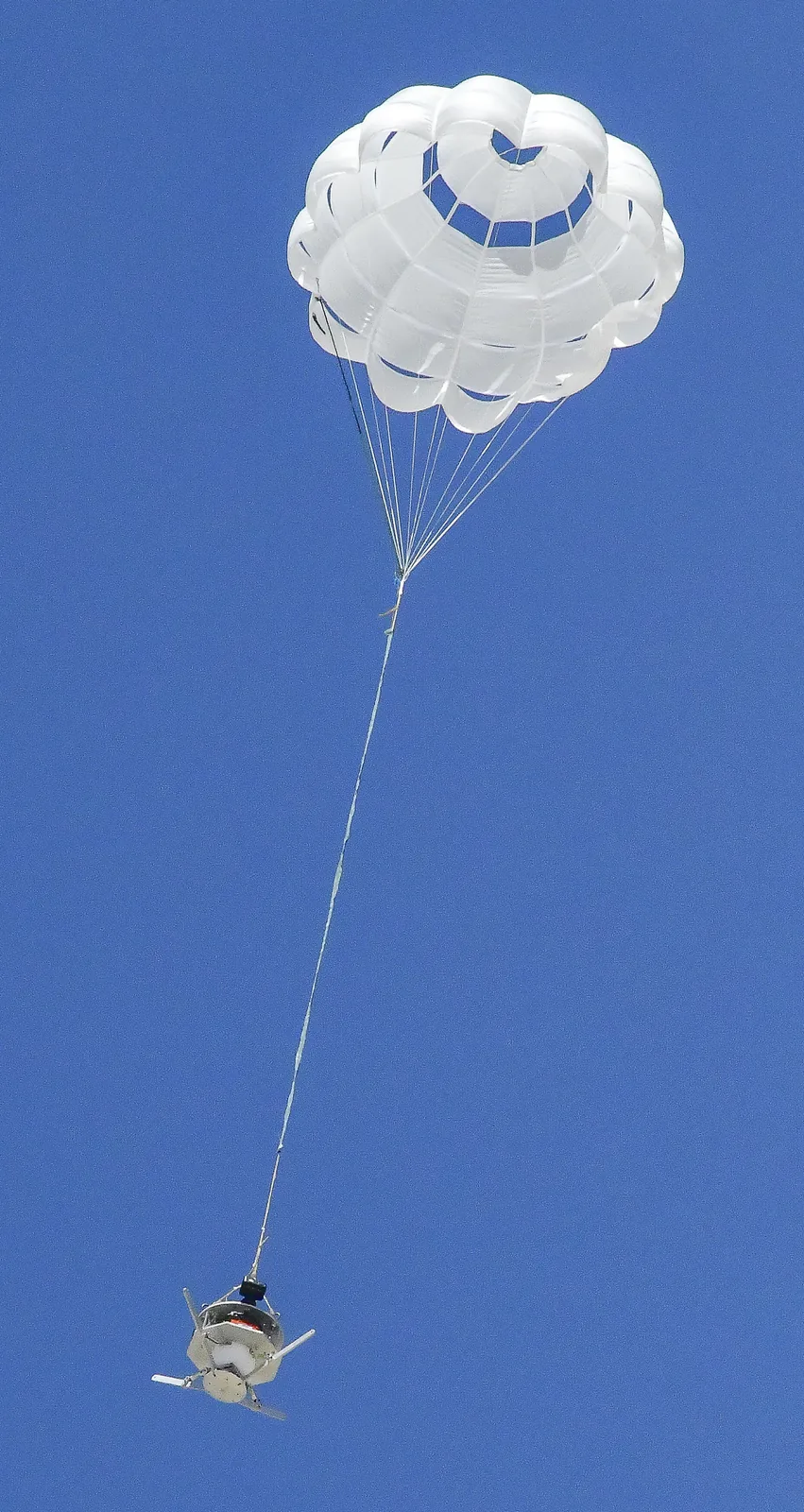
Air resistance differs from sliding friction in that it depends on speed. Air resistance does not act at all on an object that is at rest relative to the air, and it grows quickly when the speed of the object relative to the air grows. At the same speed, air resistance is greater the larger the cross-sectional area of the object and the worse the air can flow past it. At the same speed, the resistance in water is much greater than in air, because water is denser.
The three stages of a fall
The skydiver starts from rest relative to the air (the speed of the plane is ignored), so right after the jump there is no air resistance yet. The only force is the weight, and the skydiver accelerates downward with the free-fall acceleration $g$. As the speed grows, air resistance grows. The weight stays the same, so the net force becomes smaller, and the acceleration becomes smaller with it: the speed grows more and more slowly. Finally the air resistance is equal to the weight. Then the net force is zero, the acceleration is zero and the speed stays constant, as Newton's first law says. This speed is called the terminal velocity.
Terminal velocity depends on mass and shape
At terminal velocity, air resistance is equal to the weight. A heavier skydiver has a greater weight, so the speed has time to grow greater before air resistance has grown to the size of the weight. In the graph, the curves of a $60\,\text{kg}$ and a $100\,\text{kg}$ skydiver falling in the same position start equally steep, but they level off at different speeds, in the values of the model at about $48\,\text{m/s}$ and $61\,\text{m/s}$. A skydiver diving head first has a smaller cross-sectional area and a more streamlined shape, so the terminal velocity is greater.
This gives the answer to the question at the start. The weight pulls the skydiver down all the time, but as the speed grows, air resistance grows until it cancels the weight. After that the speed no longer changes. Without air resistance, all objects would fall with the same acceleration $g$. In air, a light and wide object, such as a sheet of paper or a feather, reaches a small terminal velocity very soon and therefore falls slowly.
Equation of motion with air resistance
Air resistance is one of the forces acting on an object, so the motion follows Newton's second law. An object falling or rising through air is acted on by its weight and by air resistance:
$$\overline{G} + \overline{F}_\text{v} = m\overline{a}$$
where $\overline{G}$ is the weight of the object ($\text{N}$), $\overline{F}_\text{v}$ is the air resistance ($\text{N}$), $m$ is the mass of the object ($\text{kg}$) and $\overline{a}$ is its acceleration ($\text{m/s}^2$). In this chapter the magnitude of air resistance is not calculated from the speed, but it is given or deduced from the motion: at terminal velocity $F_\text{v} = G$.
A falling and a rising object
As always, first choose the object, draw its free-body diagram and choose the positive direction, and only then write the equation. The air resistance of a falling object points up, against the weight. When the positive direction is down, $mg - F_\text{v} = ma$, so the acceleration is smaller than $g$. The air resistance of a ball thrown upward points down, in the same direction as the weight. When the positive direction is up, $-mg - F_\text{v} = ma$. The magnitude of the acceleration is then greater than $g$, and the rising ball slows down faster than without air resistance.
When the parachute opens
The large area of the parachute makes air resistance many times greater. When the parachute opens, the skydiver is still moving downward at terminal velocity, so for a moment the air resistance is many times the weight. The net force and the acceleration point up, even though the skydiver is moving down: the skydiver slows down but does not rise. As the speed decreases, air resistance decreases until, at a new, small terminal velocity, it is again equal to the weight. How many times the weight the air resistance is depends on the parachute and the moment: in the diagram it is three times, in the example almost three times, and in the model of the simulation at most about five times. The direction of the net force can therefore differ from the direction of motion. It always tells the direction of the acceleration, not of the velocity.
Common misconception
In videos, the skydiver seems to rise upward when the parachute opens. The camera operator is still falling without a parachute, and the skydiver only slows down relative to the camera operator. Relative to the ground, the skydiver moves downward all the time: the net force points up for a moment, but it decreases the speed and does not turn the motion around. Another mistake is to think that at terminal velocity air resistance is greater than the weight or that there are no forces any more. At terminal velocity the forces are equal and opposite. A third mistake is to claim that a heavy object always falls faster. Without air resistance, everything falls with the same acceleration. In air, of objects of the same size and shape the heavier one reaches the greater terminal velocity.
Summary
- Resistance of the medium, in air air resistance $\overline{F}_\text{v}$, points against the velocity and grows when the speed grows. It is greater with a large cross-sectional area and a poorly streamlined shape.
- The acceleration of a falling object decreases as air resistance grows. At terminal velocity $F_\text{v} = G$, the net force is zero and the speed stays constant.
- Of objects of the same size and shape, the heavier one has the greater terminal velocity. A parachute lowers the terminal velocity to a safe one.
- The equation of motion is $\overline{G} + \overline{F}_\text{v} = m\overline{a}$. For a rising object, air resistance points down together with the weight, so the deceleration is greater than $g$.
- When the parachute opens, the net force and the acceleration point up even though the skydiver moves down: the direction of the net force can differ from the direction of motion.
Optional Return to your predictions
Compare your predictions with the measurements. What surprised you most? Write in your own words why the net force can point up although the skydiver is moving down.
Would you change your prediction?
Apply
Worked example
Problem
A skydiver whose mass with equipment is $85.0\,\text{kg}$ opens the parachute. At one moment while the parachute is opening, the air resistance is $2.40\,\text{kN}$, and the skydiver is still moving downward. What is the acceleration of the skydiver at this moment, and in which direction does it point?
Step 1/7
Given and find. $m = 85.0\,\text{kg}$, $F_\text{v} = 2.40\,\text{kN}$ and $g = 9.81\,\text{m/s}^2$. We want the acceleration $a$ and its direction.
Step 2/7
Principle. Choose the skydiver with the equipment and the parachute as the object. The Earth (weight) and the air (air resistance) act on it. By Newton's second law, the acceleration is determined by the sum of these forces; the direction of the velocity does not decide the direction of the acceleration.
Step 3/7
Rearranged formula. In the free-body diagram the skydiver is a rectangle. The weight $\overline{G}$ starts from the centre and points down. Air resistance $\overline{F}_\text{v}$ acts mainly on the parachute, so it starts from the top surface and points up. The positive direction is chosen down, the direction of motion.
From the diagram we write the net force $mg - F_\text{v}$ and solve the acceleration:
$$\begin{aligned} &mg - F_\text{v} = ma \\ &a = \frac{mg - F_\text{v}}{m} \end{aligned}$$
Step 4/7
Unit conversions. Air resistance is converted to newtons:
Step 5/7
Substitution. First calculate the weight and then the acceleration:
$$\begin{aligned} a &= \frac{mg - F_\text{v}}{m} \\ mg &= 85.0\,\text{kg}\cdot 9.81\,\tfrac{\text{m}}{\text{s}^2} \\ \phantom{mg} &= 833.85\,\text{N} \\ a &= \frac{833.85\,\text{N} - 2400\,\text{N}}{85.0\,\text{kg}} \\ \phantom{a} &\approx -18.4\,\text{m/s}^2 \end{aligned}$$
Step 6/7
Result. The acceleration is negative, so it points up, opposite to the direction chosen as positive. The magnitude of the acceleration is $18.4\,\text{m/s}^2$ upward, given with three significant figures like the mass $85.0\,\text{kg}$ and the air resistance $2.40\,\text{kN}$. The skydiver moves down, but the speed decreases.
Step 7/7
Reasonableness. Air resistance is almost three times the weight $834\,\text{N}$, so about two weights of net force remain upward. The acceleration must therefore be about two times $g$, or about $20\,\text{m/s}^2$, and the result $18.4\,\text{m/s}^2$ fits this. To the skydiver, the opening of the parachute feels like a strong jerk, but it lasts only a few seconds.
Choose the correct free-body diagram
Optional Apply to a new situation
A snowboarder rides straight down a steep slope that is at an angle of $30.0^\circ$ to the horizontal. The mass of the snowboarder with equipment is $75.0\,\text{kg}$, and the friction force of the snow on the board is $64.0\,\text{N}$. The snowboarder has reached terminal velocity and rides at a constant speed.
What is the air resistance? Give the answer in newtons.
Hint 1: a guiding question
What is the net force when the speed is constant? Which forces act along the slope?
Hint 2: what is the connection
Choose the downhill direction as positive. Along the slope act the component of the weight $mg\sin\alpha$ downhill and friction and air resistance uphill: $mg\sin\alpha - F_\mu - F_\text{v} = 0$.
Hint 3: an intermediate step
Subtract the friction force from it.
Show the solution
Given
$m = 75.0\,\text{kg}$, angle of the slope $\alpha = 30.0^\circ$, friction force $F_\mu = 64.0\,\text{N}$, the speed is constant; $g = 9.81\,\text{m/s}^2$
Find
the air resistance $F_\text{v}$ in $\text{N}$
Principle
The speed is constant, so by Newton's second law the net force is zero both along the slope and perpendicular to it. Along the slope the component of the weight takes the snowboarder downhill, and friction and air resistance oppose the motion. Terminal velocity is the speed at which these cancel each other.
Free-body diagram
The snowboarder as a rectangle along the slope, positive $x$-direction downhill. The weight $\overline{G}$ from the centre straight down, the normal force of the snow $\overline{N}$ from the bottom surface perpendicular to the slope, the friction force $\overline{F}_\mu$ from the edge of the bottom surface uphill and the air resistance $\overline{F}_\text{v}$ uphill. The components of the weight with dashed lines.
Formula
$mg\sin\alpha - F_\mu - F_\text{v} = 0$, so $F_\text{v} = mg\sin\alpha - F_\mu$
Conversions
The quantities are in SI units, and the angle is in degrees with the calculator in degree mode, so no conversions are needed.
Substitution
Answer
$304\,\text{N}$
Uphill, three significant figures like the mass $75.0\,\text{kg}$, the angle $30.0^\circ$ and the friction force $64.0\,\text{N}$.
Reasonableness
Since $\sin 30^\circ = 0.5$, the component of the weight along the slope is half of the weight $736\,\text{N}$, or about $370\,\text{N}$. Air resistance cancels the part of it that friction does not cancel, and is therefore much smaller than the weight. Without friction the air resistance at terminal velocity would be $368\,\text{N}$.
Check your understanding
Exit ticket
Answer on your own first and only then open the answer.
- Two balls of the same size, a light plastic ball and a heavy wooden ball, are dropped at the same time from the top of a tall tower. Which hits the ground first, and why?
Answer
The heavy wooden ball. At the start both accelerate with the acceleration $g$, but as the speed grows, air resistance reduces the acceleration of the light ball more, because its weight is smaller. Balls of the same size have the same air resistance at the same speed, so the terminal velocity of the light ball is smaller.
- Why is the magnitude of the acceleration of a ball thrown upward greater than $9.81\,\text{m/s}^2$ during the rise, when air resistance is not ignored?
Answer
During the rise air resistance points against the velocity, that is down, in the same direction as the weight. The net force $mg + F_\text{v}$ is greater than the weight, so the magnitude of the acceleration $g + \tfrac{F_\text{v}}{m}$ is greater than $g$.
- Name two ways in which a skydiver can lower the terminal velocity, and explain why they work.
Answer
The skydiver can turn belly down and spread the arms and legs, which increases the cross-sectional area, or open the parachute. Both increase the air resistance at the same speed, so the air resistance grows to the size of the weight already at a smaller speed.
1. Concept
2. Calculation
After the parachute has opened, a skydiver whose mass with equipment is $64.0\,\text{kg}$ descends at a constant speed of $5.5\,\text{m/s}$.
What is the air resistance? Give the answer in newtons.
Hint 1: a guiding question
What is the acceleration when the speed is constant? What does it tell about the net force?
Hint 2: what is the connection
Draw the free-body diagram: the weight down and the air resistance up. When the positive direction is down, $mg - F_\text{v} = 0$.
Hint 3: an intermediate step
The speed $5.5\,\text{m/s}$ is not needed: $F_\text{v} = mg$.
Show the solution
Given
$m = 64.0\,\text{kg}$, the speed is constant $5.5\,\text{m/s}$; $g = 9.81\,\text{m/s}^2$
Find
the air resistance $F_\text{v}$ in $\text{N}$
Principle
The speed is constant, so the acceleration is zero and by Newton's second law the net force is zero. The skydiver falls at a new, small terminal velocity at which air resistance cancels the weight.
Free-body diagram
The skydiver with the parachute as a rectangle, positive direction down. The weight $\overline{G}$ from the centre down and the air resistance $\overline{F}_\text{v}$ from the top surface up, equally long. The velocity down is marked separately and not as a force.
Formula
$mg - F_\text{v} = 0$, so $F_\text{v} = mg$
Conversions
The mass is in kilograms. The speed is not needed, so it is not converted.
Substitution
Answer
$628\,\text{N}$
Upward, three significant figures like the mass $64.0\,\text{kg}$.
Reasonableness
The air resistance is equal to that in the fall before the parachute is opened at terminal velocity, about $630\,\text{N}$, although the speed is a tenth of it. The large area of the parachute produces the same force at a much smaller speed. The weight of a kilogram is about $10\,\text{N}$, so $64\,\text{kg}$ corresponds to about $640\,\text{N}$.
Suggestion: one answer does not show everything you can do, but review the theory summary and do the core exercises.
3. Draw it yourself
A rubber ball is thrown from a high bridge straight down at such a great speed that it is greater than the terminal velocity of the ball. The ball still falls down but slows down. Draw the free-body diagram of the ball on paper: the ball as a rectangle and each force from its point of action. Mark the directions of the velocity and the acceleration separately next to the diagram. Then write the equation of motion when the positive direction is down.
Model diagram
Only the Earth (weight $\overline{G}$) and the air (air resistance $\overline{F}_\text{v}$) act on the ball. The hand no longer touches the ball, so there is no force of the throw. The ball moves down, so air resistance points up. The ball slows down, so its acceleration points up, against the velocity, and the net force must point up: air resistance is greater than the weight. When the positive direction is down, the equation of motion is $mg - F_\text{v} = ma$, and $a$ is negative. As the speed decreases, air resistance decreases until at terminal velocity $F_\text{v} = mg$ and the ball falls at a steady speed.
Assess your own answer
Tick the points your own answer already contains.
Review the theory summary and practise with the exercises.
Review the chapter's concepts
Cards you mark Review later collect in your review deck.
- Drag of the medium
- A gas or liquid exerts a force on a moving object that opposes its motion.
- Air resistance
- The drag force of the air on an object usually grows with the speed.
- Terminal velocity
- The constant velocity reached when the drag and the other forces along the motion cancel.
Exercises
Level 1 · basic practice 8 exercises
One formula or one step of reasoning. Core exercises first, the rest is extra practice.
- Exercise 9-1Core
A skydiver whose mass with equipment is $75.0\,\text{kg}$ falls belly down at terminal velocity. Draw the free-body diagram of the skydiver. What is the air resistance?
Answer
$736\,\text{N}$
Show the solution
Given
$m = 75.0\,\text{kg}$, the skydiver falls at terminal velocity; $g = 9.81\,\text{m/s}^2$
Find
the air resistance $F_\text{v}$ in $\text{N}$
Principle
At terminal velocity the speed does not change, so the acceleration is zero. By Newton's second law the net force is then zero, even though the skydiver is moving: air resistance cancels the weight.
Free-body diagram
The skydiver as a rectangle, positive direction down. The weight $\overline{G}$ from the centre down and the air resistance $\overline{F}_\text{v}$ from the bottom surface up, equally long. The velocity is not drawn as a force.
Formula
$mg - F_\text{v} = 0$, so $F_\text{v} = mg$
Conversions
The mass is in kilograms, so no conversions are needed.
Substitution
$F_\text{v}$$= 75.0\,\text{kg}\cdot 9.81\,\text{m/s}^2$$= 735.75\,\text{N}$Answer
$736\,\text{N}$
Upward, three significant figures like the mass $75.0\,\text{kg}$.
Reasonableness
The weight of one kilogram is about $10\,\text{N}$, so the weight of a $75\,\text{kg}$ skydiver is about $750\,\text{N}$, and at terminal velocity the air resistance is equal to it. Air resistance is not greater than the weight, because then the skydiver would slow down.
- Exercise 9-2Core
A stone whose mass is $2.00\,\text{kg}$ falls vertically down. At one moment the air resistance is $5.00\,\text{N}$.
What is the net force acting on the stone at this moment?
Answer
$14.6\,\text{N}$
Show the solution
Given
$m = 2.00\,\text{kg}$, air resistance $F_\text{v} = 5.00\,\text{N}$, the stone is falling down; $g = 9.81\,\text{m/s}^2$
Find
the net force $\Sigma F$ in $\text{N}$
Principle
The Earth (weight) and the air (air resistance) act on the stone. The air resistance of a falling stone points against the velocity, that is up, so the net force is the difference of the weight and the air resistance.
Free-body diagram
The stone as a rectangle, positive direction down. The weight $\overline{G}$ from the centre down and the air resistance $\overline{F}_\text{v}$ from the bottom surface up, shorter than the weight.
Formula
$\Sigma F = G - F_\text{v}$, and $G = mg$, so $\Sigma F = mg - F_\text{v}$
Conversions
The mass is in kilograms and the force in newtons, so no conversions are needed.
Substitution
$\Sigma F$$= 2.00\,\text{kg}\cdot 9.81\,\text{m/s}^2 - 5.00\,\text{N}$$= 19.62\,\text{N} - 5.00\,\text{N}$$= 14.62\,\text{N}$Answer
$14.6\,\text{N}$
Downward, three significant figures like the mass $2.00\,\text{kg}$ and the air resistance $5.00\,\text{N}$.
Reasonableness
The net force is smaller than the weight $19.6\,\text{N}$ but positive, so the stone is still accelerating downward, now more slowly than without air. The net force decreases as the speed grows, because air resistance grows.
- Exercise 9-3
A basketball whose mass is $0.600\,\text{kg}$ is thrown straight down at a high speed. Right after the throw the air resistance is $8.00\,\text{N}$.
What is the magnitude of the acceleration of the ball at this moment, and in which direction does the acceleration point?
Answer
$3.52\,\text{m/s}^2$
Show the solution
Given
$m = 0.600\,\text{kg}$, air resistance $F_\text{v} = 8.00\,\text{N}$, the ball has been thrown down and is moving down; $g = 9.81\,\text{m/s}^2$
Find
the acceleration $a$ of the ball in $\text{m/s}^2$ and its direction
Principle
By Newton's second law the acceleration is determined by the net force. The ball moves down, so the air resistance points up, against the velocity. Air resistance is greater than the weight, so the net force points up even though the ball is moving down.
Free-body diagram
The ball as a rectangle, positive direction down. The weight $\overline{G}$ from the centre down and the air resistance $\overline{F}_\text{v}$ from the bottom surface up, longer than the weight.
Formula
$mg - F_\text{v} = ma$, so $a = \dfrac{mg - F_\text{v}}{m}$
Conversions
The quantities are in SI units, and $\tfrac{\text{N}}{\text{kg}} = \tfrac{\text{m}}{\text{s}^2}$, so no conversions are needed.
Substitution
$a$$= \dfrac{0.600\,\text{kg}\cdot 9.81\,\text{m/s}^2 - 8.00\,\text{N}}{0.600\,\text{kg}}$$= \dfrac{5.886\,\text{N} - 8.00\,\text{N}}{0.600\,\text{kg}}$$= -3.523\,\text{m/s}^2$Answer
$3.52\,\text{m/s}^2$
Upward, three significant figures like the mass $0.600\,\text{kg}$ and the air resistance $8.00\,\text{N}$. The minus sign tells that the acceleration points up.
Reasonableness
Air resistance is about $1.4$ times the weight $5.9\,\text{N}$, so about $2\,\text{N}$ remains upward and the acceleration is about $2\,\text{N} : 0.6\,\text{kg} \approx 3.5\,\text{m/s}^2$. The ball slows down until the air resistance has decreased to the size of the weight.
- Exercise 9-4
A football whose mass is $0.450\,\text{kg}$ has been kicked straight upward, and it is still rising. At one moment the air resistance is $1.20\,\text{N}$. Draw the free-body diagram of the ball.
What is the net force acting on the ball at this moment?
Answer
$5.61\,\text{N}$
Show the solution
Given
$m = 0.450\,\text{kg}$, air resistance $F_\text{v} = 1.20\,\text{N}$, the ball is rising; $g = 9.81\,\text{m/s}^2$
Find
the magnitude of the net force $\Sigma F$ in $\text{N}$
Principle
After the foot has left the ball, only the Earth (weight) and the air (air resistance) act on the ball. The rising ball moves up, so the air resistance points down, in the same direction as the weight. There is no force carrying the ball upward.
Free-body diagram
The ball as a rectangle, positive direction up. The weight $\overline{G}$ from the centre down and the air resistance $\overline{F}_\text{v}$ from the top surface down. The velocity up is marked separately next to the diagram.
Formula
$\Sigma F$$= -G - F_\text{v}$$= -mg - F_\text{v}$so the magnitude of the net force is $|\Sigma F| = mg + F_\text{v}$
Conversions
The mass is in kilograms and the force in newtons, so no conversions are needed.
Substitution
$|\Sigma F|$$= 0.450\,\text{kg}\cdot 9.81\,\text{m/s}^2 + 1.20\,\text{N}$$= 4.4145\,\text{N} + 1.20\,\text{N}$$= 5.6145\,\text{N}$Answer
$5.61\,\text{N}$
Downward, three significant figures like the mass $0.450\,\text{kg}$ and the air resistance $1.20\,\text{N}$.
Reasonableness
The net force is greater than the weight $4.41\,\text{N}$, because the air resistance pulls in the same direction. That is why a rising ball slows down faster than without air. The net force points down even though the ball is moving up.
- Exercise 9-5
A cyclist rides on a horizontal road at a constant speed. The air resistance is $18\,\text{N}$, and the rolling resistance (the resistance caused by the tyres and the road) is $6.0\,\text{N}$ in total.
What is the friction force of the road that pushes the driving wheel forward?
Answer
$24\,\text{N}$
Show the solution
Given
the speed is constant, air resistance $F_\text{v} = 18\,\text{N}$, rolling resistance (the resistance caused by the tyres and the road) $F_\text{r} = 6.0\,\text{N}$
Find
the friction force of the road $F$ that pushes the driving wheel forward, in $\text{N}$
Principle
In uniform motion the acceleration is zero, so by Newton's second law the net force is zero. In the horizontal direction, the friction force of the road, with which the road pushes the driving wheel forward, must cancel both resistive forces; the rolling resistance is a separate resistive force here. In the vertical direction the weight and the normal force of the road cancel each other.
Free-body diagram
The cyclist and the bicycle as one rectangle, positive direction forward. The weight $\overline{G}$ from the centre down and the normal force of the road $\overline{N}$ from the bottom surface up, equally long. The friction force of the road $\overline{F}$ from the bottom surface of the driving wheel forward, the air resistance $\overline{F}_\text{v}$ and the rolling resistance $\overline{F}_\text{r}$ backward.
Formula
$F - F_\text{v} - F_\text{r} = 0$, so $F = F_\text{v} + F_\text{r}$
Conversions
All forces are in newtons, so no conversions are needed.
Substitution
$F$$= 18\,\text{N} + 6.0\,\text{N}$$= 24\,\text{N}$Answer
$24\,\text{N}$
Forward, two significant figures like the air resistance $18\,\text{N}$.
Reasonableness
The force forward is equal to the resistive forces together, not greater, because the speed does not grow. A force of a few tens of newtons fits ordinary cycling on a level road; most of it goes to air resistance.
- Exercise 9-6
An object falls in air and has reached its terminal velocity. Which of the following describes the situation correctly?
Answer
Air resistance and the weight are equal, because the net force is zero
Show the solution
Find
which statement correctly describes a falling object that has reached its terminal velocity.
Principle
At terminal velocity the speed of the object does not change, so the acceleration is zero. By Newton's second law the net force is then zero, even though the object is moving. The weight down and the air resistance up still act on the object.
Model answer
The correct statement is that the air resistance and the weight are equal and the net force is zero. If the air resistance were greater than the weight, the net force would point up and the object would slow down. If the weight were greater, the net force would point down and the speed would grow. The claim that no forces act at all is wrong, because the speed stays constant only since two forces cancel each other. The direction of motion does not tell the magnitudes of the forces.
- Exercise 9-7
Two balls of the same size and shape are dropped from a great height in air. One is filled with sand and the other is empty.
Which ball reaches the greater terminal velocity?
Answer
The sand ball, because a greater air resistance is needed to cancel the greater weight
Show the solution
Find
which of the balls of the same size and shape, the one filled with sand or the empty one, reaches the greater terminal velocity.
Principle
At terminal velocity the air resistance is equal to the weight. About the same air resistance acts on balls of the same size and shape at the same speed, and the air resistance grows as the speed grows.
Model answer
The sand ball reaches the greater terminal velocity. Its weight is greater, so the air resistance must grow greater before it cancels the weight. Air resistance grows only as the speed grows, so the heavier ball has to accelerate to a greater speed. The empty ball levels off at a smaller speed, because its weight is smaller. The claim that all objects fall in the same way holds only without air resistance. In air the difference in weight shows in the terminal velocity.
- Exercise 9-8
The mass of a skydiver with equipment is $60.0\,\text{kg}$. When the parachute opens, the skydiver is still moving downward, and the air resistance is $1500\,\text{N}$.
A student solved the magnitude of the net force like this: “The skydiver moves down, so the net force points down and its magnitude is $mg + F_\text{v} = 2089\,\text{N}$.”
Find the error in the student's thinking and calculate the magnitude of the net force correctly. The answer box takes the correct magnitude of the net force.
Answer
$911\,\text{N}$
Show the solution
Given
$m = 60.0\,\text{kg}$, air resistance $F_\text{v} = 1500\,\text{N}$, the skydiver moves down; the student's result $2089\,\text{N}$; $g = 9.81\,\text{m/s}^2$
Find
the magnitude of the net force $\Sigma F$ in $\text{N}$ and the student's error
Principle
The net force is the sum of the forces acting on the object, and its direction is the direction of the acceleration, not the direction of the motion. Air resistance points against the velocity, that is up, even though the skydiver moves down. The student added the air resistance to the weight, as if it pointed down with the motion.
Free-body diagram
The skydiver as a rectangle, positive direction down. The weight $\overline{G}$ from the centre down and the air resistance $\overline{F}_\text{v}$ from the bottom surface up, longer than the weight. The velocity down is marked separately next to the diagram.
Formula
$\Sigma F = mg - F_\text{v}$, and the magnitude of the net force is $|\Sigma F|$
Conversions
The mass is in kilograms and the force in newtons, so no conversions are needed.
Substitution
$\Sigma F$$= 60.0\,\text{kg}\cdot 9.81\,\text{m/s}^2 - 1500\,\text{N}$$= 588.6\,\text{N} - 1500\,\text{N}$$= -911.4\,\text{N}$Answer
$911\,\text{N}$
Upward (the minus sign tells the direction when the positive direction is down), three significant figures like the mass $60.0\,\text{kg}$.
Reasonableness
The air resistance $1500\,\text{N}$ is about $2.5$ times the weight $588.6\,\text{N}$, so about $1.5$ weights is left upward, that is about $900\,\text{N}$. The skydiver slows down but still moves down.
Level 2 · applied practice 7 exercises
Two steps, working with measured data, a unit conversion or rearranging a formula. Core exercises first, the rest is extra practice.
- Exercise 9-9Core
A shuttlecock whose mass is $5.10\,\text{g}$ falls at terminal velocity. What is the air resistance?
Answer
$0.0500\,\text{N}$
Show the solution
Given
$m = 5.10\,\text{g}$, the shuttlecock falls at terminal velocity; $g = 9.81\,\text{m/s}^2$
Find
the air resistance $F_\text{v}$ in $\text{N}$
Principle
At terminal velocity the speed does not change, so by Newton's second law the net force is zero: the air resistance is equal to the weight and points up.
Free-body diagram
The shuttlecock as a rectangle, positive direction down. The weight $\overline{G}$ from the centre down and the air resistance $\overline{F}_\text{v}$ from the bottom surface up, equally long.
Formula
$mg - F_\text{v} = 0$, so $F_\text{v} = mg$
Conversions
$5.10\,\text{g}$$= 5.10 : 1000\,\text{kg}$$= 5.10\cdot 10^{-3}\,\text{kg}$Substitution
$F_\text{v}$$= 5.10\cdot 10^{-3}\,\text{kg}\cdot 9.81\,\text{m/s}^2$$= 0.050031\,\text{N}$Answer
$0.0500\,\text{N}$
Or $50.0\,\text{mN}$ upward, three significant figures like the mass $5.10\,\text{g}$.
Reasonableness
The weight of five grams is about $0.05\,\text{N}$, so the result is of the right order of magnitude. If the grams were not converted, the result would be a thousand times greater, about $50\,\text{N}$, which is the weight of five kilograms and far too much for a shuttlecock.
- Exercise 9-10Core
A skydiver whose mass with equipment is $70.0\,\text{kg}$ falls belly down. At one moment the acceleration is $6.00\,\text{m/s}^2$ downward.
What is the air resistance acting on the skydiver at this moment?
Answer
$267\,\text{N}$
Show the solution
Given
$m = 70.0\,\text{kg}$, acceleration $a = 6.00\,\text{m/s}^2$ downward; $g = 9.81\,\text{m/s}^2$
Find
the air resistance $F_\text{v}$ in $\text{N}$
Principle
The acceleration of the skydiver is smaller than $g$, so some force opposes the weight: air resistance, up. By Newton's second law the net force $G - F_\text{v}$ is the mass times the acceleration, and the air resistance is solved from it.
Free-body diagram
The skydiver as a rectangle, positive direction down. The weight $\overline{G}$ from the centre down and the air resistance $\overline{F}_\text{v}$ from the bottom surface up, shorter than the weight. The acceleration down is marked separately next to the diagram.
Formula
$mg - F_\text{v} = ma$, so $F_\text{v} = mg - ma = m(g - a)$
Conversions
The quantities are in SI units, so no conversions are needed.
Substitution
$F_\text{v}$$= 70.0\,\text{kg}\cdot(9.81\,\text{m/s}^2 - 6.00\,\text{m/s}^2)$$= 70.0\,\text{kg}\cdot 3.81\,\text{m/s}^2$$= 266.7\,\text{N}$Answer
$267\,\text{N}$
Upward, three significant figures like the mass $70.0\,\text{kg}$ and the acceleration $6.00\,\text{m/s}^2$.
Reasonableness
The weight of the skydiver is about $690\,\text{N}$. The acceleration is about $60\,\%$ of the free-fall acceleration, so air resistance cancels about $40\,\%$ of the weight, about $270\,\text{N}$. The skydiver is not yet at terminal velocity, because the air resistance is smaller than the weight.
- Exercise 9-11
A tennis ball whose mass is $57.0\,\text{g}$ is hit straight upward. While the ball rises, the air resistance at one moment is $0.250\,\text{N}$.
What is the acceleration of the ball at this moment?
Answer
$14.2\,\text{m/s}^2$
Show the solution
Given
$m = 57.0\,\text{g}$, air resistance $F_\text{v} = 0.250\,\text{N}$, the ball is rising; $g = 9.81\,\text{m/s}^2$
Find
the magnitude of the acceleration $a$ in $\text{m/s}^2$
Principle
After the racket has hit the ball, only the weight and the air resistance act on it. The air resistance of a rising ball points against the velocity, that is down, in the same direction as the weight, so both slow down the rise.
Free-body diagram
The ball as a rectangle, positive direction up. The weight $\overline{G}$ from the centre down and the air resistance $\overline{F}_\text{v}$ from the top surface down. The velocity up and the acceleration down are marked separately.
Formula
$-mg - F_\text{v} = ma$, so
$a$$= -\dfrac{mg + F_\text{v}}{m}$$= -\left(g + \dfrac{F_\text{v}}{m}\right)$Conversions
$57.0\,\text{g}$$= 57.0 : 1000\,\text{kg}$$= 0.0570\,\text{kg}$Substitution
$a$$= -\left(9.81\,\text{m/s}^2 + \dfrac{0.250\,\text{N}}{0.0570\,\text{kg}}\right)$$= -(9.81\,\text{m/s}^2 + 4.386\,\text{m/s}^2)$$= -14.196\,\text{m/s}^2$Answer
$14.2\,\text{m/s}^2$
Downward, three significant figures like the mass $57.0\,\text{g}$ and the air resistance $0.250\,\text{N}$. The minus sign tells that the acceleration points down.
Reasonableness
The magnitude of the acceleration is greater than $g$, because air resistance and weight pull in the same direction. For a light ball even a small air resistance is significant: $0.25\,\text{N}$ is almost half of the weight of the ball, $0.56\,\text{N}$.
- Exercise 9-12
A car whose mass is $1200\,\text{kg}$ drives on a horizontal road at a constant speed of $100\,\text{km/h}$. The air resistance is $450\,\text{N}$ and the rolling resistance (the resistance caused by the tyres and the road) is $180\,\text{N}$ in total. The driver presses the clutch pedal to the floor, and the engine no longer drives the car.
What is the deceleration of the car right after this?
Answer
$0.525\,\text{m/s}^2$
Show the solution
Given
$m = 1200\,\text{kg}$, air resistance $F_\text{v} = 450\,\text{N}$, rolling resistance $F_\text{r} = 180\,\text{N}$, the engine is not driving; speed $100\,\text{km/h}$ (not needed)
Find
the deceleration, that is the magnitude of the acceleration $a$, in $\text{m/s}^2$
Principle
When the engine no longer drives, there is no force forward. In the horizontal direction only the resistive forces backward remain, and by Newton's second law they give the car an acceleration backward. Right after the clutch is pressed the air resistance is the same as before, because the speed has not yet had time to change.
Free-body diagram
The car as a rectangle, positive direction in the direction of motion. The weight $\overline{G}$ from the centre down and the normal force of the road $\overline{N}$ from the bottom surface up, equally long. The air resistance $\overline{F}_\text{v}$ and the rolling resistance $\overline{F}_\text{r}$ backward. There is no force forward.
Formula
$-F_\text{v} - F_\text{r} = ma$, so
$a$$= -\dfrac{F_\text{v} + F_\text{r}}{m}$Conversions
The speed is not needed in the calculation, so it is not converted. The forces are in newtons and the mass in kilograms.
Substitution
$a$$= -\dfrac{450\,\text{N} + 180\,\text{N}}{1200\,\text{kg}}$$= -\dfrac{630\,\text{N}}{1200\,\text{kg}}$$= -0.525\,\text{m/s}^2$Answer
$0.525\,\text{m/s}^2$
Three significant figures, when the numbers of the task $450\,\text{N}$, $180\,\text{N}$ and $1200\,\text{kg}$ are read as three-digit values.
Reasonableness
The resistive forces are together only about $5\,\%$ of the weight of the car, $11.8\,\text{kN}$, so the deceleration is about $5\,\%$ of the free-fall acceleration, $0.5\,\text{m/s}^2$. A car rolling in neutral slows down slowly, which agrees with experience. As the speed decreases, the air resistance decreases, so the deceleration also becomes smaller later.
- Exercise 9-13
The mass of a foam ball is $20.0\,\text{g}$. The ball is dropped from rest, and its speed is measured from a video. The table is example data.
Determine the acceleration of the ball at the moment $t = 0.60\,\text{s}$ as the slope from the table points $t = 0.40\,\text{s}$ and $t = 0.80\,\text{s}$. What is the air resistance acting on the ball at this moment?
Speed of a dropped foam ball (example data) $t\,(\text{s})$ $v\,(\text{m/s})$ 0.00 0.00 0.20 1.85 0.40 3.35 0.60 4.45 0.80 5.15 1.00 5.55 1.20 5.75 1.40 5.80 Answer
$0.106\,\text{N}$
Show the solution
Given
$m = 20.0\,\text{g}$; from the table $v_1 = 3.35\,\text{m/s}$ at $t_1 = 0.40\,\text{s}$ and $v_2 = 5.15\,\text{m/s}$ at $t_2 = 0.80\,\text{s}$; $g = 9.81\,\text{m/s}^2$
Find
the air resistance $F_\text{v}$ at the moment $t = 0.60\,\text{s}$ in $\text{N}$
Principle
The acceleration is the slope of the $(t,v)$ graph. The slope between the points on either side of the moment $0.60\,\text{s}$ gives the acceleration at that moment. Only the weight and the air resistance act on the ball, so Newton's second law gives the air resistance.
Reading the graph
The points $(0.40\,\text{s}$; $3.35\,\text{m/s})$ and $(0.80\,\text{s}$; $5.15\,\text{m/s})$ are symmetrically on both sides of the moment $0.60\,\text{s}$, and the slope of the line drawn through them is the acceleration. The points are far apart, so the error of a single measurement has little effect.
Free-body diagram
The ball as a rectangle, positive direction down. The weight $\overline{G}$ from the centre down and the air resistance $\overline{F}_\text{v}$ from the bottom surface up, shorter than the weight.
Formula
$a = \dfrac{v_2 - v_1}{t_2 - t_1}$ and $mg - F_\text{v} = ma$, so $F_\text{v} = m(g - a)$
Conversions
$m$$= 20.0\,\text{g}$$= 20.0 \cdot 10^{-3}\,\text{kg}$$= 0.0200\,\text{kg}$Substitution
$a$$= \dfrac{5.15\,\text{m/s} - 3.35\,\text{m/s}}{0.80\,\text{s} - 0.40\,\text{s}}$$= 4.50\,\text{m/s}^2$$F_\text{v}$$= 0.0200\,\text{kg}\cdot(9.81\,\text{m/s}^2 - 4.50\,\text{m/s}^2)$$= 0.0200\,\text{kg}\cdot 5.31\,\text{m/s}^2$$= 0.1062\,\text{N}$Answer
$0.106\,\text{N}$
Upward, three significant figures like the mass $20.0\,\text{g}$ and the speeds.
Reasonableness
The weight of the ball is $0.0200\,\text{kg}\cdot 9.81\,\text{m/s}^2 = 0.196\,\text{N}$, and the air resistance $0.106\,\text{N}$ is about half of it. The acceleration $4.50\,\text{m/s}^2$ is about half of the free-fall acceleration, as it should be. At the end of the table the speed is almost constant, $5.8\,\text{m/s}$, and then the air resistance is close to the weight $0.196\,\text{N}$.
- Exercise 9-14
Students dropped paper cones from a great height. The cones had the same shape, but their mass grew when several were nested inside each other. In the experiment the speed of each cone was measured once it had stopped accelerating. The table is example data.
a) What is the air resistance acting on cone 4 at terminal velocity?
b) How many times greater is this air resistance than the one acting on cone 1, and what does the comparison tell about the dependence of air resistance on speed?
The answer box takes the result of part a).
Terminal velocities of paper cones (example data) Cone $m\,(\text{g})$ $v_\text{terminal}\,(\text{m/s})$ 1 1.2 0.72 2 2.4 1.05 3 3.6 1.28 4 4.8 1.49 Answer
$0.047\,\text{N}$
Show the solution
Given
from the table cone 4: $m_4 = 4.8\,\text{g}$ and $v_4 = 1.49\,\text{m/s}$; cone 1: $m_1 = 1.2\,\text{g}$ and $v_1 = 0.72\,\text{m/s}$; the cones are at terminal velocity; $g = 9.81\,\text{m/s}^2$
Find
a) the air resistance $F_\text{v}$ acting on cone 4 at terminal velocity in $\text{N}$; b) how many times greater it is than the one acting on cone 1
Principle
When the cone no longer accelerates, its net force is zero. At terminal velocity the air resistance is therefore equal to the weight. The speed is not needed to calculate the air resistance, the mass is enough.
Free-body diagram
The cone as a rectangle, positive direction down. The weight $\overline{G}$ from the centre down and the air resistance $\overline{F}_\text{v}$ from the bottom surface up, equally long.
Formula
$mg - F_\text{v} = 0$, so $F_\text{v} = mg$
Conversions
$m_4$$= 4.8\,\text{g}$$= 4.8 \cdot 10^{-3}\,\text{kg}$Substitution
a)
$F_\text{v}$$= 4.8 \cdot 10^{-3}\,\text{kg}\cdot 9.81\,\text{m/s}^2$$= 0.047088\,\text{N}$b) The ratio of the air resistances is the same as the ratio of the masses: $4.8\,\text{g} : 1.2\,\text{g} = 4.0$. The ratio of the speeds is $1.49\,\text{m/s} : 0.72\,\text{m/s} = 2.1$.
Answer
a) $0.047\,\text{N}$ upward, two significant figures like the mass $4.8\,\text{g}$. b) The air resistance is $4.0$ times greater, but the speed only about $2.1$ times greater. So the air resistance grows faster than the speed: when the speed doubles, the air resistance grows about fourfold.
Reasonableness
The weight of the cone is about $5\,\text{g}$, and the weight of $1\,\text{g}$ is about $0.01\,\text{N}$, so the weight is about $0.05\,\text{N}$, and the air resistance at terminal velocity is equal to it. A heavier cone has a greater terminal velocity, as the data shows: the speeds grow from $0.72\,\text{m/s}$ to $1.49\,\text{m/s}$.
- Exercise 9-15
The table shows the downward speed of a skydiver as a function of time after the parachute has opened. The data is example data, and the skydiver moves downward all the time.
Which statement about the net force acting on the skydiver is correct?
Speed of the skydiver after the parachute opened (example data) $t\,(\text{s})$ $v\,(\text{m/s})$ 0.0 52.0 1.0 24.5 2.0 12.8 3.0 8.9 4.0 7.6 5.0 7.3 6.0 7.2 Answer
It points up at first and is almost zero at the end, because the speed decreases and levels off
Show the solution
Find
which statement about the net force acting on the skydiver is correct on the basis of the data in the table.
Principle
By Newton's second law the net force points in the direction of the acceleration, not the direction of the motion. The acceleration is the change of speed divided by time, so it is read from the change of speed in the table.
Model answer
In the table the downward speed decreases during the first second from $52.0\,\text{m/s}$ to $24.5\,\text{m/s}$, that is about $27.5\,\text{m/s}$ per second. The skydiver moves down but slows down, so the acceleration and the net force point up. The air resistance is then greater than the weight. At the end the speed is almost constant, $7.3\,\text{m/s}$ and $7.2\,\text{m/s}$, so the acceleration and the net force are almost zero and the air resistance is the size of the weight. The claim that the net force points down because the motion is down mixes up the directions of the force and the velocity. The claim that the net force would be zero all the time contradicts the changing speed.
Level 3 · challenging 5 exercises
Optional: application, two ideas together or a new situation where you reason for yourself.
- Exercise 9-16
A skydiver whose mass with equipment is $72.0\,\text{kg}$ falls belly down at terminal velocity. The skydiver quickly turns to a head-first position, and the air resistance at the same speed decreases to half of what it was.
What is the acceleration of the skydiver right after the change of position?
Answer
$4.91\,\text{m/s}^2$
Show the solution
Given
$m = 72.0\,\text{kg}$, at first terminal velocity, after the change of position the air resistance is half of the earlier value at the same speed; $g = 9.81\,\text{m/s}^2$
Find
the acceleration $a$ right after the change of position in $\text{m/s}^2$
Principle
At terminal velocity the air resistance is equal to the weight, because the net force is zero. Right after the change of position the speed is still the same, but the air resistance has decreased to half of the weight. The net force is no longer zero, and Newton's second law gives the acceleration.
Free-body diagram
The skydiver as a rectangle, positive direction down. Before the change, the weight $\overline{G}$ and the air resistance $\overline{F}_\text{v}$ are equally long. Right after the change, the weight from the centre down and the air resistance from the bottom surface up, half the length of the weight.
Formula
Before the change $F_\text{v} = mg$, so after the change $F_\text{v}' = \tfrac{1}{2}mg$. The equation of motion $mg - F_\text{v}' = ma$ gives
$a$$= \dfrac{mg - \tfrac{1}{2}mg}{m}$$= \dfrac{g}{2}$Conversions
The mass cancels out, so no conversions are needed.
Substitution
$a$$= \dfrac{9.81\,\text{m/s}^2}{2}$$= 4.905\,\text{m/s}^2$Answer
$4.91\,\text{m/s}^2$
Downward, three significant figures like the free-fall acceleration $9.81\,\text{m/s}^2$. The mass was not needed.
Reasonableness
Half of the weight is left uncancelled, so the acceleration is half of the free-fall acceleration. The skydiver starts to accelerate again until the air resistance has grown to the size of the weight in the new position, now at a greater terminal velocity.
- Exercise 9-17
A ball whose mass is $0.200\,\text{kg}$ is thrown straight up. At one moment during the rise the air resistance is $0.600\,\text{N}$. Later the ball falls back down, and at one moment the air resistance is again $0.600\,\text{N}$.
How much greater is the magnitude of the acceleration of the ball at the first moment than at the second?
Answer
$6.00\,\text{m/s}^2$
Show the solution
Given
$m = 0.200\,\text{kg}$, air resistance $F_\text{v} = 0.600\,\text{N}$ both on the way up and on the way down; $g = 9.81\,\text{m/s}^2$
Find
the difference of the magnitudes of the accelerations $\Delta a$ in $\text{m/s}^2$
Principle
Air resistance always points against the velocity. On the way up it points down together with the weight, on the way down up against the weight. Newton's second law gives the acceleration at both moments, and they are subtracted from each other.
Free-body diagram
Two diagrams, the ball as a rectangle. On the way up, the weight $\overline{G}$ from the centre down and the air resistance $\overline{F}_\text{v}$ from the top surface down. On the way down, the weight down and the air resistance from the bottom surface up. In both, the positive direction is down.
Formula
On the way up $mg + F_\text{v} = ma_1$, so $a_1 = g + \dfrac{F_\text{v}}{m}$. On the way down $mg - F_\text{v} = ma_2$, so $a_2 = g - \dfrac{F_\text{v}}{m}$. The difference is
$\Delta a$$= a_1 - a_2$$= \dfrac{2F_\text{v}}{m}$Conversions
The quantities are in SI units, so no conversions are needed.
Substitution
$\Delta a$$= \dfrac{2\cdot 0.600\,\text{N}}{0.200\,\text{kg}}$$= 6.00\,\text{m/s}^2$Answer
$6.00\,\text{m/s}^2$
Three significant figures like the mass $0.200\,\text{kg}$ and the air resistance $0.600\,\text{N}$.
Reasonableness
Calculated separately,
$a_1$$= 9.81\,\text{m/s}^2 + 3.00\,\text{m/s}^2$$= 12.81\,\text{m/s}^2$$a_2$$= 9.81\,\text{m/s}^2 - 3.00\,\text{m/s}^2$$= 6.81\,\text{m/s}^2$and their difference is $6.00\,\text{m/s}^2$. Both accelerations point down, but on the way up it is greater than $g$ and on the way down smaller.
- Exercise 9-18
A ball whose mass is $0.150\,\text{kg}$ is dropped from rest from a great height. The graph shows the speed of the ball as a function of time, and a tangent has been drawn to the point $P$ of the curve.
What is the air resistance acting on the ball at the moment corresponding to the point $P$?
Answer
$0.50\,\text{N}$
Show the solution
Given
$m = 0.150\,\text{kg}$, a graph of the speed of the ball as a function of time and a tangent at the point $P$; $g = 9.81\,\text{m/s}^2$
Find
the air resistance $F_\text{v}$ at the moment corresponding to the point $P$, in $\text{N}$
Principle
The acceleration is the slope of the $(t,v)$ graph. The slope of the curve at a given moment is the slope of its tangent. When the acceleration is known, Newton's second law gives the air resistance, because only the weight and the air resistance act on the ball.
Free-body diagram
The ball as a rectangle, positive direction down. The weight $\overline{G}$ from the centre down and the air resistance $\overline{F}_\text{v}$ from the bottom surface up, shorter than the weight.
Reading the graph
The tangent starts on the vertical axis at $(0$; $2.0\,\text{m/s})$ and passes through the grid crossing $(2.0\,\text{s}$; $15.0\,\text{m/s})$. These points are far apart and on the grid lines, so they are read accurately. The slope is read from the tangent, not from points of the curve.
Formula
$a = \dfrac{\Delta v}{\Delta t}$ and $mg - F_\text{v} = ma$, so $F_\text{v} = m(g - a)$
Conversions
The speeds are in $\text{m/s}$, the times in seconds and the mass in kilograms, so no conversions are needed.
Substitution
$a$$= \dfrac{15.0\,\text{m/s} - 2.0\,\text{m/s}}{2.0\,\text{s} - 0\,\text{s}}$$= 6.5\,\text{m/s}^2$$F_\text{v}$$= 0.150\,\text{kg}\cdot(9.81\,\text{m/s}^2 - 6.5\,\text{m/s}^2)$$= 0.150\,\text{kg}\cdot 3.31\,\text{m/s}^2$$= 0.4965\,\text{N}$Answer
$0.50\,\text{N}$
Upward, two significant figures, because the acceleration $6.5\,\text{m/s}^2$ read from the graph is given to two digits.
Reasonableness
The weight of the ball is $0.150\,\text{kg}\cdot 9.81\,\text{m/s}^2 \approx 1.5\,\text{N}$. The acceleration is about two thirds of the free-fall acceleration, so the air resistance cancels about a third of the weight, about $0.5\,\text{N}$. Later the curve flattens, the air resistance grows and approaches the weight.
- Exercise 9-19
The mass of a skydiver with equipment is $82.0\,\text{kg}$. The table shows the downward speed of the skydiver after the parachute opens. The data is example data.
a) What is the air resistance at the moment $t = 1.0\,\text{s}$? Estimate the acceleration from the points $t = 0.5\,\text{s}$ and $t = 1.5\,\text{s}$ and choose down as the positive direction.
b) How many times the weight is the air resistance then, and in which direction does the net force point? Explain why the skydiver nevertheless does not rise.
c) Deduce the air resistance at the end from the table and explain why the speed then stays constant.
The answer box takes the result of part a).
Speed of the skydiver after the parachute opened (example data) $t\,(\text{s})$ $v\,(\text{m/s})$ 0.0 50.0 0.5 33.0 1.0 22.0 1.5 15.5 2.0 11.5 3.0 7.6 4.0 6.2 5.0 5.7 6.0 5.6 Answer
$2240\,\text{N}$
Show the solution
Given
$m = 82.0\,\text{kg}$; from the table $v_1 = 33.0\,\text{m/s}$ at $t_1 = 0.5\,\text{s}$ and $v_2 = 15.5\,\text{m/s}$ at $t_2 = 1.5\,\text{s}$; at the end $v \approx 5.6\,\text{m/s}$; $g = 9.81\,\text{m/s}^2$; positive direction down
Find
a) the air resistance $F_\text{v}$ at the moment $t = 1.0\,\text{s}$ in $\text{N}$; b) the air resistance as a multiple of the weight and the direction of the net force; c) the air resistance at the end
Principle
The acceleration is the change of speed divided by time, and the points on either side of the moment $1.0\,\text{s}$ give it for that moment. Only the weight and the air resistance act on the skydiver, so Newton's second law gives the air resistance. The direction of the acceleration determines the direction of the net force.
Reading the graph
From the table we read the points $(0.5\,\text{s}$; $33.0\,\text{m/s})$ and $(1.5\,\text{s}$; $15.5\,\text{m/s})$, which are on both sides of the moment $1.0\,\text{s}$. The speed decreases, so the slope, that is the acceleration, is negative. The speeds at the end, $5.7\,\text{m/s}$ and $5.6\,\text{m/s}$, are almost the same, so the acceleration there is almost zero.
Free-body diagram
The skydiver as a rectangle, positive direction down. The weight $\overline{G}$ from the centre down and the air resistance $\overline{F}_\text{v}$ from the bottom surface up, clearly longer than the weight. The velocity down is marked separately next to the diagram.
Formula
$a = \dfrac{v_2 - v_1}{t_2 - t_1}$ and $mg - F_\text{v} = ma$, so $F_\text{v} = m(g - a)$. At the end $a = 0$, so $F_\text{v} = mg$.
Conversions
The speeds are in $\text{m/s}$, the times in seconds and the mass in kilograms, so no conversions are needed.
Substitution
a)
$a$$= \dfrac{15.5\,\text{m/s} - 33.0\,\text{m/s}}{1.5\,\text{s} - 0.5\,\text{s}}$$= -17.5\,\text{m/s}^2$$F_\text{v}$$= 82.0\,\text{kg}\cdot(9.81\,\text{m/s}^2 + 17.5\,\text{m/s}^2)$$= 82.0\,\text{kg}\cdot 27.31\,\text{m/s}^2$$= 2239.42\,\text{N}$b)
$mg$$= 82.0\,\text{kg}\cdot 9.81\,\text{m/s}^2$$= 804.42\,\text{N}$so
$F_\text{v} : mg$$= 2239.42\,\text{N} : 804.42\,\text{N}$$= 2.78$c) $F_\text{v} = mg = 804.42\,\text{N}$.
Answer
a) $2240\,\text{N}$ upward, three significant figures like the mass $82.0\,\text{kg}$. b) The air resistance is about $2.8$ times the weight. The net force $\Sigma F = mg - F_\text{v} = -1435\,\text{N}$ points up, because the acceleration is up. The skydiver does not rise, because the net force only decreases the downward speed: the speed is positive downward at every point of the table. c) The air resistance is about $804\,\text{N}$, the size of the weight. The speed stays constant, because the weight and the air resistance cancel each other and the net force is zero.
Reasonableness
The air resistance is about three times the weight, so the net force is about two weights upward and the acceleration is about $2g \approx 20\,\text{m/s}^2$. The calculated $17.5\,\text{m/s}^2$ is close to this. As the speed decreases, the air resistance decreases, the acceleration approaches zero and the speed levels off, as the end of the table shows.
- Exercise 9-20
A raindrop whose mass is $0.0140\,\text{g}$ falls from a cloud $1.50\,\text{km}$ above the ground. Near the ground, according to measurements, the speed of the drop is a constant $8.0\,\text{m/s}$ (example data). Assume that the drop starts from rest and moves vertically.
a) What is the air resistance acting on the drop near the ground?
b) What speed would the drop have at the bottom if there were no air resistance and the acceleration of the drop were $g$ all the way?
c) Using these results, explain why raindrops are not dangerous, and tell how the air resistance changes as the drop falls.
The answer box takes the result of part b).
Answer
$172\,\text{m/s}$
Show the solution
Given
$m = 0.0140\,\text{g}$, drop height $h = 1.50\,\text{km}$, speed near the ground constant $v = 8.0\,\text{m/s}$; the drop starts from rest and moves vertically; $g = 9.81\,\text{m/s}^2$
Find
a) the air resistance $F_\text{v}$ near the ground; b) the speed $v$ of the drop at the bottom in $\text{m/s}$ if there were no air resistance; c) an explanation of why raindrops are not dangerous
Principle
When the speed is constant, the acceleration is zero and the air resistance is equal to the weight. If there were no air resistance, only the weight would act on the drop and the acceleration would be $g$ all the way, so the formula of uniformly accelerated motion $v^2 = 2gh$ gives the final speed when starting from rest.
Free-body diagram
The drop as a small rectangle, positive direction down. Near the ground the weight $\overline{G}$ from the centre down and the air resistance $\overline{F}_\text{v}$ from the bottom surface up, equally long.
Formula
a) $mg - F_\text{v} = 0$, so $F_\text{v} = mg$. b) $v^2 = 2gh$, so $v = \sqrt{2gh}$.
Conversions
$m$$= 0.0140\,\text{g}$$= 1.40 \cdot 10^{-5}\,\text{kg}$$h = 1.50\,\text{km} = 1500\,\text{m}$
Substitution
a)
$F_\text{v}$$= 1.40 \cdot 10^{-5}\,\text{kg}\cdot 9.81\,\text{m/s}^2$$= 1.373 \cdot 10^{-4}\,\text{N}$b)
$v$$= \sqrt{2 \cdot 9.81\,\text{m/s}^2 \cdot 1500\,\text{m}}$$= \sqrt{29430\,\text{m}^2/\text{s}^2}$$= 171.55\,\text{m/s}$Answer
a) $1.37 \cdot 10^{-4}\,\text{N}$ upward. b) $172\,\text{m/s}$, three significant figures like the height $1.50\,\text{km}$. c) Without air resistance the speed would be about $620\,\text{km/h}$, over $20$ times the real $8.0\,\text{m/s}$, and the drop would be dangerous. As the drop falls, the air resistance grows as the speed grows until it is the size of the weight. Then the net force is zero and the speed stays constant. The weight of the drop is only about $1.4 \cdot 10^{-4}\,\text{N}$, so a small air resistance is enough to cancel it already at a small speed.
Reasonableness
With the acceleration $g$ the drop would reach the speed $8.0\,\text{m/s}$ in the time $8.0\,\text{m/s} : 9.81\,\text{m/s}^2 = 0.82\,\text{s}$, that is within a few metres, even though the distance is $1500\,\text{m}$. In reality the air resistance limits the speed right at the start, so the drop travels almost the whole distance at a constant speed and falls for only about $190\,\text{s}$. The result $171.55\,\text{m/s}$ is of the right order of magnitude, since $\sqrt{2 \cdot 10 \cdot 1500} \approx 170$.
Photographs
- NASA Works to Improve Supersonic Parachutes for Mars Missions (AFRC2025-0094-0864). NASA/Christopher LC Clark. source, public domain (NASA)
