
Kinetic energy, potential energy and mechanical energy
Why does a skateboarder who is twice as fast rise four times as high on a ramp?
Prior knowledge
- An object thrown straight up at speed $v$ rises to a height $\tfrac{v^2}{2g}$ when air resistance is smallchapter Acceleration and uniformly accelerated motion
- The weight of an object is $G = m g$chapter Weight, friction and the inclined plane
- Energy changes from one form to another and its unit is the joulechapter Energy transformations and the joule
Core path: follow the steps in order. Tasks marked Optional give extra practice. Optional tasks: 1.
Think about it
A skateboarder rolls along level ground and goes up a straight ramp until she stops for a moment and starts back down. Friction and air resistance are small. When her speed at the foot of the ramp is $3.0\,\text{m/s}$, she rises to a height of about $0.46\,\text{m}$. When the speed is doubled, $6.0\,\text{m/s}$, she rises to about $1.8\,\text{m}$, that is, four times as high.
What grows so much in the skateboarder's motion that doubling the speed is enough for four times the rise?
Review from the chapter Acceleration and uniformly accelerated motion
Predict
Make your predictions before investigating 2 questions
Prediction 1: triple the speed
Prediction 2: gentle and steep ramp
Investigate
The cart starts up the ramp at a chosen speed, stops for a moment and returns. The bars show its kinetic, potential and mechanical energy.
Simulation
How to use
Choose the initial speed $v_0$, the mass of the cart, the steepness of the ramp and the friction. Press Start and let the cart rise and return to the foot of the ramp; the run ends there. The blue arrow is the speed of the cart, and the dashed line marks the highest point $h_\text{max}$. On the right (on a phone, below) the orange bar is the kinetic energy $E_\text{k}$, the green one the potential energy $E_\text{p}$ and the grey one their sum, the mechanical energy $E_\text{mech}$. The bars have a fixed scale, so the bars of different runs can be compared with each other. The Speed option changes only the pace of the animation.
Assumptions of the model
The values are model values calculated by the simulation, not measurements. The cart is a point mass, and the ramp is straight: the angle of the gentle ramp is $25^\circ$ and that of the steep one $50^\circ$. The zero level is the foot of the ramp ($h = 0$), and $g = 9.81\,\text{m/s}^2$. There is no air resistance. When friction is selected, the motion is opposed by a friction force with coefficient of friction $\mu = 0.10$; otherwise there is no friction.
How the calculation works
On the ramp the acceleration of the cart is $g(\sin\alpha + \mu\cos\alpha)$ when going up and $g(\sin\alpha - \mu\cos\alpha)$ when coming down, in the direction down along the ramp. The height is $h = s\sin\alpha$, where $s$ is the distance travelled along the surface of the ramp. The energies are calculated at every moment: $E_\text{k} = \tfrac{1}{2}\,m v^2$, $E_\text{p} = m g h$ and $E_\text{mech} = E_\text{k} + E_\text{p}$. $h_\text{max}$ is the highest point and $v_\text{return}$ the speed when the cart has returned to the foot of the ramp.
Experiment 1: initial speed and rise height
Test prediction 1. The initial state sets the mass to $m = 1.0\,\text{kg}$ and the ramp to gentle without friction, and locks them. Set the initial speed to $v_0 = 1.0\,\text{m/s}$, press Start and wait until the cart has returned to the foot of the ramp. Record the measurement. Repeat with speeds $2.0\,\text{m/s}$ and $3.0\,\text{m/s}$.
Initial state: $v_0$ = $1\,\text{m/s}$, $m$ = $1\,\text{kg}$, ramp: gentle ramp, friction: no friction. Kept constant: $m$, ramp, friction. Varied: $v_0$.
| $v_0$ | $h_\text{max}$ $(\text{m})$ | $E_\text{k}$ at the start $(\text{J})$ |
|---|
How many times as high does the cart rise at $3.0\,\text{m/s}$ as at $1.0\,\text{m/s}$? Calculate the ratio of the heights in the table.
Hint 1: a guiding question
Divide the rise height at the greater speed by the rise height at the smaller speed.
Hint 2: what is the connection
Use the numbers in the column $h_\text{max}$ from the rows $v_0 = 3.0\,\text{m/s}$ and $v_0 = 1.0\,\text{m/s}$.
Hint 3: an intermediate step
Show the solution
Given
from the table the rise heights $h_1 = 0.051\,\text{m}$ at speed $v_1 = 1.0\,\text{m/s}$ and $h_3 = 0.459\,\text{m}$ at speed $v_3 = 3.0\,\text{m/s}$; there is no friction, and the mass and the ramp are the same
Find
the ratio of the heights $\tfrac{h_3}{h_1}$, that is, how many times as high the faster cart rises (no unit)
Principle
In the experiment only the initial speed was changed, so the difference in heights is due to the speed. The ratio tells how the rise height depends on the speed. In a frictionless rise the kinetic energy of the cart changes into potential energy, so the ratio also tells how the kinetic energy depends on the speed.
Formula
The ratio is $\dfrac{h_3}{h_1}$. It is already in solved form.
Conversions
Both heights are in metres, so the unit cancels. No conversions are needed.
Substitution
Answer
$9.0$
Times as high. Two significant figures, because the smaller height $0.051\,\text{m}$ was read to two significant figures.
Reasonableness
The ratio of the speeds is $3$, and its square is $3^2 = 9$. Also at the speed $2.0\,\text{m/s}$ the height $0.204\,\text{m}$ is about $4$ times $0.051\,\text{m}$, so the height grows with the square of the speed. The kinetic energy in the table shows the same: $0.50\,\text{J}$ and $4.5\,\text{J}$, that is, nine times as much.
Experiment 2: gentle and steep ramp
Test prediction 2. The initial state sets $v_0 = 3.0\,\text{m/s}$, $m = 1.0\,\text{kg}$ and a frictionless ramp, and locks them. Run the cart on the gentle ramp and record the measurement when the cart has returned to the foot of the ramp. Then switch to the steep ramp, run and record again.
Initial state: $v_0$ = $3\,\text{m/s}$, $m$ = $1\,\text{kg}$, ramp: gentle ramp, friction: no friction. Kept constant: $v_0$, $m$, friction. Varied: ramp.
| ramp | $h_\text{max}$ $(\text{m})$ | $v_\text{return}$ $(\text{m/s})$ |
|---|
Experiment 3: friction
The initial state sets $v_0 = 3.0\,\text{m/s}$, $m = 1.0\,\text{kg}$ and the gentle ramp, and locks them. First run without friction and record the measurement when the cart has returned. Then choose small friction, run again and record. Also watch the grey bar during the run.
Initial state: $v_0$ = $3\,\text{m/s}$, $m$ = $1\,\text{kg}$, ramp: gentle ramp, friction: no friction. Kept constant: $v_0$, $m$, ramp. Varied: friction.
| friction | $h_\text{max}$ $(\text{m})$ | $v_\text{return}$ $(\text{m/s})$ | $E_\text{mech}$ at the end $(\text{J})$ |
|---|
Optional Experiment 4: mass
The initial state sets $v_0 = 3.0\,\text{m/s}$ and the gentle ramp without friction, and locks them. Run the cart with three masses $0.50\,\text{kg}$, $1.0\,\text{kg}$ and $2.0\,\text{kg}$ and record after each run. How does the mass affect the rise height and the kinetic energy?
Initial state: $v_0$ = $3\,\text{m/s}$, $m$ = $0{.}5\,\text{kg}$, ramp: gentle ramp, friction: no friction. Kept constant: $v_0$, ramp, friction. Varied: $m$.
| $m$ | $h_\text{max}$ $(\text{m})$ | $E_\text{k}$ at the start $(\text{J})$ |
|---|
Conclusion from the experiments
Write a conclusion from experiments 1–3: how do the rise height and the kinetic energy depend on the speed, what did the steepness of the ramp change and what did friction change?
Model answer
In the values of the simulation's model the cart rose at speeds $1.0$, $2.0$ and $3.0\,\text{m/s}$ to heights $0.051\,\text{m}$, $0.20\,\text{m}$ and $0.46\,\text{m}$, in the ratio $1 : 4 : 9$. The rise height and the energy needed for it therefore grow with the square of the speed, and so does the kinetic energy, which was $0.50\,\text{J}$, $2.0\,\text{J}$ and $4.5\,\text{J}$. On the gentle and the steep ramp the cart rose to the same height $0.46\,\text{m}$ and returned at the same speed $3.0\,\text{m/s}$: gravity returns the energy completely, and its potential energy depends only on height. With friction the cart rose only to $0.38\,\text{m}$ and returned at $2.4\,\text{m/s}$, and the mechanical energy decreased from $4.5\,\text{J}$ to $2.9\,\text{J}$. Friction changed part of it into internal energy, which did not return as motion.
Assess your own answer
Tick the points your own answer already contains.
Review the theory summary and practise with the exercises.
Theory summary
Key idea
Height stores energy
In the chapter Forms of energy and conservation of energy, potential energy and kinetic energy were forms of energy. Now we calculate how much of them there is. When an object is lifted higher, energy is transferred to it: a book lifted onto a shelf can gain speed when it falls, and water pumped uphill can turn a turbine. This energy tied to the position of an object is called potential energy. Gravitational potential energy is greater the greater the mass of the object and the higher it is. Lifting two identical books onto the same shelf takes twice as much energy as lifting one, and lifting by two metres takes twice as much as lifting by one metre. The height is measured from a chosen zero level, for example the floor.
Kinetic energy grows with the square of the speed
A moving object has kinetic energy. When a cart goes up a frictionless ramp, it slows down, and its kinetic energy changes into potential energy. The cart rises as high as a ball thrown straight up at the same speed in the chapter Acceleration and uniformly accelerated motion, that is, to the height $h = \tfrac{v^2}{2g}$: on the ramp the acceleration is smaller, but the distance is correspondingly longer. At double the speed the cart therefore rises four times as high, and that takes four times as much energy. Kinetic energy is proportional to the square of the speed. The mass does not change the rise height, but lifting a cart that is twice as heavy to the same height takes twice the energy. Kinetic energy is therefore also proportional to the mass.
The square of the speed shows in traffic. When the speed of a car grows from $50\,\text{km/h}$ to $70\,\text{km/h}$, the kinetic energy grows by the factor $\left(\tfrac{70}{50}\right)^2 \approx 2.0$, that is, almost doubles. This is exactly the energy that braking or a collision has to change into other energy.
A conservative force returns the energy
When a frictionless cart has risen to its highest point on the ramp, it starts back down and is at the foot of the ramp as fast as when it started. Gravity returns as kinetic energy all the energy that changed into potential energy in the rise. In addition, a frictionless object that starts from rest at a height $h$ gets the same speed on the way down, whether it falls straight down or slides down a steep or a gentle ramp: the energy depends only on height, not on the path. A force with these properties is called a conservative force. Potential energy is always associated with a conservative force.
Gravitational potential energy is not the only kind of potential energy. A stretched spring, a drawn bow and a compressed trampoline return the energy as kinetic energy: the spring force is conservative, and a stretched spring has spring potential energy. The force between electric charges is also conservative. Friction and air resistance, on the other hand, are not conservative. They change kinetic energy into the internal energy of the objects and the air, and this energy does not return as motion even if the object returns to its starting place. That is why no potential energy is associated with friction.
Mechanical energy
The kinetic energy and the potential energy of an object together are its mechanical energy. When a cart goes up a frictionless ramp, the kinetic energy decreases and the potential energy grows by the same amount, so the mechanical energy stays the same. When friction acts, part of the mechanical energy changes into internal energy, and the mechanical energy decreases. In the chapter Conservation of mechanical energy and the work–energy principle this becomes a tool for calculation.
Kinetic energy and potential energy
Gravitational potential energy is
$$E_\text{p} = m g h$$
where $E_\text{p}$ is the potential energy ($\text{J}$), $m$ the mass ($\text{kg}$), $g = 9.81\,\text{m/s}^2$ the acceleration of free fall and $h$ the height from the chosen zero level ($\text{m}$). The expression holds near the surface of the Earth, where $g$ is constant. Below the zero level $h < 0$, so the potential energy is negative. The unit is $\text{kg} \cdot \text{m/s}^2 \cdot \text{m} = \text{N} \cdot \text{m} = \text{J}$.
Kinetic energy is
$$E_\text{k} = \tfrac{1}{2}\,m v^2$$
where $E_\text{k}$ is the kinetic energy ($\text{J}$), $m$ the mass ($\text{kg}$) and $v$ the speed ($\text{m/s}$). The expression is obtained from the rise height on a ramp. A frictionless cart rises to the height $h = \tfrac{v^2}{2g}$, and its potential energy then grows by $m g h = m g \cdot \tfrac{v^2}{2g} = \tfrac{1}{2}\,m v^2$. That is exactly how much kinetic energy the cart had at the foot of the ramp. Kinetic energy is never negative, and it does not depend on the direction of motion.
The zero level is chosen
You may choose the zero level freely, as long as it stays the same throughout the calculation. When a $0.50\,\text{kg}$ book is on a shelf $1.80\,\text{m}$ above the floor, its potential energy is $8.8\,\text{J}$ relative to the floor but only $4.9\,\text{J}$ relative to the surface of a table $0.80\,\text{m}$ high. When the book is moved from the shelf to the table, the potential energy decreases by the same amount in both cases, $4.9\,\text{J}$. Only the change in potential energy has physical significance, and it does not depend on the zero level.
Mechanical energy is the sum of kinetic and potential energy:
$$E_\text{mech} = E_\text{k} + E_\text{p}$$
where $E_\text{mech}$ is the mechanical energy ($\text{J}$). Because potential energy depends on the zero level, the value of the mechanical energy depends on it too. Always state in a calculation what the zero level is.
Common misconception
Many people think that double the speed means double the kinetic energy. Kinetic energy, however, grows with the square of the speed: double the speed gives four times and triple the speed nine times the kinetic energy. Another mistake is to treat potential energy as a property of the object itself with one correct value. Its value depends on the chosen zero level, and only the change in potential energy is the same whatever the zero level. A third mistake is to think that potential energy is associated only with gravity. Potential energy is also associated with the spring force, but not with friction, because friction does not return the energy as motion.
Summary
- Kinetic energy $E_\text{k} = \tfrac{1}{2}\,m v^2$ is proportional to the mass and the square of the speed: double the speed gives four times the kinetic energy.
- Gravitational potential energy $E_\text{p} = m g h$ depends on the height above the chosen zero level. Below the zero level it is negative, and only its change has physical significance.
- Potential energy is associated with a conservative force, such as gravity or the spring force, which returns the energy as kinetic energy and whose energy depends only on position, not on the path. Friction and air resistance are not conservative.
- Mechanical energy is $E_\text{mech} = E_\text{k} + E_\text{p}$. When there is no friction or air resistance and the object is not pushed or pulled, it stays the same; friction and air resistance change part of it into internal energy.
Return to your predictions
Compare your predictions with the results of the experiments. What did you learn about the connection between the rise height and the speed and about the significance of the steepness of the ramp? Also return to the skateboarder at the beginning: why is double the speed enough for four times the rise?
Would you change your prediction?
Apply
Worked example
Problem
A snowboarder whose mass with equipment is $68\,\text{kg}$ goes down a slope. At a point $25\,\text{m}$ above the bottom of the slope her speed is $12\,\text{m/s}$. How great is the snowboarder's mechanical energy at this point when the bottom of the slope is chosen as the zero level?
Step 1/7
Given and find. Mass $m = 68\,\text{kg}$, speed $v = 12\,\text{m/s}$, height above the zero level $h = 25\,\text{m}$ and acceleration of free fall $g = 9.81\,\text{m/s}^2$. We are asked for the mechanical energy $E_\text{mech}$.
Step 2/7
Principle. Mechanical energy is the sum of kinetic energy and potential energy. Kinetic energy is calculated from the speed and potential energy from the height above the zero level, that is, the bottom of the slope. With such a small difference in height the acceleration of free fall is constant, so $E_\text{p} = m g h$ holds.
Step 3/7
Formula solved.
$$\begin{aligned} E_\text{mech} &= E_\text{k} + E_\text{p} \\ E_\text{mech} &= \tfrac{1}{2}\,m v^2 + m g h \end{aligned}$$
Step 4/7
Unit conversions. All quantities are in SI units, so no conversions are needed. Both terms come in the unit $\text{kg} \cdot \text{m}^2/\text{s}^2 = \text{J}$.
Step 5/7
Substitution. First we calculate each energy and then their sum:
$$\begin{aligned} &E_\text{k} = \tfrac{1}{2}\,m v^2 \\ &= \tfrac{1}{2} \cdot 68\,\text{kg} \cdot (12\,\text{m/s})^2 \\ &= 4896\,\text{J} \\[4pt] &E_\text{p} = m g h \\ &= 68\,\text{kg} \cdot 9.81\,\text{m/s}^2 \cdot 25\,\text{m} \\ &\approx 16\,677\,\text{J} \\[4pt] &E_\text{mech} = 4896\,\text{J} + 16\,677\,\text{J} \\ &\approx 21\,573\,\text{J} \end{aligned}$$
Step 6/7
Result. The snowboarder's mechanical energy is about $22\,\text{kJ}$ relative to the bottom of the slope. Two significant figures, like the mass $68\,\text{kg}$, the speed $12\,\text{m/s}$ and the height $25\,\text{m}$.
Step 7/7
Reasonableness. With rounded numbers
together about $23\,\text{kJ}$, close to the result. Both energies are positive, because the snowboarder is moving and is above the zero level.
Find the error
Apply to a new situation
A road safety campaign compares a collision with a fall. A car drives at a speed of $50\,\text{km/h}$.
How high above the zero level would the potential energy of the car be equal to its kinetic energy at this speed? Answer in metres.
Hint 1: a guiding question
Write an equation where the potential energy is equal to the kinetic energy. What happens to the mass?
Hint 2: what is the connection
$m g h = \tfrac{1}{2}\,m v^2$, so the mass cancels and $h = \tfrac{v^2}{2g}$. First convert the speed to the unit $\text{m/s}$.
Hint 3: an intermediate step
Show the solution
Given
speed $v = 50\,\text{km/h}$, acceleration of free fall $g = 9.81\,\text{m/s}^2$; the mass of the car is not given
Find
the height $h$ above the zero level in metres at which $E_\text{p} = E_\text{k}$
Principle
Kinetic energy is $\tfrac{1}{2}\,m v^2$ and potential energy $m g h$. Set them equal. The mass is a factor in both, so it cancels and is not needed. Near the surface of the Earth the height is small, so $g$ is constant.
Formula
$m g h = \tfrac{1}{2}\,m v^2$, so $h = \dfrac{v^2}{2g}$
Conversions
Substitution
Answer
$9.8\,\text{m}$
Two significant figures like the speed $50\,\text{km/h}$.
Reasonableness
A storey of an apartment building is about $3\,\text{m}$, so a collision at $50\,\text{km/h}$ corresponds in energy to a fall from the height of about the third storey. With rounded numbers $\tfrac{14^2}{20} \approx 9.8$, so the result agrees. The height does not depend on the mass, so it applies equally well to a cyclist.
Check your understanding
Exit ticket
Answer on your own first and only then open the answer.
- A book is in the basement, below the floor chosen as the zero level. Is its potential energy positive, zero or negative? Justify.
Answer
Negative. Potential energy is $E_\text{p} = m g h$, and below the zero level the height $h$ is negative. A negative value only means that the book has less potential energy than at the zero level.
- A cyclist's mass doubles because of a heavy load, and her speed is halved. How does her kinetic energy change?
Answer
The kinetic energy is halved. The mass doubles it, but half the speed reduces it to a quarter:
$\tfrac{1}{2} \cdot 2m \cdot \left(\tfrac{v}{2}\right)^2$$= \tfrac{1}{2} \cdot \tfrac{1}{2}\,m v^2$ - Two students calculate the potential energy of the same book on a shelf. One gets $9.8\,\text{J}$, the other $4.9\,\text{J}$. Can both be right?
Answer
They can, if they have chosen different zero levels, for example the floor and the surface of a table. The value of potential energy depends on the zero level, but the change in potential energy when the book is moved is the same for both.
1. Concept
2. Reading a graph
The graph shows the kinetic energy of a ball as a function of its speed. What is the mass of the ball? Answer in kilograms.
Hint 1: a guiding question
Choose a point on the curve that falls on the crossing of grid lines and read its speed and kinetic energy.
Hint 2: what is the connection
For example, at the speed $4.0\,\text{m/s}$ the kinetic energy is $4.0\,\text{J}$. Solve the mass from the equation $E_\text{k} = \tfrac{1}{2}\,m v^2$.
Hint 3: an intermediate step
Show the solution
Given
from the graph the point $v = 4.0\,\text{m/s}$, $E_\text{k} = 4.0\,\text{J}$; the graph is a parabola starting from the origin
Find
the mass $m$ of the ball in kilograms
Principle
Kinetic energy is $E_\text{k} = \tfrac{1}{2}\,m v^2$. Every point of the graph satisfies this equation with the same mass, so the mass can be found from one point that is easy to read.
Reading the graph
The point $(4.0\,\text{m/s}$; $4.0\,\text{J})$ is at the crossing of grid lines, so it is read exactly. The points $(2.0\,\text{m/s}$; $1.0\,\text{J})$ and $(6.0\,\text{m/s}$; $9.0\,\text{J})$ also fall on crossings.
Formula
$E_\text{k} = \tfrac{1}{2}\,m v^2$, so $m = \dfrac{2E_\text{k}}{v^2}$
Conversions
The energy is in joules and the speed in $\text{m/s}$, and $\tfrac{\text{J}}{\text{m}^2/\text{s}^2} = \text{kg}$. No conversions are needed.
Substitution
Answer
$0.50\,\text{kg}$
Two significant figures like the values read from the graph.
Reasonableness
Another point gives the same: $\tfrac{2 \cdot 9.0\,\text{J}}{(6.0\,\text{m/s})^2} = 0.50\,\text{kg}$. A ball of half a kilogram is about the size class of a football.
Suggestion: one answer does not show everything you can do, but review the theory summary and do the core exercises.
3. Explain
Explain the phenomenon at the beginning: why does a skateboarder who is twice as fast rise four times as high on the ramp? Use the concepts kinetic energy and potential energy.
Model answer
When friction and air resistance are small, the skateboarder's kinetic energy changes into potential energy on the ramp until she stops at the highest point. Kinetic energy $E_\text{k} = \tfrac{1}{2}\,m v^2$ is proportional to the square of the speed, so at the speed $6.0\,\text{m/s}$ the skateboarder has $2^2 = 4$ times as much kinetic energy as at the speed $3.0\,\text{m/s}$. Potential energy $E_\text{p} = m g h$ is proportional to the height, so four times the energy lifts her to four times the height: to about $1.8\,\text{m}$ instead of $0.46\,\text{m}$. The mass has no effect, because it is a factor in both energies.
Assess your own answer
Tick the points your own answer already contains.
Review the theory summary and practise with the exercises.
Review the chapter's concepts
Cards you mark Review later collect in your review deck.
- Kinetic energy
- The energy of motion depends on the mass and the speed.$$E_{\text{k}} = \tfrac{1}{2}mv^2$$
- Potential energy
- The energy of a conservative interaction depends on the positions of the objects.
- Gravitational potential energy
- The energy related to gravity near the Earth.$$E_{\text{p}} = mgh$$
- Mechanical energy
- The sum of kinetic energy and potential energy.$$E_{\text{mech}} = E_{\text{k}} + E_{\text{p}}$$
Exercises
Level 1 · basic practice 8 exercises
One formula or one step of reasoning. Core exercises first, the rest is extra practice.
- Exercise 10-1Core
The mass of a passenger car is $1200\,\text{kg}$, and it drives at a speed of $20.0\,\text{m/s}$.
How great is the kinetic energy of the car? Answer in kilojoules.
Answer
$240\,\text{kJ}$
Show the solution
Given
mass $m = 1200\,\text{kg}$, speed $v = 20.0\,\text{m/s}$
Find
the kinetic energy $E_\text{k}$ of the car in kilojoules
Principle
A moving object has kinetic energy, which is proportional to the mass and the square of the speed. The speed and the mass of the car are known, so the kinetic energy is obtained directly.
Formula
$E_\text{k} = \tfrac{1}{2}\,mv^2$. The formula is already solved for the quantity asked.
Conversions
The mass and the speed are in SI units, so the result comes in joules. Finally $1\,\text{kJ} = 1000\,\text{J}$.
Substitution
$E_\text{k}$$= \tfrac{1}{2} \cdot 1200\,\text{kg} \cdot (20.0\,\text{m/s})^2$$= 600\,\text{kg} \cdot 400\,\text{m}^2/\text{s}^2$$= 240\,000\,\text{J}$$= 240\,\text{kJ}$Answer
$240\,\text{kJ}$
Two significant figures like the mass $1200\,\text{kg}$.
Reasonableness
With rounded numbers
$\tfrac{1}{2} \cdot 1000\,\text{kg} \cdot 400\,\text{m}^2/\text{s}^2$$= 200\,\text{kJ}$so the order of magnitude is right. The speed $20\,\text{m/s} = 72\,\text{km/h}$ is a normal speed on a country road, and the kinetic energy of a car is then hundreds of kilojoules.
- Exercise 10-2Core
A flower pot with a mass of $2.50\,\text{kg}$ is on a balcony $8.00\,\text{m}$ above the ground.
How great is the potential energy of the pot when the zero level is the ground?
Answer
$196\,\text{J}$
Show the solution
Given
mass $m = 2.50\,\text{kg}$, height $h = 8.00\,\text{m}$ above the zero level, that is, the ground, acceleration of free fall $g = 9.81\,\text{m/s}^2$
Find
the potential energy $E_\text{p}$ of the pot in joules
Principle
Gravitational potential energy depends on the mass and the height above the chosen zero level. The difference in height is small, so $g$ is constant and $E_\text{p} = m g h$ holds.
Formula
$E_\text{p} = m g h$. The formula is already solved for the quantity asked.
Conversions
All quantities are in SI units, and $\text{kg} \cdot \text{m/s}^2 \cdot \text{m} = \text{J}$. No conversions are needed.
Substitution
$E_\text{p}$$= 2.50\,\text{kg} \cdot 9.81\,\text{m/s}^2 \cdot 8.00\,\text{m}$$= 196.2\,\text{J}$Answer
$196\,\text{J}$
Three significant figures like the mass and the height.
Reasonableness
With rounded numbers $2.5\,\text{kg} \cdot 10\,\text{m/s}^2 \cdot 8\,\text{m} = 200\,\text{J}$. The weight of the pot is about $25\,\text{N}$, and lifting it to eight metres takes an energy of a few hundred joules. The result is positive, because the pot is above the zero level.
- Exercise 10-3
A gull with a mass of $1.20\,\text{kg}$ flies at a speed of $10.0\,\text{m/s}$ at a height of $20.0\,\text{m}$ above sea level.
How great is the mechanical energy of the gull when the zero level is sea level?
Answer
$295\,\text{J}$
Show the solution
Given
mass $m = 1.20\,\text{kg}$, speed $v = 10.0\,\text{m/s}$, height $h = 20.0\,\text{m}$ above the zero level, that is, sea level, $g = 9.81\,\text{m/s}^2$
Find
the mechanical energy $E_\text{mech}$ of the gull in joules
Principle
Mechanical energy is the sum of kinetic energy and potential energy. Kinetic energy is obtained from the speed and potential energy from the height above sea level.
Formula
$E_\text{mech} = E_\text{k} + E_\text{p}$, so $E_\text{mech} = \tfrac{1}{2}\,mv^2 + m g h$
Conversions
All quantities are in SI units, so both terms come in joules. No conversions are needed.
Substitution
$E_\text{mech}$$= \tfrac{1}{2} \cdot 1.20\,\text{kg} \cdot (10.0\,\text{m/s})^2 + 1.20\,\text{kg} \cdot 9.81\,\text{m/s}^2 \cdot 20.0\,\text{m}$$= 60.0\,\text{J} + 235.4\,\text{J}$$\approx 295\,\text{J}$Answer
$295\,\text{J}$
Three significant figures like the initial data.
Reasonableness
With rounded numbers
$60\,\text{J} + 1.2\,\text{kg} \cdot 10\,\text{m/s}^2 \cdot 20\,\text{m}$$= 60\,\text{J} + 240\,\text{J}$$= 300\,\text{J}$The potential energy is greater than the kinetic energy, which suits a gull flying high but slowly.
- Exercise 10-4
A climber whose mass with equipment is $72\,\text{kg}$ climbs $12\,\text{m}$ up a climbing wall. By how much does his potential energy increase? Answer in kilojoules.
Answer
$8.5\,\text{kJ}$
Show the solution
Given
mass $m = 72\,\text{kg}$, change in height $\Delta h = 12\,\text{m}$ upward, $g = 9.81\,\text{m/s}^2$
Find
the change in potential energy $\Delta E_\text{p}$ in kilojoules
Principle
Potential energy is proportional to height, so its change depends only on the change in height, not on the zero level. The climber goes up, so the potential energy increases.
Formula
$E_\text{p} = m g h$, so $\Delta E_\text{p} = m g h_2 - m g h_1$, that is, $\Delta E_\text{p} = m g\,\Delta h$
Conversions
All quantities are in SI units, so the result comes in joules. Finally $1\,\text{kJ} = 1000\,\text{J}$.
Substitution
$\Delta E_\text{p}$$= 72\,\text{kg} \cdot 9.81\,\text{m/s}^2 \cdot 12\,\text{m}$$\approx 8476\,\text{J}$$\approx 8.48\,\text{kJ}$Answer
$8.5\,\text{kJ}$
Two significant figures like the mass $72\,\text{kg}$ and the height $12\,\text{m}$.
Reasonableness
The climber's weight is about $700\,\text{N}$, and $700\,\text{N} \cdot 12\,\text{m} \approx 8400\,\text{J}$. The result does not depend on the height from which the climber started, because only the change is asked.
- Exercise 10-5
A bucket with a mass of $4.0\,\text{kg}$ hangs in a well $6.5\,\text{m}$ below the ground. The zero level is the ground.
How great is the potential energy of the bucket?
Answer
$-2.6 \cdot 10^{2}\,\text{J}$
Show the solution
Given
mass $m = 4.0\,\text{kg}$, height $h = -6.5\,\text{m}$ (the bucket is $6.5\,\text{m}$ below the zero level, that is, the ground), $g = 9.81\,\text{m/s}^2$
Find
the potential energy $E_\text{p}$ of the bucket in joules
Principle
Potential energy is measured from the chosen zero level. Below the zero level the height is negative, so the potential energy is negative too: the bucket has less potential energy than at ground level.
Formula
$E_\text{p} = m g h$. The formula is already solved for the quantity asked.
Conversions
All quantities are in SI units, so no conversions are needed.
Substitution
$E_\text{p}$$= 4.0\,\text{kg} \cdot 9.81\,\text{m/s}^2 \cdot (-6.5\,\text{m})$$\approx -255\,\text{J}$Answer
$-2.6 \cdot 10^{2}\,\text{J}$
To two significant figures, like the mass $4.0\,\text{kg}$ and the depth $6.5\,\text{m}$.
Reasonableness
Lifting the bucket to ground level takes about $40\,\text{N} \cdot 6.5\,\text{m} = 260\,\text{J}$, and that is exactly how much lower the potential energy of the bucket is than its value zero at ground level. The sign is negative, as it should be below the zero level.
- Exercise 10-6
A car drives on a level road first at speed $v$ and then at speed $2v$. The mass of the car is the same in both cases.
Which statement about the change in the kinetic energy of the car is correct?
Answer
The kinetic energy becomes four times as great, because it is proportional to the square of the speed.
Show the solution
Find
how the kinetic energy of the car changes when the speed doubles and the mass stays the same
Principle
Kinetic energy $E_\text{k} = \tfrac{1}{2}\,mv^2$ depends on the square of the speed. When the speed becomes twice as great, the square grows by the factor $2^2 = 4$, and the mass stays the same.
Model answer
The kinetic energy becomes four times as great, because $\tfrac{1}{2}\,m(2v)^2 = 4 \cdot \tfrac{1}{2}\,mv^2$. The statement about doubling is wrong, because kinetic energy is not proportional to the speed but to its square. The statement about becoming eight times as great is wrong, because in the formula the speed is raised to the second power, not the third. The statement that it stays the same is wrong, because kinetic energy depends on the speed as well as the mass.
- Exercise 10-7
A lift raises a person whose mass is $80\,\text{kg}$ to a higher floor. The potential energy of the person increases by $9.4\,\text{kJ}$.
By how many metres does the lift raise the person?
Answer
$12\,\text{m}$
Show the solution
Given
mass $m = 80\,\text{kg}$, change in potential energy $\Delta E_\text{p} = 9.4\,\text{kJ}$, $g = 9.81\,\text{m/s}^2$
Find
the lifting height $\Delta h$ in $\text{m}$
Principle
The change in potential energy is proportional to the change in height. When the change and the mass are known, the change in height is solved from the formula.
Formula
$\Delta E_\text{p} = m g\,\Delta h$, so
$\Delta h$$= \dfrac{\Delta E_\text{p}}{m g}$Conversions
$9.4\,\text{kJ}$$= 9.4 \cdot 1000\,\text{J}$$= 9400\,\text{J}$Substitution
$\Delta h$$= \dfrac{9400\,\text{J}}{80\,\text{kg} \cdot 9.81\,\text{m/s}^2}$$= \dfrac{9400\,\text{J}}{784.8\,\text{N}}$$\approx 11.98\,\text{m}$Answer
$12\,\text{m}$
Two significant figures like the mass and the energy.
Reasonableness
With rounded numbers
$80\,\text{kg} \cdot 10\,\text{m/s}^2 \cdot 12\,\text{m}$$= 9600\,\text{J}$$\approx 9.4\,\text{kJ}$About $12\,\text{m}$ corresponds to the height of four floors, which suits the distance travelled by a lift.
- Exercise 10-8
A bucket is $3.0\,\text{m}$ below the ground in a well and moves downward at a speed of $2.0\,\text{m/s}$. The zero level is the ground.
Which statement about the kinetic energy $E_\text{k}$ and the potential energy $E_\text{p}$ of the bucket is correct?
Answer
$E_\text{k} > 0$ and $E_\text{p} < 0$, because kinetic energy does not depend on direction and the height is negative.
Show the solution
Find
the signs of the kinetic energy and the potential energy of the bucket when the bucket is below the zero level and moving
Principle
Kinetic energy $E_\text{k} = \tfrac{1}{2}\,mv^2$ contains the square of the speed, so it is never negative and does not depend on the direction of motion. Potential energy $E_\text{p} = m g h$ is calculated from the height above the zero level, and below the zero level $h < 0$.
Model answer
The kinetic energy is positive and the potential energy is negative. The bucket is moving, so $E_\text{k} > 0$, and it is below the zero level, so $E_\text{p} = m g h < 0$. The statement that both are negative is wrong, because downward motion does not make kinetic energy negative. The statement that both are positive is wrong, because below the zero level the potential energy is negative. The statement that the kinetic energy is negative and the potential energy positive is wrong, because it turns the signs the wrong way round: in the formula $h$ is the height from the zero level, not the depth.
Level 2 · applied practice 7 exercises
Two steps, working with measured data, a unit conversion or rearranging a formula. Core exercises first, the rest is extra practice.
- Exercise 10-9Core
The mass of a delivery van is $1350\,\text{kg}$, and it drives on a motorway at a speed of $90\,\text{km/h}$.
How great is the kinetic energy of the van? Answer in kilojoules.
Answer
$4.2 \cdot 10^{2}\,\text{kJ}$
Show the solution
Given
mass $m = 1350\,\text{kg}$, speed $v = 90\,\text{km/h}$
Find
the kinetic energy $E_\text{k}$ of the van in kilojoules
Principle
Kinetic energy is proportional to the mass and the square of the speed. The joule is $\text{kg} \cdot \text{m}^2/\text{s}^2$, so the speed must first be converted to the unit $\text{m/s}$.
Formula
$E_\text{k} = \tfrac{1}{2}\,mv^2$. The formula is already solved for the quantity asked.
Conversions
$90\,\text{km/h}$$= \dfrac{90 \cdot 1000\,\text{m}}{3600\,\text{s}}$$= 25\,\text{m/s}$and finally $1\,\text{kJ} = 1000\,\text{J}$.
Substitution
$E_\text{k}$$= \tfrac{1}{2} \cdot 1350\,\text{kg} \cdot (25\,\text{m/s})^2$$= 675\,\text{kg} \cdot 625\,\text{m}^2/\text{s}^2$$= 421\,875\,\text{J}$$\approx 422\,\text{kJ}$Answer
$4.2 \cdot 10^{2}\,\text{kJ}$
To two significant figures, like the speed $90\,\text{km/h}$.
Reasonableness
With rounded numbers
$\tfrac{1}{2} \cdot 1400\,\text{kg} \cdot 600\,\text{m}^2/\text{s}^2$$= 420\,\text{kJ}$If the speed were substituted in kilometres per hour, the result would be almost $13$ times too large, because $3.6^2 \approx 13$.
- Exercise 10-10Core
The mass of a tennis ball is $57\,\text{g}$. After a serve the kinetic energy of the ball is $82\,\text{J}$. What is the speed of the ball?
Answer
$54\,\text{m/s}$
Show the solution
Given
mass $m = 57\,\text{g}$, kinetic energy $E_\text{k} = 82\,\text{J}$
Find
the speed $v$ of the ball in $\text{m/s}$
Principle
Kinetic energy depends on the mass and the speed. When the energy and the mass are known, the speed is solved from the expression for kinetic energy. The speed is positive, because we ask for its magnitude.
Formula
$E_\text{k} = \tfrac{1}{2}\,mv^2$, so $v^2 = \dfrac{2E_\text{k}}{m}$ and $v = \sqrt{\dfrac{2E_\text{k}}{m}}$
Conversions
$m$$= 57\,\text{g}$$= 57 : 1000\,\text{kg}$$= 0.057\,\text{kg}$Substitution
$v$$= \sqrt{\dfrac{2 \cdot 82\,\text{J}}{0.057\,\text{kg}}}$$= \sqrt{2877\,\text{m}^2/\text{s}^2}$$\approx 53.6\,\text{m/s}$Answer
$54\,\text{m/s}$
Two significant figures like the mass $57\,\text{g}$ and the energy $82\,\text{J}$.
Reasonableness
$54\,\text{m/s} \approx 190\,\text{km/h}$, which is the speed of a hard serve by a top player. Calculated back,
$\tfrac{1}{2} \cdot 0.057\,\text{kg} \cdot (54\,\text{m/s})^2$$\approx 83\,\text{J}$close to the given energy.
- Exercise 10-11
A book with a mass of $1.20\,\text{kg}$ is on a shelf $1.90\,\text{m}$ above the floor. In the room there is a table whose surface is $0.75\,\text{m}$ above the floor.
How great is the potential energy of the book when the surface of the table is chosen as the zero level?
Answer
$13.5\,\text{J}$
Show the solution
Given
mass $m = 1.20\,\text{kg}$, height of the shelf from the floor $1.90\,\text{m}$, height of the table surface from the floor $0.75\,\text{m}$, $g = 9.81\,\text{m/s}^2$; the zero level is the surface of the table
Find
the potential energy $E_\text{p}$ of the book relative to the surface of the table in joules
Principle
In potential energy the height is measured from the chosen zero level. The zero level is the surface of the table, so the height is the difference between the heights of the shelf and the table, not the height of the shelf from the floor.
Formula
$E_\text{p} = m g h$, where $h = h_\text{shelf} - h_\text{table}$. So $E_\text{p} = m g\,(h_\text{shelf} - h_\text{table})$
Conversions
All quantities are in SI units, so no conversions are needed.
Substitution
$E_\text{p}$$= 1.20\,\text{kg} \cdot 9.81\,\text{m/s}^2 \cdot (1.90 - 0.75)\,\text{m}$$= 1.20\,\text{kg} \cdot 9.81\,\text{m/s}^2 \cdot 1.15\,\text{m}$$\approx 13.5\,\text{J}$Answer
$13.5\,\text{J}$
Three significant figures like the mass and the difference in height $1.15\,\text{m}$.
Reasonableness
Relative to the floor the potential energy would be
$1.20\,\text{kg} \cdot 9.81\,\text{m/s}^2 \cdot 1.90\,\text{m}$$\approx 22.4\,\text{J}$Relative to the table it is smaller, because the book is lower relative to the surface of the table than relative to the floor. The difference $8.8\,\text{J}$ is exactly the share of the height of the table, $0.75\,\text{m}$.
- Exercise 10-12
A remote-controlled model plane with a mass of $1.80\,\text{kg}$ flies $40.0\,\text{m}$ above the ground. Its mechanical energy relative to the ground is $905\,\text{J}$.
What is the speed of the plane?
Answer
$14.9\,\text{m/s}$
Show the solution
Given
mass $m = 1.80\,\text{kg}$, height $h = 40.0\,\text{m}$ above the ground, mechanical energy $E_\text{mech} = 905\,\text{J}$ relative to the ground, $g = 9.81\,\text{m/s}^2$
Find
the speed $v$ of the plane in $\text{m/s}$
Principle
Mechanical energy is the sum of kinetic and potential energy. When the potential energy is calculated from the height and subtracted from the mechanical energy, the kinetic energy is left, and the speed is solved from it.
Formula
$E_\text{mech} = \tfrac{1}{2}\,mv^2 + m g h$, so
$\tfrac{1}{2}\,mv^2$$= E_\text{mech} - m g h$$v$$= \sqrt{\dfrac{2\,(E_\text{mech} - m g h)}{m}}$Conversions
All quantities are in SI units, so no conversions are needed.
Substitution
$m g h$$= 1.80\,\text{kg} \cdot 9.81\,\text{m/s}^2 \cdot 40.0\,\text{m}$$\approx 706.3\,\text{J}$so
$v$$= \sqrt{\dfrac{2 \cdot (905 - 706.3)\,\text{J}}{1.80\,\text{kg}}}$$= \sqrt{220.8\,\text{m}^2/\text{s}^2}$$\approx 14.9\,\text{m/s}$Answer
$14.9\,\text{m/s}$
Three significant figures like the initial data.
Reasonableness
Calculated back,
$\tfrac{1}{2} \cdot 1.80\,\text{kg} \cdot (14.9\,\text{m/s})^2$$\approx 200\,\text{J}$$200\,\text{J} + 706\,\text{J} \approx 905\,\text{J}$. The speed $15\,\text{m/s} \approx 54\,\text{km/h}$ is normal for a model plane.
- Exercise 10-13
A rubber ball with a mass of $0.057\,\text{kg}$ was dropped from above the floor. With video analysis the height $h$ of the ball from the floor and its speed $v$ were measured as functions of the time $t$. Air resistance was so small that it is ignored. Example data is below.
a) For each moment, calculate the kinetic energy, the potential energy and the mechanical energy. The zero level is the floor.
b) Describe how the three energies change during the drop.
c) Calculate the mean $E_{\text{mech,av}}$ of the mechanical energy over all moments.
Write the mean of part c) in the answer box.
Height $h$ and speed $v$ of the dropped ball as functions of the time $t$ (example data) $t\,(\text{s})$ $h\,(\text{m})$ $v\,(\text{m/s})$ 0.0 1.80 0.00 0.1 1.75 0.98 0.2 1.60 1.99 0.3 1.36 2.91 0.4 1.02 3.95 0.5 0.58 4.88 0.6 0.04 5.92 Answer
$1.0\,\text{J}$
Show the solution
Given
mass $m = 0.057\,\text{kg}$, seven measurements $(t, h, v)$ of the table at the moments $0.0\,\text{s}$, $0.1\,\text{s}$, $\ldots$, $0.6\,\text{s}$; the zero level is the floor; $g = 9.81\,\text{m/s}^2$
Find
$E_\text{k}$, $E_\text{p}$ and $E_\text{mech}$ at each moment, how they change with time, and the mean $E_{\text{mech,av}}$ of the mechanical energy in joules
Principle
Kinetic energy is calculated from the speed and potential energy from the height above the floor. Mechanical energy is their sum. Air resistance is ignored, so the mechanical energy should stay the same, and measurement errors cause only a small scatter.
Formula
$E_\text{k} = \tfrac{1}{2}\,mv^2$, $E_\text{p} = m g h$ and $E_\text{mech} = E_\text{k} + E_\text{p}$. The mean is the sum of the mechanical energies divided by the number of measurements, $7$.
Conversions
All quantities are in SI units, so no conversions are needed.
Substitution
For example at the moment $t = 0.3\,\text{s}$:
$$\begin{aligned} E_\text{k} &= \tfrac{1}{2} \cdot 0.057\,\text{kg} \cdot (2.91\,\text{m/s})^2 \\ &= 0.241\,\text{J} \\ E_\text{p} &= 0.057\,\text{kg} \cdot 9.81\,\text{m/s}^2 \cdot 1.36\,\text{m} \\ &= 0.760\,\text{J} \\ E_\text{mech} &= 0.241\,\text{J} + 0.760\,\text{J} \\ &= 1.001\,\text{J} \end{aligned}$$
Similarly for the other moments (in joules):
$$\begin{array}{c|ccc} t\,(\text{s}) & E_\text{k} & E_\text{p} & E_\text{mech} \\ \hline 0.0 & 0.000 & 1.007 & 1.007 \\ 0.1 & 0.027 & 0.979 & 1.006 \\ 0.2 & 0.113 & 0.895 & 1.008 \\ 0.3 & 0.241 & 0.760 & 1.001 \\ 0.4 & 0.445 & 0.570 & 1.015 \\ 0.5 & 0.679 & 0.324 & 1.003 \\ 0.6 & 0.999 & 0.022 & 1.021 \end{array}$$
Part b): the kinetic energy grows from almost zero to about one joule, the potential energy decreases by the same amount, and their sum, the mechanical energy, stays almost the same. It varies by less than $1.5\,\%$ of the mean, which is of the order of the measurement error.
Part c): the sum of the mechanical energies is $7.061\,\text{J}$, so$E_{\text{mech,av}}$$= 7.061\,\text{J} : 7$$\approx 1.009\,\text{J}$Answer
$1.0\,\text{J}$
Two significant figures like the mass $0.057\,\text{kg}$.
Reasonableness
At the start the ball is at rest at a height of $1.80\,\text{m}$, so
$E_\text{mech}$$= m g h$$= 0.057\,\text{kg} \cdot 9.81\,\text{m/s}^2 \cdot 1.80\,\text{m}$$\approx 1.01\,\text{J}$the same as the mean. At the last moment the ball is almost at the floor, and almost all the energy is kinetic energy.
- Exercise 10-14
A diver whose mass with equipment is $70\,\text{kg}$ has jumped into the water from a tower. When he is $1.5\,\text{m}$ below the surface of the water, his speed is $4.0\,\text{m/s}$. The zero level is the water surface. The task calculates only the mechanical energy $E_\text{k} + E_\text{p}$ as defined.
A student calculated the mechanical energy of the diver like this: “$E_\text{mech} = \tfrac{1}{2}\,mv^2 + mgh = \tfrac{1}{2} \cdot 70\,\text{kg} \cdot (4.0\,\text{m/s})^2 + 70\,\text{kg} \cdot 9.81\,\text{m/s}^2 \cdot 1.5\,\text{m} \approx 1590\,\text{J}$.”
a) Explain the student’s error.
b) Calculate the mechanical energy of the diver correctly.
Write the result of part b) in the answer box.
Answer
$-4.7 \cdot 10^{2}\,\text{J}$
Show the solution
Given
mass $m = 70\,\text{kg}$, depth $1.5\,\text{m}$ below the zero level, that is, the water surface, speed $v = 4.0\,\text{m/s}$, $g = 9.81\,\text{m/s}^2$
Find
the student’s error and the mechanical energy $E_\text{mech}$ of the diver in joules
Principle
Potential energy is calculated from the height above the zero level. Below the water surface the height is negative, $h = -1.5\,\text{m}$, so the potential energy is negative. The student substituted the depth into the formula as a positive number and got a positive potential energy. Kinetic energy is positive whatever the direction.
Formula
$E_\text{mech}$$= E_\text{k} + E_\text{p}$$= \tfrac{1}{2}\,mv^2 + m g h$where $h = -1.5\,\text{m}$
Conversions
All quantities are in SI units, so no conversions are needed.
Substitution
The height is $h = -1.5\,\text{m}$, so
$$\begin{aligned} E_\text{k} &= \tfrac{1}{2} \cdot 70\,\text{kg} \cdot (4.0\,\text{m/s})^2 \\ &= 560\,\text{J} \\ E_\text{p} &= 70\,\text{kg} \cdot 9.81\,\text{m/s}^2 \cdot (-1.5\,\text{m}) \\ &\approx -1030\,\text{J} \\ E_\text{mech} &= 560\,\text{J} - 1030\,\text{J} \\ &= -470\,\text{J} \end{aligned}$$
Answer
$-4.7 \cdot 10^{2}\,\text{J}$
With two significant figures like the mass and the speed. The error: the student used the depth as a positive height, although $h < 0$ below the zero level.
Reasonableness
The diver is below the zero level, so the potential energy is negative, and its absolute value $1030\,\text{J}$ is greater than the kinetic energy $560\,\text{J}$. That is why the sum is also negative. The student’s positive result $1590\,\text{J}$ cannot be right, because below the zero level the potential energy decreases the mechanical energy.
- Exercise 10-15
The kinetic energy of a cart was measured at different speeds. The mass of the cart was not written down, so it has to be determined from the measurement data. Example data is below.
Draw the $(v^2, E_\text{k})$ graph and fit to it a line through the origin. Using the formula $E_\text{k} = \tfrac{1}{2}\,mv^2$, justify why the slope of the line gives the mass of the cart, and determine the mass.
Write the mass of the cart in the answer box.
Speed $v$ and kinetic energy $E_\text{k}$ of the cart (example data) $v\,(\text{m/s})$ $E_\text{k}\,(\text{J})$ 0.40 0.043 0.80 0.17 1.20 0.37 1.60 0.66 2.00 1.04 Answer
$0.52\,\text{kg}$
Show the solution
Given
five measurements $(v, E_\text{k})$ of the example data: $(0.40\,\text{m/s}$; $0.043\,\text{J})$, $(0.80\,\text{m/s}$; $0.17\,\text{J})$, $(1.20\,\text{m/s}$; $0.37\,\text{J})$, $(1.60\,\text{m/s}$; $0.66\,\text{J})$ and $(2.00\,\text{m/s}$; $1.04\,\text{J})$
Find
the mass $m$ of the cart in $\text{kg}$
Principle
Kinetic energy is $E_\text{k} = \tfrac{1}{2}\,mv^2$. When $E_\text{k}$ is plotted as a function of the square of the speed $v^2$, the graph is a line through the origin whose slope is $\tfrac{1}{2}\,m$. The mass is therefore twice the slope.
Reading the graph
First calculate $v^2$: $0.16$, $0.64$, $1.44$, $2.56$ and $4.00\,\text{m}^2/\text{s}^2$. Plot the points $(v^2, E_\text{k})$ and fit to them a line through the origin. A distant point is read from the line: when $v^2 = 4.00\,\text{m}^2/\text{s}^2$, the value of the line is about $E_\text{k} = 1.04\,\text{J}$.
Formula
slope
$k$$= \dfrac{\Delta E_\text{k}}{\Delta (v^2)}$$= \tfrac{1}{2}\,m$so $m = 2k$
Conversions
All quantities are in SI units, so no conversions are needed. The unit of the slope is $\text{J} : (\text{m}^2/\text{s}^2) = \text{kg}$.
Substitution
$k$$= \dfrac{1.04\,\text{J} - 0\,\text{J}}{4.00\,\text{m}^2/\text{s}^2 - 0\,\text{m}^2/\text{s}^2}$$= 0.26\,\text{kg}$so
$m$$= 2 \cdot 0.26\,\text{kg}$$= 0.52\,\text{kg}$Answer
$0.52\,\text{kg}$
Two significant figures like the measured values.
Reasonableness
Check with one point:
$\tfrac{1}{2} \cdot 0.52\,\text{kg} \cdot (1.20\,\text{m/s})^2$$= 0.37\,\text{J}$the same as in the table. A mass of $0.52\,\text{kg}$ is normal for a laboratory cart.
Level 3 · challenging 5 exercises
Optional: application, two ideas together or a new situation where you reason for yourself.
- Exercise 10-16
A lorry with a mass of $12.0\,\text{t}$ drives in a built-up area at a speed of $40.0\,\text{km/h}$.
At what speed should a passenger car with a mass of $1.20\,\text{t}$ drive for its kinetic energy to be equal to that of the lorry? Answer in km/h.
Answer
$126\,\text{km/h}$
Show the solution
Given
mass of the lorry $m_2 = 12.0\,\text{t}$ and speed $v_2 = 40.0\,\text{km/h}$, mass of the passenger car $m_1 = 1.20\,\text{t}$
Find
the speed $v_1$ of the passenger car in $\text{km/h}$ when the kinetic energies are equal
Principle
Kinetic energy is proportional to the mass and the square of the speed. The lighter car has to drive faster, but because the speed is squared, ten times the mass is made up for by only $\sqrt{10}$ times the speed.
Formula
$\tfrac{1}{2}\,m_1 v_1^2 = \tfrac{1}{2}\,m_2 v_2^2$, so $v_1^2 = \dfrac{m_2}{m_1}\,v_2^2$ and $v_1 = v_2\sqrt{\dfrac{m_2}{m_1}}$
Conversions
The formula has only the ratio of the masses and the speed is multiplied by it, so the tonnes need not be converted to kilograms nor the speed to $\text{m/s}$: the units are preserved.
Substitution
$v_1$$= 40.0\,\text{km/h} \cdot \sqrt{\dfrac{12.0\,\text{t}}{1.20\,\text{t}}}$$= 40.0\,\text{km/h} \cdot \sqrt{10.0}$$\approx 126.5\,\text{km/h}$Answer
$126\,\text{km/h}$
Three significant figures like the initial data.
Reasonableness
Check in joules: $40.0\,\text{km/h} = 11.11\,\text{m/s}$ and $126.5\,\text{km/h} = 35.14\,\text{m/s}$, so
$\tfrac{1}{2} \cdot 12\,000\,\text{kg} \cdot (11.11\,\text{m/s})^2$$\approx 741\,\text{kJ}$$\tfrac{1}{2} \cdot 1200\,\text{kg} \cdot (35.14\,\text{m/s})^2$$\approx 741\,\text{kJ}$A lorry at city speed thus carries as much kinetic energy as a passenger car well over the motorway speed.
- Exercise 10-17
The bob of a pendulum, with a mass of $0.500\,\text{kg}$, hangs at the end of a string $1.20\,\text{m}$ long. The bob is pulled aside so that the taut string is at an angle of $40^\circ$ to the vertical.
How great is the potential energy of the bob when its lowest point is chosen as the zero level?
Answer
$1.38\,\text{J}$
Show the solution
Given
mass $m = 0.500\,\text{kg}$, length of the string $L = 1.20\,\text{m}$, angle of the string to the vertical $\alpha = 40^\circ$, $g = 9.81\,\text{m/s}^2$; the zero level is the lowest point of the bob
Find
the potential energy $E_\text{p}$ of the bob in joules
Principle
For potential energy we need the height of the bob above its lowest point. The bob moves along a circular arc whose radius is the length of the string. Measured from the point of suspension, the bob is at its lowest a distance $L$ below it, and when pulled aside a distance $L\cos\alpha$ below it, so the height is the difference of these.
Formula
$h$$= L - L\cos\alpha$$= L\,(1 - \cos\alpha)$$E_\text{p} = m g h$, so $E_\text{p} = m g L\,(1 - \cos\alpha)$
Conversions
All quantities are in SI units, so no conversions are needed. The calculator must be in degrees.
Substitution
$h$$= 1.20\,\text{m} \cdot (1 - \cos 40^\circ)$$\approx 1.20\,\text{m} \cdot 0.2340$$\approx 0.2808\,\text{m}$so
$E_\text{p}$$= 0.500\,\text{kg} \cdot 9.81\,\text{m/s}^2 \cdot 0.2808\,\text{m}$$\approx 1.377\,\text{J}$Answer
$1.38\,\text{J}$
Three significant figures like the mass $0.500\,\text{kg}$ and the length of the string $1.20\,\text{m}$.
Reasonableness
The height $0.28\,\text{m}$ is clearly smaller than the length of the string, as it should be when the angle is under $90^\circ$; at the angle $90^\circ$ the height would be the whole $1.20\,\text{m}$. With rounded numbers $5\,\text{N} \cdot 0.28\,\text{m} \approx 1.4\,\text{J}$.
- Exercise 10-18
A roller skater with a mass of $55.0\,\text{kg}$ arrives at the foot of a ramp at a speed of $7.00\,\text{m/s}$. She does not push for extra speed, and she stops for a moment at a height of $2.10\,\text{m}$ above the foot of the ramp.
How much mechanical energy changed into other energy, such as internal energy, during the rise?
Answer
$214\,\text{J}$
Show the solution
Given
mass $m = 55.0\,\text{kg}$, speed at the foot of the ramp $v = 7.00\,\text{m/s}$, height at the highest point $h = 2.10\,\text{m}$, where the speed is zero, $g = 9.81\,\text{m/s}^2$; the zero level is the foot of the ramp
Find
the mechanical energy that changed into other energy, in joules
Principle
Without friction and air resistance the mechanical energy would stay the same. Friction and air resistance are not conservative, and they change part of the mechanical energy into internal energy. The amount changed is the decrease in mechanical energy from the foot to the highest point. At the foot there is only kinetic energy ($h = 0$), at the highest point only potential energy ($v = 0$).
Formula
$E_\text{other} = E_\text{mech,1} - E_\text{mech,2}$, where $E_\text{mech,1} = \tfrac{1}{2}\,mv^2$ and $E_\text{mech,2} = m g h$. So $E_\text{other} = \tfrac{1}{2}\,mv^2 - m g h$
Conversions
All quantities are in SI units, so no conversions are needed.
Substitution
$\tfrac{1}{2}\,m v^2$$= \tfrac{1}{2} \cdot 55.0\,\text{kg} \cdot (7.00\,\text{m/s})^2$$= 1347.5\,\text{J}$$m g h$$= 55.0\,\text{kg} \cdot 9.81\,\text{m/s}^2 \cdot 2.10\,\text{m}$$\approx 1133.1\,\text{J}$so
$E_\text{other}$$= 1347.5\,\text{J} - 1133.1\,\text{J}$$\approx 214\,\text{J}$Answer
$214\,\text{J}$
Three significant figures like the initial data.
Reasonableness
Without friction the skater would rise to the height
$\tfrac{v^2}{2g}$$= \tfrac{49\,\text{m}^2/\text{s}^2}{19.62\,\text{m/s}^2}$$\approx 2.50\,\text{m}$She rises $2.10\,\text{m}$, about $16\,\%$ less, and the changed energy $214\,\text{J}$ is about $16\,\%$ of the original $1347.5\,\text{J}$. The result is positive, because friction only decreases the mechanical energy.
- Exercise 10-19
A tennis ball with a mass of $0.058\,\text{kg}$ was dropped onto a hard floor. From a video, the highest point of the ball above the floor was measured before the drop and after each bounce. The ball moves vertically, and at the highest point its speed is zero. Example data is below.
a) Calculate the mechanical energy of the ball at each highest point when the zero level is the floor.
b) On average, what percentage of the mechanical energy changes into other energy in one bounce?
c) How much mechanical energy has changed into other energy during the first four bounces? Where has the energy gone?
d) Another student chooses as the zero level the surface of a table that is $1.00\,\text{m}$ above the floor. With her zero level, calculate the mechanical energy of the ball at the moment of the drop and after the fourth bounce. Justify why the result of part c) is still the same.
Write the energy of part c) in the answer box.
Highest point $h$ of the ball above the floor (example data) Bounces $h\,(\text{m})$ 0 1.50 1 1.09 2 0.80 3 0.57 4 0.42 Answer
$0.61\,\text{J}$
Show the solution
Given
mass $m = 0.058\,\text{kg}$, highest points $1.50\,\text{m}$, $1.09\,\text{m}$, $0.80\,\text{m}$, $0.57\,\text{m}$ and $0.42\,\text{m}$ above the floor; at the highest point $v = 0$; $g = 9.81\,\text{m/s}^2$
Find
the mechanical energy at the highest points, the average percentage, the energy $\Delta E$ changed in the first four bounces in joules, and why the results do not depend on the zero level
Principle
At the highest point the speed is zero, so the mechanical energy is only potential energy, $E_\text{mech} = E_\text{p} = m g h$. If mechanical energy were conserved, the ball would always return to the same height. The height decreases, so part of the mechanical energy changes into other energy: in the collision the ball and the floor warm up slightly, the ball vibrates and sound is produced. The amount changed is the decrease in mechanical energy.
Formula
$E_\text{mech} = m g h$. The energy changed is
$\Delta E$$= E_\text{mech,0} - E_\text{mech,4}$$= m g\,(h_0 - h_4)$The share in one bounce is obtained from the ratio of the heights, because $E_\text{mech}$ is proportional to the height.
Conversions
All quantities are in SI units, so no conversions are needed.
Substitution
Part a):
$m g$$= 0.058\,\text{kg} \cdot 9.81\,\text{m/s}^2$$= 0.569\,\text{N}$and $E_n = m g h_n$:
$$\begin{aligned} E_0 &= 0.569\,\text{N} \cdot 1.50\,\text{m} \\ &= 0.853\,\text{J} \\ E_1 &= 0.569\,\text{N} \cdot 1.09\,\text{m} \\ &= 0.620\,\text{J} \\ E_2 &= 0.569\,\text{N} \cdot 0.80\,\text{m} \\ &= 0.455\,\text{J} \\ E_3 &= 0.569\,\text{N} \cdot 0.57\,\text{m} \\ &= 0.324\,\text{J} \\ E_4 &= 0.569\,\text{N} \cdot 0.42\,\text{m} \\ &= 0.239\,\text{J} \end{aligned}$$
Part b): the ratios of consecutive heights are $\dfrac{1.09}{1.50} = 0.727$, $\dfrac{0.80}{1.09} = 0.734$, $\dfrac{0.57}{0.80} = 0.713$ and $\dfrac{0.42}{0.57} = 0.737$. The sum of the ratios is $2.911$, so the mean is $2.911 : 4 = 0.728$. In each bounce about $73\,\%$ of the mechanical energy is conserved and about $27\,\%$ changes into other energy.
Part c):$$\begin{aligned} \Delta E &= 0.853\,\text{J} - 0.239\,\text{J} \\ &= 0.614\,\text{J} \end{aligned}$$
Part d): the zero level is $1.00\,\text{m}$ above the floor, so the heights are $h' = h - 1.00\,\text{m}$:
$$\begin{aligned} E_0' &= 0.569\,\text{N} \cdot 0.50\,\text{m} \\ &= 0.285\,\text{J} \\ E_4' &= 0.569\,\text{N} \cdot (-0.58\,\text{m}) \\ &= -0.330\,\text{J} \\ E_4' - E_0' &= -0.615\,\text{J} \end{aligned}$$
The change is the same as with the floor as the zero level, because $m g\,(h_4' - h_0') = m g\,(h_4 - h_0)$: the height of the zero level cancels out of the difference. The value of the mechanical energy depends on the zero level, but its change does not.
Answer
$0.61\,\text{J}$
Two significant figures like the mass $0.058\,\text{kg}$. The energy has gone into the internal energy of the ball, the floor and the air, and into sound.
Reasonableness
The total change is $1 - \dfrac{0.42}{1.50} = 72\,\%$ of the original energy, and $0.72 \cdot 0.853\,\text{J} = 0.614\,\text{J}$. Four bounces that each conserve $73\,\%$ give $0.73^4 \approx 0.28$, that is, $28\,\%$ remains, which matches the ratio of the table, $0.42 : 1.50 = 0.28$.
- Exercise 10-20
Along a sledding hill there were five measuring points where the height $h$ of the sledder above the bottom of the slope and the speed $v$ were measured. The total mass of the sledder and the sled is $48\,\text{kg}$. Example data is below.
a) Calculate the mechanical energy at each measuring point when the zero level is the bottom of the slope.
b) How much mechanical energy has changed into other energy between points 1 and 5?
c) Between which points does the most mechanical energy change? Justify with an observation about the speed, and explain why the energy does not disappear anywhere.
d) Choose the height of point 1 as the zero level. Calculate the mechanical energy at points 1 and 5 and justify why the result of part b) does not change.
Write the energy of part b) in kilojoules in the answer box.
Height $h$ and speed $v$ of the sledder at the measuring points (example data) Point $h\,(\text{m})$ $v\,(\text{m/s})$ 1 18.0 1.5 2 14.0 8.3 3 10.0 11.5 4 6.0 14.0 5 2.0 15.8 Answer
$1.6\,\text{kJ}$
Show the solution
Given
mass $m = 48\,\text{kg}$, measuring points $(h, v)$: $(18.0\,\text{m}$; $1.5\,\text{m/s})$, $(14.0\,\text{m}$; $8.3\,\text{m/s})$, $(10.0\,\text{m}$; $11.5\,\text{m/s})$, $(6.0\,\text{m}$; $14.0\,\text{m/s})$ and $(2.0\,\text{m}$; $15.8\,\text{m/s})$; the zero level is the bottom of the slope; $g = 9.81\,\text{m/s}^2$
Find
the mechanical energy $E_\text{mech}$ at points 1–5, the energy $\Delta E$ changed into other energy between points 1 and 5 in kilojoules, and why the result does not depend on the zero level
Principle
At each point the mechanical energy is the sum of the kinetic energy and the potential energy. Without friction and air resistance it would stay the same, so its decrease tells how much energy has changed into other energy, that is, internal energy, because of friction and air resistance. The height is the vertical distance from the zero level, not the distance along the slope.
Formula
$E_\text{mech} = \tfrac{1}{2}\,mv^2 + m g h$ and $\Delta E = E_\text{mech,1} - E_\text{mech,5}$
Conversions
All quantities are in SI units, so the energies come in joules. Finally $1\,\text{kJ} = 1000\,\text{J}$.
Substitution
Part a), taking point 1 as an example, where
$m g$$= 48\,\text{kg} \cdot 9.81\,\text{m/s}^2$$= 470.9\,\text{N}$:
$$\begin{aligned} E_\text{k} &= \tfrac{1}{2} \cdot 48\,\text{kg} \cdot (1.5\,\text{m/s})^2 \\ &= 54\,\text{J} \\ E_\text{p} &= 470.9\,\text{N} \cdot 18.0\,\text{m} \\ &\approx 8476\,\text{J} \\ E_\text{mech} &\approx 8530\,\text{J} \end{aligned}$$
All the points (in joules):
$$\begin{array}{c|ccc} \text{Point} & E_\text{k} & E_\text{p} & E_\text{mech} \\ \hline 1 & 54 & 8476 & 8530 \\ 2 & 1653 & 6592 & 8246 \\ 3 & 3174 & 4709 & 7883 \\ 4 & 4704 & 2825 & 7529 \\ 5 & 5991 & 942 & 6933 \end{array}$$
Part b):
$$\begin{aligned} \Delta E &= 8530\,\text{J} - 6933\,\text{J} \\ &= 1597\,\text{J} \\ &\approx 1.6\,\text{kJ} \end{aligned}$$
Part c): the differences in mechanical energy between consecutive points are $284\,\text{J}$, $363\,\text{J}$, $354\,\text{J}$ and $596\,\text{J}$. The most energy changes between points 4 and 5, where the speed is greatest, and the least between points 1 and 2, where the speed is smallest. This fits air resistance, which grows as the speed grows, and the friction of the snow acts in addition. The energy does not disappear: friction and air resistance warm the sled, the snow and the air, so the mechanical energy changes into their internal energy.
Part d): the zero level is at the height of point 1, so the height of point 5 is$h'$$= 2.0\,\text{m} - 18.0\,\text{m}$$= -16.0\,\text{m}$and the height of point 1 is $0$:
$$\begin{aligned} E_1' &= 54\,\text{J} + 0\,\text{J} \\ &= 54\,\text{J} \\ E_5' &= 5991\,\text{J} - 7534\,\text{J} \\ &= -1543\,\text{J} \\ E_1' - E_5' &= 1597\,\text{J} \end{aligned}$$
The difference is the same, because the choice of the zero level adds the same number to both mechanical energies, and it cancels out of the difference.
Answer
$1.6\,\text{kJ}$
Two significant figures like the mass $48\,\text{kg}$.
Reasonableness
If the mechanical energy were conserved, the speed at point 5 would be about $17.8\,\text{m/s}$, and the measured $15.8\,\text{m/s}$ is smaller than that. The energy changed is about $19\,\%$ of the original $8530\,\text{J}$, which is a reasonable share for a sledding hill.
Photographs
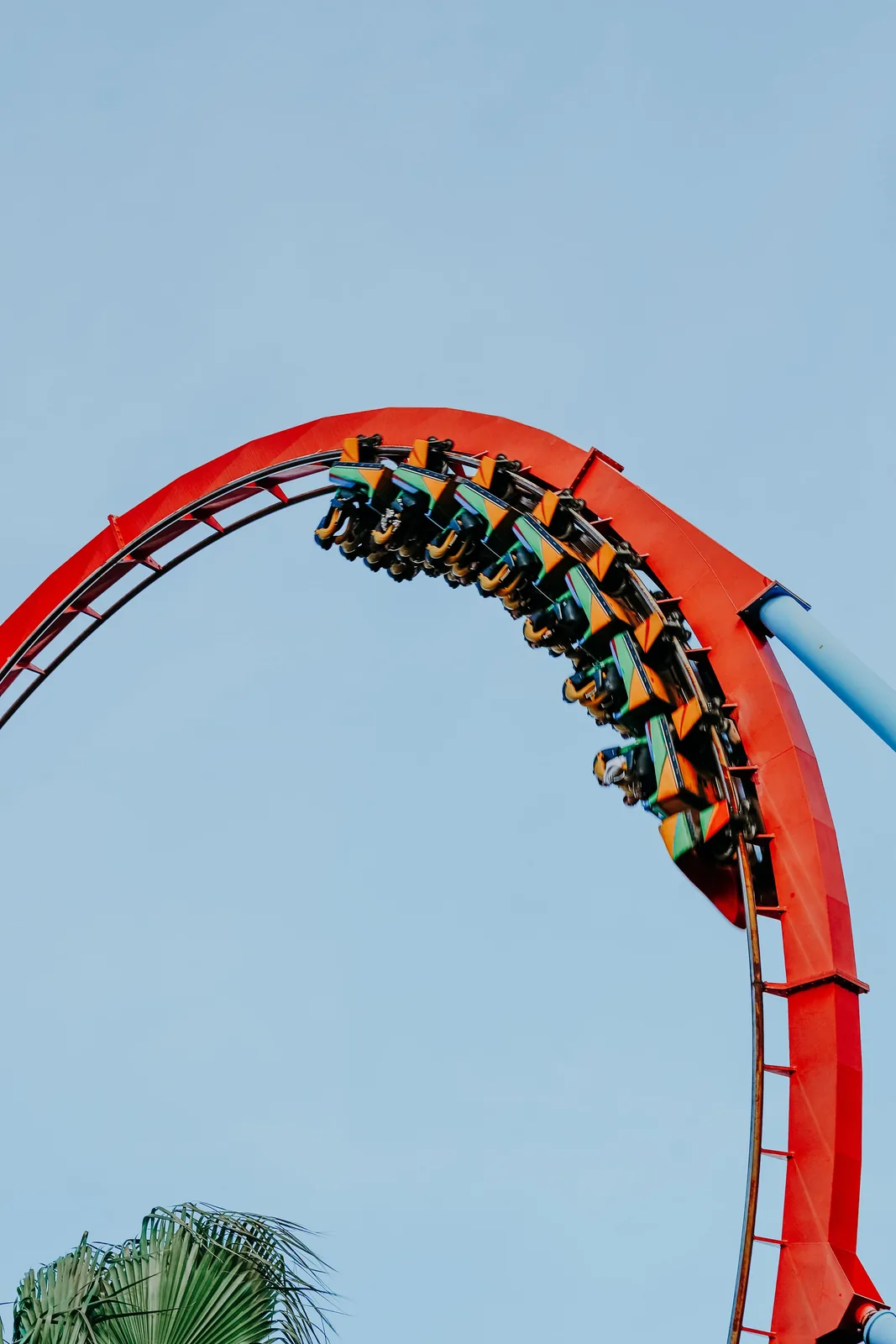
- Thrilling roller coaster loop in sunny park. Tony Rojas. source, Pexels License