
Road safety: braking, seat belts and airbags
Why is the stopping distance of a car travelling at $100\,\text{km/h}$ almost three times that at $50\,\text{km/h}$, and why does a seat belt protect you when the car cannot stop in time?
Prior knowledge
- Displacement is the area between the $(t,v)$ graph and the time axischapter Acceleration and uniformly accelerated motion
- Friction opposes sliding, and it is at most the product of the coefficient of friction and the normal forcechapter Weight, friction and the inclined plane
- The change in momentum is the impulse: $\Delta\overline{p} = \overline{F}\,\Delta t$chapter Momentum and impulse
Core path: follow the steps in order. Tasks marked Optional give extra practice. Optional tasks: 6.
Think about it
Driving school teaches that even a small increase in speed lengthens the stopping distance a lot and that the seat belt is fastened even for a short trip. According to the Finnish Crash Data Institute (OTI), in the fatal accidents investigated in 2017–2021, $198$ people died in cars and vans without a seat belt. The investigation teams estimated that $114$ of them could have survived if the belt had been fastened.
Why does the stopping distance grow so steeply with speed, and how can a seat belt decide whether a person survives a collision?
Optional Recall: impulse
Predict
Make your predictions before investigating 3 questions
Prediction 1: double the speed
Prediction 2: ten kilometres per hour more
Prediction 3: why does a seat belt protect?
Investigate
The driver notices the danger at the dashed line, reacts and brakes. Top: road and distances to scale. Bottom: the $(t,v)$ graph, whose coloured area is the distance travelled.
Simulation
How to use
Choose the driving speed, the reaction time, the road conditions and whether a stopped car is ahead. Press Start: the car travels at a constant speed for the reaction time and then brakes to a stop or hits the car in front. Pause stops and Resume continues. When the run has ended, the readouts show the reaction distance $s_\text{r}$, the braking distance $s_\text{b}$, the stopping distance $s_\text{stop}$ and the stopping time $t_\text{stop}$ or the collision speed. Changing a setting or pressing Reset returns the car to the dashed line. Speed slows down or speeds up only the display, not the readouts.
Assumptions of the model
The values are model values calculated by the simulation. During the reaction time the car moves at a constant speed. After that it slows down at a constant deceleration until it stops: the road is horizontal, air resistance is neglected and the brakes use all of the grip. The deceleration of dry asphalt $9.0\,\text{m/s}^2$ and the reaction time $1.0\,\text{s}$ are the defaults of the Liikenneturva crash speed calculator. The $6.0\,\text{m/s}^2$ of wet asphalt, the $3.0\,\text{m/s}^2$ of a snowy road and the $1.5\,\text{m/s}^2$ of an icy road are rounded example values: the real grip depends on the tyres, the temperature and the surface. The distances on the road are to scale, the cars are not. The rear bumper of the car in front is $25\,\text{m}$ or $50\,\text{m}$ from the dashed line.
How the calculation works
The speed is converted: $v_0\,(\text{m/s}) = v_0\,(\text{km/h}) : 3.6$. The reaction distance is $s_\text{r} = v_0\,t_\text{r}$. At a time $\tau$ from the start of braking the speed is $v = v_0 - a\tau$ and the distance travelled is the area under the $(t,v)$ graph. The car stops when $\tau = \dfrac{v_0}{a}$, and the braking distance is $s_\text{b} = \dfrac{v_0^2}{2a}$. If the car in front is closer than the stopping distance, the simulation calculates the speed at the moment when the distance travelled equals its distance.
Experiment 1: speed and stopping distance
Test prediction 1. The starting state chooses a reaction time of $1.0\,\text{s}$, a dry road and no obstacle. Change only the driving speed. Press Start and record the measurement when the car has stopped. Try at least the speeds $50\,\text{km/h}$ and $100\,\text{km/h}$, and also, for example, $30\,\text{km/h}$ and $60\,\text{km/h}$.
Initial state: driving speed $v_0$: $50\,\text{km/h}$, reaction time $t_\text{r}$: $1.0\,\text{s}$, road conditions: dry asphalt, ahead: no obstacle. Kept constant: reaction time $t_\text{r}$, road conditions, ahead. Varied: driving speed $v_0$.
| driving speed $v_0$ | $s_\text{r}$ $(\text{m})$ | $s_\text{b}$ $(\text{m})$ | $s_\text{stop}$ $(\text{m})$ |
|---|
Experiment 2: does the car stop in time?
Test prediction 2. The starting state chooses a reaction time of $1.0\,\text{s}$, a dry road and a stopped car $25\,\text{m}$ ahead. Change only the driving speed. First drive at $50\,\text{km/h}$ and then at $60\,\text{km/h}$, and record both runs. Also try $40\,\text{km/h}$ and $80\,\text{km/h}$.
Initial state: driving speed $v_0$: $50\,\text{km/h}$, reaction time $t_\text{r}$: $1.0\,\text{s}$, road conditions: dry asphalt, ahead: stopped car $25\,\text{m}$ ahead. Kept constant: reaction time $t_\text{r}$, road conditions, ahead. Varied: driving speed $v_0$.
| driving speed $v_0$ | collision speed $(\text{km/h})$ |
|---|
Optional Experiment 3: road conditions
Investigate the effect of the road conditions. The starting state chooses a speed of $80\,\text{km/h}$, a reaction time of $1.0\,\text{s}$ and no obstacle. Change only the road conditions and record every run. How many times as long is the braking distance on an icy road compared with a dry road?
Initial state: driving speed $v_0$: $80\,\text{km/h}$, reaction time $t_\text{r}$: $1.0\,\text{s}$, road conditions: dry asphalt, ahead: no obstacle. Kept constant: driving speed $v_0$, reaction time $t_\text{r}$, ahead. Varied: road conditions.
| road conditions | $a$ $(\text{m/s}^2)$ | $s_\text{b}$ $(\text{m})$ | $s_\text{stop}$ $(\text{m})$ |
|---|
A collision with and without a belt
Made-up example data
The table gives rounded example values for a $75\,\text{kg}$ passenger in a frontal collision in which the car hits at $50\,\text{km/h}$ and stops. A passenger wearing a belt slows down with the crumpling front of the car. Without a belt the passenger keeps moving until they hit the dashboard, and stop there. In the table $\Delta t$ is the time in which the passenger stops.
| Situation | $v$ before | $v$ after | $\Delta t$ |
|---|---|---|---|
| belt and airbag | $50\,\text{km/h}$ | $0$ | $0.10\,\text{s}$ |
| without a belt | $50\,\text{km/h}$ | $0$ | $0.010\,\text{s}$ |
Optional What do the statistics say about the seat belt?
Statistical data · Finnish Crash Data Institute (OTI): OTI seat belt report 2023 (OTI-Turvavyöraportti), fatal accidents investigated by the road accident investigation teams 2017–2021; Liikenneturva: seat belt use monitoring 2024 (Taloustaito 2025).
The road accident investigation teams investigate every fatal accident. The table shows those who died in cars and vans in 2017–2021 according to whether the seat belt was fastened. In Liikenneturva's monitoring in 2024, among those in the front seat, $98\,\%$ outside built-up areas and $97\,\%$ in built-up areas used a belt.
| Deaths 2017–2021 | Number |
|---|---|
| seat belt fastened | $278$ |
| without a seat belt | $198$ |
Conclusion
Using your own measurements, explain how the stopping distance depends on speed and why a speed $10\,\text{km/h}$ higher can turn a stop into a collision at a surprisingly high speed.
Model answer
In experiment 1 the reaction distance grew in direct proportion to the speed, in the model values from $13.9\,\text{m}$ to $27.8\,\text{m}$ when the speed grew from $50\,\text{km/h}$ to $100\,\text{km/h}$. The braking distance grew from $10.7\,\text{m}$ to $42.9\,\text{m}$, that is, to four times, because removing double the speed takes twice as long and the car moves twice as fast for that time. The stopping distance grew from $24.6\,\text{m}$ to $70.6\,\text{m}$. In experiment 2 the car stopped from $50\,\text{km/h}$ before the car $25\,\text{m}$ ahead, but from $60\,\text{km/h}$ the reaction distance was already $16.7\,\text{m}$, and about $8\,\text{m}$ was left for braking. The car hit it at about $41\,\text{km/h}$.
Assess your own answer
Tick the points your own answer already contains.
Review the theory summary and practise with the exercises.
Theory summary
Key idea
Stopping starts with a reaction
When a driver notices danger, the car does not start to slow down at once. The driver must first notice the danger, decide to brake and move a foot to the brake pedal. This takes the reaction time $t_\text{r}$, usually about one second. For example, the crash speed calculator of Liikenneturva, the Finnish Road Safety Council, assumes a reaction time of $1\,\text{s}$. Fatigue, alcohol and a glance at the phone make the reaction time longer. During the reaction time the car still moves at its original speed and travels the reaction distance $s_\text{r}$. Only then do the brakes begin to slow the car, and it travels the braking distance $s_\text{b}$ before it stops. The reaction distance and the braking distance together are the stopping distance $s_\text{stop}$.
The road stops the car by friction
The brakes slow the rotation of the wheels, but it is the road that slows the car. On a horizontal road the friction between the tyres and the road is the only horizontal force, when air resistance is neglected. Friction points backwards, so by Newton's second law the acceleration also points backwards and the car slows down. In braking, the magnitude of the acceleration is called the deceleration $a$.
Friction has an upper limit that depends on the tyres and the road surface. On dry asphalt the deceleration can be about $9\,\text{m/s}^2$, and the Liikenneturva calculator uses this value too. On a wet, snowy or icy road the friction and therefore the deceleration are smaller, on ice only a fraction of the value on a dry road. Anti-lock brakes (ABS) stop the wheels from locking. The surface of a rolling tyre does not slide relative to the road, so static friction acts on the tyre. It can be greater than the kinetic friction of a sliding tyre, and the car stays steerable.
Speed makes the braking distance grow steeply
The reaction distance is directly proportional to the speed: at double the speed the car travels double the distance during the reaction time. The braking distance grows more steeply. With the same deceleration, stopping from double the speed takes twice as long, and for that whole time the car moves twice as fast. The braking distance is therefore four times as long. In the figure the reaction time is $1.0\,\text{s}$ and the deceleration $9.0\,\text{m/s}^2$ at both speeds.
This gives the answer to the first part of the opening question. When the speed doubles from $50\,\text{km/h}$ to $100\,\text{km/h}$, the reaction distance doubles from $13.9\,\text{m}$ to $27.8\,\text{m}$, but the braking distance quadruples from $10.7\,\text{m}$ to $42.9\,\text{m}$. The stopping distance therefore grows from $24.6\,\text{m}$ to $70.6\,\text{m}$, almost three times as long.
In a collision the change in momentum is always the same
If the obstacle is closer than the stopping distance, the car collides with it. In a frontal collision the front of the car crumples and the car stops in about a tenth of a second. The passenger's momentum $p = mv$ then changes from $mv$ to zero, whether or not the passenger wears a seat belt: the collision speed determines the change in momentum. The only thing that can be changed is how long the collision time $\Delta t$ is, that is, the time in which the passenger stops. In the chapter Momentum and impulse you learned that the change in momentum equals the impulse $\overline{I} = \overline{F}\,\Delta t$. The longer the collision time, the smaller the force needed for the same change in momentum.
Without a seat belt the passenger keeps moving at almost the original speed while the car slows down around them: by Newton's first law no force is yet slowing them down. They hit the steering wheel, the dashboard or the windscreen and stop in hundredths of a second. The seat belt fastens the passenger to the car, so they slow down together with the crumpling front of the car. The belt also stretches a little and spreads the force over the strong bones of the pelvis, chest and shoulder.
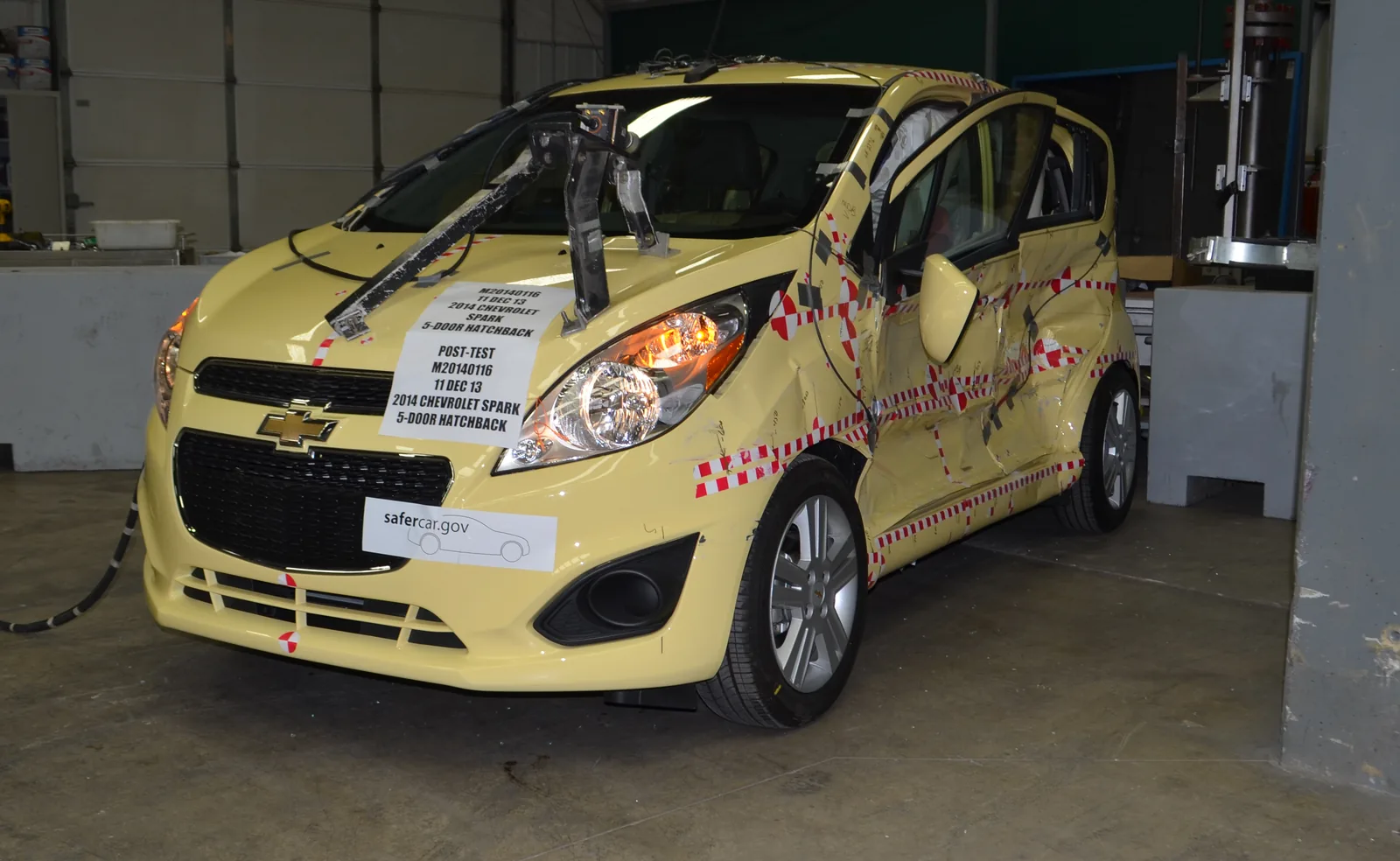
The airbag inflates in hundredths of a second and catches the head and upper body. It lengthens the stopping time and spreads the force over a large area, so the pressure on the body is smaller. An airbag is designed to work together with the seat belt, not instead of it.
This is the answer to the second part of the opening question. The difference also shows in accident statistics. According to the Finnish Crash Data Institute (OTI), in the fatal accidents investigated by the road accident investigation teams in 2017–2021, 278 people wearing a seat belt and 198 people not wearing one died in cars and vans. The investigation teams estimated that 114 of those without a belt could have survived if the belt had been fastened. In Liikenneturva's monitoring, almost everyone in the front seat wears a belt.
Stopping distance and the force of a collision
Reaction distance and braking distance
During the reaction time the car moves at a constant speed $v_0$, so the reaction distance is
$$s_\text{r} = v_0\,t_\text{r}$$
where $s_\text{r}$ is the reaction distance ($\text{m}$), $v_0$ is the speed of the car before braking ($\text{m/s}$) and $t_\text{r}$ is the reaction time ($\text{s}$). In braking the deceleration is assumed to be constant, so on the $(t,v)$ graph the speed falls in a straight line to zero. As in the chapter Acceleration and uniformly accelerated motion, the distance travelled is the area between the graph and the time axis.
The speed falls by $v_0$ at deceleration $a$, so the braking time is
$$t_\text{b} = \frac{v_0}{a}$$
where $t_\text{b}$ is the braking time ($\text{s}$) and $a$ is the deceleration, that is, the magnitude of the acceleration ($\text{m/s}^2$). The braking distance is the area of the triangle, $\tfrac{1}{2}\,v_0\,t_\text{b}$. Substituting the braking time gives
$$s_\text{b} = \frac{v_0^2}{2a}$$
where $s_\text{b}$ is the braking distance ($\text{m}$). The stopping distance is the sum of these:
$$s_\text{stop} = v_0\,t_\text{r} + \frac{v_0^2}{2a}$$
where $s_\text{stop}$ is the stopping distance ($\text{m}$). The model assumes that the road is horizontal, the deceleration is constant during braking and air resistance is neglected. The speed is substituted in $\text{m/s}$.
Deceleration from friction
On a horizontal road the car does not accelerate vertically, so the normal force equals the weight, $N = mg$. When braking as hard as the grip allows, the friction is $F_\mu = \mu N$, where $\mu$ is the coefficient of friction between the tyres and the road. By Newton's second law $\mu mg = ma$, and the mass cancels:
$$a = \mu g$$
where $\mu$ is the coefficient of friction (no unit) and $g = 9.81\,\text{m/s}^2$. The $9.0\,\text{m/s}^2$ of dry asphalt corresponds to a coefficient of friction of $0.92$. In this model the braking distance does not depend on the mass of the car. The braking distance of a heavy lorry is still often longer, because its brakes and tyres cannot always use all of the grip.
Average force in a collision
When the passenger's speed changes by $\Delta v$ in a collision in time $\Delta t$, the impulse–momentum principle $\overline{F}_\text{avg}\,\Delta t = \Delta\overline{p}$ gives the magnitude of the average force acting on them:
$$F_\text{avg} = \frac{m\,\Delta v}{\Delta t}$$
where $F_\text{avg}$ is the average force ($\text{N}$), $m$ is the passenger's mass ($\text{kg}$), $\Delta v$ is the magnitude of the change in speed ($\text{m/s}$) and $\Delta t$ is the collision time ($\text{s}$). When a $75\,\text{kg}$ passenger stops from $50\,\text{km/h}$, the change in momentum is about $1040\,\text{kg}\cdot\text{m/s}$. With a belt it is spread over about $0.10\,\text{s}$, and the average force is about $10\,\text{kN}$. Without a belt the time is about $0.010\,\text{s}$ and the force is ten times as large.
The areas of the rectangles in the graph are equal, because each is the same change in momentum $m\,\Delta v$. In reality the force varies during the collision, and the greatest force is larger than the average.
Common misconception
Many people think that double the speed means double the stopping distance. The reaction distance doubles, but the braking distance quadruples, because it depends on the square of the speed. Another mistake is to think that a seat belt reduces the change in momentum. The momentum changes from $mv$ to zero in any case; the belt lengthens the time in which the change happens and therefore reduces the force. A third mistake is to believe that in a slow crash you can brace yourself with your hands. Even in a $50\,\text{km/h}$ collision the average force is about $10\,\text{kN}$ even with a belt, more than ten times a person's weight, and the muscle force of the hands is not enough against it.
Summary
- The stopping distance is the reaction distance $s_\text{r} = v_0\,t_\text{r}$ plus the braking distance $s_\text{b} = \tfrac{v_0^2}{2a}$, when the deceleration is constant.
- The reaction distance is proportional to the speed and the braking distance to the square of the speed: double the speed gives four times the braking distance.
- In braking, the friction between the tyres and the road slows the car. On a horizontal road $a = \mu g$, so a slippery road multiplies the braking distance.
- In a collision the passenger's change in momentum is the same with and without a belt. The seat belt and the airbag lengthen the collision time, so the average force $F_\text{avg} = \tfrac{m\,\Delta v}{\Delta t}$ is smaller.
- The airbag spreads the force over a large area and works together with the seat belt, not instead of it.
Optional Return to your predictions
Compare your predictions with the measurements and the theory. What surprised you most? Write in your own words why a small increase in speed can be decisive and why the seat belt reduces the force even though the change in momentum is the same.
Would you change your prediction?
Apply
Worked example
Problem
A car is driving on dry asphalt at $80\,\text{km/h}$. The driver glances at their phone, and their reaction time in the dangerous situation is $2.0\,\text{s}$. The deceleration of the car in braking is $9.0\,\text{m/s}^2$. How long is the stopping distance of the car?
Step 1/7
Given and find. $v_0 = 80\,\text{km/h}$, $t_\text{r} = 2.0\,\text{s}$ and $a = 9.0\,\text{m/s}^2$. We are asked for the stopping distance $s_\text{stop}$.
Step 2/7
Principle. During the reaction time the car moves at a constant speed, so the reaction distance is speed times time. After that the car slows down at a constant deceleration, when the road is horizontal and air resistance is neglected, so the braking distance is the area of the triangle on the $(t,v)$ graph. The stopping distance is the sum of these.
Step 3/7
Formula solved.
$$\begin{aligned} s_\text{stop} &= s_\text{r} + s_\text{b} \\ s_\text{stop} &= v_0\,t_\text{r} + \frac{v_0^2}{2a} \end{aligned}$$
Step 4/7
Unit conversions. The speed is converted to $\text{m/s}$:
Step 5/7
Substitution. First we calculate each partial distance and then the sum:
$$\begin{aligned} s_\text{r} &= v_0\,t_\text{r} \\ \phantom{s_\text{r}} &= 22.22\,\tfrac{\text{m}}{\text{s}} \cdot 2.0\,\text{s} \\ \phantom{s_\text{r}} &= 44.44\,\text{m} \\ s_\text{b} &= \frac{(22.22\,\text{m/s})^2}{2 \cdot 9.0\,\text{m/s}^2} \\ \phantom{s_\text{b}} &= 27.43\,\text{m} \\ s_\text{stop} &= (44.44 + 27.43)\,\text{m} \\ \phantom{s_\text{stop}} &\approx 72\,\text{m} \end{aligned}$$
Step 6/7
Result. The stopping distance is about $72\,\text{m}$, to two significant figures like the reaction time $2.0\,\text{s}$ and the deceleration $9.0\,\text{m/s}^2$. The reaction distance of $44\,\text{m}$ is more than half of it.
Step 7/7
Reasonableness. With a reaction time of $1.0\,\text{s}$ the reaction distance would be $22\,\text{m}$ and the stopping distance about $50\,\text{m}$. A glance at the phone therefore lengthens the stopping distance by about $22\,\text{m}$, about five car lengths, even though the braking distance is the same. A speed of $22\,\text{m/s}$ and a braking time of $22\,\text{m/s} : 9\,\text{m/s}^2 \approx 2.5\,\text{s}$ give a braking distance of about $\tfrac{1}{2} \cdot 22\,\text{m/s} \cdot 2.5\,\text{s} \approx 27\,\text{m}$, as in the calculation.
Optional Find the error
Optional Apply to a new situation
A car is driving on a wet road in the dark of an autumn evening at $80\,\text{km/h}$. A moose steps onto the road $45\,\text{m}$ in front of the car. The driver's reaction time is $1.0\,\text{s}$, and the deceleration of the car on the wet road is $6.0\,\text{m/s}^2$.
At what speed does the car hit the moose? Answer in $\text{km/h}$.
Hint 1: a guiding question
First calculate the reaction distance. How much distance is left for braking before the moose?
Hint 2: what is the connection
If the speed of the car at the moose is $v$, stopping would still need the distance $\dfrac{v^2}{2a}$. The whole braking distance $\dfrac{v_0^2}{2a}$ is therefore the distance braked up to the moose plus $\dfrac{v^2}{2a}$.
Hint 3: an intermediate step
The reaction distance is $22.2\,\text{m}$, so $22.8\,\text{m}$ is left for braking. Solve $v^2 = v_0^2 - 2a \cdot 22.8\,\text{m}$ and convert the result to $\text{km/h}$.
Show the solution
Given
$v_0 = 80\,\text{km/h}$, reaction time $t_\text{r} = 1.0\,\text{s}$, deceleration on the wet road $a = 6.0\,\text{m/s}^2$, distance to the moose $d = 45\,\text{m}$
Find
the speed of the car $v$ at the moose in $\text{km/h}$
Principle
During the reaction time the car moves at a constant speed, so the reaction distance is $v_0\,t_\text{r}$. After that the deceleration is constant. The stopping distance $22.2\,\text{m} + 41.2\,\text{m} \approx 63\,\text{m}$ is more than $45\,\text{m}$, so the car does not stop. From speed $v$ stopping would still need the braking distance $\dfrac{v^2}{2a}$, so the whole braking distance is the distance braked up to the moose plus this remaining distance.
Formula
so $v = \sqrt{v_0^2 - 2a\,(d - v_0\,t_\text{r})}$
Conversions
The answer is finally converted back: $1\,\text{m/s} = 3.6\,\text{km/h}$.
Substitution
so
Answer
$53\,\text{km/h}$
Two significant figures like the reaction time $1.0\,\text{s}$, the deceleration $6.0\,\text{m/s}^2$ and the distance $45\,\text{m}$.
Reasonableness
The speed is lower than $80\,\text{km/h}$ but more than half of it, because the car has time to brake for only about $23\,\text{m}$, less than half of the $41\,\text{m}$ braking distance it needs. On a dry road ($9.0\,\text{m/s}^2$) the car would have stopped in $49.7\,\text{m}$ and would still have hit the moose, but much more slowly.
Check your understanding
Exit ticket
Answer on your own first and only then open the answer.
- A driver drives at $72\,\text{km/h}$ and looks at their phone for $2.0\,\text{s}$. How far does the car travel while the driver is not looking at the road?
Answer
$72\,\text{km/h} = 20\,\text{m/s}$, so the car travels $20\,\text{m/s} \cdot 2.0\,\text{s} = 40\,\text{m}$. If danger appears during that time, the whole distance is added to the reaction distance before braking can begin.
- A loose $10\,\text{kg}$ bag lies on the back seat. Why is it dangerous in a frontal collision?
Answer
When the car stops, nothing slows the bag down, so it keeps moving according to Newton's first law. It stops only when it hits the front seat or a passenger in a very short time. Its momentum is large, and the short stopping time makes the force many times the weight of the bag.
- Why does the stopping distance not halve when the braking distance halves after the tyres are changed to ones with better grip?
Answer
Better tyres increase the deceleration and therefore shorten only the braking distance. The reaction distance $v_0\,t_\text{r}$ depends on the speed and the reaction time, not on the tyres, so it stays the same.
1. Concept
2. Calculation
On a snowy road the deceleration of a car in braking is $3.0\,\text{m/s}^2$. The driver drives at $60\,\text{km/h}$, and the reaction time is $1.0\,\text{s}$.
How long is the stopping distance of the car? Answer in metres.
Hint 1: a guiding question
The stopping distance is the sum of two distances. What are they?
Hint 2: what is the connection
Convert the speed to $\text{m/s}$ and use the formula
Hint 3: an intermediate step
$v_0 \approx 16.67\,\text{m/s}$, so the reaction distance is $16.7\,\text{m}$. Now calculate the braking distance.
Show the solution
Given
$v_0 = 60\,\text{km/h}$, reaction time $t_\text{r} = 1.0\,\text{s}$, deceleration on the snowy road $a = 3.0\,\text{m/s}^2$
Find
the stopping distance $s_\text{stop}$ in $\text{m}$
Principle
During the reaction time the car moves at a constant speed, so the reaction distance is speed times time. Then the car slows down at a constant deceleration, when the road is horizontal and air resistance is neglected, so the braking distance is the area of the triangle on the $(t,v)$ graph. The stopping distance is their sum.
Formula
$s_\text{stop} = s_\text{r} + s_\text{b}$, so
Conversions
Substitution
Answer
$63\,\text{m}$
Two significant figures like the reaction time $1.0\,\text{s}$ and the deceleration $3.0\,\text{m/s}^2$.
Reasonableness
On a dry road ($9.0\,\text{m/s}^2$) the braking distance would be a third, about $15\,\text{m}$, and the stopping distance about $32\,\text{m}$. On snow the deceleration is a third, so the braking distance is three times as long, as in the result. The reaction distance does not depend on the road conditions.
Suggestion: one answer does not show everything you can do, but review the theory summary and do the core exercises.
3. Explain
Explain with the impulse–momentum principle why the seat belt and the airbag reduce the force on a passenger in a frontal collision, even though the passenger stops from the same speed as without them. Also tell why the airbag does not replace the seat belt.
Model answer
The passenger stops from the same speed, so their momentum changes from $mv$ to zero in both cases. By the impulse–momentum principle $F_\text{avg}\,\Delta t = m\,\Delta v$, so the same change in momentum is produced by a smaller average force the longer the collision time. The belt fastens the passenger to the car, and they slow down with the crumpling front of the car in about a tenth of a second. Without a belt they keep moving and stop against the dashboard or the windscreen in about a hundredth of a second, and the force is about ten times as large. The airbag lengthens the stopping time of the head and upper body and spreads the force over a large area, so the pressure on the body decreases. It is designed for a passenger who is fastened with a belt: without a belt the body slides forward and may meet the inflating bag too early or miss it, and nothing keeps the passenger in the car.
Assess your own answer
Tick the points your own answer already contains.
Review the theory summary and practise with the exercises.
Exercises
Level 1 · basic practice 5 exercises
One formula or one step of reasoning. Core exercises first, the rest is extra practice.
- Exercise 15-1Core
A car is driving at $72.0\,\text{km/h}$, and the driver's reaction time is $1.20\,\text{s}$. How far does the car travel during the reaction time?
Answer
$24.0\,\text{m}$
Show the solution
Given
$v_0 = 72.0\,\text{km/h}$, reaction time $t_\text{r} = 1.20\,\text{s}$
Find
the reaction distance $s_\text{r}$ in $\text{m}$
Principle
During the reaction time the driver is not yet braking, so the car moves at a constant speed. In uniform motion the distance travelled is speed times time.
Formula
$s_\text{r} = v_0\,t_\text{r}$
Conversions
$72.0\,\text{km/h}$$= \dfrac{72.0 \cdot 1000\,\text{m}}{3600\,\text{s}}$$= 20.0\,\text{m/s}$Substitution
$s_\text{r}$$= 20.0\,\text{m/s} \cdot 1.20\,\text{s}$$= 24.0\,\text{m}$Answer
$24.0\,\text{m}$
Three significant figures like the speed $72.0\,\text{km/h}$ and the reaction time $1.20\,\text{s}$.
Reasonableness
The car travels $20\,\text{m}$ every second, so in a little over a second the distance is a little over $20\,\text{m}$. That is about five car lengths that the car covers before braking even begins.
- Exercise 15-2Core
The speed of a car is $25.0\,\text{m/s}$ when the driver starts to brake. The deceleration is $8.00\,\text{m/s}^2$. How long is the braking distance?
Answer
$39.1\,\text{m}$
Show the solution
Given
speed at the start of braking $v_0 = 25.0\,\text{m/s}$, deceleration $a = 8.00\,\text{m/s}^2$
Find
the braking distance $s_\text{b}$ in $\text{m}$
Principle
The deceleration is constant, so on the $(t,v)$ graph the speed falls in a straight line to zero. The braking distance is the area of the triangle under the graph, $\tfrac{1}{2}\,v_0\,t_\text{b}$, where the braking time is $t_\text{b} = \tfrac{v_0}{a}$.
Formula
$s_\text{b} = \tfrac{1}{2}\,v_0\,t_\text{b}$ and $t_\text{b} = \dfrac{v_0}{a}$, so $s_\text{b} = \dfrac{v_0^2}{2a}$
Conversions
The speed is already in $\text{m/s}$, so no conversions are needed.
Substitution
$s_\text{b}$$= \dfrac{(25.0\,\text{m/s})^2}{2 \cdot 8.00\,\text{m/s}^2}$$= \dfrac{625\,\text{m}^2/\text{s}^2}{16.0\,\text{m/s}^2}$$= 39.0625\,\text{m}$Answer
$39.1\,\text{m}$
Three significant figures like the speed $25.0\,\text{m/s}$ and the deceleration $8.00\,\text{m/s}^2$.
Reasonableness
Braking takes $25 : 8 \approx 3\,\text{s}$, and the average speed is half the initial speed, about $12.5\,\text{m/s}$. The distance is about $12.5\,\text{m/s} \cdot 3.1\,\text{s} \approx 39\,\text{m}$, as in the calculation.
- Exercise 15-3
A cyclist brakes from $20.0\,\text{m/s}$ to a stop. The deceleration is $5.00\,\text{m/s}^2$. How long does the braking take?
Answer
$4.00\,\text{s}$
Show the solution
Given
speed at the start of braking $v_0 = 20.0\,\text{m/s}$, deceleration $a = 5.00\,\text{m/s}^2$, final speed $0$
Find
the braking time $t_\text{b}$ in $\text{s}$
Principle
The deceleration tells how much the speed decreases each second. When the deceleration is constant, the time needed to remove the whole speed is the speed divided by the deceleration.
Formula
$a = \dfrac{\Delta v}{\Delta t}$, and the magnitude of the change in speed is $v_0$, so $t_\text{b} = \dfrac{v_0}{a}$
Conversions
The quantities are in SI units, so no conversions are needed.
Substitution
$t_\text{b}$$= \dfrac{20.0\,\text{m/s}}{5.00\,\text{m/s}^2}$$= 4.00\,\text{s}$Answer
$4.00\,\text{s}$
Three significant figures like the speed $20.0\,\text{m/s}$ and the deceleration $5.00\,\text{m/s}^2$.
Reasonableness
The speed falls by $5\,\text{m/s}$ every second: $20 \to 15 \to 10 \to 5 \to 0$, that is, in four seconds. Units: $\tfrac{\text{m/s}}{\text{m/s}^2} = \text{s}$.
- Exercise 15-4
In a crash the speed of a $70.0\,\text{kg}$ passenger changes from $15.0\,\text{m/s}$ to zero in $0.120\,\text{s}$. How large is the average force on the passenger?
Answer
$8750\,\text{N}$
Show the solution
Given
$m = 70.0\,\text{kg}$, the speed changes from $15.0\,\text{m/s}$ to zero, $\Delta t = 0.120\,\text{s}$
Find
the average force $F_\text{avg}$ in $\text{N}$
Principle
By the impulse–momentum principle, the impulse of the force acting on the passenger equals the change in their momentum. When the force varies during the collision, the principle gives the average force.
Formula
$F_\text{avg}\,\Delta t = m\,\Delta v$, so
$F_\text{avg}$$= \dfrac{m\,\Delta v}{\Delta t}$Conversions
The quantities are in SI units, so no conversions are needed.
Substitution
$F_\text{avg}$$= \dfrac{70.0\,\text{kg} \cdot 15.0\,\text{m/s}}{0.120\,\text{s}}$$= \dfrac{1050\,\text{kg}\cdot\text{m/s}}{0.120\,\text{s}}$$= 8750\,\text{N}$Answer
$8750\,\text{N}$
That is, $8.75\,\text{kN}$, three significant figures like the data.
Reasonableness
The passenger's weight is about $700\,\text{N}$, so the force is about $13$ times the weight. This is a typical order of magnitude with a belt, and it could not be withstood with the hands. Units:
$\tfrac{\text{kg}\cdot\text{m/s}}{\text{s}}$$= \text{kg}\cdot\text{m/s}^2$$= \text{N}$ - Exercise 15-5
A car moves at $15.0\,\text{m/s}$. The driver notices danger, and before the brakes start to work the car travels $18.0\,\text{m}$. How long is the driver's reaction time?
Answer
$1.20\,\text{s}$
Show the solution
Given
speed $v_0 = 15.0\,\text{m/s}$, reaction distance $s_\text{r} = 18.0\,\text{m}$
Find
the reaction time $t_\text{r}$ in $\text{s}$
Principle
Before the brakes start to work, the car moves at a constant speed. The reaction distance is therefore speed times reaction time, and the time is solved from it.
Formula
$s_\text{r} = v_0\,t_\text{r}$, so $t_\text{r} = \dfrac{s_\text{r}}{v_0}$
Conversions
The quantities are in SI units, so no conversions are needed.
Substitution
$t_\text{r}$$= \dfrac{18.0\,\text{m}}{15.0\,\text{m/s}}$$= 1.20\,\text{s}$Answer
$1.20\,\text{s}$
Three significant figures like the speed $15.0\,\text{m/s}$ and the distance $18.0\,\text{m}$.
Reasonableness
A normal reaction time is about a second, so $1.2\,\text{s}$ is believable. In one second the car travels $15\,\text{m}$, and $18\,\text{m}$ is a little more, so the time is a little over a second.
Level 2 · applied practice 4 exercises
Two steps, working with measured data, a unit conversion or rearranging a formula. Core exercises first, the rest is extra practice.
- Exercise 15-6Core
A car is driving at $90\,\text{km/h}$. The driver's reaction time is $1.5\,\text{s}$, and the deceleration of the car in braking is $7.5\,\text{m/s}^2$.
How long is the stopping distance?
Answer
$79\,\text{m}$
Show the solution
Given
$v_0 = 90\,\text{km/h}$, reaction time $t_\text{r} = 1.5\,\text{s}$, deceleration $a = 7.5\,\text{m/s}^2$
Find
the stopping distance $s_\text{stop}$ in $\text{m}$
Principle
During the reaction time the car moves at a constant speed, so the reaction distance is speed times time. Then the car slows down at a constant deceleration, and the braking distance is the area of the triangle on the $(t,v)$ graph. The stopping distance is the sum of these.
Formula
$s_\text{stop} = s_\text{r} + s_\text{b}$, so
$s_\text{stop}$$= v_0\,t_\text{r} + \dfrac{v_0^2}{2a}$Conversions
$90\,\text{km/h}$$= \dfrac{90 \cdot 1000\,\text{m}}{3600\,\text{s}}$$= 25\,\text{m/s}$Substitution
$s_\text{stop}$$= 25\,\text{m/s} \cdot 1.5\,\text{s} + \dfrac{(25\,\text{m/s})^2}{2 \cdot 7.5\,\text{m/s}^2}$$= 37.5\,\text{m} + 41.67\,\text{m}$$= 79.17\,\text{m}$Answer
$79\,\text{m}$
Two significant figures like the reaction time $1.5\,\text{s}$ and the deceleration $7.5\,\text{m/s}^2$.
Reasonableness
The reaction distance and the braking distance are of the same order of magnitude, about $40\,\text{m}$ each. The stopping distance is almost $80\,\text{m}$, as can be expected at motorway speed. A long reaction time adds as much distance as the whole braking.
- Exercise 15-7Core
A car is driving on a snowy horizontal road at $100\,\text{km/h}$. The coefficient of friction between the tyres and the snow is $0.30$.
How long is the braking distance when the car brakes as hard as the grip allows? Air resistance is neglected.
Answer
$130\,\text{m}$
Show the solution
Given
$v_0 = 100\,\text{km/h}$, coefficient of friction $\mu = 0.30$, horizontal road; $g = 9.81\,\text{m/s}^2$
Find
the braking distance $s_\text{b}$ in $\text{m}$
Principle
On a horizontal road friction is the only horizontal force and the normal force equals the weight, so full grip gives the deceleration $a = \mu g$. The deceleration is constant, so the braking distance is the area of the triangle on the $(t,v)$ graph.
Formula
$a = \mu g$ and $s_\text{b} = \dfrac{v_0^2}{2a}$, so $s_\text{b} = \dfrac{v_0^2}{2\mu g}$
Conversions
$100\,\text{km/h}$$= \dfrac{100 \cdot 1000\,\text{m}}{3600\,\text{s}}$$\approx 27.78\,\text{m/s}$Substitution
$s_\text{b}$$= \dfrac{(27.78\,\text{m/s})^2}{2 \cdot 0.30 \cdot 9.81\,\text{m/s}^2}$$= \dfrac{771.6\,\text{m}^2/\text{s}^2}{5.886\,\text{m/s}^2}$$= 131.1\,\text{m}$Answer
$130\,\text{m}$
(that is, $1.3 \cdot 10^2\,\text{m}$), two significant figures like the coefficient of friction $0.30$.
Reasonableness
On dry asphalt ($9.0\,\text{m/s}^2$) the braking distance would be about $43\,\text{m}$. On snow the deceleration is about a third of that, so the braking distance is about three times as long, about $130\,\text{m}$. That is longer than a football pitch.
- Exercise 15-8
A car collides at $50.0\,\text{km/h}$ and stops. A $75.0\,\text{kg}$ driver wearing a belt stops with the help of the airbag and the belt in $0.100\,\text{s}$.
How large is the average force on the driver?
Answer
$10\,400\,\text{N}$
Show the solution
Given
$m = 75.0\,\text{kg}$, the speed changes from $50.0\,\text{km/h}$ to zero, $\Delta t = 0.100\,\text{s}$
Find
the average force $F_\text{avg}$ in $\text{N}$
Principle
By the impulse–momentum principle, the impulse of the forces acting on the driver equals the change in their momentum. The belt and the airbag lengthen the time in which the change happens, and the principle gives the average force.
Formula
$F_\text{avg}\,\Delta t = m\,\Delta v$, so
$F_\text{avg}$$= \dfrac{m\,\Delta v}{\Delta t}$Conversions
$50.0\,\text{km/h}$$= \dfrac{50.0 \cdot 1000\,\text{m}}{3600\,\text{s}}$$\approx 13.89\,\text{m/s}$Substitution
$F_\text{avg}$$= \dfrac{75.0\,\text{kg} \cdot 13.89\,\text{m/s}}{0.100\,\text{s}}$$= \dfrac{1041.7\,\text{kg}\cdot\text{m/s}}{0.100\,\text{s}}$$= 10\,417\,\text{N}$Answer
$10\,400\,\text{N}$
That is, $10.4\,\text{kN}$, three significant figures like the data.
Reasonableness
The driver's weight is about $740\,\text{N}$, so the force is about $14$ times the weight. Without a belt the time would be about a tenth of this and the force ten times as large, about $100\,\text{kN}$.
- Exercise 15-9
At the scene of an accident the police measure the length of a car's skid mark as $32.0\,\text{m}$. The car stopped at the end of the mark. The deceleration of the car is estimated as $8.0\,\text{m/s}^2$.
What was the speed of the car at the start of braking? Answer in $\text{km/h}$.
Answer
$81\,\text{km/h}$
Show the solution
Given
braking distance $s_\text{b} = 32.0\,\text{m}$, deceleration $a = 8.0\,\text{m/s}^2$, the car came to a stop
Find
the speed at the start of braking $v_0$ in $\text{km/h}$
Principle
The deceleration is assumed to be constant along the whole skid mark, so the formula for the braking distance applies. The initial speed is solved from it.
Formula
$s_\text{b} = \dfrac{v_0^2}{2a}$, so $v_0^2 = 2a\,s_\text{b}$ and $v_0 = \sqrt{2a\,s_\text{b}}$
Conversions
We calculate first in $\text{m/s}$ and convert at the end: $1\,\text{m/s} = 3.6\,\text{km/h}$.
Substitution
$v_0^2$$= 2 \cdot 8.0\,\text{m/s}^2 \cdot 32.0\,\text{m}$$= 512\,\text{m}^2/\text{s}^2$so
$v_0$$= \sqrt{512}\,\text{m/s}$$= 22.63\,\text{m/s}$$= 22.63 \cdot 3.6\,\text{km/h}$$= 81.46\,\text{km/h}$Answer
$81\,\text{km/h}$
Two significant figures, because the deceleration $8.0\,\text{m/s}^2$ is an estimate with two figures.
Reasonableness
On a dry road, from $80\,\text{km/h}$ the braking distance is about $27$–$31\,\text{m}$ depending on the deceleration, so a $32\,\text{m}$ mark fits a speed of about $80\,\text{km/h}$. The real speed may be higher if the car hit something before it stopped.
Level 3 · challenging 3 exercises
Optional: application, two ideas together or a new situation where you reason for yourself.
- Exercise 15-10
The speed limit at a school is $30\,\text{km/h}$. A driver notices a child running onto the road at exactly the distance at which they would be able to stop from $30\,\text{km/h}$. The reaction time is $1.0\,\text{s}$ and the deceleration $9.0\,\text{m/s}^2$.
At what speed would the car reach the child if the driver were driving at $40\,\text{km/h}$? Answer in $\text{km/h}$.
Answer
$37\,\text{km/h}$
Show the solution
Given
limit $30\,\text{km/h}$, actual speed $v_0 = 40\,\text{km/h}$, reaction time $t_\text{r} = 1.0\,\text{s}$, deceleration $a = 9.0\,\text{m/s}^2$; the child is at a distance $d$ equal to the stopping distance from $30\,\text{km/h}$
Find
the speed of the car $v$ at the child in $\text{km/h}$
Principle
First the distance $d$ is calculated from the formula for the stopping distance. At $40\,\text{km/h}$ the car travels the reaction distance at constant speed and brakes for the rest of the distance. If the speed at the child is $v$, stopping would still need the distance $\tfrac{v^2}{2a}$, so the whole braking distance is the distance braked up to the child plus this.
Formula
$d = u\,t_\text{r} + \dfrac{u^2}{2a}$, where $u = 30\,\text{km/h}$, and
$\dfrac{v_0^2}{2a}$$= (d - v_0\,t_\text{r}) + \dfrac{v^2}{2a}$so $v = \sqrt{v_0^2 - 2a\,(d - v_0\,t_\text{r})}$
Conversions
$u$$= 30\,\text{km/h}$$\approx 8.333\,\text{m/s}$$v_0$$= 40\,\text{km/h}$$\approx 11.11\,\text{m/s}$the answer is finally multiplied by $3.6$.
Substitution
$d$$= 8.333\,\text{m/s} \cdot 1.0\,\text{s} + \dfrac{(8.333\,\text{m/s})^2}{2 \cdot 9.0\,\text{m/s}^2}$$= 8.333\,\text{m} + 3.858\,\text{m}$$= 12.19\,\text{m}$$d - v_0\,t_\text{r}$$= 12.19\,\text{m} - 11.11\,\text{m}$$= 1.080\,\text{m}$$v^2$$= (11.11\,\text{m/s})^2 - 2 \cdot 9.0\,\text{m/s}^2 \cdot 1.080\,\text{m}$$= 104.0\,\text{m}^2/\text{s}^2$so
$v$$= \sqrt{104.0}\,\text{m/s}$$= 10.20\,\text{m/s}$$= 36.7\,\text{km/h}$Answer
$37\,\text{km/h}$
Two significant figures like the reaction time $1.0\,\text{s}$ and the deceleration $9.0\,\text{m/s}^2$.
Reasonableness
At $40\,\text{km/h}$ the reaction distance alone, $11.1\,\text{m}$, takes almost the whole $12.2\,\text{m}$, so only about a metre is left for braking, and the speed has time to fall only a little. The car would therefore hit the child at almost its original speed, even though the speed exceeds the limit by only $10\,\text{km/h}$.
- Exercise 15-11
A car collides at $50.0\,\text{km/h}$. A $70.0\,\text{kg}$ passenger wearing a belt moves, relative to the car and with the car, a total of $0.600\,\text{m}$ before stopping. Assume that their deceleration is constant.
How large is the average force on the passenger?
Answer
$11\,300\,\text{N}$
Show the solution
Given
$m = 70.0\,\text{kg}$, $v_0 = 50.0\,\text{km/h}$, stopping distance $s = 0.600\,\text{m}$, deceleration constant
Find
the average force $F_\text{avg}$ in $\text{N}$
Principle
The force follows from the impulse–momentum principle when the stopping time is known. The time is not given, but with a constant deceleration the average speed is half the initial speed, so the distance is $s = \tfrac{1}{2}\,v_0\,\Delta t$ (the area of the triangle on the $(t,v)$ graph). The time is solved from this.
Formula
$s = \tfrac{1}{2}\,v_0\,\Delta t$, so $\Delta t = \dfrac{2s}{v_0}$, and $F_\text{avg}\,\Delta t = m\,v_0$, so
$F_\text{avg}$$= \dfrac{m\,v_0}{\Delta t}$Conversions
$50.0\,\text{km/h}$$= \dfrac{50.0 \cdot 1000\,\text{m}}{3600\,\text{s}}$$\approx 13.89\,\text{m/s}$Substitution
$\Delta t$$= \dfrac{2 \cdot 0.600\,\text{m}}{13.89\,\text{m/s}}$$= 0.08640\,\text{s}$$F_\text{avg}$$= \dfrac{70.0\,\text{kg} \cdot 13.89\,\text{m/s}}{0.08640\,\text{s}}$$= 11\,253\,\text{N}$Answer
$11\,300\,\text{N}$
That is, $11.3\,\text{kN}$, three significant figures like the data.
Reasonableness
The stopping time is about $0.09\,\text{s}$, the same order of magnitude as the crumpling time of the car, and the force is about $16$ times the passenger's weight $687\,\text{N}$. If the passenger stopped without a belt in a few centimetres, the force would be tens of times greater.
- Exercise 15-12
A car is driving at $80\,\text{km/h}$ behind another car moving at the same speed. The car in front suddenly brakes at a deceleration of $9.0\,\text{m/s}^2$. The reaction time of the driver behind is $1.0\,\text{s}$, and the deceleration of their car is only $6.0\,\text{m/s}^2$ because of worn tyres.
What is the smallest gap between the cars that lets the driver behind stop before hitting the car in front?
Answer
$36\,\text{m}$
Show the solution
Given
speed of both cars $v_0 = 80\,\text{km/h}$, deceleration of the car in front $a_1 = 9.0\,\text{m/s}^2$, deceleration of the car behind $a_2 = 6.0\,\text{m/s}^2$ and reaction time $t_\text{r} = 1.0\,\text{s}$
Find
the smallest gap $d$ in $\text{m}$
Principle
The car in front starts to brake at once and stops after its braking distance. The car behind first travels the reaction distance and then a longer braking distance, because its deceleration is smaller. The car in front is all the time moving more slowly than the car behind, so the gap shrinks until the car behind stops. There is no collision if the gap is at least the difference between the distances the cars travel.
Formula
$d + \dfrac{v_0^2}{2a_1}$$= v_0\,t_\text{r} + \dfrac{v_0^2}{2a_2}$so
$d$$= v_0\,t_\text{r} + \dfrac{v_0^2}{2a_2} - \dfrac{v_0^2}{2a_1}$Conversions
$80\,\text{km/h}$$= \dfrac{80 \cdot 1000\,\text{m}}{3600\,\text{s}}$$\approx 22.22\,\text{m/s}$Substitution
$d$$= 22.22\,\text{m/s} \cdot 1.0\,\text{s} + \dfrac{(22.22\,\text{m/s})^2}{2 \cdot 6.0\,\text{m/s}^2} - \dfrac{(22.22\,\text{m/s})^2}{2 \cdot 9.0\,\text{m/s}^2}$$= 22.22\,\text{m} + 41.15\,\text{m} - 27.43\,\text{m}$$= 35.94\,\text{m}$Answer
$36\,\text{m}$
Two significant figures like the reaction time $1.0\,\text{s}$ and the decelerations.
Reasonableness
If the decelerations of the cars were the same, the reaction distance $22\,\text{m}$ would be enough for the gap. The worn tyres add about $14\,\text{m}$ to the gap needed. A gap of $36\,\text{m}$ corresponds to a driving time of about $1.6\,\text{s}$ at $22\,\text{m/s}$.
Photographs
- V08465P006 (2014 Chevrolet Spark, side impact test). Medical College of Wisconsin / NHTSA. source, public domain (PD-USGov-DOT)
