
Conservation of momentum and one-dimensional collisions
Why can a cue ball stop dead when it hits a stationary ball head-on, while the other ball carries on at almost the same velocity?
Prior knowledge
- The momentum of an object is $\overline{p} = m\overline{v}$, and the impulse of a constant net force changes it: $\Delta\overline{p} = \Sigma\overline{F}\,\Delta t$chapter Momentum and impulse
- The kinetic energy of an object is $E_\text{k} = \tfrac12 mv^2$, and forces such as friction change mechanical energy into internal energychapter Conservation of mechanical energy and the work–energy principle
Core path: follow the steps in order. Tasks marked Optional give extra practice. Optional tasks: 5.
Think about it
On a billiard table a red ball is at rest. A player hits the white cue ball straight towards it. The balls click, and in an instant the situation has changed: the cue ball has stopped almost where the red ball was, and the red ball speeds ahead at almost the same velocity as the cue ball had a moment ago. If the red ball were a heavy bowling ball, the cue ball would bounce back.
What determines how the motion is shared between colliding objects, and why does the cue ball stop exactly when it hits a similar ball?
Optional Review: impulse
Predict
Make your predictions before investigating 3 questions
Prediction 1: the carts stick together
Prediction 2: elastic collision
Optional Prediction 3: explosion
Investigate
Two carts collide on a horizontal air track. The bars at the bottom show the momenta of the carts and the energy: kinetic energy, the energy in the bumper and internal energy, before the collision and at each moment.
Simulation
How to use
Choose the situation, the masses of the carts and the initial velocities. The positive direction is to the right, so the velocity of a cart moving to the left is negative. Press Start. When the collision is over, the readout shows the velocities $v_1'$ and $v_2'$, the total momentum $p_\text{tot}'$ and the kinetic energy $E_\text{k}'$ after the collision. In the energy bar the kinetic energy $E_\text{k}$, the energy of the bumper or spring $E_\text{p}$ and the internal energy $E_\text{int}$ are stacked, and the dashed line shows the original total energy. In an explosion the carts are at rest at first, so the velocity sliders are not in use. Reset returns the carts to their starting places. Speed slows down or speeds up the motion without changing the readings.
Assumptions of the model
The values are model values calculated by the simulation. The track is horizontal, and friction and air resistance are neglected, so the weight of the carts and the normal force of the track cancel each other and the sum of the external forces does not change the momentum. In the collision the bumpers of the carts are compressed, and they push the carts with equally large forces in opposite directions. During the collision part of the kinetic energy is for a moment potential energy of the compressed bumper, so the total kinetic energy of the carts decreases for a moment even in an elastic collision. The spring bumper gives back all the energy spent on the compression. The soft bumper and the tape change some of the kinetic energy into internal energy, and with the tape the carts stick together; then the bumper stays compressed, and its energy becomes internal energy. In the explosion there is a spring compressed by $4.0\,\text{cm}$ between the carts, storing $0.24\,\text{J}$ of energy.
How the calculation works
The force of the bumpers is calculated from the compression and the relative velocity of the carts, and the motion of the carts is calculated from Newton's second law in time steps of $0.2\,\text{ms}$. The momenta $p = mv$ and the kinetic energies $E_\text{k} = \tfrac12 mv^2$ are calculated from the velocities of the carts, and $p_\text{tot}$ and $E_\text{k}$ are the sums of the values of the two carts. The energy of the bumper is $E_\text{p} = \tfrac12 kd^2$, where $d$ is the compression and $k = 300\,\text{N/m}$, and the internal energy $E_\text{int}$ is calculated from the work done by the damping of the bumper. The sum $E_\text{k} + E_\text{p} + E_\text{int}$ stays at its original value all the time. The readings "After" are taken at the moment when the bumpers separate or the carts stick together. Conservation of momentum has not been written into the model; it follows from the forces of the bumpers being equally large and opposite.
Experiment 1: perfectly inelastic collision
Test the first prediction. The starting state chooses the tape, a mass of $0.40\,\text{kg}$ and a velocity of $0.60\,\text{m/s}$ for cart 1, and leaves cart 2 at rest. Before the collision the total momentum is then $0.240\,\text{kg}\cdot\text{m/s}$ and the kinetic energy $0.072\,\text{J}$ (the Before readings). Change only the mass of cart 2. Press Start each time and record the measurement when the carts have stuck together.
Initial state: situation: perfectly inelastic (tape), mass $m_1$: $0.40\,\text{kg}$, initial velocity $v_1$ = $0{.}6\,\text{m/s}$, initial velocity $v_2$ = $0\,\text{m/s}$, mass $m_2$: $0.40\,\text{kg}$. Kept constant: situation, mass $m_1$, initial velocity $v_1$, initial velocity $v_2$. Varied: mass $m_2$.
| mass $m_2$ | $v'$ $(\text{m/s})$ | $p_\text{tot}'$ (kg·m/s) | $E_\text{k}'$ $(\text{J})$ |
|---|
Experiment 2: elastic collision
Test the second prediction. The starting state chooses the spring bumper, a mass of $0.40\,\text{kg}$ and a velocity of $0.60\,\text{m/s}$ for cart 1, and leaves cart 2 at rest. Change only the mass of cart 2, for example to $0.20$, $0.40$ and $0.60\,\text{kg}$. Record the measurement when the collision is over.
Initial state: situation: elastic collision (spring), mass $m_1$: $0.40\,\text{kg}$, initial velocity $v_1$ = $0{.}6\,\text{m/s}$, initial velocity $v_2$ = $0\,\text{m/s}$, mass $m_2$: $0.40\,\text{kg}$. Kept constant: situation, mass $m_1$, initial velocity $v_1$, initial velocity $v_2$. Varied: mass $m_2$.
| mass $m_2$ | $v_1'$ $(\text{m/s})$ | $v_2'$ $(\text{m/s})$ | $p_\text{tot}'$ (kg·m/s) | $E_\text{k}'$ $(\text{J})$ |
|---|
Optional Experiment 3: explosion
Test the third prediction. The starting state chooses the explosion and a mass of $0.40\,\text{kg}$ for cart 1. The carts are at rest at first. Change only the mass of cart 2 and record the measurement when the carts have separated.
Initial state: situation: explosion (spring is released), mass $m_1$: $0.40\,\text{kg}$, mass $m_2$: $0.20\,\text{kg}$. Kept constant: situation, mass $m_1$. Varied: mass $m_2$.
| mass $m_2$ | $v_1'$ $(\text{m/s})$ | $v_2'$ $(\text{m/s})$ | $p_\text{tot}'$ (kg·m/s) |
|---|
Conclusion
Use your measurements to explain what is conserved in all collisions and what only in an elastic collision. Then use Newton's third law to explain why the momentum that cart 1 loses is equal to the momentum that cart 2 gains.
Model answer
In experiment 1 the carts stuck together. In the model's values the total momentum was $0.240\,\text{kg}\cdot\text{m/s}$ both before and after for all masses of cart 2, but the kinetic energy decreased, for example from $0.072\,\text{J}$ to $0.036\,\text{J}$ when the carts had equal masses. The tape changed some of the kinetic energy into internal energy. In experiment 2 the collision was elastic: in the model's values both the total momentum, $0.240\,\text{kg}\cdot\text{m/s}$, and the kinetic energy, $0.072\,\text{J}$, were conserved on every row. Momentum is conserved because, by Newton's third law, the bumpers push the carts with equally large forces $\overline{F}$ and $-\overline{F}$ in opposite directions for the same time $\Delta t$. The momentum of cart 2 increases by the impulse $\overline{F}\,\Delta t$, and the momentum of cart 1 changes by the same amount in the opposite direction. This holds because the external forces do not change the momentum: the weight and the normal force of the track cancel each other, and friction has been neglected.
Assess your own answer
Tick the points your own answer already contains.
Review the theory summary and practise with the exercises.
Theory summary
Key idea
A system and its total momentum
In the chapter Momentum and impulse you learned that the momentum of an object is $\overline{p} = m\overline{v}$ and that the impulse of a constant net force changes it: $\Delta\overline{p} = \Sigma\overline{F}\,\Delta t$. In a collision, however, there are two objects that act on each other. So we look at them together as a system. The total momentum of a system is the vector sum of the momenta of its objects, $\overline{p}_\text{tot} = \overline{p}_1 + \overline{p}_2$.
The forces that the objects of the system exert on each other are internal forces, for example the forces of the bumpers of two carts on each other in a collision. Forces that come from outside the system are external forces, for example the weight of the carts, the normal force of the track and friction.
Why the total momentum is conserved
When cart 1 pushes cart 2 with a force $\overline{F}$, by Newton's third law cart 2 pushes cart 1 with an equally large force $-\overline{F}$ in the opposite direction. The forces begin and end at the same moment, so they act for the same time $\Delta t$. If the force is constant, the momentum of cart 2 changes by the impulse $\overline{F}\,\Delta t$, and the momentum of cart 1 changes by the same amount in the opposite direction. The momentum that one cart gains is exactly what the other loses. The total momentum does not change. The same holds even if the force changes during the collision, because at every moment the forces are equally large and opposite.
This reasoning works only when external forces do not change the momentum. On a horizontal air track the weight and the normal force cancel each other, and friction is very small. Colliding cars, on the other hand, do feel the friction of the road, but the collision lasts only a fraction of a second. The forces of the bumpers are then much larger than friction, so the impulse of friction during the collision remains negligibly small. This gives the law of conservation of momentum: when the sum of the external forces acting on a system is zero, or their impulse during the collision is negligibly small, the total momentum of the system is conserved.
Types of collisions
Momentum is conserved in every collision when the condition of the conservation law is met. Kinetic energy is not always conserved. A collision is elastic if the total kinetic energy of the objects after the collision is equal to that before it. Steel balls, billiard balls and carts with spring bumpers collide almost elastically. A collision is inelastic if some of the kinetic energy changes into other forms of energy. The objects then change shape, and kinetic energy becomes their internal energy and sound. When the objects stick together and move on together, the collision is perfectly inelastic, and the kinetic energy decreases the most: the largest possible part of it is transformed into other forms of energy.
In the figure, carts of equal mass stick together with hook-and-loop tape. The total momentum is the same before and after, but now the same momentum is shared by twice the mass, so the common velocity is half of the original. Kinetic energy $\tfrac12 mv^2$ is not conserved: twice the mass and half the velocity give half of the original kinetic energy. The other half becomes internal energy of the tape and the carts.
An explosion
In an explosion, a system that is at rest or moving together breaks into parts because of internal forces: a spring is released between carts, skaters push each other away, or gunpowder pushes a bullet and a rifle apart. If the system is at rest at first, its total momentum is zero and stays zero. When a system at rest breaks into two parts, the parts get momenta of equal magnitude in opposite directions, and the lighter part gets the greater velocity. This is why a rifle kicks backwards when the bullet goes forwards. If there are more parts, the vector sum of their momenta is zero, but the momenta of the individual parts can differ in magnitude. Kinetic energy increases in an explosion, because energy of the spring, the muscles or the gunpowder is changed into kinetic energy.
The answer to the opening question
Billiard balls have equal masses, and their collision is almost elastic. When the velocity of the cue ball is $v$, conservation of momentum says that the sum of the velocities of the balls stays the same: $v_1' + v_2' = v$. Conservation of kinetic energy says that the sum of the squares of the velocities stays the same: $v_1'^2 + v_2'^2 = v^2$. Squaring the first condition and subtracting the second gives $2 v_1' v_2' = 0$, so one of the balls is at rest after the collision. The cue ball cannot pass through the other ball, so it stops, and the other ball moves on with velocity $v$. In reality the balls also spin and the collision is not perfectly elastic, so the cue ball may keep moving a little.
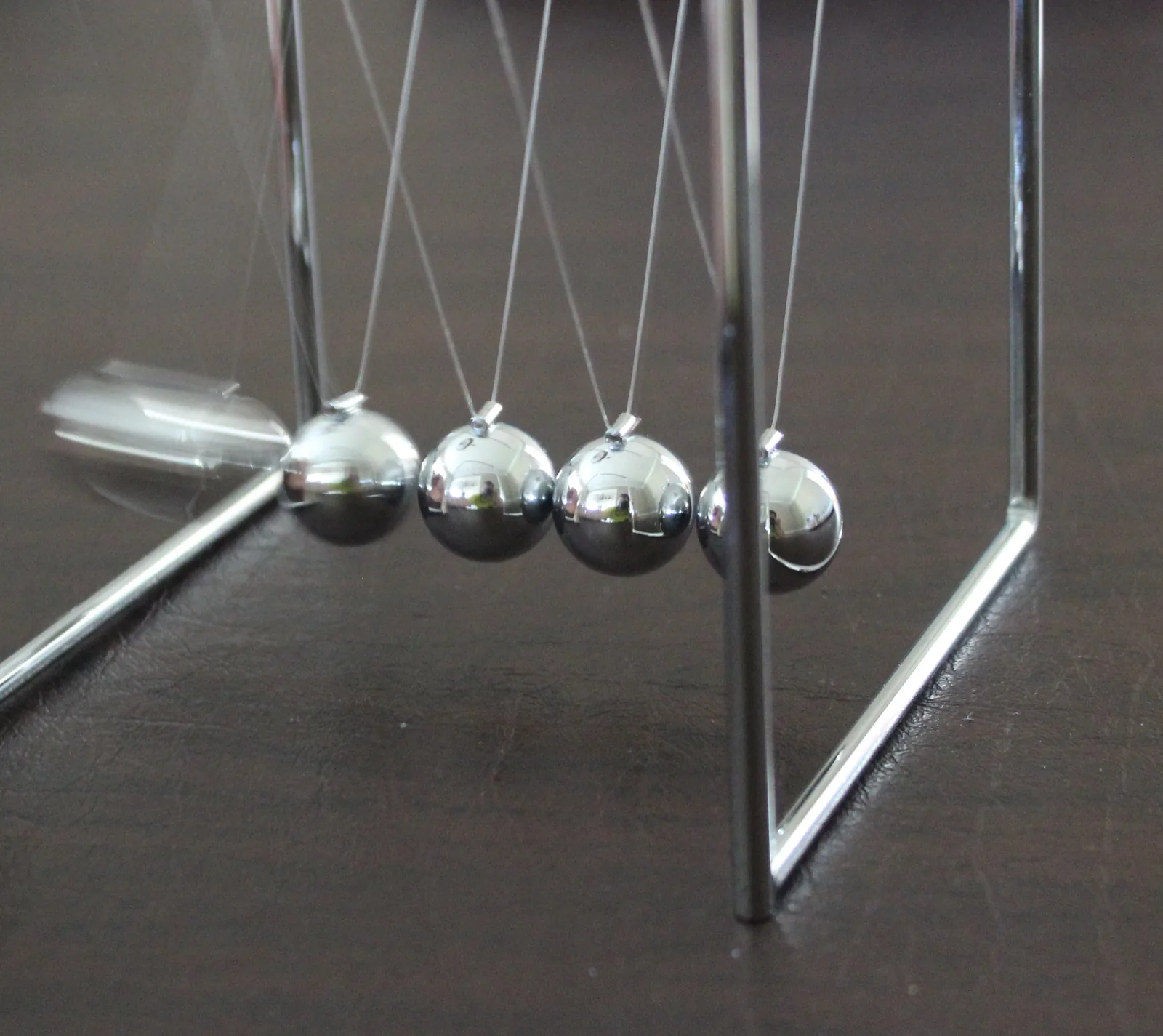
Conservation of momentum
The conservation law with vectors and in one dimension
When the sum of the external forces acting on a system is zero, or their impulse during a collision or explosion is negligibly small, the total momentum is the same before and after:
$$\overline{p}_1 + \overline{p}_2 = \overline{p}_1' + \overline{p}_2'$$
where $\overline{p}_1$ and $\overline{p}_2$ are the momenta of the objects before and $\overline{p}_1'$ and $\overline{p}_2'$ their momenta after ($\text{kg}\cdot\text{m/s}$).
In a one-dimensional collision, all the velocities lie on the same line. We choose a positive direction, and then every velocity is a signed number: the velocity of an object moving in the opposite direction is negative. The conservation law becomes
$$\begin{aligned} &m_1 v_1 + m_2 v_2 \\ \quad &= m_1 v_1' + m_2 v_2' \end{aligned}$$
where $m_1$ and $m_2$ are the masses of the objects ($\text{kg}$), $v_1$ and $v_2$ their velocities before and $v_1'$ and $v_2'$ their velocities after ($\text{m/s}$).
Perfectly inelastic collision
When the objects stick together, they have a common velocity $v'$ after the collision:
$$\begin{aligned} &m_1 v_1 + m_2 v_2 \\ \quad &= (m_1 + m_2)\,v' \end{aligned}$$
where $v'$ is the common velocity of the objects after the collision ($\text{m/s}$). For example, when a $0.40\,\text{kg}$ cart at a velocity of $0.60\,\text{m/s}$ sticks to a similar cart at rest, the common velocity is $0.30\,\text{m/s}$, and the kinetic energy decreases from $0.072\,\text{J}$ to $0.036\,\text{J}$.
Elastic collision
In an elastic collision, in addition to momentum, the total kinetic energy of the objects is conserved:
$$\begin{aligned} &E_{\text{k},1} + E_{\text{k},2} \\ \quad &= E_{\text{k},1}' + E_{\text{k},2}' \end{aligned}$$
where $E_\text{k} = \tfrac12 mv^2$ is the kinetic energy of each object before and $E_\text{k}'$ after ($\text{J}$). When the velocity of one object after the collision is known, the other follows from the law of conservation of momentum, and by comparing the kinetic energies we can see whether the collision was elastic. When an object hits an object of equal mass at rest elastically and head-on, the objects exchange velocities.
When external forces act, the law of conservation of momentum is used only across the collision or explosion itself, a short time from beginning to end. Before and after, external forces such as friction or weight can change the motion of the objects, and then the motion is studied with other laws, for example the work–energy principle.
Common misconception
Many people think that kinetic energy is conserved in a collision in the same way as momentum. Momentum is always conserved when the impulse of the external forces is negligibly small, but kinetic energy is conserved only in an elastic collision. If the velocity of carts that stick together is calculated from conservation of kinetic energy, the result is too large.
Another mistake is to forget the signs. When objects move towards each other, their momenta are in opposite directions, and one of them is negative. A third mistake is to think that momentum disappears when a clay ball dropped on the floor stops. The momentum of the ball passes to the Earth: the ball and the Earth form a system whose total momentum is conserved, but the mass of the Earth is so great that the change in its velocity cannot be noticed.
Summary
- The total momentum of a system is conserved when the sum of the external forces is zero or their impulse during the collision or explosion is negligibly small: $\overline{p}_1 + \overline{p}_2 = \overline{p}_1' + \overline{p}_2'$.
- Conservation follows from Newton's third law: the internal forces in a collision are equally large and opposite and act for the same time, so the changes in the momenta of the objects cancel each other.
- In one dimension we choose a positive direction, and velocities are signed: $m_1 v_1 + m_2 v_2 = m_1 v_1' + m_2 v_2'$.
- In an elastic collision, kinetic energy is also conserved. In an inelastic collision some of the kinetic energy changes into internal energy, and in a perfectly inelastic collision the objects move on together with a common velocity.
- In an explosion, the total momentum of a system at rest stays zero: when it splits into two parts, the parts get momenta of equal magnitude in opposite directions, and kinetic energy increases.
Optional Return to your predictions
Compare your predictions with the readings of the simulation. What surprised you most? Write in your own words when a collision can be solved with the law of conservation of momentum alone and when kinetic energy is needed as well.
Would you change your prediction?
Apply
Worked example
Problem
In a rail yard, freight car A, of mass $32\,000\,\text{kg}$, moves at $1.5\,\text{m/s}$ and catches up with car B, of mass $18\,000\,\text{kg}$, moving in the same direction at $0.50\,\text{m/s}$. The cars couple together and continue together. What is the common velocity of the cars immediately after coupling?
Step 1/7
Given and find. $m_\text{A} = 32\,000\,\text{kg}$, $v_\text{A} = 1.5\,\text{m/s}$, $m_\text{B} = 18\,000\,\text{kg}$ and $v_\text{B} = 0.50\,\text{m/s}$. We are asked for the common velocity $v'$ immediately after coupling.
Step 2/7
Principle. We choose both cars as the system and the direction of motion of the cars as the positive direction. Coupling takes a moment, and during it the forces of the couplers are internal forces. The weight and the normal force of the rails cancel each other, and the impulse of rolling resistance is negligibly small during the short coupling, so the total momentum is conserved. The cars stick together, so the collision is perfectly inelastic.
Step 3/7
Formula solved. The momentum before is equal to the momentum of the combined object after:
$$\begin{aligned} &m_\text{A} v_\text{A} + m_\text{B} v_\text{B} \\ \quad &= (m_\text{A} + m_\text{B})\,v' \\[6pt] v' &= \frac{m_\text{A} v_\text{A} + m_\text{B} v_\text{B}}{m_\text{A} + m_\text{B}} \end{aligned}$$
Step 4/7
Unit conversions. None are needed: the masses are in kilograms and the velocities in $\text{m/s}$.
Step 5/7
Substitution. First we calculate the momenta before coupling and then the common velocity:
$$\begin{aligned} &m_\text{A} v_\text{A} \\ &= 32\,000\,\text{kg} \cdot 1.5\,\tfrac{\text{m}}{\text{s}} \\ &= 48\,000\,\text{kg}\cdot\tfrac{\text{m}}{\text{s}} \\[6pt] &m_\text{B} v_\text{B} \\ &= 18\,000\,\text{kg} \cdot 0.50\,\tfrac{\text{m}}{\text{s}} \\ &= 9000\,\text{kg}\cdot\tfrac{\text{m}}{\text{s}} \\[6pt] &v' \\ &= \frac{48\,000 + 9000}{50\,000} \cdot \frac{\text{kg}\cdot\text{m/s}}{\text{kg}} \\ &= 1.14\,\tfrac{\text{m}}{\text{s}} \end{aligned}$$
Step 6/7
Result. The common velocity of the cars is $v' \approx 1.1\,\text{m/s}$ in the original direction of motion of the cars. The result is given to two significant figures, like the velocities $1.5\,\text{m/s}$ and $0.50\,\text{m/s}$.
Step 7/7
Reasonableness. The common velocity lies between the initial velocities of the cars, $0.50\,\text{m/s}$ and $1.5\,\text{m/s}$, and closer to the velocity of the heavier car A, as it should. The kinetic energy decreases from $38.3\,\text{kJ}$ to $32.5\,\text{kJ}$, that is, by about $15\,\%$, which fits a perfectly inelastic collision: kinetic energy changes into internal energy of the couplers and buffers, and into sound.
Optional Find the error
Apply to a new situation
A boy of mass $50\,\text{kg}$ stands in a rowing boat of mass $120\,\text{kg}$ that is at rest. He jumps from the boat onto the pier with a horizontal velocity of $2.4\,\text{m/s}$ relative to the pier (the ground). The resistance of the water is neglected for the short time of the push-off.
At what velocity does the boat start to move? Answer in $\text{m/s}$.
Hint 1: a guiding question
Choose the boy and the boat as the system. What is the total momentum of the system before the jump?
Hint 2: what is the connection
In the push-off the boy and the boat push each other, so this is an explosion: $0 = m_\text{boy} v_\text{boy} + m_\text{boat} v_\text{boat}$.
Hint 3: an intermediate step
Solve
The minus sign shows that the boat moves in the opposite direction.
Show the solution
Given
mass of the boy $m_\text{boy} = 50\,\text{kg}$, mass of the boat $m_\text{boat} = 120\,\text{kg}$, velocity of the boy after the jump relative to the pier $v_\text{boy}' = 2.4\,\text{m/s}$; at first both are at rest
Find
the velocity of the boat $v_\text{boat}'$ in $\text{m/s}$
Principle
We choose the boy and the boat as the system and the direction of the boy's jump as the positive direction. In the push-off the boy and the boat push each other with equally large forces in opposite directions, which are internal forces. In the horizontal direction no forces act other than the resistance of the water, which is neglected for the short push-off, so the horizontal total momentum is conserved. At first it is zero, so the situation is an explosion.
Formula
$0 = m_\text{boy} v_\text{boy}' + m_\text{boat} v_\text{boat}'$, so
Conversions
The masses are in kilograms and the velocity in $\text{m/s}$, so no conversions are needed.
Substitution
Answer
$1.0\,\text{m/s}$
Away from the pier, two significant figures like the velocity $2.4\,\text{m/s}$. The minus sign shows that the boat moves in the opposite direction to the boy.
Reasonableness
The boat is $2.4$ times as heavy as the boy, so its velocity is $2.4$ times smaller: $2.4\,\text{m/s} : 2.4 = 1.0\,\text{m/s}$.
Check your understanding
Exit ticket
Answer on your own first and only then open the answer.
- Under what condition is the total momentum of two colliding objects conserved? Why is the condition often met even if friction acts on the objects?
Answer
The total momentum is conserved when the sum of the external forces acting on the system is zero or their impulse during the collision is negligibly small. A collision lasts a very short time, and the collision forces are then much greater than friction, so the impulse of friction, $F\,\Delta t$, remains small.
- An air rifle is at rest when the bullet is fired. What is the total momentum of the rifle and the bullet immediately after the shot, and why does the rifle move backwards?
Answer
The total momentum is zero, as before the shot, because the impulse of the external forces is negligibly small for the short time of the shot and only internal forces change the momenta. The shot is an explosion. The bullet gets a momentum forwards, so the rifle gets an equally large momentum backwards. The velocity of the rifle is small, because its mass is much greater than that of the bullet.
1. Concept
2. Calculating
On an air track a $0.60\,\text{kg}$ cart moves to the right at $0.50\,\text{m/s}$ and a $0.20\,\text{kg}$ cart to the left at $0.90\,\text{m/s}$. The carts collide and stick together. Friction is neglected.
What is the common velocity of the carts after the collision? Answer in $\text{m/s}$.
Hint 1: a guiding question
Choose right as the positive direction. What is the sign of the velocity of the cart moving to the left?
Hint 2: what is the connection
In a perfectly inelastic collision $m_1 v_1 + m_2 v_2 = (m_1 + m_2)\,v'$.
Hint 3: an intermediate step
The momentum before is $0.60 \cdot 0.50 + 0.20 \cdot (-0.90)$ in $\text{kg}\cdot\text{m/s}$.
Show the solution
Given
$m_1 = 0.60\,\text{kg}$, $v_1 = +0.50\,\text{m/s}$ (to the right), $m_2 = 0.20\,\text{kg}$, $v_2 = -0.90\,\text{m/s}$ (to the left); the carts stick together
Find
the common velocity $v'$ in $\text{m/s}$
Principle
We choose both carts as the system and the right as the positive direction. On a horizontal track the weight and the normal force cancel each other and friction is neglected, so the total momentum is conserved. The carts stick together, so the collision is perfectly inelastic and the carts finally have a common velocity.
Formula
$m_1 v_1 + m_2 v_2 = (m_1 + m_2)\,v'$, so
Conversions
The masses are in kilograms and the velocities in $\text{m/s}$, so no conversions are needed.
Substitution
Answer
$0.15\,\text{m/s}$
To the right, two significant figures like the data.
Reasonableness
The velocity is positive, because the momentum of the cart moving to the right, $0.30\,\text{kg}\cdot\text{m/s}$, is greater than that of the cart moving to the left, $0.18\,\text{kg}\cdot\text{m/s}$. The common velocity is smaller than the initial velocity of either cart, as it should be when the momenta partly cancel each other.
Suggestion: one answer does not show everything you can do, but review the theory summary and do the core exercises.
3. Explain
Use momentum and kinetic energy to explain why a billiard cue ball stops when it hits a similar ball at rest head-on.
What would happen if the balls were made of clay and stuck together?
Model answer
In the collision the balls push each other with equally large forces in opposite directions for the same time, so the changes in their momenta are equally large and opposite. The impulse of the friction of the table is negligibly small during the short collision, so the total momentum is conserved. For balls of equal mass this means that the sum of the velocities stays the same: $v_1' + v_2' = v$. Billiard balls are hard, and their collision is almost elastic, so kinetic energy is conserved too: $v_1'^2 + v_2'^2 = v^2$. Both conditions are met only if the other ball is at rest after the collision. The cue ball cannot pass through the other ball, so the cue ball stops and the other moves on at velocity $v$. If the balls were made of clay and stuck together, momentum would still be conserved, but the same momentum would be shared by twice the mass: the balls would move on together at velocity $\tfrac12 v$. Only half of the kinetic energy would then remain, and the other half would change into internal energy of the clay.
Assess your own answer
Tick the points your own answer already contains.
Review the theory summary and practise with the exercises.
Review the chapter's concepts
Cards you mark Review later collect in your review deck.
- Conservation of momentum
- The total momentum of an isolated system does not change in an interaction.
- Collision
- A short interaction in which the velocities and momenta of the objects can change quickly.
- Elastic collision
- Besides the total momentum, the total kinetic energy of the objects is also conserved.
- Inelastic collision
- The total momentum is conserved, but part of the kinetic energy turns into other forms.
- Perfectly inelastic collision
- After the collision the objects move together at the same velocity.
- One-dimensional collision
- The objects move along one line, so the directions of momentum can be handled with signs.
Exercises
Level 1 · basic practice 5 exercises
One formula or one step of reasoning. Core exercises first, the rest is extra practice.
- Exercise 14-1Core
On an air track a $0.40\,\text{kg}$ cart moves to the right at $0.50\,\text{m/s}$ and a $0.25\,\text{kg}$ cart to the left at $0.60\,\text{m/s}$.
What is the total momentum of the carts when right is the positive direction? Give the momentum with its sign.
Answer
$0.050\,\text{kg}\cdot\text{m/s}$
Show the solution
Given
$m_1 = 0.40\,\text{kg}$, $v_1 = +0.50\,\text{m/s}$ (to the right), $m_2 = 0.25\,\text{kg}$, $v_2 = -0.60\,\text{m/s}$ (to the left); the positive direction is to the right
Find
the total momentum $p_\text{tot}$ with its sign in $\text{kg}\cdot\text{m/s}$
Principle
The total momentum of the system is the vector sum of the momenta of the carts. In one dimension it is the sum of the signed momenta: the velocity and momentum of the cart moving to the left are negative.
Formula
$p_\text{tot} = m_1 v_1 + m_2 v_2$
Conversions
The masses are in kilograms and the velocities in $\text{m/s}$, so no conversions are needed.
Substitution
$p_\text{tot}$$= (0.40 \cdot 0.50 + 0.25 \cdot (-0.60))\,\text{kg}\cdot\text{m/s}$$= (0.20 - 0.15)\,\text{kg}\cdot\text{m/s}$$= 0.050\,\text{kg}\cdot\text{m/s}$Answer
$0.050\,\text{kg}\cdot\text{m/s}$
That is, to the right, two significant figures like the masses and velocities.
Reasonableness
The total momentum is positive, because the momentum of the cart moving to the right, $0.20\,\text{kg}\cdot\text{m/s}$, is greater than that of the cart moving to the left, $0.15\,\text{kg}\cdot\text{m/s}$. It is smaller than the momentum of either cart, because the momenta are in opposite directions and partly cancel each other.
- Exercise 14-2Core
On an air track a $0.50\,\text{kg}$ cart moves at $0.80\,\text{m/s}$ and collides with a $0.30\,\text{kg}$ cart at rest. The carts stick together. Friction is neglected.
At what velocity do the carts move on together?
Answer
$0.50\,\text{m/s}$
Show the solution
Given
$m_1 = 0.50\,\text{kg}$, $v_1 = 0.80\,\text{m/s}$, $m_2 = 0.30\,\text{kg}$, $v_2 = 0$; the carts stick together
Find
the common velocity $v'$ in $\text{m/s}$
Principle
We choose both carts as the system and the direction of motion of cart 1 as the positive direction. The air track is horizontal, so the weight and the normal force cancel each other, and friction is neglected. The total momentum is conserved. The carts move on together, so the collision is perfectly inelastic.
Formula
$m_1 v_1 + m_2 v_2 = (m_1 + m_2)\,v'$, and $v_2 = 0$, so $v' = \dfrac{m_1 v_1}{m_1 + m_2}$
Conversions
The masses are in kilograms and the velocity in $\text{m/s}$, so no conversions are needed.
Substitution
$v'$$= \dfrac{0.50\,\text{kg} \cdot 0.80\,\text{m/s}}{0.50\,\text{kg} + 0.30\,\text{kg}}$$= \dfrac{0.40\,\text{kg}\cdot\text{m/s}}{0.80\,\text{kg}}$$= 0.50\,\text{m/s}$Answer
$0.50\,\text{m/s}$
In the original direction of motion of cart 1, two significant figures like the data.
Reasonableness
The common velocity is smaller than the initial velocity of cart 1, because the same momentum is shared by a greater mass. The mass increases by the ratio $0.80 : 0.50 = 1.6$, and the velocity decreases by the same ratio: $0.80\,\text{m/s} : 1.6 = 0.50\,\text{m/s}$.
- Exercise 14-3
Two skaters stand facing each other at rest on ice and push each other. The masses of the skaters are $60\,\text{kg}$ and $45\,\text{kg}$. After the push the lighter skater glides at $1.2\,\text{m/s}$. The friction of the ice is neglected for the duration of the push.
At what velocity does the heavier skater glide?
Answer
$0.90\,\text{m/s}$
Show the solution
Given
$m_1 = 60\,\text{kg}$, $m_2 = 45\,\text{kg}$, velocity of the lighter skater $v_2' = 1.2\,\text{m/s}$; both are at rest at first
Find
the velocity of the heavier skater $v_1'$ in $\text{m/s}$
Principle
We choose both skaters as the system and the direction of motion of the lighter skater as the positive direction. The skaters push each other with internal forces, the weight and the normal force of the ice cancel each other, and friction is neglected. The total momentum is conserved, and it is zero at first, so the situation is an explosion.
Formula
$0 = m_1 v_1' + m_2 v_2'$, so $v_1' = -\dfrac{m_2 v_2'}{m_1}$
Conversions
The masses are in kilograms and the velocity in $\text{m/s}$, so no conversions are needed.
Substitution
$v_1'$$= -\dfrac{45\,\text{kg} \cdot 1.2\,\text{m/s}}{60\,\text{kg}}$$= -\dfrac{54\,\text{kg}\cdot\text{m/s}}{60\,\text{kg}}$$= -0.90\,\text{m/s}$Answer
$0.90\,\text{m/s}$
In the direction opposite to the lighter skater, two significant figures like the velocity $1.2\,\text{m/s}$ and the masses.
Reasonableness
The heavier skater moves more slowly, as should be the case: the ratio of the masses is $60 : 45 \approx 1.33$, and the ratio of the velocities is the inverse, $1.2 : 0.90 \approx 1.33$. The minus sign shows that the skaters move in opposite directions.
- Exercise 14-4
On an air hockey table puck A, of mass $0.16\,\text{kg}$, slides at $4.0\,\text{m/s}$ and hits puck B, of mass $0.20\,\text{kg}$, at rest head-on. After the collision puck A slides back in the direction it came from at $0.44\,\text{m/s}$. Friction is neglected.
What is the velocity of puck B after the collision?
Answer
$3.6\,\text{m/s}$
Show the solution
Given
$m_\text{A} = 0.16\,\text{kg}$, $v_\text{A} = +4.0\,\text{m/s}$, $m_\text{B} = 0.20\,\text{kg}$, $v_\text{B} = 0$, velocity of puck A after the collision $v_\text{A}' = -0.44\,\text{m/s}$ (back)
Find
the velocity of puck B $v_\text{B}'$ in $\text{m/s}$
Principle
We choose both pucks as the system and the original direction of motion of puck A as the positive direction. On an air hockey table the weight and the normal force of the air cushion cancel each other and friction is neglected, so the total momentum is conserved. The velocity of puck A moving back is negative.
Formula
$m_\text{A} v_\text{A} + m_\text{B} v_\text{B}$$= m_\text{A} v_\text{A}' + m_\text{B} v_\text{B}'$and $v_\text{B} = 0$, so
$v_\text{B}'$$= \dfrac{m_\text{A} v_\text{A} - m_\text{A} v_\text{A}'}{m_\text{B}}$Conversions
The masses are in kilograms and the velocities in $\text{m/s}$, so no conversions are needed.
Substitution
$v_\text{B}'$$= \dfrac{0.16 \cdot 4.0 - 0.16 \cdot (-0.44)}{0.20}\,\text{m/s}$$= \dfrac{0.64 + 0.0704}{0.20}\,\text{m/s}$$= 3.552\,\text{m/s}$Answer
$3.6\,\text{m/s}$
In the original direction of motion of puck A, two significant figures like the velocities $4.0\,\text{m/s}$ and $0.44\,\text{m/s}$.
Reasonableness
Puck B is heavier than A, so its velocity remains smaller than the initial velocity of A, $4.0\,\text{m/s}$, and the lighter A bounces back. Kinetic energies: before $\tfrac12 \cdot 0.16 \cdot 4.0^2\,\text{J} = 1.28\,\text{J}$, after $(0.015 + 1.26)\,\text{J} \approx 1.28\,\text{J}$, so the collision is almost elastic, which fits hard pucks.
- Exercise 14-5
Two similar $0.30\,\text{kg}$ carts move towards each other on an air track: one to the right at $0.60\,\text{m/s}$ and the other to the left at $0.20\,\text{m/s}$. The carts collide and stick together. Friction is neglected.
At what velocity do the carts move on together?
Answer
$0.20\,\text{m/s}$
Show the solution
Given
$m_1 = m_2 = 0.30\,\text{kg}$, $v_1 = +0.60\,\text{m/s}$ (to the right), $v_2 = -0.20\,\text{m/s}$ (to the left); the carts stick together
Find
the common velocity $v'$ in $\text{m/s}$
Principle
We choose both carts as the system and the right as the positive direction. The weight and the normal force cancel each other and friction is neglected, so the total momentum is conserved. The carts move on together, so the collision is perfectly inelastic.
Formula
$m_1 v_1 + m_2 v_2 = (m_1 + m_2)\,v'$, so
$v'$$= \dfrac{m_1 v_1 + m_2 v_2}{m_1 + m_2}$Conversions
The masses are in kilograms and the velocities in $\text{m/s}$, so no conversions are needed.
Substitution
$v'$$= \dfrac{0.30 \cdot 0.60 + 0.30 \cdot (-0.20)}{0.60}\,\text{m/s}$$= \dfrac{0.18 - 0.06}{0.60}\,\text{m/s}$$= 0.20\,\text{m/s}$Answer
$0.20\,\text{m/s}$
To the right, two significant figures like the data.
Reasonableness
With carts of equal mass the common velocity is the average of the initial velocities: $(0.60 - 0.20)\,\text{m/s} : 2 = 0.20\,\text{m/s}$. The carts move to the right, because the cart moving to the right had the greater momentum.
Level 2 · applied practice 4 exercises
Two steps, working with measured data, a unit conversion or rearranging a formula. Core exercises first, the rest is extra practice.
- Exercise 14-6Core
A $0.50\,\text{g}$ bullet is fired from an air rifle at $180\,\text{m/s}$. The mass of the rifle is $3.2\,\text{kg}$, and before the shot it is at rest, lightly supported by the shooter. The support of the shooter is neglected for the short time of the shot.
At what velocity does the rifle start to move backwards?
Answer
$0.028\,\text{m/s}$
Show the solution
Given
mass of the bullet $m_\text{bullet} = 0.50\,\text{g}$, velocity of the bullet $v_\text{bullet}' = 180\,\text{m/s}$, mass of the rifle $m_\text{rifle} = 3.2\,\text{kg}$; both are at rest at first
Find
the velocity of the rifle $v_\text{rifle}'$ in $\text{m/s}$
Principle
We choose the bullet and the rifle as the system and the direction of flight of the bullet as the positive direction. In the shot, compressed air pushes the bullet forwards and the rifle backwards with equally large forces, which are internal forces. The impulse of the shooter's support is neglected for the short time of the shot, so the total momentum is conserved. It is zero at first, so the shot is an explosion.
Formula
$0 = m_\text{bullet} v_\text{bullet}' + m_\text{rifle} v_\text{rifle}'$, so
$v_\text{rifle}'$$= -\dfrac{m_\text{bullet} v_\text{bullet}'}{m_\text{rifle}}$Conversions
$m_\text{bullet}$$= 0.50\,\text{g}$$= 0.50 \cdot 10^{-3}\,\text{kg}$Substitution
$v_\text{rifle}'$$= -\dfrac{0.50 \cdot 10^{-3}\,\text{kg} \cdot 180\,\text{m/s}}{3.2\,\text{kg}}$$= -\dfrac{0.090\,\text{kg}\cdot\text{m/s}}{3.2\,\text{kg}}$$= -0.028125\,\text{m/s}$Answer
$0.028\,\text{m/s}$
That is, about $2.8\,\text{cm/s}$ backwards, two significant figures like the mass of the bullet $0.50\,\text{g}$ and the mass of the rifle $3.2\,\text{kg}$.
Reasonableness
The rifle is $6400$ times as heavy as the bullet, so its velocity is $6400$ times smaller: $180\,\text{m/s} : 6400 \approx 0.028\,\text{m/s}$. The recoil of an air rifle is indeed hardly noticeable.
- Exercise 14-7Core
An ice hockey player of mass $85\,\text{kg}$ glides at $6.0\,\text{m/s}$ and checks a $75\,\text{kg}$ player who is standing still. After the collision the players glide on together. The friction of the ice is neglected for the duration of the collision.
How much of the players' kinetic energy changes into other forms of energy in the collision?
Answer
$720\,\text{J}$
Show the solution
Given
$m_1 = 85\,\text{kg}$, $v_1 = 6.0\,\text{m/s}$, $m_2 = 75\,\text{kg}$, $v_2 = 0$; the players slide on together after the collision
Find
the kinetic energy that changes into other forms of energy $\Delta E$ in $\text{J}$
Principle
We choose both players as the system. The weight and the normal force of the ice cancel each other and friction is neglected during the collision, so the total momentum is conserved. The players move on together, so the collision is perfectly inelastic, and kinetic energy is not conserved. The common velocity follows from the law of conservation of momentum, and with it the kinetic energy after the collision is calculated.
Formula
$m_1 v_1 = (m_1 + m_2)\,v'$, so $v' = \dfrac{m_1 v_1}{m_1 + m_2}$, and $\Delta E = \tfrac12 m_1 v_1^2 - \tfrac12 (m_1 + m_2)\,v'^2$
Conversions
The masses are in kilograms and the velocity in $\text{m/s}$, so no conversions are needed.
Substitution
$v'$$= \dfrac{85\,\text{kg} \cdot 6.0\,\text{m/s}}{160\,\text{kg}}$$= 3.1875\,\text{m/s}$$\Delta E$$= \tfrac12 \cdot 85\,\text{kg} \cdot (6.0\,\text{m/s})^2 - \tfrac12 \cdot 160\,\text{kg} \cdot (3.1875\,\text{m/s})^2$$= 1530\,\text{J} - 812.8\,\text{J}$$= 717.2\,\text{J}$Answer
$720\,\text{J}$
That is, about $0.72\,\text{kJ}$, two significant figures like the velocity $6.0\,\text{m/s}$ and the masses.
Reasonableness
The part of the kinetic energy that changes into other forms is $717 : 1530 \approx 47\,\%$, which is less than all of the kinetic energy, as it should be, because the players are still moving. The fraction is
$\tfrac{m_2}{m_1 + m_2}$$= \tfrac{75}{160}$$\approx 47\,\%$which matches a perfectly inelastic collision with an object at rest. The energy becomes deformation of the equipment and the body, internal energy and sound.
- Exercise 14-8
On an air track a $0.20\,\text{kg}$ cart moves at $0.60\,\text{m/s}$ and collides with a $0.40\,\text{kg}$ cart at rest. After the collision the lighter cart moves back in the direction it came from at $0.10\,\text{m/s}$. Friction is neglected.
What percentage of the original kinetic energy of the carts remains after the collision?
Answer
$71\,\%$
Show the solution
Given
$m_1 = 0.20\,\text{kg}$, $v_1 = +0.60\,\text{m/s}$, $m_2 = 0.40\,\text{kg}$, $v_2 = 0$, velocity of the lighter cart after the collision $v_1' = -0.10\,\text{m/s}$ (back)
Find
the fraction of the kinetic energy that remains, as a percentage
Principle
We choose both carts as the system and the original direction of motion of the lighter cart as the positive direction. The weight and the normal force cancel each other and friction is neglected, so the total momentum is conserved. It gives the velocity of the heavier cart, and then the kinetic energies before and after are compared. Kinetic energy is not necessarily conserved, so it cannot be used as an equation.
Formula
$m_1 v_1 = m_1 v_1' + m_2 v_2'$, so
$v_2'$$= \dfrac{m_1 v_1 - m_1 v_1'}{m_2}$and the fraction is $\dfrac{\tfrac12 m_1 v_1'^2 + \tfrac12 m_2 v_2'^2}{\tfrac12 m_1 v_1^2} \cdot 100\,\%$
Conversions
The masses are in kilograms and the velocities in $\text{m/s}$, so no conversions are needed.
Substitution
$v_2'$$= \dfrac{0.20 \cdot 0.60 - 0.20 \cdot (-0.10)}{0.40}\,\text{m/s}$$= 0.35\,\text{m/s}$kinetic energy before $\tfrac12 \cdot 0.20 \cdot 0.60^2\,\text{J} = 0.036\,\text{J}$ and after
$(\tfrac12 \cdot 0.20 \cdot 0.10^2 + \tfrac12 \cdot 0.40 \cdot 0.35^2)\,\text{J}$$= 0.0255\,\text{J}$so the fraction is $0.0255 : 0.036 \cdot 100\,\% = 70.8\,\%$
Answer
$71\,\%$
Two significant figures like the velocities and masses.
Reasonableness
The fraction is below $100\,\%$, so the collision is inelastic, but the carts move apart, so it is not perfectly inelastic. In a perfectly inelastic collision only $\tfrac{m_1}{m_1 + m_2} = 33\,\%$ would remain, so the result lies between these extreme cases, as it should.
- Exercise 14-9
In a rail yard a $30\,000\,\text{kg}$ freight car moves at $1.8\,\text{m/s}$ and collides with a car at rest. The cars couple together and move on together at $1.2\,\text{m/s}$. Rolling resistance is neglected for the duration of the coupling.
What is the mass of the car that was at rest?
Answer
$15\,000\,\text{kg}$
Show the solution
Given
$m_1 = 30\,000\,\text{kg}$, $v_1 = 1.8\,\text{m/s}$, $v_2 = 0$, common velocity $v' = 1.2\,\text{m/s}$
Find
the mass of the car that was at rest, $m_2$, in $\text{kg}$
Principle
We choose both cars as the system and the direction of the moving car as the positive direction. The weight and the normal force of the rails cancel each other, and the impulse of rolling resistance is negligibly small during the short coupling, so the total momentum is conserved. The cars move on together, so the collision is perfectly inelastic.
Formula
$m_1 v_1 = (m_1 + m_2)\,v'$, so $m_2 = \dfrac{m_1 (v_1 - v')}{v'}$
Conversions
The mass is in kilograms and the velocities in $\text{m/s}$, so no conversions are needed.
Substitution
$m_2$$= \dfrac{30\,000\,\text{kg} \cdot (1.8 - 1.2)\,\text{m/s}}{1.2\,\text{m/s}}$$= \dfrac{30\,000\,\text{kg} \cdot 0.6}{1.2}$$= 15\,000\,\text{kg}$Answer
$15\,000\,\text{kg}$
Two significant figures like the velocities $1.8\,\text{m/s}$ and $1.2\,\text{m/s}$.
Reasonableness
The velocity decreased by the ratio $1.8 : 1.2 = 1.5$, so the total mass must be $1.5$ times the mass of the car that was moving: $45\,000\,\text{kg}$. The mass of the other car is therefore $45\,000\,\text{kg} - 30\,000\,\text{kg} = 15\,000\,\text{kg}$, which is a typical mass for a freight car.
Level 3 · challenging 3 exercises
Optional: application, two ideas together or a new situation where you reason for yourself.
- Exercise 14-10
The velocity of a bullet is measured with a ballistic pendulum: a $2.0\,\text{kg}$ block of wood hangs at rest from a long string, and a $10\,\text{g}$ bullet is fired horizontally into the block at $400\,\text{m/s}$ and stays in it.
The bullet stops in the block so quickly that the block does not have time to move during it. After that the block and the bullet swing up together. Air resistance is neglected.
How high does the block rise from its lowest point? Answer in centimetres.
Answer
$20\,\text{cm}$
Show the solution
Given
mass of the bullet $m = 10\,\text{g}$, velocity of the bullet $v = 400\,\text{m/s}$, mass of the block $M = 2.0\,\text{kg}$, $g = 9.81\,\text{m/s}^2$; the block is at rest at first
Find
the height of rise $h$ in $\text{cm}$
Principle
The problem has two phases. (1) The bullet embeds in the block: we choose the bullet and the block as the system. The block does not have time to move during the collision, so the string stays vertical and the force of the string and the weight are vertical. In the horizontal direction the external forces do not change the momentum, so the horizontal momentum is conserved, and the collision is perfectly inelastic. (2) The swing: only the weight does work on the block and the bullet, because the force of the string is perpendicular to the motion and air resistance is neglected, so the mechanical energy is conserved. Kinetic energy cannot be used across the collision, because the collision is inelastic.
Formula
$mv = (m + M)\,v'$, so $v' = \dfrac{mv}{m + M}$, and $\tfrac12 (m + M)\,v'^2 = (m + M)\,gh$, so $h = \dfrac{v'^2}{2 \cdot g}$
Conversions
$m = 10\,\text{g} = 0.010\,\text{kg}$, and finally $1\,\text{m} = 100\,\text{cm}$.
Substitution
$v'$$= \dfrac{0.010\,\text{kg} \cdot 400\,\text{m/s}}{2.010\,\text{kg}}$$= 1.990\,\text{m/s}$$h$$= \dfrac{(1.990\,\text{m/s})^2}{2 \cdot 9.81\,\text{m/s}^2}$$= 0.2019\,\text{m}$$= 20.19\,\text{cm}$Answer
$20\,\text{cm}$
Two significant figures like the mass of the bullet $10\,\text{g}$ and the mass of the block $2.0\,\text{kg}$.
Reasonableness
The velocity of the block is about $\tfrac{1}{200}$ of the velocity of the bullet, because the mass is about $200$ times as great. Only $\tfrac{1}{201}$ of the original $800\,\text{J}$ of the bullet's kinetic energy remains, about $4\,\text{J}$, and that is enough to lift a $2\,\text{kg}$ block about $\tfrac{4\,\text{J}}{20\,\text{N}} = 0.2\,\text{m}$. The rest of the energy became internal energy of the wood and the bullet.
- Exercise 14-11
A firework rocket of mass $0.90\,\text{kg}$ rises straight up at $12\,\text{m/s}$ when it explodes into two pieces. The $0.30\,\text{kg}$ piece continues straight up at $40\,\text{m/s}$, and the other piece moves vertically.
The impulse of the weight and of air resistance is neglected for the short time of the explosion.
What is the velocity of the other piece immediately after the explosion? Give the velocity with its sign when upwards is the positive direction.
Answer
$-2.0\,\text{m/s}$
Show the solution
Given
mass of the rocket $M = 0.90\,\text{kg}$, velocity $v = +12\,\text{m/s}$ (up), mass of piece 1 $m_1 = 0.30\,\text{kg}$ and its velocity $v_1' = +40\,\text{m/s}$, mass of piece 2 $m_2 = 0.90\,\text{kg} - 0.30\,\text{kg} = 0.60\,\text{kg}$; upwards is the positive direction
Find
the velocity of piece 2, $v_2'$, with its sign in $\text{m/s}$
Principle
We choose the rocket and its pieces as the system. The forces of the explosion are internal and much greater than the weight and air resistance, and the explosion lasts a very short time, so the impulse of the external forces is negligibly small and the total momentum is conserved. The system is moving before the explosion, so the total momentum is not zero but $Mv$.
Formula
$Mv = m_1 v_1' + m_2 v_2'$, so $v_2' = \dfrac{Mv - m_1 v_1'}{m_2}$
Conversions
The masses are in kilograms and the velocities in $\text{m/s}$, so no conversions are needed.
Substitution
$v_2'$$= \dfrac{0.90 \cdot 12 - 0.30 \cdot 40}{0.60}\,\text{m/s}$$= \dfrac{10.8 - 12.0}{0.60}\,\text{m/s}$$= -2.0\,\text{m/s}$Answer
$-2.0\,\text{m/s}$
That is, $2.0\,\text{m/s}$ downwards, two significant figures like the data.
Reasonableness
The momentum of the piece flying up, $12.0\,\text{kg}\cdot\text{m/s}$, is greater than the momentum of the whole rocket, $10.8\,\text{kg}\cdot\text{m/s}$, so the momentum of the other piece must be downwards, $-1.2\,\text{kg}\cdot\text{m/s}$. Check: $0.30 \cdot 40 + 0.60 \cdot (-2.0) = 10.8$, the same as before the explosion.
- Exercise 14-12
An astronaut is on a spacewalk, at rest relative to the space station, $12.0\,\text{m}$ from the station, when the safety tether comes loose. The mass of the astronaut with the spacesuit is $120\,\text{kg}$. The astronaut throws a $3.0\,\text{kg}$ tool away from the station at $4.0\,\text{m/s}$ relative to the station.
How long does it take for the astronaut to drift back to the station?
Answer
$120\,\text{s}$
Show the solution
Given
distance $s = 12.0\,\text{m}$, mass of the astronaut with the spacesuit $M = 120\,\text{kg}$, mass of the tool $m = 3.0\,\text{kg}$ and its velocity $v_\text{t}' = 4.0\,\text{m/s}$ away from the station; both are at rest relative to the station at first
Find
the time $t$ in which the astronaut returns to the station, in $\text{s}$
Principle
The problem has two phases. (1) The throw: we choose the astronaut and the tool as the system and the direction towards the station as the positive direction. Gravity acts on both the astronaut and the tool, but they are in the same free fall (in orbit) as the station, so gravity does not change their motion relative to the station, and during the throw there are no other external forces relative to the station. The total momentum relative to the station is conserved, and it is zero at first: the throw is an explosion. The astronaut gets a momentum as large as the tool's, in the opposite direction, that is, towards the station. (2) After the throw, no forces other than gravity act on the astronaut, and it is the same free fall as the station's, so the astronaut moves at a constant velocity.
Formula
$0 = M v_\text{a}' + m v_\text{t}'$, where $v_\text{t}' = -4.0\,\text{m/s}$, so
$v_\text{a}'$$= -\dfrac{m v_\text{t}'}{M}$and in uniform motion $t = \dfrac{s}{v_\text{a}'}$
Conversions
The masses are in kilograms, the distance in metres and the velocity in $\text{m/s}$, so no conversions are needed.
Substitution
$v_\text{a}'$$= -\dfrac{3.0\,\text{kg} \cdot (-4.0\,\text{m/s})}{120\,\text{kg}}$$= 0.10\,\text{m/s}$$t$$= \dfrac{12.0\,\text{m}}{0.10\,\text{m/s}}$$= 120\,\text{s}$Answer
$120\,\text{s}$
That is, about $2.0\,\text{min}$, two significant figures like the mass and velocity of the tool.
Reasonableness
The astronaut is $40$ times as heavy as the tool, so the astronaut's velocity is $40$ times smaller: $4.0\,\text{m/s} : 40 = 0.10\,\text{m/s}$. At this slow speed a distance of $12\,\text{m}$ takes about two minutes, which is believable. The heavier and faster the thrown object, the sooner the astronaut returns.
Photographs
- Newtons Cradle. The Dean of Physics. source, CC BY-SA 4.0
