
Pressure and hydrostatic pressure
Why is the wall of a dam much thicker at the bottom than at the top, even though the water pressing on it is the same water all the way down?
Prior knowledge
- Weight is a force, $G = mg$, and $g = 9.81\,\text{m/s}^2$chapter Force as a measure of interaction and weight $G = mg$
- Pressure is a state variable that arises in the micro model from particles colliding with the wallchapter Thermodynamic system, state variables and temperature
Core path: follow the steps in order. Tasks marked Optional give extra practice. Optional tasks: 7.
Think about it
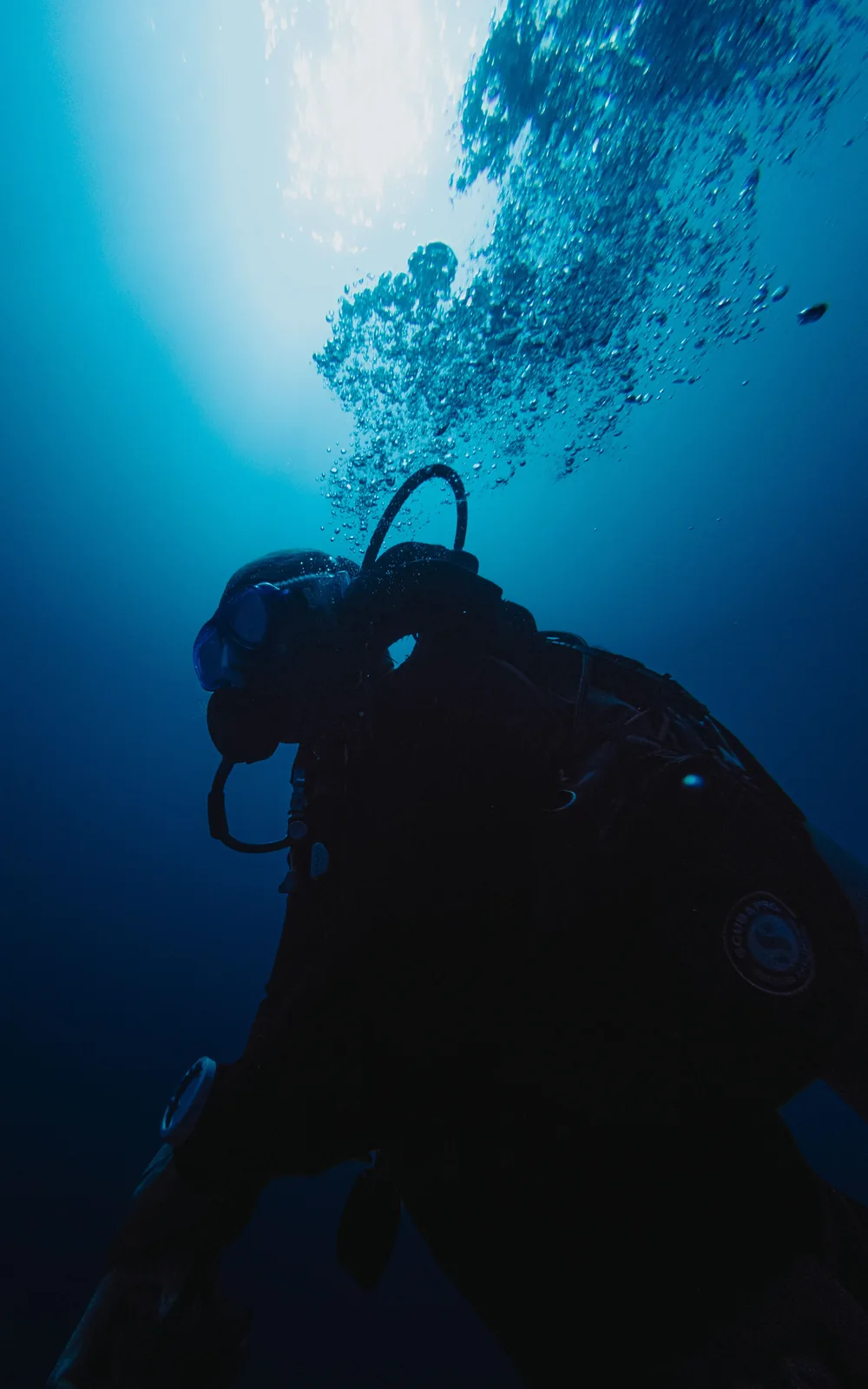
You dive towards the bottom of a swimming-pool diving pool. Already at a depth of a couple of metres you feel pressure in your ears, and the lower you go, the more clearly you feel it. At the surface your ears feel nothing, even though the atmosphere presses on them too. The same thing loads the wall of a dam and your eardrum: the water above.
How does pressure change as you go deeper in a liquid, and what does it depend on?
Optional Review: the weight of water
Predict
Make your predictions before investigating 3 questions
Prediction 1: the depth doubles
Optional Prediction 2: a denser liquid
Prediction 3: a narrow tube and a wide pool
Investigate
In the simulation a pressure gauge is lowered into a liquid.
Simulation
How to use
Adjust the depth and the density and follow the reading of the gauge and the $(h, p)$ graph. The box Show gauge pressure only removes atmospheric pressure from the graph.
Assumptions of the model
Atmospheric pressure at the surface is a fixed $101\,\text{kPa}$, and the liquid is at rest and equally dense everywhere (its compression is ignored). The readings are values from a model, not measurements from a real lake.
How the calculation works
Pressure grows steadily with depth: $p = p_0 + \rho g h$, so every metre adds $\rho g \cdot 1\,\text{m}$ of pressure. The slope of the line, $\rho g$, depends on the density, but at the surface ($h = 0$) the pressure is always the atmospheric pressure $p_0$.
Experiment 1: only the depth changes
Test prediction 1. The liquid is water, and the density stays constant. Change only the depth and record the pressures at at least two depths, for example $5\,\text{m}$, $10\,\text{m}$, $15\,\text{m}$ and $20\,\text{m}$. Compare whether the total pressure increases in the same ratio as the depth, and by how much the pressure increases for every five metres.
Initial state: depth $h$ = $5\,\text{m}$, density $\rho$ = $1000\,\text{kg/m}^3$. Kept constant: density $\rho$. Varied: depth $h$.
| depth $h$ | $\rho gh$ $(\text{kPa})$ | $p$ $(\text{kPa})$ |
|---|
By how many kilopascals does the pressure in water grow for every metre of depth? Read it from your measurements.
Show the solution
Given
water, $\rho = 1000\,\text{kg/m}^3$ constant; measurements at two depths with $\Delta h = 10.0\,\text{m} - 5.0\,\text{m} = 5.0\,\text{m}$ between them: at the depth $5.0\,\text{m}$ the total pressure is $p_1 = 150.1\,\text{kPa}$ and at the depth $10.0\,\text{m}$ the pressure is $p_2 = 199.1\,\text{kPa}$
Find
the increase in pressure per metre of depth, $\dfrac{\Delta p}{\Delta h}$, in $\text{kPa/m}$
Principle
In a liquid $p = p_0 + \rho g h$, and because only the depth changes ($\rho$ and $p_0$ stay the same), the pressure grows steadily: the increase per metre is always the same number $\rho g$. Atmospheric pressure $p_0$ does not change with depth, so it cancels when we take the difference between the pressures at two depths.
Formula
$p_2 - p_1 = \rho g (h_2 - h_1)$, so
$$\frac{\Delta p}{\Delta h} = \frac{p_2 - p_1}{h_2 - h_1} \;(= \rho g)$$
Conversions
The pressures are already in kilopascals and the depths in metres, so the result comes directly in $\text{kPa/m}$ and no conversions are needed. For comparison,
Substitution
Answer
$9.8\,\text{kPa/m}$
(from your readings), two significant figures, because the depth difference $5.0\,\text{m}$ is known to two figures, although the pressure difference $49.0\,\text{kPa}$ has three. The value of the model is $\rho g = 9.81\,\text{kPa/m}$.
Reasonableness
The increase is about $10\,\text{kPa}$ per metre, which fits the fact that $10\,\text{m}$ of water adds about one atmosphere ($101\,\text{kPa}$). Pressure grows in the same proportion as depth only for the gauge pressure: $5\,\text{m}$ gives $49\,\text{kPa}$ and $10\,\text{m}$ gives $98\,\text{kPa}$, which is double. The total pressure does not double ($150 \to 199\,\text{kPa}$), because $101\,\text{kPa}$ is included in both.
Optional Further investigation: only the density changes
Test prediction 2. The gauge stays at a depth of $10\,\text{m}$, and only the density of the liquid changes. Record the pressures for at least two densities, for example petrol 720, water 1000 and Dead Sea water $1240\,\text{kg/m}^3$. Which of the pressures increases in the same ratio as the density?
Initial state: depth $h$ = $10\,\text{m}$, density $\rho$ = $1000\,\text{kg/m}^3$. Kept constant: depth $h$. Varied: density $\rho$.
| density $\rho$ | $\rho gh$ $(\text{kPa})$ | $p$ $(\text{kPa})$ |
|---|
Conclusion: how does pressure depend on depth?
Based on your measurements, write how the gauge pressure $\rho g h$ and the total pressure $p$ depended on the depth.
Did the total pressure double when the depth doubled? What do the slope and the intercept on the vertical axis of the $(h, p)$ graph tell you?
Model answer
The gauge pressure grew in direct proportion to the depth: at $5\,\text{m}$ about $49\,\text{kPa}$ and at $10\,\text{m}$ about $98\,\text{kPa}$, that is, about $9.8\,\text{kPa}$ for every metre. The total pressure grew from $150\,\text{kPa}$ to $199\,\text{kPa}$ and did not double, because it includes the atmospheric pressure at the surface, $p_0 = 101\,\text{kPa}$, which does not depend on depth. The $(h, p)$ graph is a straight line whose slope is $\rho g$ and which cuts the vertical axis at $p_0$. The simulation calculates the pressure from the formula, so it shows the model; real depth gauges and the experience of divers (about one more atmosphere for every $10\,\text{m}$) support it.
Assess your own answer
Tick the points your own answer already contains.
Review the theory summary and practise with the exercises.
Theory summary
Key idea
When a force is spread over a surface, its effect depends on how large an area it is spread over. The sharp tip of a drawing pin sinks into a wall with the same force that leaves no mark when applied to the blunt head, and skis carry you on deep snow although boots sink in. The quantity that describes this is pressure: force divided by the area over which the force is spread. The unit of pressure is the pascal (Pa), and $1\,\text{Pa} = 1\,\text{N/m}^2$. The pascal is a small unit, so in everyday life we use the kilopascal: $1\,\text{kPa} = 1000\,\text{Pa}$.
Where does pressure come from?
According to the micro model, the pressure of a gas comes from particles colliding with the walls of the container. The pressure of a liquid comes from the weight of the liquid itself: above every layer of water there is more water pressing down on it. The deeper you go, the more water there is above you and the greater the pressure. In a liquid at rest, a horizontal surface of area $A$ below the surface carries the weight of the column of water above it. The height of the column is the depth $h$ and its volume is $V = Ah$. Density $\rho$ is mass per volume ($m = \rho V$), so the mass of the column is $\rho A h$ and its weight is $G = mg = \rho A h g$. Pressure is weight divided by area, so the area cancels and what is left is $\rho g h$. The pressure produced by the weight of a liquid is called hydrostatic pressure. It does not depend on the shape of the container or on the total amount of water, only on the depth and the density of the liquid.
Pressure is not a force but the ratio of force to area, and in a liquid at rest the pressure acts equally in every direction. If the pressure sideways were smaller than downwards, the water would flow sideways and would not stay at rest. If you make holes at several heights in the side of a bottle, the water squirts out hardest from the lowest hole, because the pressure grows with depth. The force caused by pressure is always perpendicular to the surface: on the vertical wall of a dam the force points horizontally, and on a diver's body it acts from all sides. That is why here we can treat the force as just a magnitude; the direction comes from the surface.
Atmospheric pressure and gauge pressure
Atmospheric pressure, the pressure of the atmosphere, already acts on the surface of the water. At sea level it is about $101\,\text{kPa}$. It is the weight of the column of air per unit area. Atmospheric pressure also acts on the surface of the water and is transmitted through the water to depth. Under water the total pressure is therefore the sum of atmospheric pressure and hydrostatic pressure. At a depth of ten metres the hydrostatic pressure is already about the same as one atmosphere.
This answers the opening question. Atmospheric pressure acts on both sides of the dam wall, so the wall is loaded only by the gauge pressure of the water, that is, the part of the pressure that is greater than atmospheric pressure. The gauge pressure is zero at the top and grows steadily with depth: at a depth of 30 metres it is about $290\,\text{kPa}$, so every square metre of the wall feels a force of about $290\,\text{kN}$. The lower part of the wall must therefore withstand a much greater force than the upper part, and the wall is built thick at the bottom.
Pressure and hydrostatic pressure
Pressure is the force perpendicular to a surface divided by the area:
$$p = \frac{F}{A}$$
where $p$ is the pressure (Pa), $F$ the force perpendicular to the surface (N) and $A$ the area (m²). One pascal is a force of one newton on an area of one square metre: $1\,\text{Pa} = 1\,\text{N/m}^2$.
In a liquid at depth $h$ the pressure is
$$p = p_0 + \rho g h$$
where $p_0$ is the pressure at the surface of the liquid, usually atmospheric pressure (Pa), $\rho$ the density of the liquid (kg/m³), $g$ = $9.81\,\text{m/s}^2$ and $h$ the depth below the surface (m). The term $\rho g h$ is the hydrostatic pressure, that is, the gauge pressure $\Delta p = p - p_0$, which tells how much greater the pressure is than the pressure at the surface. The graph $(h, p)$ is a straight line whose slope is $\rho g$ and whose constant term is $p_0$, as in the linear model $y = kx + b$ of FY1. For water $\rho$ = $1000\,\text{kg/m}^3$, so the pressure grows by $9.81\,\text{kPa}$ for every metre.
Common misconception
Many people think that the pressure at the bottom depends on how much water the container holds. In a narrow tube and a wide pool, where the water reaches the same height, the pressure at the bottom is the same, even though the pool holds a thousand times as much water. Pressure depends only on the depth, the density and the pressure at the surface. Another mistake is to confuse pressure and force: the sharp tip of a drawing pin does not produce a greater force than the head, but spreads the same force over a smaller area, so the pressure is greater. A third mistake is to forget atmospheric pressure: $\rho g h$ alone gives only the gauge pressure, and the total pressure under water is always greater than that.
Summary
- Pressure is force per unit area: $p = F/A$. The unit is the pascal, $1\,\text{Pa} = 1\,\text{N/m}^2$, and $1\,\text{kPa} = 1000\,\text{Pa}$.
- In a liquid the pressure grows with depth: $p = p_0 + \rho g h$. The term $\rho g h$ is the hydrostatic pressure, and it depends only on the depth and the density, not on the shape of the container.
- The force caused by pressure is perpendicular to the surface and acts in every direction in a liquid.
- Atmospheric pressure at sea level is about $101\,\text{kPa}$. In water the pressure grows by about one atmosphere for every ten metres.
Optional Go back to your predictions
Compare your predictions with your measurements and with the model $p = p_0 + \rho g h$. Which term explains why the total pressure does not double with the depth? Also go back to the opening question: how does pressure change as you go deeper, and why must the wall of a dam be thickest at the bottom?
Would you change your prediction?
Apply
Worked example
Problem
A diver is in a lake at a depth of $12.0\,\text{m}$, next to the window of an underwater observation room. Atmospheric pressure at the surface is $101\,\text{kPa}$ and the density of water is $1000\,\text{kg/m}^3$. What is the pressure around the diver, and how large is the force on a window of area $150\,\text{cm}^2$ when the room contains air at normal pressure?
Step 1/7
Given and find. Depth $h = 12.0\,\text{m}$, atmospheric pressure $p_0 = 101\,\text{kPa}$, the density of water from a table or from the problem $\rho = 1000\,\text{kg/m}^3$, $g = 9.81\,\text{m/s}^2$ and window area $A = 150\,\text{cm}^2$. We want the total pressure $p$ around the diver and the force $F$ on the window.
Step 2/7
Principle. The water is at rest and its density is constant, so the pressure grows steadily with depth: the total pressure is the atmospheric pressure at the surface plus the hydrostatic pressure of the water $\rho g h$. Only the gauge pressure $\rho g h$ acts on the window, because the atmospheric pressure in the room pushes the window from inside just as much as the atmospheric pressure at the surface pushes from outside. The force is pressure times area, because pressure is force per unit area.
Step 3/7
Rearranged formula. Both unknowns are already alone on the left-hand side:
$$\begin{aligned} p &= p_0 + \rho g h \\ F &= \rho g h \cdot A \end{aligned}$$
Step 4/7
Unit conversions. Atmospheric pressure in pascals is $101\,\text{kPa} = 101\,000\,\text{Pa}$. The area of the window in square metres is
because $1\,\text{cm}^2 = 10^{-4}\,\text{m}^2$. The other quantities are already in SI units.
Step 5/7
Substitution. We calculate the hydrostatic pressure, the total pressure and the force one after another:
$$\begin{aligned} &\rho g h \\ &= 1000\,\tfrac{\text{kg}}{\text{m}^3} \\ &\quad \cdot 9.81\,\tfrac{\text{m}}{\text{s}^2} \\ &\quad \cdot 12.0\,\text{m} \\ &= 117\,720\,\text{Pa} \\[6pt] p &= p_0 + \rho g h \\ &= 101\,000\,\text{Pa} \\ &\quad + 117\,720\,\text{Pa} \\ &= 218\,720\,\text{Pa} \\[6pt] F &= \rho g h \cdot A \\ &= 117\,720\,\text{Pa} \\ &\quad \cdot 0.015\,\text{m}^2 \\ &= 1765.8\,\text{N} \end{aligned}$$
Step 6/7
Result. The total pressure is $p \approx 219\,\text{kPa}$ and the force on the window is $F \approx 1.8\,\text{kN}$. The pressure is given with three significant figures, because the depth $12.0\,\text{m}$ and the atmospheric pressure $101\,\text{kPa}$ are given with three figures. The force is given with two, because the area $150\,\text{cm}^2$ is given with two figures.
Step 7/7
Reasonableness. The total pressure is about 2.2 times atmospheric pressure, which fits the fact that 10 metres of water add about one atmosphere and 12 metres add a little more. Estimate:
The force equals the weight of a mass of about $180\,\text{kg}$, although the window is small. The pressure does not crush the diver's body, because in water the same pressure acts on the body from all sides and the body fluids transmit it to the inside as well. Only the pressure in the body's air spaces, such as the ears, has to be equalised.
Optional Find the error
Optional Apply to a new situation
A mercury barometer has a vertical glass tube that is closed at the top and whose lower end is in a dish of mercury. In the upper part of the tube, above the mercury, there is a vacuum, so the pressure at the top of the column is zero. The atmospheric pressure of $101\,\text{kPa}$ holds the column of mercury up in the tube.
How tall is the column? The density of mercury is $13\,600\,\text{kg/m}^3$. Give the answer in metres.
Hint 1: a guiding question
At the level of the surface in the dish, the pressure inside the tube is equal to the pressure outside, that is, atmospheric pressure. What produces this pressure inside the tube?
Hint 2: what is the connection
At the top of the column the pressure is zero, so the hydrostatic pressure of the column equals atmospheric pressure: $\rho g h = p_0$, so $h = \dfrac{p_0}{\rho g}$.
Hint 3: an intermediate step
Substitute in pascals:
Show the solution
Given
density of mercury $\rho = 13\,600\,\text{kg/m}^3$ (given in the problem), atmospheric pressure $p_0 = 101\,\text{kPa}$, pressure at the top of the column $0$, $g = 9.81\,\text{m/s}^2$
Find
the height $h$ of the column of mercury in metres
Principle
The column is at rest, so at the level of the liquid surface the pressure is the same in the dish and inside the tube. In the dish it is atmospheric pressure $p_0$, and in the tube it is produced by the hydrostatic pressure of the column of mercury, because above the column there is a vacuum ($p = 0$) and nothing else presses the column downwards. Therefore $p_0 = 0 + \rho g h$.
Formula
$p_0 = \rho g h$, so
$$h = \frac{p_0}{\rho g}$$
Conversions
$101\,\text{kPa} = 101\,000\,\text{Pa}$, so that the units $\text{Pa} = \text{kg}/(\text{m}\cdot\text{s}^2)$ cancel to metres.
Substitution
Answer
$0.757\,\text{m}$
Three significant figures, like the density $13\,600\,\text{kg/m}^3$ and the atmospheric pressure $101\,\text{kPa}$.
Reasonableness
A column of water would be $101\,\text{kPa} / 9.81\,\text{kPa/m} \approx 10.3\,\text{m}$ tall, and mercury is $13.6$ times denser, so the column is $10.3\,\text{m} / 13.6 \approx 0.757\,\text{m}$. Checking backwards, $13\,600 \cdot 9.81 \cdot 0.757\,\text{Pa} \approx 101\,000\,\text{Pa}$. About $76\,\text{cm}$ is a suitable height for a glass tube.
Check your understanding
Exit ticket
Answer on your own first and only then open the answer.
- A drawing pin is pushed into a wall with a finger. Why does the sharp tip sink into the wall, although the same force acts on the tip and on the head?
Answer
The area of the tip is very small, so the same force is spread over a small area and the pressure $p = F/A$ is large. At the head the same force is spread over a large area, so the pressure stays small.
- How large is the hydrostatic pressure at a depth of $5.0\,\text{m}$ in water ($\rho = 1000\,\text{kg/m}^3$)? And the total pressure, when atmospheric pressure is $101\,\text{kPa}$?
Answer
$\rho g h$$= 1000\,\text{kg/m}^3 \cdot 9.81\,\text{m/s}^2 \cdot 5.0\,\text{m}$$\approx 49\,\text{kPa}$The total pressure is $101\,\text{kPa} + 49\,\text{kPa} \approx 150\,\text{kPa}$.
1. Concept
2. Shape of the container
3. Graph and calculation
The $(h, p)$ graph of an unknown liquid is a straight line through the points ($0\,\text{m}$, $101\,\text{kPa}$) and ($8.0\,\text{m}$, $171\,\text{kPa}$).
What is the density of the liquid? Give the answer in kg/m³.
Hint 1: a guiding question
What does the slope of the graph tell you when $p = p_0 + \rho g h$?
Hint 2: what is the connection
The slope is $\rho g = \dfrac{\Delta p}{\Delta h}$, so $\rho = \dfrac{\Delta p}{g\,\Delta h}$.
Hint 3: an intermediate step
Show the solution
Given
two points of the line $(h, p)$: $(0\,\text{m},\ 101\,\text{kPa})$ and $(8.0\,\text{m},\ 171\,\text{kPa})$; $g = 9.81\,\text{m/s}^2$
Find
the density of the liquid $\rho$ in $\text{kg/m}^3$
Principle
In a liquid $p = p_0 + \rho g h$, so the $(h, p)$ graph is a straight line whose constant term is the pressure at the surface $p_0$ and whose slope is $\rho g$. The density therefore comes from the slope, when the density of the liquid is constant at all depths. The constant term does not affect the density.
Reading the graph
From the point $h = 0$ we read $p_0 = 101\,\text{kPa}$ (atmospheric pressure at the surface) and from the point $h = 8.0\,\text{m}$ the pressure $171\,\text{kPa}$. The slope is the change in pressure divided by the change in depth:
$\Delta h = 8.0\,\text{m}$.
Formula
slope $\dfrac{\Delta p}{\Delta h} = \rho g$, so
$$\rho = \frac{\Delta p}{g\,\Delta h}$$
Conversions
so that the result comes in $\text{kg/m}^3$. At the same time the slope is
Substitution
Answer
$890\,\text{kg/m}^3$
Two significant figures, because the pressure difference $\Delta p = 70\,\text{kPa}$ and the depth difference $\Delta h = 8.0\,\text{m}$ are given to two figures.
Reasonableness
The slope for water would be $9.81\,\text{kPa/m}$, so $8.0\,\text{m}$ would give $78.5\,\text{kPa}$. The measured increase of $70\,\text{kPa}$ is slightly smaller, so the liquid is lighter than water, for example oil. Checking backwards, $890 \cdot 9.81 \cdot 8.0\,\text{Pa} \approx 70\,000\,\text{Pa}$.
Suggestion: one answer does not show everything you can do, but review the theory summary and do the core exercises.
Optional 4. Explain and transfer
A diver is at a depth of $3.0\,\text{m}$ and feels pressure in an ear. When the diver equalises the pressure by letting air from the throat into the middle ear, the feeling goes away. Use pressure to explain why a force acts on the eardrum at first and why it disappears when the pressure is equalised. Use the concepts pressure, gauge pressure and force.
Model answer
At the surface there is atmospheric pressure on both sides of the eardrum, so the forces cancel. At a depth of three metres the outside pressure is greater than atmospheric pressure by the gauge pressure $\rho g h = 1000\,\text{kg/m}^3 \cdot 9.81\,\text{m/s}^2 \cdot 3.0\,\text{m} \approx 29\,\text{kPa}$, but the air in the middle ear is still at atmospheric pressure. The pressure difference pushes the membrane inwards, perpendicular to its surface, with a force $F = \Delta p \cdot A$; if the area of the membrane is about $0.6\,\text{cm}^2$ (an approximation), the force is about $1.8\,\text{N}$. When the diver lets more air into the middle ear, its pressure rises to the same size as the outside pressure. Then the pressure on the two sides of the membrane is the same, the forces cancel and the feeling goes away.
Assess your own answer
Tick the points your own answer already contains.
Review the theory summary and practise with the exercises.
Review the chapter's concepts
Cards you mark Review later collect in your review deck.
- Pressure
- The force perpendicular to a surface per unit area.$$p = \dfrac{F}{A}$$
- Pascal
- The SI unit of pressure, one newton per square metre.
- Air pressure
- The pressure due to the weight of the atmosphere and the collisions of gas molecules.
- Standard pressure
- An agreed reference pressure of about $101\,325\,\text{Pa}$.
- Hydrostatic pressure
- The pressure due to the weight of the liquid itself grows with depth.$$p_{\text{h}} = \rho g h$$
- Total pressure
- The pressure in a liquid is the sum of the pressure at the surface and the hydrostatic pressure.$$p = p_0 + \rho g h$$
Exercises
Level 1 · basic practice 8 exercises
One formula or one step of reasoning. Core exercises first, the rest is extra practice.
- Exercise 5-1Core
A skier's weight is $720\,\text{N}$. It is spread evenly over the bases of the skis, whose total area is $0.30\,\text{m}^2$.
How large is the pressure that the skis exert on the snow?
Answer
$2400\,\text{Pa}$
Show the solution
Given
the skier's weight, that is, the force on the snow, $F = 720\,\text{N}$, total area of the skis $A = 0.30\,\text{m}^2$
Find
the pressure $p$ on the snow in pascals
Principle
Pressure is the ratio of the force acting perpendicular to a surface to the area of that surface. The weight is spread evenly over the bases of the skis, so the whole force $720\,\text{N}$ is spread over the whole area $0.30\,\text{m}^2$.
Formula
$p = \dfrac{F}{A}$; the unknown $p$ is already alone on the left-hand side
Conversions
No conversions are needed, because the force is in newtons and the area in square metres: $1\,\text{N}/\text{m}^2 = 1\,\text{Pa}$.
Substitution
$p$$= \dfrac{720\,\text{N}}{0.30\,\text{m}^2}$$= 2400\,\tfrac{\text{N}}{\text{m}^2}$$= 2400\,\text{Pa}$Answer
$2400\,\text{Pa}$
Two significant figures like the area $0.30\,\text{m}^2$ (the zeros are only place holders).
Reasonableness
Estimate: $700\,\text{N} / 0.3\,\text{m}^2 \approx 2300\,\text{Pa}$. If the same person stood in boots whose soles have about a tenth of the area of the skis, the pressure would be ten times greater, about $24\,\text{kPa}$. That is why skis carry you on deep snow although boots sink in. The result is only about $2\,\%$ of atmospheric pressure ($101\,\text{kPa}$).
- Exercise 5-2Core
The deepest point of Lake Päijänne is at a depth of about $95\,\text{m}$.
How large is the hydrostatic pressure there? The density of water is $1000\,\text{kg/m}^3$. Give the answer in kilopascals.
Answer
$930\,\text{kPa}$
Show the solution
Given
depth $h = 95\,\text{m}$, density of water $\rho = 1000\,\text{kg/m}^3$, $g = 9.81\,\text{m/s}^2$
Find
the hydrostatic pressure $\Delta p$ in kilopascals
Principle
In a liquid at rest the pressure grows with depth, because deeper down there is more liquid above. Water is practically incompressible, so $\rho$ is constant at all depths and the pressure grows in direct proportion to the depth. The hydrostatic pressure asked for is only the part caused by the water; atmospheric pressure is not included.
Formula
$\Delta p = \rho g h$; the unknown $\Delta p$ is already alone on the left-hand side
Conversions
All quantities are in SI units, so the result comes in pascals. At the end $1\,\text{kPa} = 1000\,\text{Pa}$.
Substitution
$\Delta p$$= 1000\,\tfrac{\text{kg}}{\text{m}^3} \cdot 9.81\,\tfrac{\text{m}}{\text{s}^2} \cdot 95\,\text{m}$$= 931\,950\,\text{Pa}$$= 931.95\,\text{kPa}$Answer
$930\,\text{kPa}$
Two significant figures like the depth $95\,\text{m}$.
Reasonableness
Water adds about $10\,\text{kPa}$ per metre, so $95\,\text{m}$ gives about $950\,\text{kPa}$. The exact value is slightly smaller, because $g < 10\,\text{m/s}^2$. The result is about $930/101 \approx 9.2$ atmospheres.
- Exercise 5-3
A pressure gauge has been installed on the bottom of a lake at a depth of $18.0\,\text{m}$. During a low-pressure weather system the atmospheric pressure at the surface of the lake is $98.5\,\text{kPa}$.
What is the total pressure at the gauge? The density of water is $1000\,\text{kg/m}^3$.
Answer
$275\,\text{kPa}$
Show the solution
Given
depth $h = 18.0\,\text{m}$, atmospheric pressure at the surface $p_0 = 98.5\,\text{kPa}$, $\rho = 1000\,\text{kg/m}^3$, $g = 9.81\,\text{m/s}^2$
Find
the total pressure $p$ at the gauge in kilopascals
Principle
The gauge feels both the weight of the water and the weight of the air above the water surface. The surface of the liquid transmits atmospheric pressure to the whole liquid unchanged, and the hydrostatic pressure $\rho g h$ is added on top of it, so the pressures are added.
Formula
$p = p_0 + \rho g h$; the unknown $p$ is already alone on the left-hand side
Conversions
Atmospheric pressure in pascals: $98.5\,\text{kPa} = 98\,500\,\text{Pa}$. At the end the result is converted back: $1\,\text{kPa} = 1000\,\text{Pa}$.
Substitution
$\rho g h$$= 1000\,\tfrac{\text{kg}}{\text{m}^3} \cdot 9.81\,\tfrac{\text{m}}{\text{s}^2} \cdot 18.0\,\text{m}$$= 176\,580\,\text{Pa}$$p$$= 98\,500\,\text{Pa} + 176\,580\,\text{Pa}$$= 275\,080\,\text{Pa}$$= 275.08\,\text{kPa}$Answer
$275\,\text{kPa}$
Three significant figures like the depth $18.0\,\text{m}$ and the atmospheric pressure $98.5\,\text{kPa}$.
Reasonableness
Estimate: $18\,\text{m}$ of water is about $1.8$ atmospheres, that is, about $180\,\text{kPa}$, and atmospheric pressure of about $100\,\text{kPa}$ is added to it, giving about $280\,\text{kPa}$ in all. The result is greater than the hydrostatic pressure alone, $177\,\text{kPa}$, and almost three atmospheres.
- Exercise 5-4
The weight of a sauna stove is $750\,\text{N}$. The stove stands on four legs whose total area against the floor is $0.0025\,\text{m}^2$.
How large is the pressure that the legs exert on the floor? Give the answer in kilopascals.
Answer
$300\,\text{kPa}$
Show the solution
Given
the weight of the stove, that is, the force on the floor, $F = 750\,\text{N}$, total area of the legs $A = 0.0025\,\text{m}^2$
Find
the pressure $p$ on the floor in kilopascals
Principle
Pressure is the ratio of force to area. The stove stands still, so the force on the floor is equal to the weight of the stove, and it is transmitted to the floor only through the small area of the legs.
Formula
$p = \dfrac{F}{A}$; the unknown $p$ is already alone on the left-hand side
Conversions
The force is in newtons and the area in square metres, so the result comes in pascals. At the end $1\,\text{kPa} = 1000\,\text{Pa}$.
Substitution
$p$$= \dfrac{750\,\text{N}}{0.0025\,\text{m}^2}$$= 300\,000\,\text{Pa}$$= 300\,\text{kPa}$Answer
$300\,\text{kPa}$
Two significant figures like the area $0.0025\,\text{m}^2$ (the zeros are place holders).
Reasonableness
The area of one leg is $0.0025\,\text{m}^2 / 4 \approx 6\,\text{cm}^2$, for example $2.5\,\text{cm} \cdot 2.5\,\text{cm}$, which is a believable size for a leg. The pressure is about three atmospheres, so the legs of a heavy stove can sink into a soft floor. If the area were ten times greater, the pressure would be only a tenth.
- Exercise 5-5
The depth of the water in a sauna bucket is $0.45\,\text{m}$.
How large is the hydrostatic pressure at the bottom of the bucket? The density of water is $1000\,\text{kg/m}^3$.
Answer
$4400\,\text{Pa}$
Show the solution
Given
depth $h = 0.45\,\text{m}$, $\rho = 1000\,\text{kg/m}^3$, $g = 9.81\,\text{m/s}^2$
Find
the hydrostatic pressure $\Delta p$ in pascals
Principle
In the bucket the water is at rest and its density is constant, so the pressure grows in direct proportion to the depth. At the bottom the hydrostatic pressure depends only on the depth, not on the shape of the bucket or the amount of water.
Formula
$\Delta p = \rho g h$; the unknown $\Delta p$ is already alone on the left-hand side
Conversions
No conversions are needed, because all quantities are in SI units and the result is asked for in pascals.
Substitution
$\Delta p$$= 1000\,\tfrac{\text{kg}}{\text{m}^3} \cdot 9.81\,\tfrac{\text{m}}{\text{s}^2} \cdot 0.45\,\text{m}$$= 4414.5\,\text{Pa}$Answer
$4400\,\text{Pa}$
Two significant figures like the depth $0.45\,\text{m}$.
Reasonableness
Water adds about $10\,\text{kPa}$ per metre, so in less than half a metre the pressure is about $4.5\,\text{kPa}$. The result is only about $4\,\%$ of atmospheric pressure, so the bottom does not feel a large gauge pressure.
- Exercise 5-6
A nail goes into wood point first when it is pressed with a thumb, but not head first. The force of the thumb is equally large in both cases.
What explains the difference?
Answer
The area of the point is small, so the same force causes a greater pressure at the point.
Show the solution
Find
why a nail goes into wood point first but not head first, when the force of the thumb is the same.
Principle
Pressure is the ratio of the force perpendicular to a surface to the area of the surface, $p = F/A$. The nail is in equilibrium between the thumb and the wood, so the force is equally large at the point, at the head and at the thumb. The pressure therefore depends only on how small an area the same force is concentrated on.
Model answer
The area of the point is small, so the same force causes a greater pressure at the point, and the fibres of the wood give way. The area of the head is many times greater, so the pressure there is small and the nail does not penetrate the wood. The nail does not amplify the force: the force is equally large in both cases, but the pressure is not. The weight of the nail itself does not matter, because it is small compared with the force of the thumb.
- Exercise 5-7
The water of the Baltic Sea is brackish water with a density of $1005\,\text{kg/m}^3$.
How large is the hydrostatic pressure in the water of the Baltic Sea at a depth of $40\,\text{m}$? Give the answer in kilopascals.
Answer
$390\,\text{kPa}$
Show the solution
Given
depth $h = 40\,\text{m}$, density of Baltic Sea water $\rho = 1005\,\text{kg/m}^3$, $g = 9.81\,\text{m/s}^2$
Find
the hydrostatic pressure $\Delta p$ in kilopascals
Principle
In a liquid at rest the pressure grows with depth, because deeper down there is more liquid above. Brackish water, like fresh water, is practically incompressible, so $\rho$ is constant. The hydrostatic pressure asked for is only the part caused by the water; atmospheric pressure is not included.
Formula
$\Delta p = \rho g h$; the unknown $\Delta p$ is already alone on the left-hand side
Conversions
All quantities are in SI units, so the result comes in pascals. At the end $1\,\text{kPa} = 1000\,\text{Pa}$.
Substitution
$\Delta p$$= 1005\,\tfrac{\text{kg}}{\text{m}^3} \cdot 9.81\,\tfrac{\text{m}}{\text{s}^2} \cdot 40\,\text{m}$$= 394\,362\,\text{Pa}$$= 394.362\,\text{kPa}$Answer
$390\,\text{kPa}$
Two significant figures like the depth $40\,\text{m}$.
Reasonableness
Water adds about $10\,\text{kPa}$ per metre, so $40\,\text{m}$ gives about $400\,\text{kPa}$. The exact value is slightly smaller, because $g < 10\,\text{m/s}^2$. With the density of fresh water, $1000\,\text{kg/m}^3$, the result would be $392\,\text{kPa}$, so the greater density of brackish water changes the result by less than $1\,\%$.
- Exercise 5-8
A student claims: “In a lake, the total pressure at a depth of $10\,\text{m}$ is twice as large as at a depth of $5\,\text{m}$, because the depth is twice as great.” What is the error in the reasoning?
Answer
Only the share of the water doubles, because the atmospheric pressure is the same at both depths.
Show the solution
Find
what the error is in the claim that at double the depth the total pressure is also double.
Principle
In a liquid the total pressure is $p = p_0 + \rho g h$. The hydrostatic part $\rho g h$ is directly proportional to the depth, but the pressure $p_0$ at the surface is a constant term, which is the same at every depth.
Model answer
Only the share of the water doubles, because the atmospheric pressure is the same at both depths. For example, with atmospheric pressure $101\,\text{kPa}$, the pressure at a depth of $5\,\text{m}$ is $101\,\text{kPa} + 49\,\text{kPa} = 150\,\text{kPa}$ and at a depth of $10\,\text{m}$ it is $101\,\text{kPa} + 98\,\text{kPa} = 199\,\text{kPa}$, that is, only about $1.3$ times as great. The pressure grows with depth, but not with the square of the depth, and the density of water is the same at every depth.
Level 2 · applied practice 7 exercises
Two steps, working with measured data, a unit conversion or rearranging a formula. Core exercises first, the rest is extra practice.
- Exercise 5-9Core
A person's weight is $600\,\text{N}$. At the start of a step the person presses on a parquet floor for a moment with only the heel of a high-heeled shoe, whose contact area with the floor is $1.5\,\text{cm}^2$.
How large is the pressure that the heel exerts on the floor? Give the answer in megapascals (MPa); the prefix mega means a million.
Answer
$4.0\,\text{MPa}$
Show the solution
Given
force $F = 600\,\text{N}$, contact area of the heel $A = 1.5\,\text{cm}^2$
Find
the pressure $p$ in megapascals
Principle
Pressure is the ratio of force to area. At the start of a step the whole weight $600\,\text{N}$ is transmitted to the floor through the small area of the heel, so the force is spread only over the area $1.5\,\text{cm}^2$.
Formula
$p = \dfrac{F}{A}$; the unknown $p$ is already alone on the left-hand side
Conversions
$1\,\text{cm}^2$$= (0.01\,\text{m})^2$$= 10^{-4}\,\text{m}^2$so $A = 1.5 \cdot 10^{-4}\,\text{m}^2$. At the end $1\,\text{MPa} = 10^6\,\text{Pa}$.
Substitution
$p$$= \dfrac{600\,\text{N}}{1.5 \cdot 10^{-4}\,\text{m}^2}$$= 4\,000\,000\,\text{Pa}$$= 4.0\,\text{MPa}$Answer
$4.0\,\text{MPa}$
Two significant figures like the area $1.5\,\text{cm}^2$.
Reasonableness
The pressure is about $4.0\,\text{MPa} / 0.101\,\text{MPa} \approx 40$ atmospheres. A bare sole with an area of about $200\,\text{cm}^2$ would give only about $600\,\text{N} / 0.02\,\text{m}^2 = 30\,\text{kPa}$, so the pressure under the heel is more than a hundred times greater. That is why a heel leaves a dent in a parquet floor.
- Exercise 5-10Core
A house gets its water from a water tower. When the taps are closed, a pressure gauge at the tap in the cellar shows a gauge pressure of $350\,\text{kPa}$.
How high above the tap is the water surface in the tower? The density of water is $1000\,\text{kg/m}^3$.
Answer
$35.7\,\text{m}$
Show the solution
Given
gauge pressure $\Delta p = 350\,\text{kPa}$, $\rho = 1000\,\text{kg/m}^3$, $g = 9.81\,\text{m/s}^2$
Find
the height $h$ of the water surface above the tap in metres
Principle
When the taps are closed, the water is at rest, so the gauge pressure at the tap is the hydrostatic pressure of the column of water, $\Delta p = \rho g h$. The water between the tower and the tap is continuous, so only the difference in height matters, not the length of the pipes.
Formula
$\Delta p = \rho g h$, so $h = \dfrac{\Delta p}{\rho g}$
Conversions
$350\,\text{kPa} = 350\,000\,\text{Pa}$, so that the units $\text{Pa} = \text{kg}/(\text{m}\cdot\text{s}^2)$ cancel to metres.
Substitution
$h$$= \dfrac{350\,000\,\text{Pa}}{1000\,\tfrac{\text{kg}}{\text{m}^3} \cdot 9.81\,\tfrac{\text{m}}{\text{s}^2}}$$= 35.678\,\text{m}$Answer
$35.7\,\text{m}$
Three significant figures: the gauge pressure $350\,\text{kPa} = 3.50\cdot10^{2}\,\text{kPa}$ and the density $1000\,\text{kg/m}^3$ are given here to three figures.
Reasonableness
Water gives about $10\,\text{kPa}$ per metre, so $350\,\text{kPa}$ corresponds to about $35\,\text{m}$. The exact value is slightly greater, because $g < 10\,\text{m/s}^2$. Checking backwards,
$\rho g h$$= 1000 \cdot 9.81 \cdot 35.7\,\text{Pa}$$\approx 350\,\text{kPa}$Water towers are about this tall.
- Exercise 5-11
The graph shows the pressures of two liquids, A and B, as a function of depth. At the surface the pressure is the same in both.
At what depth in liquid A is the pressure equal to the pressure in liquid B at a depth of $4.0\,\text{m}$?
Answer
$h_\text{A} = 6.0\,\text{m}$
Show the solution
Given
from the graph, in both liquids $p_0 = 100\,\text{kPa}$; line A passes through the point $(10\,\text{m}$; $200\,\text{kPa})$ and line B through the point $(10\,\text{m}$; $250\,\text{kPa})$; $h_\text{B} = 4.0\,\text{m}$
Find
the depth $h_\text{A}$ at which the pressure in liquid A equals the pressure in liquid B at depth $h_\text{B}$
Principle
In a liquid $p = p_0 + \rho g h$, so the $(h, p)$ graph is a straight line whose slope $k = \rho g$ is greater for the denser liquid. The densities do not have to be calculated; the slopes are read from the graph.
Reading the graph
The lines start from the same point $(0\,\text{m}$; $100\,\text{kPa})$ and end at crossings of the grid. So
$k_\text{A}$$= \dfrac{(200 - 100)\,\text{kPa}}{10\,\text{m}}$$= 10\,\tfrac{\text{kPa}}{\text{m}}$$k_\text{B}$$= \dfrac{(250 - 100)\,\text{kPa}}{10\,\text{m}}$$= 15\,\tfrac{\text{kPa}}{\text{m}}$Formula
$p_0 + k_\text{A} h_\text{A} = p_0 + k_\text{B} h_\text{B}$, so
$h_\text{A}$$= \dfrac{k_\text{B}}{k_\text{A}}\, h_\text{B}$Conversions
No conversions are needed: the kilopascals cancel in the ratio $k_\text{B}/k_\text{A}$.
Substitution
$h_\text{A}$$= \dfrac{15\,\text{kPa/m}}{10\,\text{kPa/m}} \cdot 4.0\,\text{m}$$= 6.0\,\text{m}$Answer
$h_\text{A} = 6.0\,\text{m}$
Two significant figures like the depth $4.0\,\text{m}$. A value read by eye in the range $5.8$–$6.2\,\text{m}$ is accepted.
Reasonableness
Liquid A is less dense, so a greater depth than $4.0\,\text{m}$ is needed to reach the same pressure. Check:
$100\,\text{kPa} + 10\,\tfrac{\text{kPa}}{\text{m}} \cdot 6.0\,\text{m}$$= 160\,\text{kPa}$$= 100\,\text{kPa} + 15\,\tfrac{\text{kPa}}{\text{m}} \cdot 4.0\,\text{m}$ - Exercise 5-12
Inside a pressure cooker there is a gauge pressure of $0.85\,\text{bar}$ ($1\,\text{bar} = 100\,\text{kPa}$). The area of the lid is $380\,\text{cm}^2$.
How large a force does the gauge pressure exert on the lid? Give the answer in kilonewtons.
Answer
$3.2\,\text{kN}$
Show the solution
Given
gauge pressure $\Delta p = 0.85\,\text{bar}$ (according to the problem $1\,\text{bar} = 100\,\text{kPa}$), area of the lid $A = 380\,\text{cm}^2$
Find
the force $F$ on the lid in kilonewtons
Principle
The gauge pressure pushes the lid from the inside at every point, and pressure is force divided by area. The total force is therefore the gauge pressure multiplied by the area of the lid. The pressure of the outside air is not part of this, because only the force caused by the gauge pressure is asked for.
Formula
$\Delta p = \dfrac{F}{A}$, so $F = \Delta p\,A$
Conversions
$0.85\,\text{bar}$$= 85\,\text{kPa}$$= 85\,000\,\text{Pa}$$380\,\text{cm}^2$$= 380 \cdot 10^{-4}\,\text{m}^2$$= 0.0380\,\text{m}^2$At the end $1\,\text{kN} = 1000\,\text{N}$.
Substitution
$F$$= 85\,000\,\text{Pa} \cdot 0.0380\,\text{m}^2$$= 3230\,\text{N}$$= 3.23\,\text{kN}$Answer
$3.2\,\text{kN}$
Two significant figures like the gauge pressure $0.85\,\text{bar}$.
Reasonableness
The force equals the weight of a mass of $3230\,\text{N} / 9.81\,\text{m/s}^2 \approx 330\,\text{kg}$, which is a lot, although the gauge pressure is less than one atmosphere. Estimate: $80\,\text{kPa} \cdot 0.04\,\text{m}^2 = 3200\,\text{N}$. That is why the lid must not be opened before the gauge pressure has been released.
- Exercise 5-13
Example data: a diver measured the pressure in a lake with a pressure gauge at different depths. The slope of the line fitted to the points is, calculated with a computer, $9.78\,\tfrac{\text{kPa}}{\text{m}}$, and the line passes through the mean point $(h_{\text{mean}}, p_{\text{mean}})$ of the points. The uncertainty of the gauge reading is $\pm 0.5\,\text{kPa}$.
a) Calculate the density $\rho$ of the water from the slope.
b) Calculate the mean point from the table and use it to find the constant term of the line, that is, the atmospheric pressure $p_0$ at the surface.
The answer field takes the atmospheric pressure of part b) in kilopascals.
Pressure in a lake as a function of depth (example data) $h\,(\text{m})$ $p\,(\text{kPa})$ 0.0 99.6 2.0 119.5 4.0 138.6 6.0 158.7 8.0 178.1 10.0 197.3 Answer
$p_0 = 99.7\,\text{kPa}$
Show the solution
Given
six points $(h, p)$ from the table; slope of the fitted line $k = 9.78\,\tfrac{\text{kPa}}{\text{m}}$; the line passes through the mean point $(h_{\text{mean}}, p_{\text{mean}})$; $g = 9.81\,\text{m/s}^2$
Find
a) the density $\rho$ of the water; b) the atmospheric pressure $p_0$ in kilopascals
Principle
The pressure in a liquid is $p = p_0 + \rho g h$, so the graph $(h, p)$ is a straight line whose slope is $\rho g$ and whose constant term is $p_0$. In real series of measurements the data points are usually not exactly on one line because of measurement uncertainty, so the fitted line passes through the middle of the set of points, and therefore through the mean point.
Reading the table
The constant term is the pressure of the line at $h = 0$, and it is obtained from the mean point. The sum of the depths is $30.0\,\text{m}$ and the sum of the pressures $891.8\,\text{kPa}$.
Formula
a) $k = \rho g$, so $\rho = \dfrac{k}{g}$. b) $p_{\text{mean}} = p_0 + k h_{\text{mean}}$, so $p_0 = p_{\text{mean}} - k h_{\text{mean}}$
Conversions
$k$$= 9.78\,\text{kPa/m}$$= 9780\,\text{Pa/m}$$= 9780\,\text{N/m}^3$so that the density comes in the unit $\text{kg/m}^3$.
Substitution
a)
$\rho$$= \dfrac{9780\,\text{N/m}^3}{9.81\,\text{m/s}^2}$$= 997.0\,\tfrac{\text{kg}}{\text{m}^3}$b)
$h_{\text{mean}}$$= 30.0\,\text{m} : 6$$= 5.0\,\text{m}$$p_{\text{mean}}$$= 891.8\,\text{kPa} : 6$$= 148.63\,\text{kPa}$so
$$\begin{aligned} p_0 &= 148.63\,\text{kPa} - 9.78\,\tfrac{\text{kPa}}{\text{m}} \cdot 5.0\,\text{m} \\ &= 148.63\,\text{kPa} - 48.9\,\text{kPa} \\ &= 99.73\,\text{kPa} \end{aligned}$$
Answer
$p_0 = 99.7\,\text{kPa}$
Three significant figures like the slope and the pressures. The density is $997\,\text{kg/m}^3$.
Reasonableness
At the point $h = 10.0\,\text{m}$ the line gives the pressure
$99.73\,\text{kPa} + 9.78\,\tfrac{\text{kPa}}{\text{m}} \cdot 10.0\,\text{m}$$= 197.5\,\text{kPa}$which differs from the measured $197.3\,\text{kPa}$ by only $0.2\,\text{kPa}$, less than the uncertainty $0.5\,\text{kPa}$. The density is close to the density of water, $1000\,\text{kg/m}^3$, and the atmospheric pressure is close to the value $101\,\text{kPa}$.
- Exercise 5-14
Example data: four glass vessels of different shapes were filled with water to a height of $0.300\,\text{m}$, and the gauge pressure was measured with a pressure gauge at the bottom of each vessel. The uncertainty of the gauge reading is $\pm 0.1\,\text{kPa}$. The density of water is $1000\,\text{kg/m}^3$.
a) Calculate the hydrostatic pressure at a depth of $0.300\,\text{m}$ and check whether the result agrees with the measurements in the table.
b) Explain why the pressure at the bottom is almost the same in all the vessels although the amount of water is different.
The answer field takes the result of part a) in kilopascals.
Gauge pressure at the bottom of different vessels (example data) Vessel $V\,(\text{l})$ $\Delta p\,(\text{kPa})$ straight 1.5 2.9 widening downwards 2.4 3.0 widening upwards 0.8 3.0 bottle 1.2 2.9 Answer
$2.94\,\text{kPa}$
Show the solution
Given
height of the water column $h = 0.300\,\text{m}$, $\rho = 1000\,\text{kg/m}^3$, $g = 9.81\,\text{m/s}^2$; measured gauge pressures $2.9\ldots 3.0\,\text{kPa}$, uncertainty of the reading $\pm 0.1\,\text{kPa}$
Find
a) the hydrostatic pressure $\Delta p$ in kilopascals; b) why the pressure at the bottom is almost the same in the different vessels
Principle
In a liquid at rest the hydrostatic pressure depends only on the depth and the density of the liquid, $\Delta p = \rho g h$. The shape of the vessel and the amount of water do not appear in the formula, and the gauge measures the gauge pressure relative to atmospheric pressure.
Reading the table
The four gauge pressures in the table are $2.9\,\text{kPa}$, $3.0\,\text{kPa}$, $3.0\,\text{kPa}$ and $2.9\,\text{kPa}$, although the amount of water is $0.8\ldots 2.4\,\textsf{l}$. They differ from each other only by the uncertainty of the gauge.
Formula
$\Delta p = \rho g h$; the unknown $\Delta p$ is already alone on the left-hand side
Conversions
All quantities are in SI units, so the result comes in pascals. At the end $1\,\text{kPa} = 1000\,\text{Pa}$.
Substitution
$\Delta p$$= 1000\,\tfrac{\text{kg}}{\text{m}^3} \cdot 9.81\,\tfrac{\text{m}}{\text{s}^2} \cdot 0.300\,\text{m}$$= 2943\,\text{Pa}$$= 2.94\,\text{kPa}$Answer
$2.94\,\text{kPa}$
Three significant figures like the height $0.300\,\text{m}$. Explanation for part b): the pressure at the bottom is determined only by the depth and the density, so the shape of the vessel and the amount of water do not affect it.
Reasonableness
Every measured value is within $0.1\,\text{kPa}$ of the calculation: the differences are $0.04\,\text{kPa}$ and $0.06\,\text{kPa}$. The largest vessel contains three times as much water as the smallest ($2.4\,\textsf{l} : 0.8\,\textsf{l} = 3$), but the pressure is the same, so the pressure cannot depend on the amount of water.
- Exercise 5-15
Example data: one arm of a U-tube manometer is open to the atmosphere and the other is connected to a closed gas tank. The tube contains water with a density of $1000\,\text{kg/m}^3$. The difference in height between the liquid surfaces was read three times; the water surface on the gas side was lower than the surface in the open arm. Atmospheric pressure is $101\,\text{kPa}$.
a) Calculate the mean $\Delta h_{\text{mean}}$ of the height difference.
b) Calculate the gauge pressure of the gas relative to atmospheric pressure.
c) Calculate the total pressure of the gas and explain why the surface on the gas side is lower.
The answer field takes the result of part b) in kilopascals.
Height difference between the liquid surfaces (example data) Measurement $\Delta h\,(\text{cm})$ 1 14.2 2 14.8 3 14.5 Answer
$1.42\,\text{kPa}$
Show the solution
Given
differences in height of the liquid surfaces $14.2\,\text{cm}$, $14.8\,\text{cm}$ and $14.5\,\text{cm}$; $\rho = 1000\,\text{kg/m}^3$, $g = 9.81\,\text{m/s}^2$, atmospheric pressure $p_0 = 101\,\text{kPa}$
Find
a) the mean $\Delta h_{\text{mean}}$; b) the gauge pressure $\Delta p$ of the gas in kilopascals; c) the total pressure $p$ of the gas
Principle
The open arm of the tube is at atmospheric pressure. At the same horizontal level in the same liquid the pressure is the same, so the hydrostatic pressure $\rho g \Delta h$ caused by the height difference $\Delta h$ is the difference between the pressure of the gas and atmospheric pressure. The mean of repeated measurements reduces the random reading error.
Formula
$\Delta h_{\text{mean}}$$= \dfrac{\text{sum}}{3}$$\Delta p = \rho g \Delta h_{\text{mean}}$; $p = p_0 + \Delta p$
Conversions
Height from centimetres to metres:
$14.5\,\text{cm}$$= 14.5 : 100\,\text{m}$$= 0.145\,\text{m}$At the end $1\,\text{kPa} = 1000\,\text{Pa}$.
Substitution
a) The sum is $14.2\,\text{cm} + 14.8\,\text{cm} + 14.5\,\text{cm} = 43.5\,\text{cm}$, so
$\Delta h_{\text{mean}}$$= 43.5\,\text{cm} : 3$$= 14.5\,\text{cm}$b)
$\Delta p$$= 1000\,\tfrac{\text{kg}}{\text{m}^3} \cdot 9.81\,\tfrac{\text{m}}{\text{s}^2} \cdot 0.145\,\text{m}$$= 1422.45\,\text{Pa}$$= 1.42\,\text{kPa}$c)
$p$$= 101\,\text{kPa} + 1.42\,\text{kPa}$$= 102.42\,\text{kPa}$Answer
b) $1.42\,\text{kPa}$, three significant figures like the height difference $14.5\,\text{cm}$. In part c) the total pressure is $102\,\text{kPa}$, because the atmospheric pressure $101\,\text{kPa}$ is given to three figures. The surface on the gas side is lower because the pressure of the gas is greater than atmospheric pressure and it pushes the liquid down in its own arm, until the water column of the height difference balances the gauge pressure.
Reasonableness
A water column of $10\,\text{cm}$ corresponds to about $1\,\text{kPa}$, so $14.5\,\text{cm}$ corresponds to about $1.4\,\text{kPa}$. The gauge pressure is only about $1.4\,\%$ of atmospheric pressure ($1.42/101 = 0.014$), which fits a small height difference.
Level 3 · challenging 5 exercises
Optional: application, two ideas together or a new situation where you reason for yourself.
- Exercise 5-16
A hiker's mass with a rucksack is $85\,\text{kg}$. Soft snow supports the hiker if the pressure on it is at most $6.0\,\text{kPa}$. When walking, the hiker is for a moment on only one foot.
How large must the area of one snowshoe be at least, so that the hiker does not sink?
Answer
$0.14\,\text{m}^2$
Show the solution
Given
mass with the rucksack $m = 85\,\text{kg}$, greatest permitted pressure $p_\text{max} = 6.0\,\text{kPa}$, $g = 9.81\,\text{m/s}^2$; the whole weight on one foot
Find
the smallest area $A$ of one snowshoe in square metres
Principle
The hiker does not sink when the pressure on the snow is at most $p_\text{max}$. For a moment the whole weight is on one foot, so the force on this shoe is the whole weight $G = mg$, and the area is smallest when the pressure is exactly $p_\text{max}$.
Formula
$G = mg$ and $p_\text{max} = \dfrac{G}{A}$, so
$A$$= \dfrac{G}{p_\text{max}}$$= \dfrac{mg}{p_\text{max}}$Conversions
$6.0\,\text{kPa} = 6000\,\text{Pa}$. The mass is already in kilograms.
Substitution
$G$$= 85\,\text{kg} \cdot 9.81\,\tfrac{\text{m}}{\text{s}^2}$$= 833.85\,\text{N}$$A$$= \dfrac{833.85\,\text{N}}{6000\,\text{Pa}}$$= 0.13898\,\text{m}^2$Answer
$0.14\,\text{m}^2$
Two significant figures like the pressure $6.0\,\text{kPa}$ and the mass $85\,\text{kg}$.
Reasonableness
Checking backwards, $833.85\,\text{N} / 0.14\,\text{m}^2 \approx 5960\,\text{Pa}$, which is less than $6000\,\text{Pa}$. The area is, for example, $25\,\text{cm} \cdot 56\,\text{cm}$, the size of an ordinary snowshoe. The area of the sole of an ordinary shoe is about $0.03\,\text{m}^2$, and with it the pressure would be about $28\,\text{kPa}$, so the shoe would sink.
- Exercise 5-17
The rainwater barrel at a cottage is full of water, and its tight lid is against the water. The area of the lid is $0.25\,\text{m}^2$.
A thin vertical hose is installed through the lid and filled with water to a height of $4.0\,\text{m}$ above the lid. The hose holds only $0.40\,\textsf{l}$ of water.
By how much does the force with which the water in the barrel presses on the lid increase? Give the answer in kilonewtons.
Answer
$9.8\,\text{kN}$
Show the solution
Given
height of the hose above the lid $h = 4.0\,\text{m}$, area of the lid $A = 0.25\,\text{m}^2$, $\rho = 1000\,\text{kg/m}^3$, $g = 9.81\,\text{m/s}^2$; amount of water in the hose $0.40\,\textsf{l}$
Find
the increase $\Delta F$ in the force on the lid in kilonewtons
Principle
The water in the barrel and the water in the hose are one liquid at rest, so at the lid the pressure grows by the hydrostatic pressure $\rho g h$ of the column of water in the hose. The pressure depends only on the height, not on the amount of water, so a thin hose is enough. This increase in pressure acts on the whole area of the lid.
Formula
$\Delta p = \rho g h$ and $\Delta F = \Delta p \, A$, so $\Delta F = \rho g h A$
Conversions
All quantities are in SI units. At the end $1\,\text{kN} = 1000\,\text{N}$.
Substitution
$\Delta p$$= 1000\,\tfrac{\text{kg}}{\text{m}^3} \cdot 9.81\,\tfrac{\text{m}}{\text{s}^2} \cdot 4.0\,\text{m}$$= 39\,240\,\text{Pa}$$\Delta F$$= 39\,240\,\text{Pa} \cdot 0.25\,\text{m}^2$$= 9810\,\text{N}$$= 9.81\,\text{kN}$Answer
$9.8\,\text{kN}$
Two significant figures like the height $4.0\,\text{m}$ and the area $0.25\,\text{m}^2$.
Reasonableness
The $0.40\,\textsf{l}$ of water in the hose weighs only $0.40\,\text{kg} \cdot 9.81\,\text{m/s}^2 \approx 3.9\,\text{N}$, but almost $10\,\text{kN}$ acts on the lid. The ratio is $9810 / 3.9 \approx 2500$, which is the same as the ratio of the cross-sectional areas of the lid and the hose ($1\,\text{cm}^2$). That is why a thin hose can break the barrel.
- Exercise 5-18
At the bottom of an oil separator well at a petrol station there is a $1.60\,\text{m}$ layer of water and on top of it a $0.40\,\text{m}$ layer of oil with a density of $850\,\text{kg/m}^3$.
How large is the gauge pressure at the bottom of the well? The density of water is $1000\,\text{kg/m}^3$. Give the answer in kilopascals.
Answer
$19.0\,\text{kPa}$
Show the solution
Given
layer of water $h_2 = 1.60\,\text{m}$, $\rho_2 = 1000\,\text{kg/m}^3$; on top of it a layer of oil $h_1 = 0.40\,\text{m}$, $\rho_1 = 850\,\text{kg/m}^3$; $g = 9.81\,\text{m/s}^2$
Find
the gauge pressure $\Delta p$ at the bottom of the well in kilopascals
Principle
The liquids are at rest, and the bottom carries the whole column of liquid above it. Because the density changes at the interface, the hydrostatic pressure of each layer is calculated with its own density and height, and the pressures are added. Gauge pressure means that atmospheric pressure is not included.
Formula
the pressures of the layers are added, so $\Delta p = \rho_1 g h_1 + \rho_2 g h_2$
Conversions
All quantities are in SI units, so the pressure comes in pascals. At the end $1\,\text{kPa} = 1000\,\text{Pa}$.
Substitution
$\rho_1 g h_1$$= 850\,\tfrac{\text{kg}}{\text{m}^3} \cdot 9.81\,\tfrac{\text{m}}{\text{s}^2} \cdot 0.40\,\text{m}$$= 3335.4\,\text{Pa}$$\rho_2 g h_2$$= 1000\,\tfrac{\text{kg}}{\text{m}^3} \cdot 9.81\,\tfrac{\text{m}}{\text{s}^2} \cdot 1.60\,\text{m}$$= 15\,696\,\text{Pa}$$\Delta p$$= 3335.4\,\text{Pa} + 15\,696\,\text{Pa}$$= 19\,031.4\,\text{Pa}$Answer
$19.0\,\text{kPa}$
In a sum the decimals are determined by the least precise term: the $3.3\,\text{kPa}$ of the oil layer (thickness $0.40\,\text{m}$, two figures) is precise to one decimal place, so $3.3 + 15.7 = 19.0\,\text{kPa}$.
Reasonableness
If the whole $2.00\,\text{m}$ were water, the gauge pressure would be $1000 \cdot 9.81 \cdot 2.00 = 19\,620\,\text{Pa}$. Oil is lighter, so the result is smaller: the difference is $(1000 - 850) \cdot 9.81 \cdot 0.40\,\text{Pa} = 588.6\,\text{Pa}$ and $19\,620 - 588.6 = 19\,031.4\,\text{Pa}$, as calculated.
- Exercise 5-19
Example data: in summer a lake has temperature layers, and the density of the water depends on the temperature. A group installed a pressure gauge in the lake at a depth of $20.0\,\text{m}$. The table shows the layers of water from the surface downwards. The uncertainty of the gauge reading is $\pm 0.5\,\text{kPa}$. Atmospheric pressure is ignored and $g = 9.81\,\text{m/s}^2$.
a) Calculate the hydrostatic pressure at the gauge, taking the own density of each layer into account.
b) Calculate the same pressure by assuming that the density of the whole water column is $1000\,\text{kg/m}^3$, and calculate how much greater this result is than the result of part a).
c) Is the difference visible in the reading of the gauge? Also calculate how large an error there would be in the depth if the gauge pressure were converted to depth using the density $1000\,\text{kg/m}^3$, and compare the result with the depth corresponding to the uncertainty.
The answer field takes the difference of part b) in kilopascals.
Water layers of a lake (example data) Layer $d\,(\text{m})$ $\theta\,({}^\circ\text{C})$ $\rho\,(\tfrac{\text{kg}}{\text{m}^3})$ surface 5.0 20 998.2 middle 10.0 10 999.7 bottom 5.0 4 1000.0 Answer
$\delta p = 0.12\,\text{kPa}$
Show the solution
Given
depth $20.0\,\text{m}$; layers: $5.0\,\text{m}$ ($998.2\,\text{kg/m}^3$), $10.0\,\text{m}$ ($999.7\,\text{kg/m}^3$) and $5.0\,\text{m}$ ($1000.0\,\text{kg/m}^3$); uncertainty of the gauge $\pm 0.5\,\text{kPa}$; $g = 9.81\,\text{m/s}^2$
Find
a) the hydrostatic pressure $\Delta p_{\text{a}}$ layer by layer; b) the pressure with a constant density and its difference $\delta p$ from part a) in kilopascals; c) whether the difference and the error in depth are visible
Principle
Each layer adds the pressure $\rho_i g d_i$, and the pressures of the layers are added, because the layers are on top of one another. If the density is taken to be constant, one density $\rho = 1000\,\text{kg/m}^3$ is used for the whole depth. The difference can be observed only if it is greater than the uncertainty of the gauge.
Reading the table
The thickness $d_i$ and the density $\rho_i$ of each layer are read from the table; the sum of the thicknesses is the depth of the gauge, $20.0\,\text{m}$.
Formula
a) $\Delta p_{\text{a}} = g\,(\rho_1 d_1 + \rho_2 d_2 + \rho_3 d_3)$. b) $\Delta p_{\text{b}} = \rho g h$ and $\delta p = \Delta p_{\text{b}} - \Delta p_{\text{a}}$. c) error in depth
$\delta h$$= h - \dfrac{\Delta p_{\text{a}}}{\rho g}$Conversions
All quantities are in SI units, so the pressures come in pascals. At the end $1\,\text{kPa} = 1000\,\text{Pa}$.
Substitution
a) The sum of the $\rho_i d_i$ is
$998.2 \cdot 5.0 + 999.7 \cdot 10.0 + 1000.0 \cdot 5.0$$= 19\,988\,\tfrac{\text{kg}}{\text{m}^2}$so
$\Delta p_{\text{a}}$$= 9.81\,\tfrac{\text{m}}{\text{s}^2} \cdot 19\,988\,\tfrac{\text{kg}}{\text{m}^2}$$= 196\,082\,\text{Pa}$$= 196.08\,\text{kPa}$b)
$\Delta p_{\text{b}}$$= 1000\,\tfrac{\text{kg}}{\text{m}^3} \cdot 9.81\,\tfrac{\text{m}}{\text{s}^2} \cdot 20.0\,\text{m}$$= 196\,200\,\text{Pa}$so
$\delta p$$= 196\,200\,\text{Pa} - 196\,082\,\text{Pa}$$= 118\,\text{Pa}$$= 0.118\,\text{kPa}$c) When the reading of the gauge $196\,082\,\text{Pa}$ is converted to depth with the density $1000\,\text{kg/m}^3$:
$$\begin{aligned} h' &= \dfrac{196\,082\,\text{Pa}}{1000\,\tfrac{\text{kg}}{\text{m}^3} \cdot 9.81\,\tfrac{\text{m}}{\text{s}^2}} \\ &= 19.988\,\text{m} \end{aligned}$$
so the error in depth is
$20.0\,\text{m} - 19.988\,\text{m}$$= 0.012\,\text{m}$$= 1.2\,\text{cm}$The uncertainty of the gauge, $0.5\,\text{kPa}$, corresponds to a depth of
$500\,\text{Pa} : 9810\,\text{Pa/m}$$= 0.051\,\text{m}$$= 5.1\,\text{cm}$Answer
$\delta p = 0.12\,\text{kPa}$
Two significant figures like the difference in density $1000 - 998.2 = 1.8\,\text{kg/m}^3$. The difference in density between the layers therefore shows up in the pressure by only about $0.06\,\%$. It is smaller than the uncertainty of the gauge, $0.5\,\text{kPa}$, and the error in depth, $1.2\,\text{cm}$, is smaller than the $5.1\,\text{cm}$ corresponding to the uncertainty, so the difference is not visible in the reading of the gauge.
Reasonableness
The density of water differs from $1000\,\text{kg/m}^3$ most in the top layer, by less than $0.2\,\%$ (the ratio $1.8 : 1000 = 0.0018$). The deviation concerns the top $15\,\text{m}$ of the water column, and in the middle layer it is only $0.03\,\%$, so the change in the total pressure is even smaller: the calculated difference is about $0.06\,\%$.
- Exercise 5-20
Example data: a vertical concrete wall of a dam holds back water to a depth of $20.0\,\text{m}$. Consider a strip of the wall one metre wide, divided into four parts of equal height; the area of a part is its height times its width. Atmospheric pressure acts on the wall on both sides, so it is ignored. The pressure grows linearly with depth, so the force on a part is calculated as the mean of the pressures at the top and bottom edges of the part multiplied by the area of the part. The density of water is $1000\,\text{kg/m}^3$ and $g = 9.81\,\text{m/s}^2$.
a) Calculate the pressure of the water at the top and bottom edge of each part.
b) Calculate the force of the water on the top part and on the bottom part.
c) Calculate the sum of the forces on all the parts and check it by calculating the force on the whole strip with the mean of the pressures at the top and bottom edges of the whole wall.
d) Using the ratio of the forces, explain why the wall of a dam is made thicker at the bottom than at the top.
The answer field takes the force on the bottom part from part b) in kilonewtons.
Parts of a strip of the wall (example data) Part $h_1\,(\text{m})$ $h_2\,(\text{m})$ 1 0.0 5.0 2 5.0 10.0 3 10.0 15.0 4 15.0 20.0 Answer
$F_4 = 858\,\text{kN}$
Show the solution
Given
height of the wall $H = 20.0\,\text{m}$ in four parts, each of height $5.0\,\text{m}$; width of the strip $w = 1.0\,\text{m}$; $\rho = 1000\,\text{kg/m}^3$, $g = 9.81\,\text{m/s}^2$
Find
a) the pressures at the edges of the parts; b) the forces on the top and bottom parts, $F_1$ and $F_4$, in kilonewtons; c) the sum of the forces and a check; d) why the wall is thicker at the bottom
Principle
The water presses on the wall perpendicular to its surface, and the pressure is $\Delta p = \rho g h$. Atmospheric pressure acts on the wall on both sides and cancels itself, so only the gauge pressure is calculated. Because the pressure is a linear function of depth, the mean pressure of a part is the mean of the pressures at its top and bottom edges, and the force on the part is $F = p_{\text{mean}} A$.
Reading the table
The depths $h_1$ and $h_2$ of the top and bottom edges of each part are read from the table. The height of each part is $h_2 - h_1 = 5.0\,\text{m}$, so the area of a part is $A = 5.0\,\text{m} \cdot 1.0\,\text{m} = 5.0\,\text{m}^2$.
Formula
a) $\Delta p = \rho g h$. b)
$p_{\text{mean}}$$= \dfrac{\rho g h_1 + \rho g h_2}{2}$$F = p_{\text{mean}} A$. c) the whole strip:
$F_{\text{tot}}$$= \dfrac{0 + \rho g H}{2} \cdot H w$d) compare the forces $F_4$ and $F_1$
Conversions
All quantities are in SI units, so the pressures come in pascals and the forces in newtons. At the end $1\,\text{kN} = 1000\,\text{N}$.
Substitution
a) $\rho g = 9810\,\text{Pa/m}$, so the pressures at the edges are $0$, $49.05$, $98.1$, $147.15$ and $196.2\,\text{kPa}$ at the depths $0$, $5.0$, $10.0$, $15.0$ and $20.0\,\text{m}$. b) The mean pressure of part 1 is $(0 + 49.05\,\text{kPa}) : 2 = 24.525\,\text{kPa}$, so
$F_1$$= 24.525\,\text{kPa} \cdot 5.0\,\text{m}^2$$= 122.6\,\text{kN}$The mean pressure of part 4 is $(147.15\,\text{kPa} + 196.2\,\text{kPa}) : 2 = 171.675\,\text{kPa}$, so
$$\begin{aligned} F_4 &= 171.675\,\text{kPa} \cdot 5.0\,\text{m}^2 \\ &= 858.375\,\text{kN} \end{aligned}$$
c) In the same way, parts 2 and 3 give $367.9\,\text{kN}$ and $613.1\,\text{kN}$. The sum is
$122.6\,\text{kN} + 367.9\,\text{kN} + 613.1\,\text{kN} + 858.4\,\text{kN}$$= 1962\,\text{kN}$Check for the whole strip: $98.1\,\text{kPa} \cdot 20.0\,\text{m}^2 = 1962\,\text{kN}$. d) The ratio of the forces is
$F_4 : F_1$$= 858.4\,\text{kN} : 122.6\,\text{kN}$$= 7.0$Answer
$F_4 = 858\,\text{kN}$
Three significant figures, because the depths $15.0\,\text{m}$ and $20.0\,\text{m}$ are given to three figures and the width of the strip is exactly one metre. The force on the bottom part is seven times the force on the top part ($F_1 = 123\,\text{kN}$), because the pressure grows with depth. That is why the wall is made thicker at the bottom: the lower part has to withstand a much greater force than the upper part.
Reasonableness
The forces on the parts grow in equal steps in the ratio $1 : 3 : 5 : 7$ ($122.6 \cdot 3 \approx 367.9$, $122.6 \cdot 5 \approx 613.1$, $122.6 \cdot 7 \approx 858.4$), which fits a linearly growing pressure.
Photographs
- Underwater scuba diving with bubbles. Mido Makasard. source, Pexels License