
Energy levels of the hydrogen atom and the Bohr model
Why does the light of a lamp containing hydrogen split on a grating into just four clearly visible coloured lines, and why exactly at the wavelengths $656\,\text{nm}$, $486\,\text{nm}$, $434\,\text{nm}$ and $410\,\text{nm}$?
Prior knowledge
- The energy of a photon is $E = hf = \tfrac{hc}{\lambda}$, and energy can be given in electron voltschapter The photoelectric effect and the photon
- The line spectrum of a gas shows that the energy of an atom can have only certain valueschapter Spectra reveal the energy levels of atoms
Core path: follow the steps in order. Tasks marked Optional give extra practice. Optional tasks: 6.
Think about it
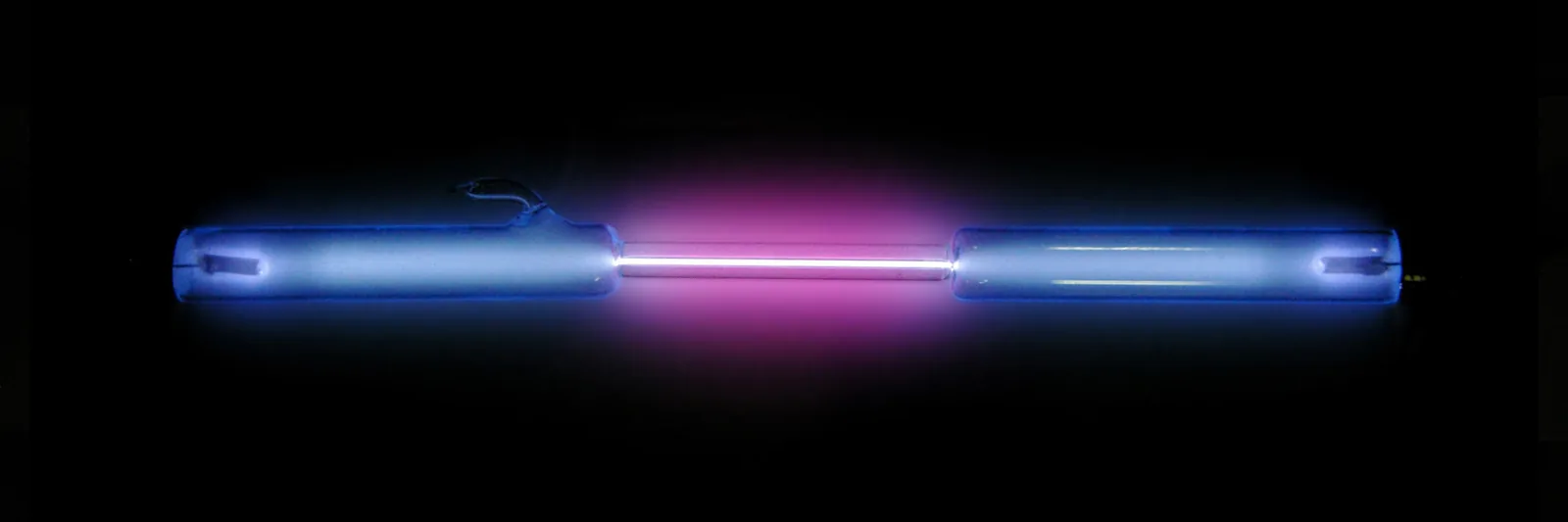
In a darkened classroom a thin glass tube containing hydrogen gas glows pinkish violet when a voltage is connected to it. When the light is viewed through a grating, instead of a smooth rainbow only four narrow lines are seen: red, cyan, blue and violet. The positions of the lines are always the same, whichever laboratory the tube is in.
What in the hydrogen atom decides that it emits exactly these four wavelengths, and can they be calculated?
Optional Recall: the energy of a photon
Predict
Make your predictions before investigating 3 questions
Prediction 1: from ever higher levels to level 2
Optional Prediction 2: to the ground state
Prediction 3: a photon that is too large
Investigate
Choose emission or absorption, set the levels and press the button. Follow the electron in the Bohr picture and in the energy-level diagram and see where the line appears in the spectrum.
Simulation
How to use
Situation chooses emission or absorption. In emission you choose the upper level $n_\text{u}$ ($2$–$6$) and the lower level $n_\text{l}$ ($1$–$3$) and press Transition: the electron falls, a photon leaves, and its line stays in the spectrum strip. In absorption you choose the state of the atom $n_\text{l}$ and the energy $hf$ of the incoming photon and press Send photon. The readouts show the energies of the levels, the energy and wavelength of the photon and the result of the absorption. The spectrum strip has three parts, each with its own wavelength scale: ultraviolet, visible light and infrared. The orange triangle shows the position of the current photon. Clear spectrum removes the collected lines. Speed changes only the pace of the animation.
Assumptions of the model
The energies of the levels are the given information $E_n = -\tfrac{13.6\,\text{eV}}{n^2}$, and the zero of energy is a free electron at rest. The radii of the orbits in the Bohr picture are schematic: in the Bohr model the radius grows as $n^2$. The energy-level diagram is to scale from level $n = 2$ upwards; the gap between levels $1$ and $2$ has been shortened. In absorption the energy of the photon must equal the difference between levels to within $0.03\,\text{eV}$; the model calculates levels up to $n = 30$, although six are shown in the pictures. Close to $13.6\,\text{eV}$ the upper levels are so dense that, from the ground state, every slider value between $13.20$ and $13.55\,\text{eV}$ hits the difference of some level and is absorbed. Every photon hits an atom that is in state $n_\text{l}$. The values are calculated by the model, not measured.
How the calculation works
In emission the energy and wavelength of the photon are
$$hf = E_\text{u} - E_\text{l}, \qquad \lambda = \frac{hc}{E_\text{u} - E_\text{l}},$$
where the energy difference is converted to joules by multiplying by $1.602 \cdot 10^{-19}\,\tfrac{\text{J}}{\text{eV}}$. In absorption the model looks for a level $m > n_\text{l}$ for which $E_m - E_\text{l} = hf$. If $hf \geq -E_\text{l}$, the electron is freed, and its kinetic energy is $E_\text{k} = hf + E_\text{l}$.
Experiment 1: the Balmer series
Test prediction 1. The lower level is $n_\text{l} = 2$; change only the upper level. Record the energy and wavelength of the photon for starting levels $3$, $4$, $5$ and $6$, and press Transition in between to see the line appear in the spectrum. Calculate how much the wavelength changes from one step to the next.
Initial state: situation: emission, lower level $n_\text{l}$ = $2$, upper level $n_\text{u}$ = $3$. Kept constant: situation, lower level $n_\text{l}$. Varied: upper level $n_\text{u}$.
| upper level $n_\text{u}$ | $hf$ $(\text{eV})$ | $\lambda$ $(\text{nm})$ |
|---|
Optional Experiment 2: transitions to the ground state
Test prediction 2. The lower level is now the ground state $n_\text{l} = 1$; change the upper level and record at least the transitions $2 \to 1$ and $3 \to 1$. Which part of the spectrum strip do the lines fall in?
Initial state: situation: emission, lower level $n_\text{l}$ = $1$, upper level $n_\text{u}$ = $2$. Kept constant: situation, lower level $n_\text{l}$. Varied: upper level $n_\text{u}$.
| upper level $n_\text{u}$ | $hf$ $(\text{eV})$ | $\lambda$ $(\text{nm})$ |
|---|
Experiment 3: which photons does the ground state absorb?
Test prediction 3. The atom is in the ground state $n_\text{l} = 1$; change only the energy of the incoming photon. Record at least the energies $10.20\,\text{eV}$, $11.00\,\text{eV}$, $12.10\,\text{eV}$ and $14.00\,\text{eV}$ and press Send photon in between. The column level after tells which level the electron ended up on.
Initial state: situation: absorption, state of the atom $n_\text{l}$ = $1$, photon energy $hf$ = $10{.}2\,\text{eV}$. Kept constant: situation, state of the atom $n_\text{l}$. Varied: photon energy $hf$.
| photon energy $hf$ | level after | $E_\text{k}$ $(\text{eV})$ |
|---|
Conclusion: what determines the lines?
Based on your tables, write: why do the wavelengths of the Balmer series get shorter and crowd together as the starting level rises? Which photons does an atom in the ground state absorb?
Model answer
The energy of a photon is the difference between levels $E_\text{u} - E_\text{l}$. As the starting level rises, the difference grows ($1.89\,\text{eV}$, $2.55\,\text{eV}$, $2.86\,\text{eV}$, $3.02\,\text{eV}$) and the wavelength gets shorter ($656\,\text{nm}$, $486\,\text{nm}$, $434\,\text{nm}$, $410\,\text{nm}$). The differences decrease because the upper levels are close to each other. The values of the optional experiment 2 also show that the energies of transitions ending in the ground state are over $10\,\text{eV}$ and their wavelengths below $122\,\text{nm}$, so they are ultraviolet. An atom in the ground state absorbs only photons whose energy is the difference between levels ($10.20\,\text{eV}$, $12.10\,\text{eV}$), not the photon of $11.00\,\text{eV}$. A photon of at least $13.6\,\text{eV}$ ionises, and the excess stays as the kinetic energy of the electron. The values are calculated by the model from the levels $E_n = -\tfrac{13.6\,\text{eV}}{n^2}$.
Assess your own answer
Tick the points your own answer already contains.
Review the theory summary and practise with the exercises.
Theory summary
Key idea
The energy of a hydrogen atom is quantised
A hydrogen atom has one proton and one electron. The energy of the atom, the sum of the electron's kinetic energy and its electric potential energy, can have only certain values, the energy levels. The levels are numbered with an integer $n = 1, 2, 3, \ldots$ The zero of energy is chosen to be the situation in which the electron is at rest far from the proton, that is, free of the atom. The energy of a bound electron is therefore negative: freeing the electron requires energy.
The lowest level $n = 1$ is the ground state, with an energy of $-13.6\,\text{eV}$. The higher levels $n = 2, 3, \ldots$ are excited states. They crowd together upwards and approach zero. The energy needed to free the electron from the ground state is the ionisation energy of hydrogen, $13.6\,\text{eV}$. An atom usually stays in an excited state for only about $10^{-8}\,\text{s}$ and then returns to a lower level.
A photon is created or disappears in a transition
When an electron moves from a higher level to a lower one, the energy of the atom decreases and the difference leaves as a single photon. Energy is conserved, so the energy of the photon is the difference between the levels. Since there are only certain levels, there are also only certain differences: hydrogen emits only certain wavelengths, and its spectrum is a line spectrum.
Transitions to the same lower level form a series. The transitions ending on level $n = 1$ (the Lyman series) are big jumps in energy, and their photons are ultraviolet. The transitions ending on level $n = 2$ (the Balmer series) produce the four bright visible lines of hydrogen; the following lines ($397\,\text{nm}$, $389\,\text{nm}$, …) are faint and lie at the violet edge of visible light, where the eye is insensitive. The transitions ending on level $n = 3$ (the Paschen series) are infrared.
Absorption is the reverse process. An atom absorbs a photon only if the energy of the photon is exactly the difference between some pair of levels: the electron then moves to the higher level. A photon of any other energy passes the atom without being absorbed. The exception is ionisation: a photon whose energy is at least the ionisation energy can free the electron, and the excess energy stays as the kinetic energy of the free electron.
The Bohr model as a historical stage
In 1913 the Danish physicist Niels Bohr proposed a model in which the electron circles the proton on a circular orbit, but only on certain allowed orbits. On an allowed orbit the electron does not radiate, although according to classical physics a circling charge should lose energy as radiation. Light is produced only when the electron moves from one orbit to another, and the energy of the photon is the difference between the energies of the orbits. The radius of the orbit grows as $n^2$: the radius of the ground state is about $0.053\,\text{nm}$, and the radius of orbit $n = 2$ is four times and that of orbit $n = 3$ nine times as large.
The model was a great step forward. The hydrogen energy levels obtained from it are the same as those measured from the spectral lines, and it explained the size of the hydrogen atom and its ionisation energy. The model has its limits, however. It works only for atoms and ions with a single electron, and it does not tell why some spectral lines are brighter than others. In reality the electron does not have an orbit either: in the chapter The wave-mechanical model of the atom and orbitals the position of the electron is described with probabilities. The energy levels remain in the new model, but the orbits are dropped.
Energy levels of the hydrogen atom and the photon of a transition
The energy levels of the hydrogen atom are
$$E_n = -\frac{13.6\,\text{eV}}{n^2}$$
where $E_n$ is the energy of level $n$ and $n = 1, 2, 3, \ldots$ is the number of the level. The expression is given information here, and it corresponds to the measured hydrogen spectrum.
When an electron moves from a level with energy $E_\text{u}$ to a lower level with energy $E_\text{l}$, the energy and wavelength of the photon produced are
$$\begin{aligned} hf &= E_\text{u} - E_\text{l} \\ \lambda &= \frac{hc}{E_\text{u} - E_\text{l}} \end{aligned}$$
where $h = 6.626 \cdot 10^{-34}\,\text{J}\,\text{s}$ is the Planck constant, $f$ the frequency of the photon, $c = 2.998 \cdot 10^{8}\,\text{m/s}$ the speed of light and $\lambda$ the wavelength. In absorption the same formulas give the photon that raises the electron from level $E_\text{l}$ to level $E_\text{u}$. The energies are first calculated in electron volts, and the difference is converted to joules by substituting $1\,\text{eV} = 1.602 \cdot 10^{-19}\,\text{J}$.
| Series | Lower level | Region | $\lambda$ (nm) |
|---|---|---|---|
| Lyman | $n = 1$ | ultraviolet | $91.2$–$122$ |
| Balmer | $n = 2$ | visible and near UV | $365$–$656$ |
| Paschen | $n = 3$ | infrared | $821$–$1876$ |
The longest wavelength of each series comes from the transition from the nearest upper level, and the shortest, the limit of the series, from the transition that starts from a free electron. Since the levels crowd together upwards, the lines of a series crowd together towards the limit.
Common misconception
Many calculate the energy of a photon from the energy of a single level, for example for the transition $4 \to 2$ from the value $|E_4| = 0.85\,\text{eV}$. The wavelength would then come out as about $1460\,\text{nm}$, although the transition produces the cyan line $486\,\text{nm}$. A photon carries not the energy of a level but the difference between levels $E_\text{u} - E_\text{l}$. The negative energy of a level does not mean that energy is missing either: it tells how much energy freeing the electron requires.
Another mistake is to take the Bohr orbits as real orbits on which the electron circles like a planet. The Bohr model gives the right energies for hydrogen, but the orbit of the electron cannot be observed, and in the present atomic model it does not exist.
Summary
- The energy of a hydrogen atom is quantised: $E_n = -\tfrac{13.6\,\text{eV}}{n^2}$. The ground state is $n = 1$, the excited states are $n \geq 2$, and the ionisation energy from the ground state is $13.6\,\text{eV}$.
- In a transition from a higher level to a lower one a photon is produced whose energy is the difference between the levels: $hf = E_\text{u} - E_\text{l}$ and $\lambda = \tfrac{hc}{E_\text{u} - E_\text{l}}$.
- An atom absorbs only a photon whose energy is the difference between levels, or is ionised by a photon whose energy is at least the ionisation energy.
- The transitions ending on level $n = 2$ (the Balmer series) give the visible lines of hydrogen, $656\,\text{nm}$, $486\,\text{nm}$, $434\,\text{nm}$ and $410\,\text{nm}$; those ending on level $n = 1$ are ultraviolet.
- The Bohr model (1913) explained the spectrum of hydrogen with allowed orbits, but it works only for atoms with one electron. The wave-mechanical model keeps the energy levels and rejects the orbits.
Optional Return to your predictions
Compare your predictions with the values of the model. Then return to the question at the start: why are exactly four lines clearly visible in the light of a hydrogen lamp? What happens to the transitions that end on levels $n = 1$ and $n = 3$?
Would you change your prediction?
Apply
Worked example
Problem
The red line of a hydrogen lamp is produced when the electron of a hydrogen atom moves from level $n = 3$ to level $n = 2$. Calculate the wavelength of the photon produced.
Step 1/7
Given and asked. Upper level $n = 3$, lower level $n = 2$, energies of the levels $E_n = -\tfrac{13.6\,\text{eV}}{n^2}$, $h = 6.626 \cdot 10^{-34}\,\text{J}\,\text{s}$ and $c = 2.998 \cdot 10^{8}\,\text{m/s}$. The wavelength $\lambda$ of the photon is asked.
Step 2/7
Principle. Energy is conserved: the energy of the atom decreases by the difference between the levels, and exactly this energy is carried away by one photon. The energy of a photon is $hf = \tfrac{hc}{\lambda}$.
Step 3/7
Formula solved. The energy of the photon is written as the difference between the levels and the wavelength is solved:
$$\begin{aligned} \frac{hc}{\lambda} &= E_3 - E_2 \\ \lambda &= \frac{hc}{E_3 - E_2} \end{aligned}$$
Step 4/7
Unit conversions. The energies of the levels are in electron volts, but $h$ is in $\text{J}\,\text{s}$. The energy difference is therefore converted to joules by substituting $1\,\text{eV} = 1.602 \cdot 10^{-19}\,\text{J}$.
Step 5/7
Substitution. First the energy difference is calculated, and then the wavelength:
$$\begin{aligned} &E_3 - E_2 \\ &= -\frac{13.6\,\text{eV}}{9} + \frac{13.6\,\text{eV}}{4} \\ &= 1.8889\,\text{eV} \\ &= 1.8889 \cdot 1.602 \cdot 10^{-19}\,\text{J} \\ &= 3.0260 \cdot 10^{-19}\,\text{J} \\[6pt] hc &= 6.626 \cdot 10^{-34}\,\text{J}\,\text{s} \\ &\quad \cdot 2.998 \cdot 10^{8}\,\text{m/s} \\ &= 1.9865 \cdot 10^{-25}\,\text{J}\,\text{m} \\[6pt] \lambda &= \frac{hc}{E_3 - E_2} \\ &= \frac{1.9865 \cdot 10^{-25}\,\text{J}\,\text{m}}{3.0260 \cdot 10^{-19}\,\text{J}} \\ &= 6.5647 \cdot 10^{-7}\,\text{m} \end{aligned}$$
Step 6/7
Answer. The wavelength is $\lambda \approx 6.56 \cdot 10^{-7}\,\text{m} = 656\,\text{nm}$. The result is given to three significant figures, because the energy of the ground state, $13.6\,\text{eV}$, is known to three figures.
Step 7/7
Reasonableness. The wavelength $656\,\text{nm}$ is red light, and exactly such a line is seen in the hydrogen spectrum. The photon energy $1.89\,\text{eV}$ lies within the range of visible-light photons, $1.7$–$3.3\,\text{eV}$. The smallest energy difference of the Balmer series gives the longest wavelength of the series, as it should.
Optional Find the error
Apply to a new situation
In the gas envelope of a hot star, some of the hydrogen atoms are in the excited state $n = 4$. Red light from the star with a wavelength of $656\,\text{nm}$ hits such an atom. The photon ionises the atom.
What is the kinetic energy of the freed electron? Use the values $h = 6.626 \cdot 10^{-34}\,\text{J}\,\text{s}$, $c = 2.998 \cdot 10^{8}\,\text{m/s}$ and $1\,\text{eV} = 1.602 \cdot 10^{-19}\,\text{J}$. Answer in electron volts.
Hint 1: a guiding question
First calculate the energy of the photon in electron volts and the energy of level $n = 4$. How much energy does freeing the electron from this state require?
Hint 2: what is the connection
The electron rises from the level $E_4 = -\tfrac{13.6\,\text{eV}}{16}$ to the energy zero, and the rest of the photon's energy stays as kinetic energy: $E_\text{k} = hf + E_4$.
Hint 3: an intermediate step
convert this to electron volts and add $E_4 = -0.850\,\text{eV}$.
Show the solution
Given
atom in state $n = 4$, $E_n = -\tfrac{13.6\,\text{eV}}{n^2}$, wavelength of the light $\lambda = 656\,\text{nm}$, $h = 6.626 \cdot 10^{-34}\,\text{J}\,\text{s}$, $c = 2.998 \cdot 10^{8}\,\text{m/s}$ and $1\,\text{eV} = 1.602 \cdot 10^{-19}\,\text{J}$
Asked
the kinetic energy $E_\text{k}$ of the freed electron in electron volts
Principle
In ionisation the electron rises from the level $E_4$ to the energy zero, and since a free electron has no levels, the energy of the photon does not have to be a difference between levels; the excess stays as kinetic energy. Energy is conserved, so $hf + E_4 = E_\text{k}$.
Formula
$hf + E_4 = E_\text{k}$ and $hf = \dfrac{hc}{\lambda}$, so
$$E_\text{k} = \frac{hc}{\lambda} + E_4$$
Conversions
the energy of the photon is converted from joules to electron volts by substituting $1\,\text{eV} = 1.602 \cdot 10^{-19}\,\text{J}$.
Substitution
Answer
$1.04\,\text{eV}$
Three significant figures, as in the wavelength $656\,\text{nm}$ and the value $13.6\,\text{eV}$.
Reasonableness
The kinetic energy is positive and smaller than the energy of the photon, $1.89\,\text{eV}$, as it should be. From the ground state the same red photon would not ionise, because that requires $13.6\,\text{eV}$: in a high excited state the electron is so weakly bound that visible light is enough.
Check your understanding
Exit ticket
Answer on your own first and only then open the answer.
- How much energy does a hydrogen atom in the ground state need for its electron to move to level $n = 3$ ($E_n = -\tfrac{13.6\,\text{eV}}{n^2}$)?
Answer
$E_3 - E_1$$= -\tfrac{13.6\,\text{eV}}{9} + 13.6\,\text{eV}$$= 12.1\,\text{eV}$The photon must bring exactly this energy to be absorbed.
- Why do the visible-light lines in the hydrogen spectrum come from transitions that end on level $n = 2$?
Answer
The energies of transitions ending on level $n = 2$ are at most $3.40\,\text{eV}$, and the photons of the four smallest ($1.89$–$3.02\,\text{eV}$) are visible light. The energies of transitions ending in the ground state are over $10\,\text{eV}$ (ultraviolet) and those of transitions ending on level $n = 3$ under $1.51\,\text{eV}$ (infrared).
1. Concept
2. The wavelength of a transition
The electron of a hydrogen atom moves from level $n = 5$ to level $n = 3$. Calculate the wavelength of the photon produced, when the energies of the levels are $E_n = -\tfrac{13.6\,\text{eV}}{n^2}$. Use the values $h = 6.626 \cdot 10^{-34}\,\text{J}\,\text{s}$, $c = 2.998 \cdot 10^{8}\,\text{m/s}$ and $1\,\text{eV} = 1.602 \cdot 10^{-19}\,\text{J}$. Answer in nanometres.
Hint 1: a guiding question
The energy of the photon is the difference between levels $E_5 - E_3$, not the energy of either level.
Hint 2: what is the connection
Hint 3: an intermediate step
Show the solution
Given
upper level $n = 5$, lower level $n = 3$, $E_n = -\tfrac{13.6\,\text{eV}}{n^2}$, $h = 6.626 \cdot 10^{-34}\,\text{J}\,\text{s}$, $c = 2.998 \cdot 10^{8}\,\text{m/s}$ and $1\,\text{eV} = 1.602 \cdot 10^{-19}\,\text{J}$
Asked
the wavelength $\lambda$ of the photon in nanometres
Principle
Energy is conserved: the energy of the atom decreases by the difference between the levels, and one photon, with energy $\tfrac{hc}{\lambda}$, carries it away.
Formula
$\dfrac{hc}{\lambda} = E_5 - E_3$, so
$$\lambda = \frac{hc}{E_5 - E_3}$$
Conversions
finally $1\,\text{m} = 10^{9}\,\text{nm}$.
Substitution
The product
Answer
$1.28 \cdot 10^{3}\,\text{nm}$
That is about $1280\,\text{nm}$, three significant figures, as in the value $13.6\,\text{eV}$.
Reasonableness
The transition ends on level $n = 3$, so it belongs to the Paschen series and is infrared. The wavelength is within the range of the series, $821$–$1876\,\text{nm}$, and shorter than the wavelength $1876\,\text{nm}$ of the transition $4 \to 3$, because the energy difference is larger.
Practise calculating the difference between levels in the tasks of level 2.
Optional 3. The Bohr model
The Bohr model is called a stage in the history of atomic models.
What did the model explain correctly, and why has it been given up? Answer in three or four sentences.
Model answer
The Bohr model explained why hydrogen emits and absorbs only certain wavelengths: the electron can only be on allowed orbits, and the energy of a photon is the difference between the energies of the orbits. The energy levels of hydrogen obtained from the model, $E_n = -\tfrac{13.6\,\text{eV}}{n^2}$, agree with the measured spectral lines and the ionisation energy. However, the model does not work for atoms with more than one electron, and it does not explain the differences in the brightness of the lines. In addition, the electron has no observable orbit; the wave-mechanical model describes the position of the electron with probabilities but keeps the energy levels.
Assess your own answer
Tick the points your own answer already contains.
Review the theory summary and practise with the exercises.
Exercises
Level 1 · basic practice 5 exercises
One formula or one step of reasoning. Core exercises first, the rest is extra practice.
- Exercise 3-1Core
The energy levels of the hydrogen atom are $E_n = -\tfrac{13.6\,\text{eV}}{n^2}$.
What is the energy of the hydrogen atom when the electron is on level $n = 4$? Give the answer with its sign in electron volts.
Answer
$-0.850\,\text{eV}$
Show the solution
Given
energy levels of the hydrogen atom $E_n = -\tfrac{13.6\,\text{eV}}{n^2}$, level $n = 4$
Asked
the energy $E_4$ of level $n = 4$ in electron volts, with its sign
Principle
The energy of a hydrogen atom is quantised, and the energy of level $n$ is obtained from the given expression. The zero of energy is a free electron, so the energy of a bound electron is negative.
Formula
$E_n = -\dfrac{13.6\,\text{eV}}{n^2}$, so $E_4 = -\dfrac{13.6\,\text{eV}}{4^2}$
Conversions
Not needed, because the answer is asked in electron volts, as in the expression.
Substitution
$E_4$$= -\dfrac{13.6\,\text{eV}}{16}$$= -0.850\,\text{eV}$Answer
$-0.850\,\text{eV}$
Three significant figures, as in the ground-state energy $13.6\,\text{eV}$.
Reasonableness
The value is negative and much closer to zero than the ground-state value $-13.6\,\text{eV}$, as it should be: the upper levels are close to zero and crowd together. On level $n = 2$ the energy is $-3.40\,\text{eV}$, so $-0.850\,\text{eV}$ is a quarter of that, because $4^2 = 16$ is four times $2^2 = 4$.
- Exercise 3-2Core
The energy levels of the hydrogen atom are $E_n = -\tfrac{13.6\,\text{eV}}{n^2}$. The electron of a hydrogen atom moves from level $n = 4$ to the ground state $n = 1$.
What is the energy of the photon produced, in electron volts?
Answer
$12.8\,\text{eV}$
Show the solution
Given
energy levels of the hydrogen atom $E_n = -\tfrac{13.6\,\text{eV}}{n^2}$, upper level $n = 4$, lower level $n = 1$
Asked
the energy $hf$ of the photon in electron volts
Principle
Energy is conserved: when the electron moves to a lower level, the energy of the atom decreases by the difference between the levels, and one photon carries exactly this energy away.
Formula
$hf = E_\text{u} - E_\text{l}$, so $hf = E_4 - E_1$
Conversions
Not needed, because the energies of the levels and the answer are in electron volts.
Substitution
$hf$$= -\dfrac{13.6\,\text{eV}}{16} - \left(-\dfrac{13.6\,\text{eV}}{1}\right)$$= -0.850\,\text{eV} + 13.6\,\text{eV}$$= 12.75\,\text{eV}$Answer
$12.8\,\text{eV}$
Three significant figures; the result is rounded to one decimal place, as the value $13.6\,\text{eV}$.
Reasonableness
The energy is slightly smaller than the ionisation energy $13.6\,\text{eV}$, because level $n = 4$ is close to zero. The energy of the photon is greater than that of visible-light photons, $1.7$–$3.3\,\text{eV}$, so the photon is ultraviolet, like all transitions ending in the ground state.
- Exercise 3-3
The hydrogen spectrum has a cyan line with a wavelength of $486\,\text{nm}$.
What is the energy of a photon of this light? Give the answer in electron volts ($h = 6.626 \cdot 10^{-34}\,\text{J}\,\text{s}$, $c = 2.998 \cdot 10^{8}\,\text{m/s}$, $1\,\text{eV} = 1.602 \cdot 10^{-19}\,\text{J}$).
Answer
$2.55\,\text{eV}$
Show the solution
Given
wavelength $\lambda = 486\,\text{nm}$, $h = 6.626 \cdot 10^{-34}\,\text{J}\,\text{s}$, $c = 2.998 \cdot 10^{8}\,\text{m/s}$, $1\,\text{eV} = 1.602 \cdot 10^{-19}\,\text{J}$
Asked
the energy $E$ of the photon in electron volts
Principle
Light consists of photons, and the energy of one photon depends only on the wavelength of the light: the shorter the wavelength, the greater the energy.
Formula
$E = hf = \dfrac{hc}{\lambda}$
Conversions
$\lambda$$= 486\,\text{nm}$$= 486 \cdot 10^{-9}\,\text{m}$Finally the joules are converted to electron volts by dividing by $1.602 \cdot 10^{-19}\,\text{J}$, because $1\,\text{eV} = 1.602 \cdot 10^{-19}\,\text{J}$.
Substitution
The product
$hc$$= 6.626 \cdot 10^{-34}\,\text{J}\,\text{s} \cdot 2.998 \cdot 10^{8}\,\text{m/s}$$= 1.9865 \cdot 10^{-25}\,\text{J}\,\text{m}$$E$$= \dfrac{1.9865 \cdot 10^{-25}\,\text{J}\,\text{m}}{486 \cdot 10^{-9}\,\text{m}}$$= 4.0874 \cdot 10^{-19}\,\text{J}$$= \dfrac{4.0874 \cdot 10^{-19}}{1.602 \cdot 10^{-19}}\,\text{eV}$$= 2.5514\,\text{eV}$Answer
$2.55\,\text{eV}$
Three significant figures, as in the wavelength $486\,\text{nm}$.
Reasonableness
The energies of visible-light photons are about $1.7$–$3.3\,\text{eV}$, and cyan light is in the middle of the spectrum. The result is also the difference between the hydrogen levels $n = 4$ and $n = 2$: $-0.850\,\text{eV} + 3.40\,\text{eV} = 2.55\,\text{eV}$.
- Exercise 3-4
The energy levels of the hydrogen atom are $E_n = -\tfrac{13.6\,\text{eV}}{n^2}$. A hydrogen atom is in the excited state $n = 3$.
How much energy is needed to free the electron from the atom from this state? Give the answer in electron volts.
Answer
$1.51\,\text{eV}$
Show the solution
Given
energy levels of the hydrogen atom $E_n = -\tfrac{13.6\,\text{eV}}{n^2}$, atom in state $n = 3$
Asked
the energy $E_\text{ion}$ needed to free the electron, in electron volts
Principle
The zero of energy is a free electron at rest. Freeing the electron from level $n = 3$ raises the energy of the atom from $E_3$ to zero, so it requires the energy difference $0 - E_3$.
Formula
$E_\text{ion}$$= 0 - E_3$$= \dfrac{13.6\,\text{eV}}{3^2}$Conversions
Not needed, because the energies are in electron volts.
Substitution
$E_\text{ion}$$= 0 - \left(-\dfrac{13.6\,\text{eV}}{9}\right)$$= 1.5111\,\text{eV}$Answer
$1.51\,\text{eV}$
Three significant figures, as in the value $13.6\,\text{eV}$.
Reasonableness
An electron comes free from an excited state much more easily than from the ground state, where $13.6\,\text{eV}$ is needed: on level $n = 3$ the energy is only a ninth of the ground-state energy. A red-light photon with an energy of about $1.9\,\text{eV}$ is already enough to free the electron from this state.
- Exercise 3-5
The energy of a photon produced in a transition of a hydrogen atom is $1.89\,\text{eV}$.
What is the frequency of the photon? Give the answer in terahertz ($1\,\text{THz} = 10^{12}\,\text{Hz}$; $h = 6.626 \cdot 10^{-34}\,\text{J}\,\text{s}$, $1\,\text{eV} = 1.602 \cdot 10^{-19}\,\text{J}$).
Answer
$457\,\text{THz}$
Show the solution
Given
energy of the photon $E = 1.89\,\text{eV}$, $h = 6.626 \cdot 10^{-34}\,\text{J}\,\text{s}$, $1\,\text{eV} = 1.602 \cdot 10^{-19}\,\text{J}$
Asked
the frequency $f$ of the photon in terahertz
Principle
The energy of a photon is proportional to its frequency, and the constant of proportionality is the Planck constant.
Formula
$E = hf$, so $f = \dfrac{E}{h}$
Conversions
$E$$= 1.89\,\text{eV}$$= 1.89 \cdot 1.602 \cdot 10^{-19}\,\text{J}$$= 3.0278 \cdot 10^{-19}\,\text{J}$Finally $1\,\text{THz} = 10^{12}\,\text{Hz}$.
Substitution
$f$$= \dfrac{3.0278 \cdot 10^{-19}\,\text{J}}{6.626 \cdot 10^{-34}\,\text{J}\,\text{s}}$$= 4.5695 \cdot 10^{14}\,\text{Hz}$$= 456.95\,\text{THz}$Answer
$457\,\text{THz}$
That is $4.57 \cdot 10^{14}\,\text{Hz}$, three significant figures, as in the energy $1.89\,\text{eV}$.
Reasonableness
The frequencies of visible light are about $400$–$790\,\text{THz}$, and $457\,\text{THz}$ is near the red end. Check with the wavelength:
$\lambda$$= \tfrac{c}{f}$$= \tfrac{2.998 \cdot 10^{8}\,\text{m/s}}{4.5695 \cdot 10^{14}\,\text{Hz}}$$\approx 656\,\text{nm}$which is the red line of hydrogen. Unit:
$\tfrac{\text{J}}{\text{J}\,\text{s}}$$= \tfrac{1}{\text{s}}$$= \text{Hz}$
Level 2 · applied practice 4 exercises
Two steps, working with measured data, a unit conversion or rearranging a formula. Core exercises first, the rest is extra practice.
- Exercise 3-6Core
The energy levels of the hydrogen atom are $E_n = -\tfrac{13.6\,\text{eV}}{n^2}$. The electron of a hydrogen atom moves from level $n = 5$ to level $n = 2$. Calculate the wavelength of the light produced in nanometres ($h = 6.626 \cdot 10^{-34}\,\text{J}\,\text{s}$, $c = 2.998 \cdot 10^{8}\,\text{m/s}$, $1\,\text{eV} = 1.602 \cdot 10^{-19}\,\text{J}$).
Answer
$434\,\text{nm}$
Show the solution
Given
energy levels of the hydrogen atom $E_n = -\tfrac{13.6\,\text{eV}}{n^2}$, transition from level $n = 5$ to level $n = 2$, $h = 6.626 \cdot 10^{-34}\,\text{J}\,\text{s}$, $c = 2.998 \cdot 10^{8}\,\text{m/s}$
Asked
the wavelength $\lambda$ of the light in nanometres
Principle
Energy is conserved: the energy of the atom decreases by the difference between the levels, and one photon, with energy $\tfrac{hc}{\lambda}$, carries it away.
Formula
$\dfrac{hc}{\lambda} = E_5 - E_2$, so $\lambda = \dfrac{hc}{E_5 - E_2}$
Conversions
The energy difference is calculated in electron volts and converted to joules by substituting $1\,\text{eV} = 1.602 \cdot 10^{-19}\,\text{J}$. Finally $1\,\text{m} = 10^{9}\,\text{nm}$.
Substitution
The product
$hc$$= 6.626 \cdot 10^{-34}\,\text{J}\,\text{s} \cdot 2.998 \cdot 10^{8}\,\text{m/s}$$= 1.9865 \cdot 10^{-25}\,\text{J}\,\text{m}$$E_5 - E_2$$= -\dfrac{13.6\,\text{eV}}{25} + \dfrac{13.6\,\text{eV}}{4}$$= 2.856\,\text{eV}$$= 2.856 \cdot 1.602 \cdot 10^{-19}\,\text{J}$$= 4.5753 \cdot 10^{-19}\,\text{J}$$\lambda$$= \dfrac{1.9865 \cdot 10^{-25}\,\text{J}\,\text{m}}{4.5753 \cdot 10^{-19}\,\text{J}}$$= 4.3417 \cdot 10^{-7}\,\text{m}$$= 434.17\,\text{nm}$Answer
$434\,\text{nm}$
Three significant figures, as in the value $13.6\,\text{eV}$.
Reasonableness
The transition ends on level $n = 2$, so the line belongs to the Balmer series and is visible light. It is shorter than the line $486\,\text{nm}$ of the transition $4 \to 2$, because the energy difference is larger, and the hydrogen spectrum has a blue line exactly at $434\,\text{nm}$.
- Exercise 3-7Core
The energy levels of the hydrogen atom are $E_n = -\tfrac{13.6\,\text{eV}}{n^2}$. The violet spectral line of hydrogen, with a wavelength of $410\,\text{nm}$, is produced in a transition that ends on level $n = 2$.
From which level does the transition start? Give the number $n$ of the level as the answer.
Answer
$n = 6$
Show the solution
Given
wavelength $\lambda = 410\,\text{nm}$, lower level $n_\text{l} = 2$, $E_n = -\tfrac{13.6\,\text{eV}}{n^2}$, $h = 6.626 \cdot 10^{-34}\,\text{J}\,\text{s}$, $c = 2.998 \cdot 10^{8}\,\text{m/s}$, $1\,\text{eV} = 1.602 \cdot 10^{-19}\,\text{J}$
Asked
the number $n$ of the upper level
Principle
The energy of a photon is the difference between levels. When the energy of the photon and the energy of the lower level are known, the energy of the upper level is their sum, and from it the number of the level.
Formula
$\dfrac{hc}{\lambda} = E_n - E_2$, so $E_n = E_2 + \dfrac{hc}{\lambda}$, and solving from the expression $E_n = -\dfrac{13.6\,\text{eV}}{n^2}$ gives
$n$$= \sqrt{\dfrac{13.6\,\text{eV}}{-E_n}}$Conversions
$\lambda = 410 \cdot 10^{-9}\,\text{m}$; the energy of the photon is converted to electron volts by dividing by $1.602 \cdot 10^{-19}\,\text{J}$.
Substitution
The product
$hc$$= 6.626 \cdot 10^{-34}\,\text{J}\,\text{s} \cdot 2.998 \cdot 10^{8}\,\text{m/s}$$= 1.9865 \cdot 10^{-25}\,\text{J}\,\text{m}$$\dfrac{hc}{\lambda}$$= \dfrac{1.9865 \cdot 10^{-25}\,\text{J}\,\text{m}}{410 \cdot 10^{-9}\,\text{m}}$$= 4.8451 \cdot 10^{-19}\,\text{J}$$= 3.0244\,\text{eV}$$E_n$$= -3.40\,\text{eV} + 3.0244\,\text{eV}$$= -0.3756\,\text{eV}$$n$$= \sqrt{\dfrac{13.6\,\text{eV}}{0.3756\,\text{eV}}}$$= \sqrt{36.21}$$= 6.017$Answer
$n = 6$
The number of a level is an integer, and the calculated $6.02$ differs from it only by rounding.
Reasonableness
Check in the other direction:
$E_6 - E_2$$= -0.378\,\text{eV} + 3.40\,\text{eV}$$= 3.02\,\text{eV}$which corresponds to the wavelength $410\,\text{nm}$. The violet line is the shortest of the visible Balmer lines, so its upper level must be the highest of these four.
- Exercise 3-8
The figure shows the energy-level diagram of an imaginary atom. The electron of the atom moves from level $E_3$ to level $E_2$. Calculate the wavelength of the photon produced in nanometres. Read the energies of the levels from the figure ($h = 6.626 \cdot 10^{-34}\,\text{J}\,\text{s}$, $c = 2.998 \cdot 10^{8}\,\text{m/s}$, $1\,\text{eV} = 1.602 \cdot 10^{-19}\,\text{J}$).
Answer
$620\,\text{nm}$
Show the solution
Given
energy-level diagram of an imaginary atom, transition from level $E_3$ to level $E_2$, $h = 6.626 \cdot 10^{-34}\,\text{J}\,\text{s}$, $c = 2.998 \cdot 10^{8}\,\text{m/s}$, $1\,\text{eV} = 1.602 \cdot 10^{-19}\,\text{J}$
Asked
the wavelength $\lambda$ of the photon in nanometres
Principle
Energy is conserved in all atoms as in hydrogen: the energy of the photon is the difference between the levels of the transition. The diagram replaces the expression of hydrogen.
Reading the graph
Level $E_3$ is on the grid line $-3\,\text{eV}$ and level $E_2$ on the line $-5\,\text{eV}$, so $E_3 = -3.0\,\text{eV}$ and $E_2 = -5.0\,\text{eV}$. The energy difference is
$E_3 - E_2$$= -3.0\,\text{eV} - (-5.0\,\text{eV})$$= 2.0\,\text{eV}$Formula
$\dfrac{hc}{\lambda} = E_3 - E_2$, so $\lambda = \dfrac{hc}{E_3 - E_2}$
Conversions
$E_3 - E_2$$= 2.0\,\text{eV}$$= 2.0 \cdot 1.602 \cdot 10^{-19}\,\text{J}$$= 3.204 \cdot 10^{-19}\,\text{J}$and finally $1\,\text{m} = 10^{9}\,\text{nm}$.
Substitution
The product
$hc$$= 6.626 \cdot 10^{-34}\,\text{J}\,\text{s} \cdot 2.998 \cdot 10^{8}\,\text{m/s}$$= 1.9865 \cdot 10^{-25}\,\text{J}\,\text{m}$$\lambda$$= \dfrac{1.9865 \cdot 10^{-25}\,\text{J}\,\text{m}}{3.204 \cdot 10^{-19}\,\text{J}}$$= 6.2000 \cdot 10^{-7}\,\text{m}$$= 620.00\,\text{nm}$Answer
$620\,\text{nm}$
That is $6.2 \cdot 10^{2}\,\text{nm}$, two significant figures, because the energy difference $2.0\,\text{eV}$ read from the figure is known to two figures.
Reasonableness
The energy difference $2.0\,\text{eV}$ lies within the range of visible-light photons, $1.7$–$3.3\,\text{eV}$, and $620\,\text{nm}$ is orange-red light. A smaller energy difference than in the red line of hydrogen ($1.89\,\text{eV}$) would give a longer wavelength; here the difference is slightly larger and the wavelength slightly shorter than $656\,\text{nm}$.
- Exercise 3-9
An ultraviolet photon with a wavelength of $80.0\,\text{nm}$ hits a hydrogen atom in the ground state. The photon ionises the atom; the ionisation energy of hydrogen from the ground state is $13.6\,\text{eV}$.
What is the kinetic energy of the freed electron in electron volts ($h = 6.626 \cdot 10^{-34}\,\text{J}\,\text{s}$, $c = 2.998 \cdot 10^{8}\,\text{m/s}$, $1\,\text{eV} = 1.602 \cdot 10^{-19}\,\text{J}$)?
Answer
$1.9\,\text{eV}$
Show the solution
Given
wavelength of the photon $\lambda = 80.0\,\text{nm}$, ionisation energy of hydrogen from the ground state $E_\text{ion} = 13.6\,\text{eV}$, $h = 6.626 \cdot 10^{-34}\,\text{J}\,\text{s}$, $c = 2.998 \cdot 10^{8}\,\text{m/s}$, $1\,\text{eV} = 1.602 \cdot 10^{-19}\,\text{J}$
Asked
the kinetic energy $E_\text{k}$ of the freed electron in electron volts
Principle
Energy is conserved. Of the energy of the photon, the ionisation energy is used to free the electron, and the rest stays as the kinetic energy of the free electron. In ionisation the energy of the photon does not have to correspond to the difference of any pair of levels, as long as it is at least the ionisation energy.
Formula
$\dfrac{hc}{\lambda}$$= E_\text{ion} + E_\text{k}$so
$E_\text{k}$$= \dfrac{hc}{\lambda} - E_\text{ion}$Conversions
$\lambda = 80.0 \cdot 10^{-9}\,\text{m}$; the energy of the photon is converted to electron volts by dividing by $1.602 \cdot 10^{-19}\,\text{J}$.
Substitution
The product
$hc$$= 6.626 \cdot 10^{-34}\,\text{J}\,\text{s} \cdot 2.998 \cdot 10^{8}\,\text{m/s}$$= 1.9865 \cdot 10^{-25}\,\text{J}\,\text{m}$$\dfrac{hc}{\lambda}$$= \dfrac{1.9865 \cdot 10^{-25}\,\text{J}\,\text{m}}{80.0 \cdot 10^{-9}\,\text{m}}$$= 2.4831 \cdot 10^{-18}\,\text{J}$$= 15.500\,\text{eV}$$E_\text{k}$$= 15.500\,\text{eV} - 13.6\,\text{eV}$$= 1.900\,\text{eV}$Answer
$1.9\,\text{eV}$
The difference is given to one decimal place, like the ionisation energy $13.6\,\text{eV}$, so the result has two significant figures.
Reasonableness
The energy of the photon is only a little above the ionisation energy, so the electron is left with a small kinetic energy. Check: the wavelength $80.0\,\text{nm}$ is shorter than the limit of the Lyman series, $91.2\,\text{nm}$, so the photon really can ionise an atom in the ground state.
Level 3 · challenging 3 exercises
Optional: application, two ideas together or a new situation where you reason for yourself.
- Exercise 3-10
The energy levels of the hydrogen atom are $E_n = -\tfrac{13.6\,\text{eV}}{n^2}$. In a discharge tube, electrons with a kinetic energy of $12.5\,\text{eV}$ collide with hydrogen atoms in the ground state. In a collision an atom can take from the electron only the share of energy that corresponds to the difference of some pair of its levels.
How many different wavelengths can the excited atoms emit when they return to the ground state, counting also the transitions that pass through intermediate levels? Count the different pairs of levels between which a transition is possible: each pair of levels gives one wavelength.
Answer
$3$
Show the solution
Given
kinetic energy of the colliding electrons $12.5\,\text{eV}$, atoms in the ground state $n = 1$, $E_n = -\tfrac{13.6\,\text{eV}}{n^2}$
Asked
the number of different wavelengths that the excited atoms can emit
Principle
In a collision an atom can take only the energy that takes it to some higher level, so we find which levels are at most $12.5\,\text{eV}$ from the ground state. We assume that each atom receives energy from one collision while in the ground state; an electron hitting an already excited atom again could raise it higher, but that is not considered here. From an excited state the atom can return directly or through intermediate levels, and each different pair of levels gives its own wavelength.
Formula
excitation energy
$E_n - E_1$$= 13.6\,\text{eV} - \dfrac{13.6\,\text{eV}}{n^2}$a level can be reached if $E_n - E_1 \leq 12.5\,\text{eV}$
Conversions
Not needed, because all energies are in electron volts.
Substitution
$E_2 - E_1$$= 13.6\,\text{eV} - 3.40\,\text{eV}$$= 10.2\,\text{eV}$$E_3 - E_1$$= 13.6\,\text{eV} - 1.511\,\text{eV}$$= 12.09\,\text{eV}$$E_4 - E_1$$= 13.6\,\text{eV} - 0.850\,\text{eV}$$= 12.75\,\text{eV}$Levels $2$ and $3$ can be reached, level $4$ cannot, because $12.75\,\text{eV} > 12.5\,\text{eV}$. The possible transitions are $3 \to 1$, $3 \to 2$ and $2 \to 1$.
Answer
$3$
Different wavelengths: $3 \to 1$ ($102\,\text{nm}$), $2 \to 1$ ($122\,\text{nm}$) and $3 \to 2$ ($656\,\text{nm}$).
Reasonableness
The gas would glow in visible light only red, because only the transition $3 \to 2$ ends on level $2$; the other two are ultraviolet. If the energy of the electrons were at least $12.75\,\text{eV}$, level $4$ and the cyan line would also come in.
- Exercise 3-11
The helium ion $\text{He}^+$ has only one electron, like the hydrogen atom, but the nucleus has two protons. The energy levels of the ion are $E_n = -\tfrac{54.4\,\text{eV}}{n^2}$. A line is observed in the spectrum of a star that is produced in the transition of the ion from level $n = 4$ to level $n = 3$. Calculate the wavelength of the line in nanometres ($h = 6.626 \cdot 10^{-34}\,\text{J}\,\text{s}$, $c = 2.998 \cdot 10^{8}\,\text{m/s}$, $1\,\text{eV} = 1.602 \cdot 10^{-19}\,\text{J}$).
Answer
$469\,\text{nm}$
Show the solution
Given
energy levels of the helium ion $E_n = -\tfrac{54.4\,\text{eV}}{n^2}$, transition from level $n = 4$ to level $n = 3$, $h = 6.626 \cdot 10^{-34}\,\text{J}\,\text{s}$, $c = 2.998 \cdot 10^{8}\,\text{m/s}$, $1\,\text{eV} = 1.602 \cdot 10^{-19}\,\text{J}$
Asked
the wavelength $\lambda$ of the line in nanometres
Principle
The ion has one electron, so its energy is quantised in the same way as in hydrogen, only the energies are greater. Energy is conserved: the energy of the photon is the difference between the levels.
Formula
$\dfrac{hc}{\lambda} = E_4 - E_3$, so $\lambda = \dfrac{hc}{E_4 - E_3}$
Conversions
The energy difference is converted to joules by substituting $1\,\text{eV} = 1.602 \cdot 10^{-19}\,\text{J}$, and finally $1\,\text{m} = 10^{9}\,\text{nm}$.
Substitution
The product
$hc$$= 6.626 \cdot 10^{-34}\,\text{J}\,\text{s} \cdot 2.998 \cdot 10^{8}\,\text{m/s}$$= 1.9865 \cdot 10^{-25}\,\text{J}\,\text{m}$$E_4 - E_3$$= -\dfrac{54.4\,\text{eV}}{16} + \dfrac{54.4\,\text{eV}}{9}$$= 2.6444\,\text{eV}$$= 2.6444 \cdot 1.602 \cdot 10^{-19}\,\text{J}$$= 4.2364 \cdot 10^{-19}\,\text{J}$$\lambda$$= \dfrac{1.9865 \cdot 10^{-25}\,\text{J}\,\text{m}}{4.2364 \cdot 10^{-19}\,\text{J}}$$= 4.6891 \cdot 10^{-7}\,\text{m}$$= 468.91\,\text{nm}$Answer
$469\,\text{nm}$
Three significant figures, as in the value $54.4\,\text{eV}$.
Reasonableness
The levels of the helium ion are four times those of hydrogen, so the energy difference of the transition $4 \to 3$ is four times the corresponding $0.661\,\text{eV}$ of hydrogen, and the wavelength is a quarter of the infrared line of hydrogen, $1876\,\text{nm}$: $1876\,\text{nm} : 4 = 469\,\text{nm}$. The line is blue visible light.
- Exercise 3-12
The energy levels of the hydrogen atom are $E_n = -\tfrac{13.6\,\text{eV}}{n^2}$. In hot hydrogen gas one atom returns from level $n = 2$ to the ground state and emits a photon. The photon hits another hydrogen atom that is in the excited state $n = 2$.
Is the energy of the photon enough to ionise this atom? If it is, what is the kinetic energy of the freed electron in electron volts?
Answer
$6.8\,\text{eV}$
Show the solution
Given
the first atom moves from level $n = 2$ to level $n = 1$, the second atom is in state $n = 2$, $E_n = -\tfrac{13.6\,\text{eV}}{n^2}$
Asked
whether the photon is enough for ionisation, and the kinetic energy $E_\text{k}$ of the freed electron in electron volts
Principle
The energy of the photon from the first atom is the difference between levels $2$ and $1$. Ionisation of the second atom from state $n = 2$ requires the energy $0 - E_2$. If the energy of the photon is greater, the electron comes free, and the excess stays as its kinetic energy, because energy is conserved.
Formula
$hf = E_2 - E_1$ and $hf = (0 - E_2) + E_\text{k}$, so $E_\text{k} = (E_2 - E_1) - (0 - E_2)$
Conversions
Not needed, because all energies are in electron volts.
Substitution
$hf$$= -3.40\,\text{eV} - (-13.6\,\text{eV})$$= 10.2\,\text{eV}$ionisation requires $0 - (-3.40\,\text{eV}) = 3.40\,\text{eV}$, and
$E_\text{k}$$= 10.2\,\text{eV} - 3.40\,\text{eV}$$= 6.80\,\text{eV}$Answer
It is enough; the kinetic energy is $6.8\,\text{eV}$. The difference is given to one decimal place, like the energy of the photon, $10.2\,\text{eV}$.
Reasonableness
The photon of a transition ending in the ground state is ultraviolet and much more energetic than visible light, and from state $n = 2$ the electron comes free with just $3.40\,\text{eV}$, so ionisation is to be expected. The same photon could not ionise an atom in the ground state, because $10.2\,\text{eV} < 13.6\,\text{eV}$; it could only excite it to level $2$.
Photographs
- Hydrogen discharge tube. Alchemist-hp (www.pse-mendelejew.de). source, Free Art License 1.3
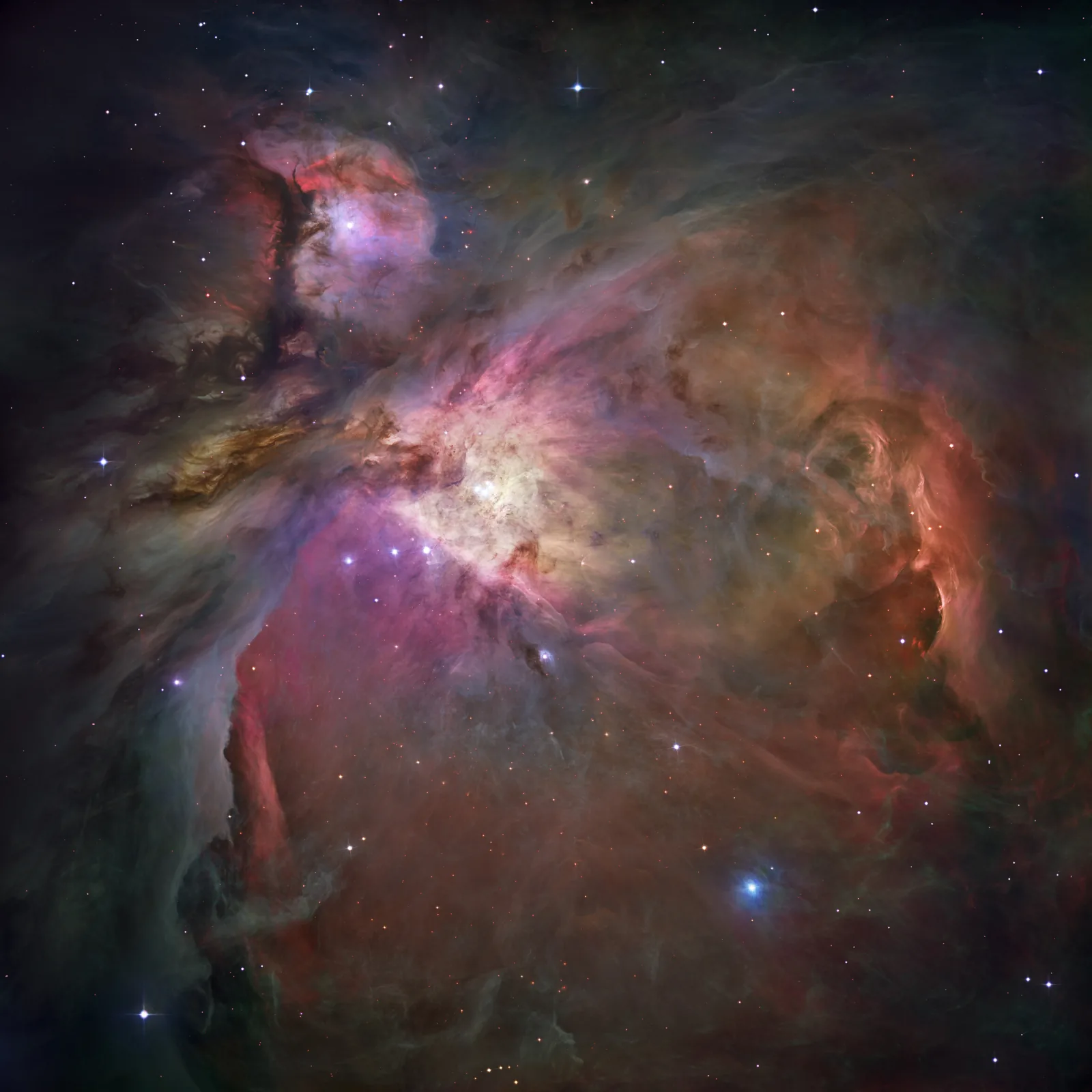
- Orion Nebula - Hubble 2006 mosaic. NASA, ESA, M. Robberto (STScI/ESA) and the Hubble Space Telescope Orion Treasury Project Team. source, public domain

