
Spectra reveal the energy levels of atoms
Why do narrow dark lines cross the rainbow colours of sunlight, and how can they tell us which elements there are in the Sun?
Prior knowledge
- The energy of a photon is $E = hf = \tfrac{hc}{\lambda}$, so a shorter wavelength means a greater energychapter The photoelectric effect and the photon
- The electronvolt is a unit of energy: $1\,\text{eV} = 1.602 \cdot 10^{-19}\,\text{J}$chapter The photoelectric effect and the photon
Core path: follow the steps in order. Tasks marked Optional give extra practice. Optional tasks: 3.
Think about it
When sunlight is directed through a narrow slit and a prism or a grating, it forms a band of rainbow colours. Looked at closely, hundreds of narrow dark lines cross the band. The same lines appear every day in the same places, and some of them are exactly where hot hydrogen gas or sodium vapour in the laboratory emits bright light.
Why are certain wavelengths missing from the light of the Sun, and why exactly the wavelengths that a hot gas emits?
Review: the energy of a photon
Predict
Make your predictions before investigating 2 questions
Prediction 1: the lines to level 2
Prediction 2: cold hydrogen gas
Investigate
Choose two energy levels of the hydrogen atom and the mode. Observe what kind of photon is emitted or absorbed and where its line appears in the spectrum.
Simulation
How to use
Choose the Mode: emission means hot hydrogen gas in which an atom moves from a higher level to a lower one and emits a photon into the spectroscope; absorption means white light from a lamp passing through hydrogen gas, in which an atom absorbs a photon and moves from a lower level to a higher one. The lower level $n_\text{l} = 1$ corresponds to a cold gas; a greater $n_\text{l}$ corresponds to a hot gas, such as the atmosphere of a star. Choose the Upper level $n_\text{u}$ and the Lower level $n_\text{l}$. In the energy-level diagram an arrow shows the transition and a blue dot the state of the electron shell. In the spectrum below, a line remains from every transition you try in the same mode: in emission a bright line on a dark background, in absorption a dark line in a continuous spectrum. The triangle under a line marks the selected transition. Ultraviolet and infrared lines are drawn in grey, because the eye cannot see them. Clear spectrum removes the lines. Speed changes only the pace of the animation.
Assumptions of the model
The energy levels of the hydrogen atom are $E_n = -\tfrac{13.6\,\text{eV}}{n^2}$, where $n = 1, 2, \ldots, 6$; they are measured values, and their origin is discussed in the chapter The energy levels of the hydrogen atom and the Bohr model. The model shows one transition of one atom at a time; in a real gas billions of atoms make all possible transitions at the same time, and the brightness of the lines depends on how often each transition occurs. The model does not describe brightness. In a cold gas practically all atoms are in the ground state $n = 1$; in the model you can nevertheless choose another lower level for absorption, which corresponds to a hot gas, such as the atmosphere of a star. The wavelengths are values calculated by the model.
How the calculation works
The energy of a photon is the difference between the levels, $\Delta E = E_\text{u} - E_\text{l}$. The wavelength is $\lambda = \tfrac{hc}{\Delta E}$, where $h = 6.626 \cdot 10^{-34}\,\text{J}\,\text{s}$, $c = 2.998 \cdot 10^8\,\text{m/s}$ and $\Delta E$ is converted to joules with the factor $1.602 \cdot 10^{-19}\,\tfrac{\text{J}}{\text{eV}}$. The scale of the spectrum is $80$–$900\,\text{nm}$; visible light is between the dashed lines, $380$–$750\,\text{nm}$. An infrared line above $900\,\text{nm}$ is shown as an arrow at the right edge of the scale.
Experiment 1: transitions to level 2
Test prediction 1. The mode is emission and the lower level is $n_\text{l} = 2$. Change only the upper level and record the energy and the wavelength of the photon at the levels $n_\text{u} = 3$, $4$, $5$ and $6$. At the same time, watch where in the spectrum the lines accumulate and how the gaps between them change.
Initial state: mode: emission, lower level $n_\text{l}$ = $2$, upper level $n_\text{u}$ = $3$. Kept constant: mode, lower level $n_\text{l}$. Varied: upper level $n_\text{u}$.
| upper level $n_\text{u}$ | $\Delta E$ $(\text{eV})$ | $\lambda$ $(\text{nm})$ |
|---|
Experiment 2: absorption by a cold gas
Test prediction 2. The mode is absorption, and the atoms of the cold gas are in the ground state $n_\text{l} = 1$. Change only the upper level and record the energy and the wavelength of the photon at least at the levels $n_\text{u} = 2$ and $3$, and if you like also at higher ones. In which range do the dark lines appear?
Initial state: mode: absorption, lower level $n_\text{l}$ = $1$, upper level $n_\text{u}$ = $2$. Kept constant: mode, lower level $n_\text{l}$. Varied: upper level $n_\text{u}$.
| upper level $n_\text{u}$ | $\Delta E$ $(\text{eV})$ | $\lambda$ $(\text{nm})$ |
|---|
Conclusion: what decides the position of a line?
Based on your tables, write: what decides where in the spectrum a line appears? Why do the lines to level $2$ crowd together towards short wavelengths? Why does cold hydrogen gas not make dark lines in the range of visible light?
Model answer
The position of a line is decided by the energy difference between the levels, $\Delta E = E_\text{u} - E_\text{l}$: the energy of the photon is exactly this difference, and the wavelength is $\lambda = \tfrac{hc}{\Delta E}$, so a greater difference gives a shorter wavelength. In experiment 1, the transitions from levels $3$–$6$ to level $2$ gave the model values $656\,\text{nm}$, $486\,\text{nm}$, $434\,\text{nm}$ and $410\,\text{nm}$; the highest levels are close together, so the energy difference grows less and less and the lines crowd together. In experiment 2, the transitions starting from the ground state required a photon of at least $10.2\,\text{eV}$, and the wavelengths were $94$–$122\,\text{nm}$, that is, ultraviolet. The energies of photons of visible light, about $1.7$–$3.3\,\text{eV}$, do not match any difference starting from the ground state, so cold hydrogen lets visible light through. The spacings of the levels $E_n = -\tfrac{13.6\,\text{eV}}{n^2}$ were given data, so the experiment did not find them out but what they mean for the positions of the lines.
Assess your own answer
Tick the points your own answer already contains.
Review the theory summary and practise with the exercises.
Identify the gas from the spectrum
Statistical data · Wavelengths of the lines: NIST Atomic Spectra Database (2024), rounded to whole nanometres; only the strongest visible lines.
The figure shows the emission spectrum of an unknown lamp. The table gives the strongest visible lines of four elements.
| Element | Lines (nm) |
|---|---|
| hydrogen | $410$, $434$, $486$, $656$ |
| helium | $447$, $471$, $502$, $588$, $668$ |
| sodium | $589$ |
| mercury | $405$, $436$, $546$, $577$, $579$ |
Theory summary
Key idea
Continuous spectrum and line spectrum
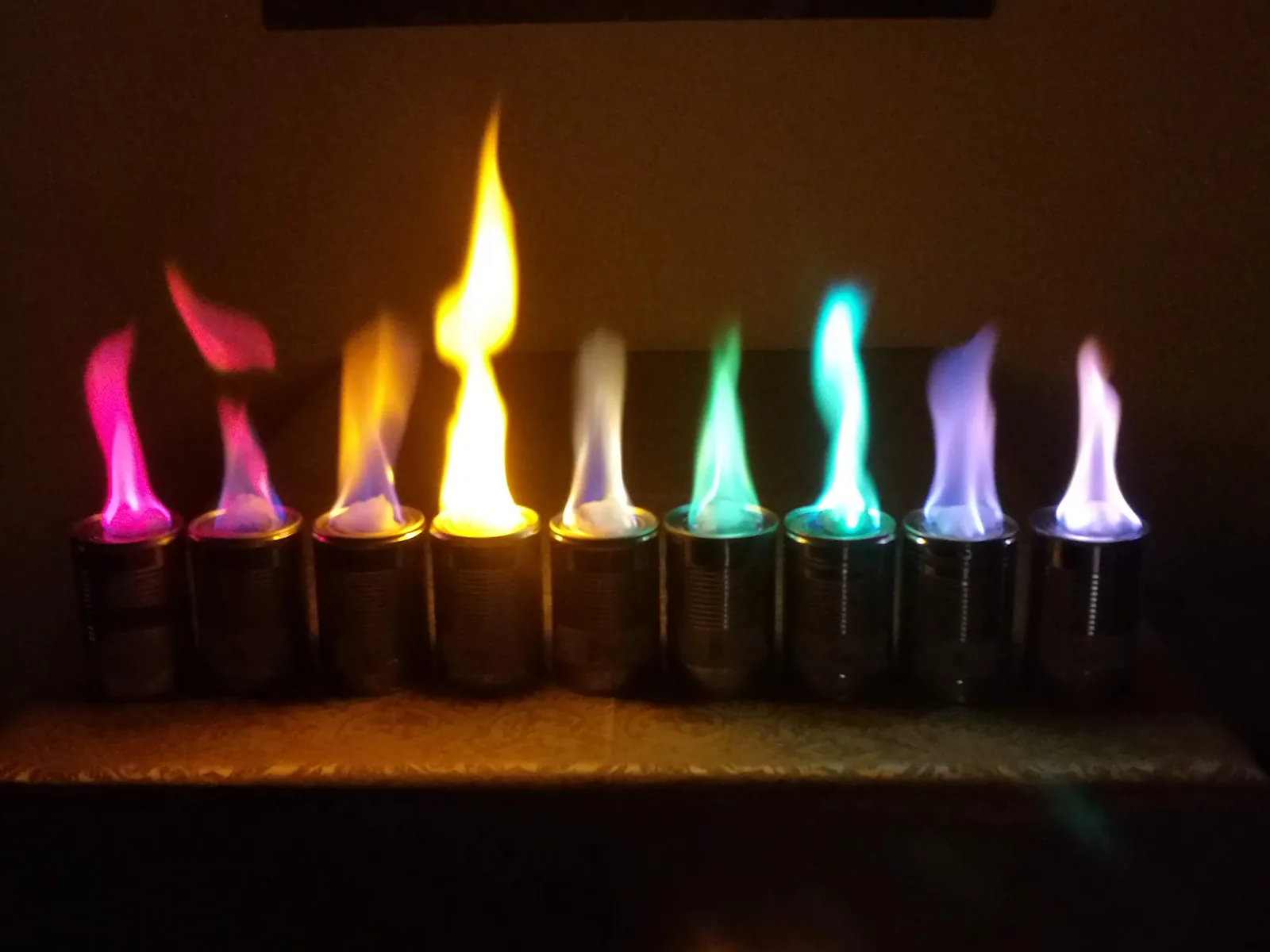
A spectrum is formed when light is separated into its wavelengths with a grating or a prism. The light of a hot solid, such as a filament, gives a continuous spectrum: all colours from red to violet as one unbroken band. The light of a hot, thin gas has only a few bright colours. Its spectrum is a line spectrum, and more precisely an emission spectrum: separate bright lines on a dark background. For example, the visible lines of hydrogen gas are at the wavelengths $656\,\text{nm}$, $486\,\text{nm}$, $434\,\text{nm}$ and $410\,\text{nm}$. Every element has its own lines, so the lines are like the fingerprint of the element.
When light with a continuous spectrum passes through a gas, dark lines are left in the spectrum. This is an absorption spectrum. Every dark line is at exactly the same wavelength as one of the bright emission lines of the same gas. The dark lines of the Sun are formed in this way: the continuous light from the surface of the Sun passes through its atmosphere, and the atoms of the atmosphere absorb their own wavelengths.
Energy states explain the lines
The electron shell of an atom can only be in certain energy states. The lowest one is the ground state, and the higher ones are excited states. The energies are given as negative numbers, because the zero is chosen to be the situation in which the electron has left the atom. When an atom moves from a higher energy state to a lower one, it emits one photon. Energy is conserved, so the energy of the photon is the difference between the energies of the states. Because an atom has only certain energy states, there are only a certain number of differences, and the spectrum has only certain lines.

Absorption is the reverse process. An atom absorbs a photon only if the energy of the photon is exactly the difference between two states; other photons pass through the gas. An excited atom soon returns to a lower state and emits a photon, but in a random direction. Therefore exactly those wavelengths are missing from the light travelling in the original direction, and a dark line is left in the spectrum. A gas absorbs only transitions that start from states in which its atoms are. In a cold gas almost all atoms are in the ground state, so there are fewer absorption lines than emission lines. The atmosphere of the Sun is so hot that a small fraction of the hydrogen atoms are in the first excited state. They absorb wavelengths of visible light, and that is why the red line $656\,\text{nm}$ of hydrogen appears dark in the spectrum of the Sun. The energy states of electrons are quantised, and spectra are the most direct evidence of this.
You can measure a spectrum yourself. In a spectroscope, light passes through a narrow slit and a grating, and the wavelengths of the lines are read from a scale. A grating fixed in front of a phone camera or a ready-made spectrometer works in the same way: in the light of a gas discharge tube, a fluorescent tube or an LED lamp you can see at once whether the spectrum is continuous or made of lines.
Fluorescence
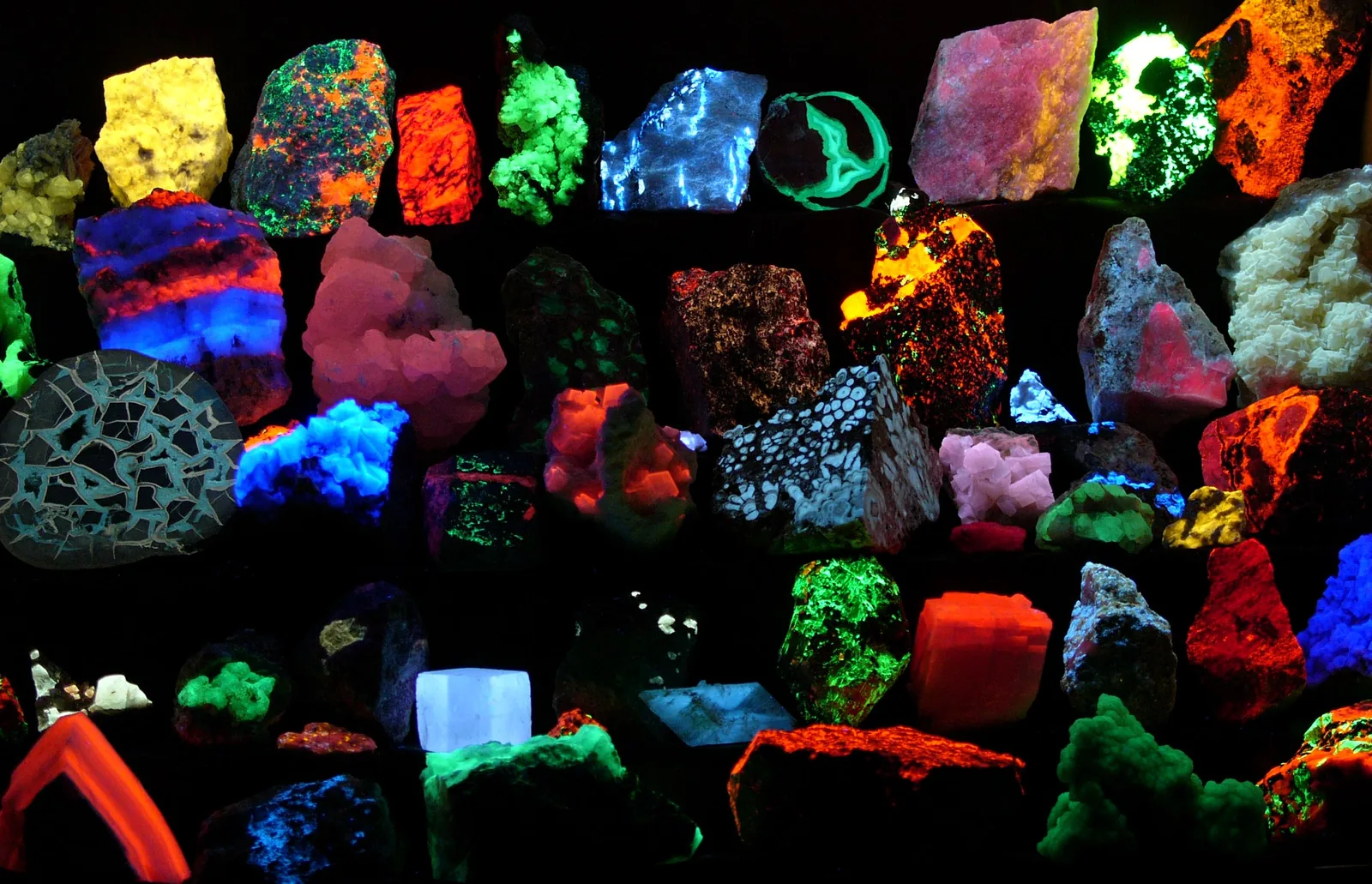
In fluorescence, a substance absorbs short-wavelength light, usually ultraviolet, and at once emits longer-wavelength visible light. The ink of a highlighter glows green in the light of a UV lamp: a molecule of the dye becomes excited, gives away part of its energy in small steps as heat to the vibrations of the molecule, and then returns to the ground state by emitting a photon of visible light. The energy of the emitted photon is smaller than that of the absorbed one, so its wavelength is longer. The spectrum is therefore shifted towards red.
Energy level difference and photon energy
When an atom moves from one energy state to another, it emits or absorbs a photon whose energy is the difference between the energies of the states:
$$\begin{aligned} hf &= E_\text{u} - E_\text{l} \\ \lambda &= \frac{hc}{E_\text{u} - E_\text{l}} \end{aligned}$$
where $E_\text{u}$ is the energy of the upper and $E_\text{l}$ the energy of the lower energy state (J or eV), ${h = 6.626 \cdot 10^{-34}\,\text{J}\,\text{s}}$ is the Planck constant, $f$ the frequency of the photon (Hz), ${c = 2.998 \cdot 10^{8}\,\text{m/s}}$ the speed of light and $\lambda$ the wavelength of the photon (m). The lower line is obtained by substituting $f = \tfrac{c}{\lambda}$ and solving for $\lambda$. The same difference gives an emission line and an absorption line, so they are at the same wavelength. A large energy difference gives a short wavelength.
The energies of atoms are often given in electronvolts. Before substituting into an equation that has $h$ and $c$, the electronvolts are converted to joules: the value ${1\,\text{eV} = 1.602 \cdot 10^{-19}\,\text{J}}$ is substituted in place of the electronvolt.
The energy states of the hydrogen atom have been measured from its spectrum. In the chapter The energy levels of the hydrogen atom and the Bohr model we see where these values come from.
| $n$ | $E_n$ (eV) |
|---|---|
| 1 | $-13.6$ |
| 2 | $-3.40$ |
| 3 | $-1.51$ |
| 4 | $-0.85$ |
| 5 | $-0.54$ |
| 6 | $-0.38$ |
The strongest visible lines of hydrogen are formed when a hydrogen atom moves from level $3$, $4$, $5$ or $6$ to level $2$. From still higher levels come weak lines at the violet edge, for example from the transition $7 \to 2$ at the wavelength $397\,\text{nm}$. Transitions to the ground state $n = 1$ are much larger, and their photons are ultraviolet.
Common misconception
In the photoelectric effect it is enough that the energy of the photon is at least as great as the work function. Therefore many people think that an atom also absorbs every photon whose energy is enough for an excitation, and that the extra energy is left over. This is not so: when the electron stays in the atom, the energy of the photon must be exactly the difference between two energy states. A photon with slightly too much or too little energy passes through the gas. The only exception is a photon whose energy is enough to free the electron completely, that is, to ionise the atom; then the extra energy remains as the kinetic energy of the freed electron.
Another mistake is to think that the dark line of an absorption spectrum is completely dark or that the absorbed energy disappears. The atoms emit the energy they absorbed again, but in all directions, so the line is only darker than its surroundings.
Summary
- A hot solid gives a continuous spectrum. A hot, thin gas gives an emission spectrum with separate bright lines, and white light that has passed through a gas gives an absorption spectrum whose dark lines are at the same wavelengths as some of the emission lines.
- The electron shell of an atom can only be in certain energy states. The energy of the photon emitted or absorbed in a transition is the difference between the states: $hf = E_\text{u} - E_\text{l}$ and $\lambda = \tfrac{hc}{E_\text{u} - E_\text{l}}$.
- Every element has its own lines, so the spectrum identifies which elements there are in a light source or in a gas on the path of the light.
- In fluorescence, a substance absorbs short-wavelength light and emits longer-wavelength light, because part of the energy is turned into heat.
Optional Return to your predictions
Compare your predictions with the values of the model in the experiments. Then return to the question at the beginning: why exactly the wavelengths that the same gas emits when hot are missing from the light of the Sun? Why can the red line $656\,\text{nm}$ of hydrogen appear dark in the spectrum of the Sun, although cold hydrogen gas does not absorb visible light?
Would you change your prediction?
Optional Greenhouse gases absorb infrared
Greenhouse gases and infrared
Molecules also have quantised energy states: their atoms vibrate relative to each other only at certain energies. The differences between the vibrational states of carbon dioxide and water vapour are about $0.08$–$0.5\,\text{eV}$. They correspond to infrared radiation: for example, the strong absorption band of carbon dioxide is at the wavelength $15\,\mu\text{m}$, where the energy of a photon is about $0.083\,\text{eV}$. Photons of visible light have no such differences to match, so the light of the Sun passes through the atmosphere to the ground.
The warmed ground radiates infrared. Carbon dioxide and water vapour molecules absorb part of it. The energy is also transferred to the rest of the air in collisions, and the gases of the atmosphere radiate infrared in all directions, also back down. Therefore the ground stays warmer than it would without these gases. When the concentration of carbon dioxide in the atmosphere grows, absorption becomes stronger and the energy balance of the Earth changes: this is the physical core of climate change.
Apply
Worked example
Problem
The spectrum of a neon sign has a strong red-orange line at the wavelength $640\,\text{nm}$. What is the difference between the energies of the neon atom's states in the transition that produces this light? Give the answer in electronvolts.
Step 1/7
Given and asked. The wavelength of the photon is $\lambda = 640\,\text{nm}$, the Planck constant is $h = 6.626 \cdot 10^{-34}\,\text{J}\,\text{s}$ and the speed of light is $c = 2.998 \cdot 10^{8}\,\text{m/s}$. The energy difference $\Delta E = E_\text{u} - E_\text{l}$ is asked, in electronvolts.
Step 2/7
Principle. An atom emits a photon when it moves from a higher energy state to a lower one. Energy is conserved, so the energy $hf$ of the photon is the difference between the energies of the states. The frequency is obtained from the wavelength, because $c = f\lambda$.
Step 3/7
Formula solved.
$$\Delta E = hf = \frac{hc}{\lambda}$$
Step 4/7
Unit conversions. The wavelength in metres: $640\,\text{nm} = 640 \cdot 10^{-9}\,\text{m}$. The result is obtained in joules, and it is converted to electronvolts by substituting $1\,\text{J} = \tfrac{1}{1.602 \cdot 10^{-19}}\,\text{eV}$.
Step 5/7
Substitution. First we calculate the product
and then the energy difference:
$$\begin{aligned} \Delta E &= \frac{hc}{\lambda} \\ &= \frac{1.9865 \cdot 10^{-25}\,\text{J}\,\text{m}}{640 \cdot 10^{-9}\,\text{m}} \\ &= 3.1039 \cdot 10^{-19}\,\text{J} \\ &= \frac{3.1039 \cdot 10^{-19}}{1.602 \cdot 10^{-19}}\,\text{eV} \\ &= 1.9375\,\text{eV} \end{aligned}$$
Step 6/7
Answer. The difference between the energies of the states is about $1.94\,\text{eV}$. The result is given to three significant figures, like the wavelength $640\,\text{nm}$.
Step 7/7
Reasonableness. The energies of photons of visible light are about $1.7$–$3.3\,\text{eV}$, and photons at the red end have the smallest energy, so $1.94\,\text{eV}$ fits red-orange light. The result is of the same order of magnitude as the energy difference $1.89\,\text{eV}$ of the red line $656\,\text{nm}$ of hydrogen, and because $640\,\text{nm}$ is a slightly shorter wavelength, its energy is slightly greater.
Find the mistake
Apply to a new situation
A fluorescent dye is illuminated with a violet flashlight whose light has a wavelength of $405\,\text{nm}$. The dye emits green light as fluorescence, with a wavelength of $530\,\text{nm}$. Assume that every absorbed photon produces one emitted photon.
How much energy is left in the dye as heat for every absorbed photon? Answer in electronvolts.
Hint 1: a guiding question
Energy is conserved: the energy of the absorbed photon is divided into the energy of the emitted photon and heat. First calculate the energy of each photon.
Hint 2: what is the connection
The energy of a photon is $E = \tfrac{hc}{\lambda}$. Convert the wavelengths to metres and the result to electronvolts by substituting $1\,\text{eV} = 1.602 \cdot 10^{-19}\,\text{J}$.
Hint 3: an intermediate step
The energy of the violet photon is $3.062\,\text{eV}$ and that of the green one $2.340\,\text{eV}$. The heat is their difference.
Show the solution
Given
wavelength of the absorbed photon $\lambda_1 = 405\,\text{nm}$, wavelength of the emitted photon $\lambda_2 = 530\,\text{nm}$, $h = 6.626 \cdot 10^{-34}\,\text{J}\,\text{s}$, $c = 2.998 \cdot 10^{8}\,\text{m/s}$, $1\,\text{eV} = 1.602 \cdot 10^{-19}\,\text{J}$
Find
the energy left as heat per photon, $E_\text{heat}$, in electronvolts
Principle
In fluorescence the molecule absorbs a violet photon and becomes excited, gives away part of the energy as heat and returns to the ground state by emitting a green photon. Energy is conserved, so the energy of the absorbed photon is the sum of the energy of the emitted photon and the heat. The energy of each photon is obtained from its wavelength.
Formula
$E_1 = E_2 + E_\text{heat}$ and $E = \dfrac{hc}{\lambda}$, so
Conversions
$405\,\text{nm} = 405 \cdot 10^{-9}\,\text{m}$ and $530\,\text{nm} = 530 \cdot 10^{-9}\,\text{m}$. Joules are converted to electronvolts by dividing by $1.602 \cdot 10^{-19}\,\tfrac{\text{J}}{\text{eV}}$.
Substitution
Answer
$0.722\,\text{eV}$
Three significant figures like the wavelengths $405\,\text{nm}$ and $530\,\text{nm}$.
Reasonableness
With the estimate $hc \approx 1240\,\text{eV}\,\text{nm}$ we get $\tfrac{1240}{405}\,\text{eV} \approx 3.1\,\text{eV}$ and $\tfrac{1240}{530}\,\text{eV} \approx 2.3\,\text{eV}$, a difference of about $0.7\,\text{eV}$. The result is positive, as it should be: the wavelength of the emitted photon is longer, so its energy is smaller. About a quarter of the energy of the violet photon heats the dye.
Check your understanding
Exit ticket
Answer on your own first and only then open the answer.
- The atom of a gas has three energy states: $0$, $2.0\,\text{eV}$ and $3.0\,\text{eV}$. How many different spectral lines can the hot gas emit, and what are the energies of their photons?
Answer
Three lines, one for each pair of states. The energies of the photons are the differences between the states: $3.0\,\text{eV} - 2.0\,\text{eV} = 1.0\,\text{eV}$, $2.0\,\text{eV} - 0 = 2.0\,\text{eV}$ and $3.0\,\text{eV} - 0 = 3.0\,\text{eV}$.
- A fluorescent substance absorbs blue light with a wavelength of $450\,\text{nm}$. Can it emit violet light with a wavelength of $400\,\text{nm}$ as fluorescence? Justify using energy.
Answer
It cannot. The energy of a photon is $E = \tfrac{hc}{\lambda}$, so a photon of $400\,\text{nm}$ has more energy than a photon of $450\,\text{nm}$. In fluorescence part of the energy of the absorbed photon is turned into heat, so the emitted photon has less energy and a longer wavelength than the absorbed one.
1. Concept
2. Calculate the energy difference
A fluorescent tube contains mercury vapour, whose spectrum has a bright green line at the wavelength $546\,\text{nm}$.
What is the difference between the energies of the mercury atom's states in the transition that produces this light? Answer in electronvolts.
Hint 1: a guiding question
The energy of the photon is the difference between the energies of the states.
Hint 2: what is the connection
$\Delta E = \tfrac{hc}{\lambda}$, when $\lambda$ is in metres.
Hint 3: an intermediate step
The result in joules is $3.638 \cdot 10^{-19}\,\text{J}$; convert it to electronvolts.
Show the solution
Given
wavelength of the mercury line $\lambda = 546\,\text{nm}$, $h = 6.626 \cdot 10^{-34}\,\text{J}\,\text{s}$, $c = 2.998 \cdot 10^{8}\,\text{m/s}$, $1\,\text{eV} = 1.602 \cdot 10^{-19}\,\text{J}$
Find
the energy difference $\Delta E = E_\text{u} - E_\text{l}$ in electronvolts
Principle
A mercury atom emits a photon when it moves from a higher energy state to a lower one. Energy is conserved, so the energy of the photon is the difference between the states, and the energy of the photon is obtained from the wavelength.
Formula
$\Delta E = hf$ and $f = \tfrac{c}{\lambda}$, so $\Delta E = \dfrac{hc}{\lambda}$
Conversions
$546\,\text{nm} = 546 \cdot 10^{-9}\,\text{m}$. The result in joules is converted to electronvolts by dividing by $1.602 \cdot 10^{-19}\,\tfrac{\text{J}}{\text{eV}}$.
Substitution
Answer
$2.27\,\text{eV}$
Three significant figures like the wavelength $546\,\text{nm}$.
Reasonableness
With the estimate $hc \approx 1240\,\text{eV}\,\text{nm}$ we get $\tfrac{1240}{546}\,\text{eV} \approx 2.3\,\text{eV}$. Green light is in the middle of the visible range, and $2.3\,\text{eV}$ is between the $1.9\,\text{eV}$ of red and the $3.0\,\text{eV}$ of violet.
Suggestion: one answer does not show everything you can do, but review the theory summary and do the core exercises.
Optional 3. Explain and transfer
Helium was discovered in 1868 in the spectrum of the Sun before it had been found on Earth: the spectrum had a yellow line at a wavelength that was not in the spectrum of any known element. Explain with energy states why this line was evidence of a new element.
Model answer
The atoms of every element have their own energy states, and the wavelength of a spectral line is decided by the difference between two states: $\lambda = \tfrac{hc}{E_\text{u} - E_\text{l}}$. All the atoms of the same element always produce the same lines, and the states, and therefore the lines, of different elements are different. When the spectrum of the Sun had a line that was not among the lines of any known element, it had to be produced by atoms whose energy states differ from all the known ones. Later helium gas was found also on Earth, and its spectrum had the same line.
Assess your own answer
Tick the points your own answer already contains.
Review the theory summary and practise with the exercises.
Exercises
Level 1 · basic practice 5 exercises
One formula or one step of reasoning. Core exercises first, the rest is extra practice.
- Exercise 2-1Core
The spectrum of a helium gas tube has a green line at the wavelength $502\,\text{nm}$.
What is the difference between the energies of the helium atom's states in the transition that produces this line? Give the answer in electronvolts.
Answer
$2.47\,\text{eV}$
Show the solution
Given
wavelength of the helium line $\lambda = 502\,\text{nm}$, $h = 6.626 \cdot 10^{-34}\,\text{J}\,\text{s}$, $c = 2.998 \cdot 10^{8}\,\text{m/s}$, $1\,\text{eV} = 1.602 \cdot 10^{-19}\,\text{J}$
Find
the energy difference $\Delta E = E_\text{u} - E_\text{l}$ in electronvolts
Principle
An atom emits a photon when it moves from a higher energy state to a lower one. Energy is conserved, so the energy $hf$ of the photon is the difference between the energies of the states, and the frequency is obtained from the wavelength with the equation $c = f\lambda$.
Formula
$\Delta E = hf$ and $f = \tfrac{c}{\lambda}$, so $\Delta E = \dfrac{hc}{\lambda}$
Conversions
$502\,\text{nm} = 502 \cdot 10^{-9}\,\text{m}$. The result in joules is converted to electronvolts by dividing by $1.602 \cdot 10^{-19}\,\tfrac{\text{J}}{\text{eV}}$.
Substitution
$hc$$= 6.626 \cdot 10^{-34}\,\text{J}\,\text{s} \cdot 2.998 \cdot 10^{8}\,\text{m/s}$$= 1.9865 \cdot 10^{-25}\,\text{J}\,\text{m}$$\Delta E$$= \dfrac{1.9865 \cdot 10^{-25}\,\text{J}\,\text{m}}{502 \cdot 10^{-9}\,\text{m}}$$= 3.9571 \cdot 10^{-19}\,\text{J}$$= \dfrac{3.9571 \cdot 10^{-19}}{1.602 \cdot 10^{-19}}\,\text{eV}$$= 2.4701\,\text{eV}$Answer
$2.47\,\text{eV}$
Three significant figures like the wavelength $502\,\text{nm}$.
Reasonableness
With the estimate $hc \approx 1240\,\text{eV}\,\text{nm}$ we get $\tfrac{1240}{502}\,\text{eV} \approx 2.5\,\text{eV}$. The energy of a photon of green light is between those of red ($1.9\,\text{eV}$) and violet ($3.0\,\text{eV}$), as it should be.
- Exercise 2-2Core
The difference between the energies of two states of a gas atom is $2.86\,\text{eV}$.
What is the wavelength of the photon that the atom emits when it moves from the upper state to the lower one? Give the answer in nanometres.
Answer
$434\,\text{nm}$
Show the solution
Given
energy difference $\Delta E = 2.86\,\text{eV}$, $h = 6.626 \cdot 10^{-34}\,\text{J}\,\text{s}$, $c = 2.998 \cdot 10^{8}\,\text{m/s}$, $1\,\text{eV} = 1.602 \cdot 10^{-19}\,\text{J}$
Find
the wavelength $\lambda$ of the emitted photon in nanometres
Principle
The energy of a photon produced in a transition from an upper state to a lower one is the difference between the states, because energy is conserved. The energy and wavelength of a photon are connected by $E = \tfrac{hc}{\lambda}$.
Formula
$\Delta E = \dfrac{hc}{\lambda}$, so $\lambda = \dfrac{hc}{\Delta E}$
Conversions
$\Delta E$$= 2.86\,\text{eV}$$= 2.86 \cdot 1.602 \cdot 10^{-19}\,\text{J}$$= 4.5817 \cdot 10^{-19}\,\text{J}$Finally $1\,\text{m} = 10^{9}\,\text{nm}$.
Substitution
$hc$$= 6.626 \cdot 10^{-34}\,\text{J}\,\text{s} \cdot 2.998 \cdot 10^{8}\,\text{m/s}$$= 1.9865 \cdot 10^{-25}\,\text{J}\,\text{m}$$\lambda$$= \dfrac{1.9865 \cdot 10^{-25}\,\text{J}\,\text{m}}{4.5817 \cdot 10^{-19}\,\text{J}}$$= 4.3357 \cdot 10^{-7}\,\text{m}$$= 433.57\,\text{nm}$Answer
$434\,\text{nm}$
Three significant figures like the energy difference $2.86\,\text{eV}$.
Reasonableness
With the estimate, $\tfrac{1240\,\text{eV}\,\text{nm}}{2.86\,\text{eV}} \approx 430\,\text{nm}$. The wavelength is at the violet end of visible light, and it is the same as the blue-violet line of hydrogen.
- Exercise 2-3
The wavelength of the red spectral line of hydrogen is $656\,\text{nm}$. What is the frequency of this light? Give the answer in the unit $10^{14}\,\text{Hz}$.
Answer
$4.57 \cdot 10^{14}\,\text{Hz}$
Show the solution
Given
wavelength $\lambda = 656\,\text{nm}$, speed of light $c = 2.998 \cdot 10^{8}\,\text{m/s}$
Find
the frequency $f$ of the light in the unit $10^{14}\,\text{Hz}$
Principle
Light is electromagnetic wave motion that travels at the speed $c$, so the wavelength and the frequency are connected by the basic equation of wave motion.
Formula
$c = f\lambda$, so $f = \dfrac{c}{\lambda}$
Conversions
$656\,\text{nm} = 656 \cdot 10^{-9}\,\text{m}$. The unit is
$\tfrac{\text{m/s}}{\text{m}}$$= \tfrac{1}{\text{s}}$$= \text{Hz}$Substitution
$f$$= \dfrac{2.998 \cdot 10^{8}\,\text{m/s}}{656 \cdot 10^{-9}\,\text{m}}$$= 4.5701 \cdot 10^{14}\,\text{Hz}$Answer
$4.57 \cdot 10^{14}\,\text{Hz}$
Three significant figures like the wavelength $656\,\text{nm}$.
Reasonableness
The frequencies of visible light are about $4 \cdot 10^{14}$–$8 \cdot 10^{14}\,\text{Hz}$, and red light has the smallest frequency, so $4.57 \cdot 10^{14}\,\text{Hz}$ fits the red line.
- Exercise 2-4
The energies of two energy states of the hydrogen atom are $E_3 = -1.51\,\text{eV}$ and $E_2 = -3.40\,\text{eV}$.
What is the energy of the photon that the atom emits when it moves from state $3$ to state $2$? Give the answer in electronvolts.
Answer
$1.89\,\text{eV}$
Show the solution
Given
the energies of the states of the hydrogen atom $E_3 = -1.51\,\text{eV}$ and $E_2 = -3.40\,\text{eV}$
Find
the energy $E_\text{ph}$ of the photon emitted in the transition $3 \to 2$ in electronvolts
Principle
When an atom moves from a higher state to a lower one, its energy decreases. Energy is conserved, so the decrease in energy leaves as a photon, and the energy of the photon is the difference between the states.
Formula
$E_\text{ph}$$= E_\text{u} - E_\text{l}$$= E_3 - E_2$Conversions
None are needed: both energies are in electronvolts, and the answer is asked in electronvolts.
Substitution
$E_\text{ph}$$= -1.51\,\text{eV} - (-3.40\,\text{eV})$$= 1.89\,\text{eV}$Answer
$1.89\,\text{eV}$
To the nearest hundredth like the energies of the states, that is, three significant figures.
Reasonableness
The energy is positive, because the energy of the upper state, $-1.51\,\text{eV}$, is greater than that of the lower one. $1.89\,\text{eV}$ is in the range of visible light, $1.7$–$3.3\,\text{eV}$; it is the photon of the red line $656\,\text{nm}$ of hydrogen.
- Exercise 2-5
The difference between the energies of two states of an atom is $3.03 \cdot 10^{-19}\,\text{J}$.
What is the wavelength of the photon produced in the transition? Give the answer in nanometres.
Answer
$656\,\text{nm}$
Show the solution
Given
energy difference $\Delta E = 3.03 \cdot 10^{-19}\,\text{J}$, $h = 6.626 \cdot 10^{-34}\,\text{J}\,\text{s}$, $c = 2.998 \cdot 10^{8}\,\text{m/s}$
Find
the wavelength $\lambda$ of the photon produced, in nanometres
Principle
The energy of the photon produced in a transition is the difference between the states, because energy is conserved, and the energy of a photon is $\tfrac{hc}{\lambda}$.
Formula
$\Delta E = \dfrac{hc}{\lambda}$, so $\lambda = \dfrac{hc}{\Delta E}$
Conversions
The energy is already in joules, so the result is obtained in metres. Finally $1\,\text{m} = 10^{9}\,\text{nm}$.
Substitution
$hc$$= 6.626 \cdot 10^{-34}\,\text{J}\,\text{s} \cdot 2.998 \cdot 10^{8}\,\text{m/s}$$= 1.9865 \cdot 10^{-25}\,\text{J}\,\text{m}$$\lambda$$= \dfrac{1.9865 \cdot 10^{-25}\,\text{J}\,\text{m}}{3.03 \cdot 10^{-19}\,\text{J}}$$= 6.5560 \cdot 10^{-7}\,\text{m}$$= 655.60\,\text{nm}$Answer
$656\,\text{nm}$
Three significant figures like the energy difference $3.03 \cdot 10^{-19}\,\text{J}$.
Reasonableness
$3.03 \cdot 10^{-19}\,\text{J}$ is about $1.9\,\text{eV}$, and $\tfrac{1240}{1.9}\,\text{nm} \approx 650\,\text{nm}$. The result is red light, the same as the red line of hydrogen.
Level 2 · applied practice 4 exercises
Two steps, working with measured data, a unit conversion or rearranging a formula. Core exercises first, the rest is extra practice.
- Exercise 2-6Core
A hydrogen atom moves from the state $n = 4$, whose energy is $-0.85\,\text{eV}$, to the state $n = 2$, whose energy is $-3.40\,\text{eV}$.
What is the wavelength of the photon produced? Give the answer in nanometres.
Answer
$486\,\text{nm}$
Show the solution
Given
the energies of the states of the hydrogen atom $E_4 = -0.85\,\text{eV}$ and $E_2 = -3.40\,\text{eV}$, $h = 6.626 \cdot 10^{-34}\,\text{J}\,\text{s}$, $c = 2.998 \cdot 10^{8}\,\text{m/s}$, $1\,\text{eV} = 1.602 \cdot 10^{-19}\,\text{J}$
Find
the wavelength $\lambda$ of the photon produced, in nanometres
Principle
The energy of the atom decreases in the transition from state $4$ to state $2$. Energy is conserved, so the energy of the photon is the difference between the states, and the wavelength is obtained from the energy of the photon.
Formula
$E_4 - E_2 = \dfrac{hc}{\lambda}$, so $\lambda = \dfrac{hc}{E_4 - E_2}$
Conversions
$E_4 - E_2$$= -0.85\,\text{eV} - (-3.40\,\text{eV})$$= 2.55\,\text{eV}$$= 2.55 \cdot 1.602 \cdot 10^{-19}\,\text{J}$$= 4.0851 \cdot 10^{-19}\,\text{J}$Finally $1\,\text{m} = 10^{9}\,\text{nm}$.
Substitution
$hc$$= 6.626 \cdot 10^{-34}\,\text{J}\,\text{s} \cdot 2.998 \cdot 10^{8}\,\text{m/s}$$= 1.9865 \cdot 10^{-25}\,\text{J}\,\text{m}$$\lambda$$= \dfrac{1.9865 \cdot 10^{-25}\,\text{J}\,\text{m}}{4.0851 \cdot 10^{-19}\,\text{J}}$$= 4.8627 \cdot 10^{-7}\,\text{m}$$= 486.27\,\text{nm}$Answer
$486\,\text{nm}$
Three significant figures like the energy difference $2.55\,\text{eV}$.
Reasonableness
With the estimate $hc \approx 1240\,\text{eV}\,\text{nm}$ we get $\tfrac{1240\,\text{eV}\,\text{nm}}{2.55\,\text{eV}} \approx 490\,\text{nm}$, and the line looks blue-green, that is, cyan. The transition from level $4$ is larger than from level $3$ (red, $656\,\text{nm}$), so the wavelength is shorter.
- Exercise 2-7Core
A model atom has three energy states: the ground state $0$ and the excited states $1.85\,\text{eV}$ and $4.00\,\text{eV}$. A hot gas of such atoms emits three different lines.
What is the wavelength of the longest of the lines? Give the answer in nanometres.
Answer
$670\,\text{nm}$
Show the solution
Given
the energy states of the model atom $E_1 = 0$, $E_2 = 1.85\,\text{eV}$ and $E_3 = 4.00\,\text{eV}$, $h = 6.626 \cdot 10^{-34}\,\text{J}\,\text{s}$, $c = 2.998 \cdot 10^{8}\,\text{m/s}$, $1\,\text{eV} = 1.602 \cdot 10^{-19}\,\text{J}$
Find
the wavelength $\lambda_\text{max}$ of the longest line in nanometres
Principle
Every pair of states gives one line, whose photon energy is the difference between the states. The wavelength is inversely proportional to the energy, so the longest wavelength comes from the smallest difference. The differences are $E_2 - E_1 = 1.85\,\text{eV}$, $E_3 - E_2 = 2.15\,\text{eV}$ and $E_3 - E_1 = 4.00\,\text{eV}$, so the smallest is $1.85\,\text{eV}$.
Formula
$\Delta E_\text{min}$$= \dfrac{hc}{\lambda_\text{max}}$so
$\lambda_\text{max}$$= \dfrac{hc}{\Delta E_\text{min}}$Conversions
$\Delta E_\text{min}$$= 1.85\,\text{eV}$$= 1.85 \cdot 1.602 \cdot 10^{-19}\,\text{J}$$= 2.9637 \cdot 10^{-19}\,\text{J}$Finally $1\,\text{m} = 10^{9}\,\text{nm}$.
Substitution
$hc$$= 6.626 \cdot 10^{-34}\,\text{J}\,\text{s} \cdot 2.998 \cdot 10^{8}\,\text{m/s}$$= 1.9865 \cdot 10^{-25}\,\text{J}\,\text{m}$$\lambda_\text{max}$$= \dfrac{1.9865 \cdot 10^{-25}\,\text{J}\,\text{m}}{2.9637 \cdot 10^{-19}\,\text{J}}$$= 6.7027 \cdot 10^{-7}\,\text{m}$$= 670.27\,\text{nm}$Answer
$670\,\text{nm}$
Three significant figures like the energy $1.85\,\text{eV}$.
Reasonableness
The other lines are $\tfrac{1240}{2.15}\,\text{nm} \approx 577\,\text{nm}$ and $\tfrac{1240}{4.00}\,\text{nm} \approx 310\,\text{nm}$, both shorter. The longest line is red, as is right for the photon with the smallest energy.
- Exercise 2-8
The atoms of hydrogen gas at room temperature are in the ground state, whose energy is $-13.6\,\text{eV}$. The next energy state is $-3.40\,\text{eV}$.
What wavelength of light does the gas absorb when an atom moves from the ground state to this state? Give the answer in nanometres.
Answer
$122\,\text{nm}$
Show the solution
Given
the energy of the ground state of the hydrogen atom $E_1 = -13.6\,\text{eV}$ and of the next state $E_2 = -3.40\,\text{eV}$, $h = 6.626 \cdot 10^{-34}\,\text{J}\,\text{s}$, $c = 2.998 \cdot 10^{8}\,\text{m/s}$, $1\,\text{eV} = 1.602 \cdot 10^{-19}\,\text{J}$
Find
the wavelength $\lambda$ of the absorbed light in nanometres
Principle
An atom absorbs a photon only if the energy of the photon is exactly the difference between two states. A transition from the ground state to state $2$ therefore requires a photon whose energy is $E_2 - E_1$.
Formula
$E_2 - E_1 = \dfrac{hc}{\lambda}$, so $\lambda = \dfrac{hc}{E_2 - E_1}$
Conversions
$E_2 - E_1$$= -3.40\,\text{eV} - (-13.6\,\text{eV})$$= 10.2\,\text{eV}$$= 10.2 \cdot 1.602 \cdot 10^{-19}\,\text{J}$$= 1.6340 \cdot 10^{-18}\,\text{J}$Finally $1\,\text{m} = 10^{9}\,\text{nm}$.
Substitution
$hc$$= 6.626 \cdot 10^{-34}\,\text{J}\,\text{s} \cdot 2.998 \cdot 10^{8}\,\text{m/s}$$= 1.9865 \cdot 10^{-25}\,\text{J}\,\text{m}$$\lambda$$= \dfrac{1.9865 \cdot 10^{-25}\,\text{J}\,\text{m}}{1.6340 \cdot 10^{-18}\,\text{J}}$$= 1.2157 \cdot 10^{-7}\,\text{m}$$= 121.57\,\text{nm}$Answer
$122\,\text{nm}$
Three significant figures like the energy of the ground state $-13.6\,\text{eV}$.
Reasonableness
$10.2\,\text{eV}$ is more than three times the energy of a photon of visible light, so the wavelength is less than a third of the wavelengths of visible light: ultraviolet. This is why cold hydrogen gas is transparent to visible light.
- Exercise 2-9
The frequency of the yellow light of sodium vapour is $5.09 \cdot 10^{14}\,\text{Hz}$.
What is the difference between the energies of the sodium atom's states in the transition that produces this light? Give the answer in electronvolts.
Answer
$2.11\,\text{eV}$
Show the solution
Given
frequency of the light of sodium $f = 5.09 \cdot 10^{14}\,\text{Hz}$, $h = 6.626 \cdot 10^{-34}\,\text{J}\,\text{s}$, $1\,\text{eV} = 1.602 \cdot 10^{-19}\,\text{J}$
Find
the energy difference $\Delta E$ in electronvolts
Principle
Energy is conserved in the transition, so the energy of the emitted photon is the difference between the states. The energy of a photon is the Planck constant times the frequency.
Formula
$\Delta E = hf$
Conversions
$\text{Hz} = \tfrac{1}{\text{s}}$, so $\text{J}\,\text{s} \cdot \text{Hz} = \text{J}$. The result in joules is converted to electronvolts by dividing by $1.602 \cdot 10^{-19}\,\tfrac{\text{J}}{\text{eV}}$.
Substitution
$\Delta E$$= 6.626 \cdot 10^{-34}\,\text{J}\,\text{s} \cdot 5.09 \cdot 10^{14}\,\text{Hz}$$= 3.3726 \cdot 10^{-19}\,\text{J}$$= \dfrac{3.3726 \cdot 10^{-19}}{1.602 \cdot 10^{-19}}\,\text{eV}$$= 2.1053\,\text{eV}$Answer
$2.11\,\text{eV}$
Three significant figures like the frequency $5.09 \cdot 10^{14}\,\text{Hz}$.
Reasonableness
The wavelength corresponding to the frequency is
$\tfrac{2.998 \cdot 10^{8}\,\text{m/s}}{5.09 \cdot 10^{14}\,\text{Hz}}$$\approx 589\,\text{nm}$the yellow line of sodium, and $\tfrac{1240}{589}\,\text{eV} \approx 2.1\,\text{eV}$.
Level 3 · challenging 3 exercises
Optional: application, two ideas together or a new situation where you reason for yourself.
- Exercise 2-10
The visible spectral lines of hydrogen are formed when an atom moves from a higher level to the level $n = 2$, whose energy is $-3.40\,\text{eV}$. The higher the starting level, the shorter the wavelength of the line, but the lines never go beyond a certain limit. The energy of levels very high up is almost zero.
What is the shortest possible wavelength of this series? Give the answer in nanometres.
Answer
$365\,\text{nm}$
Show the solution
Given
energy of the final level $E_2 = -3.40\,\text{eV}$, energy of levels very high up almost $E_\infty = 0$, $h = 6.626 \cdot 10^{-34}\,\text{J}\,\text{s}$, $c = 2.998 \cdot 10^{8}\,\text{m/s}$, $1\,\text{eV} = 1.602 \cdot 10^{-19}\,\text{J}$
Find
the shortest wavelength $\lambda_\text{min}$ of the series in nanometres
Principle
The energy of the photon of a line is the difference $E_\text{u} - E_2$ between the states. The higher the level, the greater the energy, but the upper energy cannot exceed $0$, where the electron is freed from the atom. The greatest possible difference is therefore $0 - E_2$, and it gives the shortest wavelength, towards which the lines crowd together.
Formula
$0 - E_2$$= \dfrac{hc}{\lambda_\text{min}}$so
$\lambda_\text{min}$$= \dfrac{hc}{0 - E_2}$Conversions
$0 - E_2$$= 3.40\,\text{eV}$$= 3.40 \cdot 1.602 \cdot 10^{-19}\,\text{J}$$= 5.4468 \cdot 10^{-19}\,\text{J}$Finally $1\,\text{m} = 10^{9}\,\text{nm}$.
Substitution
$hc$$= 6.626 \cdot 10^{-34}\,\text{J}\,\text{s} \cdot 2.998 \cdot 10^{8}\,\text{m/s}$$= 1.9865 \cdot 10^{-25}\,\text{J}\,\text{m}$$\lambda_\text{min}$$= \dfrac{1.9865 \cdot 10^{-25}\,\text{J}\,\text{m}}{5.4468 \cdot 10^{-19}\,\text{J}}$$= 3.6470 \cdot 10^{-7}\,\text{m}$$= 364.70\,\text{nm}$Answer
$365\,\text{nm}$
Three significant figures like the energy $-3.40\,\text{eV}$.
Reasonableness
The limit is shorter than the shortest visible line of the series, $410\,\text{nm}$, as it should be, and just below the visible range ($380\,\text{nm}$): the last lines of the series are ultraviolet.
- Exercise 2-11
Carbon dioxide in the atmosphere strongly absorbs infrared radiation with a wavelength of $15.0\,\mu\text{m}$. The absorption occurs when the molecule moves from one vibrational state to another.
What is the energy difference between these vibrational states? Give the answer in millielectronvolts ($1\,\text{meV} = 10^{-3}\,\text{eV}$).
Answer
$82.7\,\text{meV}$
Show the solution
Given
wavelength of the radiation absorbed by carbon dioxide $\lambda = 15.0\,\mu\text{m}$, $h = 6.626 \cdot 10^{-34}\,\text{J}\,\text{s}$, $c = 2.998 \cdot 10^{8}\,\text{m/s}$, $1\,\text{eV} = 1.602 \cdot 10^{-19}\,\text{J}$
Find
the energy difference $\Delta E$ of the vibrational states in millielectronvolts
Principle
The energy of the vibration of a molecule is quantised like the energy of the electron shell of an atom. A molecule absorbs a photon only if the energy of the photon is exactly the difference between two states, so the difference is obtained from the wavelength of the absorbed radiation.
Formula
$\Delta E = hf = \dfrac{hc}{\lambda}$
Conversions
$15.0\,\mu\text{m} = 15.0 \cdot 10^{-6}\,\text{m}$. Joules are converted to electronvolts by dividing by $1.602 \cdot 10^{-19}\,\tfrac{\text{J}}{\text{eV}}$ and electronvolts to millielectronvolts by substituting $1\,\text{eV} = 1000\,\text{meV}$.
Substitution
$hc$$= 6.626 \cdot 10^{-34}\,\text{J}\,\text{s} \cdot 2.998 \cdot 10^{8}\,\text{m/s}$$= 1.9865 \cdot 10^{-25}\,\text{J}\,\text{m}$$\Delta E$$= \dfrac{1.9865 \cdot 10^{-25}\,\text{J}\,\text{m}}{15.0 \cdot 10^{-6}\,\text{m}}$$= 1.3243 \cdot 10^{-20}\,\text{J}$$= \dfrac{1.3243 \cdot 10^{-20}}{1.602 \cdot 10^{-19}}\,\text{eV}$$= 0.082666\,\text{eV}$$= 82.666\,\text{meV}$Answer
$82.7\,\text{meV}$
Three significant figures like the wavelength $15.0\,\mu\text{m}$.
Reasonableness
The wavelength is $30$ times the $500\,\text{nm}$ of visible light, so the energy is about one thirtieth of the energy $2.5\,\text{eV}$ of its photon: $2.5\,\text{eV} : 30 \approx 0.083\,\text{eV}$. An energy difference this small corresponds to infrared radiation, not to visible light: the molecule cannot absorb visible light in this transition, but it does absorb the infrared radiation of the ground.
- Exercise 2-12
The molecule of a dye absorbs a UV photon with a wavelength of $365\,\text{nm}$. The molecule returns to the ground state in two steps: first it emits an infrared photon with an energy of $1.20\,\text{eV}$, and then a second photon, with which it ends up in the ground state. Assume that no energy is transferred to heat.
What is the wavelength of the second photon? Give the answer in nanometres.
Answer
$564\,\text{nm}$
Show the solution
Given
wavelength of the absorbed UV photon $\lambda_\text{UV} = 365\,\text{nm}$, energy of the first emitted photon $E_1 = 1.20\,\text{eV}$, $h = 6.626 \cdot 10^{-34}\,\text{J}\,\text{s}$, $c = 2.998 \cdot 10^{8}\,\text{m/s}$, $1\,\text{eV} = 1.602 \cdot 10^{-19}\,\text{J}$
Find
the wavelength $\lambda_2$ of the second emitted photon in nanometres
Principle
The molecule returns to the same ground state and no energy is transferred to heat, so by conservation of energy the sum of the energies of the two emitted photons is the energy of the absorbed photon.
Formula
$E_\text{UV}$$= \dfrac{hc}{\lambda_\text{UV}}$$= E_1 + \dfrac{hc}{\lambda_2}$so
$\lambda_2$$= \dfrac{hc}{\tfrac{hc}{\lambda_\text{UV}} - E_1}$Conversions
$365\,\text{nm} = 365 \cdot 10^{-9}\,\text{m}$; electronvolts and joules are converted by substituting $1\,\text{eV} = 1.602 \cdot 10^{-19}\,\text{J}$.
Substitution
$hc$$= 6.626 \cdot 10^{-34}\,\text{J}\,\text{s} \cdot 2.998 \cdot 10^{8}\,\text{m/s}$$= 1.9865 \cdot 10^{-25}\,\text{J}\,\text{m}$$E_\text{UV}$$= \dfrac{1.9865 \cdot 10^{-25}\,\text{J}\,\text{m}}{365 \cdot 10^{-9}\,\text{m}}$$= 5.4424 \cdot 10^{-19}\,\text{J}$$= 3.3973\,\text{eV}$$E_2$$= 3.3973\,\text{eV} - 1.20\,\text{eV}$$= 2.1973\,\text{eV}$$= 3.5200 \cdot 10^{-19}\,\text{J}$$\lambda_2$$= \dfrac{1.9865 \cdot 10^{-25}\,\text{J}\,\text{m}}{3.5200 \cdot 10^{-19}\,\text{J}}$$= 5.6434 \cdot 10^{-7}\,\text{m}$$= 564.34\,\text{nm}$Answer
$564\,\text{nm}$
Three significant figures like the wavelength $365\,\text{nm}$ and the energy $1.20\,\text{eV}$.
Reasonableness
The energy $2.2\,\text{eV}$ of the second photon is smaller than that of the UV photon, so the wavelength is longer: yellow-green light. Estimate: $\tfrac{1240}{1.20}\,\text{nm} \approx 1030\,\text{nm}$ is infrared, as the task says, and $1.2\,\text{eV} + \tfrac{1240}{564}\,\text{eV} \approx 3.4\,\text{eV}$ is the energy of the absorbed photon.
Photographs
- Coloured flames of methanol solutions of metal salts and compounds. Hegelrast. source, CC BY-SA 4.0
- Buildings with colorful neon street signs at blue hour, Shinjuku, Tokyo. Basile Morin. source, CC BY-SA 4.0
- Fluorescent minerals hg. Hannes Grobe/AWI. source, CC BY-SA 2.5


