
Ionising radiation and the body
Why does a sheet of paper stop alpha radiation while gamma radiation passes through the whole human body, and why is a substance that emits alpha radiation nevertheless the most dangerous one when it gets inside the body?
Prior knowledge
- The energy of a photon is $E = hf$, and the electronvolt is $1\,\text{eV} = 1.602 \cdot 10^{-19}\,\text{J}$chapter The photoelectric effect and the photon
- A radioactive nucleus emits alpha, beta or gamma radiationchapter The atomic nucleus and radioactive decay
- Every half-life halves the number of undecayed nuclei, $N = N_0 \left(\tfrac{1}{2}\right)^{t/T_{1/2}}$chapter The decay law and half-life
Core path: follow the steps in order. Tasks marked Optional give extra practice. Optional tasks: 4.
Think about it
The indoor air in Finland contains radon, which decays by emitting alpha radiation. Alpha radiation is already stopped by a sheet of paper, and an X-ray nurse protects herself from radiation with an apron containing lead. Yet it is precisely the radon in the air we breathe that is the most significant source of radiation to which people in Finland are exposed. Radiation cannot be seen, heard or felt, but a Geiger–Müller counter clicks for every particle it detects.
Why is alpha radiation, which is stopped so easily, harmful inside the body, and why do we protect ourselves from gamma radiation precisely with lead?
Optional Review: types of radiation
Predict
Make your predictions before investigating 2 questions
Prediction 1: what passes through aluminium?
Prediction 2: two lead plates
Investigate
Choose a source and a barrier, add plates and use the GM tube to measure how many pulses are produced in $10\,\text{s}$. Watch which particles stop in the plates.
Simulation
How to use
Measure starts a $10\,\text{s}$ measurement; the counter shows the pulse count $N$ and the elapsed time $t$, and the finished result stays in the readings. Source selects an alpha, beta or gamma source or no source, in which case the counter counts only background radiation. Barrier selects the material of the plates, and the slider Plates their number $n$ from $0$ to $20$: a sheet of paper is $0.1\,\text{mm}$, an aluminium or lead plate $1\,\text{mm}$. When $n = 0$, there is no barrier. In the picture a violet dot is an alpha particle, a blue one a beta particle and an orange wave a gamma photon; particles that stop in the plates disappear in them. Every particle hitting the tube produces an electron avalanche near the wire, which shows as a flash, and the counter increases by one. The grey waves from above are background radiation. If you change the source or the barrier, the measurement is reset. Speed changes only the pace of the passing of time.
Assumptions of the model
The source is $3\,\text{cm}$ from the window of the tube. The model does not take into account the loss of energy of the alpha particle in the air and in the window of the tube, although in reality alpha particles should be measured from closer. The sources are chosen so that without a barrier the counter counts on average $600$ pulses in $10\,\text{s}$ from each; background radiation gives on average $4$ pulses. Each source emits only one type of radiation: real americium-241 emits also weak gamma radiation in addition to alpha radiation. An alpha particle stops already in one sheet of paper. The maximum energy of the beta particles is $2.28\,\text{MeV}$, as in a strontium-90 source, and their range is $1.1\,\tfrac{\text{g}}{\text{cm}^2}$, about $4\,\text{mm}$ of aluminium; bremsstrahlung is not in the model. The gamma radiation is the $662\,\text{keV}$ radiation of caesium-137 as a narrow beam. A real GM tube detects only a small fraction of gamma photons, but in the model every particle or photon hitting the tube is registered, and the tube has no dead time. The readings are values of the model, not measurements.
How the calculation works
The fraction $T$ that passes through the barrier is calculated by the type of radiation. For alpha, $T = 0$ behind any barrier. For beta, $T = e^{-6.6 x}$, where $x$ is the product of the density and the thickness of the barrier in the unit $\tfrac{\text{g}}{\text{cm}^2}$, and $T = 0$ when $x \ge 1.1\,\tfrac{\text{g}}{\text{cm}^2}$. For gamma, $T = \left(\tfrac{1}{2}\right)^{d/d_{1/2}}$, where $d_{1/2}$ is $100\,\text{mm}$ for paper, $34\,\text{mm}$ for aluminium and $5.5\,\text{mm}$ for lead. The measuring time is divided into $6000$ short periods. In each period a pulse comes from the source with the probability $0.1 \cdot T$ and from the background with the probability $\tfrac{4}{6000}$, so the pulse count varies randomly around the mean $600 \cdot T + 4$. The first measurement with the same settings always gives the same result, and a repeated measurement a different one.
Experiment 1: a sheet of paper in front of the source
In front of the source there is one sheet of paper, thickness $0.1\,\text{mm}$. Change only the source: measure for $10\,\text{s}$ with each option and record the pulse count. Measure at least the alpha, beta and gamma sources, and the background alone if you wish.
Initial state: source: alpha source, barrier: paper, plates $n$ = $1$. Kept constant: barrier, plates $n$. Varied: source.
| source | pulse count $N$ |
|---|
Experiment 2: an aluminium plate in front of the source
Test prediction 1. In front of the source there is now $5\,\text{mm}$ of aluminium. Change only the source, measure for $10\,\text{s}$ with each and record the pulse count of at least the alpha, beta and gamma sources. Compare with experiment 1 and with the background, about $4$ pulses in $10\,\text{s}$.
Initial state: source: alpha source, barrier: aluminium, plates $n$ = $5$. Kept constant: barrier, plates $n$. Varied: source.
| source | pulse count $N$ |
|---|
Experiment 3: gamma radiation through lead
Test prediction 2. The source is a gamma source and the barrier is lead. Change only the number of plates: measure and record the pulse count at least with the thicknesses $0$, $5$ and $10\,\text{mm}$, and if you wish also $15$ and $20\,\text{mm}$. Finally subtract the background, about $4$ pulses, from each reading.
Initial state: source: gamma source, barrier: lead, thickness of lead $d$ = $0\,\text{mm}$. Kept constant: source, barrier. Varied: thickness of lead $d$.
| thickness of lead $d$ | pulse count $N$ |
|---|
Conclusion: penetrating power
Based on your tables, write: Which barrier stopped which radiation? What happened to the pulse count of gamma radiation after each added $5\,\text{mm}$ layer of lead? Why did gamma radiation not stop completely?
Model answer
As values of the model, behind the sheet of paper the alpha source gave $5$ pulses in $10\,\text{s}$, as many as the background alone, but the beta source $550$ and the gamma source $577$. So the paper stopped alpha radiation. Behind $5\,\text{mm}$ of aluminium the beta source gave only $4$ pulses, the level of the background, but the gamma source $535$. The charged alpha and beta particles ionise along their whole path, give up their energy and stop, alpha already in paper. Behind lead the pulse count of the gamma source was $590$, $332$, $175$, $89$ and $57$ at the thicknesses $0$, $5$, $10$, $15$ and $20\,\text{mm}$. Every $5\,\text{mm}$ layer reduced the net pulse count remaining after the background to roughly a half, so the half-value thickness of lead is slightly over $5\,\text{mm}$. A gamma photon interacts rarely and with the same probability in every layer, so every layer attenuates the same fraction and the radiation does not stop completely. The pulse counts vary randomly, so a single reading can deviate from the law.
Assess your own answer
Tick the points your own answer already contains.
Review the theory summary and practise with the exercises.
Theory summary
Key idea
Ionising radiation removes electrons
Radiation is ionising when a single particle or photon of it can remove an electron from an atom or molecule. This produces an ion pair: a positive ion and a free electron. For this the ionisation energy of the atom or molecule is needed, for example $12.6\,\text{eV}$ for a water molecule. The energy of a photon is $E = hf$ (chapter The photoelectric effect and the photon), so what matters is the frequency of the photon, not the total power of the radiation. The energy of a visible-light photon is only $1.7$–$3.3\,\text{eV}$, so even bright light does not ionise water. The energy of an X-ray or gamma photon is thousands or millions of electronvolts.
Ionisation transfers the energy of radiation to matter
An ionising particle does not usually lose its energy all at once, but removes one electron after another along its path. In air one ion pair takes on average an energy of $W \approx 34\,\text{eV}$. This is more than the ionisation energy of the molecules, because part of the energy goes to exciting the molecules and to the kinetic energy of the released electrons. When the whole kinetic energy $E$ of a particle is transferred to matter, the number of ion pairs is
$$n_\text{i} = \frac{E}{W}$$
where $n_\text{i}$ is the number of ion pairs, $E$ the energy the radiation transfers to matter and $W$ the average energy needed for one ion pair. For example, the kinetic energy of an alpha particle of americium-241 is $5.49\,\text{MeV}$, so when it stops in air it produces about $5.49 \cdot 10^{6}\,\text{eV} : 34\,\text{eV} \approx 1.6 \cdot 10^{5}$ ion pairs.
Types of radiation ionise in different ways
The types of radiation (chapter The atomic nucleus and radioactive decay) differ in how densely they ionise. An alpha particle is heavy and doubly charged. It strongly attracts the electrons of nearby atoms and removes thousands of them in every millimetre of its path, even in air. It therefore loses its energy quickly and stops after about $4\,\text{cm}$ in air and about $0.04\,\text{mm}$ in tissue, which is the size of a few cells. A beta particle is a light electron that ionises much less often and travels in a winding path for up to metres in air. Gamma and X-ray photons are electrically neutral. They travel straight until a single interaction removes an electron, and only this fast electron then ionises its surroundings. Neutral neutrons ionise in a similar indirect way: they collide with nuclei and set charged particles in motion.
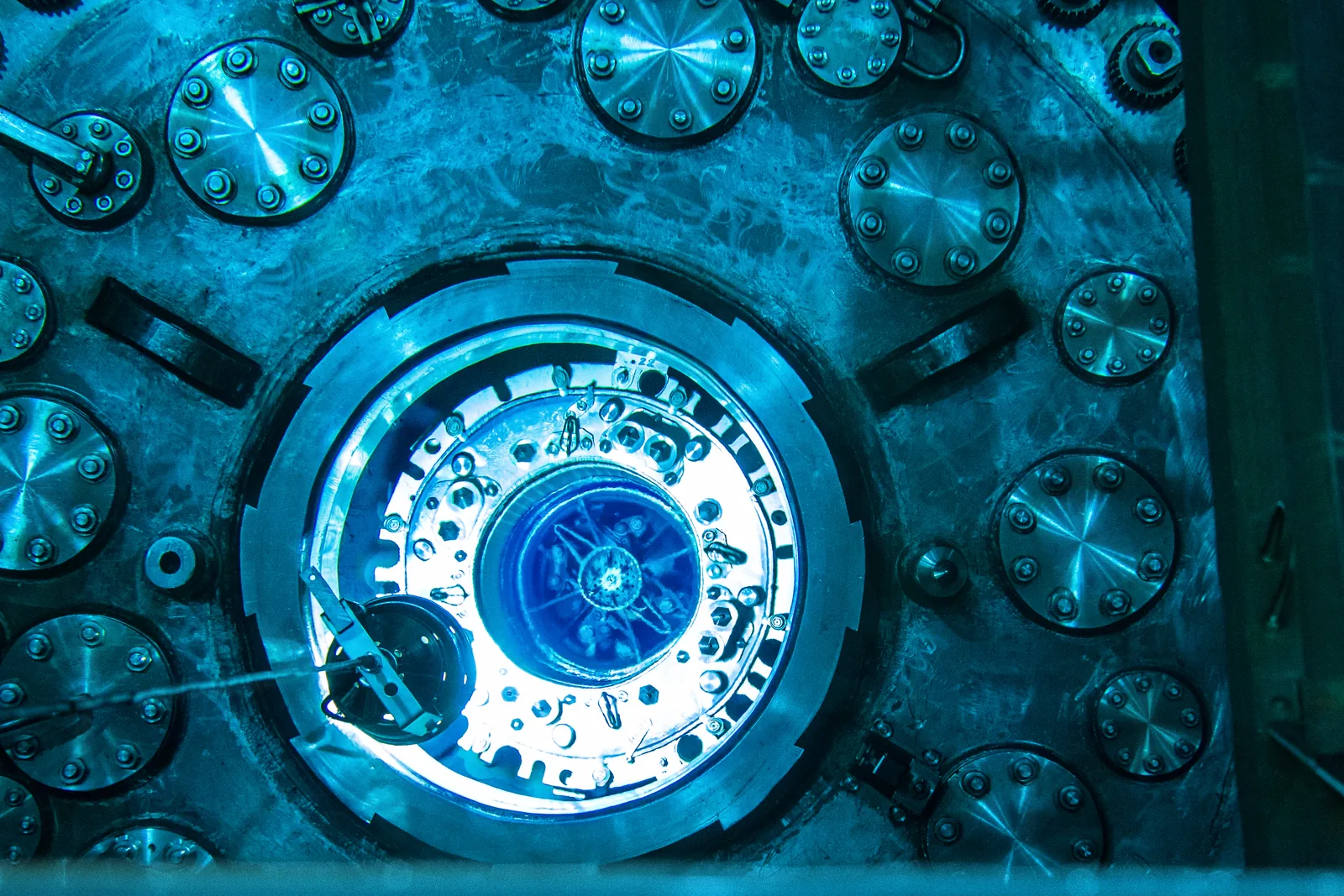
Penetrating power
Penetrating power tells how thick a layer of matter the radiation passes through. The more densely radiation ionises, the faster it gives up its energy and the thinner the layer that stops it. So alpha radiation has the smallest and gamma radiation the greatest penetrating power. The last column of the table tells what stops alpha and beta radiation and what attenuates gamma and neutron radiation effectively. X-radiation is photon radiation and behaves like gamma radiation.
| Radiation | What it is | Charge | In air | Barrier |
|---|---|---|---|---|
| alpha $\alpha$ | helium nucleus | $+2e$ | a few $\text{cm}$ | sheet of paper |
| beta $\beta^-$ | electron | $-e$ | metres | aluminium, plastic |
| gamma $\gamma$ | photon | $0$ | no range | lead, concrete |
| neutron $n$ | neutron | $0$ | no range | water, concrete |
Gamma radiation has no range: every layer attenuates the same fraction of it, so even a thick barrier does not stop it completely. Neutrons are slowed most effectively by materials rich in hydrogen, because a neutron loses the most energy when it collides with a proton of almost the same mass.
Detecting radiation with a Geiger–Müller tube
Humans cannot sense ionising radiation, so it is detected with an instrument. The most common one is the Geiger–Müller tube, or GM tube. It is a metal cylinder filled with a noble gas, with a thin wire in the middle. There is a voltage of about $500\,\text{V}$ between the wire and the wall, with the wire positive. When an ionising particle passes through the gas, it removes an electron. The electric field accelerates the electron towards the wire so that it removes new electrons, and an electron avalanche forms near the wire. The avalanche shows up as a current pulse, which a counter counts or a loudspeaker clicks. At one end of the tube there is a thin window, through which even alpha particles can enter the gas.
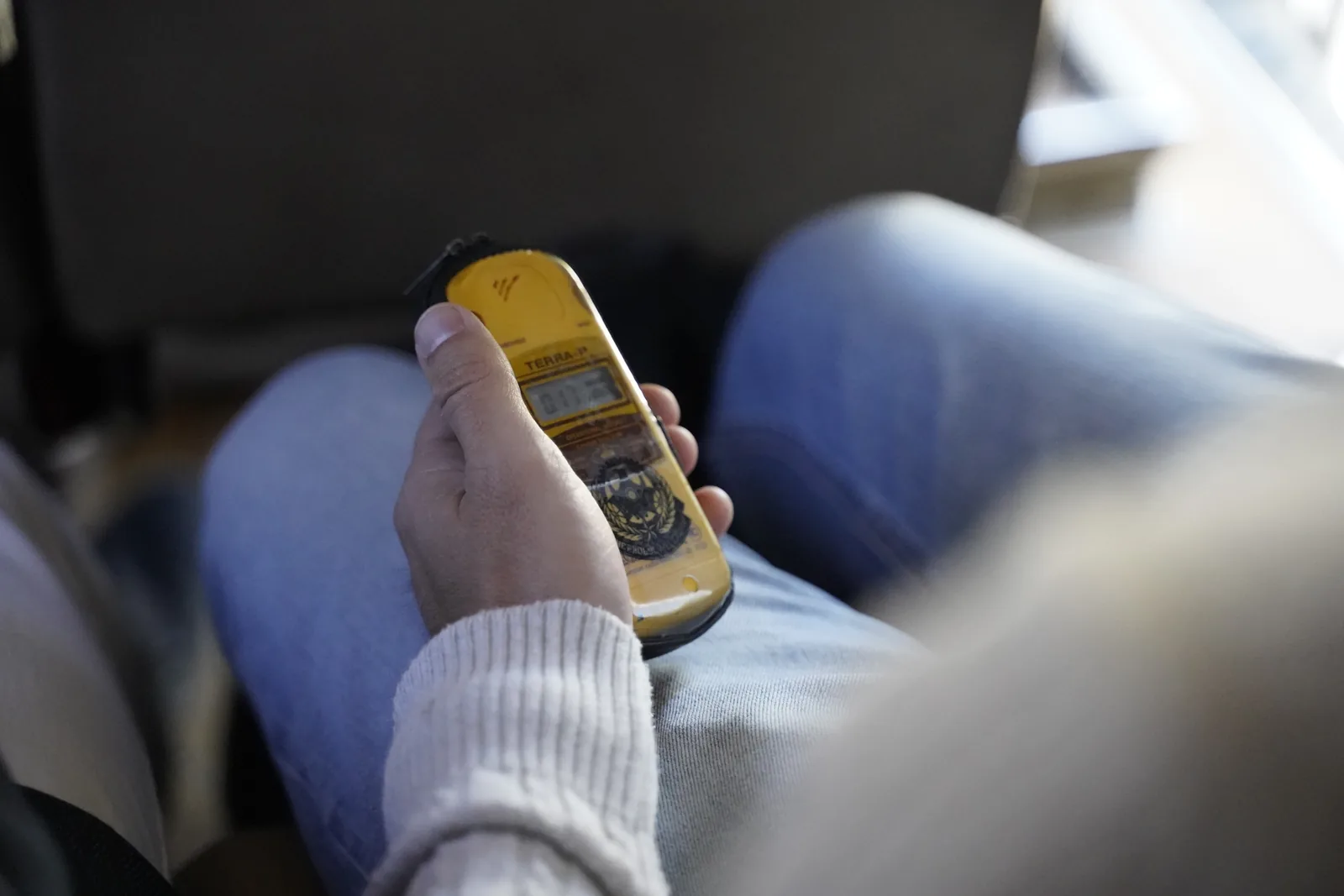
Every ionising event triggers a similar avalanche, so the pulse is equally large regardless of the type and energy of the radiation. A GM counter therefore counts events but does not tell what radiation it detects. The type of radiation can be deduced with barriers: if the pulse count drops to the background level behind a sheet of paper, the radiation is alpha radiation. The counter always counts also background radiation, which comes from the ground, building materials, radon in the air and space. A GM tube detects only a small fraction of gamma photons, because most of them pass through the thin gas without interacting. The energy of radiation is measured, for example, with scintillation detectors, and the radiation a person receives is monitored with dosimeters.
Radiation in the body
The biological effects of radiation begin with physics: ionisation breaks chemical bonds. Radiation can ionise the DNA of a cell directly (direct effect). More often it ionises water molecules, because a cell is mostly water. This produces highly reactive radicals, such as hydroxyl radicals, which damage the DNA (indirect effect). The cell repairs most of the damage. However, damage that is not repaired or is repaired wrongly can kill the cell or change its genome, and a change in the genome can lead to cancer after years.
The most harmful case for the body is when many ionisations occur within a short distance. The dense track of an alpha particle can break both strands of the DNA close together, and a cell repairs such damage poorly. Outside the body alpha radiation is almost harmless, because it does not pass through the dead outer layer of the skin. When inhaled, swallowed or entering a wound, an alpha emitter gives up all its energy in a few cell layers of living tissue. In Finland the most important such source is indoor radon, whose decay products remain in the lungs. Gamma radiation, on the other hand, passes through the body, so even an external gamma source irradiates the internal organs.
The effect of radiation on the body is described by the absorbed dose, which tells how much of the energy of radiation has been transferred to a kilogram of tissue. A large dose in a short time kills so many cells that the function of the tissue is disturbed. Small doses increase the risk of cancer. Doses, their units and protection from radiation are covered in the chapter Radiation dose and radiation safety in Finland.
Attenuation of gamma radiation
Every layer attenuates the same fraction
A gamma photon either passes through a layer of matter without interacting or interacts in it, and is then absorbed or scattered out of the beam. In a thin layer every photon has the same probability of interacting, regardless of how many layers it has already passed. Therefore every layer of equal thickness attenuates the same fraction of the radiation arriving at it, in the same way as every half-life halves the number of undecayed nuclei (chapter The decay law and half-life). The half-value thickness $d_{1/2}$, or half-value layer, is the thickness of a layer that lets half of the radiation through. The radiation that has passed through a thickness $d$ is
$$I = I_0 \left(\frac{1}{2}\right)^{d/d_{1/2}}$$
where $I_0$ is the intensity of the radiation without a barrier, $I$ the intensity behind the barrier, $d$ the thickness of the barrier and $d_{1/2}$ the half-value thickness. Instead of the intensity, the net pulse count of the counter can be substituted into the equation, that is, the pulse count from which the background radiation has been subtracted. The exponent $\tfrac{d}{d_{1/2}}$ tells how many half-value thicknesses the barrier contains, and it need not be an integer. The thicknesses $d$ and $d_{1/2}$ must be in the same unit.
The half-value thickness depends on the material and the energy
The denser the material and the more electrons its atoms have, the smaller the half-value thickness. This is why lead is an effective shield: the same attenuation requires a layer of concrete about seven times thicker. High-energy gamma radiation passes through matter better than low-energy radiation. The values in the table apply to the $662\,\text{keV}$ gamma radiation of caesium-137.
| Material | $d_{1/2}$ |
|---|---|
| lead | $5.5\,\text{mm}$ |
| iron | $12\,\text{mm}$ |
| aluminium | $34\,\text{mm}$ |
| concrete | $39\,\text{mm}$ |
| water | $81\,\text{mm}$ |
Source: calculated from the attenuation coefficients of the NIST XCOM database for a narrow beam, rounded. In a wide beam some of the scattered photons still reach the counter, so a real shield lets through slightly more than the equation gives.
The equation applies only to photon radiation. Alpha and beta particles lose their energy gradually in every ionisation, so they have a range: after a certain thickness none of them gets through.
Common misconception
Many people think that an irradiated object or food itself becomes radioactive. However, the gamma, X-ray and electron radiation used in sterilisation and medicine only ionises atoms or transfers energy to them; its energy is not enough to change nuclei, so the material does not become radioactive. For example, hospital supplies are sterilised with gamma radiation, and afterwards they are as safe to handle as before. Material can be made radioactive mainly by neutron radiation, whose neutrons are bound into nuclei (chapter Fission, fusion and nuclear power). What is harmful is that radioactive material gets onto the skin or into the body, not that an object has been in radiation.
Another mistake is to think that two half-value thicknesses stop all the gamma radiation. The second layer attenuates half of the radiation that got through the first, so a quarter gets through.
Summary
- Radiation is ionising when its particle or photon can remove an electron from an atom. For a photon the energy $E = hf$ decides: visible light does not ionise, X-rays and gamma radiation do.
- Ionisation transfers the energy of radiation to matter; in air an ion pair takes on average $34\,\text{eV}$, so the number of ion pairs is $n_\text{i} = \tfrac{E}{W}$.
- Alpha radiation ionises most densely and stops in paper, beta radiation stops in a few millimetres of aluminium, and gamma radiation is attenuated in lead and concrete: $I = I_0 \left(\tfrac{1}{2}\right)^{d/d_{1/2}}$.
- A GM tube counts ionising events with the help of electron avalanches, but it cannot distinguish the types of radiation. Background radiation is always included in a measurement.
- Radiation damages cells by ionising DNA directly and through the radicals of water. An alpha emitter is most dangerous inside the body, because it gives up its energy within a few cells.
Optional Return to your predictions
Compare your predictions with the values of the model in the experiments. Then return to the question at the start: why is alpha radiation, which is stopped by paper, dangerous in the lungs, and why does protection from gamma radiation need centimetres of lead and a thin plate is not enough?
Would you change your prediction?
Apply
Worked example
Problem
A caesium-137 source is kept in a lead shield. The half-value thickness of lead for the gamma radiation of caesium-137 is $5.5\,\text{mm}$. How thick a layer of lead attenuates the intensity of the gamma radiation to $5.0\,\%$?
Step 1/7
Known and asked. The half-value thickness is $d_{1/2} = 5.5\,\text{mm}$ and the ratio of the intensities is ${I : I_0} = 5.0\,\% = 0.050$. The thickness $d$ of the lead layer is asked.
Step 2/7
Principle. Every layer of one half-value thickness halves the intensity of the gamma radiation, so the attenuation follows the equation $I = I_0 \left(\tfrac{1}{2}\right)^{d/d_{1/2}}$. The thickness is in the exponent, so it is solved with a logarithm.
Step 3/7
Formula solved. When the equation is divided by $I_0$ and the natural logarithm is taken of both sides, we get $\ln \tfrac{I}{I_0} = -\tfrac{d}{d_{1/2}} \ln 2$, from which
$$d = d_{1/2} \cdot \frac{\ln (I_0 : I)}{\ln 2}$$
Step 4/7
Unit conversions. The percentage is converted into a ratio: $5.0\,\% = 0.050$, so ${I_0 : I} = {1 : 0.050} = 20$. The thickness is obtained in millimetres, because the half-value thickness is in millimetres.
Step 5/7
Substitution. $$\begin{aligned} d &= d_{1/2} \cdot \frac{\ln (I_0 : I)}{\ln 2} \\ &= 5.5\,\text{mm} \cdot \frac{\ln 20}{\ln 2} \\ &= 5.5\,\text{mm} \cdot \frac{2.9957}{0.69315} \\ &= 5.5\,\text{mm} \cdot 4.3219 \\ &= 23.77\,\text{mm} \end{aligned}$$
Step 6/7
Result. About $24\,\text{mm}$ of lead is needed, with two significant figures like the half-value thickness $5.5\,\text{mm}$ and the ratio $5.0\,\%$.
Step 7/7
Reasonableness. Four half-value thicknesses, that is $22\,\text{mm}$, would let through $\left(\tfrac{1}{2}\right)^{4} = 6.25\,\%$ and five, that is $27.5\,\text{mm}$, about $3.1\,\%$. The target $5.0\,\%$ lies between these, and so does the thickness $24\,\text{mm}$.
Optional Find the mistake
Apply: a lead apron in X-ray imaging
The maximum photon energy of the X-radiation used in dental X-rays is about $60\,\text{keV}$. For this radiation the half-value thickness of lead is $0.12\,\text{mm}$. The protective apron of the patient has a lead-equivalent layer with a thickness of $0.50\,\text{mm}$.
What percentage of the X-radiation hitting the apron passes through it? Assume a narrow beam.
Hint 1: a guiding question
X-radiation is photon radiation like gamma radiation, so it is attenuated according to the equation $I = I_0 \left(\tfrac{1}{2}\right)^{d/d_{1/2}}$.
Hint 2: what is the connection
First calculate how many half-value thicknesses the apron contains: $d : d_{1/2}$.
Hint 3: an intermediate step
The apron contains $0.50\,\text{mm} : 0.12\,\text{mm} \approx 4.17$ half-value thicknesses. Calculate $\left(\tfrac{1}{2}\right)^{4.17}$ and convert it into a percentage.
Show the solution
Given
half-value thickness of lead for this radiation $d_{1/2} = 0.12\,\text{mm}$, thickness of the lead layer of the apron $d = 0.50\,\text{mm}$, narrow beam
Asked
the fraction of radiation passing through, $\tfrac{I}{I_0}$, as a percentage
Principle
X-radiation is photon radiation like gamma radiation: every photon has the same probability of interacting in every thin layer of lead, so every half-value thickness halves the intensity. Low-energy X-radiation is attenuated in lead much more effectively than the gamma radiation of caesium-137, which is why a thin layer is enough.
Formula
$I = I_0 \left(\tfrac{1}{2}\right)^{d/d_{1/2}}$, from which
Conversions
Not needed: both thicknesses are in millimetres. Finally the fraction is converted into a percentage: $1 = 100\,\%$.
Substitution
Answer
$5.6\,\%$
Two significant figures like the thicknesses $0.50\,\text{mm}$ and $0.12\,\text{mm}$.
Reasonableness
Four half-value thicknesses would let through $\left(\tfrac{1}{2}\right)^{4} = 6.25\,\%$ and five $3.1\,\%$. The apron contains slightly over four half-value thicknesses, so the result is a little under $6.25\,\%$, as it should be.
Check your understanding
Exit ticket
Answer on your own first and only then open the answer.
- The photon energy of green light is about $2.5\,\text{eV}$ and the maximum photon energy of dental X-rays about $60\,\text{keV}$. Which can ionise a water molecule, whose ionisation energy is $12.6\,\text{eV}$, and why does brighter green light not change this?
Answer
Only the X-ray photon, because its energy exceeds the ionisation energy many times over. The energy of a single green photon, $2.5\,\text{eV}$, is too small, and brighter light only means more photons of the same kind: a single photon still cannot remove an electron.
- Medical supplies are sterilised with gamma radiation. Do they become radioactive?
Answer
No. Gamma radiation ionises atoms and kills microbes by breaking their molecules, but it does not change nuclei. Radioactivity can arise mainly from neutron radiation. Only the radioactive material itself is dangerous, if it gets onto the skin or into the body.
1. Concept
2. Read the half-value thickness from a graph
Plates of an unknown material have been added between a gamma source and a GM tube. The graph shows the net pulse rate, from which the background radiation has been subtracted, as a function of the total thickness $d$ of the plates. Read from the graph the half-value thickness of the material for this radiation. Answer in millimetres.
Hint 1: a guiding question
What is the pulse rate when there are no plates? And half of that?
Hint 2: what is the connection
Find the point where the curve is at half of its initial value and read the thickness from the horizontal axis.
Hint 3: an intermediate step
The initial value is $800$ pulses per minute, so find the point where the curve is at $400$ pulses.
Show the solution
Given
the net pulse rate of the graph as a function of the thickness $d$ of the plates, grid spacing $2\,\text{mm}$ and $50$ pulses per minute
Asked
the half-value thickness $d_{1/2}$ in millimetres
Principle
The net pulse rate is proportional to the intensity of the gamma radiation hitting the GM tube, and every half-value thickness halves it. So the half-value thickness is the thickness at which the pulse rate has dropped to half of the initial value.
Reading the graph
When $d = 0$, the curve starts from $800$ pulses per minute. Half of that is $400$ pulses per minute. The horizontal line at $400$ meets the curve at $d = 12\,\text{mm}$. Check: at $200$ pulses the curve is at the thickness $24\,\text{mm}$.
Formula
$I = I_0 \left(\tfrac{1}{2}\right)^{d/d_{1/2}}$; when $I = \tfrac{1}{2} I_0$, the exponent is $\tfrac{d}{d_{1/2}} = 1$, so $d_{1/2} = d$
Conversions
Not needed: the thickness is read directly in millimetres.
Substitution
which is reached at the thickness $d = 12\,\text{mm}$, so $d_{1/2} = 12\,\text{mm}$
Answer
$12\,\text{mm}$
Two significant figures, because the thickness can be read from the graph with an accuracy of about half a millimetre.
Reasonableness
At two half-value thicknesses, that is $24\,\text{mm}$, the pulse rate should be $200$ and at four, that is $48\,\text{mm}$, $50$ pulses per minute; the graph agrees with both. The value is the same as the half-value thickness of iron for the gamma radiation of caesium-137.
Suggestion: one answer does not show everything you can do, but review the theory summary and do the core exercises.
Optional 3. Explain: what does a GM counter tell?
A GM counter clicks near an unknown radiation source.
Why can the type of radiation, alpha, beta or gamma, not be deduced from the pulse count alone? How can the type of radiation be found out with the same counter?
Model answer
In a GM tube every ionising particle hitting the gas removes at least one electron. Near the wire the strong electric field accelerates the electrons so that an electron avalanche forms, and the avalanche is always the same size regardless of which particle started it and how much energy it had. So every event shows up as a similar pulse, and the counter only counts events. The type of radiation can be found out with barriers: if the pulse count drops to the background level behind a sheet of paper, the radiation is alpha radiation. If it passes through paper but stops in a few millimetres of aluminium, it is beta radiation. If it passes through aluminium and is attenuated gradually in lead, it is gamma radiation. The background radiation must be subtracted from every reading.
Assess your own answer
Tick the points your own answer already contains.
Review the theory summary and practise with the exercises.
Exercises
Level 1 · basic practice 5 exercises
One formula or one step of reasoning. Core exercises first, the rest is extra practice.
- Exercise 12-1Core
Cobalt-60 emits gamma radiation, for whose mean energy $1.25\,\text{MeV}$ the half-value thickness of lead is $10.4\,\text{mm}$.
What percentage of the gamma radiation passes through a lead plate with a thickness of $25.0\,\text{mm}$? Assume a narrow beam.
Answer
$18.9\,\%$
Show the solution
Given
half-value thickness of lead $d_{1/2} = 10.4\,\text{mm}$ for the mean gamma energy $1.25\,\text{MeV}$, thickness of the lead plate $d = 25.0\,\text{mm}$, narrow beam
Asked
the fraction of gamma radiation passing through, $\tfrac{I}{I_0}$, as a percentage
Principle
Every gamma photon has the same probability of interacting in every thin layer of lead, so every layer of one half-value thickness halves the intensity. In a narrow beam scattered photons do not return to the beam, so the attenuation law holds.
Formula
$I = I_0 \left(\tfrac{1}{2}\right)^{d/d_{1/2}}$, from which
$\dfrac{I}{I_0}$$= \left(\tfrac{1}{2}\right)^{d/d_{1/2}}$Conversions
Not needed: both thicknesses are in millimetres, so their ratio is a pure number. Finally the fraction is converted into a percentage: $1 = 100\,\%$.
Substitution
$\dfrac{I}{I_0}$$= \left(\tfrac{1}{2}\right)^{25.0\,\text{mm} / 10.4\,\text{mm}}$$= \left(\tfrac{1}{2}\right)^{2.4038}$$= 0.18896$$= 18.896\,\%$Answer
$18.9\,\%$
Three significant figures like the thicknesses $25.0\,\text{mm}$ and $10.4\,\text{mm}$.
Reasonableness
The plate contains a little over two half-value thicknesses. After two, $25\,\%$ would get through and after three $12.5\,\%$; the result lies between these and closer to $25\,\%$, as it should.
- Exercise 12-2Core
The kinetic energy of the alpha particle from the americium-241 source of a smoke detector is $5.49\,\text{MeV}$. In air, forming one ion pair takes on average $34\,\text{eV}$.
How many ion pairs does the alpha particle form in air before it stops? Give the answer in the unit $10^{5}$.
Answer
$1.6 \cdot 10^{5}$
Show the solution
Given
kinetic energy of the alpha particle $E = 5.49\,\text{MeV}$, average energy of one ion pair in air $W = 34\,\text{eV}$
Asked
the number of ion pairs $n_\text{i}$ in the unit $10^{5}$
Principle
An alpha particle gives up all its kinetic energy to the air by ionising molecules one at a time until it stops. Each ion pair takes on average the energy $W$, so the number of ion pairs is the energy divided by the energy of one ion pair.
Formula
$E = n_\text{i} W$, from which $n_\text{i} = \dfrac{E}{W}$
Conversions
$5.49\,\text{MeV} = 5.49 \cdot 10^{6}\,\text{eV}$, so that the energies are in the same unit.
Substitution
$n_\text{i}$$= \dfrac{5.49 \cdot 10^{6}\,\text{eV}}{34\,\text{eV}}$$= 1.6147 \cdot 10^{5}$Answer
$1.6 \cdot 10^{5}$
Ion pairs, two significant figures like the energy $W = 34\,\text{eV}$.
Reasonableness
With the estimate $5 \cdot 10^{6} : 30 \approx 1.7 \cdot 10^{5}$ the order of magnitude agrees. So one particle ionises over a hundred thousand molecules, and that is why even a single alpha particle is a significant event for a GM tube or a human cell.
- Exercise 12-3
Plates are added between a gamma source and a GM tube. When the plates have a total thickness of $18\,\text{mm}$, the net pulse count, that is the pulse count remaining after the background radiation, has decreased to an eighth of what it was without plates.
What is the half-value thickness of the material of the plates for this gamma radiation? Give the answer in millimetres.
Answer
$6.0\,\text{mm}$
Show the solution
Given
total thickness of the plates $d = 18\,\text{mm}$, ratio of the net pulse counts $\tfrac{I}{I_0} = \tfrac{1}{8}$
Asked
the half-value thickness $d_{1/2}$ in millimetres
Principle
The net pulse count is proportional to the intensity of the gamma radiation hitting the GM tube, and the background radiation has already been subtracted from it. Every half-value thickness halves the intensity, and $\tfrac{1}{8} = \left(\tfrac{1}{2}\right)^{3}$, so the plates contain three half-value thicknesses.
Formula
$\left(\tfrac{1}{2}\right)^{d/d_{1/2}} = \left(\tfrac{1}{2}\right)^{3}$, so $\tfrac{d}{d_{1/2}} = 3$ and $d_{1/2} = \dfrac{d}{3}$
Conversions
Not needed: the thickness is in millimetres, and the half-value thickness is obtained in the same unit.
Substitution
$d_{1/2}$$= \dfrac{18\,\text{mm}}{3}$$= 6.0\,\text{mm}$Answer
$6.0\,\text{mm}$
Two significant figures like the thickness $18\,\text{mm}$.
Reasonableness
Check: $6.0\,\text{mm}$ halves the pulse count, $12\,\text{mm}$ reduces it to a quarter and $18\,\text{mm}$ to an eighth, as in the task. The value is of the order of the value for lead, $5.5\,\text{mm}$, so the material may be some heavy metal.
- Exercise 12-4
The spent fuel of a nuclear power plant is first stored in a water pool. The half-value thickness of water for a certain gamma radiation is $8.1\,\text{cm}$.
What percentage of this gamma radiation passes through a $30\,\text{cm}$ layer of water? Assume a narrow beam.
Answer
$7.7\,\%$
Show the solution
Given
half-value thickness of water $d_{1/2} = 8.1\,\text{cm}$, thickness of the water layer $d = 30\,\text{cm}$, narrow beam
Asked
the fraction of gamma radiation passing through, $\tfrac{I}{I_0}$, as a percentage
Principle
Gamma radiation is attenuated exponentially in water, because every photon has the same probability of interacting in every thin layer of water. Every $8.1\,\text{cm}$ layer halves the intensity.
Formula
$I = I_0 \left(\tfrac{1}{2}\right)^{d/d_{1/2}}$, from which
$\dfrac{I}{I_0}$$= \left(\tfrac{1}{2}\right)^{d/d_{1/2}}$Conversions
Not needed: both thicknesses are in centimetres. Finally the fraction is converted into a percentage: $1 = 100\,\%$.
Substitution
$\dfrac{I}{I_0}$$= \left(\tfrac{1}{2}\right)^{30\,\text{cm} / 8.1\,\text{cm}}$$= \left(\tfrac{1}{2}\right)^{3.7037}$$= 0.076749$$= 7.6749\,\%$Answer
$7.7\,\%$
Two significant figures like the half-value thickness $8.1\,\text{cm}$ and the thickness $30\,\text{cm}$.
Reasonableness
The water layer contains just under four half-value thicknesses. After three, $12.5\,\%$ would get through and after four $6.25\,\%$; the result lies between these, close to the latter. In a real pool there are metres of water, so the radiation is attenuated much more.
- Exercise 12-5
At least $12.6\,\text{eV}$ is needed to ionise a water molecule.
What is the longest wavelength at which a single photon can ionise a water molecule? Give the answer in nanometres.
Answer
$98.4\,\text{nm}$
Show the solution
Given
ionisation energy of a water molecule $E = 12.6\,\text{eV}$, Planck constant $h = 6.626 \cdot 10^{-34}\,\text{J}\,\text{s}$, speed of light $c = 2.998 \cdot 10^{8}\,\text{m/s}$
Asked
the longest ionising wavelength $\lambda$ in nanometres
Principle
A single photon can ionise a molecule only if its energy is at least the ionisation energy. The energy of a photon is $E = hf = \tfrac{hc}{\lambda}$, so the longer the wavelength, the smaller the energy. The longest ionising wavelength corresponds to a photon whose energy is exactly the ionisation energy.
Formula
$E = \dfrac{hc}{\lambda}$, from which $\lambda = \dfrac{hc}{E}$
Conversions
$12.6\,\text{eV}$$= 12.6 \cdot 1.602 \cdot 10^{-19}\,\text{J}$$= 2.0185 \cdot 10^{-18}\,\text{J}$and finally $1\,\text{m} = 10^{9}\,\text{nm}$.
Substitution
$\lambda$$= 6.626 \cdot 10^{-34}\,\text{J}\,\text{s} \cdot \dfrac{2.998 \cdot 10^{8}\,\text{m/s}}{2.0185 \cdot 10^{-18}\,\text{J}}$$= 9.8412 \cdot 10^{-8}\,\text{m}$$= 98.412\,\text{nm}$Answer
$98.4\,\text{nm}$
Three significant figures like the ionisation energy $12.6\,\text{eV}$.
Reasonableness
The wavelength is much shorter than the $380$–$720\,\text{nm}$ of visible light, so visible light does not ionise water, as it should. Check: $1240\,\text{eV}\,\text{nm} : 12.6\,\text{eV} \approx 98\,\text{nm}$.
Level 2 · applied practice 4 exercises
Two steps, working with measured data, a unit conversion or rearranging a formula. Core exercises first, the rest is extra practice.
- Exercise 12-6Core
A GM counter counts $1260$ pulses in $3.00$ minutes near a radiation source. When the source is taken away, the counter counts $72$ pulses of background radiation in the same time.
How many pulses per second does the radiation of the source cause? Give the answer in the unit $\tfrac{1}{\text{s}}$.
Answer
$6.60\,\tfrac{1}{\text{s}}$
Show the solution
Given
pulse count near the source $N = 1260$, pulse count of the background radiation $N_\text{t} = 72$, both in the time $t = 3.00\,\text{min}$
Asked
the pulse rate $R$ caused by the radiation of the source in the unit $\tfrac{1}{\text{s}}$
Principle
A GM counter counts all ionising events, so the reading measured near the source also includes background radiation. The contribution of the source, the net pulse count, is obtained by subtracting the pulses of the background, and the pulse rate is the pulse count divided by the measuring time.
Formula
$R = \dfrac{N - N_\text{t}}{t}$
Conversions
$t$$= 3.00\,\text{min}$$= 3.00 \cdot 60\,\text{s}$$= 180\,\text{s}$Substitution
$R$$= \dfrac{1260 - 72}{180\,\text{s}}$$= \dfrac{1188}{180\,\text{s}}$$= 6.600\,\tfrac{1}{\text{s}}$Answer
$6.60\,\tfrac{1}{\text{s}}$
Three significant figures like the measuring time $3.00\,\text{min}$.
Reasonableness
The total pulse rate is ${1260 : 180}\,\text{s} = 7.0\,\tfrac{1}{\text{s}}$ and the background ${72 : 180}\,\text{s} = 0.40\,\tfrac{1}{\text{s}}$; the difference is $6.6\,\tfrac{1}{\text{s}}$. The share of the background is small but not insignificant.
- Exercise 12-7Core
The gamma radiation of a caesium-137 source passes first through a $10\,\text{mm}$ lead plate and then through a $20\,\text{cm}$ concrete wall. The half-value thickness of lead is $5.5\,\text{mm}$ and that of concrete $3.9\,\text{cm}$.
What percentage of the gamma radiation passes through both? Assume a narrow beam.
Answer
$0.81\,\%$
Show the solution
Given
thickness of lead $d_\text{Pb} = 10\,\text{mm}$ and half-value thickness $d_{1/2,\text{Pb}} = 5.5\,\text{mm}$, thickness of concrete $d_\text{b} = 20\,\text{cm}$ and half-value thickness $d_{1/2,\text{b}} = 3.9\,\text{cm}$, narrow beam
Asked
the fraction of radiation passing through both barriers, $\tfrac{I_2}{I_0}$, as a percentage
Principle
Lead lets through the fraction $\left(\tfrac{1}{2}\right)^{d_\text{Pb}/d_{1/2,\text{Pb}}}$. The weakened radiation arrives at the concrete, and the concrete lets through its own fraction of it, so the fractions are multiplied. The exponents tell the number of half-value thicknesses of each barrier.
Formula
$I_1 = I_0 \left(\tfrac{1}{2}\right)^{d_\text{Pb}/d_{1/2,\text{Pb}}}$ and $I_2 = I_1 \left(\tfrac{1}{2}\right)^{d_\text{b}/d_{1/2,\text{b}}}$, so
$\dfrac{I_2}{I_0}$$= \left(\tfrac{1}{2}\right)^{d_\text{Pb}/d_{1/2,\text{Pb}} + d_\text{b}/d_{1/2,\text{b}}}$Conversions
$d_\text{b}$$= 20\,\text{cm}$$= 200\,\text{mm}$$d_{1/2,\text{b}}$$= 3.9\,\text{cm}$$= 39\,\text{mm}$the ratio of each barrier is calculated in the same units. Finally $1 = 100\,\%$.
Substitution
$\dfrac{I_2}{I_0}$$= \left(\tfrac{1}{2}\right)^{10\,\text{mm} / 5.5\,\text{mm} + 200\,\text{mm} / 39\,\text{mm}}$$= \left(\tfrac{1}{2}\right)^{1.8182 + 5.1282}$$= \left(\tfrac{1}{2}\right)^{6.9464}$$= 0.0081083$$= 0.81083\,\%$Answer
$0.81\,\%$
Two significant figures like the half-value thicknesses $5.5\,\text{mm}$ and $3.9\,\text{cm}$.
Reasonableness
The barriers contain almost seven half-value thicknesses in total, and
$\left(\tfrac{1}{2}\right)^{7}$$= \tfrac{1}{128}$$\approx 0.78\,\%$The result is slightly greater, because there are a little under seven half-value thicknesses.
- Exercise 12-8
A student measures the radiation of a gamma source with a GM counter in periods of $10\,\text{s}$. Without a barrier the counter counts $480$ pulses and behind a $12\,\text{mm}$ layer of lead $105$ pulses. Without the source the counter counts $5$ pulses of background radiation in the same time.
Based on the measurements, what is the half-value thickness of lead for this gamma radiation? Give the answer in millimetres.
Answer
$5.3\,\text{mm}$
Show the solution
Given
pulse count without a barrier $N_0 = 480$, behind lead $N = 105$, background radiation $N_\text{t} = 5$, all in periods of $10\,\text{s}$; thickness of lead $d = 12\,\text{mm}$
Asked
the half-value thickness $d_{1/2}$ of lead in millimetres
Principle
Lead attenuates only the radiation of the source, not the background, so the net pulse counts $N_0 - N_\text{t}$ and $N - N_\text{t}$ are substituted into the attenuation law. They are proportional to the intensities. The half-value thickness is in the exponent, so it is solved with a logarithm.
Formula
$N - N_\text{t} = (N_0 - N_\text{t}) \left(\tfrac{1}{2}\right)^{d/d_{1/2}}$; logarithm of both sides: $\ln \tfrac{N_0 - N_\text{t}}{N - N_\text{t}} = \tfrac{d}{d_{1/2}} \ln 2$, from which
$d_{1/2}$$= \dfrac{d \ln 2}{\ln \tfrac{N_0 - N_\text{t}}{N - N_\text{t}}}$Conversions
Not needed: the pulse counts are from periods of equal length, so their ratio is a pure number, and the thickness is in millimetres.
Substitution
$d_{1/2}$$= \dfrac{12\,\text{mm} \cdot \ln 2}{\ln \tfrac{480 - 5}{105 - 5}}$$= \dfrac{12\,\text{mm} \cdot 0.69315}{\ln 4.75}$$= \dfrac{8.3178\,\text{mm}}{1.5581}$$= 5.3383\,\text{mm}$Answer
$5.3\,\text{mm}$
Two significant figures like the thickness $12\,\text{mm}$; the random variation of the pulse counts makes a more precise result uncertain.
Reasonableness
The net pulse count decreased to about a fifth, and $\left(\tfrac{1}{2}\right)^{2} = \tfrac{1}{4}$, $\left(\tfrac{1}{2}\right)^{3} = \tfrac{1}{8}$, so the lead contains a good two half-value thicknesses: $12\,\text{mm} : 2.25 \approx 5.3\,\text{mm}$. The result is close to the value for caesium-137, $5.5\,\text{mm}$.
- Exercise 12-9
A shield is designed around a radiation source. The half-value thickness for the gamma radiation of the source is $5.5\,\text{mm}$ for lead and $39\,\text{mm}$ for concrete.
How thick a concrete wall attenuates the radiation as much as $10\,\text{mm}$ of lead? Give the answer in millimetres.
Answer
$71\,\text{mm}$
Show the solution
Given
thickness of lead $d_\text{Pb} = 10\,\text{mm}$, half-value thicknesses $5.5\,\text{mm}$ for lead and $39\,\text{mm}$ for concrete
Asked
the thickness $d_\text{b}$ of the concrete wall in millimetres
Principle
Two barriers attenuate equally much when they let through the same fraction. The fraction that gets through is $\left(\tfrac{1}{2}\right)^{d/d_{1/2}}$, so the fractions are the same when both barriers contain the same number of half-value thicknesses.
Formula
$\dfrac{d_\text{b}}{d_{1/2,\text{b}}}$$= \dfrac{d_\text{Pb}}{d_{1/2,\text{Pb}}}$from which
$d_\text{b}$$= \dfrac{d_\text{Pb}}{d_{1/2,\text{Pb}}} \cdot d_{1/2,\text{b}}$Conversions
Not needed: all thicknesses are in millimetres.
Substitution
$d_\text{b}$$= \dfrac{10\,\text{mm}}{5.5\,\text{mm}} \cdot 39\,\text{mm}$$= 1.8182 \cdot 39\,\text{mm}$$= 70.909\,\text{mm}$Answer
$71\,\text{mm}$
Two significant figures like the half-value thicknesses.
Reasonableness
The half-value thickness of concrete is about seven times that of lead, so a layer of concrete about seven times thicker is needed: $7 \cdot 10\,\text{mm} = 70\,\text{mm}$. So lead is a more effective shield at the same thickness, but a thicker layer of concrete is needed, and it is often the more practical building material.
Level 3 · challenging 3 exercises
Optional: application, two ideas together or a new situation where you reason for yourself.
- Exercise 12-10
An alpha particle of americium-241 with a kinetic energy of $5.49\,\text{MeV}$ stops in air after a distance of $4.1\,\text{cm}$. A beta particle with a kinetic energy of $1.0\,\text{MeV}$ travels in a winding path in air for about $3.6\,\text{m}$ before it stops.
Both give up all their energy by ionising, and in air one ion pair takes on average $34\,\text{eV}$.
How many times more ion pairs per centimetre does the alpha particle form than the beta particle? Assume that ion pairs are formed evenly along the whole track.
Answer
$4.8 \cdot 10^{2}$
Show the solution
Given
energy of the alpha particle $E_\alpha = 5.49\,\text{MeV}$ and distance $s_\alpha = 4.1\,\text{cm}$; energy of the beta particle $E_\beta = 1.0\,\text{MeV}$ and distance $s_\beta = 3.6\,\text{m}$; energy of an ion pair $W = 34\,\text{eV}$
Asked
how many times more ion pairs per centimetre the alpha particle produces than the beta particle, that is the ratio $\tfrac{n_\alpha / s_\alpha}{n_\beta / s_\beta}$
Principle
Both particles give up all their energy by ionising, so the number of ion pairs is $n_\text{i} = \tfrac{E}{W}$. When ion pairs are produced evenly, their number per centimetre is the total number divided by the length of the track. This ionisation density tells how concentrated the damage to matter by the particle is.
Formula
$\dfrac{n_\alpha}{s_\alpha}$$= \dfrac{E_\alpha}{W s_\alpha}$$\dfrac{n_\beta}{s_\beta}$$= \dfrac{E_\beta}{W s_\beta}$so the ratio is $\dfrac{E_\alpha s_\beta}{E_\beta s_\alpha}$; $W$ cancels out.
Conversions
$s_\beta$$= 3.6\,\text{m}$$= 360\,\text{cm}$so that the tracks are in the same unit. Both energies are in megaelectronvolts.
Substitution
$\dfrac{E_\alpha s_\beta}{E_\beta s_\alpha}$$= \dfrac{5.49\,\text{MeV} \cdot 360\,\text{cm}}{1.0\,\text{MeV} \cdot 4.1\,\text{cm}}$$= \dfrac{1976.4}{4.1}$$= 482.05$Answer
about $4.8 \cdot 10^{2}$ times, two significant figures like the distance $4.1\,\text{cm}$ and the energy $1.0\,\text{MeV}$.
Reasonableness
Per centimetre the alpha particle produces about $5.49 \cdot 10^{6} : 34 : 4.1 \approx 3.9 \cdot 10^{4}$ and the beta particle about $1.0 \cdot 10^{6} : 34 : 360 \approx 82$ ion pairs; the ratio is about $480$. This is why an alpha particle stops within such a short distance and damages cells in a concentrated way.
- Exercise 12-11
In a laboratory a GM counter shows $2400$ pulses per minute near a gamma source. When $11.0\,\text{mm}$ of lead is placed in front of the source, the reading is $630$ pulses per minute. The background radiation is $30$ pulses per minute.
How thick a lead shield is needed for the pulse rate caused by the radiation of the source to drop to the same as the background radiation, $30$ pulses per minute? Give the answer in millimetres.
Answer
$35\,\text{mm}$
Show the solution
Given
pulse rate without a shield $R_0 = 2400\,\tfrac{1}{\text{min}}$, behind $d_1 = 11.0\,\text{mm}$ of lead $R_1 = 630\,\tfrac{1}{\text{min}}$, background radiation $R_\text{t} = 30\,\tfrac{1}{\text{min}}$
Asked
the thickness $d$ of the lead shield at which the pulse rate caused by the source is $30\,\tfrac{1}{\text{min}}$
Principle
Lead attenuates only the radiation of the source, so the background is subtracted first: the net pulse rates are $2370$ and $600$ pulses per minute. They follow the attenuation law, so the measurements first give the half-value thickness and with it the required thickness. Both are solved with a logarithm.
Formula
$R_1 - R_\text{t}$$= (R_0 - R_\text{t}) \left(\tfrac{1}{2}\right)^{d_1/d_{1/2}}$from which
$d_{1/2}$$= \dfrac{d_1 \ln 2}{\ln \tfrac{R_0 - R_\text{t}}{R_1 - R_\text{t}}}$similarly
$d$$= \dfrac{d_{1/2} \ln \tfrac{R_0 - R_\text{t}}{R_\text{t}}}{\ln 2}$Conversions
Not needed: all pulse rates are in pulses per minute and the thicknesses in millimetres.
Substitution
$d_{1/2}$$= \dfrac{11.0\,\text{mm} \cdot 0.69315}{\ln \tfrac{2370}{600}}$$= \dfrac{7.6246\,\text{mm}}{1.3737}$$= 5.5505\,\text{mm}$$d$$= \dfrac{5.5505\,\text{mm} \cdot \ln \tfrac{2370}{30}}{0.69315}$$= \dfrac{5.5505\,\text{mm} \cdot 4.3694}{0.69315}$$= 34.989\,\text{mm}$Answer
about $35\,\text{mm}$ of lead, two significant figures, because the reading of the background radiation, $30\,\tfrac{1}{\text{min}}$, has two figures.
Reasonableness
The net pulse rate has to be reduced from $2370$ to $30$, that is to about $\tfrac{1}{79}$, and $2^{6} = 64$, $2^{7} = 128$, so a good six half-value thicknesses are needed: $6.3 \cdot 5.55\,\text{mm} \approx 35\,\text{mm}$. The half-value thickness is close to the value for caesium-137, $5.5\,\text{mm}$.
- Exercise 12-12
A WLAN network and a microwave oven use electromagnetic radiation with a frequency of $2.45\,\text{GHz}$. The ionisation energy of a water molecule is $12.6\,\text{eV}$.
How many times greater is the ionisation energy than the energy of one photon of this radiation? Give the answer in the unit $10^{6}$.
Answer
$1.24 \cdot 10^{6}$
Show the solution
Given
frequency $f = 2.45\,\text{GHz}$, ionisation energy of a water molecule $E_\text{i} = 12.6\,\text{eV}$, $h = 6.626 \cdot 10^{-34}\,\text{J}\,\text{s}$
Asked
the ratio $\tfrac{E_\text{i}}{E}$, where $E$ is the energy of one photon, in the unit $10^{6}$, and why the radiation is not ionising
Principle
Electromagnetic radiation interacts with matter as photons, and a single photon can ionise a molecule only if its own energy $E = hf$ is at least the ionisation energy. The number of photons, that is the power of the radiation, does not help, because individual photons do not combine their energies into one ionisation.
Formula
$E = hf$, so
$\dfrac{E_\text{i}}{E}$$= \dfrac{E_\text{i}}{hf}$Conversions
$f$$= 2.45\,\text{GHz}$$= 2.45 \cdot 10^{9}\,\text{Hz}$the energy of the photon is converted into electronvolts: $1\,\text{eV} = 1.602 \cdot 10^{-19}\,\text{J}$.
Substitution
$E$$= 6.626 \cdot 10^{-34}\,\text{J}\,\text{s} \cdot 2.45 \cdot 10^{9}\,\tfrac{1}{\text{s}}$$= 1.6234 \cdot 10^{-24}\,\text{J}$$= \dfrac{1.6234 \cdot 10^{-24}\,\text{J}}{1.602 \cdot 10^{-19}\,\tfrac{\text{J}}{\text{eV}}}$$= 1.0134 \cdot 10^{-5}\,\text{eV}$$\dfrac{E_\text{i}}{E}$$= \dfrac{12.6\,\text{eV}}{1.0134 \cdot 10^{-5}\,\text{eV}}$$= 1.2434 \cdot 10^{6}$Answer
$1.24 \cdot 10^{6}$
Times, three significant figures like the frequency and the ionisation energy. The energy of one microwave photon is over a million times too small to ionise a water molecule, so even powerful microwave radiation does not ionise: it only heats matter, when the energy of the photons is transferred to the motion of the molecules.
Reasonableness
The energy of a visible-light photon is about $2\,\text{eV}$ and its frequency about $5 \cdot 10^{14}\,\text{Hz}$; the frequency of microwaves is about $2 \cdot 10^{5}$ times smaller, so the energy of the photon is about $2\,\text{eV} : (2 \cdot 10^{5}) = 10^{-5}\,\text{eV}$, as calculated.
Photographs
- HFIR Refueling July 2015 (19348392584). Oak Ridge National Laboratory. source, CC BY 2.0
- Dosimeter in Chernobyl. Gabriella Clare Marino. source, CC BY-SA 4.0

