
Electromagnetic induction
Why does a bicycle dynamo light the lamp only while the wheel is turning, even though the dynamo contains no battery or accumulator?
Prior knowledge
- A magnetic field exerts a force $F = qvB$ on a moving charged particle when the velocity is perpendicular to the fieldchapter Charged particle in electric and magnetic fields
- A current-carrying wire and a coil produce a magnetic field around themchapter Magnetic field of a wire and a coil
Core path: follow the steps in order. Tasks marked Optional give extra practice. Optional tasks: 4.
Think about it
The hub dynamo of a bicycle has no battery or accumulator. When the bicycle stands still, the lamp is dark. As soon as the wheel begins to turn, the lamp lights up, and the faster you ride, the brighter it shines. Inside the dynamo there is a permanent magnet and a wire coil. In 1831 Michael Faraday made a similar observation in his laboratory: a magnet beside a coil produced no current, but a moving magnet did.
What decides whether a voltage appears in the coil in the situation of the magnet and the coil, and what does the size of the voltage depend on?
Optional Review: the magnetic force on a charge
Predict
Make your predictions before investigating 2 questions
Prediction 1: the coil completely in the field
Prediction 2: double the speed
Investigate
A square coil moves at a steady speed through a region of magnetic field. Start the motion and follow how the magnetic flux and the induced voltage change with time.
Simulation
How to use
Choose the speed $v$ of the coil, the magnetic flux density $B$ and the number of turns $N$, and press Start. The coil starts from the left of the field and passes through the region. The green crosses show the magnetic field, which points into the paper, and the blue arrow shows the velocity of the coil. The graphs are drawn during the motion: the upper one is the magnetic flux $\Phi$ through one turn and the lower one the induced voltage $e$ of the coil. When the coil has passed through the field, the readout line shows the voltage on entry, its duration and the voltage inside the field. The Speed menu changes only the pace of the animation, not the speed of the coil. If you change the controls during the motion, the coil returns to the start.
Assumptions of the model
The coil is a square of side $l = 0.10\,\text{m}$. The field is uniform in a region $0.20\,\text{m}$ wide and zero outside it, and the edge of the field is sharp. The vertical sides of the coil are always within the height of the field region. The coil moves at a steady speed, and nothing slows it down. The voltmeter draws no current, so no current flows in the coil. The readouts are values calculated by the model, not measurements.
How the calculation works
When the leading side of the coil is a distance $x$ inside the field, the flux through one turn is $\Phi = B \cdot l \cdot x$, until the whole coil is in the field. During entry $x$ grows steadily, so the induced voltage is
$$e = -N\frac{\Delta\Phi}{\Delta t} = -NBlv$$
Inside the field the flux is constant, $\Phi = Bl^2$, so $e = 0$. During exit the flux decreases as fast as it grew, so $e = +NBlv$. The entry lasts a time $\Delta t = l : v$. The meaning of the minus sign becomes clear in the chapter Lenz's law and eddy currents.
Experiment 1: only the speed changes
Test the predictions. The magnetic flux density $B = 0.20\,\text{T}$ and the number of turns $N = 10$ stay the same; change only the speed $v$ of the coil. Drive the coil through the field by pressing Start and record the result when the coil has passed through the field. Record at least the speeds $0.10\,\text{m/s}$ and $0.20\,\text{m/s}$, and if you like also $0.05\,\text{m/s}$ and $0.15\,\text{m/s}$. For each row, calculate the product of the voltage and the duration of the entry, $e \cdot \Delta t$.
Initial state: speed = $0{.}1\,\text{m/s}$, magnetic flux density = $0{.}2\,\text{T}$, number of turns = $10$. Kept constant: magnetic flux density, number of turns. Varied: speed.
| speed | $e$ on entry $(\text{mV})$ | $\Delta t$ $(\text{s})$ | $e$ inside the field $(\text{mV})$ |
|---|
Experiment 2: only the number of turns changes
The speed $v = 0.10\,\text{m/s}$ and the magnetic flux density $B = 0.20\,\text{T}$ stay the same; change only the number of turns $N$. Drive the coil through the field with each choice and record the voltage on entry. Record at least two numbers of turns, for example $5$ and $20$.
Initial state: speed = $0{.}1\,\text{m/s}$, magnetic flux density = $0{.}2\,\text{T}$, number of turns = $10$. Kept constant: speed, magnetic flux density. Varied: number of turns.
| number of turns | $e$ on entry $(\text{mV})$ |
|---|
Conclusion: what does the induced voltage depend on?
Write on the basis of your tables: how does the voltage on entry depend on the speed of the coil and the number of turns, and what is the voltage when the coil is completely inside the field? What do you notice about the result $e \cdot \Delta t$ in experiment 1? Compare it with the greatest flux through one turn, $2.0\,\text{mWb}$, and the number of turns.
Model answer
In experiment 1 the voltage on entry was $-20.0\,\text{mV}$ at a speed of $0.10\,\text{m/s}$ and $-40.0\,\text{mV}$ at $0.20\,\text{m/s}$, so the voltage is proportional to the speed. The entry lasted $1.00\,\text{s}$ and $0.50\,\text{s}$ respectively, so the product $e \cdot \Delta t = -20\,\text{mV}\cdot\text{s}$ stayed the same. It is $-N\Delta\Phi = -10 \cdot 2.0\,\text{mWb} = -20\,\text{mWb}$, since $1\,\text{mV}\cdot\text{s} = 1\,\text{mWb}$. The voltage is therefore $e = -N \cdot \Delta\Phi : \Delta t$: the same change in flux in a shorter time gives a greater voltage. In experiment 2 the voltage was $-10.0\,\text{mV}$ with $5$ turns and $-40.0\,\text{mV}$ with $20$ turns, so it is proportional to the number of turns. When the coil was completely inside the field, the voltage was zero, because the flux did not change. The values are calculated by the model.
Assess your own answer
Tick the points your own answer already contains.
Review the theory summary and practise with the exercises.
Theory summary
Key idea
Faraday's observation
In the chapter Magnetic field of a wire and a coil, an electric current produced a magnetic field. Michael Faraday spent years looking for the reverse effect: could a magnetic field produce an electric current? In 1831 he noticed that a magnet at rest beside a coil does nothing, however strong the magnet is. When the magnet is pushed into the coil, the needle of a voltmeter connected to the coil deflects. When the magnet is at rest inside the coil, the needle returns to zero. When the magnet is pulled out, the needle deflects the other way. The faster the magnet is moved and the more turns the coil has, the greater the voltage. The same happens if the magnet is at rest and the coil is moved.
A change produces a voltage
The phenomenon is called electromagnetic induction, and the voltage produced between the ends of the coil is called the induced voltage. When the ends of the coil are joined by a wire or a lamp, an induced current flows in the circuit. What all of Faraday's experiments have in common is that the magnetic field passing through the coil changes. A coil at rest in a strong but unchanging field gets no voltage. The change can come about in many ways: the magnet or the coil moves, the coil turns in the field, the area of the loop changes, or the current in a nearby electromagnet is switched on or off. In the hub dynamo of a bicycle, a magnet turns in the middle of the coils when the wheel turns. When the wheel stands still, nothing changes and the lamp stays dark.
Magnetic flux
The size of the change is measured with the magnetic flux. It tells how much magnetic field passes through a loop. When a uniform field is perpendicular to the plane of the loop, the magnetic flux is
$$\Phi = BA$$
where $\Phi$ is the magnetic flux, $B$ the magnetic flux density (T) and $A$ the area of the loop (m²). The unit of flux is the weber: $1\,\text{Wb} = 1\,\text{T}\cdot\text{m}^2$. The flux is greater, the stronger the field and the larger the loop. If the loop is tilted, fewer field lines pass through it and the flux decreases. When the plane of the loop is parallel to the field, no field line passes through it and the flux is zero.
Faraday's law of induction
Faraday's observations are summarised in Faraday's law of induction: the induced voltage in a coil is proportional to the rate of change of the magnetic flux through the coil and to the number of turns of the coil:
$$e = -N\frac{\Delta\Phi}{\Delta t}$$
where $e$ is the induced voltage (V), $N$ the number of turns of the coil, $\Delta\Phi$ the change in the magnetic flux through one turn (Wb) and $\Delta t$ the time (s) in which the change takes place. The turns are in series, so each turn adds the same amount to the voltage. The units fit together: $1\,\tfrac{\text{Wb}}{\text{s}} = 1\,\text{V}$. The minus sign gives the direction of the induced voltage: it opposes the change that produces it. The direction is discussed in the chapter Lenz's law and eddy currents; the magnitude of the voltage is calculated from the equation $|e| = N \cdot \Delta\Phi : \Delta t$.
The flux graph and the voltage
The quotient $\Delta\Phi : \Delta t$ is the slope of the flux graph $(t, \Phi)$. The induced voltage therefore does not depend on how large the flux is but on how steeply it changes. In the graph below, a coil of ten turns moves at a steady speed through a region of magnetic field. When the coil enters the field, the flux grows steadily and the voltage is constant. When the coil is completely inside the field, the flux is at its greatest but does not change, so the voltage is zero. When the coil leaves the field, the flux decreases and the voltage is equal in size but opposite in sign.
The induced voltage of a moving conductor
When a straight metal rod moves with velocity $v$ perpendicular to a uniform magnetic field $B$, the conduction electrons of the rod move along with it. The chapter Charged particle in electric and magnetic fields showed that a magnetic field exerts a force $F_\text{m} = evB$ on a moving charge. The force points along the rod, so the electrons move to one end of the rod. A deficit of electrons is left at the other end, and an electric field $E$ appears between the ends, pulling the electrons back. The shift stops when the electric force $F_\text{s} = eE$ cancels the magnetic force. Then $eE = evB$, that is, $E = vB$. In a uniform field the voltage is the product of the field and the length (chapter Uniform electric field, potential and potential energy), so the induced voltage between the ends of the rod is
$$e = vBl$$
where $v$ is the velocity of the rod (m/s), $B$ the magnetic flux density (T) and $l$ the length of the rod in the field (m), when the velocity, the rod and the field are mutually perpendicular.
The same result follows from Faraday's law. When the rod slides along rails, the area of the loop bounded by the rails and the rod grows in the time $\Delta t$ by $\Delta A = l \cdot v\Delta t$, so the flux grows by $\Delta\Phi = Bl \cdot v\Delta t$, and the magnitude of the voltage is $\Delta\Phi : \Delta t = vBl$. When the ends of the rails are joined by a resistor, a current flows in the circuit, and the magnetic field exerts a force $F = IlB$ on the current-carrying rod, as in the chapter Force on a current-carrying wire: the electric motor and the loudspeaker. The direction of this force and the conservation of energy are studied in the chapter Lenz's law and eddy currents.
Common misconception
Many people think that the magnetic field itself produces a voltage and that a strong field gives a large voltage. However, an induced voltage arises only from a change in flux: a coil at rest beside a strong magnet gets no voltage, and a coil moving steadily inside a field gets no voltage if the flux through it does not change. The flux and its rate of change are different things, in the same way as position and velocity: a large flux can stay unchanged, and zero flux can change quickly. Another common mistake is to forget the number of turns $N$ or to convert the area wrongly: $1\,\text{cm}^2 = 10^{-4}\,\text{m}^2$, not $10^{-2}\,\text{m}^2$.
Summary
- In electromagnetic induction, an induced voltage appears in a coil when the magnetic flux through it changes. If the flux does not change, no voltage appears.
- The magnetic flux is $\Phi = BA$ when the field is perpendicular to the plane of the loop; the unit is the weber, $1\,\text{Wb} = 1\,\text{T}\cdot\text{m}^2$.
- Faraday's law: $e = -N \cdot \Delta\Phi : \Delta t$. The voltage is the slope of the flux graph multiplied by the number of turns; the minus sign gives the direction.
- The voltage between the ends of a rod moving perpendicular to the field is $e = vBl$, because the magnetic force moves the electrons of the rod to one end.
Optional Return to your predictions
Compare your predictions with the values of the model and with Faraday's law $e = -N \cdot \Delta\Phi : \Delta t$. Then return to the opening question: why does the bicycle dynamo light the lamp only when the wheel is turning, and why does the lamp shine brighter the faster you ride?
Would you change your prediction?
Apply
Worked example
Problem
A coil has $250$ turns and a cross-sectional area of $4.0\,\text{cm}^2$. The coil is between the poles of an electromagnet so that the uniform field is along the axis of the coil. When the current of the electromagnet is increased, the magnetic flux density of the field grows steadily from $0.10\,\text{T}$ to $0.50\,\text{T}$ in $0.20\,\text{s}$. How large is the induced voltage between the ends of the coil?
Step 1/7
Given and find. Number of turns $N = 250$, area $A = 4.0\,\text{cm}^2$, magnetic flux density at first $B_1 = 0.10\,\text{T}$ and at the end $B_2 = 0.50\,\text{T}$, time $\Delta t = 0.20\,\text{s}$. The magnitude of the induced voltage $|e|$ is asked.
Step 2/7
Principle. The magnetic flux through the coil changes because the field grows stronger, so an induced voltage appears in the coil according to Faraday's law. The field is along the axis, that is, perpendicular to the plane of the turns, so the flux through one turn is $\Phi = BA$. The area does not change, so the change in flux is $\Delta\Phi = (B_2 - B_1)A$.
Step 3/7
Formula solved.
$$\begin{aligned} |e| &= N\frac{\Delta\Phi}{\Delta t} \\ |e| &= \frac{N(B_2 - B_1)A}{\Delta t} \end{aligned}$$
Step 4/7
Unit conversions. The area in square metres:
The other quantities are in SI units.
Step 5/7
Substitution. $$\begin{aligned} &|e| = \frac{N(B_2 - B_1)A}{\Delta t} \\ &= \frac{250 \cdot 0.40\,\text{T} \cdot 4.0 \cdot 10^{-4}\,\text{m}^2}{0.20\,\text{s}} \\ &= 0.20\,\text{V} \end{aligned}$$
Step 6/7
Result. An induced voltage of $0.20\,\text{V}$ appears between the ends of the coil for as long as the field keeps growing. The result is given to two significant figures, like the area $4.0\,\text{cm}^2$ and the time $0.20\,\text{s}$.
Step 7/7
Reasonableness. The units fit:
One turn would give only $1.6 \cdot 10^{-4}\,\text{Wb} : 0.20\,\text{s} = 0.80\,\text{mV}$, and $250$ turns give $250$ times that voltage. When the field stops growing, the flux no longer changes and the voltage drops to zero, even though the field is then at its strongest.
Optional Find the error
Apply to a new situation: the shake-powered torch
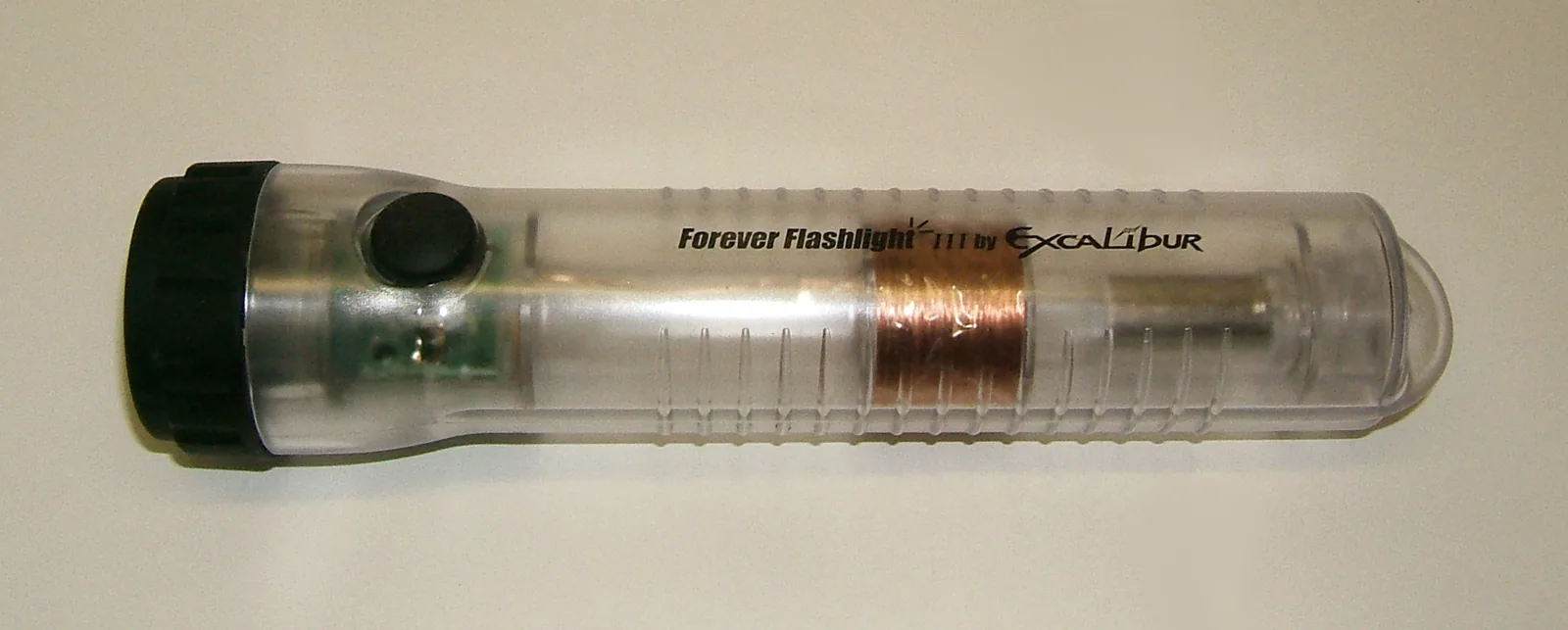
A shake-powered torch has no battery. When the torch is shaken, a magnet inside it slides through a coil of $600$ turns. When the magnet enters the coil, the magnetic flux through one turn grows by $0.12\,\text{mWb}$ in $15\,\text{ms}$.
How large is the induced voltage in the coil on average during this time? Give the answer in volts.
Hint 1: a guiding question
What changes in the flux through the coil, and how fast? How many turns are in series?
Hint 2: what is the connection
The magnitude of the induced voltage is $|e| = N \cdot \Delta\Phi : \Delta t$. First convert the flux to webers and the time to seconds.
Hint 3: an intermediate step
$\Delta\Phi = 0.12 \cdot 10^{-3}\,\text{Wb}$ and $\Delta t = 15 \cdot 10^{-3}\,\text{s}$, so
Show the solution
Given
number of turns $N = 600$, change in flux through one turn $\Delta\Phi = 0.12\,\text{mWb}$, time $\Delta t = 15\,\text{ms}$
Find
average magnitude of the induced voltage $|e|$ in volts
Principle
When the magnet slides into the coil, the magnetic flux through the coil grows, so an induced voltage appears in the coil according to Faraday's law. The flux does not necessarily grow steadily, so the quotient of the total change in flux and the time gives the average of the voltage over this interval. The turns are in series, so the voltage is $N$ times the voltage of one turn.
Formula
$|e| = N\dfrac{\Delta\Phi}{\Delta t}$
Conversions
Substitution
Answer
$4.8\,\text{V}$
Two significant figures like the change in flux $0.12\,\text{mWb}$ and the time $15\,\text{ms}$.
Reasonableness
One turn would give only $8.0\,\text{mV}$, which would not be enough for an LED. An LED needs a voltage of about $2$–$3\,\text{V}$, so a coil of hundreds of turns and fast shaking are essential. If shaken more slowly, the same change in flux takes longer and the voltage stays smaller.
Check your understanding
Exit ticket
Answer on your own first and only then open the answer.
- The side of a square wire loop is $0.20\,\text{m}$, and the loop is perpendicular to a uniform magnetic field of $0.50\,\text{T}$. How large is the magnetic flux through the loop?
Answer
$\Phi$$= BA$$= 0.50\,\text{T} \cdot (0.20\,\text{m})^2$$= 0.020\,\text{Wb}$$= 20\,\text{mWb}$ - The magnetic flux through a coil grows, is at its greatest at the moment $t_1$ and then begins to decrease. How large is the induced voltage in the coil at the moment $t_1$?
Answer
Zero. At the greatest value the flux graph $(t, \Phi)$ is horizontal for a moment, so the rate of change of flux $\Delta\Phi : \Delta t$ and the voltage $e = -N \cdot \Delta\Phi : \Delta t$ are zero. A large flux does not mean a large voltage.
1. Concept: when does a voltage appear?
2. Calculate: a moving rod
A metal rod of length $50\,\text{cm}$ moves at a speed of $4.0\,\text{m/s}$ perpendicular to a uniform magnetic field. The magnetic flux density of the field is $0.25\,\text{T}$, and the rod is perpendicular to both the field and the direction of motion.
How large is the induced voltage between the ends of the rod? Give the answer in volts.
Hint 1: a guiding question
What acts on the electrons of the rod when the rod moves in the field, and where do the electrons move to?
Hint 2: what is the connection
The voltage between the ends of the rod is $e = vBl$ when the velocity, the rod and the field are mutually perpendicular.
Hint 3: an intermediate step
$l = 50\,\text{cm} = 0.50\,\text{m}$, so $e = 4.0\,\text{m/s} \cdot 0.25\,\text{T} \cdot 0.50\,\text{m}$.
Show the solution
Given
length of the rod $l = 50\,\text{cm}$, speed $v = 4.0\,\text{m/s}$, magnetic flux density $B = 0.25\,\text{T}$; the velocity, the rod and the field are mutually perpendicular
Find
induced voltage $e$ between the ends of the rod in volts
Principle
The electrons that move with the rod experience a magnetic force $evB$ along the rod, so electrons collect at one end of the rod. The electric field that appears grows until the electric force $eE$ cancels the magnetic force, that is, $E = vB$. The field is uniform, so the voltage between the ends is $El$.
Formula
$e = vBl$
Conversions
Substitution
Answer
$0.50\,\text{V}$
Two significant figures like the given values.
Reasonableness
The units fit:
The voltage is under a volt, as is to be expected for a laboratory-sized device; the same voltage follows from Faraday's law, since the area swept by the rod grows every second by $0.50\,\text{m} \cdot 4.0\,\text{m} = 2.0\,\text{m}^2$, and
Suggestion: one answer does not show everything you can do, but review the theory summary and do the core exercises.
Optional 3. Explain: the voltage in a moving rod
A metal rod moves perpendicular to a magnetic field. Explain why a voltage appears between the ends of the rod, and why the voltage does not grow without limit but settles at the value $e = vBl$.
Model answer
The conduction electrons of the rod move along with it. A magnetic field exerts on a moving charge a force $F_\text{m} = evB$, which is perpendicular to the velocity and the field, that is, along the rod. The electrons shift to one end of the rod, which becomes negative, and positive charge is left at the other end. An electric field $E$ appears inside the rod between the charges and exerts on the electrons an opposite force $F_\text{s} = eE$. Electrons shift until the forces are equal: $eE = evB$, that is, $E = vB$. In a uniform field the voltage is $El$, so $e = vBl$. At a greater speed the magnetic force is greater, so a greater electric field is needed for balance and the voltage is greater. In a rod at rest no voltage appears, because the magnetic force is zero.
Assess your own answer
Tick the points your own answer already contains.
Review the theory summary and practise with the exercises.
Review the chapter's concepts
Cards you mark Review later collect in your review deck.
- Magnetic flux
- The amount of magnetic field passing through a surface, when the field is perpendicular to the surface.$$\Phi = BA$$
- Faraday's law of induction
- A changing magnetic flux induces a voltage.$$e = -N \cdot \dfrac{\Delta\Phi}{\Delta t}$$
Exercises
Level 1 · basic practice 5 exercises
One formula or one step of reasoning. Core exercises first, the rest is extra practice.
- Exercise 5-1Core
A square wire loop of side $0.12\,\text{m}$ is perpendicular to a uniform magnetic field. The magnetic flux density of the field is $0.35\,\text{T}$.
How large is the magnetic flux through the loop? Give the answer in milliwebers.
Answer
$5.0\,\text{mWb}$
Show the solution
Given
side of the square $a = 0.12\,\text{m}$, magnetic flux density $B = 0.35\,\text{T}$, field perpendicular to the plane of the loop
Find
magnetic flux $\Phi$ through the loop in milliwebers
Principle
When a uniform field is perpendicular to the plane of the loop, the magnetic flux is the product of the field and the area. The loop is a square, so its area is the square of the side.
Formula
$\Phi = BA$ and $A = a^2$, so $\Phi = B a^2$
Conversions
The given values are in SI units. The answer is converted to milliwebers: $1\,\text{Wb} = 1000\,\text{mWb}$.
Substitution
$\Phi$$= 0.35\,\text{T} \cdot (0.12\,\text{m})^2$$= 0.35\,\text{T} \cdot 0.0144\,\text{m}^2$$= 0.00504\,\text{Wb}$$= 5.04\,\text{mWb}$Answer
$5.0\,\text{mWb}$
Two significant figures like the given values.
Reasonableness
The area of the loop is a little under $0.015\,\text{m}^2$, about the size of an A6 sheet (a postcard), and the field is of the order of tenths of a tesla, so the flux is of the order of thousandths of a weber. Doubling the side would quadruple the flux.
- Exercise 5-2Core
A coil has $400$ turns. When a magnet is pushed into the coil, the magnetic flux through one turn grows steadily by $1.5\,\text{mWb}$ in $0.20\,\text{s}$.
How large is the induced voltage in the coil?
Answer
$3.0\,\text{V}$
Show the solution
Given
number of turns $N = 400$, change in flux through one turn $\Delta\Phi = 1.5\,\text{mWb}$, time $\Delta t = 0.20\,\text{s}$
Find
magnitude of the induced voltage $|e|$ in the coil in volts
Principle
The magnetic flux through the coil changes when the magnet is pushed into it, so an induced voltage appears in the coil according to Faraday's law. The flux grows steadily, so the voltage is constant throughout. The turns are in series, so the voltage is $N$ times the voltage of one turn.
Formula
$|e| = N\dfrac{\Delta\Phi}{\Delta t}$
Conversions
$\Delta\Phi$$= 1.5\,\text{mWb}$$= 1.5 \cdot 10^{-3}\,\text{Wb}$Substitution
$|e|$$= 400 \cdot \dfrac{1.5 \cdot 10^{-3}\,\text{Wb}}{0.20\,\text{s}}$$= 400 \cdot 7.5 \cdot 10^{-3}\,\text{V}$$= 3.0\,\text{V}$Answer
$3.0\,\text{V}$
Two significant figures like the change in flux and the time.
Reasonableness
The units fit: $\tfrac{\text{Wb}}{\text{s}} = \text{V}$. One turn would give only $7.5\,\text{mV}$; with a coil of hundreds of turns the voltage rises to volts, which matches experiments done with school coils.
- Exercise 5-3
A metal rod of length $0.25\,\text{m}$ moves at a speed of $2.0\,\text{m/s}$ in a uniform magnetic field of $0.40\,\text{T}$. The rod, its velocity and the field are mutually perpendicular.
How large is the induced voltage between the ends of the rod?
Answer
$0.20\,\text{V}$
Show the solution
Given
length of the rod $l = 0.25\,\text{m}$, speed $v = 2.0\,\text{m/s}$, magnetic flux density $B = 0.40\,\text{T}$; the rod, the velocity and the field are mutually perpendicular
Find
induced voltage $e$ between the ends of the rod in volts
Principle
The electrons that move with the rod experience a magnetic force $evB$ along the rod, so electrons collect at one end of the rod. The shift stops when the electric field $E = vB$ that appears cancels the magnetic force, and the voltage between the ends is $El$.
Formula
$e = vBl$
Conversions
None needed: all quantities are in SI units, and $\tfrac{\text{m}}{\text{s}} \cdot \text{T} \cdot \text{m} = \text{V}$.
Substitution
$e$$= 2.0\,\text{m/s} \cdot 0.40\,\text{T} \cdot 0.25\,\text{m}$$= 0.20\,\text{V}$Answer
$0.20\,\text{V}$
Two significant figures like the given values.
Reasonableness
Every second the rod sweeps an area of $0.25\,\text{m} \cdot 2.0\,\text{m} = 0.50\,\text{m}^2$, so the flux grows at the rate
$0.40\,\text{T} \cdot 0.50\,\tfrac{\text{m}^2}{\text{s}}$$= 0.20\,\tfrac{\text{Wb}}{\text{s}}$: Faraday's law gives the same voltage.
- Exercise 5-4
A coil has $150$ turns. When a magnet is pulled away from the coil, an average induced voltage of $0.45\,\text{V}$ appears between the ends of the coil for $0.12\,\text{s}$.
By how much did the magnetic flux through one turn change? Give the answer in milliwebers.
Answer
$0.36\,\text{mWb}$
Show the solution
Given
number of turns $N = 150$, average induced voltage $|e| = 0.45\,\text{V}$, time $\Delta t = 0.12\,\text{s}$
Find
change in the magnetic flux through one turn $\Delta\Phi$ in milliwebers
Principle
The voltage appears because the flux decreases as the magnet is pulled away. According to Faraday's law, the average voltage is the change in flux divided by the time, multiplied by the number of turns, so when the voltage, the time and the number of turns are known, the change in flux can be solved.
Formula
$|e| = N\dfrac{\Delta\Phi}{\Delta t}$, so $\Delta\Phi = \dfrac{|e|\,\Delta t}{N}$
Conversions
The given values are in SI units, and $\text{V}\cdot\text{s} = \text{Wb}$. The answer is converted to milliwebers: $1\,\text{Wb} = 1000\,\text{mWb}$.
Substitution
$\Delta\Phi$$= \dfrac{0.45\,\text{V} \cdot 0.12\,\text{s}}{150}$$= \dfrac{0.054\,\text{V}\cdot\text{s}}{150}$$= 3.6 \cdot 10^{-4}\,\text{Wb}$$= 0.36\,\text{mWb}$Answer
$0.36\,\text{mWb}$
Two significant figures like the voltage and the time.
Reasonableness
Check: $150 \cdot 3.6 \cdot 10^{-4}\,\text{Wb} : 0.12\,\text{s} = 0.45\,\text{V}$. If the area of the coil is about $10\,\text{cm}^2$, the flux corresponds to a field of about $0.4\,\text{T}$ inside the coil, which suits a strong permanent magnet.
- Exercise 5-5
An induced voltage of $12\,\text{mV}$ is measured between the ends of a metal rod sliding on two rails. The distance between the rails is $0.30\,\text{m}$, and the magnetic flux density of the field perpendicular to the plane of the rails is $0.080\,\text{T}$. The rod moves perpendicular to itself.
How large is the speed of the rod?
Answer
$0.50\,\text{m/s}$
Show the solution
Given
induced voltage $e = 12\,\text{mV}$, length of the rod in the field $l = 0.30\,\text{m}$, magnetic flux density $B = 0.080\,\text{T}$, velocity perpendicular to the rod and the field
Find
speed of the rod $v$ in metres per second
Principle
The magnetic force on the electrons of the moving rod moves them to one end of the rod, and a voltage $e = vBl$ appears between the ends. The voltage is proportional to the speed, so the speed can be solved from the measured voltage.
Formula
$e = vBl$, so $v = \dfrac{e}{Bl}$
Conversions
$e$$= 12\,\text{mV}$$= 12 \cdot 0.001\,\text{V}$$= 0.012\,\text{V}$Substitution
$v$$= \dfrac{0.012\,\text{V}}{0.080\,\text{T} \cdot 0.30\,\text{m}}$$= \dfrac{0.012\,\text{V}}{0.024\,\text{T}\cdot\text{m}}$$= 0.50\,\text{m/s}$Answer
$0.50\,\text{m/s}$
Two significant figures like the given values.
Reasonableness
Check:
$0.50\,\text{m/s} \cdot 0.080\,\text{T} \cdot 0.30\,\text{m}$$= 0.012\,\text{V}$Half a metre per second is slower than a slow walk, which suits a rail experiment done on a table.
Level 2 · applied practice 4 exercises
Two steps, working with measured data, a unit conversion or rearranging a formula. Core exercises first, the rest is extra practice.
- Exercise 5-6Core
A flexible wire loop is perpendicular to a uniform magnetic field of $0.80\,\text{T}$. The loop is squeezed so that its area decreases steadily from $200\,\text{cm}^2$ to $50\,\text{cm}^2$ in $0.25\,\text{s}$.
How large is the induced voltage in the loop? Give the answer in millivolts.
Answer
$48\,\text{mV}$
Show the solution
Given
magnetic flux density $B = 0.80\,\text{T}$ perpendicular to the plane of the loop, area at first $A_1 = 200\,\text{cm}^2$ and at the end $A_2 = 50\,\text{cm}^2$, time $\Delta t = 0.25\,\text{s}$, one turn $N = 1$
Find
magnitude of the induced voltage $|e|$ in the loop in millivolts
Principle
The field stays the same, but the area of the loop decreases, so the flux $\Phi = BA$ through the loop decreases. The change in flux produces a voltage according to Faraday's law. The area decreases steadily, so the voltage is constant.
Formula
$\Delta\Phi = B(A_1 - A_2)$ and $|e| = N\dfrac{\Delta\Phi}{\Delta t}$, so $|e| = \dfrac{B(A_1 - A_2)}{\Delta t}$ when $N = 1$
Conversions
$A_1$$= 200\,\text{cm}^2$$= 200 \cdot (0.01\,\text{m})^2$$= 0.0200\,\text{m}^2$$A_2$$= 50\,\text{cm}^2$$= 50 \cdot (0.01\,\text{m})^2$$= 0.0050\,\text{m}^2$Substitution
$A_1 - A_2$$= 0.0200\,\text{m}^2 - 0.0050\,\text{m}^2$$= 0.0150\,\text{m}^2$$|e|$$= \dfrac{0.80\,\text{T} \cdot 0.0150\,\text{m}^2}{0.25\,\text{s}}$$= \dfrac{0.012\,\text{Wb}}{0.25\,\text{s}}$$= 0.048\,\text{V}$$= 48\,\text{mV}$Answer
$48\,\text{mV}$
Two significant figures like the field $0.80\,\text{T}$ and the time $0.25\,\text{s}$.
Reasonableness
One turn gives a voltage of only tens of millivolts even though the field is strong; this fits the fact that practical devices need many turns. If the loop were squeezed twice as fast, the voltage would be twice as great.
- Exercise 5-7Core
A coil has $50$ turns. The graph shows the magnetic flux $\Phi$ through one turn as a function of time $t$.
What is the greatest absolute value of the induced voltage of the coil in the interval $0$–$0.70\,\text{s}$? Read the necessary values from the graph.
Answer
$2.0\,\text{V}$
Show the solution
Given
number of turns $N = 50$; the graph shows the magnetic flux $\Phi$ through one turn as a function of time $t$
Find
greatest absolute value of the induced voltage $|e|$ in volts
Principle
According to Faraday's law, the voltage is proportional to the rate of change of the flux $\Delta\Phi : \Delta t$, which is the slope of the flux graph. The voltage is therefore greatest where the graph is steepest, not where the flux is greatest.
Reading the graph
The graph consists of straight parts. In the interval $0$–$0.20\,\text{s}$ the flux grows from zero to $4.0\,\text{mWb}$, so the absolute value of the slope is $4.0\,\text{mWb} : 0.20\,\text{s} = 20\,\tfrac{\text{mWb}}{\text{s}}$. In the interval $0.20$–$0.50\,\text{s}$ the graph is horizontal, so the voltage is zero. In the interval $0.50$–$0.60\,\text{s}$ the flux decreases from $4.0\,\text{mWb}$ to zero, so the absolute value of the slope is $4.0\,\text{mWb} : 0.10\,\text{s} = 40\,\tfrac{\text{mWb}}{\text{s}}$. The steepest part is therefore $0.50$–$0.60\,\text{s}$, where $\Delta\Phi = 4.0\,\text{mWb}$ and $\Delta t = 0.10\,\text{s}$.
Formula
$|e| = N\dfrac{\Delta\Phi}{\Delta t}$
Conversions
$\Delta\Phi$$= 4.0\,\text{mWb}$$= 4.0 \cdot 10^{-3}\,\text{Wb}$Substitution
$|e|$$= 50 \cdot \dfrac{4.0 \cdot 10^{-3}\,\text{Wb}}{0.10\,\text{s}}$$= 50 \cdot 0.040\,\text{V}$$= 2.0\,\text{V}$Answer
$2.0\,\text{V}$
Two significant figures like the flux $4.0\,\text{mWb}$ read from the graph.
Reasonableness
In the rising part the voltage is $50 \cdot 4.0 \cdot 10^{-3}\,\text{Wb} : 0.20\,\text{s} = 1.0\,\text{V}$, half of the greatest, because the same change in flux takes twice as long. In the falling part the sign of the voltage is opposite to that in the rising part, because the flux decreases.
- Exercise 5-8
Two horizontal metal rails are $0.40\,\text{m}$ apart, and their ends are joined by a $2.0\,\Omega$ resistor. A transverse metal rod slides on the rails at a speed of $3.0\,\text{m/s}$. The magnetic flux density of the vertical magnetic field is $0.50\,\text{T}$. The resistance of the rails and the rod is very small.
How large is the current through the resistor?
Answer
$0.30\,\text{A}$
Show the solution
Given
distance between the rails, that is, the length of the rod in the field, $l = 0.40\,\text{m}$, speed $v = 3.0\,\text{m/s}$, magnetic flux density $B = 0.50\,\text{T}$, resistance $R = 2.0\,\Omega$; the resistance of the rails and the rod is very small
Find
current $I$ through the resistor in amperes
Principle
An induced voltage $e = vBl$ appears between the ends of the moving rod, because a magnetic force acts on the electrons of the rod. The rod, the rails and the resistor form a closed circuit in which the rod acts as the voltage source. The resistance of the rest of the circuit is small, so the whole voltage is across the resistor, and the current follows from Ohm's law.
Formula
$e = vBl$ and $I = \dfrac{e}{R}$, so $I = \dfrac{vBl}{R}$
Conversions
None needed: all quantities are in SI units.
Substitution
$e$$= 3.0\,\text{m/s} \cdot 0.50\,\text{T} \cdot 0.40\,\text{m}$$= 0.60\,\text{V}$$I$$= \dfrac{0.60\,\text{V}}{2.0\,\Omega}$$= 0.30\,\text{A}$Answer
$0.30\,\text{A}$
Two significant figures like the given values.
Reasonableness
The flux grows at the rate
$0.50\,\text{T} \cdot 0.40\,\text{m} \cdot 3.0\,\tfrac{\text{m}}{\text{s}}$$= 0.60\,\tfrac{\text{Wb}}{\text{s}}$which gives the same voltage. When a current flows in the rod, the field exerts a force $IlB = 0.060\,\text{N}$ on it; its direction is found in the chapter Lenz's law and eddy currents.
- Exercise 5-9
A square coil of side $5.0\,\text{cm}$ with $20$ turns is pulled at a steady speed of $0.25\,\text{m/s}$ into a region of uniform magnetic field. The field of $0.30\,\text{T}$ is perpendicular to the plane of the coil, and the leading side of the coil is parallel to the edge of the field.
How large is the induced voltage in the coil during the time in which the coil is entering the field? Give the answer in millivolts.
Answer
$75\,\text{mV}$
Show the solution
Given
side of the coil $l = 5.0\,\text{cm}$, number of turns $N = 20$, speed $v = 0.25\,\text{m/s}$, magnetic flux density $B = 0.30\,\text{T}$ perpendicular to the plane of the coil
Find
induced voltage $|e|$ in millivolts while the coil is entering the field
Principle
When the coil enters the field, the part of its area that is in the field grows steadily, so the flux through each turn grows steadily and the voltage is constant. In the time $\Delta t$ the coil moves a distance $v\Delta t$, so the flux grows by $\Delta\Phi = Bl \cdot v\Delta t$.
Formula
$|e|$$= N\dfrac{\Delta\Phi}{\Delta t}$$= N\dfrac{Bl \cdot v\Delta t}{\Delta t}$so $|e| = NBlv$
Conversions
$l$$= 5.0\,\text{cm}$$= 5.0 \cdot 0.01\,\text{m}$$= 0.050\,\text{m}$Substitution
$|e|$$= 20 \cdot 0.30\,\text{T} \cdot 0.050\,\text{m} \cdot 0.25\,\text{m/s}$$= 0.075\,\text{V}$$= 75\,\text{mV}$Answer
$75\,\text{mV}$
Two significant figures like the given values.
Reasonableness
Check using the whole entry: the flux grows from zero to
$BA$$= 0.30\,\text{T} \cdot (0.050\,\text{m})^2$$= 7.5 \cdot 10^{-4}\,\text{Wb}$in the time $0.050\,\text{m} : 0.25\,\text{m/s} = 0.20\,\text{s}$, so
$|e|$$= 20 \cdot 7.5 \cdot 10^{-4}\,\text{Wb} : 0.20\,\text{s}$$= 0.075\,\text{V}$
Level 3 · challenging 3 exercises
Optional: application, two ideas together or a new situation where you reason for yourself.
- Exercise 5-10
A train travels at a speed of $200\,\text{km/h}$ on a horizontal track. The track gauge of the Finnish railways is $1524\,\text{mm}$ (Finnish Transport Infrastructure Agency), and the metal axle of a pair of wheels extends from rail to rail. The vertical component of the Earth's magnetic field in southern Finland is about $50\,\mu\text{T}$ (WMM2025 model, NOAA/BGS).
How large is the induced voltage between the ends of the axle at the rails? Give the answer in millivolts.
Answer
$4.2\,\text{mV}$
Show the solution
Given
speed of the train $v = 200\,\text{km/h}$, length of the axle from rail to rail $l = 1524\,\text{mm}$, vertical component of the Earth's magnetic field $B_\text{v} = 50\,\mu\text{T}$
Find
induced voltage $e$ between the ends of the axle in millivolts
Principle
The axle is a metal rod that moves horizontally, perpendicular to itself. The magnetic force on the electrons is perpendicular to the velocity and the field; a component along the axle arises only from the vertical component of the field, because the horizontal component is either parallel to the velocity or gives a vertical force. The voltage is therefore given by $e = vB_\text{v}l$.
Formula
$e = vB_\text{v}l$
Conversions
$v$$= 200\,\text{km/h}$$= 200 \cdot \dfrac{1000\,\text{m}}{3600\,\text{s}}$$= 55.56\,\text{m/s}$$l$$= 1524\,\text{mm}$$= 1524 \cdot 0.001\,\text{m}$$= 1.524\,\text{m}$$B_\text{v}$$= 50\,\mu\text{T}$$= 50 \cdot 10^{-6}\,\text{T}$Substitution
$e$$= 55.56\,\text{m/s} \cdot 50 \cdot 10^{-6}\,\text{T} \cdot 1.524\,\text{m}$$= 4.233 \cdot 10^{-3}\,\text{V}$$= 4.2\,\text{mV}$Answer
$4.2\,\text{mV}$
Two significant figures like the field $50\,\mu\text{T}$.
Reasonableness
The Earth's field is about one ten-thousandth of the field of a laboratory magnet, so despite the high speed the voltage stays in the millivolt range. At a cyclist's speed of $20\,\text{km/h}$ the voltage would be a tenth of this, about $0.4\,\text{mV}$.
- Exercise 5-11
The Earth's magnetic field is measured with a flip coil. The coil has $100$ turns and an area of $0.020\,\text{m}^2$.
The coil is at first in a position in which its plane is perpendicular to the Earth's magnetic field. The coil is turned through half a turn in $0.10\,\text{s}$, and an average induced voltage of $2.0\,\text{mV}$ appears in the coil during this time.
How large is the magnetic flux density of the Earth's magnetic field? Give the answer in microteslas.
Answer
$50\,\mu\text{T}$
Show the solution
Given
number of turns $N = 100$, area $A = 0.020\,\text{m}^2$, plane of the coil at first perpendicular to the field, half-turn in the time $\Delta t = 0.10\,\text{s}$, average voltage $|e| = 2.0\,\text{mV}$
Find
magnetic flux density $B$ of the Earth's magnetic field in microteslas
Principle
At first the flux through one turn is $\Phi_1 = BA$. After a half-turn the same field passes through the turn from the opposite direction, so the flux is $\Phi_2 = -BA$. The magnitude of the change in flux is therefore $\Delta\Phi = 2BA$, and according to Faraday's law the average voltage is $N \cdot 2BA : \Delta t$.
Formula
$|e| = N\dfrac{2BA}{\Delta t}$, so $B = \dfrac{|e|\,\Delta t}{2NA}$
Conversions
$|e|$$= 2.0\,\text{mV}$$= 2.0 \cdot 10^{-3}\,\text{V}$the answer is converted to microteslas: $1\,\text{T} = 10^{6}\,\mu\text{T}$
Substitution
$B$$= \dfrac{2.0 \cdot 10^{-3}\,\text{V} \cdot 0.10\,\text{s}}{2 \cdot 100 \cdot 0.020\,\text{m}^2}$$= \dfrac{2.0 \cdot 10^{-4}\,\text{V}\cdot\text{s}}{4.0\,\text{m}^2}$$= 5.0 \cdot 10^{-5}\,\text{T}$$= 50\,\mu\text{T}$Answer
$50\,\mu\text{T}$
Two significant figures like the voltage $2.0\,\text{mV}$.
Reasonableness
The Earth's magnetic field in Finland is about $50\,\mu\text{T}$, so the result is believable. If the change in flux had wrongly been taken as $BA$, the result would be twice as great, $100\,\mu\text{T}$, which is too large.
- Exercise 5-12
A bar magnet is dropped through a vertical coil of $300$ turns, and the voltage of the coil is measured with a data logger.
When the magnet enters the coil, the measurement shows a voltage pulse that is roughly triangular: the voltage rises from zero to a peak value of $0.90\,\text{V}$ and falls back to zero, and the pulse lasts $40\,\text{ms}$ in all. Before the drop the magnet is far from the coil.
How large is the magnetic flux through one turn on average when the pulse has ended and the magnet is in the middle of the coil? Give the answer in milliwebers.
Answer
$0.060\,\text{mWb}$
Show the solution
Given
number of turns $N = 300$, triangular voltage pulse, peak value $e_0 = 0.90\,\text{V}$, duration $\Delta t = 40\,\text{ms}$; at first the magnet is far away, so the flux is zero
Find
average magnetic flux $\Phi$ through one turn in milliwebers when the magnet is in the middle of the coil
Principle
Faraday's law implies that the product of the voltage and the duration of a short interval is $N$ times the change in flux. When the intervals of the pulse are added up, the area between the voltage graph $(t, e)$ and the time axis is $N\Delta\Phi$. At the end of the pulse the voltage is zero, because the flux is at its greatest and no longer growing; the magnet is then in the middle of the coil. The flux has grown from zero to this value, so $\Delta\Phi = \Phi$.
Formula
the area of the triangle is $N\Phi = \tfrac{1}{2} e_0 \Delta t$, so
$\Phi$$= \dfrac{e_0 \Delta t}{2 \cdot N}$Conversions
$\Delta t$$= 40\,\text{ms}$$= 40 \cdot 0.001\,\text{s}$$= 0.040\,\text{s}$the answer is converted to milliwebers: $1\,\text{Wb} = 1000\,\text{mWb}$
Substitution
$\Phi$$= \dfrac{0.90\,\text{V} \cdot 0.040\,\text{s}}{2 \cdot 300}$$= \dfrac{0.036\,\text{V}\cdot\text{s}}{600}$$= 6.0 \cdot 10^{-5}\,\text{Wb}$$= 0.060\,\text{mWb}$Answer
$0.060\,\text{mWb}$
Two significant figures like the peak value $0.90\,\text{V}$ and the duration $40\,\text{ms}$.
Reasonableness
If the cross-sectional area of the coil is about $2\,\text{cm}^2 = 2 \cdot 10^{-4}\,\text{m}^2$, the average field through a turn is $6.0 \cdot 10^{-5}\,\text{Wb} : 2 \cdot 10^{-4}\,\text{m}^2 = 0.3\,\text{T}$, which suits a small strong magnet. When the magnet leaves the coil, a pulse of opposite sign appears, with an equal area.
