
Magnetic field of a wire and a coil
Why can the magnet of a scrapyard crane lift a tonne of scrap car into the air and drop it at the press of a button, when a fridge magnet never lets go?
Prior knowledge
- The direction of a magnetic field is the direction of the north end of a compass needle, and outside a bar magnet the field lines go from the north pole to the south polechapter Magnets, the magnetic dipole and the magnetic field
- The unit of magnetic flux density $B$ is the tesla, and the Earth's magnetic field in Finland is about $50\,\mu\text{T}$chapter Magnets, the magnetic dipole and the magnetic field
Core path: follow the steps in order. Tasks marked Optional give extra practice. Optional tasks: 5.
Think about it
A compass lies on a table, and a north–south copper wire runs above it. When a current of $3\,\text{A}$ is switched on in the wire, the needle turns almost across the wire while the wire is directly above the needle. When the direction of the current is reversed, the needle turns the other way, and when the current is switched off, the needle goes back to pointing north. Copper is not a magnetic material: a copper nail does not stick to a magnet.
Where does the magnetic field that turns the compass come from, and how can the same effect be made so strong that it lifts a scrap car?
Optional Revise: a compass in a magnetic field
Predict
Make your predictions before investigating 2 questions
Prediction 1: a stretched coil
Prediction 2: the end of the coil
Investigate
A magnetic field sensor moves along the axis of a coil. Change the current, the number of turns, the length of the coil and the position of the sensor, and follow how the magnetic flux density changes.
Simulation
How to use
Set the current $I$, the number of turns $N$, the length $l$ of the coil and the position $x$ of the sensor, measured from the centre of the coil. The reading of the sensor is shown above the sensor and in the readouts. The lower graph shows the magnetic flux density $B$ along the whole axis; the light area is the position of the coil, and the circled point is the position of the sensor. The choice of the direction of the current reverses the field and swaps the places of the poles. The speed changes only the pace of the movement of the current markers.
Assumptions of the model
The radius of the coil is $2.0\,\text{cm}$, and the turns are evenly spaced along its whole length. The model calculates the field only on the axis of the coil by adding together the fields of all the turns. The coil has no iron core, and the Earth's magnetic field is not included. The field lines are drawn schematically, and one drawn turn stands for twenty real ones. The readings are values of the model, not measurements.
How the calculation works
At the centre of the coil and on its axis at a distance $x$ from the centre, the model calculates
$$\begin{aligned} B &= \frac{\mu_0\, N I}{2 l}\,(k_1 - k_2) \\ k_1 &= \frac{x + \tfrac{l}{2}}{\sqrt{(x + \tfrac{l}{2})^2 + R^2}} \\ k_2 &= \frac{x - \tfrac{l}{2}}{\sqrt{(x - \tfrac{l}{2})^2 + R^2}} \end{aligned}$$
where $R = 2.0\,\text{cm}$ is the radius of the coil and $\mu_0 = 4\pi \cdot 10^{-7}\,\tfrac{\text{Vs}}{\text{Am}}$. When the coil is much longer than its radius, the value at the centre is almost $B = \mu_0 \tfrac{N I}{l}$: for example, with the default values $1.23\,\text{mT}$, when the formula for a long coil gives $1.26\,\text{mT}$. The turn density is $n = N : l$.
Experiment 1: only the length of the coil changes
Test prediction 1. The current, the number of turns and the position of the sensor at the centre of the coil stay constant; change only the length of the coil. Record the magnetic flux density at least at the lengths $20\,\text{cm}$ and $40\,\text{cm}$, and if you wish also at $10\,\text{cm}$ and $30\,\text{cm}$. Compare $B$ and the turn density $n$.
Initial state: current = $2\,\text{A}$, number of turns: 200 turns, length of the coil = $20\,\text{cm}$, position of the sensor = $0\,\text{cm}$, direction of the current: downwards at the front. Kept constant: current, number of turns, position of the sensor, direction of the current. Varied: length of the coil $(\text{cm})$.
| length of the coil $(\text{cm})$ | $B$ $(\text{mT})$ | $n$ (1/m) |
|---|
Experiment 2: only the position of the sensor changes
Test prediction 2. The length of the coil is $20\,\text{cm}$, so its ends are at $x = -10\,\text{cm}$ and $x = 10\,\text{cm}$. Move only the sensor and record $B$ at least at the centre and at the end of the coil, and if you wish also at $5\,\text{cm}$ and $15\,\text{cm}$.
Initial state: current = $2\,\text{A}$, number of turns: 200 turns, length of the coil = $20\,\text{cm}$, position of the sensor = $0\,\text{cm}$, direction of the current: downwards at the front. Kept constant: current, number of turns, length of the coil, direction of the current. Varied: position of the sensor.
| position of the sensor | $B$ $(\text{mT})$ |
|---|
Conclusion: what determines the field of a coil?
Write, on the basis of your tables: how did the field at the centre of the coil change when the same coil was stretched to twice its length? What quantity therefore determines the field? How did the field change when the sensor moved from the centre to the end of the coil and beyond it?
Model answer
When the coil of $200$ turns was stretched from $20\,\text{cm}$ to $40\,\text{cm}$, the field at the centre fell to about a half, from $2.46\,\text{mT}$ to $1.25\,\text{mT}$ in the values of the model. At the same time the turn density $n = N : l$ was halved. So the field is not determined by the total number of turns but by the turn density and the current. In experiment 2 the field stayed almost the same in the middle part of the coil ($2.46\,\text{mT}$ at the centre, $2.41\,\text{mT}$ at $5\,\text{cm}$), was about a half at the end ($1.25\,\text{mT}$) and weakened quickly outside the coil. Inside a long coil the field is therefore almost uniform, but not right up to the ends. The model has no iron core and no Earth's field.
Assess your own answer
Tick the points your own answer already contains.
Review the theory summary and practise with the exercises.
Measurement: the permeability of free space from a coil
Made-up example data
A group measured the magnetic flux density at the centre of a coil with a magnetic field sensor. The coil has $N = 320$ turns, and its length was measured with a ruler: $l = 16.0\,\text{cm}$, uncertainty $\Delta l = 0.2\,\text{cm}$. The diameter of the coil is $3.0\,\text{cm}$. The current was varied with a power supply, and the readings were recorded at each current.
| $I$ (A) | $B$ (mT) |
|---|---|
| $0.00$ | $0.04$ |
| $0.50$ | $1.27$ |
| $1.00$ | $2.51$ |
| $1.50$ | $3.69$ |
| $2.00$ | $4.99$ |
| $2.50$ | $6.20$ |
Vernier Graphical Analysis fitted a straight line $B = A I + B_0$ to the points and gave the slope $A = 2.465\,\tfrac{\text{mT}}{\text{A}}$, its uncertainty $\Delta A = 0.012\,\tfrac{\text{mT}}{\text{A}}$ and the constant term $B_0 = 0.035\,\text{mT}$. In real series of measurements the points are not usually exactly on one straight line because of measurement uncertainty.
Determine the permeability of free space $\mu_0$ from the measurement. Give the answer in the form $\ldots \cdot 10^{-6}\,\tfrac{\text{Vs}}{\text{Am}}$, that is, write the coefficient as your answer.
Hint 1: a guiding question
What does the slope $A$ of the line mean in the formula of the coil $B = \mu_0 \tfrac{N}{l} I$?
Hint 2: what is the connection
The slope is $A = \mu_0 \tfrac{N}{l}$, so $\mu_0 = A l : N$. First convert $A$ to the unit $\tfrac{\text{T}}{\text{A}}$ and $l$ to metres.
Hint 3: an intermediate step
Show the solution
Given
turns $N = 320$, length of the coil $l = 16.0\,\text{cm}$, slope of the fitted line $A = 2.465\,\tfrac{\text{mT}}{\text{A}}$
Find
permeability of free space $\mu_0$ in the unit $\tfrac{\text{Vs}}{\text{Am}}$
Principle
At the centre of a long coil $B = \mu_0 \tfrac{N}{l} I$, so $B$ is directly proportional to the current and the slope of the line is $\mu_0 \tfrac{N}{l}$. The slope is read from the fitted line and not from two measured points, because the line takes all the points into account. The constant term $B_0$ does not affect the slope.
Reading the graph
The fitted line passes approximately through the points $(0$; $0.04\,\text{mT})$ and $(2.5\,\text{A}$; $6.2\,\text{mT})$, so the slope is about
the exact value from the program is $2.465\,\tfrac{\text{mT}}{\text{A}}$.
Formula
$A = \mu_0 \dfrac{N}{l}$, from which $\mu_0 = \dfrac{A l}{N}$
Conversions
Unit:
Substitution
Answer
$\mu_0 \approx 1.23 \cdot 10^{-6}\,\tfrac{\text{Vs}}{\text{Am}}$
Three significant figures like the length $16.0\,\text{cm}$.
Reasonableness
The table value is
The measurement gives a value about $2\,\%$ smaller. The difference is slightly greater than the measurement uncertainty, and its cause is found in the next task. A small difference is to be expected, because at the centre of a short coil the field is slightly smaller than the formula for a long coil gives.
Uncertainty of the result
Estimate the relative uncertainty of the result $\mu_0$ of the previous measurement. Take into account the uncertainty of the slope $\Delta A = 0.012\,\tfrac{\text{mT}}{\text{A}}$ and the uncertainty of the length $\Delta l = 0.2\,\text{cm}$; the number of turns is known exactly. Add together the relative uncertainties of the factors. Give the answer as a percentage.
Hint 1: a guiding question
The result is $\mu_0 = A l : N$. When quantities are multiplied or divided, which uncertainties are added together?
Hint 2: what is the connection
A simple estimate: the relative uncertainty of a product and a quotient is the sum of the relative uncertainties of the factors, $\tfrac{\Delta \mu_0}{\mu_0} = \tfrac{\Delta A}{A} + \tfrac{\Delta l}{l}$.
Hint 3: an intermediate step
$\tfrac{\Delta A}{A} = 0.012 : 2.465$ and $\tfrac{\Delta l}{l} = 0.2 : 16.0$.
Show the solution
Given
$A = 2.465\,\tfrac{\text{mT}}{\text{A}}$, $\Delta A = 0.012\,\tfrac{\text{mT}}{\text{A}}$, $l = 16.0\,\text{cm}$, $\Delta l = 0.2\,\text{cm}$, $N = 320$ exactly; from the previous task $\mu_0 = 1.23 \cdot 10^{-6}\,\tfrac{\text{Vs}}{\text{Am}}$
Find
relative uncertainty $\Delta \mu_0 : \mu_0$ as a percentage
Principle
The result is calculated as a product and a quotient, $\mu_0 = A l : N$. A simple estimate of the uncertainty is found by adding the relative uncertainties of the factors. The number of turns is counted, so it adds no uncertainty.
Formula
Conversions
None needed: in each quotient the units cancel, because the numerator and the denominator are in the same unit.
Substitution
Answer
about $1.7\,\%$, two significant figures, because the uncertainty is itself an estimate. So $\Delta \mu_0 \approx 0.017 \cdot 1.23 \cdot 10^{-6}\,\tfrac{\text{Vs}}{\text{Am}} \approx 0.02 \cdot 10^{-6}\,\tfrac{\text{Vs}}{\text{Am}}$ and the result is $\mu_0 = (1.23 \pm 0.02) \cdot 10^{-6}\,\tfrac{\text{Vs}}{\text{Am}}$.
Reasonableness
The measurement of the length is the greatest source of uncertainty, which is plausible: $2\,\text{mm}$ is more than one per cent of $16\,\text{cm}$. The table value $1.257 \cdot 10^{-6}\,\tfrac{\text{Vs}}{\text{Am}}$ lies slightly outside the interval $1.21$–$1.25$. The difference points to a systematic error: the diameter of the coil is $3.0\,\text{cm}$, so it is not very long compared with its width, and at its centre the field is about $98\,\%$ of the value given by the formula for a long coil. When this is taken into account, the result is about $1.25 \cdot 10^{-6}\,\tfrac{\text{Vs}}{\text{Am}}$.
Theory summary
Key idea
An electric current creates a magnetic field
In 1820 the Danish physicist Hans Christian Ørsted noticed during a lecture that a compass needle turned when a current was switched on in a wire next to it. When the current was switched off, the needle went back to pointing north. The observation joined electricity and magnetism: every current-carrying wire has a magnetic field around it. The field is created by moving charges, so the wire does not have to be made of a magnetic material; even a copper wire creates a field. When the current grows, the field becomes stronger, and when the direction of the current is reversed, the direction of the field is reversed too.
The field lines of a straight wire are concentric circles around the wire, perpendicular to it. The field therefore does not point away from the wire or towards it, but goes round it. Compasses placed around the wire turn along the tangent of the circle when the field of the wire is much stronger than the Earth's magnetic field. The farther from the wire we are, the weaker the field.
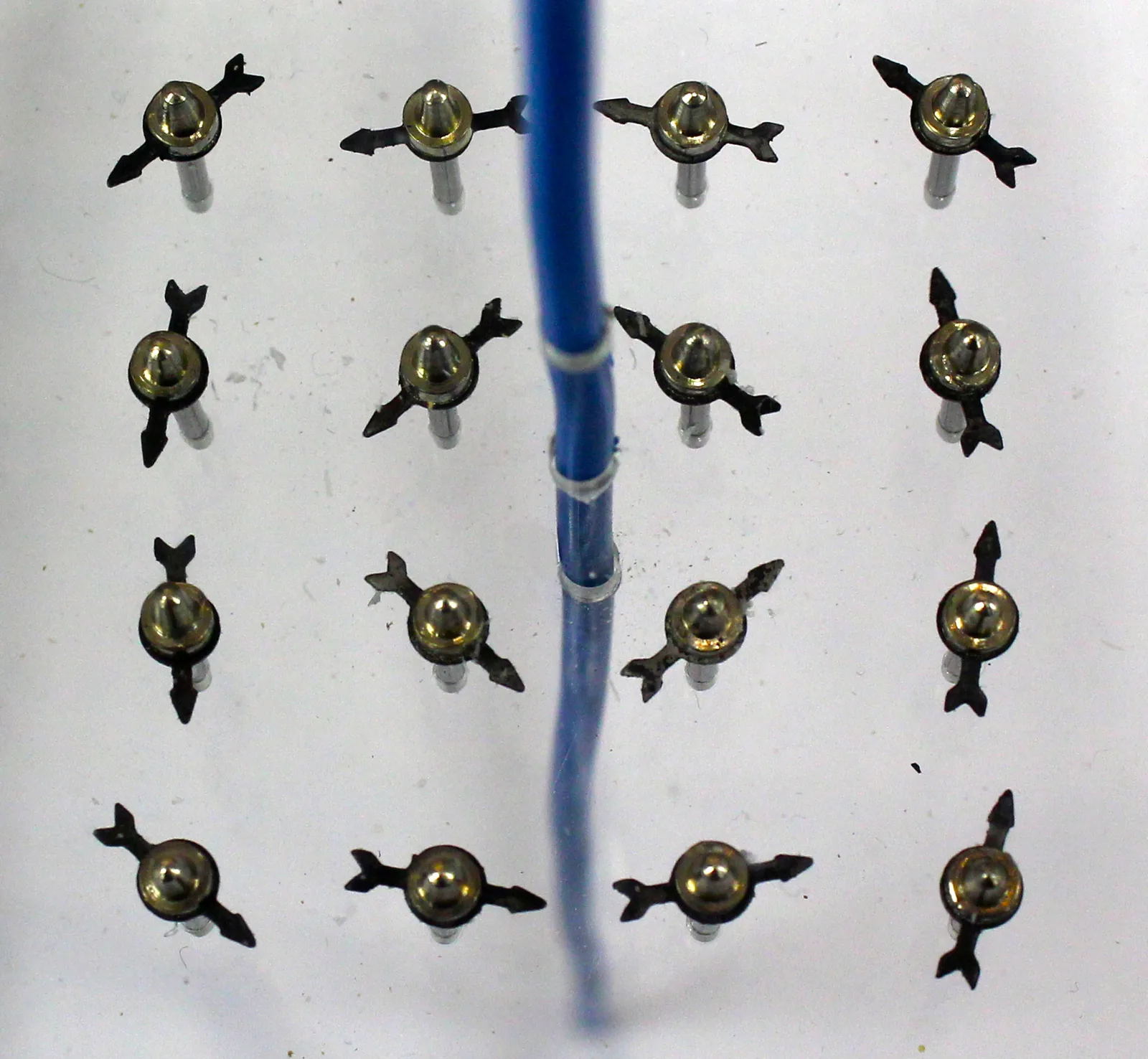
The right-hand rule
The direction in which the field goes round is given by the right-hand rule: when the thumb of the right hand points in the direction of the current, the curled fingers go round in the direction of the field lines. In the figure the current goes upwards, so seen from above the field goes round anticlockwise. In figures a current towards the viewer is marked with a dot $\odot$ and a current away from the viewer with a cross $\otimes$, like the tip and the tail feathers of an arrow.
The field of a coil
When a wire is wound into a spiral, called a coil, the field of each turn points the same way inside the coil, and the fields strengthen each other. Inside a long coil the field lines are almost straight and evenly spaced: the field is almost uniform and parallel to the axis of the coil. At the ends of the coil the field lines spread out, and outside the coil the field is like that of a bar magnet in the chapter Magnets, the magnetic dipole and the magnetic field. The end from which the field lines emerge is the north pole N. The right-hand rule works for a coil like this: when the fingers curl along the turns in the direction of the current, the thumb points inside the coil in the direction of the field, that is, towards the north pole.
The electromagnet
When an iron core is pushed inside a coil, the field becomes many times stronger. The field of the coil turns the magnetic domains of the iron to point the same way, and the magnetised iron adds its own field to the field of the coil. A coil like this is an electromagnet. When the current is switched off, the field of the coil disappears, and the domains of soft iron return almost to disorder, so the core loses almost all of its magnetisation. That is why the scrapyard crane holds the scrap only as long as the current flows. A permanent magnet, by contrast, is made of a material whose domains stay aligned, so it cannot be switched off.
Magnetic field of a straight wire and of a coil
The magnetic flux density of a long straight wire at a distance $r$ from the wire is
$$B = \frac{\mu_0 I}{2\pi r}$$
where $B$ is the magnetic flux density (T), $I$ the current in the wire (A), $r$ the distance from the wire (m) and $\mu_0 = 4\pi \cdot 10^{-7}\,\tfrac{\text{Vs}}{\text{Am}}$ the permeability of free space, a constant of nature. In air the same value is used. The field is directly proportional to the current and inversely proportional to the distance: doubling the distance halves the field. The formula holds when the wire is much longer than the distance $r$ and other wires are far away. For example, the field of a $10\,\text{A}$ wire at a distance of $1\,\text{cm}$ is $200\,\mu\text{T}$, about four times the Earth's magnetic field of about $50\,\mu\text{T}$.
Inside a long coil, far from its ends, the magnetic flux density is
$$B = \mu_0 \frac{N I}{l}$$
where $N$ is the number of turns of the coil, $I$ the current (A) and $l$ the length of the coil (m). The field depends on the turn density $N : l$, that is, on how many turns there are per metre, and not on the thickness of the coil. The formula holds when the coil is much longer than it is wide and has only air inside it. At the ends of the coil the field is about half of its value at the centre, and an iron core makes the field many times stronger.
Determining the magnetic flux density inside a coil
The field is measured with a magnetic field sensor whose tip is placed at the centre of the coil, parallel to the axis. The current is varied with a power supply, and at each current the current and the reading $B$ of the sensor are recorded. When the measurements are plotted in an $(I, B)$ graph, for example with the Vernier Graphical Analysis program, a straight line $B = A I + B_0$ is fitted to them. According to the formula the slope is $A = \mu_0 \tfrac{N}{l}$, so the measurement gives an estimate for the permeability of free space, $\mu_0 = A l : N$. When the uncertainty of the slope is $\Delta A$ and that of the length $\Delta l$, the relative uncertainty of the result is estimated by adding the relative uncertainties of the factors: $\Delta \mu_0 : \mu_0 = \Delta A : A + \Delta l : l$. The constant term $B_0$ is usually small: it is affected by the zero point of the sensor and by the Earth's magnetic field.
Common misconception
Many people think that the magnetic field of a current-carrying wire points away from the wire, like the electric field of a charged wire. The field lines, however, go round the wire as closed circles, and they have neither a starting point nor an end point. A compass next to the wire therefore turns across the wire, not towards it.
Another mistake is to think that the field of a coil depends on the total number of turns. If the same coil of $200$ turns is stretched to twice its length, the turn density $N : l$ is halved and the field at the centre of the coil is about halved, even though there are just as many turns. A third mistake is to forget that the formula for a long coil does not hold at the ends of the coil: there the field is only about half of its value at the centre.
Summary
- An electric current creates a magnetic field around it (Ørsted 1820). The field lines of a straight wire are circles going round the wire, and their direction is given by the right-hand rule: thumb in the direction of the current, fingers in the direction of the field.
- The field of a long straight wire is $B = \tfrac{\mu_0 I}{2\pi r}$: it grows with the current and weakens as the distance grows.
- Inside a long coil the field is almost uniform, $B = \mu_0 \tfrac{N I}{l}$. It depends on the turn density $N : l$ and the current. Outside, the field of the coil is like that of a bar magnet.
- An iron core turns a coil into an electromagnet, whose field is many times stronger and which can be switched on and off.
- By measuring $B$ as a function of the current and fitting a straight line, we get $\mu_0 = A l : N$ from the slope.
Optional Return to your predictions
Compare your predictions with the values of the model in the experiments and with the formula $B = \mu_0 \tfrac{N I}{l}$. Then return to the opening question: where does the field that turns the compass come from, and which three means make the magnet of the crane so strong that it lifts a scrap car?
Would you change your prediction?
Apply
Worked example
Problem
A school coil has $600$ turns and its length is $15.0\,\text{cm}$. A current of $2.50\,\text{A}$ flows in the coil. How great is the magnetic flux density at the centre of the coil? How many times greater is it than the Earth's magnetic field of $50\,\mu\text{T}$? The coil is long compared with its width, and it has air inside it.
Step 1/7
Given and asked. Number of turns $N = 600$, length of the coil $l = 15.0\,\text{cm}$, current $I = 2.50\,\text{A}$ and the constant $\mu_0 = 4\pi \cdot 10^{-7}\,\tfrac{\text{Vs}}{\text{Am}}$. We are asked for the magnetic flux density $B$ at the centre of the coil and its ratio to the Earth's field $B_\text{Earth} = 50\,\mu\text{T}$.
Step 2/7
Principle. The coil is long, it has air inside, and we want the field at the centre, far from the ends, so the formula for a long coil holds. The field depends only on the turn density and the current.
Step 3/7
Formula solved. The formula gives the asked quantity directly, and the ratio is found by dividing:
$$\begin{aligned} B &= \mu_0 \frac{N I}{l} \\ k &= \frac{B}{B_\text{Earth}} \end{aligned}$$
Step 4/7
Unit conversions. The length in metres:
The Earth's field in tesla: $50\,\mu\text{T} = 50 \cdot 10^{-6}\,\text{T}$. For the units,
Step 5/7
Substitution. $$\begin{aligned} B &= \mu_0 \frac{N I}{l} \\ &= 4\pi \cdot 10^{-7}\,\tfrac{\text{Vs}}{\text{Am}} \\ &\quad \cdot \frac{600 \cdot 2.50\,\text{A}}{0.150\,\text{m}} \\ &= 0.012566\,\text{T} \\[6pt] k &= \frac{0.012566\,\text{T}}{50 \cdot 10^{-6}\,\text{T}} \\ &= 251.3 \end{aligned}$$
Step 6/7
Result. The magnetic flux density at the centre of the coil is $12.6\,\text{mT}$, to three significant figures like the length $15.0\,\text{cm}$ and the current $2.50\,\text{A}$. It is about $250$ times the Earth's magnetic field; the ratio is given to two figures because the Earth's field of $50\,\mu\text{T}$ is known only to two figures.
Step 7/7
Reasonableness. The turn density is $600 : 0.150\,\text{m} = 4000$ turns per metre. One ampere and a thousand turns per metre give about $1.3\,\text{mT}$, so $2.5\,\text{A}$ and four times the density give about $1.3\,\text{mT} \cdot 2.5 \cdot 4 = 13\,\text{mT}$. The result is about $250$ times the Earth's field, so the field of the coil is easy to measure, and it is clearly smaller than the roughly $1.5\,\text{T}$ of an MRI scanner, which needs a superconducting coil and a current of hundreds of amperes.
Optional Find the error
Optional Apply to a new situation
In a laboratory an electron beam is to be studied without the effect of the Earth's magnetic field. The beam travels along the axis of a long coil, and the coil is oriented so that its axis is parallel to the Earth's magnetic field. The length of the coil is $0.80\,\text{m}$ and it has $120$ turns.
How great a current must flow in the coil so that its field cancels the Earth's magnetic field of $50\,\mu\text{T}$ inside the coil? The coil is much longer than it is wide.
Hint 1: a guiding question
How great must the field of the coil be, and in which direction must it point, for the total field to be zero?
Hint 2: what is the connection
The magnitude of the field of the coil must be $50\,\mu\text{T}$, opposing the Earth's field. Solve the current from the formula of the coil $B = \mu_0 \tfrac{N I}{l}$.
Hint 3: an intermediate step
Show the solution
Given
length of the coil $l = 0.80\,\text{m}$, turns $N = 120$, Earth's magnetic field $B_\text{Earth} = 50\,\mu\text{T}$; the coil is long and its axis is parallel to the Earth's field; $\mu_0 = 4\pi \cdot 10^{-7}\,\tfrac{\text{Vs}}{\text{Am}}$
Find
current $I$ of the coil in amperes
Principle
Magnetic fields are added as vectors. When the field of the coil is equal in magnitude and opposite in direction to the Earth's field, the total field inside the coil is zero. The coil is long, so inside it the field is almost uniform and the formula for a long coil holds. The direction of the field is chosen by the direction of the current according to the right-hand rule.
Formula
$B = \mu_0 \dfrac{N I}{l}$, from which $I = \dfrac{B l}{N \mu_0}$, when $B = B_\text{Earth}$
Conversions
the length is already in metres.
Substitution
Answer
$0.27\,\text{A}$
Two significant figures like the Earth's field $50\,\mu\text{T}$ and the length $0.80\,\text{m}$.
Reasonableness
The turn density is $120 : 0.80\,\text{m} = 150$ turns per metre. A thousand turns per metre and $1\,\text{A}$ give about $1.3\,\text{mT}$, so $150$ turns per metre and $0.27\,\text{A}$ give about
as it should. The Earth's field is weak, so a small current is enough.
Check your understanding
Exit ticket
Answer on your own first and only then open the answer.
- The current in a coil is doubled, and at the same time the number of turns is halved so that the length of the coil stays the same. How does the magnetic flux density inside the coil change?
Answer
It stays the same. In the formula $B = \mu_0 \tfrac{N I}{l}$ the product $N I$ does not change when $I$ is doubled and $N$ is halved, and the length $l$ is the same.
- You look at a coil from one end, and the current goes round the turns anticlockwise. Is the end towards you a north pole or a south pole?
Answer
A north pole. When the fingers of the right hand curl in the direction of the current, anticlockwise, the thumb points towards you, so the field comes out of the coil on your side.
1. Direction of the field
2. Field of a wire
A current of $150\,\text{A}$ flows in the cable of a welding machine.
How great is the magnetic flux density of the cable at a distance of $2.0\,\text{cm}$ from the centre of the cable? The cable is straight, and the return wire is far away. Give the answer in millitesla.
Hint 1: a guiding question
Which formula gives the field of a straight wire at a distance $r$?
Hint 2: what is the connection
$B = \dfrac{\mu_0 I}{2\pi r}$, and the distance is substituted in metres.
Hint 3: an intermediate step
Show the solution
Given
current $I = 150\,\text{A}$, distance $r = 2.0\,\text{cm}$, $\mu_0 = 4\pi \cdot 10^{-7}\,\tfrac{\text{Vs}}{\text{Am}}$; straight cable, return wire far away
Find
magnetic flux density $B$ in millitesla
Principle
The cable is straight and much longer than the distance of $2\,\text{cm}$, and the return wire is far away, so the formula for a long straight wire holds and no other wire weakens the field.
Formula
$B = \dfrac{\mu_0 I}{2\pi r}$
Conversions
finally $1\,\text{mT} = 10^{-3}\,\text{T}$.
Substitution
Answer
$1.5\,\text{mT}$
Two significant figures like the distance $2.0\,\text{cm}$.
Reasonableness
In the formula $\mu_0 : 2\pi = 2 \cdot 10^{-7}\,\tfrac{\text{Vs}}{\text{Am}}$, so
The field is about $30$ times the Earth's field, which fits the fact that a welding cable clearly turns a compass nearby when it carries a direct current.
Suggestion: one answer does not show everything you can do, but review the theory summary and do the core exercises.
Optional 3. Explain: the electromagnet of the crane
Explain why the magnet of a scrapyard crane has a coil and an iron core, and why the crane lets the scrap go when the current is switched off. Use the concepts current, magnetic field, magnetic domain and turn density.
Model answer
A current in the coil creates a magnetic field, which inside the coil is stronger the greater the current and the turn density $N : l$. In the iron core the field of the coil turns the magnetic domains of the iron to point the same way, so the iron becomes magnetised and its own field is added to the field of the coil: the total field is many times greater. The strong field also magnetises the steel of the scrap, and the magnet attracts it. When the current is switched off, the field of the coil disappears, and the domains of soft iron return almost to disorder, so the magnet loses its pull and the scrap falls. The domains of a permanent magnet stay aligned, and it cannot be switched off.
Assess your own answer
Tick the points your own answer already contains.
Review the theory summary and practise with the exercises.
Exercises
Level 1 · basic practice 5 exercises
One formula or one step of reasoning. Core exercises first, the rest is extra practice.
- Exercise 3-1Core
A current of $12\,\text{A}$ flows in a long straight wire.
How great is the magnetic flux density at a distance of $3.0\,\text{cm}$ from the wire? Give the answer in microtesla.
Answer
$80\,\mu\text{T}$
Show the solution
Given
long straight wire, current $I = 12\,\text{A}$, distance $r = 3.0\,\text{cm}$; $\mu_0 = 4\pi \cdot 10^{-7}\,\tfrac{\text{Vs}}{\text{Am}}$
Find
magnetic flux density $B$ in microtesla
Principle
The wire is long and straight, and the distance is much smaller than the length of the wire, so the formula for a long straight wire holds. The field is directly proportional to the current and inversely proportional to the distance.
Formula
$B = \dfrac{\mu_0 I}{2\pi r}$
Conversions
$r$$= 3.0 \cdot 0.01\,\text{m}$$= 0.030\,\text{m}$finally $1\,\mu\text{T} = 10^{-6}\,\text{T}$.
Substitution
$B$$= \dfrac{4\pi \cdot 10^{-7}\,\tfrac{\text{Vs}}{\text{Am}} \cdot 12\,\text{A}}{2\pi \cdot 0.030\,\text{m}}$$= 8.0 \cdot 10^{-5}\,\text{T}$$= 80\,\mu\text{T}$Answer
$80\,\mu\text{T}$
Two significant figures like the current $12\,\text{A}$ and the distance $3.0\,\text{cm}$.
Reasonableness
In the example of the chapter, $10\,\text{A}$ gives $200\,\mu\text{T}$ at $1\,\text{cm}$; three times the distance and a slightly greater current give about $200\,\mu\text{T} \cdot 1.2 : 3 = 80\,\mu\text{T}$. The field is of the same order of magnitude as the Earth's field of $50\,\mu\text{T}$, so it clearly turns a compass nearby.
- Exercise 3-2Core
A coil has $500$ turns, and its length is $25\,\text{cm}$. A current of $1.2\,\text{A}$ flows in the coil.
How great is the magnetic flux density at the centre of the coil? The coil is long compared with its width. Give the answer in millitesla.
Answer
$3.0\,\text{mT}$
Show the solution
Given
coil, $N = 500$, length $l = 25\,\text{cm}$, current $I = 1.2\,\text{A}$; $\mu_0 = 4\pi \cdot 10^{-7}\,\tfrac{\text{Vs}}{\text{Am}}$
Find
magnetic flux density $B$ at the centre of the coil in millitesla
Principle
The coil is long compared with its width, and the field is wanted at the centre, far from the ends. There the field is almost uniform and depends on the turn density and the current, so the formula for a long coil holds.
Formula
$B = \mu_0 \dfrac{N I}{l}$
Conversions
$l$$= 25 \cdot 0.01\,\text{m}$$= 0.25\,\text{m}$finally $1\,\text{mT} = 10^{-3}\,\text{T}$.
Substitution
$B$$= 4\pi \cdot 10^{-7}\,\tfrac{\text{Vs}}{\text{Am}} \cdot \dfrac{500 \cdot 1.2\,\text{A}}{0.25\,\text{m}}$$= 3.016 \cdot 10^{-3}\,\text{T}$$= 3.016\,\text{mT}$Answer
$3.0\,\text{mT}$
Two significant figures like the current $1.2\,\text{A}$ and the length $25\,\text{cm}$.
Reasonableness
The turn density is $500 : 0.25\,\text{m} = 2000$ turns per metre. A thousand turns per metre and $1\,\text{A}$ give about $1.26\,\text{mT}$, so $2000$ turns per metre and $1.2\,\text{A}$ give about $1.26\,\text{mT} \cdot 2 \cdot 1.2 \approx 3\,\text{mT}$.
- Exercise 3-3
A current of $800\,\text{A}$ momentarily flows in one wire of a power line.
How great is the magnetic flux density of this wire at ground level, $16\,\text{m}$ below the wire? Assume that the fields of the other wires have no effect. Give the answer in microtesla.
Answer
$10\,\mu\text{T}$
Show the solution
Given
wire of a power line, current $I = 800\,\text{A}$, distance $r = 16\,\text{m}$; the fields of the other wires are ignored; $\mu_0 = 4\pi \cdot 10^{-7}\,\tfrac{\text{Vs}}{\text{Am}}$
Find
magnetic flux density $B$ at ground level in microtesla
Principle
A power line is hundreds of metres long and straight, so at a distance of $16\,\text{m}$ it can be treated as a long straight wire. The problem leaves out the effect of the other wires, so we calculate the field of one wire.
Formula
$B = \dfrac{\mu_0 I}{2\pi r}$
Conversions
None needed: the current is in amperes and the distance in metres. Finally $1\,\mu\text{T} = 10^{-6}\,\text{T}$.
Substitution
$B$$= \dfrac{4\pi \cdot 10^{-7}\,\tfrac{\text{Vs}}{\text{Am}} \cdot 800\,\text{A}}{2\pi \cdot 16\,\text{m}}$$= 1.0 \cdot 10^{-5}\,\text{T}$$= 10\,\mu\text{T}$Answer
$10\,\mu\text{T}$
Two significant figures like the distance $16\,\text{m}$.
Reasonableness
A large current but a large distance: $2 \cdot 10^{-7} \cdot 800 : 16\,\text{T} = 1 \cdot 10^{-5}\,\text{T}$. The field is about one fifth of the Earth's magnetic field of $50\,\mu\text{T}$.
- Exercise 3-4
A current of $2.5\,\text{A}$ flows in one wire of the cord of a desk lamp.
How great is the magnetic flux density of this wire at a distance of $5.0\,\text{mm}$ from it, when the effect of the other wire is not taken into account? Give the answer in millitesla.
Answer
$0.10\,\text{mT}$
Show the solution
Given
wire, current $I = 2.5\,\text{A}$, distance $r = 5.0\,\text{mm}$; the effect of the other wire is ignored; $\mu_0 = 4\pi \cdot 10^{-7}\,\tfrac{\text{Vs}}{\text{Am}}$
Find
magnetic flux density $B$ in millitesla
Principle
The cord is much longer than the distance of $5\,\text{mm}$, so the wire can be treated as a long straight wire. The problem asks only for the field of one of the wires.
Formula
$B = \dfrac{\mu_0 I}{2\pi r}$
Conversions
$r$$= 5.0 \cdot 0.001\,\text{m}$$= 0.0050\,\text{m}$finally $1\,\text{mT} = 10^{-3}\,\text{T}$.
Substitution
$B$$= \dfrac{4\pi \cdot 10^{-7}\,\tfrac{\text{Vs}}{\text{Am}} \cdot 2.5\,\text{A}}{2\pi \cdot 0.0050\,\text{m}}$$= 1.0 \cdot 10^{-4}\,\text{T}$$= 0.10\,\text{mT}$Answer
$0.10\,\text{mT}$
Two significant figures like the current $2.5\,\text{A}$ and the distance $5.0\,\text{mm}$.
Reasonableness
The field is about twice the Earth's field of $50\,\mu\text{T}$, because the distance is very small. In a real cord the current in the other wire, in the opposite direction, weakens the field at most points and especially farther from the cord, so the field of the cord is then even smaller.
- Exercise 3-5
A coil in the physics classroom has $300$ turns, and its length is $15\,\text{cm}$. A current of $0.40\,\text{A}$ flows in the coil.
How great is the magnetic flux density at the centre of the coil? The coil is long compared with its width. Give the answer in millitesla.
Answer
$1.0\,\text{mT}$
Show the solution
Given
coil, $N = 300$, length $l = 15\,\text{cm}$, current $I = 0.40\,\text{A}$; $\mu_0 = 4\pi \cdot 10^{-7}\,\tfrac{\text{Vs}}{\text{Am}}$
Find
magnetic flux density $B$ at the centre of the coil in millitesla
Principle
The coil is long compared with its width, and the field is wanted at the centre, so the formula for a long coil holds: the field depends on the turn density $N : l$ and the current.
Formula
$B = \mu_0 \dfrac{N I}{l}$
Conversions
$l$$= 15 \cdot 0.01\,\text{m}$$= 0.15\,\text{m}$finally $1\,\text{mT} = 10^{-3}\,\text{T}$.
Substitution
$B$$= 4\pi \cdot 10^{-7}\,\tfrac{\text{Vs}}{\text{Am}} \cdot \dfrac{300 \cdot 0.40\,\text{A}}{0.15\,\text{m}}$$= 1.005 \cdot 10^{-3}\,\text{T}$$= 1.005\,\text{mT}$Answer
$1.0\,\text{mT}$
Two significant figures like the current $0.40\,\text{A}$ and the length $15\,\text{cm}$.
Reasonableness
The turn density is $300 : 0.15\,\text{m} = 2000$ turns per metre, and the current is just under half an ampere: $1.26\,\text{mT} \cdot 2 \cdot 0.4 \approx 1\,\text{mT}$. The field is about $20$ times the Earth's field.
Level 2 · applied practice 4 exercises
Two steps, working with measured data, a unit conversion or rearranging a formula. Core exercises first, the rest is extra practice.
- Exercise 3-6Core
An experiment needs a coil in which the magnetic flux density is $20\,\text{mT}$. The coil has $1200$ turns, and its length is $0.30\,\text{m}$.
How great a current must flow in the coil? The coil is long compared with its width.
Answer
$4.0\,\text{A}$
Show the solution
Given
target field $B = 20\,\text{mT}$, turns $N = 1200$, length $l = 0.30\,\text{m}$; $\mu_0 = 4\pi \cdot 10^{-7}\,\tfrac{\text{Vs}}{\text{Am}}$
Find
current $I$ of the coil in amperes
Principle
The coil is long, so inside it $B = \mu_0 \tfrac{N I}{l}$. The field is directly proportional to the current, so the required current is found by solving $I$ from the formula.
Formula
$B = \mu_0 \dfrac{N I}{l}$, from which $I = \dfrac{B l}{N \mu_0}$
Conversions
$B$$= 20\,\text{mT}$$= 20 \cdot 10^{-3}\,\text{T}$the length is already in metres.
Substitution
$I$$= \dfrac{20 \cdot 10^{-3}\,\text{T} \cdot 0.30\,\text{m}}{4\pi \cdot 10^{-7}\,\tfrac{\text{Vs}}{\text{Am}} \cdot 1200}$$= 3.979\,\text{A}$Answer
$4.0\,\text{A}$
Two significant figures like the field $20\,\text{mT}$ and the length $0.30\,\text{m}$.
Reasonableness
The turn density is $1200 : 0.30\,\text{m} = 4000$ turns per metre, so one ampere gives about $4 \cdot 1.26\,\text{mT} \approx 5\,\text{mT}$. Four amperes give about $20\,\text{mT}$, as wanted.
- Exercise 3-7Core
A current of $6.0\,\text{A}$ flows in a long straight wire.
How far from the wire is its magnetic flux density equal to the horizontal component of the Earth's magnetic field, $14\,\mu\text{T}$? Give the answer in centimetres.
Answer
$8.6\,\text{cm}$
Show the solution
Given
long straight wire, current $I = 6.0\,\text{A}$, magnitude of the field $B = 14\,\mu\text{T}$; $\mu_0 = 4\pi \cdot 10^{-7}\,\tfrac{\text{Vs}}{\text{Am}}$
Find
distance $r$ in centimetres
Principle
The field of a long straight wire weakens in inverse proportion to the distance, so the field is $14\,\mu\text{T}$ at exactly one distance. It is solved from the formula for a straight wire.
Formula
$B = \dfrac{\mu_0 I}{2\pi r}$, from which $r = \dfrac{\mu_0 I}{2\pi B}$
Conversions
$B$$= 14\,\mu\text{T}$$= 14 \cdot 10^{-6}\,\text{T}$finally $1\,\text{m} = 100\,\text{cm}$.
Substitution
$r$$= \dfrac{4\pi \cdot 10^{-7}\,\tfrac{\text{Vs}}{\text{Am}} \cdot 6.0\,\text{A}}{2\pi \cdot 14 \cdot 10^{-6}\,\text{T}}$$= 0.0857\,\text{m}$$= 8.57\,\text{cm}$Answer
$8.6\,\text{cm}$
Two significant figures like the current $6.0\,\text{A}$ and the field $14\,\mu\text{T}$.
Reasonableness
Check by substituting back:
$2 \cdot 10^{-7}\,\tfrac{\text{Vs}}{\text{Am}} \cdot 6.0\,\text{A} : 0.0857\,\text{m}$$= 1.4 \cdot 10^{-5}\,\text{T}$Closer to the wire its field is stronger than the Earth's field, farther away it is weaker; that is why the compass must be within a few centimetres for Ørsted's experiment to show clearly.
- Exercise 3-8
A student winds $25\,\text{m}$ of insulated copper wire in a single layer round a cardboard tube. The diameter of the tube is $4.0\,\text{cm}$, and the length of the finished coil is $0.20\,\text{m}$.
How great is the magnetic flux density at the centre of the coil when a current of $2.0\,\text{A}$ flows in it? The thickness of the wire is not taken into account. Give the answer in millitesla.
Answer
$2.5\,\text{mT}$
Show the solution
Given
length of wire $L = 25\,\text{m}$, diameter of the tube $d = 4.0\,\text{cm}$, length of the coil $l = 0.20\,\text{m}$, current $I = 2.0\,\text{A}$; $\mu_0 = 4\pi \cdot 10^{-7}\,\tfrac{\text{Vs}}{\text{Am}}$
Find
magnetic flux density $B$ at the centre of the coil in millitesla
Principle
First we calculate the number of turns: one turn uses a length of wire equal to the circumference $\pi d$ of the tube. The coil is five times as long as it is wide, so the formula for a long coil can be used at its centre.
Formula
$N = \dfrac{L}{\pi d}$ and $B = \mu_0 \dfrac{N I}{l}$, so $B = \dfrac{\mu_0 L I}{\pi d\, l}$
Conversions
$d$$= 4.0 \cdot 0.01\,\text{m}$$= 0.040\,\text{m}$finally $1\,\text{mT} = 10^{-3}\,\text{T}$.
Substitution
$N$$= \dfrac{25\,\text{m}}{\pi \cdot 0.040\,\text{m}}$$= 198.9$$B$$= 4\pi \cdot 10^{-7}\,\tfrac{\text{Vs}}{\text{Am}} \cdot \dfrac{198.9 \cdot 2.0\,\text{A}}{0.20\,\text{m}}$$= 2.50 \cdot 10^{-3}\,\text{T}$Answer
$2.5\,\text{mT}$
Two significant figures like the length of wire $25\,\text{m}$ and the diameter $4.0\,\text{cm}$.
Reasonableness
There are about $200$ turns and the turn density is about $1000$ turns per metre, so $2\,\text{A}$ gives about $2 \cdot 1.26\,\text{mT} \approx 2.5\,\text{mT}$. In a short coil the field is in reality slightly smaller than the formula gives.
- Exercise 3-9
Two long parallel wires are $10\,\text{cm}$ apart. A current of $10\,\text{A}$ flows in each, but in opposite directions.
How great is the magnetic flux density midway between the wires? Give the answer in microtesla.
Answer
$80\,\mu\text{T}$
Show the solution
Given
two long parallel wires, distance $d = 10\,\text{cm}$, currents $I = 10\,\text{A}$ in opposite directions; $\mu_0 = 4\pi \cdot 10^{-7}\,\tfrac{\text{Vs}}{\text{Am}}$
Find
magnetic flux density $B$ midway between the wires in microtesla
Principle
The vectors of the fields are added. By the right-hand rule, the fields of currents in opposite directions point the same way between the wires: when the thumb points up in one wire and down in the other, the fingers curl in the same direction between the wires. Midway, each wire is $5.0\,\text{cm}$ away, so the fields are equal and strengthen each other.
Formula
$B = 2 \cdot \dfrac{\mu_0 I}{2\pi r}$, where $r = \dfrac{d}{2}$, so $B = \dfrac{\mu_0 I}{\pi r}$
Conversions
$r$$= 5.0 \cdot 0.01\,\text{m}$$= 0.050\,\text{m}$finally $1\,\mu\text{T} = 10^{-6}\,\text{T}$.
Substitution
$B$$= \dfrac{4\pi \cdot 10^{-7}\,\tfrac{\text{Vs}}{\text{Am}} \cdot 10\,\text{A}}{\pi \cdot 0.050\,\text{m}}$$= 8.0 \cdot 10^{-5}\,\text{T}$$= 80\,\mu\text{T}$Answer
$80\,\mu\text{T}$
Two significant figures like the currents $10\,\text{A}$ and the distance $10\,\text{cm}$.
Reasonableness
One $10\,\text{A}$ wire gives $40\,\mu\text{T}$ at a distance of $5\,\text{cm}$, and two fields in the same direction give twice that. If the currents were in the same direction, the fields would cancel each other midway.
Level 3 · challenging 3 exercises
Optional: application, two ideas together or a new situation where you reason for yourself.
- Exercise 3-10
A compass is on a table, and its needle points north. A north–south wire is stretched directly above the compass, at a height of $5.0\,\text{cm}$.
When a current is switched on in the wire, the needle turns through $30^\circ$. The horizontal component of the Earth's magnetic field is $14\,\mu\text{T}$, and the field of the wire at the compass is horizontal and perpendicular to the horizontal component of the Earth's field.
How great is the current in the wire?
Answer
$2.0\,\text{A}$
Show the solution
Given
wire at $r = 5.0\,\text{cm}$ above the compass, deflection of the needle $\alpha = 30^\circ$, horizontal component of the Earth's field $B_\text{h} = 14\,\mu\text{T}$; the field of the wire $B_\text{w}$ is perpendicular to $B_\text{h}$; $\mu_0 = 4\pi \cdot 10^{-7}\,\tfrac{\text{Vs}}{\text{Am}}$
Find
current $I$ in the wire in amperes
Principle
The compass needle turns to point along the total field. The total field is the vector sum of two perpendicular fields, so for the deflection of the needle $\tan \alpha = B_\text{w} : B_\text{h}$. The wire is long and straight, so the current is found from its field with the formula for a straight wire.
Formula
$\tan \alpha$$= \dfrac{B_\text{w}}{B_\text{h}}$$B_\text{w} = \dfrac{\mu_0 I}{2\pi r}$, from which
$I$$= \dfrac{2\pi r B_\text{h} \tan \alpha}{\mu_0}$Conversions
$r$$= 5.0 \cdot 0.01\,\text{m}$$= 0.050\,\text{m}$$B_\text{h} = 14 \cdot 10^{-6}\,\text{T}$.
Substitution
$B_\text{w}$$= 14 \cdot 10^{-6}\,\text{T} \cdot \tan 30^\circ$$= 8.083 \cdot 10^{-6}\,\text{T}$$I$$= \dfrac{2\pi \cdot 0.050\,\text{m} \cdot 8.083 \cdot 10^{-6}\,\text{T}}{4\pi \cdot 10^{-7}\,\tfrac{\text{Vs}}{\text{Am}}}$$= 2.02\,\text{A}$Answer
$2.0\,\text{A}$
Two significant figures like the distance $5.0\,\text{cm}$ and the field $14\,\mu\text{T}$.
Reasonableness
The angle is less than $45^\circ$, so the field of the wire must be weaker than the Earth's field; $8\,\mu\text{T} < 14\,\mu\text{T}$ satisfies this. A current of two amperes is ordinary for a school power supply, and it was with an experiment like this that Ørsted noticed the phenomenon.
- Exercise 3-11
The superconducting coil of an MRI scanner produces a magnetic field of $1.5\,\text{T}$ inside it. The length of the coil is $1.6\,\text{m}$, its diameter is $1.0\,\text{m}$, and a current of $400\,\text{A}$ flows in it. Estimate how many kilometres of superconducting wire are needed for the coil. Assume the coil is long, and assume that all the turns have a diameter of $1.0\,\text{m}$.
Answer
$15\,\text{km}$
Show the solution
Given
coil of an MRI scanner, $B = 1.5\,\text{T}$, length $l = 1.6\,\text{m}$, diameter of a turn $d = 1.0\,\text{m}$, current $I = 400\,\text{A}$; $\mu_0 = 4\pi \cdot 10^{-7}\,\tfrac{\text{Vs}}{\text{Am}}$
Find
total length of wire $L$ in kilometres
Principle
The problem assumes the coil is long, so the number of turns is solved from $B = \mu_0 \tfrac{N I}{l}$. Each turn uses a length of wire equal to the circumference $\pi d$, so the length of the wire is the number of turns times the circumference.
Formula
$N = \dfrac{B l}{\mu_0 I}$ and $L = N \pi d$, so $L = \dfrac{\pi d B l}{\mu_0 I}$
Conversions
None needed before substitution: all quantities are in SI units. Finally $1\,\text{km} = 1000\,\text{m}$.
Substitution
$N$$= \dfrac{1.5\,\text{T} \cdot 1.6\,\text{m}}{4\pi \cdot 10^{-7}\,\tfrac{\text{Vs}}{\text{Am}} \cdot 400\,\text{A}}$$= 4775$$L$$= 4775 \cdot \pi \cdot 1.0\,\text{m}$$= 15\,000\,\text{m}$$= 15\,\text{km}$Answer
about $15\,\text{km}$, two significant figures like the field $1.5\,\text{T}$ and the diameter $1.0\,\text{m}$.
Reasonableness
The field is about $30\,000$ times the Earth's field, so both a large current and thousands of turns are needed: the turn density is about $3000$ turns per metre. An ordinary copper wire would overheat at such a current, which is why the wire is a superconductor. The estimate is rough, because a real coil is not long compared with its width. When the length is only $1.6$ times the diameter, the field at the centre is about $85\,\%$ of the value given by the formula for a long coil, so a real coil needs more wire than $15\,\text{km}$.
- Exercise 3-12
Two long parallel wires are $10\,\text{cm}$ apart. The wires carry currents of $4.0\,\text{A}$ and $6.0\,\text{A}$ in the same direction.
At which point between the wires is their combined magnetic field zero? Give the answer as the distance from the $4.0\,\text{A}$ wire in centimetres.
Answer
$4.0\,\text{cm}$
Show the solution
Given
two long parallel wires, distance $d = 10\,\text{cm}$, currents in the same direction $I_1 = 4.0\,\text{A}$ and $I_2 = 6.0\,\text{A}$
Find
distance $x$ of the point where the field is zero from the wire carrying current $I_1$, in centimetres
Principle
By the right-hand rule, the fields of currents in the same direction point in opposite directions between the wires, so at some point between them they cancel. There the magnitudes of the fields are equal. The wire with the weaker current must be nearer, so that its field is equally strong.
Formula
$\dfrac{\mu_0 I_1}{2\pi x}$$= \dfrac{\mu_0 I_2}{2\pi (d - x)}$from which $I_1 (d - x) = I_2 x$ and $x = \dfrac{I_1 d}{I_1 + I_2}$
Conversions
None needed: $\mu_0$ and $2\pi$ cancel, and when $d$ is substituted in centimetres, $x$ comes out in centimetres.
Substitution
$x$$= \dfrac{4.0\,\text{A} \cdot 10\,\text{cm}}{4.0\,\text{A} + 6.0\,\text{A}}$$= 4.0\,\text{cm}$Answer
$4.0\,\text{cm}$
From the $4.0\,\text{A}$ wire, two significant figures like the currents.
Reasonableness
The point is nearer the wire with the weaker current, as it should be. Check: $4.0\,\text{A} : 4.0\,\text{cm} = 1.0\,\tfrac{\text{A}}{\text{cm}}$ and $6.0\,\text{A} : 6.0\,\text{cm} = 1.0\,\tfrac{\text{A}}{\text{cm}}$, so the fields are equal.
Photographs
- Straight-wire-magnetic-field-compass-needles. MikeRun. source, CC BY-SA 4.0
