
Batteries and the charging circuit
Why does a phone battery charge quickly at the start, but the last few percent take a long time?
Prior knowledge
- When a current is drawn from a battery, its terminal voltage is $U = E - R_\text{s} I$chapter Electromotive force and internal resistance
- The sum of the potential changes around a loop is zerochapter Kirchhoff's laws and potential in a circuit
- Electric power is $P = UI$, and energy is power times timechapter Electric power and the heating of a resistor
Core path: follow the steps in order. Tasks marked Optional give extra practice. Optional tasks: 4.
Think about it
In the evening a phone battery has $10\,\%$ left. When the phone is connected to a charger, the charge level rises to about half in half an hour. The last ten percent, however, take almost as long as the whole first part, and the phone feels warm while charging. The charger is the same all the time.
What changes during charging so that the current into the battery decreases even though the charger stays the same?
Optional Recall: terminal voltage
Predict
Make your predictions before investigating 2 questions
Prediction 1: how does the charging current change?
Prediction 2: a charger voltage that is too small
Investigate
Move the duration of charging and change the voltage and resistance of the charger and the initial state. Follow the current, the voltages, the charge level and the energy.
Simulation
How to use
Duration of charging $t$ shows the situation when the charger has been connected for $t$ hours. The graph shows the current of the whole charge faintly and the part that has passed boldly, and the present moment is circled. Charger voltage $U_\text{ch}$ and resistance of the charger and wires $R$ are set with sliders. Charge level at the start tells how large a part of the capacity is available when charging begins. The purple arrows show the direction of the current by convention from the positive terminal to the negative terminal, the green fill shows the charge level of the cell and the orange glow how much electrical energy is transformed into internal energy in the internal resistance of the cell. A negative current means that the cell discharges into the charger.
Assumptions of the model
The capacity of the battery cell is $2.0\,\text{Ah}$ and its internal resistance is $R_\text{s} = 0.10\,\Omega$. The source voltage of the cell grows steadily with the charge level, from $3.40\,\text{V}$ when empty to $4.20\,\text{V}$ when full; the source voltage of a real lithium-ion battery changes less evenly. The voltage of the charger stays constant, and when the cell is full the charger cuts off the current. The charger has no diode, so a charger voltage that is too small discharges the cell until the source voltage of the cell has fallen to the voltage of the charger; the charger drains it completely only below $3.40\,\text{V}$. A real phone charger first charges with a constant current and only in the last phase with a constant voltage. The numbers are values calculated by the model, not measurements.
How the calculation works
By the voltage law $U_\text{ch} - RI - R_\text{s} I - E = 0$, so
$$I = \frac{U_\text{ch} - E}{R + R_\text{s}}$$
As charge passes through the cell, its source voltage grows by $0.40\,\text{V}$ per ampere-hour, and the current decreases as the cell charges. The model calculates the current and the source voltage together from the start of charging to the moment $t$. The terminal voltage is $U = E + R_\text{s} I$. The charger delivers the energy $W_\text{ch} = U_\text{ch}\,\Delta Q$ when the charge $\Delta Q$ has passed through the cell. The energy stored in the cell as chemical energy is the part given by the source voltage, and the difference becomes internal energy in the resistances $R$ and $R_\text{s}$. The efficiency is $\eta = W_\text{batt} : W_\text{ch}$.
Experiment 1: the current during charging
Test prediction 1. The voltage of the charger, the resistance and the charge level at the start stay constant; change only the duration of charging. Record the current, the source voltage and the charge level at at least three durations, for example $0$, $0.5$, $1.0$ and $1.5$ hours. How does the current change, and what changes at the same time?
Initial state: duration of charging = $0\,\text{h}$, charger voltage = $4{.}5\,\text{V}$, resistance of charger and wires = $0{.}4\,\Omega$, charge level at the start = $0\,\%$. Kept constant: charger voltage, resistance of charger and wires, charge level at the start. Varied: duration of charging.
| duration of charging | $I$ $(\text{A})$ | $E$ $(\text{V})$ | charge level $(\%)$ |
|---|
Experiment 2: a charger voltage that is too small
Test prediction 2. The charge level at the start ($80\,\%$), the duration of charging $0$ and the resistance stay constant; change only the voltage of the charger. Record the current and the source voltage at at least two charger voltages, one below and one above $4.04\,\text{V}$, for example $3.6\,\text{V}$, $4.0\,\text{V}$, $4.2\,\text{V}$ and $4.6\,\text{V}$. At what charger voltage does the current change direction?
Initial state: duration of charging = $0\,\text{h}$, charger voltage = $3{.}6\,\text{V}$, resistance of charger and wires = $0{.}4\,\Omega$, charge level at the start = $80\,\%$. Kept constant: duration of charging, resistance of charger and wires, charge level at the start. Varied: charger voltage.
| charger voltage | $I$ $(\text{A})$ | $E$ $(\text{V})$ |
|---|
Optional Experiment 3: fast charging and losses
Charge the cell from empty to full with different charger voltages. The duration of charging is $4.0$ hours, so the cell has time to fill, and the resistance stays constant; change only the voltage of the charger between $4.4$ and $5.0\,\text{V}$. Record the charging time, the energy delivered by the charger and the efficiency. Every time the same energy is stored in the cell, $7.6\,\text{Wh}$. What does faster charging cost?
Initial state: duration of charging = $4{.}0\,\text{h}$, charger voltage = $4{.}4\,\text{V}$, resistance of charger and wires = $0{.}4\,\Omega$, charge level at the start = $0\,\%$. Kept constant: duration of charging, resistance of charger and wires, charge level at the start. Varied: charger voltage.
| charger voltage | charging time $(\text{h})$ | $W_\text{ch}$ $(\text{Wh})$ | $\eta$ $(\%)$ |
|---|
Conclusion: the charging current and its direction
Write on the basis of your tables: how did the charging current and the source voltage of the cell change during charging, and why did the current decrease? Under what condition does the cell charge, and what happened when the condition was not met?
Model answer
During charging the source voltage of the cell grew from $3.40\,\text{V}$ to about $4.17\,\text{V}$ in an hour and a half, and at the same time the current decreased from $2.2\,\text{A}$ to about $0.66\,\text{A}$. The voltage of the charger stayed at $4.5\,\text{V}$, so the difference between the voltage of the charger and the source voltage became smaller, and the current decreased with it. This is why charging slows down towards the end. In experiment 2 the cell charged only when the voltage of the charger was greater than the source voltage of the cell, $4.04\,\text{V}$. When the voltage of the charger was smaller, the current became negative, for example $-0.88\,\text{A}$ at $3.6\,\text{V}$, and the cell discharged into the charger. The values are calculated by the model: the source voltage of the cell in the model grows steadily with the charge level.
Assess your own answer
Tick the points your own answer already contains.
Review the theory summary and practise with the exercises.
Theory summary
Key idea
Disposable and rechargeable batteries
In both a disposable and a rechargeable battery, a chemical reaction keeps a source voltage $E$ between the terminals (chapter Electromotive force and internal resistance), and when the circuit is closed, chemical energy becomes electrical energy. A disposable battery (primary battery) is single-use: when its substances have reacted, the reaction cannot be safely reversed. A rechargeable battery can be charged: an external voltage source can drive its reaction backwards, and chemical energy is stored in the battery again. Phones, laptops and electric cars usually have a lithium-ion battery, and a car starter battery is a lead-acid battery.
A battery does not store electric charge. It is electrically neutral both full and empty: when it discharges, it only moves charges around the circuit, and every charge that leaves the positive terminal returns to the negative terminal. In the external circuit the current passes from the positive terminal to the negative terminal, and inside the battery from the negative terminal to the positive terminal.
Charging reverses the current inside the battery
A battery is charged by connecting the positive terminal of the charger to the positive terminal of the battery and the negative terminal to the negative terminal. When the voltage of the charger is greater than the source voltage of the battery, the charger forces the current through the battery in the opposite direction to discharging: inside the battery from the positive terminal to the negative terminal. Then electrical energy becomes the chemical energy of the battery. In the figure the upper circuit discharges the battery into a lamp and the lower one charges it. When the direction of the current inside the battery reverses, the energy also flows in the other direction.
Battery capacity
The capacity of a battery tells how large a charge a fully charged battery can move through the circuit before it is empty. Charge is current times time, so capacity is often given in ampere-hours or milliampere-hours. One ampere-hour is the charge that a current of $1\,\text{A}$ moves in an hour: $1\,\text{Ah} = 1\,\text{A} \cdot 3600\,\text{s} = 3600\,\text{C}$. When the current is constant, the charge is the area under the graph of current against time. The battery in the figure gives a current of $0.50\,\text{A}$ for four hours, so its capacity is $2.0\,\text{Ah}$.
Charge alone does not tell the energy
Voltage tells how much energy per unit of charge is changed from one form to another (chapter Electric circuit, current and voltage). The energy of a battery is therefore voltage times charge, and its unit is the watt-hour: $1\,\text{V} \cdot 1\,\text{Ah} = 1\,\text{Wh} = 3600\,\text{J}$. The voltage used is the nominal voltage marked on the battery, which is the average voltage of the battery during discharging. In this chapter energy is denoted by $W$, because $E$ is the source voltage.
A phone battery with a capacity of $5000\,\text{mAh}$ and a nominal voltage of $3.85\,\text{V}$ stores the energy $3.85\,\text{V} \cdot 5.0\,\text{Ah} \approx 19.3\,\text{Wh}$. Batteries with different voltages can be compared only by energy: with the same number of ampere-hours, a $12\,\text{V}$ battery holds more than three times as much energy as a $3.7\,\text{V}$ battery.
Why charging slows down at the end
The source voltage of a battery is not constant: it grows as the battery charges. The charging current is driven by the difference between the voltage of the charger and the source voltage of the battery, so when the source voltage grows, the current decreases. A phone charger keeps the voltage constant in the last phase of charging, and so the current becomes smaller and smaller as the battery fills. The last few percent charge with a small current and take a long time, and finally the control circuit of the charger cuts off the current. The battery also warms up in charging, because the current passes through its internal resistance.
Battery capacity and charging current
The capacity of a battery, that is, the charge that a constant current moves in the time $t$:
$$Q = I t$$
where $Q$ is the charge (Ah or C), $I$ is the current (A) and $t$ is the time (h or s).
The energy stored in a battery:
$$W = U Q$$
where $W$ is the energy (Wh or J), $U$ is the nominal voltage of the battery (V) and $Q$ is the capacity of the battery (Ah or C).
The charging circuit
The charging circuit in the figure has a charger whose voltage is $U_\text{ch}$, the resistance $R$ of the charger and wires, and a battery with source voltage $E$ and internal resistance $R_\text{s}$. Let us go around the loop in the direction of the current, starting from the negative terminal of the charger (chapter Kirchhoff's laws and potential in a circuit). The potential rises in the charger by $U_\text{ch}$ and drops in the resistor by $RI$ and in the internal resistance of the battery by $R_\text{s} I$. It also drops by the source voltage $E$ of the battery, because the current passes through the battery from the positive terminal to the negative terminal. By the voltage law, $U_\text{ch} - RI - R_\text{s} I - E = 0$.
The charging current is therefore
$$I = \frac{U_\text{ch} - E}{R + R_\text{s}}$$
where $I$ is the charging current (A), $U_\text{ch}$ is the voltage of the charger (V), $E$ is the source voltage of the battery (V), $R$ is the resistance of the charger and wires ($\Omega$) and $R_\text{s}$ is the internal resistance of the battery ($\Omega$). The battery charges only when $U_\text{ch} > E$. If $U_\text{ch} < E$, the current reverses and the battery discharges into the charger, unless the charger has a diode that lets the current pass in one direction only.
The terminal voltage of the battery during charging is
$$U = E + R_\text{s} I$$
where $U$ is the voltage between the terminals of the battery (V). In charging the terminal voltage is greater than the source voltage, in discharging smaller, $U = E - R_\text{s} I$.
In the graph the loop of the charging circuit is traced when $U_\text{ch} = 4.5\,\text{V}$, $R = 0.40\,\Omega$, $E = 3.40\,\text{V}$ and $R_\text{s} = 0.10\,\Omega$, so the charging current is $2.2\,\text{A}$. The rise of $4.5\,\text{V}$ in the charger equals the sum of the drops $0.88\,\text{V}$, $0.22\,\text{V}$ and $3.40\,\text{V}$. The potential of the positive terminal of the battery, $3.62\,\text{V}$, is the terminal voltage.
Energy in charging
The power of the charger is $P = U_\text{ch} I$ (chapter Electric power and the heating of a resistor), so a charger with a constant voltage delivers the energy $W_\text{ch} = U_\text{ch} Q$ when the charge $Q$ passes through the battery. Only the part given by the source voltage is stored in the battery as chemical energy, and the rest becomes internal energy of the resistances $R$ and $R_\text{s}$, which is transferred to the surroundings as heat. The efficiency of charging is
$$\eta = \frac{W_\text{batt}}{W_\text{ch}}$$
where $W_\text{batt}$ is the energy stored in the battery as chemical energy (Wh) and $W_\text{ch}$ is the energy delivered by the charger (Wh).
The efficiency is at most $100\,\%$. In real devices it often stays below $100\,\%$, because part of the energy taken does not go to the defined useful purpose. In charging this always happens, because the current heats the resistances $R$ and $R_\text{s}$. In the figure a battery with a capacity of $2.0\,\text{Ah}$ is charged from empty to full with a $4.5\,\text{V}$ charger. The charger delivers $9.0\,\text{Wh}$ and $7.6\,\text{Wh}$ is stored in the battery, so the efficiency is about $84\,\%$. The greater the voltage of the charger compared with the source voltage of the battery, the greater the current and the faster the charging, but the greater the part of the energy that becomes internal energy.
Common misconception
Many people think that electric charge is put into the battery in charging and that the charge has run out of an empty battery. But the battery is electrically neutral all the time. In charging, chemical energy is stored in it, and the capacity tells how large a charge can pass through the battery when it discharges.
Another mistake is to compare batteries only by milliampere-hours. The ampere-hour is a unit of charge, not of energy. A power bank with $10\,000\,\text{mAh}$ at a voltage of $3.7\,\text{V}$ holds less energy than a laptop battery with $4000\,\text{mAh}$ at a voltage of $11.4\,\text{V}$: $37\,\text{Wh}$ and $45.6\,\text{Wh}$. A third mistake is to calculate the charging current from the voltage of the charger alone. The current is driven by the difference between the voltage of the charger and the source voltage of the battery.
Summary
- A disposable battery is single-use and a rechargeable battery can be charged. Both change chemical energy into electrical energy; a rechargeable battery stores not charge but chemical energy.
- The capacity of a battery is the charge $Q = It$, usually in ampere-hours: $1\,\text{Ah} = 3600\,\text{C}$. The energy of a battery is $W = UQ$ in watt-hours, $1\,\text{Wh} = 3600\,\text{J}$, and batteries are compared by energy.
- In charging the current passes through the battery from the positive terminal to the negative terminal. The charging current is $I = \tfrac{U_\text{ch} - E}{R + R_\text{s}}$, so a battery charges only when the voltage of the charger is greater than the source voltage of the battery. The terminal voltage in charging is $U = E + R_\text{s} I$.
- The source voltage grows as the battery charges, so with a constant-voltage charger the current decreases and charging slows down towards the end.
- Part of the energy of the charger becomes internal energy of the resistances, so the efficiency of charging is below $100\,\%$.
Optional Return to your predictions
Compare your predictions with the values of the model in the experiments and with the voltage law of the charging circuit. Then return to the question at the start: why do the last few percent of a phone charge slowly, and why does the phone warm up while charging?
Would you change your prediction?
Apply
Worked example
Problem
The source voltage of a battery cell is $3.70\,\text{V}$ and its internal resistance is $0.10\,\Omega$. The cell is charged with a charger whose voltage is $4.20\,\text{V}$, and the resistance of the charger and wires is $0.15\,\Omega$ in total. How large is the charging current, and what is the terminal voltage of the cell during charging?
Step 1/7
Given and find. $E = 3.70\,\text{V}$, $R_\text{s} = 0.10\,\Omega$, $U_\text{ch} = 4.20\,\text{V}$ and $R = 0.15\,\Omega$. We are asked for the charging current $I$ and the terminal voltage $U$.
Step 2/7
Principle. The circuit has one loop, so by the voltage law the voltage of the charger equals the sum of the potential drops: the voltages of the resistances and the source voltage of the battery, because the current passes through the battery from the positive terminal to the negative terminal. The terminal voltage is the source voltage of the battery plus the voltage of its internal resistance.
Step 3/7
Formula solved.
$$\begin{aligned} &U_\text{ch} - RI - R_\text{s} I - E = 0 \\ &I = \frac{U_\text{ch} - E}{R + R_\text{s}} \\ &U = E + R_\text{s} I \end{aligned}$$
Step 4/7
Conversions. Not needed: all the quantities are in base units, and $1\,\text{V} : 1\,\Omega = 1\,\text{A}$.
Step 5/7
Substitution. $$\begin{aligned} I &= \frac{U_\text{ch} - E}{R + R_\text{s}} \\ \phantom{I} &= \frac{4.20\,\text{V} - 3.70\,\text{V}}{0.15\,\Omega + 0.10\,\Omega} \\ \phantom{I} &= \frac{0.50\,\text{V}}{0.25\,\Omega} = 2.0\,\text{A} \\ U &= 3.70\,\text{V} + 0.10\,\Omega \cdot 2.0\,\text{A} \\ \phantom{U} &= 3.90\,\text{V} \end{aligned}$$
Step 6/7
Answer. The charging current is $2.0\,\text{A}$, two significant figures like the voltage difference $0.50\,\text{V}$ and the resistances. The terminal voltage is $3.90\,\text{V}$, to a hundredth of a volt like the given voltages.
Step 7/7
Reasonableness. Calculated from the charger side, the terminal voltage is $4.20\,\text{V} - 0.15\,\Omega \cdot 2.0\,\text{A} = 3.90\,\text{V}$, the same result. The terminal voltage lies between the source voltage and the voltage of the charger, as it should in charging. If the source voltage were left out, the current would be $16.8\,\text{A}$, which is more than eight times too much.
Find the error
Apply to a new situation
The capacity of a power bank is marked $10\,000\,\text{mAh}$, and the nominal voltage of its cells is $3.7\,\text{V}$. The capacity of a phone battery is $4000\,\text{mAh}$ and its nominal voltage is $3.85\,\text{V}$. In the transfer $30\,\%$ of the energy becomes internal energy of the voltage converter, the wires and the batteries.
How many times does the power bank charge an empty phone battery full?
Hint 1: a guiding question
The power bank and the phone work at different voltages. Which should be compared: the numbers of ampere-hours or the energies?
Hint 2: what is the connection
Calculate the energy of each in watt-hours, $W = UQ$. Only $70\,\%$ of the energy of the power bank ends up in the phone.
Hint 3: an intermediate step
The power bank holds $3.7\,\text{V} \cdot 10\,\text{Ah} = 37\,\text{Wh}$, and of that $0.70 \cdot 37\,\text{Wh}$ ends up in the phone.
Show the solution
Given
power bank $Q_1 = 10\,000\,\text{mAh}$ and $U_1 = 3.7\,\text{V}$, phone battery $Q_2 = 4000\,\text{mAh}$ and $U_2 = 3.85\,\text{V}$, losses $30\,\%$, so the share $0.70$ ends up in the phone
Find
the number of charges $N$
Principle
The voltages of the batteries are different, so they are compared by energy and not by charge. The energy of a battery is voltage times charge. $70\,\%$ of the energy of the power bank ends up in the phone, because the rest becomes internal energy.
Formula
$W = UQ$ and $N \cdot U_2 Q_2 = 0.70 \cdot U_1 Q_1$, from which $N = \dfrac{0.70\, U_1 Q_1}{U_2 Q_2}$
Conversions
Substitution
Answer
$1.7$
Times, two significant figures like the voltage $3.7\,\text{V}$ and the loss share $30\,\%$.
Reasonableness
Comparing milliampere-hours would give $2.5$, but the voltage of the phone battery is slightly greater and almost a third of the energy is wasted, so there are clearly fewer charges. After one full charge the power bank still holds energy for about two thirds of a second charge.
Check your understanding
Exit ticket
Answer on your own first and only then open the answer.
- The capacity of a battery is marked $2500\,\text{mAh}$. How large a charge in coulombs passes through the battery when it discharges from full to empty?
Answer
$2500\,\text{mAh}$$= 2.5\,\text{Ah}$$= 2.5\,\text{A} \cdot 3600\,\text{s}$$= 9000\,\text{C}$ - What is the difference between a disposable battery and a rechargeable battery, and what happens to the rechargeable battery in terms of energy when it is charged?
Answer
Both change chemical energy into electrical energy, but only the chemical reaction of a rechargeable battery can be reversed. When charging, the charger drives the current through the battery from the positive terminal to the negative terminal, and electrical energy becomes the chemical energy of the battery; part becomes internal energy.
1. Concept
2. Charging current
The source voltage of a car battery is $12.6\,\text{V}$ and its internal resistance is $0.050\,\Omega$. The battery is charged with a charger whose voltage is $14.4\,\text{V}$. The resistance of the charger and wires is $0.25\,\Omega$.
How large is the charging current? Answer in amperes.
Hint 1: a guiding question
What rises and drops of potential are there in the loop when the current passes through the battery from the positive terminal to the negative terminal?
Hint 2: what is the connection
Voltage law: $U_\text{ch} - RI - R_\text{s} I - E = 0$.
Hint 3: an intermediate step
$I = (14.4\,\text{V} - 12.6\,\text{V}) : (0.25\,\Omega + 0.050\,\Omega)$.
Show the solution
Given
$E = 12.6\,\text{V}$, $R_\text{s} = 0.050\,\Omega$, $U_\text{ch} = 14.4\,\text{V}$, $R = 0.25\,\Omega$
Find
the charging current $I$ in amperes
Principle
The circuit has one loop, so by the voltage law the voltage of the charger equals the sum of the potential drops. The current passes through the battery from the positive terminal to the negative terminal, so the potential drops in the battery both in the internal resistance and by the source voltage.
Formula
$U_\text{ch} - RI - R_\text{s} I - E = 0$, from which
Conversions
Not needed: the voltages are in volts and the resistances in ohms, and $1\,\text{V} : 1\,\Omega = 1\,\text{A}$.
Substitution
Answer
$6.0\,\text{A}$
Two significant figures like the voltage difference $1.8\,\text{V}$ and the resistance $0.25\,\Omega$.
Reasonableness
The terminal voltage is $12.6\,\text{V} + 0.050\,\Omega \cdot 6.0\,\text{A} = 12.9\,\text{V}$, and from the charger side $14.4\,\text{V} - 0.25\,\Omega \cdot 6.0\,\text{A} = 12.9\,\text{V}$. The results agree, and the terminal voltage lies between the source voltage and the voltage of the charger.
Suggestion: one answer does not show everything you can do, but review the theory summary and do the core exercises.
Optional 3. Explain the losses of charging
Use energy to explain why less energy is stored in the battery than the charger delivers.
Why does fast charging with a large current warm the battery more than slow charging?
Model answer
For each unit of charge that passes through the battery, the charger delivers energy according to the voltage of the charger, but only the part given by the source voltage is stored in the battery as chemical energy. The difference becomes internal energy of the charger, the wires and the internal resistance of the battery, and it is transferred to the surroundings as heat. This is why the efficiency of charging is below $100\,\%$. In fast charging the difference between the voltage of the charger and the source voltage is larger so that the current will be large. Then more energy per unit of charge becomes internal energy, and in the internal resistance of the battery the power $R_\text{s} I^2$ grows with the square of the current, so the battery warms more.
Assess your own answer
Tick the points your own answer already contains.
Review the theory summary and practise with the exercises.
Exercises
Level 1 · basic practice 5 exercises
One formula or one step of reasoning. Core exercises first, the rest is extra practice.
- Exercise 9-1Core
The rear light of a bicycle draws a steady current of $0.25\,\text{A}$ from its battery, and a fully charged battery runs down in $8.0$ hours.
What is the capacity of the battery? Answer in ampere-hours.
Answer
$2.0\,\text{Ah}$
Show the solution
Given
current $I = 0.25\,\text{A}$, time $t = 8.0\,\text{h}$
Find
the capacity of the battery $Q$ in ampere-hours
Principle
The capacity is the charge that the battery moves through the circuit from full to empty. The current is constant, so the charge is current times time.
Formula
$Q = It$
Conversions
Not needed: when the current is in amperes and the time in hours, the charge comes directly in ampere-hours.
Substitution
$Q$$= 0.25\,\text{A} \cdot 8.0\,\text{h}$$= 2.0\,\text{Ah}$Answer
$2.0\,\text{Ah}$
Two significant figures like the current and the time.
Reasonableness
A quarter of an ampere for eight hours is the same charge as $1\,\text{A}$ for two hours, that is, $2\,\text{Ah}$. A capacity of a few ampere-hours is usual for the battery of a small light.
- Exercise 9-2Core
The capacity of a battery is $3000\,\text{mAh}$. How large a charge passes through the battery when it discharges from full to empty? Answer in coulombs.
Answer
$1.08 \cdot 10^{4}\,\text{C}$
Show the solution
Given
capacity $Q = 3000\,\text{mAh}$
Find
the charge $Q$ in coulombs
Principle
The capacity is the charge that the battery moves from full to empty. An ampere-hour is the charge that a current of $1\,\text{A}$ moves in an hour, so it is converted to coulombs by substituting $1\,\text{A} = 1\,\text{C/s}$ and $1\,\text{h} = 3600\,\text{s}$.
Formula
$Q = It$
Conversions
$3000\,\text{mAh}$$= 3000 \cdot 0.001\,\text{Ah}$$= 3.0\,\text{Ah}$$1\,\text{Ah} = 1\,\text{A} \cdot 3600\,\text{s}$
Substitution
$Q$$= 3.0\,\text{A} \cdot 3600\,\text{s}$$= 10\,800\,\text{C}$Answer
$1.08 \cdot 10^{4}\,\text{C}$
That is, about $11\,000\,\text{C}$, two significant figures like the capacity $3.0\,\text{Ah}$.
Reasonableness
One ampere-hour is $3600\,\text{C}$, and three ampere-hours is three times as much, $10\,800\,\text{C}$. In coulombs the number is large, because an hour has $3600$ seconds.
- Exercise 9-3
The nominal voltage of an electric-bike battery is $36\,\text{V}$ and its capacity is $13\,\text{Ah}$. How much energy is stored in the fully charged battery? Answer in watt-hours.
Answer
$470\,\text{Wh}$
Show the solution
Given
nominal voltage $U = 36\,\text{V}$, capacity $Q = 13\,\text{Ah}$
Find
the energy $W$ stored in the battery in watt-hours
Principle
Voltage tells the energy per unit of charge, so the energy of a battery is voltage times charge. The nominal voltage is the average voltage of the battery during discharging.
Formula
$W = UQ$
Conversions
Not needed: $1\,\text{V} \cdot 1\,\text{Ah} = 1\,\text{Wh}$.
Substitution
$W$$= 36\,\text{V} \cdot 13\,\text{Ah}$$= 468\,\text{Wh}$Answer
$470\,\text{Wh}$
Two significant figures like the voltage and the capacity.
Reasonableness
The estimate $40\,\text{V} \cdot 12\,\text{Ah} = 480\,\text{Wh}$ is close. About half a kilowatt-hour is usual for an electric-bike battery, and it lasts for tens of kilometres.
- Exercise 9-4
The capacity of a flashlight battery is $2.4\,\text{Ah}$, and the lamp draws a current of $0.15\,\text{A}$ from the battery.
How long does the lamp stay on with a fully charged battery? Answer in hours.
Answer
$16\,\text{h}$
Show the solution
Given
capacity $Q = 2.4\,\text{Ah}$, current $I = 0.15\,\text{A}$
Find
the time $t$ in hours that the lamp stays on
Principle
The lamp draws a constant current, so the charge passing through the battery is current times time. The battery is empty when the charge equals the capacity.
Formula
$Q = It$, from which $t = \dfrac{Q}{I}$
Conversions
Not needed: the quotient of ampere-hours and amperes is hours.
Substitution
$t$$= \dfrac{2.4\,\text{Ah}}{0.15\,\text{A}}$$= 16\,\text{h}$Answer
$16\,\text{h}$
Two significant figures like the capacity and the current.
Reasonableness
With a current of $0.15\,\text{A}$, a charge of $1.5\,\text{Ah}$ passes in ten hours, and $2.4\,\text{Ah}$ is a little over one and a half times that. Sixteen hours of light suits a low-power LED flashlight.
- Exercise 9-5
The graph shows the charging current of a battery as a function of time.
How large a charge passed through the battery during charging? Read the values you need from the graph. Answer in ampere-hours.
Answer
$4.0\,\text{Ah}$
Show the solution
Given
the charging current as a function of time in the graph
Find
the charge $Q$ that passed through the battery in ampere-hours
Principle
With a constant current the charge is current times time, that is, the area under the graph of current against time. The current is constant in two parts, so the charge is the sum of the areas of two rectangles.
Reading the graph
The current is on the $2.0\,\text{A}$ grid line from time $0$ to time $1.5\,\text{h}$ and on the $1.0\,\text{A}$ line from time $1.5\,\text{h}$ to time $2.5\,\text{h}$, after which it is zero.
Formula
$Q = I_1 t_1 + I_2 t_2$
Conversions
Not needed: an ampere times an hour is an ampere-hour. The duration of the second part is
$t_2$$= 2.5\,\text{h} - 1.5\,\text{h}$$= 1.0\,\text{h}$Substitution
$Q$$= 2.0\,\text{A} \cdot 1.5\,\text{h} + 1.0\,\text{A} \cdot 1.0\,\text{h}$$= 3.0\,\text{Ah} + 1.0\,\text{Ah}$$= 4.0\,\text{Ah}$Answer
$4.0\,\text{Ah}$
Two significant figures. The values are read from grid lines whose spacing is $0.5\,\text{A}$ and $0.5\,\text{h}$.
Reasonableness
If the current had been $2.0\,\text{A}$ for the whole $2.5$ hours, the charge would be $5.0\,\text{Ah}$; the current decreased towards the end, so the result is smaller, as it should be.
Level 2 · applied practice 4 exercises
Two steps, working with measured data, a unit conversion or rearranging a formula. Core exercises first, the rest is extra practice.
- Exercise 9-6Core
The source voltage of a motorcycle battery is $12.4\,\text{V}$ and its internal resistance is $40\,\text{m}\Omega$. The battery is charged with a charger whose voltage is $14.4\,\text{V}$, and the resistance of the charger and wires is $0.36\,\Omega$.
How large is the charging current?
Answer
$5.0\,\text{A}$
Show the solution
Given
$E = 12.4\,\text{V}$, $R_\text{s} = 40\,\text{m}\Omega$, $U_\text{ch} = 14.4\,\text{V}$, $R = 0.36\,\Omega$
Find
the charging current $I$ in amperes
Principle
The circuit has one loop, so by the voltage law the voltage of the charger is the sum of the potential drops. The current passes through the battery from the positive terminal to the negative terminal, so the potential drops in the battery both in the internal resistance and by the source voltage.
Formula
$U_\text{ch} - RI - R_\text{s} I - E = 0$, from which
$I$$= \dfrac{U_\text{ch} - E}{R + R_\text{s}}$Conversions
$R_\text{s}$$= 40\,\text{m}\Omega$$= 40 \cdot 0.001\,\Omega$$= 0.040\,\Omega$Substitution
$I$$= \dfrac{14.4\,\text{V} - 12.4\,\text{V}}{0.36\,\Omega + 0.040\,\Omega}$$= \dfrac{2.0\,\text{V}}{0.40\,\Omega}$$= 5.0\,\text{A}$Answer
$5.0\,\text{A}$
Two significant figures like the voltage difference $2.0\,\text{V}$ and the resistances.
Reasonableness
The terminal voltage is $12.4\,\text{V} + 0.040\,\Omega \cdot 5.0\,\text{A} = 12.6\,\text{V}$, and from the charger side $14.4\,\text{V} - 0.36\,\Omega \cdot 5.0\,\text{A} = 12.6\,\text{V}$, the same. Without converting the milliohms the resistance would be $40\,\Omega$ and the current only about $0.05\,\text{A}$.
- Exercise 9-7Core
A battery cell is charged with a charger whose voltage is $5.0\,\text{V}$. The source voltage of the cell is $3.8\,\text{V}$, the resistance of the charger and the wire is $0.80\,\Omega$, and an ammeter shows a charging current of $1.2\,\text{A}$.
What is the internal resistance of the cell?
Answer
$0.20\,\Omega$
Show the solution
Given
$U_\text{ch} = 5.0\,\text{V}$, $E = 3.8\,\text{V}$, $R = 0.80\,\Omega$, $I = 1.2\,\text{A}$
Find
the internal resistance $R_\text{s}$ of the cell in ohms
Principle
By the voltage law, the difference between the voltage of the charger and the source voltage of the cell equals the sum of the voltages of the resistances in the loop. When the current is known, we get the sum of the resistances and from it the share of the cell.
Formula
$U_\text{ch} - RI - R_\text{s} I - E = 0$, from which
$R_\text{s}$$= \dfrac{U_\text{ch} - E}{I} - R$Conversions
Not needed: $1\,\text{V} : 1\,\text{A} = 1\,\Omega$.
Substitution
$R_\text{s}$$= \dfrac{5.0\,\text{V} - 3.8\,\text{V}}{1.2\,\text{A}} - 0.80\,\Omega$$= 1.0\,\Omega - 0.80\,\Omega$$= 0.20\,\Omega$Answer
$0.20\,\Omega$
To a hundredth of an ohm like the resistance $0.80\,\Omega$; the difference $1.2\,\text{V}$ and the current limit the precision.
Reasonableness
Check: $1.2\,\text{A} \cdot (0.80\,\Omega + 0.20\,\Omega) = 1.2\,\text{V}$, which is the difference between the voltages of the charger and the cell. The result is positive and suits the internal resistance of a small battery cell.
- Exercise 9-8
The capacity of a phone battery is $4500\,\text{mAh}$. The battery is charged from a charge level of $15\,\%$ to a charge level of $80\,\%$, and the charging current is on average $1.8\,\text{A}$.
How long does charging take? Answer in minutes.
Answer
$98\,\text{min}$
Show the solution
Given
capacity $4500\,\text{mAh}$, charge level $15\,\%$ → $80\,\%$, average current $I = 1.8\,\text{A}$
Find
the charging time $t$ in minutes
Principle
The charge passing through the battery must be the part of the capacity by which the charge level rises. With the average current the charge is current times time.
Formula
$Q = (0.80 - 0.15) \cdot Q_\text{cap}$ and $Q = It$, from which
$t$$= \dfrac{(0.80 - 0.15)\, Q_\text{cap}}{I}$Conversions
$Q_\text{cap}$$= 4500\,\text{mAh}$$= 4500 \cdot 0.001\,\text{Ah}$$= 4.5\,\text{Ah}$and finally $1\,\text{h} = 60\,\text{min}$
Substitution
$t$$= \dfrac{0.65 \cdot 4.5\,\text{Ah}}{1.8\,\text{A}}$$= \dfrac{2.925\,\text{Ah}}{1.8\,\text{A}}$$= 1.625\,\text{h}$$= 1.625 \cdot 60\,\text{min}$$= 97.5\,\text{min}$Answer
$98\,\text{min}$
Two significant figures like the current $1.8\,\text{A}$.
Reasonableness
Charging the whole battery with a current of $1.8\,\text{A}$ would take $4.5 : 1.8 = 2.5\,\text{h}$; a little under two thirds of that is about an hour and a half, which agrees.
- Exercise 9-9
The nominal voltage of an electric-bike battery is $36\,\text{V}$ and its capacity is $14\,\text{Ah}$. Charging the empty battery full takes $600\,\text{Wh}$ of energy from the mains. Assume that the energy stored in the battery is the nominal voltage times the capacity.
What is the efficiency of charging? Answer in percent.
Answer
$84\,\%$
Show the solution
Given
nominal voltage $U = 36\,\text{V}$, capacity $Q = 14\,\text{Ah}$, energy taken from the mains $W_\text{ch} = 600\,\text{Wh}$
Find
the efficiency of charging $\eta$ in percent
Principle
The efficiency is the ratio of the energy stored in the battery to the energy taken. By the assumption of the task, the energy stored in the battery is the nominal voltage times the capacity. The rest of the energy taken becomes internal energy of the charger, the wires and the battery.
Formula
$W_\text{batt}$$= UQ$$\eta$$= \dfrac{W_\text{batt}}{W_\text{ch}}$from which $\eta = \dfrac{UQ}{W_\text{ch}}$
Conversions
Not needed: $1\,\text{V} \cdot 1\,\text{Ah} = 1\,\text{Wh}$, and finally $0.84 = 84\,\%$.
Substitution
$\eta$$= \dfrac{36\,\text{V} \cdot 14\,\text{Ah}}{600\,\text{Wh}}$$= \dfrac{504\,\text{Wh}}{600\,\text{Wh}}$$= 0.84$Answer
$84\,\%$
Two significant figures like the voltage and the capacity.
Reasonableness
The efficiency is below $100\,\%$, as it should be. The losses are $96\,\text{Wh}$, and the charger and the battery warm up during charging, which fits.
Level 3 · challenging 3 exercises
Optional: application, two ideas together or a new situation where you reason for yourself.
- Exercise 9-10
A car starter battery has a nominal voltage of $12\,\text{V}$ and a capacity of $60\,\text{Ah}$, but only half of its capacity can be drawn from a lead-acid battery without damaging it.
An electric-scooter battery has a nominal voltage of $36\,\text{V}$ and a capacity of $7.8\,\text{Ah}$, and it can be used completely. The ratio of the ampere-hours is almost eight.
How many times as much usable energy can be drawn from the car battery as from the scooter battery?
Answer
$1.3$
Show the solution
Given
car battery $U_1 = 12\,\text{V}$, $Q_1 = 60\,\text{Ah}$, half usable; scooter battery $U_2 = 36\,\text{V}$, $Q_2 = 7.8\,\text{Ah}$, fully usable
Find
the ratio of the usable energies $W_1 : W_2$
Principle
Ampere-hours tell only the charge. The voltages of the batteries are different, so they are compared by the energy $W = UQ$. Only half of the capacity is drawn from the car battery, so its usable energy is calculated from half the charge.
Formula
$W_1 = 0.5\, U_1 Q_1$ and $W_2 = U_2 Q_2$, from which
$\dfrac{W_1}{W_2}$$= \dfrac{0.5\, U_1 Q_1}{U_2 Q_2}$Conversions
Not needed: $1\,\text{V} \cdot 1\,\text{Ah} = 1\,\text{Wh}$, and in the ratio the units cancel.
Substitution
$\dfrac{W_1}{W_2}$$= \dfrac{0.5 \cdot 12\,\text{V} \cdot 60\,\text{Ah}}{36\,\text{V} \cdot 7.8\,\text{Ah}}$$= \dfrac{360\,\text{Wh}}{280.8\,\text{Wh}}$$\approx 1.28$Answer
$1.3$
Times, two significant figures like the voltages and the capacities.
Reasonableness
The ratio of the ampere-hours is almost eight, but the voltage of the scooter battery is three times as great and only half of the car battery may be used: $7.7 : 3 : 2 \approx 1.3$. The usable energies are therefore of almost the same order of magnitude.
- Exercise 9-11
The voltage of a charger stays at $13.8\,\text{V}$ during charging. The source voltage of a battery is $12.0\,\text{V}$ at the start of charging and $12.6\,\text{V}$ at the end. The resistances of the charger, wires and battery are together $0.30\,\Omega$ and stay constant.
By how many percent does the charging current decrease during charging?
Answer
$33\,\%$
Show the solution
Given
$U_\text{ch} = 13.8\,\text{V}$, source voltage at the start $E_1 = 12.0\,\text{V}$ and at the end $E_2 = 12.6\,\text{V}$, resistances in total $R_\text{tot} = 0.30\,\Omega$
Find
the relative decrease of the charging current in percent
Principle
By the voltage law, the charging current is driven by the difference between the voltage of the charger and the source voltage, and the resistances stay constant. When the source voltage grows, the difference and the current decrease. The decrease is compared with the initial current.
Formula
$I$$= \dfrac{U_\text{ch} - E}{R_\text{tot}}$and the decrease is $\dfrac{I_1 - I_2}{I_1}$
Conversions
Not needed: the voltages are in volts and the resistance in ohms. Finally the ratio is converted to percent.
Substitution
$I_1$$= \dfrac{13.8\,\text{V} - 12.0\,\text{V}}{0.30\,\Omega}$$= 6.0\,\text{A}$$I_2$$= \dfrac{13.8\,\text{V} - 12.6\,\text{V}}{0.30\,\Omega}$$= 4.0\,\text{A}$$\dfrac{6.0\,\text{A} - 4.0\,\text{A}}{6.0\,\text{A}}$$= 0.333$$= 33.3\,\%$Answer
$33\,\%$
Two significant figures like the voltage differences $1.8\,\text{V}$ and $1.2\,\text{V}$.
Reasonableness
The current is proportional to the voltage difference, and the difference decreases from $1.8\,\text{V}$ to $1.2\,\text{V}$, that is, by a third. The current decreases in the same proportion, although the source voltage changes by only $5\,\%$.
- Exercise 9-12
A phone battery is charged for $1.5$ hours with a constant current of $2.0\,\text{A}$. The internal resistance of the battery is $0.15\,\Omega$.
How much energy becomes internal energy in the internal resistance of the battery during charging? Answer in kilojoules.
Answer
$3.2\,\text{kJ}$
Show the solution
Given
charging current $I = 2.0\,\text{A}$, time $t = 1.5\,\text{h}$, internal resistance $R_\text{s} = 0.15\,\Omega$
Find
the energy $W$ that becomes internal energy, in kilojoules
Principle
The charging current passes through the internal resistance of the battery, and by Ohm's law the voltage of the resistance is $R_\text{s} I$. Electric power is voltage times current (chapter Electric power and the heating of a resistor), and at constant power energy is power times time. This energy becomes internal energy of the battery, which is transferred to the surroundings as heat.
Formula
$P$$= R_\text{s} I \cdot I$$= R_\text{s} I^2$$W = Pt$, from which $W = R_\text{s} I^2 t$
Conversions
$t$$= 1.5\,\text{h}$$= 1.5 \cdot 3600\,\text{s}$$= 5400\,\text{s}$and finally $1\,\text{kJ} = 1000\,\text{J}$
Substitution
$W$$= 0.15\,\Omega \cdot (2.0\,\text{A})^2 \cdot 5400\,\text{s}$$= 0.60\,\text{W} \cdot 5400\,\text{s}$$= 3240\,\text{J}$$= 3.24\,\text{kJ}$Answer
$3.2\,\text{kJ}$
Two significant figures like the current, the time and the resistance.
Reasonableness
The power $0.60\,\text{W}$ is small, but enough to warm a phone noticeably in an hour and a half. In charging, about
$4\,\text{V} \cdot 3.0\,\text{Ah}$$= 12\,\text{Wh}$$\approx 43\,\text{kJ}$passes into the battery, so the loss is a few percent.
Photographs
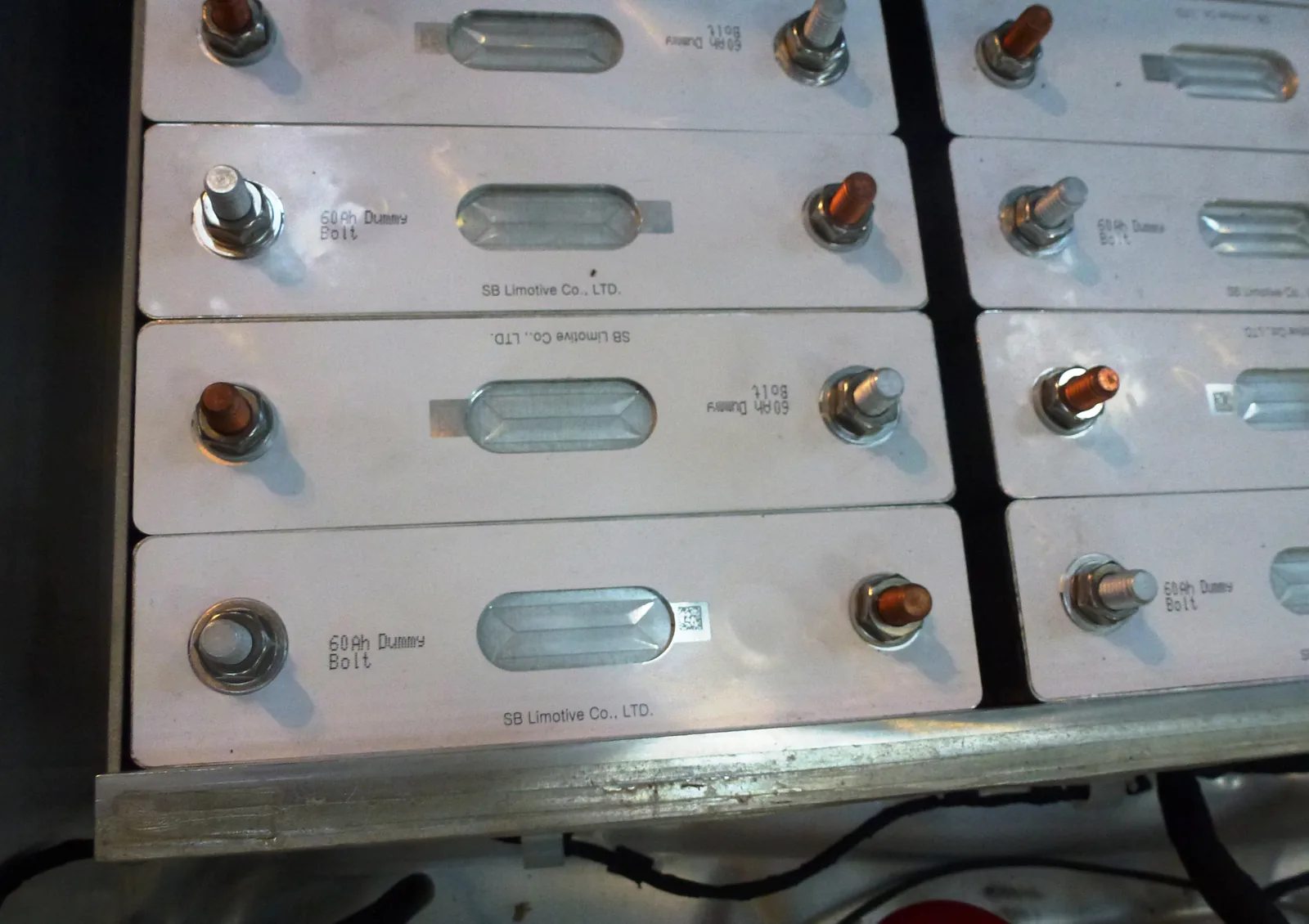
- Lithium-Ion Battery for BMW i3 - SB-LiMotive Cells. RudolfSimon. source, CC BY-SA 3.0
