
Electric charge and Coulomb's law
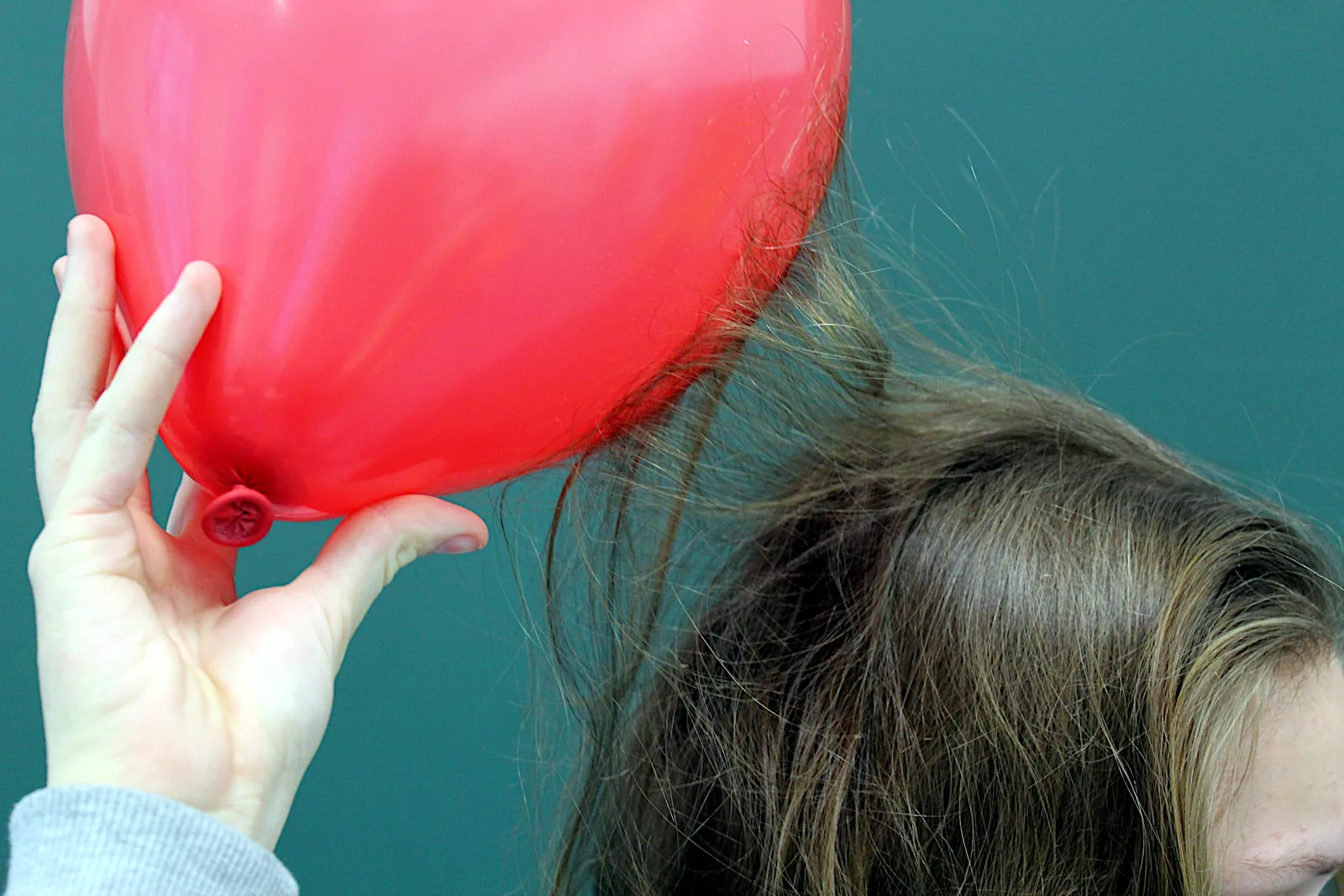
Why does a balloon rubbed on a wool sweater stick to a wall, although the wall has no electric charge?
Prior knowledge
- Electric current is moving charge, $I = Q : t$, and the charge of an electron is $-e$chapter Electric circuit, current and voltage
- A force and its reaction force are equal in magnitude and opposite in directionchapter Interaction and force: Newton's first and third laws
Core path: follow the steps in order. Tasks marked Optional give extra practice. Optional tasks: 3.
Think about it
Rub a balloon on a wool sweater for a moment and hold it against a wall. The balloon stays stuck to the wall without tape and stays there for a long time. In the same way, a plastic comb rubbed on hair lifts small bits of paper from a table. The wall and the paper are not charged, and nothing has been rubbed on them.
Why does a charged balloon stick to a wall that has no electric charge?
Optional Review: electric current and charge
Predict
Make your predictions before investigating 3 questions
Prediction 1: distance and force
Prediction 2: a larger charge
Prediction 3: why does the balloon stick to the wall?
Investigate
Adjust the charges of the spheres and the distance, and watch how the force arrows and readings change. Mark points on the graph: how does the force depend on the distance?
Simulation
How to use
The sliders set the charges of the spheres $q_1$ and $q_2$ between $-40$ and $+40\,\text{nC}$ and the distance between the centres of the spheres $r$ between $3.0$ and $12\,\text{cm}$. The red arrow $\overline{F}_{21}$ is the force with which sphere 2 acts on sphere 1, and $\overline{F}_{12}$ the force with which sphere 1 acts on sphere 2. The arrows are drawn above the spheres, and their length is proportional to the magnitude of the force; a very long arrow is cut short. Mark a point adds the present force and distance to the graph, which shows the points marked with the same charges. Horizontal axis switches the horizontal axis of the graph to the distance $r$ or to the inverse of the square of the distance, $\tfrac{1}{r^2}$. Field lines shows the field lines of the common electric field of the spheres.
Assumptions of the model
The spheres are small compared with their distance, so in the model they are point charges in air, and their charges stay in place. In real spheres the charge shifts slightly on the surface when they are close together because of induction, so at very short distances the force differs from the model's value. The model also has no induction: when the charge of one sphere is zero, there is no force, although a real uncharged metal sphere would move towards a charged one. The numbers are values calculated by the model, not measurements.
How the calculation works
The magnitude of the force is calculated with Coulomb's law
$$F = k\,\frac{\lvert q_1 q_2 \rvert}{r^2}$$
where $k = 8.988 \cdot 10^{9}\,\tfrac{\text{N} \cdot \text{m}^2}{\text{C}^2}$, the charges are converted to coulombs ($1\,\text{nC} = 10^{-9}\,\text{C}$) and the distance to metres, and the result is shown in millinewtons. The same $F$ acts on both spheres in opposite directions: away from the other sphere for charges of the same sign and towards the other sphere for charges of opposite signs. The field lines are drawn in small steps along the direction of the common field of the two point charges.
Experiment 1: force and distance
Test prediction 1. The charges of the spheres, $+20\,\text{nC}$, stay constant; change only the distance $r$. Record the force at least at the distances $3.0\,\text{cm}$, $6.0\,\text{cm}$ and $12\,\text{cm}$ and mark the points on the graph. Finally, switch the horizontal axis to the inverse of the square of the distance. How does the force change when the distance doubles?
Initial state: charge $q_1$ = $20\,\text{nC}$, charge $q_2$ = $20\,\text{nC}$, distance $r$ = $6\,\text{cm}$. Kept constant: charge $q_1$, charge $q_2$. Varied: distance $r$.
| distance $r$ | $F$ $(\text{mN})$ |
|---|
How many times larger is the force at a distance of $3.0\,\text{cm}$ than at a distance of $12\,\text{cm}$? Calculate from the readings in your table.
Hint 1: a guiding question
Find the forces at the distances $3.0\,\text{cm}$ and $12\,\text{cm}$ in the table.
Hint 2: what is the connection
Divide the force at the shorter distance by the force at the longer distance.
Hint 3: an intermediate step
With the model's values $3.99\,\text{mN} : 0.250\,\text{mN}$. The distance is four times as large, so what does the result tell about how the force depends on the distance?
Show the solution
Given
the model's readings when $q_1 = q_2 = +20\,\text{nC}$: at a distance $r_1 = 3.0\,\text{cm}$ the force is $F_1 = 3.99\,\text{mN}$ and at a distance $r_2 = 12\,\text{cm}$ the force is $F_2 = 0.250\,\text{mN}$
Find
the ratio of the forces $F_1 : F_2$
Principle
The charges stay the same, so only the distance changes the force. The ratio tells how many times larger the force is at the shorter distance, and it can be compared with the ratio of the distances.
Formula
the ratio is $\dfrac{F_1}{F_2}$
Conversions
Not needed: both forces are in millinewtons, and the unit cancels.
Substitution
Answer
$16$
; the model's readings have three significant figures.
Reasonableness
The distance is four times as large, and $4^2 = 16$. So the force is inversely proportional to the square of the distance, as Coulomb's law says. If the force were inversely proportional to the distance alone, the ratio would be only $4$.
Experiment 2: charge, force and reaction force
Test prediction 2. The charge of sphere 1, $+20\,\text{nC}$, and the distance $6.0\,\text{cm}$ stay constant; change only the charge of sphere 2, $q_2$. Record the forces on both spheres at least with the charges $+10\,\text{nC}$, $+20\,\text{nC}$ and $+40\,\text{nC}$, and finally try a negative charge. Which sphere has the larger force on it?
Initial state: charge $q_1$ = $20\,\text{nC}$, charge $q_2$ = $20\,\text{nC}$, distance $r$ = $6\,\text{cm}$. Kept constant: charge $q_1$, distance $r$. Varied: charge $q_2$.
| charge $q_2$ | $F_{21}$ $(\text{mN})$ | $F_{12}$ $(\text{mN})$ |
|---|
Conclusion: Coulomb's force
Based on your tables, write: how does the force depend on the distance between the spheres and on the charge of sphere 2? Which sphere has the larger force on it, and what changed when the sign of the charge was changed?
Model answer
When the distance doubled from $3.0\,\text{cm}$ to $6.0\,\text{cm}$, the force dropped from $3.99\,\text{mN}$ to $0.999\,\text{mN}$, that is, to a quarter, and at four times the distance, $12\,\text{cm}$, it was a sixteenth, $0.250\,\text{mN}$. So the force is inversely proportional to the square of the distance: when the horizontal axis is $\tfrac{1}{r^2}$, the points lie on a straight line through the origin. When the charge of sphere 2 doubled from $+20\,\text{nC}$ to $+40\,\text{nC}$, the force doubled from $0.999\,\text{mN}$ to $2.00\,\text{mN}$, so the force is directly proportional to the charge. Both spheres always had an equal force on them, even when the charges were different. When $q_2$ was changed to negative, the magnitude of the force stayed the same, but the spheres began to attract each other. The values are calculated by the model.
Assess your own answer
Tick the points your own answer already contains.
Review the theory summary and practise with the exercises.
Theory summary
Key idea
Electric charge and elementary charge
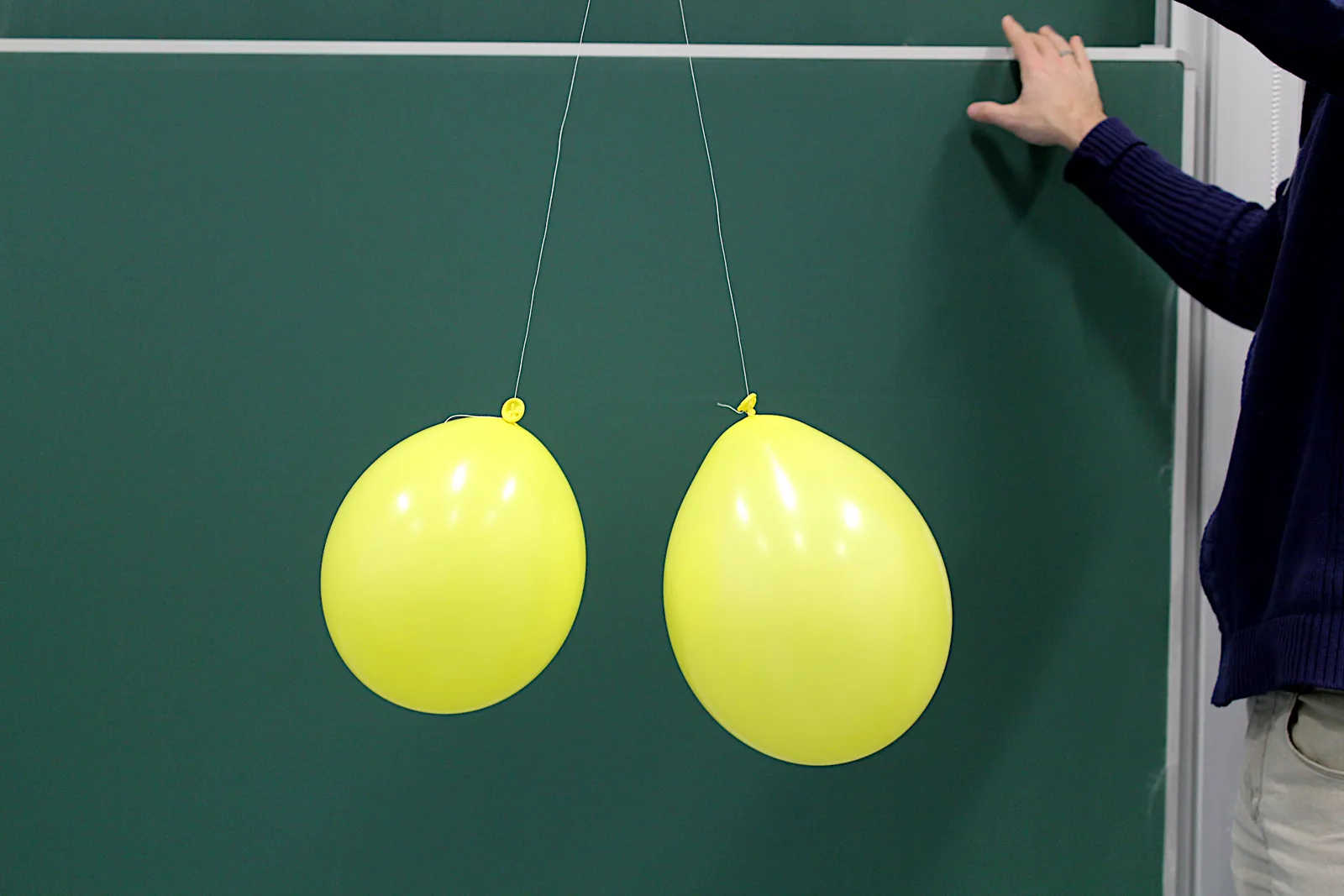
The atoms of matter contain positively charged protons and negatively charged electrons (chapter Electric circuit, current and voltage). Electric charge is a property of particles that makes them act on each other through the electric interaction: charges of the same sign repel each other and charges of opposite signs attract each other. The symbol of charge is $Q$ or $q$, and its unit is the coulomb $\text{C}$. The charge of a proton is $+e$ and that of an electron $-e$, where $e$ is the elementary charge, the smallest charge that occurs free. A neutron has no charge.
An ordinary object has as many protons as electrons, so its total charge is zero: the object is electrically neutral. An object is charged when it has more or fewer electrons than protons. Charge is always made of whole elementary charges:
$$Q = n e$$
where $Q$ is the magnitude of the charge of the object ($\text{C}$), $n$ is the number of extra or missing electrons and $e = 1.602 \cdot 10^{-19}\,\text{C}$ is the elementary charge. The coulomb is a large charge, since it takes $6.24 \cdot 10^{18}$ elementary charges. The charge of a balloon charged by rubbing is typically tens of nanocoulombs: a charge of $-50\,\text{nC}$ means about $3.1 \cdot 10^{11}$ extra electrons.
Conservation of charge
Charge is neither created nor destroyed. The total charge of an isolated system, that is, the sum of all its charges, stays the same, even though charge moves from one object to another. This is the law of conservation of charge. When a balloon is rubbed on wool, some of the electrons of the wool move to the surface of the balloon. The balloon gets a negative charge, and the wool is left with an equal positive charge, because it is missing the same number of electrons. In solids it is the electrons that move; the protons stay in the nuclei of the atoms.
Charging objects
An object can be charged in three ways.
- Rubbing. Two different materials are rubbed against each other, and electrons move from the material that holds them more weakly to the other material. The objects become equally charged with opposite signs.
- Contact. A charged object touches a conductor, and some of the charge moves to the conductor. Two identical metal spheres share their common charge equally in contact: if the charges are first $+12\,\text{nC}$ and $0\,\text{nC}$, the charge of each is $+6\,\text{nC}$ after the contact.
- Induction. A charged object is brought near a conductor without touching it. The free electrons of the conductor move, so a charge of opposite sign appears on the near side of the conductor and a charge of the same sign on the far side. The total charge of the conductor does not change. However, if the conductor is connected to the ground for a moment with a wire, some electrons move to the ground or from the ground to the conductor, and the conductor is left charged.
Why a charged object attracts a neutral object
Induction explains why a charged object also attracts a neutral object. The charge of opposite sign on a metal sphere is nearer to the charged rod than the charge of the same sign. The electric force weakens as the distance grows, so the attraction is greater than the repulsion, and the sphere is drawn towards the rod.
In an insulator the electrons cannot move from one object to another, but the charges in each molecule shift slightly: the molecule becomes polarised. Next to a negatively charged balloon, the positive ends of the molecules in the wall turn towards the balloon. The wall stays neutral, but the positive ends nearby attract the balloon more than the negative ends farther away repel it. That is why the balloon stays on the wall and the comb lifts bits of paper.
Electric current is moving charge
When charge moves from one place to another, an electric current flows. In a conductor the current is the charge that passes through the cross-section in a unit of time, $I = Q : t$ (chapter Electric circuit, current and voltage). The same holds for a spark and for lightning. When you touch a door handle on a dry winter day, a charge, typically under a microcoulomb, is discharged from your body in a spark. The discharge lasts only about a microsecond, so the current is for a moment of the order of an ampere, although the charge that moves is small.
There is an electric field around a charge
A charged object acts on another charged object without touching it. This is described with an electric field: a charge changes the space around it so that an electric force acts on another charge there. The field is illustrated with field lines. The direction of a field line is the direction in which the force on a small positive test charge points; the force on a negative charge points against the field line.
A point charge is a charged object whose size is small compared with the distances considered. From a positive point charge the field lines go out radially, and into a negative point charge they come in radially. Near the charge the lines are close together and the field is strong; farther away the lines spread out and the field weakens. The strength of the field is handled with calculations in the chapter Uniform electric field.
Coulomb's law
The magnitude of the electric force between two point charges is directly proportional to the product of the charges and inversely proportional to the square of the distance between them. This is Coulomb's law:
$$F = k\,\frac{\lvert q_1 q_2 \rvert}{r^2}$$
where $F$ is the magnitude of the force ($\text{N}$), $q_1$ and $q_2$ are the charges ($\text{C}$), $r$ is the distance between the charges ($\text{m}$) and $k = 8.988 \cdot 10^{9}\,\tfrac{\text{N} \cdot \text{m}^2}{\text{C}^2}$ is the constant of Coulomb's law. The law holds for point charges and for uniformly charged spheres, whose distance is measured between the centres. The value of the constant holds in a vacuum; in air the force is almost the same.
Force and reaction force
Coulomb's law gives the magnitude of the force. The direction of the force is worked out from the signs of the charges: the forces lie on the line between the charges, and charges of the same sign repel and charges of opposite signs attract each other. The charge $q_1$ acts on the charge $q_2$ with the force $\overline{F}_{12}$, and the charge $q_2$ acts on the charge $q_1$ with the force $\overline{F}_{21}$. They are a force and its reaction force, $\overline{F}_{12} = -\overline{F}_{21}$ (chapter Interaction and force: Newton's first and third laws), so they are equal in magnitude and opposite in direction, also when the charges are of different sizes. In the formula of the law the charges appear symmetrically, so the same $F$ acts on both charges.
The square of the distance
The force depends strongly on the distance. When the distance doubles, the denominator $r^2$ becomes four times as large and the force drops to a quarter. At three times the distance the force is a ninth and at four times the distance a sixteenth. On the charges, in contrast, the force is directly proportional: when one charge doubles, the force doubles. In the graph each charge is $20\,\text{nC}$. At a distance of $3\,\text{cm}$ the force is $4.0\,\text{mN}$ and at a distance of $6\,\text{cm}$ only $1.0\,\text{mN}$.
The forces of several charges
When several other charges act on a charge, the force of each charge is calculated separately with Coulomb's law, as if the others were not there. The net force on the charge is the vector sum of these forces:
$$\overline{F} = \overline{F}_1 + \overline{F}_2$$
where $\overline{F}$ is the net force ($\text{N}$) and $\overline{F}_1$ and $\overline{F}_2$ are the forces that two other charges exert on it ($\text{N}$). When all the charges are on the same line, forces in the same direction are added and forces in opposite directions are subtracted from each other.
Common misconception
Many people think that a larger charge acts on a smaller one with a greater force than the smaller acts on the larger. The forces between the charges are, however, a force and its reaction force: they are always equal in magnitude and opposite in direction. Coulomb's law contains the product of the charges, so doubling both charges quadruples the same force that acts on both.
Another mistake is to think that no electric force acts on a neutral object. A charged object attracts a neutral object, because induction or polarisation brings the charge of opposite sign nearer than the charge of the same sign. A third mistake is to believe that rubbing creates charge. Rubbing only moves electrons from one object to another, and the total charge is conserved.
Summary
- Charge is a multiple of the elementary charge, $Q = ne$, $e = 1.602 \cdot 10^{-19}\,\text{C}$. Charges of the same sign repel and charges of opposite signs attract each other.
- Charge is conserved: in rubbing and contact, electrons only move from one object to another. Two identical metal spheres share their common charge equally in contact.
- In induction a charged object moves the charges of a conductor, and in an insulator it polarises the molecules, so a charged object attracts a neutral object.
- Electric current is moving charge, $I = Q : t$.
- The field lines of a point charge are radial: outwards from a positive charge and inwards into a negative one, and the field weakens as the distance grows.
- Coulomb's law $F = k\,\tfrac{\lvert q_1 q_2 \rvert}{r^2}$: double the distance gives a quarter of the force. A force and its reaction force are equal, and the forces of several charges are added as vectors.
Optional Return to your predictions
Compare your predictions with the model's values from the experiments and with the theory. Then return to the question at the start: why does a charged balloon stay stuck to a neutral wall?
Would you change your prediction?
Apply
Worked example
Problem
Two small metal spheres are on insulating rods so that the distance between the centres of the spheres is $6.0\,\text{cm}$. The charge of one sphere is $+12\,\text{nC}$ and that of the other $-8.0\,\text{nC}$. How large is the electric force between the spheres, and do the spheres attract or repel each other?
Step 1/7
Given and find. $q_1 = +12\,\text{nC}$, $q_2 = -8.0\,\text{nC}$ and $r = 6.0\,\text{cm}$. We are asked for the magnitude of the force $F$ and whether the spheres attract or repel each other.
Step 2/7
Principle. The spheres are small compared with their distance, so they can be treated as point charges, and Coulomb's law gives the magnitude of the force. The direction of the force is worked out from the signs: charges of opposite signs attract each other. An equal force acts on each sphere.
Step 3/7
Formula solved.
$$F = k\,\frac{\lvert q_1 q_2 \rvert}{r^2}$$
Step 4/7
Conversions.
The absolute value of the product of the charges is
Step 5/7
Substitution. $$\begin{aligned} F &= k\,\frac{\lvert q_1 q_2 \rvert}{r^2} \\ &= 8.988 \cdot 10^{9}\,\tfrac{\text{N} \cdot \text{m}^2}{\text{C}^2} \\ &\quad \cdot \frac{9.6 \cdot 10^{-17}\,\text{C}^2}{(0.060\,\text{m})^2} \\ &= 2.397 \cdot 10^{-4}\,\text{N} \end{aligned}$$
Step 6/7
Answer. The force is $2.4 \cdot 10^{-4}\,\text{N} = 0.24\,\text{mN}$, two significant figures like the charge $8.0\,\text{nC}$ and the distance $6.0\,\text{cm}$. The spheres attract each other, because their charges have opposite signs.
Step 7/7
Reasonableness. With rounded numbers $10^{10} \cdot 10^{-16} : 0.004 \approx 2.5 \cdot 10^{-4}$, so the order of magnitude is right. The force is equal to the weight of a mass of about $24\,\text{mg}$, so it is small, but it is enough to move light objects. At half the distance the force would be four times as large, $0.96\,\text{mN}$.
Find the error
Apply to a new situation
$1.0 \cdot 10^{11}$ electrons are moved onto each of two identical small metal spheres. The distance between the centres of the spheres is $5.0\,\text{cm}$.
How large is the electric force between the spheres? Give the answer in millinewtons.
Hint 1: a guiding question
What is the charge of each sphere when $1.0 \cdot 10^{11}$ electrons have been moved onto it?
Hint 2: what is the connection
The charge is $Q = ne$. Then substitute the charges and the distance in metres into Coulomb's law.
Hint 3: an intermediate step
The charge of each sphere is
and $r = 0.050\,\text{m}$.
Show the solution
Given
the number of electrons moved onto each sphere $n = 1.0 \cdot 10^{11}$, the distance $r = 5.0\,\text{cm}$; the elementary charge $e = 1.602 \cdot 10^{-19}\,\text{C}$ and the constant of Coulomb's law $k = 8.988 \cdot 10^{9}\,\tfrac{\text{N} \cdot \text{m}^2}{\text{C}^2}$
Find
the magnitude of the force between the spheres $F$ in millinewtons
Principle
Charge is made of elementary charges, so the charge of each sphere is $Q = ne$, and the spheres are negative. The spheres are small compared with the distance, so they can be treated as point charges, and the magnitude of the force comes from Coulomb's law. Having charges of the same sign, the spheres repel each other.
Formula
so with equal charges $F = \dfrac{k (ne)^2}{r^2}$
Conversions
the answer is converted to millinewtons, $1\,\text{N} = 1000\,\text{mN}$.
Substitution
Answer
$0.92\,\text{mN}$
Two significant figures like the number of electrons and the distance.
Reasonableness
The charge of each sphere is about $16\,\text{nC}$, a little under the $20\,\text{nC}$ of the simulation. In the simulation spheres of $20\,\text{nC}$ at a distance of $6.0\,\text{cm}$ repel each other with a force of $1.0\,\text{mN}$, so a force of under a millinewton is believable with smaller charges and a slightly shorter distance.
Check your understanding
Exit ticket
Answer on your own first and only then open the answer.
- The charge of an object is $+3.2 \cdot 10^{-19}\,\text{C}$. How many electrons is the object missing?
Answer
Charge is made of elementary charges, so
$n$$= Q : e$$= 3.2 \cdot 10^{-19}\,\text{C} : 1.602 \cdot 10^{-19}\,\text{C}$$\approx 2$The object is missing two electrons, and that is why it is positive.
- Both charges of two point charges are doubled, and at the same time the distance between them is doubled. How does the force between them change?
Answer
The force does not change. The product of the charges becomes four times as large, and the denominator $r^2$ of Coulomb's law also becomes four times as large, so they cancel: $\tfrac{2 \cdot 2}{2^2} = 1$.
1. Concept
2. Read the graph
The graph shows the force $F$ between two identical, equally charged small spheres as a function of the distance $r$ between them. Determine the charge of the spheres from the graph. Give the answer in nanocoulombs.
Hint 1: a guiding question
Choose a point on the graph whose values you can read accurately from the grid.
Hint 2: what is the connection
At the point $r = 3.0\,\text{cm}$ the force is $9.0\,\text{mN}$. When the charges are equal, Coulomb's law is $F = k\,\tfrac{q^2}{r^2}$.
Hint 3: an intermediate step
Solve $q = r\sqrt{\tfrac{F}{k}}$ and substitute $r = 0.030\,\text{m}$ and $F = 9.0 \cdot 10^{-3}\,\text{N}$.
Show the solution
Given
the points of the graph; the spheres are identical and equally charged, $q_1 = q_2 = q$; $k = 8.988 \cdot 10^{9}\,\tfrac{\text{N} \cdot \text{m}^2}{\text{C}^2}$
Find
the charge of the spheres $q$ in nanocoulombs
Principle
The spheres are small compared with the distance, so the force between them comes from Coulomb's law. When the charges are equal, the product of the charges is $q^2$, and $r$ and $F$ of one point read from the graph are enough to solve the charge.
Reading the graph
The point $r = 3.0\,\text{cm}$ is on a vertical grid line, and the force there is on the horizontal line of $9.0\,\text{mN}$. The largest force was chosen because its relative reading uncertainty is the smallest.
Formula
$F = k\,\dfrac{q^2}{r^2}$, so $q = r\sqrt{\dfrac{F}{k}}$
Conversions
finally $1\,\text{C} = 10^{9}\,\text{nC}$.
Substitution
Answer
$30\,\text{nC}$
Two significant figures, because the force $9.0\,\text{mN}$ is read from the graph with two significant figures.
Reasonableness
Checked with another point, $k\,\tfrac{q^2}{r^2}$ gives at a distance of $9.0\,\text{cm}$ the force
as in the graph. At three times the distance the force is a ninth.
Suggestion: one answer does not show everything you can do, but review the theory summary and do the core exercises.
Optional 3. Explain induction
A negatively charged plastic rod is brought near an empty aluminium drink can lying on its side on a table. The can starts to roll towards the rod, although it is uncharged and the rod does not touch it. Explain why.
Model answer
Aluminium is a conductor with free electrons. The negative charge of the rod repels them, so electrons move to the side of the can farther from the rod. A positive charge is left on the side facing the rod and an equal negative charge on the far side, so the can is still neutral as a whole. This is called induction. The positive charge is nearer to the rod than the negative one, and the electric force weakens as the distance grows. So the attraction of the rod on the positive side of the can is greater than the repulsion on the negative side, and a net force towards the rod acts on the can.
Assess your own answer
Tick the points your own answer already contains.
Review the theory summary and practise with the exercises.
Exercises
Level 1 · basic practice 5 exercises
One formula or one step of reasoning. Core exercises first, the rest is extra practice.
- Exercise 10-1Core
The charge of a comb rubbed on hair is $-6.4\,\text{nC}$. How many extra electrons does the comb have? The elementary charge is $e = 1.602 \cdot 10^{-19}\,\text{C}$.
Answer
$4.0 \cdot 10^{10}$
Show the solution
Given
charge of the comb $Q = -6.4\,\text{nC}$, elementary charge $e = 1.602 \cdot 10^{-19}\,\text{C}$
Find
the number of extra electrons $n$
Principle
Charge is always made of whole elementary charges. The comb is negative because it has more electrons than protons, and each extra electron brings a charge of $-e$. So the magnitude of the charge is the number of extra electrons times the elementary charge.
Formula
$Q = ne$, so $n = \dfrac{Q}{e}$, when $Q$ is the magnitude of the charge
Conversions
$Q$$= 6.4\,\text{nC}$$= 6.4 \cdot 10^{-9}\,\text{C}$Substitution
$n$$= \dfrac{6.4 \cdot 10^{-9}\,\text{C}}{1.602 \cdot 10^{-19}\,\text{C}}$$= 3.995 \cdot 10^{10}$Answer
$4.0 \cdot 10^{10}$
Electrons, two significant figures like the charge $6.4\,\text{nC}$.
Reasonableness
One coulomb takes about $6 \cdot 10^{18}$ elementary charges, so a nanocoulomb takes about $6 \cdot 10^{9}$, and $6.4\,\text{nC}$ about six times as many, $4 \cdot 10^{10}$. The number is huge, but it is only a small part of all the electrons of the comb.
- Exercise 10-2Core
The charges of two small spheres are $+15\,\text{nC}$ and $+25\,\text{nC}$, and the distance between the centres of the spheres is $4.0\,\text{cm}$.
How large is the electric force between the spheres? Give the answer in millinewtons.
Answer
$2.1\,\text{mN}$
Show the solution
Given
charges $q_1 = +15\,\text{nC}$ and $q_2 = +25\,\text{nC}$, distance $r = 4.0\,\text{cm}$; the constant of Coulomb's law $k = 8.988 \cdot 10^{9}\,\tfrac{\text{N} \cdot \text{m}^2}{\text{C}^2}$
Find
the magnitude of the force between the spheres $F$ in millinewtons
Principle
The spheres are small compared with their distance, so they can be treated as point charges, and the magnitude of the force comes from Coulomb's law. The charges have the same sign, so the spheres repel each other.
Formula
$F$$= k\,\dfrac{\lvert q_1 q_2 \rvert}{r^2}$Conversions
$q_1 = 15 \cdot 10^{-9}\,\text{C}$,
$q_2$$= 25 \cdot 10^{-9}\,\text{C}$$r$$= 4.0 \cdot 0.01\,\text{m}$$= 0.040\,\text{m}$finally $1\,\text{N} = 1000\,\text{mN}$.
Substitution
$F$$= 8.988 \cdot 10^{9}\,\tfrac{\text{N} \cdot \text{m}^2}{\text{C}^2} \cdot \dfrac{15 \cdot 10^{-9}\,\text{C} \cdot 25 \cdot 10^{-9}\,\text{C}}{(0.040\,\text{m})^2}$$= 2.107 \cdot 10^{-3}\,\text{N}$$= 2.107\,\text{mN}$Answer
$2.1\,\text{mN}$
Two significant figures like the charges and the distance.
Reasonableness
The product of the charges is $3.75 \cdot 10^{-16}\,\text{C}^2$ and $r^2 = 1.6 \cdot 10^{-3}\,\text{m}^2$, so the estimate
$9 \cdot 10^{9} \cdot 4 \cdot 10^{-16} : 1.6 \cdot 10^{-3}$$\approx 2 \cdot 10^{-3}\,\text{N}$is close. In the simulation two spheres of $20\,\text{nC}$ at a distance of $3.0\,\text{cm}$ repel each other with a force of $4.0\,\text{mN}$, so a force of a few millinewtons is believable.
- Exercise 10-3
In lightning, a charge of $5.0\,\text{C}$ moves between a thundercloud and the ground in a time of $0.20\,\text{ms}$.
How large is the average electric current? Give the answer in kiloamperes.
Answer
$25\,\text{kA}$
Show the solution
Given
the charge that moved in the lightning $Q = 5.0\,\text{C}$, time $t = 0.20\,\text{ms}$
Find
the average electric current $I$ in kiloamperes
Principle
Electric current is moving charge: the current tells how large a charge moves in a unit of time. So the average current is the charge that moved divided by the time, even though the real current in lightning varies.
Formula
$I = \dfrac{Q}{t}$
Conversions
$t$$= 0.20\,\text{ms}$$= 0.20 \cdot 0.001\,\text{s}$$= 2.0 \cdot 10^{-4}\,\text{s}$finally $1\,\text{kA} = 1000\,\text{A}$.
Substitution
$I$$= \dfrac{5.0\,\text{C}}{2.0 \cdot 10^{-4}\,\text{s}}$$= 25\,000\,\text{A}$$= 25\,\text{kA}$Answer
$25\,\text{kA}$
Two significant figures like the charge and the time.
Reasonableness
The unit is right, $1\,\text{C/s} = 1\,\text{A}$. A charge of $5\,\text{C}$ is small, but it moves in under a millisecond, so the current is tens of thousands of amperes; the peak currents of lightning are typically of just this order of magnitude.
- Exercise 10-4
The charges of two identical metal spheres are $+12\,\text{nC}$ and $-4.0\,\text{nC}$. The spheres are touched together and separated.
How large is the charge of each sphere after the contact? Give the answer in nanocoulombs.
Answer
$+4.0\,\text{nC}$
Show the solution
Given
the charges of the spheres before the contact $Q_1 = +12\,\text{nC}$ and $Q_2 = -4.0\,\text{nC}$; the spheres are identical
Find
the charge $Q$ of each sphere after the contact in nanocoulombs
Principle
Charge is conserved: in contact electrons only move from one sphere to the other, so the common charge of the spheres is the same before and after. Identical metal spheres share their common charge equally, so each gets half.
Formula
$Q_1 + Q_2 = 2Q$, so $Q = \dfrac{Q_1 + Q_2}{2}$
Conversions
Not needed: all the charges are in nanocoulombs, and the answer is asked in the same unit.
Substitution
$Q$$= \dfrac{12\,\text{nC} + (-4.0\,\text{nC})}{2}$$= \dfrac{8.0\,\text{nC}}{2}$$= 4.0\,\text{nC}$Answer
$+4.0\,\text{nC}$
On each, two significant figures like the charge $4.0\,\text{nC}$.
Reasonableness
The common charge is $+8.0\,\text{nC}$ before and $2 \cdot 4.0\,\text{nC} = 8.0\,\text{nC}$ after, so the charge was conserved. The negative sphere has lost its extra electrons and more, so both became positive.
- Exercise 10-5
Two point charges, $+2.0\,\mu\text{C}$ and $-4.0\,\mu\text{C}$, are $0.50\,\text{m}$ apart. How large is the electric force between them?
Answer
$0.29\,\text{N}$
Show the solution
Given
charges $q_1 = +2.0\,\mu\text{C}$ and $q_2 = -4.0\,\mu\text{C}$, distance $r = 0.50\,\text{m}$; $k = 8.988 \cdot 10^{9}\,\tfrac{\text{N} \cdot \text{m}^2}{\text{C}^2}$
Find
the magnitude of the force between the charges $F$ in newtons
Principle
The charges are point charges, so Coulomb's law gives the magnitude of the force. The sign does not affect the magnitude, because the law has the absolute value of the product; charges of opposite signs attract each other.
Formula
$F$$= k\,\dfrac{\lvert q_1 q_2 \rvert}{r^2}$Conversions
$\lvert q_1 \rvert$$= 2.0\,\mu\text{C}$$= 2.0 \cdot 10^{-6}\,\text{C}$$\lvert q_2 \rvert = 4.0 \cdot 10^{-6}\,\text{C}$; the distance is already in metres.
Substitution
$F$$= 8.988 \cdot 10^{9}\,\tfrac{\text{N} \cdot \text{m}^2}{\text{C}^2} \cdot \dfrac{2.0 \cdot 10^{-6}\,\text{C} \cdot 4.0 \cdot 10^{-6}\,\text{C}}{(0.50\,\text{m})^2}$$= 0.2876\,\text{N}$Answer
$0.29\,\text{N}$
Two significant figures like the charges and the distance; the charges attract each other.
Reasonableness
Estimate: $10^{10} \cdot 8 \cdot 10^{-12} : 0.25 \approx 0.3\,\text{N}$. Microcoulombs are a thousand times larger than nanocoulombs, so the force is much larger than the millinewtons of the experiments, although the distance is longer.
Level 2 · applied practice 4 exercises
Two steps, working with measured data, a unit conversion or rearranging a formula. Core exercises first, the rest is extra practice.
- Exercise 10-6Core
Two small spheres, each with a charge of $+30\,\text{nC}$, repel each other with a force of $2.0\,\text{mN}$.
How far apart are the centres of the spheres? Give the answer in centimetres.
Answer
$6.4\,\text{cm}$
Show the solution
Given
charges $q_1 = q_2 = +30\,\text{nC}$, force $F = 2.0\,\text{mN}$; $k = 8.988 \cdot 10^{9}\,\tfrac{\text{N} \cdot \text{m}^2}{\text{C}^2}$
Find
the distance between the centres of the spheres $r$ in centimetres
Principle
The spheres are small, so Coulomb's law holds when the distance is measured between the centres. The distance is solved from the law: the force is inversely proportional to the square of the distance, so the distance comes as a square root.
Formula
$F$$= k\,\dfrac{\lvert q_1 q_2 \rvert}{r^2}$so
$r$$= \sqrt{\dfrac{k \lvert q_1 q_2 \rvert}{F}}$Conversions
$q_1$$= q_2$$= 30 \cdot 10^{-9}\,\text{C}$$F$$= 2.0\,\text{mN}$$= 2.0 \cdot 10^{-3}\,\text{N}$finally $1\,\text{m} = 100\,\text{cm}$.
Substitution
$r^2$$= 8.988 \cdot 10^{9}\,\tfrac{\text{N} \cdot \text{m}^2}{\text{C}^2} \cdot \dfrac{(30 \cdot 10^{-9}\,\text{C})^2}{2.0 \cdot 10^{-3}\,\text{N}}$$= 4.045 \cdot 10^{-3}\,\text{m}^2$so
$r$$= \sqrt{4.045 \cdot 10^{-3}\,\text{m}^2}$$= 0.0636\,\text{m}$$= 6.36\,\text{cm}$Answer
$6.4\,\text{cm}$
Two significant figures like the charges and the force.
Reasonableness
Substituting back:
$8.988 \cdot 10^{9} \cdot 9.0 \cdot 10^{-16} : 0.0636^2\,\text{N}$$= 2.0 \cdot 10^{-3}\,\text{N}$In addition, spheres of $20\,\text{nC}$ at a distance of $6.0\,\text{cm}$ repel each other with a force of $1.0\,\text{mN}$, so with larger charges a force twice as large at the same distance is believable.
- Exercise 10-7Core
When the distance between the centres of two charged spheres is $4.0\,\text{cm}$, the force between them is $3.6\,\text{mN}$. The spheres are moved to a distance of $10\,\text{cm}$ from each other, and their charges stay the same.
How large is the force now? Give the answer in millinewtons.
Answer
$0.58\,\text{mN}$
Show the solution
Given
force $F_1 = 3.6\,\text{mN}$ at a distance $r_1 = 4.0\,\text{cm}$, new distance $r_2 = 10\,\text{cm}$; the charges stay the same
Find
the force $F_2$ in millinewtons
Principle
In Coulomb's law the charges and $k$ stay the same, so the force is inversely proportional to the square of the distance. When the law is written for both distances and divided, the unknown charges cancel.
Formula
$\dfrac{F_2}{F_1}$$= \dfrac{r_1^2}{r_2^2}$so
$F_2$$= F_1 \left(\dfrac{r_1}{r_2}\right)^2$Conversions
Not needed: in the ratio of the distances the centimetres cancel, and the force comes in the same unit as $F_1$.
Substitution
$F_2$$= 3.6\,\text{mN} \cdot \left(\dfrac{4.0\,\text{cm}}{10\,\text{cm}}\right)^2$$= 3.6\,\text{mN} \cdot 0.16$$= 0.576\,\text{mN}$Answer
$0.58\,\text{mN}$
Two significant figures like the force and the distance $4.0\,\text{cm}$.
Reasonableness
The distance becomes $2.5$ times as large, so the force drops to $2.5^2 = 6.25$ times smaller: $3.6\,\text{mN} : 6.25 = 0.58\,\text{mN}$. The force dropped clearly more than the distance grew, as follows from the square of the distance.
- Exercise 10-8
The charges of two identical metal spheres are $+18\,\text{nC}$ and $-6.0\,\text{nC}$. The spheres are touched together and separated so that the distance between their centres is $4.0\,\text{cm}$.
How large is the force between the spheres now? Give the answer in millinewtons.
Answer
$0.20\,\text{mN}$
Show the solution
Given
the charges before the contact $Q_1 = +18\,\text{nC}$ and $Q_2 = -6.0\,\text{nC}$, distance after the contact $r = 4.0\,\text{cm}$; $k = 8.988 \cdot 10^{9}\,\tfrac{\text{N} \cdot \text{m}^2}{\text{C}^2}$
Find
the magnitude of the force between the spheres $F$ in millinewtons
Principle
Charge is conserved, and identical metal spheres share their common charge equally in contact, so the charge of each is half of the common charge. After that the force comes from Coulomb's law; spheres with charges of the same sign repel each other.
Formula
$q = \dfrac{Q_1 + Q_2}{2}$ and $F = k\,\dfrac{q^2}{r^2}$
Conversions
$r$$= 4.0 \cdot 0.01\,\text{m}$$= 0.040\,\text{m}$$1\,\text{nC} = 10^{-9}\,\text{C}$ and finally $1\,\text{N} = 1000\,\text{mN}$.
Substitution
$q$$= \dfrac{18\,\text{nC} - 6.0\,\text{nC}}{2}$$= 6.0\,\text{nC}$$F$$= 8.988 \cdot 10^{9}\,\tfrac{\text{N} \cdot \text{m}^2}{\text{C}^2} \cdot \dfrac{(6.0 \cdot 10^{-9}\,\text{C})^2}{(0.040\,\text{m})^2}$$= 2.022 \cdot 10^{-4}\,\text{N}$$= 0.2022\,\text{mN}$Answer
$0.20\,\text{mN}$
Two significant figures like the charge $6.0\,\text{nC}$ and the distance.
Reasonableness
Before the contact the spheres attracted each other with a force of
$8.988 \cdot 10^{9} \cdot 18 \cdot 10^{-9} \cdot 6.0 \cdot 10^{-9} : 0.040^2\,\text{N}$$\approx 0.61\,\text{mN}$After the contact the charges are smaller and have the same sign, so the force is smaller and repulsive.
- Exercise 10-9
Two identical small spheres each have a mass of $0.50\,\text{g}$, and they have equal charges. The distance between the centres of the spheres is $5.0\,\text{cm}$.
How large is the charge on the spheres when the electric force between them is equal to the weight of a sphere? Give the answer in nanocoulombs.
Answer
$37\,\text{nC}$
Show the solution
Given
the mass of each sphere $m = 0.50\,\text{g}$, distance $r = 5.0\,\text{cm}$, equal charges; $g = 9.81\,\text{m/s}^2$ and $k = 8.988 \cdot 10^{9}\,\tfrac{\text{N} \cdot \text{m}^2}{\text{C}^2}$
Find
the charge of a sphere $q$ in nanocoulombs
Principle
The electric force is equal to the weight of a sphere, $G = mg$. The spheres are small, so the force comes from Coulomb's law, and with equal charges the product of the charges is $q^2$. The charge is solved as a square root.
Formula
$k\,\dfrac{q^2}{r^2} = mg$, so $q = r\sqrt{\dfrac{mg}{k}}$
Conversions
$m$$= 0.50\,\text{g}$$= 0.50 \cdot 0.001\,\text{kg}$$= 5.0 \cdot 10^{-4}\,\text{kg}$$r$$= 5.0 \cdot 0.01\,\text{m}$$= 0.050\,\text{m}$finally $1\,\text{C} = 10^{9}\,\text{nC}$.
Substitution
$mg$$= 5.0 \cdot 10^{-4}\,\text{kg} \cdot 9.81\,\text{m/s}^2$$= 4.905 \cdot 10^{-3}\,\text{N}$$\dfrac{mg}{k}$$= \dfrac{4.905 \cdot 10^{-3}\,\text{N}}{8.988 \cdot 10^{9}\,\tfrac{\text{N} \cdot \text{m}^2}{\text{C}^2}}$$= 5.457 \cdot 10^{-13}\,\tfrac{\text{C}^2}{\text{m}^2}$$q$$= 0.050\,\text{m} \cdot \sqrt{5.457 \cdot 10^{-13}\,\tfrac{\text{C}^2}{\text{m}^2}}$$= 3.693 \cdot 10^{-8}\,\text{C}$$= 36.94\,\text{nC}$Answer
$37\,\text{nC}$
Two significant figures like the mass and the distance.
Reasonableness
Substituting back:
$8.988 \cdot 10^{9} \cdot (3.69 \cdot 10^{-8})^2 : 0.050^2\,\text{N}$$= 4.9\,\text{mN}$which is the weight of a sphere. The charge is of the same order of magnitude as the tens of nanocoulombs of a balloon charged by rubbing, so the electric force can well lift a light sphere.
Level 3 · challenging 3 exercises
Optional: application, two ideas together or a new situation where you reason for yourself.
- Exercise 10-10
A point charge $q_1 = +20\,\text{nC}$ is at $x = 0$ and a point charge $q_2 = -20\,\text{nC}$ at $x = 10\,\text{cm}$. A point charge $q_3 = +5.0\,\text{nC}$ is brought to the midpoint between them, to $x = 5.0\,\text{cm}$.
How large is the net force on the charge $q_3$? Give the answer in millinewtons.
Answer
$0.72\,\text{mN}$
Show the solution
Given
$q_1 = +20\,\text{nC}$ at $x = 0$, $q_2 = -20\,\text{nC}$ at $x = 10\,\text{cm}$, $q_3 = +5.0\,\text{nC}$ at $x = 5.0\,\text{cm}$; $k = 8.988 \cdot 10^{9}\,\tfrac{\text{N} \cdot \text{m}^2}{\text{C}^2}$
Find
the magnitude of the net force $F$ on the charge $q_3$ in millinewtons
Principle
The force of each charge is calculated separately with Coulomb's law, and the net force is their vector sum. The positive $q_1$ repels the positive $q_3$ in the positive $x$-direction, and the negative $q_2$ attracts $q_3$ towards itself, also in the positive $x$-direction. The forces are in the same direction, so their magnitudes are added. The distances and the magnitudes of the charges are the same, so the forces are equal.
Formula
$F_1$$= k\,\dfrac{\lvert q_1 q_3 \rvert}{r^2}$$F_2$$= k\,\dfrac{\lvert q_2 q_3 \rvert}{r^2}$$F = F_1 + F_2$
Conversions
$r = 5.0\,\text{cm} = 0.050\,\text{m}$, $1\,\text{nC} = 10^{-9}\,\text{C}$ and finally $1\,\text{N} = 1000\,\text{mN}$.
Substitution
$F_1$$= F_2$$= 8.988 \cdot 10^{9}\,\tfrac{\text{N} \cdot \text{m}^2}{\text{C}^2} \cdot \dfrac{20 \cdot 10^{-9}\,\text{C} \cdot 5.0 \cdot 10^{-9}\,\text{C}}{(0.050\,\text{m})^2}$$= 3.595 \cdot 10^{-4}\,\text{N}$$F$$= 2 \cdot 3.595 \cdot 10^{-4}\,\text{N}$$= 7.190 \cdot 10^{-4}\,\text{N}$$= 0.7190\,\text{mN}$Answer
$0.72\,\text{mN}$
In the positive $x$-direction, that is, towards the charge $q_2$, two significant figures like the charge $5.0\,\text{nC}$ and the distance.
Reasonableness
If $q_2$ were positive, the forces would be opposite and would cancel. Between charges of opposite signs the forces reinforce each other, so the net force is twice the force of one charge.
- Exercise 10-11
In a hydrogen atom, the electron and the proton attract each other with both an electric force and a gravitational force $F_\text{g} = G\,\tfrac{m_\text{e} m_\text{p}}{r^2}$, where $G = 6.674 \cdot 10^{-11}\,\tfrac{\text{N} \cdot \text{m}^2}{\text{kg}^2}$. The mass of the electron is $m_\text{e} = 9.109 \cdot 10^{-31}\,\text{kg}$ and that of the proton $m_\text{p} = 1.673 \cdot 10^{-27}\,\text{kg}$.
How many times larger is the electric force than the gravitational force? Also explain why the answer does not depend on the distance.
Answer
$2.27 \cdot 10^{39}$
Show the solution
Given
$G = 6.674 \cdot 10^{-11}\,\tfrac{\text{N} \cdot \text{m}^2}{\text{kg}^2}$, $m_\text{e} = 9.109 \cdot 10^{-31}\,\text{kg}$, $m_\text{p} = 1.673 \cdot 10^{-27}\,\text{kg}$; the values of the chapter $e = 1.602 \cdot 10^{-19}\,\text{C}$ and $k = 8.988 \cdot 10^{9}\,\tfrac{\text{N} \cdot \text{m}^2}{\text{C}^2}$
Find
the ratio of the forces $F_\text{e} : F_\text{g}$ and why it does not depend on the distance
Principle
The charge of an electron is $-e$ and that of a proton $+e$, so the electric force comes from Coulomb's law. Both forces are inversely proportional to the square of the distance, so $r^2$ cancels in the ratio, and the ratio is the same at all distances.
Formula
$F_\text{e}$$= k\,\dfrac{e^2}{r^2}$$F_\text{g}$$= G\,\dfrac{m_\text{e} m_\text{p}}{r^2}$so
$\dfrac{F_\text{e}}{F_\text{g}}$$= \dfrac{k e^2}{G m_\text{e} m_\text{p}}$Conversions
Not needed: all the quantities are in base units, and the units cancel, since
$\tfrac{\text{N} \cdot \text{m}^2}{\text{C}^2} \cdot \text{C}^2$$= \tfrac{\text{N} \cdot \text{m}^2}{\text{kg}^2} \cdot \text{kg}^2$Substitution
$k e^2$$= 8.988 \cdot 10^{9}\,\tfrac{\text{N} \cdot \text{m}^2}{\text{C}^2} \cdot (1.602 \cdot 10^{-19}\,\text{C})^2$$= 2.307 \cdot 10^{-28}\,\text{N} \cdot \text{m}^2$$G m_\text{e} m_\text{p}$$= 6.674 \cdot 10^{-11}\,\tfrac{\text{N} \cdot \text{m}^2}{\text{kg}^2} \cdot 9.109 \cdot 10^{-31}\,\text{kg} \cdot 1.673 \cdot 10^{-27}\,\text{kg}$$= 1.017 \cdot 10^{-67}\,\text{N} \cdot \text{m}^2$so
$\dfrac{F_\text{e}}{F_\text{g}}$$= \dfrac{2.307 \cdot 10^{-28}\,\text{N} \cdot \text{m}^2}{1.017 \cdot 10^{-67}\,\text{N} \cdot \text{m}^2}$$= 2.27 \cdot 10^{39}$Answer
$2.27 \cdot 10^{39}$
Three significant figures (a chosen precision). Check your explanation: the ratio does not depend on the distance, because the expression of each force contains the same $r^2$.
Reasonableness
Estimate: $10^{10} \cdot 2.6 \cdot 10^{-38} : 10^{-67} \approx 2.6 \cdot 10^{39}$. Between particles gravity is negligibly weak; in everyday life it shows only because the mass of the Earth is huge and its charge is almost zero.
- Exercise 10-12
A point charge $+4.0\,\text{nC}$ is at $x = 0$ and a point charge $+1.0\,\text{nC}$ at $x = 12\,\text{cm}$. A third point charge is brought to a point on the $x$-axis between them.
At which point is there no net force on the third charge? Give the answer in centimetres from the point $x = 0$.
Answer
$8.0\,\text{cm}$
Show the solution
Given
$Q_1 = +4.0\,\text{nC}$ at $x = 0$, $Q_2 = +1.0\,\text{nC}$ at $d = 12\,\text{cm}$; the third charge is between them
Find
the point $x$ where no net force acts on the third charge, in centimetres
Principle
Both charges are positive, so between them they push the third charge in opposite directions. The net force is zero when the forces are equal. In Coulomb's law the magnitude of the third charge and $k$ are the same in both forces, so they cancel, and the result does not depend on the magnitude or the sign of the third charge.
Formula
$k\,\dfrac{Q_1 q}{x^2}$$= k\,\dfrac{Q_2 q}{(d - x)^2}$so
$\dfrac{x}{d - x}$$= \sqrt{\dfrac{Q_1}{Q_2}}$$x$$= \dfrac{d \sqrt{Q_1 : Q_2}}{1 + \sqrt{Q_1 : Q_2}}$Conversions
Not needed: in the ratio of the charges the nanocoulombs cancel, and the point comes in centimetres.
Substitution
$\sqrt{\dfrac{4.0\,\text{nC}}{1.0\,\text{nC}}}$$= 2$$x$$= \dfrac{12\,\text{cm} \cdot 2}{1 + 2}$$= 8.0\,\text{cm}$Answer
$8.0\,\text{cm}$
Two significant figures like the charges.
Reasonableness
The point is twice as far from the larger charge ($8.0\,\text{cm}$) as from the smaller one ($4.0\,\text{cm}$). A charge four times as large and a distance twice as large give the same force, since $\tfrac{4}{2^2} = \tfrac{1}{1^2}$. The equilibrium point is nearer the smaller charge, as it should be.
Photographs
- Attractive-electric-force-between-hair-and-balloon. MikeRun. source, CC BY-SA 4.0
- Repulsive-electric-force-between-balloons. MikeRun. source, CC BY-SA 4.0

