
Electrical energy at home
Why is an electricity bill calculated from kilowatt-hours and not from the watts of the home's devices?
Prior knowledge
- Electric power is voltage times current, $P = UI$, and in a resistor $P = RI^2$chapter Electric power and the heating of a resistor
- Power tells how much energy is transformed per unit of time, and energy can be measured in kilowatt-hourschapter Power
Core path: follow the steps in order. Tasks marked Optional give extra practice. Optional tasks: 3.
Think about it
On a winter evening a home has many devices on at once: the sauna stove is heating up, a kettle is boiling in the kitchen, the refrigerator hums, the television is on and a phone is charging. A month later the electricity bill arrives. It does not usually show a single watt, but the consumption in kilowatt-hours and its price.
What decides how much a device adds to the electricity bill?
Optional Review: electric power
Predict
Make your predictions before investigating 2 questions
Prediction 1: the kettle or the refrigerator?
Prediction 2: what saves the most?
Investigate
A day of home appliances
Made-up example data · Invented example data: typical rated powers of devices and estimated times of use, not a measurement.
The table shows the power of five home appliances and their total time of use during one day. The refrigerator compressor starts and stops in turns, so its time is the sum of the running periods.
| device | $P$ | time of use |
|---|---|---|
| kettle | $2000\,\text{W}$ | $12\,\text{min}$ |
| refrigerator | $100\,\text{W}$ | $8.0\,\text{h}$ |
| television | $100\,\text{W}$ | $3.0\,\text{h}$ |
| LED lighting | $40\,\text{W}$ | $5.0\,\text{h}$ |
| phone charger | $5.0\,\text{W}$ | $2.0\,\text{h}$ |
Calculate the energy in a day for each device in kilowatt-hours: convert the power to kilowatts and the time to hours and multiply them. Then compare the results with the powers of the devices.
How much electrical energy does the kettle use in a day? Answer in kilowatt-hours.
Hint 1: a guiding question
Energy is power times time. In which units must the power and the time be given for the result to come out in kilowatt-hours?
Hint 2: what is the connection
$2000\,\text{W} = 2.0\,\text{kW}$ and $12\,\text{min} = \tfrac{12}{60}\,\text{h}$.
Hint 3: an intermediate step
$E = 2.0\,\text{kW} \cdot 0.20\,\text{h}$.
Show the solution
Given
power $P = 2000\,\text{W}$, time of use $t = 12\,\text{min}$ per day
Find
the energy in a day $E$ in kilowatt-hours
Principle
When the kettle is on, its power is constant, so the energy is power times the total time of use. With kilowatts and hours the energy comes out directly in kilowatt-hours.
Formula
$E = Pt$
Conversions
Substitution
Answer
$0.40\,\text{kWh}$
Two significant figures like the time of use $12\,\text{min}$.
Reasonableness
Used for an hour, the kettle would use $2.0\,\text{kWh}$, and $12\,\text{min}$ is a fifth of an hour, so $2.0\,\text{kWh} : 5 = 0.40\,\text{kWh}$. In the same time the refrigerator uses $0.10\,\text{kW} \cdot 8.0\,\text{h} = 0.80\,\text{kWh}$, even though its power is much smaller.
Comparing ways to save
Made-up example data · Invented example data: typical powers and estimated times of use, not a measurement.
A family compares four ways to save: switching off the standby mode of the television and the set-top box, shortening the use of the kettle by ten minutes every day, replacing five $40\,\text{W}$ halogen lamps with $5.0\,\text{W}$ LED lamps, and having one sauna session heated with a $6.0\,\text{kW}$ stove less per week. The table shows how much power each way saves and for how long the saving acts during a year.
| way | power saved | time per year |
|---|---|---|
| standby off | $3.0\,\text{W}$ | $365 \cdot 21\,\text{h}$ |
| kettle $10\,\text{min}$ less | $2.0\,\text{kW}$ | $365 \cdot 10\,\text{min}$ |
| LED lamps | $5 \cdot 35\,\text{W}$ | $365 \cdot 3.0\,\text{h}$ |
| sauna less often | $6.0\,\text{kW}$ | $52 \cdot 1.5\,\text{h}$ |
Calculate the yearly energy saving of each way in kilowatt-hours and put the ways in order by saving.
How much electrical energy does replacing the lamps save in a year? Answer in kilowatt-hours.
Hint 1: a guiding question
The saving is the power saved times the time the saving acts. How much power is saved when five lamps are replaced?
Hint 2: what is the connection
The power saved is
and the time per year is $365 \cdot 3.0\,\text{h}$.
Hint 3: an intermediate step
$\Delta E = 0.175\,\text{kW} \cdot 1095\,\text{h}$.
Show the solution
Given
five lamps whose power drops from $40\,\text{W}$ to $5.0\,\text{W}$; burning time $3.0\,\text{h}$ per day, $365$ days
Find
the yearly energy saving $\Delta E$ in kilowatt-hours
Principle
The lamps burn equally long before and after the replacement, so the saving is the difference of the powers times the burning time. The saving of all five lamps is five times the saving of one lamp.
Formula
$\Delta E = 5 \cdot (P_1 - P_2) \cdot t$
Conversions
Substitution
Answer
$190\,\text{kWh}$
Two significant figures like the burning time $3.0\,\text{h}$ and the power $5.0\,\text{W}$.
Reasonableness
Estimate: $0.2\,\text{kW} \cdot 1000\,\text{h} = 200\,\text{kWh}$. The other savings in the table are, for standby, $0.0030\,\text{kW} \cdot 7665\,\text{h} \approx 23\,\text{kWh}$, for the kettle
and for the sauna $6.0\,\text{kW} \cdot 78\,\text{h} = 468\,\text{kWh}$, so replacing the lamps is the second most effective way and shortening the kettle use the third.
Conclusion: what decides the consumption?
Write on the basis of your calculations: what decides how much electrical energy a device uses? Why can a low-power device use more energy than a high-power one, and which ways to save should be done first?
Model answer
The energy a device uses is power times time of use, so both matter equally. The refrigerator uses $0.80\,\text{kWh}$ in a day and the kettle only $0.40\,\text{kWh}$, even though the power of the kettle is twenty times as large, because the refrigerator runs for $8\,\text{h}$ and the kettle for $12\,\text{min}$. Of the ways to save, the greatest effect comes from reducing sauna sessions, $468\,\text{kWh}$ a year, and the next greatest from replacing the lamps, about $190\,\text{kWh}$, because in them the power saved and the time are large. Shortening the kettle use saves about $122\,\text{kWh}$ and switching off standby only about $23\,\text{kWh}$. It is worth starting with the devices whose energy is the greatest. The numbers are calculated values of invented example data.
Assess your own answer
Tick the points your own answer already contains.
Review the theory summary and practise with the exercises.
Theory summary
Key idea
Power tells the pace, energy the amount
The rating plate of every electrical device shows its rated power, for example $2000\,\text{W}$ for a kettle and $100\,\text{W}$ for a television. Power tells how fast the device takes electrical energy from the mains (chapter Electric power and the heating of a resistor). How much energy the device uses in all depends, besides the power, on the time of use: when the power stays constant, energy is power times time. An electricity bill charges mainly for energy, not for power.
So a large power alone does not mean a large consumption. A kettle with a power of $2.0\,\text{kW}$ uses in six minutes as much energy as a $0.10\,\text{kW}$ television in two hours. In a graph of power against time, the energy is the area between the graph and the time axis: a narrow, tall rectangle can be equal to a wide, low one.
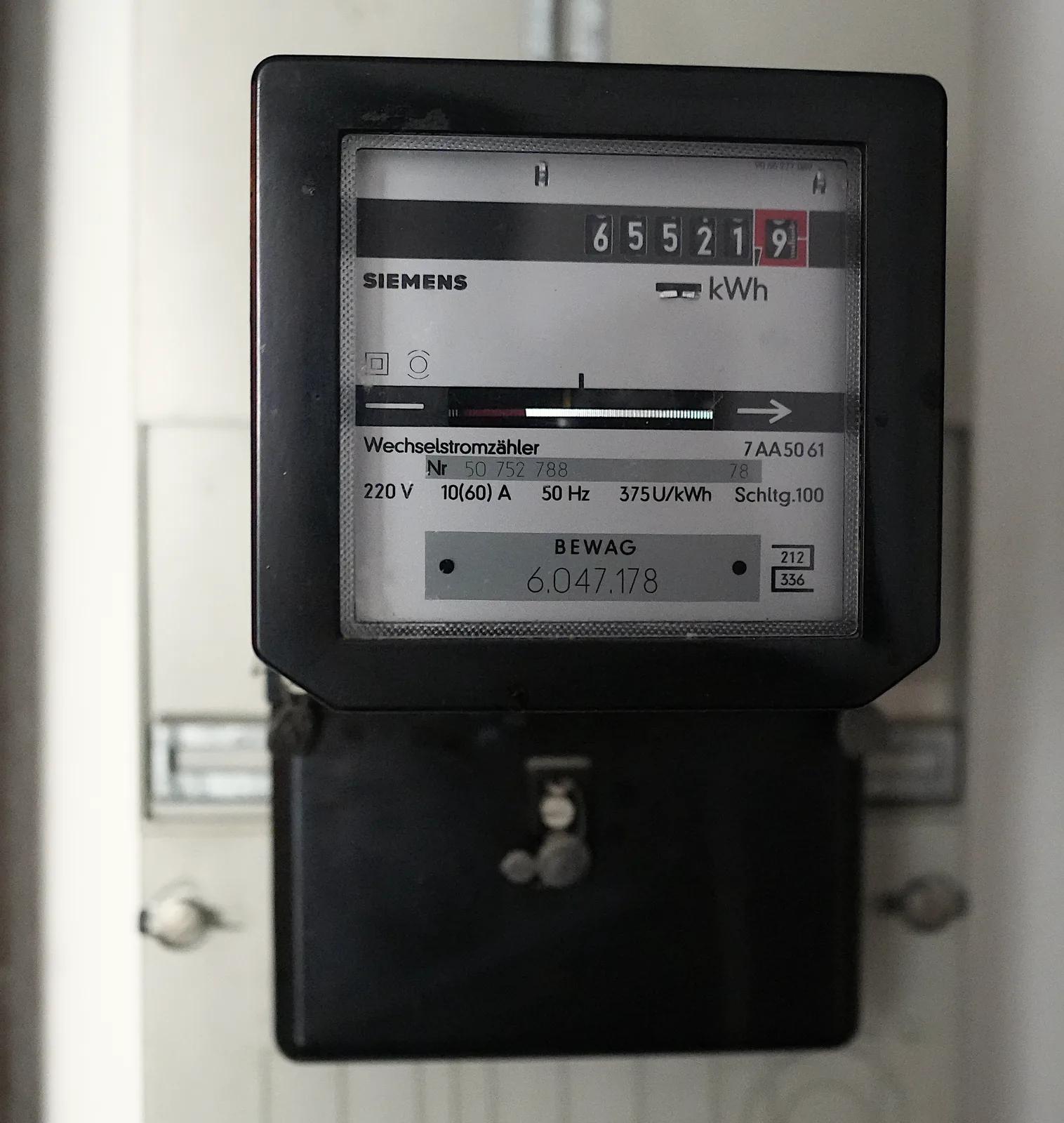
The kilowatt-hour is a unit of energy
The SI unit of energy is the joule, but the electrical energy of a home is measured and charged in kilowatt-hours. One kilowatt-hour is the energy that a device working at a power of $1\,\text{kW}$ uses in an hour. When the power is given in kilowatts and the time in hours, the energy comes out directly in kilowatt-hours. The name tells how it is calculated: kilowatt times hour, not kilowatt per hour. One kilowatt-hour is $3.6$ million joules.
The current of a device in the mains
The sockets of a home have a voltage of $230\,\text{V}$. It is the effective value of an alternating voltage, so the power of a heating device is calculated with it in the same way as with a direct voltage: $P = UI$. From the rated power of a device we therefore get the current $I = P : U$. A kettle draws a current of $2000\,\text{W} : 230\,\text{V} \approx 8.7\,\text{A}$, whereas a phone charger draws only a fraction of an ampere. High-power devices draw a large current, and that is why the fuses of a home's circuits limit how many such devices can be on at the same time in one circuit (chapter Electrical safety at home and at work).
Where the electrical energy of a home goes
The most energy is used by the devices in which both the power and the time of use are large: electric heating, a water heater and an electric sauna stove. In their resistors electrical energy becomes the internal energy of the resistor, which is transferred as heat to water, air or stones. A six-kilowatt stove uses $9.0\,\text{kWh}$ in a sauna session of an hour and a half, as much as a $100\,\text{W}$ television does in $90$ hours.
A low-power device can still build up a considerable consumption if it is on all the time. A refrigerator runs around the clock, and a device in standby mode uses about $9\,\text{kWh}$ a year for each watt of power. Saving is therefore possible in two ways: by reducing the power, for example by replacing lamps with LED lamps, or by shortening the time of use, for example by having a sauna less often or by lowering the room temperature. The effect is greatest in the devices whose energy is the greatest.
Electrical energy
When the power of a device stays constant, the electrical energy it uses is
$$E = Pt$$
where $E$ is the energy (J or kWh), $P$ the power (W or kW) and $t$ the time (s or h). When the power is in watts and the time in seconds, the energy comes out in joules; with kilowatts and hours it comes out in kilowatt-hours. The conversion is done by substituting the units: $1\,\text{kWh} = 1000\,\text{W} \cdot 3600\,\text{s} = 3\,600\,000\,\text{J} = 3.6\,\text{MJ}$.
Since the electric power is $P = UI$, the energy can also be calculated from the voltage and the current:
$$E = UIt$$
where $U$ is the voltage of the device (V) and $I$ the current through it (A).
An electricity bill charges both for the electrical energy and for its transmission in the electricity network per kilowatt-hour, and in addition monthly basic charges:
$$K = aE + K_\text{base}$$
where $K$ is the total of the bill (€), $a$ the price of energy and transmission together per kilowatt-hour (€/kWh), $E$ the energy of the billing period (kWh) and $K_\text{base}$ the basic charges (€). The energy of the billing period is the difference of the readings of the electricity meter. Prices are often given in cents: $18\,\text{c/kWh} = 0.18\,\text{€/kWh}$.
Common misconception
Many think that a high-power device is always the biggest item on the electricity bill. Power, however, only tells how fast the device uses energy. A kettle is on for only a few minutes a day, whereas a refrigerator, a water heater and heating work for hours. The consumption is decided by power times time.
Another common mistake is to read a kilowatt-hour as "kilowatts per hour". A kilowatt-hour is a unit of energy, kilowatt times hour, and it does not tell how fast anything changes. A third mistake is to mix up units: $2000\,\text{W} \cdot 15\,\text{min}$ is not $30\,000\,\text{kWh}$ but $2.0\,\text{kW} \cdot 0.25\,\text{h} = 0.50\,\text{kWh}$.
Summary
- The electrical energy used by a device working at a constant power is $E = Pt = UIt$. Power tells how fast energy is used, energy how much.
- The kilowatt-hour is a unit of energy: $1\,\text{kWh} = 1000\,\text{W} \cdot 3600\,\text{s} = 3.6\,\text{MJ}$. Energy calculated with kilowatts and hours comes out directly in kilowatt-hours.
- The current of a heating device in a $230\,\text{V}$ mains is $I = P : U$; a high-power device draws a large current.
- An electricity bill is the price of energy and transmission times the energy used, plus the basic charges. The energy is the difference of the meter readings.
- The most is saved by reducing the power or the time of use of the devices whose energy is the greatest: heating, hot water and the sauna.
Optional Return to your predictions
Compare your predictions with the energies you calculated. Then return to the opening question: why does an electricity bill show kilowatt-hours and not watts?
Would you change your prediction?
Apply
Worked example
Problem
The power of the electric underfloor heating of a bathroom is $0.80\,\text{kW}$. The thermostat keeps the heating on for $6\,\text{h}\ 15\,\text{min}$ a day on average. How much electrical energy does the underfloor heating use in $30$ days, and how much does it cost when electricity costs $18\,\text{c/kWh}$ including transmission?
Step 1/7
Given and find. $P = 0.80\,\text{kW}$, time of use $6\,\text{h}\ 15\,\text{min}$ per day, $30$ days, price $a = 18\,\text{c/kWh}$. We are asked for the energy $E$ in kilowatt-hours and the cost $K$ in euros.
Step 2/7
Principle. When the heating is on, its power is constant, so the energy is power times the total time of use. The cost is the energy times the price per kilowatt-hour; the basic charges belong to the bill of the whole home, not to one device.
Step 3/7
Formula solved.
$$\begin{aligned} E &= Pt \\ K &= aE \end{aligned}$$
Step 4/7
Unit conversions.
so the time of use in a day is $6.25\,\text{h}$ and the total time is
The price $18\,\text{c/kWh} = 0.18\,\text{€/kWh}$.
Step 5/7
Substitution. $$\begin{aligned} E &= Pt \\ \phantom{E} &= 0.80\,\text{kW} \cdot 187.5\,\text{h} \\ \phantom{E} &= 150\,\text{kWh} \\ K &= aE \\ \phantom{K} &= 0.18\,\tfrac{\text{€}}{\text{kWh}} \cdot 150\,\text{kWh} \\ \phantom{K} &= 27\,\text{€} \end{aligned}$$
Step 6/7
Result. In $30$ days the underfloor heating uses about $150\,\text{kWh}$ of electrical energy, and it costs about $27\,\text{€}$. The results are given with two significant figures like the power $0.80\,\text{kW}$ and the price $18\,\text{c/kWh}$.
Step 7/7
Reasonableness. In a day the heating uses $0.80\,\text{kW} \cdot 6.25\,\text{h} = 5.0\,\text{kWh}$, which costs about $0.90\,\text{€}$; in a month that is about $30 \cdot 0.90\,\text{€} = 27\,\text{€}$. If the minutes had been left unconverted and the time $6.15\,\text{h}$ used, the result would have been slightly too small.
Find the error
Apply to a new situation
The reading of the electricity meter of an apartment in a block of flats was $15\,362\,\text{kWh}$ at the beginning of the month and $15\,589\,\text{kWh}$ at the end. Electrical energy costs $12.0\,\text{c/kWh}$ and transmission $6.0\,\text{c/kWh}$. In addition, the energy company and the network company charge basic charges of $9.00\,\text{€}$ a month in total. All prices include value added tax.
What is the electricity bill for the month? Answer in euros.
Hint 1: a guiding question
How much energy was used during the month? The meter shows the total consumption of all time.
Hint 2: what is the connection
The price of a kilowatt-hour is the price of energy and transmission together. The basic charges are added once, not per kilowatt-hour.
Hint 3: an intermediate step
$a = 0.180\,\text{€/kWh}$, so $K = aE + 9.00\,\text{€}$.
Show the solution
Given
meter readings $15\,362\,\text{kWh}$ and $15\,589\,\text{kWh}$, price of energy $12.0\,\text{c/kWh}$, price of transmission $6.0\,\text{c/kWh}$, basic charges $K_\text{base} = 9.00\,\text{€}$
Find
the total of the bill for the month $K$ in euros
Principle
The meter adds up all the electrical energy used in the apartment, so the energy of the month is the difference of the readings. Energy and transmission are paid per kilowatt-hour, and the basic charges are added regardless of consumption.
Formula
$E = E_\text{end} - E_\text{start}$ and $K = aE + K_\text{base}$, so $K = a(E_\text{end} - E_\text{start}) + K_\text{base}$
Conversions
Substitution
Answer
$49.86\,\text{€} \approx 50\,\text{€}$
; the data are accurate to three significant figures like the price of energy $12.0\,\text{c/kWh}$.
Reasonableness
Estimate: $230\,\text{kWh} \cdot 0.2\,\text{€/kWh} \approx 46\,\text{€}$ and the basic charges on top, about $55\,\text{€}$; the exact result is a little smaller, because the price is below $0.2\,\text{€/kWh}$. A consumption of $227\,\text{kWh}$ a month, that is about $7.6\,\text{kWh}$ a day, suits an apartment in a block of flats without electric heating.
Check your understanding
Exit ticket
Answer on your own first and only then open the answer.
- How many megajoules is $2.0\,\text{kWh}$?
Answer
Because
$1\,\text{kWh}$$= 1000\,\text{W} \cdot 3600\,\text{s}$$= 3.6\,\text{MJ}$the energy is $2.0 \cdot 3.6\,\text{MJ} = 7.2\,\text{MJ}$.
- A lamp whose power is $10\,\text{W}$ burns for a total of $100\,\text{h}$. How much electrical energy does it use in kilowatt-hours?
Answer
$E$$= Pt$$= 0.010\,\text{kW} \cdot 100\,\text{h}$$= 1.0\,\text{kWh}$
1. Concept
2. Energy in kilowatt-hours
The power of a hair dryer is $1800\,\text{W}$, and it is used for $10\,\text{min}$ every day.
How much electrical energy does the dryer use in $30$ days? Answer in kilowatt-hours.
Hint 1: a guiding question
What is the total time of use of the dryer in $30$ days, in hours?
Hint 2: what is the connection
$10\,\text{min} = \tfrac{10}{60}\,\text{h}$, so in $30$ days $t = 30 \cdot \tfrac{10}{60}\,\text{h}$.
Hint 3: an intermediate step
$E = 1.8\,\text{kW} \cdot 5.0\,\text{h}$.
Show the solution
Given
power $P = 1800\,\text{W}$, time of use $10\,\text{min}$ per day, $30$ days
Find
the energy $E$ in kilowatt-hours
Principle
The power of the dryer is constant, so the energy is power times the total time of use. With kilowatts and hours the energy comes out in kilowatt-hours.
Formula
$E = Pt$
Conversions
$P = 1800\,\text{W} = 1.8\,\text{kW}$;
Substitution
Answer
$9.0\,\text{kWh}$
Two significant figures like the power $1800\,\text{W}$ and the time $10\,\text{min}$.
Reasonableness
In a day the dryer uses $1.8\,\text{kW} \cdot \tfrac{1}{6}\,\text{h} = 0.30\,\text{kWh}$, and in $30$ days $30 \cdot 0.30\,\text{kWh} = 9.0\,\text{kWh}$. It costs about $9 \cdot 0.18\,\text{€} \approx 1.6\,\text{€}$ a month, which is a small part of the bill of a home.
Suggestion: one answer does not show everything you can do, but review the theory summary and do the core exercises.
Optional 3. Explain the consumption
A detached house has electric heating, a water heater and an electric sauna stove. Explain why precisely these devices decide the size of the electricity bill of the house, even though there are dozens of other electrical devices in the house. Also say where the electrical energy ends up in heating devices.
Model answer
The energy of a device is power times time of use. The power of heating, a water heater and a sauna stove is kilowatts, and the heating and the water heater work for hours every day, so their energy is large. For example, a $2\,\text{kW}$ water heater uses $6\,\text{kWh}$ in three hours, whereas a $100\,\text{W}$ television uses only $0.3\,\text{kWh}$ in three hours. The other devices have a small power or a short time of use, so their total energy remains smaller. In heating devices electrical energy becomes the internal energy of the resistor, which is transferred as heat to the room air, water or stones. That is why the ways to save should be aimed at these devices.
Assess your own answer
Tick the points your own answer already contains.
Review the theory summary and practise with the exercises.
Exercises
Level 1 · basic practice 5 exercises
One formula or one step of reasoning. Core exercises first, the rest is extra practice.
- Exercise 7-1Core
The power of a laptop is $45\,\text{W}$. The computer is used for $4.0\,\text{h}$. How much electrical energy does it use? Answer in kilowatt-hours.
Answer
$0.18\,\text{kWh}$
Show the solution
Given
power $P = 45\,\text{W}$, time of use $t = 4.0\,\text{h}$
Find
the electrical energy $E$ in kilowatt-hours
Principle
The power of the computer is assumed to be constant, so the energy it uses is power times time. When the power is in kilowatts and the time in hours, the energy comes out directly in kilowatt-hours.
Formula
$E = Pt$
Conversions
$P$$= 45\,\text{W}$$= 45 \cdot 0.001\,\text{kW}$$= 0.045\,\text{kW}$Substitution
$E$$= 0.045\,\text{kW} \cdot 4.0\,\text{h}$$= 0.18\,\text{kWh}$Answer
$0.18\,\text{kWh}$
Two significant figures like the power $45\,\text{W}$ and the time $4.0\,\text{h}$.
Reasonableness
In watt-hours the energy is $45\,\text{W} \cdot 4.0\,\text{h} = 180\,\text{Wh}$, and $1000\,\text{Wh} = 1\,\text{kWh}$, so the result $0.18\,\text{kWh}$ agrees. The energy is small, because the power of a computer is small compared with, for example, a kettle.
- Exercise 7-2Core
A kettle uses $0.15\,\text{kWh}$ of electrical energy in one boiling. How large is the energy in megajoules?
Answer
$0.54\,\text{MJ}$
Show the solution
Given
energy $E = 0.15\,\text{kWh}$
Find
the energy in megajoules
Principle
The kilowatt-hour and the joule are units of the same quantity, energy. The conversion is done by substituting for the kilowatt-hour what the unit means: kilowatt times hour.
Formula
$E = Pt$: a kilowatt-hour is the power of a kilowatt for an hour, so to convert to joules we substitute watts for the kilowatt and seconds for the hour.
Conversions
$1\,\text{kWh}$$= 1000\,\text{W} \cdot 3600\,\text{s}$$= 3\,600\,000\,\text{J}$$= 3.6\,\text{MJ}$Substitution
$E$$= 0.15 \cdot 3.6\,\text{MJ}$$= 0.54\,\text{MJ}$Answer
$0.54\,\text{MJ}$
Two significant figures like the energy $0.15\,\text{kWh}$.
Reasonableness
A kilowatt-hour is $3.6\,\text{MJ}$, so a little under a fifth of it is a little over half a megajoule. In joules the number is larger than in kilowatt-hours, because the joule is a much smaller unit.
- Exercise 7-3
The rated power of an iron is $1200\,\text{W}$, and it is connected to a $230\,\text{V}$ socket. How large a current does the iron draw?
Answer
$5.2\,\text{A}$
Show the solution
Given
rated power $P = 1200\,\text{W}$, voltage $U = 230\,\text{V}$
Find
the current $I$ in amperes
Principle
Electric power is voltage times current. The mains voltage $230\,\text{V}$ is the effective value of an alternating voltage, so the power of a heating device is calculated with it as with a direct voltage.
Formula
$P = UI$, so $I = \dfrac{P}{U}$
Conversions
Not needed: $1\,\text{W} : 1\,\text{V} = 1\,\text{A}$.
Substitution
$I$$= \dfrac{1200\,\text{W}}{230\,\text{V}}$$= 5.217\,\text{A}$Answer
$5.2\,\text{A}$
Two significant figures like the voltage $230\,\text{V}$.
Reasonableness
The estimate $1200\,\text{W} : 200\,\text{V} = 6\,\text{A}$ is a little larger, because the divisor is smaller. The current is under $10\,\text{A}$, so the iron suits a circuit protected by a $10\,\text{A}$ or $16\,\text{A}$ fuse when no other high-power devices are on at the same time.
- Exercise 7-4
The electrical energy consumption of a home in a month was $350\,\text{kWh}$. Energy and transmission cost $15.0\,\text{c/kWh}$ together.
How much does the energy used cost? Basic charges are not taken into account.
Answer
$52.5\,\text{€}$
Show the solution
Given
energy $E = 350\,\text{kWh}$, price $a = 15.0\,\text{c/kWh}$
Find
the cost $K$ in euros
Principle
The same price is paid for every kilowatt-hour of energy and its transmission, so the cost is price times energy. The basic charges are left out as the task says.
Formula
$K = aE$
Conversions
$a$$= 15.0\,\text{c/kWh}$$= 15.0 \cdot 0.01\,\text{€/kWh}$$= 0.150\,\text{€/kWh}$Substitution
$K$$= 0.150\,\tfrac{\text{€}}{\text{kWh}} \cdot 350\,\text{kWh}$$= 52.5\,\text{€}$Answer
$52.5\,\text{€}$
Three significant figures like the price $15.0\,\text{c/kWh}$ and the energy $350\,\text{kWh}$.
Reasonableness
In cents the cost is $350 \cdot 15\,\text{c} = 5250\,\text{c}$, that is $52.50\,\text{€}$. At ten cents per kilowatt-hour the bill would be $35\,\text{€}$ and at twenty cents $70\,\text{€}$; the result is between them.
- Exercise 7-5
The power of an LED lamp in a hallway is $6.0\,\text{W}$, and it burns $5.0\,\text{h}$ every day.
How much electrical energy does the lamp use in a year ($365$ days)? Answer in kilowatt-hours.
Answer
$11\,\text{kWh}$
Show the solution
Given
power $P = 6.0\,\text{W}$, time of use $5.0\,\text{h}$ per day, $365$ days
Find
the energy of a year $E$ in kilowatt-hours
Principle
The power of the lamp is constant, so the energy is power times the total burning time. With kilowatts and hours the energy comes out directly in kilowatt-hours.
Formula
$E = Pt$
Conversions
$P = 6.0\,\text{W} = 0.0060\,\text{kW}$; burning time in a year
$t$$= 365 \cdot 5.0\,\text{h}$$= 1825\,\text{h}$Substitution
$E$$= 0.0060\,\text{kW} \cdot 1825\,\text{h}$$= 10.95\,\text{kWh}$Answer
$11\,\text{kWh}$
Two significant figures like the power $6.0\,\text{W}$ and the time $5.0\,\text{h}$.
Reasonableness
In a day the lamp uses $6\,\text{W} \cdot 5\,\text{h} = 30\,\text{Wh}$, and
$365 \cdot 30\,\text{Wh}$$\approx 11\,000\,\text{Wh}$$= 11\,\text{kWh}$The lighting of a whole year with one LED lamp uses roughly the same energy as one sauna session of an hour and a half with a $6\,\text{kW}$ stove ($9.0\,\text{kWh}$); the lamp's energy is slightly larger.
Level 2 · applied practice 4 exercises
Two steps, working with measured data, a unit conversion or rearranging a formula. Core exercises first, the rest is extra practice.
- Exercise 7-6Core
The graph shows the power of a washing machine during one wash program.
How much electrical energy does the washing machine use during the program? Read the needed values from the graph and answer in kilowatt-hours.
Answer
$0.80\,\text{kWh}$
Show the solution
Given
the powers and times of the three phases of the wash program from the graph $(t, P)$
Find
the whole energy of the program $E$ in kilowatt-hours
Principle
In each phase the power is constant, so the energy of the phase is power times the duration of the phase, that is the area of the rectangle under the graph. The whole energy is the sum of the energies of the phases.
Reading the graph
In the heating phase the power is $2.0\,\text{kW}$ between $0$ and $0.25\,\text{h}$, so the duration is $0.25\,\text{h}$. In the wash the power is $0.2\,\text{kW}$ between $0.25$ and $1.25\,\text{h}$, that is $1.0\,\text{h}$. In the spin the power is $0.4\,\text{kW}$ between $1.25$ and $1.5\,\text{h}$, that is $0.25\,\text{h}$.
Formula
$E = P_1 t_1 + P_2 t_2 + P_3 t_3$
Conversions
Not needed: the powers are read in kilowatts and the times in hours, so the energy comes out in kilowatt-hours.
Substitution
$E$$= 2.0\,\text{kW} \cdot 0.25\,\text{h} + 0.2\,\text{kW} \cdot 1.0\,\text{h} + 0.4\,\text{kW} \cdot 0.25\,\text{h}$$= 0.80\,\text{kWh}$Answer
$0.80\,\text{kWh}$
Two significant figures, because the values are read from the grid lines of $0.2\,\text{kW}$ and $0.25\,\text{h}$.
Reasonableness
The heating is short but uses over half of the energy, $0.50\,\text{kWh}$, because its power is ten times that of the wash. A program of an hour and a half at an average power of about $0.5\,\text{kW}$ would give $0.8\,\text{kWh}$.
- Exercise 7-7Core
A kettle is connected to the $230\,\text{V}$ mains, and a current of $8.7\,\text{A}$ flows through it. The water boils in $4.0\,\text{min}$.
How much electrical energy does the kettle use? Answer in kilojoules.
Answer
$480\,\text{kJ}$
Show the solution
Given
voltage $U = 230\,\text{V}$, current $I = 8.7\,\text{A}$, time $t = 4.0\,\text{min}$
Find
the electrical energy $E$ in kilojoules
Principle
The power of the kettle is voltage times current, and at constant power the energy is power times time. When the voltage is in volts, the current in amperes and the time in seconds, the energy comes out in joules.
Formula
$P = UI$ and $E = Pt$, so $E = UIt$
Conversions
$t$$= 4.0\,\text{min}$$= 4.0 \cdot 60\,\text{s}$$= 240\,\text{s}$finally $1\,\text{kJ} = 1000\,\text{J}$
Substitution
$E$$= 230\,\text{V} \cdot 8.7\,\text{A} \cdot 240\,\text{s}$$= 480\,240\,\text{J}$$= 480.24\,\text{kJ}$Answer
$480\,\text{kJ}$
Two significant figures like the current $8.7\,\text{A}$ and the time $4.0\,\text{min}$.
Reasonableness
The power of the kettle is $230\,\text{V} \cdot 8.7\,\text{A} \approx 2000\,\text{W}$, that is $2\,\text{kJ}$ per second, and in $240$ seconds it is about $480\,\text{kJ}$. In kilowatt-hours this is $0.13\,\text{kWh}$, which fits an ordinary boiling of a kettle.
- Exercise 7-8
The television, set-top box and game console in the living room are in standby mode all year, and their combined standby power is $4.5\,\text{W}$. Electricity costs $17\,\text{c/kWh}$ including transmission.
How much does the standby mode cost in a year ($365$ days)? Answer in euros.
Answer
$6.7\,\text{€}$
Show the solution
Given
standby power $P = 4.5\,\text{W}$ all year, $365$ days, price $a = 17\,\text{c/kWh}$
Find
the cost of a year $K$ in euros
Principle
The standby power is small but constant, and the devices are in that state around the clock. Energy is power times time, and the cost is price times energy.
Formula
$E = Pt$ and $K = aE$, so $K = aPt$
Conversions
$P = 4.5\,\text{W} = 0.0045\,\text{kW}$;
$t$$= 365 \cdot 24\,\text{h}$$= 8760\,\text{h}$$a$$= 17\,\text{c/kWh}$$= 0.17\,\text{€/kWh}$Substitution
$E$$= 0.0045\,\text{kW} \cdot 8760\,\text{h}$$= 39.42\,\text{kWh}$$K$$= 0.17\,\tfrac{\text{€}}{\text{kWh}} \cdot 39.42\,\text{kWh}$$= 6.70\,\text{€}$Answer
$6.7\,\text{€}$
Two significant figures like the power $4.5\,\text{W}$ and the price $17\,\text{c/kWh}$.
Reasonableness
One watt for a whole year is about $9\,\text{kWh}$, so $4.5\,\text{W}$ is about $40\,\text{kWh}$, and $40 \cdot 0.17\,\text{€} \approx 7\,\text{€}$. The sum is small compared with heating, but the standby mode can be removed with no effort using a power switch.
- Exercise 7-9
A $60\,\text{W}$ filament lamp on a desk is replaced with an equally bright LED lamp whose power is $8.0\,\text{W}$. The lamp burns $4.0\,\text{h}$ a day.
How much electrical energy does the replacement save in a year ($365$ days)? Answer in kilowatt-hours.
Answer
$76\,\text{kWh}$
Show the solution
Given
power of the filament lamp $P_1 = 60\,\text{W}$, power of the LED lamp $P_2 = 8.0\,\text{W}$, burning time $4.0\,\text{h}$ per day, $365$ days
Find
the energy saving of a year $\Delta E$ in kilowatt-hours
Principle
The lamps burn equally long, so the saving is the difference of the powers times the burning time. There is no need to calculate the energy of each separately.
Formula
$\Delta E = P_1 t - P_2 t$, so $\Delta E = (P_1 - P_2)t$
Conversions
$P_1 - P_2$$= 60\,\text{W} - 8.0\,\text{W}$$= 52\,\text{W}$$= 0.052\,\text{kW}$$t$$= 365 \cdot 4.0\,\text{h}$$= 1460\,\text{h}$Substitution
$\Delta E$$= 0.052\,\text{kW} \cdot 1460\,\text{h}$$= 75.92\,\text{kWh}$Answer
$76\,\text{kWh}$
Two significant figures like the powers $60\,\text{W}$ and $8.0\,\text{W}$ and the burning time $4.0\,\text{h}$.
Reasonableness
In a year the filament lamp uses $0.060\,\text{kW} \cdot 1460\,\text{h} \approx 88\,\text{kWh}$ and the LED lamp about $12\,\text{kWh}$; the difference is about $76\,\text{kWh}$. The saving is almost the whole consumption of the filament lamp, because the power of the LED lamp is only about a seventh of it.
Level 3 · challenging 3 exercises
Optional: application, two ideas together or a new situation where you reason for yourself.
- Exercise 7-10
A kettle whose power is $2200\,\text{W}$ is on for $3.0\,\text{min}$. For how long could a $15\,\text{W}$ lamp burn with the same energy? Answer in hours.
Answer
$7.3\,\text{h}$
Show the solution
Given
power of the kettle $P_1 = 2200\,\text{W}$, time $t_1 = 3.0\,\text{min}$, power of the lamp $P_2 = 15\,\text{W}$
Find
the burning time of the lamp $t_2$ in hours
Principle
The lamp uses the same energy as the kettle. The energy of each is power times time, so with a smaller power the same energy lasts for a longer time.
Formula
$P_2 t_2 = P_1 t_1$, so $t_2 = \dfrac{P_1 t_1}{P_2}$
Conversions
The unit W of the powers cancels, so the time comes out in minutes; finally $1\,\text{h} = 60\,\text{min}$.
Substitution
$t_2$$= \dfrac{2200\,\text{W} \cdot 3.0\,\text{min}}{15\,\text{W}}$$= 440\,\text{min}$$= \tfrac{440}{60}\,\text{h}$$= 7.33\,\text{h}$Answer
$7.3\,\text{h}$
Two significant figures like the time $3.0\,\text{min}$ and the power $15\,\text{W}$.
Reasonableness
The power of the kettle is about $150$ times that of the lamp, so the lamp burns about $150$ times as long:
$150 \cdot 3\,\text{min}$$= 450\,\text{min}$$\approx 7.5\,\text{h}$The energy of both is $0.11\,\text{kWh}$.
- Exercise 7-11
The total of a monthly electricity bill is $64.20\,\text{€}$. It includes the basic charges of energy and transmission, $8.50\,\text{€}$ in total. Energy and transmission cost $15.0\,\text{c/kWh}$ together.
How much electrical energy was used at home during the month?
Answer
$371\,\text{kWh}$
Show the solution
Given
total of the bill $K = 64.20\,\text{€}$, basic charges $K_\text{base} = 8.50\,\text{€}$, price $a = 15.0\,\text{c/kWh}$
Find
the energy of the month $E$ in kilowatt-hours
Principle
The bill consists of basic charges that do not depend on consumption and a consumption charge, which is price times energy. When the basic charges are subtracted from the total, the consumption charge is left, and the energy follows by dividing by the price.
Formula
$K = aE + K_\text{base}$, so $E = \dfrac{K - K_\text{base}}{a}$
Conversions
$a$$= 15.0\,\text{c/kWh}$$= 0.150\,\text{€/kWh}$Substitution
$E$$= \dfrac{64.20\,\text{€} - 8.50\,\text{€}}{0.150\,\text{€/kWh}}$$= \dfrac{55.70\,\text{€}}{0.150\,\text{€/kWh}}$$= 371.3\,\text{kWh}$Answer
$371\,\text{kWh}$
Three significant figures like the price $15.0\,\text{c/kWh}$.
Reasonableness
Check: $371\,\text{kWh} \cdot 0.150\,\text{€/kWh} = 55.65\,\text{€}$, and with the basic charges the total is $64.15\,\text{€} \approx 64.20\,\text{€}$. The consumption suits an apartment in a block of flats without electric heating. If the basic charges had been forgotten, the energy would have come out too large, $428\,\text{kWh}$.
- Exercise 7-12
The resistance of the heating resistor of a water heater is $26.5\,\Omega$, and it is connected to a voltage of $230\,\text{V}$. The heater warms water at night for $2.50\,\text{h}$. Assume that the resistance of the resistor stays constant.
How much electrical energy does the heater use during the night? Answer in kilowatt-hours.
Answer
$4.99\,\text{kWh}$
Show the solution
Given
resistance of the heating resistor $R = 26.5\,\Omega$, voltage $U = 230\,\text{V}$, time $t = 2.50\,\text{h}$
Find
the electrical energy $E$ in kilowatt-hours
Principle
By Ohm's law the current of a resistor is the voltage divided by the resistance. The power of the resistor is voltage times current, and since the resistance stays constant, the power is constant and the energy is power times time. The electrical energy becomes the internal energy of the resistor, which is transferred as heat to the water.
Formula
$I = \dfrac{U}{R}$, $P = UI$ and $E = Pt$, so $E = UIt$
Conversions
The power is converted to kilowatts ($1\,\text{kW} = 1000\,\text{W}$), so that the energy calculated with hours comes out in kilowatt-hours.
Substitution
$I$$= \dfrac{230\,\text{V}}{26.5\,\Omega}$$= 8.679\,\text{A}$$P$$= 230\,\text{V} \cdot 8.679\,\text{A}$$= 1996\,\text{W}$$= 1.996\,\text{kW}$$E$$= 1.996\,\text{kW} \cdot 2.50\,\text{h}$$= 4.99\,\text{kWh}$Answer
$4.99\,\text{kWh}$
Three significant figures like the resistance $26.5\,\Omega$ and the time $2.50\,\text{h}$.
Reasonableness
The power of the heater is about $2\,\text{kW}$, and in two and a half hours it uses about $2\,\text{kW} \cdot 2.5\,\text{h} = 5\,\text{kWh}$. The current $8.7\,\text{A}$ is of the same order as that of a kettle, but the heater is on for hours, so its energy is many times as large.
