
Standing waves: nodes, antinodes and natural frequencies
Why does a guitar string always sound the same note when it is plucked, and why does the note rise when the string is pressed against the fingerboard or tightened?
Prior knowledge
- The speed, the frequency and the wavelength of a wave are related by $v = f\lambda$chapter How waves form and travel
- A wave is reflected from the fixed end of a rope in the opposite phasechapter A wave meets an obstacle or a gap
- The displacements of waves that meet add up, and waves in opposite phase cancel each otherchapter When waves combine: superposition and interference
Core path: follow the steps in order. Tasks marked Optional give extra practice. Optional tasks: 5.
Think about it
Two students experiment in the gym with a long skipping rope. One end of the rope is tied to a wall bar, and the other student shakes the free end up and down with small movements. With slow, uneven shaking the rope wriggles messily. When the shaking rate is just right, the rope settles into one calm arc that swings with a large amplitude. When the rate is increased, the arc breaks up, until at a new, faster rate the rope shows two arcs and, between them, a point that does not move at all.
Why does the rope settle into a calm pattern only at certain shaking rates, and what determines those rates?
Optional Recap: reflection from a fixed end
Predict
Make your predictions before investigating 2 questions
Prediction 1: two loops
Prediction 2: a tube closed at one end
Investigate
Choose a string or a tube, change the frequency of the driving source and watch at which frequencies the displacement grows large. Every frequency you try is left as a point on the graph.
Simulation
How to use
Choose the Situation: a string with both ends fixed, a tube open at both ends or a tube closed at one end. At the left end of the string is a vibrator, and at the left, open end of the tube a loudspeaker. Adjust the frequency $f$ of the driving source with the slider; the arrow keys change it in steps of $5\,\text{Hz}$. In the picture the blue line is the displacement at the moment and the dashed lines are the extreme positions between which the rope or the air moves. In the tube the blue rows of dots are air moving along the tube, and under the tube the same displacement is drawn as a graph. Nodes are marked with the letter N and antinodes with the letter A when there is room for them. The graph below keeps a point for every frequency you have tried; the points are cleared when you change the situation, the length or the speed. The speed $v$ of the wave in the string increases when the string is tightened: in the picture the tightening weight grows. Speed changes only the pace of the motion.
Assumptions of the model
The picture shows the steady state that forms after the driving has gone on for a long time: the wave travelling towards the right end and its reflection have added up. The motion is drawn greatly slowed down, because the real frequency is hundreds of hertz, and the displacements are magnified. The amplitude of the driving source itself is $1.0\,\text{mm}$ in the model for the string, and a small damping limits the greatest displacement to about $17\,\text{mm}$; in real instruments the ratio depends on the materials. At the open end of the tube the antinode at the natural frequencies is in the model exactly at the mouth of the tube (there is no end correction), and the speed of sound in air is $340\,\text{m/s}$. All numbers are values calculated by the model, not measurements.
How the calculation works
The wavelength is $\lambda = \tfrac{v}{f}$. When $s = L - x$ is the distance from the right end and $k = \tfrac{2\pi f}{v} - i\alpha$ is the wave number with a small damping $\alpha = \tfrac{0.06}{L}$, the amplitude of the displacement at the point $x$ is $U = a\tfrac{\sin ks}{\sin kL}$ for the string, $U = a\tfrac{\cos ks}{\sin kL}$ for the open tube and $U = a\tfrac{\sin ks}{\cos kL}$ for the closed tube, where $a = 1.0\,\text{mm}$. These satisfy the conditions at the ends: at a fixed and at a closed end the displacement is zero, and at an open end it is greatest. The greatest displacement $A$ is the greatest value of $|U|$ along the string or the tube. Nodes are points where $|U|$ is at its smallest and below $15\,\%$ of $A$, and antinodes points where it is at its greatest and above $85\,\%$ of $A$. The natural frequencies are not fed into the model: the displacement grows large by itself when the denominator $\sin kL$ or $\cos kL$ is almost zero.
Experiment 1: the natural frequencies of a string
Test prediction 1. The length of the string is $0.60\,\text{m}$ and the speed of the wave $120\,\text{m/s}$, and they stay constant. Raise the frequency from $50\,\text{Hz}$ to $320\,\text{Hz}$ and watch the graph. Record at least the frequencies at which the greatest displacement $A$ peaks, and one frequency between two peaks. Also count the nodes from the picture.
Initial state: situation: string, both ends fixed, length of the string = $0{.}6\,\text{m}$, speed of the wave = $120\,\text{m/s}$, frequency = $50\,\text{Hz}$. Kept constant: situation, length of the string, speed of the wave. Varied: frequency.
| frequency | $A$ $(\text{mm})$ | nodes | $\lambda$ $(\text{m})$ |
|---|
Experiment 2: a tube closed at one end
Test prediction 2. The tube is $0.85\,\text{m}$ long and closed at its right end. Raise the frequency from $50\,\text{Hz}$ to $550\,\text{Hz}$ and record at least the frequencies at which the displacement peaks, and the frequencies $200\,\text{Hz}$ and $400\,\text{Hz}$. At which end of the tube is the node and at which the antinode?
Initial state: situation: tube, one end closed, length of the tube = $0{.}85\,\text{m}$, frequency = $50\,\text{Hz}$. Kept constant: situation, length of the tube. Varied: frequency.
| frequency | $A$ $(\text{mm})$ | nodes | antinodes |
|---|
Optional Experiment 3: the same tube open at both ends
Open the closed end of the tube: choose the tube open at both ends, whose length is still $0.85\,\text{m}$. Find the two lowest frequencies at which the displacement peaks and compare them with the frequencies of experiment 2.
Initial state: situation: tube, both ends open, length of the tube = $0{.}85\,\text{m}$, frequency = $50\,\text{Hz}$. Kept constant: situation, length of the tube. Varied: frequency.
| frequency | $A$ $(\text{mm})$ | nodes | antinodes |
|---|
Conclusion: at which frequencies does a standing wave form?
Write on the basis of your tables: at which frequencies did a strong standing wave form in the string and in the closed tube? How are these frequencies related to the lowest of them? How were the length of the string and the wavelength related at the peaks, and why are the frequencies of the closed tube different from those of the string?
Model answer
In the string ($L = 0.60\,\text{m}$, $v = 120\,\text{m/s}$) the greatest displacement grew to about $16.7\,\text{mm}$ only at the frequencies $100\,\text{Hz}$, $200\,\text{Hz}$ and $300\,\text{Hz}$; between them, for example at $150\,\text{Hz}$, it was only about $1.0\,\text{mm}$. The frequencies are whole-number multiples of the lowest frequency $100\,\text{Hz}$. At the peaks there were $2$, $3$ and $4$ nodes, and the wavelengths were $1.20\,\text{m}$, $0.60\,\text{m}$ and $0.40\,\text{m}$: one, two or three half wavelengths fitted on the string. In the closed tube ($L = 0.85\,\text{m}$) the peaks were at $100\,\text{Hz}$, $300\,\text{Hz}$ and $500\,\text{Hz}$, but at $200\,\text{Hz}$ and $400\,\text{Hz}$ the displacement was only about $1.0\,\text{mm}$. There was always a node at the closed end and an antinode at the open end, so only an odd number of quarter wavelengths fitted in the tube. The values are calculated by the model.
Assess your own answer
Tick the points your own answer already contains.
Review the theory summary and practise with the exercises.
Theory summary
Key idea
A wave and its reflection
When the end of a rope is shaken steadily, a wave travels along the rope towards its fixed end. At the fixed end the wave is reflected back in the opposite phase (chapter A wave meets an obstacle or a gap). The rope then carries two waves with the same frequency, wavelength and amplitude but opposite directions of travel. Their displacements add up at every point (chapter When waves combine: superposition and interference). The sum does not look like a travelling wave: certain points stay in place all the time, and between them the rope swings back and forth. This kind of wave motion is called a standing wave.
Nodes and antinodes
The points of a standing wave where the displacement is zero at every moment are called nodes. There the incident and the reflected wave are always in opposite phase and cancel each other. Halfway between the nodes the waves are always in phase and reinforce each other. At these antinodes the amplitude of the oscillation is greatest, twice the amplitude of a single wave. The distance between two adjacent nodes is half a wavelength, $\tfrac{\lambda}{2}$, and from a node to the next antinode it is $\tfrac{\lambda}{4}$.
The part of the rope between two nodes moves as a whole in the same direction, and the neighbouring part always moves in the opposite direction. So no wave crest travels anywhere. Because the incident and the reflected wave carry the same amount of energy in each direction, a standing wave does not transfer energy along the rope.
Natural frequencies
Both ends of a guitar string are fixed, so both ends are nodes. A standing wave can form only if a whole number of half wavelengths fits on the length of the string. At other wavelengths the waves reflecting back and forth in the string are in different phases on different round trips and largely cancel each other. The frequencies at which a standing wave forms are called the natural frequencies of the string. When the string is driven at a natural frequency, every round trip of the reflection strengthens the motion and the amplitude grows large. This phenomenon is called resonance.
The lowest natural frequency is the fundamental frequency. A plucked string vibrates at many of its natural frequencies at the same time, and the pitch we hear is determined by the fundamental frequency. The air column in a wind instrument behaves in the same way: its natural frequencies depend on the length of the tube and on whether the end of the tube is open or closed.
Natural frequencies of a string and of an air column
A string fixed at both ends
When the length of the vibrating part of the string is $L$, there is a node at each end, and $n$ half wavelengths fit on the string:
$$\begin{aligned} L &= n \cdot \frac{\lambda_n}{2} \\ \lambda_n &= \frac{2L}{n} \end{aligned}$$
The speed, the frequency and the wavelength of a wave are related by $v = f\lambda$ (chapter How waves form and travel). From this we get the natural frequencies of the string
$$\begin{aligned} f_n &= \frac{v}{\lambda_n} = n \cdot \frac{v}{2L} = n f_1 \\ n &= 1, 2, 3, \ldots \end{aligned}$$
where $f_n$ is the $n$th natural frequency (Hz), $v$ the speed of the wave in the string (m/s), $L$ the length of the vibrating part of the string (m) and $\lambda_n$ the wavelength (m). The fundamental frequency is $f_1 = \tfrac{v}{2L}$, and the other natural frequencies are its multiples. The natural frequencies above the fundamental frequency are called overtones. At the natural frequency $f_n$ the string has $n$ antinodes and $n + 1$ nodes, counting the ends.
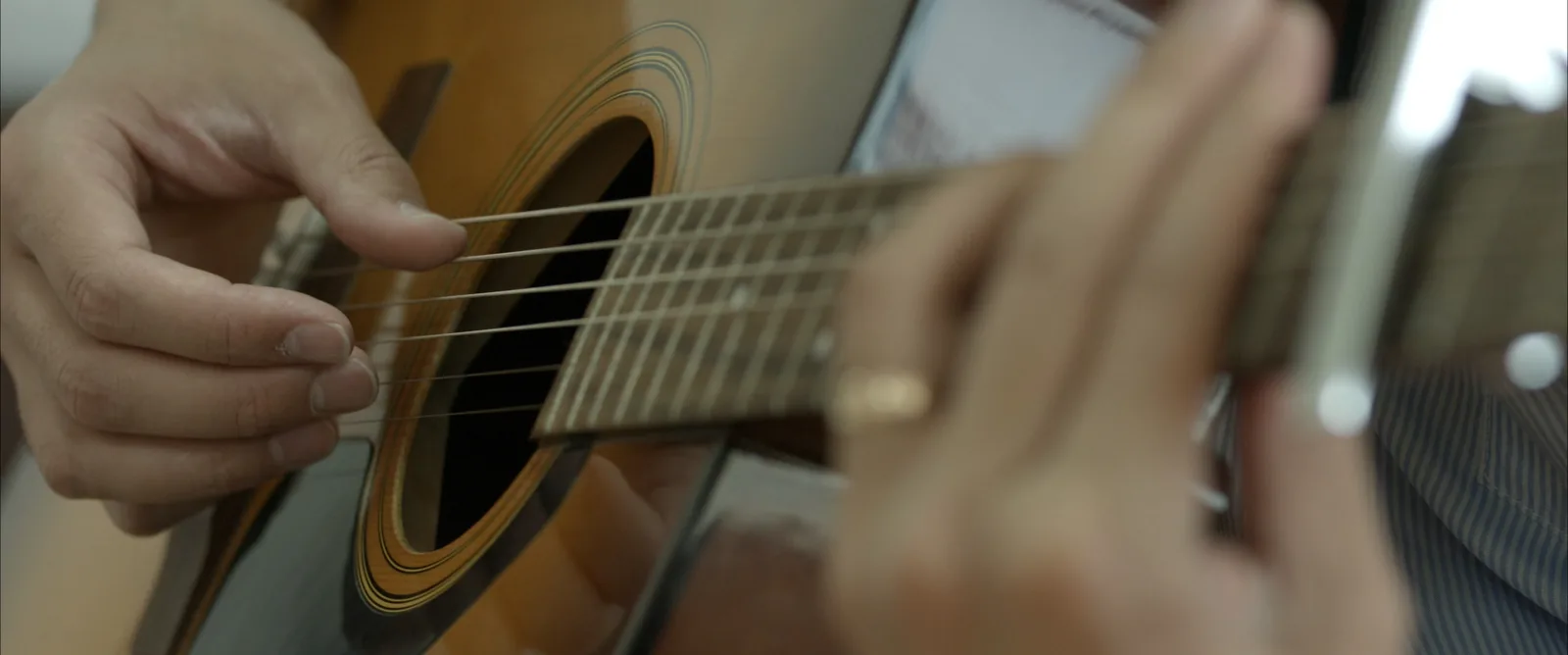
An instrument and its pitch
The formula tells how the pitch of a string instrument is changed. When the player presses the string against the fingerboard, the vibrating part $L$ becomes shorter and the fundamental frequency increases. When the string is tightened with the tuning peg, the speed $v$ of the wave in the string increases and the fundamental frequency rises. At the same tension a thick, heavy string carries a wave more slowly than a thin one, which is why bass strings sound low. The vibrating string makes the body of the instrument and the air vibrate at the same frequency, so the frequency of the sound we hear is the frequency of the string's vibration.
An air column in a tube
In a flute or an organ pipe the standing wave forms in the air inside the tube. Sound is longitudinal wave motion, so the air oscillates along the tube. At the closed end of the tube the air cannot move, so there is a displacement node. At the open end the air can move freely, and there is a displacement antinode. In reality the antinode is slightly outside the mouth of the tube, but this so-called end correction is neglected here. In this chapter the speed of sound in air is taken to be $v = 340\,\text{m/s}$.
When the tube is open at both ends, there is an antinode at each end, and again $n$ half wavelengths fit in the tube. The natural frequencies are the same as for a string, $f_n = n \cdot \tfrac{v}{2L}$, where $v$ is the speed of sound in air.
When the tube is closed at one end, there is a node at the closed end and an antinode at the open end. From a node to an antinode is $\tfrac{\lambda}{4}$, so the length of the tube must be an odd number of quarter wavelengths:
$$\begin{aligned} L &= n \cdot \frac{\lambda_n}{4} \\ f_n &= n \cdot \frac{v}{4L} \\ n &= 1, 3, 5, \ldots \end{aligned}$$
A closed tube therefore has only the odd natural frequencies $f_1$, $3f_1$, $5f_1$ and so on. Its fundamental frequency $f_1 = \tfrac{v}{4L}$ is half the fundamental frequency of an open tube of the same length, so a closed organ pipe sounds an octave lower than an open pipe of the same length.
Common misconception
Many people think that at the fundamental frequency a whole wavelength fits on the string, that is, $\lambda_1 = L$. At the fundamental frequency, however, the string has only one antinode in the middle and nodes at the ends, so the length of the string is half a wavelength and $\lambda_1 = 2L$. For example, the wavelength corresponding to the fundamental frequency of a $1.20\,\text{m}$ string is $2.40\,\text{m}$. For the same reason the distance between adjacent nodes is $\tfrac{\lambda}{2}$, not $\lambda$.
Another mistake is to calculate the natural frequencies of a tube closed at one end in the same way as for a string. The fundamental frequency of a closed tube is $\tfrac{v}{4L}$, and its next natural frequency is $3f_1$, not $2f_1$.
Summary
- A standing wave forms when a wave and its reflection travel in opposite directions and add up. At the nodes the displacement is always zero, and at the antinodes the amplitude is greatest.
- The distance between adjacent nodes is $\tfrac{\lambda}{2}$, and from a node to an antinode it is $\tfrac{\lambda}{4}$.
- The natural frequencies of a string fixed at both ends and of a tube open at both ends are $f_n = n \cdot \tfrac{v}{2L}$, where $n = 1, 2, 3, \ldots$ The lowest of them is the fundamental frequency $f_1$.
- In a tube closed at one end the closed end is a node and the open end an antinode, and the natural frequencies are $f_n = n \cdot \tfrac{v}{4L}$, where $n = 1, 3, 5, \ldots$
- A shorter or tighter string and a shorter tube sound higher. The chapter Sound as a wave: pitch, timbre and the Doppler effect examines how the fundamental frequency and the overtones show up in the frequency analysis of a sound.
Optional Return to your predictions
Compare your predictions with the values of the model and with the formulas $f_n = n \cdot \tfrac{v}{2L}$ and $f_n = n \cdot \tfrac{v}{4L}$. Then return to the skipping rope: why did the rope settle into a calm arc only at certain rates, and what would happen to the rates if the rope were made shorter?
Would you change your prediction?
Apply
Worked example
Problem
The vibrating part of a guitar's A string, from the nut to the bridge, is $0.650\,\text{m}$ long, and the fundamental frequency of the string is $110\,\text{Hz}$. What is the speed of the wave in the string? How short must the vibrating part be made by pressing the string against the fingerboard so that the fundamental frequency is $165\,\text{Hz}$? The tension of the string does not change when it is pressed.
Step 1/7
Given and find. The length of the string is $L = 0.650\,\text{m}$ and the fundamental frequency is $f_1 = 110\,\text{Hz}$; the new fundamental frequency is $f_1' = 165\,\text{Hz}$. We want the speed $v$ of the wave in the string and the new length $L'$ of the vibrating part.
Step 2/7
Principle. The string is fixed at both ends, so at the fundamental frequency half a wavelength fits on its length and $f_1 = \tfrac{v}{2L}$. When the string is pressed against the fingerboard, its tension and thickness stay the same, so the speed $v$ of the wave does not change. Only the length of the vibrating part changes.
Step 3/7
Formula solved. From the formula for the fundamental frequency we first solve $v$ and then the new length $L'$:
$$\begin{aligned} f_1 &= \frac{v}{2L} \;\Rightarrow\; v = 2 L f_1 \\ f_1' &= \frac{v}{2L'} \;\Rightarrow\; L' = \frac{v}{2 f_1'} \end{aligned}$$
Step 4/7
Unit conversions. None are needed: the length is in metres and the frequency in hertz, and $\text{m} \cdot \text{Hz} = \tfrac{\text{m}}{\text{s}}$.
Step 5/7
Substitution. $$\begin{aligned} &v = 2 L f_1 \\ &= 2 \cdot 0.650\,\text{m} \cdot 110\,\text{Hz} \\ &= 143\,\text{m/s} \\[6pt] &L' = \frac{v}{2 f_1'} \\ &= \frac{143\,\text{m/s}}{2 \cdot 165\,\text{Hz}} \\ &= 0.4333\,\text{m} \end{aligned}$$
Step 6/7
Answer. The speed of the wave in the string is $143\,\text{m/s}$, and the vibrating part must be $0.433\,\text{m}$ long. The results are given to three significant figures, like the length of the string $0.650\,\text{m}$ and the frequencies.
Step 7/7
Reasonableness. The new fundamental frequency is $165\,\text{Hz} : 110\,\text{Hz} = 1.5$ times the old one, and since $f_1$ is inversely proportional to the length, the string must become shorter in the same ratio: $0.650\,\text{m} : 1.5 = 0.433\,\text{m}$. A higher note needs a shorter string, as is observed when playing. At the fundamental frequency $\lambda_1 = 2L = 1.30\,\text{m}$, so
which is the same as the calculated speed of the wave.
Optional Find the error
Apply to a new situation
A didgeridoo is a long wooden tube that the player blows into with the lips pressed against the mouth of the tube. The lips close this end of the tube, so the instrument works roughly as a tube closed at one end. The length of the tube is $1.50\,\text{m}$.
What is the second lowest natural frequency of the tube? Use $340\,\text{m/s}$ as the speed of sound in air. Give the answer in hertz.
Hint 1: a guiding question
At which end of the tube is the node and at which the antinode? How large a part of a wavelength fits in the tube at the fundamental frequency?
Hint 2: what is the connection
The natural frequencies of a closed tube are $f_n = n \cdot \tfrac{v}{4L}$, and $n$ can only be odd: $1, 3, 5, \ldots$
Hint 3: an intermediate step
The fundamental frequency is
What is the next allowed $n$?
Show the solution
Given
tube closed at one end, length $L = 1.50\,\text{m}$; speed of sound in air $v = 340\,\text{m/s}$
Find
the second lowest natural frequency in hertz
Principle
The lips close the end of the tube, so the air cannot move there and there is a displacement node; at the open end there is an antinode. Therefore only an odd number of quarter wavelengths fits in the tube, and the natural frequencies are odd multiples of the fundamental frequency. The second lowest corresponds to $n = 3$.
Formula
$f_n = n \cdot \dfrac{v}{4L}$, where $n = 1, 3, 5, \ldots$, so for $n = 3$: $f_3 = \dfrac{3v}{4L}$
Conversions
None are needed: the length is in metres and the speed in metres per second.
Substitution
Answer
$170\,\text{Hz}$
Three significant figures as in the length of the tube $1.50\,\text{m}$ and the speed of sound.
Reasonableness
The fundamental frequency is $\tfrac{340\,\text{m/s}}{6.00\,\text{m}} = 56.7\,\text{Hz}$, which suits the low, humming sound of a didgeridoo, and $3 \cdot 56.7\,\text{Hz} = 170\,\text{Hz}$. At this frequency three quarters of a wavelength fit in the tube:
$\tfrac{3}{4} \cdot 2.00\,\text{m} = 1.50\,\text{m}$.
Check your understanding
Exit ticket
Answer on your own first and only then open the answer.
- A string fixed at both ends vibrates at its third natural frequency. How many nodes and how many antinodes does the string have, counting the ends?
Answer
Three half wavelengths fit on the string, so it has three antinodes and four nodes: two at the ends and two between them.
- A flute is a tube open at both ends and a clarinet roughly a tube closed at one end. The instruments are equally long. Which has the lower fundamental frequency, and how many times as great is the fundamental frequency of the other?
Answer
The clarinet. The fundamental frequency of a closed tube is $\tfrac{v}{4L}$ and that of an open tube $\tfrac{v}{2L}$, so the fundamental frequency of a flute of the same length is twice as great, that is, an octave higher.
1. Concept
2. Wavelength in a closed tube
The length of a tube closed at one end is $0.60\,\text{m}$. The air column of the tube vibrates at the natural frequency $f_3 = 3f_1$.
What is the wavelength of the sound wave? Give the answer in metres.
Hint 1: a guiding question
At which end of the tube is the node and at which the antinode? How many quarter wavelengths fit in the tube when $n = 3$?
Hint 2: what is the connection
In a closed tube $L = n \cdot \tfrac{\lambda_n}{4}$, so $\lambda_3 = \tfrac{4L}{3}$.
Hint 3: an intermediate step
$\lambda_3 = \tfrac{4 \cdot 0.60\,\text{m}}{3}$.
Show the solution
Given
tube closed at one end, $L = 0.60\,\text{m}$; natural frequency $f_3 = 3f_1$, that is, $n = 3$
Find
the wavelength $\lambda_3$ in metres
Principle
At the closed end the air cannot move, so there is a displacement node, and at the open end there is an antinode. From a node to an antinode is a quarter of a wavelength, so at the natural frequency $f_n$ there are $n$ quarters in the tube, and $n = 3$ means three quarters.
Formula
$L = n \cdot \dfrac{\lambda_n}{4}$, so $\lambda_n = \dfrac{4L}{n}$ and for $n = 3$: $\lambda_3 = \dfrac{4L}{3}$
Conversions
None are needed: the length is in metres.
Substitution
Answer
$0.80\,\text{m}$
Two significant figures as in the length of the tube $0.60\,\text{m}$.
Reasonableness
In the tube there is a node at the closed end and another node $\tfrac{\lambda}{2} = 0.40\,\text{m}$ from it, and from that node an antinode $\tfrac{\lambda}{4} = 0.20\,\text{m}$ further on at the open end: $0.40\,\text{m} + 0.20\,\text{m} = 0.60\,\text{m}$, the length of the tube. The wavelength of the fundamental frequency would be $4L = 2.4\,\text{m}$, three times as long.
Suggestion: one answer does not show everything you can do, but review the theory summary and do the core exercises.
Optional 3. Explain: pitch
Using a standing wave, explain why the note of a guitar rises when the string is pressed against the fingerboard, and why it also rises when the string is tightened.
Model answer
Both ends of a guitar string are fixed, so the ends are nodes, and at the fundamental frequency the length of the vibrating part of the string is half a wavelength: $\lambda_1 = 2L$. When the string is pressed against the fingerboard, the vibrating part becomes shorter, so the wavelength also becomes shorter. The speed of the wave in the string does not change, so according to the equation $v = f\lambda$ the frequency increases: $f_1 = \tfrac{v}{2L}$ is inversely proportional to the length. When the string is tightened, the wavelength stays the same, but the wave travels faster in the tighter string. A greater $v$ at the same wavelength means a greater frequency. The note we hear rises in both cases, because the pitch is determined by the fundamental frequency.
Assess your own answer
Tick the points your own answer already contains.
Review the theory summary and practise with the exercises.
Review the chapter's concepts
Cards you mark Review later collect in your review deck.
- Natural frequency
- The frequency at which a system oscillates freely after a disturbance.
- Resonance
- A strong growth of the amplitude when the frequency of an external drive matches the system's natural frequency.
- Standing wave
- A wave pattern formed by the interference of two identical waves travelling in opposite directions; its nodes stay in place.
- Node
- A point of a standing wave where the amplitude of oscillation is zero.
- Antinode
- A point of a standing wave where the amplitude of oscillation is largest.
- Fundamental frequency
- The lowest possible natural frequency of an oscillating system.
- Pipe open at both ends
- A pipe with both ends open, so an antinode of the standing wave forms at each end.
Exercises
Level 1 · basic practice 5 exercises
One formula or one step of reasoning. Core exercises first, the rest is extra practice.
- Exercise 13-1Core
The vibrating part of the lowest string of a double bass is $1.05\,\text{m}$ long, and a wave travels in the string at the speed $86.1\,\text{m/s}$. The string is fixed at both ends.
What is the fundamental frequency of the string?
Answer
$41.0\,\text{Hz}$
Show the solution
Given
length of the vibrating part of the string $L = 1.05\,\text{m}$, speed of the wave in the string $v = 86.1\,\text{m/s}$; the string is fixed at both ends
Find
the fundamental frequency $f_1$ of the string in hertz
Principle
There is a node at each fixed end. At the fundamental frequency the string has one antinode, so half a wavelength fits on the string: $\lambda_1 = 2L$. The frequency follows from the basic wave equation $v = f\lambda$.
Formula
$f_n = n \cdot \dfrac{v}{2L}$, so at the fundamental frequency $n = 1$: $f_1 = \dfrac{v}{2L}$
Conversions
None are needed: the length is in metres and the speed in metres per second, so
$\tfrac{\text{m/s}}{\text{m}}$$= \tfrac{1}{\text{s}}$$= \text{Hz}$Substitution
$f_1$$= \dfrac{86.1\,\text{m/s}}{2 \cdot 1.05\,\text{m}}$$= \dfrac{86.1\,\text{m/s}}{2.10\,\text{m}}$$= 41.0\,\text{Hz}$Answer
$41.0\,\text{Hz}$
Three significant figures as in the length $1.05\,\text{m}$ and the speed $86.1\,\text{m/s}$.
Reasonableness
The lowest note of a double bass is very low, about $40\,\text{Hz}$, and the result matches it. A check the other way round: the wavelength is
$\lambda_1$$= 2.10\,\text{m}$$f_1 \lambda_1$$= 41.0\,\text{Hz} \cdot 2.10\,\text{m}$$= 86.1\,\text{m/s}$which is the given speed.
- Exercise 13-2Core
In a school project a pipe open at both ends is made from a plastic tube whose length is $0.330\,\text{m}$.
What is the fundamental frequency of the air column of the tube? Use $340\,\text{m/s}$ as the speed of sound in air.
Answer
$515\,\text{Hz}$
Show the solution
Given
tube open at both ends, length $L = 0.330\,\text{m}$; speed of sound in air $v = 340\,\text{m/s}$
Find
the fundamental frequency $f_1$ of the air column in hertz
Principle
At the open ends the air can move, so there is a displacement antinode at each end. At the fundamental frequency there is one node between the two antinodes, so half a wavelength fits in the tube and the natural frequencies are the same as for a string fixed at both ends.
Formula
$f_n = n \cdot \dfrac{v}{2L}$, so at the fundamental frequency $n = 1$: $f_1 = \dfrac{v}{2L}$
Conversions
None are needed: the length is in metres and the speed in metres per second.
Substitution
$f_1$$= \dfrac{340\,\text{m/s}}{2 \cdot 0.330\,\text{m}}$$= \dfrac{340\,\text{m/s}}{0.660\,\text{m}}$$= 515.2\,\text{Hz}$Answer
$515\,\text{Hz}$
Three significant figures as in the length of the tube $0.330\,\text{m}$ and the speed of sound.
Reasonableness
A whistle about thirty centimetres long sounds at a few hundred hertz, like the middle notes of a recorder or a flute. The wavelength is $2L = 0.660\,\text{m}$, and $515\,\text{Hz} \cdot 0.660\,\text{m} \approx 340\,\text{m/s}$.
- Exercise 13-3
The largest pipe of a church organ is closed at its upper end and its length is $2.60\,\text{m}$.
What is the fundamental frequency of the pipe? Use $340\,\text{m/s}$ as the speed of sound in air.
Answer
$32.7\,\text{Hz}$
Show the solution
Given
organ pipe closed at its upper end, length $L = 2.60\,\text{m}$; speed of sound in air $v = 340\,\text{m/s}$
Find
the fundamental frequency $f_1$ of the pipe in hertz
Principle
At the closed end the air cannot move, so there is a displacement node; at the open end there is an antinode. From a node to an antinode is a quarter of a wavelength, so at the fundamental frequency $L = \tfrac{\lambda_1}{4}$, that is, $\lambda_1 = 4L$.
Formula
$f_n = n \cdot \dfrac{v}{4L}$, where $n = 1, 3, 5, \ldots$, so at the fundamental frequency $f_1 = \dfrac{v}{4L}$
Conversions
None are needed: the length is in metres and the speed in metres per second.
Substitution
$f_1$$= \dfrac{340\,\text{m/s}}{4 \cdot 2.60\,\text{m}}$$= \dfrac{340\,\text{m/s}}{10.4\,\text{m}}$$= 32.69\,\text{Hz}$Answer
$32.7\,\text{Hz}$
Three significant figures as in the length of the pipe $2.60\,\text{m}$.
Reasonableness
The largest organ pipes produce the lowest sounds a person can only just hear (about $20$–$40\,\text{Hz}$). An open pipe of the same length would sound twice as high, $65.4\,\text{Hz}$, so by closing the upper end of the pipe the same low sound is obtained with a pipe half as long.
- Exercise 13-4
In a PE lesson a long rope fixed to a wall is shaken so that a standing wave forms in it. The distance between two adjacent nodes is measured to be $0.35\,\text{m}$.
What is the wavelength of the waves travelling in the rope?
Answer
$0.70\,\text{m}$
Show the solution
Given
standing wave in a rope, distance between two adjacent nodes $d = 0.35\,\text{m}$
Find
the wavelength $\lambda$ of the waves travelling in the rope in metres
Principle
A standing wave is the sum of waves travelling in opposite directions in the rope. The nodes are points where the waves cancel each other, and they repeat at intervals of half a wavelength.
Formula
$d = \dfrac{\lambda}{2}$, so $\lambda = 2d$
Conversions
None are needed: the distance is in metres.
Substitution
$\lambda$$= 2 \cdot 0.35\,\text{m}$$= 0.70\,\text{m}$Answer
$0.70\,\text{m}$
Two significant figures as in the distance between the nodes $0.35\,\text{m}$.
Reasonableness
One wavelength contains two loops, that is, three nodes, so the wavelength must be greater than the distance between nodes. Between two adjacent nodes there is one antinode, which is $\tfrac{\lambda}{4} = 0.175\,\text{m}$ from each node.
- Exercise 13-5
The fundamental frequency of the G string of a cello is $98.0\,\text{Hz}$.
What is the fourth natural frequency of the string, that is, the frequency at which four antinodes fit on the string?
Answer
$392\,\text{Hz}$
Show the solution
Given
fundamental frequency of a cello string $f_1 = 98.0\,\text{Hz}$; the string is fixed at both ends
Find
the fourth natural frequency $f_4$ in hertz
Principle
At the natural frequencies of a string fixed at both ends, $n$ half wavelengths fit on the string and the string has $n$ antinodes. The natural frequencies are multiples of the fundamental frequency, because the speed of the wave and the length of the string stay the same.
Formula
$f_n = n \cdot \dfrac{v}{2L} = n f_1$, so four antinodes correspond to $n = 4$: $f_4 = 4 f_1$
Conversions
None are needed.
Substitution
$f_4$$= 4 \cdot 98.0\,\text{Hz}$$= 392\,\text{Hz}$Answer
$392\,\text{Hz}$
Three significant figures as in the fundamental frequency $98.0\,\text{Hz}$.
Reasonableness
Four antinodes mean that the wavelength is a quarter of the wavelength at the fundamental frequency. Since $v = f\lambda$ stays the same, the frequency must be four times as high. The frequency $392\,\text{Hz}$ is two octaves above the fundamental frequency, because $98.0\,\text{Hz}$ doubled twice is $392\,\text{Hz}$.
Level 2 · applied practice 4 exercises
Two steps, working with measured data, a unit conversion or rearranging a formula. Core exercises first, the rest is extra practice.
- Exercise 13-6Core
The vibrating part of a guitar string is $0.650\,\text{m}$ long. When the guitarist tightens the string with the tuning peg, the speed of the wave in the string increases from $141.0\,\text{m/s}$ to $148.0\,\text{m/s}$.
By how many hertz does the fundamental frequency of the string rise?
Answer
$5.4\,\text{Hz}$
Show the solution
Given
length of the vibrating part of the string $L = 0.650\,\text{m}$; speed of the wave before tightening $v_1 = 141.0\,\text{m/s}$ and after it $v_2 = 148.0\,\text{m/s}$
Find
the change in the fundamental frequency $\Delta f = f_\text{2} - f_\text{1}$ in hertz
Principle
The string is fixed at both ends, so at the fundamental frequency $f = \tfrac{v}{2L}$. Tightening changes only the speed of the wave; the length of the vibrating part of the string stays the same. The fundamental frequency is therefore directly proportional to the speed.
Formula
$f = \dfrac{v}{2L}$, so
$\Delta f$$= \dfrac{v_2}{2L} - \dfrac{v_1}{2L}$giving $\Delta f = \dfrac{v_2 - v_1}{2L}$
Conversions
None are needed: the speeds are in metres per second and the length in metres.
Substitution
$\Delta f$$= \dfrac{148.0\,\text{m/s} - 141.0\,\text{m/s}}{2 \cdot 0.650\,\text{m}}$$= \dfrac{7.0\,\text{m/s}}{1.300\,\text{m}}$$= 5.385\,\text{Hz}$Answer
$5.4\,\text{Hz}$
Two significant figures, because the difference of the speeds $7.0\,\text{m/s}$ is known to two figures.
Reasonableness
The fundamental frequencies are $108.46\,\text{Hz}$ before and $113.85\,\text{Hz}$ after, and their difference is the same $5.39\,\text{Hz} \approx 5.4\,\text{Hz}$. The speed increases by about $5\,\%$, so the frequency also increases by about $5\,\%$: $0.05 \cdot 108\,\text{Hz} \approx 5\,\text{Hz}$. The frequency rises, as is heard when a string is tightened.
- Exercise 13-7Core
The speed of sound is measured with a resonance tube. The lower part of a vertical tube contains water, and a tuning fork with the frequency $440\,\text{Hz}$ sounds above the upper end of the tube. When the water level is lowered, the sound is amplified for the first time when the air column from the water surface to the mouth of the tube is $19.3\,\text{cm}$ long. The water surface acts as the closed end of the tube.
What is the speed of sound in air according to the measurement?
Answer
$340\,\text{m/s}$
Show the solution
Given
tuning fork $f = 440\,\text{Hz}$; shortest resonating air column $L = 19.3\,\text{cm}$, closed at its lower end by the water surface
Find
the speed of sound in air $v$ in metres per second
Principle
At the water surface the air cannot move, so there is a displacement node, and at the open mouth of the tube there is an antinode. The sound is first amplified when the length of the air column corresponds to the fundamental frequency of a closed tube, that is, a quarter of a wavelength from the node to the antinode. The speed follows from the basic wave equation.
Formula
$L = \dfrac{\lambda}{4}$ and $v = f\lambda$, so $v = 4 L f$
Conversions
$L = 19.3\,\text{cm} = 0.193\,\text{m}$
Substitution
$v$$= 4 \cdot 0.193\,\text{m} \cdot 440\,\text{Hz}$$= 0.772\,\text{m} \cdot 440\,\text{Hz}$$= 339.68\,\text{m/s}$Answer
$340\,\text{m/s}$
Three significant figures as in the length of the air column $19.3\,\text{cm}$.
Reasonableness
The result is the speed of sound in air at room temperature, about $340\,\text{m/s}$. The next resonance would be at three quarters, $\tfrac{3\lambda}{4} = 0.579\,\text{m}$; by comparing two resonances in a measurement the error of the end correction is eliminated, which makes the shortest air column slightly shorter than the true quarter wavelength.
- Exercise 13-8
The third natural frequency of a tube open at both ends is $1530\,\text{Hz}$.
How long is the tube? Use $340\,\text{m/s}$ as the speed of sound in air. Give the answer in centimetres.
Answer
$33.3\,\text{cm}$
Show the solution
Given
tube open at both ends, third natural frequency $f_3 = 1530\,\text{Hz}$; speed of sound in air $v = 340\,\text{m/s}$
Find
the length of the tube $L$ in centimetres
Principle
There is a displacement antinode at the open ends, so the natural frequencies are the same as for a string fixed at both ends, $f_n = n \cdot \tfrac{v}{2L}$. The third natural frequency corresponds to $n = 3$, so three half wavelengths fit in the tube.
Formula
$f_3 = 3 \cdot \dfrac{v}{2L}$, so $L = \dfrac{3v}{2 f_3}$
Conversions
Finally metres to centimetres: $1\,\text{m} = 100\,\text{cm}$.
Substitution
$L$$= \dfrac{3 \cdot 340\,\text{m/s}}{2 \cdot 1530\,\text{Hz}}$$= \dfrac{1020\,\text{m/s}}{3060\,\text{Hz}}$$= 0.3333\,\text{m}$$= 33.33\,\text{cm}$Answer
$33.3\,\text{cm}$
Three significant figures as in the frequency $1530\,\text{Hz}$ and the speed of sound.
Reasonableness
The fundamental frequency of the tube is $1530\,\text{Hz} : 3 = 510\,\text{Hz}$, and the check gives $\tfrac{340\,\text{m/s}}{2 \cdot 0.3333\,\text{m}} = 510\,\text{Hz}$. The wavelength of the third natural frequency is $\tfrac{2L}{3} = 0.222\,\text{m}$, and $1530\,\text{Hz} \cdot 0.222\,\text{m} \approx 340\,\text{m/s}$.
- Exercise 13-9
In the figure a vibrator vibrates at the frequency $100\,\text{Hz}$, and the rope between the vibrator and the pulley vibrates as a standing wave. The positions of the vibrator and the pulley are nodes.
What is the speed of the wave in the rope? Read the necessary data from the figure.
Answer
$60.0\,\text{m/s}$
Show the solution
Given
frequency of the vibrator $f = 100\,\text{Hz}$; the positions of the vibrator and the pulley are nodes; the length of the vibrating part of the rope and the number of loops are read from the figure
Find
the speed of the wave in the rope $v$ in metres per second
Principle
The rope vibrates as a standing wave in which the distance between adjacent nodes is half a wavelength. When we know how many half wavelengths fit on the vibrating part, we get the wavelength, and the speed follows from the basic wave equation $v = f\lambda$.
Reading the figure
According to the ruler the vibrator is at $0$ and the pulley at $1.20\,\text{m}$, so the length of the vibrating part is $L = 1.20\,\text{m}$. The rope has four loops, that is, four antinodes and five nodes counting the ends, so $L$ is four half wavelengths: $n = 4$.
Formula
$L = n \cdot \dfrac{\lambda}{2}$ and $v = f\lambda$, so $\lambda = \dfrac{2L}{n}$ and $v = \dfrac{2 L f}{n}$
Conversions
None are needed: the length is in metres and the frequency in hertz.
Substitution
$v$$= \dfrac{2 \cdot 1.20\,\text{m} \cdot 100\,\text{Hz}}{4}$$= \dfrac{240\,\text{m/s}}{4}$$= 60.0\,\text{m/s}$Answer
$60.0\,\text{m/s}$
Three significant figures as in the length $1.20\,\text{m}$ read from the ruler and the frequency $100\,\text{Hz}$.
Reasonableness
One loop is $0.30\,\text{m}$ long, so the wavelength is $0.60\,\text{m}$, and $100\,\text{Hz} \cdot 0.60\,\text{m} = 60\,\text{m/s}$. The fundamental frequency of the rope would be $100\,\text{Hz} : 4 = 25\,\text{Hz}$, so the vibrator excites the fourth natural frequency.
Level 3 · challenging 3 exercises
Optional: application, two ideas together or a new situation where you reason for yourself.
- Exercise 13-10
The fundamental frequency of an organ pipe open at both ends is $262\,\text{Hz}$. The organ builder closes the upper end of the pipe with a plug.
What is the new fundamental frequency of the pipe? The length of the pipe and the temperature of the air do not change.
Answer
$131\,\text{Hz}$
Show the solution
Given
fundamental frequency of the open organ pipe $f_\text{o} = 262\,\text{Hz}$; the length of the pipe $L$ and the speed of sound $v$ stay the same when the upper end is closed
Find
the fundamental frequency $f_\text{c}$ of the closed pipe in hertz
Principle
In an open pipe there is a displacement antinode at each end, so at the fundamental frequency $L = \tfrac{\lambda}{2}$. At the closed end there is a node, so at the fundamental frequency of the closed pipe $L = \tfrac{\lambda}{4}$. The same length therefore corresponds to a wavelength twice as long, and since the speed of sound is the same, the frequency is halved.
Formula
$f_\text{o} = \dfrac{v}{2L}$ and $f_\text{c} = \dfrac{v}{4L}$, so dividing,
$\dfrac{f_\text{c}}{f_\text{o}}$$= \dfrac{2L}{4L}$$= \dfrac{1}{2}$giving $f_\text{c} = \dfrac{f_\text{o}}{2}$
Conversions
None are needed: the length and the speed are not needed as numbers, because they cancel.
Substitution
$f_\text{c}$$= \dfrac{262\,\text{Hz}}{2}$$= 131\,\text{Hz}$Answer
$131\,\text{Hz}$
Three significant figures as in the fundamental frequency $262\,\text{Hz}$.
Reasonableness
A halved frequency is a note an octave lower, as it should be for a stopped pipe. For example, at the speed $340\,\text{m/s}$ the length of the pipe would be $\tfrac{340\,\text{m/s}}{2 \cdot 262\,\text{Hz}} = 0.649\,\text{m}$, and when closed $\tfrac{340\,\text{m/s}}{4 \cdot 0.649\,\text{m}} = 131\,\text{Hz}$.
- Exercise 13-11
A string fixed at both ends is driven by a vibrator whose frequency can be adjusted. When the frequency is raised, the string resonates strongly at the frequency $330\,\text{Hz}$ and the next time at $440\,\text{Hz}$, but at no frequency between them.
What is the fundamental frequency of the string?
Answer
$110\,\text{Hz}$
Show the solution
Given
string fixed at both ends; two successive resonance frequencies $f_a = 330\,\text{Hz}$ and $f_b = 440\,\text{Hz}$, no resonance between them
Find
the fundamental frequency $f_1$ of the string in hertz
Principle
The string resonates only at its natural frequencies $f_n = n f_1$, so the resonance frequencies are multiples of the fundamental frequency. Since there are no other resonances in between, the frequencies are successive natural frequencies $f_n$ and $f_{n+1}$, and their difference is one fundamental frequency.
Formula
$f_{n+1} - f_n = (n + 1) f_1 - n f_1$, so $f_1 = f_b - f_a$
Conversions
None are needed.
Substitution
$f_1$$= 440\,\text{Hz} - 330\,\text{Hz}$$= 110\,\text{Hz}$Answer
$110\,\text{Hz}$
Three significant figures, because the frequencies are given to the nearest hertz and the difference $110\,\text{Hz}$ has three digits.
Reasonableness
Both measured frequencies are whole-number multiples of the fundamental frequency: $330\,\text{Hz} = 3 \cdot 110\,\text{Hz}$ and $440\,\text{Hz} = 4 \cdot 110\,\text{Hz}$, so the measured resonances are the third and the fourth natural frequency. The fundamental frequency is lower than either measured frequency, as it should be.
- Exercise 13-12
A loudspeaker whose frequency is varied sounds near the mouth of a tube closed at one end. The tube resonates at the frequencies $510\,\text{Hz}$ and $850\,\text{Hz}$, but at no frequency between them.
How long is the tube? Use $340\,\text{m/s}$ as the speed of sound in air.
Answer
$0.500\,\text{m}$
Show the solution
Given
tube closed at one end; successive resonance frequencies $f_a = 510\,\text{Hz}$ and $f_b = 850\,\text{Hz}$; speed of sound in air $v = 340\,\text{m/s}$
Find
the length of the tube $L$ in metres
Principle
At the closed end there is a displacement node and at the open end an antinode, so the natural frequencies are $f_n = n \cdot \tfrac{v}{4L} = n f_1$ only for the odd numbers $n = 1, 3, 5, \ldots$ The difference between successive natural frequencies $n$ and $n + 2$ is therefore two fundamental frequencies. Once the fundamental frequency is known, the length follows from the formula for the fundamental frequency.
Formula
$f_b - f_a$$= (n + 2) f_1 - n f_1$$= 2 f_1$so $f_1 = \dfrac{f_b - f_a}{2}$; and $f_1 = \dfrac{v}{4L}$, so $L = \dfrac{v}{4 f_1}$
Conversions
None are needed: the speed is in metres per second and the frequencies in hertz.
Substitution
$f_1$$= \dfrac{850\,\text{Hz} - 510\,\text{Hz}}{2}$$= \dfrac{340\,\text{Hz}}{2}$$= 170\,\text{Hz}$$L$$= \dfrac{340\,\text{m/s}}{4 \cdot 170\,\text{Hz}}$$= \dfrac{340\,\text{m/s}}{680\,\text{Hz}}$$= 0.500\,\text{m}$Answer
$0.500\,\text{m}$
Three significant figures as in the frequencies and the speed of sound.
Reasonableness
The measured frequencies are odd multiples of the fundamental frequency: $510\,\text{Hz} = 3 \cdot 170\,\text{Hz}$ and $850\,\text{Hz} = 5 \cdot 170\,\text{Hz}$, as is right for a closed tube. If the difference $340\,\text{Hz}$ had been taken to be the fundamental frequency, $510\,\text{Hz}$ would not be a whole-number multiple of it, which reveals the mistake.
Photographs
- Close up of an acoustic guitar being played. Nataev. source, CC BY-SA 4.0
