
Equation of motion for connected bodies
Why does a mass hanging over the edge of a table fall more slowly than a freely falling object when it pulls a cart along the table with a string?
Prior knowledge
- Newton's second law $\Sigma\overline{F} = m\overline{a}$chapter Newton's second law
- Drawing a free-body diagram and writing the equation of motion by componentschapter Free-body diagrams and the combined effect of forces
- A force and its reaction force act on different bodieschapter Interaction and force: Newton's first and third laws
Core path: follow the steps in order. Tasks marked Optional give extra practice. Optional tasks: 5.
Think about it
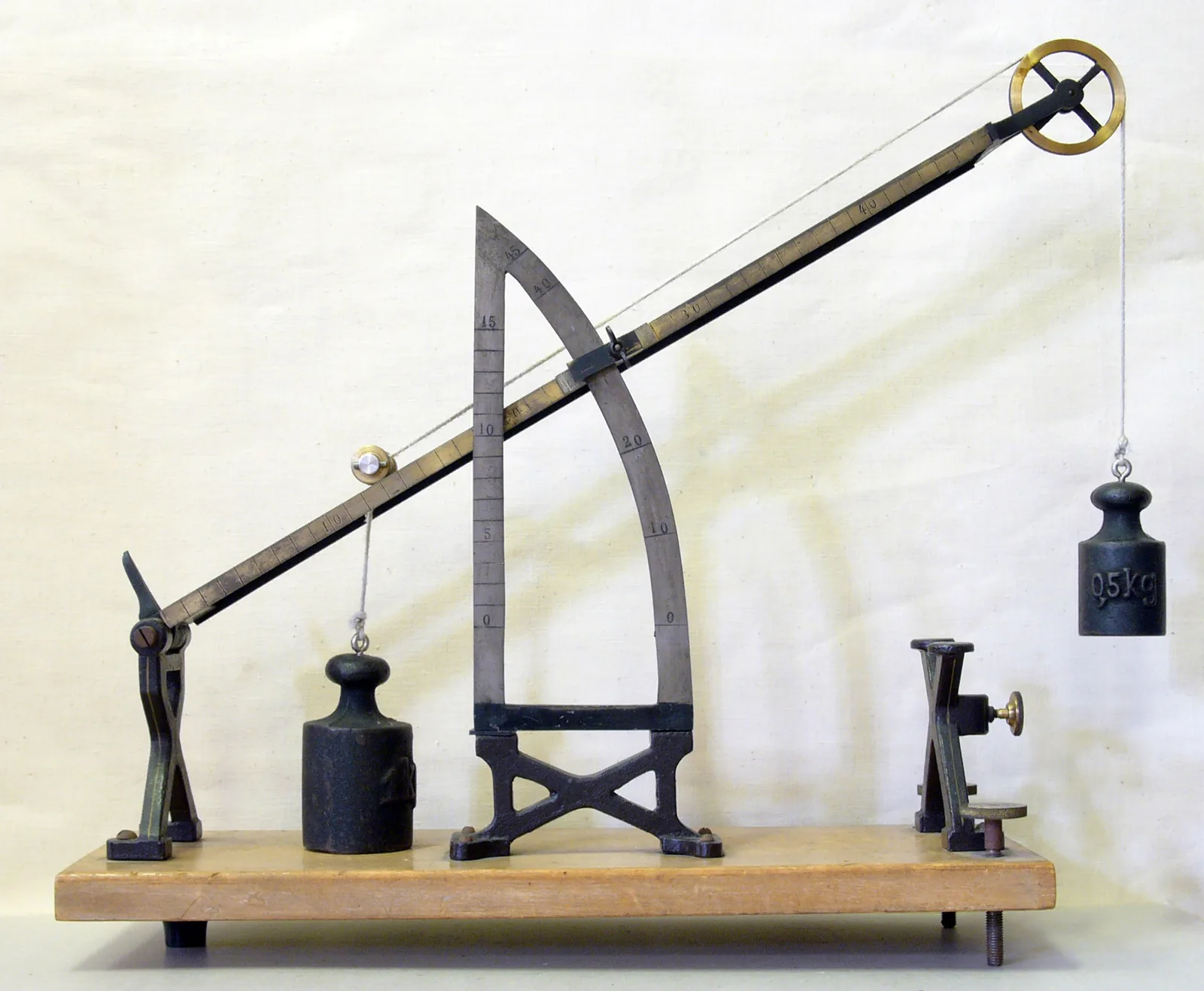
A cart stands on a table, and a string tied to it passes over a pulley at the edge of the table. A mass hangs from the other end of the string. When the cart is released, the mass starts to descend and pulls the cart along. The mass does not fall as fast as it would in free fall, though.
What pulls the cart, and how large is the force of the string compared with the weight of the mass?
Optional Review: force and reaction force
Predict
Make your predictions before investigating 2 questions
Prediction 1: the force of the string
Optional Prediction 2: two hanging bodies
Investigate
In the simulation, a cart and a hanging mass are tied by a string, or two bodies hang over a pulley. Each body has its own free-body diagram.
Simulation
How to use
Choose the Situation and the masses $m_1$ and $m_2$. Start releases the bodies, and they travel $0.60\,\text{m}$. Reset returns them to the start, and Speed slows down or speeds up the motion without changing the readings. The free-body diagrams and the readings are visible at once, also before starting. With two hanging bodies, equal masses do not start to move.
Assumptions of the model
The values are model values calculated by the simulation. The string is light and inextensible, the pulley is light and frictionless, and friction on the table and air resistance are neglected. So the accelerations of the bodies have the same magnitude and the string pulls both bodies with a force of the same magnitude $T$. The blue arrow for velocity and the orange arrow for acceleration are in the situation view because they are not forces. The arrows of the free-body diagrams are on a common scale.
How the calculation works
Cart and hanging mass: the equation of the cart $T = m_1 a$ and the equation of the hanging mass $m_2 g - T = m_2 a$ give $a = \dfrac{m_2}{m_1 + m_2}\,g$ and $T = m_1 a$. Two hanging bodies, $m_2 > m_1$: $T - m_1 g = m_1 a$ and $m_2 g - T = m_2 a$ give $a = \dfrac{m_2 - m_1}{m_1 + m_2}\,g$ and $T = \dfrac{2 m_1 m_2}{m_1 + m_2}\,g$. In the readings $\Sigma F_1$ and $\Sigma F_2$ are the net forces on the bodies along the motion, and $g = 9.81\,\text{m/s}^2$.
Experiment 1: the mass of the cart changes
Test the prediction. The initial state selects a cart and a hanging mass of $0.50\,\text{kg}$ and weight $4.9\,\text{N}$. Change only the mass $m_1$ of the cart. Record a measurement with the masses $0.50\,\text{kg}$, $1.0\,\text{kg}$ and $1.5\,\text{kg}$ and each time see how the lengths of the arrows $\overline{T}_1$ and $\overline{G}_2$ change.
Initial state: situation: cart and hanging mass, mass of the hanging mass $m_2$: $0.50\,\text{kg}$, mass of the cart $m_1$: $0.50\,\text{kg}$. Kept constant: situation, mass of the hanging mass $m_2$. Varied: mass of the cart $m_1$.
| mass of the cart $m_1$ | $T$ $(\text{N})$ | $a$ (m/s$^2$) |
|---|
When the mass of the cart is $1.0\,\text{kg}$, the table gives the tension $T$.
How large is the net force on the hanging mass, when its weight is $4.9\,\text{N}$? Answer in newtons.
Hint 1: a guiding question
Draw the free-body diagram of the hanging mass: weight down and tension up. Which arrow is longer when the mass accelerates downward?
Hint 2: what is the connection
The mass accelerates downward, so the net force down is $\Sigma F = G_2 - T$.
Hint 3: an intermediate step
$\Sigma F = 4.9\,\text{N} - T$, where $T$ is the tension in the row $m_1 = 1.0\,\text{kg}$ of the table.
Show the solution
Given
from the table, with cart mass $m_1 = 1.0\,\text{kg}$, the tension $T = 3.27\,\text{N}$; hanging mass $m_2 = 0.50\,\text{kg}$ and weight $G_2 = 4.9\,\text{N}$
Find
the net force $\Sigma F$ on the hanging mass in $\text{N}$
Principle
The hanging mass is one of the connected bodies, so it has its own free-body diagram and its own equation of motion. It accelerates downward, so by Newton's second law its net force points down.
Free-body diagram
The hanging mass as a rectangle, positive direction down. Weight $\overline{G}_2$ down and tension $\overline{T}_2$ in the string up. The arrow $\overline{G}_2$ is longer, because the net force points down.
Formula
$\Sigma F = m_2 g - T = G_2 - T$
Conversions
All forces are in newtons, so no conversions are needed.
Substitution
Answer
$1.6\,\text{N}$
Down. In a difference the number of decimals decides: the weight $4.9\,\text{N}$ is given to one decimal, so the result is rounded to one decimal.
Reasonableness
From the equation of motion
the same result as from the difference. The force is smaller than the weight $4.9\,\text{N}$, because the string holds up part of the weight.
Optional Experiment 2: two hanging bodies
Test the second prediction. The initial state selects two hanging bodies, the mass $m_2$ of one of them is $0.50\,\text{kg}$. Change only the mass $m_1$. Record a measurement with the masses $0.30\,\text{kg}$, $0.50\,\text{kg}$ and $1.0\,\text{kg}$ and compare the tension with the weights of the bodies.
Initial state: situation: two bodies, mass $m_2$: $0.50\,\text{kg}$, mass $m_1$: $0.30\,\text{kg}$. Kept constant: situation, mass $m_2$. Varied: mass $m_1$.
| mass $m_1$ | $G_1$ $(\text{N})$ | $T$ $(\text{N})$ | $a$ (m/s$^2$) |
|---|
When $m_1 = 0.30\,\text{kg}$, the lighter body rises. How large is the net force on it? Calculate it from the values in the table. Answer in newtons.
Hint 1: a guiding question
Draw the free-body diagram of the lighter body. Which force is greater when the body rises?
Hint 2: what is the connection
The body rises, so the net force up is $\Sigma F = T - G_1$.
Hint 3: an intermediate step
$\Sigma F = T - G_1$, where $T$ and $G_1$ are the values in the row $m_1 = 0.30\,\text{kg}$ of the table.
Show the solution
Given
from the table, when $m_1 = 0.30\,\text{kg}$: weight $G_1 = 2.94\,\text{N}$ and tension $T = 3.68\,\text{N}$
Find
the net force $\Sigma F$ on the lighter body in $\text{N}$
Principle
The lighter body accelerates upward, so by Newton's second law its net force points up. The body has its own free-body diagram and its own equation of motion.
Free-body diagram
The body as a rectangle, positive direction up. Tension $\overline{T}_1$ up and weight $\overline{G}_1$ down. The arrow $\overline{T}_1$ is longer.
Formula
$\Sigma F = T - G_1$
Conversions
All forces are in newtons, so no conversions are needed.
Substitution
Answer
$0.74\,\text{N}$
Up. The readings in the table have three significant figures, but the difference has only two, because the readings are given to the nearest hundredth.
Reasonableness
From the equation of motion
the same result. The tension of a rising body is greater than its weight, as it should be.
Conclusion
Using your measurements and the free-body diagrams, explain why the tension in the string is smaller than the weight of the hanging mass and why it approaches the weight when the cart is heavier.
Model answer
The hanging mass accelerates downward, so the net force $G_2 - T = m_2 a$ on it points down and $T$ is smaller than the weight $G_2 = 4.9\,\text{N}$. Only the string acts on the cart horizontally, so $T = m_1 a$. When the cart is heavier, the acceleration decreases and the net force $m_2 a$ on the hanging mass decreases. Then $T$ approaches the weight: in the model's values $T = 2.45\,\text{N}$ with cart mass $0.50\,\text{kg}$, $3.27\,\text{N}$ with $1.0\,\text{kg}$ and $3.68\,\text{N}$ with $1.5\,\text{kg}$. The tension would equal the weight only if the bodies did not accelerate, for example when the cart is held still.
Assess your own answer
Tick the points your own answer already contains.
Review the theory summary and practise with the exercises.
Optional Tension from measured motion
Made-up example data
A student studies the motion of a cart and a hanging mass. The mass of the cart is $1.0\,\text{kg}$ and the mass of the hanging mass $0.50\,\text{kg}$. The cart starts from rest and travels $0.80\,\text{m}$. The travel time is measured in five repetitions: $0.69\,\text{s}$, $0.71\,\text{s}$, $0.70\,\text{s}$, $0.70\,\text{s}$ and $0.70\,\text{s}$, on average $0.70\,\text{s}$. Friction and air resistance are so small that they are neglected. Draw the free-body diagram of the cart in your notebook before you answer.
How large is the tension in the string? First calculate the acceleration of the cart from the travel time and then use the equation of motion of the cart. Answer in newtons.
Hint 1: a guiding question
The cart starts from rest and moves with constant acceleration. Which formula connects distance, acceleration and time?
Hint 2: what is the connection
$s = \tfrac{1}{2}at^2$, so $a = \dfrac{2s}{t^2}$. Horizontally only the string acts on the cart: $T = m_1 a$.
Hint 3: an intermediate step
$T = 1.0\,\text{kg} \cdot a$.
Show the solution
Given
$m_1 = 1.0\,\text{kg}$, distance $s = 0.80\,\text{m}$, travel time $t = 0.70\,\text{s}$ (the mean of five measurements), starting from rest
Find
the tension $T$ in the string in $\text{N}$
Principle
The cart accelerates uniformly from rest, so the distance and the time give the acceleration. Friction is neglected, so horizontally only the string acts on the cart, and by Newton's second law its force is $m_1 a$.
Free-body diagram
The cart as a rectangle, positive direction along the motion. Weight $\overline{G}_1$ down and normal force $\overline{N}$ up, equally long, and tension $\overline{T}_1$ along the motion. Horizontally only $\overline{T}_1$ acts.
Formula
$s = \tfrac{1}{2}at^2$, so $a = \dfrac{2s}{t^2}$; equation of motion $T = m_1 a$, so $T = \dfrac{2 m_1 s}{t^2}$
Conversions
The time and the distance are in seconds and metres, so no conversions are needed.
Substitution
Answer
$3.3\,\text{N}$
Two significant figures like the time $0.70\,\text{s}$ and the distance $0.80\,\text{m}$.
Reasonableness
The tension is smaller than the weight of the hanging mass $0.50\,\text{kg} \cdot 9.81\,\text{m/s}^2 \approx 4.9\,\text{N}$, as it should be for an accelerating hanging mass. The result is the same as the simulation's model value $3.27\,\text{N}$.
Theory summary
Key idea
Often two bodies move together because a string joins them. When the string is taut and does not stretch, the bodies travel the same distance in the same time, so their accelerations have the same magnitude $a$. The string passes a force from one body to the other: it pulls each body toward itself. In this chapter the string is light and inextensible, the pulley is light and frictionless, and friction on the table and air resistance are neglected.
Connected bodies are treated one at a time. Each gets its own free-body diagram that shows only the forces acting on it, and each gets its own equation of motion. In the figure, the cart is acted on by its weight $\overline{G}_1$, the normal force $\overline{N}$ from the table and the tension $\overline{T}_1$ in the string. The hanging mass is acted on by its weight $\overline{G}_2$ and the tension $\overline{T}_2$ in the string.
The string pulls the cart with the force $\overline{T}_1$ and the hanging mass with the force $\overline{T}_2$. They act on different bodies, so they appear in different free-body diagrams. A light string and a frictionless pulley only pass the force on and turn its direction, so the magnitudes are equal: $T_1 = T_2 = T$. The forces $\overline{T}_1$ and $\overline{T}_2$ are nevertheless not an action–reaction pair. When the string pulls the cart, the cart pulls the string back with an equally large force, and that force acts on the string and is not in the cart's free-body diagram.
When the hanging mass accelerates downward, the tension in the string is smaller than its weight. The acceleration is downward, so the net force on the mass points down and $G_2 > T$. If $T$ were equal to $G_2$, the net force on the mass would be zero and it would not start to move. The mass therefore descends more slowly than a freely falling object: the acceleration $a = \tfrac{m_2 g}{m_1 + m_2}$ is smaller than $g$, because the weight of the hanging mass also accelerates the cart.
Equations of motion for connected bodies
Each body gets its own equation of motion $\Sigma F = ma$. The positive direction is chosen separately for each body along its acceleration: to the right for the cart and down for the hanging mass. Because the string does not stretch, both bodies have the same acceleration magnitude $a$. The equations of the cart and the hanging mass are
$$\begin{aligned} T &= m_1 a \\ m_2 g - T &= m_2 a \end{aligned}$$
where $m_1$ is the mass of the cart (kg), $m_2$ the mass of the hanging mass (kg), $T$ the tension in the string (N), $a$ the acceleration (m/s²) and $g = 9.81\,\text{m/s}^2$. There are two unknowns, $a$ and $T$, and two equations.
When the equations are added side by side, $T$ cancels, because the string is an internal force between the bodies. This gives the acceleration and then the tension:
$$\begin{aligned} a &= \frac{m_2}{m_1 + m_2}\,g \\ T &= m_1 a = \frac{m_1 m_2}{m_1 + m_2}\,g \end{aligned}$$
The tension is always smaller than the weight $m_2 g$ of the hanging mass, because $\tfrac{m_1}{m_1 + m_2} < 1$. The heavier the cart is compared with the hanging mass, the less the bodies accelerate and the closer $T$ is to the weight $m_2 g$.
Two hanging bodies
When a body hangs at each end of the string, the heavier one ($m_2$) goes down and the lighter one ($m_1$) goes up. The positive direction is chosen along the motion: up for the lighter body and down for the heavier one. Then
$$\begin{aligned} T - m_1 g &= m_1 a \\ m_2 g - T &= m_2 a \end{aligned}$$
$$\begin{aligned} a &= \frac{m_2 - m_1}{m_1 + m_2}\,g \\ T &= \frac{2 m_1 m_2}{m_1 + m_2}\,g \end{aligned}$$
where $m_2 > m_1$. The tension lies between the weights $m_1 g$ and $m_2 g$ of the bodies. If the masses are equal, $a = 0$ and $T = mg$.
Method for connected bodies
- Draw a free-body diagram for each body. The string pulls each body toward itself, and each body has its own tension arrow.
- Choose the positive direction for each body along its acceleration.
- Write the equation of motion $\Sigma F = ma$ for each body separately. The acceleration magnitude $a$ and the tension magnitude $T$ are the same in both. If a body is also pulled by an external force $\overline{F}$, that force belongs only in the free-body diagram and equation of motion of the body being pulled.
- Solve the two equations: add them, so that $T$ cancels, or substitute the $T$ from one into the other.
- Check the signs and compare: the tension is not equal to the weight of a hanging body when the bodies accelerate.
Common misconception
People often think that the cart is pulled by the weight of the hanging mass, so that the tension would be $m_2 g$. The cart is pulled by the string, however, and the force of the string is $T$. Only when the bodies do not accelerate, for example when the cart is held still, is $T = m_2 g$. When the hanging mass descends with increasing speed, its net force $G_2 - T = m_2 a$ must point down, so $T < m_2 g$.
Another mistake is to treat the forces $\overline{T}_1$ and $\overline{T}_2$ as an action–reaction pair. They act on different bodies but belong to different interactions: one to the string–cart pair and the other to the string–mass pair. They are equal because the string is light and the pulley is light and frictionless, not because they would be the forces of one interaction pair. A third mistake is to think that the heavier body accelerates more. Bodies at the ends of an inextensible string have the same acceleration magnitude.
Summary
- Bodies connected by a string or over a pulley each have their own free-body diagram and their own equation of motion $\Sigma F = ma$, and the positive direction is chosen for each body along its acceleration.
- A light, inextensible string and a light, frictionless pulley give the bodies the same acceleration magnitude $a$ and equal tensions $T_1 = T_2 = T$.
- For a cart and a hanging mass, $a = \frac{m_2}{m_1 + m_2}\,g$ and $T = \frac{m_1 m_2}{m_1 + m_2}\,g$. For two hanging bodies, $a = \frac{m_2 - m_1}{m_1 + m_2}\,g$ and $T = \frac{2 m_1 m_2}{m_1 + m_2}\,g$.
- The tension for an accelerating hanging body is not its weight: for the cart and the hanging mass $T < m_2 g$, and for two hanging bodies $T$ lies between the weights.
- The tensions $\overline{T}_1$ and $\overline{T}_2$ act on different bodies and are not an action–reaction pair.
Optional Return to your predictions
Compare your predictions with the measurements. What did you learn about the tension in the string? Also return to the cart at the beginning: what pulls the cart, and how large is its force compared with the weight of the mass? So why does the mass descend more slowly than a freely falling object?
Would you change your prediction?
Apply
Worked example
Problem
A cart of mass $1.5\,\text{kg}$ stands on a table. A string tied to it passes over a light pulley at the edge of the table, and a mass of $0.60\,\text{kg}$ hangs from the other end of the string. The cart is released from rest. Friction and air resistance are neglected, and the string is light and inextensible. What is the acceleration of the cart and what is the tension in the string?
Step 1/8
Given and find. $m_1 = 1.5\,\text{kg}$, $m_2 = 0.60\,\text{kg}$ and $g = 9.81\,\text{m/s}^2$. We want the acceleration $a$ and the tension $T$ in the string.
Step 2/8
Principle. The cart and the hanging mass are two bodies, so each gets its own equation of motion. The string does not stretch, so the accelerations of the bodies have the same magnitude $a$. The string is light and the pulley is light and frictionless, so the string pulls both bodies with the same force $T$. There is no friction, so in the horizontal direction only the string acts on the cart.
Step 3/8
Free-body diagram. Each body has its own free-body diagram. The positive direction is to the right for the cart and down for the hanging mass. The cart does not accelerate vertically, so $N = G_1$. In the horizontal direction the cart is pulled only by $\overline{T}_1$. The hanging mass is acted on by $\overline{G}_2$ downward and $\overline{T}_2$ upward.
Step 4/8
Rearranged formula. The two equations of motion are read from the diagrams and solved:
$$\begin{aligned} &T = m_1 a \\ &m_2 g - T = m_2 a \\ &m_2 g = (m_1 + m_2) a \\ &a = \frac{m_2 g}{m_1 + m_2} \\ &T = m_1 a \end{aligned}$$
Step 5/8
Unit conversions. None are needed: the masses are in kilograms and $\tfrac{\text{kg} \cdot \text{m/s}^2}{\text{kg}} = \text{m/s}^2$.
Step 6/8
Substitution. The numerical values are substituted with their units:
$$\begin{aligned} a &= \frac{m_2 g}{m_1 + m_2} \\ \phantom{a} &= \frac{0.60\,\text{kg} \cdot 9.81\,\text{m/s}^2}{1.5\,\text{kg} + 0.60\,\text{kg}} \\ \phantom{a} &\approx 2.80\,\text{m/s}^2 \\[4pt] T &= m_1 a = 1.5\,\text{kg} \cdot 2.803\,\text{m/s}^2 \\ \phantom{T} &\approx 4.20\,\text{N} \end{aligned}$$
Step 7/8
Result. The acceleration of the cart is $a \approx 2.8\,\text{m/s}^2$ and the tension in the string is $T \approx 4.2\,\text{N}$, with two significant figures like the masses $1.5\,\text{kg}$ and $0.60\,\text{kg}$.
Step 8/8
Reasonableness. The weight of the hanging mass is $m_2 g \approx 5.9\,\text{N}$, and the tension $4.2\,\text{N}$ is smaller than that, as it should be. The net force on the hanging mass is $5.886\,\text{N} - 4.204\,\text{N} \approx 1.68\,\text{N}$, and this equals
The acceleration is smaller than $g$, because the hanging mass also accelerates the cart. Without the cart, the mass would fall with acceleration $g$.
Find the error
Apply to a new situation
A cart of mass $1.2\,\text{kg}$ on a table is tied by a string over a pulley to a hanging mass. The acceleration of the cart is measured to be $2.0\,\text{m/s}^2$. Friction and air resistance are neglected, and the string and the pulley are light.
What is the mass of the hanging mass? Answer in kilograms.
Hint 1: a guiding question
Draw the free-body diagram of each body. Which force accelerates the cart?
Hint 2: what is the connection
Cart: $T = m_1 a$. Hanging mass: $m_2 g - T = m_2 a$.
Hint 3: an intermediate step
Substitute $T = m_1 a$ into the equation of the hanging mass and solve for $m_2$: $m_2 (g - a) = m_1 a$.
Show the solution
Given
$m_1 = 1.2\,\text{kg}$, acceleration of the cart $a = 2.0\,\text{m/s}^2$, $g = 9.81\,\text{m/s}^2$
Find
the mass $m_2$ of the hanging mass in $\text{kg}$
Principle
The cart and the hanging mass are two bodies, and each gets its own equation of motion. The string is inextensible, so the acceleration of the hanging mass has the same magnitude $a$, and the string is light, so it pulls both bodies with the force $T$. Friction is neglected.
Free-body diagram
The cart as a rectangle, positive direction to the right: horizontally only the tension $\overline{T}_1$. The hanging mass as a rectangle, positive direction down: weight $\overline{G}_2$ down and tension $\overline{T}_2$ up, and $T_1 = T_2 = T$.
Formula
Cart $T = m_1 a$ and hanging mass $m_2 g - T = m_2 a$. Substituting $T$: $m_2 g - m_1 a = m_2 a$, so $m_2 = \dfrac{m_1 a}{g - a}$
Conversions
All quantities are in SI units, so no conversions are needed.
Substitution
Answer
$0.31\,\text{kg}$
Two significant figures like the mass $1.2\,\text{kg}$ and the acceleration $2.0\,\text{m/s}^2$.
Reasonableness
With the formula
as measured. The hanging mass is lighter than the cart, so the acceleration stays below $g/2$, and the tension $T = 2.4\,\text{N}$ is smaller than the weight of the hanging mass, $3.0\,\text{N}$.
Check your understanding
Exit ticket
Answer on your own first and only then open the answer.
- A cart on a table and a hanging mass are tied by a string over a pulley. Why are the string's forces $\overline{T}_1$ on the cart and $\overline{T}_2$ on the hanging mass not an action–reaction pair?
Answer
They act on different bodies but belong to different interactions: $\overline{T}_1$ to the string–cart pair and $\overline{T}_2$ to the string–mass pair. The reaction force of $\overline{T}_1$ is the force of the cart on the string. The forces $\overline{T}_1$ and $\overline{T}_2$ are equal because the string is light and the pulley is light and frictionless.
- Write the equation of motion of the hanging mass when it descends with acceleration $a$ and the tension in the string is $T$. What is the positive direction?
Answer
The positive direction is down, along the acceleration: $m_2 g - T = m_2 a$. The weight $m_2 g$ is down and the tension $T$ is up, so the tension is smaller than the weight.
- A cart on a table and a hanging mass are tied by a string over a pulley. The mass of the cart is doubled and the hanging mass stays the same. How do the acceleration and the tension change?
Answer
The acceleration decreases, because the same weight of the hanging mass accelerates a greater total mass: $a = \tfrac{m_2 g}{m_1 + m_2}$. The tension increases, because the mass of the cart grows more than the acceleration decreases, and $T = m_1 a$ approaches the weight $m_2 g$. It still stays smaller than it.
1. Accelerations
2. Calculate the tension
A cart of mass $0.60\,\text{kg}$ on a table is tied by a string over a pulley to a hanging mass of $0.80\,\text{kg}$. Friction and air resistance are neglected, and the string and the pulley are light.
What is the tension in the string when the bodies are moving? Answer in newtons.
Hint 1: a guiding question
Draw the free-body diagram of each body and choose the positive direction along the motion.
Hint 2: what is the connection
Cart: $T = m_1 a$. Hanging mass: $m_2 g - T = m_2 a$. Solve $a$ first.
Hint 3: an intermediate step
$a = \dfrac{m_2 g}{m_1 + m_2}$ and $T = m_1 a$.
Show the solution
Given
$m_1 = 0.60\,\text{kg}$ (cart), $m_2 = 0.80\,\text{kg}$ (hanging mass), $g = 9.81\,\text{m/s}^2$
Find
the tension $T$ in the string in $\text{N}$
Principle
The cart and the hanging mass are two bodies, and each gets its own equation of motion. The string is inextensible and light, so the acceleration magnitude $a$ and the tension $T$ are the same for both. Friction is neglected.
Free-body diagram
The cart as a rectangle, positive direction to the right: horizontally only $\overline{T}_1$. The hanging mass as a rectangle, positive direction down: $\overline{G}_2$ down and $\overline{T}_2$ up.
Formula
$T = m_1 a$ and $m_2 g - T = m_2 a$, so
Conversions
All quantities are in SI units, so no conversions are needed.
Substitution
Answer
$3.4\,\text{N}$
Two significant figures like the masses $0.60\,\text{kg}$ and $0.80\,\text{kg}$.
Reasonableness
The weight of the hanging mass is $0.80\,\text{kg} \cdot 9.81\,\text{m/s}^2 \approx 7.8\,\text{N}$, and $3.4\,\text{N}$ is smaller than that, as it should be. The whole mass to be accelerated is $1.4\,\text{kg}$, of which $0.60\,\text{kg}$ is the cart:
Suggestion: one answer does not show everything you can do, but review the theory summary and do the core exercises.
3. Draw it yourself
Bodies of masses $0.40\,\text{kg}$ and $0.80\,\text{kg}$ hang at the ends of a string over a pulley. The string is light and inextensible, the pulley is light and frictionless, and air resistance is neglected. The bodies are released. Draw the free-body diagram of each body on paper: the body as a rectangle and each force from its point of application. Then write the equation of motion of each body and calculate the acceleration and the tension.
Model diagram
Each body has its own free-body diagram. The lighter body ($m_1 = 0.40\,\text{kg}$) is acted on by the weight $\overline{G}_1$ down and the tension $\overline{T}_1$ in the string up, and the heavier body ($m_2 = 0.80\,\text{kg}$) by the weight $\overline{G}_2$ down and the tension $\overline{T}_2$ up. The string is light and the pulley frictionless, so $T_1 = T_2 = T$. The lighter body rises and the heavier one descends with the same acceleration magnitude $a$. The positive direction is chosen along the motion: up for the lighter body and down for the heavier one. Then $T - m_1 g = m_1 a$ and $m_2 g - T = m_2 a$. Adding gives $a = \dfrac{(m_2 - m_1)\,g}{m_1 + m_2} = \dfrac{0.40\,\text{kg} \cdot 9.81\,\text{m/s}^2}{1.20\,\text{kg}} \approx 3.3\,\text{m/s}^2$ and $T = m_1 (g + a) \approx 5.2\,\text{N}$. The tension lies between the weights $3.9\,\text{N}$ and $7.8\,\text{N}$.
Assess your own answer
Tick the points your own answer already contains.
Review the theory summary and practise with the exercises.
Exercises
Level 1 · basic practice 8 exercises
One formula or one step of reasoning. Core exercises first, the rest is extra practice.
- Exercise 7-1Core
A cart of mass $1.5\,\text{kg}$ is on a frictionless table. A string tied to it pulls it horizontally with a force of $3.0\,\text{N}$. Draw the free-body diagram of the cart.
What is the acceleration of the cart?
Answer
$2.0\,\text{m/s}^2$
Show the solution
Given
$m = 1.5\,\text{kg}$, tension in the string $T = 3.0\,\text{N}$ horizontally; friction is neglected
Find
the acceleration $a$ of the cart in $\text{m/s}^2$
Principle
The cart accelerates horizontally, so by Newton's second law the sum of the horizontal forces is mass times acceleration. The cart does not accelerate vertically, so the forces there cancel.
Free-body diagram
The cart as a rectangle, with $x$ along the string. Weight $\overline{G}$ down and normal force $\overline{N}$ from the table up, equally long. Tension $\overline{T}$ horizontally forward. In the horizontal direction only $\overline{T}$ acts.
Formula
$T = ma$, so $a = \dfrac{T}{m}$
Conversions
All quantities are in SI units, so no conversions are needed.
Substitution
$a$$= \dfrac{3.0\,\text{N}}{1.5\,\text{kg}}$$= 2.0\,\text{m/s}^2$Answer
$2.0\,\text{m/s}^2$
Two significant figures like the data $3.0\,\text{N}$ and $1.5\,\text{kg}$.
Reasonableness
One newton gives a one-kilogram body an acceleration of $1\,\text{m/s}^2$. A force of $3.0\,\text{N}$ and a mass of $1.5\,\text{kg}$ give twice that, and the product $1.5\,\text{kg} \cdot 2.0\,\text{m/s}^2 = 3.0\,\text{N}$ gives back the force.
- Exercise 7-2Core
A mass of $0.60\,\text{kg}$ hangs from a string and descends with an acceleration of $2.0\,\text{m/s}^2$. Air resistance is neglected. Draw the free-body diagram of the mass.
What is the tension in the string?
Answer
$4.7\,\text{N}$
Show the solution
Given
$m = 0.60\,\text{kg}$, downward acceleration $a = 2.0\,\text{m/s}^2$, $g = 9.81\,\text{m/s}^2$; air resistance is neglected
Find
the tension $T$ in the string in $\text{N}$
Principle
The mass accelerates downward, so by Newton's second law its net force points down and equals $ma$. The Earth and the string act on it.
Free-body diagram
The mass as a rectangle, positive direction down. Weight $\overline{G}$ down from the centre and tension $\overline{T}$ up from the top surface. The arrow $\overline{G}$ is longer, because the net force points down.
Formula
$mg - T = ma$, so $T = m(g - a)$
Conversions
All quantities are in SI units, so no conversions are needed.
Substitution
$T$$= 0.60\,\text{kg} \cdot (9.81\,\text{m/s}^2 - 2.0\,\text{m/s}^2)$$= 0.60\,\text{kg} \cdot 7.81\,\text{m/s}^2$$= 4.686\,\text{N}$Answer
$4.7\,\text{N}$
Two significant figures like the mass $0.60\,\text{kg}$ and the acceleration $2.0\,\text{m/s}^2$.
Reasonableness
The weight of the mass is $0.60\,\text{kg} \cdot 9.81\,\text{m/s}^2 \approx 5.9\,\text{N}$, and $4.7\,\text{N}$ is smaller than that, because the mass accelerates downward. The difference $1.2\,\text{N}$ is $ma = 0.60\,\text{kg} \cdot 2.0\,\text{m/s}^2$.
- Exercise 7-3
A cart of mass $1.0\,\text{kg}$ is on a frictionless table. A light, inextensible string tied to it passes over a light, frictionless pulley at the edge of the table, and a mass of $0.40\,\text{kg}$ hangs from the end of the string. Air resistance is neglected.
Draw the free-body diagram of each body. What is the tension in the string when the bodies are moving?
Answer
$2.8\,\text{N}$
Show the solution
Given
cart $m_1 = 1.0\,\text{kg}$, hanging mass $m_2 = 0.40\,\text{kg}$, $g = 9.81\,\text{m/s}^2$; friction and air resistance are neglected, the string is light and inextensible, the pulley is light and frictionless
Find
the tension $T$ in the string in $\text{N}$
Principle
There are two bodies, so each gets its own equation of motion. The string is inextensible, so the acceleration magnitude $a$ is the same, and a light string and a frictionless pulley pass the force on unchanged, so the string pulls both bodies with the force $T$.
Free-body diagram
The cart as a rectangle, positive direction to the right: $\overline{G}_1$ and $\overline{N}$ cancel, and in the horizontal direction $\overline{T}_1$ acts. The hanging mass as a rectangle, positive direction down: $\overline{G}_2$ down and $\overline{T}_2$ up.
Formula
$T = m_1 a$ and $m_2 g - T = m_2 a$. Adding gives $m_2 g = (m_1 + m_2)\,a$, so $a = \dfrac{m_2 g}{m_1 + m_2}$, and $T = m_1 a$
Conversions
All quantities are in SI units, so no conversions are needed.
Substitution
$a$$= \dfrac{0.40\,\text{kg} \cdot 9.81\,\text{m/s}^2}{1.4\,\text{kg}}$$= 2.803\,\text{m/s}^2$$T$$= 1.0\,\text{kg} \cdot 2.803\,\text{m/s}^2$$= 2.803\,\text{N}$Answer
$2.8\,\text{N}$
Two significant figures like the masses $1.0\,\text{kg}$ and $0.40\,\text{kg}$.
Reasonableness
The tension is smaller than the weight of the hanging mass $m_2 g = 3.9\,\text{N}$, because the mass accelerates downward. The acceleration $a = T : m_1 \approx 2.8\,\text{m/s}^2$ is smaller than $g$, and the difference $3.9\,\text{N} - 2.8\,\text{N} = 1.1\,\text{N}$ is $m_2 a = 0.40\,\text{kg} \cdot 2.8\,\text{m/s}^2$.
- Exercise 7-4
Two identical bodies, each of mass $3.0\,\text{kg}$, hang at the ends of a light string over a light, frictionless pulley. The bodies are at rest. Draw the free-body diagram of one body.
What is the tension in the string?
Answer
$29\,\text{N}$
Show the solution
Given
two bodies, each of mass $m = 3.0\,\text{kg}$, at rest; $g = 9.81\,\text{m/s}^2$; the string is light, the pulley is light and frictionless
Find
the tension $T$ in the string in $\text{N}$
Principle
The body is at rest, so by Newton's second law the sum of the forces on it is zero. The free-body diagram of one body is enough, because the string is light and pulls both bodies with equally large forces.
Free-body diagram
The body as a rectangle, positive direction up. Weight $\overline{G}$ down from the centre and tension $\overline{T}$ up from the top surface. The arrows are equally long.
Formula
$T - mg = 0$, so $T = mg$
Conversions
All quantities are in SI units, so no conversions are needed.
Substitution
$T$$= 3.0\,\text{kg} \cdot 9.81\,\text{m/s}^2$$= 29.43\,\text{N}$Answer
$29\,\text{N}$
Two significant figures like the mass $3.0\,\text{kg}$.
Reasonableness
The tension is the weight of one body, not the sum $59\,\text{N}$ of the weights of both: the string holds up each body from its end with one force. If one body were replaced by a hook fixed to a wall, the string would carry the same force.
- Exercise 7-5
Two carts of masses $1.0\,\text{kg}$ and $2.0\,\text{kg}$ are tied together with a light string on a frictionless track, and air resistance is neglected. A horizontal pulling force of $12\,\text{N}$ acts on the lighter cart, and the carts move together.
What is the common acceleration of the carts?
Answer
$4.0\,\text{m/s}^2$
Show the solution
Given
carts $m_1 = 1.0\,\text{kg}$ and $m_2 = 2.0\,\text{kg}$, pulling force $F = 12\,\text{N}$ on the lighter cart; friction is neglected
Find
the common acceleration $a$ of the carts in $\text{m/s}^2$
Principle
The carts move together with the same acceleration magnitude. Each cart gets its own equation of motion, and when they are added, the internal force $T$ in the string cancels.
Free-body diagram
The lighter cart as a rectangle, positive direction toward the pull: horizontally the pulling force $\overline{F}$ forward and the tension $\overline{T}_1$ backward. The heavier cart as a rectangle: horizontally only $\overline{T}_2$ forward. Weight and normal force cancel in both.
Formula
$F - T = m_1 a$ and $T = m_2 a$. Adding gives $F = (m_1 + m_2)\,a$, so $a = \dfrac{F}{m_1 + m_2}$
Conversions
All quantities are in SI units, so no conversions are needed.
Substitution
$a$$= \dfrac{12\,\text{N}}{1.0\,\text{kg} + 2.0\,\text{kg}}$$= 4.0\,\text{m/s}^2$Answer
$4.0\,\text{m/s}^2$
Two significant figures like the data.
Reasonableness
The tension is
$T$$= m_2 a$$= 2.0\,\text{kg} \cdot 4.0\,\text{m/s}^2$$= 8.0\,\text{N}$and the lighter cart is left with $F - T = 4.0\,\text{N} = m_1 a$. The acceleration is the same as if a body of $3.0\,\text{kg}$ were pulled with a force of $12\,\text{N}$.
- Exercise 7-6
A cart is on a frictionless table and is tied by a string over a pulley to a hanging mass. The mass descends and the cart accelerates. The string and the pulley are light, and air resistance is neglected.
How are the tension $T$ in the string and the weight $G_2$ of the hanging mass related?
Answer
$T$ is smaller than $G_2$, because the net force on the hanging mass points downward
Show the solution
Find
how the tension $T$ in the string and the weight $G_2$ of the hanging mass are related when the mass descends with an acceleration.
Principle
By Newton's second law the net force on a body points in the direction of its acceleration. The hanging mass accelerates downward, so its net force points down. Only the weight, down, and the tension in the string, up, act on the hanging mass.
Model answer
For the hanging mass, $G_2 - T = m_2 a$, and because $a > 0$ downward, $G_2 - T > 0$. So the tension is smaller than the weight of the hanging mass. The string does not support the whole weight, because the mass accelerates downward and is not at rest. The string cannot pull harder than the weight either, because then the net force on the hanging mass would point up and the mass would not descend. The string pulls the cart and the hanging mass with the same force $T$, so it does not share its force in halves: the difference from the weight is always $m_2 a$.
- Exercise 7-7
Two bodies of masses $0.30\,\text{kg}$ and $0.70\,\text{kg}$ hang at the ends of a light, inextensible string over a pulley. The pulley is light and frictionless, and air resistance is neglected. The bodies are released. Draw the free-body diagram of each body.
What is the common acceleration of the bodies?
Answer
$3.9\,\text{m/s}^2$
Show the solution
Given
$m_1 = 0.30\,\text{kg}$ and $m_2 = 0.70\,\text{kg}$ at the ends of the string, $g = 9.81\,\text{m/s}^2$; the string is light and inextensible, the pulley is light and frictionless, air resistance is neglected
Find
the common acceleration $a$ of the bodies in $\text{m/s}^2$
Principle
Each body gets its own equation of motion. The string is inextensible, so the accelerations of the bodies have the same magnitude $a$, and the light string pulls both with the force $T$. The heavier body descends and the lighter one rises.
Free-body diagram
The lighter body as a rectangle, positive direction up: $\overline{T}_1$ up and $\overline{G}_1$ down. The heavier body as a rectangle, positive direction down: $\overline{G}_2$ down and $\overline{T}_2$ up. The arrow $\overline{T}$ is shorter than $\overline{G}_2$ and longer than $\overline{G}_1$.
Formula
$T - m_1 g = m_1 a$ and $m_2 g - T = m_2 a$. Adding eliminates $T$: $(m_2 - m_1)\,g = (m_1 + m_2)\,a$, so $a = \dfrac{(m_2 - m_1)\,g}{m_1 + m_2}$
Conversions
All quantities are in SI units, so no conversions are needed.
Substitution
$a$$= \dfrac{(0.70\,\text{kg} - 0.30\,\text{kg}) \cdot 9.81\,\text{m/s}^2}{0.30\,\text{kg} + 0.70\,\text{kg}}$$= \dfrac{0.40 \cdot 9.81}{1.00}\,\text{m/s}^2$$= 3.924\,\text{m/s}^2$Answer
$3.9\,\text{m/s}^2$
Two significant figures like the masses $0.30\,\text{kg}$ and $0.70\,\text{kg}$.
Reasonableness
The acceleration is smaller than $g = 9.81\,\text{m/s}^2$, because the lighter body slows down the heavier one. The tension
$T$$= m_1 (g + a)$$= 0.30\,\text{kg} \cdot 13.73\,\text{m/s}^2$$= 4.12\,\text{N}$gives the heavier body
$m_2 g - T$$= 6.87\,\text{N} - 4.12\,\text{N}$$= 2.75\,\text{N}$$= m_2 a$ - Exercise 7-8
A cart is on a frictionless table and is tied by a string over a pulley to a descending hanging mass. You are drawing the free-body diagram of the cart.
Which forces act on the cart along the table? Which statement is correct?
Answer
Only the tension in the string, because the weight of the hanging mass acts on the hanging mass and not on the cart
Show the solution
Find
which forces act on the cart in the direction of the table when the hanging mass descends on the string.
Principle
The free-body diagram of a body includes only the forces that act on that very body. Every force arises from an interaction: in the direction of the table only the string touches the cart. The weight of the cart and the normal force from the table are vertical.
Model answer
The weight of the hanging mass is the force of the Earth on the hanging mass, and it belongs in the free-body diagram of the hanging mass. The string transmits the effect of the hanging mass to the cart as the tension $T$, and that is the only force on the cart along the table. The equation of motion of the cart along the table is therefore $T = m_1 a$. The cart moves forward, but motion is not a force, and kinetic energy is not drawn in a free-body diagram. Because the hanging mass accelerates downward, the tension is smaller than the weight of the hanging mass: $T < m_2 g$.
Level 2 · applied practice 7 exercises
Two steps, working with measured data, a unit conversion or rearranging a formula. Core exercises first, the rest is extra practice.
- Exercise 7-9Core
A crane's rope lifts a crate of mass $50\,\text{kg}$. Below it, a second crate of mass $30\,\text{kg}$ hangs from another rope. The crates accelerate upward with an acceleration of $1.2\,\text{m/s}^2$.
The ropes are light and inextensible, and air resistance is neglected.
Draw the free-body diagram of each crate in your notebook before you open the solution. What is the tension in the crane's rope?
Answer
$880\,\text{N}$
Show the solution
Given
upper crate $m_1 = 50\,\text{kg}$, lower crate $m_2 = 30\,\text{kg}$, upward acceleration $a = 1.2\,\text{m/s}^2$, $g = 9.81\,\text{m/s}^2$; the ropes are light and inextensible, air resistance is neglected
Find
the tension $T_1$ in the crane's rope in $\text{N}$
Principle
The crates are two bodies, and each gets its own equation of motion. The lower crate hangs from the upper one, so they have the same acceleration $a$. The force of a light rope is the same at both ends of the rope, so the lower rope pulls the upper crate down with the same force $T_2$ with which it pulls the lower crate up.
Free-body diagram
The upper crate as a rectangle, positive direction up: the crane rope's $\overline{T}_1$ up from the top surface, weight $\overline{G}_1$ down from the centre and the lower rope's $\overline{T}_2$ down from the bottom surface. The lower crate as a rectangle: $\overline{T}_2$ up from the top surface and weight $\overline{G}_2$ down. The arrow $\overline{T}_1$ is the longest.
Formula
$T_1 - T_2 - m_1 g = m_1 a$ and $T_2 - m_2 g = m_2 a$, so adding gives $T_1 = (m_1 + m_2)(g + a)$
Conversions
All quantities are in SI units, so no conversions are needed.
Substitution
$T_1$$= (50\,\text{kg} + 30\,\text{kg}) \cdot (9.81\,\text{m/s}^2 + 1.2\,\text{m/s}^2)$$= 80\,\text{kg} \cdot 11.01\,\text{m/s}^2$$= 880.8\,\text{N}$Answer
$880\,\text{N}$
That is $8.8 \cdot 10^{2}\,\text{N}$, two significant figures like the acceleration $1.2\,\text{m/s}^2$ and the mass $30\,\text{kg}$.
Reasonableness
The combined weight of the crates is $80\,\text{kg} \cdot 9.81\,\text{m/s}^2 \approx 785\,\text{N}$, and lifting with acceleration needs more. The excess $96\,\text{N}$ is $(m_1 + m_2)\,a = 80\,\text{kg} \cdot 1.2\,\text{m/s}^2$. The force in the lower rope is
$T_2$$= m_2 (g + a)$$\approx 330\,\text{N}$smaller than $T_1$, because it carries only the lower crate.
- Exercise 7-10Core
Bodies of masses $0.50\,\text{kg}$ and $1.0\,\text{kg}$ hang at the ends of a light, inextensible string over a pulley. The pulley is light and frictionless, and air resistance is neglected. The bodies are released. Draw the free-body diagram of each body.
What is the tension in the string?
Answer
$6.5\,\text{N}$
Show the solution
Given
$m_1 = 0.50\,\text{kg}$ and $m_2 = 1.0\,\text{kg}$ at the ends of the string, $g = 9.81\,\text{m/s}^2$; the string is light, the pulley is light and frictionless, air resistance is neglected
Find
the tension $T$ in the string in $\text{N}$
Principle
Each body gets its own equation of motion. The heavier body $m_2$ goes down and the lighter body $m_1$ goes up with the same acceleration magnitude $a$, because the string is inextensible, and the string pulls both with the force $T$.
Free-body diagram
The lighter body as a rectangle, positive direction up: $\overline{T}_1$ up and $\overline{G}_1$ down. The heavier body as a rectangle, positive direction down: $\overline{G}_2$ down and $\overline{T}_2$ up.
Formula
$T - m_1 g = m_1 a$ and $m_2 g - T = m_2 a$, so adding gives
$a$$= \dfrac{(m_2 - m_1)\,g}{m_1 + m_2}$$T$$= m_1 (g + a)$$= \dfrac{2 m_1 m_2}{m_1 + m_2}\cdot g$Conversions
All quantities are in SI units, so no conversions are needed.
Substitution
$T$$= \dfrac{2 \cdot 0.50\,\text{kg} \cdot 1.0\,\text{kg}}{0.50\,\text{kg} + 1.0\,\text{kg}} \cdot 9.81\,\text{m/s}^2$$= 0.6667\,\text{kg} \cdot 9.81\,\text{m/s}^2$$= 6.54\,\text{N}$Answer
$6.5\,\text{N}$
Two significant figures like the masses $0.50\,\text{kg}$ and $1.0\,\text{kg}$.
Reasonableness
The weights are $m_1 g \approx 4.9\,\text{N}$ and $m_2 g \approx 9.8\,\text{N}$, and $6.5\,\text{N}$ lies between them: $T > G_1$ for the rising body and $T < G_2$ for the descending one. The acceleration $a = 3.27\,\text{m/s}^2$ gives the same forces: $T - G_1 = 1.635\,\text{N} = m_1 a$.
- Exercise 7-11
Two sleds of masses $3.0\,\text{kg}$ and $2.0\,\text{kg}$ are on ice. The sleds are tied together with a light rope. The heavier sled is pulled horizontally with a force of $20\,\text{N}$ by another rope, and the sleds move together. Friction and air resistance are neglected. Draw the free-body diagram of each sled.
What is the tension in the rope between the sleds?
Answer
$8.0\,\text{N}$
Show the solution
Given
sleds $m_1 = 3.0\,\text{kg}$ (the one being pulled) and $m_2 = 2.0\,\text{kg}$, pulling force $F = 20\,\text{N}$; friction and air resistance are neglected, the ropes are light and inextensible
Find
the tension $T$ in the rope between the sleds in $\text{N}$
Principle
The sleds move together with the same acceleration magnitude $a$. Each sled gets its own equation of motion; the rear sled is pulled only by the rope between the sleds.
Free-body diagram
The heavier sled as a rectangle, positive direction toward the pull: the pulling force $\overline{F}$ forward and the tension $\overline{T}_1$ backward. The lighter sled as a rectangle: horizontally only $\overline{T}_2$ forward. Weight and normal force cancel in both.
Formula
$F - T = m_1 a$ and $T = m_2 a$. Adding gives $a = \dfrac{F}{m_1 + m_2}$, so $T = m_2 a = \dfrac{m_2}{m_1 + m_2}\,F$
Conversions
All quantities are in SI units, so no conversions are needed.
Substitution
$T$$= \dfrac{2.0\,\text{kg}}{3.0\,\text{kg} + 2.0\,\text{kg}} \cdot 20\,\text{N}$$= 0.40 \cdot 20\,\text{N}$$= 8.0\,\text{N}$Answer
$8.0\,\text{N}$
Two significant figures like the data.
Reasonableness
The force in the rope is smaller than the pulling force $20\,\text{N}$, because it accelerates only the rear sled. The acceleration is
$a$$= 20\,\text{N} : 5.0\,\text{kg}$$= 4.0\,\text{m/s}^2$and the front sled is left with
$20\,\text{N} - 8.0\,\text{N}$$= 12\,\text{N}$$= m_1 a$ - Exercise 7-12
Two bodies hang at the ends of a light, inextensible string over a pulley. The mass of the lighter one is $0.60\,\text{kg}$. The bodies are released, and the heavier one descends with an acceleration of $2.0\,\text{m/s}^2$. The pulley is light and frictionless, and air resistance is neglected. Draw the free-body diagram of each body.
What is the mass of the heavier body?
Answer
$0.91\,\text{kg}$
Show the solution
Given
mass of the lighter body $m_1 = 0.60\,\text{kg}$, downward acceleration of the heavier one $a = 2.0\,\text{m/s}^2$, $g = 9.81\,\text{m/s}^2$; the string is light, the pulley is light and frictionless, air resistance is neglected
Find
the mass $m_2$ of the heavier body in $\text{kg}$
Principle
There are two bodies, and each gets its own equation of motion. The string is inextensible, so the acceleration magnitude $a$ is the same, and the light string pulls both with the force $T$. The lighter body goes up and the heavier one goes down.
Free-body diagram
The lighter body as a rectangle, positive direction up: $\overline{T}_1$ up and $\overline{G}_1$ down, with $\overline{T}_1$ longer. The heavier body as a rectangle, positive direction down: $\overline{G}_2$ down and $\overline{T}_2$ up, with $\overline{G}_2$ longer.
Formula
$T - m_1 g = m_1 a$ and $m_2 g - T = m_2 a$. The first gives $T = m_1 (g + a)$, and the second gives $m_2 (g - a) = T$, so $m_2 = \dfrac{m_1 (g + a)}{g - a}$
Conversions
All quantities are in SI units, so no conversions are needed.
Substitution
$m_2$$= \dfrac{0.60\,\text{kg} \cdot (9.81 + 2.0)\,\text{m/s}^2}{(9.81 - 2.0)\,\text{m/s}^2}$$= \dfrac{7.086\,\text{N}}{7.81\,\text{m/s}^2}$$= 0.9073\,\text{kg}$Answer
$0.91\,\text{kg}$
Two significant figures like the mass $0.60\,\text{kg}$ and the acceleration $2.0\,\text{m/s}^2$.
Reasonableness
The mass $0.91\,\text{kg}$ is greater than $0.60\,\text{kg}$, as it must be for the heavier body. Check with the formula
$a$$= \dfrac{(m_2 - m_1)\,g}{m_1 + m_2}$$= \dfrac{0.3073 \cdot 9.81}{1.5073}\,\text{m/s}^2$$\approx 2.0\,\text{m/s}^2$and the tension $T = 7.09\,\text{N}$ lies between the weights $5.9\,\text{N}$ and $8.9\,\text{N}$.
- Exercise 7-13
In an Atwood machine, two masses hang at the ends of a light, inextensible string over a pulley, and their total mass is always $M = 0.500\,\text{kg}$. The pulley is light and frictionless. The mass difference $\Delta m = m_2 - m_1$ is changed by moving small masses from one mass to the other, and for each mass difference the acceleration $a$ of the heavier mass is measured. The table shows example data of the measurements.
a) From the equations of motion of the two masses, derive a formula for calculating $a$ from the mass difference $\Delta m$.
b) Draw the $(\Delta m, a)$ graph and fit a straight line through the origin to it. Determine the acceleration of free fall $g$ from the slope of the line.
The answer box takes the acceleration of free fall from part b).
Acceleration of an Atwood machine at different mass differences (example data) $\Delta m\,(\text{g})$ $a\,(\text{m/s}^2)$ 50 0.96 100 2.02 150 2.88 200 3.97 250 4.84 Answer
$9.8\,\text{m/s}^2$
Show the solution
Given
total mass of the masses $M = 0.500\,\text{kg}$; from the table $\Delta m = 50$; $100$; $150$; $200$ and $250\,\text{g}$ and $a = 0.96$; $2.02$; $2.88$; $3.97$ and $4.84\,\text{m/s}^2$ (example data)
Find
a) a formula for $a$ using the mass difference $\Delta m$; b) the acceleration of free fall $g$ in $\text{m/s}^2$
Principle
Each mass gets its own equation of motion. The string is inextensible and light, so the magnitude of the acceleration $a$ and the tension $T$ are the same for both masses. When the equations are added, $T$ cancels and a direct proportionality $a \propto \Delta m$ remains. The slope of the line gives $g$.
Reading the graph
The points $(\Delta m, a)$ lie almost on a straight line through the origin; individual points deviate from it by at most about $0.1\,\text{m/s}^2$, which is random variation of the measurement. The fitted line through the origin hits the value $a = 4.9\,\text{m/s}^2$ at the last point, where $\Delta m = 0.250\,\text{kg}$, so the slope is
$k$$= \dfrac{4.9\,\text{m/s}^2}{0.250\,\text{kg}}$$= 19.6\,\dfrac{\text{m/s}^2}{\text{kg}}$Formula
The lighter $m_1$ rises and the heavier $m_2$ descends: $T - m_1 g = m_1 a$ and $m_2 g - T = m_2 a$. Adding gives $(m_2 - m_1)\,g = (m_1 + m_2)\,a$, so $a = \dfrac{g}{M}\,\Delta m$. The slope is $k = \dfrac{g}{M}$, so $g = k\,M$
Conversions
$\Delta m$$= 250\,\text{g}$$= 0.250\,\text{kg}$the other quantities are in SI units.
Substitution
$g$$= 19.6\,\dfrac{\text{m/s}^2}{\text{kg}} \cdot 0.500\,\text{kg}$$= 9.8\,\text{m/s}^2$Answer
$9.8\,\text{m/s}^2$
Two significant figures, because the slope of a line fitted by hand is obtained only to two figures.
Reasonableness
The result is close to the known value $9.81\,\text{m/s}^2$. The ratios $a : \Delta m$ of the points are $19.2$; $20.2$; $19.2$; $19.9$ and $19.4$ in the unit $\dfrac{\text{m/s}^2}{\text{kg}}$, so all are close to $19.6$. By the formula, $\Delta m = 250\,\text{g}$ gives
$a$$= \dfrac{0.250 \cdot 9.81}{0.500}\,\text{m/s}^2$$= 4.9\,\text{m/s}^2$which is smaller than $g$, as it should be.
- Exercise 7-14
A cart of mass $1.20\,\text{kg}$ is on a frictionless track and is tied by a light, inextensible string over a light, frictionless pulley to a hanging mass. The cart is released from rest with different hanging masses, and the acceleration $a$ of the cart is measured each time. The table shows example data of the measurements.
From the measurement in which the hanging mass is $0.50\,\text{kg}$, determine the tension in the string using the equation of motion of the cart. Check the result with the equation of motion of the hanging mass from the same measurement. First draw the free-body diagram of each body.
The answer box takes the tension obtained from the equation of motion of the cart.
Acceleration of the cart with different hanging masses (example data) $m_2\,(\text{kg})$ $a\,(\text{m/s}^2)$ 0.10 0.74 0.20 1.40 0.30 1.97 0.50 2.84 0.70 3.60 Answer
$3.4\,\text{N}$
Show the solution
Given
mass of the cart $m_1 = 1.20\,\text{kg}$; from the measurement in which the hanging mass is $m_2 = 0.50\,\text{kg}$, the acceleration $a = 2.84\,\text{m/s}^2$ (example data); $g = 9.81\,\text{m/s}^2$; friction is neglected, the string and the pulley are light
Find
the tension $T$ in the string in $\text{N}$
Principle
In the direction of the table only the string acts on the cart, so its equation of motion gives $T$ directly from the measured acceleration. As a check, $T$ is calculated from the same measurement using the equation of motion of the hanging mass, where $T$ is opposite in direction to the weight.
Reading the graph
The row $m_2 = 0.50\,\text{kg}$ of the table gives $a = 2.84\,\text{m/s}^2$. The acceleration grows as the hanging mass grows, but not in direct proportion: the mass becomes five times as large ($0.10\,\text{kg} \to 0.50\,\text{kg}$), but the acceleration becomes only four times as large ($0.74 \to 2.84\,\text{m/s}^2$).
Free-body diagram
The cart as a rectangle, positive direction along the string: $\overline{G}_1$ and $\overline{N}$ cancel, and in the horizontal direction only $\overline{T}_1$ acts. The hanging mass as a rectangle, positive direction down: $\overline{G}_2$ down and $\overline{T}_2$ up.
Formula
Cart: $T = m_1 a$. Hanging mass: $m_2 g - T = m_2 a$, so the check is $T = m_2\,(g - a)$
Conversions
All quantities are in SI units, so no conversions are needed.
Substitution
$T$$= 1.20\,\text{kg} \cdot 2.84\,\text{m/s}^2$$= 3.408\,\text{N}$Check:
$T$$= 0.50\,\text{kg} \cdot (9.81\,\text{m/s}^2 - 2.84\,\text{m/s}^2)$$= 0.50\,\text{kg} \cdot 6.97\,\text{m/s}^2$$= 3.485\,\text{N}$Answer
$3.4\,\text{N}$
Two significant figures, because the two equations give $3.41\,\text{N}$ and $3.49\,\text{N}$, which differ by about $2\,\%$, so only the first two figures are reliable.
Reasonableness
The two ways give $3.4\,\text{N}$ and $3.5\,\text{N}$, so they differ by about $2\,\%$, which fits the precision of the measurement. By theory,
$a$$= \dfrac{0.50 \cdot 9.81}{1.70}\,\text{m/s}^2$$= 2.89\,\text{m/s}^2$so the measured $2.84\,\text{m/s}^2$ is slightly smaller. The tension is smaller than the weight of the hanging mass $4.9\,\text{N}$, as it should be.
- Exercise 7-15
A cart of mass $2.0\,\text{kg}$ is on a frictionless table. A light, inextensible string tied to it passes over a light, frictionless pulley, and a mass of $0.50\,\text{kg}$ hangs from the end of the string. The bodies are released, and air resistance is neglected.
A student's solution: “Only the string acts on the cart in the horizontal direction, so $T = m_1 a$. For the hanging mass, $m_2 g - T = m_2 a$. I substituted the first into the second: $m_2 g - m_1 a = m_2 a$. From this I solved $a = \dfrac{m_2 g}{m_1} = 2.5\,\text{m/s}^2$.”
Find the error in the student's solution and calculate the correct acceleration. Also draw the free-body diagram of each body.
The answer box takes the correct acceleration.
Answer
$2.0\,\text{m/s}^2$
Show the solution
Given
cart $m_1 = 2.0\,\text{kg}$, hanging mass $m_2 = 0.50\,\text{kg}$, $g = 9.81\,\text{m/s}^2$; friction and air resistance are neglected, the string and the pulley are light; the student's result $2.5\,\text{m/s}^2$
Find
the error in the student's solution and the correct acceleration $a$ in $\text{m/s}^2$
Principle
Each body gets its own equation of motion, and the acceleration accelerates the whole system: both the cart and the hanging mass. The student's equations $T = m_1 a$ and $m_2 g - T = m_2 a$ are correct, but the solution contains an error.
Free-body diagram
The cart as a rectangle, positive direction to the right: $\overline{G}_1$ and $\overline{N}$ cancel, and in the horizontal direction only $\overline{T}_1$ acts. The hanging mass as a rectangle, positive direction down: $\overline{G}_2$ down and $\overline{T}_2$ up.
Formula
The error: after the substitution the equation is $m_2 g - m_1 a = m_2 a$, and the mass of the hanging mass also belongs in the denominator:
$m_2 g$$= m_1 a + m_2 a$$= (m_1 + m_2)\,a$The student forgot the mass of the hanging mass, that is, the mass $m_1 + m_2$ of the whole moving system. Correctly, $a = \dfrac{m_2 g}{m_1 + m_2}$
Conversions
All quantities are in SI units, so no conversions are needed.
Substitution
$a$$= \dfrac{0.50\,\text{kg} \cdot 9.81\,\text{m/s}^2}{2.0\,\text{kg} + 0.50\,\text{kg}}$$= \dfrac{4.905\,\text{N}}{2.5\,\text{kg}}$$= 1.962\,\text{m/s}^2$Answer
$2.0\,\text{m/s}^2$
Two significant figures like the data $2.0\,\text{kg}$ and $0.50\,\text{kg}$. The student's result was too large, because the student divided only by the mass of the cart.
Reasonableness
The tension
$T$$= m_1 a$$= 2.0\,\text{kg} \cdot 1.962\,\text{m/s}^2$$= 3.92\,\text{N}$is smaller than the weight of the hanging mass $4.9\,\text{N}$, and the difference $0.98\,\text{N}$ is $m_2 a = 0.50\,\text{kg} \cdot 1.962\,\text{m/s}^2$. With the student's value $a = 2.45\,\text{m/s}^2$ we would have $T = m_1 a = 4.9\,\text{N}$ and $m_2 g - T \approx 0$, but the equation of motion of the hanging mass would require $m_2 a = 1.2\,\text{N}$, so the value is wrong.
Level 3 · challenging 5 exercises
Optional: application, two ideas together or a new situation where you reason for yourself.
- Exercise 7-16
An elevator cabin of mass $800\,\text{kg}$ hangs from the end of a light, inextensible rope. The rope passes over a light, frictionless wheel, and at its other end is a counterweight of mass $1200\,\text{kg}$.
The counterweight descends and the cabin rises. Friction and air resistance are neglected.
Draw the free-body diagrams of the cabin and the counterweight. What is the force that the rope exerts on the axle of the wheel, when the wheel is light and the axle holds it in place?
Answer
$19000\,\text{N}$
Show the solution
Given
mass of the cabin $m_1 = 800\,\text{kg}$, mass of the counterweight $m_2 = 1200\,\text{kg}$, $g = 9.81\,\text{m/s}^2$; the rope is light and inextensible, the wheel is light and frictionless, air resistance is neglected
Find
the force $F_\text{axle}$ that the rope exerts on the axle of the wheel, in $\text{N}$
Principle
The cabin and the counterweight are two bodies, and each gets its own equation of motion. The rope is inextensible, so $a$ is the same for both, and the light rope pulls both with the force $T$. The wheel is light and does not accelerate, so its net force is zero.
Free-body diagram
The cabin as a rectangle, positive direction up: $\overline{T}_1$ up and $\overline{G}_1$ down. The counterweight as a rectangle, positive direction down: $\overline{G}_2$ down and $\overline{T}_2$ up. The arrows $\overline{T}_1$ and $\overline{T}_2$ are equally long. On the wheel: two forces $T$ down and $F_\text{axle}$ up.
Formula
$T - m_1 g = m_1 a$ and $m_2 g - T = m_2 a$, so
$T$$= \dfrac{2 m_1 m_2}{m_1 + m_2}\cdot g$From the equilibrium of the wheel, $F_\text{axle} - 2T = 0$, so $F_\text{axle} = 2T$
Conversions
All quantities are in SI units, so no conversions are needed.
Substitution
$T$$= \dfrac{2 \cdot 800\,\text{kg} \cdot 1200\,\text{kg}}{800\,\text{kg} + 1200\,\text{kg}} \cdot 9.81\,\text{m/s}^2$$= 960\,\text{kg} \cdot 9.81\,\text{m/s}^2$$= 9418\,\text{N}$$F_\text{axle}$$= 2 \cdot 9418\,\text{N}$$= 18\,835\,\text{N}$Answer
$19000\,\text{N}$
That is $19\,\text{kN}$, two significant figures, because the masses are given to the nearest hundred kilograms.
Reasonableness
The weights are $m_1 g \approx 7850\,\text{N}$ and $m_2 g \approx 11\,770\,\text{N}$, and $T = 9418\,\text{N}$ lies between them. The force on the axle, $18\,835\,\text{N}$, is smaller than the sum of the weights, $19\,620\,\text{N}$, because the counterweight accelerates downward.
- Exercise 7-17
A cart of mass $1.0\,\text{kg}$ is on a frictionless table and is tied by a light, inextensible string over a light, frictionless pulley to a hanging mass.
The string breaks if its tension exceeds $3.0\,\text{N}$.
What is the greatest mass of the hanging mass for which the string still holds while the bodies are moving? First draw the free-body diagram of each body. Answer in kilograms.
Answer
$0.44\,\text{kg}$
Show the solution
Given
cart $m_1 = 1.0\,\text{kg}$, greatest allowed tension $T_{\max} = 3.0\,\text{N}$, $g = 9.81\,\text{m/s}^2$; friction is neglected, the string and the pulley are light
Find
the greatest mass $m_2$ of the hanging mass in $\text{kg}$
Principle
The bodies get their own equations of motion, and from them the tension is obtained as a function of the masses. The tension increases as the mass of the hanging mass increases, so the limiting value $T = T_{\max}$ gives the greatest mass.
Free-body diagram
The cart as a rectangle, positive direction to the right: horizontally only $\overline{T}_1$. The hanging mass as a rectangle, positive direction down: $\overline{G}_2$ down and $\overline{T}_2$ up.
Formula
$T = m_1 a$ and $m_2 g - T = m_2 a$, so $T = \dfrac{m_1 m_2}{m_1 + m_2}\,g$. When $T = T_{\max}$: $T_{\max} (m_1 + m_2) = m_1 m_2 g$, so
$m_2$$= \dfrac{m_1\,T_{\max}}{g\,m_1 - T_{\max}}$Conversions
All quantities are in SI units, so no conversions are needed.
Substitution
$m_2$$= \dfrac{3.0\,\text{N} \cdot 1.0\,\text{kg}}{1.0\,\text{kg} \cdot 9.81\,\text{m/s}^2 - 3.0\,\text{N}}$$= \dfrac{3.0\,\text{N}\cdot\text{kg}}{6.81\,\text{N}}$$= 0.4405\,\text{kg}$Answer
$0.44\,\text{kg}$
Two significant figures like the data $3.0\,\text{N}$ and $1.0\,\text{kg}$.
Reasonableness
Check:
$T$$= \dfrac{1.0 \cdot 0.4405}{1.4405} \cdot 9.81\,\text{N}$$\approx 3.0\,\text{N}$With a hanging mass heavier than the limit, $T$ is greater, but always below the weight of the cart $9.81\,\text{N}$, because $T$ approaches $m_1 g$ only for an infinitely large $m_2$.
- Exercise 7-18
A cart of mass $1.5\,\text{kg}$ is on a frictionless table and is tied by a light, inextensible string over a light, frictionless pulley to a hanging mass of $0.50\,\text{kg}$. The cart is released from rest.
How long does it take for the cart to travel $0.90\,\text{m}$? First draw the free-body diagram of each body.
Answer
$0.86\,\text{s}$
Show the solution
Given
cart $m_1 = 1.5\,\text{kg}$, hanging mass $m_2 = 0.50\,\text{kg}$, distance $s = 0.90\,\text{m}$, starting from rest, $g = 9.81\,\text{m/s}^2$; friction is neglected, the string and the pulley are light
Find
the time $t$ in $\text{s}$
Principle
First the equations of motion of the bodies give the acceleration. The acceleration is constant, so for motion from rest $s = \tfrac{1}{2}at^2$, which gives the time.
Free-body diagram
The cart as a rectangle, positive direction to the right: horizontally only $\overline{T}_1$. The hanging mass as a rectangle, positive direction down: $\overline{G}_2$ down and $\overline{T}_2$ up, and $T_1 = T_2 = T$.
Formula
$T = m_1 a$ and $m_2 g - T = m_2 a$, so $a = \dfrac{m_2 g}{m_1 + m_2}$. From the distance $s = \tfrac{1}{2}at^2$, so $t = \sqrt{\dfrac{2s}{a}}$
Conversions
All quantities are in SI units, so no conversions are needed.
Substitution
$a$$= \dfrac{0.50\,\text{kg} \cdot 9.81\,\text{m/s}^2}{2.0\,\text{kg}}$$= 2.4525\,\text{m/s}^2$$t$$= \sqrt{\dfrac{2 \cdot 0.90\,\text{m}}{2.4525\,\text{m/s}^2}}$$= 0.857\,\text{s}$Answer
$0.86\,\text{s}$
Two significant figures like the data $0.90\,\text{m}$ and $0.50\,\text{kg}$.
Reasonableness
Check: the final speed is $at \approx 2.1\,\text{m/s}$ and the average speed $1.05\,\text{m/s}$, so $1.05\,\text{m/s} \cdot 0.857\,\text{s} \approx 0.90\,\text{m}$. A freely falling mass ($a = g$) would cover the same distance in $0.43\,\text{s}$, so $0.86\,\text{s}$ is sensibly longer.
- Exercise 7-19
A locomotive pulls three cars in a row on a straight horizontal track. The masses of the cars are $m_1 = 24\,\text{t}$, $m_2 = 18\,\text{t}$ and $m_3 = 12\,\text{t}$, and they are connected to each other by couplings. The mass of the locomotive is not counted, and the locomotive pulls the first car with the same force in both orders. Resistive forces are neglected, and the couplings are light and inextensible. The speed of the train is measured after the start. The table shows example data.
a) Determine the acceleration of the train from the table. Justify why it can be considered constant.
b) Draw the free-body diagram of each car and calculate the force of the coupling between cars 1 and 2.
c) The cars are rearranged so that the heaviest car is last and the lightest first, and the acceleration is the same. What is now the force of the coupling between the first and second cars? Does a coupling with a greatest permitted force of $20\,\text{kN}$ hold? Justify why the force of the coupling changed.
The answer box takes the force of the coupling from part b) in kilonewtons.
Speed of the train after the start (example data) $t\,(\text{s})$ $v\,(\text{m/s})$ 0.0 0.00 5.0 2.46 10.0 5.03 15.0 7.48 20.0 10.02 Answer
$15\,\text{kN}$
Show the solution
Given
masses of the cars $m_1 = 24\,\text{t}$, $m_2 = 18\,\text{t}$ and $m_3 = 12\,\text{t}$; from the table the speed $v = 0$ at $t = 0$ and $v = 10.02\,\text{m/s}$ at $t = 20.0\,\text{s}$ (example data); greatest permitted force of the coupling $20\,\text{kN}$; resistive forces are neglected
Find
a) the acceleration $a$ of the train; b) the force $K_{12}$ of the coupling between cars 1 and 2 in $\text{kN}$; c) the force of the coupling when the cars are in the order $12\,\text{t}$, $18\,\text{t}$, $24\,\text{t}$, and whether the coupling holds
Principle
The cars are coupled, so they move together with the same acceleration $a$. Each car gets its own equation of motion. The coupling between cars 1 and 2 pulls car 2 forward, and the cars 2 and 3 behind it resist it, so the force of the coupling accelerates all the cars behind it. By the third law, car 2 pulls car 1 backward with an equally large force.
Reading the graph
The speed grows steadily by about $2.5\,\text{m/s}$ in each five-second interval ($2.46$; $2.57$; $2.45$; $2.54\,\text{m/s}$), so the $(t, v)$ graph is almost a straight line and the acceleration is constant. The slope from the end points is
$a$$= \dfrac{10.02\,\text{m/s} - 0}{20.0\,\text{s} - 0}$$= 0.50\,\text{m/s}^2$Free-body diagram
The force of the locomotive is marked $\overline{F}$. Car 3 as a rectangle, positive direction in the direction of motion of the train: horizontally only the coupling force $\overline{K}_{23}$ forward. Car 2: $\overline{K}_{12}$ forward and $\overline{K}_{23}$ backward. Car 1: the force of the locomotive forward and $\overline{K}_{12}$ backward. In each car the weight and the normal force cancel (in the figure the vertical arrows are drawn shortened). The arrows $\overline{K}_{12}$ are equally long in cars 1 and 2, and the arrows $\overline{K}_{23}$ are equally long in cars 2 and 3 (third law), and $\overline{K}_{12}$ is longer than $\overline{K}_{23}$.
Formula
Car 3: $K_{23} = m_3 a$. Car 2: $K_{12} - K_{23} = m_2 a$. Adding gives $K_{12} = (m_2 + m_3)\,a$
Conversions
$m_2 + m_3$$= 18\,\text{t} + 12\,\text{t}$$= 30\,\text{t}$$= 30\,000\,\text{kg}$$1\,\text{kN} = 1000\,\text{N}$.
Substitution
b)
$K_{12}$$= 30\,000\,\text{kg} \cdot 0.50\,\text{m/s}^2$$= 15\,000\,\text{N}$$= 15\,\text{kN}$c) The new order is $12\,\text{t}$, $18\,\text{t}$, $24\,\text{t}$, and behind the coupling between cars 1 and 2 are $18\,\text{t}$ and $24\,\text{t}$, altogether $42\,\text{t}$. Then
$K_{12}'$$= 42\,000\,\text{kg} \cdot 0.50\,\text{m/s}^2$$= 21\,000\,\text{N}$$= 21\,\text{kN}$Answer
a) $a = 0.50\,\text{m/s}^2$. b) $15\,\text{kN}$, two significant figures like the data $18\,\text{t}$ and $12\,\text{t}$ (this goes into the answer box). c) $21\,\text{kN}$, so a coupling with a limit of $20\,\text{kN}$ does not hold in the new order. Reason: the force of the coupling accelerates all the cars behind it, and the heaviest car is now behind the coupling.
Reasonableness
In the original order the couplings are
$K_{12}$$= 15\,\text{kN}$$K_{23}$$= 12\,000\,\text{kg} \cdot 0.50\,\text{m/s}^2$$= 6.0\,\text{kN}$and the force of the locomotive on car 1 is $54\,000\,\text{kg} \cdot 0.50\,\text{m/s}^2 = 27\,\text{kN}$. The force decreases from the locomotive backward, because each coupling accelerates less and less mass, and the equation of car 2 checks:
$15\,\text{kN} - 6.0\,\text{kN}$$= 9.0\,\text{kN}$$= 18\,000\,\text{kg} \cdot 0.50\,\text{m/s}^2$ - Exercise 7-20
A cart on a frictionless track has an unknown mass $m_1$. A light, inextensible string tied to it passes over a light, frictionless pulley, and a mass $m_2$ that varies hangs from the end of the string. The cart is released from rest, and the time $t$ that the hanging mass takes to descend $0.80\,\text{m}$ to the floor is measured. The table shows example data of the measurements.
a) Calculate the acceleration of the hanging mass from each measurement. From the equations of motion of the two bodies, derive a formula for calculating the mass of the cart from the mass $m_2$ and the acceleration $a$.
b) Determine the mass of the cart from each measurement and calculate their mean.
c) The hanging mass of $0.200\,\text{kg}$ hits the floor; the track is long enough, so the cart does not hit the pulley. What happens to the cart after that? Justify and calculate the speed of the cart at that moment.
The answer box takes the mean mass of the cart from part b).
Descent time of the hanging mass over a distance of $0.80\,\text{m}$ (example data) $m_2\,(\text{kg})$ $t\,(\text{s})$ 0.100 1.29 0.200 0.96 0.300 0.80 0.400 0.73 Answer
$0.91\,\text{kg}$
Show the solution
Given
distance $s = 0.80\,\text{m}$ from rest; from the table $m_2 = 0.100$; $0.200$; $0.300$ and $0.400\,\text{kg}$ and times $t = 1.29$; $0.96$; $0.80$ and $0.73\,\text{s}$ (example data); $g = 9.81\,\text{m/s}^2$; friction is neglected, the string and the pulley are light
Find
a) the accelerations and a formula for $m_1$; b) the mean of the mass $m_1$ of the cart in $\text{kg}$; c) the motion of the cart after the hanging mass hits the floor and its speed
Principle
The bodies start from rest and the acceleration is constant, so $s = \tfrac{1}{2}at^2$ gives $a$ from the time. Each body gets its own equation of motion, and from them $m_1$ can be solved when $a$ and $m_2$ are known. When the string slackens, no force acts on the cart in the horizontal direction any more, so the first law solves part c).
Reading the graph
Four measurements $(m_2, t)$ are read from the table. The time gets shorter as the hanging mass grows, which makes sense, because the acceleration grows.
Free-body diagram
The measurement $m_2 = 0.200\,\text{kg}$, $a = 1.74\,\text{m/s}^2$. The cart as a rectangle, positive direction to the right (along the string): $\overline{G}_1$ and $\overline{N}$ cancel, and in the horizontal direction only $\overline{T}_1$ acts to the right. The hanging mass as a rectangle, positive direction down: $\overline{G}_2$ down and $\overline{T}_2$ up.
Formula
a) $a = \dfrac{2s}{t^2}$. Cart: $T = m_1 a$. Hanging mass: $m_2 g - T = m_2 a$. Substituting, $m_2 g = m_1 a + m_2 a$, so
$m_1$$= m_2 \left(\dfrac{g}{a} - 1\right)$b)
$m_{1,\text{mean}}$$= \dfrac{\Sigma m_1}{n}$c) $v = at$ and $s = \tfrac{1}{2}vt$, so $v = \dfrac{2s}{t}$
Conversions
All quantities are in SI units, so no conversions are needed.
Substitution
a) The accelerations are $a = \dfrac{1.60\,\text{m}}{t^2}$: $0.961$; $1.736$; $2.500$ and $3.002\,\text{m/s}^2$.
b)$m_1$$= m_2 \left(\dfrac{g}{a} - 1\right)$gives for each measurement
$m_1$$= 0.100\,\text{kg} \cdot (10.20 - 1)$$= 0.920\,\text{kg}$$m_1$$= 0.200\,\text{kg} \cdot (5.65 - 1)$$= 0.930\,\text{kg}$$m_1$$= 0.300\,\text{kg} \cdot (3.924 - 1)$$= 0.877\,\text{kg}$$m_1$$= 0.400\,\text{kg} \cdot (3.27 - 1)$$= 0.907\,\text{kg}$The sum of the masses is $3.634\,\text{kg}$, so
$m_{1,\text{mean}}$$= \dfrac{3.634\,\text{kg}}{4}$$= 0.909\,\text{kg}$c) When
$m_2$$= 0.200\,\text{kg}$$v$$= \dfrac{2 \cdot 0.80\,\text{m}}{0.96\,\text{s}}$$= 1.67\,\text{m/s}$Answer
b) $0.91\,\text{kg}$, two significant figures, because the four values vary between $0.88$ and $0.93\,\text{kg}$ and the third figure is not reliable. c) When the hanging mass hits the floor, the string slackens and no horizontal force acts on the cart any more. By the first law the cart keeps moving at a constant speed, about $1.7\,\text{m/s}$, until some other force acts on it.
Reasonableness
The four masses are $0.88$–$0.93\,\text{kg}$, so they deviate from the mean by at most $4\,\%$, and the difference is random variation, not systematic. Check:
$a$$= \dfrac{m_2 g}{m_1 + m_2}$$= \dfrac{0.200 \cdot 9.81}{1.109}\,\text{m/s}^2$$= 1.77\,\text{m/s}^2$is close to the measured $1.74\,\text{m/s}^2$. The final speed $1.67\,\text{m/s}$ is twice the average speed $s : t = 0.83\,\text{m/s}$, as it should be in uniformly accelerated motion.
