
Thermodynamic system, state variables and temperature
Why does a bicycle tyre feel harder on a hot summer day than on a frosty day, even though no more air has been pumped into it?
Prior knowledge
- Celsius scale: water freezes at $0\,{}^\circ\text{C}$ and boils at $100\,{}^\circ\text{C}$ at normal pressure (lower secondary school physics)
- Pumping extra air into a tyre makes it harder (everyday experience)
Core path: follow the steps in order. Tasks marked Optional give extra practice. Optional tasks: 7.
Think about it
A bicycle is left outside in a frosty night, and in the morning the tyre gives way under your thumb. In the afternoon the same bicycle has stood in the sun, and the tyre is hard. The valve has been closed all the time, so the tyre holds the same air, and the rubber stretches so little that the volume of the tyre stays almost the same. The only thing that has changed is the temperature of the air.
What happens to the air inside the tyre when it warms up, and why does it then push harder on the walls of the tyre?
Optional Review: why does a tyre get harder?
Predict
Make your predictions before investigating 3 questions
Prediction 1: the gas warms up
Optional Prediction 2: the container gets smaller
Prediction 3: why does a warm gas push harder?
Investigate
The simulation is a micro model of a gas: 80 particles move in the container and bounce off the walls. Explore freely what temperature and volume do to the particles and the pressure.
Simulation
Assumptions of the model
The model is simplified: it is two-dimensional, the particles do not collide with each other, and all the particles have the same speed, determined by the temperature. When the particles move faster, they hit the wall more often and harder. When the container is smaller, they hit the wall more often. In both cases the pressure increases. The measured pressure varies a little around the theoretical value.
How the calculation works
The pressure is a relative number (100 = $300\,\text{K}$ and 1.0 dm³). The measured pressure is calculated from the collisions of the particles with the wall during the last 1.5 seconds, so it varies a little; the theory is the value calculated by the model. Speed changes only the pace of the animation: the pressure is calculated in simulated time, so it does not change the measured value.
Experiment 1: only the temperature changes
Test predictions 1 and 3. The volume is locked at 1.0 dm³, and only the temperature changes. Record the pressure and the mean speed $v$ of the particles (relative to the mean speed at $300\,\text{K}$) at at least two temperatures, for example $150\,\text{K}$, $300\,\text{K}$ and $600\,\text{K}$. After adjusting, wait a couple of seconds so that the measured pressure has time to settle to its new value. Compare the ratio of the temperatures in kelvins with the ratio of the pressures.
Initial state: $T$ = $300\,\text{K}$, $V$ = $1\,\text{dm}^3$. Kept constant: $V$. Varied: $T$.
| $T$ | $\theta$ (°C) | $v$ (rel.) | $p$ measured | $p$ theory |
|---|
Optional Further investigation: only the volume changes
Test prediction 2. The temperature is locked at $300\,\text{K}$, and only the volume changes. Record the pressure and the mean speed $v$ of the particles (relative to the mean speed at $300\,\text{K}$) at at least two volumes, for example 2.0 dm³ and 1.0 dm³. Wait a couple of seconds after adjusting before recording. Does the speed of the particles change? What then increases the pressure?
Initial state: $T$ = $300\,\text{K}$, $V$ = $2\,\text{dm}^3$. Kept constant: $T$. Varied: $V$.
| $V$ | $v$ (rel.) | $p$ measured | $p$ theory |
|---|
Conclusion: temperature, speed and pressure
Write a short conclusion based on the table of experiment 1.
How many times greater did the pressure become when the temperature in kelvins doubled, and by how much did the speed of the particles increase? How does the micro model explain that the pressure increases more than the speed? Why must the ratio of the temperatures be calculated in kelvins?
Model answer
When the temperature rose from $300\,\text{K}$ to $600\,\text{K}$, the measured pressure doubled (about $100 \to 200$), but the speed of the particles increased only about $1.41$ times. Faster particles hit the wall both more often and harder, so the pressure increases for two reasons and is proportional to the temperature in kelvins. In degrees Celsius the same change is $27\,{}^\circ\text{C} \to 327\,{}^\circ\text{C}$, more than ten times, but the pressure only doubled, so the pressure follows the temperature in kelvins. The measured pressure of the simulation comes from counting simulated collisions, so it varies a little. The assumption of the model that the speed is determined by the temperature is, however, part of the model and not a measurement result.
Assess your own answer
Tick the points your own answer already contains.
Review the theory summary and practise with the exercises.
Theory summary
Key idea
When you study a phenomenon, you separate the part of the world you are looking at from the rest. The separated part is the thermodynamic system, and everything outside it is the surroundings. The air in a bicycle tyre is an example of a system. If no matter can leave or enter the system, the system is closed. The state of a system is described by state variables: temperature, pressure and volume, and the amount of substance. Pressure is force per unit area; its unit is the pascal (Pa), and 1 kPa = 1000 Pa. Pressure is studied in more detail later. When you change one state variable of a gas system, at least one of the others changes too.
The micro model of matter explains why this happens. A gas consists of particles that move all the time in all directions and collide with each other and with the walls of the container. The temperature of a gas tells you the average kinetic energy of the particles: the hotter the gas, the faster the particles move on average. Pressure arises when particles hit the wall and each collision pushes the wall a little. When the volume decreases and the temperature stays the same, the particles have less room and hit the wall more often, so the pressure increases, but a single collision does not become harder. When the temperature rises but the volume stays the same, the particles hit the wall both more often and harder, so the pressure increases. This is why the tyre feels harder in summer.
The figure is schematic: the length of an arrow shows the speed of a particle. The containers are the same size and contain the same number of particles.
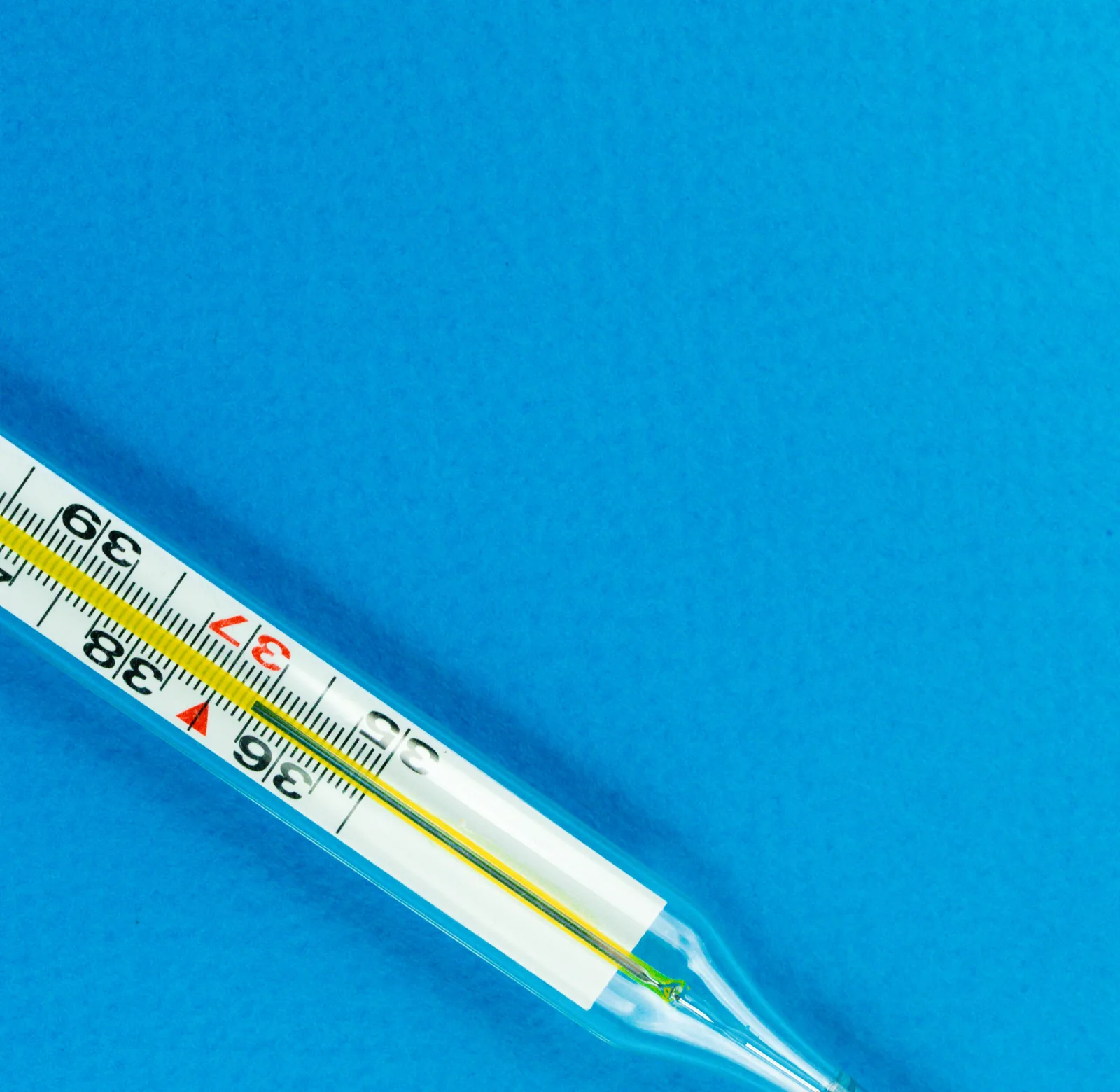
Temperature is measured on the Celsius scale, where $0\,{}^\circ\text{C}$ is the freezing point of water and $100\,{}^\circ\text{C}$ is the boiling point of water at normal pressure, and on the Kelvin scale. The zero of the Kelvin scale is absolute zero, the lowest possible temperature. At absolute zero the average kinetic energy of the particles is at its smallest, and nothing can be colder. A Celsius degree and a kelvin are the same size, so a temperature difference is the same in kelvins and in degrees Celsius. When the volume and the amount of gas stay the same and the gas is dilute, that is, far from liquefying, the pressure of the gas is directly proportional to the temperature in kelvins. The average kinetic energy of the particles of a dilute gas is also directly proportional to the temperature in kelvins, so ratios of temperatures are compared in kelvins. The connection between pressure, volume and temperature is studied in more detail in the chapter Changes of state of a gas and Boyle's law.
Limits of the model
The statement "temperature tells you the average kinetic energy of the particles" holds as such for a dilute gas whose particles interact with each other only when they collide. Then the temperature is proportional to the average kinetic energy of the translational motion of the particles. In a liquid and in a solid the particles are close to each other and vibrate, pulled by their neighbours. Temperature describes the strength of the thermal motion of the particles in them too, but the energy of the substance also includes the energy of the interactions between the particles. So temperature is not the same thing as the energy of a substance: ice and water can have the same temperature $0\,{}^\circ\text{C}$, although water of the same mass has more internal energy than ice (chapters Internal energy, heat and conservation of energy and Changes of state). Even at absolute zero not all motion of the particles stops, but its energy is the smallest possible.
Kelvin scale
The conversion of a Celsius temperature $\theta$ to kelvins is:
$$T = \theta + 273.15$$
where $T$ is the temperature in kelvins (K) and $\theta$ is the temperature in degrees Celsius (°C). In practice the number 273 is often enough. For kelvins you do not use the word degree: you say "300 kelvins", not "300 degrees kelvin".
Absolute zero is therefore $0\,\text{K}$ = $-273.15\,{}^\circ\text{C}$. A temperature in kelvins cannot be negative, but a Celsius temperature can.
The figure is drawn to scale. The upper scale is the Kelvin scale and the lower scale is the Celsius scale; the interval from $0\,{}^\circ\text{C}$ to $100\,{}^\circ\text{C}$ is as long as the interval from $273.15\,\text{K}$ to $373.15\,\text{K}$.
Common misconception
Many people think that the temperature doubles when it rises from $10\,{}^\circ\text{C}$ to $20\,{}^\circ\text{C}$. The physically correct comparison is made in kelvins: from $283\,\text{K}$ to $293\,\text{K}$. The ratio of the temperatures is 293/283 ≈ 1.035, so the increase is about $3.5\,\%$. This is why the average kinetic energy of the particles does not double. Another mistake is to think that $0\,{}^\circ\text{C}$ is the lowest possible temperature. It is only the freezing point of water, and the lowest possible temperature is $0\,\text{K}$.
Summary
- A thermodynamic system is a separated part of the world. Its state is described by state variables: temperature, pressure, volume and amount of substance.
- In a gas system, temperature, pressure and volume depend on each other: if you change one, at least one of the others changes too.
- Micro model of a gas: temperature tells you the average kinetic energy of the particles, and pressure arises from the collisions of the particles with the wall. In a liquid and in a solid the energy also includes the energy of the interactions between the particles, so temperature is not the same thing as the energy of a substance.
- When the volume and the amount of substance stay the same, the pressure of a dilute gas is directly proportional to the temperature in kelvins. Continuing the line through the data points, that is, extrapolation, gives an estimate of absolute zero.
- The conversion is $T = \theta + 273.15$. Absolute zero is $0\,\text{K}$ = $-273.15\,{}^\circ\text{C}$.
Optional Return to your predictions
Compare your predictions with the results of the experiments and the micro model. Then return to the opening question: why is a bicycle tyre hard in the sun and soft in the frost, even though the air in it is the same? Use the words temperature, speed of the particles and collisions in your explanation.
Would you change your prediction?
Apply
Worked example
Problem
A closed rigid container holds gas, so its volume and the amount of substance stay the same. The pressure of the gas is measured at different temperatures:
| $\theta$ (°C) | 0 | 20 | 40 | 60 | 80 | 100 |
|---|---|---|---|---|---|---|
| $p$ (kPa) | 100 | 107 | 115 | 122 | 129 | 137 |
Use extrapolation to find the temperature at which the pressure of the gas would be zero.
Step 1/7
Given and find. The table has six data points $(\theta,\, p)$, and the pressure is $p_0 = 100\,\text{kPa}$ at $0\,{}^\circ\text{C}$. You are asked for the temperature $\theta_0$ at which the pressure would be zero. On a graph the points lie on a straight line: for every $20\,{}^\circ\text{C}$ the pressure increases by $7$–$8\,\text{kPa}$. The line is continued to the left, outside the measured range, that is, extrapolated.
The vertical axis is drawn at the left edge of the figure, at about $-300\,{}^\circ\text{C}$, and not at $\theta = 0$. The solid line is the measured range and the dashed line is the extrapolation.
Step 2/7
Principle. The container is closed and rigid, so the amount of gas and the volume stay the same, and the pressure depends only on the temperature. The data points are on a straight line, so the pressure changes steadily with the temperature. The equation of the line gives an estimate of the pressure also outside the measured range, if you assume that the dependence stays the same. The pressure is zero where the line crosses the temperature axis.
Step 3/7
Rearranged formula. The slope $k$ is calculated from two points of the line that are far apart. Here the data points lie on the line within the reading accuracy, so the end points of the measured range are also points of the line. In the equation of the line, $p_0$ is the pressure at $0\,{}^\circ\text{C}$. Set $p = 0$ and solve for $\theta_0$:
$$\begin{aligned} k &= \frac{\Delta p}{\Delta \theta} \\[4pt] p &= p_0 + k\theta \\ 0 &= p_0 + k\theta_0 \\ \theta_0 &= -\frac{p_0}{k} \end{aligned}$$
Step 4/7
Unit conversions. No conversions are needed. The pressures are already in kilopascals, and the temperature difference $\Delta\theta$ is the same in degrees Celsius and in kelvins, so the unit of the slope $\tfrac{\text{kPa}}{{}^\circ\text{C}}$ is also $\tfrac{\text{kPa}}{\text{K}}$. The result comes out directly in degrees Celsius, because the temperatures in the table are in degrees Celsius.
Step 5/7
Substitution. First calculate the slope and then the zero point:
$$\begin{aligned} &k = \frac{\Delta p}{\Delta \theta} \\ &= \frac{(137 - 100)\,\text{kPa}}{(100 - 0)\,{}^\circ\text{C}} \\ &= 0.37\,\tfrac{\text{kPa}}{{}^\circ\text{C}} \\[6pt] &\theta_0 = -\frac{p_0}{k} \\ &= -\frac{100\,\text{kPa}}{0.37\,\tfrac{\text{kPa}}{{}^\circ\text{C}}} \\ &= -270.27\,{}^\circ\text{C} \end{aligned}$$
Step 6/7
Result. The temperature at zero pressure is about $-270\,{}^\circ\text{C}$. The result is given with two significant figures, because the slope $0.37\,\tfrac{\text{kPa}}{{}^\circ\text{C}}$ is known only to two figures.
Step 7/7
Reasonableness. The result is close to absolute zero, $-273.15\,{}^\circ\text{C}$: only about $3\,{}^\circ\text{C}$, or one per cent, away from it. An independent check: if the pressure is proportional to the temperature in kelvins, $p = 100\,\text{kPa}$ corresponds to $273.15\,\text{K}$, so the pressure at $100\,{}^\circ\text{C}$ would be $100\,\text{kPa} \cdot \tfrac{373.15}{273.15} = 136.6\,\text{kPa}$, and the measured value is $137\,\text{kPa}$. According to the micro model, at zero pressure the motion of the particles would be so small that no pressure would arise any more. Real gases liquefy before this temperature is reached, so the continuation of the line is only a model and describes a limiting value.
Optional Find the error
Optional Apply to a new situation
A glass jar is sealed with an airtight lid in a room where the air temperature is $20\,{}^\circ\text{C}$ and the pressure is 101 kPa. The jar is heated in a water bath until the temperature of the air inside it is $80\,{}^\circ\text{C}$. The volume of the jar and the amount of air stay the same.
What is the pressure of the air in the jar? Give your answer in kilopascals.
Hint 1: a guiding question
Which state variables stay the same and which change? On which scale must the ratio of the temperatures be calculated?
Hint 2: what is the connection
When the volume and the amount of substance stay the same, the pressure is directly proportional to the temperature in kelvins: $\dfrac{p_2}{p_1} = \dfrac{T_2}{T_1}$, so $p_2 = p_1 \dfrac{T_2}{T_1}$.
Hint 3: an intermediate step
First convert: $T_1 = 293.15\,\text{K}$ and $T_2 = 353.15\,\text{K}$. Substitute:
Show the solution
Given
air in a closed jar, $\theta_1 = 20\,{}^\circ\text{C}$, $p_1 = 101\,\text{kPa}$, $\theta_2 = 80\,{}^\circ\text{C}$; the volume of the jar and the amount of air stay the same
Find
pressure of the air $p_2$ in kilopascals
Principle
The volume and the amount of air are constant, so the pressure is directly proportional to the temperature in kelvins: the particles of the warmer air move faster and hit the wall more often and harder. The proportionality does not hold for the Celsius temperature.
Formula
$\dfrac{p_2}{p_1} = \dfrac{T_2}{T_1}$, so
$$p_2 = p_1\,\frac{T_2}{T_1}$$
Conversions
The temperatures are converted to kelvins: $T_1 = 20 + 273.15 = 293.15\,\text{K}$ and $T_2 = 80 + 273.15 = 353.15\,\text{K}$. The pressure stays in kilopascals.
Substitution
Answer
$122\,\text{kPa}$
Three significant figures like the pressure $101\,\text{kPa}$.
Reasonableness
The temperature in kelvins rises by $60\,\text{K}$, or about $\dfrac{60}{293} \approx 20\,\%$, so the pressure rises by about $0.20 \cdot 101\,\text{kPa} \approx 21\,\text{kPa}$, and $101 + 21 \approx 122\,\text{kPa}$. The temperature rises, so the pressure must increase. The ratio of Celsius temperatures $\tfrac{80}{20} = 4$ would give an unreasonable $404\,\text{kPa}$. The pressure in the jar is greater than the outdoor air pressure of $101\,\text{kPa}$, so the lid bulges outwards.
Check your understanding
Exit ticket
Answer on your own first and only then open the answer.
- Why does the pressure of a gas in a closed container increase when the gas warms up?
Answer
When the temperature rises, the average kinetic energy of the particles increases, that is, the particles move faster. They hit the wall more often and harder, so the pressure increases.
1. Concept
2. Increase in temperature
3. Table and extrapolation
The table shows the theoretical values of the simulation for the pressure (a relative number) when the volume is 1.0 dm³. They are values of the model, not measurements.
| $\theta$ (°C) | −123 | 27 | 177 |
|---|---|---|---|
| $p$ (rel.) | 50 | 100 | 150 |
The points are on the same line. Continue the line and find the temperature at which the pressure would be zero. Give your answer in degrees Celsius.
Hint 1: a guiding question
How much does the pressure change when the temperature rises by one degree Celsius?
Hint 2: what is the connection
The slope is $k = \dfrac{\Delta p}{\Delta \theta}$, and the pressure is zero when it has decreased from 100 to zero:
Hint 3: an intermediate step
so a drop of 100 units needs $300\,{}^\circ\text{C}$.
Show the solution
Given
points $(-123\,{}^\circ\text{C}$; $50)$, $(27\,{}^\circ\text{C}$; $100)$ and $(177\,{}^\circ\text{C}$; $150)$ on the same line; $p$ is a relative number without a unit
Find
temperature $\theta_0$ at which $p = 0$, in degrees Celsius
Principle
The points are on the same line, so the pressure changes steadily with the temperature. When the line is continued downwards outside the measured range, that is, extrapolated, the zero pressure is found where the line crosses the temperature axis.
Reading the graph
Read two points from the table, for example the end points $(-123\,{}^\circ\text{C}$; $50)$ and $(177\,{}^\circ\text{C}$; $150)$. The third point $(27\,{}^\circ\text{C}$; $100)$ is on the same line, so the model is linear. Continue the line to the left until $p = 0$.
Formula
and line $p = p_a + k(\theta - \theta_a)$ through the point $(\theta_a,\, p_a) = (27\,{}^\circ\text{C}$; $100)$. When $p = 0$:
$$\theta_0 = \theta_a - \frac{p_a}{k}$$
Conversions
No conversions are needed: the temperature difference $\theta_2 - \theta_1$ is the same in degrees Celsius and in kelvins, and the result is wanted in degrees Celsius. The unit of the slope is $\tfrac{1}{{}^\circ\text{C}}$.
Substitution
and
Answer
$-273\,{}^\circ\text{C}$
Three significant figures like the temperatures in the table.
Reasonableness
The pressure drops $50$ units for every $150\,{}^\circ\text{C}$, so from the point $(-123\,{}^\circ\text{C}$; $50)$ it is another $150\,{}^\circ\text{C}$ to zero: $-123 - 150 = -273\,{}^\circ\text{C}$. The result is absolute zero, $-273.15\,{}^\circ\text{C}$ or $0\,\text{K}$, because in the model the pressure is proportional to the temperature in kelvins.
Suggestion: one answer does not show everything you can do, but review the theory summary and do the core exercises.
Optional 4. Explain
Use the micro model to explain why ratios of temperatures are compared in kelvins and not in degrees Celsius, and why a temperature in kelvins cannot be negative.
Model answer
In the micro model of a gas, temperature tells you the average kinetic energy of the particles, and in a dilute gas the kinetic energy is directly proportional to the temperature in kelvins. The zero of the Kelvin scale is absolute zero, where the kinetic energy of the particles is at its smallest; nothing can be colder, so there are no negative temperatures in kelvins. The zero of the Celsius scale is only the freezing point of water, and the particles are nowhere near at rest there. This is why the ratio is calculated in kelvins: when the temperature rises from $10\,{}^\circ\text{C}$ to $20\,{}^\circ\text{C}$, it rises from $283\,\text{K}$ to $293\,\text{K}$, only about $3.5\,\%$, and the average kinetic energy of the particles does not double.
Assess your own answer
Tick the points your own answer already contains.
Review the theory summary and practise with the exercises.
Review the chapter's concepts
Cards you mark Review later collect in your review deck.
- Temperature
- Describes how vigorous the thermal motion of the particles of matter is.
- Kelvin scale
- The absolute temperature scale, whose zero $0\,\text{K}$ is the lowest possible temperature.
- Absolute zero
- The lowest possible temperature, $0\,\text{K}$ or $-273.15\,{}^{\circ}\text{C}$.
- Thermal motion
- The constant random motion and vibration of the particles of matter.
- State variable
- A quantity that describes the state of a system, such as temperature, pressure or volume.
- Thermodynamic system
- The matter or region marked off for study, whose energy changes are examined.
- Open system
- Both matter and energy can be exchanged with the surroundings.
- Closed system
- Energy but not matter can be exchanged with the surroundings.
- Isolated system
- Neither matter nor energy is exchanged with the surroundings.
- Thermal equilibrium
- The temperatures of systems in contact have become equal.
Exercises
Level 1 · basic practice 8 exercises
One formula or one step of reasoning. Core exercises first, the rest is extra practice.
- Exercise 3-1Core
The temperature of a room is $21\,{}^\circ\text{C}$. What is the temperature in kelvins?
Answer
$294\,\text{K}$
Show the solution
Given
$\theta = 21\,{}^\circ\text{C}$
Find
temperature in kelvins, $T$
Principle
A kelvin and a degree Celsius are the same size, and the scales differ only in their zero point: $0\,{}^\circ\text{C}$ is $273.15\,\text{K}$. So you get the reading in kelvins by adding $273.15$ to the Celsius reading.
Formula
$T = \theta + 273.15$, and this is already solved for the quantity to find, $T$
Conversions
The Celsius temperature is converted to kelvins in this formula; no other unit conversions are needed.
Substitution
$T = 21 + 273.15 = 294.15\,\text{K}$
Answer
$294\,\text{K}$
In whole kelvins, because the temperature $21\,{}^\circ\text{C}$ is given in whole degrees.
Reasonableness
Room temperature is about $20\,{}^\circ\text{C}$, so the estimate is $20 + 273 \approx 293\,\text{K}$, and the result is close to it. Check by converting back: $294.15 - 273.15 = 21$, so the conversion returns the starting value. A temperature in kelvins is positive, as it should be.
- Exercise 3-2Core
The temperature of a gas is $350\,\text{K}$. What is the temperature in degrees Celsius?
Answer
$77\,{}^\circ\text{C}$
Show the solution
Given
$T = 350\,\text{K}$
Find
temperature in degrees Celsius, $\theta$
Principle
The intervals of the Kelvin and Celsius scales are the same size, and the difference between the zero points is $273.15$. So you get the Celsius reading by subtracting $273.15$ from the reading in kelvins.
Formula
$T = \theta + 273.15$, so $\theta = T - 273.15$
Conversions
The temperature in kelvins is converted to degrees Celsius with this formula; no other unit conversions are needed.
Substitution
$\theta$$= 350 - 273.15$$= 76.85\,{}^\circ\text{C}$Answer
$77\,{}^\circ\text{C}$
In whole degrees, because $350\,\text{K}$ is given in whole kelvins.
Reasonableness
The boiling point of water at normal pressure is $373\,\text{K}$, or $100\,{}^\circ\text{C}$, and $350\,\text{K}$ is $23\,\text{K}$ below it, so the estimate is $100 - 23 = 77\,{}^\circ\text{C}$. The result is also above zero, because $350\,\text{K} > 273\,\text{K}$. Check by converting back: $76.85 + 273.15 = 350$.
- Exercise 3-3
The boiling point of liquid nitrogen is $77.4\,\text{K}$. What is it in degrees Celsius?
Answer
$-196\,{}^\circ\text{C}$
Show the solution
Given
$T = 77.4\,\text{K}$
Find
temperature in degrees Celsius, $\theta$
Principle
The intervals of the Celsius and Kelvin scales are the same size, and the difference between the zero points is $273.15$. So $\theta$ is found by subtracting $273.15$ from the reading in kelvins. The formula also works when the result is negative.
Formula
$T = \theta + 273.15$, so $\theta = T - 273.15$
Conversions
The temperature in kelvins is converted to degrees Celsius with this formula; no other unit conversions are needed.
Substitution
$\theta$$= 77.4 - 273.15$$= -195.75\,{}^\circ\text{C}$Answer
$-196\,{}^\circ\text{C}$
Three significant figures like the value $77.4\,\text{K}$ (the exact constant $273.15$ does not limit the result; to one decimal place the result would be $-195.8\,{}^\circ\text{C}$).
Reasonableness
Nitrogen is the main component of air and liquefies only at very low temperatures: the result is clearly below the freezing point of water, $0\,{}^\circ\text{C}$, but above absolute zero, $-273.15\,{}^\circ\text{C}$. Check by converting back: $-195.75 + 273.15 = 77.4\,\text{K}$. Estimate: $77 - 273 \approx -196$.
- Exercise 3-4
The temperature of water rises from $20\,{}^\circ\text{C}$ to $45\,{}^\circ\text{C}$. How large is the change in temperature in kelvins?
Answer
$25\,\text{K}$
Show the solution
Given
$\theta_1 = 20\,{}^\circ\text{C}$, $\theta_2 = 45\,{}^\circ\text{C}$
Find
change in temperature in kelvins, $\Delta T$
Principle
A degree Celsius and a kelvin are the same size, and the zero points of the scales differ only by the constant $273.15$. The constant cancels in the subtraction, so a change in temperature is the same on both scales.
Formula
$\Delta T$$= T_2 - T_1$$= (\theta_2 + 273.15) - (\theta_1 + 273.15)$so $\Delta T = \theta_2 - \theta_1$
Conversions
No conversion is needed, because a change in temperature is the same in degrees Celsius and in kelvins; only the unit changes.
Substitution
$\Delta T = 45 - 20 = 25\,\text{K}$
Answer
$25\,\text{K}$
Two significant figures like the given temperatures.
Reasonableness
Check in kelvins: $T_1 = 293.15\,\text{K}$ and $T_2 = 318.15\,\text{K}$, so the difference is $318.15 - 293.15 = 25\,\text{K}$. The sign is positive, because the water warms up.
- Exercise 3-5
The temperature of the cosmic background radiation of the universe is $2.7\,\text{K}$. What is it in degrees Celsius?
Answer
$-270\,{}^\circ\text{C}$
Show the solution
Given
$T = 2.7\,\text{K}$
Find
temperature in degrees Celsius, $\theta$
Principle
The intervals of the Celsius and Kelvin scales are the same size, and the difference between the zero points is $273.15$, so $\theta$ is found by subtracting $273.15$ from the reading in kelvins. The reading in kelvins is small, so the result is negative.
Formula
$T = \theta + 273.15$, so $\theta = T - 273.15$
Conversions
The temperature in kelvins is converted to degrees Celsius with this formula; no other unit conversions are needed.
Substitution
$\theta$$= 2.7 - 273.15$$= -270.45\,{}^\circ\text{C}$Answer
$-270\,{}^\circ\text{C}$
Two significant figures like the value $2.7\,\text{K}$ (the exact constant $273.15$ does not limit the result; to one decimal place the result would be $-270.5\,{}^\circ\text{C}$).
Reasonableness
The temperature is only $2.7\,\text{K}$ above absolute zero, so it must be only a little above $-273.15\,{}^\circ\text{C}$: $-273.15 + 2.7 = -270.45$. The result is not below absolute zero, as it must not be.
- Exercise 3-6
A gas is in a sealed cylinder with a movable piston. The gas is chosen as the thermodynamic system. The gas can be heated and compressed, but no matter can leave the cylinder and no more can enter.
Which of the following describes this system correctly?
Answer
Closed, because no matter crosses the boundary of the system; energy can still be transferred.
Show the solution
Find
whether the gas in a sealed cylinder is a closed or an open system.
Principle
A system is closed if no matter can leave it and none can enter. Energy can still cross the boundary. The piston is part of the boundary of the system: when it moves, the volume changes, but no matter crosses the boundary.
Model answer
The gas is a closed system, because no matter crosses its boundary, even though energy can be transferred and the volume can change. A system would become open only if matter could get out or in, for example if the cylinder leaked. Heating and compression change the state variables, that is, the temperature, the pressure and the volume, but they do not make the system open. The temperature of a closed system is not constant either.
- Exercise 3-7
The temperature of a freezer is $-18\,{}^\circ\text{C}$. What is the temperature in kelvins?
Answer
$255\,\text{K}$
Show the solution
Given
$\theta = -18\,{}^\circ\text{C}$
Find
temperature in kelvins, $T$
Principle
A kelvin and a degree Celsius are the same size, and the scales differ only in their zero point: $0\,{}^\circ\text{C}$ is $273.15\,\text{K}$. You get the reading in kelvins by adding $273.15$ to the Celsius reading, also when the Celsius reading is negative.
Formula
$T = \theta + 273.15$, and this is already solved for the quantity to find, $T$
Conversions
The Celsius temperature is converted to kelvins in this formula; no other unit conversions are needed.
Substitution
$T = -18 + 273.15 = 255.15\,\text{K}$
Answer
$255\,\text{K}$
The answer is rounded to whole kelvins, because the temperature $-18\,{}^\circ\text{C}$ is given in whole degrees.
Reasonableness
Estimate with rounded numbers: $273 - 18 = 255$, so the result agrees with it. The temperature in kelvins is positive and lower than $273.15\,\text{K}$, which corresponds to the freezing point of water, because a freezer is colder than the freezing point. Check by converting back: $255.15 - 273.15 = -18$.
- Exercise 3-8
A gas is in a closed, rigid container. The container is heated. Which of the following quantities of the gas stays the same?
Answer
The volume, because the walls of a rigid container do not move when it is heated.
Show the solution
Find
which quantity of the gas stays the same when a closed rigid container is heated.
Principle
The walls of a rigid container do not move, so the volume of the gas is the volume of the container and stays the same. Heating raises the temperature of the gas, and the average kinetic energy of the particles grows. The particles hit the wall more often and harder, so the pressure rises.
Model answer
The volume stays the same, because the walls of a rigid container do not move when it is heated. The temperature and the pressure rise. The average kinetic energy of the particles grows with the temperature, because in a dilute gas it is directly proportional to the temperature in kelvins. The container being closed only means that the number of particles, that is, the amount of substance, stays the same. The container does not prevent warming or the rise in pressure.
Level 2 · applied practice 7 exercises
Two steps, working with measured data, a unit conversion or rearranging a formula. Core exercises first, the rest is extra practice.
- Exercise 3-9Core
The temperature of a gas is $288\,\text{K}$. The gas is heated, and its temperature rises by $45\,\text{K}$. What is the final temperature in degrees Celsius?
Answer
$60\,{}^\circ\text{C}$
Show the solution
Given
$T_1 = 288\,\text{K}$, temperature rise $\Delta T = 45\,\text{K}$
Find
final temperature in degrees Celsius, $\theta_2$
Principle
A change in temperature is the same in kelvins and in degrees Celsius, so the rise can be added directly to the temperature in kelvins. Only at the end is the result converted to degrees Celsius.
Formula
$T_2 = T_1 + \Delta T$ and $\theta_2 = T_2 - 273.15$, so $\theta_2 = T_1 + \Delta T - 273.15$
Conversions
The rise $45\,\text{K}$ is added as it is. The final temperature is converted from kelvins to degrees Celsius by subtracting $273.15$.
Substitution
$T_2 = 288 + 45 = 333\,\text{K}$, and
$\theta_2$$= 333 - 273.15$$= 59.85\,{}^\circ\text{C}$Answer
$60\,{}^\circ\text{C}$
In whole degrees, because the initial values are given in whole kelvins.
Reasonableness
The initial temperature $288\,\text{K}$ is about $15\,{}^\circ\text{C}$, and a rise of $45\,\text{K}$ gives about $15 + 45 = 60\,{}^\circ\text{C}$. Exact check: $288 - 273.15 = 14.85\,{}^\circ\text{C}$ and $14.85 + 45 = 59.85\,{}^\circ\text{C}$. The gas warms up, so the final temperature is higher than the initial temperature.
- Exercise 3-10Core
In a closed rigid container the pressure of a gas is $90.0\,\text{kPa}$ at $0\,{}^\circ\text{C}$ and $123\,\text{kPa}$ at $100\,{}^\circ\text{C}$. Assume that the pressure depends linearly on the temperature.
What is the pressure at $35\,{}^\circ\text{C}$?
Answer
$102\,\text{kPa}$
Show the solution
Given
$(\theta_1,\, p_1) = (0\,{}^\circ\text{C},\ 90.0\,\text{kPa})$ and $(\theta_2,\, p_2) = (100\,{}^\circ\text{C},\ 123\,\text{kPa})$; the pressure depends linearly on the temperature
Find
pressure $p$ at the temperature $\theta = 35\,{}^\circ\text{C}$ in kilopascals
Principle
The container is closed and rigid, so the amount of gas and the volume stay the same and the pressure changes only with the temperature. The problem allows a linear model, so the points determine a straight line, and you read the pressure at $35\,{}^\circ\text{C}$ from the line.
Formula
slope
$k$$= \dfrac{p_2 - p_1}{\theta_2 - \theta_1}$and line $p = p_1 + k\theta$, because $\theta_1 = 0\,{}^\circ\text{C}$; so
$p$$= p_1 + \dfrac{p_2 - p_1}{\theta_2 - \theta_1}\,\theta$Conversions
No conversions are needed: the pressures are in the same unit, and the temperature difference $\theta_2 - \theta_1$ is the same in degrees Celsius and in kelvins. The unit of the slope is $\tfrac{\text{kPa}}{{}^\circ\text{C}}$.
Substitution
$k$$= \dfrac{(123 - 90.0)\,\text{kPa}}{(100 - 0)\,{}^\circ\text{C}}$$= 0.33\,\tfrac{\text{kPa}}{{}^\circ\text{C}}$and
$p$$= 90.0\,\text{kPa} + 0.33\,\tfrac{\text{kPa}}{{}^\circ\text{C}} \cdot 35\,{}^\circ\text{C}$$= 101.55\,\text{kPa}$Answer
$102\,\text{kPa}$
The pressure difference $\Delta p = 123 - 90.0 = 33\,\text{kPa}$ has two figures, so $k = 0.33\,\tfrac{\text{kPa}}{{}^\circ\text{C}}$ and $k\theta \approx 12\,\text{kPa}$; the sum $90.0 + 12 = 102\,\text{kPa}$ is rounded to whole kilopascals.
Reasonableness
The temperature $35\,{}^\circ\text{C}$ is $35\,\%$ of the way from $0\,{}^\circ\text{C}$ to $100\,{}^\circ\text{C}$, so the pressure must be $35\,\%$ of the way through the range $90.0\ldots123\,\text{kPa}$: $90.0 + 0.35 \cdot 33 = 101.55\,\text{kPa}$. The result is between the pressures of the points and below the mean of the range, $106.5\,\text{kPa}$.
- Exercise 3-11
The graph shows the pressures of a gas measured at different temperatures in a closed rigid container. Assume that the pressure depends linearly on the temperature also outside the measured range.
What would the pressure be at $-100\,{}^\circ\text{C}$?
Answer
$p \approx 48\,\text{kPa}$
Show the solution
Given
reading from the graph, the points $(0\,{}^\circ\text{C}$; $75\,\text{kPa})$ and $(100\,{}^\circ\text{C}$; $102.5\,\text{kPa})$; the pressure depends linearly on the temperature, also outside the measured range
Find
pressure $p$ at the temperature $\theta = -100\,{}^\circ\text{C}$ in kilopascals
Principle
In a rigid closed container the amount of gas and the volume stay the same, so the pressure depends only on the temperature. The points are on a straight line, so the line can be continued outside the measured range, that is, extrapolated.
Reading the graph
The data points are at temperatures $0\ldots 100\,{}^\circ\text{C}$. The first point is at a crossing of the grid, $(0\,{}^\circ\text{C}$; $75\,\text{kPa})$, and the last point is slightly above the $100\,\text{kPa}$ line, at $102.5\,\text{kPa}$. From these two points the slope of the line is calculated, and the line is continued to the left to the temperature $-100\,{}^\circ\text{C}$. If you draw the line by eye, you get a value of $45$–$50\,\text{kPa}$, which is accepted.
Formula
$k$$= \dfrac{p_2 - p_1}{\theta_2 - \theta_1}$$p = p_1 + k(\theta - \theta_1)$
Conversions
No conversions are needed: the pressures are in kilopascals, and the temperature differences are the same in degrees Celsius and in kelvins.
Substitution
$k$$= \dfrac{(102.5 - 75)\,\text{kPa}}{(100 - 0)\,{}^\circ\text{C}}$$= 0.275\,\tfrac{\text{kPa}}{{}^\circ\text{C}}$and
$p$$= 75\,\text{kPa} + 0.275\,\tfrac{\text{kPa}}{{}^\circ\text{C}} \cdot (-100 - 0)\,{}^\circ\text{C}$$= 75\,\text{kPa} - 27.5\,\text{kPa}$$= 47.5\,\text{kPa}$Answer
$p \approx 48\,\text{kPa}$
Two significant figures, because the pressure difference $27.5\,\text{kPa}$ read from the graph is a three-figure value but the reading accuracy is about $1\,\text{kPa}$.
Reasonableness
The temperature is below the measured range, so the pressure must be lower than the lowest measured value, $75\,\text{kPa}$, but clearly above zero. An independent check: if the pressure is proportional to the temperature in kelvins,
$p$$\approx 75\,\text{kPa} \cdot \dfrac{173.15\,\text{K}}{273.15\,\text{K}}$$= 47.5\,\text{kPa}$which is the same.
- Exercise 3-12
The temperature of the night side of the Moon is $-173\,{}^\circ\text{C}$ and of the day side $127\,{}^\circ\text{C}$.
How many times greater is the temperature in kelvins of the day side than the temperature in kelvins of the night side?
Answer
$4.00$
Show the solution
Given
$\theta_\text{night} = -173\,{}^\circ\text{C}$ and $\theta_\text{day} = 127\,{}^\circ\text{C}$
Find
ratio of the temperatures in kelvins $\dfrac{T_\text{day}}{T_\text{night}}$
Principle
The ratio is asked for the temperatures in kelvins, because only the zero of the Kelvin scale is absolute zero, the lowest possible temperature. The ratio of Celsius temperatures has no physical meaning.
Formula
$T = \theta + 273.15$, and the ratio
$\dfrac{T_\text{day}}{T_\text{night}}$$= \dfrac{\theta_\text{day} + 273.15}{\theta_\text{night} + 273.15}$Conversions
Both temperatures are converted to kelvins by adding $273.15$:
$T_\text{night}$$= -173 + 273.15$$= 100.15\,\text{K}$$T_\text{day}$$= 127 + 273.15$$= 400.15\,\text{K}$Substitution
$\dfrac{T_\text{day}}{T_\text{night}}$$= \dfrac{400.15\,\text{K}}{100.15\,\text{K}}$$= 3.9955$Answer
$4.00$
Times. Whole degrees give temperatures of $100\,\text{K}$ and $400\,\text{K}$ to the nearest kelvin, three significant figures in each, so the quotient also has three.
Reasonableness
In kelvins the temperatures are about $100\,\text{K}$ and $400\,\text{K}$, so the ratio is about $4$. The day side is warmer, so the ratio is above $1$. The ratio of the Celsius temperatures would be $\tfrac{127}{-173} \approx -0.73$, which is a meaningless comparison.
- Exercise 3-13
Thermometer A is compared with an accurate reference thermometer in a calibration. Both are kept in the same water bath at different temperatures. The table is example data.
a) Calculate the average difference between the readings of thermometer A and the reference, $\theta_\text{A} - \theta_\text{ref}$, in kelvins.
b) Is the difference systematic or random? Justify using the table. A systematic error deviates in the same direction in every measurement, a random error varies in both directions.
c) Thermometer A shows the temperature of bath water as $38.6\,{}^\circ\text{C}$. What is the corrected temperature?
Enter the result of part a) in the answer box.
Calibration of thermometer A (example data) $\theta_\text{ref}\,({}^\circ\text{C})$ $\theta_\text{A}\,({}^\circ\text{C})$ 0.0 1.4 20.0 21.7 40.0 41.3 60.0 61.6 80.0 81.5 Answer
$1.5\,\text{K}$
Show the solution
Given
reference readings $0$, $20.0$, $40.0$, $60.0$ and $80.0\,{}^\circ\text{C}$ and the readings of thermometer A $1.4$, $21.7$, $41.3$, $61.6$ and $81.5\,{}^\circ\text{C}$ (example data); bath water reading $38.6\,{}^\circ\text{C}$
Find
the average difference between the readings of thermometer A and the reference, $\Delta\theta$, in kelvins (part a), and the corrected temperature of the bath water
Principle
The reference thermometer is accurate, so the difference $\theta_\text{A} - \theta_\text{ref}$ in each measurement gives the error of thermometer A. If the difference is roughly the same size and has the same sign in every measurement, the error is systematic, and it is corrected by subtracting the average difference from the reading.
Formula
$\Delta\theta_i$$= \theta_{\text{A},i} - \theta_{\text{ref},i}$$\Delta\theta_\text{avg}$$= \dfrac{\sum \Delta\theta_i}{n}$where $n = 5$; corrected temperature $\theta_\text{corr} = \theta_\text{A} - \Delta\theta_\text{avg}$
Conversions
No conversions are needed, because a temperature difference is the same in degrees Celsius and in kelvins.
Substitution
the differences are $1.4$, $1.7$, $1.3$, $1.6$ and $1.5\,\text{K}$. The sum is $7.5\,\text{K}$, so
$\Delta\theta_\text{avg}$$= 7.5\,\text{K} : 5$$= 1.5\,\text{K}$The corrected temperature is
$\theta_\text{corr}$$= 38.6\,{}^\circ\text{C} - 1.5\,\text{K}$$= 37.1\,{}^\circ\text{C}$Answer
$1.5\,\text{K}$
Two significant figures like the individual differences. The difference is systematic: thermometer A reads $1.3\ldots 1.7\,\text{K}$ too high in all five measurements, although the temperature varies over $80\,\text{K}$, and the variation of the differences is small random scatter. The corrected temperature of the bath water is $37.1\,{}^\circ\text{C}$.
Reasonableness
All the differences are positive, so the mean must lie between the smallest and the largest difference: $1.3 < 1.5 < 1.7$. The corrected reading is lower than the reading of the thermometer, because the thermometer reads too high, and $37.1\,{}^\circ\text{C}$ is a normal bath water temperature.
- Exercise 3-14
Hot water was poured into a thermos flask, and the temperature of the water was measured once an hour. The room temperature was $20.0\,{}^\circ\text{C}$ the whole time. The table is example data.
a) Calculate the drop in the temperature of the water during the first hour and during the last hour.
b) How many times greater was the drop in the first hour than in the last hour?
c) Using the table, explain why the drop in temperature slows down as the water approaches room temperature. Hint: calculate the drop of each hour divided by the temperature difference to the room at the start of that hour.
Enter the result of part b) in the answer box.
Temperature of the water in a thermos flask (example data) $t\,(\text{h})$ $\theta\,({}^\circ\text{C})$ 0 80.0 1 69.9 2 61.3 3 54.4 4 48.6 Answer
$1.7$
Show the solution
Given
$\theta_0 = 80.0\,{}^\circ\text{C}$, $\theta_1 = 69.9\,{}^\circ\text{C}$, $\theta_3 = 54.4\,{}^\circ\text{C}$, $\theta_4 = 48.6\,{}^\circ\text{C}$ (example data); room temperature $20.0\,{}^\circ\text{C}$
Find
the ratio of the drops in temperature $\dfrac{\Delta\theta_\text{first}}{\Delta\theta_\text{last}}$
Principle
The drop in temperature in an hour is the difference between the earlier and the later measurement. A temperature difference is the same in degrees Celsius and in kelvins. By comparing the drop of the first and of the last hour, you see how the cooling changes as the water approaches room temperature.
Formula
$\Delta\theta = \theta_\text{start} - \theta_\text{end}$ and the ratio $\dfrac{\Delta\theta_1}{\Delta\theta_4}$
Conversions
No conversions are needed: the difference of the temperatures is the same in degrees Celsius and in kelvins, and the units cancel in the ratio.
Substitution
$$\begin{aligned} \Delta\theta_1 &= 80.0 - 69.9 = 10.1\,\text{K} \\ \Delta\theta_4 &= 54.4 - 48.6 = 5.8\,\text{K} \\ \frac{\Delta\theta_1}{\Delta\theta_4} &= \frac{10.1\,\text{K}}{5.8\,\text{K}} = 1.741 \end{aligned}$$
Answer
$1.7$
Times, two significant figures like the drops $10.1\,\text{K}$ and $5.8\,\text{K}$. Explanation: at the start the water is $60.0\,\text{K}$ warmer than the room and at the end only $28.6\,\text{K}$ warmer. When the temperature difference to the room gets smaller, the drop slows down: in the first hour the drop is $10.1 : 60.0 \approx 0.17$ and in the last hour $5.8 : 34.4 \approx 0.17$ of the temperature difference at the start of the hour. The water tends towards room temperature but does not go past it.
Reasonableness
The drop of cooling water slows down, so the ratio must be above $1$, and $1.7 > 1$. Check: the hourly drops are $10.1$, $8.6$, $6.9$ and $5.8\,\text{K}$, a decreasing sequence. The temperature of the water, $48.6\,{}^\circ\text{C}$, is still above the room temperature $20.0\,{}^\circ\text{C}$.
- Exercise 3-15
A student moves a liquid thermometer at room temperature into hot water whose temperature is kept constant, and reads the thermometer every $10\,\text{s}$. The reading settles at $60.2\,{}^\circ\text{C}$. The table is example data.
a) From the times in the table, choose the earliest time at which the reading differs from the settled reading by less than $0.5\,\text{K}$. For how many seconds at least must the thermometer be kept in the water before reading it?
b) Explain why a reading taken too early is too low and what the thermometer is then measuring.
Enter the result of part a) in the answer box.
Thermometer reading in the water (example data) $t\,(\text{s})$ $\theta\,({}^\circ\text{C})$ 0 21.0 10 48.2 20 56.6 30 59.3 40 59.9 50 60.2 60 60.2 Answer
$40\,\text{s}$
Show the solution
Given
settled reading $60.2\,{}^\circ\text{C}$, limit difference $0.5\,\text{K}$ and the readings in the table every $10\,\text{s}$ (example data)
Find
the earliest time $t$ in the table, in seconds, at which the reading differs from the settled reading by less than $0.5\,\text{K}$
Principle
A liquid thermometer shows its own temperature, not the temperature of the water. After the move the temperature of the thermometer approaches the temperature of the water gradually, and the reading settles only when the thermometer is at the same temperature as the water bath. A reading taken early is too low.
Formula
$\Delta\theta(t) = \theta_\text{steady} - \theta(t)$, and we look for the earliest $t$ at which $\Delta\theta(t) < 0.5\,\text{K}$
Conversions
No conversions are needed: the time is already in seconds, and a temperature difference is the same in degrees Celsius and in kelvins.
Substitution
$$\begin{aligned} \Delta\theta(10\,\text{s}) &= 60.2 - 48.2 = 12.0\,\text{K} \\ \Delta\theta(20\,\text{s}) &= 60.2 - 56.6 = 3.6\,\text{K} \\ \Delta\theta(30\,\text{s}) &= 60.2 - 59.3 = 0.9\,\text{K} \\ \Delta\theta(40\,\text{s}) &= 60.2 - 59.9 = 0.3\,\text{K} \end{aligned}$$
Answer
$40\,\text{s}$
To the accuracy of the $10\,\text{s}$ interval of the table. The reading at $30\,\text{s}$ cannot be used, because the difference is then $0.9\,\text{K}$. A reading taken earlier is too low, because the thermometer has not yet warmed up to the temperature of the water and measures its own temperature.
Reasonableness
The difference keeps getting smaller: $12.0$, $3.6$, $0.9$ and $0.3\,\text{K}$, and in each $10\,\text{s}$ period it drops to about a quarter or a third of the previous one. The readings at $50\,\text{s}$ and $60\,\text{s}$ are equal, so the settled reading $60.2\,{}^\circ\text{C}$ is justified.
Level 3 · challenging 5 exercises
Optional: application, two ideas together or a new situation where you reason for yourself.
- Exercise 3-16
The total pressure (not gauge pressure) of the air in a bicycle tyre is $300\,\text{kPa}$ at $15\,{}^\circ\text{C}$. The tyre does not leak, and its volume stays the same. The pressure is directly proportional to the temperature in kelvins.
What is the pressure in the tyre at $35\,{}^\circ\text{C}$?
Answer
$321\,\text{kPa}$
Show the solution
Given
$p_1 = 300\,\text{kPa}$ (total pressure), $\theta_1 = 15\,{}^\circ\text{C}$, $\theta_2 = 35\,{}^\circ\text{C}$
Find
pressure $p_2$ at the temperature $\theta_2$ in kilopascals
Principle
The tyre does not leak and its volume does not change, so the amount of air and the volume are constant. Then the pressure is directly proportional to the temperature in kelvins: the particles of the warmer gas move faster and hit the wall more often and harder. The proportionality does not hold for the Celsius temperature.
Formula
$\dfrac{p_2}{p_1} = \dfrac{T_2}{T_1}$, so $p_2 = p_1\,\dfrac{T_2}{T_1}$
Conversions
The temperatures are converted to kelvins: $T_1 = 15 + 273.15 = 288.15\,\text{K}$ and $T_2 = 35 + 273.15 = 308.15\,\text{K}$. The pressure stays in kilopascals, because it appears only in a ratio.
Substitution
$p_2$$= 300\,\text{kPa} \cdot \dfrac{308.15\,\text{K}}{288.15\,\text{K}}$$= 320.8\,\text{kPa}$Answer
$321\,\text{kPa}$
Three significant figures like the given values.
Reasonableness
The temperature in kelvins rises by $20\,\text{K}$, or about $\dfrac{20}{288} \approx 6.9\,\%$, so the pressure rises by about $0.069 \cdot 300\,\text{kPa} \approx 21\,\text{kPa}$, and $300 + 21 = 321\,\text{kPa}$. The temperature rises, so the pressure must increase. The ratio of Celsius temperatures $\tfrac{35}{15}$ would give an unreasonable $700\,\text{kPa}$.
- Exercise 3-17
In a closed rigid container the pressure of a gas is $150\,\text{kPa}$ at $27.0\,{}^\circ\text{C}$. The container is heated until the pressure is $200\,\text{kPa}$. The pressure is directly proportional to the temperature in kelvins.
What is the final temperature in degrees Celsius?
Answer
$127\,{}^\circ\text{C}$
Show the solution
Given
$p_1 = 150\,\text{kPa}$, $\theta_1 = 27.0\,{}^\circ\text{C}$, $p_2 = 200\,\text{kPa}$
Find
final temperature in degrees Celsius, $\theta_2$
Principle
The container is closed and rigid, so the volume and the amount of gas stay the same, and the pressure is directly proportional to the temperature in kelvins. So the ratio of the pressures equals the ratio of the temperatures in kelvins.
Formula
$\dfrac{p_2}{p_1} = \dfrac{T_2}{T_1}$, so $T_2 = T_1\,\dfrac{p_2}{p_1}$, and $\theta_2 = T_2 - 273.15$
Conversions
The initial temperature is converted to kelvins:
$T_1$$= 27.0 + 273.15$$= 300.15\,\text{K}$At the end the result is converted to degrees Celsius by subtracting $273.15$. The pressures do not need converting, because they are in the same unit.
Substitution
$T_2$$= 300.15\,\text{K} \cdot \dfrac{200\,\text{kPa}}{150\,\text{kPa}}$$= 400.2\,\text{K}$and
$\theta_2$$= 400.2 - 273.15$$= 127.05\,{}^\circ\text{C}$Answer
$127\,{}^\circ\text{C}$
Three significant figures like the value $27.0\,{}^\circ\text{C}$.
Reasonableness
The pressure increases by a factor of $\tfrac{4}{3}$, so the temperature in kelvins must increase by the same factor: about $300\,\text{K} \to 400\,\text{K}$, or $127\,{}^\circ\text{C}$. Check: $\tfrac{p}{T}$ at the start is $\tfrac{150}{300.15} = 0.4998\,\tfrac{\text{kPa}}{\text{K}}$ and at the end $\tfrac{200}{400.2} = 0.4998\,\tfrac{\text{kPa}}{\text{K}}$. The ratio of Celsius temperatures would wrongly give $36\,{}^\circ\text{C}$.
- Exercise 3-18
The temperature of a gas is $20.0\,{}^\circ\text{C}$. The gas is cooled until the average kinetic energy of its particles is half of the original. The average kinetic energy is directly proportional to the temperature in kelvins.
What is the final temperature in degrees Celsius?
Answer
$-127\,{}^\circ\text{C}$
Show the solution
Given
$\theta_1 = 20.0\,{}^\circ\text{C}$ and average kinetic energy $E_2 = \tfrac{1}{2}E_1$
Find
final temperature in degrees Celsius, $\theta_2$
Principle
According to the task, the average kinetic energy of the particles of the gas is directly proportional to the temperature in kelvins; this is so in a dilute gas whose particles interact with each other only when they collide. The proportionality applies to the temperature in kelvins, because only the zero of the Kelvin scale is absolute zero. When the energy is halved, the temperature in kelvins is also halved. You must not halve the Celsius temperature.
Formula
$\dfrac{E_2}{E_1}$$= \dfrac{T_2}{T_1}$$= \dfrac{1}{2}$so $T_2 = \dfrac{T_1}{2}$, and $\theta_2 = T_2 - 273.15$
Conversions
The initial temperature is converted to kelvins:
$T_1$$= 20.0 + 273.15$$= 293.15\,\text{K}$At the end $T_2$ is converted back to degrees Celsius by subtracting $273.15$.
Substitution
$T_2$$= \dfrac{293.15\,\text{K}}{2}$$= 146.575\,\text{K}$and
$\theta_2$$= 146.575 - 273.15$$= -126.575\,{}^\circ\text{C}$Answer
$-127\,{}^\circ\text{C}$
Three significant figures like the value $20.0\,{}^\circ\text{C}$.
Reasonableness
The gas must cool, so the result is below $20\,{}^\circ\text{C}$, and it is above absolute zero, $-273.15\,{}^\circ\text{C}$. Check: $\tfrac{146.575\,\text{K}}{293.15\,\text{K}} = 0.5$. Halving the Celsius temperature would give $10\,{}^\circ\text{C}$, but then the temperature in kelvins would be only $283\,\text{K}$, or $97\,\%$ of the initial value, not half.
- Exercise 3-19
The body temperature of a person was measured five times with three methods in a short time. A digital thermometer placed in the mouth is the reference method here. The table is example data.
a) Calculate the mean of the readings of each method. Write the sum before dividing. Check the other parts against the solution.
b) Calculate the difference between the mean of the forehead thermometer and the mean of the reference method, $\theta_\text{mouth} - \theta_\text{forehead}$, in kelvins.
c) Estimate the spread of each method by half of the range of its readings. Is the difference of the forehead thermometer a systematic or a random error? Justify. A systematic error deviates in the same direction in every measurement, a random error varies in both directions.
d) The person's temperature measured in the mouth is $37.6\,{}^\circ\text{C}$, and the limit for a fever is $37.5\,{}^\circ\text{C}$. Assume that the difference of the forehead thermometer is always the same. What would the forehead thermometer show on average, and would the fever be detected?
Enter the result of part b) in the answer box.
Body temperature with three methods (example data) Measurement $\theta_\text{ear}\,({}^\circ\text{C})$ $\theta_\text{forehead}\,({}^\circ\text{C})$ $\theta_\text{mouth}\,({}^\circ\text{C})$ 1 36.9 36.2 37.0 2 37.1 36.7 37.0 3 36.8 36.0 37.1 4 37.0 36.5 36.9 5 37.2 36.6 37.0 Answer
$0.6\,\text{K}$
Show the solution
Given
the readings of five measurements (example data): ear thermometer $36.9$, $37.1$, $36.8$, $37.0$, $37.2$; forehead thermometer $36.2$, $36.7$, $36.0$, $36.5$, $36.6$; mouth thermometer (reference) $37.0$, $37.0$, $37.1$, $36.9$, $37.0$, all in degrees Celsius; fever limit $37.5\,{}^\circ\text{C}$ and a mouth measurement of $37.6\,{}^\circ\text{C}$
Find
the difference between the mean of the forehead thermometer and the reference method, $\Delta\theta = \theta_\text{mouth,avg} - \theta_\text{forehead,avg}$, in kelvins (part b)
Principle
The mean is calculated from the repeated measurements. The difference to the reference method shows the direction and size of the error of the method, and the spread of the readings shows the order of magnitude of the random variation. If the difference is larger than the spread and all the readings deviate in the same direction, the error is systematic. A simple estimate of the spread is half of the range.
Formula
$\theta_\text{avg}$$= \dfrac{\sum \theta_i}{n}$estimate of the spread
$s$$= \dfrac{\theta_\text{max} - \theta_\text{min}}{2}$$\Delta\theta = \theta_\text{mouth,avg} - \theta_\text{forehead,avg}$
Conversions
No conversions are needed, because a temperature difference is the same in degrees Celsius and in kelvins.
Substitution
$$\begin{aligned} \sum\theta_\text{ear} &= 36.9 + 37.1 + 36.8 \\ &\quad + 37.0 + 37.2 \\ &= 185.0\,{}^\circ\text{C} \\ \theta_\text{ear,avg} &= 185.0 : 5 = 37.0\,{}^\circ\text{C} \\ \sum\theta_\text{forehead} &= 36.2 + 36.7 + 36.0 \\ &\quad + 36.5 + 36.6 \\ &= 182.0\,{}^\circ\text{C} \\ \theta_\text{forehead,avg} &= 182.0 : 5 = 36.4\,{}^\circ\text{C} \\ \sum\theta_\text{mouth} &= 37.0 + 37.0 + 37.1 \\ &\quad + 36.9 + 37.0 \\ &= 185.0\,{}^\circ\text{C} \\ \theta_\text{mouth,avg} &= 185.0 : 5 = 37.0\,{}^\circ\text{C} \end{aligned}$$
$$\begin{aligned} \Delta\theta &= 37.0 - 36.4 = 0.6\,\text{K} \\ s_\text{ear} &= (37.2 - 36.8) : 2 = 0.2\,\text{K} \\ s_\text{forehead} &= (36.7 - 36.0) : 2 = 0.35\,\text{K} \\ s_\text{mouth} &= (37.1 - 36.9) : 2 = 0.1\,\text{K} \end{aligned}$$
$$\theta_\text{forehead,corr} = 37.6 - 0.6 = 37.0\,{}^\circ\text{C}$$Answer
$0.6\,\text{K}$
One significant figure, because the readings are given to the accuracy of $0.1\,\text{K}$. The difference is systematic, because every forehead reading ($36.0\ldots 36.7\,{}^\circ\text{C}$) is lower than every mouth reading ($36.9\ldots 37.1\,{}^\circ\text{C}$), and the difference $0.6\,\text{K}$ is larger than the spread of the forehead thermometer, $0.35\,\text{K}$. When the mouth shows $37.6\,{}^\circ\text{C}$, the forehead thermometer would show $37.0\,{}^\circ\text{C}$ on average, which is below the fever limit, so the fever would go undetected although the person has a fever.
Reasonableness
The mean of the ear thermometer is the same as that of the reference, and its spread of $0.2\,\text{K}$ is small, so the ear thermometer is the most reliable in this data. The mean of the forehead thermometer, $36.4\,{}^\circ\text{C}$, is lower than the reference, and all five forehead readings are lower than the lowest reference reading, $36.9\,{}^\circ\text{C}$. Repeating reduces the random error of the mean but does not remove the systematic error, so even the mean of five measurements is too low for assessing a fever.
- Exercise 3-20
A rigid, sealed steel air tank is filled at a temperature of $20.0\,{}^\circ\text{C}$ so that the gauge pressure of the tank is $600\,\text{kPa}$. The atmospheric pressure is $101\,\text{kPa}$, and gauge pressure means the difference between the total pressure and the atmospheric pressure. The safety valve of the tank opens when the gauge pressure is $900\,\text{kPa}$. Assume that no air leaks and that the total pressure is directly proportional to the temperature in kelvins. The values are example data.
a) The tank is left in a hot car, where its temperature rises to $60.0\,{}^\circ\text{C}$. Calculate the total pressure and the gauge pressure of the tank.
b) At what temperature would the safety valve open?
c) By what percentage does the average kinetic energy of the air particles increase from $20.0\,{}^\circ\text{C}$ to $60.0\,{}^\circ\text{C}$? Compare the relative increase of the total pressure and of the gauge pressure and justify which of them is proportional to the temperature in kelvins.
Enter the result of part b) in degrees Celsius in the answer box.
Answer
$145\,{}^\circ\text{C}$
Show the solution
Given
gauge pressure $p_\text{g1} = 600\,\text{kPa}$ at the temperature $\theta_1 = 20.0\,{}^\circ\text{C}$, atmospheric pressure $p_0 = 101\,\text{kPa}$, the gauge pressure at which the valve opens $p_\text{g,max} = 900\,\text{kPa}$, $\theta_2 = 60.0\,{}^\circ\text{C}$ (example data)
Find
the temperature $\theta_3$ in degrees Celsius at which the safety valve opens (part b); in addition the total pressure and the gauge pressure at the temperature $\theta_2$ and the increase in kinetic energy
Principle
The tank is sealed and rigid, so the amount of air and the volume are constant. Then the total pressure is directly proportional to the temperature in kelvins. The proportionality applies to the total pressure, not to the gauge pressure, so the gauge pressures are first converted to total pressures by adding the atmospheric pressure. In a dilute gas the average kinetic energy of the particles is also directly proportional to the temperature in kelvins.
Formula
$p = p_\text{g} + p_0$
$$p_2 = p_1\,\frac{T_2}{T_1}$$
$$\frac{\Delta E_\text{k}}{E_\text{k,1}} = \frac{T_2 - T_1}{T_1}$$
$$T_3 = T_1\,\frac{p_3}{p_1}$$
$$\theta_3 = T_3 - 273.15$$Conversions
$T_1$$= 20.0 + 273.15$$= 293.15\,\text{K}$$T_2$$= 60.0 + 273.15$$= 333.15\,\text{K}$Total pressures: $p_1 = 600 + 101 = 701\,\text{kPa}$ and $p_3 = 900 + 101 = 1001\,\text{kPa}$.
Substitution
$$\begin{aligned} p_2 &= 701\,\text{kPa} \cdot \frac{333.15\,\text{K}}{293.15\,\text{K}} \\ &= 796.7\,\text{kPa} \\ p_{\text{g},2} &= 796.7 - 101 = 695.7\,\text{kPa} \\ T_3 &= 293.15\,\text{K} \cdot \frac{1001\,\text{kPa}}{701\,\text{kPa}} \\ &= 418.61\,\text{K} \\ \theta_3 &= 418.61 - 273.15 = 145.46\,{}^\circ\text{C} \\ \frac{\Delta E_\text{k}}{E_\text{k,1}} &= \frac{333.15 - 293.15}{293.15} = 0.136 \end{aligned}$$
So the kinetic energy increases by $13.6\,\%$.Answer
$145\,{}^\circ\text{C}$
(exactly $145.46\,{}^\circ\text{C}$), three significant figures like the atmospheric pressure $101\,\text{kPa}$. Other results: the total pressure is $797\,\text{kPa}$ and the gauge pressure $696\,\text{kPa}$ at $60.0\,{}^\circ\text{C}$ (the valve does not open), and the kinetic energy increases by $13.6\,\%$. The total pressure increases by a factor of $796.7 : 701 = 1.136$, or $13.6\,\%$, the same as the kinetic energy, but the gauge pressure increases by a factor of $695.7 : 600 = 1.16$, or $16\,\%$. The total pressure is proportional to the temperature in kelvins, because it arises from the collisions of the particles; the gauge pressure is the difference between the total pressure and the atmospheric pressure.
Reasonableness
When the valve opens, the total pressure increases by the ratio $1001 : 701 = 1.43$, so the temperature in kelvins must increase by the same factor: $293 \cdot 1.43 \approx 419\,\text{K}$, which matches the order of magnitude of the result
$418.61\,\text{K} - 273.15$$= 145.46\,{}^\circ\text{C}$$\approx 145\,{}^\circ\text{C}$The $60\,{}^\circ\text{C}$ inside a car is clearly below $145\,{}^\circ\text{C}$, so the valve does not open. If the gauge pressure were taken as proportional, the wrong result would be $293.15 \cdot 1.5 - 273.15 \approx 167\,{}^\circ\text{C}$.
Photographs
- Yellow and white thermometer. Maksim Goncharenok. source, Pexels License
- Liquid nitrogen ŚFN 2025 (2). Adrian Tync. source, CC BY-SA 4.0
