
Fuels and heat of combustion $E = Hm$
Why do a kilogram of petrol and a kilogram of air-dried firewood release different amounts of energy when they burn, even though both are just burning matter?
Prior knowledge
- Energy is neither created nor destroyed but transformed from one form to anotherchapter Forms of energy and conservation of energy
- The unit of energy is the joule, and $1\,\text{kWh} = 3.6\,\text{MJ}$chapter Energy transformations and the joule
- Efficiency tells you what share of the energy taken in is usefulchapter Efficiency
- Power is energy per unit of timechapter Power P = ΔE/Δt
Core path: follow the steps in order. Tasks marked Optional give extra practice. Optional tasks: 5.
Think about it
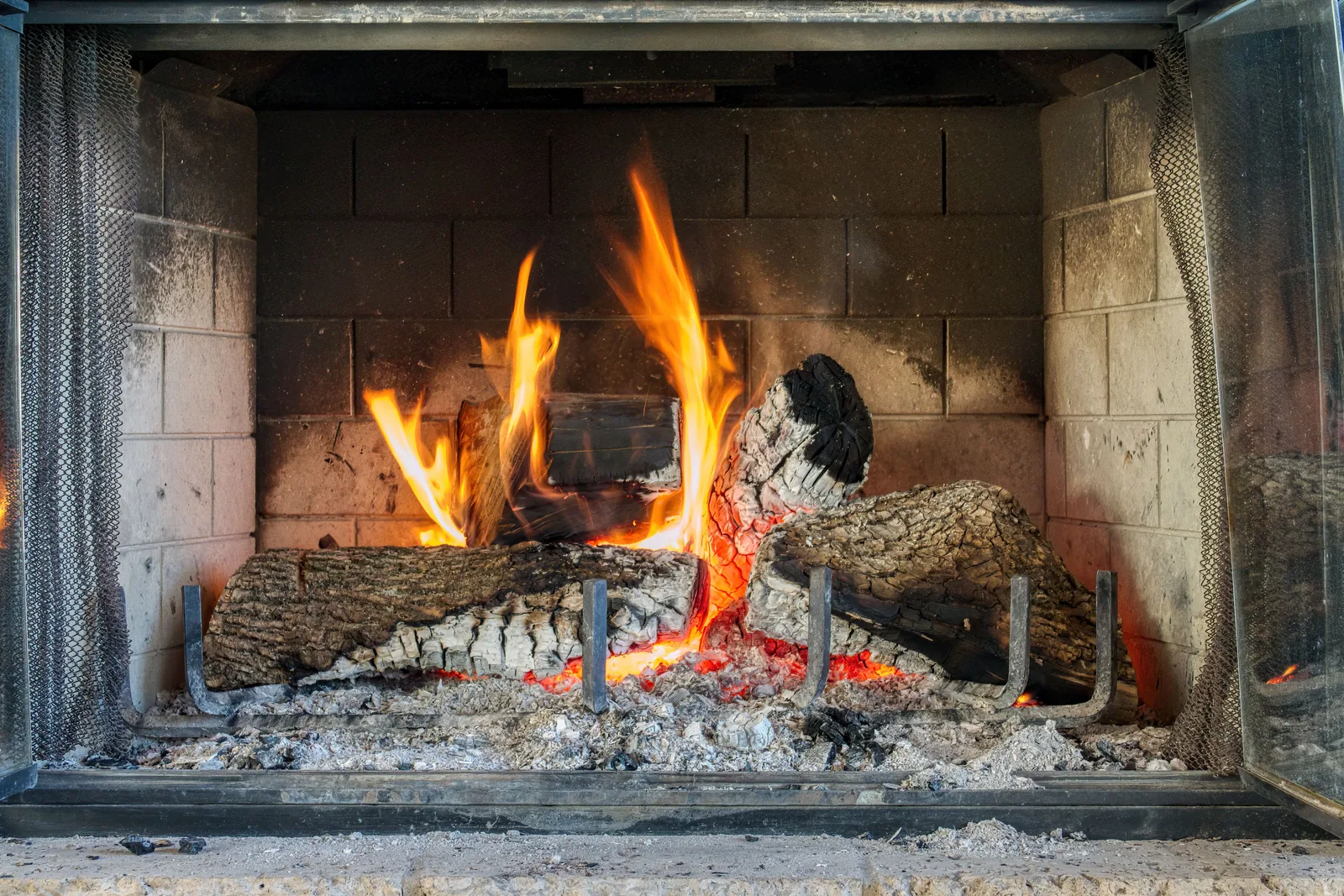
At a petrol station a car is filled with petrol, and in a cottage fireplace firewood is burnt. On the side of a chocolate bar it says "energy $2200\,\text{kJ}$ per hundred grams". In all three, energy is stored in the substance, and it is released when the substance burns or when the body uses it.
Is the same amount of energy released from a kilogram of different substances, and how can you calculate the energy released?
Optional Review: energy transformations
Predict
Make your predictions before investigating 2 questions
Prediction 1: petrol and firewood
Prediction 2: chocolate and firewood
Investigate
Heats of combustion of fuels
Statistical data · Firewood and milled peat: Statistics Finland, Fuel Classification (2017); natural gas, coal and diesel: IPCC 2006 Guidelines, Volume 2, table of default heating values (2006); petrol: typical value for Finnish petrol containing ethanol (for pure petrol IPCC 2006 gives $44.3\,\text{MJ/kg}$); wood pellets: typical value. Net heats of combustion, rounded
The table gives the heats of combustion $H$ of common fuels. The heat of combustion is the energy released from one kilogram of fuel.
| Fuel | $H$ ($\text{MJ/kg}$) |
|---|---|
| natural gas | 48 |
| petrol | 43 |
| diesel | 43 |
| coal | 26 |
| wood pellets | 17 |
| firewood (air-dried) | 15 |
| peat (milled peat) | 10 |
Optional How does energy depend on mass?
Values calculated by a model · example: values calculated from burning air-dried firewood with a heat of combustion of $15\,\text{MJ/kg}$
Different amounts of air-dried firewood are burnt. The table gives the mass $m$ of the wood burnt and the energy $E$ released from it.
| $m$ ($\text{kg}$) | $E$ ($\text{MJ}$) |
|---|---|
| 1.0 | 15 |
| 2.0 | 30 |
| 4.0 | 60 |
| 8.0 | 120 |
A package label converted to MJ/kg
Made-up example data · example label, not the data of a real product
The packaging of a chocolate bar says:
| Nutritional value | per 100 g |
|---|---|
| energy | $2200\,\text{kJ}$ |
When you convert the energy to megajoules and the mass to kilograms, the label gives the energy content $e$ of the chocolate in $\text{MJ/kg}$. It is given in the same unit as the heat of combustion, but it describes the energy the body can use.
What is the energy content $e$ of the chocolate in $\text{MJ/kg}$?
Hint 1: a guiding question
How many megajoules is $2200\,\text{kJ}$ and how many kilograms is $100\,\text{g}$?
Hint 2: what is the connection
Hint 3: an intermediate step
The energy content is energy divided by mass: $e = 2.2\,\text{MJ} : 0.100\,\text{kg}$.
Show the solution
Given
energy $2200\,\text{kJ}$ per mass $100\,\text{g}$
Find
energy content $e$ in $\text{MJ/kg}$
Principle
The energy content is the energy per kilogram, and the label gives the energy the body can use for a hundred grams. So the label is converted to megajoules per kilogram, in the same way as a heat of combustion is given.
Formula
$e = \dfrac{E}{m}$
Conversions
Substitution
Answer
$22\,\text{MJ/kg}$
Two significant figures, as in the number $2200\,\text{kJ}$.
Reasonableness
The heat of combustion of firewood is $15\,\text{MJ/kg}$ and that of petrol $43\,\text{MJ/kg}$. The energy content of chocolate lies between them, which is a believable result: chocolate contains a lot of fat and sugar. The numbers are not quite the same quantity, but they are fine for comparing orders of magnitude.
Conclusion: what does the heat of combustion tell you?
Based on the tables and the package label, write: what does the heat of combustion tell you about a fuel, and how is it used to calculate the energy released from a mass? How does the label on food packaging relate to this?
Model answer
The heat of combustion $H$ tells you how much energy is released from one kilogram of fuel, and it is measured in $\text{MJ/kg}$. In the table the heat of combustion of petrol is $43\,\text{MJ/kg}$ and that of air-dried wood $15\,\text{MJ/kg}$, so burning the same mass releases different amounts of energy. The energy is directly proportional to the mass, so the energy released is found by multiplying the heat of combustion by the mass: $E = Hm$, when the mass is in kilograms. The label on food packaging gives the energy for a hundred grams. When it is converted to megajoules per kilogram, you get the energy content of the food, for example $22\,\text{MJ/kg}$ for chocolate. It is given in the same unit as the heat of combustion, but it describes the energy the body can use, whereas the heat of combustion describes the energy released in burning.
Assess your own answer
Tick the points your own answer already contains.
Review the theory summary and practise with the exercises.
Theory summary
Key idea
In this chapter a fuel means a chemical fuel: a substance whose chemical energy is released by burning it. The uranium in a nuclear power plant is also called a fuel, but nuclear fuel does not burn: its energy is nuclear energy (chapter Forms of energy and conservation of energy). Chemical energy is energy stored in the structure of the atoms and molecules of a substance. When a fuel burns, the structure changes and energy is released as heat and light. Energy does not appear out of nothing: chemical energy is transformed into another form. The same is true of food: your body slowly "burns" food and releases energy from it.
Different fuels contain different amounts of chemical energy for their mass. The quantity that tells you this is the heat of combustion $H$. It is the energy released when one kilogram of fuel burns, and its unit is, for example, $\text{MJ/kg}$. The heat of combustion of petrol is about $43\,\text{MJ/kg}$, so about $43\,\text{MJ}$ is released from one kilogram (about $43 \cdot 10^{6}\,\text{J}$). The heat of combustion of air-dried firewood (moisture $20\text{–}25\,\%$) is only about $15\,\text{MJ/kg}$, so to get the same energy you need almost three times the mass of wood.
Because the heat of combustion is energy per unit of mass, the energy released is directly proportional to the mass of fuel burnt: twice as much fuel releases twice as much energy. This gives the law used to calculate the energy released.
Heat of combustion and released energy
The energy released when a fuel burns is
$$E = Hm$$
where $E$ is the energy released ($\text{J}$ or $\text{MJ}$), $H$ is the heat of combustion of the fuel ($\text{MJ/kg}$) and $m$ is the mass of fuel burnt ($\text{kg}$). The mass must be in kilograms, because the heat of combustion is energy per kilogram. For example, $3.0\,\text{kg}$ of petrol releases $43\,\tfrac{\text{MJ}}{\text{kg}} \cdot 3.0\,\text{kg} = 129\,\text{MJ} \approx 130\,\text{MJ}$, because the mass is known to two figures.
The table gives the heats of combustion of common fuels. They are net heats of combustion, meaning that the heat released when water vapour in the flue gas condenses is not counted, and energy statistics use them. The values are rounded: the real value varies from batch to batch of fuel.
| Fuel | $H\ (\text{MJ/kg})$ |
|---|---|
| natural gas | 48 |
| petrol | 43 |
| diesel | 43 |
| coal | 26 |
| wood pellets | 17 |
| firewood (air-dried) | 15 |
| peat (milled peat) | 10 |
Sources: firewood ($13\text{–}15\,\text{GJ/t}$, moisture $20\text{–}25\,\%$) and milled peat ($9\text{–}11\,\text{GJ/t}$, moisture $40\text{–}50\,\%$): Statistics Finland, Polttoaineluokitus, määritelmät (2017). Natural gas $48.0\,\text{MJ/kg}$: IPCC, 2006 Guidelines for National Greenhouse Gas Inventories, volume 2, table of default heating values (2006). Typical values: coal (IPCC 2006: $25.8\,\text{MJ/kg}$), diesel (IPCC 2006: $43.0\,\text{MJ/kg}$), petrol ($43\,\text{MJ/kg}$; the IPCC 2006 value for pure petrol is $44.3\,\text{MJ/kg}$, but Finnish petrol contains ethanol, which has a lower heat of combustion) and wood pellets (published typical value). The values are rounded.
Moisture and fuel quality
Wet wood gives less energy per kilogram than dry wood, because part of its mass is water, which does not burn, and in addition part of the released energy is used to vaporise this water. This is why the firewood in the table is air-dried (moisture $20\text{–}25\,\%$) and the peat is milled peat with a moisture of $40\text{–}50\,\%$. Completely dry wood would have a heat of combustion of about $19\,\text{MJ/kg}$.
The energy content of food and the heat of combustion
A nutrition label gives energy per hundred grams, for example $2200\,\text{kJ}$ per $100\,\text{g}$. When you convert the energy to megajoules and the mass to kilograms, you get the energy content of the food per unit of mass, here $e = 22\,\text{MJ/kg}$. Both the energy content of food and the heat of combustion of a fuel can be given in the unit $\text{MJ/kg}$. The nutrition label describes the energy the body can use, whereas the heat of combustion of a fuel describes the energy released in burning. So they are not the same quantity: your body does not get all the energy from food that would be released if it burned, because, for example, part of the food is not absorbed from the intestine. The calculation is still the same as with the heat of combustion: the energy of food is $E = em$.
| Food | $\text{kJ}$ / $100\,\text{g}$ | $e$ ($\text{MJ/kg}$) |
|---|---|---|
| potato, boiled | 300 | 3 |
| rye bread | 1000 | 10 |
| milk chocolate | 2200 | 22 |
| butter | 3000 | 30 |
Typical nutritional values (reference: Fineli, THL), rounded and varying between products.
Common misconception
- Heat of combustion is not temperature. Many people think the heat of combustion tells you how hot the fuel burns. It is actually energy per unit of mass.
- Energy is not created in burning. The chemical energy of the fuel is transformed into heat and light, but energy does not appear out of nothing.
- Released energy is not useful energy. In a boiler, a fireplace or an engine, part of the energy is wasted, and the useful share is calculated with efficiency (chapter Efficiency).
Burning carbon-containing fuels, such as wood, peat and fossil fuels, also produces carbon dioxide, which is covered in the chapter Energy production, the environment and climate change.
Summary
- The chemical energy of a fuel is released as heat and light when it burns. Energy is not created but transformed.
- The heat of combustion $H$ is the energy released per kilogram of fuel, with the unit $\text{MJ/kg}$.
- The energy released is $E = Hm$ when the mass $m$ is in kilograms.
- The heat of combustion of petrol and diesel is about $43\,\text{MJ/kg}$, of coal $26$, of air-dried wood $15$ and of peat $10\,\text{MJ/kg}$.
- The $\text{kJ}$ per $100\,\text{g}$ on a food package can be converted to $\text{MJ/kg}$ like a heat of combustion, but it describes the energy the body can use, not the energy released in burning.
- Released energy is not the same as useful energy: useful energy is found with efficiency.
Optional Go back to your predictions
Compare your predictions with the tables and the equation $E = Hm$. Then go back to the question at the start: is the same amount of energy released from a kilogram of different substances? What does the $\text{kJ}$ figure on a package label tell you?
Would you change your prediction?
Apply
Worked example
Problem
In a fireplace, $6.0\,\text{kg}$ of air-dried firewood with a heat of combustion of $15\,\tfrac{\text{MJ}}{\text{kg}}$ is burnt. How much energy is released from the wood? Give the answer in megajoules and in kilowatt-hours.
Step 1/7
Given and find. The mass of the firewood is $m = 6.0\,\text{kg}$ and from the table the heat of combustion is $H = 15\,\tfrac{\text{MJ}}{\text{kg}}$. We want the energy released, $E$.
Step 2/7
Principle. The wood burns, so its chemical energy is transformed into heat. The heat of combustion tells you the energy per kilogram, so the energy released is found by multiplying the heat of combustion by the mass.
Step 3/7
Rearranged formula. The quantity we want, $E$, is already alone on the left side of the equation:
$$E = Hm$$
Step 4/7
Unit conversions. The mass is already in kilograms, so you can calculate the megajoules directly. For kilowatt-hours we use $1\,\text{kWh} = 3.6\,\text{MJ}$, from which $1\,\text{MJ} = 1\,\text{kWh} : 3.6$.
Step 5/7
Substitution. $$\begin{aligned} E &= Hm \\ &= 15\,\tfrac{\text{MJ}}{\text{kg}} \cdot 6.0\,\text{kg} \\ &= 90\,\text{MJ} \end{aligned}$$
In kilowatt-hours
Step 6/7
Result. The wood releases $90\,\text{MJ}$ of energy, which is $25\,\text{kWh}$. The answer is given to two significant figures, because both the mass $6.0\,\text{kg}$ and the heat of combustion $15\,\tfrac{\text{MJ}}{\text{kg}}$ are known to two figures.
Step 7/7
Reasonableness. One kilogram of wood gives $15\,\text{MJ}$, which is about $4\,\text{kWh}$, so six kilograms give about six times as much: $6 \cdot 4\,\text{kWh} = 24\,\text{kWh}$, which matches the result. The energy equals that of a one-kilowatt ($1\,\text{kW}$) heater switched on for $25\,\text{h}$. However, you do not get all of it as heat for the room, because some of the heat leaves with the flue gases (chapter Efficiency).
Optional Find the error
Apply to a new situation
A camping stove gas cartridge contains $0.230\,\text{kg}$ of liquefied petroleum gas with a heat of combustion of about $46\,\text{MJ/kg}$. The efficiency of the stove is $60\,\%$.
How much useful energy is obtained when all the gas in the cartridge is burnt? Give the answer in megajoules.
Hint 1: a guiding question
How much energy is released from the gas when it burns? Which law tells you?
Hint 2: what is the connection
The energy released is $E_\text{in} = Hm$. The efficiency is
(chapter Efficiency), so $E_\text{useful} = \eta\, E_\text{in}$.
Hint 3: an intermediate step
$E_\text{in} = 46\,\text{MJ/kg} \cdot 0.230\,\text{kg}$ and $E_\text{useful} = 0.60 \cdot E_\text{in}$.
Show the solution
Given
mass of the liquefied petroleum gas $m = 0.230\,\text{kg}$, heat of combustion $H = 46\,\text{MJ/kg}$ and efficiency of the stove $\eta = 60\,\% = 0.60$
Find
useful energy $E_\text{useful}$ in megajoules
Principle
When the gas burns, its chemical energy is released according to the heat of combustion. Of the energy released, only the share given by the efficiency is useful (chapter Efficiency), because part of the heat goes into the surroundings.
Formula
so $E_\text{useful} = \eta\, E_\text{in}$
Conversions
Not needed: the mass is in kilograms and $60\,\% = 0.60$.
Substitution
Answer
$6.3\,\text{MJ}$
Two significant figures like the data $46\,\text{MJ/kg}$ and $60\,\%$.
Reasonableness
The energy released, $10.6\,\text{MJ}$, is of the right order of magnitude, because a quarter of a kilogram of fuel gives about $0.25 \cdot 46\,\text{MJ} \approx 11\,\text{MJ}$. The useful energy is smaller than that, about six tenths, as the efficiency of $60\,\%$ requires.
Check your understanding
Exit ticket
Answer on your own first and only then open the answer.
- How much energy is released when $5.0\,\text{kg}$ of air-dried firewood ($H = 15\,\text{MJ/kg}$) is burnt?
Answer
$E$$= Hm$$= 15\,\text{MJ/kg} \cdot 5.0\,\text{kg}$$= 75\,\text{MJ}$
1. Concept
2. Per kilogram and in total
3. Food and fuel
4. Unit conversion and energy
The heat of combustion of petrol is $43\,\text{MJ/kg}$. How many kilowatt-hours of energy are released when $1.0\,\text{kg}$ of petrol is burnt? Give the answer in kilowatt-hours.
Hint 1: a guiding question
First calculate the energy in megajoules. Then convert it to kilowatt-hours.
Hint 2: what is the connection
$E = Hm$ and $1\,\text{kWh} = 3.6\,\text{MJ}$ (chapter Energy transformations and the joule).
Hint 3: an intermediate step
Since $1\,\text{kWh} = 3.6\,\text{MJ}$, we have $1\,\text{MJ} = 1\,\text{kWh} : 3.6$. Substitute this.
Show the solution
Given
heat of combustion of petrol $H = 43\,\text{MJ/kg}$ and mass $m = 1.0\,\text{kg}$
Find
energy released $E$ in kilowatt-hours
Principle
The chemical energy of petrol is released when it burns, and the heat of combustion gives the energy per kilogram. First the energy is calculated in megajoules, then it is converted to kilowatt-hours.
Formula
$E = Hm$
Conversions
so $1\,\text{MJ} = 1\,\text{kWh} : 3.6$.
Substitution
Answer
$12\,\text{kWh}$
Two significant figures like the data $43\,\text{MJ/kg}$ and $1.0\,\text{kg}$.
Reasonableness
The kilowatt-hour is a large unit, so the number is smaller than in megajoules. Estimate: $3.6 \cdot 12 = 43.2$, which is $43\,\text{MJ}$, so $12\,\text{kWh}$ is correct.
Suggestion: one answer does not show everything you can do, but review the theory summary and do the core exercises.
Optional 5. Explain
A ten-kilogram sack of wood pellets and a ten-kilogram can of petrol are burnt.
Which releases more energy, and how much? Also explain why released energy is not the same as the energy obtained as useful energy.
Model answer
The heat of combustion of pellets is about $17\,\text{MJ/kg}$ and that of petrol about $43\,\text{MJ/kg}$. By the law $E = Hm$, the pellets release $17\,\tfrac{\text{MJ}}{\text{kg}} \cdot 10\,\text{kg} = 170\,\text{MJ}$ and the petrol $43\,\tfrac{\text{MJ}}{\text{kg}} \cdot 10\,\text{kg} = 430\,\text{MJ}$, so about $2.5$ times as much energy is released from the petrol. Only part of the energy released is transformed into a useful form, because part of the heat leaves with the flue gases and the surroundings in the boiler or the engine. The share that is useful is calculated with efficiency.
Assess your own answer
Tick the points your own answer already contains.
Review the theory summary and practise with the exercises.
Review the chapter's concepts
Cards you mark Review later collect in your review deck.
- Heating value
- The energy released per unit mass of a fuel when it burns completely.
Exercises
Level 1 · basic practice 8 exercises
One formula or one step of reasoning. Core exercises first, the rest is extra practice.
- Exercise 5-1Core
At a petrol station, $2.0\,\text{kg}$ of petrol was bought for a chainsaw. The heat of combustion of petrol is $43\,\tfrac{\text{MJ}}{\text{kg}}$.
How much energy is released when the petrol burns? Give the answer in megajoules.
Answer
$86\,\text{MJ}$
Show the solution
Given
petrol, mass $m = 2.0\,\text{kg}$ and heat of combustion $H = 43\,\tfrac{\text{MJ}}{\text{kg}}$
Find
the energy $E$ released in burning, in megajoules
Principle
The chemical energy of petrol is released when it burns. The heat of combustion gives the energy released per kilogram, so the energy is the product of the heat of combustion and the mass.
Formula
$E = Hm$
Conversions
Not needed: the mass is already in kilograms and the answer is wanted in megajoules, like the heat of combustion.
Substitution
$E$$= 43\,\tfrac{\text{MJ}}{\text{kg}} \cdot 2.0\,\text{kg}$$= 86\,\text{MJ}$Answer
$86\,\text{MJ}$
Two significant figures like the mass $2.0\,\text{kg}$.
Reasonableness
One kilogram gives $43\,\text{MJ}$, so two kilograms give twice as much, about $2 \cdot 40\,\text{MJ} = 80\,\text{MJ}$. The result is of the right order of magnitude and positive.
- Exercise 5-2Core
On a winter day, $2.0\,\text{kg}$ of natural gas is burnt in a gas boiler. Read the heat of combustion of natural gas from the bar chart in the figure.
How much energy is released from the gas? Give the answer in megajoules.
Answer
$96\,\text{MJ}$
Show the solution
Given
natural gas, mass $m = 2.0\,\text{kg}$; heat of combustion $H = 48\,\tfrac{\text{MJ}}{\text{kg}}$ is read from the figure
Find
the energy $E$ released, in megajoules
Principle
When the gas burns, its chemical energy is transformed into heat. The energy released is proportional to the mass, so we use the definition of the heat of combustion.
Reading the graph
The top bar of the bar chart is natural gas, and the number $48$ is printed at its end. The unit on the horizontal axis is $\text{MJ/kg}$, so $H = 48\,\tfrac{\text{MJ}}{\text{kg}}$; the end of the bar is also a little before the grid line $50$.
Formula
$E = Hm$
Conversions
Not needed: the mass is in kilograms and the heat of combustion in megajoules per kilogram, so the energy comes out in megajoules.
Substitution
$E$$= 48\,\tfrac{\text{MJ}}{\text{kg}} \cdot 2.0\,\text{kg}$$= 96\,\text{MJ}$Answer
$96\,\text{MJ}$
Two significant figures like the mass $2.0\,\text{kg}$.
Reasonableness
The heat of combustion of gas is about $50\,\tfrac{\text{MJ}}{\text{kg}}$, so two kilograms give about $100\,\text{MJ}$. The result is slightly smaller, because $48 < 50$.
- Exercise 5-3
A coal-fired power plant burns $12\,000\,\text{kg}$ of coal per hour, with a heat of combustion of $26\,\tfrac{\text{MJ}}{\text{kg}}$.
How much energy is released from the coal in an hour? Give the answer in megajoules.
Answer
$310\,000\,\text{MJ}$
Show the solution
Given
coal, mass $m = 12\,000\,\text{kg}$ and heat of combustion $H = 26\,\tfrac{\text{MJ}}{\text{kg}}$
Find
the energy $E$ released in one hour, in megajoules
Principle
The chemical energy of coal is released when it burns, and the energy released is the product of the heat of combustion and the mass. The mass is already in kilograms, as the heat of combustion requires.
Formula
$E = Hm$
Conversions
Not needed: the mass is in kilograms and the answer is wanted in megajoules, like the heat of combustion.
Substitution
$E$$= 26\,\tfrac{\text{MJ}}{\text{kg}} \cdot 12\,000\,\text{kg}$$= 312\,000\,\text{MJ}$Answer
$310\,000\,\text{MJ}$
Two significant figures like the heat of combustion $26\,\tfrac{\text{MJ}}{\text{kg}}$.
Reasonableness
Roughly
$10\,000\,\text{kg} \cdot 30\,\tfrac{\text{MJ}}{\text{kg}}$$= 300\,000\,\text{MJ}$The energy for one hour at a power plant is large, because about ten tonnes of fuel are used.
- Exercise 5-4
$400\,\text{kg}$ of milled peat with a heat of combustion of $10\,\tfrac{\text{MJ}}{\text{kg}}$ is taken from the storage of a heating plant to be burnt.
How much energy is released from the peat? Give the answer in megajoules.
Answer
$4000\,\text{MJ}$
Show the solution
Given
milled peat, mass $m = 400\,\text{kg}$ and heat of combustion $H = 10\,\tfrac{\text{MJ}}{\text{kg}}$
Find
the energy $E$ released, in megajoules
Principle
When peat burns, its chemical energy is released, and the energy is the product of the heat of combustion and the mass.
Formula
$E = Hm$
Conversions
Not needed: the mass is already in kilograms.
Substitution
$E$$= 10\,\tfrac{\text{MJ}}{\text{kg}} \cdot 400\,\text{kg}$$= 4000\,\text{MJ}$Answer
$4000\,\text{MJ}$
Or $4.0 \cdot 10^3\,\text{MJ}$, two significant figures like the heat of combustion $10\,\tfrac{\text{MJ}}{\text{kg}}$.
Reasonableness
The heat of combustion of peat is small, so a hundred kilograms gives only $1000\,\text{MJ}$. Four times the mass gives four times the energy, $4000\,\text{MJ}$.
- Exercise 5-5
The energy content of a hiker's nut mix is $24\,\tfrac{\text{MJ}}{\text{kg}}$ (example value). A handful of nuts weighs $0.040\,\text{kg}$.
How much energy do you get from the handful? Give the answer in megajoules.
Answer
$0.96\,\text{MJ}$
Show the solution
Given
nuts, energy content $e = 24\,\tfrac{\text{MJ}}{\text{kg}}$ and mass $m = 0.040\,\text{kg}$
Find
the energy $E$ contained in the nuts, in megajoules
Principle
The energy of food is calculated in the same way as for a fuel: the energy content is the energy the body can use per kilogram, so the energy is the product of it and the mass. The energy content is not a heat of combustion, even though the unit is the same.
Formula
$E = em$
Conversions
Not needed: the mass is in kilograms and the answer is wanted in megajoules.
Substitution
$E$$= em$$= 24\,\tfrac{\text{MJ}}{\text{kg}} \cdot 0.040\,\text{kg}$$= 0.96\,\text{MJ}$Answer
$0.96\,\text{MJ}$
Two significant figures like the mass $0.040\,\text{kg}$.
Reasonableness
An estimate with rounded numbers: $25\,\tfrac{\text{MJ}}{\text{kg}} \cdot 0.04\,\text{kg} = 1\,\text{MJ}$, so $0.96\,\text{MJ}$ is of the right order of magnitude. It is about $1000\,\text{kJ}$, the typical energy of a small snack.
- Exercise 5-6
The heat of combustion of petrol is $43\,\tfrac{\text{MJ}}{\text{kg}}$. What does this mean?
Answer
When one kilogram of petrol burns, an energy of $43\,\text{MJ}$ is released.
Show the solution
Find
what the heat of combustion of petrol $H = 43\,\tfrac{\text{MJ}}{\text{kg}}$ tells
Principle
The heat of combustion is the energy released per unit of mass when a fuel burns, so its unit $\text{MJ/kg}$ is energy divided by mass. It is not a temperature, and energy is not created from nothing: chemical energy is transformed into heat and light.
Model answer
When one kilogram of petrol burns, an energy of $43\,\text{MJ}$ is released. Two kilograms release twice as much, $E = Hm = 43\,\tfrac{\text{MJ}}{\text{kg}} \cdot 2.0\,\text{kg} = 86\,\text{MJ}$. The heat of combustion does not tell the temperature of the flame, and it does not mean that energy would be created anew.
- Exercise 5-7
In a pellet burner, an energy of $255\,\text{MJ}$ is to be released from wood pellets. The heat of combustion of the pellets is $17\,\tfrac{\text{MJ}}{\text{kg}}$.
How many kilograms of pellets must be burned? Give the answer in kilograms.
Answer
$15\,\text{kg}$
Show the solution
Given
the energy to be released is $E = 255\,\text{MJ}$ and the heat of combustion of the pellets is $H = 17\,\tfrac{\text{MJ}}{\text{kg}}$
Find
the mass $m$ of pellets to be burned, in kilograms
Principle
The chemical energy of the pellets is released when they burn, and the energy released is the product of the heat of combustion and the mass. The mass is obtained by dividing the energy needed by the heat of combustion.
Formula
$E = Hm$, so $m = \dfrac{E}{H}$
Conversions
Not needed: the energy is in megajoules and the heat of combustion in megajoules per kilogram, so the mass comes out in kilograms.
Substitution
$m$$= \dfrac{255\,\text{MJ}}{17\,\tfrac{\text{MJ}}{\text{kg}}}$$= 15\,\text{kg}$Answer
$15\,\text{kg}$
Two significant figures like the heat of combustion $17\,\tfrac{\text{MJ}}{\text{kg}}$.
Reasonableness
One kilogram gives $17\,\text{MJ}$, so $15\,\text{kg}$ gives $15 \cdot 17\,\text{MJ} = 255\,\text{MJ}$, which is the energy in the problem.
- Exercise 5-8
When three kilograms of natural gas burn, an energy of $144\,\text{MJ}$ is released. How much is this in kilowatt-hours? Use the relation $1\,\text{kWh} = 3.6\,\text{MJ}$. Give the answer in kilowatt-hours.
Answer
$40\,\text{kWh}$
Show the solution
Given
mass of natural gas $m = 3.0\,\text{kg}$ and energy released $E = 144\,\text{MJ}$
Find
the energy $E$ in kilowatt-hours
Principle
Megajoules and kilowatt-hours are units of the same quantity, energy. The conversion is done by substituting the unit relation $1\,\text{kWh} = 3.6\,\text{MJ}$, so the value of the energy does not change, only its unit.
Formula
$E$ in kilowatt-hours:
$E$$= \dfrac{144\,\text{MJ}}{3.6\,\text{MJ/kWh}}$Conversions
$1\,\text{kWh} = 3.6\,\text{MJ}$, so $1\,\text{MJ} = 1\,\text{kWh} : 3.6$.
Substitution
$E$$= \dfrac{144\,\text{MJ}}{3.6\,\text{MJ/kWh}}$$= 40\,\text{kWh}$Answer
$40\,\text{kWh}$
Two significant figures like the energy $144\,\text{MJ}$ (the conversion factor $3.6$ is exact).
Reasonableness
One kilowatt-hour is $3.6\,\text{MJ}$, so $40\,\text{kWh}$ is $40 \cdot 3.6\,\text{MJ} = 144\,\text{MJ}$, as in the problem. The number of kilowatt-hours is smaller than the number of megajoules, because one kilowatt-hour is a larger amount of energy than one megajoule.
Level 2 · applied practice 7 exercises
Two steps, working with measured data, a unit conversion or rearranging a formula. Core exercises first, the rest is extra practice.
- Exercise 5-9Core
The nutritional label on a loaf of bread (example) says: energy $1200\,\text{kJ}$ per hundred grams. A slice of bread weighs $40\,\text{g}$.
How much energy is in the slice? Give the answer in kilojoules.
Answer
$480\,\text{kJ}$
Show the solution
Given
according to the label $1200\,\text{kJ}$ per hundred grams, mass of the slice $m = 40\,\text{g}$
Find
the energy $E$ of the slice, in kilojoules
Principle
The label gives the energy content of the food, that is the energy the body can use, per unit of mass. It is not a heat of combustion, but the calculation is done in the same way: the label is converted to megajoules per kilogram and multiplied by the mass.
Formula
$E = em$, where the energy content $e$ is the energy on the label divided by the mass on the label
Conversions
$1200\,\text{kJ}$$= 1200 \cdot (1 : 1000)\,\text{MJ}$$= 1.2\,\text{MJ}$$100\,\text{g}$$= 100 \cdot (1 : 1000)\,\text{kg}$$= 0.100\,\text{kg}$$40\,\text{g}$$= 40 \cdot (1 : 1000)\,\text{kg}$$= 0.040\,\text{kg}$Substitution
$e$$= 1.2\,\text{MJ} : 0.100\,\text{kg}$$= 12\,\tfrac{\text{MJ}}{\text{kg}}$$E$$= 12\,\tfrac{\text{MJ}}{\text{kg}} \cdot 0.040\,\text{kg}$$= 0.48\,\text{MJ}$$= 480\,\text{kJ}$Answer
$480\,\text{kJ}$
Two significant figures like the mass $40\,\text{g}$.
Reasonableness
The slice is $40\,\%$ of a hundred grams, and $40\,\%$ of $1200\,\text{kJ}$ is $0.4 \cdot 1200\,\text{kJ} = 480\,\text{kJ}$. The result is smaller than $1200\,\text{kJ}$, as it should be.
- Exercise 5-10Core
A diesel generator on a building site must release $1.8\,\text{GJ}$ of energy from fuel. The heat of combustion of diesel is $43\,\tfrac{\text{MJ}}{\text{kg}}$.
How many kilograms of diesel must be burnt? Give the answer in kilograms.
Answer
$42\,\text{kg}$
Show the solution
Given
the energy released must be $E = 1.8\,\text{GJ}$, heat of combustion of diesel $H = 43\,\tfrac{\text{MJ}}{\text{kg}}$
Find
the mass $m$ of diesel to be burnt, in kilograms
Principle
By the law $E = Hm$ the energy is the product of the heat of combustion and the mass. Now the energy is known and the mass is wanted, so the law is solved for the mass.
Formula
$E = Hm$, so $m = \dfrac{E}{H}$
Conversions
$1.8\,\text{GJ}$$= 1.8 \cdot 1000\,\text{MJ}$$= 1800\,\text{MJ}$Substitution
$m$$= 1800\,\text{MJ} : 43\,\tfrac{\text{MJ}}{\text{kg}}$$= 41.86\,\text{kg}$Answer
$42\,\text{kg}$
Two significant figures like the data $1.8\,\text{GJ}$ and $43\,\tfrac{\text{MJ}}{\text{kg}}$.
Reasonableness
One kilogram gives about $43\,\text{MJ}$, so $42\,\text{kg}$ gives about $42 \cdot 43\,\text{MJ} \approx 1800\,\text{MJ}$, which is $1.8\,\text{GJ}$.
- Exercise 5-11
In the pellet burner of a detached house, $40\,\text{kg}$ of wood pellets with a heat of combustion of $17\,\tfrac{\text{MJ}}{\text{kg}}$ are burnt. The efficiency of the boiler is $85\,\%$.
How much useful energy is obtained from the pellets to heat the house? Give the answer in megajoules.
Answer
$580\,\text{MJ}$
Show the solution
Given
wood pellets, mass $m = 40\,\text{kg}$ and heat of combustion $H = 17\,\tfrac{\text{MJ}}{\text{kg}}$; efficiency of the boiler $\eta = 85\,\% = 0.85$
Find
the useful energy $E_\text{useful}$ in megajoules
Principle
The pellets release the energy $E_\text{in} = Hm$. Efficiency is the share of the energy taken in that is obtained as useful energy (chapter Efficiency), so only part of the released energy ends up heating the house.
Formula
$E_\text{in}$$= Hm$$\eta$$= \dfrac{E_\text{useful}}{E_\text{in}}$so $E_\text{useful} = \eta\, E_\text{in}$
Conversions
Not needed: the mass is in kilograms and $85\,\% = 0.85$.
Substitution
$E_\text{in}$$= 17\,\tfrac{\text{MJ}}{\text{kg}} \cdot 40\,\text{kg}$$= 680\,\text{MJ}$$E_\text{useful}$$= 0.85 \cdot 680\,\text{MJ}$$= 578\,\text{MJ}$Answer
$580\,\text{MJ}$
Two significant figures like the data $40\,\text{kg}$ and $85\,\%$.
Reasonableness
The useful energy is smaller than the $680\,\text{MJ}$ released, because part of the heat leaves with the flue gases. Estimate: $0.85 \approx 0.9$ and $0.9 \cdot 680\,\text{MJ} \approx 610\,\text{MJ}$, so $578\,\text{MJ}$ is of the right order of magnitude.
- Exercise 5-12
A passenger car needs $48\,\text{MJ}$ of useful energy to drive $100\,\text{km}$. The efficiency of the engine is $25\,\%$. The heat of combustion of petrol is $43\,\tfrac{\text{MJ}}{\text{kg}}$.
How many kilograms of petrol are used on a $100\,\text{km}$ journey? Give the answer in kilograms.
Answer
$4.5\,\text{kg}$
Show the solution
Given
useful energy $E_\text{useful} = 48\,\text{MJ}$, efficiency $\eta = 25\,\% = 0.25$, heat of combustion of petrol $H = 43\,\tfrac{\text{MJ}}{\text{kg}}$
Find
the mass $m$ of petrol, in kilograms
Principle
The engine transforms only part of the energy of the petrol into motion (chapter Efficiency). First we use the efficiency to find the energy needed from the petrol, and then the law $E = Hm$ to find the mass.
Formula
$\eta$$= \dfrac{E_\text{useful}}{E_\text{in}}$so
$E_\text{in}$$= \dfrac{E_\text{useful}}{\eta}$$E_\text{in} = Hm$, so $m = \dfrac{E_\text{in}}{H}$
Conversions
Not needed: $25\,\% = 0.25$ and the energies are in megajoules.
Substitution
$E_\text{in}$$= 48\,\text{MJ} : 0.25$$= 192\,\text{MJ}$$m$$= 192\,\text{MJ} : 43\,\tfrac{\text{MJ}}{\text{kg}}$$= 4.465\,\text{kg}$Answer
$4.5\,\text{kg}$
Two significant figures like the data $48\,\text{MJ}$ and $25\,\%$.
Reasonableness
The density of petrol is about $0.74\,\tfrac{\text{kg}}{\textsf{l}}$, so $4.5\,\text{kg}$ is about $6\,\textsf{l}$, a typical consumption per hundred kilometres. The energy of the petrol, $192\,\text{MJ}$, is four times the useful energy, because the efficiency is one quarter.
- Exercise 5-13
The table gives example data on the effective heat of combustion of firewood at different moisture contents. Heating a sauna requires an energy of $200\,\text{MJ}$ released from firewood.
Using the heats of combustion in the table, calculate the mass of wood needed when the moisture content is $20\,\%$ and when it is $40\,\%$. How many kilograms more moist ($40\,\%$) wood is needed than air-dried ($20\,\%$) wood? Give the answer in kilograms.
Example data: effective heat of combustion of firewood by moisture content Moisture content $(\%)$ $H\,(\text{MJ/kg})$ 0 19.0 10 16.9 20 14.7 30 12.6 40 10.4 50 8.3 Answer
$5.6\,\text{kg}$
Show the solution
Given
the energy needed $E = 200\,\text{MJ}$; from the table the heat of combustion $H_{20} = 14.7\,\tfrac{\text{MJ}}{\text{kg}}$ at moisture content $20\,\%$ and $H_{40} = 10.4\,\tfrac{\text{MJ}}{\text{kg}}$ at $40\,\%$
Find
the difference of the masses $\Delta m = m_{40} - m_{20}$ in kilograms
Principle
The same energy has to be released from both kinds of wood. By the law $E = Hm$, the mass is the energy divided by the heat of combustion. Moist wood gives less energy per kilogram, because part of its mass is water, which does not burn and whose evaporation consumes energy.
Formula
$E = Hm$, so $m = \dfrac{E}{H}$, and $\Delta m = m_{40} - m_{20}$
Conversions
Not needed: the energy is in megajoules and the heats of combustion in megajoules per kilogram.
Substitution
$m_{20}$$= 200\,\text{MJ} : 14.7\,\tfrac{\text{MJ}}{\text{kg}}$$= 13.61\,\text{kg}$$m_{40}$$= 200\,\text{MJ} : 10.4\,\tfrac{\text{MJ}}{\text{kg}}$$= 19.23\,\text{kg}$The difference is
$\Delta m$$= 19.23\,\text{kg} - 13.61\,\text{kg}$$= 5.62\,\text{kg}$Answer
$5.6\,\text{kg}$
More moist wood is needed, two significant figures like the data $200\,\text{MJ}$.
Reasonableness
The ratio of the heats of combustion is $14.7 : 10.4 = 1.41$, so the mass of the moist wood is about $1.41$ times as large: $1.41 \cdot 13.61\,\text{kg} = 19.2\,\text{kg}$. Moist wood gives less energy per kilogram, so more mass is needed, and the difference is positive.
- Exercise 5-14
A student solved a problem: “A power plant burns $3.0\,\text{t}$ of coal with a heat of combustion of $26\,\tfrac{\text{MJ}}{\text{kg}}$. The energy is $E = Hm = 26 \cdot 3.0\,\text{MJ} = 78\,\text{MJ}$.” Where is the student’s mistake?
Answer
The mass was not converted to kilograms: $3.0\,\text{t} = 3000\,\text{kg}$, so the correct result is $78\,000\,\text{MJ}$.
Show the solution
Find
where the student’s calculation goes wrong and what the correct result is
Principle
The heat of combustion is energy per kilogram, so in the formula $E = Hm$ the mass must be substituted in kilograms. A tonne is not a kilogram: $1\,\text{t} = 1000\,\text{kg}$.
Model answer
The student substituted the mass in tonnes, although the heat of combustion is in the unit $\text{MJ/kg}$. Correctly, $3.0\,\text{t} = 3.0 \cdot 1000\,\text{kg} = 3000\,\text{kg}$ and $E = Hm = 26\,\tfrac{\text{MJ}}{\text{kg}} \cdot 3000\,\text{kg} = 78\,000\,\text{MJ}$. The student’s result $78\,\text{MJ}$ is a thousand times too small. The formula, the heat of combustion of coal and the unit $\text{MJ}$ of the answer were correct. The thousandfold error also shows in an estimate: one kilogram of coal already gives $26\,\text{MJ}$, so three tonnes give much more than $78\,\text{MJ}$.
- Exercise 5-15
In an example measurement, a pellet burner and its pellets stood on a scale, and the burner burned steadily the whole time. The reading $m$ of the scale was recorded every $10\,\text{min}$.
Draw a graph of the mass as a function of time and determine from its slope how many kilograms of pellets burn per minute. The heat of combustion of the pellets is $17\,\tfrac{\text{MJ}}{\text{kg}}$. What is the power released in the burning? Give the answer in kilowatts.
Example measurement: mass of the pellet burner and the pellets $t\,(\text{min})$ $m\,(\text{kg})$ 0 12.00 10 11.34 20 10.71 30 10.04 40 9.40 Answer
$18\,\text{kW}$
Show the solution
Given
a table $(t, m)$, heat of combustion of the pellets $H = 17\,\tfrac{\text{MJ}}{\text{kg}}$; the burner burns steadily
Find
the power $P$ released in the burning, in kilowatts
Principle
The burner burns steadily, so the mass decreases steadily and the graph $m(t)$ is a straight line; its slope tells the mass burned per minute. The burned mass releases an energy $E = Hm$, and power is energy per unit of time, $P = E : t$ (chapter Power).
Reading the graph
When the points $(t, m)$ are plotted, they lie roughly on the same descending line, because the mass decreases by about $0.65\,\text{kg}$ every $10$ minutes (the small scatter of the measured points is part of the measurement). A suitable line is drawn through the points and its slope is read from the ends of the line, which pass through the points $(0\,\text{min}, 12.00\,\text{kg})$ and $(40\,\text{min}, 9.40\,\text{kg})$:
$k$$= \dfrac{9.40\,\text{kg} - 12.00\,\text{kg}}{40\,\text{min} - 0\,\text{min}}$$= -0.065\,\tfrac{\text{kg}}{\text{min}}$The minus sign shows that the mass decreases, so the rate at which mass burns is $0.065\,\tfrac{\text{kg}}{\text{min}}$.
Formula
$E = Hm$ and $P = \dfrac{E}{t}$, together $P = H \cdot \dfrac{m}{t}$
Conversions
$1\,\text{min} = 60\,\text{s}$, so $0.065\,\tfrac{\text{kg}}{\text{min}} = 0.065\,\text{kg} : 60\,\text{s}$. The heat of combustion is
$17\,\tfrac{\text{MJ}}{\text{kg}}$$= 17 \cdot 10^{6}\,\tfrac{\text{J}}{\text{kg}}$and $1\,\text{W} = 1\,\tfrac{\text{J}}{\text{s}}$.
Substitution
$P$$= 17 \cdot 10^{6}\,\tfrac{\text{J}}{\text{kg}} \cdot \dfrac{0.065\,\text{kg}}{60\,\text{s}}$$= 18\,417\,\text{W}$$= 18.4\,\text{kW}$Answer
$18\,\text{kW}$
Two significant figures like the heat of combustion $17\,\tfrac{\text{MJ}}{\text{kg}}$.
Reasonableness
In a minute $0.065\,\text{kg}$ burns, which releases $17\,\tfrac{\text{MJ}}{\text{kg}} \cdot 0.065\,\text{kg} = 1.1\,\text{MJ}$. That is
$1.1\,\text{MJ} : 60\,\text{s}$$= 0.018\,\text{MJ/s}$$= 18\,\text{kW}$which suits the fuel power of the pellet boiler of a detached house. The power is the power released, not the useful power received by the house.
Level 3 · challenging 5 exercises
Optional: application, two ideas together or a new situation where you reason for yourself.
- Exercise 5-16
To heat a cottage, $120\,\text{MJ}$ of energy must be released from fuel. The energy can be obtained either from air-dried firewood ($15\,\tfrac{\text{MJ}}{\text{kg}}$) or from light heating oil ($43\,\tfrac{\text{MJ}}{\text{kg}}$). Calculate the mass of each fuel needed and say how many kilograms more wood than oil are needed. Also explain why more wood is needed. Give the answer in kilograms.
Answer
$5.2\,\text{kg}$
Show the solution
Given
the energy needed $E = 120\,\text{MJ}$, air-dried firewood $H_\text{wood} = 15\,\tfrac{\text{MJ}}{\text{kg}}$ and heating oil $H_\text{oil} = 43\,\tfrac{\text{MJ}}{\text{kg}}$
Find
how many kilograms more wood than oil are needed, $\Delta m = m_\text{wood} - m_\text{oil}$
Principle
The same energy $E$ must be released from both fuels. By the law $E = Hm$ the mass is the energy divided by the heat of combustion, so a smaller heat of combustion needs a larger mass.
Formula
$E = Hm$, so $m = \dfrac{E}{H}$ for each fuel, and $\Delta m = m_\text{wood} - m_\text{oil}$
Conversions
Not needed: the energy is in megajoules and the heats of combustion in megajoules per kilogram.
Substitution
$m_\text{wood}$$= 120\,\text{MJ} : 15\,\tfrac{\text{MJ}}{\text{kg}}$$= 8.0\,\text{kg}$$m_\text{oil}$$= 120\,\text{MJ} : 43\,\tfrac{\text{MJ}}{\text{kg}}$$= 2.79\,\text{kg}$Difference:
$\Delta m$$= 8.0\,\text{kg} - 2.79\,\text{kg}$$= 5.21\,\text{kg}$Answer
$5.2\,\text{kg}$
More wood is needed, two significant figures like the data $120\,\text{MJ}$ and $15\,\tfrac{\text{MJ}}{\text{kg}}$. More wood is needed because one kilogram of wood contains less chemical energy than one kilogram of oil.
Reasonableness
The mass of wood is about $2.9$ times the mass of oil, since $43 : 15 = 2.87$. So $2.87 \cdot 2.79\,\text{kg} \approx 8.0\,\text{kg}$, and the difference is $2.87 - 1 = 1.87$ times the mass of oil: $1.87 \cdot 2.79\,\text{kg} \approx 5.2\,\text{kg}$, as it should be.
- Exercise 5-17
A hiker carries food with an energy content of $18\,\tfrac{\text{MJ}}{\text{kg}}$ (example value). There is $2.4\,\text{kg}$ of food, and the hiker needs $12\,\text{MJ}$ of energy from food per day.
How many daily rations does the food provide? Give the answer as a decimal number and justify your calculation.
Answer
$3.6$
Show the solution
Given
energy content of the food $e = 18\,\tfrac{\text{MJ}}{\text{kg}}$, mass $m = 2.4\,\text{kg}$, daily consumption $12\,\text{MJ}$
Find
the number of daily rations $N$ that the food provides (as a decimal number)
Principle
The total energy obtainable from the food is found by multiplying the energy content by the mass, as with a fuel by the law $E = Hm$. The number of rations is how many times the daily consumption fits into the total energy, so $N = E : \text{daily consumption}$.
Formula
$E = em$ and the number of days $N = \dfrac{E}{12\,\text{MJ}}$
Conversions
Not needed: the mass is in kilograms and the energy in megajoules.
Substitution
$E$$= 18\,\tfrac{\text{MJ}}{\text{kg}} \cdot 2.4\,\text{kg}$$= 43.2\,\text{MJ}$$N$$= 43.2\,\text{MJ} : 12\,\text{MJ}$$= 3.6$Answer
$3.6$
Daily rations, two significant figures like the data $2.4\,\text{kg}$ and $18\,\tfrac{\text{MJ}}{\text{kg}}$.
Reasonableness
The need for three rations is $36\,\text{MJ}$ and for four $48\,\text{MJ}$. There is $43.2\,\text{MJ}$ of food, so the result lies between three and four: three full days and part of a fourth.
- Exercise 5-18
A peat-fired power plant burns $36\,\text{t}$ of milled peat per hour, with a heat of combustion of $10\,\tfrac{\text{MJ}}{\text{kg}}$. The efficiency of the plant in electricity production is $35\,\%$.
What is the electric power of the power plant? Give the answer in megawatts. Remember: $1\,\text{W} = 1\,\text{J/s}$ and one hour is $3600\,\text{s}$.
Answer
$35\,\text{MW}$
Show the solution
Given
peat $m = 36\,\text{t}$ per hour, $H = 10\,\tfrac{\text{MJ}}{\text{kg}}$, efficiency of electricity production $\eta = 35\,\% = 0.35$, time $t = 1\,\text{h}$
Find
the electric power $P$ in megawatts
Principle
In one hour the peat releases the energy $E_\text{in} = Hm$. By the efficiency, only the share $\eta$ of it becomes electricity (chapter Efficiency). Power is energy per unit of time, so power = energy : time (chapter Power P = ΔE/Δt).
Formula
$E_\text{in} = Hm$, $E_\text{useful} = \eta\, E_\text{in}$ and $P = \dfrac{E_\text{useful}}{t}$, together $P = \dfrac{\eta H m}{t}$
Conversions
$36\,\text{t}$$= 36 \cdot 1000\,\text{kg}$$= 36\,000\,\text{kg}$$1\,\text{h} = 3600\,\text{s}$. Since $1\,\text{MJ/s} = 1\,\text{MW}$, the unit of power comes out directly in megawatts.
Substitution
$E_\text{in}$$= 10\,\tfrac{\text{MJ}}{\text{kg}} \cdot 36\,000\,\text{kg}$$= 360\,000\,\text{MJ}$$E_\text{useful}$$= 0.35 \cdot 360\,000\,\text{MJ}$$= 126\,000\,\text{MJ}$$P$$= 126\,000\,\text{MJ} : 3600\,\text{s}$$= 35\,\text{MJ/s}$$= 35\,\text{MW}$Answer
$35\,\text{MW}$
Two significant figures like the data $10\,\tfrac{\text{MJ}}{\text{kg}}$ and $35\,\%$.
Reasonableness
If all the energy of the peat became electricity, the power would be $360\,000\,\text{MJ} : 3600\,\text{s} = 100\,\text{MW}$. With an efficiency of $35\,\%$ we get $35\,\%$ of that, $35\,\text{MW}$, which is a typical power for a small power plant.
- Exercise 5-19
The table gives example data on the useful energy needed each month to heat a detached house. The house can be heated either with a pellet boiler (heat of combustion of pellets $17\,\tfrac{\text{MJ}}{\text{kg}}$, efficiency $85\,\%$) or with light heating oil (heat of combustion $43\,\tfrac{\text{MJ}}{\text{kg}}$, efficiency $90\,\%$).
a) Calculate the heating energy of the year in kilowatt-hours and in megajoules.
b) Calculate the mass of pellets burned in the pellet boiler in a year.
c) Calculate the mass of oil used in a year and compare it with the mass of pellets. Explain why the ratio of the masses is not the same as the ratio of the heats of combustion.
d) Because of poor adjustment, the efficiency of the pellet boiler drops to $70\,\%$. How many kilograms more pellets are then used in a year, and why?
Enter the result of part b) in kilograms in the answer box.
Example data: useful energy needed to heat the house each month Month $E\,(\text{kWh})$ January 2100 February 1900 March 1600 April 1100 May 600 June 250 July 200 August 250 September 600 October 1100 November 1600 December 2000 Answer
$3300\,\text{kg}$
Show the solution
Given
the monthly energies in the table (sum below); pellets $H_\text{p} = 17\,\tfrac{\text{MJ}}{\text{kg}}$, $\eta_\text{p} = 85\,\% = 0.85$; oil $H_\text{oil} = 43\,\tfrac{\text{MJ}}{\text{kg}}$, $\eta_\text{oil} = 90\,\% = 0.90$; efficiency with poor adjustment $\eta_\text{p}' = 0.70$
Find
the yearly consumption of pellets $m_\text{p}$ in kilograms; also the useful energy of the year $E_\text{useful}$, the mass of oil $m_\text{oil}$ and the extra consumption of pellets at efficiency $0.70$
Principle
The energy in the table is the useful energy that ends up in the heating. The efficiency is the share of the energy released from the fuel that becomes useful energy, so the energy released is $E_\text{in} = E_\text{useful} : \eta$ and the mass of the fuel follows from the law $E = Hm$. Energy is conserved: what does not end up in the heating is lost in the flue gases and the boiler (chapter Efficiency).
Formula
$E_\text{in}$$= \dfrac{E_\text{useful}}{\eta}$$E_\text{in} = Hm$, so $m = \dfrac{E_\text{useful}}{\eta H}$
Conversions
$1\,\text{kWh} = 3.6\,\text{MJ}$, so $E_\text{useful} = 13\,300 \cdot 3.6\,\text{MJ}$. Efficiencies $85\,\% = 0.85$, $90\,\% = 0.90$ and $70\,\% = 0.70$.
Substitution
The sum of the months is
$2100 + 1900 + 1600 + 1100 + 600 + 250 + 200 + 250 + 600 + 1100 + 1600 + 2000$$= 13\,300$so
$E_\text{useful}$$= 13\,300\,\text{kWh}$$= 13\,300 \cdot 3.6\,\text{MJ}$$= 47\,880\,\text{MJ}$With pellets
$E_\text{in}$$= 47\,880\,\text{MJ} : 0.85$$= 56\,329\,\text{MJ}$$m_\text{p}$$= 56\,329\,\text{MJ} : 17\,\tfrac{\text{MJ}}{\text{kg}}$$= 3313\,\text{kg}$With oil
$E_\text{in}$$= 47\,880\,\text{MJ} : 0.90$$= 53\,200\,\text{MJ}$$m_\text{oil}$$= 53\,200\,\text{MJ} : 43\,\tfrac{\text{MJ}}{\text{kg}}$$= 1237\,\text{kg}$At efficiency $0.70$ the pellets need
$47\,880\,\text{MJ} : 0.70$$= 68\,400\,\text{MJ}$$m_\text{p}'$$= 68\,400\,\text{MJ} : 17\,\tfrac{\text{MJ}}{\text{kg}}$$= 4024\,\text{kg}$so the extra consumption is $4024\,\text{kg} - 3313\,\text{kg} = 710\,\text{kg}$.
Answer
The heating energy of the year is $13\,300\,\text{kWh} = 47\,900\,\text{MJ}$. The pellets used are $3300\,\text{kg}$, about $3.3$ tonnes, two significant figures like the efficiency $85\,\%$ and the heat of combustion $17\,\tfrac{\text{MJ}}{\text{kg}}$. The oil used is $1200\,\text{kg}$, and with poor adjustment about $710\,\text{kg}$ more pellets are used. The mass of pellets is about $2.7$ times the mass of oil, but the ratio of the heats of combustion is $43 : 17 = 2.5$. The difference is due to the efficiencies: the efficiency of the oil boiler is higher ($0.90$ instead of $0.85$), so even less oil is needed, and $2.5 \cdot (0.90 : 0.85) = 2.7$. A drop in efficiency increases the consumption, because the same useful energy has to be obtained from a larger energy released; the losses grow.
Reasonableness
A rough estimate: $13\,300\,\text{kWh}$ is about $48\,000\,\text{MJ}$, and pellets give $17\,\text{MJ}$ per kilogram, so without losses $48\,000 : 17 = 2820\,\text{kg}$ would be needed. Because of the losses the amount is larger, $2820\,\text{kg} : 0.85 = 3320\,\text{kg}$, which agrees with the result. Consumption is highest in the winter months, and in summer heating energy is needed only for hot water.
- Exercise 5-20
A housing company needs $36\,000\,\text{MJ}$ of useful energy per year for heating (example data). The table gives three boiler options. The fuel is assumed to burn completely and the efficiency of the boiler to stay constant.
a) For each option, calculate the mass of fuel needed in a year.
b) How many kilograms more firewood than pellets are used in a year? Use the unrounded masses from part a).
c) As the pellet boiler ages, its efficiency drops to $75\,\%$. Calculate the consumption of pellets then and explain how the efficiency affects the amount of fuel needed.
d) Justify why the mass of oil used is clearly smaller than the mass of wood, even though the efficiencies of the boilers are of the same order of magnitude.
Enter the result of part b) in kilograms in the answer box.
Example data: three boiler options Boiler $H\,(\text{MJ/kg})$ $\eta\,(\%)$ Wood boiler (air-dried wood) 15 70 Pellet boiler 17 85 Oil boiler 43 90 Answer
$940\,\text{kg}$
Show the solution
Given
the useful energy of the year $E_\text{useful} = 36\,000\,\text{MJ}$; from the table wood $H = 15\,\tfrac{\text{MJ}}{\text{kg}}$, $\eta = 0.70$; pellets $H = 17\,\tfrac{\text{MJ}}{\text{kg}}$, $\eta = 0.85$; oil $H = 43\,\tfrac{\text{MJ}}{\text{kg}}$, $\eta = 0.90$
Find
the difference of the masses of wood and pellets $\Delta m = m_\text{wood} - m_\text{pellet}$ in kilograms; also the mass of each fuel and the consumption of pellets at efficiency $0.75$
Principle
A model: the energy released from the fuel is $E_\text{in} = Hm$, and only the share $\eta$ of it becomes useful energy, $E_\text{useful} = \eta H m$. The smaller the heat of combustion and the efficiency, the larger the mass. The model is simple: the efficiency of the boiler is assumed to stay constant.
Formula
$E_\text{useful} = \eta H m$, so $m = \dfrac{E_\text{useful}}{\eta H}$, and $\Delta m = m_\text{wood} - m_\text{pellet}$
Conversions
Not needed: the energy is in megajoules and the heats of combustion in megajoules per kilogram. The percentages as ratios are $70\,\% = 0.70$, $85\,\% = 0.85$, $90\,\% = 0.90$ and $75\,\% = 0.75$.
Substitution
$m_\text{wood}$$= \dfrac{36\,000\,\text{MJ}}{0.70 \cdot 15\,\tfrac{\text{MJ}}{\text{kg}}}$$= 3429\,\text{kg}$$m_\text{pellet}$$= \dfrac{36\,000\,\text{MJ}}{0.85 \cdot 17\,\tfrac{\text{MJ}}{\text{kg}}}$$= 2491\,\text{kg}$$m_\text{oil}$$= \dfrac{36\,000\,\text{MJ}}{0.90 \cdot 43\,\tfrac{\text{MJ}}{\text{kg}}}$$= 930\,\text{kg}$The difference is
$\Delta m$$= 3429\,\text{kg} - 2491\,\text{kg}$$= 938\,\text{kg}$At efficiency $0.75$ the pellets used are
$m_\text{pellet}'$$= \dfrac{36\,000\,\text{MJ}}{0.75 \cdot 17\,\tfrac{\text{MJ}}{\text{kg}}}$$= 2824\,\text{kg}$Answer
in the answer box, the result of part b), $940\,\text{kg}$.
a) The wood used is $3400\,\text{kg}$, the pellets $2500\,\text{kg}$ and the oil $930\,\text{kg}$.
b) About $940\,\text{kg}$ more wood than pellets is used, two significant figures like the data $36\,000\,\text{MJ}$.
c) The consumption of pellets rises at efficiency $0.75$ to $2800\,\text{kg}$, that is $330\,\text{kg}$ more: when the efficiency drops, part of the energy released goes to losses and more fuel is needed for the same useful energy.
d) The least oil is used, because its heat of combustion is more than twice that of wood and pellets ($43 : 15 = 2.9$), while the efficiencies are of the same order of magnitude ($0.90$ and $0.70$); the heat of combustion determines the order of magnitude of the mass.Reasonableness
An estimate without losses: wood $36\,000 : 15 = 2400\,\text{kg}$ and pellets $36\,000 : 17 = 2120\,\text{kg}$. The efficiencies increase these to $2400 : 0.70 = 3430\,\text{kg}$ and $2120 : 0.85 = 2490\,\text{kg}$, which agrees with the result. The mass for the pellet boiler grows by a factor of $2824\,\text{kg} : 2491\,\text{kg} = 1.13$, and $0.85 : 0.75 = 1.13$, as it should.
Photographs
- Wood burning in the fireplace. Tom Fisk. source, Pexels License
- Garzweiler Tagebau 2008 – Schaufelradbagger 258. © Raimond Spekking. source, CC BY-SA 4.0
