
Energy transformations and the joule
Why does the motion of a bicycle ultimately come from the Sun, and how can the amount of energy be given as a single number?
Prior knowledge
- Energy appears in different forms and is conservedchapter Forms of energy and conservation of energy
- The prefixes kilo, mega, giga and tera are powers of tenchapter Quantities, units and the SI system
- Powers of ten and orders of magnitudechapter Physics as a science and the scales of the universe
Core path: follow the steps in order. Tasks marked Optional give extra practice. Optional tasks: 4.
Think about it
In the morning you eat oat porridge and set off to school by bike. The pedals turn, your speed stays up and the tyres warm up. When you arrive, you brake and stop. The oats grew in a field through the summer, and the Sun shone on them the whole time.
Where does the energy of the bicycle's motion come from, and where does it finally go when you stop?
Optional Review: conservation of energy
Predict
Make your predictions before investigating 2 questions
Prediction 1: petrol or food
Prediction 2: the Sun and humankind
Investigate
Each step on the ladder is a factor of ten. Choose an item and see which step it falls on.
Simulation
How to use
Choose an energy from the Item menu, and the view moves to it; the energy of the chosen item is shown under its name. With the buttons you move up or down the ladder, and one press is one power of ten. A filled dot means a value from a source or a calculation, a ring means an estimate. The value and source of the chosen item are also shown below the ladder.
Assumptions of the model
The values are rounded orders of magnitude, not exact measurements: the energy of a lightning strike varies a lot, and the energy of a day's food depends on the person. Each item has a source (a table value, a statistic or a calculation) or is marked as an estimate. The scale is logarithmic, so the same distance on the ladder always means the same number of times more energy.
How the calculation works
The energy of each item is written as a number times a power of ten, for example $3.2 \cdot 10^{7}\,\text{J}$. The prefix is obtained by replacing the power with its value: $10^{6}\,\text{J} = 1\,\text{MJ}$, so $3.2 \cdot 10^{7}\,\text{J} = 32 \cdot 10^{6}\,\text{J} = 32\,\text{MJ}$. When two items are compared, the larger energy is divided by the smaller: $32\,\text{MJ} : 10\,\text{MJ} = 3.2$.
Experiment 1: petrol and food
Test prediction 1. In the Item menu, select first a day's food and then a litre of petrol, and record the energy of each in megajoules. You can also record a banana and a chocolate bar.
Initial state: item: a day's food. Kept constant: nothing. Varied: item.
| item | $E$ $(\text{MJ})$ |
|---|
Experiment 2: the Sun and humankind
Test prediction 2. In the Item menu, select first the solar radiation reaching the Earth in one hour and then humankind's energy use in a year, and record the energy of each in exajoules ($1\,\text{EJ} = 10^{18}\,\text{J}$). Compare the numbers with each other.
Initial state: item: Sun to Earth in one hour. Kept constant: nothing. Varied: item.
| item | $E$ $(\text{EJ})$ |
|---|
An energy chain from a power plant to a kettle
Values calculated by a model
An example chain (a calculated model, not a measurement): the chemical energy of the fuel turns into electricity in a power plant, the electricity travels through the grid to a home, and a kettle heats the water. The table shows the useful energy left at each step.
| Step | Energy | Form |
|---|---|---|
| Fuel | $100\,\text{MJ}$ | chemical |
| Power plant | $40\,\text{MJ}$ | electricity |
| Grid | $38\,\text{MJ}$ | electricity |
| Water | $34\,\text{MJ}$ | thermal energy |
How many megajoules of the energy of the fuel have ended up somewhere other than the water along the chain? Answer in megajoules.
Hint 1: a guiding question
Energy is conserved. How much energy was there at the start, and how much of it is in the water at the end?
Hint 2: what is the connection
The energy that did not end up in the water is the difference between the initial energy and the energy transferred to the water: $E_\text{other} = E_\text{start} - E_\text{water}$.
Hint 3: an intermediate step
$E_\text{other} = 100\,\text{MJ} - 34\,\text{MJ}$.
Show the solution
Given
chemical energy of the fuel $E_\text{start} = 100\,\text{MJ}$ and energy transferred to the water $E_\text{water} = 34\,\text{MJ}$
Find
energy that ended up somewhere other than the water $E_\text{other}$ in megajoules
Principle
Energy is conserved, so the initial energy is divided entirely between the water and elsewhere. The other energy turned into thermal energy in the power plant, the grid and the kettle and was transferred as heat to the surroundings.
Formula
$E_\text{start} = E_\text{water} + E_\text{other}$, so $E_\text{other} = E_\text{start} - E_\text{water}$
Conversions
Not needed: all energies are given in megajoules.
Substitution
Answer
$66\,\text{MJ}$
Two significant figures as in the data $34\,\text{MJ}$.
Reasonableness
The heat at the steps is $100\,\text{MJ} - 40\,\text{MJ} = 60\,\text{MJ}$, $40\,\text{MJ} - 38\,\text{MJ} = 2\,\text{MJ}$ and $38\,\text{MJ} - 34\,\text{MJ} = 4\,\text{MJ}$, and together they make $60\,\text{MJ} + 2\,\text{MJ} + 4\,\text{MJ} = 66\,\text{MJ}$. This is more than the energy that remained in the water, as in power plants.
Conclusion: how much energy is there and where does it go?
Write, on the basis of your tables and the energy chain: which was greater, a litre of petrol or a day's food, and by what factor? How did the energy from the Sun in one hour compare with the energy use of humankind in a year? What form does the energy of the chain finally end up in?
Model answer
A litre of petrol was about $32\,\text{MJ}$ and a day's food about $10\,\text{MJ}$, so petrol contains about $32\,\text{MJ} : 10\,\text{MJ} \approx 3$ times as much energy. The solar radiation reaching the Earth in an hour and the energy use of humankind in a year were each about $620\,\text{EJ}$, that is, $6.2 \cdot 10^{20}\,\text{J}$, in the table, so they are of the same order of magnitude. In an energy chain, energy is conserved, but a large part turns into thermal energy at every step and spreads into the surroundings. The values are rounded orders of magnitude, partly estimates.
Assess your own answer
Tick the points your own answer already contains.
Review the theory summary and practise with the exercises.
Theory summary
Key idea
Energy changes from one form to another
Energy is a quantity that describes what can happen in a system. It appears in different forms, such as mechanical, chemical, electrical, thermal energy, radiation and nuclear energy (chapter Forms of energy and conservation of energy). In everyday life, energy seldom stays in one form: it changes from one form to another in a chain of steps.
The cyclist's chain begins with the Sun. Radiation energy is stored in a plant as chemical energy, and it ends up in oats and in morning porridge. The muscles turn part of the chemical energy of the porridge into the motion of the bicycle, and when you stop, the kinetic energy finally turns into thermal energy of the tyres, the brakes and the air.
At every step, part of the energy turns into thermal energy, which is transferred as heat to the surroundings and spreads out. Even so, no energy disappears: as stated in chapter Forms of energy and conservation of energy, there is the same amount of energy at the start and at the end of the chain. In the example in the figure, the $800\,\text{kJ}$ of the porridge is divided into motion and thermal energy, and the parts add up to the same amount as at the start. Thermal energy spreads so widely that it is no longer easy to put to use, and this is why energy seems to "run out".
Joule
The symbol of energy is $E$ and its unit is the joule, whose symbol is J. One joule is a small amount of energy: it is roughly what is needed to lift an apple of about $0.1\,\text{kg}$ by one metre. In this chapter you learn the size of the joule through examples.
Unit of energy and its multiples
Everyday energies are large numbers when given in joules, so we use prefixes (chapter Quantities, units and the SI system): kilo (k), mega (M), giga (G) and tera (T). Each of them is a thousand times the previous one:
$$\begin{aligned} 1\,\text{kJ} &= 1000\,\text{J} \\ 1\,\text{MJ} &= 1000\,\text{kJ} \\ 1\,\text{GJ} &= 1000\,\text{MJ} \\ 1\,\text{TJ} &= 1000\,\text{GJ} \end{aligned}$$
where J is the joule, kJ the kilojoule, MJ the megajoule, GJ the gigajoule and TJ the terajoule. So a megajoule contains $1000 \cdot 1000\,\text{J} = 1\,000\,000\,\text{J}$.
A conversion is done by replacing the prefix with its value: $2.5\,\text{kJ} = 2.5 \cdot 1000\,\text{J} = 2500\,\text{J}$. In the other direction, the number is written using the prefix: $3000\,\text{J} = 3 \cdot 1000\,\text{J} = 3\,\text{kJ}$. Energies are added together only in the same unit, so they are first converted to the same unit.
The orders of magnitude of everyday energies are collected in the figure, where each step is a factor of ten (chapter Physics as a science and the scales of the universe). When the orders of magnitude of two energies are very different, one division is enough for the comparison: the ratio of the $32\,\text{MJ}$ of a litre of petrol to the $10\,\text{MJ}$ of a day's food is $32\,\text{MJ} : 10\,\text{MJ} \approx 3$.
The amount of energy does not yet tell how fast the energy is used. That is described in the next chapter, Power.
Common misconception
Many people think that energy runs out when the speed slows down or the battery goes flat. Energy does not run out and does not disappear. It changes form, and a large part ends up as heat in the surroundings, from where it can no longer easily be collected back for use.
Another mistake is to add energies in different units, for example $1.5\,\text{MJ} + 300\,\text{kJ} = 301.5$. A prefix is a multiplier, so the energies are first converted to the same unit.
Summary
- Energy changes from one form to another in a chain, for example radiation, chemical energy, kinetic energy and thermal energy.
- Energy is conserved (chapter Forms of energy and conservation of energy). At every step part of it turns into thermal energy, which is transferred as heat to the surroundings.
- The unit of energy is the joule (J). Prefixes: $1\,\text{kJ} = 1000\,\text{J}$, $1\,\text{MJ} = 1000\,\text{kJ}$, $1\,\text{GJ} = 1000\,\text{MJ}$ and $1\,\text{TJ} = 1000\,\text{GJ}$.
- A prefix is replaced by its value: $2.5\,\text{kJ} = 2.5 \cdot 1000\,\text{J}$. Energies are added in the same unit.
- Everyday energies range from joules to terajoules, and they are compared using powers of ten.
Optional Return to your predictions
Compare your predictions with the tables. Then return to the opening question: where does the energy of the bicycle come from, and where does it go when you stop? Describe the chain step by step.
Would you change your prediction?
Apply
Worked example
Problem
A cyclist eats a banana whose chemical energy is $0.45\,\text{MJ}$. The muscles turn $110\,\text{kJ}$ of it into the motion of cycling, and the rest turns into thermal energy. How much energy turns into thermal energy in the muscles and the body? Give the answer in kilojoules.
Step 1/7
Given and find. The chemical energy at the start is $E_\text{start} = 0.45\,\text{MJ}$ and the energy that turned into motion is $E_\text{motion} = 110\,\text{kJ}$. The thermal energy $E_\text{heat}$ is to be found in kilojoules.
Step 2/7
Principle. Energy is conserved: the chemical energy of the banana does not disappear but turns entirely into motion and thermal energy. So the energy at the start is equal to the sum of the energies that turned into motion and thermal energy.
Step 3/7
Rearranged formula. $$\begin{aligned} E_\text{start} &= E_\text{motion} + E_\text{heat} \\ E_\text{heat} &= E_\text{start} - E_\text{motion} \end{aligned}$$
Step 4/7
Unit conversions. The energies are calculated in the same unit. Replace the prefix mega with its value:
Step 5/7
Substitution. $$\begin{aligned} E_\text{heat} &= E_\text{start} - E_\text{motion} \\ &= 450\,\text{kJ} - 110\,\text{kJ} \\ &= 340\,\text{kJ} \end{aligned}$$
Step 6/7
Result. The thermal energy produced is $340\,\text{kJ}$. The result is rounded to two significant figures, because the initial energy $0.45\,\text{MJ}$ and the motion $110\,\text{kJ}$ are given with two figures.
Step 7/7
Reasonableness. More energy turns into thermal energy than into motion, as is usual in human muscles: the body warms up when you cycle. The sum checks out: $110\,\text{kJ} + 340\,\text{kJ} = 450\,\text{kJ}$, which is the same as at the start.
Optional Find the error
Apply to a new situation
A wind farm produces electrical energy of $360\,\text{GJ}$ in a day. In the grid, $9\,\text{GJ}$ turns into thermal energy on the way, and consumers use $0.300\,\text{TJ}$ of electricity. The rest is stored in a battery.
How many gigajoules are stored in the battery?
Hint 1: a guiding question
Where does all the electrical energy that was produced go? Energy does not disappear.
Hint 2: what is the connection
Write the conservation law: the energy produced equals the energy that turned into thermal energy, the energy used by consumers and the stored energy, added together. Solve for the stored energy.
Hint 3: an intermediate step
First convert to the same unit: $0.300\,\text{TJ} = 0.300 \cdot 1000\,\text{GJ}$. Then $E_\text{battery} = 360\,\text{GJ} - 9\,\text{GJ} - 300\,\text{GJ}$.
Show the solution
Given
electrical energy produced $E_\text{produced} = 360\,\text{GJ}$, turned into thermal energy in the grid $E_\text{heat} = 9\,\text{GJ}$, consumers $E_\text{use} = 0.300\,\text{TJ}$
Find
energy stored in the battery $E_\text{battery}$ in gigajoules
Principle
Energy is conserved: the energy produced is divided into thermal energy, the consumers and the battery. Nothing disappears, so the parts together equal the energy produced.
Formula
$E_\text{produced} = E_\text{heat} + E_\text{use} + E_\text{battery}$, so $E_\text{battery} = E_\text{produced} - E_\text{heat} - E_\text{use}$
Conversions
Replace the terajoule with its value:
Substitution
Answer
$51\,\text{GJ}$
To the accuracy of a whole gigajoule: in a subtraction the least precise value decides the accuracy, and all the data ($360\,\text{GJ}$, $9\,\text{GJ}$ and $0.300\,\text{TJ} = 300\,\text{GJ}$) are known to the accuracy of a gigajoule.
Reasonableness
A small part of the energy produced is left for the battery, and the sum is correct: $9\,\text{GJ} + 300\,\text{GJ} + 51\,\text{GJ} = 360\,\text{GJ}$. The energy that turned into thermal energy in the grid is the smallest item, which fits the fact that transmission losses are small.
Check your understanding
Exit ticket
Answer on your own first and only then open the answer.
- What is the unit of energy, and how many joules are there in one kilojoule?
Answer
The unit of energy is the joule (J). One kilojoule is $1000\,\text{J}$.
- A torch battery gives out $12\,\text{kJ}$, of which $3\,\text{kJ}$ turns into light. What does the remaining $9\,\text{kJ}$ turn into, and why has no energy been lost?
Answer
The remaining $9\,\text{kJ}$ turns into thermal energy. No energy has been lost, because the energy of the light and the thermal energy together is $3\,\text{kJ} + 9\,\text{kJ} = 12\,\text{kJ}$, which is the same as at the start.
1. Concept
2. Prefixes and size
3. Comparison
A lightning strike releases on average about $1.0\,\text{GJ}$ of energy, and the energy of a day's food is $10\,\text{MJ}$.
How many days' food does the energy of a lightning strike correspond to?
Hint 1: a guiding question
Both energies must be in the same unit so that they can be compared.
Hint 2: what is the connection
$1.0\,\text{GJ} = 1.0 \cdot 1000\,\text{MJ}$.
Hint 3: an intermediate step
The number is the energy of the lightning divided by the energy of a day's food: $1000\,\text{MJ} : 10\,\text{MJ}$.
Show the solution
Given
lightning $E_\text{lightning} = 1.0\,\text{GJ}$ and a day's food $E_\text{food} = 10\,\text{MJ}$
Find
number of days' food $N$
Principle
The number is obtained by dividing the energy of the lightning by the energy of one day's food, when both are in the same unit.
Formula
$N = E_\text{lightning} : E_\text{food}$
Conversions
Substitution
Answer
About $100$ days' food, two significant figures as in the data $1.0\,\text{GJ}$ and $10\,\text{MJ}$.
Reasonableness
A gigajoule is a thousand megajoules and a day's food is ten, so the ratio is a thousand divided by ten, about a hundred. The energy of the lightning would last a person over three months, but the lightning releases it in a fraction of a second.
Suggestion: one answer does not show everything you can do, but review the theory summary and do the core exercises.
Optional 4. Explain and transfer
Explain why we say that energy cannot be used up, even though a petrol tank becomes empty. Use driving a car as an example and use the words energy chain and thermal energy.
Model answer
In the engine of a car, the chemical energy of petrol turns into motion and thermal energy. When driving, air resistance, the tyres and the brakes turn the energy of the motion into thermal energy, which spreads into the air and the road. So no energy disappears: there is the same amount of energy at the start and at the end of the chain. The tank becomes empty because the energy has changed into a form that can no longer easily be collected back for use. That is why new energy is needed all the time, for example from fuel or from the Sun.
Assess your own answer
Tick the points your own answer already contains.
Review the theory summary and practise with the exercises.
Review the chapter's concepts
Cards you mark Review later collect in your review deck.
- Energy transformation
- The amount of one form of energy decreases while that of another increases.
Exercises
Level 1 · basic practice 8 exercises
One formula or one step of reasoning. Core exercises first, the rest is extra practice.
- Exercise 2-1Core
The battery of a smartphone stores energy of $54\,\text{kJ}$. Give the energy in joules.
Answer
$54\,000\,\text{J}$
Show the solution
Given
energy $E = 54\,\text{kJ}$
Find
energy $E$ in joules
Principle
The prefix kilo (k) means a thousand, so a kilojoule is a thousand joules. The energy stays the same; only the way of writing it changes.
Formula
$1\,\text{kJ} = 1000\,\text{J}$, so
$E$$= \text{value} \cdot 1\,\text{kJ}$$= \text{value} \cdot 1000\,\text{J}$Conversions
The conversion is the task itself: $\text{kJ}$ is replaced with the value $1000\,\text{J}$.
Substitution
$E$$= 54 \cdot 1000\,\text{J}$$= 54\,000\,\text{J}$Answer
$54\,000\,\text{J}$
Two significant figures as in the given value $54\,\text{kJ}$.
Reasonableness
The joule is a much smaller unit than the kilojoule, so the number must grow: $54$ is less than $54\,000$. The battery contains tens of thousands of joules, which fits the fact that the energy of a match is about $1000\,\text{J}$.
- Exercise 2-2Core
The energy of a chocolate bar ($200\,\text{g}$) is $4.4\,\text{MJ}$, and the energy of an adult's day's food is about $10\,\text{MJ}$.
How many chocolate bars correspond in energy to a day's food?
Answer
$2.3$
Show the solution
Given
chocolate bar ($200\,\text{g}$) $E_\text{chocolate} = 4.4\,\text{MJ}$ and a day's food $E_\text{food} = 10\,\text{MJ}$
Find
number of chocolate bars $N$
Principle
Every bar has the same energy, so the number is obtained by dividing the energy of a day's food by the energy of one bar. The energies are in the same unit, so they can be divided directly.
Formula
$N \cdot E_\text{chocolate} = E_\text{food}$, so $N = E_\text{food} : E_\text{chocolate}$
Conversions
Not needed: both energies are given in megajoules, and the unit cancels.
Substitution
$N$$= 10\,\text{MJ} : 4.4\,\text{MJ}$$= 2.27$Answer
About $2.3$ chocolate bars, two significant figures as in the data $4.4\,\text{MJ}$ and $10\,\text{MJ}$.
Reasonableness
Estimate with round numbers: $10 : 5 = 2$, so a little over two bars is the right order of magnitude. Two bars ($8.8\,\text{MJ}$) fall slightly short of a day's food, and three ($13.2\,\text{MJ}$) go over it.
- Exercise 2-3
A wind farm produces electrical energy of $0.14\,\text{TJ}$ in a day. Give the energy in gigajoules.
Answer
$140\,\text{GJ}$
Show the solution
Given
energy $E = 0.14\,\text{TJ}$
Find
energy $E$ in gigajoules
Principle
The prefix tera (T) is a thousand times giga (G), so one terajoule is a thousand gigajoules. The energy stays the same.
Formula
$1\,\text{TJ} = 1000\,\text{GJ}$, so $E = \text{value} \cdot 1000\,\text{GJ}$
Conversions
$\text{TJ}$ is replaced with the value $1000\,\text{GJ}$.
Substitution
$E$$= 0.14 \cdot 1000\,\text{GJ}$$= 140\,\text{GJ}$Answer
$140\,\text{GJ}$
Two significant figures as in the given value $0.14\,\text{TJ}$.
Reasonableness
The terajoule is a larger unit than the gigajoule, so the number grows. A tank of petrol is about $1.6\,\text{GJ}$, so $140\,\text{GJ} : 1.6\,\text{GJ} \approx 90$, that is, $140\,\text{GJ}$ corresponds to about $90$ tanks. That is the daily output of a small wind farm; a nuclear power plant unit produces about a thousand times more in a day, $140\,\text{TJ}$.
- Exercise 2-4
Gas with a chemical energy of $12\,\text{MJ}$ is burned on a gas cooker. Of this, $9.0\,\text{MJ}$ is transferred to the water in the pan, and the rest heats the air of the kitchen.
How much energy is transferred to the air of the kitchen? Give the answer in megajoules.
Answer
$3\,\text{MJ}$
Show the solution
Given
chemical energy $E_\text{start} = 12\,\text{MJ}$ and energy transferred to the water $E_\text{water} = 9.0\,\text{MJ}$
Find
energy transferred to the air $E_\text{air}$ in megajoules
Principle
Energy is conserved, so the chemical energy of the gas is transferred entirely to the water and the air. The chemical energy does not disappear anywhere.
Formula
$E_\text{start} = E_\text{water} + E_\text{air}$, so $E_\text{air} = E_\text{start} - E_\text{water}$
Conversions
Not needed: both energies are given in megajoules.
Substitution
$E_\text{air}$$= 12\,\text{MJ} - 9.0\,\text{MJ}$$= 3.0\,\text{MJ}$$\approx 3\,\text{MJ}$Answer
$3\,\text{MJ}$
To the accuracy of a whole megajoule: in a subtraction the least precise value decides the accuracy, and the energy of the gas, $12\,\text{MJ}$, is given only in whole megajoules.
Reasonableness
Most goes to the water, $9.0\,\text{MJ}$ out of twelve. Check: $9.0\,\text{MJ} + 3\,\text{MJ} = 12\,\text{MJ}$, which is the same total as at the start.
- Exercise 2-5
The figure shows the order of magnitude of the energy of three things on a power-of-ten scale, and each small step is a factor of ten. Read the energy of an AA battery and of a lightning flash from the figure in joules.
How many AA batteries correspond in energy to one lightning flash?
Answer
$100\,000$
Show the solution
Given
energies read from the figure: AA battery $E_\text{b} = 10^{4}\,\text{J}$ and lightning $E_\text{l} = 10^{9}\,\text{J}$ (orders of magnitude)
Find
number of batteries $N$ whose total energy equals that of the lightning flash
Principle
Every battery has the same energy, so the number is obtained by dividing the energy of the lightning flash by the energy of one battery. On a power-of-ten scale every step is a factor of ten, so the power of ten of an energy is read by counting steps.
Reading the graph
The AA battery point is one small step to the right of $1\,\text{kJ} = 10^{3}\,\text{J}$, so its energy is $10 \cdot 10^{3}\,\text{J} = 10^{4}\,\text{J}$. The lightning point is at $1\,\text{GJ} = 10^{9}\,\text{J}$. There are five small steps between the points.
Formula
$N \cdot E_\text{b} = E_\text{l}$, so $N = E_\text{l} : E_\text{b}$
Conversions
Both energies were read in joules, so no conversions are needed.
Substitution
$N$$= 10^{9}\,\text{J} : 10^{4}\,\text{J}$$= 10^{9-4}$$= 10^{5}$$= 100\,000$Answer
About $100\,000$ batteries. The result is an order of magnitude, because the energies in the figure are orders of magnitude.
Reasonableness
Five steps of a factor of ten means multiplying by ten five times: $10 \cdot 10 \cdot 10 \cdot 10 \cdot 10 = 100\,000$. The energy of lightning is large, but it is released in an instant; the same energy takes an enormous number of small batteries.
- Exercise 2-6
The energy of four foods is given in different units. Which of them contains the most energy?
Answer
$0.0033\,\text{GJ}$
Show the solution
Find
which of the four energies given in different units is the greatest.
Principle
Energies can be compared only in the same unit, because a prefix is a multiplier. A large number does not mean a large energy if the unit is small, and a small number does not mean a small energy if the unit is large. So all the energies are first converted to megajoules.
Model answer
Converting: $2900\,\text{kJ} = 2.9\,\text{MJ}$, $3.1\,\text{MJ}$, $3\,000\,000\,\text{J} = 3.0\,\text{MJ}$ and $0.0033\,\text{GJ} = 3.3\,\text{MJ}$. The greatest is $0.0033\,\text{GJ}$. It has the smallest number but the largest unit, and the energy given in joules has the greatest number but the smallest unit.
- Exercise 2-7
According to the packaging of a bag of nuts, $100\,\text{g}$ of nuts contains $2400\,\text{kJ}$ of energy. The bag contains $50\,\text{g}$ of nuts.
How much energy do the nuts in the bag contain? Give the answer in kilojoules.
Answer
$1200\,\text{kJ}$
Show the solution
Given
energy in a hundred grams $E_{100} = 2400\,\text{kJ}$ and mass of the nuts in the bag $m = 50\,\text{g}$
Find
energy of the nuts in the bag $E$ in kilojoules
Principle
Energy is directly proportional to mass. The bag contains half of a hundred grams, so it contains half of the energy of a hundred grams.
Formula
$E = \dfrac{m}{m_{100}} \cdot E_{100}$, where $m_{100}$ is the mass of a hundred grams
Conversions
Not needed: the energy is given in kilojoules as asked.
Substitution
$E$$= \dfrac{50\,\text{g}}{100\,\text{g}} \cdot 2400\,\text{kJ}$$= 0.50 \cdot 2400\,\text{kJ}$$= 1200\,\text{kJ}$Answer
$1200\,\text{kJ}$
That is, $1.2\,\text{MJ}$, two significant figures as in the data $50\,\text{g}$ and $2400\,\text{kJ}$.
Reasonableness
The bag contains fewer nuts than a hundred grams, so the energy is less than $2400\,\text{kJ}$. The result is about an eighth ($12\,\%$) of the $10\,\text{MJ}$ of a day's food, which fits the high energy density of nuts.
- Exercise 2-8
The thermal energy produced in a day by a small pellet boiler is $0.35\,\text{GJ}$. Give the energy in megajoules.
Answer
$350\,\text{MJ}$
Show the solution
Given
energy $E = 0.35\,\text{GJ}$
Find
energy $E$ in megajoules
Principle
The prefix giga (G) is a thousand times mega (M), so one gigajoule is a thousand megajoules. The energy stays the same; only the way of writing it changes.
Formula
$1\,\text{GJ} = 1000\,\text{MJ}$, so $E = \text{value} \cdot 1000\,\text{MJ}$
Conversions
$\text{GJ}$ is replaced with the value $1000\,\text{MJ}$.
Substitution
$E$$= 0.35 \cdot 1000\,\text{MJ}$$= 350\,\text{MJ}$Answer
$350\,\text{MJ}$
Two significant figures as in the given value $0.35\,\text{GJ}$.
Reasonableness
The megajoule is a smaller unit than the gigajoule, so the number must grow. The result is the energy of about $350 : 32 \approx 11$ litres of petrol, when a litre contains $32\,\text{MJ}$.
Level 2 · applied practice 7 exercises
Two steps, working with measured data, a unit conversion or rearranging a formula. Core exercises first, the rest is extra practice.
- Exercise 2-9Core
On a hike you eat a $100\,\text{g}$ chocolate bar with an energy of $2.2\,\text{MJ}$ and a bag of nuts with an energy of $800\,\text{kJ}$.
How much energy do you get in total? Give the answer in megajoules.
Answer
$3.0\,\text{MJ}$
Show the solution
Given
chocolate bar ($100\,\text{g}$) $E_1 = 2.2\,\text{MJ}$ and nuts $E_2 = 800\,\text{kJ}$
Find
total energy $E$ in megajoules
Principle
Energies are added together, because energy is additive. Addition works only in the same unit, so the kilojoules are converted to megajoules.
Formula
$E = E_1 + E_2$
Conversions
Write the number using a thousand and replace $1000\,\text{kJ}$ with a megajoule:
$800\,\text{kJ}$$= 0.80 \cdot 1000\,\text{kJ}$$= 0.80\,\text{MJ}$Substitution
$E$$= 2.2\,\text{MJ} + 0.80\,\text{MJ}$$= 3.0\,\text{MJ}$Answer
$3.0\,\text{MJ}$
To the accuracy of tenths of a megajoule, because the energy of the chocolate, $2.2\,\text{MJ}$, is given to tenths.
Reasonableness
The result is greater than either part. The wrong result $802.2$ would come from adding the numbers of different units. Beside the $10\,\text{MJ}$ of a day's food, $3.0\,\text{MJ}$ is a third, which suits a hiking snack.
- Exercise 2-10Core
A car has $40\,\textsf{l}$ of petrol, and one litre of petrol contains $32\,\text{MJ}$ of energy. How much energy is there in the tank? Give the answer in gigajoules.
Answer
$1.3\,\text{GJ}$
Show the solution
Given
petrol $V = 40\,\textsf{l}$ and the energy of one litre $E_\text{litre} = 32\,\text{MJ}/\textsf{l}$
Find
energy of the tank $E$ in gigajoules
Principle
Every litre contains the same energy, so the total energy is the number of litres multiplied by the energy of one litre.
Formula
$E = V \cdot E_\text{litre}$
Conversions
Finally the megajoules are converted to gigajoules by writing the number using a thousand and replacing $1000\,\text{MJ}$ with a gigajoule.
Substitution
$E$$= 40\,\textsf{l} \cdot 32\,\text{MJ}/\textsf{l}$$= 1280\,\text{MJ}$$= 1.28 \cdot 1000\,\text{MJ}$$= 1.28\,\text{GJ}$Answer
$1.3\,\text{GJ}$
Two significant figures as in the data $40\,\textsf{l}$ and $32\,\text{MJ}/\textsf{l}$.
Reasonableness
The litres cancel, and the unit of energy remains. Estimate with round numbers:
$40 \cdot 30\,\text{MJ}$$= 1200\,\text{MJ}$$\approx 1\,\text{GJ}$The result is of the same order of magnitude as the $1.6\,\text{GJ}$ of a $50$-litre tank.
- Exercise 2-11
An LED lamp receives electrical energy of $6.0\,\text{kJ}$. It turns $1.5\,\text{kJ}$ of it into light, and the rest turns into thermal energy in the lamp. The light hits the walls and surfaces of the room and is absorbed by them.
How much energy has finally turned into thermal energy in the room? Give the answer in kilojoules.
Answer
$6.0\,\text{kJ}$
Show the solution
Given
electrical energy $E_\text{electric} = 6.0\,\text{kJ}$, energy turned into light $E_\text{light} = 1.5\,\text{kJ}$; the light is absorbed by the surfaces of the room
Find
energy that turned into thermal energy in the room $E_\text{heat}$ in kilojoules
Principle
Energy is conserved. The thermal energy of the lamp is $E_\text{electric} - E_\text{light}$, and when the light is absorbed, it also turns into thermal energy. No energy leaves the room as light.
Formula
$E_\text{heat}$$= (E_\text{electric} - E_\text{light}) + E_\text{light}$$= E_\text{electric}$Conversions
Not needed: all energies are given in kilojoules.
Substitution
$E_\text{heat}$$= (6.0\,\text{kJ} - 1.5\,\text{kJ}) + 1.5\,\text{kJ}$$= 4.5\,\text{kJ} + 1.5\,\text{kJ}$$= 6.0\,\text{kJ}$Answer
$6.0\,\text{kJ}$
Two significant figures as in the given electrical energy.
Reasonableness
All the electrical energy ends up as thermal energy, as at the end of a chain whenever nothing is stored. The light is not stored anywhere but heats the surfaces.
- Exercise 2-12
The energy of explosives is often given in tonnes of TNT: by convention, one tonne of TNT corresponds to about $4.2\,\text{GJ}$. The energy of a chocolate bar ($200\,\text{g}$) is $4.4\,\text{MJ}$.
How many chocolate bars correspond in energy to one tonne of TNT?
Answer
$950$
Show the solution
Given
a tonne of TNT $E_\text{TNT} = 4.2\,\text{GJ}$ and a chocolate bar ($200\,\text{g}$) $E_\text{chocolate} = 4.4\,\text{MJ}$
Find
number of chocolate bars $N$
Principle
Every bar has the same energy, so the number is obtained by dividing the energy of a tonne of TNT by the energy of one bar, when both are in the same unit.
Formula
$N \cdot E_\text{chocolate} = E_\text{TNT}$, so $N = E_\text{TNT} : E_\text{chocolate}$
Conversions
Replace the prefix giga with its value:
$4.2\,\text{GJ}$$= 4.2 \cdot 1000\,\text{MJ}$$= 4200\,\text{MJ}$Substitution
$N$$= 4200\,\text{MJ} : 4.4\,\text{MJ}$$= 954.5$Answer
About $950$ chocolate bars, two significant figures as in the data $4.2\,\text{GJ}$ and $4.4\,\text{MJ}$.
Reasonableness
A gigajoule is a thousand megajoules, and the energy of a bar is roughly the same number as the gigajoules of a tonne of TNT ($4.4$ and $4.2$), so the ratio is a little under a thousand. An explosive does not contain an especially large amount of energy, but it releases it very quickly.
- Exercise 2-13
Breakfast consists of the foods in the table. Calculate the total energy of the breakfast in megajoules.
What length of walk corresponds to that energy, when walking uses $220\,\text{kJ}$ of energy per kilometre? Give the answer in kilometres.
Foods of the breakfast and their energy Food $m\,(\text{g})$ $E_{100}\,(\text{kJ})$ Porridge 250 300 Banana 120 400 Orange juice 200 190 Answer
$7.3\,\text{km}$
Show the solution
Given
foods of the table: porridge $250\,\text{g}$ ($300\,\text{kJ}$ per hundred grams), banana $120\,\text{g}$ ($400\,\text{kJ}$) and orange juice $200\,\text{g}$ ($190\,\text{kJ}$); energy used in walking $220\,\text{kJ}$ per kilometre
Find
energy of the breakfast $E$ in megajoules and the corresponding walking distance $s$ in kilometres
Principle
The energy of each food is obtained by multiplying the energy of a hundred grams by its mass divided by a hundred grams. The energies are added in the same unit. The walking distance is obtained by dividing the energy by the energy per kilometre, because every kilometre uses the same energy.
Formula
$E_\text{food}$$= \dfrac{m}{100\,\text{g}} \cdot E_{100}$$E = E_\text{porridge} + E_\text{banana} + E_\text{juice}$ and $s = E : E_\text{km}$
Conversions
Calculate in kilojoules and convert at the end: $1\,\text{MJ} = 1000\,\text{kJ}$.
Substitution
$E_\text{porridge}$$= 2.5 \cdot 300\,\text{kJ}$$= 750\,\text{kJ}$$E_\text{banana}$$= 1.2 \cdot 400\,\text{kJ}$$= 480\,\text{kJ}$$E_\text{juice}$$= 2.0 \cdot 190\,\text{kJ}$$= 380\,\text{kJ}$The sum is $1610\,\text{kJ} = 1.6\,\text{MJ}$, so
$s$$= 1610\,\text{kJ} : 220\,\text{kJ/km}$$= 7.3\,\text{km}$Answer
The walking distance is about $7.3\,\text{km}$ and the energy of the breakfast about $1.6\,\text{MJ}$, two significant figures as in the data.
Reasonableness
The breakfast is about a sixth of the $10\,\text{MJ}$ of a day's food, which is a usual share. Estimate: $1600 : 200 = 8$, so about seven kilometres is the right order of magnitude.
- Exercise 2-14
A student adds up the energy of breakfast, lunch and a snack: breakfast $0.85\,\text{MJ}$, lunch $1200\,\text{kJ}$ and snack $450\,\text{kJ}$. They write: “$0.85 + 1200 + 450 = 1650.85\,\text{kJ}$.” Find the error and calculate the correct total energy in megajoules. Explain why the student’s result cannot be correct.
Answer
$2.5\,\text{MJ}$
Show the solution
Given
breakfast $0.85\,\text{MJ}$, lunch $1200\,\text{kJ}$ and snack $450\,\text{kJ}$; the student's result $1650.85\,\text{kJ}$
Find
the student's error and the correct energy $E$ in megajoules
Principle
Energies are added only in the same unit. A prefix is a multiplier, so $0.85\,\text{MJ}$ and $1200\,\text{kJ}$ are not in the same unit, even though their numbers can be added together. The student added the numbers together and attached one unit to the sum.
Formula
$E = E_\text{breakfast} + E_\text{lunch} + E_\text{snack}$
Conversions
Convert the kilojoules to megajoules:
$1200\,\text{kJ}$$= 1200 : 1000\,\text{MJ}$$= 1.2\,\text{MJ}$$450\,\text{kJ} = 0.45\,\text{MJ}$.
Substitution
$E$$= 0.85\,\text{MJ} + 1.2\,\text{MJ} + 0.45\,\text{MJ}$$= 2.5\,\text{MJ}$Answer
The correct energy is $2.5\,\text{MJ}$. The student's $1650.85\,\text{kJ}$ is only $1.65\,\text{MJ}$, so it is too small: the breakfast's $0.85\,\text{MJ}$ has turned in the student's calculation into $0.85\,\text{kJ}$, that is, a thousandth of the real value ($850\,\text{kJ}$).
Reasonableness
The correct sum is greater than either of the two largest parts, and its form in kilojoules is $2500\,\text{kJ}$, which is more than the student's result. The result is about a quarter of the daily need of $10\,\text{MJ}$, which fits three light meals.
- Exercise 2-15
In an example data set, a test subject walked distances of different lengths, and the energy $E$ used during the distance $s$ was read from an activity band. Draw a graph of the measurement points and fit a straight line to the points. Determine its slope and use it to calculate what length of walk corresponds in energy to a chocolate bar of $1.5\,\text{MJ}$. Give the answer in kilometres.
What does the slope tell you?
Energy used while walking $s\,(\text{km})$ $E\,(\text{kJ})$ 1.0 262 2.0 498 3.0 771 4.0 1003 5.0 1262 Answer
$6.0\,\text{km}$
Show the solution
Given
measurement points of the table $(s$; $E)$: $(1.0\,\text{km}$; $262\,\text{kJ})$, $(2.0\,\text{km}$; $498\,\text{kJ})$, $(3.0\,\text{km}$; $771\,\text{kJ})$, $(4.0\,\text{km}$; $1003\,\text{kJ})$ and $(5.0\,\text{km}$; $1262\,\text{kJ})$; energy of the chocolate bar $E_\text{chocolate} = 1.5\,\text{MJ}$
Find
slope $k$ of the fitted line in kJ/km and the walking distance $s$ in kilometres
Principle
The energy used grows steadily with the distance, so the points fit a model in which $E$ is approximately proportional to the distance $s$. The slope tells how much energy is used per kilometre. When the slope is known, the distance is obtained by dividing the energy by the slope.
Reading the graph
The points lie on a rising straight line with points on both sides of it. Draw a line through the points on paper or with a graphing program. The fitted line passes approximately through the points $(0\,\text{km}$; $8\,\text{kJ})$ and $(5.0\,\text{km}$; $1260\,\text{kJ})$. These two points are taken from the drawn line, and they are chosen far apart.
Formula
$k$$= \dfrac{\Delta E}{\Delta s}$$= \dfrac{E_2 - E_1}{s_2 - s_1}$$s = E : k$
Conversions
Energy of the chocolate bar in kilojoules:
$1.5\,\text{MJ}$$= 1.5 \cdot 1000\,\text{kJ}$$= 1500\,\text{kJ}$Substitution
$k$$= \dfrac{1260\,\text{kJ} - 8\,\text{kJ}}{5.0\,\text{km} - 0\,\text{km}}$$= 250\,\dfrac{\text{kJ}}{\text{km}}$and
$s$$= 1500\,\text{kJ} : 250\,\text{kJ/km}$$= 6.0\,\text{km}$Answer
The slope is about $250\,\text{kJ/km}$ and the energy of the chocolate bar corresponds to a walk of about $6.0\,\text{km}$. Fitting by eye varies, so $5.8\text{–}6.2\,\text{km}$ is a good answer. The slope tells that every kilometre walked uses about $250\,\text{kJ}$ of energy.
Reasonableness
The line passes almost through the origin, as it should: no energy is used over a distance of zero kilometres. Estimate: $1500 : 250 = 6$, so six kilometres is the right order of magnitude.
Level 3 · challenging 5 exercises
Optional: application, two ideas together or a new situation where you reason for yourself.
- Exercise 2-16
In Finland, on average about $790\,\text{TJ}$ of electrical energy is consumed per day (calculated from Statistics Finland data for 2023). An Olkiluoto 3 nuclear power plant unit produces electrical energy of $140\,\text{TJ}$ per day.
What is the smallest number of such units whose output would cover the whole consumption? Give the answer as a whole number.
Answer
$6$
Show the solution
Given
electricity consumption of Finland $E_\text{Finland} = 790\,\text{TJ}$ per day and the output of one unit $E_\text{unit} = 140\,\text{TJ}$ per day
Find
the smallest number of units $N$, as a whole number
Principle
Identical units together produce the number of units times the energy of one unit. The output must be at least as large as the consumption, so the result of the division is rounded up to the next whole number: less than a whole unit is not enough.
Formula
At the limit the output equals the consumption, $N \cdot E_\text{unit} = E_\text{Finland}$, so $N = E_\text{Finland} : E_\text{unit}$
Conversions
Not needed: both energies are given in terajoules, and the unit cancels.
Substitution
$N$$= 790\,\text{TJ} : 140\,\text{TJ}$$= 5.64$so at least the next whole number of units is needed.
Answer
At least $6$ units. Five units would produce only $5 \cdot 140\,\text{TJ} = 700\,\text{TJ}$, which is less than the consumption; six produce $6 \cdot 140\,\text{TJ} = 840\,\text{TJ}$. The number is a whole number, so rounding to significant figures does not apply to it.
Reasonableness
Estimate: $800 : 150 \approx 5.3$, so a little over five are needed, that is, six units. One Olkiluoto 3 therefore covers about a sixth of Finland's electricity, which is a realistic share for one large power plant unit.
- Exercise 2-17
In the reactor of a nuclear power plant unit, thermal energy of $370\,\text{TJ}$ is released per day. Of this, $140\,\text{TJ}$ turns into electricity, and the rest is carried into the sea by the cooling water. Heating a detached house takes, for example, $72\,\text{GJ}$ per year.
The energy transferred to the sea in one day corresponds to a year's heating for how many detached houses?
Answer
$3200$
Show the solution
Given
energy released in the reactor $E_\text{reactor} = 370\,\text{TJ}$ and electricity $E_\text{electric} = 140\,\text{TJ}$ per day; heating a detached house for a year $E_\text{house} = 72\,\text{GJ}$ (an example)
Find
number of detached houses $N$
Principle
First conservation of energy: the energy of the reactor is divided into electricity and the heat that goes to the sea, so the energy going to the sea is their difference. Then the comparison: the number is obtained by dividing the energy going to the sea by the yearly heating energy of one house, in the same unit.
Formula
$E_\text{reactor} = E_\text{electric} + E_\text{sea}$, so $E_\text{sea} = E_\text{reactor} - E_\text{electric}$, and $N = E_\text{sea} : E_\text{house}$
Conversions
Replace the prefix tera with its value:
$230\,\text{TJ}$$= 230 \cdot 1000\,\text{GJ}$$= 230\,000\,\text{GJ}$Substitution
$E_\text{sea}$$= 370\,\text{TJ} - 140\,\text{TJ}$$= 230\,\text{TJ}$$= 230\,000\,\text{GJ}$and
$N$$= 230\,000\,\text{GJ} : 72\,\text{GJ}$$= 3194$Answer
About $3200$ detached houses, two significant figures as in the data $72\,\text{GJ}$, $140\,\text{TJ}$ and $370\,\text{TJ}$.
Reasonableness
More energy goes to the sea than into electricity, as is usual in power plants that run on heat: $140\,\text{TJ} + 230\,\text{TJ} = 370\,\text{TJ}$. Estimate: $200\,000 : 70 \approx 3000$, so thousands of houses is the right order of magnitude. This amount of energy therefore corresponds to heating a small town for a year, but the heat going to the sea is too cool for district heating; in combined heat and power production the steam is condensed at a higher temperature, so the heat can be recovered and slightly less electricity is produced.
- Exercise 2-18
In the reactor of a nuclear power plant unit, energy of $370\,\text{TJ}$ is released per day, and about $4.5\,\text{kg}$ of uranium-235 undergoes fission for it.
How many litres of petrol would have to be burned to get the same energy, when a litre of petrol contains $32\,\text{MJ}$ of energy? Compare the result with the amount of uranium.
Answer
$1.2 \cdot 10^{7}\,\textsf{l}$
Show the solution
Given
energy of the reactor per day $E = 370\,\text{TJ}$, $4.5\,\text{kg}$ of uranium-235 and the energy of petrol per litre $E_\text{litre} = 32\,\text{MJ}/\textsf{l}$
Find
volume of petrol $V$ in litres and a comparison with the amount of uranium
Principle
Every litre of petrol gives the same energy, so the number of litres that gives the same energy is obtained by dividing the total energy by the energy of one litre. The energies must first be given in the same unit.
Formula
$E = V \cdot E_\text{litre}$, so $V = E : E_\text{litre}$
Conversions
Replace the prefixes with their values:
$370\,\text{TJ}$$= 370 \cdot 1000\,\text{GJ}$$= 370 \cdot 1000 \cdot 1000\,\text{MJ}$$= 3.7 \cdot 10^{8}\,\text{MJ}$Substitution
$V$$= 3.7 \cdot 10^{8}\,\text{MJ} : 32\,\text{MJ}/\textsf{l}$$= 1.16 \cdot 10^{7}\,\textsf{l}$Answer
About $1.2 \cdot 10^{7}\,\textsf{l}$, that is, about $12$ million litres of petrol, two significant figures as in the data $370\,\text{TJ}$ and $32\,\text{MJ}/\textsf{l}$. Comparison: only about $4.5\,\text{kg}$ of uranium-235 gives the same energy in a day, which fits in the palm of a hand, whereas the petrol would fill hundreds of tanker lorries.
Reasonableness
Estimate: $400\,000\,000 : 40 = 10\,000\,000$ litres, so about ten million litres is the right order of magnitude. The litres remain in the result, because the megajoules cancel. The difference from uranium is huge, which fits the fact that much more nuclear energy is released from the same amount of matter than in burning.
- Exercise 2-19
The table shows the annual energy of four items, each given in the unit of its own field.
Convert the energies to gigajoules, when $1\,\text{MWh} = 3.6\,\text{GJ}$, $1\,\text{toe} = 42\,\text{GJ}$ and $1\,\text{PJ} = 1\,000\,000\,\text{GJ}$. Put the items in order from smallest to greatest. How many times greater is the greatest energy than the smallest? Justify why the numbers of the table ($18$, $12$, $1200$ and $3.2$) give a misleading picture of the sizes of the energies.
Annual energy in different units Item Energy Unit Electricity consumption of a detached house 18 $\text{MWh}$ Heating oil of a farm 12 $\text{toe}$ Output of a small hydropower plant 1200 $\text{MWh}$ District heating of a city 3.2 $\text{PJ}$ Answer
$49\,000$
Show the solution
Given
detached house $18\,\text{MWh}$, farm heating oil $12\,\text{toe}$, small hydropower plant $1200\,\text{MWh}$ and district heating $3.2\,\text{PJ}$; $1\,\text{MWh} = 3.6\,\text{GJ}$, $1\,\text{toe} = 42\,\text{GJ}$ and $1\,\text{PJ} = 1\,000\,000\,\text{GJ}$
Find
the energies in gigajoules, their order, and the ratio $N$ of the greatest energy to the smallest
Principle
Energies can be compared only in a common unit. Each given unit is a fixed number of gigajoules, so the energy of each is obtained by multiplying the number by the size of the unit. The ratio is obtained by dividing the greatest energy by the smallest.
Formula
$E = \text{value} \cdot E_\text{unit}$ and $N = E_\text{greatest} : E_\text{smallest}$
Conversions
Use the given relations: $1\,\text{MWh} = 3.6\,\text{GJ}$, $1\,\text{toe} = 42\,\text{GJ}$ and $1\,\text{PJ} = 1\,000\,000\,\text{GJ}$.
Substitution
Detached house: $18 \cdot 3.6\,\text{GJ} = 65\,\text{GJ}$. Farm oil: $12 \cdot 42\,\text{GJ} = 504\,\text{GJ}$. Hydropower plant: $1200 \cdot 3.6\,\text{GJ} = 4320\,\text{GJ}$. District heating: $3.2 \cdot 1\,000\,000\,\text{GJ} = 3\,200\,000\,\text{GJ}$. Order from smallest to greatest: detached house, farm, hydropower plant, district heating. The ratio is
$N$$= 3\,200\,000\,\text{GJ} : 65\,\text{GJ}$$= 49\,000$Answer
The greatest energy is about $49\,000$ times the smallest (two significant figures as in the data). The numbers of the table give a misleading picture because the units are of different sizes: $\text{PJ}$ is a million gigajoules, $\text{toe}$ is $42\,\text{GJ}$ and $\text{MWh}$ is only $3.6\,\text{GJ}$. That is why the smallest number of the table, the $3.2$ of district heating, is the greatest in energy, and the number $1200$ of the hydropower plant does not make it the greatest.
Reasonableness
Estimate: $3\,000\,000 : 60 = 50\,000$, so a ratio of about $50\,000$ is the right order of magnitude. A city's district heating is a year's heating for tens of thousands of houses (about $3\,200\,000\,\text{GJ} : 70\,\text{GJ} \approx 45\,000$ houses), and energies are not compared by their numbers; the units must be converted.
- Exercise 2-20
The energy of a person’s food for a day is in the table. The person uses $10.2\,\text{MJ}$ a day on basal metabolism and everyday activities, and in addition walks $5.0\,\text{km}$ every day, which uses $250\,\text{kJ}$ of energy per kilometre.
Surplus or missing energy is stored in the body as fat or used from fat, and one kilogram of fat contains $37\,\text{MJ}$ of chemical energy.
How much fat is used up in $30$ days, if the situation stays the same? Give the answer in kilograms. Using conservation of energy, justify what the fat that is used up turns into.
Energy of a day’s food Meal Number Unit Breakfast 1.4 $\text{MJ}$ Lunch 3200 $\text{kJ}$ Snack 650 $\text{kJ}$ Dinner 0.0042 $\text{GJ}$ Evening snack 900 $\text{kJ}$ Answer
$0.89\,\text{kg}$
Show the solution
Given
energies of the food $1.4\,\text{MJ}$, $3200\,\text{kJ}$, $650\,\text{kJ}$, $0.0042\,\text{GJ}$ and $900\,\text{kJ}$; use $E_\text{basic} = 10.2\,\text{MJ}$ per day; walking $s = 5.0\,\text{km}$ per day, $250\,\text{kJ/km}$; energy of fat $37\,\text{MJ/kg}$; time $30$ days
Find
mass of the fat used up $m$ in kilograms
Principle
Energy is conserved. If the energy obtained from food is less than the use, the missing energy is taken from the body's fat store, whose chemical energy turns into motion and thermal energy. The daily deficit is multiplied by the number of days and divided by the energy of fat per kilogram.
Formula
$E_\text{use} = E_\text{basic} + s \cdot E_\text{km}$,
$\Delta E$$= E_\text{use} - E_\text{food}$$m$$= \dfrac{30 \cdot \Delta E}{37\,\text{MJ/kg}}$Conversions
All to megajoules: $3200\,\text{kJ} = 3.2\,\text{MJ}$, $650\,\text{kJ} = 0.65\,\text{MJ}$, $0.0042\,\text{GJ} = 4.2\,\text{MJ}$, $900\,\text{kJ} = 0.90\,\text{MJ}$ and walking $1250\,\text{kJ} = 1.25\,\text{MJ}$.
Substitution
The meals together are $1.4 + 3.2 + 0.65 + 4.2 + 0.90 = 10.35$, so $E_\text{food} = 10.35\,\text{MJ}$. The use is
$E_\text{use}$$= 10.2\,\text{MJ} + 1.25\,\text{MJ}$$= 11.45\,\text{MJ}$The deficit is
$\Delta E$$= 11.45\,\text{MJ} - 10.35\,\text{MJ}$$= 1.10\,\text{MJ}$per day. The deficit of thirty days is $30 \cdot 1.10\,\text{MJ} = 33\,\text{MJ}$, and
$m$$= 33\,\text{MJ} : 37\,\text{MJ/kg}$$= 0.89\,\text{kg}$Answer
About $0.89\,\text{kg}$ of fat is used up in a month. The chemical energy of the fat does not disappear: it turns into the motion of the muscles and mostly into thermal energy, which is transferred to the surroundings as heat. Two significant figures as in the data.
Reasonableness
The deficit is only about $10\,\%$ of the day's energy, so losing a little under a kilogram in a month is believable. Estimate: $30 \cdot 1 : 37 \approx 0.8$. The tolerance of five percent covers the rounding of the deficit $1.10\,\text{MJ}$.
Photographs
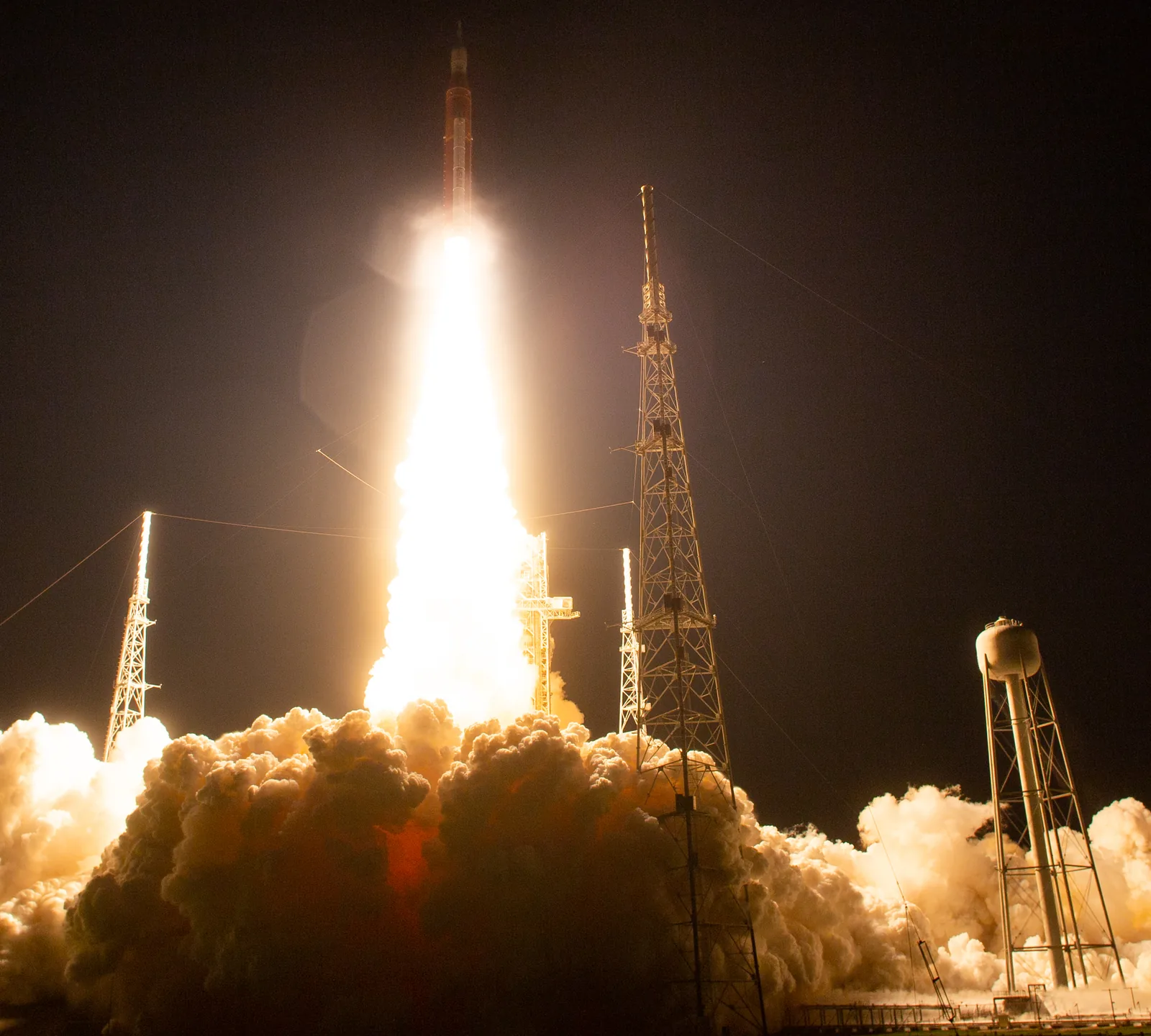
- Artemis I Launch. NASA/Joel Kowsky. source, public domain