
The generator and alternating current
Why does the rotating rotor of a wind turbine produce in the electricity grid a voltage that reverses its direction a hundred times a second?
Prior knowledge
- An induced voltage $e = -N\,\Delta\Phi : \Delta t$ arises in a coil only when the magnetic flux through it, $\Phi = BA$, changeschapter Electromagnetic induction
- A voltage $e = vBl$ arises in a conductor moving in a fieldchapter Electromagnetic induction
- An induced current opposes the change that produces itchapter Lenz's law and eddy currents
Core path: follow the steps in order. Tasks marked Optional give extra practice. Optional tasks: 5.
Think about it
On the coast of Ostrobothnia the rotor of a wind turbine turns steadily, about once every five seconds. Hundreds of kilometres away, at home, the voltage of the wall socket reverses its direction a hundred times a second, and all the power plants of the grid are synchronised to the same frequency, $50\,\text{Hz}$. A wind turbine, a hydropower plant and a nuclear power plant produce electricity on the same principle: something rotates in a magnetic field.
How does steady rotation produce a voltage that reverses its direction?
Optional Recall: when does a voltage arise?
Predict
Make your predictions before investigating 2 questions
Prediction 1: in which position is the voltage greatest?
Prediction 2: rotating twice as fast
Investigate
The coil rotates in the magnetic field, and the graphs of the flux $\Phi$ and the voltage $e$ are drawn at the same time. Pause the picture when you want to look more closely at the position of the coil.
Simulation
How to use
The coil is seen along its axis: the copper line is the plane of the coil, and the circles at its ends are the sides of the coil. A cross (into the paper) and a dot (out of the paper) show the direction in which the induced voltage would drive a current in a side if a load were connected to the coil. The blue arrows are the velocities of the sides. Choose the number of turns $N$ and adjust the magnetic flux density $B$ and the rotation frequency $f$. The graphs are drawn in sweeps of $2.0\,\text{s}$, and they start again from the beginning whenever you change a control. Pause freezes the picture; the Now values in the readout row are the values at the moment it was paused. The animation speed changes only the pace of the display, not the rotation frequency.
Assumptions of the model
The field is uniform, and the coil is rectangular, with area $A = 4.0\,\text{cm} \cdot 5.0\,\text{cm} = 20\,\text{cm}^2$. The coil rotates steadily. No load is connected to the coil, so no current flows in it and no force is needed to turn it; the crosses and dots show only the direction of the induced voltage. The readings are values calculated by the model, not measurements.
How the calculation works
The angle $\theta$ is the angle between the normal of the plane of the coil and the field, and at the moment $t = 0$ it is zero. The flux through one turn is $\Phi = BA\cos\theta$, where $\theta = 2\pi f t$. The voltage is calculated from the flux with the law of induction\n\n$$e = -N\,\frac{\Delta\Phi}{\Delta t}$$\n\nover a very short time interval $\Delta t$. The peak voltage $e_0$ is the greatest value of the voltage during one revolution, the rms value is $U = e_0 : \sqrt{2}$ and the period is $T = 1 : f$. The simulation does not use the formula for the peak value; the formula is found from its results.
Experiment 1: only the rotation frequency changes
Test the predictions. The coil has $500$ turns and the field is $0.20\,\text{T}$; change only the rotation frequency. Record the peak voltage and the period at least at the frequencies $1.0\,\text{Hz}$, $2.0\,\text{Hz}$ and $4.0\,\text{Hz}$. Pause the picture once, when the graph of the voltage is at its peak, and look at the position of the coil and the value of the flux.
Initial state: number of turns: $500$ turns, magnetic field = $0{.}2\,\text{T}$, rotation frequency = $1\,\text{Hz}$. Kept constant: number of turns, magnetic field. Varied: rotation frequency.
| rotation frequency | $e_0$ $(\text{V})$ | $T$ $(\text{s})$ |
|---|
Optional Experiment 2: only the magnetic field changes
The coil has $500$ turns and the rotation frequency is $2.0\,\text{Hz}$; change only the magnetic flux density. Record the peak voltage at least at the fields $0.10\,\text{T}$, $0.20\,\text{T}$ and $0.30\,\text{T}$. Finally, work out from the formula what would happen to the peak voltage if the number of turns were doubled.
Initial state: number of turns: $500$ turns, magnetic field = $0{.}1\,\text{T}$, rotation frequency = $2\,\text{Hz}$. Kept constant: number of turns, rotation frequency. Varied: magnetic field.
| magnetic field | $e_0$ $(\text{V})$ |
|---|
Conclusion: what does the peak voltage depend on?
Write, on the basis of your table: how do the peak voltage and the period depend on the rotation frequency? In which position was the coil when the voltage was at its peak, and how large was the flux then? Finally, calculate $e_0 : f$ from the values of experiment 1 and compare it with the number $NBA \cdot 2\pi$, when $A = 0.0020\,\text{m}^2$.
Model answer
At $1.0\,\text{Hz}$ the peak voltage is $1.26\,\text{V}$, at $2.0\,\text{Hz}$ it is $2.51\,\text{V}$ and at $4.0\,\text{Hz}$ it is $5.03\,\text{V}$, so the peak voltage is directly proportional to the rotation frequency. The period is $1.0\,\text{s}$, $0.50\,\text{s}$ and $0.25\,\text{s}$, that is $T = 1 : f$. When the voltage was at its peak, the plane of the coil was parallel to the field and the flux was zero. The ratio is $e_0 : f = 1.26\,\text{V} : 1.0\,\text{Hz} \approx 1.26\,\text{V} \cdot \text{s}$, and $NBA \cdot 2\pi = 500 \cdot 0.20\,\text{T} \cdot 0.0020\,\text{m}^2 \cdot 2\pi \approx 1.26\,\text{V} \cdot \text{s}$, so $e_0 = NBA \cdot 2\pi f$. The values are calculated by the model.
Assess your own answer
Tick the points your own answer already contains.
Review the theory summary and practise with the exercises.
Theory summary
Key idea
A rotating coil in a magnetic field
In the chapter Electromagnetic induction a voltage was induced in a coil when the magnetic flux through it changed. A generator produces the change in flux by rotation: a coil is turned between the poles of a magnet. When the plane of the coil is perpendicular to the field, the greatest number of field lines pass through the coil and the flux is at its greatest, $\Phi = BA$. After a quarter of a turn the plane of the coil is parallel to the field, and not a single field line passes through it: the flux is zero. After the next quarter the field passes through the coil perpendicularly again, but from the other side of the coil, so the flux is $-BA$. In a rotating coil the flux thus varies smoothly and continuously between $BA$ and $-BA$.

Slip rings and brushes
The ends of the wire of the coil are connected to two slip rings on the axis. Carbon brushes touch the rings, and the voltage is led through the brushes to an external circuit, such as the lamp in the picture. Unlike the commutator of a direct-current motor in the chapter Force on a current-carrying wire: the electric motor and the loudspeaker, slip rings do not reverse the direction of the current, so the external circuit receives the voltage induced in the coil as it is.
Why the voltage is sinusoidal
By the law of induction the voltage does not depend on how large the flux is, but on how fast it changes. In the graph of $\Phi(t)$ the rate of change is the steepness of the graph. When the flux is at its greatest, the sides of the coil move along the field lines, the flux hardly changes for a moment and the voltage is zero. When the plane of the coil is parallel to the field, the flux is zero, but the sides move perpendicular to the field lines and the flux changes fastest: the voltage is at its greatest. The flux varies like a cosine, and its steepness varies like a sine. In every half revolution the direction of the change in flux reverses, so the sign of the voltage also reverses. The result is an alternating voltage, and in a closed circuit an alternating current flows, whose direction reverses twice during every revolution.
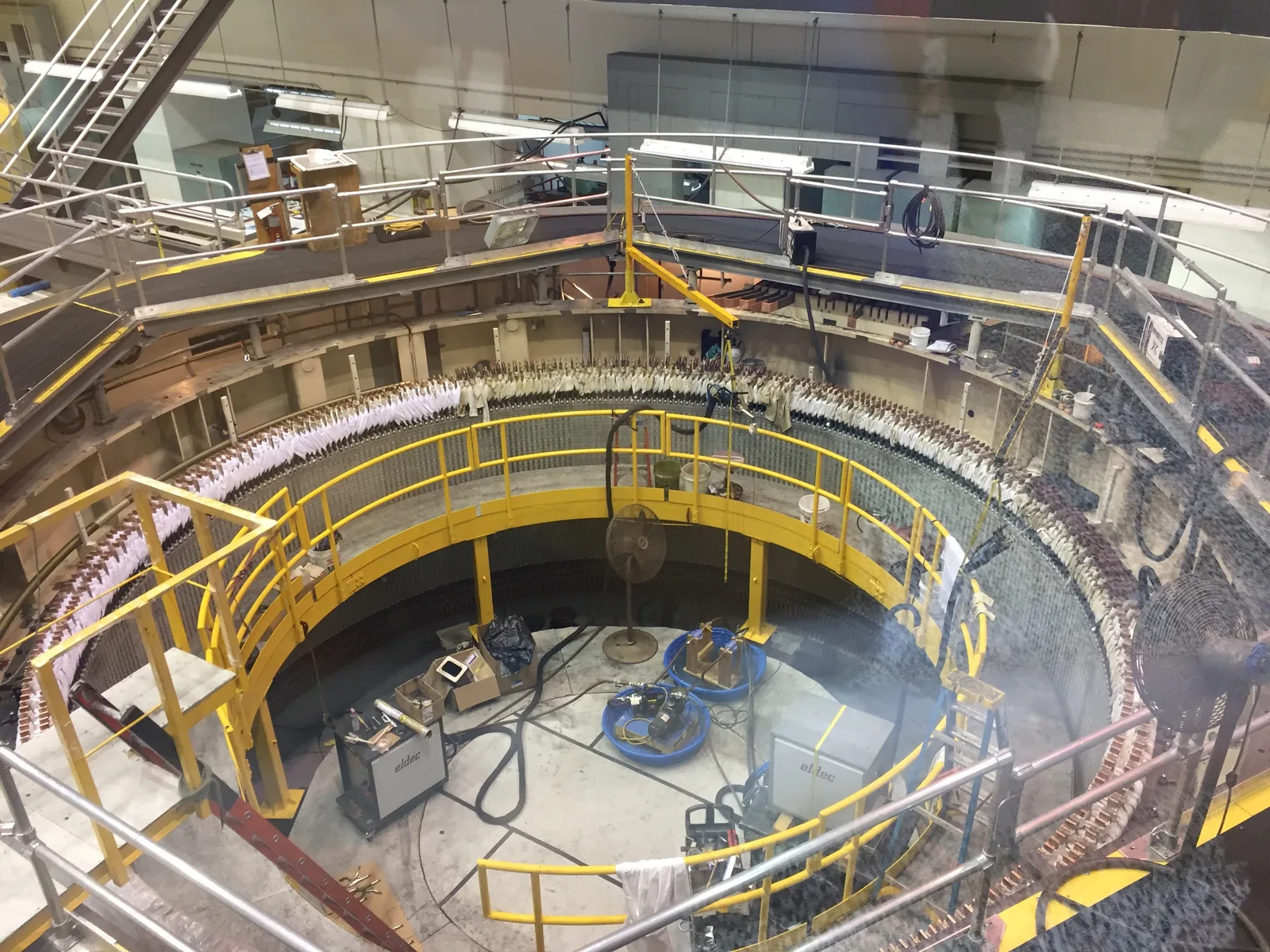
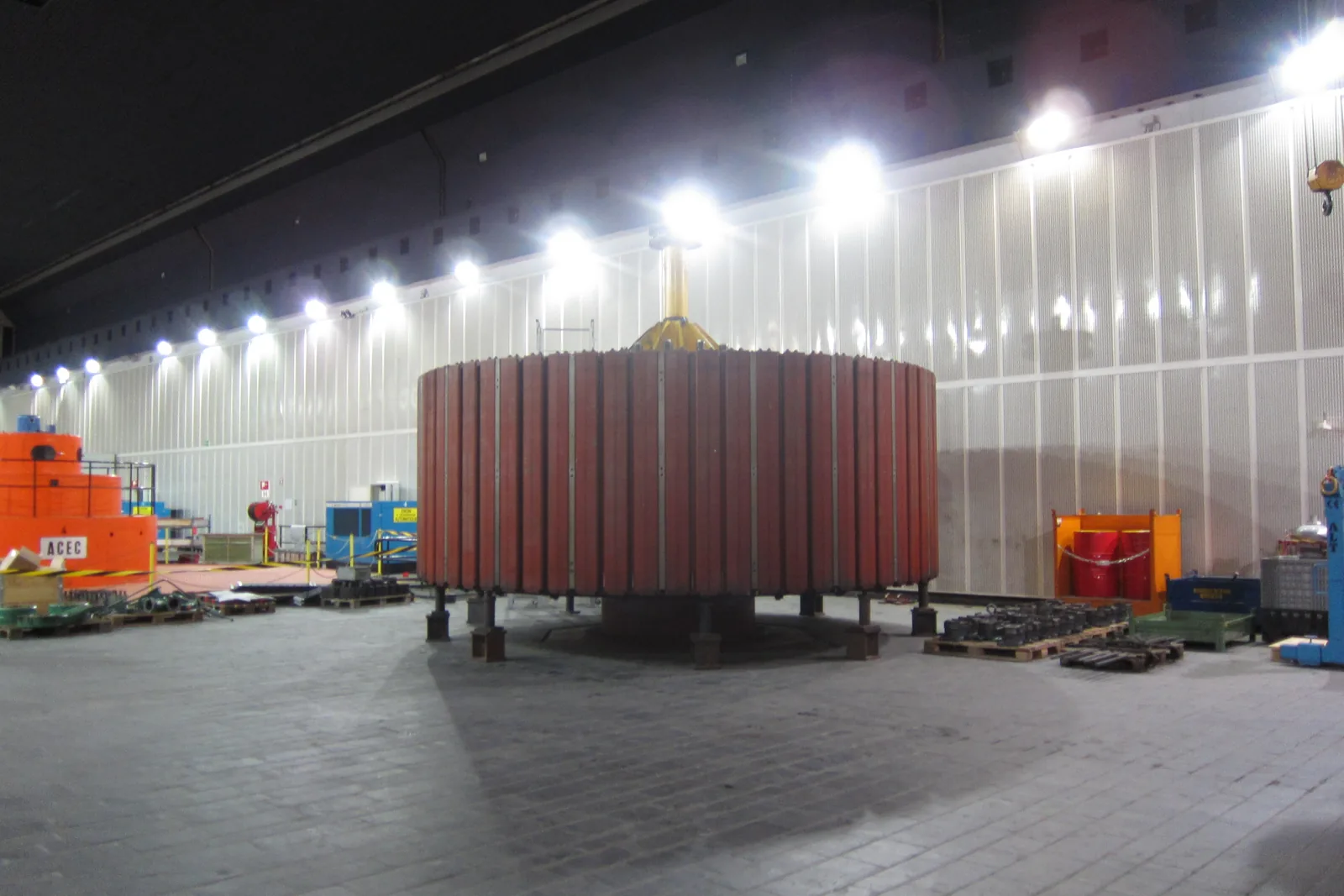
The generator of a power plant and the wind turbine
In the large generators of power plants an electromagnet rotates and the coils stay in place around it. The flux through a stationary coil changes in the same way as in a rotating coil, so a similar alternating voltage arises, and a large current is obtained from the coils without sliding contacts. In a wind turbine the wind turns the rotor, and the shaft of the rotor turns the generator. The rotor turns slowly, about $10$–$15$ revolutions per minute, so the generator has either a gearbox that raises the rotation rate or a large number of magnetic poles. The wind speed varies, so a frequency converter changes the voltage of the generator to the grid frequency, $50\,\text{Hz}$. At the end of 2024 Finland had $1835$ wind turbines with a combined rated power of $8358\,\text{MW}$. In 2024 they produced $19.8\,\text{TWh}$ of electricity, about $24\,\%$ of Finland's electricity consumption (Suomen Uusiutuvat ry, wind power statistics 2024).
The voltage of a generator
When a coil with $N$ turns and area $A$ rotates steadily in a uniform magnetic field $B$ at a rotation frequency $f$, and at the moment $t = 0$ the plane of the coil is perpendicular to the field, the flux through the coil and the voltage induced in it are
$$\begin{aligned} \Phi &= BA\cos(2\pi f t) \\[4pt] e &= e_0 \sin(2\pi f t) \\[4pt] e_0 &= NBA \cdot 2\pi f \end{aligned}$$
where $\Phi$ is the magnetic flux through one turn (Wb), $e$ the instantaneous value of the voltage (V), $e_0$ the peak value of the voltage (V), $N$ the number of turns, $B$ the magnetic flux density (T), $A$ the area of the coil (m²) and $f$ the rotation frequency (Hz). The frequency of the voltage is the same as the rotation frequency, and the period is $T = 1 : f$.
Where the peak value comes from
The peak value is obtained from the voltage of a moving conductor, $e = vBl$ (chapter Electromagnetic induction). The two sides of a rectangular coil, of length $l$, circle the axis at a radius $b : 2$, where $b$ is the width of the coil. The speed of the sides is $v = 2\pi f \cdot b : 2 = \pi f b$. Only the component of the velocity perpendicular to the field, $v \sin\theta$, contributes to the voltage, where $\theta$ is the angle between the velocity and the field. A voltage $B l v \sin\theta$ is induced in each side, and the voltages of the sides add up in a turn. In one turn the voltage is therefore $2 B l \cdot \pi f b \sin\theta = BA \cdot 2\pi f \sin\theta$, because $lb = A$, and in $N$ turns it is $N$ times as large. When $\theta = 90^\circ$, the plane of the coil is parallel to the field and the voltage is at its peak value $e_0 = NBA \cdot 2\pi f$. Doubling the rotation frequency doubles both the frequency and the peak value of the voltage, because the sides move twice as fast.
The rms value
The average of an alternating voltage over one period is zero, but a lamp or a resistor still heats up, because the power $p = ui$ is positive for both directions of the current. The power in a resistor varies between zero and the peak value $P_0 = U_0 I_0$, and its average is half of the peak value. The rms value (effective value) is the direct voltage or direct current that would deliver the same average power to a resistor:
$$\begin{aligned} U &= \frac{U_0}{\sqrt{2}} \\[4pt] I &= \frac{I_0}{\sqrt{2}} \end{aligned}$$
where $U_0$ and $I_0$ are the peak values of the voltage and the current and $U$ and $I$ the rms values. The average power is then $P = UI$, as with direct current. The $230\,\text{V}$ of a wall socket is an rms value: the peak value of the voltage is $230\,\text{V} \cdot \sqrt{2} \approx 325\,\text{V}$, and the frequency is $50\,\text{Hz}$, so the voltage reverses its direction a hundred times a second. Fingrid normally keeps the frequency of the national grid between $49.9$ and $50.1\,\text{Hz}$. Meters show the rms values of an alternating voltage and current.
Common misconception
Many think that the voltage is greatest when the most field lines pass through the coil, that is, when the plane of the coil is perpendicular to the field. The voltage is then, however, zero, because the flux is not changing at that moment. The voltage is greatest when the plane of the coil is parallel to the field and the flux is zero, because then the flux changes fastest. Another common mistake is to take the $230\,\text{V}$ of the wall socket as the greatest value of the voltage. It is an rms value, and the voltage swings between $-325\,\text{V}$ and $325\,\text{V}$. A third mistake is to conclude that alternating current does not transfer energy because its average is zero. The power is positive for both directions of the current.
Summary
- In a generator a coil rotates in a magnetic field (or a magnet rotates inside a coil), and the flux through the coil, $\Phi = BA\cos(2\pi f t)$, varies continuously.
- The induced voltage depends on the rate of change of the flux: it is zero when the flux is at its greatest, and greatest when the plane of the coil is parallel to the field and the flux is zero.
- A sinusoidal alternating voltage $e = e_0 \sin(2\pi f t)$ arises, with peak value $e_0 = NBA \cdot 2\pi f$ and the same frequency as the rotation frequency.
- The rms value of a sinusoidal alternating voltage is $U = U_0 : \sqrt{2}$ and $I = I_0 : \sqrt{2}$, and the average power is $P = UI$. The peak value of the mains voltage $230\,\text{V}$ is about $325\,\text{V}$ and its frequency is $50\,\text{Hz}$.
- The rotor of a wind turbine turns the generator, and a frequency converter matches the voltage to the frequency of the grid.
Optional Return to your predictions
Compare your predictions with the graphs of the simulation and with the formula $e_0 = NBA \cdot 2\pi f$. Then return to the opening question: how does steady rotation produce a voltage that reverses its direction? What does the frequency $50\,\text{Hz}$ of the wall-socket voltage tell you about the generators of the grid?
Would you change your prediction?
Apply
Worked example
Problem
The coil of a generator used for teaching has $250$ turns, and the sides of the rectangular coil are $4.0\,\text{cm}$ and $5.0\,\text{cm}$ long. The coil rotates in a uniform magnetic field whose magnetic flux density is $0.18\,\text{T}$, and it makes $12$ revolutions per second. How large is the rms value of the alternating voltage induced in the coil?
Step 1/7
Given and find. The number of turns is $N = 250$, the sides of the coil are $4.0\,\text{cm}$ and $5.0\,\text{cm}$, the magnetic flux density is $B = 0.18\,\text{T}$ and the rotation frequency is $f = 12\,\text{Hz}$. We are asked for the rms value $U$ of the voltage.
Step 2/7
Principle. The coil rotates steadily in a uniform field, so a sinusoidal alternating voltage is induced in it, with peak value $e_0 = NBA \cdot 2\pi f$. The rms value of a sinusoidal voltage is the peak value divided by $\sqrt{2}$.
Step 3/7
Formula solved.
$$\begin{aligned} e_0 &= NBA \cdot 2\pi f \\ U &= \frac{e_0}{\sqrt{2}} = \frac{NBA \cdot 2\pi f}{\sqrt{2}} \end{aligned}$$
Step 4/7
Unit conversions. The area in square metres:
The rotation frequency is $12$ revolutions per second, that is $f = 12\,\text{Hz}$.
Step 5/7
Substitution. First calculate the peak value and then the rms value:
$$\begin{aligned} e_0 &= NBA \cdot 2\pi f \\ &= 250 \cdot 0.18\,\text{T} \cdot 0.0020\,\text{m}^2 \\ &\quad \cdot 2\pi \cdot 12\,\tfrac{1}{\text{s}} \\ &= 6.786\,\text{V} \\[6pt] U &= \frac{6.786\,\text{V}}{\sqrt{2}} \\ &= 4.798\,\text{V} \end{aligned}$$
Step 6/7
Result. The rms value of the voltage is $U \approx 4.8\,\text{V}$ and the peak value is about $6.8\,\text{V}$. The result is given to two significant figures, like the dimensions of the coil and the magnetic flux density.
Step 7/7
Reasonableness. The units fit:
With round numbers
which fits the peak value. The rms value is smaller than the peak value, as it should be. A voltage of a few volts is of the same order of magnitude as the voltage of a bicycle dynamo.
Optional Find the error
Apply to a new situation: a cottage wind turbine
In a small cottage wind turbine the rotor turns a permanent magnet directly, and a stationary coil surrounds it. In a simplified model the coil has $120$ turns, its area is $0.015\,\text{m}^2$, and the field of the magnet at the coil is $0.40\,\text{T}$. The rotor turns at $300$ revolutions per minute.
How large is the rms value of the alternating voltage induced in the coil? Answer in volts.
Hint 1: a guiding question
What is the rotation frequency in hertz when the rotor turns at $300$ revolutions per minute?
Hint 2: what is the connection
The peak value is $e_0 = NBA \cdot 2\pi f$, and the rms value is obtained by dividing the peak value by $\sqrt{2}$.
Hint 3: an intermediate step
so
Show the solution
Given
number of turns $N = 120$, area of the coil $A = 0.015\,\text{m}^2$, magnetic flux density $B = 0.40\,\text{T}$, rotation rate $300$ revolutions per minute
Asked
the rms value $U$ of the voltage in volts
Principle
The coil stays in place and the magnet rotates, but the flux through the coil changes in the same way as in a rotating coil in a uniform field. A sinusoidal alternating voltage therefore arises, with peak value $e_0 = NBA \cdot 2\pi f$, and its rms value is $U = e_0 : \sqrt{2}$.
Formula
Conversions
rotation frequency
Substitution
Answer
$16\,\text{V}$
Two significant figures like the magnetic flux density $0.40\,\text{T}$ and the area $0.015\,\text{m}^2$.
Reasonableness
With round numbers
and the rms value is about $0.7$ times this. A voltage of a few tens of volts suits a small wind turbine that charges batteries.
Check your understanding
Exit ticket
Answer on your own first and only then open the answer.
- The voltage of the wall socket is $230\,\text{V}$. How large is the peak value of the voltage?
Answer
$230\,\text{V}$ is the rms value, so the peak value is
$U_0$$= U \cdot \sqrt{2}$$= 230\,\text{V} \cdot \sqrt{2}$$\approx 325\,\text{V}$ - Why does the magnet rotate, and not the coil from which the electricity is taken, in a power-plant generator?
Answer
The flux through a stationary coil changes because of the rotating magnet in the same way as in a rotating coil, so the same alternating voltage arises. The large current is taken straight from the stationary coils to the conductors without slip rings and brushes.
1. Concept: rms value
2. Calculate: the current of a kettle
The power of an electric kettle is $2.00\,\text{kW}$ when it is connected to a mains voltage of $230\,\text{V}$.
How large is the peak value of the current in the kettle? Answer in amperes.
Hint 1: a guiding question
Is $230\,\text{V}$ an rms value or a peak value? And is the power of the kettle an average power?
Hint 2: what is the connection
With rms values $P = UI$, and the peak value is $I_0 = \sqrt{2} \cdot I$.
Hint 3: an intermediate step
Show the solution
Given
power of the kettle $P = 2.00\,\text{kW}$, rms value of the mains voltage $U = 230\,\text{V}$
Asked
the peak value $I_0$ of the current in amperes
Principle
The mains voltage $230\,\text{V}$ is an rms value, and the power of the kettle is an average power. With rms values the average power is $P = UI$, which gives the rms value of the current. The peak value of a sinusoidal current is $\sqrt{2}$ times its rms value.
Formula
$P = UI$, so $I = \dfrac{P}{U}$, and
Conversions
Substitution
Answer
$12.3\,\text{A}$
Three significant figures like the power $2.00\,\text{kW}$ and the voltage $230\,\text{V}$.
Reasonableness
The rms value of the current, $8.7\,\text{A}$, is below the ordinary $10\,\text{A}$ fuse of a household, as it should be. The peak value is larger than the rms value, about $1.4$ times as large.
Suggestion: one answer does not show everything you can do, but review the theory summary and do the core exercises.
Optional 3. Explain: why is the voltage sinusoidal?
Explain why a sinusoidal alternating voltage arises in a coil that rotates steadily. Say in which position of the coil the voltage is zero and in which it is greatest, and why the sign of the voltage changes.
Model answer
When the coil rotates, the flux through it varies like a cosine: $\Phi = BA\cos(2\pi f t)$. By the law of induction the voltage is proportional to the rate of change of the flux, that is, to the steepness of the $\Phi(t)$ graph. When the plane of the coil is perpendicular to the field, the flux is at its greatest but hardly changes for a moment, because the sides move along the field lines: the voltage is zero. When the plane of the coil is parallel to the field, the flux is zero, but the sides move perpendicular to the field lines and the flux changes fastest: the voltage is greatest. The steepness of a cosine curve varies like a sine, so the voltage is $e = e_0 \sin(2\pi f t)$. Every half revolution the direction of the change in flux reverses (the flux starts to increase instead of decrease), so the sign of the voltage and the direction of the current change.
Assess your own answer
Tick the points your own answer already contains.
Review the theory summary and practise with the exercises.
Review the chapter's concepts
Cards you mark Review later collect in your review deck.
- Generator
- A device that turns kinetic energy into electrical energy by induction.
- Alternating current
- A current whose direction and size change periodically.
- RMS value
- The value of an alternating current that has the same heating effect as an equal direct current.
Exercises
Level 1 · basic practice 5 exercises
One formula or one step of reasoning. Core exercises first, the rest is extra practice.
- Exercise 7-1Core
The coil of a school generator model has $300$ turns, and its area is $0.0030\,\text{m}^2$. The coil rotates in a uniform magnetic field of $0.15\,\text{T}$ at a rotation frequency of $10\,\text{Hz}$.
How large is the peak value of the voltage induced in the coil?
Answer
$8.5\,\text{V}$
Show the solution
Given
number of turns $N = 300$, area $A = 0.0030\,\text{m}^2$, magnetic flux density $B = 0.15\,\text{T}$, rotation frequency $f = 10\,\text{Hz}$
Find
the peak value $e_0$ of the voltage in volts
Principle
The coil rotates steadily in a uniform field, so the flux through it varies sinusoidally and a sinusoidal alternating voltage is induced in the coil. Its peak value is $e_0 = NBA \cdot 2\pi f$: the voltage is greatest when the plane of the coil is parallel to the field and the flux changes fastest.
Formula
$e_0 = NBA \cdot 2\pi f$
Conversions
Not needed: the quantities are in SI units, and $\text{T} \cdot \text{m}^2 \cdot \tfrac{1}{\text{s}} = \text{V}$.
Substitution
$e_0$$= 300 \cdot 0.15\,\text{T} \cdot 0.0030\,\text{m}^2 \cdot 2\pi \cdot 10\,\tfrac{1}{\text{s}}$$= 8.482\,\text{V}$Answer
$8.5\,\text{V}$
Two significant figures like the initial values.
Reasonableness
With round numbers $300 \cdot 0.15\,\text{T} \cdot 0.003\,\text{m}^2 \approx 0.14\,\text{Wb}$, and multiplying this by $2\pi \cdot 10 \approx 60$ gives about $8\,\text{V}$. A voltage of a few volts suits a teaching generator turned by hand.
- Exercise 7-2Core
The electrical system of a passenger aircraft has an alternating voltage with an rms value of $115\,\text{V}$ and a frequency of $400\,\text{Hz}$.
How large is the peak value of the voltage?
Answer
$163\,\text{V}$
Show the solution
Given
rms value of the voltage $U = 115\,\text{V}$, frequency $400\,\text{Hz}$
Find
the peak value $U_0$ of the voltage in volts
Principle
An alternating voltage is given as an rms value. The rms value of a sinusoidal voltage is the peak value divided by $\sqrt{2}$, so the peak value is $\sqrt{2}$ times the rms value. The frequency does not affect this ratio.
Formula
$U = \dfrac{U_0}{\sqrt{2}}$, so $U_0 = \sqrt{2} \cdot U$
Conversions
Not needed.
Substitution
$U_0$$= \sqrt{2} \cdot 115\,\text{V}$$= 162.63\,\text{V}$Answer
$163\,\text{V}$
Three significant figures like the voltage $115\,\text{V}$.
Reasonableness
The peak value is about $1.4$ times the rms value: $1.4 \cdot 115\,\text{V} \approx 161\,\text{V}$. In the same way the peak value of the household $230\,\text{V}$ is about $325\,\text{V}$.
- Exercise 7-3
The sinusoidal alternating current in the element of a kettle has a peak value of $8.5\,\text{A}$. How large is the rms value of the current?
Answer
$6.0\,\text{A}$
Show the solution
Given
peak value of the current $I_0 = 8.5\,\text{A}$, the current is sinusoidal
Find
the rms value $I$ of the current in amperes
Principle
The rms value is the direct current that would deliver the same average power to a resistor. For a sinusoidal current the power in a resistor is on average half of the peak power, so the rms value is the peak value divided by $\sqrt{2}$.
Formula
$I = \dfrac{I_0}{\sqrt{2}}$
Conversions
Not needed.
Substitution
$I$$= \dfrac{8.5\,\text{A}}{\sqrt{2}}$$= 6.010\,\text{A}$Answer
$6.0\,\text{A}$
Two significant figures like the peak value $8.5\,\text{A}$.
Reasonableness
The rms value is about $0.7$ times the peak value: $0.7 \cdot 8.5\,\text{A} \approx 6\,\text{A}$. At the mains voltage $230\,\text{V}$ this corresponds to a power of about $1.4\,\text{kW}$, which suits a kettle.
- Exercise 7-4
The shaft of a hydropower plant's generator makes $1500$ revolutions per minute. How large is the rotation frequency of the shaft in hertz?
Answer
$25\,\text{Hz}$
Show the solution
Given
the shaft makes $1500$ revolutions per minute
Find
the rotation frequency $f$ in hertz
Principle
The rotation frequency is the number of revolutions per second. When the revolutions are known per minute, they are divided by the number of seconds in a minute.
Formula
$f = \dfrac{n}{t}$, where $n$ is the number of revolutions in the time $t$
Conversions
$t = 1\,\text{min} = 60\,\text{s}$
Substitution
$f$$= \dfrac{1500}{60\,\text{s}}$$= 25\,\tfrac{1}{\text{s}}$$= 25\,\text{Hz}$Answer
$25\,\text{Hz}$
; the reading $1500$ revolutions per minute is exact, so the result is exactly $25\,\text{Hz}$.
Reasonableness
The grid frequency $50\,\text{Hz}$ would correspond to $3000$ revolutions per minute with one pair of magnetic poles. Half of that gives half the frequency, so such a generator has two pairs of poles so that the frequency of the voltage is $50\,\text{Hz}$.
- Exercise 7-5
An electric heater is connected to a mains voltage with an rms value of $230\,\text{V}$, and the rms value of its current is $4.35\,\text{A}$.
How large is the average power of the heater? Give the answer in kilowatts.
Answer
$1.00\,\text{kW}$
Show the solution
Given
rms value of the voltage $U = 230\,\text{V}$, rms value of the current $I = 4.35\,\text{A}$
Find
the average power $P$ in kilowatts
Principle
The rms value is defined so that with alternating current the average power is calculated from the rms values with the same formula as with direct current. A heater is a resistor, so the voltage and the current are in step.
Formula
$P = UI$
Conversions
The result is converted to kilowatts: $1\,\text{kW} = 1000\,\text{W}$.
Substitution
$P$$= 230\,\text{V} \cdot 4.35\,\text{A}$$= 1000.5\,\text{W}$$= 1000.5 \cdot 0.001\,\text{kW}$$= 1.0005\,\text{kW}$Answer
$1.00\,\text{kW}$
Three significant figures like the current $4.35\,\text{A}$ and the voltage $230\,\text{V}$.
Reasonableness
The power of an ordinary electric heater is $0.5$–$2\,\text{kW}$. A power calculated with the peak values would be $2.00\,\text{kW}$, twice as large, but that is only the instantaneous peak value, not the average.
Level 2 · applied practice 4 exercises
Two steps, working with measured data, a unit conversion or rearranging a formula. Core exercises first, the rest is extra practice.
- Exercise 7-6Core
The rectangular coil of a generator has $150$ turns, and the lengths of its sides are $6.0\,\text{cm}$ and $8.0\,\text{cm}$. The coil rotates in a uniform magnetic field of $0.25\,\text{T}$ and makes $1200$ revolutions per minute.
How large is the peak value of the voltage induced in the coil?
Answer
$23\,\text{V}$
Show the solution
Given
number of turns $N = 150$, sides of the coil $6.0\,\text{cm}$ and $8.0\,\text{cm}$, magnetic flux density $B = 0.25\,\text{T}$, rotation rate $1200$ revolutions per minute
Find
the peak value $e_0$ of the voltage in volts
Principle
The coil rotates steadily in a uniform field, so a sinusoidal alternating voltage is induced in it, with peak value $e_0 = NBA \cdot 2\pi f$. First the area of the coil and the rotation frequency are calculated in SI units.
Formula
$A = ab$ and $e_0 = NBA \cdot 2\pi f$
Conversions
$A$$= 6.0 \cdot 0.01\,\text{m} \cdot 8.0 \cdot 0.01\,\text{m}$$= 0.0048\,\text{m}^2$$f$$= \dfrac{1200}{60\,\text{s}}$$= 20\,\text{Hz}$Substitution
$e_0$$= 150 \cdot 0.25\,\text{T} \cdot 0.0048\,\text{m}^2 \cdot 2\pi \cdot 20\,\tfrac{1}{\text{s}}$$= 22.62\,\text{V}$Answer
$23\,\text{V}$
Two significant figures like the dimensions of the coil and the magnetic flux density.
Reasonableness
With round numbers $150 \cdot 0.25\,\text{T} \cdot 0.005\,\text{m}^2 \approx 0.19\,\text{Wb}$ and $2\pi \cdot 20\,\tfrac{1}{\text{s}} \approx 125\,\tfrac{1}{\text{s}}$, so $e_0 \approx 23\,\text{V}$. If the rotation rate $1200$ had been used as hertz, the result would have been $60$ times as large.
- Exercise 7-7Core
The graph shows the voltage of a small generator as a function of time. The coil of the generator has $200$ turns, its area is $30\,\text{cm}^2$, and it rotates in a uniform magnetic field. Read the peak value and the period of the voltage from the graph.
How large is the magnetic flux density?
Answer
$0.13\,\text{T}$
Show the solution
Given
number of turns $N = 200$, area $A = 30\,\text{cm}^2$, peak value and period read from the graph
Find
the magnetic flux density $B$ in teslas
Principle
The coil rotates steadily in a uniform field, so its voltage is sinusoidal and the peak value is $e_0 = NBA \cdot 2\pi f$. The graph gives the peak value and the period, and the period gives the rotation frequency $f = 1 : T$.
Reading the graph
The peaks of the curve are on the grid line $12\,\text{V}$ (at the times $10\,\text{ms}$ and $50\,\text{ms}$), so $e_0 = 12\,\text{V}$. The curve is zero and rising at the times $0\,\text{ms}$, $40\,\text{ms}$ and $80\,\text{ms}$, so one period lasts $T = 40\,\text{ms}$.
Formula
$f = \dfrac{1}{T}$ and $e_0 = NBA \cdot 2\pi f$, so
$B$$= \dfrac{e_0}{NA \cdot 2\pi f}$$= \dfrac{e_0 T}{NA \cdot 2\pi}$Conversions
$T$$= 40\,\text{ms}$$= 40 \cdot 0.001\,\text{s}$$= 0.040\,\text{s}$$A$$= 30\,\text{cm}^2$$= 30 \cdot 0.0001\,\text{m}^2$$= 0.0030\,\text{m}^2$Substitution
$f$$= \dfrac{1}{0.040\,\text{s}}$$= 25\,\text{Hz}$$B$$= \dfrac{12\,\text{V}}{200 \cdot 0.0030\,\text{m}^2 \cdot 2\pi \cdot 25\,\tfrac{1}{\text{s}}}$$= \dfrac{12\,\text{V}}{94.25\,\tfrac{\text{m}^2}{\text{s}}}$$= 0.1273\,\text{T}$Answer
$0.13\,\text{T}$
Two significant figures, because the values $12\,\text{V}$ and $40\,\text{ms}$ read from the graph are known to two figures.
Reasonableness
The field of a permanent magnet is typically a few tenths of a tesla, so $0.13\,\text{T}$ is believable. Check:
$200 \cdot 0.13\,\text{T} \cdot 0.0030\,\text{m}^2 \cdot 2\pi \cdot 25\,\tfrac{1}{\text{s}}$$\approx 12.3\,\text{V}$which matches the peak of the graph.
- Exercise 7-8
A hiker charges a battery with a hand-cranked generator whose voltage must have an rms value of $12\,\text{V}$. The coil of the generator has $200$ turns, its area is $0.0050\,\text{m}^2$, and the magnetic field is $0.30\,\text{T}$.
At what rotation frequency must the coil be turned?
Answer
$9.0\,\text{Hz}$
Show the solution
Given
rms value of the voltage $U = 12\,\text{V}$, number of turns $N = 200$, area $A = 0.0050\,\text{m}^2$, magnetic flux density $B = 0.30\,\text{T}$
Find
the rotation frequency $f$ in hertz
Principle
The voltage of a rotating coil is sinusoidal, and its peak value is $e_0 = NBA \cdot 2\pi f$. The given $12\,\text{V}$ is an rms value, so the peak value is $\sqrt{2}$ times as large. The rotation frequency is solved from the formula for the peak value.
Formula
$e_0 = \sqrt{2} \cdot U$ and $e_0 = NBA \cdot 2\pi f$, so
$f$$= \dfrac{\sqrt{2} \cdot U}{NBA \cdot 2\pi}$Conversions
Not needed: the quantities are in SI units.
Substitution
$e_0$$= \sqrt{2} \cdot 12\,\text{V}$$= 16.97\,\text{V}$$f$$= \dfrac{16.97\,\text{V}}{200 \cdot 0.30\,\text{T} \cdot 0.0050\,\text{m}^2 \cdot 2\pi}$$= \dfrac{16.97\,\text{V}}{1.885\,\text{V}\cdot\text{s}}$$= 9.003\,\text{Hz}$Answer
$9.0\,\text{Hz}$
Two significant figures like the voltage $12\,\text{V}$ and the field $0.30\,\text{T}$.
Reasonableness
Nine revolutions per second is brisk but possible with a crank that has gearing. If the rms value had been substituted in place of the peak value, the frequency would have come out too small, $6.4\,\text{Hz}$, and the rms value of the voltage would have been below $12\,\text{V}$.
- Exercise 7-9
In 2024 Finland's wind turbines produced $19.8\,\text{TWh}$ of electricity, and at the end of the year their combined rated power was $8358\,\text{MW}$ (Suomen Uusiutuvat ry, wind power statistics 2024). The year 2024 had $366$ days.
What percentage of the rated power at the end of the year was the average power of the wind turbines?
Answer
$27\,\%$
Show the solution
Given
electrical energy produced $E = 19.8\,\text{TWh}$ in 2024, length of the year $366$ days, rated power at the end of the year $P_\text{n} = 8358\,\text{MW}$ (Suomen Uusiutuvat ry)
Find
the share of the average power in the rated power as a percentage
Principle
The average power is the energy produced during the year divided by the length of the year. Wind turbines produce their rated power only in a strong wind, so the average power is clearly smaller than the rated power. The share is obtained by dividing the average power by the rated power.
Formula
$P = \dfrac{E}{t}$ and share $= \dfrac{P}{P_\text{n}} \cdot 100\,\%$
Conversions
$t$$= 366 \cdot 24\,\text{h}$$= 8784\,\text{h}$$E$$= 19.8\,\text{TWh}$$= 19.8 \cdot 10^{12}\,\text{Wh}$$P_\text{n}$$= 8358\,\text{MW}$$= 8358 \cdot 10^{6}\,\text{W}$Substitution
$P$$= \dfrac{19.8 \cdot 10^{12}\,\text{Wh}}{8784\,\text{h}}$$= 2.254 \cdot 10^{9}\,\text{W}$and share $= \dfrac{2.254 \cdot 10^{9}\,\text{W}}{8358 \cdot 10^{6}\,\text{W}} \cdot 100\,\% = 26.97\,\%$
Answer
$27\,\%$
Two significant figures, because the production $19.8\,\text{TWh}$ is given to three figures and the result is an estimate.
Reasonableness
The average power of wind turbines is typically a quarter to a third of the rated power, so $27\,\%$ is believable. The true share is slightly larger, because the rated power grew during the year: at the beginning of the year there were fewer turbines than at the end.
Level 3 · challenging 3 exercises
Optional: application, two ideas together or a new situation where you reason for yourself.
- Exercise 7-10
The coil of a generator rotates steadily, and the peak value of its voltage is $20.0\,\text{V}$. At the moment $t = 0$ the plane of the coil is perpendicular to the field.
How large is the voltage of the coil when the coil has turned $30^\circ$ from this position?
Answer
$10.0\,\text{V}$
Show the solution
Given
peak value of the voltage $e_0 = 20.0\,\text{V}$, at the moment $t = 0$ the plane of the coil is perpendicular to the field, the coil turns $30^\circ$ from this position
Find
the instantaneous value $e$ of the voltage in volts
Principle
When the plane of the coil is perpendicular to the field, the flux is at its greatest and does not change for a moment, so the voltage is zero. From then on the voltage grows like a sine, $e = e_0 \sin\theta$, where $\theta$ is the angle through which the coil has turned from this position. The voltage is at its peak value at the angle $90^\circ$, when the plane of the coil is parallel to the field.
Formula
$e = e_0 \sin\theta$
Conversions
Not needed.
Substitution
$e$$= 20.0\,\text{V} \cdot \sin 30^\circ$$= 20.0\,\text{V} \cdot 0.5$$= 10.0\,\text{V}$Answer
$10.0\,\text{V}$
Three significant figures like the peak value $20.0\,\text{V}$.
Reasonableness
The angle $30^\circ$ is a third of the way from the position of zero voltage to the position of peak voltage, but the voltage is already half the peak value, because the sine curve rises most steeply at the start. A $17.3\,\text{V}$ calculated with the cosine would be wrong: it would give the greatest voltage in the position where the flux does not change.
- Exercise 7-11
A generator whose voltage has a peak value of $40\,\text{V}$ is connected to a $40\,\Omega$ resistor. The resistance of the generator itself is so small that it can be ignored.
How large is the average power of the resistor?
Answer
$20\,\text{W}$
Show the solution
Given
peak value of the generator's voltage $U_0 = 40\,\text{V}$, resistance $R = 40\,\Omega$, resistance of the generator negligible
Find
the average power $P$ of the resistor in watts
Principle
The resistance of the generator is negligible, so the whole voltage is across the resistor. The average power is calculated with rms values as with direct current: $P = UI$, and by Ohm's law $I = U : R$, so $P = U^2 : R$. A power calculated with the peak value would be only the instantaneous peak power.
Formula
$U$$= \dfrac{U_0}{\sqrt{2}}$$P$$= UI$$= \dfrac{U^2}{R}$$= \dfrac{U_0^2}{2R}$Conversions
Not needed.
Substitution
$U$$= \dfrac{40\,\text{V}}{\sqrt{2}}$$= 28.28\,\text{V}$$P$$= \dfrac{(28.28\,\text{V})^2}{40\,\Omega}$$= \dfrac{800\,\text{V}^2}{40\,\Omega}$$= 20\,\text{W}$Answer
$20\,\text{W}$
Two significant figures like the voltage $40\,\text{V}$ and the resistance $40\,\Omega$.
Reasonableness
The instantaneous peak power is
$U_0^2 : R$$= 1600\,\text{V}^2 : 40\,\Omega$$= 40\,\text{W}$and the average is half of that, because the power varies between zero and the peak value. Units:
$\tfrac{\text{V}^2}{\Omega}$$= \text{V} \cdot \text{A}$$= \text{W}$ - Exercise 7-12
In a direct-drive wind turbine a permanent-magnet generator rotates at the same rate as the rotor. The rms value of the generator's voltage is $690\,\text{V}$ when the rotor turns at $15$ revolutions per minute.
The wind weakens, and the rotor now turns at only $9.0$ revolutions per minute. The magnets and coils of the generator are the same, and the frequency converter is not taken into account.
How large is the rms value of the generator's voltage now?
Answer
$410\,\text{V}$
Show the solution
Given
rms voltage $U_1 = 690\,\text{V}$ at a rotation rate of $15$ revolutions per minute, new rotation rate $9.0$ revolutions per minute, magnets and coils the same
Find
the new rms voltage $U_2$ in volts
Principle
The peak voltage of a generator is $e_0 = NBA \cdot 2\pi f$. When $N$, $B$ and $A$ stay the same, the peak voltage, and with it the rms value $U = e_0 : \sqrt{2}$, are directly proportional to the rotation frequency. In a direct-drive turbine the generator rotates at the same rate as the rotor, so the frequency is proportional to the revolutions per minute of the rotor.
Formula
$\dfrac{U_2}{U_1} = \dfrac{f_2}{f_1}$, so $U_2 = U_1 \cdot \dfrac{f_2}{f_1}$
Conversions
Not needed: in the ratio the revolutions per minute cancel, so they need not be converted to hertz.
Substitution
$U_2$$= 690\,\text{V} \cdot \dfrac{9.0}{15}$$= 690\,\text{V} \cdot 0.60$$= 414\,\text{V}$Answer
about $410\,\text{V}$, two significant figures like the rotation rates $15$ and $9.0$ revolutions per minute.
Reasonableness
The rotation rate fell by $40\,\%$, so the voltage also falls by $40\,\%$. The frequency of the voltage falls as well, which is why a wind turbine needs a frequency converter that matches both the voltage and the frequency to the grid.


