
Applied chapter: the electric car and the home electrical system
Why should an electric car not be charged through an extension cord from an ordinary socket, and is the electricity of a home enough for the sauna and for charging the car at the same time?
Prior knowledge
- The energy of a battery is the nominal voltage times the capacity, $W = UQ$, and the efficiency of charging is below $100\,\%$chapter Batteries and the charging circuit
- The current of a device on the mains is $I = P : U$, and energy is power times time in kilowatt-hourschapter Electrical energy at home
- A fuse protects a cable from overheating and a residual current device protects a person from leakage currentchapter Electrical safety at home and at work
Core path: follow the steps in order. Tasks marked Optional give extra practice. Optional tasks: 3.
Think about it
A family comes home on a winter evening. The car is plugged into the charging station on the wall of the house, the sauna is warming up with a $9\,\text{kW}$ heater and water is boiling in the kitchen. The neighbour charges his own car with an extension cord from a socket in the garage. By morning both cars should be full.
Is the electricity of the home enough for everything at the same time, how long does charging take, and why is the extension cord not a good solution?
Optional Review: the energy of a battery
Predict
Make your predictions before investigating 2 questions
Prediction 1: one phase or three?
Prediction 2: heater, kettle and car
Investigate
Three ways to charge
Made-up example data · Invented example data: typical charging currents and estimated efficiencies, not a measurement of a particular car.
A battery has to be charged with $40\,\text{kWh}$. The table shows three ways to charge at home. The phase voltage is $230\,\text{V}$ in all of them. At low power the efficiency of charging is usually poorer, because the own consumption of the charger of the car and the control electronics is spread over a longer time.
| method | phases | $I$ | $\eta$ |
|---|---|---|---|
| socket | $1$ | $8.0\,\text{A}$ | $85\,\%$ |
| station, one phase | $1$ | $16\,\text{A}$ | $90\,\%$ |
| station, three phases | $3$ | $16\,\text{A}$ | $90\,\%$ |
Calculate the charging power $P$ and the charging time $t$ for each method. Does the charging fit in one night, for example ten hours?
How long does charging take from an ordinary socket? Answer in hours.
Hint 1: a guiding question
What is the charging power when the voltage is $230\,\text{V}$ and the current $8.0\,\text{A}$?
Hint 2: what is the connection
Only the fraction $\eta$ of the energy taken from the grid goes into the battery, so the power transferred to the battery is $\eta P$.
Hint 3: an intermediate step
Show the solution
Given
into the battery $W_\text{battery} = 40\,\text{kWh}$, voltage $U = 230\,\text{V}$, current $I = 8.0\,\text{A}$, one phase, efficiency $\eta = 85\,\%$
Find
charging time $t$ in hours
Principle
A socket uses one phase, so the power is $P = UI$. The power is constant, so the energy taken from the grid is $Pt$, and the fraction $\eta$ of it is stored in the battery.
Formula
$\eta U I t = W_\text{battery}$, so
Conversions
$\eta = 0.85$
Substitution
Answer
$26\,\text{h}$
Two significant figures like the current $8.0\,\text{A}$ and the efficiency $85\,\%$.
Reasonableness
About $1.6\,\text{kW}$ goes into the battery, and $40\,\text{kWh} : 1.6\,\text{kW} = 25\,\text{h}$. Charging takes more than a day and does not fit in one night. With a single-phase station the same takes about $12\,\text{h}$ and with a three-phase station about $4\,\text{h}$.
The evening loads phase by phase
Made-up example data · Invented example data: typical powers of household devices, not a measurement.
The main fuses of a detached house are $3 \cdot 25\,\text{A}$. The table shows three devices that are on at the same time in the evening, and the phase conductors they are connected to. Three-phase devices draw an equal current from each phase. The phase voltage is $230\,\text{V}$.
| device | $P$ | phases |
|---|---|---|
| sauna heater | $9.0\,\text{kW}$ | $\text{L}_1$, $\text{L}_2$, $\text{L}_3$ |
| kettle | $2.0\,\text{kW}$ | $\text{L}_1$ |
| charging station | $11\,\text{kW}$ | $\text{L}_1$, $\text{L}_2$, $\text{L}_3$ |
First calculate the current of each device in one phase conductor. Then add up the currents of each phase and compare them with the size of the main fuse. How large a current could the charging station draw while the heater is on?
How large is the current in phase conductor $\text{L}_1$ when all three devices are on?
Hint 1: a guiding question
A three-phase device draws a current $I = P : (3U)$ from each phase, a single-phase device a current $I = P : U$.
Hint 2: what is the connection
The heater draws $9000\,\text{W} : 690\,\text{V} \approx 13.0\,\text{A}$, the charging station $11\,000\,\text{W} : 690\,\text{V} \approx 16\,\text{A}$ and the kettle $2000\,\text{W} : 230\,\text{V} \approx 8.7\,\text{A}$.
Hint 3: an intermediate step
The currents of all three devices pass through phase $\text{L}_1$: $I_1 = 13.0\,\text{A} + 16\,\text{A} + 8.7\,\text{A}$.
Show the solution
Given
heater $P_\text{heater} = 9.0\,\text{kW}$ and charging station $P_\text{charger} = 11\,\text{kW}$ on three phases, kettle $P_\text{kettle} = 2.0\,\text{kW}$ on phase $\text{L}_1$, $U = 230\,\text{V}$
Find
current $I_1$ of phase conductor $\text{L}_1$ in amperes
Principle
A three-phase device draws the same current from each phase, so its power is $P = 3UI$; the power of a single-phase device is $P = UI$. All the devices get their current through the same phase conductor, so the currents are added (chapter Kirchhoff's laws and potential in a circuit).
Formula
Conversions
$P_\text{heater} = 9000\,\text{W}$, $P_\text{charger} = 11\,000\,\text{W}$ and $P_\text{kettle} = 2000\,\text{W}$; $3U = 690\,\text{V}$
Substitution
Answer
$38\,\text{A}$
Two significant figures like the powers $9.0\,\text{kW}$ and $11\,\text{kW}$.
Reasonableness
The heater and the station together draw $20\,\text{kW}$ from three phases, about $6.7\,\text{kW}$ per phase or about $29\,\text{A}$, and the kettle adds about $9\,\text{A}$. The current is about one and a half times the $25\,\text{A}$ of the main fuse, so without load management the fuse could blow.
Conclusion: what does home charging require?
Write on the basis of your calculations: how should the car be charged at home so that charging fits in the night? What happens to the main fuses if the car charges at full power while the sauna is warming up, and how is the problem solved?
Model answer
From a socket with a current of $8\,\text{A}$ the power is only about $1.8\,\text{kW}$, and $40\,\text{kWh}$ takes about $26\,\text{h}$ with the losses, so it does not fit in the night. A single-phase $16\,\text{A}$ station charges with a power of about $3.7\,\text{kW}$ in about $12\,\text{h}$, a three-phase one with three times the power in about $4\,\text{h}$. When the heater ($13.0\,\text{A}$ per phase) and the station ($16\,\text{A}$ per phase) are on at the same time, every phase carries $29.0\,\text{A}$ and the phase of the kettle $37.7\,\text{A}$, over the $25\,\text{A}$ of the main fuse. If this continues for long, a main fuse may blow. Load management reduces the charging current to about $12\,\text{A}$ for the time of the sauna or interrupts charging for a moment. The numbers are calculated values of invented example data.
Assess your own answer
Tick the points your own answer already contains.
Review the theory summary and practise with the exercises.
Theory summary
Key idea
Battery, power and charging time
The battery of an electric car is a large lithium-ion battery (chapter Batteries and the charging circuit). This chapter uses an example car whose battery has a nominal voltage of $400\,\text{V}$ and a capacity of $160\,\text{Ah}$. The energy of the battery is then $W = UQ = 400\,\text{V} \cdot 160\,\text{Ah} = 64\,\text{kWh}$, and it is enough for about $350\,\text{km}$ of driving when the car uses $18\,\text{kWh}$ per hundred kilometres. So the battery holds as much energy as a $6\,\text{kW}$ sauna heater uses in over ten hours.
The charging time depends on how much energy has to be transferred to the battery and at what power this is done. In charging, part of the energy taken from the grid does not end up in the battery but turns into internal energy of the charger of the car, the cables and the battery, which is transferred to the surroundings as heat. The efficiency of home charging is typically about $80\text{–}95\,\%$, and it is always below $100\,\%$. More energy therefore has to be taken from the grid than is stored in the battery.
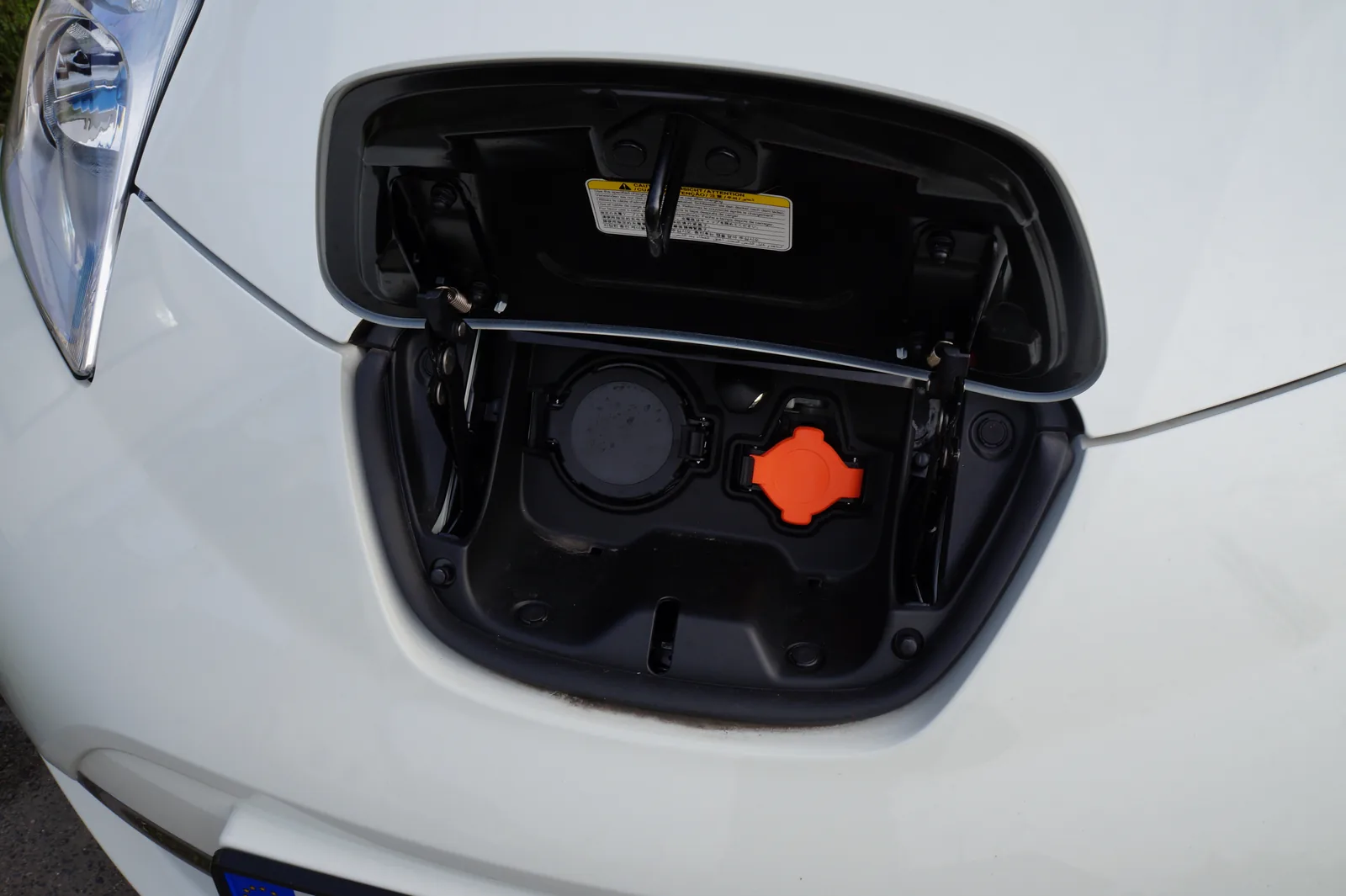
One phase or three
A Finnish detached house usually gets three-phase electricity: three phase conductors $\text{L}_1$, $\text{L}_2$ and $\text{L}_3$ and a neutral conductor $\text{N}$. Between each phase conductor and the neutral conductor there is a voltage of $230\,\text{V}$. An ordinary socket and a kettle use one phase, a sauna heater and a charging station usually all three. When a device draws the same current $I$ from each phase conductor, each phase transfers a power $UI$, and the total power is three times as great. The voltage between the phase conductors is $400\,\text{V}$, but it is not needed here.
The current of a device is obtained from its power as in the chapter Electrical energy at home: in one phase $I = P : U$. When charging from an ordinary socket, the charging cable usually limits the current to about $8\,\text{A}$, and the power is then $230\,\text{V} \cdot 8\,\text{A} \approx 1.8\,\text{kW}$. A single-phase charging station with a current of $16\,\text{A}$ charges with a power of about $3.7\,\text{kW}$, and a three-phase one with the same current at three times the power, about $11\,\text{kW}$. The same $40\,\text{kWh}$ charge takes more than a day from a socket and about four hours with a three-phase station.
The home electrical system
The cable coming from the electricity grid goes through the meter to the consumer unit. In the consumer unit come first the main fuses, one in each phase conductor, for example $3 \cdot 25\,\text{A}$. After them the current divides into circuits: each circuit has its own cable and its own fuse or miniature circuit breaker, for example $10\,\text{A}$ or $16\,\text{A}$. A fuse protects the cable: it cuts the current before the current heats the cable dangerously (chapter Electrical safety at home and at work). That is why the size of a fuse is chosen according to the cross-sectional area of the cable, and a larger one must not be put in its place.
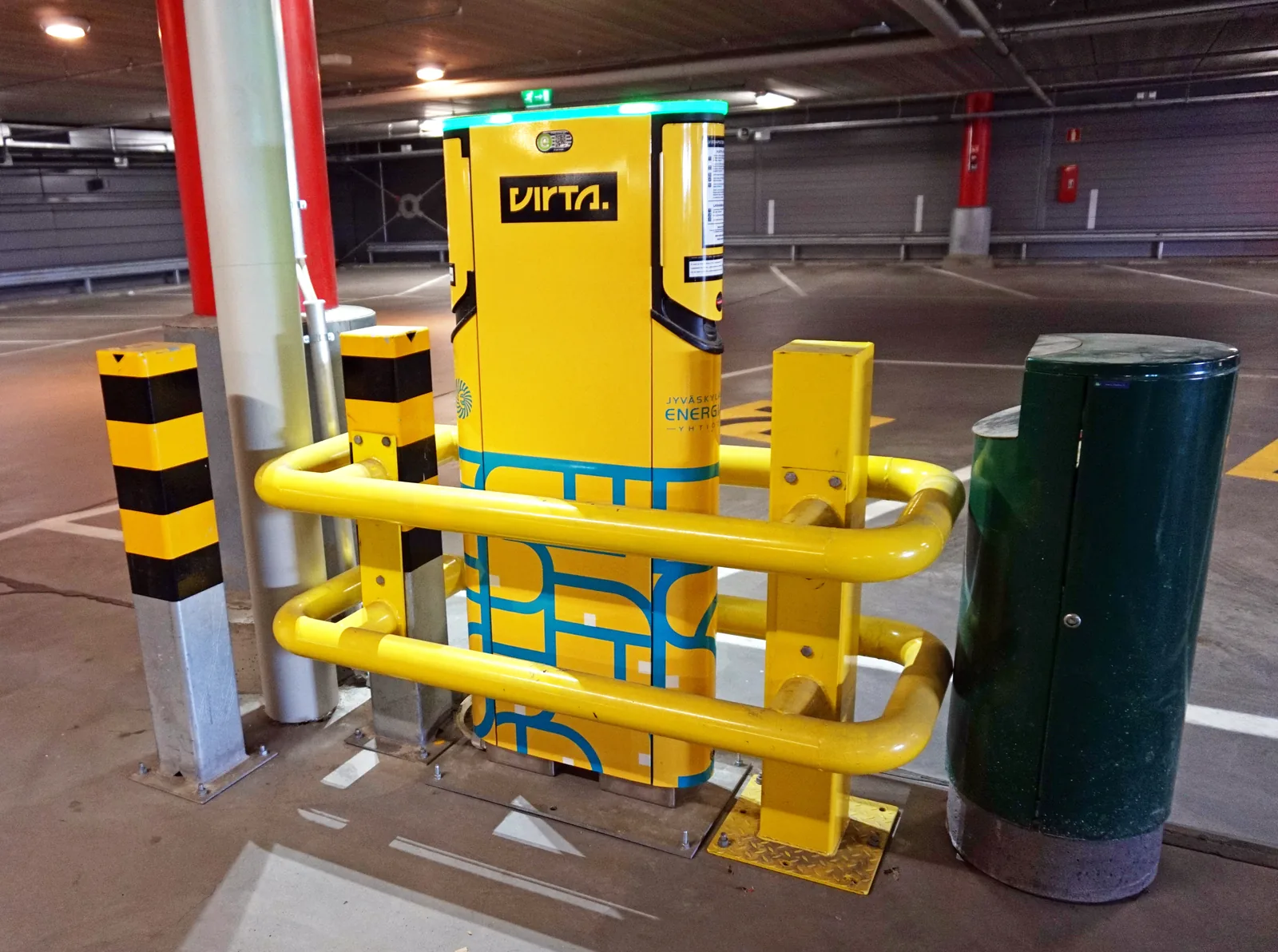
Why a charging station has its own circuit and a residual current device
Charging a car is the longest large load in a home: the current can flow for hours at almost the size of the fuse of the circuit. If there were other sockets in the same circuit, the cable and the socket would be at almost the rated current for hours, the contacts of the socket would warm up, and other loads could cut the charging. That is why the electrical installation standard requires that every charging point has its own circuit, sized for its current. A charging point also has its own residual current device (RCD): it cuts the current if part of it leaks along another route, for example through a wet cable and a person to the ground, and the difference is over $30\,\text{mA}$. Outdoors a cable gets wet, freezes and sometimes ends up under a wheel, so damage to the insulation is more likely than indoors. The enclosure of a station installed outdoors has an enclosure rating (IP rating), for example IP54, which tells that it withstands dust and splashing water.
The main fuse and simultaneous loads
The main fuses limit the current of the whole house. When the main fuses are $3 \cdot 25\,\text{A}$, the house can draw at most about $3 \cdot 230\,\text{V} \cdot 25\,\text{A} \approx 17\,\text{kW}$ from the grid, and even then only if the load divides evenly between the three phases. What decides is the current of each phase conductor. In the figure the following are on at the same time: a $9.0\,\text{kW}$ sauna heater, which draws $13.0\,\text{A}$ from each phase, an $11\,\text{kW}$ charging station, which draws $16\,\text{A}$ from each phase, and in phase $\text{L}_1$ a kettle, $8.7\,\text{A}$. The current of phase $\text{L}_1$ is $37.7\,\text{A}$ and that of the others $29.0\,\text{A}$.
A main fuse does not blow at once from a small overload, but if the overload is large enough and lasts long, it may blow and the whole house goes dark. That is why a charging station often has load management: it measures the current of the main fuses and reduces the charging current when other devices are on. When the heater draws $13.0\,\text{A}$, about $12\,\text{A}$ is left for the car in each phase, that is, about $8.3\,\text{kW}$. If the kettle is also switched on, only about $3\,\text{A}$ is left in phase $\text{L}_1$, so load management interrupts the charging for a moment.
Heating of a cable and a joint
A cable is a resistor through which flows the same current as through the device. The current goes to the device along the phase conductor and returns along the neutral conductor, so there is copper twice the length of the cable. By Joule's law the power dissipated in the cable is $RI^2$ (chapter Electric power and the heating of a resistor): when the current doubles, the heating power becomes four times as great. A $25\,\text{m}$ extension cord on a reel, with conductors of $1.5\,\text{mm}^2$, has a resistance of about $0.57\,\Omega$, and with a current of $10\,\text{A}$ about $57\,\text{W}$ is dissipated in it. From the reel little energy is transferred as heat to the surroundings, so the reel gets hot, and the high temperature ages the insulation. The dielectric strength of the insulation can then weaken, and the insulation can fail.
A loose or oxidised joint is even more dangerous. The contact resistance of an old socket can be, for example, $0.10\,\Omega$, and with a current of $10\,\text{A}$ a power of $10\,\text{W}$ is dissipated in the joint. It is concentrated in a spot the size of a pea, and the charging lasts for hours. That is why a charging station is recommended for regular charging, and an extension cord is not used.
Sources of the numerical values
The numerical values of the chapter are typical example values, not measurements of a particular car or house. The mains voltage $230\,\text{V}$ and the standard currents $10\,\text{A}$, $16\,\text{A}$ and $25\,\text{A}$ are common values of the Finnish electricity grid and home installations. The battery size $64\,\text{kWh}$ and the consumption $18\,\text{kWh}$ per hundred kilometres are of the order of magnitude of a small or medium-sized electric car. The efficiency $80\text{–}95\,\%$ is an estimate. The requirement of an own circuit and a residual current device for a charging point comes from the electrical installation standard SFS 6000-7-722, and Tukes (the Finnish Safety and Chemicals Agency) gives guidance on charging an electric car at home. The resistivity of copper is from the table in the chapter Resistance and Ohm's law.
Charging time, charging power and heating of a cable
The efficiency of charging tells what fraction of the energy taken from the grid is stored in the battery:
$$\eta = \frac{W_\text{battery}}{W_\text{grid}}$$
where $\eta$ is the efficiency, $W_\text{battery}$ the energy stored in the battery ($\text{kWh}$) and $W_\text{grid}$ the energy taken from the grid ($\text{kWh}$).
When the charging power $P$ is constant, the energy taken from the grid is $W_\text{grid} = Pt$ (chapter Electrical energy at home). The charging time is therefore
$$t = \frac{W_\text{battery}}{\eta P}$$
where $t$ is the charging time ($\text{h}$) and $P$ the power taken from the grid ($\text{kW}$). In the model in the figure the power stays constant until the battery is at a charge level of about $90\,\%$. After that the power decreases, because the source voltage of the battery grows and the control circuit reduces the current (chapter Batteries and the charging circuit). The energy taken from the grid is the area under the curve. The formula therefore fits the steady part of charging, for example from a charge level of $20\,\%$ to $80\,\%$.
The power of a single-phase device is $P = UI$. The power of a three-phase device that draws the same current from each phase conductor is
$$P = 3UI$$
where $U = 230\,\text{V}$ is the voltage between a phase conductor and the neutral conductor and $I$ the current of one phase conductor ($\text{A}$).
The heating power dissipated in a cable is obtained from Joule's law and the resistance of the conductor $R = \rho l : A$ (chapter Resistance and Ohm's law), when the length of copper is taken as the outgoing and return conductor together:
$$P_\text{cable} = \rho \frac{2l}{A} I^2$$
where $P_\text{cable}$ is the power dissipated in the cable ($\text{W}$), $\rho$ the resistivity of copper $1.7 \cdot 10^{-8}\,\Omega\cdot\text{m}$, $l$ the length of the cable ($\text{m}$), $A$ the cross-sectional area of one conductor ($\text{m}^2$) and $I$ the current ($\text{A}$).
The cost of charging is calculated from the energy taken from the grid, not from the energy stored in the battery:
$$K = a W_\text{grid}$$
where $K$ is the cost ($\text{€}$) and $a$ the total price of energy and transmission ($\text{€/kWh}$). Driving a hundred kilometres, $18\,\text{kWh}$ from the battery, needs $20\,\text{kWh}$ from the grid at an efficiency of $90\,\%$, and at a price of $15\,\text{c/kWh}$ it costs about $3.0\,\text{€}$.
Common misconception
Many people think that when a fuse blows repeatedly, a larger one can be put in its place. A fuse, however, does not protect the device but the cable: its size is chosen so that the cable does not get dangerously hot. A larger fuse lets through a current that heats the cable more than it can stand, and the insulation can melt or catch fire. The right solution is an own circuit, as for a charging station, or taking turns between the loads.
Another common mistake is to assume that filling a $64\,\text{kWh}$ battery takes $64\,\text{kWh}$ from the grid. Because of the losses, more is taken from the grid: the energy going into the battery is divided by the efficiency, not multiplied by it.
Summary
- The charging time is the energy to be transferred to the battery divided by the product of the efficiency and the power, $t = W_\text{battery} : (\eta P)$. The efficiency is below $100\,\%$, because there are always losses in charging, so more energy is taken from the grid than is stored in the battery, and the price is paid for the energy taken from the grid.
- The power of single-phase charging is $P = UI$ and that of three-phase charging $P = 3UI$, when each phase conductor carries the same current. With the same current of $16\,\text{A}$, a three-phase station charges three times as fast.
- The main fuses limit the current of each phase conductor. The currents in the same phase are added, and load management reduces the charging current when the sauna heater or other devices are on.
- A charging station has its own circuit and its own residual current device: charging is a long, large load, and outdoors the insulation of a cable can be damaged.
- The heating power of a cable is $RI^2$: a doubled current makes it four times as great. A coiled extension cord and a loose joint get hot: little energy is transferred from the reel as heat to the surroundings, and in a loose joint the heating power is concentrated in a small spot.
Optional Return to your predictions
Compare your predictions with the powers and currents you calculated. Then return to the question at the start: why is the neighbour's extension cord not a good solution, even though it works?
Would you change your prediction?
Apply
Worked example
Problem
The energy of the battery of the example car is $64\,\text{kWh}$. The battery is charged overnight from a charge level of $20\,\%$ to $80\,\%$ with a three-phase charging station that draws a current of $16\,\text{A}$ from each phase conductor. The phase voltage is $230\,\text{V}$, the efficiency of charging $90\,\%$, and the power stays constant during the whole charge. How long does charging take, and how much does it cost when the electricity costs $15\,\text{c/kWh}$ including transmission?
Step 1/7
Given and find. Energy of the battery $64\,\text{kWh}$, charge level $20\,\% \to 80\,\%$, $I = 16\,\text{A}$ in each of the three phases, $U = 230\,\text{V}$, $\eta = 0.90$, $a = 15\,\text{c/kWh}$. We are asked for the charging time $t$ and the cost $K$.
Step 2/7
Principle. $60\,\%$ of its energy has to be transferred to the battery. The station draws the same current from each of the three phases, so its power is three times the power of one phase. Because of the losses, the energy taken from the grid is the energy going into the battery divided by the efficiency, and the price is paid for the energy taken from the grid.
Step 3/7
Formula solved.
$$\begin{aligned} P &= 3UI \\ t &= \frac{W_\text{battery}}{\eta P} \\ K &= \frac{a W_\text{battery}}{\eta} \end{aligned}$$
Step 4/7
Conversions.
The power is converted to kilowatts so that the time comes out in hours.
Step 5/7
Substitution. $$\begin{aligned} P &= 3UI \\ \phantom{P} &= 3 \cdot 230\,\text{V} \cdot 16\,\text{A} \\ \phantom{P} &= 11\,040\,\text{W} = 11.04\,\text{kW} \\ t &= \frac{W_\text{battery}}{\eta P} \\ \phantom{t} &= \frac{38.4\,\text{kWh}}{0.90 \cdot 11.04\,\text{kW}} \\ \phantom{t} &\approx 3.86\,\text{h} \\ K &= \frac{a W_\text{battery}}{\eta} \\ \phantom{K} &= \frac{0.15\,\text{€/kWh} \cdot 38.4\,\text{kWh}}{0.90} \\ \phantom{K} &= 6.40\,\text{€} \end{aligned}$$
Step 6/7
Answer. Charging takes about $3.9\,\text{h}$ and costs about $6.4\,\text{€}$. The energy taken from the grid is $38.4\,\text{kWh} : 0.90 \approx 42.7\,\text{kWh}$. The results are given with two significant figures like the efficiency $0.90$ and the price $15\,\text{c/kWh}$.
Step 7/7
Reasonableness. Estimate: about $40\,\text{kWh}$ at a power of about $10\,\text{kW}$ takes about $4\,\text{h}$. Without losses charging would take $38.4\,\text{kWh} : 11.04\,\text{kW} \approx 3.5\,\text{h}$, so the losses make it longer, as they should. The price corresponds to about $210\,\text{km}$ of driving, about $3\,\text{€}$ per hundred kilometres, and charging fits easily in one night.
Find the error
Apply to a new situation
A single-phase charging station is connected to the consumer unit with a $25\,\text{m}$ long cable whose copper conductors have a cross-sectional area of $2.5\,\text{mm}^2$. The charging current is $16\,\text{A}$. The current flows to the station along the phase conductor and returns along the neutral conductor. The resistivity of copper is $1.7 \cdot 10^{-8}\,\Omega\cdot\text{m}$.
How much power is dissipated in the cable? Answer in watts.
Hint 1: a guiding question
The copper conductors of the cable are a resistor. How long is the stretch of copper that the current travels when it goes to the station and back?
Hint 2: what is the connection
$R = \rho \dfrac{2l}{A}$, where $A = 2.5 \cdot 10^{-6}\,\text{m}^2$.
Hint 3: an intermediate step
$R = 0.34\,\Omega$, and by Joule's law $P = RI^2$.
Show the solution
Given
length of cable $l = 25\,\text{m}$, cross-sectional area $A = 2.5\,\text{mm}^2$, current $I = 16\,\text{A}$, resistivity of copper $\rho = 1.7 \cdot 10^{-8}\,\Omega\cdot\text{m}$
Find
heating power $P_\text{cable}$ dissipated in the cable in watts
Principle
The copper conductors of the cable are a resistor through which the charging current flows. The current flows in both an outgoing and a return conductor, so the length of copper is $2l$. By Joule's law the power dissipated in a resistor is $RI^2$, and it turns into internal energy of the cable, which is transferred to the surroundings as heat.
Formula
$P_\text{cable} = RI^2$ and $R = \rho \dfrac{2l}{A}$, so
Conversions
Substitution
Answer
$87\,\text{W}$
Two significant figures like the resistivity $1.7 \cdot 10^{-8}\,\Omega\cdot\text{m}$ and the cross-sectional area $2.5\,\text{mm}^2$.
Reasonableness
The power is $87\,\text{W} : 3680\,\text{W} \approx 2.4\,\%$ of the power of the charging station, and it is spread over the $25\,\text{m}$ stretch, about $3.5\,\text{W}$ per metre, so a fixed cable warms up only a little. With half the current the power would be a quarter, about $22\,\text{W}$.
Check your understanding
Exit ticket
Answer on your own first and only then open the answer.
- A three-phase charging station draws a current of $16\,\text{A}$ from each phase conductor, and the phase voltage is $230\,\text{V}$. How large is the charging power?
Answer
Each phase transfers a power of $UI$, so
$P$$= 3UI$$= 3 \cdot 230\,\text{V} \cdot 16\,\text{A}$$= 11\,040\,\text{W}$$\approx 11\,\text{kW}$ - A battery has to be charged with $45\,\text{kWh}$, and the efficiency of charging is $90\,\%$. How much energy is taken from the grid?
Answer
$W_\text{grid}$$= W_\text{battery} : \eta$$= 45\,\text{kWh} : 0.90$$= 50\,\text{kWh}$More is taken from the grid than is stored in the battery, because part of the energy turns into internal energy of the cables, the charger and the battery.
1. Own circuit and residual current device
2. Charging time
A single-phase charging station draws a current of $16\,\text{A}$ at a voltage of $230\,\text{V}$. $30\,\text{kWh}$ has to be stored in the battery, and the efficiency of charging is $90\,\%$.
How long does charging take when the power stays constant? Answer in hours.
Hint 1: a guiding question
What is the power of a single-phase station?
Hint 2: what is the connection
The power transferred to the battery is $\eta P = 0.90 \cdot 3.68\,\text{kW}$.
Hint 3: an intermediate step
Show the solution
Given
one phase, $U = 230\,\text{V}$, $I = 16\,\text{A}$, into the battery $W_\text{battery} = 30\,\text{kWh}$, $\eta = 90\,\%$
Find
charging time $t$ in hours
Principle
The power of a single-phase station is voltage times current. The power is constant, so the energy taken from the grid is $Pt$, and the fraction $\eta$ of it is stored in the battery.
Formula
$\eta U I t = W_\text{battery}$, so
Conversions
$\eta = 0.90$
Substitution
Answer
$9.1\,\text{h}$
Two significant figures like the efficiency $90\,\%$ and the energy $30\,\text{kWh}$.
Reasonableness
About $3.3\,\text{kW}$ goes into the battery, and $30\,\text{kWh} : 3.3\,\text{kW} \approx 9\,\text{h}$. Charging just fits in one night; with a three-phase station it would take a third of that, about $3\,\text{h}$.
Suggestion: one answer does not show everything you can do, but review the theory summary and do the core exercises.
Optional 3. Explain the danger of the extension cord
A neighbour charges his car all night with a current of $10\,\text{A}$ through an extension cord on a reel, from an old socket. Use Joule's law to explain which parts get hot and why, and how the charging should be arranged safely.
Model answer
By Joule's law a power $RI^2$ is dissipated in the cable and the joint, and it turns into their internal energy, which is transferred to the surroundings as heat. The resistance of a $25\,\text{m}$ extension cord on a reel is about $0.57\,\Omega$, so with a current of $10\,\text{A}$ about $57\,\text{W}$ is dissipated in it. From the reel little energy is transferred as heat to the surroundings, so the cable gets hot and the insulation ages. The contact resistance of a loose joint in an old socket can be, for example, $0.10\,\Omega$, so $10\,\text{W}$ is concentrated in a small spot all night. The heating power grows with the square of the current. The safest thing is to install a charging station with its own circuit and a residual current device; if a socket has to be used, the charging current is kept low and an extension cord is not used.
Assess your own answer
Tick the points your own answer already contains.
Review the theory summary and practise with the exercises.
Exercises
Level 1 · basic practice 5 exercises
One formula or one step of reasoning. Core exercises first, the rest is extra practice.
- Exercise 16-1Core
The energy of the battery of an electric car when fully charged is $64\,\text{kWh}$.
How much energy has to be stored in the battery when it is charged from a charge level of $15\,\%$ to $80\,\%$? Answer in kilowatt-hours.
Answer
$42\,\text{kWh}$
Show the solution
Given
energy of the battery when fully charged $W = 64\,\text{kWh}$, charge level rises from $15\,\%$ to $80\,\%$
Find
energy to be stored in the battery $W_\text{battery}$ in kilowatt-hours
Principle
The charge level tells what fraction of the full energy of the battery is stored in it. So the fraction of the full energy given by the difference of the charge levels has to be transferred to the battery.
Formula
$W_\text{battery} = (s_2 - s_1) W$, where $s_1$ and $s_2$ are the charge levels as decimal numbers
Conversions
$s_1 = 15\,\% = 0.15$ and $s_2 = 80\,\% = 0.80$
Substitution
$W_\text{battery}$$= (0.80 - 0.15) \cdot 64\,\text{kWh}$$= 0.65 \cdot 64\,\text{kWh}$$= 41.6\,\text{kWh}$Answer
$42\,\text{kWh}$
Two significant figures like the energy of the battery $64\,\text{kWh}$.
Reasonableness
Two thirds of the battery is about $\tfrac{2}{3} \cdot 64\,\text{kWh} \approx 43\,\text{kWh}$, and $65\,\%$ is a little less than two thirds. The result is smaller than the whole battery, as it should be.
- Exercise 16-2Core
An electric car is charged at a cottage from an ordinary socket with a charging cable that limits the current to $10\,\text{A}$. The voltage is $230\,\text{V}$.
How large is the charging power? Answer in kilowatts.
Answer
$2.3\,\text{kW}$
Show the solution
Given
voltage $U = 230\,\text{V}$, charging current $I = 10\,\text{A}$
Find
charging power $P$ in kilowatts
Principle
A socket uses one phase, so the power is voltage times current, like the power of any single-phase device. The mains voltage $230\,\text{V}$ is the effective value of an alternating voltage, so it is used in the calculation like a direct voltage.
Formula
$P = UI$
Conversions
The result in watts is converted to kilowatts: $1\,\text{W} = 0.001\,\text{kW}$.
Substitution
$P$$= 230\,\text{V} \cdot 10\,\text{A}$$= 2300\,\text{W}$$= 2.3\,\text{kW}$Answer
$2.3\,\text{kW}$
Two significant figures like the current $10\,\text{A}$.
Reasonableness
The power is of the same order of magnitude as the power of a kettle, but charging takes hours. A $40\,\text{kWh}$ charge would take more than $17\,\text{h}$ at this power, so charging from a socket suits mainly emergencies or a cottage.
- Exercise 16-3
The power of a three-phase charging station is $11\,\text{kW}$, and it draws an equal current from each of the three phase conductors. The phase voltage is $230\,\text{V}$.
How large a current flows in one phase conductor?
Answer
$16\,\text{A}$
Show the solution
Given
power $P = 11\,\text{kW}$, three phases, phase voltage $U = 230\,\text{V}$
Find
current $I$ of one phase conductor in amperes
Principle
The station draws the same current from each of the three phase conductors, and each phase transfers a power $UI$. The total power is therefore three times the power of one phase.
Formula
$P = 3UI$, so $I = \dfrac{P}{3U}$
Conversions
$P = 11\,\text{kW} = 11\,000\,\text{W}$
Substitution
$I$$= \dfrac{11\,000\,\text{W}}{3 \cdot 230\,\text{V}}$$= \dfrac{11\,000\,\text{W}}{690\,\text{V}}$$= 15.94\,\text{A}$Answer
$16\,\text{A}$
Two significant figures like the power $11\,\text{kW}$.
Reasonableness
If the whole power flowed in one phase, the current would be $11\,000\,\text{W} : 230\,\text{V} \approx 48\,\text{A}$; divided between three phases it is a third of that. $16\,\text{A}$ is a common size for the circuit fuse of a charging station.
- Exercise 16-4
Charging an electric car took $45\,\text{kWh}$ of energy from the grid. The electricity costs $14\,\text{c/kWh}$ including transmission. How much did the charging cost? Answer in euros.
Answer
$6.3\,\text{€}$
Show the solution
Given
energy taken from the grid $W_\text{grid} = 45\,\text{kWh}$, price $a = 14\,\text{c/kWh}$
Find
cost $K$ in euros
Principle
Charging is paid for by the energy taken from the grid, and every kilowatt-hour costs the same price. The cost is therefore the price times the energy.
Formula
$K = a W_\text{grid}$
Conversions
$a$$= 14\,\text{c/kWh}$$= 14 \cdot 0.01\,\text{€/kWh}$$= 0.14\,\text{€/kWh}$Substitution
$K$$= 0.14\,\text{€/kWh} \cdot 45\,\text{kWh}$$= 6.30\,\text{€}$Answer
$6.3\,\text{€}$
Two significant figures like the energy $45\,\text{kWh}$ and the price $14\,\text{c/kWh}$.
Reasonableness
In cents $45 \cdot 14\,\text{c} = 630\,\text{c}$. At ten cents the price would be $4.50\,\text{€}$ and at fifteen $6.75\,\text{€}$, so the result is between them, close to the latter.
- Exercise 16-5
According to the meter of the charging station, charging took $50\,\text{kWh}$ from the grid, and according to the car $44\,\text{kWh}$ was stored in the battery.
What was the efficiency of charging? Answer as a percentage.
Answer
$88\,\%$
Show the solution
Given
energy taken from the grid $W_\text{grid} = 50\,\text{kWh}$, energy stored in the battery $W_\text{battery} = 44\,\text{kWh}$
Find
efficiency of charging $\eta$ as a percentage
Principle
The useful energy is the energy stored in the battery, and the energy taken is the energy taken from the grid. The efficiency is their ratio.
Formula
$\eta$$= \dfrac{W_\text{battery}}{W_\text{grid}}$Conversions
Not needed: both energies are in kilowatt-hours, so the unit cancels. A decimal number is converted to a percentage by multiplying by a hundred.
Substitution
$\eta$$= \dfrac{44\,\text{kWh}}{50\,\text{kWh}}$$= 0.88$$= 88\,\%$Answer
$88\,\%$
Two significant figures like the energies $44\,\text{kWh}$ and $50\,\text{kWh}$.
Reasonableness
The losses were $50\,\text{kWh} - 44\,\text{kWh} = 6\,\text{kWh}$, that is, $12\,\%$ of the energy taken; $88\,\% + 12\,\% = 100\,\%$. The efficiency is below $100\,\%$ and of the size typical of home charging.
Level 2 · applied practice 4 exercises
Two steps, working with measured data, a unit conversion or rearranging a formula. Core exercises first, the rest is extra practice.
- Exercise 16-6Core
The graph shows the power the charging station drew from the grid during one charge. At two hours the sauna heater was switched on in the house, and load management reduced the charging current.
How much energy did the charging station take from the grid during the whole charge? Read the necessary values from the graph and answer in kilowatt-hours.
Answer
$28\,\text{kWh}$
Show the solution
Given
powers and times read from the graph
Find
energy taken from the grid $W_\text{grid}$ in kilowatt-hours
Principle
When the power is constant, the energy is power times time. In the graph the power is constant in two periods, so the energy is the sum of the areas of two rectangles.
Reading the graph
In the first period the power is $P_1 = 11\,\text{kW}$ for the time $0\text{–}2.0\,\text{h}$, so $t_1 = 2.0\,\text{h}$. In the second period the power is $P_2 = 5.5\,\text{kW}$ for the time $2.0\text{–}3.0\,\text{h}$, so $t_2 = 1.0\,\text{h}$. After that the power is zero.
Formula
$W_\text{grid} = P_1 t_1 + P_2 t_2$
Conversions
Not needed: with kilowatts and hours the energy comes out directly in kilowatt-hours.
Substitution
$W_\text{grid}$$= 11\,\text{kW} \cdot 2.0\,\text{h} + 5.5\,\text{kW} \cdot 1.0\,\text{h}$$= 22\,\text{kWh} + 5.5\,\text{kWh}$$= 27.5\,\text{kWh}$Answer
$28\,\text{kWh}$
Two significant figures like the values read from the graph.
Reasonableness
If the power had been $11\,\text{kW}$ for all three hours, $33\,\text{kWh}$ would have been taken; the halved power in the last hour reduces this by $5.5\,\text{kWh}$, so $33\,\text{kWh} - 5.5\,\text{kWh} = 27.5\,\text{kWh}$.
- Exercise 16-7Core
A single-phase charging station draws a current of $16\,\text{A}$ at a voltage of $230\,\text{V}$. The energy of the battery of the car is $60\,\text{kWh}$, and it is charged from a charge level of $20\,\%$ to $80\,\%$. The efficiency of charging is $90\,\%$, and the power stays constant the whole time.
How long does charging take? Answer in hours.
Answer
$11\,\text{h}$
Show the solution
Given
$U = 230\,\text{V}$, $I = 16\,\text{A}$, one phase, energy of the battery $60\,\text{kWh}$, charge level $20\,\% \to 80\,\%$, $\eta = 90\,\%$
Find
charging time $t$ in hours
Principle
$60\,\%$ of its energy has to be transferred to the battery. The power is constant, so the energy taken from the grid is power times time, and the fraction given by the efficiency of it is stored in the battery. The power of a single-phase station is voltage times current.
Formula
$\eta P t = W_\text{battery}$ and $P = UI$, so
$t$$= \dfrac{W_\text{battery}}{\eta U I}$Conversions
$W_\text{battery}$$= (0.80 - 0.20) \cdot 60\,\text{kWh}$$= 36\,\text{kWh}$$UI$$= 230\,\text{V} \cdot 16\,\text{A}$$= 3680\,\text{W}$$= 3.68\,\text{kW}$$\eta = 0.90$
Substitution
$t$$= \dfrac{36\,\text{kWh}}{0.90 \cdot 3.68\,\text{kW}}$$= \dfrac{36\,\text{kWh}}{3.312\,\text{kW}}$$= 10.87\,\text{h}$Answer
$11\,\text{h}$
Two significant figures like the efficiency $90\,\%$.
Reasonableness
Estimate: about $3.3\,\text{kW}$ goes into the battery, and $33\,\text{kWh}$ would take $10\,\text{h}$; $36\,\text{kWh}$ takes a little more. With a three-phase $16\,\text{A}$ station the same charge would take a third, about $3.6\,\text{h}$.
- Exercise 16-8
The main fuses of a detached house are $3 \cdot 25\,\text{A}$. A $9.0\,\text{kW}$ sauna heater is on in the sauna, drawing an equal current from each of the three phase conductors. The phase voltage is $230\,\text{V}$, and no other devices are assumed to be on.
How large a current may a three-phase charging station draw from each phase so that the current of the main fuses is not exceeded?
Answer
$12\,\text{A}$
Show the solution
Given
main fuses $3 \cdot 25\,\text{A}$, power of the heater $P_\text{heater} = 9.0\,\text{kW}$ on three phases, $U = 230\,\text{V}$
Find
greatest allowed current $I_\text{charger}$ of the charging station in one phase conductor
Principle
There is a main fuse in each phase conductor, and the currents through the same phase conductor are added (chapter Kirchhoff's laws and potential in a circuit). The heater draws the same current from each phase, so its current is obtained from the formula $P = 3UI$. What is left of the $25\,\text{A}$ remains for the car.
Formula
$I_\text{heater} + I_\text{charger}$$= I_\text{main}$$I_\text{heater}$$= \dfrac{P_\text{heater}}{3U}$so
$I_\text{charger}$$= I_\text{main} - \dfrac{P_\text{heater}}{3U}$where $I_\text{main} = 25\,\text{A}$
Conversions
$P_\text{heater}$$= 9.0\,\text{kW}$$= 9000\,\text{W}$Substitution
$I_\text{charger}$$= 25\,\text{A} - \dfrac{9000\,\text{W}}{3 \cdot 230\,\text{V}}$$= 25\,\text{A} - 13.04\,\text{A}$$= 11.96\,\text{A}$Answer
$12\,\text{A}$
Two significant figures like the current of the main fuse $25\,\text{A}$.
Reasonableness
The heater and the car together then draw $13\,\text{A} + 12\,\text{A} = 25\,\text{A}$ from each phase. The power of the car is about $3 \cdot 230\,\text{V} \cdot 12\,\text{A} \approx 8.3\,\text{kW}$, less than the $11\,\text{kW}$ of the station, so load management has to reduce the charging for the time of the sauna.
- Exercise 16-9
A single-phase charging station is connected to the consumer unit with a $30\,\text{m}$ long cable whose copper conductors have a cross-sectional area of $2.5\,\text{mm}^2$. The charging current of $16\,\text{A}$ flows to the station along the phase conductor and returns along the neutral conductor. The resistivity of copper is $1.7 \cdot 10^{-8}\,\Omega\cdot\text{m}$.
How large a voltage is lost in the cable?
Answer
$6.5\,\text{V}$
Show the solution
Given
length of cable $l = 30\,\text{m}$, cross-sectional area $A = 2.5\,\text{mm}^2$, current $I = 16\,\text{A}$, $\rho = 1.7 \cdot 10^{-8}\,\Omega\cdot\text{m}$
Find
voltage $U_\text{loss}$ lost in the cable in volts
Principle
The copper conductors of the cable are a resistor through which the charging current flows. The current goes to the station along the phase conductor and returns along the neutral conductor, so the length of copper is $2l$. By Ohm's law the voltage across a resistance is resistance times current.
Formula
$U_\text{loss} = RI$ and $R = \rho \dfrac{2l}{A}$, so $U_\text{loss} = \rho \dfrac{2l}{A} I$
Conversions
$A$$= 2.5\,\text{mm}^2$$= 2.5 \cdot (10^{-3}\,\text{m})^2$$= 2.5 \cdot 10^{-6}\,\text{m}^2$Substitution
$U_\text{loss}$$= 1.7 \cdot 10^{-8}\,\Omega\cdot\text{m} \cdot \dfrac{2 \cdot 30\,\text{m}}{2.5 \cdot 10^{-6}\,\text{m}^2} \cdot 16\,\text{A}$$= 0.408\,\Omega \cdot 16\,\text{A}$$= 6.53\,\text{V}$Answer
$6.5\,\text{V}$
Two significant figures like the resistivity $1.7 \cdot 10^{-8}\,\Omega\cdot\text{m}$ and the cross-sectional area $2.5\,\text{mm}^2$.
Reasonableness
The loss is $6.5\,\text{V} : 230\,\text{V} \approx 3\,\%$ of the mains voltage, so the station still gets almost the whole voltage. A power of $6.5\,\text{V} \cdot 16\,\text{A} \approx 100\,\text{W}$ is dissipated in the cable, that is, about $3.5\,\text{W}$ per metre, which is spread over a long stretch.
Level 3 · challenging 3 exercises
Optional: application, two ideas together or a new situation where you reason for yourself.
- Exercise 16-10
A family stores a total of $3000\,\text{kWh}$ a year in the battery of its car. With a charging cable from an ordinary socket the efficiency of charging is $82\,\%$, with a charging station $92\,\%$. The electricity costs $15\,\text{c/kWh}$ including transmission.
How much does the family save in a year if it always charges with the charging station? Answer in euros.
Answer
$60\,\text{€}$
Show the solution
Given
into the battery in a year $W_\text{battery} = 3000\,\text{kWh}$, efficiencies $\eta_1 = 82\,\%$ (socket) and $\eta_2 = 92\,\%$ (charging station), price $a = 15\,\text{c/kWh}$
Find
saving in a year $\Delta K$ in euros
Principle
The same energy goes into the battery either way, but the energy taken from the grid is the energy going into the battery divided by the efficiency. The saving comes from less being taken from the grid with the charging station, and it is paid at the same price.
Formula
$W_\text{grid}$$= \dfrac{W_\text{battery}}{\eta}$$K = a W_\text{grid}$, so
$\Delta K$$= a \left(\dfrac{W_\text{battery}}{\eta_1} - \dfrac{W_\text{battery}}{\eta_2}\right)$Conversions
$\eta_1 = 0.82$,
$\eta_2$$= 0.92$$a$$= 15\,\text{c/kWh}$$= 0.15\,\text{€/kWh}$Substitution
$\Delta K$$= 0.15\,\text{€/kWh} \cdot \left(\dfrac{3000\,\text{kWh}}{0.82} - \dfrac{3000\,\text{kWh}}{0.92}\right)$$= 0.15\,\text{€/kWh} \cdot (3658.5\,\text{kWh} - 3260.9\,\text{kWh})$$= 0.15\,\text{€/kWh} \cdot 397.7\,\text{kWh}$$= 59.7\,\text{€}$Answer
$60\,\text{€}$
Two significant figures like the efficiencies $82\,\%$ and $92\,\%$.
Reasonableness
The difference in efficiency is ten percentage points, so the energy taken from the grid differs by about $10\text{–}12\,\%$ of the annual consumption ($3260\,\text{kWh}$ or $3660\,\text{kWh}$), that is, by about $400\,\text{kWh}$. $400\,\text{kWh} \cdot 0.15\,\text{€/kWh} = 60\,\text{€}$. The saving is small compared with the price of a charging station; a more important reason for a charging station is safety.
- Exercise 16-11
The charging current of a car is increased from $10\,\text{A}$ to $16\,\text{A}$ in the same cable. Assume that the resistance of the cable stays the same.
By how many percent does the heating power dissipated in the cable increase?
Answer
$156\,\%$
Show the solution
Given
the current grows from $I_1 = 10\,\text{A}$ to $I_2 = 16\,\text{A}$, the resistance $R$ of the cable stays the same
Find
increase in the heating power as a percentage
Principle
By Joule's law the power dissipated in the cable is $RI^2$. When $R$ stays the same, the power is directly proportional to the square of the current, so the ratio of the powers is the square of the ratio of the currents.
Formula
$P = RI^2$, so
$\dfrac{P_2}{P_1}$$= \dfrac{R I_2^2}{R I_1^2}$$= \left(\dfrac{I_2}{I_1}\right)^2$and the increase is $\dfrac{P_2}{P_1} - 1$
Conversions
Not needed: the amperes cancel. The increase is converted to a percentage by multiplying by a hundred.
Substitution
$\dfrac{P_2}{P_1}$$= \left(\dfrac{16\,\text{A}}{10\,\text{A}}\right)^2$$= 1.6^2$$= 2.56$so the increase is $2.56 - 1 = 1.56 = 156\,\%$
Answer
$156\,\%$
; $10\,\text{A}$ and $16\,\text{A}$ are exact settings of the charging device, so $156\,\%$ is given as it was calculated.
Reasonableness
The current grows by $60\,\%$, but the power more than doubles, because the current is squared. If the current doubled, the power would become four times as great, that is, grow by $300\,\%$; $156\,\%$ is suitably between $60\,\%$ and $300\,\%$.
- Exercise 16-12
During the night, $40\,\text{kWh}$ has to be stored in the battery of a car. Charging starts at $22.00$, and the car has to be ready at $7.00$. The efficiency of charging is $90\,\%$.
A three-phase charging station draws an equal current from each phase conductor, and the phase voltage is $230\,\text{V}$.
What is the smallest charging current needed in one phase conductor when the current is kept constant all night?
Answer
$7.2\,\text{A}$
Show the solution
Given
energy to be stored in the battery $W_\text{battery} = 40\,\text{kWh}$, time $22.00\text{–}7.00$, $\eta = 90\,\%$, three phases, $U = 230\,\text{V}$
Find
smallest constant current $I$ in one phase conductor
Principle
The energy going into the battery divided by the efficiency has to be taken from the grid, and it has to be taken in the time available, so the power is at least the energy divided by the time. The power of a three-phase station is $P = 3UI$ when every phase carries the same current.
Formula
$\eta \cdot 3UI \cdot t = W_\text{battery}$, so
$I$$= \dfrac{W_\text{battery}}{3 \eta U t}$Conversions
$t = 7.00 - 22.00 = 9.0\,\text{h}$;
$W_\text{battery}$$= 40\,\text{kWh}$$= 40\,000\,\text{Wh}$so that the result comes out in amperes; $\eta = 0.90$
Substitution
$I$$= \dfrac{40\,000\,\text{Wh}}{3 \cdot 0.90 \cdot 230\,\text{V} \cdot 9.0\,\text{h}}$$= \dfrac{40\,000\,\text{Wh}}{5589\,\text{Vh}}$$= 7.157\,\text{A}$Answer
$7.2\,\text{A}$
Two significant figures like the energy $40\,\text{kWh}$ and the efficiency $90\,\%$.
Reasonableness
$40\,\text{kWh} : 0.90 \approx 44\,\text{kWh}$ is taken from the grid, which in nine hours requires about $4.9\,\text{kW}$; $4900\,\text{W} : 690\,\text{V} \approx 7\,\text{A}$. The current is less than half of the $16\,\text{A}$ of the station, so slow overnight charging leaves room for the sauna and other loads.
Photographs
- 2013 Nissan Leaf charging socket. Kiwiev. source, CC0 1.0
- Jyväskylä - electric car charging station. Tiia Monto. source, CC BY-SA 4.0

