
Potential energy and potential in an electric field
Why are the electrons plunging into the upper atmosphere in the aurora so fast that they make the air glow?
Prior knowledge
- In a uniform field the force $F = qE$ is the same everywhere between the plates, and $E = U : d$chapter Uniform electric field
- Potential is the voltage of a point relative to the zero point, and voltage is a potential differencechapter Kirchhoff's laws and potential in a circuit
- Potential energy and kinetic energy $E_\text{k} = \tfrac{1}{2}mv^2$; without friction mechanical energy is conservedchapter Kinetic energy, potential energy and mechanical energy
Core path: follow the steps in order. Tasks marked Optional give extra practice. Optional tasks: 3.
Think about it
On a winter evening a green curtain of aurora shimmers in the sky over Lapland. The light is produced at a height of about $100$–$300\,\text{km}$ when electrons arriving from space collide with atoms of the air. Before the collision the electrons have passed through a potential difference of a few kilovolts at a height of thousands of kilometres, and their speed has grown to tens of thousands of kilometres per second.
How can a potential difference alone give an electron kinetic energy, and what decides how much energy it gets?
Optional Recap: the uniform field
Predict
Make your predictions before investigating 2 questions
Prediction 1: a longer acceleration distance
Prediction 2: the electron and the proton
Investigate
Choose the particle, the voltage and the plate separation, and release the particle. Follow the force, the velocity and the energy bars as the particle travels from one plate to the other.
Simulation
How to use
Release lets the particle go from rest: the proton and the alpha particle start from the positive plate, the electron from the negative plate. Reset returns the particle to its starting plate, and so does changing the slider or the particle. The grey dashed lines are equipotential surfaces with their potentials; the green arrows are field lines of the electric field $\overline{E}$; the negative plate is the zero point. The red arrow is the force on the particle and the blue arrow its velocity. The grey dots show the position of the particle at equal time intervals: a growing gap means accelerated motion. The bars show the potential energy $E_\text{p}$ and the kinetic energy $E_\text{k}$ in electronvolts. The motion of the electron is shown $40$ times slower than that of the proton and the alpha particle; compare the real times from the readings. Speed changes only the pace of the display.
Assumptions of the model
Between the plates the field is uniform, and outside the plates it is zero. The particle starts from rest and only the electric force acts on it: gravity is left out, because in the fields of the model it is at least billions of times smaller. The plates are in a vacuum, and the particle does not radiate energy. The speeds stay below $7\,\%$ of the speed of light, so the kinetic energy is $\tfrac{1}{2}mv^2$. The numbers are values calculated by the model, not measurements.
How the calculation works
The field strength is $E = U : d$ and the force $F = |q|E$, so the acceleration is constant, $a = F : m$. The program calculates the motion in short time steps with the formulas of constant acceleration until the particle hits the other plate, and calculates the kinetic energy from the speed:
$$E_\text{k} = \frac{1}{2}mv^2$$
The potential is $V = Ex$, where $x$ is the distance from the negative plate, and the potential energy is $E_\text{p} = qV$, where $q = -e$ for the electron. The energies are converted to electronvolts by dividing by $1.602 \cdot 10^{-19}\,\text{J}$. The program does not use the formula $E_\text{k} = |q|U$; it follows the force and the distance.
Experiment 1: change the plate separation
Test prediction 1. The particle is a proton and the voltage is $500\,\text{V}$; change only the plate separation. Release the proton and record the readings when it has arrived, at least at two separations, for example $2.5\,\text{cm}$, $5.0\,\text{cm}$ and $10.0\,\text{cm}$. Which readings change and which does not?
Initial state: voltage $U$ = $500\,\text{V}$, plate separation $d$ = $5\,\text{cm}$, particle: proton. Kept constant: voltage $U$, particle. Varied: plate separation $d$.
| plate separation $d$ | $E$ $(\text{V/m})$ | $t$ $(\text{ns})$ | $E_k$ $(\text{eV})$ |
|---|
Experiment 2: change the particle
Test prediction 2. The voltage is $500\,\text{V}$ and the plate separation $5.0\,\text{cm}$; change only the particle. Release the particle and record the readings when it has arrived, at least for the proton and the electron, preferably also for the alpha particle, whose charge is $+2e$. Which reading decides the energy, the charge or the mass?
Initial state: voltage $U$ = $500\,\text{V}$, plate separation $d$ = $5\,\text{cm}$, particle: proton. Kept constant: voltage $U$, plate separation $d$. Varied: particle.
| particle | $E_k$ $(\text{eV})$ | $E_p$ $(\text{eV})$ | $v$ $(\text{km/s})$ |
|---|
Conclusion: what decides the energy?
Write on the basis of your tables: how does the plate separation affect the field, the acceleration time and the kinetic energy when the voltage stays the same? How do the kinetic energies and speeds of the proton, the electron and the alpha particle differ, and what causes the differences?
Model answer
When the plate separation grows while the voltage stays at $500\,\text{V}$, the field becomes weaker, for example from $20\,000\,\text{V/m}$ to $5000\,\text{V/m}$, and the acceleration takes longer, but the kinetic energy of the proton on arrival is always $500\,\text{eV}$. The weaker force acts over a longer distance, so the work $qEd = qU$ stays the same. The proton and the electron get the same $500\,\text{eV}$, because the magnitudes of the charges are the same, but on arrival the electron moves at about $13\,000\,\text{km/s}$ and the proton at about $310\,\text{km/s}$, because the mass of the electron is much smaller. The alpha particle gets $1000\,\text{eV}$, because its charge is twice as great. The energy is decided by the charge and the potential difference; the speed also depends on the mass. The values are calculated by the model.
Assess your own answer
Tick the points your own answer already contains.
Review the theory summary and practise with the exercises.
Theory summary
Key idea
An electric field does work like gravity
In a uniform electric field the same force $\overline{F} = q\overline{E}$ acts on a charged particle everywhere between the plates (chapter Uniform electric field). The situation resembles gravity near the surface of the Earth, where the weight $m\overline{g}$ of a ball is the same at every height. When a ball falls from a height $h$, the weight does the work $W = mgh$, and the potential energy of the ball changes into kinetic energy (chapter Kinetic energy, potential energy and mechanical energy). In the same way, when a positive charge $q$ travels from the positive plate to the negative plate in the direction of the field a distance $d$, the electric force does the work $W = Fd = qEd$. The force and the displacement are in the same direction, so the work is positive.
Electric potential energy
The electric force is conservative like gravity: the work it does depends only on the initial and final points, not on the path. So a charge in a field has potential energy $E_\text{p}$, which depends on its position. When the field does positive work, the potential energy decreases by the same amount. When a charge is moved against the force of the field, the potential energy increases. The zero level of the potential energy is chosen freely, like the zero level of height: often it is the negative plate or an earthed point. Only the changes of the potential energy matter, and they do not depend on the choice of the zero level.
Potential: energy per unit charge
A double charge experiences a double force, so at the same point it has a double potential energy. The ratio $E_\text{p} : q$ therefore does not depend on the charge but describes the point in the field. It is called the potential $V$ of the point, and its unit is $1\,\text{J/C} = 1\,\text{V}$. This is the same potential as in the chapter Kirchhoff's laws and potential in a circuit: the voltage of a point relative to the chosen zero point. The potential difference of two points is the voltage between them.
Between the plates the potential grows steadily from the negative plate to the positive one. When the negative plate is the zero point, the potential of the positive plate is the voltage $U$ between the plates. The field always points from a higher potential to a lower one. Points with the same potential form an equipotential surface. Between the plates the equipotential surfaces are planes parallel to the plates, and the field lines are perpendicular to them. When a charge is moved along an equipotential surface, the field does no work, because the force is perpendicular to the displacement.

Positive and negative charge
A positive charge starts moving from rest in the direction of the field, that is, toward a lower potential, and its potential energy decreases. The charge of an electron is negative, $q = -e$, so the force on it points against the field: the electron starts toward a higher potential. Its potential energy decreases then too, because the potential energy of a negative charge is the lower the higher the potential. At the same point of $150\,\text{V}$ the potential energy of a proton is positive and that of an electron negative. Each charge starts moving from rest in the direction in which its potential energy decreases, like a ball falling downward.
The electronvolt
When a particle whose charge has the magnitude of the elementary charge $e$ travels through a potential difference $U$, the field does the work $eU$. If only the electric force does work, the kinetic energy of the particle increases by the same amount. The energies of particles are therefore often given in electronvolts ($\text{eV}$): one electronvolt is the energy that a charge of the magnitude of the elementary charge gets when it travels through a potential difference of $1\,\text{V}$. When a proton and an electron travel from rest through a potential difference of $200\,\text{V}$, each gets a kinetic energy of $200\,\text{eV}$, although they move in opposite directions. For each, the sum of the kinetic energy and the potential energy stays the same all the way.
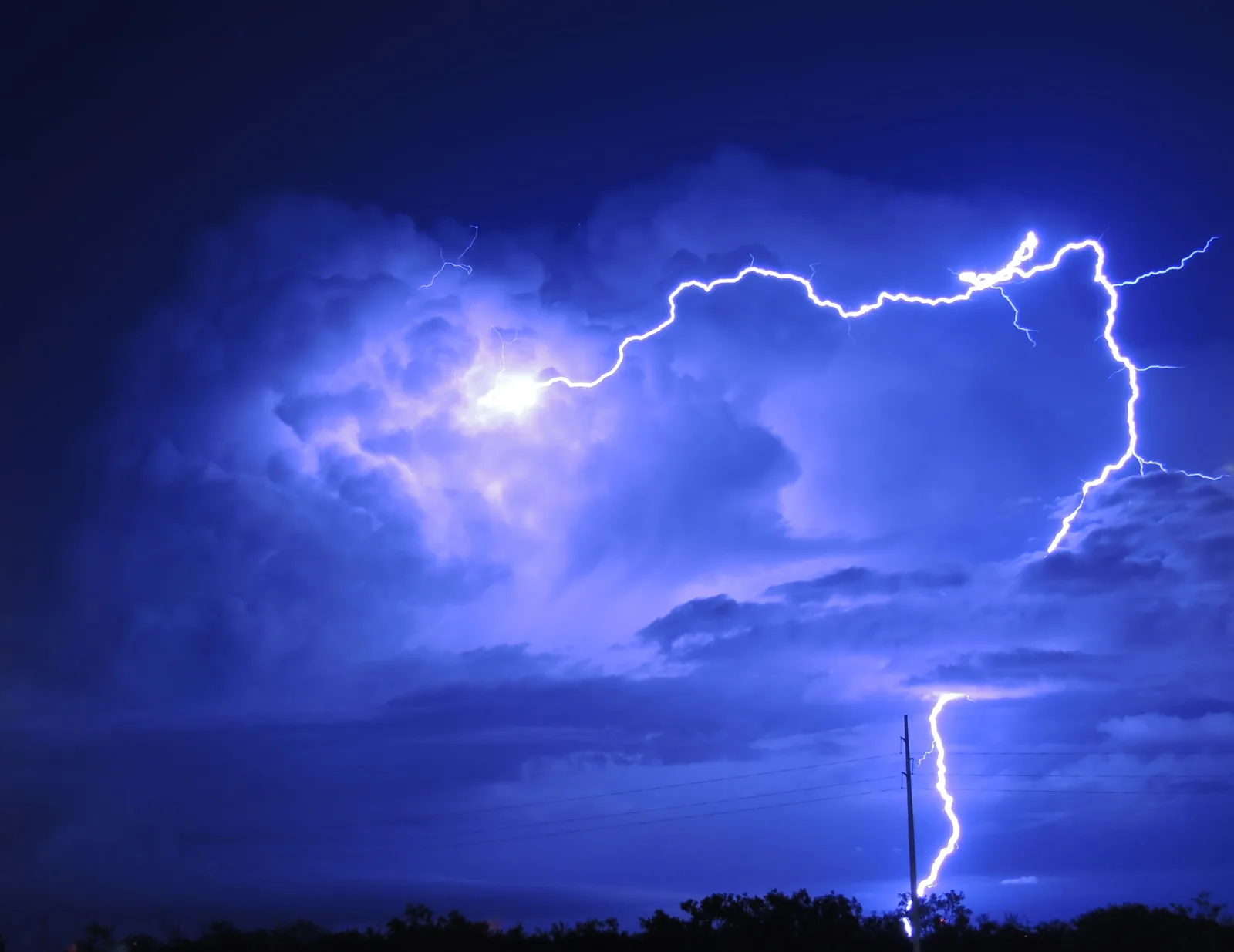
The aurora
The magnetic field of the Earth guides electrons coming from space to the polar regions. At a height of thousands of kilometres the electrons often travel through a potential difference of a few kilovolts, and every volt gives the electron one electronvolt of kinetic energy. A potential difference of $5\,\text{kV}$ gives a kinetic energy of $5\,\text{keV}$ and a speed of about $40\,000\,\text{km/s}$. The mass of an electron is so small that even such an energy gives it an enormous speed. At a height of about $100$–$300\,\text{km}$ the electrons collide with the oxygen and nitrogen atoms and molecules of the air and give them their energy, and these radiate the energy as light. The green light comes from oxygen.
Electric potential energy and potential
The potential energy of a charge at a point whose potential is $V$:
$$E_\text{p} = qV$$
where $E_\text{p}$ is the potential energy ($\text{J}$), $q$ the charge with its sign ($\text{C}$) and $V$ the potential of the point ($\text{V}$) relative to the chosen zero point. For an electron $q = -e$.
When a charge moves from point $A$ to point $B$, the electric force does the work
$$W_{AB} = q(V_A - V_B) = qU_{AB}$$
where $W_{AB}$ is the work ($\text{J}$) and $U_{AB} = V_A - V_B$ is the potential difference, or voltage, of the points ($\text{V}$). The work equals the decrease of the potential energy $E_{\text{p},A} - E_{\text{p},B}$, and it does not depend on the path. In a uniform field the voltage between the plates is $U = Ed$ (chapter Uniform electric field), so the field does the work $qU = qEd$ on a charge travelling from one plate to the other in the direction of the field.
When the negative plate is the zero point, the potential of a uniform field is
$$V = Ex$$
where $E$ is the field strength ($\text{V/m}$) and $x$ the distance of the point from the negative plate ($\text{m}$). The graph $(x, V)$ is a straight line whose slope is the field strength. Between the plates in the figure the potential changes by $100\,\text{V}$ over a distance of $2.0\,\text{cm}$, so $E = 100\,\text{V} : 0.020\,\text{m} = 5000\,\text{V/m}$.
When only the electric force does work, the sum of the kinetic energy and the potential energy is conserved. A particle starting from rest has, after travelling through a potential difference $U$, the kinetic energy
$$\frac{1}{2}mv^2 = |q|U$$
where $m$ is the mass of the particle ($\text{kg}$), $v$ its speed ($\text{m/s}$) and $|q|$ the magnitude of the charge ($\text{C}$). Gravity is ignored: for example, the weight of a proton in the field of the figure is tens of billions of times smaller than the electric force. The unit of energy of particles, the electronvolt, is
$$1\,\text{eV} = 1.602 \cdot 10^{-19}\,\text{J}$$
because $1.602 \cdot 10^{-19}\,\text{C} \cdot 1\,\text{V} = 1.602 \cdot 10^{-19}\,\text{J}$. So $1\,\text{keV} = 1000\,\text{eV}$.
Common misconception
Potential and potential energy are not the same thing. Potential is a property of a point in the field, and it does not depend on whether there is a charge at the point. Potential energy is the energy of a charge, and it depends on the magnitude and the sign of the charge: at the same point of $150\,\text{V}$ the potential energy of a proton is $+150\,\text{eV}$ and that of an electron $-150\,\text{eV}$. So it cannot be said that a charge always moves toward a lower potential: an electron moves toward a higher one.
Many also think that a longer acceleration distance gives a particle more energy. If the voltage between the plates stays the same, a larger plate separation makes the field weaker, $E = U : d$, and the work $qEd = qU$ is the same. What matters is the potential difference, not the distance. The distance affects only how long the acceleration takes.
Summary
- The electric force is conservative, so a charge in a field has potential energy $E_\text{p} = qV$. The work done by the field is the decrease of the potential energy.
- Potential $V$ is potential energy per unit charge, $1\,\text{V} = 1\,\text{J/C}$. It is a property of a point in the field, and the potential difference of two points is the voltage between them.
- In a uniform field the potential changes steadily, $V = Ex$, and the field points from a higher potential to a lower one. Equipotential surfaces are parallel to the plates, and the field lines are perpendicular to them.
- When a charge travels through a potential difference $U$, the field does the work $qU$ regardless of the distance and the path. A particle that starts from rest gets the kinetic energy $\tfrac{1}{2}mv^2 = |q|U$.
- A positive charge starts moving toward a lower potential and a negative charge toward a higher one; the potential energy of each decreases.
- The electronvolt is a unit of energy for particles: $1\,\text{eV} = 1.602 \cdot 10^{-19}\,\text{J}$.
Optional Return to your predictions
Compare your predictions with the values of the model in the experiments and with the concept of potential. Then return to the opening question: where does an aurora electron get its kinetic energy, and why does its speed grow so great?
Would you change your prediction?
Apply
Worked example
Problem
An aurora electron starts almost from rest and travels toward a higher potential through a potential difference of $3.0\,\text{kV}$. What are the kinetic energy of the electron in electronvolts and in joules, and its speed? The charge of the electron is $-e$, where $e = 1.602 \cdot 10^{-19}\,\text{C}$, and its mass is $m = 9.109 \cdot 10^{-31}\,\text{kg}$. Forces other than the electric force are ignored.
Step 1/7
Given and find. $U = 3.0\,\text{kV}$, $e = 1.602 \cdot 10^{-19}\,\text{C}$, $m = 9.109 \cdot 10^{-31}\,\text{kg}$ and initial speed zero. We are asked for the kinetic energy $E_\text{k}$ in electronvolts and in joules and for the speed $v$.
Step 2/7
Principle. Only the electric force does work, so the sum of the kinetic energy and the potential energy is conserved. The electron travels toward a higher potential, so its potential energy decreases by $eU$ and its kinetic energy increases by the same amount. Every volt gives the electron one electronvolt.
Step 3/7
Formula solved.
$$\begin{aligned} \tfrac{1}{2}mv^2 &= eU \\ E_\text{k} &= eU \\ v &= \sqrt{\frac{2eU}{m}} \end{aligned}$$
Step 4/7
Conversions.
In addition $1\,\text{C} \cdot 1\,\text{V} = 1\,\text{J}$ and $\sqrt{1\,\text{J} : 1\,\text{kg}} = 1\,\text{m/s}$.
Step 5/7
Substitution. $$\begin{aligned} E_\text{k} &= eU \\ &= 1.602 \cdot 10^{-19}\,\text{C} \cdot 3000\,\text{V} \\ &= 4.806 \cdot 10^{-16}\,\text{J} \\ v &= \sqrt{\frac{2E_\text{k}}{m}} \\ &= \sqrt{\frac{2 \cdot 4.806 \cdot 10^{-16}\,\text{J}}{9.109 \cdot 10^{-31}\,\text{kg}}} \\ &= 3.248 \cdot 10^{7}\,\text{m/s} \end{aligned}$$
Step 6/7
Answer. The kinetic energy of the electron is $3.0\,\text{keV}$ or $4.8 \cdot 10^{-16}\,\text{J}$, and its speed is $3.2 \cdot 10^{7}\,\text{m/s}$. The results are given with two significant figures like the potential difference $3.0\,\text{kV}$.
Step 7/7
Reasonableness. With rounded numbers
so the order of magnitude is right. The speed is about $11\,\%$ of the speed of light $3.00 \cdot 10^{8}\,\text{m/s}$: it stays clearly below the speed of light, so the expression $\tfrac{1}{2}mv^2$ still gives a good result.
Find the error
Apply to a new situation
The ion thruster of a satellite accelerates xenon ions and pushes the satellite with their reaction force. The charge of each ion is $+e$ and its mass is $2.18 \cdot 10^{-25}\,\text{kg}$. The ions start almost from rest and are accelerated through a potential difference of $1.2\,\text{kV}$. The elementary charge is $e = 1.602 \cdot 10^{-19}\,\text{C}$.
What is the speed of the ions? Answer in kilometres per second.
Hint 1: a guiding question
Into what does the energy change when the field does work on the ion? How great is the work done by the field?
Hint 2: what is the connection
The kinetic energy of the ion is $\tfrac{1}{2}mv^2 = eU$. Convert $1.2\,\text{kV} = 1200\,\text{V}$.
Hint 3: an intermediate step
finally convert $1\,\text{km/s} = 1000\,\text{m/s}$.
Show the solution
Given
charge of the ion $q = e = 1.602 \cdot 10^{-19}\,\text{C}$, mass $m = 2.18 \cdot 10^{-25}\,\text{kg}$, potential difference $U = 1.2\,\text{kV}$, initial speed almost zero
Find
the speed $v$ of the ions in kilometres per second
Principle
In the acceleration only the electric force does work on the ion, so the potential energy of the ion decreases by $eU$ and the kinetic energy increases by the same amount. The ion starts almost from rest, so the whole kinetic energy comes from the work done by the field.
Formula
$\tfrac{1}{2}mv^2 = eU$, from which $v = \sqrt{\dfrac{2eU}{m}}$
Conversions
and finally $1\,\text{km/s} = 1000\,\text{m/s}$.
Substitution
Answer
$42\,\text{km/s}$
Two significant figures like the voltage $1.2\,\text{kV}$.
Reasonableness
With rounded numbers
A xenon ion is about $240\,000$ times heavier than an electron, so it is much slower than the aurora electron of the example, although the energies are of the same order of magnitude, but still about ten times faster than the exhaust gases of a rocket.
Check your understanding
Exit ticket
Answer on your own first and only then open the answer.
- An electron moves from a point whose potential is $20\,\text{V}$ to a point whose potential is $70\,\text{V}$. Does its potential energy increase or decrease, and by how much in electronvolts?
Answer
The potential energy of the electron is $-eV$, so it decreases when the potential increases: the change is $-e \cdot (70\,\text{V} - 20\,\text{V}) = -50\,\text{eV}$.
- How much is $3.0\,\text{keV}$ in joules?
Answer
$3.0\,\text{keV}$$= 3000 \cdot 1.602 \cdot 10^{-19}\,\text{J}$$= 4.8 \cdot 10^{-16}\,\text{J}$
1. Concept
2. Energy in a field
The strength of a uniform electric field is $1.5 \cdot 10^{4}\,\text{V/m}$. A proton starts from rest and travels $2.0\,\text{cm}$ in the direction of the field. Only the electric force acts on it.
What is the kinetic energy of the proton at the end of the distance? Answer in electronvolts.
Hint 1: a guiding question
How much does the potential change over a distance of $2.0\,\text{cm}$ in the direction of the field?
Hint 2: what is the connection
In a uniform field the potential difference is $U = Es$. Convert $2.0\,\text{cm} = 0.020\,\text{m}$.
Hint 3: an intermediate step
$U = 1.5 \cdot 10^{4}\,\text{V/m} \cdot 0.020\,\text{m}$, and the proton gets one electronvolt for every volt.
Show the solution
Given
field strength $E = 1.5 \cdot 10^{4}\,\text{V/m}$, distance in the direction of the field $s = 2.0\,\text{cm}$, charge of the proton $e$, initial speed zero
Find
the kinetic energy $E_\text{k}$ in electronvolts
Principle
Only the electric force does work, so the kinetic energy of the proton increases by as much as its potential energy decreases. In a uniform field the potential decreases steadily in the direction of the field, so the potential difference is the field strength times the distance.
Formula
$U = Es$ and $E_\text{k} = eU$, so $E_\text{k} = eEs$
Conversions
Substitution
Answer
$3.0 \cdot 10^{2}\,\text{eV}$
Or $300\,\text{eV}$, two significant figures like the field strength and the distance.
Reasonableness
In joules the energy is
which is the same as force times distance: $1.602 \cdot 10^{-19}\,\text{C} \cdot 1.5 \cdot 10^{4}\,\text{V/m} \cdot 0.020\,\text{m}$. The energy is positive, because a positive charge accelerates in the direction of the field.
Suggestion: one answer does not show everything you can do, but review the theory summary and do the core exercises.
Optional 3. Explain potential
Explain the difference between potential and potential energy.
Why does the potential of a point not depend on which charge is brought to the point, although the potential energy does?
Model answer
Potential energy is the energy of a charge that depends on its position in the field: the field does work when the charge moves, and the work is the decrease of the potential energy. A double charge experiences a double force, so at the same point its potential energy is double, and the potential energy of a negative charge has the opposite sign. When the potential energy is divided by the charge, we get a quantity that is the same for all charges: the potential of the point $V = E_\text{p} : q$. It is a property of the field, and its unit is $1\,\text{J/C} = 1\,\text{V}$. For example, at a point of $150\,\text{V}$ the potential energy of a proton is $+150\,\text{eV}$ and that of an electron $-150\,\text{eV}$.
Assess your own answer
Tick the points your own answer already contains.
Review the theory summary and practise with the exercises.
Exercises
Level 1 · basic practice 5 exercises
One formula or one step of reasoning. Core exercises first, the rest is extra practice.
- Exercise 12-1Core
A proton travels between two plates from the positive plate to the negative one. The voltage between the plates is $240\,\text{V}$.
How much work does the electric field do on the proton? The elementary charge is $e = 1.602 \cdot 10^{-19}\,\text{C}$. Answer in joules.
Answer
$3.84 \cdot 10^{-17}\,\text{J}$
Show the solution
Given
charge of the proton $q = e = 1.602 \cdot 10^{-19}\,\text{C}$, voltage between the plates $U = 240\,\text{V}$
Find
the work $W$ done by the electric field on the proton in joules
Principle
When a charge moves through a potential difference $U$, the electric field does the work $qU$. The proton is positive and travels from the positive plate to the negative one, that is, toward a lower potential, so the work is positive.
Formula
$W = qU$, where $q = e$, so $W = eU$
Conversions
Not needed: $1\,\text{C} \cdot 1\,\text{V} = 1\,\text{J}$.
Substitution
$W$$= 1.602 \cdot 10^{-19}\,\text{C} \cdot 240\,\text{V}$$= 3.845 \cdot 10^{-17}\,\text{J}$Answer
$3.84 \cdot 10^{-17}\,\text{J}$
Three significant figures like the voltage $240\,\text{V}$.
Reasonableness
In electronvolts the work is $240\,\text{eV}$, and $240 \cdot 1.6 \cdot 10^{-19}\,\text{J} \approx 3.8 \cdot 10^{-17}\,\text{J}$. The energy of one particle is a very small number of joules, as it should be.
- Exercise 12-2Core
A small ball has a charge of $+3.0\,\text{nC}$, and it is at a point of an electric field whose potential is $120\,\text{V}$ relative to the zero point.
What is the electric potential energy of the ball? Answer in microjoules.
Answer
$0.36\,\mu\text{J}$
Show the solution
Given
charge $q = +3.0\,\text{nC}$, potential of the point $V = 120\,\text{V}$
Find
the potential energy $E_\text{p}$ in microjoules
Principle
Potential is potential energy per unit charge, so the potential energy of a charge is the charge times the potential of the point. The charge is positive and the potential is positive, so the potential energy is positive.
Formula
$E_\text{p} = qV$
Conversions
$q$$= 3.0\,\text{nC}$$= 3.0 \cdot 10^{-9}\,\text{C}$and finally $1\,\text{J} = 10^{6}\,\mu\text{J}$.
Substitution
$E_\text{p}$$= 3.0 \cdot 10^{-9}\,\text{C} \cdot 120\,\text{V}$$= 3.6 \cdot 10^{-7}\,\text{J}$$= 0.36\,\mu\text{J}$Answer
$0.36\,\mu\text{J}$
Two significant figures like the charge $3.0\,\text{nC}$.
Reasonableness
The estimate $3 \cdot 10^{-9}\,\text{C} \cdot 100\,\text{V} = 3 \cdot 10^{-7}\,\text{J}$ is close to the result. A double charge would give a double potential energy at the same point, as can be seen from the formula.
- Exercise 12-3
The kinetic energy of an electron that produces an aurora is $5.0\,\text{keV}$. What is the kinetic energy in joules? The elementary charge is $e = 1.602 \cdot 10^{-19}\,\text{C}$.
Answer
$8.0 \cdot 10^{-16}\,\text{J}$
Show the solution
Given
kinetic energy $E_\text{k} = 5.0\,\text{keV}$, $e = 1.602 \cdot 10^{-19}\,\text{C}$
Find
the kinetic energy in joules
Principle
An electronvolt is the energy that a charge of the magnitude of the elementary charge gets when it travels through a potential difference of $1\,\text{V}$, that is, $1\,\text{eV} = e \cdot 1\,\text{V}$. The energy in joules is obtained by multiplying the number of electronvolts by this.
Formula
$E_\text{k} = N \cdot 1\,\text{eV}$, where $N$ is the number of electronvolts and $1\,\text{eV} = 1.602 \cdot 10^{-19}\,\text{J}$
Conversions
$5.0\,\text{keV}$$= 5.0 \cdot 1000\,\text{eV}$$= 5000\,\text{eV}$Substitution
$E_\text{k}$$= 5000 \cdot 1.602 \cdot 10^{-19}\,\text{J}$$= 8.01 \cdot 10^{-16}\,\text{J}$Answer
$8.0 \cdot 10^{-16}\,\text{J}$
Two significant figures like the energy $5.0\,\text{keV}$.
Reasonableness
A thousand electronvolts is about $1.6 \cdot 10^{-16}\,\text{J}$, and five times that is $8 \cdot 10^{-16}\,\text{J}$. The number of joules is small, because it is the energy of a single electron.
- Exercise 12-4
A charge of $4.0\,\mu\text{C}$ moves in an electric field from point $A$, whose potential is $60\,\text{V}$, to point $B$, whose potential is $15\,\text{V}$.
How much work does the electric field do on the charge? Answer in millijoules.
Answer
$0.18\,\text{mJ}$
Show the solution
Given
$q = 4.0\,\mu\text{C}$, $V_A = 60\,\text{V}$, $V_B = 15\,\text{V}$
Find
the work $W_{AB}$ done by the electric field in millijoules
Principle
The electric force is conservative, so its work depends only on the potentials of the initial and final points: the work is the charge times the potential difference. A positive charge moves to a lower potential, so the work is positive.
Formula
$W_{AB} = q(V_A - V_B)$
Conversions
$q$$= 4.0\,\mu\text{C}$$= 4.0 \cdot 10^{-6}\,\text{C}$and finally $1\,\text{J} = 1000\,\text{mJ}$.
Substitution
$W_{AB}$$= 4.0 \cdot 10^{-6}\,\text{C} \cdot (60\,\text{V} - 15\,\text{V})$$= 1.8 \cdot 10^{-4}\,\text{J}$$= 0.18\,\text{mJ}$Answer
$0.18\,\text{mJ}$
Two significant figures like the charge $4.0\,\mu\text{C}$.
Reasonableness
The potential difference is $45\,\text{V}$, and $4 \cdot 10^{-6}\,\text{C} \cdot 50\,\text{V} = 2 \cdot 10^{-4}\,\text{J}$ is close to the result. The work is positive, because the potential energy of the charge decreases when it moves to a lower potential.
- Exercise 12-5
The graph shows the potential of the uniform field between two parallel plates, where $x$ is the distance from the negative plate. A proton moves from $x = 4.0\,\text{cm}$ to $x = 1.0\,\text{cm}$, and only the electric force acts on it.
By how much does the kinetic energy of the proton increase? Read the values you need from the graph and answer in electronvolts.
Answer
$150\,\text{eV}$
Show the solution
Given
the potential $V$ between the plates from the graph; the proton moves from $x = 4.0\,\text{cm}$ to $x = 1.0\,\text{cm}$; only the electric force does work
Find
the increase of the kinetic energy $\Delta E_\text{k}$ in electronvolts
Principle
When only the electric force does work, the kinetic energy increases by as much as the potential energy decreases. The charge of the proton is $e$, so every volt by which the potential falls gives it one electronvolt of kinetic energy.
Reading the graph
At $x = 4.0\,\text{cm}$ the line is on the grid line of $200\,\text{V}$ and at $x = 1.0\,\text{cm}$ on the grid line of $50\,\text{V}$. So the potential falls in the displacement.
Formula
$\Delta E_\text{k}$$= -\Delta E_\text{p}$$= e(V_1 - V_2)$where $V_1 = V(4.0\,\text{cm})$ and $V_2 = V(1.0\,\text{cm})$
Conversions
Not needed: when the charge is $e$ and the potential difference is in volts, the energy is obtained directly in electronvolts.
Substitution
$\Delta E_\text{k}$$= e \cdot (200\,\text{V} - 50\,\text{V})$$= 150\,\text{eV}$Answer
$150\,\text{eV}$
Two significant figures, because the potentials are read from the $50\,\text{V}$ grid lines and the positions are given to two significant figures.
Reasonableness
The slope of the graph is $50\,\text{V}$ per centimetre, and over a distance of $3.0\,\text{cm}$ the potential changes by $150\,\text{V}$. The proton moves toward the negative plate, that is, in the direction of the field, so its kinetic energy increases, as it should for a positive charge.
Level 2 · applied practice 4 exercises
Two steps, working with measured data, a unit conversion or rearranging a formula. Core exercises first, the rest is extra practice.
- Exercise 12-6Core
The strength of a uniform electric field is $2.5\,\text{kV/m}$. A proton moves $3.0\,\text{cm}$ in the direction of the field.
By how much does the potential energy of the proton change? Answer in electronvolts with the sign (negative if the energy decreases).
Answer
$-75\,\text{eV}$
Show the solution
Given
field strength $E = 2.5\,\text{kV/m}$, displacement in the direction of the field $s = 3.0\,\text{cm}$, charge of the proton $e$
Find
the change of the potential energy $\Delta E_\text{p}$ in electronvolts with its sign
Principle
In a uniform field the potential changes steadily, and in the direction of the field it decreases by $Es$. The potential energy of the proton is $eV$, so it decreases by as many electronvolts as the potential decreases in volts.
Formula
$\Delta V = -Es$ and $\Delta E_\text{p} = e\Delta V$, so $\Delta E_\text{p} = -eEs$
Conversions
$E$$= 2.5\,\text{kV/m}$$= 2.5 \cdot 1000\,\text{V/m}$$= 2500\,\text{V/m}$$s$$= 3.0\,\text{cm}$$= 3.0 \cdot 0.01\,\text{m}$$= 0.030\,\text{m}$Substitution
$\Delta V$$= -2500\,\text{V/m} \cdot 0.030\,\text{m}$$= -75\,\text{V}$$\Delta E_\text{p}$$= e \cdot (-75\,\text{V})$$= -75\,\text{eV}$Answer
$-75\,\text{eV}$
Two significant figures like the field strength and the distance.
Reasonableness
A positive charge moves by itself in the direction of the field, and then its potential energy decreases, so the sign is right. In joules the change is
$-75 \cdot 1.602 \cdot 10^{-19}\,\text{J}$$\approx -1.2 \cdot 10^{-17}\,\text{J}$which corresponds to the work $eEs$ done by the field.
- Exercise 12-7Core
The separation of two parallel plates is $2.0\,\text{cm}$, and the voltage between them is $300\,\text{V}$. The negative plate is the zero point. Point $P$ is between the plates, $0.80\,\text{cm}$ from the negative plate.
What is the potential energy of an electron at point $P$? Answer in electronvolts with the sign.
Answer
$-120\,\text{eV}$
Show the solution
Given
plate separation $d = 2.0\,\text{cm}$, voltage $U = 300\,\text{V}$, distance of point $P$ from the negative plate $x = 0.80\,\text{cm}$; the negative plate is the zero point; charge of the electron $-e$
Find
the potential energy $E_\text{p}$ of the electron at point $P$ in electronvolts
Principle
In a uniform field the potential grows steadily from the negative plate to the positive one, $V = Ex$, where $E = U : d$. The charge of the electron is negative, so its potential energy $E_\text{p} = -eV$ is negative at a point whose potential is positive.
Formula
$V_P = Ex = \dfrac{U}{d}\,x$ and $E_\text{p} = -eV_P$, so $E_\text{p} = -e\,\dfrac{Ux}{d}$
Conversions
Not needed: the centimetres cancel in the ratio $x : d$, and with the charge $e$ the potential in volts gives the energy in electronvolts.
Substitution
$V_P$$= 300\,\text{V} \cdot \dfrac{0.80\,\text{cm}}{2.0\,\text{cm}}$$= 120\,\text{V}$$E_\text{p}$$= -e \cdot 120\,\text{V}$$= -120\,\text{eV}$Answer
$-120\,\text{eV}$
Or $-1.2 \cdot 10^{2}\,\text{eV}$, two significant figures like the distances.
Reasonableness
Point $P$ is $40\,\%$ of the way from the negative plate, so its potential is $40\,\%$ of the voltage $300\,\text{V}$. The electron tends toward the positive plate, where its potential energy would be even lower, $-300\,\text{eV}$.
- Exercise 12-8
The charge of an alpha particle is $+2e$ and its mass is $6.645 \cdot 10^{-27}\,\text{kg}$. The alpha particle starts from rest and travels through a potential difference of $2.0\,\text{kV}$.
What is its speed? The elementary charge is $e = 1.602 \cdot 10^{-19}\,\text{C}$. Answer in metres per second.
Answer
$4.4 \cdot 10^{5}\,\text{m/s}$
Show the solution
Given
charge $q = 2e$, $e = 1.602 \cdot 10^{-19}\,\text{C}$, mass $m = 6.645 \cdot 10^{-27}\,\text{kg}$, potential difference $U = 2.0\,\text{kV}$, initial speed zero
Find
the speed $v$ in metres per second
Principle
Only the electric force does work, so potential energy changes into kinetic energy: the field does the work $qU$, and a particle that starts from rest gets a kinetic energy of the same size. The charge of the alpha particle is double, so it gets double the energy compared with a proton.
Formula
$\tfrac{1}{2}mv^2 = qU = 2eU$, from which $v = \sqrt{\dfrac{4eU}{m}}$
Conversions
$U$$= 2.0\,\text{kV}$$= 2.0 \cdot 1000\,\text{V}$$= 2000\,\text{V}$Substitution
$v$$= \sqrt{\dfrac{4 \cdot 1.602 \cdot 10^{-19}\,\text{C} \cdot 2000\,\text{V}}{6.645 \cdot 10^{-27}\,\text{kg}}}$$= 4.392 \cdot 10^{5}\,\text{m/s}$Answer
$4.4 \cdot 10^{5}\,\text{m/s}$
Two significant figures like the voltage $2.0\,\text{kV}$.
Reasonableness
The kinetic energy is $4000\,\text{eV} \approx 6.4 \cdot 10^{-16}\,\text{J}$, and
$v^2$$\approx 2 \cdot 6 \cdot 10^{-16}\,\text{J} : (7 \cdot 10^{-27}\,\text{kg})$$\approx 2 \cdot 10^{11}\,\text{m}^2/\text{s}^2$so $v \approx 4 \cdot 10^{5}\,\text{m/s}$. The speed is much smaller than the speed of light, so the expression $\tfrac{1}{2}mv^2$ is suitable.
- Exercise 12-9
In an electron gun, electrons start from rest and are accelerated by a voltage.
What voltage is needed for the speed of an electron to be $1.0 \cdot 10^{7}\,\text{m/s}$? Answer in volts. The mass of the electron is $9.109 \cdot 10^{-31}\,\text{kg}$. The elementary charge is $e = 1.602 \cdot 10^{-19}\,\text{C}$.
Answer
$2.8 \cdot 10^{2}\,\text{V}$
Show the solution
Given
final speed $v = 1.0 \cdot 10^{7}\,\text{m/s}$, initial speed zero, $m = 9.109 \cdot 10^{-31}\,\text{kg}$, $e = 1.602 \cdot 10^{-19}\,\text{C}$
Find
the accelerating voltage $U$ in volts
Principle
Only the electric force does work, so the kinetic energy gained by the electron equals the work $eU$ done by the field. When the kinetic energy is known from the speed, the voltage is obtained by solving the energy equation.
Formula
$\tfrac{1}{2}mv^2 = eU$, from which $U = \dfrac{mv^2}{2e}$
Conversions
Not needed: $1\,\text{kg} \cdot 1\,\text{m}^2/\text{s}^2 = 1\,\text{J}$ and $1\,\text{J} : 1\,\text{C} = 1\,\text{V}$.
Substitution
$mv^2$$= 9.109 \cdot 10^{-31}\,\text{kg} \cdot (1.0 \cdot 10^{7}\,\text{m/s})^2$$= 9.109 \cdot 10^{-17}\,\text{J}$$U$$= \dfrac{9.109 \cdot 10^{-17}\,\text{J}}{2 \cdot 1.602 \cdot 10^{-19}\,\text{C}}$$= 284.3\,\text{V}$Answer
$2.8 \cdot 10^{2}\,\text{V}$
Or about $280\,\text{V}$, two significant figures like the speed.
Reasonableness
The kinetic energy is
$\tfrac{1}{2} \cdot 9.1 \cdot 10^{-31}\,\text{kg} \cdot 10^{14}\,\text{m}^2/\text{s}^2$$\approx 4.6 \cdot 10^{-17}\,\text{J}$$\approx 280\,\text{eV}$so about $280\,\text{V}$ is needed. Even a voltage of a few hundred volts gives a light electron a great speed.
Level 3 · challenging 3 exercises
Optional: application, two ideas together or a new situation where you reason for yourself.
- Exercise 12-10
An electron passes point $A$ at a speed of $2.0 \cdot 10^{6}\,\text{m/s}$. The potential of point $A$ is $40\,\text{V}$. The electron continues to point $B$, whose potential is $160\,\text{V}$, and only the electric force acts on it.
What is the speed of the electron at point $B$? The mass of the electron is $9.109 \cdot 10^{-31}\,\text{kg}$. The elementary charge is $e = 1.602 \cdot 10^{-19}\,\text{C}$.
Answer
$6.8 \cdot 10^{6}\,\text{m/s}$
Show the solution
Given
$v_A = 2.0 \cdot 10^{6}\,\text{m/s}$, $V_A = 40\,\text{V}$, $V_B = 160\,\text{V}$, $m = 9.109 \cdot 10^{-31}\,\text{kg}$, charge of the electron $q = -e$, $e = 1.602 \cdot 10^{-19}\,\text{C}$
Find
the speed $v_B$ in metres per second
Principle
Only the electric force does work, so the sum of the kinetic energy and the potential energy is conserved. The potential energy of the electron is $-eV$, so it decreases when the electron moves to a higher potential, and the kinetic energy increases by the same amount.
Formula
$\tfrac{1}{2}mv_A^2 - eV_A = \tfrac{1}{2}mv_B^2 - eV_B$, from which
$E_{\text{k},B}$$= \tfrac{1}{2}mv_A^2 + e(V_B - V_A)$$v_B$$= \sqrt{\dfrac{2E_{\text{k},B}}{m}}$Conversions
Not needed: all quantities are in base units.
Substitution
$\tfrac{1}{2}mv_A^2$$= \tfrac{1}{2} \cdot 9.109 \cdot 10^{-31}\,\text{kg} \cdot (2.0 \cdot 10^{6}\,\text{m/s})^2$$= 1.822 \cdot 10^{-18}\,\text{J}$$e(V_B - V_A)$$= 1.602 \cdot 10^{-19}\,\text{C} \cdot 120\,\text{V}$$= 1.922 \cdot 10^{-17}\,\text{J}$$E_{\text{k},B}$$= 1.822 \cdot 10^{-18}\,\text{J} + 1.922 \cdot 10^{-17}\,\text{J}$$= 2.105 \cdot 10^{-17}\,\text{J}$$v_B$$= \sqrt{\dfrac{2 \cdot 2.105 \cdot 10^{-17}\,\text{J}}{9.109 \cdot 10^{-31}\,\text{kg}}}$$= 6.80 \cdot 10^{6}\,\text{m/s}$Answer
$6.8 \cdot 10^{6}\,\text{m/s}$
Two significant figures like the initial speed and the potentials.
Reasonableness
At point $A$ the kinetic energy of the electron is only about $11\,\text{eV}$, and it gains another $120\,\text{eV}$, so the kinetic energy grows to about $12$ times and the speed to about $\sqrt{12} \approx 3.5$ times: $3.5 \cdot 2.0 \cdot 10^{6}\,\text{m/s} = 7 \cdot 10^{6}\,\text{m/s}$. The electron speeds up, because a negative charge accelerates toward a higher potential.
- Exercise 12-11
An electron and a proton start from rest and each travels through the same potential difference, each in its own direction.
How many times greater is the speed of the electron than the speed of the proton? The mass of the electron is $9.109 \cdot 10^{-31}\,\text{kg}$ and the mass of the proton $1.673 \cdot 10^{-27}\,\text{kg}$.
Answer
$43$
Show the solution
Given
mass of the electron $m_\text{e} = 9.109 \cdot 10^{-31}\,\text{kg}$, mass of the proton $m_\text{p} = 1.673 \cdot 10^{-27}\,\text{kg}$; each starts from rest and travels through the same potential difference $U$, and the magnitude of each charge is $e$
Find
the ratio of the speeds of the electron and the proton $v_\text{e} : v_\text{p}$ when they travel from rest through the same potential difference $U$
Principle
The magnitude of each charge is $e$, so the field does the same work $eU$ on each and they get the same kinetic energy, although they move in opposite directions. The same kinetic energy $\tfrac{1}{2}mv^2$ gives a smaller mass a greater speed.
Formula
$\tfrac{1}{2}m_\text{e}v_\text{e}^2$$= eU$$= \tfrac{1}{2}m_\text{p}v_\text{p}^2$so
$\dfrac{v_\text{e}}{v_\text{p}}$$= \sqrt{\dfrac{m_\text{p}}{m_\text{e}}}$Conversions
Not needed: the units of the masses cancel, and the voltage is not needed.
Substitution
$\dfrac{v_\text{e}}{v_\text{p}}$$= \sqrt{\dfrac{1.673 \cdot 10^{-27}\,\text{kg}}{9.109 \cdot 10^{-31}\,\text{kg}}}$$= \sqrt{1837}$$= 42.86$Answer
The speed of the electron is about $43$ times as great; two significant figures are enough for a ratio, and the masses are given to four figures.
Reasonableness
The mass of the proton is about $1800$ times as great, and $\sqrt{1800} \approx 42$. The result does not depend on the voltage, as long as the speeds stay much smaller than the speed of light. So the same energy gives a speed that is inversely proportional to the square root of the mass.
- Exercise 12-12
The separation of two parallel plates is $2.0\,\text{cm}$, and the voltage between them is $600\,\text{V}$. A proton starts from a hole in the negative plate toward the positive plate at a speed of $3.0 \cdot 10^{5}\,\text{m/s}$.
How close to the positive plate does the proton get before it turns back? The mass of the proton is $1.673 \cdot 10^{-27}\,\text{kg}$. The elementary charge is $e = 1.602 \cdot 10^{-19}\,\text{C}$. Answer in millimetres.
Answer
$4.3\,\text{mm}$
Show the solution
Given
plate separation $d = 2.0\,\text{cm}$, voltage $U = 600\,\text{V}$, initial speed $v_0 = 3.0 \cdot 10^{5}\,\text{m/s}$, $m = 1.673 \cdot 10^{-27}\,\text{kg}$, $e = 1.602 \cdot 10^{-19}\,\text{C}$
Find
the distance of the turning point from the positive plate in millimetres
Principle
The proton moves toward a higher potential, so its potential energy increases and its kinetic energy decreases by the same amount. It stops at the point where the whole initial kinetic energy has changed into potential energy. In a uniform field the potential grows steadily, $V = Ex = \dfrac{U}{d}\,x$ measured from the negative plate.
Formula
$E_{\text{k},0}$$= \tfrac{1}{2}mv_0^2$$E_{\text{k},0}$$= eV$$= e\,\dfrac{U}{d}\,x$from which $x = \dfrac{E_{\text{k},0}\,d}{eU}$; the distance from the positive plate is $d - x$
Conversions
$d = 2.0\,\text{cm} = 0.020\,\text{m}$ and finally $1\,\text{m} = 1000\,\text{mm}$.
Substitution
$E_{\text{k},0}$$= \tfrac{1}{2} \cdot 1.673 \cdot 10^{-27}\,\text{kg} \cdot (3.0 \cdot 10^{5}\,\text{m/s})^2$$= 7.529 \cdot 10^{-17}\,\text{J}$$x$$= \dfrac{7.529 \cdot 10^{-17}\,\text{J} \cdot 0.020\,\text{m}}{1.602 \cdot 10^{-19}\,\text{C} \cdot 600\,\text{V}}$$= 0.01566\,\text{m}$$d - x$$= 0.020\,\text{m} - 0.01566\,\text{m}$$= 0.00434\,\text{m}$$= 4.34\,\text{mm}$Answer
$4.3\,\text{mm}$
Two significant figures like the initial data.
Reasonableness
At the start the kinetic energy is about $470\,\text{eV}$, so the proton can climb $470\,\text{V}$ of potential. That is less than $600\,\text{V}$, so the proton turns back before the positive plate: $470 : 600 \approx 0.78$ of the distance, or about $16\,\text{mm}$ from the negative plate and about $4\,\text{mm}$ from the positive one.
Photographs
- Lightning in Dallas 2015. NOAA Photo Library. source, public domain
- Blitze IMGP6376 wp. smial. source, Free Art License 1.3
- Plasma-lamp. Luc Viatour. source, CC BY-SA 3.0


