
Intensity and the decibel scale
Why is the loudness of a sound given in decibels and not in watts per square metre, and what does a decibel reading actually tell us?
Prior knowledge
- Sound is a longitudinal wave travelling in air, and its amplitude tells how loud the sound ischapter Sound as a wave: pitch, timbre and the Doppler effect
- A wave carries energy from the source to its surroundings without the medium travelling alongchapter How waves form and travel
- Power is energy per unit time, $P = \tfrac{\Delta E}{\Delta t}$, and its unit is the wattchapter Power
Core path: follow the steps in order. Tasks marked Optional give extra practice. Optional tasks: 4.
Think about it
At an open-air concert in front of the stage the music can be felt in your chest, yet the same music is heard clearly from a hillside hundreds of metres away. The ear can tell apart both the quiet rustle of leaves and the roar of the concert, even though their intensities differ by a factor of about a billion. A sound level meter gives both on the same scale, in decibels.
How does the loudness of a sound change when the listener moves farther away or when more sound sources are added, and why is loudness given in decibels?
Optional Review: properties of sound
Predict
Make your predictions before investigating 2 questions
Prediction 1: twice as far away
Prediction 2: a second loudspeaker next to it
Investigate
Move the sound level meter and add loudspeakers. Observe how the intensity and the sound intensity level change.
Simulation
How to use
Adjust the sound power $P$ of one loudspeaker, the number of loudspeakers and the distance $r$ of the meter from the loudspeakers. Above the meter is its reading, the sound intensity level $L$, and the readouts also show the total power, the area of the sphere $4\pi r^2$ and the intensity $I$. The graph shows the level as a function of distance with the present loudspeakers, and the ring marks the position of the meter. The brightness of the arcs shows the level. Speed changes only the pace of the arcs' motion, not the readings.
Assumptions of the model
The loudspeakers are at the same place and radiate evenly in all directions like one point source. The sound is not reflected from the ground or from anywhere else, and the air does not absorb it, so the whole power passes through every spherical surface. The loudspeakers play independent sounds, so their powers add up. The readings are values calculated by the model, not measurements. The motion of the arcs is only an illustration, not the real speed of sound.
How the calculation works
The total power is $P_\text{tot} = N P$, where $N$ is the number of loudspeakers. The intensity at distance $r$ is
$$I = \frac{P_\text{tot}}{4\pi r^2}$$
and the sound intensity level is $L = 10\,\text{dB} \cdot \lg \tfrac{I}{I_0}$, where $I_0 = 1.0 \cdot 10^{-12}\,\text{W/m}^2$. In the tables of the experiments the intensity is in $\text{mW/m}^2$, where $1\,\text{mW/m}^2 = 10^{-3}\,\text{W/m}^2$. The vertical axis of the graph starts at the level $40\,\text{dB}$.
Experiment 1: only the distance changes
Test prediction 1. One loudspeaker plays at a power of $50\,\text{mW}$; change only the distance of the meter. Record the readings at least at distances $2.0\,\text{m}$ and $4.0\,\text{m}$, preferably also at $1.0\,\text{m}$ and $8.0\,\text{m}$. Compare: by what factor does the intensity change and by how many decibels does the level change when the distance doubles?
Initial state: power per loudspeaker = $50\,\text{mW}$, loudspeakers: one, distance = $2\,\text{m}$. Kept constant: power per loudspeaker, loudspeakers. Varied: distance.
| distance | $I$ $(\text{mW/m}^2)$ | $L$ $(\text{dB})$ |
|---|
Experiment 2: only the number of loudspeakers changes
Test prediction 2. The meter is $2.0\,\text{m}$ away and the power of each loudspeaker is $50\,\text{mW}$; change only the number of loudspeakers. Record the readings at least with one and two loudspeakers, preferably also with four and ten. By how many decibels does the level rise when the number of loudspeakers doubles, and by how many when it increases tenfold?
Initial state: power per loudspeaker = $50\,\text{mW}$, loudspeakers: one, distance = $2\,\text{m}$. Kept constant: power per loudspeaker, distance. Varied: loudspeakers.
| loudspeakers | $I$ $(\text{mW/m}^2)$ | $L$ $(\text{dB})$ |
|---|
Conclusion: intensity and decibels
Based on your tables, write: by what factor did the intensity change and by how many decibels did the level change when the distance doubled? What about when the number of loudspeakers doubled or increased tenfold? Why does the level not change in the same proportion as the intensity?
Model answer
When the distance doubled, the intensity fell to a quarter, for example from $0.995\,\text{mW/m}^2$ to $0.249\,\text{mW/m}^2$, because the same power was spread over a spherical surface four times as large. Even so, the level decreased by only about $6\,\text{dB}$, from $90.0\,\text{dB}$ to $84.0\,\text{dB}$. With two loudspeakers the intensity doubled and the level rose by about $3\,\text{dB}$, to $93.0\,\text{dB}$; with ten loudspeakers the intensity increased tenfold and the level rose by $10\,\text{dB}$, to $100.0\,\text{dB}$. The decibel scale is logarithmic: the same ratio of intensities always changes the level by the same number of decibels. The values are calculated by the model: in the model the sound is not reflected or absorbed.
Assess your own answer
Tick the points your own answer already contains.
Review the theory summary and practise with the exercises.
Theory summary
Key idea
Intensity: power per unit area
Sound is a wave travelling in air that carries energy from the source to the listener. How loud a sound seems depends on how much energy per second hits, for example, the surface of the eardrum or of a microphone. That is why the loudness of a sound is described by the intensity $I$: it is the sound power $P$ passing through a surface divided by the area $A$ of the surface, when the surface is perpendicular to the direction in which the sound travels. The unit of intensity is watt per square metre, $\text{W/m}^2$. The same power concentrated on a small area means a large intensity, and spread over a large area a small one.
A point source and distance
A small sound source that radiates evenly in all directions is a point source. When there are no reflections and the air does not absorb the sound, the whole power $P$ of the source passes through every spherical surface around the source. The area of a sphere, $4\pi r^2$, grows as the square of the distance $r$: at twice the distance the same power is spread over four times the area, at three times the distance over nine times the area. The intensity is therefore inversely proportional to the square of the distance. This is the inverse-square law. In reality walls and the ground reflect sound, so indoors the intensity decreases more slowly.
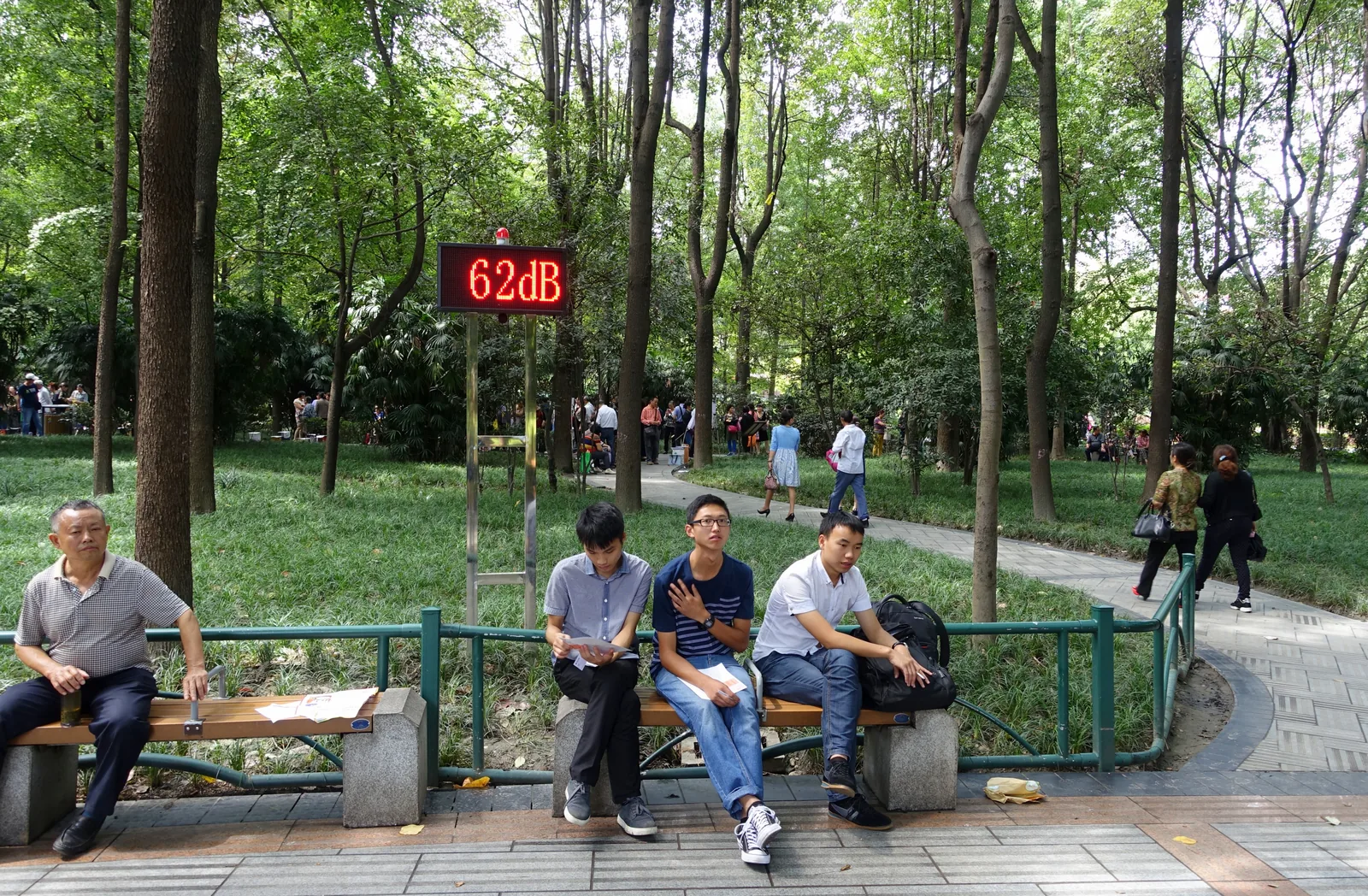
Threshold of hearing and threshold of pain
The human ear is astonishingly sensitive. The weakest sound that a young person with normal hearing can distinguish at a frequency of about $1000\,\text{Hz}$ has an intensity of about $I_0 = 1.0 \cdot 10^{-12}\,\text{W/m}^2$. This is called the threshold of hearing. The threshold of hearing is not silence but the weakest audible sound, and it is different at different frequencies. The loudest sounds begin to feel painful when the intensity is about $1\,\text{W/m}^2$. This threshold of pain is a trillion, that is $10^{12}$, times the threshold of hearing. Such a wide range is hard to present on an ordinary scale.
The decibel scale
That is why the loudness of a sound is described by the sound intensity level $L$, which compares the intensity with the threshold of hearing by means of a logarithm. The unit of the level is the decibel ($\text{dB}$). At the threshold of hearing the level is $0\,\text{dB}$, at the threshold of pain $120\,\text{dB}$. The scale is logarithmic: every time the intensity increases tenfold, $10\,\text{dB}$ is added to the level. A conversation, about $60\,\text{dB}$, is therefore not half of the threshold of pain but a millionth of its intensity. The ear also senses loudness roughly logarithmically: an increase of about $10\,\text{dB}$ sounds roughly twice as loud, even though the intensity increases tenfold.
The ear is not equally sensitive to all frequencies: low and very high sounds seem quieter at the same intensity than sounds of about $1000$–$4000\,\text{Hz}$. Sound level meters therefore weight the frequencies according to the sensitivity of the ear, and such a weighted reading is written $\text{dB(A)}$. In this chapter we calculate unweighted sound intensity levels. The effects of noise and the protection of hearing are covered in the chapter Noise, acoustics and sound reproduction.
Sound intensity level
Intensity
The intensity of a sound is
$$I = \frac{P}{A}$$
where $I$ is the intensity ($\text{W/m}^2$), $P$ the sound power passing through the surface ($\text{W}$) and $A$ the area of the surface ($\text{m}^2$). For a point source that radiates evenly in all directions without reflections, $A$ is the area of a sphere, $4\pi r^2$:
$$I = \frac{P}{4\pi r^2}$$
where $P$ is the sound power of the source ($\text{W}$) and $r$ the distance from the source ($\text{m}$).
Sound intensity level
The sound intensity level in decibels is
$$L = 10\,\text{dB} \cdot \lg \frac{I}{I_0}$$
where $L$ is the sound intensity level ($\text{dB}$), $I$ the intensity and $I_0 = 1.0 \cdot 10^{-12}\,\text{W/m}^2$ the threshold of hearing. The notation $\lg$ is the base-ten logarithm: $\lg x$ tells you to what power $10$ must be raised to get $x$. For example $\lg 1000 = 3$, because $10^3 = 1000$, and $\lg 1 = 0$, so $I = I_0$ gives the level $0\,\text{dB}$.
Intensity from a known level
When the level is known, the intensity is solved in two steps. First the equation is divided on both sides by $10\,\text{dB}$. Then the definition of the logarithm is used: if $\lg x = y$, then $x = 10^y$. Finally we multiply by $I_0$:
$$\begin{aligned} &\lg \frac{I}{I_0} = \frac{L}{10\,\text{dB}} \\ &\frac{I}{I_0} = 10^{\,L/(10\,\text{dB})} \\ &I = I_0 \cdot 10^{\,L/(10\,\text{dB})} \end{aligned}$$
For example, the $60\,\text{dB}$ of a conversation gives $\tfrac{L}{10\,\text{dB}} = 6$, so $I = 10^{6} \cdot I_0 = 1.0 \cdot 10^{-6}\,\text{W/m}^2$. On a calculator the logarithm is the key $\lg$ (or $\log$) and the power $10^x$ is usually the second function of the same key; check that $\lg 3 \approx 0.477$ and $10^{0.477} \approx 3$.
Difference in levels
The difference between the levels of two sounds depends only on the ratio of their intensities, because $I_0$ cancels:
$$L_2 - L_1 = 10\,\text{dB} \cdot \lg \frac{I_2}{I_1}$$
When the intensity doubles, the level increases by $10\,\text{dB} \cdot \lg 2 \approx 3.0\,\text{dB}$. When it increases tenfold, the level increases by $10\,\text{dB}$. When the distance from a point source doubles, the intensity falls to a quarter and the level decreases by $10\,\text{dB} \cdot \lg 4 \approx 6.0\,\text{dB}$.
Combined level of several sources
When two independent sound sources, for example two machines or two players, are heard at the same place, their powers and therefore their intensities add up: $I = I_1 + I_2$. Decibels are not added; the combined level is calculated from the total intensity. Two equally strong sources double the intensity, so $80\,\text{dB}$ and $80\,\text{dB}$ together give about $83\,\text{dB}$. If one source is much weaker, it hardly changes the level: $70\,\text{dB}$ and $60\,\text{dB}$ give an intensity of $1.1 \cdot 10^{-5}\,\text{W/m}^2$, that is about $70.4\,\text{dB}$. The rule does not apply to two loudspeakers that play the same pure tone: their waves interfere as in the chapter When waves combine: superposition and interference.
Common misconception
Many people add decibels like ordinary numbers. Two machines that each produce $80\,\text{dB}$ alone do not produce $160\,\text{dB}$ together, which would be a sound louder than a jet aircraft. It is the intensities that are added: the intensity doubles, and the level rises by only about $3\,\text{dB}$, to $83\,\text{dB}$.
Another mistake is to think that a double decibel reading means a double sound. A level of $120\,\text{dB}$ is $60\,\text{dB}$ greater than $60\,\text{dB}$, so the intensity is $10^6$, that is a million times greater. A third mistake is to believe that $0\,\text{dB}$ means there is no sound. It means the intensity of the threshold of hearing, $I_0$; for even weaker sounds the level is negative.
Summary
- Intensity is power per unit area: $I = \tfrac{P}{A}$, unit $\text{W/m}^2$. For a point source without reflections $I = \tfrac{P}{4\pi r^2}$: twice the distance gives a quarter of the intensity.
- The threshold of hearing $I_0 = 1.0 \cdot 10^{-12}\,\text{W/m}^2$ is the weakest audible sound, and the threshold of pain is about $1\,\text{W/m}^2$.
- The sound intensity level is $L = 10\,\text{dB} \cdot \lg \tfrac{I}{I_0}$. Doubling the intensity raises the level by about $3\,\text{dB}$, a tenfold intensity by $10\,\text{dB}$.
- Intensity from the level: $I = I_0 \cdot 10^{\,L/(10\,\text{dB})}$.
- The intensities of independent sources are added, the decibels are not.
Optional Return to your predictions
Compare your predictions with the model's values in the experiments and with the equation $L = 10\,\text{dB} \cdot \lg \tfrac{I}{I_0}$. Then return to the opening question: why is the sound of the concert still heard as far as the hillside, even though the intensity there is only a small fraction of the intensity in front of the stage?
Would you change your prediction?
Apply
Worked example
Problem
At an open-air concert a decibel meter reads $96\,\text{dB}$ at a distance of $10\,\text{m}$ from a loudspeaker tower. What is the intensity of the sound at the meter, and what is the sound power of the loudspeaker tower? Assume that the tower radiates like a point source evenly in all directions and the sound is neither reflected nor absorbed.
Step 1/7
Given and asked. The sound intensity level is $L = 96\,\text{dB}$, the distance $r = 10\,\text{m}$ and the threshold of hearing $I_0 = 1.0 \cdot 10^{-12}\,\text{W/m}^2$. We are asked for the intensity $I$ and the sound power $P$ of the source.
Step 2/7
Principle. The sound intensity level compares the intensity with the threshold of hearing, so the intensity is obtained by solving it from the level equation: first we divide by $10\,\text{dB}$, then we use the definition of the logarithm. Because the tower radiates evenly in all directions, the whole power passes through a spherical surface of radius $10\,\text{m}$, and $I = \tfrac{P}{4\pi r^2}$.
Step 3/7
Formula solved. From the level equation we get $\lg \tfrac{I}{I_0} = \tfrac{L}{10\,\text{dB}}$, and the definition of the logarithm gives the intensity. The power is obtained by multiplying the intensity by the area of the sphere:
$$\begin{aligned} I &= I_0 \cdot 10^{\,L/(10\,\text{dB})} \\[6pt] P &= I \cdot 4\pi r^2 \end{aligned}$$
Step 4/7
Unit conversions. None are needed: the distance is in metres and the threshold of hearing in $\text{W/m}^2$. The decibels cancel in the quotient:
$$\begin{aligned} &\dfrac{L}{10\,\text{dB}} \\ &= \dfrac{96\,\text{dB}}{10\,\text{dB}} \\ &= 9.6 \end{aligned}$$
Step 5/7
Substitution. $$\begin{aligned} I &= I_0 \cdot 10^{\,L/(10\,\text{dB})} \\ &= 1.0 \cdot 10^{-12}\,\tfrac{\text{W}}{\text{m}^2} \cdot 10^{9.6} \\ &= 3.98 \cdot 10^{-3}\,\tfrac{\text{W}}{\text{m}^2} \\[6pt] P &= I \cdot 4\pi r^2 \\ &= 3.98 \cdot 10^{-3}\,\tfrac{\text{W}}{\text{m}^2} \cdot 4\pi \cdot (10\,\text{m})^2 \\ &= 5.00\,\text{W} \end{aligned}$$
Step 6/7
Answer. The intensity is about $4.0 \cdot 10^{-3}\,\text{W/m}^2$ and the sound power of the loudspeaker tower about $5.0\,\text{W}$. The results are given to two significant figures, because the level $96\,\text{dB}$ and the distance $10\,\text{m}$ are given to two figures; a difference of just $1\,\text{dB}$ in the level would change the power by about a quarter.
Step 7/7
Reasonableness. The level $96\,\text{dB}$ lies between the levels $90\,\text{dB}$ and $100\,\text{dB}$, so the intensity must be between $10^{-3}$ and $10^{-2}\,\text{W/m}^2$, and $4.0 \cdot 10^{-3}\,\text{W/m}^2$ is. A sound power of $5\,\text{W}$ seems small, but a loudspeaker typically converts only about $1\,\%$ of its electric power into sound, so the amplifiers of the tower have a power of hundreds of watts.
Optional Find the error
Apply to a new situation
In a banquet hall there are two identical loudspeakers playing independent sounds at the same power. A listener is $2.0\,\text{m}$ from one loudspeaker and $4.0\,\text{m}$ from the other. The nearer loudspeaker alone produces $80\,\text{dB}$ at the listener.
By how many decibels is the combined level greater than the level of the nearer loudspeaker alone? Assume that each loudspeaker radiates evenly in all directions and the sound is not reflected. Answer in decibels.
Hint 1: a guiding question
Which loudspeaker produces the greater intensity at the listener, and by what factor? The farther one is twice as far away.
Hint 2: what is the connection
Calculate the intensity of the nearer loudspeaker $I_1 = I_0 \cdot 10^{\,L_1/(10\,\text{dB})}$. The intensity of the farther one is $I_2 = \tfrac{I_1}{4}$, because the intensity is inversely proportional to the square of the distance.
Hint 3: an intermediate step
Show the solution
Given
nearer loudspeaker $r_1 = 2.0\,\text{m}$, level alone $L_1 = 80\,\text{dB}$; an identical loudspeaker at $r_2 = 4.0\,\text{m}$; $I_0 = 1.0 \cdot 10^{-12}\,\text{W/m}^2$; even spreading, no reflections
Find
the difference $L - L_1$ between the combined level and the level of the nearer loudspeaker, in decibels
Principle
The loudspeakers play independent sounds, so the intensities add up. Each is a point source whose intensity is inversely proportional to the square of the distance, and the powers of the loudspeakers are equal.
Formula
$I_1 = I_0 \cdot 10^{\,L_1/(10\,\text{dB})}$ and $I_2 = I_1 \cdot \dfrac{r_1^2}{r_2^2}$, so
$$L - L_1 = 10\,\text{dB} \cdot \lg \frac{I_1 + I_2}{I_1}$$
Conversions
Not needed: the distances are in metres and cancel in the ratio $\tfrac{r_1^2}{r_2^2}$.
Substitution
so
Answer
$0.97\,\text{dB}$
To two significant figures like the distances; the combined level is about $81\,\text{dB}$.
Reasonableness
The farther loudspeaker alone produces $80\,\text{dB} - 6.0\,\text{dB} = 74\,\text{dB}$. The increase must be less than $3\,\text{dB}$, which two equally strong sources would give, and clearly above zero: under $1\,\text{dB}$ fits, because the weaker source adds only a quarter to the intensity.
Check your understanding
Exit ticket
Answer on your own first and only then open the answer.
- A sound level meter reads $80\,\text{dB}$. What is the intensity of the sound?
Answer
$I$$= I_0 \cdot 10^{\,L/(10\,\text{dB})}$$= 1.0 \cdot 10^{-12}\,\text{W/m}^2 \cdot 10^{8}$$= 1.0 \cdot 10^{-4}\,\text{W/m}^2$ - Three identical machines are running in a workshop, each producing $80\,\text{dB}$ alone at the meter. What is the combined level?
Answer
The intensities add up: $I = 3 \cdot 1.0 \cdot 10^{-4}\,\text{W/m}^2$, so
$L$$= 80\,\text{dB} + 10\,\text{dB} \cdot \lg 3$$\approx 84.8\,\text{dB}$not $240\,\text{dB}$.
1. Threshold of hearing
2. Difference in levels
In a quiet office the level is $50\,\text{dB}$ and beside a busy street $70\,\text{dB}$.
By what factor is the sound intensity beside the street greater than in the office? Answer as a plain number.
Hint 1: a guiding question
The difference in levels depends only on the ratio of the intensities.
Hint 2: what is the connection
$L_2 - L_1 = 10\,\text{dB} \cdot \lg \tfrac{I_2}{I_1}$, so $\tfrac{I_2}{I_1} = 10^{\,(L_2 - L_1)/(10\,\text{dB})}$.
Hint 3: an intermediate step
Show the solution
Given
level in the office $L_1 = 50\,\text{dB}$, level beside the street $L_2 = 70\,\text{dB}$
Find
the ratio of the intensities $\tfrac{I_2}{I_1}$ as a plain number
Principle
The difference in levels of two sounds depends only on the ratio of their intensities, because the threshold of hearing $I_0$ cancels. The ratio is obtained by undoing the logarithm as a power.
Formula
so
$$\frac{I_2}{I_1} = 10^{\,(L_2 - L_1)/(10\,\text{dB})}$$
Conversions
Not needed: the decibels cancel in the quotient.
Substitution
Answer
$100$
; the difference in levels $20\,\text{dB}$ is a whole number, and the ratio is given accordingly.
Reasonableness
The intensity in the office is $10^{-7}\,\text{W/m}^2$ and beside the street $10^{-5}\,\text{W/m}^2$, and their ratio is $100$. The sound of the street does not seem a hundred times as loud but about four times as loud, because the ear senses loudness roughly logarithmically.
Suggestion: one answer does not show everything you can do, but review the theory summary and do the core exercises.
Optional 3. Explain and apply
At an open-air concert you are $5\,\text{m}$ from a loudspeaker and the level is too loud. A friend says: “If we move twice as far away, the sound is only half of what it is now.” Evaluate the claim. Explain how the intensity and the sound intensity level change when the distance doubles, and why.
Model answer
The claim does not hold. When the sound spreads evenly in all directions and is not reflected, the power of the loudspeaker is spread over a spherical surface whose area is $4\pi r^2$. At twice the distance the area is four times as large, so the intensity falls to a quarter, not to a half. The decibel reading, however, neither halves nor falls to a quarter: the level decreases by $10\,\text{dB} \cdot \lg 4 \approx 6\,\text{dB}$, for example from $100\,\text{dB}$ to about $94\,\text{dB}$. To the ear this is a clear but not a large drop in loudness. Note that "half" can also mean perceived loudness: a drop of about $10\,\text{dB}$ sounds roughly half as loud, even though the intensity then falls to a tenth. Intensity and perceived loudness are not the same thing, and neither interpretation fits exactly: the intensity falls to a quarter, and a drop of about $6\,\text{dB}$ sounds only about a third quieter, not half. In reality the ground and structures reflect sound, so the level often decreases even less.
Assess your own answer
Tick the points your own answer already contains.
Review the theory summary and practise with the exercises.
Review the chapter's concepts
Cards you mark Review later collect in your review deck.
- Loudness
- The perception affected mainly by the sound intensity level and the frequency.
- Sound intensity
- The sound energy passing through unit area per unit time.$$I = \dfrac{P}{A}$$
- Sound intensity level
- A logarithmic quantity in decibels that compares the intensity of a sound with the threshold of hearing.$$L = 10\,\text{dB} \cdot \lg\dfrac{I}{I_0}$$
- Threshold of hearing
- The lowest sound intensity a person can hear at a given frequency; at $1\,\text{kHz}$:$$I_0 \approx 10^{-12}\,\text{W/m}^2$$
Exercises
Level 1 · basic practice 5 exercises
One formula or one step of reasoning. Core exercises first, the rest is extra practice.
- Exercise 15-1Core
A lawn mower is running next to the wall of a house. The area of an open window opening is $1.5\,\text{m}^2$, and a sound power of $3.0\,\text{mW}$ passes through the opening into the room.
What is the intensity of the sound at the window opening? Assume that the power is spread evenly over the whole opening. Give the answer in $\text{W/m}^2$.
Answer
$0.0020\,\text{W/m}^2$
Show the solution
Given
area of the window opening $A = 1.5\,\text{m}^2$, sound power passing through the opening $P = 3.0\,\text{mW}$, the power is spread evenly
Find
the intensity $I$ in $\text{W/m}^2$
Principle
Intensity is the power passing through a surface divided by the area of the surface. Because the power is spread evenly over the whole opening, the intensity is the same everywhere in the opening.
Formula
$I = \dfrac{P}{A}$
Conversions
$P$$= 3.0\,\text{mW}$$= 3.0 \cdot 10^{-3}\,\text{W}$Substitution
$I$$= \dfrac{3.0 \cdot 10^{-3}\,\text{W}}{1.5\,\text{m}^2}$$= 2.0 \cdot 10^{-3}\,\text{W/m}^2$$= 0.0020\,\text{W/m}^2$Answer
$0.0020\,\text{W/m}^2$
Two significant figures like the power $3.0\,\text{mW}$ and the area $1.5\,\text{m}^2$.
Reasonableness
The area is greater than $1\,\text{m}^2$, so the numerical value of the intensity must be smaller than the numerical value of the power in watts, and $0.0020 < 0.0030$. As a sound intensity level this would be about $93\,\text{dB}$, which fits a lawn mower running right under the window.
- Exercise 15-2Core
The intensity of the sound of a vacuum cleaner at the ear of the user is $3.2 \cdot 10^{-5}\,\text{W/m}^2$.
What is the sound intensity level? Give the answer in decibels.
Answer
$75\,\text{dB}$
Show the solution
Given
intensity $I = 3.2 \cdot 10^{-5}\,\text{W/m}^2$, threshold of hearing $I_0 = 1.0 \cdot 10^{-12}\,\text{W/m}^2$
Find
the sound intensity level $L$ in decibels
Principle
The sound intensity level compares the intensity with the threshold of hearing logarithmically: it tells how many tenfold steps the intensity is above the threshold of hearing, multiplied by ten.
Formula
$L$$= 10\,\text{dB} \cdot \lg \dfrac{I}{I_0}$Conversions
Not needed: both intensities are in $\text{W/m}^2$, and the units cancel in the quotient.
Substitution
$L$$= 10\,\text{dB} \cdot \lg \dfrac{3.2 \cdot 10^{-5}\,\text{W/m}^2}{1.0 \cdot 10^{-12}\,\text{W/m}^2}$$= 10\,\text{dB} \cdot \lg (3.2 \cdot 10^{7})$$= 10\,\text{dB} \cdot 7.505$$= 75.05\,\text{dB}$Answer
$75\,\text{dB}$
In whole decibels, because the intensity is given to two significant figures.
Reasonableness
The intensity is between $10^{-5}$ and $10^{-4}\,\text{W/m}^2$, so the level must be between $70$ and $80\,\text{dB}$. A vacuum cleaner is usually about as loud as a busy street.
- Exercise 15-3
As a motorcycle passes a pedestrian, a sound level meter reads $95\,\text{dB}$. What is the intensity of the sound at the meter? Give the answer in $\text{W/m}^2$.
Answer
$0.0032\,\text{W/m}^2$
Show the solution
Given
sound intensity level $L = 95\,\text{dB}$, threshold of hearing $I_0 = 1.0 \cdot 10^{-12}\,\text{W/m}^2$
Find
the intensity $I$ in $\text{W/m}^2$
Principle
The level is ten times the logarithm of the ratio of the intensities. The intensity is obtained by dividing the equation by $10\,\text{dB}$ and using the definition of the logarithm: if $\lg x = y$, then $x = 10^y$.
Formula
$L$$= 10\,\text{dB} \cdot \lg \dfrac{I}{I_0}$so
$\lg \dfrac{I}{I_0}$$= \dfrac{L}{10\,\text{dB}}$$I = I_0 \cdot 10^{\,L/(10\,\text{dB})}$
Conversions
Not needed:
$\dfrac{L}{10\,\text{dB}}$$= \dfrac{95\,\text{dB}}{10\,\text{dB}}$$= 9.5$the decibels cancel.
Substitution
$I$$= 1.0 \cdot 10^{-12}\,\text{W/m}^2 \cdot 10^{9.5}$$= 3.16 \cdot 10^{-3}\,\text{W/m}^2$$= 0.00316\,\text{W/m}^2$Answer
$0.0032\,\text{W/m}^2$
Two significant figures, because the level is given in whole decibels.
Reasonableness
$90\,\text{dB}$ corresponds to an intensity of $10^{-3}\,\text{W/m}^2$ and $100\,\text{dB}$ to $10^{-2}\,\text{W/m}^2$, so the intensity at $95\,\text{dB}$ must lie between them. The factor for half a tenfold step is $\sqrt{10} \approx 3.16$, and $3.16 \cdot 10^{-3}\,\text{W/m}^2$ is exactly this.
- Exercise 15-4
The emergency siren of a rescue service produces a sound power of $2.0\,\text{W}$.
What is the intensity of the sound at a distance of $25\,\text{m}$ from the siren when the sound spreads evenly in all directions and is not reflected? Give the answer in $\text{W/m}^2$.
Answer
$0.00025\,\text{W/m}^2$
Show the solution
Given
sound power of the siren $P = 2.0\,\text{W}$, distance $r = 25\,\text{m}$, the sound spreads evenly in all directions and is not reflected
Find
the intensity $I$ in $\text{W/m}^2$
Principle
The siren acts as a point source: when the sound is neither reflected nor absorbed, the whole power passes through a spherical surface of radius $25\,\text{m}$ around the siren and is spread evenly over it.
Formula
$I$$= \dfrac{P}{A}$$= \dfrac{P}{4\pi r^2}$Conversions
Not needed: the power is in watts and the distance in metres.
Substitution
$I$$= \dfrac{2.0\,\text{W}}{4\pi \cdot (25\,\text{m})^2}$$= \dfrac{2.0\,\text{W}}{7854\,\text{m}^2}$$= 2.55 \cdot 10^{-4}\,\text{W/m}^2$$= 0.000255\,\text{W/m}^2$Answer
$0.00025\,\text{W/m}^2$
Two significant figures like the power $2.0\,\text{W}$ and the distance $25\,\text{m}$.
Reasonableness
The area of the sphere is about $8000\,\text{m}^2$, and $2\,\text{W} : 8000\,\text{m}^2 = 0.00025\,\text{W/m}^2$. As a level this is about $84\,\text{dB}$, which is believable for a siren at $25\,\text{m}$.
- Exercise 15-5
The intensity of a sound increases a hundredfold. By how many decibels does the sound intensity level increase?
Answer
$20\,\text{dB}$
Show the solution
Given
ratio of the intensities $\dfrac{I_2}{I_1} = 100$
Find
the difference in levels $L_2 - L_1$ in decibels
Principle
The difference in levels depends only on the ratio of the intensities, because the threshold of hearing $I_0$ cancels when the levels are subtracted.
Formula
$L_2 - L_1$$= 10\,\text{dB} \cdot \lg \dfrac{I_2}{I_1}$Conversions
Not needed: the ratio is a plain number.
Substitution
$L_2 - L_1$$= 10\,\text{dB} \cdot \lg 100$$= 10\,\text{dB} \cdot 2$$= 20\,\text{dB}$Answer
$20\,\text{dB}$
; the factor $100$ is exact, so the result is exact.
Reasonableness
A hundredfold increase is two tenfold steps in succession, and each raises the level by $10\,\text{dB}$: $10\,\text{dB} + 10\,\text{dB} = 20\,\text{dB}$. The level rises by $20\,\text{dB}$, not a hundredfold: the decibel scale is logarithmic.
Level 2 · applied practice 4 exercises
Two steps, working with measured data, a unit conversion or rearranging a formula. Core exercises first, the rest is extra practice.
- Exercise 15-6Core
A portable loudspeaker produces a sound power of $0.050\,\text{W}$.
What is the sound intensity level at a distance of $3.0\,\text{m}$ from the loudspeaker when the sound spreads evenly in all directions and is not reflected? Give the answer in decibels.
Answer
$86\,\text{dB}$
Show the solution
Given
sound power of the loudspeaker $P = 0.050\,\text{W}$, distance $r = 3.0\,\text{m}$, threshold of hearing $I_0 = 1.0 \cdot 10^{-12}\,\text{W/m}^2$; the sound spreads evenly and is not reflected
Find
the sound intensity level $L$ in decibels
Principle
The loudspeaker is a point source whose power is spread evenly over a spherical surface of radius $3.0\,\text{m}$. First the intensity is calculated, then it is compared with the threshold of hearing.
Formula
$I$$= \dfrac{P}{4\pi r^2}$$L$$= 10\,\text{dB} \cdot \lg \dfrac{I}{I_0}$so
$L$$= 10\,\text{dB} \cdot \lg \dfrac{P}{4\pi r^2 I_0}$Conversions
Not needed: the power is in watts and the distance in metres.
Substitution
$I$$= \dfrac{0.050\,\text{W}}{4\pi \cdot (3.0\,\text{m})^2}$$= 4.42 \cdot 10^{-4}\,\text{W/m}^2$so
$L$$= 10\,\text{dB} \cdot \lg \dfrac{4.42 \cdot 10^{-4}\,\text{W/m}^2}{1.0 \cdot 10^{-12}\,\text{W/m}^2}$$= 10\,\text{dB} \cdot \lg (4.42 \cdot 10^{8})$$= 86.45\,\text{dB}$Answer
$86\,\text{dB}$
In whole decibels, because the power and the distance are given to two significant figures.
Reasonableness
The intensity is between $10^{-4}$ and $10^{-3}\,\text{W/m}^2$, so the level must be between $80$ and $90\,\text{dB}$. A portable loudspeaker playing loudly sounds a few metres away about as loud as a busy street or louder.
- Exercise 15-7Core
A lawn mower and a leaf blower are running in the yard at the same time. At the meter the lawn mower alone produces $85\,\text{dB}$ and the leaf blower alone $88\,\text{dB}$.
By how many decibels is the combined level greater than the level of the leaf blower alone?
Answer
$1.8\,\text{dB}$
Show the solution
Given
lawn mower alone $L_1 = 85\,\text{dB}$, leaf blower alone $L_2 = 88\,\text{dB}$, threshold of hearing $I_0 = 1.0 \cdot 10^{-12}\,\text{W/m}^2$
Find
by how much the combined level $L$ is greater than $L_2$, that is $L - L_2$ in decibels
Principle
The machines are independent sound sources, so their intensities add up. Decibels cannot be added, so the levels are first converted to intensities.
Formula
$L - L_2$$= 10\,\text{dB} \cdot \lg \dfrac{I_1 + I_2}{I_0} - L_2$where the intensities and the combined level are
$$\begin{aligned} I_1 &= I_0 \cdot 10^{\,L_1/(10\,\text{dB})} \\ I_2 &= I_0 \cdot 10^{\,L_2/(10\,\text{dB})} \\ L &= 10\,\text{dB} \cdot \lg \dfrac{I_1 + I_2}{I_0} \end{aligned}$$
Conversions
Not needed: all levels are in decibels and the intensities in $\text{W/m}^2$.
Substitution
$I_1$$= 10^{-12}\,\text{W/m}^2 \cdot 10^{8.5}$$= 3.16 \cdot 10^{-4}\,\text{W/m}^2$$I_2$$= 10^{-12}\,\text{W/m}^2 \cdot 10^{8.8}$$= 6.31 \cdot 10^{-4}\,\text{W/m}^2$so
$L$$= 10\,\text{dB} \cdot \lg (9.47 \cdot 10^{8})$$= 89.76\,\text{dB}$$L - L_2$$= 89.76\,\text{dB} - 88\,\text{dB}$$= 1.76\,\text{dB}$Answer
$1.8\,\text{dB}$
To two significant figures, because the levels are given in whole decibels.
Reasonableness
If the lawn mower were as loud as the leaf blower, the level would rise by $3\,\text{dB}$. A weaker source adds less, and a very weak one would add hardly anything, so $1.8\,\text{dB}$ lies between these. The combined level $89.8\,\text{dB}$ is much smaller than the incorrect sum $173\,\text{dB}$.
- Exercise 15-8
At $3.0\,\text{m}$ in front of a loudspeaker a meter reads $85\,\text{dB}$.
What does the meter read at $12\,\text{m}$ from the same loudspeaker when the sound spreads evenly in all directions and is not reflected? Give the answer in decibels.
Answer
$73\,\text{dB}$
Show the solution
Given
level $L_1 = 85\,\text{dB}$ at distance $r_1 = 3.0\,\text{m}$, new distance $r_2 = 12\,\text{m}$; the sound spreads evenly and is not reflected
Find
the level $L_2$ at distance $r_2$ in decibels
Principle
The intensity of a point source is inversely proportional to the square of the distance, because the same power is spread over a spherical surface $4\pi r^2$. The difference in levels is obtained from the ratio of the intensities.
Formula
$\dfrac{I_2}{I_1}$$= \dfrac{r_1^2}{r_2^2}$$L_2 - L_1$$= 10\,\text{dB} \cdot \lg \dfrac{I_2}{I_1}$so
$L_2$$= L_1 + 10\,\text{dB} \cdot \lg \dfrac{r_1^2}{r_2^2}$Conversions
Not needed: both distances are in metres, and the units cancel.
Substitution
$\dfrac{r_1^2}{r_2^2}$$= \dfrac{(3.0\,\text{m})^2}{(12\,\text{m})^2}$$= \dfrac{1}{16}$so
$L_2$$= 85\,\text{dB} + 10\,\text{dB} \cdot \lg \dfrac{1}{16}$$= 85\,\text{dB} - 12.04\,\text{dB}$$= 72.96\,\text{dB}$Answer
$73\,\text{dB}$
In whole decibels like the initial level $85\,\text{dB}$.
Reasonableness
The distance doubles twice ($3\,\text{m} \to 6\,\text{m} \to 12\,\text{m}$), and each doubling lowers the level by about $6\,\text{dB}$: $85\,\text{dB} - 6\,\text{dB} - 6\,\text{dB} = 73\,\text{dB}$. The level decreases, as it should farther from the source.
- Exercise 15-9
At a construction site one concrete saw produces $85\,\text{dB}$ at the meter. When more identical saws are brought to the site at the same distance from the meter, the level rises to $91\,\text{dB}$.
How many saws are running at the same time now?
Answer
$4$
Show the solution
Given
one saw $L_1 = 85\,\text{dB}$, all saws together $L = 91\,\text{dB}$, the saws are identical and equally far from the meter
Find
the number of saws $N$
Principle
The intensities of independent sources add up. When $N$ identical saws are running, the intensity is $N$ times as great, so the difference in levels tells the ratio $N$ of the intensities.
Formula
$L - L_1$$= 10\,\text{dB} \cdot \lg \dfrac{N I_1}{I_1}$$= 10\,\text{dB} \cdot \lg N$so
$\lg N$$= \dfrac{L - L_1}{10\,\text{dB}}$$N = 10^{\,(L - L_1)/(10\,\text{dB})}$
Conversions
Not needed: the levels are in decibels, and the decibels cancel.
Substitution
$N$$= 10^{\,(91\,\text{dB} - 85\,\text{dB})/(10\,\text{dB})}$$= 10^{0.6}$$= 3.98$Answer
$4$
Saws; the number is a whole number, and $3.98$ rounds to it, because the levels are given in whole decibels.
Reasonableness
Two saws would raise the level by $3\,\text{dB}$ and four by $6\,\text{dB}$, that is $85\,\text{dB} + 6\,\text{dB} = 91\,\text{dB}$. This matches the given level, so four saws is the right number.
Level 3 · challenging 3 exercises
Optional: application, two ideas together or a new situation where you reason for yourself.
- Exercise 15-10
There are $12\,000$ spectators in an ice hall.
When one spectator shouts, the voice produces an average level of $42\,\text{dB}$ at the centre of the rink. At the same time the public address system of the hall is playing, and alone it produces a level of $80\,\text{dB}$ at the centre of the rink.
What is the sound intensity level at the centre of the rink when all the spectators shout at once and the public address system is playing? Assume that every shout produces the same intensity at the centre of the rink and that all the sound sources are independent of each other. Give the answer in decibels.
Answer
$85\,\text{dB}$
Show the solution
Given
spectators $N = 12\,000$, level of one shout at the centre of the rink $L_1 = 42\,\text{dB}$, level of the public address system alone $L_K = 80\,\text{dB}$; the shouts are equally strong and all sources are independent
Find
the combined level $L$ of all the sounds in decibels
Principle
The intensities of independent sources add up, the decibels do not. First the combined level of the shouts is calculated: when each shout produces the same intensity $I_1$, the intensity of the shouts is $N I_1$. Then the intensities of the shouts and of the public address system are added.
Formula
shouts together $L_H = L_1 + 10\,\text{dB} \cdot \lg N$, and the whole sound
$$\begin{aligned} L &= 10\,\text{dB} \cdot \lg \frac{I_H + I_K}{I_0} \\ I &= I_0 \cdot 10^{\,L/(10\,\text{dB})} \end{aligned}$$
Conversions
Not needed: the levels are in decibels, $N$ is a plain number and the intensities are in $\text{W/m}^2$.
Substitution
$L_H$$= 42\,\text{dB} + 10\,\text{dB} \cdot \lg 12\,000$$= 42\,\text{dB} + 40.79\,\text{dB}$$= 82.79\,\text{dB}$so
$I_H$$= 10^{-12}\,\text{W/m}^2 \cdot 10^{8.279}$$= 1.90 \cdot 10^{-4}\,\text{W/m}^2$$I_K$$= 10^{-12}\,\text{W/m}^2 \cdot 10^{8}$$= 1.0 \cdot 10^{-4}\,\text{W/m}^2$so
$L$$= 10\,\text{dB} \cdot \lg \dfrac{2.90 \cdot 10^{-4}\,\text{W/m}^2}{1.0 \cdot 10^{-12}\,\text{W/m}^2}$$= 84.63\,\text{dB}$Answer
$85\,\text{dB}$
In whole decibels, because the levels are given in whole decibels.
Reasonableness
$10\,000$ sources would add exactly $40\,\text{dB}$ to the level, so the shouts alone are about $83\,\text{dB}$. The public address system is quieter than the shouts, so it raises the combined level by less than $3\,\text{dB}$, and $2\,\text{dB}$ fits. The sum of the decibels $12\,000 \cdot 42\,\text{dB} + 80\,\text{dB}$ would be absurd. In a real hall reflections raise the level still more.
- Exercise 15-11
The whine of a mosquito has a level of $30\,\text{dB}$ at a distance of $0.50\,\text{m}$ from the mosquito.
From how far away could the whine in principle be heard, that is, at what distance does its level fall to the threshold of hearing? Assume that the mosquito is a point source, the sound spreads evenly in all directions without being reflected or absorbed, and it is completely quiet all around. Give the answer in metres.
Answer
$16\,\text{m}$
Show the solution
Given
level $L_1 = 30\,\text{dB}$ at distance $r_1 = 0.50\,\text{m}$, level of the threshold of hearing $L_2 = 0\,\text{dB}$; a point source, even spreading, no reflections, absorption or background sounds
Find
the distance $r_2$ at which the level is $0\,\text{dB}$, in metres
Principle
The intensity of a point source is inversely proportional to the square of the distance. The difference in levels tells by what factor the intensity must decrease, and from it the ratio of the distances is obtained.
Formula
$L_1 - L_2$$= 10\,\text{dB} \cdot \lg \dfrac{I_1}{I_2}$$= 10\,\text{dB} \cdot \lg \dfrac{r_2^2}{r_1^2}$so
$\dfrac{r_2^2}{r_1^2}$$= 10^{\,(L_1 - L_2)/(10\,\text{dB})}$$r_2 = r_1 \sqrt{10^{\,(L_1 - L_2)/(10\,\text{dB})}}$
Conversions
Not needed: the distance is in metres, and the decibels cancel.
Substitution
$r_2$$= 0.50\,\text{m} \cdot \sqrt{10^{\,(30\,\text{dB} - 0\,\text{dB})/(10\,\text{dB})}}$$= 0.50\,\text{m} \cdot \sqrt{1000}$$= 0.50\,\text{m} \cdot 31.6$$= 15.8\,\text{m}$Answer
$16\,\text{m}$
Two significant figures like the distance $0.50\,\text{m}$.
Reasonableness
A drop of $30\,\text{dB}$ means the intensity falls to a thousandth, and a distance $\sqrt{1000} \approx 32$ times as great does this. In reality the whine cannot be heard from so far away, because background sounds mask it and one's own threshold of hearing may be higher; the result is an upper limit for an ideal situation.
- Exercise 15-12
In the anechoic room of an acoustics laboratory the sound intensity level of a very quiet fan is measured as $-5\,\text{dB}$.
A student says: “The measurement must be wrong, because a negative sound intensity level would mean a negative intensity.” Is she right? Explain what a negative sound intensity level means and whether the fan can be heard. Remember that the threshold of hearing $I_0$ is defined for a frequency of about $1000\,\text{Hz}$.
Answer
She is not: a negative level means that the intensity is positive but less than the threshold of hearing, $I = 10^{-0.5} I_0 \approx 3.2 \cdot 10^{-13}\,\text{W/m}^2$; the average listener cannot hear it, but the most sensitive listeners may hear it at the most sensitive frequencies.
Show the solution
Find
whether a negative sound intensity level is impossible, what it means, and whether the fan can be heard
Principle
The sound intensity level $L = 10\,\text{dB} \cdot \lg \dfrac{I}{I_0}$ is not an intensity but a comparison with the threshold of hearing $I_0 = 1.0 \cdot 10^{-12}\,\text{W/m}^2$. A logarithm is negative when its argument is positive but less than one.
Model answer
The student is not right. A negative level does not mean a negative intensity but that the intensity is smaller than the threshold of hearing: $\lg \dfrac{I}{I_0} = -0.5$, so
$$I = I_0 \cdot 10^{-0.5} \approx 3.2 \cdot 10^{-13}\,\text{W/m}^2$$
It is positive, about a third of the threshold of hearing. Every time the intensity decreases to a tenth, the level falls by $10\,\text{dB}$, so for sounds weaker than the threshold of hearing the level is negative, even though the intensity is always positive. The average listener cannot hear the fan, because the sound is below the threshold of hearing. The threshold of hearing $I_0$ is, however, an agreed reference value: the threshold of hearing varies from person to person and from frequency to frequency, and young, sensitive-eared people can hear sounds slightly below $0\,\text{dB}$ at the most sensitive frequencies, around $3000\,\text{Hz}$. In a quiet anechoic room the measurement is therefore quite possible.
Self-assessment
In my answer I
- say that the intensity is always positive and a negative level means an intensity smaller than the threshold of hearing $I_0$
- calculate or estimate the intensity from the level $-5\,\text{dB}$ as the power $10^{-0.5}$
- say that the threshold of hearing depends on the person and the frequency, so the fan can be heard only by the most sensitive listeners at the most sensitive frequencies.
