
Interaction and force: Newton's first and third laws
Why does a curling stone slide tens of metres along the ice although nobody is pushing it any more?
Prior knowledge
- Velocity is a vector, and in uniform motion it stays the same in magnitude and directionchapter Position, velocity and uniform motion as graphs
Core path: follow the steps in order. Tasks marked Optional give extra practice. Optional tasks: 3.
Think about it
A curler slides a few metres with the stone and then lets go. The stone carries on alone along the ice and stops only tens of metres away, in the target area. The sweepers do not touch the stone, and nothing else pushes it after the release. When the stone hits another stone, both stones change their motion.
Why does the stone keep moving although nothing pushes it any more, and what happens to each stone in the collision?
Optional Recall: uniform motion
Predict
Make your predictions before investigating 2 questions
Prediction 1: motion after release
Prediction 2: which pushes harder?
Investigate
A hand pushes the box into motion and lets go. Choose a surface and watch how the speed and the forces acting on the box change after the release.
Simulation
How to use
Choose the Surface and the Initial speed $v_0$ and press Start. The hand pushes the box over a distance of $0.50\,\text{m}$ and lets go. The top shows the situation, the bottom left the graph of the speed and the bottom right the force diagram of the box. The run ends when the box stops or reaches the end of the $12\,\text{m}$ track; the readings $s$ and $t$ then give the sliding distance and sliding time from the release. Reset returns the box to the start. Speed slows down or speeds up the animation without changing the readings.
Assumptions of the model
The values are model values calculated by the simulation. The mass of the box is $10\,\text{kg}$, and its kinetic friction is constant: $40\,\text{N}$ on the carpet, $20\,\text{N}$ on the wooden floor and $10\,\text{N}$ on the ice. The frictionless surface is a thought experiment that does not exist in reality. There is no air resistance. When the box is at rest, there is no friction. A very small force is drawn at least as a short arrow so that it can be seen. The blue arrow of the velocity is in the situation picture, not in the force diagram, because velocity is not a force.
How the calculation works
The weight is $G = mg = 10\,\text{kg}\cdot 9.81\,\text{m/s}^2 = 98.1\,\text{N}$, and the floor supports the box with an equally large normal force $N$. During the push the force $F$ of the hand is so large that the speed of the box increases steadily from zero to $v_0$; for example on the wooden floor at $3.0\,\text{m/s}$ it is $110\,\text{N}$. After the release only friction acts in the horizontal direction, so $\Sigma F_x = -F_\mu$, and the speed decreases steadily. On the frictionless surface $\Sigma F_x = 0$, and the speed stays the same.
Experiment 1: sliding on different surfaces
Test prediction 1. The initial state sets the initial speed to $v_0 = 3.0\,\text{m/s}$ and the surface to carpet. Press Start, wait for the run to end and then record the measurement. Repeat on the wooden floor, on the ice and on the frictionless surface: record all four surfaces, because the prediction concerns the frictionless surface. Each time, look at the force diagram after the release: which forces remain?
Initial state: surface: carpet, initial speed $v_0$ = $3\,\text{m/s}$. Kept constant: initial speed $v_0$. Varied: surface.
| surface | $s$ $(\text{m})$ | $t$ $(\text{s})$ | $v_\text{final}$ $(\text{m/s})$ |
|---|
The friction forces of the model are $40\,\text{N}$ on the carpet, $20\,\text{N}$ on the wooden floor and $10\,\text{N}$ on the ice.
Compare the sliding distances in your table: how does the sliding distance change when the friction force is halved? How far would the box slide with the same initial speed on a surface where the friction force is only $5.0\,\text{N}$? Answer in metres.
Hint 1: a guiding question
Record the sliding distance on at least two surfaces whose friction forces differ by a factor of two, for example the wooden floor and the ice.
Hint 2: what is the connection
In the model values the sliding distance is $1.125\,\text{m}$ on the carpet, $2.25\,\text{m}$ on the wooden floor and $4.5\,\text{m}$ on the ice. Calculate the product $F_\mu\cdot s$ for each surface.
Hint 3: an intermediate step
The product is $45\,\text{N}\cdot\text{m}$ on every surface. Solve $s$ from the equation $5.0\,\text{N}\cdot s = 45\,\text{N}\cdot\text{m}$.
Show the solution
Given
model values at the initial speed $v_0 = 3.0\,\text{m/s}$: on the carpet $F_\mu = 40\,\text{N}$ and $s = 1.125\,\text{m}$, on the wooden floor $20\,\text{N}$ and $2.25\,\text{m}$, on the ice $10\,\text{N}$ and $4.5\,\text{m}$; new friction force $F_\mu = 5.0\,\text{N}$
Find
the sliding distance $s$ in $\text{m}$
Principle
The table shows a regularity: when the friction force is halved, the sliding distance doubles. So the product of the friction force and the sliding distance is the same on every surface. We assume that the same rule also holds for a smaller friction.
Formula
$F_\mu s = F_{\mu,1} s_1$, so $s = \dfrac{F_{\mu,1} s_1}{F_\mu}$, where $F_{\mu,1}$ and $s_1$ are the values of one row of the table
Conversions
The forces are in newtons and the distances in metres, so no conversions are needed.
Substitution
On the ice row
so
Answer
$9.0\,\text{m}$
Two significant figures like the friction force $5.0\,\text{N}$.
Reasonableness
The friction is half of the friction on the ice, so the distance must be twice the $4.5\,\text{m}$ of the ice, and it is. As the friction decreases towards zero, the sliding distance grows without limit: on a frictionless surface the box does not stop at all, and that is exactly what Newton's first law says.
Conclusion
Using your measurements and the force diagram, explain why the box slides after the release although the hand no longer pushes it, and what would happen if there were no friction at all.
Model answer
During the push the hand acts on the box, but the force ends when the hand lets go. After that the force diagram has only the weight, the normal force and friction pointing backwards. The box continues its motion because it has a velocity, and only friction changes it. In the model values the box slid $1.125\,\text{m}$ on the carpet ($40\,\text{N}$), $2.25\,\text{m}$ on the wooden floor ($20\,\text{N}$) and $4.5\,\text{m}$ on the ice ($10\,\text{N}$): when the friction is halved, the sliding distance doubles. On the frictionless surface the net force is zero, and the speed stayed at $3.0\,\text{m/s}$ to the end of the track. Without friction the box would therefore slide at the same speed for ever, as Newton's first law says.
Assess your own answer
Tick the points your own answer already contains.
Review the theory summary and practise with the exercises.
Collision of two carts
Made-up example data
Test prediction 2. A light cart A ($0.50\,\text{kg}$) rolls to the right along a track and collides with a heavy cart B ($1.5\,\text{kg}$) that is at rest. At the front of each cart there is a force sensor that measures the force the other cart exerts on it every hundredth of a second. A positive reading means a force to the right. The graph shows the readings of both sensors during the collision.
Theory summary
Key idea
Force is an interaction
When two objects act on each other, there is an interaction between them: a hand pushes a box, a rope pulls a sledge and the Earth pulls an apple. The strength of an interaction is described by a force, whose unit is the newton ($\text{N}$). A force is a vector with a magnitude and a direction, and it is written $\overline{F}$. Every force has a cause, and that cause is always another object. In contact forces the objects touch each other. The gravitational force of the Earth, the weight $\overline{G}$, and the forces of magnets also act at a distance.
Motion continues without a force
A curler pushes the stone only for a moment. When the hand lets go, nothing pushes the stone forward any more, but the stone still slides tens of metres. During the slide only the Earth and the ice act on the stone (air resistance is very small). In the vertical direction the weight and the normal force of the ice, the force that supports the stone upwards and is perpendicular to the surface, cancel each other. In the horizontal direction there is only the small friction of the ice, a force between the surfaces that opposes motion, points backwards and slows the stone down very gradually.
If there were no friction at all, the speed of the stone would not change, and it would slide in the same direction for ever. This is Newton's first law, also called the law of inertia: if the sum of the forces acting on an object is zero, the object stays at rest or moves in a straight line at constant velocity. A force is needed to change motion, not to keep it going. The tendency of an object to keep its state of motion is called inertia.
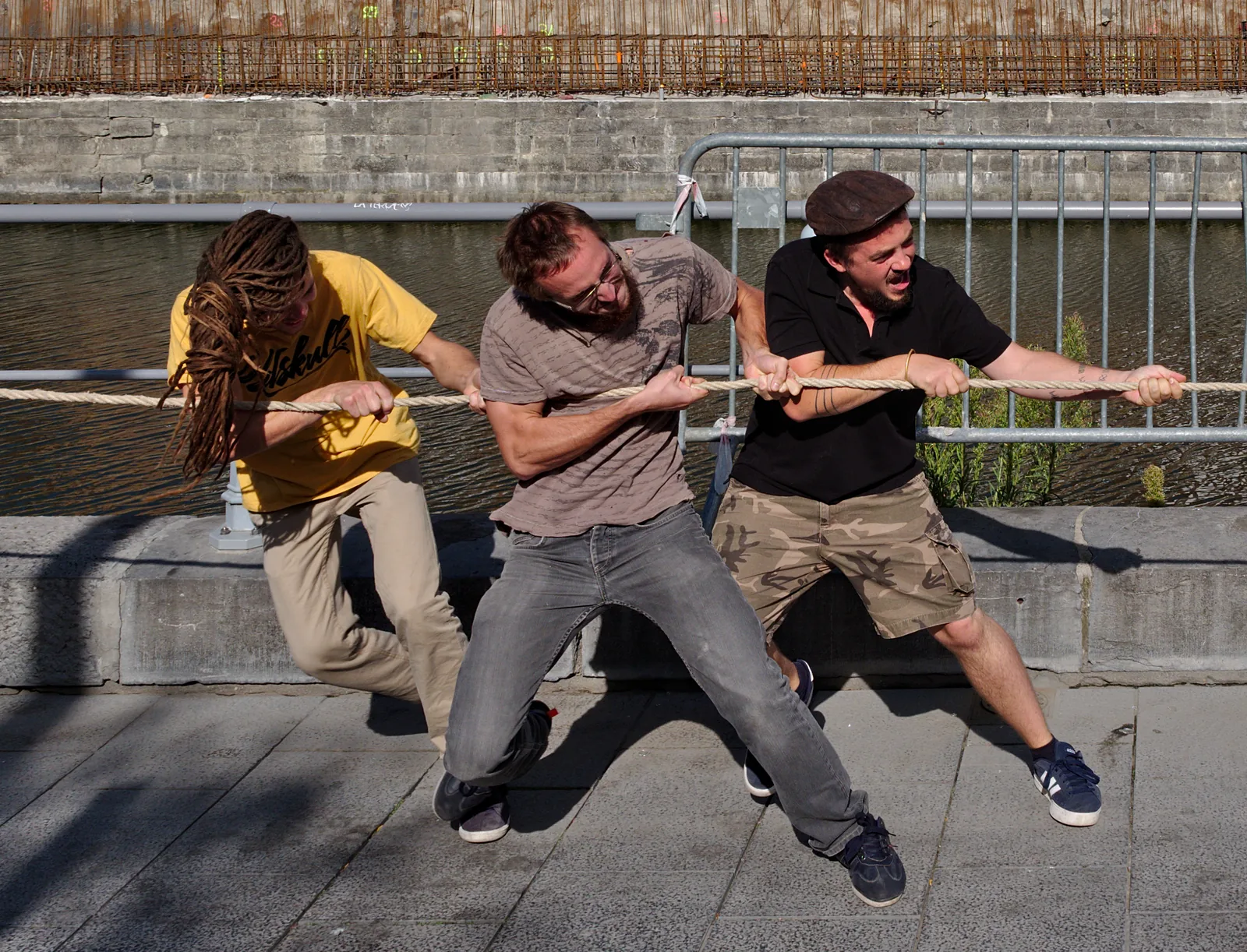
Everyday experience seems to say otherwise, because on Earth friction and air resistance slow down almost everything that moves. A bicycle stops when you stop pedalling because the road and the air brake it, not because the "force of motion" has been used up. The smaller the friction, the longer the motion continues: further on ice than on asphalt, and in space almost without limit.
Action and reaction
When skater A pushes skater B, both start to glide away from each other. B does not just receive the push, but acts on A at the same time. An interaction always works in both directions. This is Newton's third law, the law of action and reaction: when object A exerts a force on object B, B exerts an equally large but oppositely directed force on A. The two forces form an action–reaction pair. A force and its reaction force arise in the same interaction at the same time, and they are of the same kind: push and counter-push, attraction and counter-attraction.

An adult and a child receive an equally large force from each other, although the adult is much heavier. The child still starts moving with a greater speed, because the same force changes the motion of the smaller mass more; we return to this in the chapter Newton's second law. The most important point is that a force and its reaction force act on different objects. That is why they never cancel each other, and why they are not drawn in the force diagram of the same object.
Newton's first and third laws
Newton's first law is a condition for the sum of the forces acting on an object:
$$\Sigma\overline{F} = \overline{0} \ \Leftrightarrow\ \overline{v} = \text{constant}$$
where $\Sigma\overline{F}$ is the vector sum of the forces acting on the object, the net force (N), and $\overline{v}$ is the velocity of the object (m/s). Constant velocity means that both the magnitude and the direction of the velocity stay the same; rest, $\overline{v} = \overline{0}$, is also constant velocity.
A net force of zero does not mean that there are no forces, but that they cancel each other. On a car driving along a straight road at constant velocity, the weight and the normal force of the road act in the vertical direction, and the force of the road on the tyres forwards and the air resistance backwards. Because the velocity does not change, the forward force is as large as the air resistance when rolling resistance is ignored.
Newton's third law is written for the forces between two objects:
$$\overline{F}_{AB} = -\overline{F}_{BA}$$
where $\overline{F}_{AB}$ is the force with which object A acts on object B (N), and $\overline{F}_{BA}$ is the force with which B acts on A (N). The minus sign tells that the forces are opposite in direction; the magnitudes are the same, $F_{AB} = F_{BA}$.
In calculations the magnitude of the weight is often needed:
$$G = mg$$
where $G$ is the weight (N), $m$ is the mass of the object (kg) and $g = 9.81\,\text{m/s}^2$ is the acceleration due to gravity. The reaction force of the weight is the equally large gravitational force of the object on the Earth.
Common misconception
Many people think that a force must act on a moving object in the direction of motion and that the motion ends when this force "wears out". According to the first law this is not so: no force acts forwards on a sliding curling stone, and it slows down only because of friction. Another common error is to think that a force and its reaction force cancel each other. They act on different objects: a horse pulls a cart and the cart pulls the horse, but the motion of the cart is decided only by the forces acting on the cart. A third error is to take the weight of a book resting on a table and the normal force of the table as a force and its reaction force. They are equally large because of the first law. The reaction force of the normal force is the force of the book on the table, and the reaction force of the weight is the gravitational force of the book on the Earth.
Summary
- A force describes the interaction of two objects. Every force has a cause, another object, and the unit of force is the newton.
- Newton's first law: if the net force is zero, the object stays at rest or moves in a straight line at constant velocity.
- A force is needed to change motion, not to keep it going. In everyday life motion slows down because of friction and air resistance.
- Newton's third law: $\overline{F}_{AB} = -\overline{F}_{BA}$. A force and its reaction force are equally large, opposite in direction and of the same kind, and they act on different objects, so they do not cancel each other.
Optional Return to your predictions
Compare your predictions with the results of the experiment and the graph. Which of your ideas was right, and which would you change? Return also to the curling stone at the beginning: why does it slide, and what happens to each stone in the collision?
Would you change your prediction?
Apply
Worked example
Problem
A passenger aircraft flies horizontally in a straight line at a constant velocity of $850\,\text{km/h}$. Each of its two jet engines pushes air and exhaust gases backwards with a force of $48\,\text{kN}$. How large is the air resistance on the aircraft?
Step 1/7
Given and asked. The force of one engine on the gases is $F_1 = 48\,\text{kN}$ backwards, there are two engines, and the velocity $850\,\text{km/h}$ stays the same in magnitude and direction. We are asked for the air resistance $F_\text{d}$.
Step 2/7
Principle. By Newton's third law the gases push each engine forwards with an equally large force $F_1$; this is the thrust of the engine. The aircraft flies straight at constant velocity, so by Newton's first law its net force is zero. In the horizontal direction only two thrusts $\overline{F}_1$ and $\overline{F}_2$ act forwards on the aircraft (both $48\,\text{kN}$), and the air resistance $\overline{F}_\text{d}$ acts backwards, so they cancel each other. In the vertical direction the lift of the wings and the weight cancel each other. In the force diagram the aircraft is a rectangle and the forces acting on it are arrows:
Step 3/7
Formula solved. Choose the forward direction as positive and solve the air resistance:
$$\begin{aligned} \Sigma F_x &= 2F_1 - F_\text{d} = 0 \\ F_\text{d} &= 2F_1 \end{aligned}$$
Step 4/7
Unit conversions. The velocity $850\,\text{km/h}$ is not needed: it is enough to know that it does not change. The forces are in kilonewtons, so the result is obtained directly in kilonewtons: $48\,\text{kN} = 48\,000\,\text{N}$.
Step 5/7
Substitution. Substitute the force of the engine with its unit:
$$\begin{aligned} F_\text{d} &= 2F_1 \\ &= 2\cdot 48\,\text{kN} \\ &= 96\,\text{kN} \end{aligned}$$
Step 6/7
Result. The air resistance is $96\,\text{kN}$, or $9.6\cdot 10^{4}\,\text{N}$, and it points backwards. The precision is two significant figures like the force of the engine $48\,\text{kN}$.
Step 7/7
Reasonableness. If the air resistance were smaller than the thrusts, the net force would point forwards and the aircraft would accelerate; if it were larger, the aircraft would slow down. Constant velocity is possible only when the air resistance is as large as the sum of the thrusts $2\cdot 48\,\text{kN}$. The result does not depend on the magnitude of the velocity: the same reasoning holds for all constant velocities.
Optional Find the error
Apply to a new situation
A car pulls a trailer along a straight road at constant velocity. The air resistance $420\,\text{N}$ and the rolling resistance $260\,\text{N}$ act backwards on the trailer.
With what force does the trailer pull the tow hook of the car? Answer in newtons.
Hint 1: a guiding question
First choose the trailer as the object. Which horizontal forces act on it, and what does the constant velocity tell about their sum?
Hint 2: what is the connection
On the trailer, the forward force of the tow hook is as large as the resistances together. The force asked for, however, acts on the car: which law connects these two forces?
Hint 3: an intermediate step
By Newton's third law the trailer pulls the hook backwards with the same force as the hook pulls the trailer forwards: $420\,\text{N} + 260\,\text{N}$.
Show the solution
Given
air resistance of the trailer $F_\text{d} = 420\,\text{N}$ and rolling resistance $F_\text{r} = 260\,\text{N}$ backwards, the velocity is constant and the road is straight
Find
the force of the trailer on the tow hook of the car $F_{\text{TC}}$ in $\text{N}$
Principle
The trailer moves in a straight line at constant velocity, so by Newton's first law its net force is zero: the forward force $F_{\text{CT}}$ of the tow hook is as large as the resistances together. By Newton's third law the trailer pulls the hook backwards with an equally large force.
Force diagram
Choose the trailer as the object and draw it as a rectangle. Three forces act on it in the horizontal direction: the force of the tow hook $\overline{F}_{\text{CT}}$ forwards, and the air resistance $\overline{F}_\text{a}$ and rolling resistance $\overline{F}_\text{r}$ backwards. In the vertical direction there are also the weight and the normal force of the road, which cancel each other. The force of the car on the hook does not belong in the force diagram of the trailer, because it acts on the car. The positive direction is forwards.
Formula
$F_{\text{TC}} = F_{\text{CT}}$, so $F_{\text{TC}} = F_\text{d} + F_\text{r}$
Conversions
The forces are in newtons, so no conversions are needed.
Substitution
Answer
$680\,\text{N}$
Backwards, to the nearest ten newtons like the given forces.
Reasonableness
If the hook pulled the trailer more weakly than $680\,\text{N}$, the resistances would slow it down, and if it pulled harder, the trailer would accelerate. The force of the road on the wheels of the car must cancel, in addition to the car's own air resistance and rolling resistance, this $680\,\text{N}$ as well, so the trailer increases fuel consumption.
Check your understanding
Exit ticket
Answer on your own first and only then open the answer.
- A space probe travels far from stars and planets with its engine switched off. Is a force needed for the probe to keep going?
Answer
No. When no forces act on the probe, by Newton's first law it continues in a straight line at the same velocity. An engine is needed only when the magnitude or the direction of the velocity is to be changed.
- A mosquito hits the windscreen of a moving car. Which one experiences the larger force in the collision, the mosquito or the car?
Answer
The forces are equally large and opposite in direction, because they belong to the same interaction (Newton's third law). The consequences are different: the motion of the light mosquito changes drastically, but the motion of the heavy car hardly changes at all.
1. Concept
2. Action and reaction
3. Draw it yourself
A lamp hangs at rest from the ceiling on a vertical cord. Draw the force diagram of the lamp on paper: the lamp as a rectangle and each force from its point of application. Optional extension: then write next to each force its reaction force, that is, which object acts on which object and in which direction.
Model diagram
The Earth and the cord act on the lamp. The gravitational force of the Earth, the weight $\overline{G}$, points down from the centre, and the tension of the cord $\overline{T}$ points up along the cord from the point of attachment. The lamp is at rest, so by the first law the forces cancel each other and the arrows are equally long. The reaction force of the weight is the equally large gravitational force of the lamp on the Earth, pointing up, and the reaction force of the tension is the force of the lamp on the cord, pointing down. Neither reaction force acts on the lamp, so they do not belong in its force diagram. The weight and the tension are not a force and its reaction force, although they are equally large and opposite in direction: they act on the same object and belong to different interactions.
Assess your own answer
Tick the points your own answer already contains.
Review the theory summary and practise with the exercises.
Review the chapter's concepts
Cards you mark Review later collect in your review deck.
- Interaction
- Something between two objects in which they can change each other's motion or shape.
- Force
- Describes the strength of an interaction; its unit is the newton.
- Newton's first law
- An object keeps its state of motion if the net force on it is zero; the law of inertia.
- Inertia
- The property of an object to resist a change in its state of motion.
- Newton's third law
- In an interaction the objects exert equal but opposite forces on each other.
- Action and reaction
- Two equal and opposite forces acting on different objects in the same interaction.
Exercises
Level 1 · basic practice 8 exercises
One formula or one step of reasoning. Core exercises first, the rest is extra practice.
- Exercise 4-1Core
A ceiling lamp hangs at rest from a vertical cord. The weight of the lamp is $18\,\text{N}$.
How large is the tension of the cord on the lamp?
Answer
$18\,\text{N}$
Show the solution
Given
weight of the lamp $G = 18\,\text{N}$, the lamp is at rest
Find
the tension of the cord $T$ in $\text{N}$
Principle
The lamp is at rest, so by Newton's first law the sum of the forces acting on it is zero. Only the Earth and the cord act on the lamp.
Force diagram
The lamp as a rectangle, positive direction up. The weight $\overline{G}$ down from the centre and the tension of the cord $\overline{T}$ up from the top surface, equally long.
Formula
$T - G = 0$, so $T = G$
Conversions
The weight is in newtons, so no conversions are needed.
Substitution
$T = G = 18\,\text{N}$
Answer
$18\,\text{N}$
Two significant figures like the weight $18\,\text{N}$.
Reasonableness
If the cord pulled with less than $18\,\text{N}$, the weight would win and the lamp would start to move downwards; if with more, upwards. Staying at rest requires a force exactly as large as the weight. The cord acts on the lamp upwards, because a cord can only pull.
- Exercise 4-2Core
In a tug of war the rope is at rest. Team A pulls the rope to the left with a force of $850\,\text{N}$. The weight of the rope is ignored.
With what force does team B pull the rope to the right?
Answer
$850\,\text{N}$
Show the solution
Given
force of team A on the rope $F_A = 850\,\text{N}$ to the left, the rope is at rest, the weight of the rope is ignored
Find
the force of team B on the rope $F_B$ in $\text{N}$
Principle
The rope is at rest, so by Newton's first law the sum of the forces acting on it is zero. In the horizontal direction only the pulls of the teams act on the rope.
Force diagram
The rope as a long rectangle, positive direction to the right. The pull of team A $\overline{F}_A$ from the left end of the rope to the left and the pull of team B $\overline{F}_B$ from the right end to the right.
Formula
$F_B - F_A = 0$, so $F_B = F_A$
Conversions
The force is in newtons, so no conversions are needed.
Substitution
$F_B = F_A = 850\,\text{N}$
Answer
$850\,\text{N}$
Three significant figures like the force $850\,\text{N}$.
Reasonableness
If B pulled more weakly, the rope would start to move to the left. A tug of war is won by the team that gets a larger friction force from the ground on its feet, not by the team that pulls the rope harder: the rope pulls both teams with an equally large force.
- Exercise 4-3
A skater stands on the ice and pushes the boards of the rink with their hands with a force of $90\,\text{N}$.
With what force do the boards push the skater?
Answer
$90\,\text{N}$
Show the solution
Given
force of the skater on the board $F_{\text{SB}} = 90\,\text{N}$ towards the board
Find
the force of the board on the skater $F_{\text{BS}}$ in $\text{N}$
Principle
Newton's third law: the skater and the board interact, so the board acts on the skater with an equally large but oppositely directed force. The law holds regardless of whether either of them moves.
Force diagram
Choose the skater as the object and draw the skater as a rectangle; the positive direction is away from the board. The skater's weight acts down, the normal force of the ice up and the force of the board $\overline{F}_{\text{BS}}$ away from the board, ending at the skater's side. The skater's own force on the board $\overline{F}_{\text{SB}}$ acts on the board, so it does not belong in the skater's diagram but is the reaction force of the force asked for.
Formula
$\overline{F}_{\text{BS}} = -\overline{F}_{\text{SB}}$, so in magnitudes $F_{\text{BS}} = F_{\text{SB}}$
Conversions
The force is in newtons, so no conversions are needed.
Substitution
$F_{\text{BS}}$$= F_{\text{SB}}$$= 90\,\text{N}$Answer
$90\,\text{N}$
On the skater, directed away from the board, two significant figures like the force $90\,\text{N}$.
Reasonableness
The skater starts to glide away from the board, so a force away from the board has acted on the skater. Its cause is the board. The board does not move, because it is fixed to the ice and the structures of the rink, which act on it with their own forces.
- Exercise 4-4
A car drives along a straight road at constant velocity. The road pushes the driving wheels of the car forwards with a force of $620\,\text{N}$, and the air resistance on the car is $380\,\text{N}$. In addition, rolling resistance acts backwards on the car.
How large is the rolling resistance?
Answer
$240\,\text{N}$
Show the solution
Given
force of the road on the tyres forwards $F = 620\,\text{N}$, air resistance $F_\text{d} = 380\,\text{N}$, the velocity is constant and the road is straight
Find
the rolling resistance $F_\text{r}$ in $\text{N}$
Principle
The car moves in a straight line at constant velocity, so by Newton's first law the net force is zero also in the direction of motion: the forces acting forwards and backwards are equally large.
Force diagram
The car as a rectangle, positive direction forwards. In the horizontal direction the force of the road $\overline{F}$ forwards, and the air resistance $\overline{F}_\text{d}$ and rolling resistance $\overline{F}_\text{r}$ backwards. In the vertical direction the weight and the normal force of the road cancel each other.
Formula
$F - F_\text{d} - F_\text{r} = 0$, so $F_\text{r} = F - F_\text{d}$
Conversions
The forces are in newtons, so no conversions are needed.
Substitution
$F_\text{r}$$= 620\,\text{N} - 380\,\text{N}$$= 240\,\text{N}$Answer
$240\,\text{N}$
To the nearest ten newtons like the given forces, so two significant figures.
Reasonableness
The sum of the resistances $380\,\text{N} + 240\,\text{N} = 620\,\text{N}$ is as large as the force driving forwards, so the velocity does not change. The rolling resistance is smaller than the air resistance, which fits motorway speeds, at which air resistance is the largest resistance on a car.
- Exercise 4-5
A book of mass $0.65\,\text{kg}$ rests on a table. The Earth pulls the book with a force equal to its weight.
With what force does the book pull the Earth?
Answer
$6.4\,\text{N}$
Show the solution
Given
mass of the book $m = 0.65\,\text{kg}$, the force of the Earth on the book is the weight of the book; $g = 9.81\,\text{m/s}^2$
Find
the force of the book on the Earth $F$ in $\text{N}$
Principle
The Earth and the book pull each other. By Newton's third law the book pulls the Earth with an equally large force as the Earth pulls the book, but in the opposite direction, that is, upwards. The force of the Earth on the book is the weight $G = mg$.
Force diagram
Choose the book as the object and draw it as a rectangle; the positive direction is up. The weight $\overline{G}$ acts down from the centre and the normal force of the table $\overline{N}$ up from the bottom surface. The weight is the force of the Earth on the book, and its reaction force is the force $\overline{F}$ of the book on the Earth, which acts on the Earth and does not belong in the diagram of the book.
Formula
$F = G$ and $G = mg$, so $F = mg$
Conversions
The mass is in kilograms, so no conversions are needed.
Substitution
$F$$= 0.65\,\text{kg}\cdot 9.81\,\text{m/s}^2$$= 6.3765\,\text{N}$Answer
$6.4\,\text{N}$
Upwards towards the book, two significant figures like the mass $0.65\,\text{kg}$.
Reasonableness
The weight of a kilogram is about $10\,\text{N}$, so the weight of a book of $0.65\,\text{kg}$ is about $6\,\text{N}$. The Earth does not noticeably move because of this force, since its mass is enormous. The normal force of the table is not the reaction force of the weight, but belongs to the interaction between the book and the table.
- Exercise 4-6
An ice hockey puck slides straight at constant velocity on very slippery ice. Friction and air resistance can be ignored.
Which statement about the forces acting on the puck is correct?
Answer
The net force is zero, because the speed and direction of the puck stay the same
Show the solution
Find
which statement about the forces acting on the puck is correct when the puck slides at constant velocity and there is no friction or air resistance.
Principle
By Newton’s first law the velocity of an object stays the same if and only if the net force is zero. A force is needed to change the velocity, not to maintain it.
Model answer
The speed and direction of the puck stay the same, so the net force is zero. In the vertical direction the weight and the normal force of the ice cancel each other, and in the horizontal direction no force acts, because friction and air resistance are missing. A forward-pushing force is not needed and there is none: the force of the hit ended when the stick left the puck. If the net force pointed in the direction of motion, the puck would speed up, and if backwards, it would slow down.
- Exercise 4-7
A book rests on a horizontal table. The table supports the book with an upward force.
Which force is the reaction force of this normal force according to Newton’s third law?
Answer
The force of the book on the table, because the normal force is an interaction between the book and the table
Show the solution
Find
which force is the reaction force of the normal force that the table exerts on the book.
Principle
By Newton’s third law, in an interaction each party acts on the other with an equally large and oppositely directed force. The reaction force therefore acts on a different object than the original force and is of the same kind.
Model answer
The normal force is the force of the table on the book, so its reaction force is the force of the book on the table: the book presses the table down. The weight of the book is not the reaction force, because it acts on the same object as the normal force; they are equally large because the book is at rest (first law). The pull of the Earth on the book is the weight of the book and belongs to the interaction between the Earth and the book. The weight of the table on the floor belongs to the interaction between the table and the floor.
- Exercise 4-8
A child pulls a sled horizontally with a rope, and the sled moves straight at constant velocity. The child pulls the rope with a force of $38\,\text{N}$. The weight of the rope is ignored.
With what force does the rope pull the child?
Answer
$38\,\text{N}$
Show the solution
Given
force of the child on the rope $F = 38\,\text{N}$, the sled moves at constant velocity, the weight of the rope is ignored
Find
the force of the rope on the child $F_\text{RC}$ in $\text{N}$
Principle
By Newton’s third law the child and the rope interact, so the rope pulls the child with an equally large but oppositely directed force as the child pulls the rope. The law holds even though the sled moves at constant velocity.
Force diagram
Choose the child as the object and draw the child as a rectangle. The force of the rope $\overline{F}_\text{RC}$ points from the child towards the sled, that is, against the child, and the child’s own force on the rope acts on the rope and does not belong in the child’s diagram.
Formula
$\overline{F}_\text{RC} = -\overline{F}_\text{CR}$, so in magnitudes $F_\text{RC} = F_\text{CR}$
Conversions
The force is in newtons, so no conversions are needed.
Substitution
$F_\text{RC}$$= F_\text{CR}$$= 38\,\text{N}$Answer
$38\,\text{N}$
Towards the sled, two significant figures like the force $38\,\text{N}$.
Reasonableness
The motion of the sled does not affect the magnitudes of the forces: the same $38\,\text{N}$ would result if the sled were at rest. The constant velocity only tells that the force of the rope on the sled is as large as the resistance acting on the sled, $38\,\text{N}$.
Level 2 · applied practice 7 exercises
Two steps, working with measured data, a unit conversion or rearranging a formula. Core exercises first, the rest is extra practice.
- Exercise 4-9Core
On a table there is a book of weight $8.0\,\text{N}$ and on top of it another book of weight $5.0\,\text{N}$. The books are at rest.
With what force does the lower book press the table?
Answer
$13\,\text{N}$
Show the solution
Given
weight of the lower book $G_1 = 8.0\,\text{N}$, weight of the upper book $G_2 = 5.0\,\text{N}$, the books are at rest
Find
the force of the lower book on the table $F$ in $\text{N}$
Principle
The upper book is at rest, so the lower book supports it with a force $G_2$ (first law), and by the third law the upper book presses the lower one down with an equally large force. The lower book is also at rest, so the normal force of the table on it is as large as the downward forces together. Finally, the lower book presses the table with a force as large as the normal force (third law).
Force diagram
The lower book as a rectangle, positive direction up. The weight $\overline{G}_1$ down from the centre, the force of the upper book $\overline{F}_2$ down from the top surface and the normal force of the table $\overline{N}$ up from the bottom surface.
Formula
$N - G_1 - F_2 = 0$ and $F_2 = G_2$, so $F = N = G_1 + G_2$
Conversions
The forces are in newtons, so no conversions are needed.
Substitution
$F$$= 8.0\,\text{N} + 5.0\,\text{N}$$= 13\,\text{N}$Answer
$13\,\text{N}$
Downwards. The sum is to the nearest tenth of a newton like the weights $8.0\,\text{N}$ and $5.0\,\text{N}$, so it has two significant figures.
Reasonableness
The table supports both books, so it must support their combined weight. The upper book does not touch the table, however: its weight is transmitted to the table through the lower book as a chain of force pairs.
- Exercise 4-10Core
A swimmer swims straight in the horizontal direction at constant velocity. The swimmer's weight is $720\,\text{N}$ and the buoyancy of the water is equally large. She pushes the water backwards with the hands and feet with an average force of $65\,\text{N}$.
How large is the average drag of the water on the swimmer?
Answer
$65\,\text{N}$
Show the solution
Given
force of the swimmer on the water $F_{\text{SW}} = 65\,\text{N}$ backwards, weight of the swimmer $720\,\text{N}$ and an equally large buoyancy of the water, the swimmer swims straight in the horizontal direction at constant velocity
Find
the drag of the water on the swimmer $F_\text{d}$ in $\text{N}$
Principle
By the third law the water pushes the swimmer forwards with an equally large force $F_{\text{WS}} = 65\,\text{N}$; this force moves the swimmer forwards. The swimmer moves at constant velocity, so by the first law the sum of the horizontal forces is zero. The weight and the buoyancy are vertical and do not affect the horizontal equilibrium, so they are not needed: the drag of the water backwards is as large as the push of the water forwards.
Force diagram
The swimmer as a rectangle, positive direction forwards. The push of the water $\overline{F}_{\text{WS}}$ forwards and the drag of the water $\overline{F}_\text{d}$ backwards. In the vertical direction the buoyancy and the weight cancel each other.
Formula
$F_{\text{WS}} - F_\text{d} = 0$ and $F_{\text{WS}} = F_{\text{SW}}$, so $F_\text{d} = F_{\text{SW}}$
Conversions
The force is in newtons, so no conversions are needed.
Substitution
$F_\text{d}$$= F_{\text{SW}}$$= 65\,\text{N}$Answer
$65\,\text{N}$
Backwards, two significant figures like the force $65\,\text{N}$.
Reasonableness
The swimmer moves forwards only because the water pushes the swimmer; without a reaction force, pulling with the hands would not move the swimmer anywhere. If the swimmer pushed the water harder, the forward force would increase and she would accelerate until the drag grew equally large.
- Exercise 4-11
A skydiver whose mass with equipment is $85\,\text{kg}$ descends straight down at constant velocity with the parachute open.
How large is the air resistance on the skydiver and the parachute together?
Answer
$830\,\text{N}$
Show the solution
Given
mass with equipment $m = 85\,\text{kg}$, the velocity is constant and straight down; $g = 9.81\,\text{m/s}^2$
Find
the air resistance $F_\text{d}$ in $\text{N}$
Principle
The skydiver descends in a straight line at constant velocity, so by Newton's first law the net force is zero. The Earth (weight, down) and the air (resistance, up, against the motion) act on the skydiver.
Force diagram
The skydiver and the parachute as a rectangle, positive direction up. The weight $\overline{G}$ down from the centre and the air resistance $\overline{F}_\text{d}$ up, equally long. The velocity, directed down, is drawn separately and is not a force.
Formula
$F_\text{d} - G = 0$ and $G = mg$, so $F_\text{d} = mg$
Conversions
The mass is in kilograms, so no conversions are needed.
Substitution
$F_\text{d}$$= 85\,\text{kg}\cdot 9.81\,\text{m/s}^2$$= 833.85\,\text{N}$Answer
$830\,\text{N}$
Or $8.3\cdot 10^{2}\,\text{N}$, upwards, two significant figures like the mass $85\,\text{kg}$.
Reasonableness
The weight of $85\,\text{kg}$ is about $850\,\text{N}$, and the air resistance is equally large. Motion downwards does not require a net force downwards: the skydiver moves down because of inertia, and the forces are in balance.
- Exercise 4-12
The weight of an elevator car is $5.8\,\text{kN}$, and the car contains passengers whose total mass is $320\,\text{kg}$. The elevator rises at constant velocity.
How large is the tension of the cable on the car? Answer in kilonewtons.
Answer
$8.9\,\text{kN}$
Show the solution
Given
weight of the car $G_\text{c} = 5.8\,\text{kN}$, mass of the passengers $m = 320\,\text{kg}$, the elevator rises at constant velocity; $g = 9.81\,\text{m/s}^2$
Find
the tension of the cable $T$ in $\text{kN}$
Principle
The car and the passengers move together at constant velocity, so by the first law the sum of the forces acting on them is zero. When the car and the passengers are thought of as one object, the cable supports their combined weight.
Force diagram
The car with the passengers as a rectangle, positive direction up. The tension of the cable $\overline{T}$ up from the top surface, and the weight of the car $\overline{G}_\text{c}$ and the weight of the passengers $\overline{G}_\text{p}$ down.
Formula
$T - G_\text{c} - mg = 0$, so $T = G_\text{c} + mg$
Conversions
$5.8\,\text{kN} = 5800\,\text{N}$; at the end the newtons are converted to kilonewtons by dividing by $1000$.
Substitution
$T$$= 5800\,\text{N} + 320\,\text{kg}\cdot 9.81\,\text{m/s}^2$$= 5800\,\text{N} + 3139.2\,\text{N}$$= 8939.2\,\text{N}$Answer
$8.9\,\text{kN}$
Two significant figures like the weight of the car $5.8\,\text{kN}$.
Reasonableness
The weight of the passengers is about $3\,\text{kN}$, and $5.8\,\text{kN} + 3\,\text{kN} \approx 9\,\text{kN}$. In steady rising the tension is exactly the same as in an elevator standing still, because the velocity does not change.
- Exercise 4-13
A student pulls a rope whose other end is attached to a wall. Force sensor A is at the student’s end and force sensor B at the wall end. The rope is at rest throughout the measurement, and its weight is ignored. The table gives example data of the sensor readings.
With what force does the wall pull the rope at the moment when sensor A shows its largest reading? Justify your answer with Newton’s laws. The answer box takes the magnitude of the force.
Readings of the force sensors at the ends of the rope (example data) $t\,(\text{s})$ $F_\text{A}\,(\text{N})$ $F_\text{B}\,(\text{N})$ 0.0 0.9 1.0 0.5 2.6 2.5 1.0 4.8 4.8 1.5 3.4 3.5 2.0 1.2 1.1 Answer
$4.8\,\text{N}$
Show the solution
Given
the rope is at rest; from the table the largest reading of sensor A is $F_\text{A} = 4.8\,\text{N}$ at $t = 1.0\,\text{s}$, when sensor B shows $4.8\,\text{N}$
Find
the force of the wall on the rope $F_\text{W}$ in $\text{N}$ at the moment when $F_\text{A}$ is largest
Principle
The rope is at rest, so by the first law the sum of the forces acting on it is zero: the force of the wall on the rope is as large as the force of the student on the rope. By the third law the rope pulls sensor A and the wall with forces as large as they pull the rope, so the readings of the sensors are equally large at every moment.
Reading the graph
From the table we read the row where $F_\text{A}$ is largest: $t = 1.0\,\text{s}$, $F_\text{A} = 4.8\,\text{N}$. On the same row $F_\text{B} = 4.8\,\text{N}$. On the other rows the readings differ by at most $0.1\,\text{N}$, which is random variation of the measurement, not a physical difference.
Formula
$F_\text{W} - F_\text{A} = 0$, so $F_\text{W} = F_\text{A}$
Conversions
The forces are in newtons, so no conversions are needed.
Substitution
$F_\text{W}$$= F_\text{A}$$= 4.8\,\text{N}$Answer
$4.8\,\text{N}$
Two significant figures like the readings in the table.
Reasonableness
At all five moments the readings of the sensors differ by at most $0.1\,\text{N}$, while the readings vary between $0.9\,\text{N}$ and $4.8\,\text{N}$. The differences vary in direction, so they are random measurement variation: both ends of a light rope pull with an equally large force at every moment.
- Exercise 4-14
On an air track a cart glides straight with almost no friction. No horizontal force acts on the cart except a very small air resistance. A motion sensor measured the velocity of the cart. The table gives example data of the measurement.
a) Justify with Newton’s first law why no forward-pushing force needs to act on the cart.
b) Calculate the mean of the velocity over the measurement and use it to find the distance travelled by the cart in $6.0\,\text{s}$.
The answer box takes the distance of part b).
Velocity of a cart on an air track (example data) $t\,(\text{s})$ $v\,(\text{m/s})$ 0.0 0.51 1.0 0.50 2.0 0.49 3.0 0.50 4.0 0.51 5.0 0.49 Answer
$3.0\,\text{m}$
Show the solution
Given
from the table the velocities $0.51$; $0.50$; $0.49$; $0.50$; $0.51$ and $0.49\,\text{m/s}$, time $\Delta t = 6.0\,\text{s}$
Find
a) why a forward-pushing force is not needed; b) the distance $s$ travelled by the cart in $\text{m}$
Principle
By Newton’s first law an object moves at constant velocity when the net force is zero, and no force is needed to maintain motion. The velocity is almost the same in all readings, so the motion is uniform and the distance is the product of the velocity and the time.
Reading the graph
From the table we see that the velocity stays between $0.49$ and $0.51\,\text{m/s}$ and neither increases nor decreases. The variation is random variation of the measurement. The mean velocity $v_\text{av}$ describes the constant velocity.
Formula
$v_\text{av} = \dfrac{\Sigma v}{n}$ and $s = v_\text{av}\,\Delta t$
Conversions
The velocity is in $\text{m/s}$ and the time in seconds, so no conversions are needed.
Substitution
The sum of the velocities is $3.00\,\text{m/s}$ and there are $6$ readings, so
$v_\text{av}$$= \dfrac{3.00\,\text{m/s}}{6}$$= 0.500\,\text{m/s}$The distance is
$s$$= 0.500\,\text{m/s}\cdot 6.0\,\text{s}$$= 3.0\,\text{m}$Answer
a) The velocity does not change, so the net force is zero: the air resistance is very small and in the vertical direction the weight and the normal force cancel each other, so a forward-pushing force is not needed. b) $3.0\,\text{m}$, two significant figures like the time $6.0\,\text{s}$.
Reasonableness
The velocity is about $0.5\,\text{m/s}$, so in $6\,\text{s}$ the cart travels about $3\,\text{m}$. The track must therefore be at least this long.
- Exercise 4-15
A student reasons: “When a fist hits a wall, the wall pushes the fist back with an equally large force. The forces are opposite and equally large, so they cancel each other and the motion of the fist does not change.”
What is the error in the student’s reasoning?
Answer
The forces act on different objects, so the force of the wall slows down the fist
Show the solution
Find
what the error in the student’s reasoning is.
Principle
The force and the reaction force of Newton’s third law are equally large and oppositely directed, but they act on different objects. The motion of an object is decided only by the sum of the forces acting on that object itself.
Model answer
The student considers two forces, the force of the fist on the wall and the force of the wall on the fist, but they act on different objects. The force of the fist on the wall acts on the wall, so it does not cancel anything acting on the fist. The force of the wall acts on the fist, and it is against the motion of the fist, so the fist slows down and stops. The forces are nevertheless equally large even though the wall does not move, and they appear at the same time. No force is needed to maintain motion.
Level 3 · challenging 5 exercises
Optional: application, two ideas together or a new situation where you reason for yourself.
- Exercise 4-16
A hot-air balloon descends straight down at constant velocity. The combined weight of the balloon, the hot air inside it, the basket and the passengers is $4.62\,\text{kN}$, and the buoyancy of the surrounding air is $4.35\,\text{kN}$.
How large is the air resistance on the balloon, and in which direction does it point? Give the magnitude in kilonewtons and the direction in words; only the magnitude is checked.
Answer
$0.27\,\text{kN}$
Show the solution
Given
combined weight $G = 4.62\,\text{kN}$, buoyancy $F_\text{b} = 4.35\,\text{kN}$, the balloon descends straight down at constant velocity
Find
the air resistance $F_\text{d}$ in $\text{kN}$ and its direction
Principle
The balloon moves at constant velocity, so by the first law the net force is zero. Air resistance opposes the motion, and the balloon moves down, so the resistance points up. The buoyancy alone is not enough to cancel the weight, so the air resistance supports the rest.
Force diagram
The balloon with its basket as a rectangle, positive direction up. The weight $\overline{G}$ down from the centre, the buoyancy $\overline{F}_\text{b}$ up and the air resistance $\overline{F}_\text{d}$ up. The velocity down is drawn separately and is not a force.
Formula
$F_\text{b} + F_\text{d} - G = 0$, so $F_\text{d} = G - F_\text{b}$
Conversions
All forces are in kilonewtons and the answer is asked in kilonewtons, so no conversions are needed.
Substitution
$F_\text{d}$$= 4.62\,\text{kN} - 4.35\,\text{kN}$$= 0.27\,\text{kN}$Answer
$0.27\,\text{kN}$
Upwards. The difference has two significant figures, because the given forces are to the nearest hundredth of a kilonewton.
Reasonableness
If there were no air resistance, the difference of $0.27\,\text{kN}$ between the weight and the buoyancy, directed down, would change the motion of the balloon and it would descend faster and faster. Steady descent means that the air resistance has grown exactly as large as this difference. The air resistance points up, although the motion is down.
- Exercise 4-17
Two identical ring magnets are threaded onto a vertical wooden stick standing on a table. The magnets repel each other, and the upper one floats at rest above the lower one without touching it. The weight of each magnet is $0.30\,\text{N}$, and friction against the stick is ignored.
With what force does the table support the lower magnet? The force of the stick is ignored.
Answer
$0.60\,\text{N}$
Show the solution
Given
weight of each magnet $G = 0.30\,\text{N}$, the upper magnet floats at rest, friction and the force of the stick are ignored
Find
the normal force of the table on the lower magnet $N$ in $\text{N}$
Principle
The upper magnet is at rest, so the repulsion of the lower magnet on it points up and is as large as its weight (first law). By the third law the upper magnet repels the lower one downwards with an equally large force, although the magnets do not touch each other. The lower magnet is at rest, so the normal force of the table cancels its weight and this force.
Force diagram
The lower magnet as a rectangle, positive direction up. The weight $\overline{G}$ down from the centre, the force of the upper magnet $\overline{F}_\text{m}$ down from the top surface and the normal force of the table $\overline{N}$ up from the bottom surface.
Formula
$N - G - F_\text{m} = 0$ and $F_\text{m} = G$, so $N = 2G$
Conversions
The forces are in newtons, so no conversions are needed.
Substitution
$N$$= 2\cdot 0.30\,\text{N}$$= 0.60\,\text{N}$Answer
$0.60\,\text{N}$
Two significant figures like the weight $0.30\,\text{N}$.
Reasonableness
The table carries the weight of both magnets, just as if the upper magnet were resting on the lower one. A floating magnet is not weightless: its weight is transmitted to the table through a magnetic pair of forces.
- Exercise 4-18
Two spring scales are hung one below the other: the upper one is attached to the ceiling, and the lower one hangs from the hook of the upper one. An apple of weight $1.5\,\text{N}$ hangs from the hook of the lower scale. The weight of the lower scale itself is $0.40\,\text{N}$. Everything is at rest.
What does the upper scale show?
Answer
$1.9\,\text{N}$
Show the solution
Given
weight of the apple $G_\text{a} = 1.5\,\text{N}$, weight of the lower scale $G_\text{s} = 0.40\,\text{N}$, everything is at rest
Find
the reading of the upper scale, that is, the force $F$ with which the lower scale pulls the hook of the upper one, in $\text{N}$
Principle
The apple is at rest, so the hook of the lower scale pulls it up with a force of $1.5\,\text{N}$ (first law), and by the third law the apple pulls the hook down with an equally large force. The lower scale is at rest, so the hook of the upper scale must pull it up by the force of the apple plus the weight of the scale itself. By the third law the lower scale pulls the upper one down with an equally large force, and this is what the upper scale shows.
Force diagram
The lower scale as a rectangle, positive direction up. The force of the hook of the upper scale $\overline{F}$ up from the top surface, the weight $\overline{G}_\text{s}$ down from the centre and the force of the apple $\overline{F}_\text{a}$ down from the bottom surface.
Formula
$F - G_\text{s} - F_\text{a} = 0$ and $F_\text{a} = G_\text{a}$, so $F = G_\text{a} + G_\text{s}$
Conversions
The forces are in newtons, so no conversions are needed.
Substitution
$F$$= 1.5\,\text{N} + 0.40\,\text{N}$$= 1.9\,\text{N}$Answer
$1.9\,\text{N}$
To the nearest tenth of a newton like the weight of the apple $1.5\,\text{N}$, so two significant figures.
Reasonableness
The lower scale shows the weight of the apple, $1.5\,\text{N}$, and the upper one also supports the lower scale, so its reading must be larger. The difference of the readings, $0.40\,\text{N}$, is exactly the weight of the lower scale.
- Exercise 4-19
A horse pulls a cart along a horizontal road straight forwards at constant velocity. The rolling resistance of the road on the cart is $410\,\text{N}$ and the air resistance on the cart is $40\,\text{N}$. The air resistance on the horse is $30\,\text{N}$. The mass of the rope is ignored. The values are example data.
a) Calculate the force of the rope on the cart.
b) Calculate the force with which the road pushes the hooves of the horse forwards. The feet of the horse do not slip on the road.
c) A student says: “The horse pulls the cart and the cart pulls the horse backwards equally hard, so they cancel each other and nothing can move.” Explain why the reasoning is wrong and what sets the horse and the cart in motion.
The answer box takes the force of part b).
Answer
$480\,\text{N}$
Show the solution
Given
rolling resistance on the cart $F_\text{r} = 410\,\text{N}$, air resistance on the cart $F_\text{dc} = 40\,\text{N}$, air resistance on the horse $F_\text{dh} = 30\,\text{N}$, the velocity is constant and straight forwards, example data
Find
a) the force of the rope on the cart $T$; b) the force of the road on the hooves of the horse $F_\text{road}$ in $\text{N}$; c) why the forces do not cancel each other
Principle
Both the cart and the horse move at constant velocity, so the net force on each is zero (first law). The cart gives the force of the rope. By the third law the cart pulls the horse backwards with a force $T$ as large as the rope pulls the cart forwards, and this is used in the equilibrium of the horse. The force of the road on the hooves is an external force that carries the pair forwards.
Force diagram
For the cart draw: the force of the rope $\overline{T}$ forwards, the rolling resistance and the air resistance backwards. For the horse: the force of the road $\overline{F}_\text{road}$ forwards, the force of the rope $\overline{T}$ and the air resistance backwards. The forces on the horse and on the cart are in different diagrams.
Formula
Cart: $T - F_\text{r} - F_\text{dc} = 0$, so $T = F_\text{r} + F_\text{dc}$. Horse: $F_\text{road} - T - F_\text{dh} = 0$, so $F_\text{road} = T + F_\text{dh}$.
Conversions
The forces are in newtons, so no conversions are needed.
Substitution
$T$$= 410\,\text{N} + 40\,\text{N}$$= 450\,\text{N}$$F_\text{road}$$= 450\,\text{N} + 30\,\text{N}$$= 480\,\text{N}$Answer
a) $450\,\text{N}$ and b) $480\,\text{N}$ forwards, two significant figures like the given forces. c) The force of the horse on the cart and the force of the cart on the horse are equally large and oppositely directed, but they act on different objects, so they do not cancel each other. The motion of the cart is decided only by the forces acting on the cart, and the motion of the horse only by the forces acting on the horse. The horse gets going because the road pushes its hooves forwards with a force that is larger than the force of the cart on the horse.
Reasonableness
The force of the road $480\,\text{N}$ is as large as the sum of all the resistances $410\,\text{N} + 40\,\text{N} + 30\,\text{N} = 480\,\text{N}$, so the whole system moves at constant velocity. The friction between the road and the hooves points forwards, because it opposes the hoof slipping backwards.
- Exercise 4-20
A student pulls a cart on a horizontal table with a rope. A force sensor in the hand at the end of the rope measures the force, and a motion sensor measures the velocity of the cart. The rope is horizontal all the time, and its mass is ignored. The table gives example data of the measurement.
a) Deduce from the table when the sum of the forces acting on the cart is zero. Justify with the first law.
b) Determine the force of friction of the table on the cart. When the velocity is constant, the forces opposing the motion of the cart are equally large as the force of the rope.
c) Explain why the reading of the sensor is at the start larger than the friction, and with what force the cart then pulls the rope.
The answer box takes the force of friction of part b).
Velocity of the cart and force of the rope (example data) $t\,(\text{s})$ $v\,(\text{m/s})$ $F\,(\text{N})$ 0.0 0.00 5.1 1.0 0.31 4.6 2.0 0.55 4.3 3.0 0.69 3.6 4.0 0.70 3.4 5.0 0.71 3.5 6.0 0.70 3.3 Answer
$3.4\,\text{N}$
Show the solution
Given
from the table the velocity and the force of the rope; at $t = 4.0\,\text{s}$, $5.0\,\text{s}$ and $6.0\,\text{s}$ the velocities are $0.70$; $0.71$ and $0.70\,\text{m/s}$ and the forces $3.4$; $3.5$ and $3.3\,\text{N}$; at the start $F = 5.1\,\text{N}$ and $v = 0$ (example data)
Find
a) when the net force is zero; b) the force of friction $F_\text{f}$ in $\text{N}$; c) why $F > F_\text{f}$ at the start
Principle
When the velocity of the cart is constant, by the first law the net force is zero, so the force of the rope and the friction are equally large. If the velocity changes, the net force is not zero. By the third law the cart pulls the rope and the student with a force as large as the rope pulls the cart.
Reading the graph
The velocity increases from $t = 0$ from $0$ to $0.69\,\text{m/s}$ and then, from $t = 4.0\,\text{s}$ on, stays almost the same, about $0.70\,\text{m/s}$. The net force is zero from $t = 4.0\,\text{s}$ on. The sensor readings at these three moments are $3.4\,\text{N}$, $3.5\,\text{N}$ and $3.3\,\text{N}$.
Formula
$F_\text{f} = F_\text{av}$ and $F_\text{av} = \dfrac{\Sigma F}{n}$
Conversions
The forces are in newtons and the velocity in $\text{m/s}$, so no conversions are needed.
Substitution
The sum of the forces is $10.2\,\text{N}$ and there are $3$ readings, so
$F_\text{f}$$= \dfrac{10.2\,\text{N}}{3}$$= 3.40\,\text{N}$Answer
b) $3.4\,\text{N}$, two significant figures like the sensor readings. a) The net force is zero from the moment the velocity is constant, that is, from the fourth second on. c) At the start the velocity increases, so the net force is not zero: the rope pulls the cart forwards more than friction opposes, and at the start the rope pulls the cart with a force of $5.1\,\text{N}$. By the third law the cart pulls the rope and the student with the same $5.1\,\text{N}$ backwards, even though the cart accelerates.
Reasonableness
The force decreases from $5.1\,\text{N}$ towards $3.4\,\text{N}$ as the acceleration ends. The friction $3.4\,\text{N}$ is smaller than the force at the start, so the cart has speeded up, and equal to the force at constant speed, so the velocity no longer changes.
Photographs
- Tug of war - seconds from victory (DSCF9121). Trougnouf (Benoit Brummer). source, CC BY 4.0
- NASA's SpaceX Crew-9 Launch (NHQ202409280010). NASA/Keegan Barber. source, public domain (NASA)
