
Hydro and wind power as energy converters
Why does the same water of the Vuoksi river give three times as much power at Imatra as at Tainionkoski? And why does the power of a wind turbine grow so much more than the wind speed?
Prior knowledge
- Potential energy is $E_\text{p} = mgh$ and kinetic energy $E_\text{k} = \tfrac{1}{2}mv^2$chapter Kinetic energy, potential energy and mechanical energy
- When only gravity does work, potential energy turns into kinetic energy and mechanical energy is conservedchapter Conservation of mechanical energy and the work–energy principle
- Power tells how fast energy is converted: $P = \tfrac{\Delta E}{\Delta t}$chapter Power
Core path: follow the steps in order. Tasks marked Optional give extra practice. Optional tasks: 3.
Think about it
The Vuoksi river, flowing out of Lake Saimaa, runs first through the Tainionkoski power plant and a few kilometres downstream through the Imatra power plant. The same water turns the turbines of both, but the power of Imatra is $192\,\text{MW}$ and that of Tainionkoski $62\,\text{MW}$. The power of a wind turbine, on the other hand, varies with the wind: in a weak wind it is small, but when the wind strengthens only a little, the power can grow many times over.
What do the powers of a hydro and a wind power plant depend on, and why does the wind speed affect the power so strongly?
Optional Review: kinetic energy
Predict
Make your predictions before investigating 2 questions
Prediction 1: wind speed and power
Prediction 2: two power plants, the same water
Investigate
Power curve of a wind turbine
Statistical data · Power curve given by the manufacturer, Vestas V82, rotor diameter $82\,\text{m}$: NREL Turbine Archive (nrel.github.io/turbine-models, file VestasV82_1.65MW_82.csv, folder turbine_models/data/Onshore), read 30 Oct 2026.
The manufacturer gives the electric power $P$ of a wind turbine at different wind speeds $v$. The table and the graph are for a turbine with a rotor diameter of $82\,\text{m}$.
| $v$ (m/s) | $P$ (kW) |
|---|---|
| $3$ | $0$ |
| $4$ | $28$ |
| $5$ | $144$ |
| $6$ | $309$ |
| $7$ | $511$ |
| $8$ | $758$ |
| $9$ | $1017$ |
| $10$ | $1285$ |
| $11$ | $1504$ |
| $12$ | $1637$ |
| $13$ | $1650$ |
| $16$ | $1650$ |
| $20$ | $1650$ |
How many times as large is the electric power at a wind speed of $10\,\text{m/s}$ as at $5\,\text{m/s}$?
Hint 1: a guiding question
Read the power at each wind speed from the table.
Hint 2: what is the connection
Divide the larger power by the smaller.
Hint 3: an intermediate step
$1285\,\text{kW} : 144\,\text{kW}$
Show the solution
Given
from the table $P_{5} = 144\,\text{kW}$ at $v = 5\,\text{m/s}$, and $P_{10} = 1285\,\text{kW}$ at $v = 10\,\text{m/s}$
Find
how many times as large $P_{10}$ is as $P_{5}$, a ratio $x$ without a unit
Principle
The factor is obtained by dividing the larger power by the smaller. The powers are of the same turbine, so the difference is due only to the wind speed.
Formula
$P_{10} = x P_{5}$, so $x = \dfrac{P_{10}}{P_{5}}$
Conversions
Both powers are in kilowatts, so the unit cancels and no conversions are needed.
Substitution
Answer
$8.92$
Three significant figures like the power $144\,\text{kW}$. The power grows almost nine times when the wind speed doubles.
Reasonableness
If the power were proportional to the speed, the factor would be $2$, and if to the square of the speed, $4$. The result is close to $2^3 = 8$, so the power grows roughly with the third power of the wind speed.
The two power plants of the Vuoksi
Statistical data · Power and head: Fortum, power plants of the Vuoksi watercourse (fortum.com), read 30 Oct 2026. Mean annual flow of the Vuoksi about $600\,\text{m}^3\text{/s}$: Southeast Finland Vitality Centre (Kaakkois-Suomen elinvoimakeskus), press release 29 Apr 2026.
The water of the Vuoksi flows first through the Tainionkoski and then through the Imatra power plant, so the flow rate is almost the same at both. The mean annual flow of the Vuoksi is about $600\,\text{m}^3\text{/s}$, but the maximum power is reached at the maximum flow of the turbines, about $900\,\text{m}^3\text{/s}$ (calculated with efficiency $\eta \approx 0.90$, not measured). The table gives the maximum electric powers $P$ and the heads $h$ of the power plants.
| power plant | $P$ (MW) | $h$ (m) |
|---|---|---|
| Tainionkoski | $62$ | $7.8$ |
| Imatra | $192$ | $24$ |
Conclusion
Use the data to explain what the power of a hydropower plant and of a wind turbine depend on. Use potential and kinetic energy in your reasoning.
Model answer
The water of the Vuoksi flows through both Tainionkoski and Imatra, so the flow rate is almost the same. The head of Imatra, $24\,\text{m}$, is about three times that of Tainionkoski, $7.8\,\text{m}$, and the power of Imatra, $192\,\text{MW}$, is about three times that of Tainionkoski, $62\,\text{MW}$. So the power is proportional to the head, because the potential energy $mgh$ of each kilogram of water is proportional to the height. In addition, the power grows when more water falls each second. When the wind speed of a wind turbine goes from $5\,\text{m/s}$ to $10\,\text{m/s}$, the power grows from $144\,\text{kW}$ to $1285\,\text{kW}$, about $8.9$ times. In a doubled wind twice as much air flows through the rotor each second, and each kilogram of air has four times as much kinetic energy $\tfrac{1}{2}mv^2$, so the power grows about $2 \cdot 4 = 8$ times.
Assess your own answer
Tick the points your own answer already contains.
Review the theory summary and practise with the exercises.
Theory summary
Key idea
A power plant converts energy
Hydro and wind power plants do not produce energy out of nothing. They convert the mechanical energy of water or air into electricity. Water behind a dam has potential energy $E_\text{p} = mgh$ relative to the water below. When the water flows down a pipe, the potential energy turns into kinetic energy, as in the chapter Conservation of mechanical energy and the work–energy principle. The fast stream of water pushes on the blades of the turbine and makes it rotate (in many turbines the pressure of the water also does work, but the energy chain is the same), and the shaft of the turbine turns a generator, which converts the energy of rotation into electricity. After the turbine, the water flows slowly on to the tailwater. The difference in height between the upper and the lower water surface is called the head $h$.
Power tells how much energy per second
A power plant is described by its power: how much energy it converts in one second. When one cubic metre of water, that is $1000\,\text{kg}$, falls the $24\,\text{m}$ head of Imatra, it releases potential energy $mgh \approx 235\,\text{kJ}$. If hundreds of cubic metres flow through the turbines every second, the power is hundreds of megawatts. So power grows for two reasons: when more water falls each second, and when it falls from higher up. The water of the Vuoksi flows first through the Tainionkoski power plant and then through the Imatra power plant, so the flow rate is the same at both. The head at Imatra is about three times as large, and so is its power.
Efficiency
Not all the energy the water loses becomes electricity. The water rubs against the walls of the pipe, the turbine and the generator warm up, and the water leaving into the tailwater still has a little kinetic energy. The efficiency of a power plant is the ratio of the electric power it delivers $P_\text{s}$ to the power taken in $P_\text{o}$:
$$\eta = \frac{P_\text{s}}{P_\text{o}}$$
where $\eta$ (eta) is the efficiency, given as a decimal number or as a percentage. Efficiency is at most $100\,\%$. In real devices it is usually below $100\,\%$, because part of the energy taken in does not end up in the intended useful form, here electricity. The efficiency of a large hydropower plant is about $90\,\%$.
The kinetic energy of the wind
In a wind turbine the source of energy is the kinetic energy of moving air, $E_\text{k} = \tfrac{1}{2}mv^2$. The wind pushes on the rotor blades and makes the rotor turn, and the air slows down as it passes the rotor. The rotor cannot stop the air completely, because the air must be able to flow away behind the rotor. So even an ideal rotor can capture only about $59\,\%$ of the power of the wind flowing through it, and a real wind turbine captures less than half. Air is light: a cubic metre has a mass of only about $1.25\,\text{kg}$. This is why the rotor of a wind turbine has to be large, so that a lot of air flows through it every second.
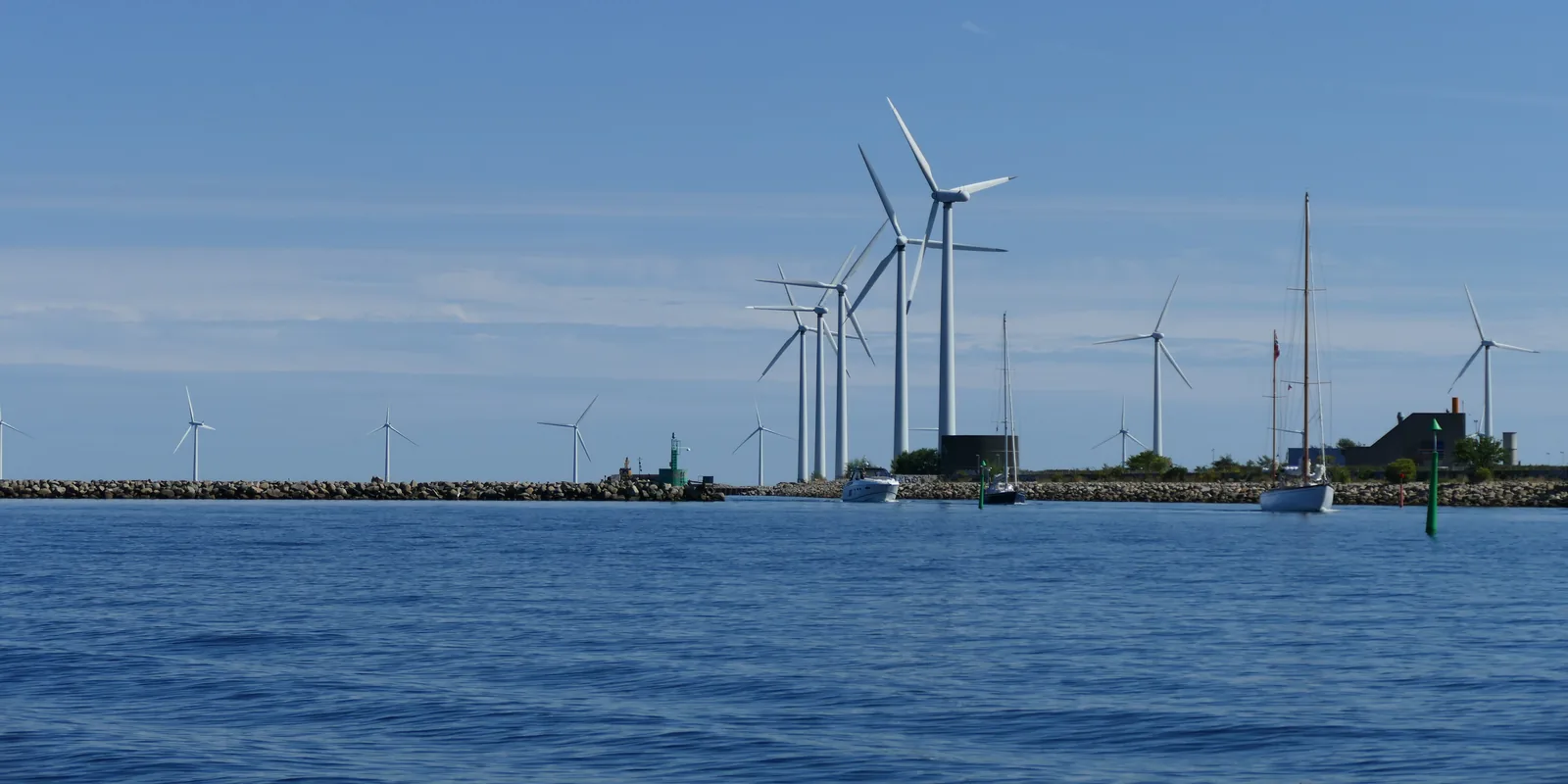
Hydro and wind power
Hydropower
The flow rate $Q$ tells how many cubic metres of water flow through the turbines each second. In time $t$ a volume $V = Qt$ flows through the turbines, and its mass is $m = \rho V = \rho Q t$. Its potential energy over the head $h$ is $mgh = \rho Q t g h$, so the power the water brings is $P_\text{o} = \rho Q g h$. By the definition of efficiency, the electric power is $\eta$ times this:
$$P = \eta \rho Q g h$$
where $P$ is the electric power of the plant ($\text{W}$), $\eta$ the efficiency, $\rho$ the density of water ($1000\,\text{kg/m}^3$), $Q$ the flow rate ($\text{m}^3\text{/s}$), $g$ the acceleration due to gravity ($9.81\,\text{m/s}^2$) and $h$ the head ($\text{m}$). The formula assumes that the kinetic energy of the water in the upper and lower water is small, so the energy that is converted is the change in potential energy.
Wind power
In time $t$ the air flowing through the rotor fills a cylinder whose cross-sectional area is the area swept by the rotor, $A = \pi r^2$, and whose length is $vt$. The mass of this air is $m = \rho A v t$, and its kinetic energy is $\tfrac{1}{2}mv^2 = \tfrac{1}{2}\rho A v^3 t$. So the power of the wind flowing through the rotor is $\tfrac{1}{2}\rho A v^3$.
The turbine converts the fraction $\eta$ of this into electricity:
$$P = \frac{1}{2}\eta \rho A v^3$$
where $P$ is the electric power ($\text{W}$), $\eta$ the fraction of the wind's power that becomes electricity, that is the efficiency of the turbine, $\rho$ the density of air (about $1.25\,\text{kg/m}^3$), $A$ the area swept by the rotor ($\text{m}^2$) and $v$ the wind speed ($\text{m/s}$).
Why is the speed raised to the third power?
When the wind speed doubles, twice as much air flows through the rotor each second, and each kilogram of air has four times as much kinetic energy. So the power grows by a factor of $2 \cdot 4 = 2^3 = 8$. In the power curve of a real turbine, the power grows about $8.9$ times when the wind speed goes from $5\,\text{m/s}$ to $10\,\text{m/s}$, because the efficiency is slightly better at the higher speed. From a wind of about $13\,\text{m/s}$ on, the power stays at $1650\,\text{kW}$. This is the rated power of the turbine, which the generator cannot exceed, so the blades are turned to let part of the wind pass by. Then the formula with a constant efficiency no longer describes the turbine.
Common misconception
People often think that a power plant produces energy. A power plant converts energy: the electricity of a hydropower plant comes from the potential energy of water and the electricity of a wind turbine from the kinetic energy of the wind, and some of the energy always turns into something other than electricity. A second mistake is to assume that double the wind gives double the power. The power grows with the third power of the speed, until the turbine reaches its rated power. A third mistake is to mix up power and energy: power is given in watts, and energy is obtained by multiplying power by time. A power plant with a power of $3\,\text{MW}$ produces $3\,\text{MWh}$ of energy in an hour.
Summary
- Hydro and wind power plants convert mechanical energy into electricity: a hydropower plant the potential energy of water, a wind turbine the kinetic energy of air.
- The efficiency $\eta = \tfrac{P_\text{s}}{P_\text{o}}$ is at most $100\,\%$; for a large hydropower plant it is about $90\,\%$ and for a wind turbine below $50\,\%$.
- The power of a hydropower plant is $P = \eta\rho Q g h$: it is proportional to the flow rate and the head.
- The power of a wind turbine is $P = \tfrac{1}{2}\eta\rho A v^3$: double the wind speed gives about eight times the power, until the turbine reaches its rated power.
- Energy is power times time, $E = Pt$.
Optional Return to your predictions
Compare your predictions with the data and the theory. Write in your own words why doubling the wind speed does not merely double or quadruple the power.
Would you change your prediction?
Apply
Worked example
Problem
The rotor of a wind turbine has a diameter of $120\,\text{m}$. The wind speed is $9.0\,\text{m/s}$ and the density of air is $1.25\,\text{kg/m}^3$. The turbine converts $45\,\%$ of the power of the wind flowing through the rotor into electricity. What is the electric power of the turbine?
Step 1/7
Given and find. The rotor diameter is $d = 120\,\text{m}$, the wind speed $v = 9.0\,\text{m/s}$, the density of air $\rho = 1.25\,\text{kg/m}^3$ and the efficiency $\eta = 45\,\%$. We are asked for the electric power $P$.
Step 2/7
Principle. Air flows through the rotor every second, and its kinetic energy per second is the power of the wind, $\tfrac{1}{2}\rho A v^3$. The turbine converts the fraction $\eta$ of it into electricity, so the electric power comes from the formula for the power of a wind turbine. The area $A$ is the circle swept by the rotor.
Step 3/7
Formula solved. The formula gives the asked power directly, once the area is calculated from the radius $r = \tfrac{d}{2}$:
$$\begin{aligned} P &= \tfrac{1}{2}\eta\rho A v^3 \\ A &= \pi r^2 \end{aligned}$$
Step 4/7
Unit conversions. The radius is $r = 120\,\text{m} : 2 = 60\,\text{m}$, and the efficiency as a decimal number is $\eta = 0.45$. The other quantities are in SI units, and
Step 5/7
Substitution. First we calculate the area and then the power:
$$\begin{aligned} A &= \pi r^2 \\ &= \pi\cdot(60\,\text{m})^2 \\ &= 11\,309.7\,\text{m}^2 \\ P &= \tfrac{1}{2}\eta\rho A v^3 \\ &= 0.5\cdot 0.45\cdot 1.25\,\tfrac{\text{kg}}{\text{m}^3} \\ &\quad\cdot 11\,309.7\,\text{m}^2\cdot\left(9.0\,\tfrac{\text{m}}{\text{s}}\right)^3 \\ &= 2\,318\,849\,\text{W} \end{aligned}$$
Step 6/7
Answer. The electric power is about $2.3\,\text{MW}$, to two significant figures like the wind speed $9.0\,\text{m/s}$ and the efficiency $0.45$.
Step 7/7
Reasonableness. The turbine of the power curve, with a rotor diameter of $82\,\text{m}$, gives a power of $1017\,\text{kW}$ at a wind speed of $9\,\text{m/s}$. The area of this rotor is $(120 : 82)^2 \approx 2.1$ times as large, so the power should be about $2.1 \cdot 1.0\,\text{MW} \approx 2.2\,\text{MW}$. The result $2.3\,\text{MW}$ is of the same order of magnitude. The power of the wind is $5.2\,\text{MW}$, and less than half of it becomes electricity, as it should.
Find the error
Optional Apply to a new situation
A pumped-storage plant stores electricity by lifting water from a lower reservoir to an upper one when there is too much electricity, and produces electricity by letting the water back down. In the planned plant the difference in height between the reservoir surfaces is $1.40\,\text{km}$, and the efficiency of the plant when letting water down is $0.850$.
What flow rate is needed for an electric power of $75.0\,\text{MW}$? Give the answer in cubic metres per second.
Hint 1: a guiding question
What is the head in this situation, in metres?
Hint 2: what is the connection
Solve the flow rate $Q$ from the formula for the power of a hydropower plant, $P = \eta\rho Q g h$.
Hint 3: an intermediate step
$Q = \dfrac{P}{\eta\rho g h}$, where $P = 75.0 \cdot 10^{6}\,\text{W}$ and $h = 1400\,\text{m}$.
Show the solution
Given
height difference $h = 1.40\,\text{km}$, efficiency $\eta = 0.850$, electric power $P = 75.0\,\text{MW}$; density of water $\rho = 1000\,\text{kg/m}^3$, $g = 9.81\,\text{m/s}^2$
Find
the flow rate $Q$ in $\text{m}^3\text{/s}$
Principle
Water flowing down loses potential energy, and the plant converts the fraction $\eta$ of it into electricity. When producing electricity, a pumped-storage plant works like an ordinary hydropower plant, so we use the formula for the power of a hydropower plant.
Formula
$P = \eta\rho Q g h$, so $Q = \dfrac{P}{\eta\rho g h}$
Conversions
Substitution
The units are SI units, and
so
Answer
$6.42\,\text{m}^3\text{/s}$
Three significant figures like the height difference $1.40\,\text{km}$, the efficiency $0.850$ and the power $75.0\,\text{MW}$.
Reasonableness
At Imatra the same power would need about $75 : 192$ of the maximum flow $900\,\text{m}^3\text{/s}$, that is over $300\,\text{m}^3\text{/s}$. The head here is about $58$ times the $24\,\text{m}$ of Imatra, so tens of times less flow is needed.
Check your understanding
Exit ticket
Answer on your own first and only then open the answer.
- The electric power of a hydropower plant is $50\,\text{MW}$ and its efficiency $90\,\%$. How much power is taken from the water, and where does the difference end up?
Answer
The power taken is
$P_\text{o}$$= \tfrac{P_\text{s}}{\eta}$$= \tfrac{50\,\text{MW}}{0.90}$$\approx 56\,\text{MW}$The difference, about $6\,\text{MW}$, does not end up as electricity: it turns into internal energy through friction in the pipes, the turbine and the generator, and part of it remains as the kinetic energy of the water discharged to the tailwater.
- Two hydropower plants give the same electric power with the same efficiency. The head of one is twice the head of the other. How do their flow rates differ?
Answer
The flow rate of the higher plant is half that of the other. The power is proportional to the product $Qh$, so when $h$ doubles and the power stays the same, $Q$ halves: every cubic metre gives twice as much energy.
- Why does the power of a wind turbine stop growing when the wind becomes stronger than the speed at which the turbine reaches the top of its power curve?
Answer
The turbine has reached its rated power, which the generator cannot exceed. The blades are turned so that part of the wind passes by, so the fraction of the wind's power that becomes electricity decreases as the wind strengthens, and the power stays constant.
1. Concept
2. Calculation
A small hydropower plant has a head of $8.0\,\text{m}$, and $12\,\text{m}^3$ of water flows through its turbine every second. The efficiency of the plant is $0.85$.
What is the electric power of the plant? Give the answer in kilowatts.
Hint 1: a guiding question
Which energy is converted into electricity, and what does the flow rate $12\,\text{m}^3\text{/s}$ tell you?
Hint 2: what is the connection
Use the formula for the power of a hydropower plant, $P = \eta\rho Q g h$.
Hint 3: an intermediate step
$P = 0.85 \cdot 1000 \cdot 12 \cdot 9.81 \cdot 8.0\,\text{W}$; convert to kilowatts at the end.
Show the solution
Given
head $h = 8.0\,\text{m}$, flow rate $Q = 12\,\text{m}^3\text{/s}$, efficiency $\eta = 0.85$; density of water $\rho = 1000\,\text{kg/m}^3$, $g = 9.81\,\text{m/s}^2$
Find
the electric power $P$ in $\text{kW}$
Principle
The water falling through the turbine loses potential energy $mgh$, and the mass $\rho Q$ falls every second. The plant converts the fraction $\eta$ of this power into electricity, so we use the formula for the power of a hydropower plant.
Formula
$P = \eta\rho Q g h$
Conversions
The quantities are in SI units, so the power comes out in watts; finally $1\,\text{kW} = 1000\,\text{W}$.
Substitution
Answer
$8.0 \cdot 10^{2}\,\text{kW}$
Or about $800\,\text{kW}$, two significant figures like the head $8.0\,\text{m}$, the flow rate $12\,\text{m}^3\text{/s}$ and the efficiency $0.85$.
Reasonableness
A cubic metre of water gives about $1000\,\text{kg} \cdot 10\,\text{m/s}^2 \cdot 8\,\text{m} = 80\,\text{kJ}$ in an $8\,\text{m}$ drop, so $12$ cubic metres per second give about $960\,\text{kW}$, and $85\,\%$ of that is about $800\,\text{kW}$. The power is much smaller than the $62\,\text{MW}$ of Tainionkoski, because the flow rate is only a fraction of it.
Suggestion: one answer does not show everything you can do, but review the theory summary and do the core exercises.
3. Explain
Two similar wind turbines are in different places. At the first place the wind blows steadily at $6\,\text{m/s}$, and at the second at $8\,\text{m/s}$. Use the kinetic energy of the wind to explain why the second turbine produces more than twice the power, although the wind is only a third stronger.
Model answer
The power of a wind turbine is a fraction of the kinetic energy of the air flowing through the rotor each second. When the wind is $8\,\text{m/s}$ instead of $6\,\text{m/s}$, $8 : 6 \approx 1.33$ times as much air flows through the rotor each second. In addition, each kilogram of air has kinetic energy $\tfrac{1}{2}mv^2$ that is $(8 : 6)^2 \approx 1.78$ times as large. So the power grows by a factor of $(8 : 6)^3 \approx 2.4$. This holds when the turbines are similar, that is the area of the rotor and the efficiency are the same, and the wind is lower than the speed at which the turbine reaches its rated power.
Assess your own answer
Tick the points your own answer already contains.
Review the theory summary and practise with the exercises.
Exercises
Level 1 · basic practice 8 exercises
One formula or one step of reasoning. Core exercises first, the rest is extra practice.
- Exercise 12-1Core
The head of a hydropower plant is $15.0\,\text{m}$, and $120\,\text{m}^3$ of water flows through the turbines every second. The efficiency of the plant is $0.900$.
What is the electric power of the plant?
Answer
$15.9\,\text{MW}$
Show the solution
Given
head $h = 15.0\,\text{m}$, flow rate $Q = 120\,\text{m}^3\text{/s}$, efficiency $\eta = 0.900$; density of water $\rho = 1000\,\text{kg/m}^3$, $g = 9.81\,\text{m/s}^2$
Find
the electric power $P$ in $\text{MW}$
Principle
The water falling through the turbines loses potential energy $mgh$, and the mass $\rho Q$ falls every second. The plant converts the fraction $\eta$ of this power into electricity, so we use the formula for the power of a hydropower plant.
Formula
$P = \eta\rho Q g h$
Conversions
The quantities are in SI units, so the power comes out in watts; finally $1\,\text{MW} = 10^{6}\,\text{W}$.
Substitution
$P$$= 0.900 \cdot 1000\,\tfrac{\text{kg}}{\text{m}^3} \cdot 120\,\tfrac{\text{m}^3}{\text{s}} \cdot 9.81\,\tfrac{\text{m}}{\text{s}^2} \cdot 15.0\,\text{m}$$= 15\,892\,200\,\text{W}$$\approx 15.9\,\text{MW}$Answer
$15.9\,\text{MW}$
Three significant figures like the head $15.0\,\text{m}$, the flow rate $120\,\text{m}^3\text{/s}$ and the efficiency $0.900$.
Reasonableness
A cubic metre of water gives about $1000\,\text{kg} \cdot 10\,\text{m/s}^2 \cdot 15\,\text{m} = 150\,\text{kJ}$ in a $15\,\text{m}$ drop, so $120$ cubic metres per second give about $18\,\text{MW}$, and $90\,\%$ of that is about $16\,\text{MW}$. The power is smaller than the $192\,\text{MW}$ of Imatra, because both the flow rate and the head are smaller.
- Exercise 12-2Core
One cubic metre of water, with a mass of $1000\,\text{kg}$, falls through the turbine of a power plant from the upper reservoir to the tailwater, $24.0\,\text{m}$ lower.
By how much does the potential energy of the water decrease?
Answer
$235\,\text{kJ}$
Show the solution
Given
mass of water $m = 1000\,\text{kg}$, height difference $h = 24.0\,\text{m}$; $g = 9.81\,\text{m/s}^2$
Find
the decrease in potential energy $E_\text{p}$ in $\text{kJ}$
Principle
Gravitational potential energy is proportional to the height above the chosen zero level. When the zero level is the surface of the tailwater, the potential energy of the water in the upper reservoir is $mgh$, and that is exactly how much it decreases when it falls to the tailwater.
Formula
$E_\text{p} = mgh$
Conversions
The quantities are in SI units, so the energy comes out in joules; finally $1\,\text{kJ} = 1000\,\text{J}$.
Substitution
$E_\text{p}$$= 1000\,\text{kg} \cdot 9.81\,\tfrac{\text{m}}{\text{s}^2} \cdot 24.0\,\text{m}$$= 235\,440\,\text{J}$$\approx 235\,\text{kJ}$Answer
$235\,\text{kJ}$
Three significant figures like the height difference $24.0\,\text{m}$.
Reasonableness
The estimate $1000\,\text{kg} \cdot 10\,\text{m/s}^2 \cdot 24\,\text{m} = 240\,\text{kJ}$ is close to the result. If hundreds of cubic metres fall every second, the power is hundreds of times $235\,\text{kW}$, that is tens or hundreds of megawatts, as in large hydropower plants.
- Exercise 12-3
The power of the water flowing into the turbine of a hydropower plant is $50.0\,\text{MW}$, and the generator gives an electric power of $46.0\,\text{MW}$.
What is the efficiency of the plant?
Answer
$92.0\,\%$
Show the solution
Given
power of the water flowing into the turbine $P_\text{o} = 50.0\,\text{MW}$, electric power $P_\text{s} = 46.0\,\text{MW}$
Find
the efficiency $\eta$ as a percentage
Principle
Efficiency is the ratio of the useful power obtained to the power taken into the device. Here the useful power is the electric power and the power taken in is the power the water brings to the plant.
Formula
$\eta = \dfrac{P_\text{s}}{P_\text{o}}$
Conversions
Both powers are in megawatts, so the unit cancels. A decimal number is changed to a percentage by multiplying by one hundred.
Substitution
$\eta$$= \dfrac{46.0\,\text{MW}}{50.0\,\text{MW}}$$= 0.920$$= 92.0\,\%$Answer
$92.0\,\%$
Three significant figures like the powers $46.0\,\text{MW}$ and $50.0\,\text{MW}$.
Reasonableness
The efficiency is below $100\,\%$, as it should be, and the efficiency of a large hydropower plant is typically about $90\,\%$. The losses are $4.0\,\text{MW}$, that is $8\,\%$ of the power taken in.
- Exercise 12-4
The area swept by the rotor of a wind turbine is $1500\,\text{m}^2$. The wind speed is $8.0\,\text{m/s}$ and the density of air is $1.25\,\text{kg/m}^3$.
What is the power of the wind flowing through the rotor?
Answer
$480\,\text{kW}$
Show the solution
Given
area swept by the rotor $A = 1500\,\text{m}^2$, wind speed $v = 8.0\,\text{m/s}$, density of air $\rho = 1.25\,\text{kg/m}^3$
Find
the power of the wind $P_\text{wind}$ in $\text{kW}$
Principle
In time $t$ a cylinder of air flows through the rotor, with mass $m = \rho A v t$ and kinetic energy $\tfrac{1}{2}mv^2$. The power of the wind is this kinetic energy divided by the time. The efficiency is not needed, because we are asked for the power of the wind, not the electric power.
Formula
$P_\text{wind}$$= \dfrac{\tfrac{1}{2}mv^2}{t}$$= \dfrac{\tfrac{1}{2}\rho A v t\, v^2}{t}$so $P_\text{wind} = \tfrac{1}{2}\rho A v^3$
Conversions
The quantities are in SI units, so the power comes out in watts; finally $1\,\text{kW} = 1000\,\text{W}$.
Substitution
$P_\text{wind}$$= \tfrac{1}{2} \cdot 1.25\,\tfrac{\text{kg}}{\text{m}^3} \cdot 1500\,\text{m}^2 \cdot \left(8.0\,\tfrac{\text{m}}{\text{s}}\right)^3$$= 480\,000\,\text{W}$$= 480\,\text{kW}$Answer
$480\,\text{kW}$
Or $4.8 \cdot 10^{2}\,\text{kW}$, two significant figures like the wind speed $8.0\,\text{m/s}$.
Reasonableness
Every second $1.25 \cdot 1500 \cdot 8\,\text{kg} = 15\,000\,\text{kg}$ of air flows through the rotor, and each kilogram has kinetic energy $\tfrac{1}{2}\cdot 8^2\,\text{J} = 32\,\text{J}$. The product is $480\,000\,\text{J}$ per second, the same result. Less than half of this would become electricity.
- Exercise 12-5
A wind turbine produces electricity at a steady power of $3.00\,\text{MW}$ for $6.00$ hours on a stormy day.
How much electric energy does the turbine produce in this time? Give the answer in megawatt-hours.
Answer
$18.0\,\text{MWh}$
Show the solution
Given
electric power $P = 3.00\,\text{MW}$, time $t = 6.00\,\text{h}$
Find
the electric energy $E$ in $\text{MWh}$
Principle
Power tells how much energy is converted per unit of time. When the power stays constant, the energy is power times time.
Formula
$P = \dfrac{E}{t}$, so $E = Pt$
Conversions
When the power is in megawatts and the time in hours, the energy comes out directly in megawatt-hours, so no conversions are needed.
Substitution
$E$$= 3.00\,\text{MW} \cdot 6.00\,\text{h}$$= 18.0\,\text{MWh}$Answer
$18.0\,\text{MWh}$
Three significant figures like the power $3.00\,\text{MW}$ and the time $6.00\,\text{h}$.
Reasonableness
In joules the energy is
$3.00 \cdot 10^{6}\,\text{W} \cdot 6.00 \cdot 3600\,\text{s}$$\approx 6.5 \cdot 10^{10}\,\text{J}$A detached house with electric heating uses about $20\,\text{MWh}$ a year, so this is almost one house's consumption for a whole year.
- Exercise 12-6
Two hydropower plants have the same flow rate and the same efficiency, but the head of one is twice that of the other. The power of the plant with the double head is twice as large.
Which of the following explains this?
Answer
Every kilogram of water flowing through the turbine loses twice as much potential energy as it falls.
Show the solution
Find
what explains why the power of the plant with the double head is twice as large when the flow rate and the efficiency are the same
Principle
Water falling through the turbine loses potential energy $mgh$, which is directly proportional to the head $h$. Since the mass $\rho Q$ passing through the turbine per second is the same, the power brought by the water $\rho Q g h$ is proportional to the head, and with the same efficiency so is the electric power.
Model answer
Every kilogram of water flowing through the turbine loses twice as much potential energy as it falls. The mass per second and the efficiency stay the same, so the power doubles when the head doubles. The other explanations do not hold: according to the task the flow rate is the same, the mass of the water does not grow as it falls, and the efficiency does not change.
- Exercise 12-7
River water flows through the turbines of a power plant at $35.0\,\text{m}^3$ per second, and the head is $8.50\,\text{m}$.
How much power is released from the potential energy of the falling water? The efficiency is not taken into account.
Answer
$2.92\,\text{MW}$
Show the solution
Given
flow rate $Q = 35.0\,\text{m}^3\text{/s}$, head $h = 8.50\,\text{m}$; density of water $\rho = 1000\,\text{kg/m}^3$, $g = 9.81\,\text{m/s}^2$
Find
the power brought by the water $P_\text{o}$ in $\text{MW}$
Principle
The water mass $\rho Q$ falls through the turbines every second, and every kilogram loses potential energy $gh$. The efficiency is not taken into account, so the power asked for is the rate at which the potential energy decreases.
Formula
$P_\text{o} = \rho Q g h$
Conversions
The quantities are in SI units, so the power comes out in watts; finally $1\,\text{MW} = 10^{6}\,\text{W}$.
Substitution
$P_\text{o}$$= 1000\,\tfrac{\text{kg}}{\text{m}^3} \cdot 35.0\,\tfrac{\text{m}^3}{\text{s}} \cdot 9.81\,\tfrac{\text{m}}{\text{s}^2} \cdot 8.50\,\text{m}$$= 2\,918\,475\,\text{W}$$\approx 2.92\,\text{MW}$Answer
$2.92\,\text{MW}$
Three significant figures like the flow rate $35.0\,\text{m}^3\text{/s}$ and the head $8.50\,\text{m}$.
Reasonableness
$35\,000\,\text{kg}$ of water falls every second, and a kilogram loses about $10 \cdot 8.5\,\text{J} = 85\,\text{J}$ in an $8.5\,\text{m}$ drop. The product is about $3.0\,\text{MW}$, so the result is of the right magnitude. With an efficiency, the electric power would be less than $2.92\,\text{MW}$.
- Exercise 12-8
During a certain time, air with a mass of $2.50\cdot 10^{3}\,\text{kg}$ and a speed of $12.0\,\text{m/s}$ flows through the rotor of a wind turbine.
What is the kinetic energy of this air?
Answer
$180\,\text{kJ}$
Show the solution
Given
mass of air $m = 2.50 \cdot 10^{3}\,\text{kg}$, speed $v = 12.0\,\text{m/s}$
Find
the kinetic energy $E_\text{k}$ in $\text{kJ}$
Principle
The kinetic energy of a moving body depends on its mass and on the square of its speed. The mass of air is calculated as one body whose parts all move at the speed $v$.
Formula
$E_\text{k} = \tfrac{1}{2}mv^2$
Conversions
The quantities are in SI units, so the energy comes out in joules; finally $1\,\text{kJ} = 1000\,\text{J}$.
Substitution
$E_\text{k}$$= \tfrac{1}{2} \cdot 2.50 \cdot 10^{3}\,\text{kg} \cdot \left(12.0\,\tfrac{\text{m}}{\text{s}}\right)^2$$= 180\,000\,\text{J}$$= 180\,\text{kJ}$Answer
$180\,\text{kJ}$
Three significant figures like the mass and the speed.
Reasonableness
A kilogram of air at $12\,\text{m/s}$ has kinetic energy $\tfrac{1}{2} \cdot 12^2\,\text{J} = 72\,\text{J}$, and $2500$ kilograms have $2500 \cdot 72\,\text{J} = 180\,\text{kJ}$. The result agrees.
Level 2 · applied practice 7 exercises
Two steps, working with measured data, a unit conversion or rearranging a formula. Core exercises first, the rest is extra practice.
- Exercise 12-9Core
The head of a planned hydropower plant is $12.0\,\text{m}$ and its efficiency $0.880$. What flow rate is needed for an electric power of $10.0\,\text{MW}$?
Answer
$96.5\,\text{m}^3\text{/s}$
Show the solution
Given
electric power $P = 10.0\,\text{MW}$, head $h = 12.0\,\text{m}$, efficiency $\eta = 0.880$; density of water $\rho = 1000\,\text{kg/m}^3$, $g = 9.81\,\text{m/s}^2$
Find
the flow rate $Q$ in $\text{m}^3\text{/s}$
Principle
Falling water loses potential energy, and the plant converts the fraction $\eta$ of it into electricity. We solve the flow rate that gives the desired power from the formula for the power of a hydropower plant.
Formula
$P = \eta\rho Q g h$, so $Q = \dfrac{P}{\eta\rho g h}$
Conversions
$P$$= 10.0\,\text{MW}$$= 10.0 \cdot 10^{6}\,\text{W}$Substitution
The quantities are in SI units, and
$\tfrac{\text{W}}{\text{kg/m}^3 \cdot \text{m/s}^2 \cdot \text{m}}$$= \tfrac{\text{m}^3}{\text{s}}$so
$Q$$= \dfrac{10.0 \cdot 10^{6}}{0.880 \cdot 1000 \cdot 9.81 \cdot 12.0}\,\tfrac{\text{m}^3}{\text{s}}$$= 96.53\,\tfrac{\text{m}^3}{\text{s}}$Answer
$96.5\,\text{m}^3\text{/s}$
Three significant figures like the power $10.0\,\text{MW}$, the head $12.0\,\text{m}$ and the efficiency $0.880$.
Reasonableness
A cubic metre of water gives about $120\,\text{kJ}$ in a $12\,\text{m}$ drop and about $105\,\text{kJ}$ of electricity. So a power of $10\,\text{MW}$ needs about $10\,000 : 105 \approx 95$ cubic metres per second.
- Exercise 12-10Core
According to the manufacturer's power curve, a wind turbine with a rotor diameter of $82\,\text{m}$ gives an electric power of $758\,\text{kW}$ at a wind speed of $8.0\,\text{m/s}$. The density of air is $1.25\,\text{kg/m}^3$.
What fraction of the power of the wind flowing through the rotor is converted into electricity? Give the answer as a percentage.
Answer
$45\,\%$
Show the solution
Given
rotor diameter $d = 82\,\text{m}$, wind speed $v = 8.0\,\text{m/s}$, electric power $P = 758\,\text{kW}$, density of air $\rho = 1.25\,\text{kg/m}^3$
Find
the fraction converted into electricity, that is the efficiency $\eta$, as a percentage
Principle
The power of the wind flowing through the rotor is the kinetic energy of the air per second, $\tfrac{1}{2}\rho A v^3$. The turbine converts the fraction $\eta$ of it into electricity, so the fraction follows from the formula for the power of a wind turbine.
Formula
$P = \tfrac{1}{2}\eta\rho A v^3$ and $A = \pi r^2$, so $\eta = \dfrac{2P}{\rho A v^3}$
Conversions
The radius is
$r$$= 82\,\text{m} : 2$$= 41\,\text{m}$$P$$= 758\,\text{kW}$$= 758\,000\,\text{W}$Substitution
$A$$= \pi \cdot (41\,\text{m})^2$$= 5281.0\,\text{m}^2$$\eta$$= \dfrac{2 \cdot 758\,000\,\text{W}}{1.25\,\tfrac{\text{kg}}{\text{m}^3} \cdot 5281.0\,\text{m}^2 \cdot \left(8.0\,\tfrac{\text{m}}{\text{s}}\right)^3}$$= 0.4485$Answer
about $45\,\%$, two significant figures like the diameter $82\,\text{m}$ and the wind speed $8.0\,\text{m/s}$.
Reasonableness
The fraction is below the theoretical upper limit of $59\,\%$, and the fraction of a real wind turbine is less than half, as it should be. The power of the wind is about $1.7\,\text{MW}$, and the electric power $0.76\,\text{MW}$ is a little less than half of it.
- Exercise 12-11
$850\,\textsf{l}$ of water flows through the turbine of the Myllypuro small hydropower plant every second. The head is $6.5\,\text{m}$, and the efficiency of the plant is $0.75$.
What is the electric power of the plant?
Answer
$41\,\text{kW}$
Show the solution
Given
flow rate $Q = 850\,\textsf{l}\text{/s}$, head $h = 6.5\,\text{m}$, efficiency $\eta = 0.75$; density of water $\rho = 1000\,\text{kg/m}^3$, $g = 9.81\,\text{m/s}^2$
Find
the electric power $P$ in $\text{kW}$
Principle
The water falling through the turbine loses potential energy, and the mass $\rho Q$ falls every second. The plant converts the fraction $\eta$ of this power into electricity, so we use the formula for the power of a hydropower plant.
Formula
$P = \eta\rho Q g h$
Conversions
$850\,\textsf{l}$$= 850 \cdot 0.001\,\text{m}^3$$= 0.850\,\text{m}^3$so $Q = 0.850\,\text{m}^3\text{/s}$; finally $1\,\text{kW} = 1000\,\text{W}$.
Substitution
$P$$= 0.75 \cdot 1000\,\tfrac{\text{kg}}{\text{m}^3} \cdot 0.850\,\tfrac{\text{m}^3}{\text{s}} \cdot 9.81\,\tfrac{\text{m}}{\text{s}^2} \cdot 6.5\,\text{m}$$= 40\,650\,\text{W}$$\approx 41\,\text{kW}$Answer
$41\,\text{kW}$
Two significant figures like the head $6.5\,\text{m}$ and the efficiency $0.75$.
Reasonableness
Every second $850\,\text{kg}$ of water falls, which gives about $850 \cdot 10 \cdot 6.5\,\text{J} \approx 55\,\text{kJ}$ in a $6.5\,\text{m}$ drop, and three quarters of that is about $41\,\text{kJ}$ per second. If the litres were not converted, the result would be a thousand times too large, $41\,\text{MW}$, which is far too much for a stream.
- Exercise 12-12
A small hydropower plant has a head of $9.50\,\text{m}$, a flow rate of $3.20\,\text{m}^3\text{/s}$ and an efficiency of $0.800$.
How much electric energy does the plant produce in a day ($24.0\,\text{h}$), when the flow rate stays the same? Give the answer in megawatt-hours.
Answer
$5.73\,\text{MWh}$
Show the solution
Given
head $h = 9.50\,\text{m}$, flow rate $Q = 3.20\,\text{m}^3\text{/s}$, efficiency $\eta = 0.800$, time $t = 24.0\,\text{h}$; density of water $\rho = 1000\,\text{kg/m}^3$, $g = 9.81\,\text{m/s}^2$
Find
the electric energy $E$ in $\text{MWh}$
Principle
First we calculate the electric power from the formula for the power of a hydropower plant, because the fraction $\eta$ of the potential energy of the falling water becomes electricity. The power stays constant when the flow rate stays constant, so the energy is power times time.
Formula
$P = \eta\rho Q g h$ and $E = Pt$, so $E = \eta\rho Q g h t$
Conversions
The power is calculated in watts and converted to megawatts, $1\,\text{MW} = 10^{6}\,\text{W}$; the time is kept in hours, so the energy comes out in megawatt-hours.
Substitution
$P$$= 0.800 \cdot 1000\,\tfrac{\text{kg}}{\text{m}^3} \cdot 3.20\,\tfrac{\text{m}^3}{\text{s}} \cdot 9.81\,\tfrac{\text{m}}{\text{s}^2} \cdot 9.50\,\text{m}$$= 238\,579\,\text{W}$$E$$= 0.238\,579\,\text{MW} \cdot 24.0\,\text{h}$$= 5.7259\,\text{MWh}$Answer
$5.73\,\text{MWh}$
Three significant figures like the initial data.
Reasonableness
The power is about $0.24\,\text{MW}$, and a day has $24$ hours: $0.24 \cdot 24 \approx 5.8\,\text{MWh}$. That is about a third of the yearly consumption of a detached house with electric heating, which fits a small power plant.
- Exercise 12-13
The table is an example data set of the electric power of a wind turbine at different wind speeds and of how many hours a year the wind blows at each speed. The rated power of the turbine is $2000\,\text{kW}$.
At other times the wind is too weak or the turbine has been stopped, and it produces no electricity. Assume that the power stays at the value in the table for the whole stated time.
Calculate the electric energy produced by the turbine in a year in gigawatt-hours.
Power of a wind turbine and the time per year the wind speed occurs (example data) $v\,(\text{m/s})$ $P\,(\text{kW})$ $t\,(\text{h})$ 4 100 1500 6 340 2200 8 850 1800 10 1650 1000 12 2000 700 Answer
$5.5\,\text{GWh}$
Show the solution
Given
table: power $P$ and time $t$ per year at five wind speeds (example data); at other times the power is zero
Find
the annual energy $E$ in $\text{GWh}$
Principle
Power tells the rate at which energy is converted, so the energy is power times time. At each speed the power is constant, so the energy of each row is $P t$. The annual energy is the sum of the energies of the rows.
Formula
$E = \sum P t$
Conversions
When the power is in kilowatts and the time in hours, the energy comes out in kilowatt-hours. Finally $1\,\text{GWh} = 10^{6}\,\text{kWh}$.
Substitution
The energies of the rows are $100\,\text{kW} \cdot 1500\,\text{h} = 150\,000\,\text{kWh}$, $340 \cdot 2200 = 748\,000\,\text{kWh}$, $850 \cdot 1800 = 1\,530\,000\,\text{kWh}$, $1650 \cdot 1000 = 1\,650\,000\,\text{kWh}$ and $2000 \cdot 700 = 1\,400\,000\,\text{kWh}$. The sum is $5\,478\,000\,\text{kWh}$, so $E = 5.478\,\text{GWh}$.
Answer
$5.5\,\text{GWh}$
Two significant figures, because the powers in the table are given to two or three significant figures.
Reasonableness
If the turbine produced its rated power $2000\,\text{kW}$ for the whole year ($8760\,\text{h}$), the energy would be $17.5\,\text{GWh}$. The result $5.5\,\text{GWh}$ is about $31\,\%$ of that, which fits the fact that the mean power of a wind turbine is clearly lower than its rated power.
- Exercise 12-14
The table is an example data set of the mean flow rate $Q$ of a river at a small hydropower plant from April to September. The head of the plant is $9.0\,\text{m}$ and its efficiency $0.85$.
Assume that the whole flow passes through the turbine, the head and efficiency stay constant, and every month has $30$ days.
a) Calculate the total electric energy produced by the plant from April to September in gigawatt-hours.
b) How many times as large is the electric power of the plant in May as in August? Explain with the help of the table why the production of the plant varies during the year.
The answer field takes the result of part a).
Mean flow rate of the river by month (example data) Month $Q\,(\text{m}^3\text{/s})$ April 85 May 120 June 45 July 30 August 28 September 40 Answer
$19\,\text{GWh}$
Show the solution
Given
flow rates from April to September $85$, $120$, $45$, $30$, $28$ and $40\,\text{m}^3\text{/s}$ (example data), head $h = 9.0\,\text{m}$, efficiency $\eta = 0.85$, length of a month $30\,\text{days}$; $\rho = 1000\,\text{kg/m}^3$, $g = 9.81\,\text{m/s}^2$
Find
a) the electric energy $E$ in $\text{GWh}$; b) the ratio of the powers in May and August and an explanation of the variation
Principle
The power of a hydropower plant at the flow rate of a month is $P = \eta\rho Q g h$. Since $\eta$, $\rho$ and $h$ are constants, the power is proportional to the flow rate. Energy is power times time, and every month has the same length, so the energy is obtained by summing the powers of the months and multiplying by the length of one month.
Formula
$P = \eta\rho Q g h$ and $E = Pt$, so $E = \eta\rho g h\,\left(\sum Q\right) t$
Conversions
The length of a month is
$t$$= 30 \cdot 24\,\text{h}$$= 720\,\text{h}$The power is calculated in watts and converted to megawatts, $1\,\text{MW} = 10^{6}\,\text{W}$, so the energy comes out in megawatt-hours; finally $1\,\text{GWh} = 1000\,\text{MWh}$.
Substitution
The sum of the flow rates is $85 + 120 + 45 + 30 + 28 + 40 = 348\,\text{m}^3\text{/s}$. The sum of the monthly powers is
$$\begin{aligned}\textstyle\sum P &= 0.85 \cdot 1000 \cdot 9.81 \cdot 9.0 \cdot 348\,\text{W} \\ &= 26.12\,\text{MW}\end{aligned}$$
and the energy
$$\begin{aligned}E &= 26.12\,\text{MW} \cdot 720\,\text{h} \\ &= 18\,804\,\text{MWh} \\ &= 18.8\,\text{GWh}\end{aligned}$$Answer
$19\,\text{GWh}$
Two significant figures like the head $9.0\,\text{m}$ and the efficiency $0.85$.
Model answer for part b
The power is proportional to the flow rate, so the ratio of the powers in May and August is the same as the ratio of the flow rates, $120 : 28 = 4.3$. In May the power is about $9.0\,\text{MW}$ and in August about $2.1\,\text{MW}$. In the table the flow rate is greatest in spring and smallest in late summer, so the production varies with how much water flows in the river. The head and the efficiency stay constant, so they do not explain the variation.
Reasonableness
The mean flow rate is $348 : 6 = 58\,\text{m}^3\text{/s}$, and at that flow rate the power would be
$0.85 \cdot 1000 \cdot 58 \cdot 9.81 \cdot 9.0\,\text{W}$$\approx 4.35\,\text{MW}$Over six months ($4320\,\text{h}$) the energy would be $4.35\,\text{MW} \cdot 4320\,\text{h} \approx 18.8\,\text{GWh}$, the same result.
- Exercise 12-15
A student calculated the electric power of a wind turbine and got a strangely small result. Here is the student's solution.
“The diameter of the rotor is $60\,\text{m}$, the wind speed $7.0\,\text{m/s}$, the density of air $1.25\,\text{kg/m}^3$ and the efficiency $0.40$. The area is $A = \pi r^2 = 2827\,\text{m}^2$ and the power $P = \tfrac{1}{2}\eta\rho A v = 0.5 \cdot 0.40 \cdot 1.25 \cdot 2827 \cdot 7.0 = 4948\,\text{W} \approx 4.9\,\text{kW}$.”
Explain what the error in the student's formula is, and calculate the correct electric power of the turbine. The answer field takes the correct power in kilowatts.
Answer
$240\,\text{kW}$
Show the solution
Given
diameter $d = 60\,\text{m}$, wind speed $v = 7.0\,\text{m/s}$, density of air $\rho = 1.25\,\text{kg/m}^3$, efficiency $\eta = 0.40$; the student's result $4.9\,\text{kW}$
Find
the student's error and the correct electric power $P$ in $\text{kW}$
Principle
The mass of air flowing through the rotor per second is proportional to the speed $v$, and the kinetic energy of each kilogram of air is proportional to the square of the speed $v^2$. The power of the wind is therefore proportional to the cube of the speed $v^3$. The student used the speed to the first power.
Formula
$P = \tfrac{1}{2}\eta\rho A v^3$ and $A = \pi r^2$
Conversions
The radius is $r = 60\,\text{m} : 2 = 30\,\text{m}$. The area is
$A$$= \pi \cdot (30\,\text{m})^2$$= 2827\,\text{m}^2$as in the student's solution. Finally $1\,\text{kW} = 1000\,\text{W}$.
Substitution
The correct power is
$$\begin{aligned}P &= 0.5 \cdot 0.40 \cdot 1.25\,\tfrac{\text{kg}}{\text{m}^3} \\ &\quad \cdot 2827\,\text{m}^2 \cdot \left(7.0\,\tfrac{\text{m}}{\text{s}}\right)^3 \\ &= 242\,452\,\text{W}\end{aligned}$$Answer
$240\,\text{kW}$
Or $2.4 \cdot 10^{2}\,\text{kW}$, two significant figures like the wind speed $7.0\,\text{m/s}$ and the efficiency $0.40$.
Model answer for the error
In the student's formula the wind speed is to the first power, although it must be to the third power. The error can be noticed from the units: $\tfrac{\text{kg}}{\text{m}^3} \cdot \text{m}^2 \cdot \tfrac{\text{m}}{\text{s}}$ is $\tfrac{\text{kg}}{\text{s}}$, not a watt $\tfrac{\text{kg} \cdot \text{m}^2}{\text{s}^3}$: the result lacks the factor $v^2$, that is, the unit $\tfrac{\text{m}^2}{\text{s}^2}$. The correct power is $7.0^2 = 49$ times the student's result.
Reasonableness
The student's result $4948\,\text{W}$ multiplied by $49$ is $242\,452\,\text{W}$, the same as the correct result. The power of the wind is $240 : 0.40 = 600\,\text{kW}$, and $40\,\%$ of it is converted into electricity, as it should be.
Level 3 · challenging 5 exercises
Optional: application, two ideas together or a new situation where you reason for yourself.
- Exercise 12-16
The mean wind speed at a turbine increases from $6.0\,\text{m/s}$ to $9.0\,\text{m/s}$ when the turbine is built on a taller tower. The efficiency stays the same, and the turbine does not reach its rated power.
How many times as large is the electric power of the turbine in the stronger wind?
Answer
$3.4$
Show the solution
Given
wind speed before $v_1 = 6.0\,\text{m/s}$ and after $v_2 = 9.0\,\text{m/s}$; the rotor and the efficiency are the same, and the turbine does not reach its rated power
Find
how many times as large the electric power $P_2$ is as $P_1$, the ratio $x$
Principle
The electric power is the fraction $\eta$ of the kinetic energy per second of the air flowing through the rotor. When the wind is faster, more air flows through each second in proportion to $v$, and each kilogram has more kinetic energy in proportion to $v^2$. So the power is proportional to the cube $v^3$, when $\eta$, $\rho$ and $A$ stay the same.
Formula
$P = \tfrac{1}{2}\eta\rho A v^3$, so
$x$$= \dfrac{P_2}{P_1}$$= \dfrac{\tfrac{1}{2}\eta\rho A v_2^3}{\tfrac{1}{2}\eta\rho A v_1^3}$$= \left(\dfrac{v_2}{v_1}\right)^3$Conversions
Both speeds are in the same unit, so the unit cancels and no conversions are needed.
Substitution
$x$$= \left(\dfrac{9.0\,\text{m/s}}{6.0\,\text{m/s}}\right)^3$$= 1.5^3$$= 3.375$Answer
about $3.4$ times as large, two significant figures like the wind speeds $6.0\,\text{m/s}$ and $9.0\,\text{m/s}$.
Reasonableness
$1.5$ times as much air flows through, and each kilogram has $1.5^2 = 2.25$ times as much kinetic energy: $1.5 \cdot 2.25 \approx 3.4$. The factor is larger than the ratio of the speeds, $1.5$, as follows from the third power.
- Exercise 12-17
The rotor of an old wind turbine has a diameter of $82\,\text{m}$, and that of a new one $162\,\text{m}$.
How many times as much electric power does the new turbine get at the same wind speed, when the efficiency is the same and neither reaches its rated power?
Answer
$3.9$
Show the solution
Given
diameter of the old rotor $d_1 = 82\,\text{m}$, of the new one $d_2 = 162\,\text{m}$; the wind speed, the density of air and the efficiency are the same, and neither reaches its rated power
Find
how many times as large the electric power of the new turbine $P_2$ is as that of the old one $P_1$, the ratio $x$
Principle
At the same wind speed, a cylinder of air flows through each rotor every second, and its mass is proportional to the area swept by the rotor, $A = \pi r^2$. Each kilogram of air has the same kinetic energy, so the power is proportional to the area and therefore to the square of the diameter.
Formula
$P = \tfrac{1}{2}\eta\rho A v^3$ and $A = \pi\left(\tfrac{d}{2}\right)^2$, so
$x$$= \dfrac{P_2}{P_1}$$= \dfrac{A_2}{A_1}$$= \left(\dfrac{d_2}{d_1}\right)^2$Conversions
The diameters are in the same unit, so the unit cancels and no conversions are needed.
Substitution
$x$$= \left(\dfrac{162\,\text{m}}{82\,\text{m}}\right)^2$$= 1.9756^2$$= 3.903$Answer
about $3.9$ times as large, two significant figures like the diameter $82\,\text{m}$.
Reasonableness
The diameter is about double, so the area is about $2^2 = 4$ times as large, and the result is a little below four. This is why new turbines have ever longer blades: the area grows with the square of the diameter.
- Exercise 12-18
The wind blows at $10.0\,\text{m/s}$.
From what height would a kilogram of water have to fall for its potential energy to decrease by as much as a kilogram of this wind has kinetic energy?
Answer
$5.10\,\text{m}$
Show the solution
Given
wind speed $v = 10.0\,\text{m/s}$, mass $m = 1\,\text{kg}$ for both the air and the water; $g = 9.81\,\text{m/s}^2$
Find
the height of the fall $h$ in $\text{m}$
Principle
The kinetic energy of a kilogram of air is $\tfrac{1}{2}mv^2$, and the potential energy of a kilogram of water decreases by $mgh$ in a fall. We set these equal. The mass cancels, so the result does not depend on how many kilograms are compared.
Formula
$mgh = \tfrac{1}{2}mv^2$, so $h = \dfrac{v^2}{2 \cdot g}$
Conversions
The quantities are in SI units, so no conversions are needed.
Substitution
$h$$= \dfrac{\left(10.0\,\tfrac{\text{m}}{\text{s}}\right)^2}{2 \cdot 9.81\,\tfrac{\text{m}}{\text{s}^2}}$$= 5.097\,\text{m}$Answer
$5.10\,\text{m}$
Three significant figures like the wind speed $10.0\,\text{m/s}$.
Reasonableness
A kilogram of wind has kinetic energy of only $50\,\text{J}$, while in the $24\,\text{m}$ drop at Imatra a kilogram of water gives about $235\,\text{J}$. So wind has little energy per kilogram, and air is also light, which is why the rotor of a wind turbine has to be large. Unit: $\tfrac{\text{m}^2/\text{s}^2}{\text{m}/\text{s}^2} = \text{m}$.
- Exercise 12-19
The table is an example data set of the electric power of a wind turbine at different wind speeds. The diameter of the rotor is $80\,\text{m}$, the density of air $1.25\,\text{kg/m}^3$ and the rated power of the turbine $2.0\,\text{MW}$. At the speeds in the table the turbine operates below its rated power, and the efficiency is assumed to be approximately constant.
Let us investigate whether the power follows the model $P = k v^3$.
a) Calculate the ratio $P/v^3$ for each row of the table and use it to justify that the power is proportional to the cube of the speed.
b) From the mean of the ratios $P/v^3$, calculate the efficiency of the turbine as a percentage.
c) What would be the power according to the model at a speed of $13\,\text{m/s}$? Compare the result with the rated power and explain what the difference tells about the validity of the model.
The answer field takes the result of part b).
Electric power of a wind turbine as a function of wind speed (example data) $v\,(\text{m/s})$ $P\,(\text{kW})$ 4 80 5 155 6 275 7 425 8 650 9 905 Answer
$40\,\%$
Show the solution
Given
table: speeds $v = 4$–$9\,\text{m/s}$ and powers $P = 80$–$905\,\text{kW}$ (example data), diameter $d = 80\,\text{m}$, density of air $\rho = 1.25\,\text{kg/m}^3$, rated power $2.0\,\text{MW}$
Find
a) whether $P \propto v^3$; b) the efficiency $\eta$ as a percentage; c) the power of the model at a speed of $13\,\text{m/s}$ and its comparison with the rated power
Principle
If the power follows the model $P = k v^3$, the ratio $P/v^3 = k$ is constant. In the formula of a wind turbine, $P = \tfrac{1}{2}\eta\rho A v^3$, the constant is $k = \tfrac{1}{2}\eta\rho A$, so the efficiency is obtained from the constant $k$ when the area of the rotor is known.
Formula
$k = \dfrac{P}{v^3}$ and $k = \tfrac{1}{2}\eta\rho A$, so $\eta = \dfrac{2k}{\rho A}$ and $A = \pi r^2$
Conversions
The radius is $r = 80\,\text{m} : 2 = 40\,\text{m}$, and
$A$$= \pi \cdot (40\,\text{m})^2$$= 5027\,\text{m}^2$The ratios are calculated in the unit $\text{kW}/(\text{m/s})^3$; the mean is converted to watts, $1\,\text{kW} = 1000\,\text{W}$.
Substitution
The ratios $P/v^3$ at the speeds $4$–$9\,\text{m/s}$ are $1.250$, $1.240$, $1.273$, $1.239$, $1.270$ and $1.241$ in the unit $\tfrac{\text{kW}}{(\text{m/s})^3}$.
The sum of the ratios is $7.513$, so the mean is$k_\text{mean}$$= 7.513 : 6$$= 1.252\,\tfrac{\text{kW}}{(\text{m/s})^3}$$= 1252\,\tfrac{\text{W}}{(\text{m/s})^3}$The efficiency is
$$\begin{aligned}\eta &= \frac{2 \cdot 1252}{1.25 \cdot 5027} \\ &= 0.3986\end{aligned}$$Answer
$40\,\%$
Two significant figures, because the powers in the table are given to two or three significant figures.
Model answer for parts a and c
The speed grows from $4\,\text{m/s}$ to $9\,\text{m/s}$, that is, $2.25$-fold, so $v^3$ grows more than $11$-fold, and the power grows by the same factor: $905 : 80 \approx 11.3$. The ratio $P/v^3$ stays between $1.24$ and $1.27$, that is, it varies only by about $\pm 2\,\%$ over the whole speed range. The random scatter of the points explains the small variation, and the ratio neither grows nor decreases with the speed, so the model $P = k v^3$ fits the data. Doubling supports the result: from $4\,\text{m/s}$ to $8\,\text{m/s}$ the power grows by a factor of $650 : 80 \approx 8.1$, and $2^3 = 8$. The prediction of the model at $13\,\text{m/s}$ is $1.252 \cdot 13^3\,\text{kW} \approx 2750\,\text{kW} = 2.8\,\text{MW}$, which is greater than the rated power $2.0\,\text{MW}$. The turbine cannot produce more than its rated power; the blades are turned to let part of the wind pass, so the model $P = k v^3$ holds only below the rated power.
Reasonableness
The power of the wind at $9\,\text{m/s}$ is
$\tfrac{1}{2} \cdot 1.25 \cdot 5027 \cdot 9^3\,\text{W}$$\approx 2290\,\text{kW}$and $905\,\text{kW}$ is $905 : 2290 \approx 0.40$ of it, the same as the efficiency obtained. The result is below the theoretical upper limit of $59\,\%$ and below half, as for a wind turbine.
- Exercise 12-20
At night the electricity production of a wind farm exceeds consumption. The table is an example data set of the surplus power of the farm over six consecutive hours; the power is the mean of each hour.
The surplus electricity is used to pump water from the lower reservoir to the upper reservoir, which is $85.0\,\text{m}$ higher. The efficiency of the pumps is $0.800$, that is, $80.0\,\%$ of the electric energy is converted into the potential energy of the water. Assume that all the water is raised through the height difference of $85.0\,\text{m}$. The volume of the upper reservoir is $1.20\cdot 10^{6}\,\text{m}^3$.
a) What volume of water can be pumped into the upper reservoir in six hours?
b) Does the water fit into the upper reservoir?
c) For how many hours would the stored potential energy be enough for a consumption of $40.0\,\text{MW}$, when the losses of the turbine and the generator are ignored here? Justify why a pumped-storage plant suits well alongside wind power.
The answer field takes the result of part a).
Surplus power of a wind farm at night (example data) $t\,(\text{h})$ $P\,(\text{MW})$ 1 40 2 52 3 62 4 58 5 48 6 40 Answer
$1.04 \cdot 10^{6}\,\text{m}^3$
Show the solution
Given
surplus powers $40$, $52$, $62$, $58$, $48$ and $40\,\text{MW}$ over six hours, as the mean of each hour (example data); lifting height $h = 85.0\,\text{m}$, efficiency of the pumps $\eta = 0.800$, volume of the upper reservoir $1.20 \cdot 10^{6}\,\text{m}^3$, consumption $40.0\,\text{MW}$; $\rho = 1000\,\text{kg/m}^3$, $g = 9.81\,\text{m/s}^2$
Find
a) the volume $V$ of the pumped water in $\text{m}^3$; b) whether the water fits into the upper reservoir; c) how long the stored energy lasts for a consumption of $40.0\,\text{MW}$
Principle
The surplus electric energy is power times time. The pumps convert the fraction $\eta$ of it into the potential energy $mgh$ of the water, from which the mass of the lifted water is solved, and then the volume $V = m/\rho$.
Formula
$E = \sum P t$, $\eta E = mgh$, so $m = \dfrac{\eta E}{gh}$ and $V = \dfrac{m}{\rho}$
Conversions
The power of each hour is constant, so $E$ comes out in megawatt-hours. Finally
$1\,\text{MWh}$$= 10^{6}\,\text{W} \cdot 3600\,\text{s}$$= 3.6 \cdot 10^{9}\,\text{J}$Substitution
The sum of the powers is $40 + 52 + 62 + 58 + 48 + 40 = 300\,\text{MW}$, and each power lasts one hour, so
$E$$= 300\,\text{MWh}$$= 300 \cdot 3.6 \cdot 10^{9}\,\text{J}$$= 1.08 \cdot 10^{12}\,\text{J}$The energy transferred to the water is
$\eta E$$= 0.800 \cdot 1.08 \cdot 10^{12}\,\text{J}$$= 8.64 \cdot 10^{11}\,\text{J}$The mass and the volume are
$$\begin{aligned}m &= \frac{8.64 \cdot 10^{11}\,\text{J}}{9.81\,\tfrac{\text{m}}{\text{s}^2} \cdot 85.0\,\text{m}} \\ &= 1.036 \cdot 10^{9}\,\text{kg} \\ V &= \frac{m}{\rho} = 1.036 \cdot 10^{6}\,\text{m}^3\end{aligned}$$Answer
$1.04 \cdot 10^{6}\,\text{m}^3$
Three significant figures like the height $85.0\,\text{m}$ and the efficiency $0.800$.
Model answer for parts b and c
The pumped water $1.04 \cdot 10^{6}\,\text{m}^3$ is less than the volume of the upper reservoir $1.20 \cdot 10^{6}\,\text{m}^3$, so the water fits into the reservoir and it fills to about $86\,\%$. The energy stored in the water is $0.800 \cdot 300\,\text{MWh} = 240\,\text{MWh}$. At a power of $40.0\,\text{MW}$ it would last $240\,\text{MWh} : 40.0\,\text{MW} = 6.00\,\text{h}$, if the losses of the turbine and the generator are ignored. In reality the losses shorten the time. A pumped-storage plant suits well alongside wind power, because wind power depends on the weather and its power can exceed consumption, while hydropower is easy to regulate. Surplus electricity can be stored as the potential energy of water and converted back into electricity when the wind calms down and consumption is greater than production.
Reasonableness
Let us check the potential energy:
$1.036 \cdot 10^{9}\,\text{kg} \cdot 9.81\,\text{m/s}^2 \cdot 85.0\,\text{m}$$= 8.64 \cdot 10^{11}\,\text{J}$which is $240\,\text{MWh}$. A cubic metre of water at a height of $85\,\text{m}$ stores about $1000 \cdot 9.81 \cdot 85\,\text{J} = 0.83\,\text{MJ}$, so $240\,\text{MWh} = 8.64 \cdot 10^{5}\,\text{MJ}$ requires about $10^{6}$ cubic metres, as obtained.
Photographs
- Middelgrunden offshore wind farm 04. Kritzolina. source, CC BY-SA 4.0
