
Thermal expansion
Why is there a comb-shaped steel joint at the end of a long bridge, which makes the car tyres thump as they cross it?
Prior knowledge
- Temperature describes how strongly the particles move in random thermal motion; in a gas it tells you the average kinetic energy of the particleschapter Thermodynamic system, state variables and temperature
- A change in temperature is the same in kelvins and in degrees Celsius, $T = \theta + 273.15$chapter Thermodynamic system, state variables and temperature
Core path: follow the steps in order. Tasks marked Optional give extra practice. Optional tasks: 7.
Think about it
Steel feels completely rigid: you cannot make a steel railing longer, however hard you pull it. Yet the teeth of the comb-shaped joint at the end of a bridge interlock less on a frosty morning than on a hot afternoon, and nobody has pulled the bridge. Something changes the length of the steel just because of the temperature.
What makes rigid steel change its length, and what does the amount the joint has to give depend on?
Optional Review: change in temperature in kelvins
Predict
Make your predictions before investigating 3 questions
Prediction 1: heating to a higher temperature
Optional Prediction 2: a longer rod
Prediction 3: why does steel expand?
Investigate
Choose the substance, the initial length $L_0$ of the rod (measured at $20\,{}^\circ\text{C}$) and the temperature $T$.
Simulation
How to use
On the left is the micro model, on the right the rod and the $(T, \Delta L)$ graph. The changes are drawn exaggerated a hundred times; the real changes are less than $0.3\,\%$. The particles do not get bigger, but their average distance grows. The thin straight lines in the graph are the lines of the other substances: the steepest is aluminium, the gentlest is borosilicate glass. The dashed line is the situation at $20\,{}^\circ\text{C}$. Speed changes only the pace of the vibration, not the lengths.
Assumptions of the model
The readings are values from the model, in which the coefficient $\alpha$ is assumed to be constant, not measurements of a real rod. In the micro model the particles vibrate equally far in both directions in the drawing, and their average distance is set directly from the formula $\Delta L/L_0 = \alpha \Delta T$. So the model shows that the distance grows, but not why; the reason is in the Theory summary.
Experiment 1: only the temperature changes
Test prediction 1. The substance and the initial length are constant, and only the temperature is changed. Record the change in length at at least two temperatures, for example $70\,{}^\circ\text{C}$ and $120\,{}^\circ\text{C}$, and also try a freezing temperature, for example $-30\,{}^\circ\text{C}$. Also watch what happens to the particles of the micro model and the gaps between them.
Initial state: substance: steel, initial length $L_0$ = $10\,\text{m}$, temperature $T$ = 20 °C. Kept constant: substance, initial length $L_0$. Varied: temperature $T$.
| temperature $T$ | $\Delta T$ $(\text{K})$ | $\Delta L$ $(\text{m})$ |
|---|
Optional Extra investigation: only the initial length changes
Test prediction 2. Now the substance and the temperature are constant, and only the initial length of the rod is changed. Record the change in length and the relative change for at least two initial lengths, for example $10\,\text{m}$, $20\,\text{m}$ and $40\,\text{m}$. What changes, and what stays the same?
Initial state: substance: steel, initial length $L_0$ = $10\,\text{m}$, temperature $T$ = 70 °C. Kept constant: substance, temperature $T$. Varied: initial length $L_0$.
| initial length $L_0$ | $\Delta L$ $(\text{m})$ | $\Delta L/L_0$ |
|---|
Conclusion: what does the change in length depend on?
Write, based on the table of experiment 1: how did the change in length $\Delta L$ depend on the change in temperature $\Delta T$? Why was the change at $120\,{}^\circ\text{C}$ twice the change at $70\,{}^\circ\text{C}$, although $120/70$ is not $2$? What did the frost trial show, and how does the motion of the particles in the micro model explain the observation?
Model answer
The change in length was directly proportional to the change in temperature from $20\,{}^\circ\text{C}$: at $70\,{}^\circ\text{C}$ $\Delta T = 50\,\text{K}$ and $\Delta L = 6.0\,\text{mm}$, at $120\,{}^\circ\text{C}$ $\Delta T = 100\,\text{K}$ and $\Delta L = 12.0\,\text{mm}$. What matters is the change in temperature, not the temperature itself. In the frost ($-30\,{}^\circ\text{C}$) $\Delta T$ and $\Delta L$ are negative: the rod gets shorter. In the micro model the particles vibrate over a wider range when they warm up, and because particles move apart more easily than they come closer, their average distance grows. The simulation calculates $\Delta L$ from the formula and draws the change a hundred times exaggerated; a real $\alpha$ is measured, for example, by heating a rod and measuring the lengthening with a dial gauge.
Assess your own answer
Tick the points your own answer already contains.
Review the theory summary and practise with the exercises.
Solid, liquid and gas
Values calculated by a model
The table shows how much a litre of different substances expands when its temperature rises by $10\,\text{K}$. The values are calculated from the coefficients in the lesson's table with the formula $\Delta V = \gamma V_0 \Delta T$ (for steel $\gamma \approx 3\alpha$); they are values from a model, not measurements. The volume of air is calculated at constant pressure.
| $1.00\,\textsf{l}$ of substance | $\Delta V$ (cm³) |
|---|---|
| steel (solid) | 0.36 |
| water (liquid) | 2.1 |
| ethanol (liquid) | 11 |
| air (gas) | 34 |
Theory summary
Key idea
Almost all substances expand when they are heated and contract when they are cooled. This phenomenon is called thermal expansion.
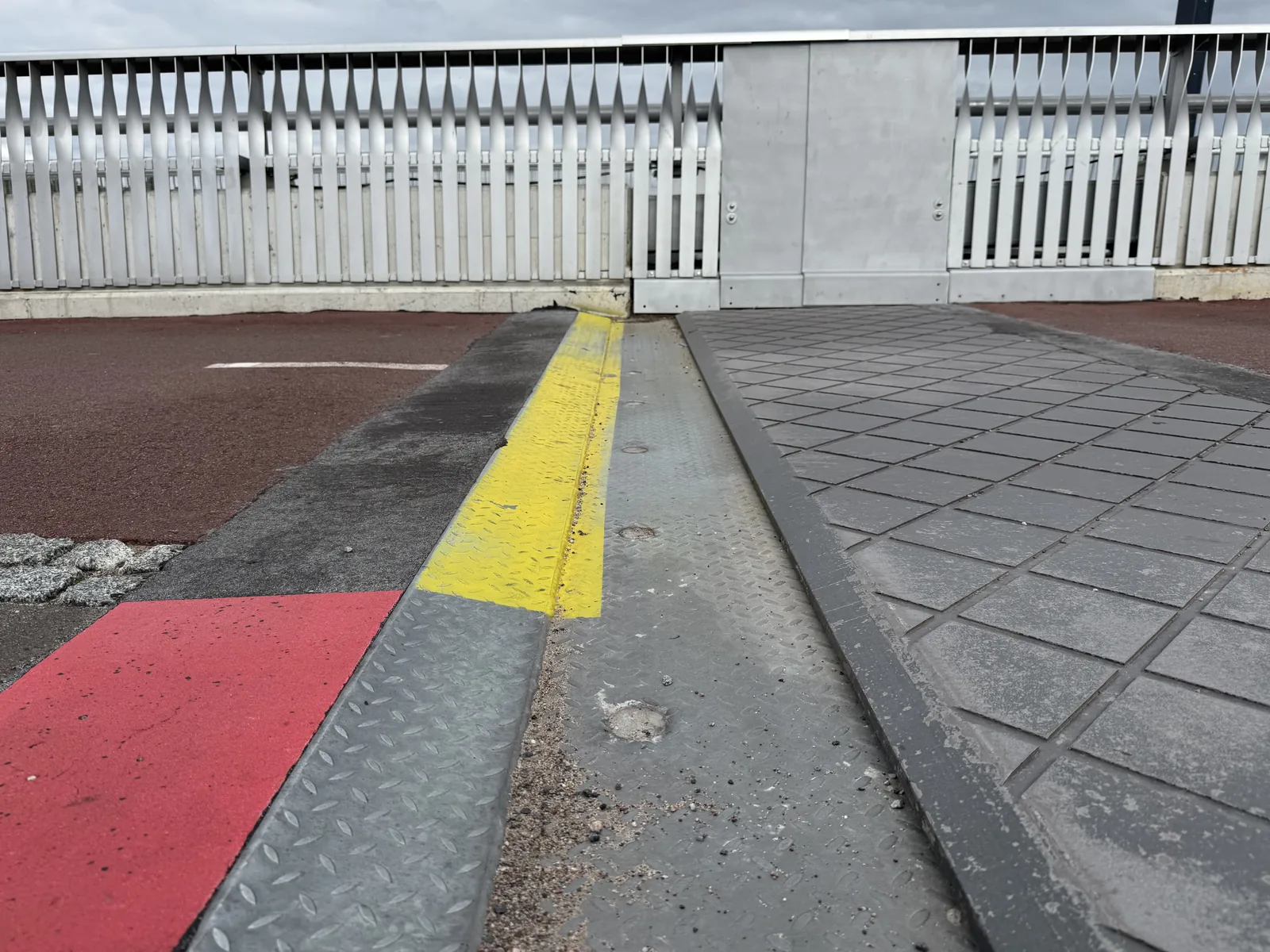
Why does a substance expand?
The micro model explains thermal expansion. In a solid the particles vibrate around their equilibrium positions. When the temperature rises, the vibration gets stronger.
It is easier for the particles to move apart than to be squeezed closer: particles pressed close together repel each other strongly, but the attraction between particles moving apart weakens gradually. So a particle swings farther from its neighbour than closer to it, and for more strongly vibrating particles the average distance grows. When all the gaps between the particles grow, the whole object expands.
Thermal expansion in everyday life
The change is small but powerful. A steel rod gets longer by only about one hundred-thousandth of its length for each kelvin, but if the ends of the rod are fixed, the expanding steel pushes on them with an enormous force. That is why long structures have expansion joints. A steel bridge deck is shorter in a winter frost than in a summer heatwave, and the comb-shaped joint at the end of the bridge lets the deck move freely. For the same reason electric power lines hang lower in a heatwave than in a frost.
An object expands in all directions in the same proportion, as when a photograph is enlarged. A hole in a plate also gets bigger when the plate warms up. This is used in a shrink fit: a heated steel ring is slipped onto an axle, and as it cools it is pressed tightly in place.
Thermal expansion of different substances
Different substances expand differently. A bimetallic strip, in which two different metals are joined together, bends when it warms up, because one metal lengthens more. Such a strip opens and closes an electric circuit in old-style thermostats.
Liquids usually expand clearly more than solids, and gases much more still. The particles of a liquid do not stay in place, and the interactions between them are weaker than in a solid, so a rise in temperature moves them farther apart. The particles of a gas are far apart and almost free, so at constant pressure the volume of a gas grows much more. The volume of a gas also depends on pressure, and we return to this in the chapter Changes of state of a gas and Boyle's law. A liquid thermometer is based on the expansion of a liquid: when the temperature rises, the liquid column rises in a thin tube.
Water is an exception: between $0\,{}^\circ\text{C}$ and $4\,{}^\circ\text{C}$ it contracts when it warms up, so its density is greatest at about $4\,{}^\circ\text{C}$. The densest, 4-degree water sinks to the bottom, and colder water stays at the surface and freezes. That is why a lake freezes from the surface, and even in winter there is water at about 4 °C at the bottom, where fish survive.
Thermal expansion of length and volume
When the temperature of an object changes by $\Delta T$, its length changes by
$$\Delta L = \alpha L_0 \Delta T$$
where $\Delta L$ is the change in length (m), $\alpha$ is the coefficient of linear expansion (1/K), $L_0$ is the original length (m) and $\Delta T$ is the change in temperature (K). The coefficient of linear expansion $\alpha$ tells you what fraction of its length an object lengthens when its temperature rises by $1\,\text{K}$. So the change is proportional to the original length: a rod twice as long has twice as many gaps between particles, so it lengthens twice as much. The number 12 in the table means that $\alpha = 12 \cdot 10^{-6}\,\tfrac{1}{\text{K}}$. The new length is $L = L_0 + \Delta L$. When the object cools, $\Delta T$ is negative, so $\Delta L$ is also negative, that is, the object gets shorter.
The change in the volume of liquids (and of gases at constant pressure) is calculated in the same way:
$$\Delta V = \gamma V_0 \Delta T$$
where $\Delta V$ is the change in volume (m³), $\gamma$ is the coefficient of volume expansion (1/K) and $V_0$ is the original volume (m³). For a solid $\gamma \approx 3\alpha$, because an object expands in all three directions: length, width and height each grow in proportion $\alpha \Delta T$, and when the changes are small, the relative growth in volume is almost the sum of these, $3\alpha \Delta T$. The formulas are good models when the change in temperature is moderate. For solids that means, for example, at most about a hundred kelvins. For liquids, especially water, the coefficient $\gamma$ changes clearly with temperature, so the values in the table at $20\,{}^\circ\text{C}$ are used only close to $20\,{}^\circ\text{C}$.
| Substance | $\alpha$ (10⁻⁶ 1/K) |
|---|---|
| steel | 12 |
| aluminium | 23 |
| copper | 17 |
| ordinary glass | 9 |
| borosilicate glass | 3.3 |
| Substance ($20\,{}^\circ\text{C}$) | $\gamma$ (10⁻³ 1/K) |
|---|---|
| water | 0.21 |
| ethanol | 1.1 |
| petrol | 0.95 |
| air (at constant pressure) | 3.4 |
Common misconception
Many people think that when a substance warms up, its particles themselves grow. In the micro model the particles stay the same size, and only their average distances grow. Another mistake is to think that a hole in a plate gets smaller because the plate supposedly expands from its edges towards the hole. The hole gets bigger in the same proportion as the plate does everywhere else. A third mistake is to assume that all substances always expand when they warm up: water contracts between $0\,{}^\circ\text{C}$ and $4\,{}^\circ\text{C}$, and when it freezes it expands. That is why ice floats and lakes freeze from the surface.
Summary
- When a substance warms up, the vibration of its particles gets stronger and their average distance grows, so the substance expands.
- The change in length is $\Delta L = \alpha L_0 \Delta T$ and the change in volume is $\Delta V = \gamma V_0 \Delta T$. For a solid $\gamma \approx 3\alpha$.
- Liquids expand more than solids, and gases much more than liquids.
- An object expands in all directions in the same proportion, so holes also get bigger.
- Water is an exception: its density is greatest at about $4\,{}^\circ\text{C}$.
Optional Go back to your predictions
Compare your predictions with the values from the model in the experiments and with the formula $\Delta L = \alpha L_0 \Delta T$. Then go back to the question at the start: what makes rigid steel change its length, and what does the amount the bridge joint has to give depend on?
Would you change your prediction?
Apply
Worked example
Problem
The deck of a steel bridge is $120\,\text{m}$ long. At the location the temperature varies during the year from a frost of $-30\,{}^\circ\text{C}$ to a heatwave of +$30\,{}^\circ\text{C}$, and the coefficient of linear expansion of steel is 12 · 10⁻⁶ 1/K. By how much does the length of the deck change, that is, how much must the expansion joint give at least?
Step 1/7
Given and find. The length of the deck is $L_0 = 120\,\text{m}$, $\alpha = 12 \cdot 10^{-6}\,\tfrac{1}{\text{K}}$ for steel (given in the problem), the lowest temperature is $-30\,{}^\circ\text{C}$ and the highest $+30\,{}^\circ\text{C}$. The question is the change $\Delta L$ in the length of the deck over the whole year.
Step 2/7
Principle. The vibration of the particles of a solid gets stronger when it warms up and their average distance grows, so the deck gets longer. Steel stays solid all year and the deck is free to expand, so the change in length is proportional to the initial length and the change in temperature: $\Delta L = \alpha L_0 \Delta T$.
Step 3/7
Rearranged formula. The quantity asked for is already alone on the left side of the formula, so the formula does not need rearranging:
$$\begin{aligned} \Delta L &= \alpha L_0 \Delta T \\ \Delta T &= T_\text{max} - T_\text{min} \end{aligned}$$
Step 4/7
Unit conversions. The change in temperature is the same in degrees Celsius and in kelvins, so
The lengths are in metres, so $\Delta L$ comes out in metres; finally $1\,\text{m} = 1000\,\text{mm}$.
Step 5/7
Substitution. Substitute the values with their units:
$$\begin{aligned} \Delta L &= \alpha L_0 \Delta T \\ &= 12 \cdot 10^{-6}\,\tfrac{1}{\text{K}} \cdot 120\,\text{m} \cdot 60\,\text{K} \\ &= 0.0864\,\text{m} \\ &= 86.4\,\text{mm} \end{aligned}$$
Step 6/7
Result. The length of the deck changes by about $86\,\text{mm}$ during the year. The result is given to two significant figures. The limiting data are the coefficient $12 \cdot 10^{-6}\,\tfrac{1}{\text{K}}$ and the difference of whole degrees $\Delta T = 60\,\text{K}$ (both have two figures); the length $120\,\text{m}$ has at least two figures and does not limit the result.
Step 7/7
Reasonableness. A rough estimate:
so the result is of the right order of magnitude. The deck gets almost nine centimetres longer by summer, because the temperature rises. That is only $\alpha \Delta T = 0.072\,\%$ of the length of the deck, but without an expansion joint the expanding steel would push on the ends of the bridge with such a large force that the structures would be damaged. That is why there is a comb-shaped joint at the end of the bridge, with teeth that slide between each other.
Optional Find the error
Optional Apply to a new situation
The bulb of a liquid thermometer contains $0.20\,\text{cm}^3$ of ethanol ($\gamma = 1.1 \cdot 10^{-3}\,\tfrac{1}{\text{K}}$). A thin tube with a cross-sectional area of $0.050\,\text{mm}^2$ leads from the bulb.
By how many millimetres does the liquid column rise when the temperature rises from $15\,{}^\circ\text{C}$ to $25\,{}^\circ\text{C}$? The expansion of the glass is ignored (the $\gamma \approx 3\alpha$ of glass is about forty times smaller than the coefficient of ethanol), and the expansion of the ethanol in the tube itself is small compared with the bulb.
Hint 1: a guiding question
Where does the increase in the volume of the ethanol in the bulb go? Think of the liquid column rising in the tube as a cylinder.
Hint 2: what is the connection
The change in volume is $\Delta V = \gamma V_0 \Delta T$, and in the tube it forms a cylinder $\Delta V = A h$, so $h = \dfrac{\gamma V_0 \Delta T}{A}$.
Hint 3: an intermediate step
First convert
Then
Show the solution
Given
ethanol, $V_0 = 0.20\,\text{cm}^3$, $\gamma = 1.1 \cdot 10^{-3}\,\tfrac{1}{\text{K}}$ (given in the problem), cross-sectional area of the tube $A = 0.050\,\text{mm}^2$, $T_0 = 15\,{}^\circ\text{C}$, $T = 25\,{}^\circ\text{C}$
Find
the rise $h$ of the liquid column in millimetres
Principle
Ethanol is a liquid and expands when it warms up, so the change in its volume is proportional to the initial volume and the change in temperature: $\Delta V = \gamma V_0 \Delta T$. The expansion of the glass is about forty times smaller and is ignored, so the whole increase in volume goes into the thin tube. The volume of the column rising in the tube is the volume of a cylinder, $\Delta V = A h$.
Formula
$\Delta V = \gamma V_0 \Delta T$ and $\Delta V = A h$, so $\gamma V_0 \Delta T = A h$, from which
$$h = \frac{\gamma V_0 \Delta T}{A}$$
Conversions
The area is in square millimetres, so the volume is converted:
because $1\,\text{cm}^3 = 1000\,\text{mm}^3$. The change in temperature is the same in kelvins:
Substitution
$$\begin{aligned} \Delta V &= 1.1 \cdot 10^{-3}\,\tfrac{1}{\text{K}} \cdot 200\,\text{mm}^3 \cdot 10\,\text{K} \\ &= 2.2\,\text{mm}^3 \end{aligned}$$
$$h = \frac{2.2\,\text{mm}^3}{0.050\,\text{mm}^2} = 44\,\text{mm}$$
Answer
$h = 44\,\text{mm}$
Two significant figures. There are four limiting data: $\gamma = 1.1 \cdot 10^{-3}\,\tfrac{1}{\text{K}}$, $V_0 = 0.20\,\text{cm}^3$, $A = 0.050\,\text{mm}^2$ and the difference of whole degrees $\Delta T = 10\,\text{K}$ are all two-figure values.
Reasonableness
The volume of the ethanol grows by only $\gamma \Delta T = 1.1\,\%$, but in a thin tube even a small volume is a long column: $44\,\text{mm} / 10\,\text{K} \approx 4\,\text{mm}$ per kelvin, which is the order of magnitude of the scale of an ordinary thermometer. The column rises because the liquid warms up. If the expansion of the glass is taken into account, the column rises by about $43\,\text{mm}$.
Check your understanding
Exit ticket
Answer on your own first and only then open the answer.
- By how much does a $25\,\text{m}$ long copper pipe get longer when it warms up from $10\,{}^\circ\text{C}$ to $60\,{}^\circ\text{C}$ ($\alpha = 17 \cdot 10^{-6}\,\tfrac{1}{\text{K}}$)?
Answer
$\Delta L$$= \alpha L_0 \Delta T$$= 17 \cdot 10^{-6}\,\tfrac{1}{\text{K}} \cdot 25\,\text{m} \cdot 50\,\text{K}$$\approx 0.021\,\text{m}$that is, about 21 mm.
1. Concept
2. The hole warms up
3. Table and calculation
A metal rod is $2.00\,\text{m}$ long at $20\,{}^\circ\text{C}$. The table gives example values of the change in length of the rod at different temperatures (calculated values, not measurements).
| $T$ (°C) | 20 | 60 | 100 |
|---|---|---|---|
| $\Delta L$ (mm) | 0 | 1.84 | 3.68 |
Calculate the coefficient of linear expansion $\alpha$ of the metal. Give the answer in the unit $10^{-6}\,\tfrac{1}{\text{K}}$.
Hint 1: a guiding question
By how much does $\Delta L$ grow when the temperature rises by $40\,\text{K}$? Does the growth stay the same in every interval?
Hint 2: what is the connection
From the formula $\Delta L = \alpha L_0 \Delta T$ you get
The change in temperature is calculated from $20\,{}^\circ\text{C}$, where $L_0$ was measured.
Hint 3: an intermediate step
For example from the $60\,{}^\circ\text{C}$ column:
Show the solution
Given
metal rod, $L_0 = 2.00\,\text{m}$ at $T_0 = 20\,{}^\circ\text{C}$; from the table $\Delta L = 1.84\,\text{mm}$ at $60\,{}^\circ\text{C}$ and $\Delta L = 3.68\,\text{mm}$ at $100\,{}^\circ\text{C}$
Find
the coefficient of linear expansion $\alpha$ in the unit $10^{-6}\,\tfrac{1}{\text{K}}$
Principle
The change in the length of a solid is proportional to the initial length and the change in temperature, and the constant of proportionality $\alpha$ is a constant characteristic of the material. In the table $\Delta L$ doubles when the change in temperature $\Delta T$ ($40\,\text{K} \to 80\,\text{K}$) doubles, so the proportionality holds and the rod does not change its state of matter.
Formula
$\Delta L = \alpha L_0 \Delta T$, from which
$$\alpha = \frac{\Delta L}{L_0 \Delta T}$$
Conversions
so that the length units cancel.
the same in kelvins. The result is given in the unit $10^{-6}\,\tfrac{1}{\text{K}}$.
Substitution
$$\begin{aligned} \alpha &= \frac{1.84 \cdot 10^{-3}\,\text{m}}{2.00\,\text{m} \cdot 40\,\text{K}} \\ &= 2.3 \cdot 10^{-5}\,\tfrac{1}{\text{K}} \\ &= 23 \cdot 10^{-6}\,\tfrac{1}{\text{K}} \end{aligned}$$
Answer
$\alpha = 23 \cdot 10^{-6}\,\tfrac{1}{\text{K}}$
Two significant figures. The limiting datum is the temperature difference $\Delta T = 60\,{}^\circ\text{C} - 20\,{}^\circ\text{C} = 40\,\text{K}$, which as a difference of whole degrees is a two-figure value; $\Delta L = 1.84\,\text{mm}$ and $L_0 = 2.00\,\text{m}$ are three-figure values and do not limit the result.
Reasonableness
The other column gives the same:
The value equals the $\alpha$ of aluminium in the table and is in the usual range of metals, $10$–$25 \cdot 10^{-6}\,\tfrac{1}{\text{K}}$. If $60\,\text{K}$ were used in place of $\Delta T$, the result would be $15 \cdot 10^{-6}\,\tfrac{1}{\text{K}}$, which would not fit the other column.
Suggestion: one answer does not show everything you can do, but review the theory summary and do the core exercises.
Optional 4. Explain and transfer
Use the micro model to explain why a steel rail gets longer when it warms up, and why the same rise in temperature increases the volume of air at constant pressure proportionally much more than the volume of the rail.
Model answer
The particles of the rail vibrate around their equilibrium positions. When the temperature rises, the vibration gets stronger. It is easier for the particles to move apart than to be squeezed closer, so a particle swings farther from its neighbour than closer to it, and the average distance between the particles grows. The particles themselves do not grow. When all the gaps between the particles grow in the same proportion, the whole rail gets longer. In a solid, strong bonds hold the particles tightly in place, so the relative change is small. The particles of a gas are far apart and almost free, so at constant pressure a rise in temperature increases their average distance much more: the coefficient of volume expansion of air is about a hundred times the $\gamma \approx 3\alpha$ of steel.
Assess your own answer
Tick the points your own answer already contains.
Review the theory summary and practise with the exercises.
Review the chapter's concepts
Cards you mark Review later collect in your review deck.
- Thermal expansion
- Most substances grow when they warm up and shrink when they cool.
- Linear thermal expansion
- The change in an object's length depends on its original length, the change in temperature and the material.$$\Delta L = \alpha L_0 \Delta T$$
- Volume thermal expansion
- The change in an object's volume depends on its original volume, the change in temperature and the material.$$\Delta V = \gamma V_0 \Delta T$$
- Heat
- Energy transferred because of a temperature difference from a hotter system to a colder one.
- Thermal conductor
- A material in which energy is transferred efficiently by conduction.
Exercises
Level 1 · basic practice 8 exercises
One formula or one step of reasoning. Core exercises first, the rest is extra practice.
- Exercise 10-1Core
A detached house has a $6.0\,\text{m}$ long gutter made of coated steel ($\alpha = 12 \cdot 10^{-6}\,\tfrac{1}{\text{K}}$). On a summer day the sun heats the gutter from $15\,{}^\circ\text{C}$ in the morning to $55\,{}^\circ\text{C}$ in the afternoon.
By how much does the gutter get longer? Give the answer in millimetres.
Answer
$\Delta L \approx 2.9\,\text{mm}$
Show the solution
Given
steel gutter, $L_0 = 6.0\,\text{m}$, $T_0 = 15\,{}^\circ\text{C}$, $T = 55\,{}^\circ\text{C}$, $\alpha = 12 \cdot 10^{-6}\,\tfrac{1}{\text{K}}$ (given in the problem)
Find
the change in length of the gutter $\Delta L$ in millimetres
Principle
The vibration of the particles of a solid gets stronger when it warms up and the average distance between the particles grows. The gutter is not jammed and its state of matter does not change, so the change in length is proportional to the initial length and the change in temperature.
Formula
$\Delta L = \alpha L_0 \Delta T$, where $\Delta T = T - T_0$. The quantity asked for, $\Delta L$, is already alone on the left side.
Conversions
The change in temperature is the same in degrees Celsius and in kelvins:
$\Delta T$$= 55\,{}^\circ\text{C} - 15\,{}^\circ\text{C}$$= 40\,\text{K}$The result comes out in metres, and $1\,\text{m} = 1000\,\text{mm}$.
Substitution
$\Delta L$$= 12 \cdot 10^{-6}\,\tfrac{1}{\text{K}} \cdot 6.0\,\text{m} \cdot 40\,\text{K}$$= 0.00288\,\text{m}$$= 2.88\,\text{mm}$Answer
$\Delta L \approx 2.9\,\text{mm}$
Two significant figures. The limiting data are the length $6.0\,\text{m}$ and the coefficient $12 \cdot 10^{-6}\,\tfrac{1}{\text{K}}$ (both have two figures); the temperature difference $\Delta T = 40\,\text{K}$, as a difference of whole degrees, also has two figures, so it does not limit the result any further.
Reasonableness
A rough estimate:
$10^{-5}\,\tfrac{1}{\text{K}} \cdot 6\,\text{m} \cdot 40\,\text{K}$$\approx 2.4\,\text{mm}$so the result is of the right order of magnitude. $\Delta L$ is positive because the gutter warms up. The change is only $\alpha \Delta T = 0.048\,\%$ of the length, but the fastenings must still let the gutter slide.
- Exercise 10-2Core
An aluminium overhead wire ($\alpha = 23 \cdot 10^{-6}\,\tfrac{1}{\text{K}}$) between two electricity poles is $50.0\,\text{m}$ long at $18\,{}^\circ\text{C}$ on a summer evening. On a frosty night the temperature of the wire drops to $-27\,{}^\circ\text{C}$. Calculate the change in the length of the wire $\Delta L$ with its sign. Give the answer in millimetres.
Answer
$\Delta L \approx -52\,\text{mm}$
Show the solution
Given
aluminium wire, $L_0 = 50.0\,\text{m}$, $T_0 = 18\,{}^\circ\text{C}$, $T = -27\,{}^\circ\text{C}$, $\alpha = 23 \cdot 10^{-6}\,\tfrac{1}{\text{K}}$ (given in the problem)
Find
the change in length $\Delta L$ with its sign in millimetres
Principle
When it cools, the vibration of the particles gets weaker and their average distance decreases, so the wire gets shorter. The state of matter of the wire does not change, so the same formula $\Delta L = \alpha L_0 \Delta T$ describes both warming and cooling, and a negative $\Delta T$ gives a negative $\Delta L$.
Formula
$\Delta L = \alpha L_0 \Delta T$, where $\Delta T = T - T_0$ (final minus initial).
Conversions
The change in temperature is the same in kelvins:
$\Delta T$$= -27\,{}^\circ\text{C} - 18\,{}^\circ\text{C}$$= -45\,\text{K}$The result comes out in metres, and $1\,\text{m} = 1000\,\text{mm}$.
Substitution
$\Delta L$$= 23 \cdot 10^{-6}\,\tfrac{1}{\text{K}} \cdot 50.0\,\text{m} \cdot (-45\,\text{K})$$= -0.05175\,\text{m}$$= -51.75\,\text{mm}$Answer
$\Delta L \approx -52\,\text{mm}$
Two significant figures. The limiting data are $\alpha = 23 \cdot 10^{-6}\,\tfrac{1}{\text{K}}$ and the difference of whole degrees $\Delta T = -45\,\text{K}$ (both have two figures); the length $50.0\,\text{m}$ has three figures and does not limit the result.
Reasonableness
A rough estimate:
$2 \cdot 10^{-5}\,\tfrac{1}{\text{K}} \cdot 50\,\text{m} \cdot 45\,\text{K}$$\approx 45\,\text{mm}$The sign is correct because the temperature falls. The wire gets shorter by about $0.10\,\%$, so it must be installed slack in summer so that it does not become too tight in winter.
- Exercise 10-3
In a physics lesson a copper tube ($\alpha = 17 \cdot 10^{-6}\,\tfrac{1}{\text{K}}$) is cooled with ice water to $0\,{}^\circ\text{C}$, and its length is measured to be $500.0\,\text{mm}$. One end of the tube is fixed in a stand, and a dial gauge is placed against the other end.
Then steam from boiling water is passed through the tube, and the tube warms up to $100\,{}^\circ\text{C}$.
By how much does the tube get longer, that is, by how much does the reading of the dial gauge change? Give the answer in millimetres.
Answer
$\Delta L = 0.85\,\text{mm}$
Show the solution
Given
copper tube, $L_0 = 500.0\,\text{mm}$ at the temperature $T_0 = 0\,{}^\circ\text{C}$, $T = 100\,{}^\circ\text{C}$, $\alpha = 17 \cdot 10^{-6}\,\tfrac{1}{\text{K}}$ (given in the problem)
Find
the change in length of the tube $\Delta L$ in millimetres, that is, the change in the reading of the dial gauge
Principle
One end of the tube is fixed, so the whole change in length shows at the free end and in the dial gauge. The copper warms up and its state of matter does not change, so the change in length is proportional to the initial length and the change in temperature.
Formula
$\Delta L = \alpha L_0 \Delta T$, where $\Delta T = T - T_0$. The new length is $L = L_0 + \Delta L$.
Conversions
$\Delta T$$= 100\,{}^\circ\text{C} - 0\,{}^\circ\text{C}$$= 100\,\text{K}$the same in kelvins. No unit conversion is needed: $L_0$ is in millimetres, so $\Delta L$ also comes out in millimetres.
Substitution
$\Delta L$$= 17 \cdot 10^{-6}\,\tfrac{1}{\text{K}} \cdot 500.0\,\text{mm} \cdot 100\,\text{K}$$= 0.85\,\text{mm}$and
$L$$= 500.0\,\text{mm} + 0.85\,\text{mm}$$= 500.85\,\text{mm}$Answer
$\Delta L = 0.85\,\text{mm}$
Two significant figures. The limiting datum is $\alpha = 17 \cdot 10^{-6}\,\tfrac{1}{\text{K}}$ (two figures); the length $500.0\,\text{mm}$ and the difference of whole degrees $\Delta T = 100\,\text{K}$ are more precise.
Reasonableness
The relative change is
$\alpha \Delta T$$= 17 \cdot 10^{-6}\,\tfrac{1}{\text{K}} \cdot 100\,\text{K}$$= 0.17\,\%$and $0.17\,\%$ of $500\,\text{mm}$ is $0.85\,\text{mm}$. The tube gets longer because it warms up, and a change of less than a millimetre shows on a dial gauge but not on a ruler.
- Exercise 10-4
On the roof of a summer cottage sauna there is a black $200.0\,\textsf{l}$ tank from which shower water is drawn. In the morning the temperature of the water is $12\,{}^\circ\text{C}$, and in the afternoon the sun has heated it to $32\,{}^\circ\text{C}$. The coefficient of volume expansion of water is $\gamma = 0.21 \cdot 10^{-3}\,\tfrac{1}{\text{K}}$.
By how many litres does the volume of the water grow?
Answer
$\Delta V = 0.84\,\textsf{l}$
Show the solution
Given
water, $V_0 = 200.0\,\textsf{l}$, $T_0 = 12\,{}^\circ\text{C}$, $T = 32\,{}^\circ\text{C}$, $\gamma = 0.21 \cdot 10^{-3}\,\tfrac{1}{\text{K}}$ (given in the problem)
Find
the increase in the volume of the water $\Delta V$ in litres
Principle
A liquid expands in all directions, so the change in its volume is proportional to the initial volume and the change in temperature. Water stays liquid below $100\,{}^\circ\text{C}$, so the coefficient of volume expansion $\gamma$ describes the situation. The tank does not limit the expansion, because the question is only about the growth of the volume of the water.
Formula
$\Delta V = \gamma V_0 \Delta T$, where $\Delta T = T - T_0$.
Conversions
$\Delta T$$= 32\,{}^\circ\text{C} - 12\,{}^\circ\text{C}$$= 20\,\text{K}$the same in kelvins. The litres do not need converting, because $V_0$ is in litres and $\Delta V$ also comes out in litres.
Substitution
$\Delta V$$= 0.21 \cdot 10^{-3}\,\tfrac{1}{\text{K}} \cdot 200.0\,\textsf{l} \cdot 20\,\text{K}$$= 0.84\,\textsf{l}$Answer
$\Delta V = 0.84\,\textsf{l}$
Two significant figures. The limiting datum is $\gamma = 0.21 \cdot 10^{-3}\,\tfrac{1}{\text{K}}$ (two figures); the volume $200.0\,\textsf{l}$ has four figures and the difference of whole degrees $\Delta T = 20\,\text{K}$ has two figures, so neither limits the result any further.
Reasonableness
The relative growth is
$\gamma \Delta T$$= 0.21 \cdot 10^{-3}\,\tfrac{1}{\text{K}} \cdot 20\,\text{K}$$= 0.42\,\%$and $0.42\,\%$ of $200.0\,\textsf{l}$ is $0.84\,\textsf{l}$. The growth is positive because the water warms up. Almost a litre more would not fit in a tank filled to the brim and closed, so the tank has an overflow or an air space.
- Exercise 10-5
The living room window has a $1.5\,\text{m}$ wide pane of ordinary glass ($\alpha = 9.0 \cdot 10^{-6}\,\tfrac{1}{\text{K}}$). On a summer day the sunshine heats the glass from $20\,{}^\circ\text{C}$ to $45\,{}^\circ\text{C}$.
By how much does the width of the glass grow? Give the answer in millimetres.
Answer
$\Delta L \approx 0.34\,\text{mm}$
Show the solution
Given
ordinary glass, width $L_0 = 1.5\,\text{m}$, $T_0 = 20\,{}^\circ\text{C}$, $T = 45\,{}^\circ\text{C}$, $\alpha = 9.0 \cdot 10^{-6}\,\tfrac{1}{\text{K}}$ (given in the problem)
Find
the change in width $\Delta L$ in millimetres
Principle
Glass is a solid, and it expands in all directions in the same proportion when it warms up. The glass does not melt, so the change in width is proportional to the initial width and the change in temperature.
Formula
$\Delta L = \alpha L_0 \Delta T$, where $\Delta T = T - T_0$.
Conversions
$\Delta T$$= 45\,{}^\circ\text{C} - 20\,{}^\circ\text{C}$$= 25\,\text{K}$the same in kelvins. The result comes out in metres, and $1\,\text{m} = 1000\,\text{mm}$.
Substitution
$\Delta L$$= 9.0 \cdot 10^{-6}\,\tfrac{1}{\text{K}} \cdot 1.5\,\text{m} \cdot 25\,\text{K}$$= 0.0003375\,\text{m}$$= 0.3375\,\text{mm}$Answer
$\Delta L \approx 0.34\,\text{mm}$
Two significant figures. There are three limiting data: $\alpha = 9.0 \cdot 10^{-6}\,\tfrac{1}{\text{K}}$, the width $1.5\,\text{m}$ and the difference of whole degrees $\Delta T = 25\,\text{K}$ all have two figures.
Reasonableness
The relative change is $9.0 \cdot 10^{-6}\,\tfrac{1}{\text{K}} \cdot 25\,\text{K} = 0.0225\,\%$, and $1500\,\text{mm} \cdot 0.000225 = 0.34\,\text{mm}$. The same situation with steel ($\alpha = 12 \cdot 10^{-6}\,\tfrac{1}{\text{K}}$) would give about $0.45\,\text{mm}$, so glass expands less than metal, as its smaller $\alpha$ promises.
- Exercise 10-6
The steel lid of a glass jar that is stuck tight often comes loose more easily when hot water is run over the lid for a moment.
What is the reason?
Answer
The steel lid expands more than the glass when it warms up, so the lid becomes loose around the mouth of the jar.
Show the solution
Find
why hot water helps to loosen a tight steel lid from a glass jar
Principle
When a solid warms up, the average distance between its particles grows, so the object expands, and the expansion is proportional to the temperature coefficient $\alpha$. The coefficient of steel, $12 \cdot 10^{-6}\,\tfrac{1}{\text{K}}$, is greater than that of glass, $9 \cdot 10^{-6}\,\tfrac{1}{\text{K}}$. The hot water is run over the lid, so the lid warms up first and the most.
Model answer
The steel lid expands more than the glass when it warms up, so the lid becomes loose around the mouth of the jar and comes off more easily. The lid does not shrink, because when it warms up the distances between the particles grow. The particles do not grow either, and different materials expand by different amounts because their temperature coefficients are different.
- Exercise 10-7
Three samples of the same size, a piece of steel, a glass of water and a balloon full of air (at constant pressure), warm up from $20\,{}^\circ\text{C}$ to $30\,{}^\circ\text{C}$.
Which sample expands the most in relative terms, and why?
Answer
Air, because only weak interactions bind the particles of a gas to each other.
Show the solution
Find
which of the three samples (steel, water, air) expands the most in relative terms when the temperature rises by $10\,\text{K}$, and why
Principle
The relative growth in volume is $\dfrac{\Delta V}{V_0} = \gamma \Delta T$, and $\Delta T$ is the same for all the samples, so the difference comes from the temperature coefficient $\gamma$. The size of the coefficient tells how tightly the particles are bound to each other: most tightly in a solid and most loosely in a gas.
Model answer
Air expands the most, because only weak interactions bind the particles of a gas to each other and the distances between the particles grow easily. According to the table, the $\gamma = 3.4 \cdot 10^{-3}\,\tfrac{1}{\text{K}}$ of air is about 16 times the $0.21 \cdot 10^{-3}\,\tfrac{1}{\text{K}}$ of water and about 90 times the $\gamma \approx 3\alpha = 36 \cdot 10^{-6}\,\tfrac{1}{\text{K}}$ of steel. So the same change in temperature does not expand everything equally, and the solid expands the least.
- Exercise 10-8
A student calculated how much a $2.0\,\text{m}$ long aluminium rod ($\alpha = 23 \cdot 10^{-6}\,\tfrac{1}{\text{K}}$) gets longer when its temperature rises from $15\,{}^\circ\text{C}$ to $65\,{}^\circ\text{C}$. The student wrote $\Delta L = 23 \cdot 10^{-6}\,\tfrac{1}{\text{K}} \cdot 2.0\,\text{m} \cdot 65 = 3.0\,\text{mm}$ (units left out).
There is an error here. Calculate the change in the length of the rod correctly. Give the answer in millimetres.
Answer
$\Delta L = 2.3\,\text{mm}$
Show the solution
Given
aluminium rod, $L_0 = 2.0\,\text{m}$, $T_0 = 15\,{}^\circ\text{C}$, $T = 65\,{}^\circ\text{C}$, $\alpha = 23 \cdot 10^{-6}\,\tfrac{1}{\text{K}}$ (given in the problem)
Find
the change in the length of the rod $\Delta L$ in millimetres (the error in the student's calculation)
Principle
The change in length is proportional to the initial length and to the change in temperature, not to the final temperature. The student put the final temperature $65$ into the formula instead of the change in temperature.
Formula
$\Delta L = \alpha L_0 \Delta T$, where $\Delta T = T - T_0$. The quantity asked for, $\Delta L$, is already alone on the left side.
Conversions
The change in temperature is the same in degrees Celsius and in kelvins:
$\Delta T$$= 65\,{}^\circ\text{C} - 15\,{}^\circ\text{C}$$= 50\,\text{K}$The length is in metres, so $\Delta L$ comes out in metres; finally $1\,\text{m} = 1000\,\text{mm}$.
Substitution
$\Delta L$$= 23 \cdot 10^{-6}\,\tfrac{1}{\text{K}} \cdot 2.0\,\text{m} \cdot 50\,\text{K}$$= 0.0023\,\text{m}$$= 2.3\,\text{mm}$Answer
$\Delta L = 2.3\,\text{mm}$
Two significant figures like the given data.
Reasonableness
The student's result $3.0\,\text{mm}$ came from the factor $65$ instead of $50$, so it is $\tfrac{65}{50} = 1.3$ times as large, that is $30\,\%$ too big. If the rod had been heated from $0\,{}^\circ\text{C}$ to $65\,{}^\circ\text{C}$, the student's number would have been correct. The relative change in the length of the rod, $\alpha \Delta T = 0.12\,\%$, is typical for a metal.
Level 2 · applied practice 7 exercises
Two steps, working with measured data, a unit conversion or rearranging a formula. Core exercises first, the rest is extra practice.
- Exercise 10-9Core
A flexible bellows section is installed at the end of a straight section of a district heating pipe, and it can take up a change in length of at most $50.0\,\text{mm}$. The steel pipe ($\alpha = 12 \cdot 10^{-6}\,\tfrac{1}{\text{K}}$) is installed at $10\,{}^\circ\text{C}$, and in use its temperature is $90\,{}^\circ\text{C}$.
What is the greatest length the straight section of the pipe may have? Give the answer in metres.
Answer
$L_0 \approx 52\,\text{m}$
Show the solution
Given
steel pipe, maximum allowance of the bellows section $\Delta L = 50.0\,\text{mm}$, $T_0 = 10\,{}^\circ\text{C}$, $T = 90\,{}^\circ\text{C}$, $\alpha = 12 \cdot 10^{-6}\,\tfrac{1}{\text{K}}$ (given in the problem)
Find
the greatest length $L_0$ of the straight section in metres
Principle
The change in the length of the pipe is proportional to its length and the change in temperature, and the bellows section takes up at most $50.0\,\text{mm}$. Steel stays solid, so the same expansion formula applies. The formula is rearranged for the initial length, because the change is known and the length is asked for.
Formula
$\Delta L = \alpha L_0 \Delta T$, from which
$L_0$$= \dfrac{\Delta L}{\alpha \Delta T}$Conversions
$\Delta L$$= 50.0\,\text{mm}$$= 0.0500\,\text{m}$so that the result comes out in metres.
$\Delta T$$= 90\,{}^\circ\text{C} - 10\,{}^\circ\text{C}$$= 80\,\text{K}$the same in kelvins.
Substitution
$L_0$$= \dfrac{0.0500\,\text{m}}{12 \cdot 10^{-6}\,\tfrac{1}{\text{K}} \cdot 80\,\text{K}}$$= \dfrac{0.0500\,\text{m}}{9.6 \cdot 10^{-4}}$$= 52.083\,\text{m}$Answer
$L_0 \approx 52\,\text{m}$
Two significant figures. The limiting data are $\alpha = 12 \cdot 10^{-6}\,\tfrac{1}{\text{K}}$ and the difference of whole degrees $\Delta T = 80\,\text{K}$ (both have two figures); the allowed change $50.0\,\text{mm}$ has three figures and does not limit the result.
Reasonableness
Check forwards:
$12 \cdot 10^{-6}\,\tfrac{1}{\text{K}} \cdot 52\,\text{m} \cdot 80\,\text{K}$$= 0.0499\,\text{m}$$\approx 50\,\text{mm}$A larger allowed change or a smaller temperature difference would allow a longer pipe, so the result goes in the right direction. If the millimetres were not converted to metres, the result would be a thousand times too large.
- Exercise 10-10Core
A steel kettlebell with a volume of $2.0\,\text{dm}^3$ has been in a garage at $-22\,{}^\circ\text{C}$ on a frosty night. It is brought inside, where it warms to $20\,{}^\circ\text{C}$. The coefficient of linear expansion of steel is $\alpha = 12 \cdot 10^{-6}\,\tfrac{1}{\text{K}}$.
By how many cubic centimetres does the volume of the kettlebell grow? Hint: for a solid $\gamma \approx 3\alpha$.
Answer
$\Delta V \approx 3.0\,\text{cm}^3$
Show the solution
Given
steel kettlebell, $V_0 = 2.0\,\text{dm}^3$, $T_0 = -22\,{}^\circ\text{C}$, $T = 20\,{}^\circ\text{C}$, $\alpha = 12 \cdot 10^{-6}\,\tfrac{1}{\text{K}}$ (given in the problem)
Find
the increase in volume $\Delta V$ in cubic centimetres
Principle
The kettlebell expands in all three directions in the same proportion, so its volume grows in relative terms about three times as much as its length: $\gamma \approx 3\alpha$. This holds for a solid whose state of matter does not change. The change in volume is proportional to the initial volume and the change in temperature.
Formula
$\gamma \approx 3\alpha$ and $\Delta V = \gamma V_0 \Delta T$, that is, $\Delta V = 3\alpha V_0 \Delta T$.
Conversions
$V_0$$= 2.0\,\text{dm}^3$$= 2000\,\text{cm}^3$because $1\,\text{dm}^3 = 1000\,\text{cm}^3$.
$\Delta T$$= 20\,{}^\circ\text{C} - (-22\,{}^\circ\text{C})$$= 42\,\text{K}$the same in kelvins.
Substitution
$\gamma$$\approx 3 \cdot 12 \cdot 10^{-6}\,\tfrac{1}{\text{K}}$$= 36 \cdot 10^{-6}\,\tfrac{1}{\text{K}}$and
$\Delta V$$= 36 \cdot 10^{-6}\,\tfrac{1}{\text{K}} \cdot 2000\,\text{cm}^3 \cdot 42\,\text{K}$$= 3.024\,\text{cm}^3$Answer
$\Delta V \approx 3.0\,\text{cm}^3$
Two significant figures. There are three limiting data: the volume $2.0\,\text{dm}^3$, the coefficient $12 \cdot 10^{-6}\,\tfrac{1}{\text{K}}$ and the difference of whole degrees $\Delta T = 42\,\text{K}$ all have two figures. The factor $3$ ($\gamma \approx 3\alpha$) is an exact number and does not limit the result.
Reasonableness
The relative growth is $36 \cdot 10^{-6}\,\tfrac{1}{\text{K}} \cdot 42\,\text{K} = 0.15\,\%$, and $0.15\,\%$ of $2000\,\text{cm}^3$ is $3.0\,\text{cm}^3$. The volume grows because the kettlebell warms up. The change is so small that you cannot notice it by hand.
- Exercise 10-11
On an old-style railway, the steel rails ($\alpha = 12 \cdot 10^{-6}\,\tfrac{1}{\text{K}}$) are $25.0\,\text{m}$ long. When the track is built at $12\,{}^\circ\text{C}$, a gap of $7.2\,\text{mm}$ is left between the rails. Assume that the gap closes when a rail has lengthened by the width of the gap.
At what temperature does the gap close?
Answer
$T = 36\,{}^\circ\text{C}$
Show the solution
Given
steel rail, $L_0 = 25.0\,\text{m}$, $T_0 = 12\,{}^\circ\text{C}$, gap $\Delta L = 7.2\,\text{mm}$, $\alpha = 12 \cdot 10^{-6}\,\tfrac{1}{\text{K}}$ (given in the problem)
Find
the temperature $T$ at which the gap closes
Principle
The rail gets longer when it warms up, in proportion to its length and its change in temperature. According to the assumption in the problem, the gap closes when the rail has lengthened by the width of the gap, so $\Delta L$ is set equal to the gap and the required change in temperature is solved.
Formula
$\Delta L = \alpha L_0 \Delta T$, from which
$\Delta T$$= \dfrac{\Delta L}{\alpha L_0}$and finally $T = T_0 + \Delta T$.
Conversions
$\Delta L$$= 7.2\,\text{mm}$$= 0.0072\,\text{m}$so that the lengths are in the same unit. The change in temperature $\Delta T$ comes out in kelvins, and it is the same in degrees Celsius, so it is added directly to the temperature $T_0$.
Substitution
$\Delta T$$= \dfrac{0.0072\,\text{m}}{12 \cdot 10^{-6}\,\tfrac{1}{\text{K}} \cdot 25.0\,\text{m}}$$= \dfrac{0.0072\,\text{m}}{3.0 \cdot 10^{-4}\,\text{m/K}}$$= 24\,\text{K}$and
$T$$= 12\,{}^\circ\text{C} + 24\,\text{K}$$= 36\,{}^\circ\text{C}$Answer
$T = 36\,{}^\circ\text{C}$
Two significant figures. The figures of the change in temperature $\Delta T = 24\,\text{K}$ are limited by the gap $7.2\,\text{mm}$ and the coefficient $12 \cdot 10^{-6}\,\tfrac{1}{\text{K}}$ (both have two figures; the length $25.0\,\text{m}$ has three). The sum $12\,{}^\circ\text{C} + 24\,\text{K}$ is in whole degrees, so $36\,{}^\circ\text{C}$ keeps those two figures.
Reasonableness
Check:
$12 \cdot 10^{-6}\,\tfrac{1}{\text{K}} \cdot 25.0\,\text{m} \cdot 24\,\text{K}$$= 7.2\,\text{mm}$so the rail fills the gap. The temperature is above the initial temperature, because the rail gets longer only when it warms up. The neighbouring rail also gets longer, but each rail lengthens in both directions: each edge of the gap moves $\tfrac{1}{2}\Delta L$, so in total the lengthening of one rail, $\Delta L$, is directed towards the gap, and the assumption of the problem holds. A dark rail easily heats above $36\,{}^\circ\text{C}$ in a heatwave.
- Exercise 10-12
A metal beam used in a bridge structure, with a length of $5.00\,\text{m}$ at $20\,{}^\circ\text{C}$, is heated and the change in its length is measured. The graph shows the change in length $\Delta L$ as a function of temperature.
Calculate the coefficient of linear expansion $\alpha$ of the material of the beam in the unit $10^{-6}\,\tfrac{1}{\text{K}}$ and use the table in the lesson to work out which metal the beam is made of (steel 12, aluminium 23, copper 17, all in the unit $10^{-6}\,\tfrac{1}{\text{K}}$). Read the values you need from the graph.
Answer
$\alpha = 12 \cdot 10^{-6}\,\tfrac{1}{\text{K}}$
Show the solution
Given
metal beam, $L_0 = 5.00\,\text{m}$ at $20\,{}^\circ\text{C}$; change in length as a function of temperature in the graph; from the table $\alpha_\text{steel} = 12$, $\alpha_\text{aluminium} = 23$, $\alpha_\text{copper} = 17$ (in the unit $10^{-6}\,\tfrac{1}{\text{K}}$)
Find
the coefficient of linear expansion $\alpha$ in the unit $10^{-6}\,\tfrac{1}{\text{K}}$ and, based on it, the metal
Principle
The beam gets longer when it warms up, in proportion to its length and its change in temperature, and the coefficient $\alpha$ is a constant characteristic of the material. The points of the graph give the change in temperature and the change in length, and from them $\alpha$, which can be compared with the table.
Reading the graph
The line starts at the grid crossing $(20\,{}^\circ\text{C}$; $0\,\text{mm})$ and ends at the crossing $(70\,{}^\circ\text{C}$; $3.0\,\text{mm})$. So the change in temperature is
$\Delta T$$= 70\,{}^\circ\text{C} - 20\,{}^\circ\text{C}$$= 50\,\text{K}$and the change in length is $\Delta L = 3.0\,\text{mm}$.
Formula
$\Delta L = \alpha L_0 \Delta T$, from which
$\alpha$$= \dfrac{\Delta L}{L_0 \Delta T}$Conversions
$\Delta L$$= 3.0\,\text{mm}$$= 0.0030\,\text{m}$so that the units cancel. The change in temperature is the same in degrees Celsius and in kelvins. The result is given in the unit $10^{-6}\,\tfrac{1}{\text{K}}$, so the factor $10^{-6}$ is left in the unit.
Substitution
$\alpha$$= \dfrac{0.0030\,\text{m}}{5.00\,\text{m} \cdot 50\,\text{K}}$$= \dfrac{0.0030}{250}\,\tfrac{1}{\text{K}}$$= 0.000012\,\tfrac{1}{\text{K}}$$= 12 \cdot 10^{-6}\,\tfrac{1}{\text{K}}$Answer
$\alpha = 12 \cdot 10^{-6}\,\tfrac{1}{\text{K}}$
So the beam is steel. Two significant figures, because the change in length $3.0\,\text{mm}$ was read with two figures. The values are read exactly from the grid, so $11.6\ldots12.4$ is accepted.
Reasonableness
Units:
$\dfrac{\text{m}}{\text{m} \cdot \text{K}}$$= \tfrac{1}{\text{K}}$Comparison with the table: an aluminium beam would lengthen
$23 \cdot 10^{-6}\,\tfrac{1}{\text{K}} \cdot 5.00\,\text{m} \cdot 50\,\text{K}$$= 5.75\,\text{mm}$and a copper beam $4.25\,\text{mm}$, so only steel gives the $3.0\,\text{mm}$ that was read. A fraction of a millimetre per metre of length is typical of metals.
- Exercise 10-13
Example data: the table gives the volume of $1.000\,\text{kg}$ of water at different temperatures. The volume calculated from a density table is given to six significant figures, because the changes are small.
a) At which temperature in the table does water take up the least space, and what does that tell you about the density of water at that temperature?
b) Calculate the temperature coefficient of the volume of water $\gamma$ over the temperature range $4\,{}^\circ\text{C} \ldots 10\,{}^\circ\text{C}$ in the unit $10^{-6}\,\tfrac{1}{\text{K}}$. Use the volume at $4\,{}^\circ\text{C}$ as the initial volume.
c) Compare the result with the value $\gamma = 210 \cdot 10^{-6}\,\tfrac{1}{\text{K}}$ valid at $20\,{}^\circ\text{C}$ and explain why water differs from other liquids over the temperature range $0\,{}^\circ\text{C} \ldots 4\,{}^\circ\text{C}$ and why the temperature of the water at the bottom of a deep lake in winter is about $4\,{}^\circ\text{C}$.
The answer field takes the result of part b).
Volume of $1.000\,\text{kg}$ of water (example data) $T\,({}^\circ\text{C})$ $V\,(\text{dm}^3)$ 0 1.00016 2 1.00006 4 1.00003 6 1.00006 8 1.00015 10 1.00030 Answer
$\gamma \approx 45 \cdot 10^{-6}\,\tfrac{1}{\text{K}}$
Show the solution
Given
$1.000\,\text{kg}$ of water: the volume at $4\,{}^\circ\text{C}$ is $V_4 = 1.00003\,\text{dm}^3$ and at $10\,{}^\circ\text{C}$ $V_{10} = 1.00030\,\text{dm}^3$; the smallest volume in the table is $1.00003\,\text{dm}^3$
Find
a) the temperature at which water takes up the least space and what that tells about the density; b) $\gamma$ over $4\,{}^\circ\text{C} \ldots 10\,{}^\circ\text{C}$ in the unit $10^{-6}\,\tfrac{1}{\text{K}}$; c) the comparison with the value $210 \cdot 10^{-6}\,\tfrac{1}{\text{K}}$ and the unusual behaviour of water
Principle
The mass of a substance is constant, so the smallest volume means the greatest density $\rho = m/V$. The temperature coefficient is obtained from the change in volume: when $\Delta V = \gamma V_0 \Delta T$ holds, then $\gamma = \dfrac{\Delta V}{V_0 \Delta T}$.
Reading the table
The volume in the table decreases from $1.00016\,\text{dm}^3$ at $0\,{}^\circ\text{C}$ to $1.00003\,\text{dm}^3$ at $4\,{}^\circ\text{C}$ and then grows to $1.00030\,\text{dm}^3$ at $10\,{}^\circ\text{C}$. So the smallest volume is at $4\,{}^\circ\text{C}$.
Formula
$\Delta V = \gamma V_0 \Delta T$, so
$\gamma$$= \dfrac{\Delta V}{V_0 \Delta T}$$\Delta V = V_{10} - V_4$
Conversions
The volumes are in the same unit, so $\Delta V$ and $V_0$ cancel in the same unit. The change in temperature is
$\Delta T$$= 10\,{}^\circ\text{C} - 4\,{}^\circ\text{C}$$= 6\,\text{K}$the same in kelvins. The result is given in the unit $10^{-6}\,\tfrac{1}{\text{K}}$.
Substitution
$\Delta V$$= 1.00030\,\text{dm}^3 - 1.00003\,\text{dm}^3$$= 0.00027\,\text{dm}^3$and
$\gamma$$= \dfrac{0.00027\,\text{dm}^3}{1.00003\,\text{dm}^3 \cdot 6\,\text{K}}$$= 0.000045\,\tfrac{1}{\text{K}}$$= 45 \cdot 10^{-6}\,\tfrac{1}{\text{K}}$Answer
b) $\gamma \approx 45 \cdot 10^{-6}\,\tfrac{1}{\text{K}}$, two significant figures, because the change in volume $0.00027\,\text{dm}^3$ is known to two figures. Part a): the smallest volume is at $4\,{}^\circ\text{C}$, so the density is greatest there. Model answer c): the $\gamma$ of water is not constant; it grows with temperature and is close to zero near $4\,{}^\circ\text{C}$. So the table value $210 \cdot 10^{-6}\,\tfrac{1}{\text{K}}$ cannot be used over this range. Unlike most liquids, water shrinks when it warms up over $0\,{}^\circ\text{C} \ldots 4\,{}^\circ\text{C}$. In winter the surface water of a lake cools, becomes denser and sinks until all the water is at about $4\,{}^\circ\text{C}$. After that the colder water is lighter and stays at the surface, so the water at the bottom stays at about $4\,{}^\circ\text{C}$ and the lake freezes from the surface.
Reasonableness
The coefficient $45 \cdot 10^{-6}\,\tfrac{1}{\text{K}}$ is clearly smaller than the comparison value of part c), about a fifth of it, because $\gamma$ grows with temperature. Over $0\,{}^\circ\text{C} \ldots 4\,{}^\circ\text{C}$ the volume decreases, so the coefficient there is negative.
- Exercise 10-14
Example data: a group used a dial gauge to measure the change in length $\Delta L$ of a $0.800\,\text{m}$ long metal rod when the rod was heated from $20\,{}^\circ\text{C}$. The reading accuracy of the dial gauge is $0.01\,\text{mm}$.
a) Calculate the temperature coefficient of the length $\alpha$ of the material of the rod in the unit $10^{-6}\,\tfrac{1}{\text{K}}$ using the first and the last point of the table.
b) Work out from the table in the lesson (steel 12, aluminium 23, copper 17, all in the unit $10^{-6}\,\tfrac{1}{\text{K}}$) which metal the rod is made of, and explain why the measurement points do not usually lie exactly on the same straight line.
The answer field takes the result of part a).
Change in the length of a metal rod (example data) $T\,({}^\circ\text{C})$ $\Delta L\,(\text{mm})$ 20 0.00 30 0.19 40 0.38 50 0.55 60 0.75 70 0.92 80 1.10 Answer
$\alpha \approx 22.9 \cdot 10^{-6}\,\tfrac{1}{\text{K}}$
Show the solution
Given
metal rod, $L_0 = 0.800\,\text{m}$ at $20\,{}^\circ\text{C}$; first point $(20\,{}^\circ\text{C}$; $0.00\,\text{mm})$ and last point $(80\,{}^\circ\text{C}$; $1.10\,\text{mm})$; from the table $\alpha_\text{steel} = 12$, $\alpha_\text{aluminium} = 23$, $\alpha_\text{copper} = 17$ (in the unit $10^{-6}\,\tfrac{1}{\text{K}}$)
Find
a) $\alpha$ in the unit $10^{-6}\,\tfrac{1}{\text{K}}$; b) the material of the rod and why the points are not exactly on a straight line
Principle
The rod gets longer in proportion to the change in temperature and the initial length, and the coefficient $\alpha$ is characteristic of the material. A straight line through the points tells the change per kelvin, and the same property gives the coefficient.
Reading the table
From the first point to the last, the temperature changes by $\Delta T = 80\,{}^\circ\text{C} - 20\,{}^\circ\text{C} = 60\,\text{K}$ and the length by $\Delta L = 1.10\,\text{mm}$.
Formula
$\Delta L = \alpha L_0 \Delta T$, so
$\alpha$$= \dfrac{\Delta L}{L_0 \Delta T}$Conversions
$\Delta L$$= 1.10\,\text{mm}$$= 0.00110\,\text{m}$so that the units cancel. The result is given in the unit $10^{-6}\,\tfrac{1}{\text{K}}$.
Substitution
$\alpha$$= \dfrac{0.00110\,\text{m}}{0.800\,\text{m} \cdot 60\,\text{K}}$$= \dfrac{0.00110}{48}\,\tfrac{1}{\text{K}}$$= 22.9 \cdot 10^{-6}\,\tfrac{1}{\text{K}}$Answer
a) $\alpha \approx 22.9 \cdot 10^{-6}\,\tfrac{1}{\text{K}}$, three significant figures, because the change in length $1.10\,\text{mm}$ is given to three figures. Model answer b): the coefficient is closest to the value for aluminium, $23 \cdot 10^{-6}\,\tfrac{1}{\text{K}}$, so the rod is aluminium. The value for steel, $12$, and for copper, $17$, are clearly further away. The measurement points usually do not lie exactly on the same straight line because of measurement uncertainty: every reading has an uncertainty, and the rod does not warm up completely evenly. So the variation of the steps $0.17\ldots 0.20\,\text{mm}$ is to be expected, and a straight line fitted through all the points gives the same slope as the end points, $\alpha \approx 22.9 \cdot 10^{-6}\,\tfrac{1}{\text{K}}$.
Reasonableness
The expected change in the length of an aluminium rod over the whole range is
$23 \cdot 10^{-6}\,\tfrac{1}{\text{K}} \cdot 0.800\,\text{m} \cdot 60\,\text{K}$$= 1.10\,\text{mm}$which matches the measured value. For steel it would be $0.58\,\text{mm}$ and for copper $0.82\,\text{mm}$, which differ from the measured value clearly more than the accuracy of the dial gauge, $0.01\,\text{mm}$.
- Exercise 10-15
A group is planning an experiment in which the temperature coefficient of the length of steel ($\alpha = 12 \cdot 10^{-6}\,\tfrac{1}{\text{K}}$) is measured from a steel tube. At $20\,{}^\circ\text{C}$ the tube is $1.00\,\text{m}$ long, and it is heated with steam to $100\,{}^\circ\text{C}$. The group intends to measure the length with a tape measure whose reading accuracy is $0.5\,\text{mm}$.
a) Calculate how much the tube gets longer.
b) Explain why the tape measure is not suitable for this measurement, and suggest an instrument with which a small change in length can be measured reliably.
c) How long should the steel tube be so that the reading accuracy of the tape measure is at most $5.0\,\%$ of the change in length, when the change in temperature is the same? Give the answer in metres.
The answer field takes the result of part c).
Answer
$L_0 \approx 10.4\,\text{m}$
Show the solution
Given
steel tube, $L_0 = 1.00\,\text{m}$, $T_0 = 20\,{}^\circ\text{C}$, $T = 100\,{}^\circ\text{C}$, $\alpha = 12 \cdot 10^{-6}\,\tfrac{1}{\text{K}}$ (given in the problem); reading accuracy of the tape measure $0.5\,\text{mm}$
Find
a) the change in length $\Delta L$; b) why the tape measure is not suitable and which instrument is; c) the length of the tube $L_0$ when the reading accuracy is at most $5.0\,\%$ of the change
Principle
The change in length is proportional to the initial length and the change in temperature, $\Delta L = \alpha L_0 \Delta T$. A measurement is reliable only if the change to be measured is much greater than the reading accuracy of the instrument. In part c) the condition is written for the change and the length is solved from it.
Formula
a) $\Delta L = \alpha L_0 \Delta T$. c) The condition $0.5\,\text{mm} \le 0.050 \cdot \Delta L$ gives $\Delta L \ge 10\,\text{mm}$, and $\Delta L = \alpha L_0 \Delta T$ gives
$L_0$$= \dfrac{\Delta L}{\alpha \Delta T}$Conversions
$\Delta T$$= 100\,{}^\circ\text{C} - 20\,{}^\circ\text{C}$$= 80\,\text{K}$the same in kelvins. The change in length $10\,\text{mm} = 0.010\,\text{m}$, so that $L_0$ comes out in metres.
Substitution
a)
$\Delta L$$= 12 \cdot 10^{-6}\,\tfrac{1}{\text{K}} \cdot 1.00\,\text{m} \cdot 80\,\text{K}$$= 0.00096\,\text{m}$$= 0.96\,\text{mm}$c) The required change is
$\Delta L$$= \dfrac{0.5\,\text{mm}}{0.050}$$= 10\,\text{mm}$$= 0.010\,\text{m}$so
$L_0$$= \dfrac{0.010\,\text{m}}{12 \cdot 10^{-6}\,\tfrac{1}{\text{K}} \cdot 80\,\text{K}}$$= 10.4\,\text{m}$Answer
c) $L_0 \approx 10.4\,\text{m}$, three significant figures as calculated; the reading accuracy $0.5\,\text{mm}$ is a one-figure value, so in practice the length is about $10\,\text{m}$. Model answer b): the change in part a), $0.96\,\text{mm}$, is only about twice the reading accuracy of the tape measure, $0.5\,\text{mm}$, so the measurement uncertainty could be over half of the result ($52\,\%$) and the coefficient $\alpha$ could not be obtained reliably. A small change is measured with an instrument that reads to a hundredth of a millimetre, such as a dial gauge whose probe is against the end of the tube. A longer tube or a greater change in temperature would also reduce the relative uncertainty.
Reasonableness
A check:
$12 \cdot 10^{-6}\,\tfrac{1}{\text{K}} \cdot 10.4\,\text{m} \cdot 80\,\text{K}$$= 10\,\text{mm}$and $5.0\,\%$ of that is $0.5\,\text{mm}$. A ten-metre steam pipe is impractical in a school laboratory, so a dial gauge is a more sensible solution than a longer tube. The reading accuracy of a dial gauge, $0.01\,\text{mm}$, would be only $1\,\%$ of the change $0.96\,\text{mm}$.
Level 3 · challenging 5 exercises
Optional: application, two ideas together or a new situation where you reason for yourself.
- Exercise 10-16
In a farm machine workshop a steel gear is fitted on the axle of a tractor with a shrink fit. The diameter of the central hole of the gear is $75.000\,\text{mm}$ at $20\,{}^\circ\text{C}$ and the diameter of the axle is $75.090\,\text{mm}$. For steel $\alpha = 12 \cdot 10^{-6}\,\tfrac{1}{\text{K}}$.
To what temperature must the gear be heated at least so that it fits on the axle? Also justify why the hole gets bigger and not smaller when the gear warms up, and why the gear is held tightly in place after it has cooled.
Answer
$T = 120\,{}^\circ\text{C}$
Show the solution
Given
steel gear, diameter of the hole $d_0 = 75.000\,\text{mm}$ at the temperature $T_0 = 20\,{}^\circ\text{C}$, diameter of the axle $d = 75.090\,\text{mm}$, $\alpha = 12 \cdot 10^{-6}\,\tfrac{1}{\text{K}}$ (given in the problem)
Find
the lowest temperature $T$ at which the hole is at least as big as the axle
Principle
An object expands in all directions in the same proportion, as when a photograph is enlarged, and so does a hole. The diameter of the hole is a dimension of the object itself, so its change follows the same formula $\Delta d = \alpha d_0 \Delta T$ as a change in length. So the hole does not get smaller even though the material around it expands. When it cools, the hole tries to return to the size $75.000\,\text{mm}$, but the axle is in the way, and the gear is pressed tightly in place.
Formula
$\Delta d = \alpha d_0 \Delta T$, from which
$\Delta T$$= \dfrac{\Delta d}{\alpha d_0}$and $T = T_0 + \Delta T$. Here $\Delta d = d - d_0$.
Conversions
All the dimensions are in millimetres, so $\Delta d$ and $d_0$ cancel in the same unit and no conversion is needed. $\Delta T$ comes out in kelvins and is the same as in degrees Celsius.
Substitution
$\Delta d$$= 75.090\,\text{mm} - 75.000\,\text{mm}$$= 0.090\,\text{mm}$and
$\Delta T$$= \dfrac{0.090\,\text{mm}}{12 \cdot 10^{-6}\,\tfrac{1}{\text{K}} \cdot 75.000\,\text{mm}}$$= \dfrac{0.090}{9.0 \cdot 10^{-4}}\,\text{K}$$= 100\,\text{K}$So
$T$$= 20\,{}^\circ\text{C} + 100\,\text{K}$$= 120\,{}^\circ\text{C}$Answer
$T = 120\,{}^\circ\text{C}$
Two significant figures. The difference of the diameters $\Delta d = 0.090\,\text{mm}$ has two figures, because the dimensions are given to the nearest thousandth of a millimetre ($75.000$ and $75.090$), and the coefficient $12 \cdot 10^{-6}\,\tfrac{1}{\text{K}}$ also has two figures; they limit the result $\Delta T = 100\,\text{K}$ and thus the temperature $120\,{}^\circ\text{C}$.
Reasonableness
Check:
$75.000\,\text{mm} \cdot (1 + 12 \cdot 10^{-6}\,\tfrac{1}{\text{K}} \cdot 100\,\text{K})$$= 75.090\,\text{mm}$The temperature is clearly higher than room temperature but below the melting of steel. In practice the gear is heated a little above $120\,{}^\circ\text{C}$ so that a clearance is left between the hole and the axle.
- Exercise 10-17
The thermostat of an old-style electric sauna heater has a bimetallic strip in which copper and steel strips, each $50.0\,\text{mm}$ long, are joined together (copper $\alpha = 17.0 \cdot 10^{-6}\,\tfrac{1}{\text{K}}$, steel $\alpha = 12.0 \cdot 10^{-6}\,\tfrac{1}{\text{K}}$).
As the sauna warms up, the temperature of the strip rises from $20\,{}^\circ\text{C}$ to $100\,{}^\circ\text{C}$.
How much more would the copper strip lengthen than the steel strip if they were separate? Give the answer in micrometres, that is, thousandths of a millimetre. Justify which way the joined strip bends.
Answer
$20\,\mu\text{m}$
Show the solution
Given
copper and steel strips, $L_0 = 50.0\,\text{mm}$, $T_0 = 20\,{}^\circ\text{C}$, $T = 100\,{}^\circ\text{C}$, $\alpha_\text{Cu} = 17.0 \cdot 10^{-6}\,\tfrac{1}{\text{K}}$, $\alpha_\text{Fe} = 12.0 \cdot 10^{-6}\,\tfrac{1}{\text{K}}$ (given in the problem)
Find
the difference of the lengthenings $\Delta L_\text{Cu} - \Delta L_\text{Fe}$ in micrometres and the direction in which the strip bends
Principle
Both strips are solids and lengthen according to the formula $\Delta L = \alpha L_0 \Delta T$. The strips have the same initial length and the same change in temperature, so the difference in length comes only from the difference of the coefficients. Copper lengthens more because its $\alpha$ is greater.
Formula
$\Delta L_\text{Cu} - \Delta L_\text{Fe}$$= (\alpha_\text{Cu} - \alpha_\text{Fe}) L_0 \Delta T$where $\Delta T = T - T_0$.
Conversions
$\Delta T$$= 100\,{}^\circ\text{C} - 20\,{}^\circ\text{C}$$= 80\,\text{K}$the same in kelvins. $L_0$ is in millimetres, so the difference comes out in millimetres, and $1\,\text{mm} = 1000\,\mu\text{m}$.
Substitution
$\Delta L_\text{Cu}$$= 17.0 \cdot 10^{-6}\,\tfrac{1}{\text{K}} \cdot 50.0\,\text{mm} \cdot 80\,\text{K}$$= 0.068\,\text{mm}$$\Delta L_\text{Fe}$$= 12.0 \cdot 10^{-6}\,\tfrac{1}{\text{K}} \cdot 50.0\,\text{mm} \cdot 80\,\text{K}$$= 0.048\,\text{mm}$The difference is
$0.068\,\text{mm} - 0.048\,\text{mm}$$= 0.020\,\text{mm}$$= 20\,\mu\text{m}$Answer
$20\,\mu\text{m}$
Two significant figures. The limiting datum is the difference of the coefficients $17.0 - 12.0 = 5.0$ (in the unit $10^{-6}\,\tfrac{1}{\text{K}}$), which has two figures because the coefficients are given to the nearest tenth; $\Delta T = 80\,\text{K}$ also has two figures. If the coefficients were given only as whole numbers, the difference $17 - 12 = 5$ would have one figure.
Reasonableness
The same result with a single multiplication:
$(17.0 - 12.0) \cdot 10^{-6}\,\tfrac{1}{\text{K}} \cdot 50.0\,\text{mm} \cdot 80\,\text{K}$$= 0.020\,\text{mm}$The difference is positive because copper lengthens more. The strips are fastened to each other, so the longer copper stays on the outer edge of the curve and the strip bends towards the steel side. The end of the strip moves much more than $20\,\mu\text{m}$ and opens the electric circuit.
- Exercise 10-18
A $20.0\,\textsf{l}$ steel can for a motorboat is filled to the brim at a filling station with petrol at $10\,{}^\circ\text{C}$ and closed.
On the jetty the sun heats the can and the petrol to $35\,{}^\circ\text{C}$. For petrol $\gamma = 0.95 \cdot 10^{-3}\,\tfrac{1}{\text{K}}$ and for steel $\alpha = 12 \cdot 10^{-6}\,\tfrac{1}{\text{K}}$. The inner volume of the can grows in the same way as the volume of a steel object of the same size.
How many cubic centimetres of petrol would try to overflow if the cap is opened? Justify why a can is not filled to the brim even though the can also expands.
Answer
$\Delta V_\text{over} \approx 460\,\text{cm}^3$
Show the solution
Given
petrol $V_0 = 20.0\,\textsf{l}$, $T_0 = 10\,{}^\circ\text{C}$, $T = 35\,{}^\circ\text{C}$, $\gamma_\text{petrol} = 0.95 \cdot 10^{-3}\,\tfrac{1}{\text{K}}$; steel can $\alpha_\text{steel} = 12 \cdot 10^{-6}\,\tfrac{1}{\text{K}}$ (given in the problem)
Find
the volume of petrol that overflows $\Delta V_\text{over}$ in cubic centimetres and a justification for why the can is not filled to the brim
Principle
Both the petrol and the inner space of the can expand, and the inner volume of the can grows like that of a steel object of the same size ($\gamma \approx 3\alpha$). The can was full, so what overflows is the difference between the growth of the petrol and the growth of the inner volume. Both volumes are calculated with the same formula.
Formula
$\Delta V = \gamma V_0 \Delta T$ for both, $\gamma_\text{steel} \approx 3\alpha_\text{steel}$ and $\Delta V_\text{over} = \Delta V_\text{petrol} - \Delta V_\text{can}$.
Conversions
$V_0$$= 20.0\,\textsf{l}$$= 20\,000\,\text{cm}^3$because $1\,\textsf{l} = 1000\,\text{cm}^3$.
$\Delta T$$= 35\,{}^\circ\text{C} - 10\,{}^\circ\text{C}$$= 25\,\text{K}$the same in kelvins.
Substitution
$\Delta V_\text{petrol}$$= 0.95 \cdot 10^{-3}\,\tfrac{1}{\text{K}} \cdot 20\,000\,\text{cm}^3 \cdot 25\,\text{K}$$= 475\,\text{cm}^3$$\Delta V_\text{can}$$= 3 \cdot 12 \cdot 10^{-6}\,\tfrac{1}{\text{K}} \cdot 20\,000\,\text{cm}^3 \cdot 25\,\text{K}$$= 18\,\text{cm}^3$So
$\Delta V_\text{over}$$= 475\,\text{cm}^3 - 18\,\text{cm}^3$$= 457\,\text{cm}^3$Answer
$\Delta V_\text{over} \approx 460\,\text{cm}^3$
Two significant figures. The growth of the petrol $475\,\text{cm}^3$ is limited by the coefficient $\gamma = 0.95 \cdot 10^{-3}\,\tfrac{1}{\text{K}}$ (two figures), so it is known only to the nearest tens of cubic centimetres. In the difference $475 - 18$ the less precise number determines the decimals, so the result is rounded to tens: $460\,\text{cm}^3$. The $\alpha$ of steel and the volume $20.0\,\textsf{l}$ affect only the small part $18\,\text{cm}^3$.
Reasonableness
The growth of the petrol is $0.95 \cdot 10^{-3}\,\tfrac{1}{\text{K}} \cdot 25\,\text{K} = 2.4\,\%$ and that of the can only $0.09\,\%$, so the difference is almost the whole growth of the petrol, about $0.46\,\textsf{l}$. The expansion of the can is not enough to compensate, because the $\gamma$ of petrol is more than 25 times the $\gamma$ of steel. That is why an air space is left in the can.
- Exercise 10-19
Example data: steel rails ($\alpha = 12 \cdot 10^{-6}\,\tfrac{1}{\text{K}}$) that are $25.0\,\text{m}$ long are to be installed on a track. The table gives the temperature of the rail at the time of installation and the lowest and highest temperatures of the year (the sun heats the rail hotter than the air). Assume, as is usual with railway rails, that the change in the width of the gap is equal to the change in the length of one rail. The gap must not close in summer, and it must not exceed $30\,\text{mm}$ in winter.
a) Calculate the smallest installation gap at which the gap does not close.
b) Calculate the greatest installation gap at which the gap does not exceed $30\,\text{mm}$ in winter.
c) Justify with a calculation why an installation gap of $15\,\text{mm}$ is acceptable when installing at the temperature in the table but not when installing in a winter frost.
The answer field takes the result of part a) in millimetres.
Temperatures of the rail (example data) Situation $T\,({}^\circ\text{C})$ winter minimum −32 installation 8 summer maximum 52 Answer
$g_\text{min} = 13.2\,\text{mm}$
Show the solution
Given
steel rails, $L_0 = 25.0\,\text{m}$, $\alpha = 12 \cdot 10^{-6}\,\tfrac{1}{\text{K}}$ (given in the problem); temperature of the rail: winter minimum $T_\text{min} = -32\,{}^\circ\text{C}$, installation $T_\text{inst} = 8\,{}^\circ\text{C}$, summer maximum $T_\text{max} = 52\,{}^\circ\text{C}$ (example data); the gap must not close, and it must not exceed $30\,\text{mm}$ in winter
Find
a) the smallest installation gap $g_\text{min}$; b) the greatest installation gap $g_\text{max}$; c) why a gap of $15\,\text{mm}$ is acceptable at the installation temperature but not in a winter frost
Principle
The change in the width of the gap is equal to the change in the length of one rail, $\Delta L = \alpha L_0 \Delta T$. In summer the rail gets longer and the gap narrows, so the installation gap must be at least this change. In winter the rail gets shorter and the gap widens, so the installation gap plus the change in winter must be at most $30\,\text{mm}$.
Reading the table
The temperatures are read from the table. The change in temperature from installation to summer is $\Delta T_\text{summer} = 52\,{}^\circ\text{C} - 8\,{}^\circ\text{C} = 44\,\text{K}$. The change from installation to winter is $\Delta T_\text{winter} = 8\,{}^\circ\text{C} - (-32\,{}^\circ\text{C}) = 40\,\text{K}$.
Formula
$g_\text{min} = \alpha L_0 \Delta T_\text{summer}$ and $g_\text{max} = g_\text{limit} - \alpha L_0 \Delta T_\text{winter}$, where $g_\text{limit}$ is the greatest gap allowed in winter
Conversions
The change in temperature is the same in degrees Celsius and in kelvins. The length is in metres, so the changes come out in metres; finally $1\,\text{m} = 1000\,\text{mm}$.
Substitution
a)
$g_\text{min}$$= 12 \cdot 10^{-6}\,\tfrac{1}{\text{K}} \cdot 25.0\,\text{m} \cdot 44\,\text{K}$$= 0.0132\,\text{m}$$= 13.2\,\text{mm}$b) The change in winter is
$12 \cdot 10^{-6}\,\tfrac{1}{\text{K}} \cdot 25.0\,\text{m} \cdot 40\,\text{K}$$= 0.0120\,\text{m}$$= 12.0\,\text{mm}$so
$g_\text{max}$$= 30\,\text{mm} - 12.0\,\text{mm}$$= 18\,\text{mm}$Answer
a) $g_\text{min} = 13.2\,\text{mm}$, in practice $13\,\text{mm}$, and b) $g_\text{max} = 18\,\text{mm}$. The coefficient $12 \cdot 10^{-6}\,\tfrac{1}{\text{K}}$ is a two-figure value, so the results are acceptable rounded to two figures. Model answer c): the gap $15\,\text{mm}$ is in the range $13.2\,\text{mm} \ldots 18\,\text{mm}$, so it is acceptable when installing at $8\,{}^\circ\text{C}$: in summer a gap of $15\,\text{mm} - 13.2\,\text{mm} = 1.8\,\text{mm}$ is left, and in winter it is $15\,\text{mm} + 12.0\,\text{mm} = 27\,\text{mm} < 30\,\text{mm}$. If the rails were installed in a frost at $-32\,{}^\circ\text{C}$ with the same gap, the rail would warm up to summer by $\Delta T = 84\,\text{K}$ and lengthen by $12 \cdot 10^{-6}\,\tfrac{1}{\text{K}} \cdot 25.0\,\text{m} \cdot 84\,\text{K} = 25.2\,\text{mm}$. That is more than the gap of $15\,\text{mm}$, so the gap would close and the rails would be pressed against each other. So the installation gap depends on the installation temperature.
Reasonableness
The change over the whole year is
$12 \cdot 10^{-6}\,\tfrac{1}{\text{K}} \cdot 25.0\,\text{m} \cdot 84\,\text{K}$$= 25.2\,\text{mm}$and it is the sum $13.2\,\text{mm} + 12.0\,\text{mm}$, so the width of the range
$g_\text{max} - g_\text{min}$$= 18\,\text{mm} - 13.2\,\text{mm}$$= 4.8\,\text{mm}$$= 30\,\text{mm} - 25.2\,\text{mm}$matches. In practice the gap is chosen from the middle of the range, about $15\,\text{mm}$, and nowadays long rails are welded together without a gap.
- Exercise 10-20
Example data: the glass bulb of a liquid thermometer contains ethanol, whose volume at $10\,{}^\circ\text{C}$ is $1.00\,\text{cm}^3$ and which fills the bulb exactly. The ethanol rises from the bulb into a glass capillary tube with an inner radius of $0.30\,\text{mm}$. Use $\gamma = 1.1 \cdot 10^{-3}\,\tfrac{1}{\text{K}}$ for ethanol and $\alpha = 9.0 \cdot 10^{-6}\,\tfrac{1}{\text{K}}$ for glass, and assume that the coefficients are constant over the temperature range $10\,{}^\circ\text{C} \ldots 30\,{}^\circ\text{C}$. The inner volume of the bulb grows in the same way as an equal piece of glass, and the cross-sectional area of the capillary is assumed to be constant.
a) Calculate how many millimetres the column of ethanol rises in the capillary when the temperature rises from $10\,{}^\circ\text{C}$ to $30\,{}^\circ\text{C}$.
b) By what percentage would the rise be greater if the expansion of the bulb were ignored?
c) Calculate how much water would rise in the same device, and use it to justify why water is not suitable as the liquid of a liquid thermometer.
The answer field takes the result of part a) in millimetres.
Answer
$h \approx 75.9\,\text{mm}$
Show the solution
Given
ethanol $V_0 = 1.00\,\text{cm}^3$ at $10\,{}^\circ\text{C}$, $\gamma_\text{ethanol} = 1.1 \cdot 10^{-3}\,\tfrac{1}{\text{K}}$; glass bulb $\alpha_\text{glass} = 9.0 \cdot 10^{-6}\,\tfrac{1}{\text{K}}$; inner radius of the capillary $r = 0.30\,\text{mm}$; temperature $10\,{}^\circ\text{C} \rightarrow 30\,{}^\circ\text{C}$ (example data)
Find
a) the rise of the column $h$ in millimetres; b) how much greater the rise would be without the expansion of the bulb; c) the rise with water and a justification of why water is not suitable
Principle
Ethanol expands more than the glass bulb that contains it. Of the growth in the volume of the ethanol, the part that does not fit in the expanded bulb rises into the capillary. The inner volume of the glass bulb grows like an equal piece of glass, so $\gamma_\text{glass} \approx 3\alpha$. The volume that moves into the tube is the volume of a cylinder $A h$, where $A = \pi r^2$.
Formula
$\Delta V_\text{ethanol} = \gamma V_0 \Delta T$, $\Delta V_\text{bulb} = 3\alpha V_0 \Delta T$ and $A h = \Delta V_\text{ethanol} - \Delta V_\text{bulb}$, so
$h$$= \dfrac{\Delta V_\text{ethanol} - \Delta V_\text{bulb}}{\pi r^2}$Conversions
$V_0$$= 1.00\,\text{cm}^3$$= 1000\,\text{mm}^3$so that the volumes and the area of the capillary are in the same unit, and
$\Delta T$$= 30\,{}^\circ\text{C} - 10\,{}^\circ\text{C}$$= 20\,\text{K}$The area of the capillary is
$A$$= \pi \cdot (0.30\,\text{mm})^2$$= 0.283\,\text{mm}^2$Substitution
$\Delta V_\text{ethanol}$$= 1.1 \cdot 10^{-3}\,\tfrac{1}{\text{K}} \cdot 1000\,\text{mm}^3 \cdot 20\,\text{K}$$= 22.0\,\text{mm}^3$$\Delta V_\text{bulb}$$= 3 \cdot 9.0 \cdot 10^{-6}\,\tfrac{1}{\text{K}} \cdot 1000\,\text{mm}^3 \cdot 20\,\text{K}$$= 0.54\,\text{mm}^3$So
$h$$= \dfrac{22.0\,\text{mm}^3 - 0.54\,\text{mm}^3}{0.283\,\text{mm}^2}$$= 75.9\,\text{mm}$Answer
a) $h \approx 75.9\,\text{mm}$, three significant figures as calculated; the coefficients $1.1 \cdot 10^{-3}$ and $9.0 \cdot 10^{-6}$ are values with 2–3 figures, so in practice the rise is about $76\,\text{mm}$. Model answer b): without the expansion of the bulb the rise would be $\dfrac{22.0\,\text{mm}^3}{0.283\,\text{mm}^2} = 77.8\,\text{mm}$, that is $\dfrac{77.8\,\text{mm} - 75.9\,\text{mm}}{75.9\,\text{mm}} = 2.5\,\%$ greater. So the expansion of the bulb is a small but not negligible correction. Model answer c): with water $\gamma = 0.21 \cdot 10^{-3}\,\tfrac{1}{\text{K}}$ the growth in volume would be $4.2\,\text{mm}^3$, of which the bulb's share $0.54\,\text{mm}^3$ leaves $3.66\,\text{mm}^3$, that is a rise of only $12.9\,\text{mm}$. That is less than a fifth of the rise of the ethanol, so the scale would be dense and the uncertainty of reading large. In addition, water shrinks over $0\,{}^\circ\text{C} \ldots 4\,{}^\circ\text{C}$ and freezes, so the column would not work correctly in the cold.
Reasonableness
The density of the scale is
$\dfrac{75.9\,\text{mm}}{20\,\text{K}}$$= 3.8\,\tfrac{\text{mm}}{\text{K}}$so reading one degree is possible, and the length of the column, $76\,\text{mm}$, fits in an ordinary thermometer. The relative growth in the volume of the ethanol is $1.1 \cdot 10^{-3}\,\tfrac{1}{\text{K}} \cdot 20\,\text{K} = 2.2\,\%$ and that of the bulb only $0.054\,\%$, so the effect of the bulb is small, as the result shows.
