
Changes of state
Why does the temperature of boiling water not rise above $100\,{}^\circ\text{C}$, even though the hob is on full and energy keeps flowing into the pan?
Prior knowledge
- The quantity of heat $Q = cm\Delta T$ and the specific heat capacity of water, $4190\,\text{J/(kg}\cdot\text{K)}$chapter Heating and cooling of a substance
- Power tells you how fast energy is transferred: $Q = Pt$chapter Work and energy
Core path: follow the steps in order. Tasks marked Optional give extra practice. Optional tasks: 6.
Think about it
You put ice cubes from the freezer into a pan, switch the hotplate on and push a thermometer in among the ice. The hotplate gives out the same power all the time. The thermometer reading starts below freezing and rises – but does it rise steadily all the time until the pan is empty?
Where does the energy from the hotplate go at the moments when the thermometer reading does not change?
Optional Review: quantity of heat
Predict
Make your predictions before investigating 3 questions
Prediction 1: the power doubles
Optional Prediction 2: melting and boiling
Prediction 3: why does the temperature not rise?
Investigate
In the simulation, ice is heated from $-20\,{}^\circ\text{C}$ at constant power at normal atmospheric pressure until it is 130-degree steam.
Simulation
How to use
Press Heat and follow the $(t, T)$ graph: where does the temperature rise and where does it stay in place?
Assumptions of the model
The model assumes that all the energy from the heater is transferred to the substance and that the pressure stays at normal atmospheric pressure $p = 101\,\text{kPa}$. The vessel is closed by a light, freely moving piston, and the steam does not leave the vessel but expands under the piston; the picture is not to scale, since the volume of the steam is about 1700 times that of the water. That is why the water boils at $100\,{}^\circ\text{C}$, and the specific heat capacity at constant pressure, $2.0\,\text{kJ/(kg}\cdot\text{K)}$, is used for warming the steam. In an open pan the steam would escape and would not warm up to $130\,{}^\circ\text{C}$. In a closed rigid vessel the pressure would rise as the steam formed, the boiling temperature would rise, and the curve would have no horizontal part at exactly $100\,{}^\circ\text{C}$. The values on the screen are calculated by the model, not measurements from a real vessel.
Experiment 1: only the power changes
Test prediction 1. The mass is locked at $0.50\,\text{kg}$; change only the power. Record the durations of melting and boiling for at least two powers, for example $1000\,\text{W}$ and $2000\,\text{W}$. The durations are calculated by the model ($t = Q/P$) and are shown immediately. At both powers also press Heat and see at what temperature the long horizontal part of the graph is.
Initial state: mass $m$ = $0{.}5\,\text{kg}$, power $P$ = $1000\,\text{W}$. Kept constant: mass $m$. Varied: power $P$.
| power $P$ | melts $(\text{s})$ | boils $(\text{s})$ |
|---|
Experiment 2: only the mass changes
Test predictions 2 and 3. The power is locked at $1000\,\text{W}$; change only the mass. Record the durations for at least two masses, for example $0.25\,\text{kg}$ and $0.50\,\text{kg}$, and compare the duration of boiling with the duration of melting. Heat once and see at what stage there are two phases in the container at the same time.
Initial state: mass $m$ = $0{.}25\,\text{kg}$, power $P$ = $1000\,\text{W}$. Kept constant: power $P$. Varied: mass $m$.
| mass $m$ | melts $(\text{s})$ | boils $(\text{s})$ |
|---|
Conclusion: where does the energy go on the plateau?
Write a short conclusion based on the graph and your tables.
At what temperature was the horizontal part for boiling at different powers? How did the durations of melting and boiling depend on the mass and the power, and what does that tell you about the energy needed for a change of state? Whose explanation in prediction 3 fits this?
Model answer
The horizontal part for boiling was at $100\,{}^\circ\text{C}$ for both powers; a greater power only made it shorter ($0.50\,\text{kg}$: $1130\,\text{s}$ at $1000\,\text{W}$ and $565\,\text{s}$ at $2000\,\text{W}$). The durations doubled with the mass, so the energy needed, $Q = Pt$, is directly proportional to the mass: $Q = sm$ and $Q = rm$. Boiling lasted about $6.8$ times as long as melting, because $r/s \approx 6.8$. On the plateau the temperature stays constant, so the average kinetic energy of the particles does not increase; the energy transferred changes the interactions between the particles and increases the interaction energy between them (Bea's explanation). In vaporisation a small part of the energy is also used for work, as the steam expands and pushes a piston. The simulation calculates the durations from the table values $s$ and $r$, so it illustrates the model but does not measure them. In a real experiment $r$ is determined by measuring, for example, the decrease in the mass of boiling water on a balance.
Assess your own answer
Tick the points your own answer already contains.
Review the theory summary and practise with the exercises.
Theory summary
Key idea
Matter exists in three states: solid, liquid and gas. In the micro model, the particles of a solid vibrate in place, held together by each other. In a liquid, they move past each other but stay together. In a gas, they move freely and only rarely collide. In a change of state, the interactions between the particles change: in melting, the regular order of the solid breaks down, and in vaporisation, the particles move far apart from each other. The particles themselves do not change: when ice melts or water boils, the chemical bonds inside the water molecules do not break. The opposite changes are freezing and condensation. Ice can also sublimate straight into vapour, as in laundry drying in freezing weather.
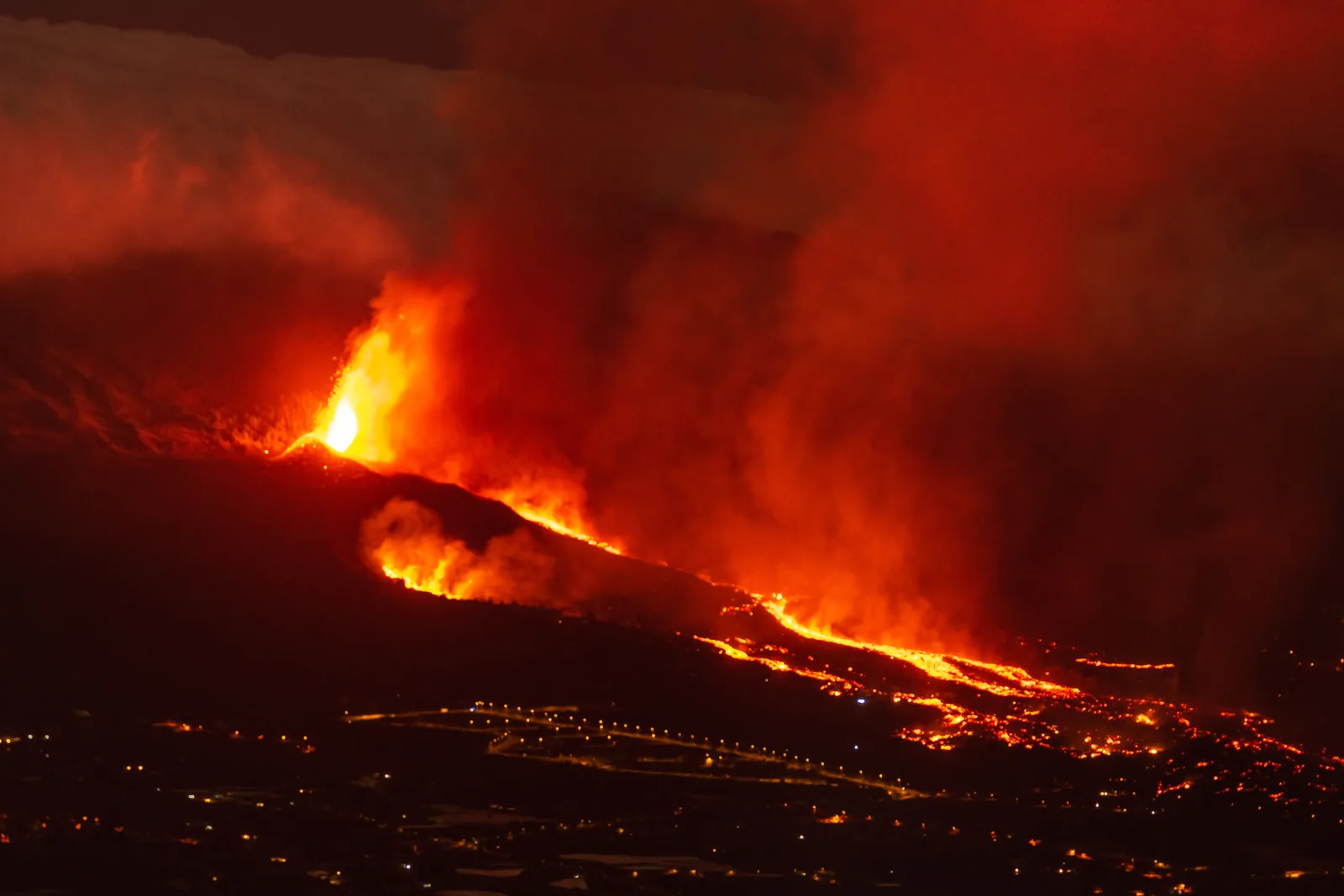
Where does the energy go?
Melting and vaporisation need energy but do not raise the temperature. When ice is heated, its temperature rises up to $0\,{}^\circ\text{C}$. Then the temperature stays constant until all the ice has melted, even though energy keeps being transferred. During melting and vaporisation, the energy transferred to the substance changes the interactions between the particles and increases the interaction energy between them. When a pure substance changes state at constant pressure, its temperature stays constant, so the average kinetic energy of the particles does not increase.
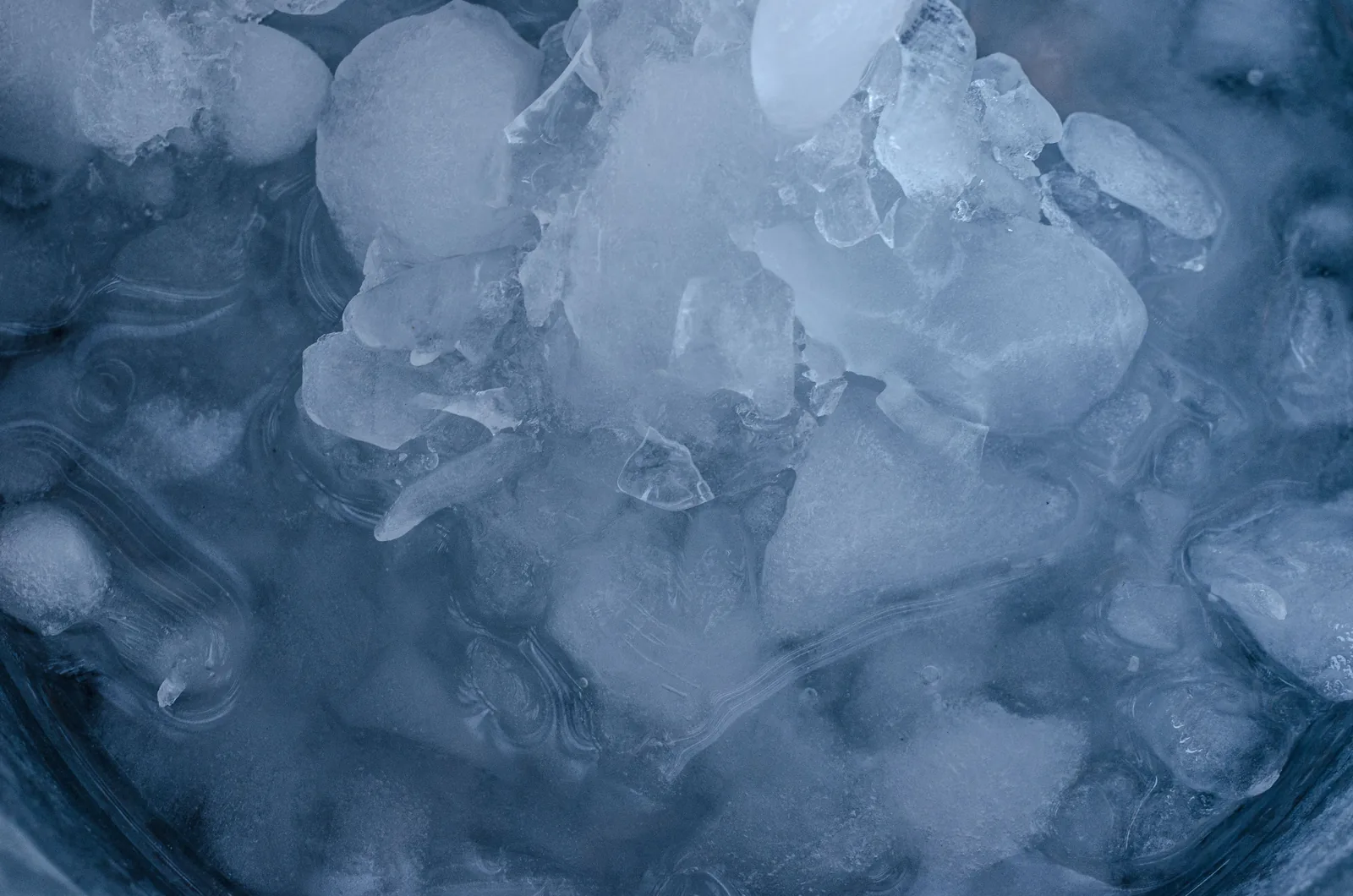
For the same reason, boiling water stays at $100\,{}^\circ\text{C}$ even when the hob is on full: the energy transferred vaporises water and does not raise its temperature. Steam takes up about 1700 times as much space as water, so as it expands it pushes the surrounding air. A small part of the energy needed for vaporisation is used for this work, and most of it increases the interaction energy between the molecules. The greater the power, the faster the water boils away, but it does not get any hotter. The energy that was taken up when the water vaporised is released again when the vapour condenses, and that is why 100-degree steam burns worse than 100-degree water.
The quantity of heat needed for melting and vaporisation is directly proportional to the mass. The coefficients are properties of the substance: the specific latent heat of fusion $s$ tells you how much energy it takes to melt one kilogram, and the specific latent heat of vaporisation $r$ how much it takes to vaporise one kilogram. For water, $s = 334\,\text{kJ/kg}$ and $r = 2260\,\text{kJ/kg}$. So vaporising takes almost seven times as much energy as melting, and more than five times as much as heating water from $0\,{}^\circ\text{C}$ to $100\,{}^\circ\text{C}$.
The boiling point depends on pressure. A phase diagram shows the state of a substance at each temperature and pressure: its curves join the melting, boiling and sublimation points at different pressures. On a mountain, where the atmospheric pressure is lower, water boils below $100\,{}^\circ\text{C}$, and in a pressure cooker the pressure raises the boiling point above $100\,{}^\circ\text{C}$, so food cooks faster.
Latent heat of fusion and vaporisation
The quantity of heat needed to melt or vaporise a mass $m$ is
$$Q = s m \qquad \text{and} \qquad Q = r m$$
where $Q$ is the quantity of heat (J), $s$ is the specific latent heat of fusion of the substance (J/kg), $r$ is the specific latent heat of vaporisation (J/kg) and $m$ is the mass of the substance that melts or vaporises (kg). The same quantity of heat is released when the substance freezes or condenses. At constant pressure the temperature does not change during a change of state, so the formula has no temperature change $\Delta T$.
| Water | Value |
|---|---|
| $s$ | $334\,\text{kJ/kg}$ |
| $r$ | $2260\,\text{kJ/kg}$ |
| $c$ (ice) | $2100\,\text{J/(kg}\cdot\text{K)}$ |
| $c$ (water) | $4190\,\text{J/(kg}\cdot\text{K)}$ |
| $c$ (steam) | $2000\,\text{J/(kg}\cdot\text{K)}$ |
In the table, $c$ is the specific heat capacity, which was introduced in chapter Heating and cooling of a substance.
A heating curve shows the temperature as a function of the energy transferred. On the rising parts the substance warms up and $Q = cm\Delta T$ applies. On the horizontal parts the substance changes state and $Q = sm$ or $Q = rm$ applies. The smaller the specific heat capacity, the steeper the temperature rises, so the parts for ice and steam are about twice as steep as the part for water:
Common misconception
Many people think that adding heat always raises the temperature. When a pure substance changes state at constant pressure, the temperature stays constant even though a lot of energy is transferred: melting ice takes as much energy as heating the same water from $0\,{}^\circ\text{C}$ to $80\,{}^\circ\text{C}$. Another mistake is to treat ice at zero degrees and water at zero degrees as equally good coolants. Ice cools a drink much more effectively, because as it melts it takes in a lot of energy before it starts to warm up. A third mistake is to think that water always boils at $100\,{}^\circ\text{C}$: the boiling point depends on pressure.
Summary
- The states of matter are solid, liquid and gas. In the micro model, a change of state changes the interactions between the particles: in melting and vaporisation the interaction energy between the particles increases, but the chemical bonds inside the molecules do not break.
- At constant pressure, the temperature of a pure substance stays constant during a change of state. Melting needs $Q = sm$ and vaporising needs $Q = rm$; for water, $s = 334\,\text{kJ/kg}$ and $r = 2260\,\text{kJ/kg}$.
- In a heating curve, the rising parts are warming ($Q = cm\Delta T$) and the horizontal parts are changes of state.
- The boiling point depends on pressure; a phase diagram tells you the state of a substance from its temperature and pressure.
- The specific latent heat of vaporisation can be measured by boiling water with an immersion heater on a balance: $r = Pt/\Delta m$, where $\Delta m$ is the change in the balance reading.
Optional Return to your predictions
Compare your predictions with the measurements and the model $Q = sm$, $Q = rm$. Then return to the opening question: where does the energy from the hotplate go at the moments when the thermometer reading does not change, and why does the temperature of boiling water not rise even though the hob is on full?
Would you change your prediction?
Apply
Worked example
Problem
The specific latent heat of vaporisation of water is determined experimentally. An open calorimeter containing boiling water stands on a balance, and the water contains a $1000\,\text{W}$ immersion heater. During five minutes ($300\,\text{s}$), the balance reading falls by $128\,\text{g}$ (an invented figure, not the result of a real measurement). What is the specific latent heat of vaporisation of water according to this reading?
Step 1/7
Given and find. Power $P = 1000\,\text{W}$, time $t = 300\,\text{s}$ and the mass vaporised, that is, the change in the balance reading, $\Delta m = 128\,\text{g}$. The water is boiling, so it is at $100\,{}^\circ\text{C}$. We want the specific latent heat of vaporisation $r$. Assume that all the energy from the heater goes into the water.
Step 2/7
Principle. The water boils all the time, so its temperature does not rise and all the energy $Q = Pt$ from the heater is used to vaporise water. The quantity of heat needed for vaporisation is proportional to the mass vaporised, $Q = r\,\Delta m$. Energy is conserved, so these two are equal.
Step 3/7
Rearranged formula. Set the quantities of heat equal and solve for $r$:
$$\begin{aligned} Pt &= r\,\Delta m \\ r &= \frac{Pt}{\Delta m} \end{aligned}$$
Step 4/7
Unit conversions. Convert the change in the balance reading to kilograms: $128\,\text{g} = 0.128\,\text{kg}$. Power and time are already in base units, and $1\,\text{W} \cdot 1\,\text{s} = 1\,\text{J}$. Finally the result is converted to megajoules: $1\,\text{MJ} = 10^6\,\text{J}$.
Step 5/7
Substitution. Substitute the values with their units:
$$\begin{aligned} r &= \frac{Pt}{\Delta m} \\ &= \frac{1000\,\text{W} \cdot 300\,\text{s}}{0.128\,\text{kg}} \\ &= \frac{300\,000\,\text{J}}{0.128\,\text{kg}} \\ &= 2\,343\,750\,\tfrac{\text{J}}{\text{kg}} \end{aligned}$$
Step 6/7
Result. The specific latent heat of vaporisation is $2.34\,\tfrac{\text{MJ}}{\text{kg}}$. The result is given to three significant figures, because the mass reading $128\,\text{g}$ is given to three figures and it limits the precision most.
Step 7/7
Reasonableness. The result $2.34\,\tfrac{\text{MJ}}{\text{kg}}$ is slightly greater than the table value $2.26\,\tfrac{\text{MJ}}{\text{kg}}$, by about $3.7\,\%$. This is the expected direction: some of the heater's energy passes through the vessel into the surrounding air and does not vaporise water, so the assumption "all the energy goes into the water" gives too large an $r$. With the table value,
or $133\,\text{g}$, would vaporise, only $5\,\text{g}$ more than was measured, so the result is correct to within a few per cent.
Optional Find the error
Optional Apply to a new situation
A steam humidifier boils water into steam. In an hour, $0.30\,\text{kg}$ of water evaporates from its tank, and the water is at 100 degrees to begin with.
What is the power the humidifier uses for vaporising? Heat losses are not taken into account. Give your answer in watts.
Hint 1: a guiding question
What quantity of heat is needed to vaporise $0.30\,\text{kg}$ of water, and in how long is it transferred?
Hint 2: what is the connection
Vaporising needs $Q = rm$, and the power is $P = \dfrac{Q}{t} = \dfrac{rm}{t}$.
Hint 3: an intermediate step
Substitute:
Remember that $1\,\text{J/s} = 1\,\text{W}$.
Show the solution
Given
water vaporising $m = 0.30\,\text{kg}$ in a time $t = 1\,\text{h}$, the water is already at $100\,{}^\circ\text{C}$, no heat losses; from the table $r = 2260\,\tfrac{\text{kJ}}{\text{kg}}$
Find
the power $P$ used for vaporising, in watts
Principle
The water is already at the boiling point, so it does not need to be warmed and all the energy is used for vaporisation, $Q = rm$. With no losses, energy is conserved, and power is energy divided by time.
Formula
$P = \dfrac{Q}{t}$ and $Q = rm$, so
$$P = \frac{rm}{t}$$
Conversions
$t = 1\,\text{h} = 3600\,\text{s}$. This way the result comes out in the unit $\tfrac{\text{J}}{\text{s}} = \text{W}$.
Substitution
Answer
$1.9\cdot10^{2}\,\text{W}$
(calculator result $188\,\text{W}$), two significant figures like the mass $0.30\,\text{kg}$.
Reasonableness
Estimate: $0.7\,\text{MJ}$ in an hour is about $700\,000\,\text{J} / 3600\,\text{s} \approx 190\,\text{W}$. A couple of hundred watts is a typical power for a household steam humidifier. The actual input power is slightly greater, because some of the energy passes to the surroundings, and the power is smaller than that of a $2000\,\text{W}$ hotplate, because the steam is produced slowly.
Check your understanding
Exit ticket
Answer on your own first and only then open the answer.
- Crushed ice is heated. The temperature rises to $0\,{}^\circ\text{C}$ and then stays at $0\,{}^\circ\text{C}$ until all the ice has melted, even though energy is transferred all the time. Use the micro model to explain where the energy goes.
Answer
The energy transferred during melting changes the interactions between the particles: the regular arrangement of the ice breaks down, and the interaction energy between the particles increases. The water molecules themselves stay intact. The temperature stays at $0\,{}^\circ\text{C}$, so the average kinetic energy of the particles does not increase until all the ice has melted.
- A heating curve has rising and horizontal parts. What happens in each, and which formula applies?
Answer
On the rising parts the substance warms up and $Q = cm\Delta T$. On the horizontal parts the substance changes state at a constant temperature and $Q = sm$ (melting) or $Q = rm$ (vaporisation).
1. Concept
2. Boiling water
3. Heating curve
A pan is heated with a $1500\,\text{W}$ heater whose energy is transferred entirely to the water. In the heating curve $(t, T)$ of the water, the temperature is horizontal at $100\,{}^\circ\text{C}$ from the moment $t = 2.0\,\text{min}$ to the moment $t = 17.0\,\text{min}$, when the pan is empty.
How much water boiled away? Give your answer in kilograms.
Hint 1: a guiding question
What happens during the horizontal part, and how long does it last?
Hint 2: what is the connection
On the horizontal part all the energy $Q = Pt$ is used for vaporisation, $Q = rm$, so $m = \dfrac{Pt}{r}$.
Hint 3: an intermediate step
The duration is
so
Show the solution
Given
heater power $P = 1500\,\text{W}$, all the energy is transferred to the water; the horizontal part of the heating curve $(t, T)$ at $100\,{}^\circ\text{C}$ is from the moment $t_1 = 2.0\,\text{min}$ to the moment $t_2 = 17.0\,\text{min}$; from the table $r = 2260\,\tfrac{\text{kJ}}{\text{kg}}$
Find
the mass $m$ of water that boiled away, in kilograms
Principle
On the horizontal part the temperature does not change even though energy is transferred: the water boils and turns into steam. Then all the energy $Pt$ from the heater is used for vaporisation, $Q = rm$. Energy is conserved, because there are no losses.
Reading the graph
The horizontal part starts at $t_1 = 2.0\,\text{min}$ and ends at $t_2 = 17.0\,\text{min}$. The time for vaporisation is the difference between these, $t = t_2 - t_1 = 15.0\,\text{min}$. During the first $2.0\,\text{min}$ the water is only warming up, and that time is not counted.
Formula
$Pt = rm$, from which
$$m = \frac{Pt}{r}$$
Conversions
so that $\text{W} \cdot \text{s} = \text{J}$.
Substitution
Answer
$0.597\,\text{kg}$
Three significant figures, because the time difference $15.0\,\text{min}$ and the power $1500\,\text{W}$ are given to three figures.
Reasonableness
Estimate: $1.35\,\text{MJ}$ of energy and about $2.3\,\text{MJ}$ per kilogram give about $0.6\,\text{kg}$. Warming took the water only $2.0\,\text{min}$, or $180\,000\,\text{J}$, which would be enough to warm about
of water from $20\,{}^\circ\text{C}$ to the boiling point, which is the same order of magnitude as the original amount of water in the pan. Vaporising took over seven times as long as warming, because $r$ is large.
Suggestion: one answer does not show everything you can do, but review the theory summary and do the core exercises.
Optional 4. Explain and transfer
Why does 100-degree steam burn skin worse than the same mass of 100-degree water? Use a change of state and energy in your explanation.
Model answer
When steam hits the skin, it condenses into water. As it condenses, the molecules bind to each other, and the energy that was taken up in vaporisation is released: $Q = rm$. After that the water that has formed cools to the temperature of the skin like ordinary hot water. One gram of steam gives out $2260\,\text{J}$ as it condenses and a further $264\,\text{J}$ or so as it cools from $100\,{}^\circ\text{C}$ to $37\,{}^\circ\text{C}$, about $2.5\,\text{kJ}$ in total. One gram of 100-degree water gives out only the cooling part, about $264\,\text{J}$, which is almost ten times less.
Assess your own answer
Tick the points your own answer already contains.
Review the theory summary and practise with the exercises.
Review the chapter's concepts
Cards you mark Review later collect in your review deck.
- Solid
- The particles are bound in place and vibrate about their equilibrium positions.
- Liquid
- The particles are close together but can move relative to each other.
- Gas
- The particles move almost freely and fill the space available.
- Freezing
- A liquid turns into a solid and gives up energy to the surroundings.
- Vaporisation
- A liquid turns into a gas and takes in energy.
- Condensation
- A gas turns into a liquid and gives up energy to the surroundings.
- Sublimation
- A solid turns directly into a gas without a liquid stage.
- Deposition
- A gas turns directly into a solid without a liquid stage.
- Specific latent heat of fusion
- The energy needed to melt one kilogram at the melting point.$$Q = sm$$
- Specific latent heat of vaporisation
- The energy needed to vaporise one kilogram at the boiling point.$$Q = rm$$
- Phase diagram
- Shows the state of a substance as a function of temperature and pressure.
- Triple point
- The temperature and pressure at which solid, liquid and gas can be in equilibrium at the same time.
- Critical point
- Above this temperature a gas cannot be liquefied by raising the pressure alone.
- Boiling
- Vaporisation throughout the liquid, when the vapour pressure reaches the pressure of the surroundings.
- Evaporation
- Vaporisation from the surface of a liquid, which can happen at any temperature.
- Saturated vapour
- The gas holds the largest possible amount of the substance's vapour at that temperature.
- Relative humidity
- The amount of water vapour compared with the largest possible amount at that temperature.
- Dew point
- The temperature to which air must be cooled for water vapour to start condensing.
- Boiling point
- The temperature depends on the pressure of the surroundings and rises as the pressure rises.
Exercises
Level 1 · basic practice 8 exercises
One formula or one step of reasoning. Core exercises first, the rest is extra practice.
- Exercise 8-1Core
On a trip to the cottage, a cool bag contains $1.20\,\text{kg}$ of ice cubes at $0\,{}^\circ\text{C}$. During the journey the ice cubes melt completely into water at $0\,{}^\circ\text{C}$.
What quantity of heat does the ice absorb as it melts? Give your answer in kilojoules.
Answer
$401\,\text{kJ}$
Show the solution
Given
ice, $m = 1.20\,\text{kg}$, temperature $0\,{}^\circ\text{C}$; from the table $s = 334\,\tfrac{\text{kJ}}{\text{kg}}$
Find
the quantity of heat $Q$ needed to melt the ice, in kilojoules
Principle
The ice is already at the melting temperature $0\,{}^\circ\text{C}$ and turns into water at $0\,{}^\circ\text{C}$. The temperature does not change, so $Q = cm\Delta T$ does not apply. Instead we need the latent heat of fusion: the quantity of heat is proportional to the mass that melts.
Formula
$Q = sm$, and the quantity we want, $Q$, is already alone on the left-hand side: $Q = sm$
Conversions
None needed: the mass is in kilograms and $s$ is in kilojoules per kilogram, so the result comes out directly in kilojoules.
Substitution
$Q$$= 334\,\tfrac{\text{kJ}}{\text{kg}} \cdot 1.20\,\text{kg}$$= 400.8\,\text{kJ}$Answer
$401\,\text{kJ}$
Three significant figures like the mass $1.20\,\text{kg}$.
Reasonableness
Melting one kilogram takes $334\,\text{kJ}$, so melting a little over a kilogram takes a little over $334\,\text{kJ}$: the estimate is $334\,\text{kJ} \cdot 1.2 \approx 400\,\text{kJ}$. $Q$ is positive because the ice absorbs energy. The meltwater does not warm up in the calculation, because the temperature stays at $0\,{}^\circ\text{C}$.
- Exercise 8-2Core
Potatoes are boiled at the cottage without a lid. While they cook, $0.40\,\text{kg}$ of water boils away from the pan.
What quantity of heat is used to vaporise this amount of water? Give your answer in megajoules.
Answer
$0.90\,\text{MJ}$
Show the solution
Given
boiling water from a pan, $m = 0.40\,\text{kg}$; from the table $r = 2260\,\tfrac{\text{kJ}}{\text{kg}}$
Find
the quantity of heat $Q$ used for vaporisation, in megajoules
Principle
The water is already boiling and turns into steam at a constant temperature of $100\,{}^\circ\text{C}$. The temperature does not change, so we do not use $c m \Delta T$ but the latent heat of vaporisation: the quantity of heat is proportional to the mass that vaporises.
Formula
$Q = rm$, and $Q$ is already solved for: $Q = rm$
Conversions
We first get the result in kilojoules: $r m = 904\,\text{kJ}$. Finally $1\,\text{MJ} = 1000\,\text{kJ}$, so $904\,\text{kJ} = 0.904\,\text{MJ}$.
Substitution
$Q$$= 2260\,\tfrac{\text{kJ}}{\text{kg}} \cdot 0.40\,\text{kg}$$= 904\,\text{kJ}$$= 0.904\,\text{MJ}$Answer
$0.90\,\text{MJ}$
Two significant figures like the mass $0.40\,\text{kg}$.
Reasonableness
Estimate:
$2300\,\tfrac{\text{kJ}}{\text{kg}} \cdot 0.4\,\text{kg}$$\approx 920\,\text{kJ}$Vaporising takes a lot of energy: the same $0.90\,\text{MJ}$ would heat
$\dfrac{904\,\text{kJ}}{4.19\,\tfrac{\text{kJ}}{\text{kg}\cdot\text{K}} \cdot 80\,\text{K}}$$\approx 2.7\,\text{kg}$of water from $20\,{}^\circ\text{C}$ to $100\,{}^\circ\text{C}$. That is why a pan with a lid saves energy.
- Exercise 8-3
During the first week of frost in autumn, $45\,\text{kg}$ of water freezes at the surface of a lake for every square metre. The water is at $0\,{}^\circ\text{C}$ and turns into ice at $0\,{}^\circ\text{C}$.
What quantity of heat is released in the freezing for every square metre? Give your answer in megajoules.
Answer
$15\,\text{MJ}$
Show the solution
Given
water freezing at the surface of a lake, $m = 45\,\text{kg}$ for every square metre, temperature $0\,{}^\circ\text{C}$; from the table $s = 334\,\tfrac{\text{kJ}}{\text{kg}}$
Find
the quantity of heat $Q$ released in freezing, in megajoules
Principle
The water freezes into ice at $0\,{}^\circ\text{C}$ at a constant temperature. When a substance freezes, it releases the same quantity of heat that the same mass would absorb when melting, so we use the latent heat of fusion $s$ and not a temperature change.
Formula
$Q = sm$ (the quantity of heat released is given as a positive number), and $Q$ is already solved for: $Q = sm$
Conversions
The result comes out in kilojoules: $15\,030\,\text{kJ}$. Finally $1\,\text{MJ} = 1000\,\text{kJ}$, so $15\,030\,\text{kJ} = 15.03\,\text{MJ}$.
Substitution
$Q$$= 334\,\tfrac{\text{kJ}}{\text{kg}} \cdot 45\,\text{kg}$$= 15\,030\,\text{kJ}$$= 15.03\,\text{MJ}$Answer
$15\,\text{MJ}$
Two significant figures like the mass $45\,\text{kg}$.
Reasonableness
Estimate:
$330\,\tfrac{\text{kJ}}{\text{kg}} \cdot 45\,\text{kg}$$\approx 15\,000\,\text{kJ}$The thickness of the layer of water is
$\dfrac{45\,\text{kg}}{1000\,\tfrac{\text{kg}}{\text{m}^3} \cdot 1\,\text{m}^2}$$= 4.5\,\text{cm}$which fits a layer that freezes during a week of frost. The heat released slows down the freezing, so a lake does not freeze in an instant.
- Exercise 8-4
At a café, steam at $100\,{}^\circ\text{C}$ is blown from the steam wand of an espresso machine into a jug of milk. While the milk is being frothed, $0.030\,\text{kg}$ of steam condenses in the milk into water at $100\,{}^\circ\text{C}$.
What quantity of heat does the steam give out as it condenses? Give your answer in kilojoules.
Answer
$68\,\text{kJ}$
Show the solution
Given
steam that condenses into water at $100\,{}^\circ\text{C}$, $m = 0.030\,\text{kg}$; from the table $r = 2260\,\tfrac{\text{kJ}}{\text{kg}}$
Find
the quantity of heat $Q$ given out by the steam, in kilojoules
Principle
The steam condenses into water at the same temperature of $100\,{}^\circ\text{C}$, so the temperature does not change. When steam condenses, it releases the same quantity of heat that would be needed to vaporise it, so we use the latent heat of vaporisation $r$.
Formula
$Q = rm$ (the quantity of heat released is given as a positive number), and $Q$ is already solved for: $Q = rm$
Conversions
None needed: the mass is in kilograms and $r$ is in kilojoules per kilogram, so the result comes out in kilojoules.
Substitution
$Q$$= 2260\,\tfrac{\text{kJ}}{\text{kg}} \cdot 0.030\,\text{kg}$$= 67.8\,\text{kJ}$Answer
$68\,\text{kJ}$
Two significant figures like the mass $0.030\,\text{kg}$.
Reasonableness
Estimate:
$2300\,\tfrac{\text{kJ}}{\text{kg}} \cdot 0.03\,\text{kg}$$\approx 69\,\text{kJ}$This quantity of heat would warm $0.3\,\text{kg}$ of milk by about
$\dfrac{67.8\,\text{kJ}}{4.19\,\tfrac{\text{kJ}}{\text{kg}\cdot\text{K}} \cdot 0.3\,\text{kg}}$$\approx 54\,\text{K}$so a small amount of steam warms a whole jug of milk. For the same reason steam burns skin worse than water that is just as hot.
- Exercise 8-5
A $0.60\,\text{kg}$ piece of ice taken from the freezer is heated. The graph shows the temperature of the ice as a function of the energy transferred. Use the graph to determine the specific latent heat of fusion of ice. Read the values you need from the graph.
Answer
$333\,\tfrac{\text{kJ}}{\text{kg}}$
Show the solution
Given
mass of the ice $m = 0.60\,\text{kg}$; the temperature as a function of the energy transferred in the graph
Find
the specific latent heat of fusion of ice $s$
Principle
On the horizontal part of the graph the temperature stays constant at $0\,{}^\circ\text{C}$ even though energy is transferred: the ice melts, and all the energy transferred is used for melting, $Q = sm$. The energy used for melting is the length of the horizontal part on the horizontal axis.
Reading the graph
The horizontal part starts at the grid crossing $(20\,\text{kJ}$; $0\,{}^\circ\text{C})$ and ends at the crossing $(220\,\text{kJ}$; $0\,{}^\circ\text{C})$. So the energy used for melting is
$Q$$= 220\,\text{kJ} - 20\,\text{kJ}$$= 200\,\text{kJ}$Formula
$Q = sm$, from which $s = \dfrac{Q}{m}$
Conversions
None needed: the energy is read in kilojoules, and the answer is requested in the unit $\tfrac{\text{kJ}}{\text{kg}}$.
Substitution
$s$$= \dfrac{200\,\text{kJ}}{0.60\,\text{kg}}$$= 333\,\tfrac{\text{kJ}}{\text{kg}}$Answer
$333\,\tfrac{\text{kJ}}{\text{kg}}$
Three significant figures. The values are read exactly from the grid, so $323\ldots343\,\tfrac{\text{kJ}}{\text{kg}}$ is accepted.
Reasonableness
The result is close to the table value $334\,\tfrac{\text{kJ}}{\text{kg}}$. Melting takes $200\,\text{kJ}$, whereas warming the ice before melting took only $20\,\text{kJ}$, so the horizontal part is long, and the temperature rises more gently after melting because the specific heat capacity of water is greater than that of ice.
- Exercise 8-6
A block of ice is heated steadily at its melting point, and the block melts.
What happens to the temperature of the mixture of ice and meltwater while there is still ice left?
Answer
The temperature stays the same, because the energy changes the interactions between the particles.
Show the solution
Find
what happens to the temperature of the mixture of melting ice and meltwater while there is still ice left.
Principle
At constant pressure the temperature of a pure substance stays constant throughout a change of state. The energy transferred during melting changes the interactions between the particles and increases the interaction energy between them, so it does not show up as a rise in temperature.
Model answer
The temperature stays the same, because the energy is used to change the interactions between the particles and not to increase the kinetic energy of the particles. The option saying that the temperature rises steadily forgets this. The option saying that the mixture cools contradicts the fact that energy is transferred to the mixture all the time during heating. The option in which the temperature first rises and then falls does not match any stage of melting. Only when all the ice has melted does the meltwater start to warm up.
- Exercise 8-7
On a hot day sweat appears on the skin, and the sweat evaporates. Why does the evaporation of sweat cool the skin?
Answer
Evaporating sweat takes energy from the skin, so the skin cools.
Show the solution
Find
why the evaporation of sweat cools the skin.
Principle
The vaporisation of a liquid needs energy, $Q = rm$. Evaporating sweat takes this energy from its surroundings, here from the skin, so the skin loses energy and its temperature falls.
Model answer
The evaporating water molecules take energy with them from the skin, so the skin loses energy and cools. Vaporisation absorbs energy and does not give it out, so the claim that sweat would warm the skin is wrong. Sweat is as warm as the skin, so it does not cool the skin because of a temperature difference. Evaporation does not use up the oxygen of the skin either. The quantity of energy is large: the evaporation of one gram needs $r m = 2260\,\tfrac{\text{kJ}}{\text{kg}} \cdot 0.001\,\text{kg} = 2.26\,\text{kJ}$.
- Exercise 8-8
A cottage hob is left on under an open pan. When the water boils, a total of $1.36\,\text{MJ}$ of energy is transferred to the water during boiling, and all of it is used to vaporise the water.
How many kilograms of water boil away?
Answer
$0.602\,\text{kg}$
Show the solution
Given
energy used for vaporisation $Q = 1.36\,\text{MJ}$; from the table $r = 2260\,\tfrac{\text{kJ}}{\text{kg}}$
Find
the mass $m$ of water that boils away, in kilograms
Principle
The water is already boiling, so its temperature does not rise and all the energy is used for vaporisation, $Q = rm$. The mass that vaporises is proportional to the energy.
Formula
$Q = rm$, from which $m = \dfrac{Q}{r}$
Conversions
$Q = 1.36\,\text{MJ} = 1360\,\text{kJ}$, because $1\,\text{MJ} = 1000\,\text{kJ}$. Then $r$ can be taken in kilojoules per kilogram.
Substitution
$m$$= \dfrac{1360\,\text{kJ}}{2260\,\tfrac{\text{kJ}}{\text{kg}}}$$= 0.6018\,\text{kg}$Answer
$0.602\,\text{kg}$
Three significant figures like the energy $1.36\,\text{MJ}$.
Reasonableness
Check by calculating back:
$0.602\,\text{kg} \cdot 2260\,\tfrac{\text{kJ}}{\text{kg}}$$\approx 1360\,\text{kJ}$The result is less than $1\,\text{kg}$, because $1\,\text{kg}$ would need $2260\,\text{kJ}$, which is more than $1360\,\text{kJ}$. Units: $\tfrac{\text{kJ}}{\text{kJ/kg}} = \text{kg}$.
Level 2 · applied practice 7 exercises
Two steps, working with measured data, a unit conversion or rearranging a formula. Core exercises first, the rest is extra practice.
- Exercise 8-9Core
The hotplate of an electric cooker at a cottage has a power of $2.0\,\text{kW}$. A pan with boiling water stands on the plate and is forgotten on the hob.
How long does it take before $0.50\,\text{kg}$ of water has boiled away from the pan? Assume that all the energy from the plate goes into the water. Give your answer in minutes.
Answer
$9.4\,\text{min}$
Show the solution
Given
$P = 2.0\,\text{kW}$, mass vaporised from boiling water $m = 0.50\,\text{kg}$, all the energy from the hotplate goes into the water; from the table $r = 2260\,\tfrac{\text{kJ}}{\text{kg}}$
Find
the time $t$ in minutes
Principle
The water is already boiling, so its temperature does not rise and all the energy $Pt$ from the hotplate is used for vaporisation, $Q = rm$. Energy is conserved when there are no losses, so $Pt = rm$.
Formula
$Pt = rm$, from which $t = \dfrac{rm}{P}$
Conversions
$P$$= 2.0\,\text{kW}$$= 2000\,\text{W}$$r$$= 2260\,\tfrac{\text{kJ}}{\text{kg}}$$= 2\,260\,000\,\tfrac{\text{J}}{\text{kg}}$The time comes out in seconds and is finally converted to minutes: $1\,\text{min} = 60\,\text{s}$.
Substitution
$t$$= \dfrac{2\,260\,000\,\tfrac{\text{J}}{\text{kg}} \cdot 0.50\,\text{kg}}{2000\,\text{W}}$$= 565\,\text{s}$$= \dfrac{565}{60}\,\text{min}$$= 9.42\,\text{min}$Answer
$9.4\,\text{min}$
Two significant figures like the power $2.0\,\text{kW}$ and the mass $0.50\,\text{kg}$.
Reasonableness
Estimate: about $1.1\,\text{MJ}$ of energy at a power of $2\,\text{kW}$ takes about $550\,\text{s}$, which is just under $10\,\text{min}$. Half a kilogram boiling away in about ten minutes matches experience. Units:
$\tfrac{\text{J}}{\text{W}}$$= \tfrac{\text{J}}{\text{J/s}}$$= \text{s}$ - Exercise 8-10Core
$750\,\text{g}$ of ice at $-18\,{}^\circ\text{C}$ is taken out of the freezer.
What quantity of heat is needed to warm the ice to $0\,{}^\circ\text{C}$ and melt it completely into water at $0\,{}^\circ\text{C}$? The specific heat capacity of ice is $2100\,\text{J/(kg}\cdot\text{K)}$. Give your answer in kilojoules.
Answer
$280\,\text{kJ}$
Show the solution
Given
ice, $m = 750\,\text{g}$, $T_1 = -18\,{}^\circ\text{C}$, ending as water at $0\,{}^\circ\text{C}$; from the table $c_\text{ice} = 2100\,\tfrac{\text{J}}{\text{kg}\cdot\text{K}}$ and $s = 334\,\tfrac{\text{kJ}}{\text{kg}}$
Find
the total quantity of heat $Q$ in kilojoules
Principle
The process has two stages. First the ice warms from $-18\,{}^\circ\text{C}$ to the melting temperature $0\,{}^\circ\text{C}$ ($Q_1 = cm\Delta T$), and then it melts at a constant temperature ($Q_2 = sm$). The total quantity of heat is the sum of these.
Formula
$Q = Q_1 + Q_2$, and $Q = c_\text{ice} m \Delta T + sm$, where $\Delta T = 0\,{}^\circ\text{C} - T_1$
Conversions
$m = 750\,\text{g} = 0.750\,\text{kg}$. The temperature change is the same in kelvins:
$\Delta T$$= 0\,{}^\circ\text{C} - (-18\,{}^\circ\text{C})$$= 18\,\text{K}$$s = 334\,000\,\tfrac{\text{J}}{\text{kg}}$ and finally $1\,\text{kJ} = 1000\,\text{J}$.
Substitution
$Q_1$$= 2100\,\tfrac{\text{J}}{\text{kg}\cdot\text{K}} \cdot 0.750\,\text{kg} \cdot 18\,\text{K}$$= 28\,350\,\text{J}$$Q_2$$= 334\,000\,\tfrac{\text{J}}{\text{kg}} \cdot 0.750\,\text{kg}$$= 250\,500\,\text{J}$so
$Q$$= 28\,350\,\text{J} + 250\,500\,\text{J}$$= 278\,850\,\text{J}$$= 278.85\,\text{kJ}$Answer
$280\,\text{kJ}$
Two significant figures like the temperature $-18\,{}^\circ\text{C}$.
Reasonableness
Estimate: melting takes $0.75 \cdot 334 \approx 250\,\text{kJ}$ and warming less than $30\,\text{kJ}$, about $280\,\text{kJ}$ in total. Melting takes $\dfrac{250.5}{278.85} \approx 90\,\%$ of the energy, even though the temperature rises only in the heating stage. If you did not convert the grams to kilograms, the result would be a thousand times too large.
- Exercise 8-11
In April the ice on a lake has already warmed to $0\,{}^\circ\text{C}$. On a sunny day the ice receives $12\,\text{MJ}$ of energy from the Sun for every square metre. Assume that all this energy is used to melt the ice.
How many kilograms of ice melt during the day over each square metre?
Answer
$36\,\text{kg}$
Show the solution
Given
energy received from the Sun $Q = 12\,\text{MJ}$ per square metre, ice at $0\,{}^\circ\text{C}$, all the energy is used for melting; from the table $s = 334\,\tfrac{\text{kJ}}{\text{kg}}$
Find
the mass $m$ of ice that melts, in kilograms
Principle
The ice is already at $0\,{}^\circ\text{C}$, so it does not warm up and all the energy is used for melting. So the quantity of heat needed for melting is $Q = sm$, and we get the mass that melts by solving for $m$.
Formula
$Q = sm$, from which $m = \dfrac{Q}{s}$
Conversions
Megajoules and kilojoules must be put in the same unit before dividing: $12\,\text{MJ} = 12\,000\,000\,\text{J}$ and $334\,\tfrac{\text{kJ}}{\text{kg}} = 334\,000\,\tfrac{\text{J}}{\text{kg}}$.
Substitution
$m$$= \dfrac{12\,000\,000\,\text{J}}{334\,000\,\tfrac{\text{J}}{\text{kg}}}$$= 35.93\,\text{kg}$Answer
$36\,\text{kg}$
Two significant figures like the energy $12\,\text{MJ}$.
Reasonableness
Estimate: $\dfrac{12\,000}{330} \approx 36$. The thickness of the layer is
$\dfrac{35.93\,\text{kg}}{920\,\tfrac{\text{kg}}{\text{m}^3} \cdot 1\,\text{m}^2}$$\approx 3.9\,\text{cm}$so a sunny day thins the ice by a few centimetres, which fits observations in spring. If you mixed up $\text{MJ}$ and $\text{kJ}$, the result would be a thousand times wrong.
- Exercise 8-12
To cook pasta, $2.0\,\text{kg}$ of water at $15\,{}^\circ\text{C}$ is put in a pan. The water is heated to the boiling point, that is, $100\,{}^\circ\text{C}$, and boiled until $0.10\,\text{kg}$ of water has vaporised from the pan.
What is the total quantity of heat transferred to the water? Give your answer in megajoules.
Answer
$0.94\,\text{MJ}$
Show the solution
Given
water $m = 2.0\,\text{kg}$, $T_1 = 15\,{}^\circ\text{C}$, $T_2 = 100\,{}^\circ\text{C}$, part that vaporises $m_\text{v} = 0.10\,\text{kg}$; from the table $c = 4190\,\tfrac{\text{J}}{\text{kg}\cdot\text{K}}$ and $r = 2260\,\tfrac{\text{kJ}}{\text{kg}}$
Find
the total quantity of heat $Q$ transferred to the water, in megajoules
Principle
The process has two stages. First all the water warms to the boiling point ($Q_1 = cm\Delta T$), and then only the part that vaporises turns into steam at a constant temperature ($Q_2 = rm_\text{v}$). The total quantity of heat is the sum of these.
Formula
$Q = Q_1 + Q_2$, and $Q = cm(T_2 - T_1) + rm_\text{v}$
Conversions
The temperature change is the same in kelvins:
$T_2 - T_1$$= 100\,{}^\circ\text{C} - 15\,{}^\circ\text{C}$$= 85\,\text{K}$$r = 2\,260\,000\,\tfrac{\text{J}}{\text{kg}}$ and finally $1\,\text{MJ} = 10^6\,\text{J}$.
Substitution
$Q_1$$= 4190\,\tfrac{\text{J}}{\text{kg}\cdot\text{K}} \cdot 2.0\,\text{kg} \cdot 85\,\text{K}$$= 712\,300\,\text{J}$$Q_2$$= 2\,260\,000\,\tfrac{\text{J}}{\text{kg}} \cdot 0.10\,\text{kg}$$= 226\,000\,\text{J}$so
$Q$$= 938\,300\,\text{J}$$= 0.9383\,\text{MJ}$Answer
$0.94\,\text{MJ}$
Two significant figures like the masses $2.0\,\text{kg}$ and $0.10\,\text{kg}$.
Reasonableness
Estimate:
$4\,\tfrac{\text{kJ}}{\text{kg}\cdot\text{K}} \cdot 2\,\text{kg} \cdot 85\,\text{K}$$\approx 680\,\text{kJ}$$2300 \cdot 0.1 = 230\,\text{kJ}$, about $0.9\,\text{MJ}$ in total. The mass that vaporises is only $0.10\,\text{kg}$, not the whole $2.0\,\text{kg}$. Even so, that small amount takes $\dfrac{226}{938.3} \approx 24\,\%$ of the energy, because $r$ is large.
- Exercise 8-13
A student heats $0.250\,\text{kg}$ of ice with a $600\,\text{W}$ immersion heater and measures the temperature $T$ as a function of time $t$ (table, sample data). Assume that all the energy of the heater is transferred to the ice and the water formed from it.
a) Use the table to explain what happens to the substance in the different stages and why the temperature does not rise between about $20\,\text{s}$ and $150\,\text{s}$.
b) Determine from the table the time taken by the melting and use it to calculate the specific latent heat of fusion of ice. The rows $20\,\text{s}$ and $150\,\text{s}$ of the table are already inside the plateau: use the slopes of the rises to estimate exactly when the temperature reaches $0\,{}^\circ\text{C}$ and when it starts to rise again.
Write the specific latent heat of fusion from part b) in the unit $\text{kJ/kg}$ in the answer box.
Heating of ice at a power of $600\,\text{W}$ (sample data) $t\,(\text{s})$ $T\,({}^\circ\text{C})$ 0 −20.0 10 −8.6 20 0.0 60 0.0 100 0.1 140 0.0 150 0.0 160 1.9 180 13.4 Answer
$334\,\tfrac{\text{kJ}}{\text{kg}}$
Show the solution
Given
mass of the ice $m = 0.250\,\text{kg}$, power $P = 600\,\text{W}$, all the energy goes into the ice; the temperature as a function of time from the table
Find
a) the stages and why the temperature stays constant; b) the specific latent heat of fusion $s$ in $\tfrac{\text{kJ}}{\text{kg}}$
Principle
The power is constant, so the energy given by the heater is $Pt$. While the temperature rises, the energy is used for warming, $Q = cm\Delta T$. While the temperature stays constant at $0\,{}^\circ\text{C}$, the ice melts and all the energy is used for melting, $Pt = sm$.
Model answer a)
First the ice warms to $0\,{}^\circ\text{C}$. Then the temperature stays at $0\,{}^\circ\text{C}$ even though the heater gives out energy: the energy is used to melt the ice and increases the interaction energy between the particles. Finally all the ice has melted and the water warms up.
Reading the table
The rows $20\,\text{s}$ and $150\,\text{s}$ are already inside the plateau, so the start and end of melting are estimated from the slopes. Start: the rows $0\,\text{s}$ and $10\,\text{s}$ give a rise of $1.14\,\tfrac{\text{K}}{\text{s}}$, so $0\,{}^\circ\text{C}$ is reached at about $18\,\text{s}$. End: at the row $160\,\text{s}$ the temperature is $1.9\,{}^\circ\text{C}$, and the rise between the rows $160\,\text{s}$ and $180\,\text{s}$ is $0.575\,\tfrac{\text{K}}{\text{s}}$, so the rise began about $3.3\,\text{s}$ earlier, at about $157\,\text{s}$. The duration of melting is $\Delta t = 157\,\text{s} - 18\,\text{s} = 139\,\text{s}$.
Formula
$Pt = sm$, from which $s = \dfrac{P\,\Delta t}{m}$
Conversions
The power and time are already in base units, $1\,\text{W} \cdot 1\,\text{s} = 1\,\text{J}$. Finally $1\,\text{kJ} = 1000\,\text{J}$.
Substitution
$$\begin{aligned} s &= \dfrac{600\,\text{W} \cdot 139\,\text{s}}{0.250\,\text{kg}} \\ &= \dfrac{83\,400\,\text{J}}{0.250\,\text{kg}} \\ &= 333\,600\,\tfrac{\text{J}}{\text{kg}} \end{aligned}$$
Answer
$334\,\tfrac{\text{kJ}}{\text{kg}}$
The time is read only to about a second, so $\pm 5\,\%$ is accepted, and three significant figures are given to match the mass and the power. If the plateau is read directly as the rows $20\,\text{s}$ and $150\,\text{s}$, the time is $130\,\text{s}$ and the result $312\,\tfrac{\text{kJ}}{\text{kg}}$, too small, because melting started before the row $20\,\text{s}$ and ended only after the row $150\,\text{s}$.
Reasonableness
The result matches the known specific latent heat of fusion of ice, $334\,\tfrac{\text{kJ}}{\text{kg}}$. Heating the ice from $-20\,{}^\circ\text{C}$ took about $18\,\text{s}$, that is, $600\,\text{W} \cdot 18\,\text{s} = 10\,800\,\text{J}$. Check:
$c m \Delta T$$= 2100\,\tfrac{\text{J}}{\text{kg}\cdot\text{K}} \cdot 0.250\,\text{kg} \cdot 20\,\text{K}$$= 10\,500\,\text{J}$so the measurement and the calculation agree. Melting took about $83\,\text{kJ}$, about eight times more energy than warming the ice.
- Exercise 8-14
A student boils water in an open pan on an electric hob. The water boils, and she writes in her notes: “When I turn up the power of the hob, the boiling water warms to over $100\,{}^\circ\text{C}$, because more energy is transferred to the water, and so it vaporises faster.”
a) Explain what is wrong in the student’s reasoning.
b) The power of the hob is $3.0\,\text{kW}$. How many kilograms of water boil away in $5.0\,\text{min}$ when all the energy of the hob is transferred to the water?
Write the result of part b) in the answer box.
Answer
$0.40\,\text{kg}$
Show the solution
Given
power $P = 3.0\,\text{kW}$, time $t = 5.0\,\text{min}$, all the energy of the hob goes into the water; from the table $r = 2260\,\tfrac{\text{kJ}}{\text{kg}}$
Find
a) the error in the student’s reasoning; b) the mass $m$ of water that boils away, in kilograms
Principle
In an open pan the pressure is constant atmospheric pressure, and the temperature of boiling water stays at the boiling point, about $100\,{}^\circ\text{C}$ at normal pressure. All the energy $Pt$ given by the hob is used for vaporisation, $Q = rm$, so $Pt = rm$.
Model answer a)
The student assumes that the added energy raises the temperature of boiling water. At constant pressure the temperature does not rise during a change of state: the extra energy is used to vaporise the water. The power affects how fast the water vaporises but not the temperature of the water. Twice the power vaporises twice as many kilograms of water in the same time, and the water stays at $100\,{}^\circ\text{C}$ all the time.
Formula
$Pt = rm$, from which $m = \dfrac{Pt}{r}$
Conversions
$P$$= 3.0\,\text{kW}$$= 3000\,\text{W}$$t$$= 5.0\,\text{min}$$= 5.0 \cdot 60\,\text{s}$$= 300\,\text{s}$$r$$= 2260\,\tfrac{\text{kJ}}{\text{kg}}$$= 2\,260\,000\,\tfrac{\text{J}}{\text{kg}}$Substitution
$$\begin{aligned} m &= \dfrac{3000\,\text{W} \cdot 300\,\text{s}}{2\,260\,000\,\tfrac{\text{J}}{\text{kg}}} \\ &= \dfrac{900\,000\,\text{J}}{2\,260\,000\,\tfrac{\text{J}}{\text{kg}}} \\ &= 0.398\,\text{kg} \end{aligned}$$
Answer
$0.40\,\text{kg}$
Two significant figures like the power $3.0\,\text{kW}$ and the time $5.0\,\text{min}$.
Reasonableness
Estimate: $900\,\text{kJ}$ divided by about $2300\,\tfrac{\text{kJ}}{\text{kg}}$ is about $0.39\,\text{kg}$. At a power of $1.5\,\text{kW}$ half of this would vaporise in the same time, about $0.2\,\text{kg}$, which matches the fact that the mass that vaporises is directly proportional to the power.
- Exercise 8-15
The table gives the boiling point $T_\text{b}$ of water at different pressures $p$ (steam table, values rounded). Water is boiled in an open pan high in the mountains, where the air pressure is $60.0\,\text{kPa}$. Normal air pressure is $101.3\,\text{kPa}$.
a) Estimate the boiling point at a pressure of $60.0\,\text{kPa}$ using the two neighbouring rows of the table. By how many kelvins lower does water boil at $60.0\,\text{kPa}$ than at normal pressure?
b) Explain why food cooks more slowly in the mountains even though the water boils all the time and the hob gives the same power.
Write the result of part a) in the answer box.
Boiling point of water at different pressures (steam table) $p\,(\text{kPa})$ $T_\text{b}\,({}^\circ\text{C})$ 20.0 60.1 30.0 69.1 50.0 81.3 70.0 90.0 101.3 100.0 Answer
$14.4\,\text{K}$
Show the solution
Given
boiling points from the table: $T_\text{b} = 100.0\,{}^\circ\text{C}$ at $101.3\,\text{kPa}$, $T_\text{b} = 81.3\,{}^\circ\text{C}$ at $50.0\,\text{kPa}$ and $T_\text{b} = 90.0\,{}^\circ\text{C}$ at $70.0\,\text{kPa}$; in the mountains $p = 60.0\,\text{kPa}$
Find
a) the difference $\Delta T$ in the boiling point in kelvins at $60.0\,\text{kPa}$ compared with normal pressure; b) why food cooks more slowly in the mountains
Principle
The boiling point of water depends on the pressure: at a lower pressure water boils at a lower temperature. The pressure $60.0\,\text{kPa}$ is halfway between the rows $50.0\,\text{kPa}$ and $70.0\,\text{kPa}$ of the table, so the boiling point is estimated as the midpoint of those (linear interpolation).
Formula
$T_\text{b,mountain}$$= \dfrac{T_{50} + T_{70}}{2}$$\Delta T = T_\text{b,normal} - T_\text{b,mountain}$
Conversions
None needed: a temperature difference is the same in degrees Celsius and in kelvins.
Substitution
$$\begin{aligned} T_\text{b,mountain} &= \dfrac{81.3\,{}^\circ\text{C} + 90.0\,{}^\circ\text{C}}{2} \\ &= 85.65\,{}^\circ\text{C} \end{aligned}$$
$$\begin{aligned} \Delta T &= 100.0\,{}^\circ\text{C} - 85.65\,{}^\circ\text{C} \\ &= 14.35\,\text{K} \end{aligned}$$
Answer
$14.4\,\text{K}$
Three significant figures like the temperatures in the table. The interpolation is an estimate, so $\pm 4\,\%$ is accepted.
Model answer b)
Boiling water stays at the temperature $T_\text{b}$ even though the hob gives more energy: the extra energy vaporises water and does not raise the temperature. In the mountains $T_\text{b}$ is only about $85.7\,{}^\circ\text{C}$, so the food in the surrounding water is about $14\,\text{K}$ cooler than at sea level. Cooking depends on temperature, so it takes longer.
Reasonableness
The estimate $85.7\,{}^\circ\text{C}$ lies between the rows $81.3\,{}^\circ\text{C}$ and $90.0\,{}^\circ\text{C}$, just as the pressure $60.0\,\text{kPa}$ lies between the rows $50.0\,\text{kPa}$ and $70.0\,\text{kPa}$. The difference $14.4\,\text{K}$ is smaller than at $50.0\,\text{kPa}$ ($18.7\,\text{K}$) and larger than at $70.0\,\text{kPa}$ ($10.0\,\text{K}$), as it should be.
Level 3 · challenging 5 exercises
Optional: application, two ideas together or a new situation where you reason for yourself.
- Exercise 8-16
Juice is being drunk on a jetty.
The glass contains $0.35\,\text{kg}$ of juice at $25\,{}^\circ\text{C}$, and $60\,\text{g}$ of melting ice cubes at $0\,{}^\circ\text{C}$ are dropped into it. The specific heat capacity of the juice is the same as that of water.
What is the temperature of the drink when all the ice has melted and the contents of the glass are in thermal equilibrium? Assume that no heat passes to the glass or the air. Also justify why $60\,\text{g}$ of water at $0\,{}^\circ\text{C}$ would not cool the juice as much.
Answer
$9.7\,{}^\circ\text{C}$
Show the solution
Given
juice (the $c$ of water) $m_1 = 0.35\,\text{kg}$, $T_1 = 25\,{}^\circ\text{C}$; ice $m_2 = 60\,\text{g}$, $T_0 = 0\,{}^\circ\text{C}$; no heat losses; from the table $c = 4190\,\tfrac{\text{J}}{\text{kg}\cdot\text{K}}$ and $s = 334\,\tfrac{\text{kJ}}{\text{kg}}$
Find
the final temperature $T$ when all the ice has melted
Principle
Energy is conserved when no heat passes to the glass or the air: the quantity of heat the juice gives out equals the quantity used to melt the ice and warm the meltwater. The ice melts completely if the juice has enough energy: cooling to $0\,{}^\circ\text{C}$ it would give out $36\,662.5\,\text{J}$, but melting needs only $20\,040\,\text{J}$.
Formula
$cm_1(T_1 - T) = sm_2 + cm_2(T - T_0)$, from which
$T$$= \dfrac{cm_1T_1 + cm_2T_0 - sm_2}{c(m_1 + m_2)}$Conversions
$m_2 = 60\,\text{g} = 0.060\,\text{kg}$ and $s = 334\,000\,\tfrac{\text{J}}{\text{kg}}$. Since $T_0 = 0\,{}^\circ\text{C}$, the term $cm_2T_0$ is zero, and the temperatures can be substituted in degrees Celsius because the formula contains temperature differences.
Substitution
The numerator is
$4190 \cdot 0.35 \cdot 25 - 334\,000 \cdot 0.060$$= 36\,662.5 - 20\,040$$= 16\,622.5$and the denominator is $4190 \cdot 0.41 = 1717.9$, so
$$T = \dfrac{16\,622.5}{1717.9}\,{}^\circ\text{C} = 9.68\,{}^\circ\text{C}$$
Answer
$9.7\,{}^\circ\text{C}$
Two significant figures like the mass $0.35\,\text{kg}$.
Reasonableness
The result is between $0\,{}^\circ\text{C}$ and $25\,{}^\circ\text{C}$. If the $60\,\text{g}$ were already water at $0\,{}^\circ\text{C}$, the final temperature would be
$\dfrac{0.35 \cdot 25}{0.41}\,{}^\circ\text{C}$$\approx 21\,{}^\circ\text{C}$Ice cools much more, because melting absorbs $20\,040\,\text{J}$ of heat without any change of temperature: this is why the drink cools by over $11\,\text{K}$ more.
- Exercise 8-17
In a sauna, steam is made by throwing a ladleful, that is, $0.25\,\text{kg}$ of water at $20\,{}^\circ\text{C}$, onto the heater. The water warms to $100\,{}^\circ\text{C}$ on the hot stones and vaporises completely.
The heater contains $30\,\text{kg}$ of stones with a specific heat capacity of $800\,\text{J/(kg}\cdot\text{K)}$. Assume that all the energy the water needs comes from the stones and that the heater does not warm them in the meantime.
By how many kelvins does the temperature of the stones fall? Justify which stage, the warming of the water or its vaporisation, takes more energy.
Answer
$27\,\text{K}$
Show the solution
Given
water $m = 0.25\,\text{kg}$, $T_1 = 20\,{}^\circ\text{C}$, warms to $T_2 = 100\,{}^\circ\text{C}$ and vaporises completely; stones $m_\text{s} = 30\,\text{kg}$, $c_\text{s} = 800\,\tfrac{\text{J}}{\text{kg}\cdot\text{K}}$; from the table $c = 4190\,\tfrac{\text{J}}{\text{kg}\cdot\text{K}}$ and $r = 2260\,\tfrac{\text{kJ}}{\text{kg}}$
Find
the drop in temperature $\Delta T$ of the stones, in kelvins
Principle
Energy is conserved: all the energy the water needs comes from the stones. The water first needs $cm(T_2 - T_1)$ to warm up and then $rm$ to vaporise, during which the temperature does not change. The quantity of heat the stones give out is $c_\text{s}m_\text{s}\Delta T$.
Formula
$c_\text{s}m_\text{s}\Delta T = cm(T_2 - T_1) + rm$, from which
$\Delta T$$= \dfrac{cm(T_2 - T_1) + rm}{c_\text{s}m_\text{s}}$Conversions
$T_2 - T_1$$= 100\,{}^\circ\text{C} - 20\,{}^\circ\text{C}$$= 80\,\text{K}$the same in kelvins. $r = 2\,260\,000\,\tfrac{\text{J}}{\text{kg}}$.
Substitution
$Q_1$$= 4190\,\tfrac{\text{J}}{\text{kg}\cdot\text{K}} \cdot 0.25\,\text{kg} \cdot 80\,\text{K}$$= 83\,800\,\text{J}$$Q_2$$= 2\,260\,000\,\tfrac{\text{J}}{\text{kg}} \cdot 0.25\,\text{kg}$$= 565\,000\,\text{J}$so
$\Delta T$$= \dfrac{648\,800\,\text{J}}{800\,\tfrac{\text{J}}{\text{kg}\cdot\text{K}} \cdot 30\,\text{kg}}$$= \dfrac{648\,800\,\text{J}}{24\,000\,\tfrac{\text{J}}{\text{K}}}$$= 27.03\,\text{K}$Answer
$27\,\text{K}$
Two significant figures like the mass $0.25\,\text{kg}$.
Reasonableness
Vaporisation takes $\dfrac{565}{648.8} \approx 87\,\%$ of the energy and warming only $13\,\%$, even though the temperature rises by $80\,\text{K}$: vaporising one kilogram takes the same energy as warming it by about
$\dfrac{2260}{4.19}$$\approx 540\,\text{K}$The heat capacity of the stones is $24\,000\,\tfrac{\text{J}}{\text{K}}$, so one ladleful cools the stones by a few tens of kelvins, which fits the experience of a sauna.
- Exercise 8-18
A group measures the specific latent heat of vaporisation of water with two measurements. Water boils in an open vessel on a balance, and the water contains an immersion heater whose power can be adjusted.
When the heater power is $800\,\text{W}$, the balance reading falls by $196\,\text{g}$ in $10.0\,\text{min}$. When the power is $400\,\text{W}$, the reading falls by $90.0\,\text{g}$ in $10.0\,\text{min}$. In both measurements the water is at $100\,{}^\circ\text{C}$, so the same amount of energy passes from the vessel to the surrounding air every second.
Calculate the specific latent heat of vaporisation using the difference of the two measurements. Justify why the energy passing to the air does not affect the result and why the value calculated from each measurement separately is too large. Give your answer in the unit MJ/kg.
Answer
$2.26\,\tfrac{\text{MJ}}{\text{kg}}$
Show the solution
Given
$P_1 = 800\,\text{W}$, $\Delta m_1 = 196\,\text{g}$; $P_2 = 400\,\text{W}$, $\Delta m_2 = 90.0\,\text{g}$; in both $t = 10.0\,\text{min}$; the water is at $100\,{}^\circ\text{C}$, so the power $P_\text{loss}$ passing to the air is the same
Find
the specific latent heat of vaporisation $r$ in $\tfrac{\text{MJ}}{\text{kg}}$
Principle
The water boils all the time, so its temperature does not change and the energy that stays in the water is used for vaporisation: $(P - P_\text{loss})t = r\Delta m$. There are two equations and two unknowns ($r$ and $P_\text{loss}$), so they can be solved together.
Formula
$(P_1 - P_\text{loss})t = r\Delta m_1$ and $(P_2 - P_\text{loss})t = r\Delta m_2$. Subtract the equations: $(P_1 - P_2)t = r(\Delta m_1 - \Delta m_2)$, from which
$r$$= \dfrac{(P_1 - P_2)t}{\Delta m_1 - \Delta m_2}$Conversions
$t = 10.0\,\text{min} = 600\,\text{s}$, $\Delta m_1 = 0.196\,\text{kg}$ and $\Delta m_2 = 0.0900\,\text{kg}$. Finally $1\,\text{MJ} = 10^6\,\text{J}$.
Substitution
$r$$= \dfrac{(800\,\text{W} - 400\,\text{W}) \cdot 600\,\text{s}}{0.196\,\text{kg} - 0.0900\,\text{kg}}$$= \dfrac{240\,000\,\text{J}}{0.106\,\text{kg}}$$= 2\,264\,151\,\tfrac{\text{J}}{\text{kg}}$$= 2.264\,\tfrac{\text{MJ}}{\text{kg}}$Answer
$2.26\,\tfrac{\text{MJ}}{\text{kg}}$
Three significant figures: the difference $196\,\text{g} - 90.0\,\text{g} = 106\,\text{g}$ is accurate to the nearest gram and has three figures.
Reasonableness
The energy passing to the air, $P_\text{loss}t$, is the same in both measurements and cancels in the difference. The individual measurements would give
$\dfrac{800\,\text{W} \cdot 600\,\text{s}}{0.196\,\text{kg}}$$\approx 2.45\,\tfrac{\text{MJ}}{\text{kg}}$$\dfrac{400\,\text{W} \cdot 600\,\text{s}}{0.0900\,\text{kg}}$$\approx 2.67\,\tfrac{\text{MJ}}{\text{kg}}$both too large, because the energy passing to the air would also be counted as vaporisation. The loss power is
$800\,\text{W} - 2.264 \cdot 10^6\,\tfrac{\text{J}}{\text{kg}} \cdot \dfrac{0.196\,\text{kg}}{600\,\text{s}}$$\approx 60\,\text{W}$and the result agrees with the table value $2.26\,\tfrac{\text{MJ}}{\text{kg}}$.
- Exercise 8-19
The stearin used to make candles has been melted into a $0.100\,\text{kg}$ batch, which cools and solidifies in air. The temperature $T$ is measured as a function of time $t$ (table, sample data). The stearin gives out the same power to its surroundings all the time. The specific heat capacity of liquid stearin is $2200\,\text{J/(kg}\cdot\text{K)}$.
a) Determine the solidification temperature of stearin from the table.
b) Calculate the power $P$ given out to the surroundings as liquid stearin cools.
c) Estimate from the table the start and end of solidification, and calculate the energy released in the solidification and the specific latent heat of solidification of stearin (the same as the specific latent heat of fusion). Justify why the temperature does not fall during solidification.
Write the energy released in the solidification in part c) in the unit $\text{kJ}$ in the answer box.
Cooling of a batch of stearin (sample data) $t\,(\text{min})$ $T\,({}^\circ\text{C})$ 0 80.0 1 76.7 2 73.5 3 70.2 4 69.4 8 69.4 14 69.3 20 69.3 26 69.2 30 69.2 32 65.0 34 57.4 Answer
$Q = 20\,\text{kJ}$
Show the solution
Given
mass of the stearin $m = 0.100\,\text{kg}$; for the liquid $c = 2200\,\tfrac{\text{J}}{\text{kg}\cdot\text{K}}$; the temperature as a function of time in the table; the power given out $P$ is constant
Find
a) the solidification temperature; b) the power $P$; c) the energy released in solidification $Q$ in kilojoules and $s$
Principle
When a liquid cools, the energy given out is $Q = cm\Delta T$, so the power is $P = \dfrac{cm\Delta T}{\Delta t}$. During solidification the temperature stays constant, but the same power $P$ goes to the surroundings: the solidifying substance gives out energy $Q = sm$ and keeps the temperature constant.
Reading the table
In the table the temperature stays at $69.2\ldots 69.4\,{}^\circ\text{C}$ between $4\ldots 30\,\text{min}$, that is, about $69\,{}^\circ\text{C}$. The rows of the liquid stage, $0\,\text{min}$ and $3\,\text{min}$, give a cooling of $80.0\,{}^\circ\text{C} - 70.2\,{}^\circ\text{C} = 9.8\,\text{K}$ in $3\,\text{min}$.
Solidification begins at about $3.2\,\text{min}$: the plateau is reached along the cooling line of the liquid, about $0.8\,\text{K} : 3.27\,\tfrac{\text{K}}{\text{min}} = 0.24\,\text{min}$ after the row $3\,\text{min}$.
Solidification ends at about $30.9\,\text{min}$: the rows of the solid, $32\,\text{min}$ and $34\,\text{min}$, give a cooling rate of $(65.0\,\text{K} - 57.4\,\text{K}) : 2\,\text{min} = 3.8\,\tfrac{\text{K}}{\text{min}}$, so from the plateau temperature $69.2\,{}^\circ\text{C}$ to the temperature $65.0\,{}^\circ\text{C}$ of the row $32\,\text{min}$ takes $4.2\,\text{K} : 3.8\,\tfrac{\text{K}}{\text{min}} = 1.1\,\text{min}$.
The duration of solidification is about $30.9\,\text{min} - 3.2\,\text{min} = 27.7\,\text{min}$.
Formula
b) $P = \dfrac{cm\Delta T}{\Delta t}$; c) $Q = P\,\Delta t_\text{sol}$ and $Q = sm$, from which $s = \dfrac{Q}{m}$
Conversions
The change in temperature is the same in degrees Celsius and in kelvins.
$\Delta t$$= 3\,\text{min}$$= 180\,\text{s}$$\Delta t_\text{sol}$$= 27.7\,\text{min}$$= 1662\,\text{s}$Finally $1\,\text{kJ} = 1000\,\text{J}$.
Substitution
$$\begin{aligned} P &= \dfrac{2200\,\tfrac{\text{J}}{\text{kg}\cdot\text{K}} \cdot 0.100\,\text{kg} \cdot 9.8\,\text{K}}{180\,\text{s}} \\ &= \dfrac{2156\,\text{J}}{180\,\text{s}} \\ &= 11.98\,\text{W} \end{aligned}$$
$$\begin{aligned} Q &= 11.98\,\text{W} \cdot 1662\,\text{s} \\ &= 19\,910\,\text{J} \approx 20\,\text{kJ} \end{aligned}$$
$$\begin{aligned} s &= \dfrac{19\,910\,\text{J}}{0.100\,\text{kg}} \\ &= 199\,100\,\tfrac{\text{J}}{\text{kg}} \end{aligned}$$
Answer
a) $69\,{}^\circ\text{C}$; b) $12\,\text{W}$; c) $Q = 20\,\text{kJ}$ and $s \approx 200\,\tfrac{\text{kJ}}{\text{kg}}$. The time is read roughly, so $\pm 8\,\%$ is accepted and the result is given to two significant figures.
Reasonableness
Solidification lasts $27.7\,\text{min}$, much longer than the $3\,\text{min}$ in which the liquid cools by $9.8\,\text{K}$. Comparison: if the same energy $19.9\,\text{kJ}$ cooled the liquid, the temperature would fall by
$\dfrac{19\,910\,\text{J}}{2200\,\tfrac{\text{J}}{\text{kg}\cdot\text{K}} \cdot 0.100\,\text{kg}}$$\approx 90\,\text{K}$so a lot of energy is released in solidification. On the plateau the temperature does not fall, because solidification releases exactly the energy that the substance gives out to the surroundings: all the energy released goes to cover the losses to the surroundings.
- Exercise 8-20
At a café milk is heated with the steam wand of an espresso machine. The jug contains $0.300\,\text{kg}$ of milk at a temperature of $20.0\,{}^\circ\text{C}$. Steam at $100\,{}^\circ\text{C}$ is blown from the wand into the milk; it condenses and cools to the final temperature of the milk. The milk is heated until its temperature is $65.0\,{}^\circ\text{C}$. The specific heat capacity of milk is the same as that of water, and no heat passes to the jug or the air.
a) Calculate how many grams of steam must condense in the milk.
b) How many kilograms of water at $100\,{}^\circ\text{C}$ would have to be mixed into the milk for the milk to warm to the same $65.0\,{}^\circ\text{C}$? Use the comparison to justify why steam at $100\,{}^\circ\text{C}$ burns the skin worse than water that is just as hot.
Write the result of part a) in the unit $\text{g}$ in the answer box. You can check the calculation and justification of part b) from the model answer.
Answer
$23.5\,\text{g}$
Show the solution
Given
milk $M = 0.300\,\text{kg}$, $T_0 = 20.0\,{}^\circ\text{C}$, final temperature $T = 65.0\,{}^\circ\text{C}$; steam at $100\,{}^\circ\text{C}$; no heat losses; from the table $c = 4190\,\tfrac{\text{J}}{\text{kg}\cdot\text{K}}$ and $r = 2260\,\tfrac{\text{kJ}}{\text{kg}}$
Find
a) the mass $m_\text{s}$ of steam that condenses, in grams; b) for comparison: the mass of water at $100\,{}^\circ\text{C}$ needed
Principle
Energy is conserved when there are no losses: the energy absorbed by the milk equals the energy given out by the steam. The steam gives out energy in two stages: as it condenses into water at $100\,{}^\circ\text{C}$ ($Q = rm_\text{s}$) and then as the condensed water cools from $100\,{}^\circ\text{C}$ to the final temperature ($Q = cm_\text{s}\Delta T$).
Formula
$c M (T - T_0) = r m_\text{s} + c\, m_\text{s}(100\,{}^\circ\text{C} - T)$, from which
$m_\text{s}$$= \dfrac{c M (T - T_0)}{r + c\,(100\,{}^\circ\text{C} - T)}$In the comparison, water alone at $100\,{}^\circ\text{C}$ gives out energy only as it cools: $c M (T - T_0) = c\, m_\text{w}(100\,{}^\circ\text{C} - T)$, from which
$m_\text{w}$$= \dfrac{M (T - T_0)}{100\,{}^\circ\text{C} - T}$Conversions
The temperature differences are the same in degrees Celsius and in kelvins: $T - T_0 = 45.0\,\text{K}$ and $100\,{}^\circ\text{C} - T = 35.0\,\text{K}$. $r = 2\,260\,000\,\tfrac{\text{J}}{\text{kg}}$ and finally $1\,\text{kg} = 1000\,\text{g}$.
Substitution
The numerator is $4190 \cdot 0.300 \cdot 45.0\,\text{J} = 56\,565\,\text{J}$ and the denominator is $2\,260\,000 + 4190 \cdot 35.0 = 2\,406\,650\,\tfrac{\text{J}}{\text{kg}}$, so
$$\begin{aligned} m_\text{s} &= \dfrac{56\,565\,\text{J}}{2\,406\,650\,\tfrac{\text{J}}{\text{kg}}} \\ &= 0.0235\,\text{kg} = 23.5\,\text{g} \end{aligned}$$
$$m_\text{w} = \dfrac{0.300 \cdot 45.0}{35.0}\,\text{kg} = 0.386\,\text{kg}$$
Answer
a) $23.5\,\text{g}$, three significant figures like the mass $0.300\,\text{kg}$; b) $0.386\,\text{kg}$, which is about $16$ times the mass of the steam.
Model answer
One kilogram of steam cooling to $65\,{}^\circ\text{C}$ gives out a total of $2\,406\,650\,\text{J}$, but one kilogram of water at the same temperature gives out only $4190 \cdot 35.0\,\text{J} = 146\,650\,\text{J}$. Most of the energy given out by the steam, about $94\,\%$, is released in condensation while the temperature stays constant. Steam that hits the skin condenses on the surface of the skin and gives this large quantity of energy to the skin, so the same mass of steam causes a much worse burn than water that is just as hot.
Reasonableness
The result $23.5\,\text{g}$ is small compared with the mass of the milk, $300\,\text{g}$, because steam gives out a lot of energy as it condenses ($r$ is large). Check: $23.5\,\text{g}$ gives out
$2260\,\tfrac{\text{kJ}}{\text{kg}} \cdot 0.0235\,\text{kg}$$= 53.1\,\text{kJ}$as it condenses and
$4190\,\tfrac{\text{J}}{\text{kg}\cdot\text{K}} \cdot 0.0235\,\text{kg} \cdot 35.0\,\text{K}$$= 3.4\,\text{kJ}$as it cools, $56.6\,\text{kJ}$ in total, and the milk absorbs $56.6\,\text{kJ}$. The energies match.
Photographs
- LUN 8401 (La Palma 2021). Eduardo Robaina. source, CC BY-SA 3.0
- Melting ice. Julia Sakelli. source, Pexels License
