
Ideal gas law $pV = nRT$
Why is a helium balloon much lighter than an air balloon of the same size? Does it contain less gas?
Prior knowledge
- Boyle's law $p_1V_1 = p_2V_2$ at constant temperaturechapter Changes of state of a gas and Boyle's law
- When the amount of gas stays the same, the pressure of a dilute gas at constant volume and its volume at constant pressure are proportional to the temperature in kelvinschapter Changes of state of a gas and Boyle's law
Core path: follow the steps in order. Tasks marked Optional give extra practice. Optional tasks: 5.
Think about it
At a party two balloons of the same size are filled: one from a helium cylinder, the other with a pump full of air. Both are at room temperature, and the pressure inside each is almost the same as the outside air. The helium balloon rises to the ceiling, and the air balloon falls to the floor. The gas is invisible, and you cannot count its particles one by one.
How could you compare the amounts of gas in the two balloons when you know only the pressure, volume and temperature?
Optional Revise: Boyle's law
Predict
Make your predictions before investigating 1 question
Prediction: twice as many particles
Investigate
Weigh the flasks
Simulated example data · invented example values to which the usual spread of weighing has been added
A thin-walled 5.00 litre glass flask is weighed first pumped empty and then filled with different gases. Each time the gas pressure is 101 kPa and the temperature is $20\,{}^\circ\text{C}$. A mole is always the same, a certain number of particles, and the molar mass $M$ is the mass of one mole. The table shows the masses of the gases (example values with the usual scatter of weighing, about ±$0.02\,\text{g}$) and the molar masses.
| gas | $m$ (g) | $M$ (g/mol) |
|---|---|---|
| helium He | 0.83 | 4.00 |
| nitrogen N₂ | 5.78 | 28.0 |
| air | 6.02 | 29.0 |
| carbon dioxide CO₂ | 9.10 | 44.0 |
First calculate the quotient of the mass and the molar mass, $m/M$, for helium.
What is $m/M$ for helium?
Hint 1: a guiding question
Which numbers in the table belong to helium, and which is divided by which?
Hint 2: what is the connection
Grams divided by the unit g/mol give moles: $\tfrac{\text{g}}{\text{g/mol}} = \text{mol}$.
Hint 3: an intermediate step
$m/M = 0.83\,\text{g} / 4.00\,\tfrac{\text{g}}{\text{mol}}$.
Show the solution
Given
helium, from the table $m = 0.83\,\text{g}$ and $M = 4.00\,\text{g/mol}$
Find
the quotient $m/M$ in mol
Principle
The molar mass is the mass of one mole, so the mass of the gas divided by the molar mass tells how many moles of gas are in the flask. The calculation needs neither pressure nor temperature, because the mass and the molar mass determine the amount of substance directly.
Formula
$M = \dfrac{m}{n}$, so $n = \dfrac{m}{M}$
Conversions
No conversions are needed, because the mass and the molar mass are both in grams. The grams cancel, and the mole is left.
Substitution
Answer
$0.21\,\text{mol}$
Two significant figures. The limiting datum is the mass $0.83\,\text{g}$ (two digits); the molar mass $4.00\,\text{g/mol}$ has three digits. The intermediate result $0.2075\,\text{mol}$ of the substitution is kept with four digits for the next calculation.
Reasonableness
At the same pressure and temperature, $5.00\,\textsf{l}$ contains about $5.00 \cdot 0.041 \approx 0.21\,\text{mol}$ of any gas, so the result is believable. Checking backwards: $0.2075\,\text{mol} \cdot 4.00\,\text{g/mol} = 0.83\,\text{g}$.
Compare the gases
Deduce: two balloons
The simulation is a particle model of an ideal gas: point-like particles collide only with the walls, not with each other. Try freely how the flashes at the walls change when you change the controls.
Simulation
How to use
Change the number of particles $N$, the temperature $T$ and the volume $V$ with the sliders. Reset measurement starts calculating the average of the pressure from the beginning. The colour tells the speed of a particle: hot gas is orange. A flash at the wall is one hit. The pressure is read as a number, because the scale of the bar adjusts to the value and the heights of the bars cannot be compared between states. Speed changes only the pace of the animation, not the measured values.
Assumptions of the model
The box is a flat model in which area corresponds to volume. The particles collide only with the walls, not with each other. A change in volume does not change the speeds of the particles, so the temperature stays the same.
How the calculation works
The pressure is shown relative to the reference state ($N = 100$, $T = 300\,\text{K}$, $V = 100\,\%$), in which $p/p_\text{ref} = 1.00$ (dashed line). The measured pressure is a measurement of the simulation: a moving average of the collisions with the walls over about $2\,\text{s}$ (simulated time), so it fluctuates a little. When $N$ is about $20$, the variation is about $\pm 10\,\%$ (statistical variation). There are as many flashes as there are hits on the walls.
Experiment 1: only the number of particles changes
Test your prediction. The temperature and volume are locked, and only the number of particles changes. Record the pressure for at least two particle numbers, for example $N = 50$, $100$ and $200$; the row $N = 100$ is still needed in Experiment 2. Measured pressure and the hits are moving averages: after you have changed the control, press Reset measurement and wait until the reading shows the mean over about $2\,\text{s}$ (at normal speed about 4 seconds). Only then record.
Initial state: number of particles $N$ = $100$, temperature $T$ = $300\,\text{K}$, volume $V$ = $100\,\%$. Kept constant: temperature $T$, volume $V$. Varied: number of particles $N$.
| number of particles $N$ | hits on the walls (1/s) | $p/p_\text{ref}$ measured |
|---|
Experiment 2: hotter gas, same pressure
Solve the challenge. The temperature is now $600\,\text{K}$, which is twice the reference state $300\,\text{K}$. First record the row $N = 100$ and compare the pressure with the row $N = 100$ of Experiment 1. Then find the number of particles for which the measured pressure is again about 1.00, and record it. After every change, press Reset measurement and wait for a mean over about $2\,\text{s}$ before recording.
Initial state: number of particles $N$ = $100$, temperature $T$ = $600\,\text{K}$, volume $V$ = $100\,\%$. Kept constant: temperature $T$, volume $V$. Varied: number of particles $N$.
| number of particles $N$ | $p/p_\text{ref}$ measured |
|---|
The temperature was doubled to $600\,\text{K}$. With what number of particles does the pressure stay at $p/p_\text{ref} = 1.00$?
Hint 1: a guiding question
Did raising the temperature increase the pressure, and by what factor? Look at the row $N = 100$.
Hint 2: what is the connection
According to experiment 1 the pressure is proportional to the number of particles. How much must the number of particles be changed for the doubled pressure to return to its original value?
Hint 3: an intermediate step
At $600\,\text{K}$ and with 100 particles $p/p_\text{ref} \approx 2.0$. The pressure is halved when the number of particles is halved.
Show the solution
Given
temperature $T_2 = 600\,\text{K}$, that is, twice the temperature of the reference state $T_1 = 300\,\text{K}$; the volume $V = 100\,\%$ stays the same; in the reference state $N_1 = 100$ and $p/p_\text{ref} = 1.00$
Find
the number of particles $N_2$ for which $p/p_\text{ref}$ is again $1.00$
Principle
The volume is constant, so by the equation of state the pressure is proportional to the product of the number of particles and the temperature in kelvins: $p \propto NT$. Experiment 1 showed that $p \propto N$, and the row $N = 100$ shows the pressure doubling at $600\,\text{K}$, so $p \propto T$. The pressure stays the same when the product $NT$ stays the same.
Formula
$N_1 T_1 = N_2 T_2$, so $N_2 = N_1 \cdot \dfrac{T_1}{T_2}$
Conversions
The temperatures are already in kelvins and the units cancel in the ratio, so no conversions are needed.
Substitution
Answer
$N_2 = 50$
Particles. The numbers of particles $N$ are exact counts and the temperature was doubled exactly ($300\,\text{K} \to 600\,\text{K}$), so the ratio $300/600 = 1/2$ is exact and does not limit the result; the answer is an exact number.
Reasonableness
The temperature doubled, so the pressure would double, and halving the number of particles brings it back: $\tfrac{50}{100} \cdot \tfrac{600\,\text{K}}{300\,\text{K}} = 1.00$. The number of particles must be reduced, not increased, because hotter particles hit the wall both more often and more forcefully.
What stays the same?
Values calculated by a model
The table shows example values from the simulation for five states in which the number of particles, the temperature and the volume change at the same time. $p/p_\text{ref}$ is the pressure calculated by the simulation from the collisions, a $2\,\text{s}$ average at the end of a $20\,\text{s}$ run. In the last column this pressure is multiplied by the volume and divided by the number of particles and the temperature, all relative to the reference state ($N = 100$, $T = 300\,\text{K}$, $V = 100\,\%$).
| $N$ | $T$ (K) | $V$ (%) | $p/p_\text{ref}$ | $pV/(NT)$ |
|---|---|---|---|---|
| 100 | 300 | 100 | 1.05 | 1.05 |
| 200 | 300 | 100 | 2.00 | 1.00 |
| 100 | 600 | 50 | 3.91 | 0.98 |
| 50 | 150 | 25 | 0.98 | 0.98 |
| 180 | 300 | 35 | 5.11 | 0.99 |
Calculate the constant from the weighing
In the simulation $pV/(NT)$ stayed constant. Let us calculate the same quantity from weighing data that resemble a measurement of a real gas. In the weighing the amount of substance of helium was $n = m/M = 0.2075\,\text{mol}$, the pressure 101 kPa, the volume $5.00\,\textsf{l}$ and the temperature $20\,{}^\circ\text{C}$. Calculate $pV/(nT)$ in SI units.
Hint 1: a guiding question
In what units must the pressure, volume and temperature be substituted for the result to be in SI units?
Hint 2: what is the connection
Pascals, cubic metres and kelvins: $1\,\text{Pa}\cdot\text{m}^3 = 1\,\text{J}$, and $T = (20 + 273.15)\,\text{K}$.
Hint 3: an intermediate step
Show the solution
Given
helium, from the table $m/M = n = 0.2075\,\text{mol}$; $p = 101\,\text{kPa}$, $V = 5.00\,\textsf{l}$, $\theta = 20\,{}^\circ\text{C}$
Find
the quantity $\dfrac{pV}{nT}$ in SI units
Principle
In the simulation this quotient stayed constant when the number of particles, the temperature and the volume were changed. The same ratio is now calculated for the gas of the weighing data, for which all three quantities and the amount of substance are known. It is the same for all ideal gases, because the gas laws do not depend on the type of gas, and dilute real gases obey them well.
Formula
$\dfrac{pV}{nT}$, and from the equation of state $pV = nRT$ it follows that $R = \dfrac{pV}{nT}$
Conversions
Substitution
Answer
$8.3\,\tfrac{\text{J}}{\text{mol}\cdot\text{K}}$
Two significant figures. The limiting datum is the mass of helium $0.83\,\text{g}$ (two digits), from which the amount of substance $n = 0.2075\,\text{mol}$ was calculated; its four digits are only an intermediate result. The pressure $101\,\text{kPa}$, the volume $5.00\,\textsf{l}$ and the temperature $293\,\text{K}$ have three digits. This is the molar gas constant $R$.
Reasonableness
The result is close to the table value $8.31\,\tfrac{\text{J}}{\text{mol}\cdot\text{K}}$, and the difference is under $0.2\,\%$. For the other gases you get almost the same number, because $m/M$ was almost the same for them. The unit is correct, because $\text{Pa}\cdot\text{m}^3 = \text{J}$.
Conclusion: what does the amount of gas mean?
Based on the weighing and the experiments, write a short conclusion.
What was the same for the four different gases? How did the pressure depend on the number of particles, and what had to be done to the number of particles when the temperature doubled but the pressure had to stay the same? Which results are based on the model and which on the weighing?
Model answer
In the weighing the quotient $m/M$ was about $0.207\,\text{mol}$ for all the gases: at the same pressure, volume and temperature there is the same number of moles, that is, the same number of particles, whatever the gas. In the simulation the pressure was directly proportional to the number of particles, and when the temperature doubled, the number of particles had to be halved ($N = 50$) for the pressure to stay the same. So $pV$ is proportional to the product $NT$, and the constant $pV/(nT) \approx 8.3\,\tfrac{\text{J}}{\text{mol}\cdot\text{K}}$ calculated from the weighing is the gas constant $R$. The pressure in the simulation comes from simulated hits on the walls under the assumptions of an ideal gas. The numbers of the weighing are invented example values; real weighings give a similar result.
Assess your own answer
Tick the points your own answer already contains.
Review the theory summary and practise with the exercises.
Theory summary
Key idea
The gas laws in the chapter Changes of state of a gas and Boyle's law applied to a fixed amount of gas. Now we compare different amounts of gas and different gases. Fill a rigid $5.00$ litre glass flask, first pumped empty, at a pressure of $101\,\text{kPa}$ and a temperature of $20\,{}^\circ\text{C}$, one after another, with helium, nitrogen, air and carbon dioxide. In an example weighing (invented values with some scatter of weighing) the masses of the gases are very different: $0.83\,\text{g}$, $5.78\,\text{g}$, $6.02\,\text{g}$ and $9.10\,\text{g}$. But when you divide each mass by the molar mass of the gas, the result is about $0.207\,\text{mol}$ every time. So at the same pressure and temperature, the same volume contains the same amount of gas, whatever the gas is. The helium balloon is lighter because helium particles are lighter, not because there is less gas.
Even a small amount of gas contains an enormous number of particles. So we do not count them one by one but in moles, in the same way as eggs are counted in dozens. One mole is ${6.022 \cdot 10^{23}}$ particles, and the number ${N_\text{A} = 6.022 \cdot 10^{23}\,\text{1/mol}}$ is called the Avogadro constant. The amount of substance $n$ tells you how many moles of particles there are. The mass of one mole is the molar mass $M$ of the substance: $4.00\,\text{g/mol}$ for helium, $29.0\,\text{g/mol}$ for air on average and $44.0\,\text{g/mol}$ for carbon dioxide. So you can get the amount of substance both from the number of particles and from the mass:
$$n = \frac{N}{N_\text{A}} = \frac{m}{M}$$
where $N$ is the number of particles, $m$ is the mass (g or kg) and $M$ is the molar mass (g/mol or kg/mol).
The ideal gas is a microscopic model. In it, the particles are thought of as points, and they interact with each other and with the walls of the container only when they collide. So the energy of the interactions between the particles is negligible in the model, and the temperature in kelvins is directly proportional to the mean kinetic energy of the particles. Pressure comes from collisions with the walls. It grows when there are more particles, when they move faster (that is, the temperature is higher) or when the volume is smaller. Real gases follow the model well in ordinary conditions. The model starts to fail at high pressures and low temperatures, when the particles are close together and the attraction between them condenses the gas into a liquid.
Equation of state of an ideal gas
The example weighing gives a number that is the same for all gases: pressure multiplied by volume and divided by the amount of substance and the temperature in kelvins. With the mean amount of substance of the four gases, $0.2071\,\text{mol}$, it is
$$\begin{aligned} R &= \frac{pV}{nT} \\ &= \frac{101\,000\,\text{Pa} \cdot 0.00500\,\text{m}^3}{0.2071\,\text{mol} \cdot 293.15\,\text{K}} \\ &\approx 8.3\,\tfrac{\text{J}}{\text{mol}\cdot\text{K}} \end{aligned}$$
Precise measurements give the value $R = 8.31\,\tfrac{\text{J}}{\text{mol}\cdot\text{K}}$ for all gases, as long as the pressure is not very high and the temperature is not very low. This number is called the molar gas constant. From it we get the equation of state of an ideal gas
$$pV = nRT$$
where $p$ is the pressure (Pa), $V$ the volume (m³), $n$ the amount of substance (mol), $R = 8.31\,\tfrac{\text{J}}{\text{mol}\cdot\text{K}}$ the molar gas constant and $T$ the temperature in kelvins (K). The type of gas does not appear in the equation at all. A temperature $\theta$ given in degrees Celsius is converted to kelvins by adding $273.15$ to the numerical value. The pressure is always the total pressure in pascals and the volume is in cubic metres, because the unit of $R$ contains the joule: ${1\,\text{Pa} \cdot \text{m}^3} = {1\,\tfrac{\text{N}}{\text{m}^2} \cdot \text{m}^3} = {1\,\text{N} \cdot \text{m}} = 1\,\text{J}$.
When you solve the equation of state for pressure, you see that the pressure doubles when the number of particles or the temperature in kelvins doubles, or when the volume is halved. So the pressure is directly proportional to the number of particles and the temperature in kelvins and inversely proportional to the volume, that is, $p \propto NT/V$.
In the simulation you can investigate this at the particle level: change the number of particles, the temperature and the volume, and compare the pressure measured at the walls with the prediction of the equation of state, which you calculate yourself. Collisions between the particles do not change the pressure on average, so they have been left out of the simulation. In the simulation the pressure is shown relative to a reference state ($p/p_\text{ref}$), not in pascals. The reference state is $N = 100$ particles, $T = 300\,\text{K}$ and the full volume ($V = 100\,\%$); in it $p/p_\text{ref} = 1$, and the value 2 means twice the reference pressure. The number of particles $N$ represents the amount of gas.
When the amount of gas does not change, $nR$ is constant, and the equation of state gives the combined gas law $p_1V_1/T_1 = p_2V_2/T_2$ (subscripts 1 and 2 are the initial and final state). From it you get every gas law of the chapter Changes of state of a gas and Boyle's law when one quantity is kept constant.
Common misconception
Three mistakes keep appearing in calculations with the equation of state:
- Degrees Celsius. In the equation of state the temperature is always in kelvins. For example, $0\,{}^\circ\text{C}$ would give a pressure of zero, but a gas has a pressure at the freezing point too.
- Mixed units. If the pressure is in kilopascals but the volume in cubic metres, or the pressure in pascals but the volume in litres, the result is wrong by a factor of a thousand. The safest way is to convert all quantities to base units: pressure to pascals, volume to cubic metres and temperature to kelvins.
- Heavy gas. Many people think that fewer moles of a heavier gas fit in the same volume. But the amount of substance depends only on the pressure, the volume and the temperature, not on the type of gas. The mass, on the other hand, depends on the molar mass.
Summary
- The equation of state of an ideal gas is $pV = nRT$, where $R = 8.31\,\tfrac{\text{J}}{\text{mol}\cdot\text{K}}$ and $T$ is in kelvins.
- The amount of substance $n$ tells the amount of gas in moles: $n = N/{N_\text{A}} = m/M$.
- The pressure is proportional to the expression $NT/V$: the pressure doubles when the number of particles or the temperature in kelvins doubles, or when the volume is halved.
- When the amount of gas stays the same, $p_1V_1/T_1 = p_2V_2/T_2$, and from it you get the separate gas laws.
- At the same pressure, temperature and volume there is always the same number of moles of gas, whatever the type of gas; weighing gives the same $m/M$ for all gases.
- The ideal gas model works well in ordinary conditions and fails at high pressures and low temperatures.
Optional Return to your predictions
Compare your prediction and your conclusion with the weighing, the results of the experiments and the equation of state $pV = nRT$. Then return to the question at the start: what do the pressure, volume and temperature tell you about the amounts of gas in the helium balloon and the air balloon, and why is the helium balloon still lighter?
Would you change your prediction?
Apply
Worked example
Problem
A party balloon is filled with helium until its volume is $5.0\,\textsf{l}$. In the balloon the pressure is $101\,\text{kPa}$ and the temperature is $20\,{}^\circ\text{C}$. How many moles of helium are in the balloon, and what is the mass of the helium? The molar mass of helium is $4.0\,\text{g/mol}$.
Step 1/7
Given and find. The volume of the balloon is $V = 5.0\,\textsf{l}$, the pressure is $p = 101\,\text{kPa}$, the temperature is $\theta = 20\,{}^\circ\text{C}$ and the molar mass of helium is $M = 4.0\,\text{g/mol}$. We want the amount of substance $n$ and the mass $m$.
Step 2/7
Principle. The balloon contains a certain amount of helium in a certain volume, at a certain pressure and temperature, and helium behaves as an ideal gas at ordinary pressure and room temperature. So the equation of state $pV = nRT$ gives the amount of substance, and the molar mass converts the amount of substance into mass.
Step 3/7
Rearranged formula. Solve the amount of substance from the equation of state and the mass from the equation $n = m/M$:
$$\begin{aligned} n &= \frac{pV}{RT} \\ m &= nM \end{aligned}$$
Step 4/7
Unit conversions. The equation of state needs base units:
- volume
- pressure
- temperature
- the molar mass stays as $M = 4.0\,\text{g/mol}$, so the mass comes out in grams
Step 5/7
Substitution. Substitute the values with their units:
$$\begin{aligned} n &= \frac{pV}{RT} \\ &= \frac{101\,000\,\text{Pa} \cdot 0.0050\,\text{m}^3}{8.31\,\tfrac{\text{J}}{\text{mol}\cdot\text{K}} \cdot 293.15\,\text{K}} \\ &= 0.2073\,\text{mol} \approx 0.21\,\text{mol} \end{aligned}$$
Step 6/7
Result. The mass of the helium is calculated with the more precise amount of substance:
$$\begin{aligned} m &= nM \\ &= 0.2073\,\text{mol} \cdot 4.0\,\text{g/mol} \\ &\approx 0.83\,\text{g} \end{aligned}$$
The balloon contains $0.21\,\text{mol}$ of helium, and its mass is $0.83\,\text{g}$. The amount of substance is limited by the volume $5.0\,\textsf{l}$, and the mass by the molar mass $4.0\,\text{g/mol}$ as well, each with two digits, so the results are given with two significant figures. The pressure $101\,\text{kPa}$ and the temperature $293\,\text{K}$ have three digits and do not limit the result.
Step 7/7
Reasonableness. One mole of gas takes up about $24\,\textsf{l}$ at room temperature and normal pressure, so $5.0\,\textsf{l}$ contain about $5.0\,\textsf{l} : 24\,\textsf{l/mol} \approx 0.21\,\text{mol}$ of gas. An air balloon of the same size contains the same number of moles of air, but its mass is about $0.2073\,\text{mol} \cdot 29\,\text{g/mol} \approx 6.0\,\text{g}$. The helium balloon is lighter because helium particles are lighter, not because there is less gas.
Optional Find the error
Optional Apply to a new situation
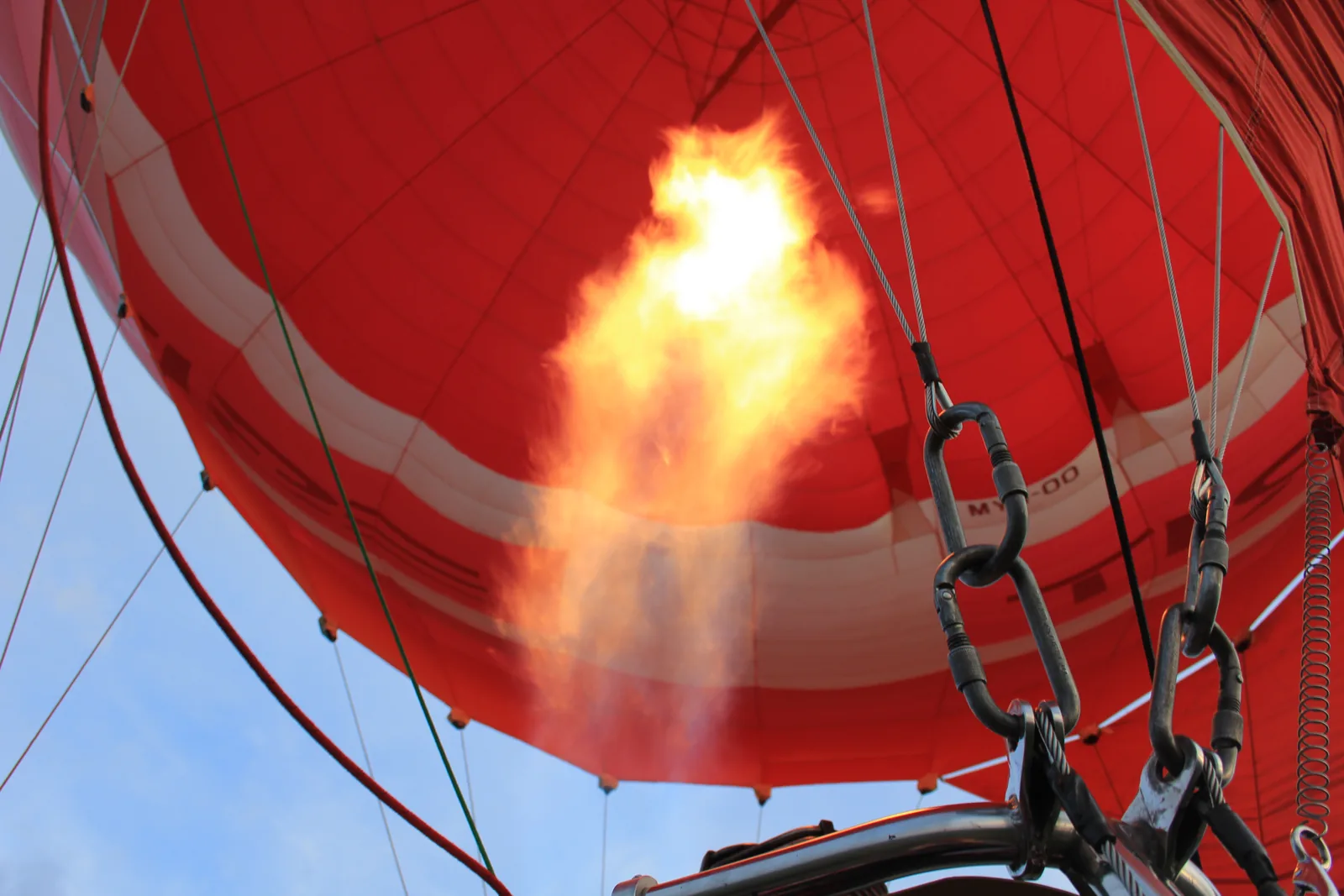
The volume of the envelope of a hot-air balloon is $2.80 \cdot 10^3\,\text{m}^3$. The lower part of the envelope is open, so the pressure of the air inside is the same as that outside, 101 kPa. The burner heats the air inside to $100\,{}^\circ\text{C}$.
How many kilograms of air are inside the envelope? The molar mass of air is $29.0\,\text{g/mol}$, and $R = 8.31\,\tfrac{\text{J}}{\text{mol}\cdot\text{K}}$. Assume that air is an ideal gas.
Hint 1: a guiding question
You do not get the mass directly from the equation of state. What quantity does the equation of state give, and how do you get from it to the mass?
Hint 2: what is the connection
First solve the amount of substance $n = \dfrac{pV}{RT}$ and then the mass $m = nM$. Units: pascals, cubic metres, kelvins and kg/mol.
Hint 3: an intermediate step
so
Show the solution
Given
air inside a hot-air balloon, $V = 2.80 \cdot 10^3\,\text{m}^3$, $p = 101\,\text{kPa}$, $\theta = 100\,{}^\circ\text{C}$, $M = 29.0\,\text{g/mol}$; $R = 8.31\,\tfrac{\text{J}}{\text{mol}\cdot\text{K}}$
Find
mass $m$ of the air in kilograms
Principle
The lower part of the envelope is open, so the pressure is the same as in the outside air and the volume is the volume of the envelope. The equation of state does not give the mass directly but the amount of substance, and the molar mass converts the amount of substance into mass. Air behaves as an ideal gas.
Formula
$pV = nRT$ and $m = nM$, so $n = \dfrac{pV}{RT}$ and $m = \dfrac{pVM}{RT}$
Conversions
so that the mass comes out in kilograms.
Substitution
$$\begin{aligned} n &= \frac{101\,000\,\text{Pa} \cdot 2.80 \cdot 10^3\,\text{m}^3}{8.31\,\tfrac{\text{J}}{\text{mol}\cdot\text{K}} \cdot 373.15\,\text{K}} \\ &= 91\,200\,\text{mol} \\ m &= 91\,200\,\text{mol} \cdot 0.0290\,\tfrac{\text{kg}}{\text{mol}} \\ &= 2644.8\,\text{kg} \end{aligned}$$
Answer
$2.64 \cdot 10^3\,\text{kg}$
Three significant figures. The limiting data are the molar mass $29.0\,\text{g/mol}$ and the volume $2.80 \cdot 10^3\,\text{m}^3$ (three digits); the pressure $101\,\text{kPa}$ and the temperature $373\,\text{K}$ (from the whole degrees $100\,{}^\circ\text{C}$) also have three digits.
Reasonableness
Ordinary air weighs about $1.2\,\text{kg/m}^3$, so $2.80 \cdot 10^3\,\text{m}^3$ would weigh about $1.2 \cdot 2800 = 3360\,\text{kg}$ at $20\,{}^\circ\text{C}$. At the same pressure and volume, hot air contains fewer moles, because $T$ is greater:
The air inside is about $3360\,\text{kg} - 2640\,\text{kg} \approx 700\,\text{kg}$ lighter than the outside air it displaces, and this difference carries the balloon, the basket and the passengers.
Check your understanding
Exit ticket
Answer on your own first and only then open the answer.
- How many moles of gas are in a 10.0 litre container when the pressure is 150 kPa and the temperature is $27\,{}^\circ\text{C}$ ($R = 8.31\,\tfrac{\text{J}}{\text{mol}\cdot\text{K}}$)?
Answer
$T$$= (27 + 273.15)\,\text{K}$$= 300.15\,\text{K}$and
$n$$= \dfrac{pV}{RT}$$= \dfrac{150\,000\,\text{Pa} \cdot 0.0100\,\text{m}^3}{8.31\,\tfrac{\text{J}}{\text{mol}\cdot\text{K}} \cdot 300.15\,\text{K}}$$\approx 0.601\,\text{mol}$
1. Concept
2. Temperature in kelvins
3. Prediction for a state of the simulation
In the reference state of the simulation ($N = 100$, $T = 300\,\text{K}$, $V = 100\,\%$) the pressure is $p/p_\text{ref} = 1.00$. The number of particles is increased to 150, the temperature is raised to $450\,\text{K}$ and the volume is reduced to $75\,\%$.
What is the prediction of the equation of state for $p/p_\text{ref}$?
Hint 1: a guiding question
Which changes increase the pressure and which change decreases it?
Hint 2: what is the connection
The pressure is proportional to the number of particles and the temperature in kelvins and inversely proportional to the volume: $p \propto NT/V$.
Hint 3: an intermediate step
Show the solution
Given
reference state $N_1 = 100$, $T_1 = 300\,\text{K}$, $V_1 = 100\,\%$, $p_1/p_\text{ref} = 1.00$; new state $N_2 = 150$, $T_2 = 450\,\text{K}$, $V_2 = 75\,\%$
Find
the pressure ratio $p_2/p_\text{ref}$
Principle
From the equation of state $pV = nRT$ the average pressure satisfies $p \propto \dfrac{NT}{V}$, because the number of particles $N$ is proportional to the amount of substance $n$. The number of particles and the temperature in kelvins increase the pressure, and a smaller volume increases it too, because the particles hit the wall more often. In the reference state the ratio is $1.00$, so it is enough to calculate the factors of the changes.
Formula
and since
Conversions
The temperatures are already in kelvins, and the volumes are in percent of the same reference volume, so all the units cancel in the ratios.
Substitution
Answer
$p_2/p_\text{ref} = 3.0$
Two significant figures. The numbers of particles $100$ and $150$ are exact counts, so the limiting data are the volume $75\,\%$ (two digits) and the temperatures $300\,\text{K}$ and $450\,\text{K}$ (at least two digits).
Reasonableness
All three changes increase the pressure, so the result must be over $1$: the product $1.5 \cdot 1.5 = 2.25$ is increased further by the decrease in volume, by the factor $1.33$, to $3.0$. It is worth checking the prediction in the simulation by setting the same values.
Suggestion: one answer does not show everything you can do, but review the theory summary and do the core exercises.
Optional 4. Explain using the weighing
Using the weighing and the equation of state, explain why two containers of the same size, at the same pressure and temperature, contain the same number of moles of gas, whatever the gas is.
Why do the gases still weigh different amounts?
Model answer
In the weighing each of the four gases had the same pressure, volume and temperature, and the quotient $m/M$ was almost the same for all of them, 0.2075 mol for helium and 0.2068 mol for carbon dioxide. The equation of state explains this: $n = pV/(RT)$, and the molar gas constant $R$ is the same for all gases, so the same $p$, $V$ and $T$ give the same amount of substance whatever the type of gas. A mole is always the same number of particles, so there are the same number of particles too. The masses differ because $m = nM$: a carbon dioxide particle is much heavier than a helium particle, so the same amount of carbon dioxide weighs about 11 times more.
Assess your own answer
Tick the points your own answer already contains.
Review the theory summary and practise with the exercises.
Review the chapter's concepts
Cards you mark Review later collect in your review deck.
- Amount of substance
- Describes the number of particles of a substance; its unit is the mole.
- Mole
- The amount of substance that contains about $6.02 \cdot 10^{23}$ particles.
- Ideal gas
- A simplified model of a gas that neglects the volume of the particles and their interactions.
- Ideal gas law
- Links the pressure, volume, amount of substance and temperature of a gas.$$pV = nRT$$
- Combined gas law
- The states of a fixed amount of gas can be compared with an equation in which pressure times volume is divided by temperature.$$\dfrac{p_1 V_1}{T_1} = \dfrac{p_2 V_2}{T_2}$$
Exercises
Level 1 · basic practice 8 exercises
One formula or one step of reasoning. Core exercises first, the rest is extra practice.
- Exercise 12-1Core
The volume of the inside of a fridge is $0.250\,\text{m}^3$. When the door has been closed for a long time, the temperature of the air in the fridge is $278\,\text{K}$ and the pressure is $1.01 \cdot 10^5\,\text{Pa}$.
How many moles of air are in the fridge? Use the value $R = 8.31\,\tfrac{\text{J}}{\text{mol}\cdot\text{K}}$.
Answer
$10.9\,\text{mol}$
Show the solution
Given
air in a fridge, $V = 0.250\,\text{m}^3$, $T = 278\,\text{K}$, $p = 1.01 \cdot 10^5\,\text{Pa}$; $R = 8.31\,\tfrac{\text{J}}{\text{mol}\cdot\text{K}}$
Find
amount of substance $n$ in moles
Principle
The air in the fridge is in a fixed container, and its pressure, volume and temperature are all known at the same time. The equation of state of an ideal gas links these three to the amount of substance, and air behaves like an ideal gas at ordinary pressure and temperature.
Formula
$pV = nRT$, so $n = \dfrac{pV}{RT}$
Conversions
No conversions are needed, because the volume is in cubic metres, the pressure in pascals and the temperature in kelvins. Then $\text{Pa}\cdot\text{m}^3 = \text{J}$, and the joules cancel.
Substitution
$n$$= \dfrac{1.01 \cdot 10^5\,\text{Pa} \cdot 0.250\,\text{m}^3}{8.31\,\tfrac{\text{J}}{\text{mol}\cdot\text{K}} \cdot 278\,\text{K}}$$= 10.93\,\text{mol}$Answer
$10.9\,\text{mol}$
Three significant figures. All the data ($0.250\,\text{m}^3$, $278\,\text{K}$, $1.01 \cdot 10^5\,\text{Pa}$ and $R = 8.31$) are given with three digits.
Reasonableness
At room temperature and normal pressure one litre of air contains about $0.041\,\text{mol}$, so $250\,\textsf{l}$ contains about $250 \cdot 0.041 \approx 10\,\text{mol}$. In the cold, slightly more air fits, because $293\,\text{K} / 278\,\text{K} \approx 1.05$. So the result $10.9\,\text{mol}$ is believable, and the mass of the air is about $10.9\,\text{mol} \cdot 29\,\text{g/mol} \approx 0.32\,\text{kg}$.
- Exercise 12-2Core
The inside volume of a basketball is $0.00710\,\text{m}^3$, and it contains $0.460\,\text{mol}$ of air. The temperature of the sports hall is $293\,\text{K}$.
What is the pressure of the air inside the ball? Use the value $R = 8.31\,\tfrac{\text{J}}{\text{mol}\cdot\text{K}}$. Give the answer in kilopascals.
Answer
$158\,\text{kPa}$
Show the solution
Given
air in a basketball, $V = 0.00710\,\text{m}^3$, $n = 0.460\,\text{mol}$, $T = 293\,\text{K}$; $R = 8.31\,\tfrac{\text{J}}{\text{mol}\cdot\text{K}}$
Find
pressure $p$ in kilopascals
Principle
The ball contains a certain amount of air in a certain volume and at a certain temperature. The air behaves as an ideal gas, so the equation of state gives the pressure directly from the amount of substance, the temperature and the volume.
Formula
$pV = nRT$, so $p = \dfrac{nRT}{V}$
Conversions
The data are already in base units, so the substitution gives the pressure in pascals, because $\tfrac{\text{J}}{\text{m}^3} = \text{Pa}$. Finally $1\,\text{kPa} = 1000\,\text{Pa}$.
Substitution
$p$$= \dfrac{0.460\,\text{mol} \cdot 8.31\,\tfrac{\text{J}}{\text{mol}\cdot\text{K}} \cdot 293\,\text{K}}{0.00710\,\text{m}^3}$$= 157\,750\,\text{Pa}$$= 157.75\,\text{kPa}$Answer
$158\,\text{kPa}$
Three significant figures. All the data ($0.460\,\text{mol}$, $0.00710\,\text{m}^3$, $293\,\text{K}$ and $R = 8.31$) are given with three digits.
Reasonableness
Atmospheric pressure is about $101\,\text{kPa}$, so the gauge pressure of the ball is about $158\,\text{kPa} - 101\,\text{kPa} \approx 57\,\text{kPa}$. This is a typical gauge pressure for a pumped-up basketball, so the ball is hard but not overinflated. The pressure is clearly greater than atmospheric pressure, as it should be for a fully pumped-up ball.
- Exercise 12-3
An automatic life jacket inflates when $0.400\,\text{mol}$ of carbon dioxide is released from the cartridge of the jacket. The temperature of the gas in the jacket is $283\,\text{K}$ and the pressure is $1.05 \cdot 10^5\,\text{Pa}$.
What is the volume of the gas in the jacket? Use the value $R = 8.31\,\tfrac{\text{J}}{\text{mol}\cdot\text{K}}$. Give the answer in cubic metres.
Answer
$0.00896\,\text{m}^3$
Show the solution
Given
carbon dioxide in a life jacket, $n = 0.400\,\text{mol}$, $T = 283\,\text{K}$, $p = 1.05 \cdot 10^5\,\text{Pa}$; $R = 8.31\,\tfrac{\text{J}}{\text{mol}\cdot\text{K}}$
Find
volume $V$ in cubic metres
Principle
When the gas has been released into the jacket, its pressure is the pressure in the jacket and its temperature is known. The amount of gas is known, so the equation of state gives the volume. The type of gas does not affect the calculation, because the equation of state has no molar mass.
Formula
$pV = nRT$, so $V = \dfrac{nRT}{p}$
Conversions
No conversions are needed: the amount of substance is in moles, the temperature in kelvins and the pressure in pascals, so the volume comes out in cubic metres.
Substitution
$V$$= \dfrac{0.400\,\text{mol} \cdot 8.31\,\tfrac{\text{J}}{\text{mol}\cdot\text{K}} \cdot 283\,\text{K}}{1.05 \cdot 10^5\,\text{Pa}}$$= 0.008959\,\text{m}^3$Answer
$0.00896\,\text{m}^3$
Three significant figures. All the data ($0.400\,\text{mol}$, $283\,\text{K}$, $1.05 \cdot 10^5\,\text{Pa}$ and $R = 8.31$) are given with three digits.
Reasonableness
The result is about $9.0\,\textsf{l}$. At room temperature a mole of gas takes up about $24\,\textsf{l}$, so $0.400\,\text{mol}$ takes up about $0.400 \cdot 24\,\textsf{l} \approx 9.6\,\textsf{l}$, and at a slightly lower temperature the volume is a little smaller. The mass of the carbon dioxide is only $0.400\,\text{mol} \cdot 44\,\text{g/mol} \approx 18\,\text{g}$, which is the size of a cartridge.
- Exercise 12-4
On the jetty of a cottage there is a dark plastic barrel with its lid closed. The volume of the barrel is $0.200\,\text{m}^3$, and it contains $8.40\,\text{mol}$ of air. On a sunny afternoon the pressure of the air in the barrel is $1.13 \cdot 10^5\,\text{Pa}$.
What is the temperature of the air in the barrel in kelvins? Use the value $R = 8.31\,\tfrac{\text{J}}{\text{mol}\cdot\text{K}}$.
Answer
$324\,\text{K}$
Show the solution
Given
air in a barrel, $V = 0.200\,\text{m}^3$, $n = 8.40\,\text{mol}$, $p = 1.13 \cdot 10^5\,\text{Pa}$; $R = 8.31\,\tfrac{\text{J}}{\text{mol}\cdot\text{K}}$
Find
temperature $T$ in kelvins
Principle
The barrel is closed, so the amount of air and the volume are known, and the pressure has been measured. The equation of state gives the temperature when the air behaves as an ideal gas.
Formula
$pV = nRT$, so $T = \dfrac{pV}{nR}$
Conversions
No conversions are needed: the pressure is in pascals, the volume in cubic metres and the amount of substance in moles, so the result comes out directly in kelvins.
Substitution
$T$$= \dfrac{1.13 \cdot 10^5\,\text{Pa} \cdot 0.200\,\text{m}^3}{8.40\,\text{mol} \cdot 8.31\,\tfrac{\text{J}}{\text{mol}\cdot\text{K}}}$$= 323.8\,\text{K}$Answer
$324\,\text{K}$
Three significant figures. All the data ($0.200\,\text{m}^3$, $8.40\,\text{mol}$, $1.13 \cdot 10^5\,\text{Pa}$ and $R = 8.31$) are given with three digits.
Reasonableness
In degrees Celsius the result is $323.8 - 273.15 \approx 51\,{}^\circ\text{C}$, which is a possible temperature for a dark barrel in the summer sun. With the same amount of substance and volume, a pressure of $101\,\text{kPa}$ would correspond to a temperature of $16\,{}^\circ\text{C}$, so the pressure has risen by about $12\,\%$ as the temperature rose. The pressure grows with the temperature, as it should.
- Exercise 12-5
The gas cylinder of a home carbonation machine contains $425\,\text{g}$ of carbon dioxide. The molar mass of carbon dioxide is $44\,\text{g/mol}$.
How many moles of carbon dioxide are in the cylinder?
Answer
$9.7\,\text{mol}$
Show the solution
Given
carbon dioxide, $m = 425\,\text{g}$, $M = 44\,\text{g/mol}$
Find
amount of substance $n$ in moles
Principle
The molar mass tells the mass of one mole, so the total mass of the gas divided by the molar mass gives the number of moles. The equation of state is not needed, because pressure and temperature do not affect the amount of substance.
Formula
$M = \dfrac{m}{n}$, so $n = \dfrac{m}{M}$
Conversions
No conversions are needed, because the mass and the molar mass are both in grams. The grams cancel, and the mole is left.
Substitution
$n$$= \dfrac{425\,\text{g}}{44\,\text{g/mol}}$$= 9.659\,\text{mol}$Answer
$9.7\,\text{mol}$
Two significant figures. The limiting datum is the molar mass $44\,\text{g/mol}$ (two digits); the mass $425\,\text{g}$ has three digits.
Reasonableness
If the molar mass is rounded to $40\,\text{g/mol}$, you get about $425 / 40 \approx 10.6\,\text{mol}$, so the result $9.7\,\text{mol}$ is of the same order of magnitude and a little smaller, because the real molar mass is greater. Checking backwards: $9.659\,\text{mol} \cdot 44\,\text{g/mol} = 425\,\text{g}$. At room temperature the gas would take up about $9.7 \cdot 24\,\textsf{l} \approx 230\,\textsf{l}$.
- Exercise 12-6
What does the amount of substance $n$ describe in the equation of state of an ideal gas $pV = nRT$?
Answer
The number of particles in moles, because one mole is always the same number of particles.
Show the solution
Find
what the amount of substance $n$ describes in the equation of state $pV = nRT$.
Principle
The mole is a unit of the number of particles, and one mole always contains $6.022 \cdot 10^{23}$ particles, whatever the substance. The equation of state links the pressure, volume and temperature of a gas to its number of particles.
Model answer
The amount of substance gives the number of particles of the gas in moles, $n = N/N_\text{A}$. It is not the mass of the gas: the mass is $m = nM$, and the molar mass $M$ does not appear in the equation of state. Nor is it the density or the speed of the particles, because the volume $V$ and the temperature $T$ are quantities of their own in the equation.
- Exercise 12-7
A balloon is filled with helium in a room where the temperature is $21\,{}^\circ\text{C}$ and the air pressure is $101\,\text{kPa}$. The volume of the balloon is then $2.50\,\textsf{l}$.
The balloon is taken outside, where the temperature is $-9\,{}^\circ\text{C}$ and the air pressure is $98\,\text{kPa}$. The pressure of the gas in the balloon is always the same as the pressure of the surrounding air, and no gas escapes.
What is the volume of the balloon outside, in litres?
Answer
$2.3\,\textsf{l}$
Show the solution
Given
helium, $V_1 = 2.50\,\textsf{l}$, $\theta_1 = 21\,{}^\circ\text{C}$, $p_1 = 101\,\text{kPa}$; $\theta_2 = -9\,{}^\circ\text{C}$, $p_2 = 98\,\text{kPa}$
Find
volume $V_2$ in litres
Principle
No gas escapes, so the amount of substance $n$ stays the same. In both states the equation of state $pV = nRT$ gives the same number $nR = pV/T$, so $p_1V_1/T_1 = p_2V_2/T_2$.
Formula
$\dfrac{p_1V_1}{T_1}$$= \dfrac{p_2V_2}{T_2}$so $V_2 = \dfrac{p_1 V_1 T_2}{p_2 T_1}$
Conversions
$T_1$$= (21 + 273.15)\,\text{K}$$= 294.15\,\text{K}$$T_2$$= (-9 + 273.15)\,\text{K}$$= 264.15\,\text{K}$The units of pressure and volume cancel, so they do not need to be converted.
Substitution
$V_2$$= \dfrac{101\,\text{kPa} \cdot 2.50\,\textsf{l} \cdot 264.15\,\text{K}}{98\,\text{kPa} \cdot 294.15\,\text{K}}$$= 2.314\,\textsf{l}$Answer
$2.3\,\textsf{l}$
Two significant figures, because the pressure $98\,\text{kPa}$ is given with two digits (intermediate result $2.314\,\textsf{l}$).
Reasonableness
The temperature falls by the ratio $264.15 : 294.15 \approx 0.90$, which decreases the volume by a tenth. The pressure falls by the ratio $98 : 101 \approx 0.97$, which increases the volume by three per cent. The ratio of the volumes is $0.90 : 0.97 \approx 0.93$ and $0.93 \cdot 2.50\,\textsf{l} \approx 2.3\,\textsf{l}$, which agrees with the result.
- Exercise 12-8
A student calculates the amount of substance of a gas when the pressure is $150\,\text{kPa}$, the volume is $0.0020\,\text{m}^3$ and the temperature is $300\,\text{K}$. The student writes
$n = \dfrac{150 \cdot 0.0020}{8.31 \cdot 300} = 1.2 \cdot 10^{-4}\,\text{mol}$
The result seems small to the student, because two litres of gas surely contains more than a thousandth of a mole. What is the error in the calculation?
Answer
The pressure has been substituted in kilopascals instead of pascals, so the numerator is too small.
Show the solution
Find
what the error in the student's calculation is.
Principle
The equation of state works correctly only when the quantities are in base units: pressure in pascals, volume in cubic metres and temperature in kelvins. Otherwise a unit factor is left in the result.
Model answer
The student substituted the pressure $150\,\text{kPa}$ as the number $150$ instead of in pascals. The correct pressure is $150\,000\,\text{Pa}$, which gives $n = \dfrac{150\,000 \cdot 0.0020}{8.31 \cdot 300} \approx 0.12\,\text{mol}$. The student's result is thus a thousand times too small, as the student's own estimate hinted. The temperature and the volume were substituted in the correct units, and no molar mass is needed.
Level 2 · applied practice 7 exercises
Two steps, working with measured data, a unit conversion or rearranging a formula. Core exercises first, the rest is extra practice.
- Exercise 12-9Core
The pressure gauge of the oxygen cylinder of an ambulance is broken. The volume of the cylinder is $10.0\,\textsf{l}$, and weighing shows that the cylinder contains $2.40\,\text{kg}$ of oxygen. The temperature in the garage is $15\,{}^\circ\text{C}$.
What is the pressure of the oxygen in the cylinder in bars ($1\,\text{bar}$ = $100\,\text{kPa}$)? The molar mass of oxygen is $32.0\,\text{g/mol}$. Use the value $R = 8.31\,\tfrac{\text{J}}{\text{mol}\cdot\text{K}}$ and assume that oxygen obeys the equation of state of an ideal gas.
Answer
$180\,\text{bar}$
Show the solution
Given
oxygen, $V = 10.0\,\textsf{l}$, $m = 2.40\,\text{kg}$, $\theta = 15\,{}^\circ\text{C}$, $M = 32.0\,\text{g/mol}$; $R = 8.31\,\tfrac{\text{J}}{\text{mol}\cdot\text{K}}$
Find
pressure $p$ in bars, where $1\,\text{bar} = 100\,\text{kPa}$
Principle
The oxygen in the cylinder is in a fixed volume at a known temperature, and its amount of substance can be found by weighing from the mass and the molar mass. We assume that oxygen is an ideal gas, so the equation of state gives the pressure.
Formula
$pV = nRT$ and $n = \dfrac{m}{M}$, so $p = \dfrac{nRT}{V} = \dfrac{mRT}{MV}$
Conversions
$V$$= 10.0\,\textsf{l}$$= 0.0100\,\text{m}^3$$M$$= 32.0\,\text{g/mol}$$= 0.0320\,\text{kg/mol}$$T$$= (15 + 273.15)\,\text{K}$$= 288.15\,\text{K}$Finally $1\,\text{bar} = 10^5\,\text{Pa}$.
Substitution
$n$$= \dfrac{2.40\,\text{kg}}{0.0320\,\text{kg/mol}}$$= 75.0\,\text{mol}$$p$$= \dfrac{75.0\,\text{mol} \cdot 8.31\,\tfrac{\text{J}}{\text{mol}\cdot\text{K}} \cdot 288.15\,\text{K}}{0.0100\,\text{m}^3}$$= 1.796 \cdot 10^7\,\text{Pa}$$= 179.6\,\text{bar}$Answer
$180\,\text{bar}$
Three significant figures. All the data ($10.0\,\textsf{l}$, $2.40\,\text{kg}$, $32.0\,\text{g/mol}$ and $R = 8.31$) are given with three digits, and the $288\,\text{K}$ obtained from the whole degrees $15\,{}^\circ\text{C}$ also has three digits.
Reasonableness
The pressure of a full oxygen cylinder is typically about $200\,\text{bar}$, so an almost full cylinder is believable. Order of magnitude: a mole of gas takes up about $24\,\textsf{l}$ at normal pressure, so $75\,\text{mol}$ would take up about $1800\,\textsf{l}$, and compressed into $10\,\textsf{l}$ the pressure is about $1800 / 10 \approx 180$ times atmospheric pressure. At such a high pressure a real gas differs from an ideal gas by a few percent, but the problem asked for the ideal gas value.
- Exercise 12-10Core
In a chemistry storeroom there is a gas cylinder whose label is worn illegible.
A $1.00\,\textsf{l}$ glass flask emptied with a vacuum pump is filled with the gas from the cylinder, and the mass of the flask increases by $1.15\,\text{g}$. The pressure of the gas in the flask is $101\,\text{kPa}$ and the temperature is $22\,{}^\circ\text{C}$.
Calculate the molar mass of the gas in grams per mole. Which gas is it, when the options are helium ($4.0\,\text{g/mol}$), nitrogen ($28\,\text{g/mol}$), oxygen ($32\,\text{g/mol}$), argon ($40\,\text{g/mol}$) and carbon dioxide ($44\,\text{g/mol}$)? Use the value $R = 8.31\,\tfrac{\text{J}}{\text{mol}\cdot\text{K}}$.
Answer
$27.9\,\text{g/mol}$
Show the solution
Given
unknown gas, $V = 1.00\,\textsf{l}$, increase in mass $m = 1.15\,\text{g}$, $p = 101\,\text{kPa}$, $\theta = 22\,{}^\circ\text{C}$; $R = 8.31\,\tfrac{\text{J}}{\text{mol}\cdot\text{K}}$
Find
molar mass $M$ and the type of gas
Principle
The flask was a vacuum, so the increase in mass is the mass of the gas. The equation of state gives the amount of substance from the pressure, the volume and the temperature, and the molar mass is the mass divided by the amount of substance. The equation of state does not contain the type of gas, so the type is identified only from the molar mass.
Formula
$pV = nRT$ and $n = \dfrac{m}{M}$, so $\dfrac{pV}{RT} = \dfrac{m}{M}$ and $M = \dfrac{mRT}{pV}$
Conversions
$V$$= 1.00\,\textsf{l}$$= 0.00100\,\text{m}^3$$p$$= 101\,\text{kPa}$$= 101\,000\,\text{Pa}$$T$$= (22 + 273.15)\,\text{K}$$= 295.15\,\text{K}$The mass is left in grams, so the result is in $\text{g/mol}$.
Substitution
$M$$= \dfrac{1.15\,\text{g} \cdot 8.31\,\tfrac{\text{J}}{\text{mol}\cdot\text{K}} \cdot 295.15\,\text{K}}{101\,000\,\text{Pa} \cdot 0.00100\,\text{m}^3}$$= 27.93\,\tfrac{\text{g}}{\text{mol}}$Answer
$27.9\,\text{g/mol}$
Three significant figures. All the data ($1.00\,\textsf{l}$, $1.15\,\text{g}$, $101\,\text{kPa}$ and $R = 8.31$) are given with three digits, and $295\,\text{K}$ (from the whole degrees $22\,{}^\circ\text{C}$) also has three digits. The gas is nitrogen ($28\,\text{g/mol}$).
Reasonableness
The amount of substance is
$\dfrac{101\,000\,\text{Pa} \cdot 0.00100\,\text{m}^3}{8.31 \cdot 295.15}$$= 0.0412\,\text{mol}$which fits the fact that a litre of gas at room temperature contains about $0.04\,\text{mol}$. With the same amount of substance the mass would have been $0.16\,\text{g}$ for helium, $1.32\,\text{g}$ for oxygen, $1.65\,\text{g}$ for argon and $1.81\,\text{g}$ for carbon dioxide, so only nitrogen ($1.15\,\text{g}$) fits.
- Exercise 12-11
At the end of the intake stroke, the cylinder of a tractor's diesel engine contains $0.500\,\textsf{l}$ of air. The pressure of the air is $101\,\text{kPa}$ and the temperature is $30\,{}^\circ\text{C}$.
At the end of the compression stroke the volume of the air is $0.0300\,\textsf{l}$ and the pressure is $4.60\,\text{MPa}$. The valves are closed, so no air can escape from the cylinder.
What is the temperature of the air at the end of compression in degrees Celsius? Diesel fuel ignites by itself at a temperature of about $250\,{}^\circ\text{C}$. Does the fuel injected into the cylinder ignite?
Answer
$555\,{}^\circ\text{C}$
Show the solution
Given
air in a cylinder, initially $V_1 = 0.500\,\textsf{l}$, $p_1 = 101\,\text{kPa}$, $\theta_1 = 30\,{}^\circ\text{C}$; finally $V_2 = 0.0300\,\textsf{l}$, $p_2 = 4.60\,\text{MPa}$
Find
final temperature $\theta_2$ in degrees Celsius, and whether the fuel ignites ($250\,{}^\circ\text{C}$)
Principle
The valves are closed, so the amount of air stays the same and $nR$ is constant. Then the equation of state gives the combined gas law between the initial and final state.
Formula
$\dfrac{p_1 V_1}{T_1}$$= \dfrac{p_2 V_2}{T_2}$so
$T_2$$= T_1 \cdot \dfrac{p_2 V_2}{p_1 V_1}$$\theta_2 = T_2 - 273.15\,\text{K}$
Conversions
$T_1$$= (30 + 273.15)\,\text{K}$$= 303.15\,\text{K}$The pressures and volumes appear as ratios, so they cancel when they are in the same units: $4.60\,\text{MPa} = 4600\,\text{kPa}$ and the litres stay as litres.
Substitution
$T_2$$= 303.15\,\text{K} \cdot \dfrac{4600\,\text{kPa} \cdot 0.0300\,\textsf{l}}{101\,\text{kPa} \cdot 0.500\,\textsf{l}}$$= 828.4\,\text{K}$$\theta_2$$= 828.4 - 273.15$$= 555.3\,{}^\circ\text{C}$Answer
$555\,{}^\circ\text{C}$
Three significant figures. All the data ($0.500\,\textsf{l}$, $101\,\text{kPa}$, $0.0300\,\textsf{l}$, $4.60\,\text{MPa}$ and $303\,\text{K}$ from the whole degrees $30\,{}^\circ\text{C}$) have three digits, and subtracting $273.15\,\text{K}$ from the temperature $828\,\text{K}$ keeps the units. The fuel ignites, because $555\,{}^\circ\text{C}$ is clearly above $250\,{}^\circ\text{C}$.
Reasonableness
The volume is about $17$ times smaller and the pressure about $46$ times greater ($0.500/0.0300 \approx 16.7$ and $4600/101 \approx 45.5$), so the product $pV$ and with it the temperature in kelvins grow by a factor of about $45.5 / 16.7 \approx 2.73$: $303\,\text{K} \cdot 2.73 \approx 828\,\text{K}$. The result agrees, and the temperature rises when a gas is compressed, so a diesel engine does not need a spark plug.
- Exercise 12-12
Two identical, closed and rigid containers, each with a volume of $2.00\,\textsf{l}$, contain gas samples A and B.
When the containers are heated, their pressure is measured at different temperatures. The graph shows the measurement results.
How many moles more gas is there in container A than in container B? Read the values you need from the graph. Use the value $R = 8.31\,\tfrac{\text{J}}{\text{mol}\cdot\text{K}}$ and assume that the gases obey the equation of state of an ideal gas.
Answer
$n_\text{A} - n_\text{B} \approx 0.024\,\text{mol}$
Show the solution
Given
the volume of each container $V = 2.00\,\textsf{l}$; the measurement points of the graph at grid crossings, $R = 8.31\,\tfrac{\text{J}}{\text{mol}\cdot\text{K}}$
Find
the difference of the amounts of substance $n_\text{A} - n_\text{B}$
Principle
The containers are closed and rigid, so the amount of gas and the volume stay the same and the lines of the graph follow the equation of state. When the pressure of both series is read at the same temperature, the equation of state gives both amounts of substance, and the difference is obtained by subtracting.
Reading the graph
Both series are read at the same temperature $T = 400\,\text{K}$, which is a vertical grid line: gas A $p_\text{A} = 100\,\text{kPa}$ and gas B $p_\text{B} = 60\,\text{kPa}$. The pressures of the points at $T = 200\,\text{K}$ are half of these, so the lines pass through the origin, as $p = nRT/V$ requires.
Formula
$pV = nRT$, so
$n$$= \dfrac{pV}{RT}$$n_\text{A} - n_\text{B}$$= \dfrac{(p_\text{A} - p_\text{B})\,V}{RT}$Conversions
$p_\text{A} - p_\text{B}$$= (100 - 60)\,\text{kPa}$$= 40\,\text{kPa}$$= 40\,000\,\text{Pa}$$V$$= 2.00\,\textsf{l}$$= 0.00200\,\text{m}^3$The temperature is already in kelvins.
Substitution
$n_\text{A} - n_\text{B}$$= \dfrac{40\,000\,\text{Pa} \cdot 0.00200\,\text{m}^3}{8.31\,\tfrac{\text{J}}{\text{mol}\cdot\text{K}} \cdot 400\,\text{K}}$$= \dfrac{80\,\text{J}}{3324\,\tfrac{\text{J}}{\text{mol}}}$$= 0.0241\,\text{mol}$Answer
$n_\text{A} - n_\text{B} \approx 0.024\,\text{mol}$
Two significant figures, because the volume and the pressure readings from the graph are known to two digits. Separately $n_\text{A} \approx 0.060\,\text{mol}$ and $n_\text{B} \approx 0.036\,\text{mol}$. The points are read from grid crossings, so the accepted range is narrow: $0.0233$–$0.0247\,\text{mol}$.
Reasonableness
The slope of line A is greater, so there is more gas in A and the difference is positive. The ratio of the pressures $100 : 60$ is also the ratio of the amounts of substance: $0.060 / 0.036 \approx 1.7$.
- Exercise 12-13
A motorist suspects that the tyre of a passenger car is leaking. The motorist measures the total pressure of the air in the tyre before driving and immediately after a long drive (example data set). The volume of the tyre is assumed to stay the same.
a) Calculate how high the pressure in the tyre would be after the drive if no air had leaked.
b) What percentage of the original amount of air in the tyre has leaked? Justify with the equation of state why measuring the pressure alone is not enough to show a leak.
The answer box takes the result of part b).
Temperature and total pressure of the air in the tyre (example data set) Moment $\theta\,({}^\circ\text{C})$ $p\,(\text{kPa})$ Before the drive 5.0 300 After the drive 26.0 305 Answer
$5.5\,\%$
Show the solution
Given
tyre, $\theta_1 = 5.0\,{}^\circ\text{C}$, $p_1 = 300\,\text{kPa}$ before the drive; $\theta_2 = 26.0\,{}^\circ\text{C}$, $p_2 = 305\,\text{kPa}$ after the drive; volume $V$ constant
Find
the leaked share $\dfrac{n_1 - n_2}{n_1}$ as a percentage
Principle
The volume is constant, so the equation of state $pV = nRT$ gives the amount of substance $n = \dfrac{pV}{RT}$ in both states. The temperature rises during the drive, so the pressure would rise even in a tyre that does not leak, and the leak shows only when the amounts of substance are compared.
Formula
$n_1 = \dfrac{p_1V}{RT_1}$ and $n_2 = \dfrac{p_2V}{RT_2}$, so
$\dfrac{n_2}{n_1}$$= \dfrac{p_2 T_1}{p_1 T_2}$and the leaked share is $1 - \dfrac{n_2}{n_1}$
Conversions
$T_1$$= (5.0 + 273.15)\,\text{K}$$= 278.15\,\text{K}$$T_2$$= (26.0 + 273.15)\,\text{K}$$= 299.15\,\text{K}$The pressures are in the same unit, so they cancel.
Substitution
a) Without a leak the amount of substance and the volume do not change, so
$p_2'$$= p_1 \dfrac{T_2}{T_1}$$= 300\,\text{kPa} \cdot \dfrac{299.15\,\text{K}}{278.15\,\text{K}}$$= 322.6\,\text{kPa}$b)
$\dfrac{n_2}{n_1}$$= \dfrac{305\,\text{kPa} \cdot 278.15\,\text{K}}{300\,\text{kPa} \cdot 299.15\,\text{K}}$$= 0.9453$so the leaked share is $1 - 0.9453 = 0.0547$
Answer
$5.5\,\%$
Two significant figures: the share is the difference $1 - 0.945$, so the third digit of the pressures decides the second digit. In a tyre that does not leak the pressure after the drive would be $323\,\text{kPa}$, but the measured pressure is $305\,\text{kPa}$. The rise in pressure $300 \to 305\,\text{kPa}$ does not alone show a leak, because the rise in temperature would raise the pressure even without a leak.
Reasonableness
The measured pressure is $305 : 322.6 \approx 0.945$ of the pressure of a tyre that does not leak, so about $94.5\,\%$ of the air is left and the leaked share is about $5.5\,\%$. The temperature rose by about $7.5\,\%$ ($278 \to 299\,\text{K}$), but the pressure by only $1.7\,\%$, so some air must have escaped.
- Exercise 12-14
Students study how the volume of air depends on temperature. The air is in a syringe that is heated and whose piston moves freely. The pressure stays at atmospheric pressure, $101\,\text{kPa}$, and the amount of air stays constant. The measurement results are in the table (example data set). Draw the $(T, V)$ graph and fit a line to the points. The points are usually not exactly on a line because of measurement uncertainty.
a) Determine the slope $\Delta V / \Delta T$ of the line from two points chosen on the line, not from two measurement points.
b) Calculate from the slope the amount of substance $n$ of the air in the syringe in millimoles. Use the value $R = 8.31\,\tfrac{\text{J}}{\text{mol}\cdot\text{K}}$. Justify briefly why the line should pass through the origin when the temperature is in kelvins.
The answer box takes the result of part b).
Volume of air at constant pressure (example data set) $T\,(\text{K})$ $V\,(\text{cm}^3)$ 280 115.0 300 124.1 320 131.2 340 140.5 360 147.6 Answer
$5.0\,\text{mmol}$
Show the solution
Given
$p = 101\,\text{kPa}$ constant, amount of air constant; $(T, V)$ points in the table; $R = 8.31\,\tfrac{\text{J}}{\text{mol}\cdot\text{K}}$
Find
amount of substance $n$ in millimoles
Principle
The pressure and the amount of substance are constant, so the equation of state gives $V = \dfrac{nR}{p}\,T$. The volume is directly proportional to the temperature in kelvins, and the slope of the line in the $(T, V)$ graph is $\dfrac{nR}{p}$.
Reading the graph
Plot the points and draw a line that passes between them. The least-squares line is $V = 0.408\,\tfrac{\text{cm}^3}{\text{K}} \cdot T + 1.1\,\text{cm}^3$, and your own line can be compared with it. Read two points far apart from the line: the values of the line are $(280\,\text{K}$; $115.4\,\text{cm}^3)$ and $(360\,\text{K}$; $148.0\,\text{cm}^3)$, not the table values $115.0\,\text{cm}^3$ and $147.6\,\text{cm}^3$. The slope is
$k$$= \dfrac{(148.0 - 115.4)\,\text{cm}^3}{(360 - 280)\,\text{K}}$$= 0.4075\,\tfrac{\text{cm}^3}{\text{K}}$The constant term of the line, $1.1\,\text{cm}^3$, is small compared with the volumes $115$–$148\,\text{cm}^3$, so the line passes almost through the origin.
Formula
$k = \dfrac{nR}{p}$, so $n = \dfrac{kp}{R}$
Conversions
$k$$= 0.4075\,\tfrac{\text{cm}^3}{\text{K}}$$= 0.4075 \cdot 10^{-6}\,\tfrac{\text{m}^3}{\text{K}}$$p$$= 101\,\text{kPa}$$= 101\,000\,\text{Pa}$Finally $1\,\text{mol} = 1000\,\text{mmol}$.
Substitution
$n$$= \dfrac{0.4075 \cdot 10^{-6}\,\tfrac{\text{m}^3}{\text{K}} \cdot 101\,000\,\text{Pa}}{8.31\,\tfrac{\text{J}}{\text{mol}\cdot\text{K}}}$$= 4.953 \cdot 10^{-3}\,\text{mol}$Answer
$5.0\,\text{mmol}$
Two significant figures, because the measurement uncertainty of the fitted line is about $\pm 0.1\,\text{mmol}$ (intermediate result $4.95\,\text{mmol}$). The line must pass through the origin, because $V = nRT/p$ is directly proportional to the temperature when $T$ is in kelvins: at $T = 0$ the volume would be zero.
Reasonableness
A volume of $131\,\text{cm}^3$ at $320\,\text{K}$ and a pressure of $101\,\text{kPa}$ give
$n$$\approx \dfrac{101\,000 \cdot 131 \cdot 10^{-6}}{8.31 \cdot 320}$$\approx 5.0 \cdot 10^{-3}\,\text{mol}$which agrees with the result. At room temperature $0.13\,\textsf{l}$ of air contains about $0.13 \cdot 0.041\,\text{mol} \approx 5\,\text{mmol}$.
- Exercise 12-15
The table shows the pressure of two equal amounts of gas as a function of volume (example data set). Series A and B were measured at different temperatures, and the volumes in the measurements are different.
Which series was measured at the higher temperature?
Pressure and volume of the same amount of gas at two temperatures (example data set) $V_\text{A}\,(\textsf{l})$ $p_\text{A}\,(\text{kPa})$ $V_\text{B}\,(\textsf{l})$ $p_\text{B}\,(\text{kPa})$ 1.0 244 1.5 203 2.0 122 2.5 122 3.0 81 3.5 87 4.0 61 4.5 68 Answer
Series B, because its product $pV$ is greater, and the temperature of the same amount of gas is proportional to it.
Show the solution
Given
pressures and volumes of the same amount of gas: series A with volumes $1.0$–$4.0\,\textsf{l}$ and series B with volumes $1.5$–$4.5\,\textsf{l}$
Find
which series was measured at the higher temperature.
Principle
The amount of gas is the same, so the equation of state $pV = nRT$ implies that the product $pV$ is directly proportional to the temperature. On an isotherm the product $pV$ is constant, and at a higher temperature the product is greater. The volumes of the series are different, so the pressures cannot be compared directly.
Model answer
In series A the product $pV$ is about $244\,\text{kPa} \cdot \textsf{l}$ on every row, for example $2.0\,\textsf{l} \cdot 122\,\text{kPa}$. In series B it is about $305\,\text{kPa} \cdot \textsf{l}$, for example $2.5\,\textsf{l} \cdot 122\,\text{kPa}$. The product is greater in series B, so series B was measured at the higher temperature. The ratio of the temperatures is $305 : 244 \approx 1.25$. The same pressure $122\,\text{kPa}$ is at a greater volume in series B, and in the $(V, p)$ coordinate system the isotherm of B lies higher. Both series obey Boyle's law, so the decrease of the pressure as the volume increases does not tell the temperature.
Level 3 · challenging 5 exercises
Optional: application, two ideas together or a new situation where you reason for yourself.
- Exercise 12-16
At rest, a person breathes into the lungs with one inhalation air that takes up a volume of $0.55\,\textsf{l}$ at a temperature of $37\,{}^\circ\text{C}$. The pressure of the air in the lungs is $101\,\text{kPa}$.
How many molecules are in one breath? The Avogadro constant is $6.022 \cdot 10^{23}\,\tfrac{1}{\text{mol}}$ and $R = 8.31\,\tfrac{\text{J}}{\text{mol}\cdot\text{K}}$. Give the answer in the form $a \cdot 10^{22}$. Justify why the calculation does not need information about which gases the air consists of.
Answer
$1.3 \cdot 10^{22}$
Show the solution
Given
air in the lungs, $V = 0.55\,\textsf{l}$, $\theta = 37\,{}^\circ\text{C}$, $p = 101\,\text{kPa}$; $N_\text{A} = 6.022 \cdot 10^{23}\,\tfrac{1}{\text{mol}}$, $R = 8.31\,\tfrac{\text{J}}{\text{mol}\cdot\text{K}}$
Find
number of molecules $N$
Principle
The equation of state gives the amount of substance, and the Avogadro constant converts it into the number of molecules. Air is a mixture of gases, but the equation of state contains only the total amount of substance of all the particles and no molar mass. So you do not need to know which gases the air consists of.
Formula
$pV = nRT$ and $N = n N_\text{A}$, so $n = \dfrac{pV}{RT}$ and $N = \dfrac{pV N_\text{A}}{RT}$
Conversions
$V$$= 0.55\,\textsf{l}$$= 0.00055\,\text{m}^3$$p$$= 101\,\text{kPa}$$= 101\,000\,\text{Pa}$$T$$= (37 + 273.15)\,\text{K}$$= 310.15\,\text{K}$Substitution
The numerator is
$101\,000\,\text{Pa} \cdot 0.00055\,\text{m}^3 \cdot 6.022 \cdot 10^{23}\,\tfrac{1}{\text{mol}}$$= 3.345 \cdot 10^{25}\,\tfrac{\text{J}}{\text{mol}}$and the denominator is
$8.31\,\tfrac{\text{J}}{\text{mol}\cdot\text{K}} \cdot 310.15\,\text{K}$$= 2577\,\tfrac{\text{J}}{\text{mol}}$so
$$N = \dfrac{3.345 \cdot 10^{25}\,\tfrac{\text{J}}{\text{mol}}}{2577\,\tfrac{\text{J}}{\text{mol}}} = 1.298 \cdot 10^{22}$$
Answer
$1.3 \cdot 10^{22}$
Molecules, two significant figures. The limiting datum is the volume $0.55\,\textsf{l}$ (two digits); the pressure $101\,\text{kPa}$, the temperature $310\,\text{K}$ (from the whole degrees $37\,{}^\circ\text{C}$) and the constants have three or more digits.
Reasonableness
The amount of substance is
$\dfrac{1.298 \cdot 10^{22}}{6.022 \cdot 10^{23}\,\text{1/mol}}$$= 0.0216\,\text{mol}$which fits the fact that a litre of gas at room temperature is about $0.04\,\text{mol}$ and a little less at body temperature: $0.55 \cdot 0.04 \approx 0.022\,\text{mol}$. About $21\,\%$ of the molecules are oxygen, so one breath contains about $2.7 \cdot 10^{21}$ oxygen molecules.
- Exercise 12-17
In new windows the space between the panes is often filled with argon, because argon conducts heat worse than air.
The panes of an insulating glass unit are $1.20\,\text{m}$ × $1.00\,\text{m}$. According to the manufacturer, an argon filling makes the unit $6.0\,\text{g}$ heavier than an air filling when the gap is filled at a pressure of $101\,\text{kPa}$ and a temperature of $20\,{}^\circ\text{C}$.
How thick is the layer of gas between the panes? The molar mass of argon is $40\,\text{g/mol}$ and that of air is $29\,\text{g/mol}$, and $R = 8.31\,\tfrac{\text{J}}{\text{mol}\cdot\text{K}}$. Give the answer in millimetres.
Answer
$11\,\text{mm}$
Show the solution
Given
insulating glass unit, $A = 1.20\,\text{m}^2$, difference in mass $\Delta m = 6.0\,\text{g}$, $p = 101\,\text{kPa}$, $\theta = 20\,{}^\circ\text{C}$, $M_\text{Ar} = 40\,\text{g/mol}$, $M_\text{air} = 29\,\text{g/mol}$; $R = 8.31\,\tfrac{\text{J}}{\text{mol}\cdot\text{K}}$
Find
thickness $d$ of the gas layer in millimetres
Principle
The gap is filled at the same pressure and temperature, so the volume is the same and there is the same number of moles of gas with either filling. The difference in mass is due only to the greater molar mass of argon, so you can get the amount of substance from the difference in mass and the difference in molar masses.
Formula
$\Delta m = n (M_\text{Ar} - M_\text{air})$, so
$n$$= \dfrac{\Delta m}{M_\text{Ar} - M_\text{air}}$From the equation of state $V = \dfrac{nRT}{p}$ and $V = Ad$, so
$d$$= \dfrac{nRT}{pA}$$= \dfrac{\Delta m\,RT}{pA(M_\text{Ar} - M_\text{air})}$Conversions
$T$$= (20 + 273.15)\,\text{K}$$= 293.15\,\text{K}$$p$$= 101\,\text{kPa}$$= 101\,000\,\text{Pa}$The mass and the molar masses are in grams, so $n$ comes out directly in moles. Finally $1\,\text{m} = 1000\,\text{mm}$.
Substitution
$n$$= \dfrac{6.0\,\text{g}}{40\,\text{g/mol} - 29\,\text{g/mol}}$$= 0.5455\,\text{mol}$The numerator is
$0.5455\,\text{mol} \cdot 8.31\,\tfrac{\text{J}}{\text{mol}\cdot\text{K}} \cdot 293.15\,\text{K}$$= 1328.9\,\text{J}$and the denominator is $101\,000\,\text{Pa} \cdot 1.20\,\text{m}^2 = 121\,200\,\text{N}$, because $\text{Pa}\cdot\text{m}^2 = \text{N}$. So
$$\begin{aligned} d &= \dfrac{1328.9\,\text{J}}{121\,200\,\text{N}} \\ &= 0.01096\,\text{m} \\ &= 10.96\,\text{mm} \end{aligned}$$
Answer
$11\,\text{mm}$
Two significant figures. The limiting data are the difference in mass $6.0\,\text{g}$ and the difference in molar masses $40\,\text{g/mol} - 29\,\text{g/mol} = 11\,\text{g/mol}$, each with two digits; the dimensions $1.20\,\text{m}$ and $1.00\,\text{m}$, the pressure $101\,\text{kPa}$ and $293\,\text{K}$ have three digits.
Reasonableness
The gap in an insulating glass unit is usually $10\text{–}20\,\text{mm}$, so the result is believable. Check the masses: the argon is $0.5455\,\text{mol} \cdot 40\,\text{g/mol} = 21.8\,\text{g}$ and the air is $0.5455\,\text{mol} \cdot 29\,\text{g/mol} = 15.8\,\text{g}$, and the difference is $6.0\,\text{g}$.
- Exercise 12-18
The compressed air tank of a car workshop's compressor has a volume of $200.0\,\textsf{l}$. In the evening the pressure gauge of the tank shows $10.0\,\text{bar}$, but in the morning only $7.0\,\text{bar}$, because air leaks from a joint.
The gauge shows gauge pressure, that is, how much greater the pressure in the tank is than atmospheric pressure ($1\,\text{bar}$ = $100\,\text{kPa}$). The temperature of the workshop is $18\,{}^\circ\text{C}$ the whole time.
How many kilograms of air leaked from the tank during the night? The molar mass of air is $29\,\text{g/mol}$, and $R = 8.31\,\tfrac{\text{J}}{\text{mol}\cdot\text{K}}$. Justify why in this calculation the readings of the gauge can be used without adding atmospheric pressure to them.
Answer
$0.72\,\text{kg}$
Show the solution
Given
compressed air tank, $V = 200.0\,\textsf{l}$, gauge pressure before $10.0\,\text{bar}$ and after $7.0\,\text{bar}$, $\theta = 18\,{}^\circ\text{C}$, $M = 29\,\text{g/mol}$; $R = 8.31\,\tfrac{\text{J}}{\text{mol}\cdot\text{K}}$
Find
mass $\Delta m$ of the air that leaked out, in kilograms
Principle
The volume and the temperature of the tank stay the same, so the drop in pressure is due only to the decrease in the amount of substance: $\Delta p V = \Delta n RT$. The reading of the gauge is the total pressure minus atmospheric pressure, and atmospheric pressure is the same at the start and at the end. It cancels in the pressure difference, so the readings can be used as they are.
Formula
$\Delta n = \dfrac{\Delta p\,V}{RT}$ and $\Delta m = \Delta n\,M$, so $\Delta m = \dfrac{\Delta p\,V M}{RT}$
Conversions
$\Delta p$$= 10.0\,\text{bar} - 7.0\,\text{bar}$$= 3.0\,\text{bar}$$= 3.0 \cdot 10^5\,\text{Pa}$$V$$= 200.0\,\textsf{l}$$= 0.2000\,\text{m}^3$$M$$= 0.029\,\text{kg/mol}$$T$$= (18 + 273.15)\,\text{K}$$= 291.15\,\text{K}$Substitution
$\Delta n$$= \dfrac{3.0 \cdot 10^5\,\text{Pa} \cdot 0.2000\,\text{m}^3}{8.31\,\tfrac{\text{J}}{\text{mol}\cdot\text{K}} \cdot 291.15\,\text{K}}$$= 24.80\,\text{mol}$$\Delta m$$= 24.80\,\text{mol} \cdot 0.029\,\tfrac{\text{kg}}{\text{mol}}$$= 0.7192\,\text{kg}$Answer
$0.72\,\text{kg}$
Two significant figures. The limiting datum is the pressure difference $10.0\,\text{bar} - 7.0\,\text{bar} = 3.0\,\text{bar}$: the difference of the readings has the decimals of the less precise reading, so it has two digits. The volume $200.0\,\textsf{l}$, the molar mass $29\,\text{g/mol}$ and $291\,\text{K}$ have at least two digits and do not limit the result.
Reasonableness
At the start the tank contained, at a total pressure of $11.0\,\text{bar}$, about $2.6\,\text{kg}$ of air, so the leaked $0.72\,\text{kg}$ is about $27\,\%$. The gauge pressure fell $10.0 \to 7.0\,\text{bar}$, which is $30\,\%$ of the gauge pressure and a little more than $27\,\%$ of the total pressure, because atmospheric pressure does not leak out. The amount of air that leaked was $24.8\,\text{mol}$, and that is a sensible amount for a drop in pressure of three bars.
- Exercise 12-19
At a party, balloons are filled from a helium cylinder whose volume is $20.0\,\textsf{l}$. The cylinder was first in a cold storeroom and was then used indoors in two stages. The table shows the total pressure indicated by the pressure gauge in bars ($1\,\text{bar} = 100\,\text{kPa}$) at three moments (example data set). The temperature of the gas in the cylinder is always the same as that of the surroundings, and the cylinder does not leak. Treat the helium as an ideal gas and use the value $R = 8.31\,\tfrac{\text{J}}{\text{mol}\cdot\text{K}}$. The amount of helium that goes into one filled balloon is such that the balloon takes up a volume of $5.0\,\textsf{l}$ at atmospheric pressure $101\,\text{kPa}$ and temperature $21.0\,{}^\circ\text{C}$.
a) Calculate the amount of substance of helium in the cylinder at moments 1, 2 and 3.
b) Calculate the mass of helium used between moments 1 and 3. The molar mass is $M = 4.0\,\tfrac{\text{g}}{\text{mol}}$. Explain why the amount used cannot be calculated directly from the difference of the pressures.
c) How many balloons were filled with the helium used? How many more balloons can be obtained from the cylinder when it is used until the pressure has fallen to atmospheric pressure $101\,\text{kPa}$?
The answer box takes the mass of part b).
Temperature and total pressure of the helium cylinder (example data set) Moment $\theta\,({}^\circ\text{C})$ $p\,(\text{bar})$ 1 (storeroom, before use) 5.0 14.2 2 (indoors, after stage 1) 21.0 11.0 3 (indoors, after stage 2) 21.0 6.5 Answer
$28\,\text{g}$
Show the solution
Given
helium, $V = 20.0\,\textsf{l}$; from the table moment 1: $\theta_1 = 5.0\,{}^\circ\text{C}$, $p_1 = 14.2\,\text{bar}$, moment 2: $\theta_2 = 21.0\,{}^\circ\text{C}$, $p_2 = 11.0\,\text{bar}$, moment 3: $\theta_3 = 21.0\,{}^\circ\text{C}$, $p_3 = 6.5\,\text{bar}$; balloon $p_\text{b} = 101\,\text{kPa}$, $\theta_\text{b} = 21.0\,{}^\circ\text{C}$, $V_\text{b} = 5.0\,\textsf{l}$; $M = 4.0\,\tfrac{\text{g}}{\text{mol}}$, $R = 8.31\,\tfrac{\text{J}}{\text{mol}\cdot\text{K}}$
Find
the mass $m$ of helium used in grams (part b); the amounts of substance $n_1$, $n_2$, $n_3$ (a) and the numbers of balloons (c)
Principle
The volume of the cylinder is constant and no gas leaks, so the equation of state $pV = nRT$ gives the amount of substance at each moment separately. The temperature changes between moments 1 and 2, so the amount of substance is not directly proportional to the pressure: the same pressure corresponds to a greater amount of substance in the cold. The amount used is the difference of the amounts of substance.
Formula
$n = \dfrac{pV}{RT}$, the amount used $\Delta n = n_1 - n_3$ and the mass $m = \Delta n \cdot M$. The amount of substance in one balloon is
$n_\text{b}$$= \dfrac{p_\text{b}V_\text{b}}{RT_\text{b}}$and the number of balloons is $\dfrac{\Delta n}{n_\text{b}}$.
Conversions
$V$$= 20.0\,\textsf{l}$$= 0.0200\,\text{m}^3$$V_\text{b} = 0.0050\,\text{m}^3$;
$p_1$$= 14.2\,\text{bar}$$= 1.42 \cdot 10^6\,\text{Pa}$$p_2 = 1.10 \cdot 10^6\,\text{Pa}$ and $p_3 = 6.5 \cdot 10^5\,\text{Pa}$;
$T_1$$= (5.0 + 273.15)\,\text{K}$$= 278.15\,\text{K}$$T_2$$= T_3$$= T_\text{b}$$= 294.15\,\text{K}$Substitution
a)
$n_1$$= \dfrac{1.42 \cdot 10^6\,\text{Pa} \cdot 0.0200\,\text{m}^3}{8.31\,\tfrac{\text{J}}{\text{mol}\cdot\text{K}} \cdot 278.15\,\text{K}}$$= 12.29\,\text{mol}$$n_2$$= \dfrac{1.10 \cdot 10^6\,\text{Pa} \cdot 0.0200\,\text{m}^3}{8.31\,\tfrac{\text{J}}{\text{mol}\cdot\text{K}} \cdot 294.15\,\text{K}}$$= 9.000\,\text{mol}$$n_3$$= \dfrac{6.5 \cdot 10^5\,\text{Pa} \cdot 0.0200\,\text{m}^3}{8.31\,\tfrac{\text{J}}{\text{mol}\cdot\text{K}} \cdot 294.15\,\text{K}}$$= 5.318\,\text{mol}$b)
$\Delta n$$= 12.29\,\text{mol} - 5.318\,\text{mol}$$= 6.968\,\text{mol}$$m$$= 6.968\,\text{mol} \cdot 4.0\,\tfrac{\text{g}}{\text{mol}}$$= 27.87\,\text{g}$c)
$n_\text{b}$$= \dfrac{101\,000\,\text{Pa} \cdot 0.0050\,\text{m}^3}{8.31\,\tfrac{\text{J}}{\text{mol}\cdot\text{K}} \cdot 294.15\,\text{K}}$$= 0.2066\,\text{mol}$so the helium used filled
$\dfrac{6.968\,\text{mol}}{0.2066\,\text{mol}}$$= 33.7$balloons. When the pressure is $101\,\text{kPa}$, the cylinder contains
$n_\text{end}$$= \dfrac{101\,000\,\text{Pa} \cdot 0.0200\,\text{m}^3}{8.31\,\tfrac{\text{J}}{\text{mol}\cdot\text{K}} \cdot 294.15\,\text{K}}$$= 0.8264\,\text{mol}$so $5.318\,\text{mol} - 0.8264\,\text{mol} = 4.492\,\text{mol}$ is still available, enough for
$\dfrac{4.492\,\text{mol}}{0.2066\,\text{mol}}$$= 21.7$balloons.
Answer
b) $28\,\text{g}$, two significant figures, because the molar mass $4.0\,\tfrac{\text{g}}{\text{mol}}$ is given with two digits. a) $n_1 = 12.3\,\text{mol}$, $n_2 = 9.00\,\text{mol}$ and $n_3 = 5.32\,\text{mol}$. c) The helium used filled about $34$ balloons (about $16$ in the first stage and about $18$ in the second), and $21$ more full balloons can still be filled. From the pressure difference $14.2 - 6.5 = 7.7\,\text{bar}$ the mass would have been calculated as about $25\,\text{g}$, which is too small, because at the first moment the cylinder contained cold gas: the same pressure corresponds to a greater amount of substance in the cold gas, so the initial amount of substance is greater than the pressure difference would suggest.
Reasonableness
At the start the cylinder contained about $14 \cdot 20 : (0.083 \cdot 278) \approx 12\,\text{mol}$ and at the end about $5\,\text{mol}$, so the difference is about $7\,\text{mol}$ and $7 \cdot 4\,\text{g} \approx 28\,\text{g}$. One litre of gas at room temperature is about $0.041\,\text{mol}$, so a $5\,\textsf{l}$ balloon needs about $0.21\,\text{mol}$, and $7 : 0.21 \approx 33$ agrees with the result.
- Exercise 12-20
A weather balloon is filled with helium at ground level, and its volume is then $2.50\,\text{m}^3$. The table shows the pressure and temperature of the atmosphere at different heights (ICAO standard atmosphere, rounded). Assume that the pressure and temperature of the gas in the balloon are always the same as those of the surrounding air, that no gas escapes and that the balloon rises. Use the value $R = 8.31\,\tfrac{\text{J}}{\text{mol}\cdot\text{K}}$.
a) Calculate the amount of substance of helium in the balloon at ground level.
b) Calculate the volume of the balloon at a height of $10\,\text{km}$.
c) The envelope of the balloon withstands a volume of at most $12.0\,\text{m}^3$. Calculate the volume at a height of $15\,\text{km}$ and estimate up to what height the balloon withstands: assume the volume is linear with respect to height between the heights $10\,\text{km}$ and $15\,\text{km}$. Explain why the volume increases even though the gas cools.
The answer box takes the volume of part b).
Standard atmosphere (ICAO, rounded) $h\,(\text{km})$ $p\,(\text{kPa})$ $\theta\,({}^\circ\text{C})$ 0 101 15.0 5 54.0 −17.5 10 26.5 −50.0 15 12.1 −56.5 Answer
$7.4\,\text{m}^3$
Show the solution
Given
helium, $V_0 = 2.50\,\text{m}^3$; from the table ground level $p_0 = 101\,\text{kPa}$, $\theta_0 = 15.0\,{}^\circ\text{C}$, height $10\,\text{km}$: $p = 26.5\,\text{kPa}$, $\theta = -50.0\,{}^\circ\text{C}$ and height $15\,\text{km}$: $p = 12.1\,\text{kPa}$, $\theta = -56.5\,{}^\circ\text{C}$; $V_\text{max} = 12.0\,\text{m}^3$; $R = 8.31\,\tfrac{\text{J}}{\text{mol}\cdot\text{K}}$
Find
volume $V$ at a height of $10\,\text{km}$ (part b)
Principle
The balloon is closed, so the amount of substance $n$ stays the same. The pressure and temperature of the atmosphere fall, and the pressure of the gas in the balloon is the same as that of the surroundings. The equation of state $pV = nRT$ gives the volume at each height.
Formula
a) $n = \dfrac{p_0V_0}{RT_0}$. b) and c) $V = \dfrac{nRT}{p}$. In the linear estimate the height is
$h$$= h_{10} + (h_{15} - h_{10}) \cdot \dfrac{V_\text{max} - V_{10}}{V_{15} - V_{10}}$Conversions
$p_0$$= 101\,000\,\text{Pa}$$T_0$$= (15.0 + 273.15)\,\text{K}$$= 288.15\,\text{K}$$T_{10}$$= (-50.0 + 273.15)\,\text{K}$$= 223.15\,\text{K}$$T_{15} = 216.65\,\text{K}$ and $p_{10} = 26\,500\,\text{Pa}$, $p_{15} = 12\,100\,\text{Pa}$.
Substitution
a)
$n$$= \dfrac{101\,000\,\text{Pa} \cdot 2.50\,\text{m}^3}{8.31\,\tfrac{\text{J}}{\text{mol}\cdot\text{K}} \cdot 288.15\,\text{K}}$$= 105.4\,\text{mol}$b)
$V_{10}$$= \dfrac{105.4\,\text{mol} \cdot 8.31\,\tfrac{\text{J}}{\text{mol}\cdot\text{K}} \cdot 223.15\,\text{K}}{26\,500\,\text{Pa}}$$= 7.379\,\text{m}^3$c)
$V_{15}$$= \dfrac{105.4\,\text{mol} \cdot 8.31\,\tfrac{\text{J}}{\text{mol}\cdot\text{K}} \cdot 216.65\,\text{K}}{12\,100\,\text{Pa}}$$= 15.69\,\text{m}^3$$h$$= 10\,\text{km} + 5\,\text{km} \cdot \dfrac{(12.0 - 7.379)\,\text{m}^3}{(15.69 - 7.379)\,\text{m}^3}$$= 12.8\,\text{km}$Answer
b) $7.4\,\text{m}^3$, two significant figures, because the ICAO values are rounded and the gas of the balloon is not exactly at the temperature of the surrounding air. The amount of helium is a) $105\,\text{mol}$. c) At a height of $15\,\text{km}$ the volume would be $15.7\,\text{m}^3$, which is over the limit of the envelope, $12.0\,\text{m}^3$. According to the linear estimate the balloon withstands up to a height of about $12.8\,\text{km}$ and bursts after that; the real limit is slightly higher, because the volume grows at an accelerating rate. The volume increases because the pressure falls by the factor $26.5 : 101 \approx 0.26$ but the temperature in kelvins only by the factor $223.15 : 288.15 \approx 0.77$. The volume is directly proportional to the temperature and inversely proportional to the pressure, so the fall in pressure wins over the fall in temperature.
Reasonableness
The ratio of the volumes is
$V_{10} : V_0$$= 0.77 : 0.26$$\approx 3.0$$3.0 \cdot 2.50\,\text{m}^3 \approx 7.4\,\text{m}^3$. The mass of the helium is
$105.4\,\text{mol} \cdot 4.0\,\tfrac{\text{g}}{\text{mol}}$$\approx 0.42\,\text{kg}$which is reasonable for a weather balloon. The limit $12.0\,\text{m}^3$ lies between the volumes $7.4\,\text{m}^3$ and $15.7\,\text{m}^3$, so the height $12.8\,\text{km}$ lies between the heights $10\,\text{km}$ and $15\,\text{km}$.
