
Force as a measure of interaction and weight $G = mg$
Why does an astronaut weigh only one sixth as much on the Moon as on Earth, even though no part of the astronaut has gone missing?
Prior knowledge
- Direct proportionality and a straight line through the origin, for example $s = vt$ (FY1)
- Everyday experience: a heavy and a light object, a stretching spring or rubber band (everyday knowledge, not a previous lesson)
Core path: follow the steps in order. Tasks marked Optional give extra practice. Optional tasks: 6.
Think about it
A force meter is basically just a spring. Hang a $10\,\text{kg}$ sample box on it on Earth, and the spring stretches a certain distance. Take the same box and the same meter to the Moon: the spring stretches much less. The box contains as much matter as before, and the spring has not changed either. Something else has changed.
What does the spring of a force meter actually measure, and what changes in it when the place changes?
Optional Revision from FY1: direct proportionality
Predict
Make your predictions before investigating 2 questions
Optional Prediction 1: the mass triples
Prediction 2: the same object on another planet
Investigate
Choose a celestial body and adjust the mass.
Simulation
How to use
Follow the extension of the spring, the red weight arrow and the bar chart, in which the same mass has been weighed on all four celestial bodies.
Assumptions of the model
The readings are values of the model, which the simulation calculates from the formula: it assumes that the acceleration of free fall is constant at the surface of the celestial body.
Experiment 1: only the mass changes
Test prediction 1. The celestial body is locked to the Earth, and only the mass changes. Record the weight for at least two masses, for example $10\,\text{kg}$, $20\,\text{kg}$ and $30\,\text{kg}$. Also watch how the extension of the spring changes.
Initial state: celestial body: Earth, mass $m$ = $10\,\text{kg}$. Kept constant: celestial body. Varied: mass $m$.
| mass $m$ | $G$ $(\text{N})$ |
|---|
Experiment 2: only the place changes
Test prediction 2. Now the mass is locked at $10\,\text{kg}$, and only the celestial body changes. Record the mass, the acceleration of free fall and the weight in at least two places, for example on the Earth and on Jupiter, and also try the Moon.
Initial state: celestial body: Earth, mass $m$ = $10\,\text{kg}$. Kept constant: mass $m$. Varied: celestial body.
| celestial body | $m$ $(\text{kg})$ | $g$ $(\text{m/s}^2)$ | $G$ $(\text{N})$ |
|---|
Conclusion: what does a force meter measure?
Calculate the ratio $G/m$ for each row of your tables.
What do you notice? Write briefly how weight depended on mass, what changed when the place changed and so what a force meter measures.
Model answer
On Earth the ratio $G/m$ was the same for every mass, $9.81\,\text{m/s}^2$: weight is directly proportional to mass, and the constant is the acceleration of free fall $g$. When the place changed, the mass stayed $10\,\text{kg}$, but $G/m$ changed (for example $1.62\,\text{m/s}^2$ on the Moon and $24.8\,\text{m/s}^2$ on Jupiter), so the weight changed. A force meter measures force, that is, the interaction between the object and the celestial body, not the amount of matter. The simulation calculates the weight from the formula $G = mg$, so it illustrates the model; experimentally you can check the same with a spring calibrated with weights.
Assess your own answer
Tick the points your own answer already contains.
Review the theory summary and practise with the exercises.
The scale of a force meter
Simulated example data · invented example values, not the results of a real measurement
A spring knows nothing about newtons: the scale is made by hanging identical weights on it. The table has example values (not the results of a real measurement) for a spring whose weights each weigh $1.0\,\text{N}$. The spring is not stretched too far.
| Weights | Force $F$ (N) | Extension (cm) |
|---|---|---|
| 0 | 0 | 0.0 |
| 1 | 1.0 | 1.6 |
| 2 | 2.0 | 3.2 |
| 3 | 3.0 | 4.8 |
| 4 | 4.0 | 6.4 |
Theory summary
Key idea
When two objects act on each other, they interact. For example, the Earth pulls an apple towards itself. Force tells you how strong the interaction is: the greater the force, the stronger the interaction. The unit of force is the newton (N), and about $1\,\text{N}$ is the weight of a hundred-gram apple on Earth. At this stage only the magnitude of the force matters, and in the figures an arrow shows the direction in which the force points.
You can measure a force with a force meter. It contains a spring that stretches more the greater the force acting on it.
The extension is directly proportional to the force as long as the spring is not stretched too far: double the force stretches the spring double the distance. The graph (force, extension) is therefore a straight line through the origin, like the directly proportional models in FY1, for example uniform motion $s = v t$. If $5.0\,\text{N}$ stretches a spring by $2.0\,\text{cm}$, then $10\,\text{N}$ stretches it by $4.0\,\text{cm}$ and $2.5\,\text{N}$ stretches it by $1.0\,\text{cm}$.
The scale is calibrated by hanging identical small objects on the spring, each with a mass of about $100\,\text{g}$, that is, a weight of about $1\,\text{N}$:
- One object stretches the spring by a certain distance, and the position is marked $1\,\text{N}$.
- Each object pulls on the spring equally hard, so two objects pull with double the force and stretch it double the distance. This position is marked $2\,\text{N}$, and so on.
- After that you can read the force directly in newtons from the extension.
The weight of an object is a measure of the strength of the interaction between the Earth and the object. It is a force, and its unit is the newton. Mass is something quite different: it tells you how much matter an object contains, and its unit is the kilogram. Mass is the same everywhere, but weight depends on where the object is. The Moon is a much smaller celestial body than the Earth, and the interaction between the Moon and the astronaut is weaker than between the Earth and the astronaut, so the astronaut weighs less on the Moon.
Weight
Two identical objects stretch the spring of a force meter twice as much as one, so weight is directly proportional to mass:
$$G = m g$$
where $G$ is the weight (N), $m$ the mass (kg) and $g$ the acceleration of free fall (m/s²), $9.81\,\text{m/s}^2$ on the surface of the Earth. When mass is in kilograms and $g$ in m/s², the weight comes out in newtons, because $1\,\text{N} = 1\,\text{kg}\cdot\text{m/s}^2$ (this is justified in FY4). So the weight of a one-kilogram mass on Earth is $9.81\,\text{N}$. Elsewhere $g$ is different. The values in the table apply to the surface of the celestial body (for Jupiter, the level of the cloud tops):
| Celestial body | $g$ at the surface (m/s²) |
|---|---|
| Moon | 1.62 |
| Mars | 3.71 |
| Earth | 9.81 |
| Jupiter | 24.8 |
The Moon's $g$ is about one sixth of the Earth's value ($1.62 : 9.81 \approx 0.17 \approx 1 : 6$), so the same mass weighs about one sixth as much on the Moon as on Earth. This answers the question about the astronaut at the beginning.
In the graph, weight is plotted as a function of mass. For each celestial body, weight is directly proportional to mass, so the graph is a straight line through the origin. The greater $g$ is, the steeper the line: for the same mass, weight is greatest on Jupiter and smallest on the Moon.
Common misconception
In everyday language people say "I weigh 70 kilos", but the kilogram is a unit of mass, not of weight. In physics the mass is $70\,\text{kg}$ and the weight on Earth is about $690\,\text{N}$. Another mistake is to think that an object's mass changes on the Moon. The mass stays the same, and only the weight decreases. Note also that a force meter measures force, not mass: its reading changes when the same object is taken to another place. A bathroom scale still shows kilograms, because it measures force and its scale has been made on Earth by dividing the force by $9.81\,\text{m/s}^2$. On the Moon such a scale would show only about one sixth of the mass.
Summary
- Force tells you the strength of an interaction, and its unit is the newton (N). The extension of a force meter's spring is directly proportional to the force.
- Weight is a force: $G = m g$. Mass tells you how much matter an object contains, and it is the same everywhere.
- $g = 9.81\,\text{m/s}^2$ on the surface of the Earth, so the weight of a one-kilogram mass on Earth is $9.81\,\text{N}$. On the Moon $g = 1.62\,\text{m/s}^2$ and on Mars $3.71\,\text{m/s}^2$.
Optional Go back to your predictions
Compare your predictions with the values of the model in the experiments and with the formula $G = mg$. Then go back to the question at the beginning: what does a force meter measure, and why does the same box stretch the spring less on the Moon even though nothing has disappeared from it?
Would you change your prediction?
Apply
Worked example
Problem
A research robot has a mass of $120\,\text{kg}$. What is its weight on Earth and on Mars?
Step 1/7
Given and find. The mass is $m = 120\,\text{kg}$, and from the table $g_\text{Earth} = 9.81\,\text{m/s}^2$ and $g_\text{Mars} = 3.71\,\text{m/s}^2$. We want the weights $G_\text{Earth}$ and $G_\text{Mars}$.
Step 2/7
Principle. Weight is a measure of the strength of the interaction: it is directly proportional to mass, and the constant is the $g$ of the celestial body on whose surface the robot is. The robot's mass is the same in both places, so only $g$ changes.
Step 3/7
Rearranged formula. The weight we want is already alone on the left-hand side of the formula, so the formula does not need rearranging. The same mass is multiplied by the acceleration of free fall at each place:
$$\begin{aligned} G_\text{Earth} &= m g_\text{Earth} \\ G_\text{Mars} &= m g_\text{Mars} \end{aligned}$$
Step 4/7
Unit conversions. The mass is already in kilograms and $g$ in m/s², so no conversions are needed: $1\,\text{kg} \cdot 1\,\text{m/s}^2 = 1\,\text{N}$, and the result comes out directly in newtons.
Step 5/7
Substitution. The values are substituted with their units into both formulas:
$$\begin{aligned} &G_\text{Earth} = m g_\text{Earth} \\ &= 120\,\text{kg} \cdot 9.81\,\text{m/s}^2 \\ &= 1177.2\,\text{N} \\[6pt] &G_\text{Mars} = m g_\text{Mars} \\ &= 120\,\text{kg} \cdot 3.71\,\text{m/s}^2 \\ &= 445.2\,\text{N} \end{aligned}$$
Step 6/7
Result. To three significant figures, the robot's weight on Earth is $G_\text{Earth} \approx 1180\,\text{N}$, or about $1.18\,\text{kN}$, and on Mars $G_\text{Mars} \approx 445\,\text{N}$. Three figures, because the mass $120\,\text{kg}$ and the $g$ values are given to three figures.
Step 7/7
Reasonableness. The weight of a one-kilogram mass on Earth is about $10\,\text{N}$, so the weight of a $120\,\text{kg}$ mass is about $1200\,\text{N}$. Mars's $g$ is a little over one third of the Earth's value ($3.71 : 9.81 \approx 0.38$), and $445\,\text{N}$ is a little over one third of $1180\,\text{N}$. On Mars the weight is smaller because the interaction between Mars and the robot is weaker than between the Earth and the robot. The mass is the same in both.
Optional Find the error
Optional Apply to a new situation
On the Moon, an astronaut hangs a box of rock samples on a force meter, and the meter shows $12\,\text{N}$. The box is brought to Earth as it is.
How great is its weight on Earth? The accelerations of free fall are in the table of the lesson. Answer in newtons.
Hint 1: a guiding question
What stays the same about the box when it is brought from the Moon to Earth? Can you calculate it from the reading on the Moon?
Hint 2: what is the connection
The mass is obtained from the weight on the Moon,
and the weight on Earth for the same mass is $G_\text{Earth} = m g_\text{Earth}$.
Hint 3: an intermediate step
so $G_\text{Earth} = 7.41\,\text{kg} \cdot 9.81\,\text{m/s}^2$.
Show the solution
Given
the reading on the Moon, that is, the weight $G_\text{Moon} = 12\,\text{N}$; from the table $g_\text{Moon} = 1.62\,\text{m/s}^2$ and $g_\text{Earth} = 9.81\,\text{m/s}^2$
Find
the weight of the box on Earth $G_\text{Earth}$ in newtons
Principle
A force meter shows the weight, and weight is directly proportional to mass: $G = m g$. The box is brought as it is, so its mass stays the same and only $g$ changes. The mass links the reading on the Moon to the weight on Earth.
Formula
$G_\text{Moon} = m g_\text{Moon}$ and $G_\text{Earth} = m g_\text{Earth}$, so
$$G_\text{Earth} = m g_\text{Earth} = G_\text{Moon} \frac{g_\text{Earth}}{g_\text{Moon}}$$
Conversions
No conversions are needed: the weight is in newtons and $g$ in $\text{m/s}^2$, so the mass comes out in kilograms and the weight on Earth in newtons.
Substitution
so
Answer
$73\,\text{N}$
Two significant figures like the reading on the Moon, $12\,\text{N}$.
Reasonableness
The Earth's $g$ is about six times the Moon's value, so the weight is about $6 \cdot 12\,\text{N} = 72\,\text{N}$. The weight increases when the box is brought from the Moon to Earth, as it should. Check by calculating back:
the same mass as on the Moon.
Check your understanding
Exit ticket
Answer on your own first and only then open the answer.
- The spring of a force meter stretches $3.0\,\text{cm}$ when a force of $8.0\,\text{N}$ acts on it. How much does the spring stretch under a force of $20\,\text{N}$?
Answer
$7.5\,\text{cm}$. The extension is directly proportional to the force, and the force is 2.5 times as great: $2.5 \cdot 3.0\,\text{cm} = 7.5\,\text{cm}$.
1. Concept
2. Mass and weight in everyday language
3. Graph and calculation
Weights were measured for different masses on an unknown celestial body. The $(m, G)$ graph is a straight line through the origin that passes through the point $(50\,\text{kg}, 440\,\text{N})$.
What is the acceleration of free fall on this celestial body? Answer in m/s².
Hint 1: a guiding question
What does the steepness of the line tell you when weight is directly proportional to mass?
Hint 2: what is the connection
Solving the formula $G = mg$ gives $g = \dfrac{G}{m}$, that is, the slope of the line.
Hint 3: an intermediate step
Show the solution
Given
the $(m, G)$ graph is a straight line through the origin that passes through the point $(50\,\text{kg}, 440\,\text{N})$
Find
the acceleration of free fall $g$ in $\text{m/s}^2$
Principle
Weight is directly proportional to mass, $G = m g$, so the graph is a straight line through the origin. The slope of the line $\dfrac{G}{m}$ is the same at every point, and it is exactly the acceleration of free fall $g$.
Reading the graph
Read one point from the line, $m = 50\,\text{kg}$ and $G = 440\,\text{N}$. Because the line passes through the origin, the slope is the weight at the point divided by its mass. No other points are needed, because the ratio is the same everywhere.
Formula
$G = m g$, so
$$g = \frac{G}{m}$$
Conversions
No conversions are needed: the weight is in newtons and the mass in kilograms, and $1\,\text{N} = 1\,\text{kg} \cdot \text{m/s}^2$, so $\dfrac{\text{N}}{\text{kg}}$ is $\text{m/s}^2$.
Substitution
Answer
$8.8\,\text{m/s}^2$
Two significant figures like the mass $50\,\text{kg}$ and the weight $440\,\text{N}$.
Reasonableness
The value is close to the Earth's value $9.81\,\text{m/s}^2$ but slightly smaller, so it is none of the celestial bodies in the table. Check by calculating back: $50\,\text{kg} \cdot 8.8\,\text{m/s}^2 = 440\,\text{N}$, so the point is on the line.
Suggestion: one answer does not show everything you can do, but review the theory summary and do the core exercises.
Optional 4. Explain and transfer
Explain in your own words why an astronaut weighs only about one sixth as much on the Moon as on Earth, even though no part of the astronaut has gone missing. Use the concepts mass, weight and interaction, and the units.
Model answer
The astronaut's mass, for example $80\,\text{kg}$, tells you how much matter he contains, and it stays the same everywhere. Weight is a force whose unit is the newton: it tells you how strongly the astronaut and the celestial body interact. Weight is calculated from the formula $G = mg$. The interaction between the Moon and the astronaut is weaker than between the Earth and the astronaut, and the Moon's $g = 1.62\,\text{m/s}^2$ is about one sixth of the Earth's value $9.81\,\text{m/s}^2$. So the same mass weighs about one sixth as much on the Moon as on Earth, and the spring of a force meter stretches one sixth as much.
Assess your own answer
Tick the points your own answer already contains.
Review the theory summary and practise with the exercises.
Review the chapter's concepts
Cards you mark Review later collect in your review deck.
- Force
- Describes the strength of the interaction between two objects.
- Weight
- The strength of the gravitational interaction between the Earth and an object.$$G = mg$$
- Pressure difference
- Different pressures in two regions can exert a force on an object.
Exercises
Level 1 · basic practice 8 exercises
One formula or one step of reasoning. Core exercises first, the rest is extra practice.
- Exercise 1-1Core
The mass of an object is $4.0\,\text{kg}$. What is its weight on Earth?
Answer
$39\,\text{N}$
Show the solution
Given
$m = 4.0\,\text{kg}$; from the table $g = 9.81\,\text{m/s}^2$ (Earth)
Find
the weight $G$ of the object on Earth in newtons
Principle
Weight is a measure of the strength of the interaction between the Earth and the object, and it is directly proportional to mass. The object is on the surface of the Earth, so the constant is the Earth's acceleration of free fall $g$.
Formula
$G = m g$. The weight we want is already alone on the left-hand side, so the formula does not need rearranging: $G = m g$.
Conversions
The mass is already in kilograms and $g$ in $\text{m/s}^2$, so the product comes out directly in newtons: $1\,\text{N} = 1\,\text{kg} \cdot \text{m/s}^2$.
Substitution
$G$$= 4.0\,\text{kg} \cdot 9.81\,\text{m/s}^2$$= 39.24\,\text{N}$Answer
$39\,\text{N}$
Two significant figures like the mass $4.0\,\text{kg}$.
Reasonableness
The weight of a one-kilogram mass is about $10\,\text{N}$, so the weight of a $4.0\,\text{kg}$ mass is about $4 \cdot 10\,\text{N} = 40\,\text{N}$. The result is positive and in newtons, as a force should be.
- Exercise 1-2Core
The spring of a force meter stretches $2.0\,\text{cm}$ when an object with a weight of $4.0\,\text{N}$ is hung on it.
How many centimetres does the spring stretch when an object with a weight of $12\,\text{N}$ is hung on it?
Answer
$6.0\,\text{cm}$
Show the solution
Given
$F_1 = 4.0\,\text{N}$ and its extension $x_1 = 2.0\,\text{cm}$; a second force $F = 12\,\text{N}$
Find
the extension $x$ in centimetres
Principle
The extension of a force meter's spring is directly proportional to the force stretching it (the spring is not stretched too far), so when the force is multiplied, the extension is multiplied by the same number. That is why we can use a ratio.
Formula
$\dfrac{x}{x_1} = \dfrac{F}{F_1}$, so $x = \dfrac{x_1 F}{F_1}$
Conversions
No conversions are needed: the extension comes out in the same unit as $x_1$ (centimetres), and the newtons cancel in the ratio $\dfrac{F}{F_1}$.
Substitution
$x$$= \dfrac{2.0\,\text{cm} \cdot 12\,\text{N}}{4.0\,\text{N}}$$= 6.0\,\text{cm}$Answer
$6.0\,\text{cm}$
Two significant figures like the given values.
Reasonableness
The force is $\dfrac{12}{4.0} = 3$ times as great, so the extension must be $3 \cdot 2.0\,\text{cm} = 6.0\,\text{cm}$. The spring constant agrees too:
$\dfrac{2.0\,\text{cm}}{4.0\,\text{N}}$$= 0.50\,\tfrac{\text{cm}}{\text{N}}$$0.50 \cdot 12 = 6.0$.
- Exercise 1-3
The mass of a measuring instrument left on the surface of the Moon is $30\,\text{kg}$.
What is its weight on the Moon? Read the value of $g$ from the table of the lesson.
Answer
$49\,\text{N}$
Show the solution
Given
$m = 30\,\text{kg}$; from the table $g_\text{Moon} = 1.62\,\text{m/s}^2$
Find
the weight on the Moon $G$ in newtons
Principle
Weight is a measure of the strength of the interaction between the Moon and the instrument, and it is directly proportional to mass. The instrument is on the surface of the Moon, so the constant is the Moon's $g$, not the Earth's.
Formula
$G = m g_\text{Moon}$. The weight we want is already alone on the left-hand side.
Conversions
The mass is in kilograms and $g$ in $\text{m/s}^2$, so the result comes out directly in newtons.
Substitution
$G$$= 30\,\text{kg} \cdot 1.62\,\text{m/s}^2$$= 48.6\,\text{N}$Answer
$49\,\text{N}$
Two significant figures like the mass $30\,\text{kg}$.
Reasonableness
On Earth the instrument's weight would be $30\,\text{kg} \cdot 9.81\,\text{m/s}^2 = 294.3\,\text{N}$. The Moon's $g$ is about one sixth of the Earth's value, and
$\dfrac{294.3\,\text{N}}{6}$$\approx 49\,\text{N}$so the result agrees.
- Exercise 1-4
The graph shows the calibration measurements of the spring of a force meter. When an unknown object is hung on the spring, it stretches $3.5\,\text{cm}$.
How great a force stretches the spring?
Answer
$F = 7.0\,\text{N}$
Show the solution
Given
the measurement points of the graph at grid crossings; the extension of the spring with the object $x = 3.5\,\text{cm}$
Find
the force $F$ in newtons
Principle
The extension of the spring is directly proportional to the force (the spring is not stretched too far), so the points lie on a straight line through the origin and the ratio $x/F$ is the same everywhere. The unknown force does not have to be read between the points by eye: it is calculated from the ratio.
Reading the graph
Read two points from the grid crossings: $(4\,\text{N}$; $2\,\text{cm})$ and $(10\,\text{N}$; $5\,\text{cm})$. In both, $x/F = 0.5\,\text{cm/N}$, so the points lie on the same straight line through the origin. The extension $3.5\,\text{cm}$ is between the points $(6\,\text{N}$; $3\,\text{cm})$ and $(8\,\text{N}$; $4\,\text{cm})$, so the force must be between $6\,\text{N}$ and $8\,\text{N}$. An answer read by eye, $6.8$–$7.2\,\text{N}$, is accepted.
Formula
$\dfrac{x}{F} = \dfrac{x_1}{F_1}$, so $F = \dfrac{F_1 x}{x_1}$
Conversions
No conversions are needed: the centimetres cancel in the ratio $\dfrac{x}{x_1}$ and the force comes out in newtons.
Substitution
$F$$= \dfrac{4\,\text{N} \cdot 3.5\,\text{cm}}{2\,\text{cm}}$$= 7.0\,\text{N}$Answer
$F = 7.0\,\text{N}$
Two significant figures like the extension $3.5\,\text{cm}$.
Reasonableness
The extension $3.5\,\text{cm}$ is $1.75$ times that of the point $(4\,\text{N}$; $2\,\text{cm})$, and $1.75 \cdot 4\,\text{N} = 7.0\,\text{N}$. The result is between $6\,\text{N}$ and $8\,\text{N}$, as it should be.
- Exercise 1-5
The mass of an object is $2.5\,\text{kg}$. What is its weight on Jupiter, where $g = 24.8\,\text{m/s}^2$?
Answer
$62\,\text{N}$
Show the solution
Given
$m = 2.5\,\text{kg}$, $g_\text{Jupiter} = 24.8\,\text{m/s}^2$
Find
the weight on Jupiter $G$ in newtons
Principle
Weight is directly proportional to mass, and the constant is the $g$ of the celestial body on whose surface (here the cloud tops) the object is. Mass is the same everywhere, and only $g$ changes.
Formula
$G = m g_\text{Jupiter}$. The weight we want is already alone on the left-hand side.
Conversions
The mass is in kilograms and $g$ in $\text{m/s}^2$, so the result comes out directly in newtons.
Substitution
$G$$= 2.5\,\text{kg} \cdot 24.8\,\text{m/s}^2$$= 62.0\,\text{N}$Answer
$62\,\text{N}$
Two significant figures like the mass $2.5\,\text{kg}$.
Reasonableness
On Earth the weight would be $2.5\,\text{kg} \cdot 9.81\,\text{m/s}^2 \approx 24.5\,\text{N}$. Jupiter's $g$ is $\dfrac{24.8}{9.81} \approx 2.5$ times the Earth's value, and $2.5 \cdot 24.5\,\text{N} \approx 62\,\text{N}$, so $62\,\text{N}$ agrees.
- Exercise 1-6
An astronaut travels from the Earth to the Moon. Which statement about his mass and weight is correct?
Answer
The mass stays the same, but the weight decreases, because the interaction of the Moon is weaker.
Show the solution
Find
how the mass and the weight of the astronaut change when he moves from the Earth to the Moon.
Principle
Mass tells you how much matter there is in an object, and the amount of matter stays the same wherever the object is. The weight $G = m g$ is a force that describes the strength of the interaction between a celestial body and the object, and it depends on the $g$ of the place. The Moon's $g = 1.62\,\text{m/s}^2$ is smaller than the Earth's $9.81\,\text{m/s}^2$.
Model answer
The mass of the astronaut stays the same, because he contains as much matter as on Earth. His weight decreases, because the interaction between the Moon and the astronaut is weaker: on the Moon the weight is about one sixth of the weight on Earth. The claim that the mass decreases confuses the amount of matter with the strength of the interaction. The claim that the weight does not change ignores the fact that $g$ is different on the Moon.
- Exercise 1-7
A book hangs from a force meter on the surface of the Earth.
The weight $G$ of the book describes the strength of the interaction between which two objects?
Answer
The Earth and the book, because the Earth pulls the book towards itself.
Show the solution
Find
which two objects the weight of the book describes the interaction between.
Principle
A force tells you the strength of the interaction between two objects. The weight is a measure of the strength of the gravitational pull between the Earth and the object, so one party is always the Earth (or another celestial body) and the other is the object being weighed.
Model answer
The weight of the book describes the interaction between the Earth and the book, because the Earth pulls the book towards itself. The force meter is not a party to the interaction but a tool from whose spring extension the force is read. Air does not cause weight either: the gravitational pull acts even where there is no air.
- Exercise 1-8
The mass of a rover moving on Mars is $0.18\,\text{t}$. What is its weight on Mars, where $g = 3.71\,\text{m/s}^2$?
Answer
$670\,\text{N}$
Show the solution
Given
$m = 0.18\,\text{t}$, $g_\text{Mars} = 3.71\,\text{m/s}^2$
Find
the weight on Mars $G$ in newtons
Principle
Weight is directly proportional to mass, and the constant is the $g$ of the celestial body on whose surface the object is. The rover is on Mars, so we use the $g$ of Mars, not that of the Earth.
Formula
$G = m g_\text{Mars}$. The weight we want is already alone on the left-hand side.
Conversions
$1\,\text{t} = 1000\,\text{kg}$, so $m = 0.18\,\text{t} = 180\,\text{kg}$. Now the mass is in kilograms and $g$ in $\text{m/s}^2$, so the result comes out in newtons.
Substitution
$G$$= 180\,\text{kg} \cdot 3.71\,\text{m/s}^2$$= 667.8\,\text{N}$Answer
$670\,\text{N}$
Two significant figures like the mass $0.18\,\text{t}$.
Reasonableness
On Earth the weight of the rover would be $180\,\text{kg} \cdot 9.81\,\text{m/s}^2 \approx 1766\,\text{N}$. The $g$ of Mars is about $0.38$ times the Earth's value, and $0.38 \cdot 1766\,\text{N} \approx 671\,\text{N}$, so $670\,\text{N}$ agrees.
Level 2 · applied practice 7 exercises
Two steps, working with measured data, a unit conversion or rearranging a formula. Core exercises first, the rest is extra practice.
- Exercise 1-9Core
A force meter shows $49\,\text{N}$ when an object is hung on it on Earth. What is the mass of the object?
Answer
$5.0\,\text{kg}$
Show the solution
Given
the force meter reading, that is, the weight $G = 49\,\text{N}$ on Earth; from the table $g = 9.81\,\text{m/s}^2$
Find
the mass $m$ of the object in kilograms
Principle
A force meter measures force, and the object hangs from the meter on Earth, so the reading is the object's weight $G = m g$. The mass is obtained by dividing the weight by the Earth's $g$.
Formula
$G = m g$, so $m = \dfrac{G}{g}$
Conversions
No conversions are needed: $1\,\text{N} = 1\,\text{kg} \cdot \text{m/s}^2$, so $\dfrac{\text{N}}{\text{m/s}^2}$ is a kilogram.
Substitution
$m$$= \dfrac{49\,\text{N}}{9.81\,\text{m/s}^2}$$= 4.995\,\text{kg}$Answer
$5.0\,\text{kg}$
Two significant figures like the weight $49\,\text{N}$.
Reasonableness
The weight of a one-kilogram mass is about $10\,\text{N}$, so $49\,\text{N}$ corresponds to a mass of about $5\,\text{kg}$. Check by calculating back:
$5.0\,\text{kg} \cdot 9.81\,\text{m/s}^2$$= 49.05\,\text{N}$$\approx 49\,\text{N}$ - Exercise 1-10Core
The mass of a hen's egg is $60\,\text{g}$. What is its weight on Earth in newtons?
Answer
$0.59\,\text{N}$
Show the solution
Given
$m = 60\,\text{g}$; from the table $g = 9.81\,\text{m/s}^2$ (Earth)
Find
the weight $G$ in newtons
Principle
Weight is directly proportional to mass, $G = m g$. The egg is on the surface of the Earth, so we use the Earth's $g$. The formula needs the mass in kilograms, so the grams must be converted.
Formula
$G = m g$. The weight we want is already alone on the left-hand side.
Conversions
$1\,\text{g} = 0.001\,\text{kg}$, so $m = 60\,\text{g} = 0.060\,\text{kg}$. This way the result comes out in newtons.
Substitution
$G$$= 0.060\,\text{kg} \cdot 9.81\,\text{m/s}^2$$= 0.5886\,\text{N}$Answer
$0.59\,\text{N}$
Two significant figures like the mass $60\,\text{g}$.
Reasonableness
The weight of an object of about $100\,\text{g}$ is $1\,\text{N}$, so the weight of $60\,\text{g}$ is about $0.6\,\text{N}$. If the mass had not been converted, we would have got $60 \cdot 9.81 \approx 589$, a value a thousand times too large, which is impossible for an egg.
- Exercise 1-11
The mass of an astronaut with equipment is $145\,\text{kg}$. By how much is his weight on the Moon ($g = 1.62\,\text{m/s}^2$) smaller than on Earth ($g = 9.81\,\text{m/s}^2$)?
Answer
$1190\,\text{N}$
Show the solution
Given
$m = 145\,\text{kg}$; from the table $g_\text{Earth} = 9.81\,\text{m/s}^2$ and $g_\text{Moon} = 1.62\,\text{m/s}^2$
Find
the decrease in weight $\Delta G = G_\text{Earth} - G_\text{Moon}$ in newtons
Principle
The mass is the same in both places, and the weight in each is $G = m g$ with the $g$ of that place. The difference is obtained by subtracting the weight on the Moon from the weight on Earth.
Formula
$\Delta G = m g_\text{Earth} - m g_\text{Moon}$, so $\Delta G = m (g_\text{Earth} - g_\text{Moon})$
Conversions
The mass is in kilograms and the $g$ values in $\text{m/s}^2$, so the result comes out in newtons and no conversions are needed.
Substitution
$\Delta G$$= 145\,\text{kg} \cdot (9.81\,\text{m/s}^2 - 1.62\,\text{m/s}^2)$$= 145\,\text{kg} \cdot 8.19\,\text{m/s}^2$$= 1187.55\,\text{N}$Answer
$1190\,\text{N}$
Three significant figures like the mass $145\,\text{kg}$.
Reasonableness
On Earth the weight is about $145 \cdot 9.81\,\text{N} \approx 1422\,\text{N}$ and on the Moon about $145 \cdot 1.62\,\text{N} \approx 235\,\text{N}$, and the difference is $1422\,\text{N} - 235\,\text{N} \approx 1187\,\text{N}$. On the Moon the weight is
$\dfrac{1.62}{9.81}$$\approx \dfrac{1}{6}$of the weight on Earth, so it decreases by about $\dfrac{5}{6}$, that is, $83\,\%$.
- Exercise 1-12
The spring of a force meter stretches $1.5\,\text{cm}$ when a $0.20\,\text{kg}$ object is hung on it on Earth. How great a force stretches the spring $4.5\,\text{cm}$?
Answer
$5.9\,\text{N}$
Show the solution
Given
$m = 0.20\,\text{kg}$ and its extension $x_1 = 1.5\,\text{cm}$ on Earth; a new extension $x = 4.5\,\text{cm}$; from the table $g = 9.81\,\text{m/s}^2$
Find
the stretching force $F$ in newtons
Principle
The weight of the object $G = m g$ is the force that stretches the spring by $x_1$. The extension is directly proportional to the force (the spring is not stretched too far), so the force at the new extension is obtained from the ratio.
Formula
$G = m g$ and $\dfrac{F}{G} = \dfrac{x}{x_1}$, so $F = \dfrac{m g x}{x_1}$
Conversions
The mass is already in kilograms. The centimetres cancel in the ratio $\dfrac{x}{x_1}$, so the extensions do not need to be converted to metres.
Substitution
$F$$= \dfrac{0.20\,\text{kg} \cdot 9.81\,\text{m/s}^2 \cdot 4.5\,\text{cm}}{1.5\,\text{cm}}$$= 1.962\,\text{N} \cdot \dfrac{4.5}{1.5}$$= 5.886\,\text{N}$Answer
$5.9\,\text{N}$
Two significant figures like the mass $0.20\,\text{kg}$.
Reasonableness
The extension is $\dfrac{4.5}{1.5} = 3$ times as great, so the force must be three times as great too: $3 \cdot 1.962\,\text{N} = 5.886\,\text{N}$. Rough estimate: $0.2\,\text{kg}$ weighs about $2\,\text{N}$ and $3 \cdot 2\,\text{N} = 6\,\text{N}$.
- Exercise 1-13
A student hangs weights of different masses from a force meter on Earth and reads the weight $G$ from the meter. The measurements are in the table (example data). Plot the points in a $(m, G)$ coordinate system, fit a straight line through the origin to them and determine the acceleration of free fall $g$ from the slope of the line.
Mass of the weights and the reading of the force meter on Earth (example data) $m\,(\text{kg})$ $G\,(\text{N})$ 0.10 0.99 0.20 1.95 0.30 2.96 0.40 3.92 0.50 4.89 Answer
$g = 9.8\,\text{m/s}^2$
Show the solution
Given
the measurement points $(m$; $G)$: $(0.10\,\text{kg}$; $0.99\,\text{N})$, $(0.20$; $1.95)$, $(0.30$; $2.96)$, $(0.40$; $3.92)$, $(0.50\,\text{kg}$; $4.89\,\text{N})$
Find
the acceleration of free fall $g$ in $\text{m/s}^2$
Principle
Weight is directly proportional to mass, $G = m g$, so the $(m, G)$ points lie on a straight line through the origin and the slope of the line is $g$. The measurement points are not exactly on a line, so the line is fitted between the points, and the slope is read from two points of the drawn line.
Reading the graph
The drawn line passes through the origin so that measurement points are left on both sides of the line. Two points far apart are read from the line: the origin $(0$; $0)$ and the point $(0.50\,\text{kg}$; $4.90\,\text{N})$. From them
$\Delta G$$= 4.90\,\text{N} - 0\,\text{N}$$= 4.90\,\text{N}$$\Delta m$$= 0.50\,\text{kg} - 0\,\text{kg}$$= 0.50\,\text{kg}$Formula
$G = m g$, so the slope is $g = \dfrac{\Delta G}{\Delta m}$
Conversions
No conversions are needed: $1\,\text{N} = 1\,\text{kg} \cdot \text{m/s}^2$, so $\dfrac{\text{N}}{\text{kg}}$ is $\text{m/s}^2$.
Substitution
$g$$= \dfrac{4.90\,\text{N}}{0.50\,\text{kg}}$$= 9.8\,\dfrac{\text{N}}{\text{kg}}$$= 9.8\,\text{m/s}^2$Answer
$g = 9.8\,\text{m/s}^2$
Two significant figures like the masses.
Reasonableness
The result is close to the table value of the Earth, $9.81\,\text{m/s}^2$ (a deviation of less than $1\,\%$). Every measurement point gives a ratio $G/m$ close to the same value: for example
$\dfrac{2.96\,\text{N}}{0.30\,\text{kg}}$$\approx 9.9\,\text{m/s}^2$$\dfrac{3.92\,\text{N}}{0.40\,\text{kg}}$$= 9.8\,\text{m/s}^2$ - Exercise 1-14
The same rock sample is weighed with the same force meter on three celestial bodies. The mass of the sample is not known. The results are in the table (example data). The acceleration of free fall on Earth is $g_\text{Earth} = 9.81\,\text{m/s}^2$.
Calculate the acceleration of free fall on Mars $g_\text{Mars}$ from the weights in the table.
Weight of the same sample on three celestial bodies (example data) Celestial body $G\,(\text{N})$ Earth 7.4 Moon 1.2 Mars 2.8 Answer
$g_\text{Mars} = 3.7\,\text{m/s}^2$
Show the solution
Given
the weights of the same sample: $G_\text{Earth} = 7.4\,\text{N}$, $G_\text{Moon} = 1.2\,\text{N}$, $G_\text{Mars} = 2.8\,\text{N}$; $g_\text{Earth} = 9.81\,\text{m/s}^2$
Find
the acceleration of free fall on Mars $g_\text{Mars}$
Principle
The mass of the sample is the same everywhere, but it is not known. On Earth the weight gives the mass, $m = G_\text{Earth}/g_\text{Earth}$, and the same mass is used on Mars: $g_\text{Mars} = G_\text{Mars}/m$. The weight on the Moon in the table is not needed for this question.
Formula
$m$$= \dfrac{G_\text{Earth}}{g_\text{Earth}}$$g_\text{Mars}$$= \dfrac{G_\text{Mars}}{m}$so
$g_\text{Mars}$$= g_\text{Earth} \dfrac{G_\text{Mars}}{G_\text{Earth}}$Conversions
No conversions are needed: the newtons cancel in the ratio $\dfrac{G_\text{Mars}}{G_\text{Earth}}$, and $g$ stays in $\text{m/s}^2$.
Substitution
$m$$= \dfrac{7.4\,\text{N}}{9.81\,\text{m/s}^2}$$= 0.754\,\text{kg}$so
$g_\text{Mars}$$= \dfrac{2.8\,\text{N}}{0.754\,\text{kg}}$$= 3.71\,\text{m/s}^2$Answer
$g_\text{Mars} = 3.7\,\text{m/s}^2$
Two significant figures like the weights.
Reasonableness
On Mars the weight of the sample is $\dfrac{2.8}{7.4} \approx 0.38$ times that on Earth, and $0.38 \cdot 9.81\,\text{m/s}^2 \approx 3.7\,\text{m/s}^2$. The result is the same as the value of Mars in the table of the lesson, $3.71\,\text{m/s}^2$.
- Exercise 1-15
A student hangs an object from a force meter on Earth, and the reading of the meter is $4.9\,\text{N}$. She writes in her notes: “The mass of the object is $4.9\,\text{kg}$, because the force meter shows the mass.”
a) Explain what is wrong in the student's reasoning.
b) Calculate the correct mass of the object. Write the result of part b) in the answer box.
Answer
$0.50\,\text{kg}$
Show the solution
Given
the force meter reading $4.9\,\text{N}$ on Earth; from the table $g = 9.81\,\text{m/s}^2$
Find
a) the error in the student's reasoning; b) the mass $m$ of the object in kilograms
Principle
A force meter measures force: the extension of the spring tells you how strong the interaction between the Earth and the object is. The reading in newtons is therefore the weight $G$, not the mass. The mass is obtained from the weight only when the $g$ of the place is known: $G = m g$.
Model answer a)
The student has confused weight and mass. The reading $4.9\,\text{N}$ is a force, and its unit is the newton, not the kilogram. Mass and weight are not the same quantity, because the weight depends on $g$ and the mass does not. The mass is obtained by dividing the weight by the number $9.81\,\text{m/s}^2$, so it is about a tenth of the reading $4.9$, that is, much smaller than $4.9\,\text{kg}$.
Formula
$G = m g$, so $m = \dfrac{G}{g}$
Conversions
No conversions are needed: $1\,\text{N} = 1\,\text{kg} \cdot \text{m/s}^2$, so $\dfrac{\text{N}}{\text{m/s}^2}$ is a kilogram.
Substitution
$m$$= \dfrac{4.9\,\text{N}}{9.81\,\text{m/s}^2}$$= 0.4995\,\text{kg}$Answer
$0.50\,\text{kg}$
Two significant figures like the weight $4.9\,\text{N}$.
Reasonableness
The weight of a one-kilogram mass is about $10\,\text{N}$, so $4.9\,\text{N}$ corresponds to a mass of about $0.5\,\text{kg}$. Check by calculating back: $0.50\,\text{kg} \cdot 9.81\,\text{m/s}^2 = 4.9\,\text{N}$. The student's value $4.9\,\text{kg}$ would weigh about $48\,\text{N}$ on Earth, which does not match the reading.
Level 3 · challenging 5 exercises
Optional: application, two ideas together or a new situation where you reason for yourself.
- Exercise 1-16
An object is hung on a force meter on Earth, and the meter shows $18\,\text{N}$. The same object is taken to Mars ($g = 3.71\,\text{m/s}^2$).
What does the same meter show there?
Answer
$6.8\,\text{N}$
Show the solution
Given
$G_\text{Earth} = 18\,\text{N}$; from the table $g_\text{Earth} = 9.81\,\text{m/s}^2$ and $g_\text{Mars} = 3.71\,\text{m/s}^2$
Find
the meter reading on Mars $G_\text{Mars}$ in newtons
Principle
The meter shows the weight. The mass of the object stays the same on Mars and only $g$ changes, so the weight changes in the same proportion as $g$. The mass is therefore constant here, and it links the two places.
Formula
$m$$= \dfrac{G_\text{Earth}}{g_\text{Earth}}$$G_\text{Mars} = m g_\text{Mars}$, so
$G_\text{Mars}$$= \dfrac{G_\text{Earth} g_\text{Mars}}{g_\text{Earth}}$Conversions
No conversions are needed: $\dfrac{\text{m/s}^2}{\text{m/s}^2}$ cancels, and the weight stays in newtons.
Substitution
$m$$= \dfrac{18\,\text{N}}{9.81\,\text{m/s}^2}$$= 1.835\,\text{kg}$so
$G_\text{Mars}$$= 1.835\,\text{kg} \cdot 3.71\,\text{m/s}^2$$= 6.807\,\text{N}$Answer
$6.8\,\text{N}$
Two significant figures like the weight $18\,\text{N}$.
Reasonableness
Mars's $g$ is $\dfrac{3.71}{9.81} \approx 0.38$ of the Earth's value, and $0.38 \cdot 18\,\text{N} \approx 6.8\,\text{N}$. The weight decreases because the interaction on Mars is weaker, so the meter must show less than on Earth.
- Exercise 1-17
On Earth a lifter can lift at most a mass of $22.0\,\text{kg}$, that is, the lifter can produce a force equal to the weight of this mass.
How great a mass could the lifter lift on the Moon ($g = 1.62\,\text{m/s}^2$) with the same force?
Answer
$133\,\text{kg}$
Show the solution
Given
$m_\text{Earth} = 22.0\,\text{kg}$; from the table $g_\text{Earth} = 9.81\,\text{m/s}^2$ and $g_\text{Moon} = 1.62\,\text{m/s}^2$
Find
the mass that can be lifted on the Moon $m_\text{Moon}$ in kilograms
Principle
The lifter can produce the same force $F$ in both places, and the weight of the mass lifted must be at most this force. On the Moon $g$ is smaller, so the same force is enough for a greater mass.
Formula
$F = m_\text{Earth} g_\text{Earth}$ and $F = m_\text{Moon} g_\text{Moon}$, so
$m_\text{Moon}$$= \dfrac{m_\text{Earth} g_\text{Earth}}{g_\text{Moon}}$Conversions
The mass is in kilograms and the $g$ values in $\text{m/s}^2$, so the force comes out in newtons and the mass in kilograms without conversions.
Substitution
$m_\text{Moon}$$= \dfrac{22.0\,\text{kg} \cdot 9.81\,\text{m/s}^2}{1.62\,\text{m/s}^2}$$= \dfrac{215.82\,\text{N}}{1.62\,\text{m/s}^2}$$= 133.2\,\text{kg}$Answer
$133\,\text{kg}$
Three significant figures like the mass $22.0\,\text{kg}$.
Reasonableness
The Moon's $g$ is about one sixth of the Earth's value, so the mass must be about $6 \cdot 22.0\,\text{kg} = 132\,\text{kg}$. Check by calculating back: $133.2\,\text{kg} \cdot 1.62\,\text{m/s}^2 = 215.8\,\text{N}$, the same as the weight of $22.0\,\text{kg}$ on Earth.
- Exercise 1-18
The scale of a force meter has been made on Earth so that it shows, in kilograms, the number obtained by dividing the force by $9.81\,\text{m/s}^2$. On Mars ($g = 3.71\,\text{m/s}^2$) the meter shows $26\,\text{kg}$ for an object hung on it.
What is the mass of the object?
Answer
$69\,\text{kg}$
Show the solution
Given
the meter reading $L = 26\,\text{kg}$ on Mars; from the table $g_\text{Mars} = 3.71\,\text{m/s}^2$; the scale shows the force divided by the Earth's value $g_\text{Earth} = 9.81\,\text{m/s}^2$
Find
the true mass $m$ of the object in kilograms
Principle
The meter measures force, not mass: its scale was made on Earth by dividing the force by the number $9.81\,\text{m/s}^2$. On Mars we must therefore first work out the force, that is, the weight of the object, from the reading, and the mass is obtained by dividing it by Mars's $g$.
Formula
$L = \dfrac{G}{g_\text{Earth}}$, so $G = L g_\text{Earth}$. On Mars $G = m g_\text{Mars}$, so
$m$$= \dfrac{L g_\text{Earth}}{g_\text{Mars}}$Conversions
The reading $26\,\text{kg}$ is interpreted as a number on the scale: the force is $G = 26\,\text{kg} \cdot 9.81\,\text{m/s}^2$ in newtons. No other conversions are needed.
Substitution
$m$$= \dfrac{26\,\text{kg} \cdot 9.81\,\text{m/s}^2}{3.71\,\text{m/s}^2}$$= \dfrac{255.06\,\text{N}}{3.71\,\text{m/s}^2}$$= 68.75\,\text{kg}$Answer
$69\,\text{kg}$
Two significant figures like the reading $26\,\text{kg}$.
Reasonableness
On Mars $g$ is $\dfrac{3.71}{9.81} \approx 0.38$ of the Earth's value, so the reading is only about $0.38$ times the mass. The mass must be about
$\dfrac{26\,\text{kg}}{0.38}$$\approx 69\,\text{kg}$clearly greater than the reading. Check by calculating back:
$69\,\text{kg} \cdot 3.71\,\text{m/s}^2$$\approx 256\,\text{N}$$\dfrac{256\,\text{N}}{9.81\,\text{m/s}^2}$$\approx 26\,\text{kg}$ - Exercise 1-19
A student calibrates a spring on Earth by hanging weights from it and measuring the extension $x$ of the spring (table, example data). The same spring is then taken to an unknown celestial body, where a $0.50\,\text{kg}$ weight stretches the spring $1.9\,\text{cm}$. The extension of the spring is directly proportional to the force.
a) From the table, determine the extension per unit of mass $x/m$ on Earth and use it to calculate the acceleration of free fall $g$ of the celestial body. On Earth $g = 9.81\,\text{m/s}^2$.
b) Work out which celestial body of the lesson's table ($g$: Moon $1.62$, Mars $3.71$, Earth $9.81$, Jupiter $24.8\,\text{m/s}^2$) it is, and justify your answer.
Write $g$ of part a) in the unit $\text{m/s}^2$ in the answer box. You can check the justification of part b) from the model answer.
Extension of the spring on Earth as a function of the mass of the weight (example data) $m\,(\text{kg})$ $x\,(\text{cm})$ 0.10 1.1 0.20 2.1 0.30 3.2 0.40 4.1 0.50 5.2 0.60 6.1 Answer
$g_\text{X} = 3.6\,\text{m/s}^2$
Show the solution
Given
on Earth $(m$; $x)$: $(0.10\,\text{kg}$; $1.1\,\text{cm})$, $(0.20$; $2.1)$, $(0.30$; $3.2)$, $(0.40$; $4.1)$, $(0.50$; $5.2)$, $(0.60\,\text{kg}$; $6.1\,\text{cm})$; on the unknown celestial body $m_\text{X} = 0.50\,\text{kg}$ and $x_\text{X} = 1.9\,\text{cm}$; $g_\text{Earth} = 9.81\,\text{m/s}^2$
Find
a) $g_\text{X}$ of the celestial body; b) which celestial body it is
Principle
The extension of the spring is directly proportional to the force, and the weight $G = m g$ is a force, so $x$ is directly proportional to the product $m g$. The extensions of the same spring with the same mass are therefore in the same ratio as the $g$ values. The measurements on Earth give the calibration of the spring, and with it the $g$ of the unknown place.
Reading the table
The points $(m, x)$ lie on a line through the origin, so the ratio $x/m$ is almost the same at every point ($1.1/0.10 = 11$ and $6.1/0.60 \approx 10.2\,\text{cm/kg}$). To even out the scatter of the measurements, the ratio is calculated from all the points: the sum of the extensions is $1.1 + 2.1 + 3.2 + 4.1 + 5.2 + 6.1 = 21.8\,\text{cm}$ and the sum of the masses $0.10 + 0.20 + 0.30 + 0.40 + 0.50 + 0.60 = 2.10\,\text{kg}$.
Formula
On Earth $\dfrac{x}{m} = c\, g_\text{Earth}$ and on the unknown celestial body
$\dfrac{x_\text{X}}{m_\text{X}}$$= c\, g_\text{X}$where $c$ is the constant of the spring. Dividing gives
$g_\text{X}$$= g_\text{Earth} \dfrac{x_\text{X}/m_\text{X}}{(x/m)_\text{Earth}}$Conversions
No conversions are needed: the centimetres and the kilograms stay the same in both ratios and cancel. The ratio on Earth is
$\dfrac{21.8\,\text{cm}}{2.10\,\text{kg}}$$= 10.38\,\text{cm/kg}$and at the unknown place
$\dfrac{1.9\,\text{cm}}{0.50\,\text{kg}}$$= 3.8\,\text{cm/kg}$Substitution
$g_\text{X}$$= 9.81\,\text{m/s}^2 \cdot \dfrac{3.8\,\text{cm/kg}}{10.38\,\text{cm/kg}}$$= 9.81\,\text{m/s}^2 \cdot 0.366$$= 3.59\,\text{m/s}^2$Answer
a) $g_\text{X} = 3.6\,\text{m/s}^2$, two significant figures like the extension $1.9\,\text{cm}$. b) The celestial body is Mars. The value of the Moon, $1.62\,\text{m/s}^2$, is less than half of the result, and the values of the Earth, $9.81\,\text{m/s}^2$, and Jupiter, $24.8\,\text{m/s}^2$, are several times as great. The value of Mars, $3.71\,\text{m/s}^2$, differs from the result by only about $3\,\%$, which is of the order of the scatter of the measurements.
Reasonableness
The extension $1.9\,\text{cm}$ for a $0.50\,\text{kg}$ weight is much smaller than on Earth, where the same weight would stretch the spring about $0.50\,\text{kg} \cdot 10.38\,\text{cm/kg} = 5.2\,\text{cm}$. The extension is $\dfrac{1.9}{5.2} \approx 0.37$ times as great, and $g$ is smaller by the same factor: $0.37 \cdot 9.81 \approx 3.6\,\text{m/s}^2$.
- Exercise 1-20
The legs of a landing unit have been tested on Earth: they withstand a total force of at most $6.00\,\text{kN}$. The unit is being calculated for Mars ($g = 3.71\,\text{m/s}^2$). The masses of the parts of the unit are in the table (example data).
a) Calculate the total mass of the parts and the weight of the unit on Earth and on Mars. Could the unit stand on its legs on Earth?
b) Calculate how great an additional load ($\text{kg}$) can still be added for Mars, when the legs withstand the same force as in the test. Justify why a greater total mass can be taken to Mars than to Earth.
Write the mass of the additional load of part b) in the answer box. You can check the results of part a) and the justification from the model answer.
Masses of the parts of the landing unit (example data) Part $m\,(\text{kg})$ Body 520 Rover 180 Instruments 95 Fuel 140 Answer
$682\,\text{kg}$
Show the solution
Given
the masses of the parts $520\,\text{kg}$, $180\,\text{kg}$, $95\,\text{kg}$ and $140\,\text{kg}$; the force the legs withstand $F_\text{max} = 6.00\,\text{kN}$; $g_\text{Earth} = 9.81\,\text{m/s}^2$, $g_\text{Mars} = 3.71\,\text{m/s}^2$
Find
a) the total mass and the weight on Earth and on Mars; b) the greatest additional load $m_\text{extra}$ on Mars in kilograms
Principle
The limit of the legs is a force, not a mass. The weight of the unit $G = m g$ is the force the legs carry, and it may be at most $F_\text{max}$. With the same force, the smaller $g$ of Mars allows a greater mass. The greatest mass of the additional load is the difference between the greatest allowed total mass and the present total mass.
Formula
$m_\text{tot} = m_1 + m_2 + m_3 + m_4$,
$G$$= m g$$m_\text{max}$$= \dfrac{F_\text{max}}{g_\text{Mars}}$so
$m_\text{extra}$$= \dfrac{F_\text{max}}{g_\text{Mars}} - m_\text{tot}$Conversions
$6.00\,\text{kN} = 6000\,\text{N}$, so that the force is in newtons and the mass comes out in kilograms.
Substitution
a) and b)
$$\begin{aligned} m_\text{tot} &= 520\,\text{kg} + 180\,\text{kg} \\ &\quad + 95\,\text{kg} + 140\,\text{kg} \\ &= 935\,\text{kg} \\ G_\text{Earth} &= 935\,\text{kg} \cdot 9.81\,\text{m/s}^2 = 9172\,\text{N} \\ G_\text{Mars} &= 935\,\text{kg} \cdot 3.71\,\text{m/s}^2 = 3469\,\text{N} \\ m_\text{max} &= \dfrac{6000\,\text{N}}{3.71\,\text{m/s}^2} = 1617\,\text{kg} \\ m_\text{extra} &= 1617\,\text{kg} - 935\,\text{kg} = 682\,\text{kg} \end{aligned}$$
Answer
a) The total mass is $935\,\text{kg}$; the weight on Earth is $9.17\,\text{kN}$ and on Mars $3.47\,\text{kN}$. On Earth the weight exceeds the limit $6.00\,\text{kN}$, so the unit could not stand on its legs on Earth, but on Mars it can. b) The additional load can be at most $682\,\text{kg}$. A greater total mass can be taken to Mars ($1617\,\text{kg}$) than to Earth ($6000\,\text{N} : 9.81\,\text{m/s}^2 \approx 612\,\text{kg}$), because the same mass weighs only about $0.38$ times as much on Mars and a smaller force acts on the legs.
Reasonableness
When the total mass is $1617\,\text{kg}$, the weight on Mars is $1617\,\text{kg} \cdot 3.71\,\text{m/s}^2 = 6000\,\text{N}$, exactly the limit of the legs. The allowed total mass on Mars is $\dfrac{9.81}{3.71} \approx 2.64$ times the mass allowed on Earth, and $2.64 \cdot 612\,\text{kg} \approx 1620\,\text{kg}$.
Photographs
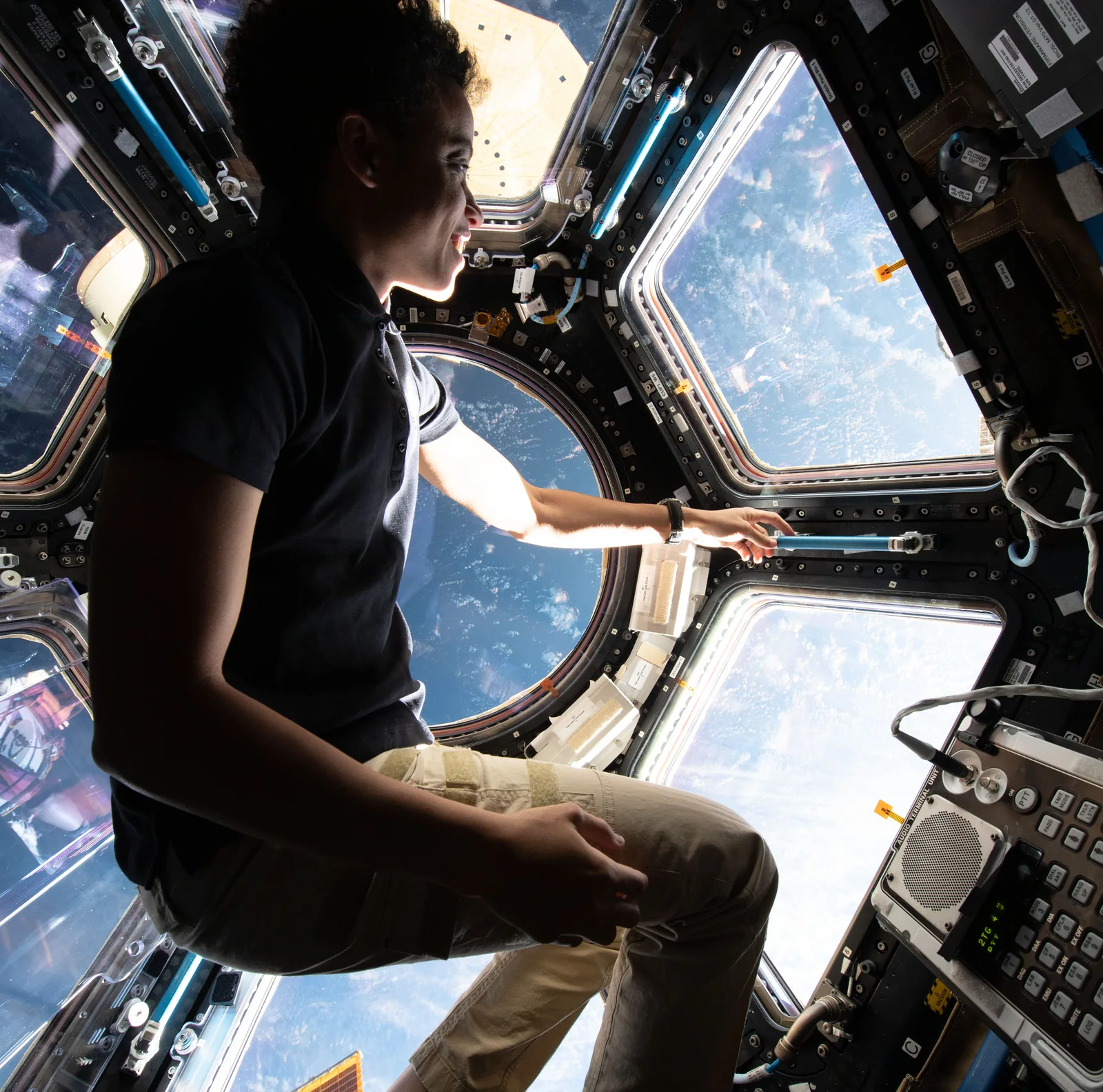
- Jessica Watkins in the cupola (iss067e033745). NASA. source, public domain