
Energy production, the environment and climate change
Why does the way we produce electricity decide how much carbon dioxide ends up in the atmosphere, even though the electricity from a socket at home is always the same?
Prior knowledge
- When a fuel burns, chemical energy is released, and energy is measured in joules and kilowatt-hourschapter Fuels and heat of combustion $E = Hm$
- Ways of producing energy differ in power, availability and environmental effectschapter Ways of producing energy and how they compare
Core path: follow the steps in order. Tasks marked Optional give extra practice. Optional tasks: 4.
Think about it
Before industrialisation the atmosphere contained about $280\,\text{ppm}$ of carbon dioxide, that is, $280$ molecules per million molecules of the atmosphere. In 2024 the global mean concentration was about $424\,\text{ppm}$ (WMO Greenhouse Gas Bulletin 2025), and the rise is largely caused by burning fossil fuels for electricity, heat and transport. Even so, carbon dioxide is less than half a part per thousand of the atmosphere.
How can such a small part of the atmosphere change the temperature of the whole Earth, and why does it matter how electricity is produced?
Optional Review: burning a fuel
Predict
Make your predictions before investigating 2 questions
Prediction 1: an atmosphere without greenhouse gases
Prediction 2: the largest and smallest emissions
Investigate
Choose the amount of greenhouse gases and follow the radiation in the atmosphere and the thermometer.
Simulation
How to use
Choose the amount of greenhouse gases from the menu. The short yellow waves are radiation from the Sun, and the long red waves are thermal radiation from the ground. When a greenhouse gas molecule absorbs thermal radiation, it glows and sends the radiation onwards in a random direction, up or down. The thermometer shows the mean temperature of the ground, and the readings give the value at which the temperature settles. The legend shows the molecules of the atmosphere: nitrogen $\text{N}_2$ and oxygen $\text{O}_2$ hardly absorb thermal radiation, while carbon dioxide $\text{CO}_2$, water vapour $\text{H}_2\text{O}$ and methane $\text{CH}_4$ do. The speed changes the pace of the picture and of the warming.
Assumptions of the model
The simulation is an illustration, not a calculation model. It does not calculate the temperature; the temperatures are rounded source values: without greenhouse gases about $-18\,{}^\circ\text{C}$, in the pre-industrial era ($\text{CO}_2$ concentration $280\,\text{ppm}$) about $+14\,{}^\circ\text{C}$, and at present (a rounded level of $420\,\text{ppm}$ in the simulation) about $+15\,{}^\circ\text{C}$ as measured, since in 2011–2020 the Earth was about $1.1\,{}^\circ\text{C}$ warmer than in 1850–1900 (IPCC AR6, 2021). The present temperature has not yet settled: at the same concentration the Earth is still warming, and the best estimate of the climate sensitivity (below) gives a settled temperature of about $+16\,{}^\circ\text{C}$. The simulation starts from the present, $+15\,{}^\circ\text{C}$. With twice as much carbon dioxide as in the pre-industrial era ($560\,\text{ppm}$), the best estimate of the warming is about $3\,{}^\circ\text{C}$, likely $2.5\text{–}4\,{}^\circ\text{C}$ (IPCC AR6), that is, about $+17\,{}^\circ\text{C}$ once the temperature has had time to settle. In reality settling takes decades or centuries. The waves of radiation are not to scale: the real atmosphere already absorbs most of the thermal radiation of the ground at the present amount, and the difference between the levels is exaggerated in the picture. The picture does not show the solar radiation reflected by clouds and ice, nor the change in the amount of water vapour with temperature.
How the calculation works
In the picture the ground sends thermal radiation more often the warmer it is. The temperature approaches the value of the chosen level gradually: at normal speed the difference halves in about two seconds. The passage of thermal radiation and the calculation of temperature from radiation are covered in the FY3 course in the chapter Heat transfer, energy balance and climate change.
Experiment: the amount of greenhouse gases
Test prediction 1. Change the amount of greenhouse gases and record every level: no greenhouse gases, pre-industrial, present and double carbon dioxide. At the level $0\,\text{ppm}$ water vapour and methane have also been removed from the atmosphere. At each level wait until the thermometer has settled, and watch what happens to the thermal radiation in the atmosphere.
Initial state: $\text{CO}_2$ concentration: present amount. Kept constant: nothing. Varied: $\text{CO}_2$ concentration.
| $\text{CO}_2$ concentration | settled $T\ ({}^\circ\text{C})$ |
|---|
Data: life-cycle emissions per kilowatt-hour
Annex III of Working Group III of the IPCC Fifth Assessment Report (AR5, 2014) collects the results of hundreds of life-cycle calculations. Below are the rounded medians: grams of carbon dioxide equivalent per kilowatt-hour produced.
| Way of producing energy | $e\ (\text{g/kWh})$ |
|---|---|
| Coal | 820 |
| Natural gas | 490 |
| Biomass | 230 |
| Solar power | 41–48 |
| Hydropower | 24 |
| Nuclear power | 12 |
| Wind power | 11–12 |
The figures are not measurements of a single power plant but medians of several studies, so they describe a typical plant.
$1000\,\text{kWh}$ of electricity is produced with coal. How many kilograms of carbon dioxide equivalent are produced during the life cycle? Give the answer in kilograms.
Hint 1: a guiding question
The figure in the table gives grams per kilowatt-hour. How many kilowatt-hours are produced?
Hint 2: what is the connection
The emission is $m = e \cdot E$, where $e = 820\,\text{g/kWh}$ and $E = 1000\,\text{kWh}$.
Hint 3: an intermediate step
Finally convert grams into kilograms: $1\,\text{g} = 0.001\,\text{kg}$.
Show the solution
Given
energy $E = 1000\,\text{kWh}$; from the table the emission factor of coal $e = 820\,\text{g/kWh}$
Find
emission $m$ in kilograms
Principle
The emission is directly proportional to the energy produced, and the emission factor gives the emission per kilowatt-hour. So the emission is obtained by multiplying the energy by the emission factor.
Formula
$m = e \cdot E$
Conversions
The kilowatt-hours cancel, so the result comes out in grams. Grams are converted into kilograms: $1\,\text{g} = 0.001\,\text{kg}$.
Substitution
Answer
$820\,\text{kg} = 8.2 \cdot 10^{2}\,\text{kg}$
Two significant figures like the rounded median $820\,\text{g/kWh}$, whose zero is a rounding zero (likewise for natural gas $490\,\text{g/kWh}$).
Reasonableness
With rounded numbers
which is close to the result. With coal, one kilowatt-hour causes an emission of less than a kilogram, so a thousand kilowatt-hours cause less than $1000\,\text{kg}$.
Where do the emissions of wind power come from?
In the table the emission factor of wind power is $11\text{–}12\,\text{g/kWh}$. A wind turbine does not burn anything.
What does the emission factor not tell you?
The emission factors of nuclear power and wind power are almost equally small in the table, about $12\,\text{g/kWh}$. Even so, both are much debated.
Theory summary
Key idea
The Sun warms the ground by radiating energy to it, as visible light and near-infrared radiation. The atmosphere lets most of this radiation through. The warm ground sends energy back into space as thermal radiation, and the greenhouse gases in the atmosphere absorb it. The most important ones are water vapour, carbon dioxide $\text{CO}_2$ and methane $\text{CH}_4$. They radiate the energy out again in all directions, so part of it returns to the ground.
So greenhouse gases let sunlight through but slow down the escape of thermal radiation. The ground stays warmer than it would be without them: the greenhouse effect raises the mean temperature of the Earth from about $-18\,{}^\circ\text{C}$ to about $+15\,{}^\circ\text{C}$. This natural effect keeps the Earth habitable, because without it the water in the oceans would be frozen.
The problem is that the effect is getting stronger. When people add carbon dioxide and methane to the atmosphere, thermal radiation escapes more slowly and the mean temperature of the Earth rises. This long-term change is called climate change. The concentration of carbon dioxide in the atmosphere has grown from about $280\,\text{ppm}$ (before industrialisation) to about $424\,\text{ppm}$ (global mean in 2024, WMO Greenhouse Gas Bulletin 2025). Even so, carbon dioxide is less than half a part per thousand of the air. A small share is enough, because nitrogen and oxygen, the main gases of the air, hardly absorb thermal radiation: it is the few greenhouse gas molecules that decide how easily thermal radiation escapes.
The greenhouse effect is treated with calculations on the FY3 course in the chapter Heat transfer, energy balance and climate change. Here it is enough to understand what the gases do to radiation and where the extra gases come from.
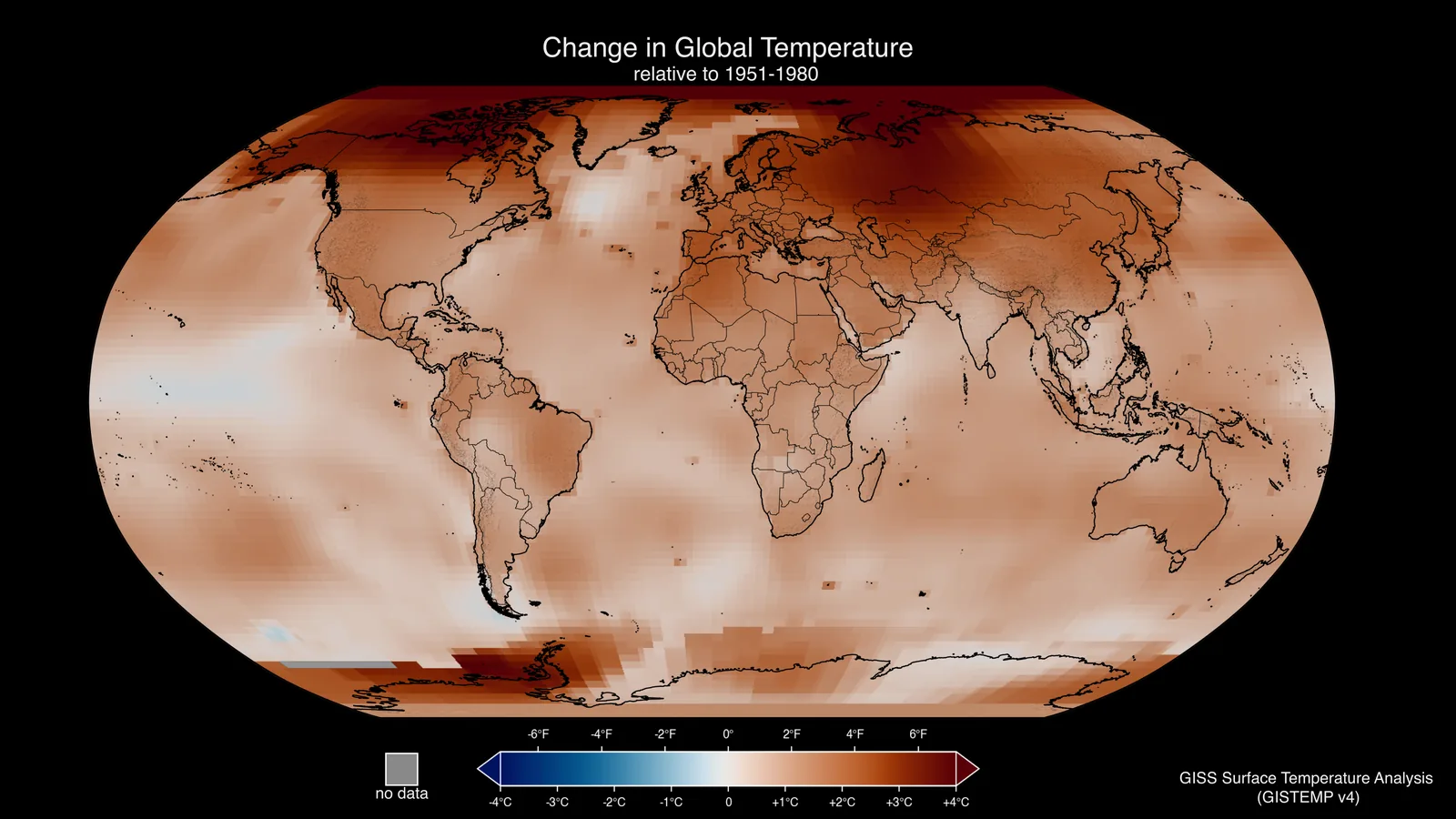
Fuels link energy and climate
A fossil fuel, such as coal, oil or natural gas, is chemical energy from ancient living things: coal formed mostly from plants, oil and natural gas from marine plankton. When such a carbon-containing fuel burns completely, its carbon combines with oxygen: $\text{C} + \text{O}_2 \rightarrow \text{CO}_2$. The chemical energy is released as heat (chapter Fuels and heat of combustion $E = Hm$), and the carbon dioxide leaves with the flue gases into the atmosphere. The more energy we get by burning carbon-containing fuels, the more carbon dioxide is released. Not every fuel contains carbon: when hydrogen burns, only water is formed.
The carbon of a fossil fuel has been underground for millions of years, so burning it adds carbon dioxide to the atmosphere. The carbon of biomass, for example wood, was bound into plants only during the last few decades. Even so, burning biomass is not emission-free: the carbon dioxide from burning stays in the atmosphere until new growth binds it back over decades, and growing, harvesting and transport cause their own emissions.
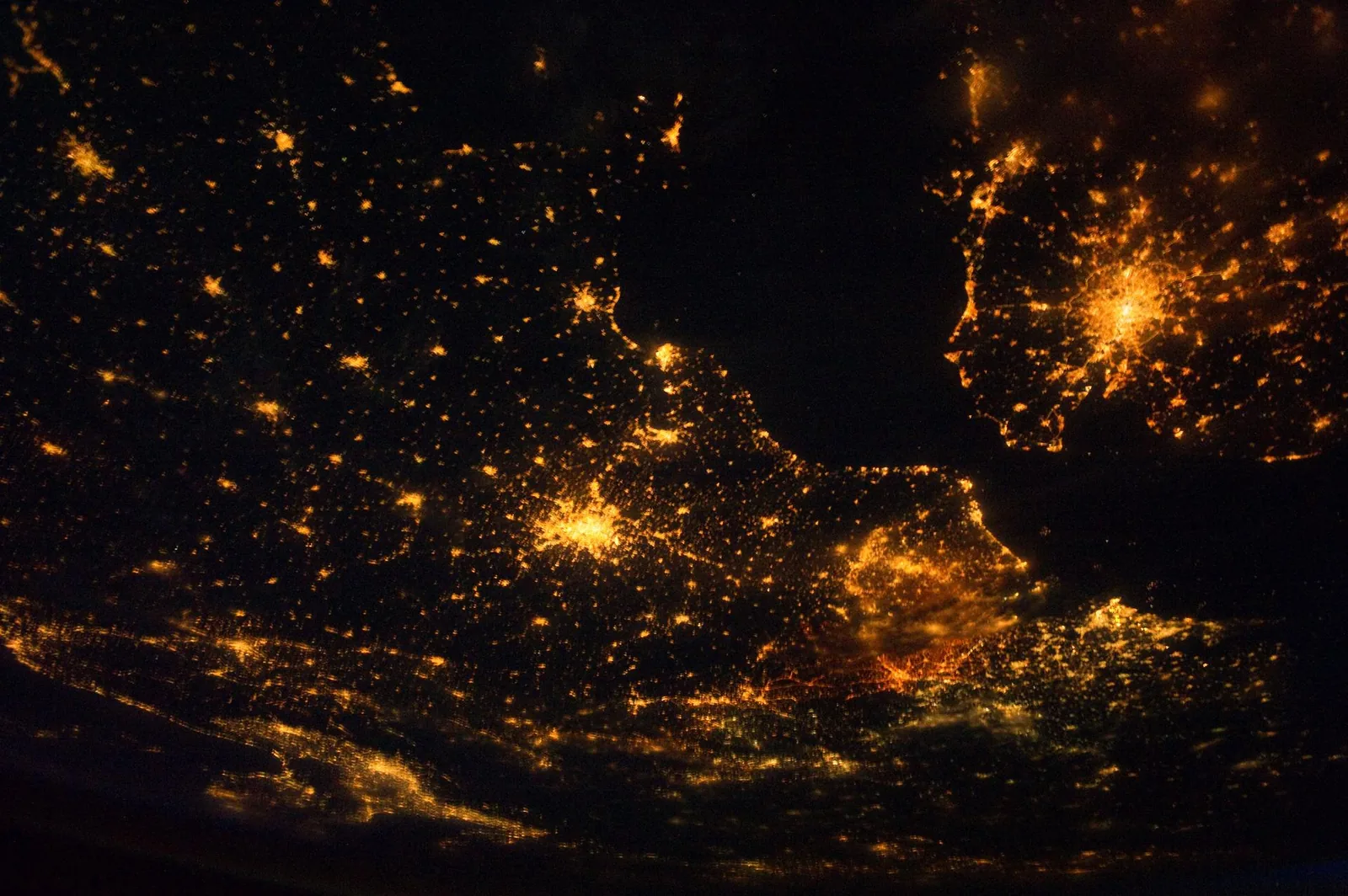
Ways of producing energy are compared by life-cycle emissions
Emissions come from more than just burning. A power plant must be built from steel, concrete and copper, the fuel must be mined or collected and transported, and in the end the plant is dismantled. That is why ways of producing energy are compared by life-cycle emissions: the emissions of all stages are added together and divided by the energy produced over the whole life cycle.
For comparison, methane and other greenhouse gases are converted into carbon dioxide equivalents ($\text{CO}_2$-eq.), that is, the amount of carbon dioxide that has the same warming effect.
Emissions are not the only criterion
Besides the effect on the climate, ways of producing energy are weighed by land use, transport, waste and safety:
- Coal and natural gas: the largest emissions. The fuels are mined and transported by ship, train or pipeline, and the flue gases also contain other pollutants.
- Biomass: takes up forest and field area. Biomass is bulky and its energy content per unit mass is small, so it is not worth transporting far.
- Solar and wind power: need a lot of area per unit of energy produced, and wind power affects the landscape and birds. Production depends on the weather, so regulating power or storage is needed.
- Hydropower: dams and reservoirs change the river environment and block the passage of fish, but production can be regulated.
- Nuclear power: needs little area, and only a small mass of fuel, so there is little transport. Spent fuel is radioactive waste that must be isolated for a long time, and the consequences of an accident could be serious, although the risk is small.
A sustainable energy economy produces and uses energy so that meeting today's needs does not take away the possibilities of future generations. There is no best power plant: the choice weighs the climate effect, land use, waste, safety, price and whether electricity is always available (chapter Ways of producing energy and how they compare).
Carbon dioxide emission
The emission is obtained by multiplying the energy used or produced by the emission factor:
$$m = e \cdot E$$
where $m$ is the emission ($\text{g}$ or $\text{kg}$ of carbon dioxide equivalent), $e$ is the emission factor ($\text{g/kWh}$) and $E$ is the energy ($\text{kWh}$).
The emission factor tells how many grams of carbon dioxide equivalent are produced per kilowatt-hour. The units carry through the calculation: when $\text{g/kWh}$ is multiplied by kilowatt-hours, grams are left. The kilowatt-hour is a unit of energy, $1\,\text{kWh} = 1000\,\text{W} \cdot 3600\,\text{s} = 3.6\,\text{MJ}$. The emission of a fuel is calculated in the same way when the factor is, for example, $\text{g/MJ}$ and the energy is in megajoules.
| Way of producing energy | $e\ (\text{g/kWh})$ |
|---|---|
| Coal | 820 |
| Natural gas | 490 |
| Biomass | 230 |
| Solar power | 41–48 |
| Hydropower | 24 |
| Nuclear power | 12 |
| Wind power | 11–12 |
The source of the table is the IPCC Fifth Assessment Report (AR5, 2014), Working Group III, Annex III: medians of life-cycle emissions, rounded, in the unit grams of carbon dioxide equivalent per kilowatt-hour. The lower limit for solar power is for rooftop panels and the upper limit for utility-scale plants; the lower limit for wind power is onshore and the upper limit offshore. The figure for biomass applies to biomass grown for energy. It includes the emissions of growing, harvesting, transport and the power plant, but the carbon dioxide from burning is counted as zero, because new growth binds it back. So the figure does not show that the binding takes decades.
In the figure all the bars are drawn to the same scale. The dark bars are fossil fuels and the light bars are other ways of producing energy. The emission factor of coal is about $70$ times that of nuclear and wind power ($820 : 12 \approx 68$). The bars of nuclear and wind power are narrow but not zero: their life cycles also include building and transport.
Common misconception
"Wind, solar and nuclear power are emission-free." They are low-emission, not emission-free: building the plants, making the fuel and transport cause emissions, about $12\,\text{g/kWh}$ for wind and nuclear power. For coal the figure is about $820\,\text{g/kWh}$.
"The greenhouse effect is a harmful phenomenon." The natural greenhouse effect is necessary, because without it the mean temperature of the Earth would be about $-18\,{}^\circ\text{C}$. The problem is the strengthening of the effect when carbon dioxide and methane are added to the atmosphere.
Summary
- Greenhouse gases let most of the Sun's radiation through but slow down the escape of thermal radiation from the ground. The natural greenhouse effect raises the mean temperature from about $-18\,{}^\circ\text{C}$ to about $+15\,{}^\circ\text{C}$.
- Burning fossil fuels adds carbon dioxide to the atmosphere, strengthens the greenhouse effect and leads to climate change.
- The emission is the emission factor times the energy: $m = e \cdot E$. Ways of producing energy are compared by life-cycle emission factors, which range from about $12\,\text{g/kWh}$ (nuclear and wind power) to about $820\,\text{g/kWh}$ (coal).
- The emission factor does not tell everything: land use, transport, waste, safety and the availability of electricity are weighed separately when looking for a sustainable energy economy.
Optional Go back to your predictions
Compare your predictions with the explanation of the greenhouse effect and the table of emission factors. Then return to the question at the start: how can a small concentration of carbon dioxide change the temperature of the whole Earth, and why does the way electricity is produced matter?
Would you change your prediction?
Apply
Worked example
Problem
An example family uses $4800\,\text{kWh}$ of electricity a year. The electricity is produced with natural gas, whose life-cycle emission factor is $490\,\text{g/kWh}$. How many tonnes of carbon dioxide equivalent are produced per year by the family's electricity use? (The family is an invented example, not statistics.)
Step 1/7
Given and find. $E = 4800\,\text{kWh}$ and $e = 490\,\text{g/kWh}$. We want the emission $m$ in tonnes.
Step 2/7
Principle. The emission is directly proportional to the energy produced, and the emission factor gives the emission per kilowatt-hour. So the life-cycle emission is obtained by multiplying the energy by the emission factor.
Step 3/7
Rearranged formula. $$m = e \cdot E$$
Step 4/7
Unit conversions. The kilowatt-hours cancel, so the result comes out in grams. Grams are converted into tonnes: $1\,\text{g} = 0.001\,\text{kg}$ and $1\,\text{kg} = 0.001\,\text{t}$.
Step 5/7
Substitution. $$\begin{aligned} m &= e \cdot E \\ &= 490\,\text{g/kWh} \cdot 4800\,\text{kWh} \\ &= 2\,352\,000\,\text{g} \\ &= 2\,352\,000 \cdot 0.001\,\text{kg} \\ &= 2352\,\text{kg} \\ &= 2352 \cdot 0.001\,\text{t} \\ &= 2.352\,\text{t} \end{aligned}$$
Step 6/7
Result. The emission is $m \approx 2.4\,\text{t}$ of carbon dioxide equivalent per year, to two significant figures like the emission factor $490\,\text{g/kWh}$.
Step 7/7
Reasonableness. With rounded numbers
which is close to the result. If the same electricity were produced with wind power, the emission would be
about $41$ times smaller ($490 : 12 \approx 41$).
Optional Find the error
Where should the wood chips come from?
An example municipality builds a heating plant that burns forest wood chips. The chips could be brought by lorry either from the municipality's own forests about $50\,\text{km}$ away or from another region about $400\,\text{km}$ away. The chips are moist and airy, so a lorry load holds little energy. (The municipality is an invented example.)
Apply: the electricity of a city
A city needs $100\,\text{GWh}$ of electricity a year. The electricity is produced with natural gas, whose life-cycle emission factor is $490\,\text{g/kWh}$.
How many tonnes of carbon dioxide equivalent are produced per year? Give the answer in tonnes. (The city is an invented example.)
Hint 1: a guiding question
Convert the energy into kilowatt-hours, because the emission factor is in the unit $\text{g/kWh}$. How many kilowatt-hours is one gigawatt-hour?
Hint 2: what is the connection
$1\,\text{GWh} = 10^{6}\,\text{kWh}$, so $E = 100 \cdot 10^{6}\,\text{kWh}$. Substitute into the formula $m = e \cdot E$.
Hint 3: an intermediate step
Convert grams into tonnes: $1\,\text{g} = 10^{-6}\,\text{t}$.
Show the solution
Given
energy $E = 100\,\text{GWh}$; emission factor $e = 490\,\text{g/kWh}$
Find
emission $m$ in tonnes
Principle
The emission is directly proportional to the energy produced: all kilowatt-hours are produced in the same way and each causes the same emission $e$.
Formula
$m = e \cdot E$
Conversions
$1\,\text{GWh} = 10^{6}\,\text{kWh}$, so $E = 100 \cdot 10^{6}\,\text{kWh}$. Finally $1\,\text{g} = 10^{-6}\,\text{t}$.
Substitution
Answer
$4.9 \cdot 10^{4}\,\text{t} = 49\,000\,\text{t}$
Two significant figures like the emission factor $490\,\text{g/kWh}$.
Reasonableness
With rounded numbers
which is close to the result. One kilowatt-hour causes an emission of less than a kilogram, and there are a hundred million kilowatt-hours, so the emission is tens of thousands of tonnes.
Justify: how does the city produce its electricity?
The city replaces its old coal power plant and will in future produce $100\,\text{GWh}$ of electricity a year. The options are a natural gas power plant, a wind farm, a nuclear power plant or a plant that runs on biomass. Choose one and write a justification in the following order:
- Claim: which option do you choose?
- Evidence: calculate the yearly emissions for the way you chose and compare them with one other option. Also mention at least two other criteria for comparison (for example land use, waste, safety, dependence on the weather).
- Physics reason: why is the chosen way better or worse for the climate?
- Counterargument: what is the strongest argument against your choice, and how do you answer it?
- Limitation: what did you leave out (for example price), and why could it matter?
Swap justifications with a partner. Can you find each of the five parts in your partner's text? What was the strongest argument, and would it change your own choice?
Model answer
I choose wind power. Emissions: $12\,\text{g/kWh} \cdot 100 \cdot 10^{6}\,\text{kWh} = 1.2 \cdot 10^{9}\,\text{g} = 1.2 \cdot 10^{9} \cdot 10^{-6}\,\text{t} = 1200\,\text{t}$, whereas with natural gas they would be $490\,\text{g/kWh} \cdot 100 \cdot 10^{6}\,\text{kWh} = 4.9 \cdot 10^{10}\,\text{g} = 4.9 \cdot 10^{10} \cdot 10^{-6}\,\text{t} = 49\,000\,\text{t}$, about $41$ times as much. The emission factor of wind power is small because emissions arise only in making and building the turbines, not in burning; when gas is burnt, carbon combines with oxygen and carbon dioxide is released for every kilowatt-hour produced. Other criteria: wind power needs a lot of area and affects the landscape, but it produces no radioactive waste and uses no fuel, so no fuel transport is needed. Production depends on the weather, so regulating power or storage is needed. The strongest counterargument is that the wind does not always blow. I answer that wind power can be complemented, for example, by hydropower, whose production can be regulated, and by an interconnected electricity grid. I left out the price and the transmission of electricity, which can be decisive for the final decision.
Assess your own answer
Tick the points your own answer already contains.
Review the theory summary and practise with the exercises.
Check your understanding
Exit ticket
Answer on your own first and only then open the answer.
- $10\,\text{kWh}$ of electricity is used, and it has been produced with wind power, whose emission factor is $12\,\text{g/kWh}$. How much carbon dioxide equivalent is produced?
Answer
$m$$= e \cdot E$$= 12\,\text{g/kWh} \cdot 10\,\text{kWh}$$= 120\,\text{g}$ - Why can wind power not be called completely emission-free, and by how much smaller are its emissions than those of coal?
Answer
Making, transporting, building and dismantling the turbines cause emissions, so the life-cycle emission factor is about $12\,\text{g/kWh}$. For coal it is about $820\,\text{g/kWh}$, so the emissions of coal are about $70$ times as large.
1. Concept
2. Is biomass electricity emission-free?
3. A reasoned comparison
4. Emission of a journey
A car uses $6.0$ litres of petrol per hundred kilometres. The energy content of petrol is about $32\,\text{MJ}$ per litre, and the emission factor of its burning is about $69\,\text{g/MJ}$ (IPCC default value).
How many kilograms of carbon dioxide are released over a distance of $120\,\text{km}$ from burning alone? Give the answer in kilograms.
Hint 1: a guiding question
First calculate how many litres of petrol are used over $120\,\text{km}$, and then how much energy is released by burning.
Hint 2: what is the connection
The petrol used is
and the energy is $E = V \cdot 32\,\text{MJ/}\textsf{l}$.
Hint 3: an intermediate step
$m = 69\,\text{g/MJ} \cdot 230.4\,\text{MJ}$.
Show the solution
Given
distance $s = 120\,\text{km}$; consumption $6.0\,\textsf{l}$ per hundred kilometres; energy content $32\,\text{MJ/}\textsf{l}$; emission factor $e = 69\,\text{g/MJ}$
Find
emission $m$ in kilograms
Principle
The burning of petrol releases carbon dioxide in proportion to the energy released, so the emission is the emission factor times the energy, $m = e \cdot E$. The factor is given per megajoule, so the energy is calculated in megajoules.
Formula
$E = V \cdot 32\,\text{MJ/}\textsf{l}$ and $m = e \cdot E$
Conversions
Amount of petrol:
Finally $1\,\text{g} = 0.001\,\text{kg}$.
Substitution
Answer
$16\,\text{kg}$
Two significant figures like the consumption $6.0\,\textsf{l}$ and the emission factor $69\,\text{g/MJ}$.
Reasonableness
With rounded numbers
which is close to the result. A litre of petrol releases
of carbon dioxide, so $7.2$ litres release about $7.2 \cdot 2.2\,\text{kg} \approx 16\,\text{kg}$.
Suggestion: one answer does not show everything you can do, but review the theory summary and do the core exercises.
Optional 5. Explain
Explain why the natural greenhouse effect is useful but its strengthening is a problem. Also say why burning fossil fuels strengthens the effect.
Model answer
The Sun warms the ground with radiation that the greenhouse gases of the atmosphere let mostly through. The warm ground sends out energy as thermal radiation, which the greenhouse gases absorb and partly radiate back down. That is why the ground is at about $+15\,{}^\circ\text{C}$ and not at about $-18\,{}^\circ\text{C}$, and the effect keeps the Earth habitable. When fossil fuels burn, their carbon combines with oxygen and is released as carbon dioxide. When there is more of the gas, thermal radiation escapes more slowly than before, so the effect gets stronger and the mean temperature rises: that is climate change.
Assess your own answer
Tick the points your own answer already contains.
Review the theory summary and practise with the exercises.
Review the chapter's concepts
Cards you mark Review later collect in your review deck.
- Infrared radiation
- Electromagnetic radiation of longer wavelength than visible light, emitted by the warm ground.
- Greenhouse effect
- Gases in the atmosphere reduce how much of the Earth's thermal radiation escapes directly to space.
- Greenhouse gas
- A gas in the atmosphere that absorbs infrared radiation emitted by the Earth.
- Carbon dioxide
- A greenhouse gas whose concentration grows with the use of fossil fuels.
- Methane
- A strong greenhouse gas released for example by agriculture and the production of fossil fuels.
- Climate change
- A long-term change in the Earth's climate; human greenhouse gas emissions intensify the present warming.
- Carbon sink
- A system that takes up more carbon dioxide from the atmosphere than it releases.
- Feedback
- A change triggers an effect that can strengthen or weaken the original change.
- Emission reduction
- Releasing less greenhouse gas into the atmosphere, for example by changing energy production and use.
- Life cycle
- The impacts of a way of producing energy are examined from construction and use to dismantling the plant.
- Carbon dioxide emission
- The climate impact of energy production can be compared by the amount of carbon dioxide released.
- Land use
- Different ways of production need different areas for plants, fuels and transmission lines.
- Natural resources
- Energy production uses materials and fuels whose availability and renewal vary.
- Impact on ecosystems
- Energy production can change habitats, waters and biodiversity.
- Health impact
- Emissions, accident risks and other factors of production can affect people's health.
- Order of magnitude
- Ways of production can be compared by the scale of their power, emissions, costs or area.
- Sustainable energy economy
- The ecological, economic and social impacts are considered in the production and use of energy.
- Ecological sustainability
- Natural resources are used so that the environment's capacity to renew and to carry the load is not put at risk.
- Economic sustainability
- Energy solutions must be workable in the long run in cost and in the use of resources.
- Social sustainability
- Energy solutions take into account people's well-being, safety and fair access to energy.
- Saving energy
- Reducing needless consumption by changing habits and using energy only as needed.
- Waste heat
- Heat that would otherwise go unused can be recovered and used elsewhere.
- Storing energy
- Keeping energy for later use evens out the difference in time between production and consumption.
- Sustainable consumption
- Energy is used efficiently for real needs and its environmental impacts are reduced.
Exercises
Level 1 · basic practice 8 exercises
One formula or one step of reasoning. Core exercises first, the rest is extra practice.
- Exercise 8-1Core
An example household uses $3000\,\text{kWh}$ of electricity a year. The electricity is produced with hydropower, whose life-cycle emission factor is $24\,\text{g/kWh}$.
How much carbon dioxide equivalent is produced per year by the household's electricity use? Give the answer in kilograms.
Answer
$72\,\text{kg}$
Show the solution
Given
energy $E = 3000\,\text{kWh}$; emission factor of hydropower $e = 24\,\text{g/kWh}$
Find
emission $m$ in kilograms
Principle
The emission is directly proportional to the energy produced, and the emission factor gives the emission per kilowatt-hour. So the emission is obtained by multiplying the energy by the emission factor.
Formula
$m = e \cdot E$
Conversions
The kilowatt-hours cancel, so the result comes out in grams. Grams are converted into kilograms: $1\,\text{g} = 0.001\,\text{kg}$.
Substitution
$m$$= 24\,\text{g/kWh} \cdot 3000\,\text{kWh}$$= 72\,000\,\text{g}$$= 72\,000 \cdot 0.001\,\text{kg}$$= 72\,\text{kg}$Answer
$72\,\text{kg}$
Two significant figures like the emission factor $24\,\text{g/kWh}$.
Reasonableness
With rounded numbers
$25\,\text{g/kWh} \cdot 3000\,\text{kWh}$$= 75\,000\,\text{g}$$= 75\,000 \cdot 0.001\,\text{kg}$$= 75\,\text{kg}$close to the result. The same electricity from coal would give
$820\,\text{g/kWh} \cdot 3000\,\text{kWh}$$= 2\,460\,000\,\text{g}$$= 2\,460\,000 \cdot 0.001\,\text{kg}$$= 2460\,\text{kg}$so with hydropower the emission is only a few per cent of that.
- Exercise 8-2Core
An electric sauna heater uses $3.0\,\text{kWh}$ of electricity in one sauna session. The electricity is produced with coal, whose life-cycle emission factor is $820\,\text{g/kWh}$.
How much carbon dioxide equivalent is produced by one sauna session? Give the answer in kilograms.
Answer
$2.5\,\text{kg}$
Show the solution
Given
energy $E = 3.0\,\text{kWh}$; emission factor of coal $e = 820\,\text{g/kWh}$
Find
emission $m$ in kilograms
Principle
Every kilowatt-hour produced causes the same emission, so the total emission is the emission factor times the energy.
Formula
$m = e \cdot E$
Conversions
The kilowatt-hours cancel, and the result comes out in grams. Finally $1\,\text{g} = 0.001\,\text{kg}$.
Substitution
$m$$= 820\,\text{g/kWh} \cdot 3.0\,\text{kWh}$$= 2460\,\text{g}$$= 2460 \cdot 0.001\,\text{kg}$$= 2.46\,\text{kg}$Answer
$2.5\,\text{kg}$
Two significant figures like the energy $3.0\,\text{kWh}$.
Reasonableness
With rounded numbers
$800\,\text{g/kWh} \cdot 3\,\text{kWh}$$= 2400\,\text{g}$$= 2400 \cdot 0.001\,\text{kg}$$= 2.4\,\text{kg}$close to the result. With coal, one kilowatt-hour causes less than a kilogram, so three kilowatt-hours cause less than three kilograms.
- Exercise 8-3
An electric car uses $18\,\text{kWh}$ of electricity over a distance of $100\,\text{km}$. The electricity used to charge the car has been produced with wind power, whose life-cycle emission factor is $12\,\text{g/kWh}$.
How much carbon dioxide equivalent is produced per $100\,\text{km}$? Give the answer in grams.
Answer
$220\,\text{g}$
Show the solution
Given
energy $E = 18\,\text{kWh}$; emission factor of wind power $e = 12\,\text{g/kWh}$
Find
emission $m$ in grams
Principle
The electricity used by the car is produced with wind power, so its emission is the emission factor of wind power times the energy used by the car.
Formula
$m = e \cdot E$
Conversions
Not needed: the kilowatt-hours cancel and the result already comes out in grams, as the answer is asked for.
Substitution
$m$$= 12\,\text{g/kWh} \cdot 18\,\text{kWh}$$= 216\,\text{g}$Answer
$220\,\text{g}$
Two significant figures like the data $12\,\text{g/kWh}$ and $18\,\text{kWh}$.
Reasonableness
With rounded numbers $10\,\text{g/kWh} \cdot 20\,\text{kWh} = 200\,\text{g}$, close to the result. The emission is only under a quarter of a kilogram per hundred kilometres, which fits the small emission factor of wind power.
- Exercise 8-4
The life-cycle emission factor of rooftop panels is $41\,\text{g/kWh}$ and that of natural gas electricity is $490\,\text{g/kWh}$. Both produce the same amount of electricity.
How many times as large is the emission of natural gas electricity compared with that of rooftop panels?
Answer
$12$
Show the solution
Given
emission factor of rooftop panels $e_1 = 41\,\text{g/kWh}$; emission factor of natural gas electricity $e_2 = 490\,\text{g/kWh}$; the same energy $E$
Find
how many times as large the emission $m_2$ of natural gas electricity is compared with the emission $m_1$ of rooftop panels
Principle
Each emission is the factor times the energy, $m = e \cdot E$. When the energy is the same, it cancels in the comparison, so the ratio of the emissions is the ratio of the emission factors. We compare by division.
Formula
$m = e \cdot E$; when the energy $E$ is the same, the emission of natural gas electricity compared with that of rooftop panels is as many times as large as the factor, so we compare the factors: ratio $= e_2 : e_1$
Conversions
Not needed: the factors are in the same unit $\text{g/kWh}$, so the unit cancels.
Substitution
$e_2 : e_1$$= 490\,\text{g/kWh} : 41\,\text{g/kWh}$$= 11.95$Answer
about $12$ times, two significant figures like the factor $41\,\text{g/kWh}$.
Reasonableness
With rounded numbers $500 : 40 = 12.5$, close to the result. Check by multiplication: one kilowatt-hour from rooftop panels causes $41\,\text{g}$, and $12 \cdot 41\,\text{g} = 492\,\text{g}$, which is almost the $490\,\text{g}$ of natural gas.
- Exercise 8-5
A washing machine and a tumble dryer together use $2.4\,\text{kWh}$ of electricity for one load of laundry, and the electricity is produced with natural gas. Read the life-cycle emission factor of natural gas electricity from the bar chart in the figure.
How much carbon dioxide equivalent is produced by one load of laundry? Give the answer in kilograms.
Answer
$1.2\,\text{kg}$
Show the solution
Given
energy $E = 2.4\,\text{kWh}$; emission factor of natural gas electricity $e = 490\,\text{g/kWh}$, read from the figure
Find
emission $m$ in kilograms
Principle
Electricity produced with natural gas causes the same life-cycle emission for every kilowatt-hour, so the emission is the factor times the energy.
Reading the graph
The second bar from the top in the figure is natural gas, dark grey like the fossil fuels, and the number $490$ is at its end. The bar ends between the grid lines $400$ and $600$, a little before the middle ($500$). The unit of the axis is $\text{g}\ \text{CO}_2\text{-eq.}/\text{kWh}$, so $e = 490\,\text{g/kWh}$.
Formula
$m = e \cdot E$
Conversions
The kilowatt-hours cancel, and the result comes out in grams. Finally $1\,\text{g} = 0.001\,\text{kg}$.
Substitution
$m$$= 490\,\text{g/kWh} \cdot 2.4\,\text{kWh}$$= 1176\,\text{g}$$= 1176 \cdot 0.001\,\text{kg}$$= 1.176\,\text{kg}$Answer
$1.2\,\text{kg}$
Two significant figures like the energy $2.4\,\text{kWh}$.
Reasonableness
With rounded numbers
$500\,\text{g/kWh} \cdot 2\,\text{kWh}$$= 1000\,\text{g}$$= 1000 \cdot 0.001\,\text{kg}$$= 1\,\text{kg}$close to the result. With gas, one kilowatt-hour causes less than a kilogram, so the emission of two kilowatt-hours is about a kilogram.
- Exercise 8-6
Which of the following best describes the natural greenhouse effect?
Answer
Greenhouse gases let the Sun's radiation through but slow down the escape of the ground's thermal radiation.
Show the solution
Find
which statement describes the natural greenhouse effect.
Principle
Most of the Sun's radiation passes through the atmosphere and warms the ground. The warm ground emits thermal radiation, and greenhouse gases slow down its escape into space. The atmosphere does not produce energy itself, does not absorb all of the Sun's radiation, and does not reflect most of it away.
Model answer
The correct option is the one according to which greenhouse gases let the Sun's radiation through but slow down the escape of the ground's thermal radiation. The phenomenon raises the mean temperature of the Earth from about $-18\,{}^\circ\text{C}$ to about $+15\,{}^\circ\text{C}$, so it is essential for life. The problem is the strengthening of the phenomenon when carbon dioxide and methane are added to the atmosphere.
- Exercise 8-7
Which of the following statements concerns climate and not weather? The statements are examples, not measurement results.
Answer
In Oulu the mean temperature in January over the period 1991–2020 is about $-10\,{}^\circ\text{C}$.
Show the solution
Find
which statement concerns climate and not weather.
Principle
Weather is the state of the atmosphere in a given place at a given moment or over a short period. Climate is the long-term average and variation of weather in an area, typically over at least thirty years.
Model answer
Climate is described by the statement according to which the mean temperature in January over the period 1991–2020 is about $-10\,{}^\circ\text{C}$. The other statements tell about a single day, night or week, so they are weather. One cold day or warm week proves nothing about climate, because weather varies a lot around the average of the climate.
- Exercise 8-8
An example school uses $40\,000\,\text{kWh}$ of electricity a year. The electricity is produced with nuclear power, whose life-cycle emission factor is $12\,\text{g/kWh}$.
How much carbon dioxide equivalent is produced per year by the school's electricity use? Give the answer in kilograms.
Answer
$480\,\text{kg}$
Show the solution
Given
energy $E = 40\,000\,\text{kWh}$; emission factor of nuclear power $e = 12\,\text{g/kWh}$
Find
emission $m$ in kilograms
Principle
The emission is directly proportional to the energy produced, and the emission factor gives the emission per kilowatt-hour. So the emission is obtained by multiplying the energy by the emission factor.
Formula
$m = e \cdot E$
Conversions
The kilowatt-hours cancel, so the result comes out in grams. Grams are converted into kilograms: $1\,\text{g} = 0.001\,\text{kg}$.
Substitution
$m$$= 12\,\text{g/kWh} \cdot 40\,000\,\text{kWh}$$= 480\,000\,\text{g}$$= 480\,000 \cdot 0.001\,\text{kg}$$= 480\,\text{kg}$Answer
$480\,\text{kg}$
Two significant figures like the emission factor $12\,\text{g/kWh}$.
Reasonableness
With rounded numbers
$10\,\text{g/kWh} \cdot 40\,000\,\text{kWh}$$= 400\,000\,\text{g}$$= 400\,\text{kg}$close to the result. The same electricity from coal would give
$820\,\text{g/kWh} \cdot 40\,000\,\text{kWh}$$= 32\,800\,000\,\text{g}$$= 32\,800\,\text{kg}$about $68$ times as much ($820 : 12 \approx 68$).
Level 2 · applied practice 7 exercises
Two steps, working with measured data, a unit conversion or rearranging a formula. Core exercises first, the rest is extra practice.
- Exercise 8-9Core
A power plant that uses biomass produces $2.0\,\text{GWh}$ of electricity in a month. The life-cycle emission factor of biomass electricity is $230\,\text{g/kWh}$.
How many tonnes of carbon dioxide equivalent are produced by a month of electricity production? Give the answer in tonnes.
Answer
$460\,\text{t}$
Show the solution
Given
energy $E = 2.0\,\text{GWh}$; emission factor of biomass $e = 230\,\text{g/kWh}$
Find
emission $m$ in tonnes
Principle
The emission is the emission factor times the energy. The factor is given per kilowatt-hour, so the energy must first be converted into kilowatt-hours.
Formula
$m = e \cdot E$
Conversions
$1\,\text{GWh} = 10^{6}\,\text{kWh}$, so $E = 2.0 \cdot 10^{6}\,\text{kWh}$. Finally $1\,\text{g} = 10^{-6}\,\text{t}$.
Substitution
$m$$= 230\,\text{g/kWh} \cdot 2.0 \cdot 10^{6}\,\text{kWh}$$= 4.6 \cdot 10^{8}\,\text{g}$$= 4.6 \cdot 10^{8} \cdot 10^{-6}\,\text{t}$$= 460\,\text{t}$Answer
$460\,\text{t}$
Two significant figures like the energy $2.0\,\text{GWh}$ and the factor $230\,\text{g/kWh}$.
Reasonableness
With rounded numbers
$200\,\text{g/kWh} \cdot 2 \cdot 10^{6}\,\text{kWh}$$= 4 \cdot 10^{8}\,\text{g}$$= 4 \cdot 10^{8} \cdot 10^{-6}\,\text{t}$$= 400\,\text{t}$close to the result. With biomass, one kilowatt-hour causes $0.23\,\text{kg}$, and two million kilowatt-hours give
$0.23\,\text{kg} \cdot 2 \cdot 10^{6}$$= 460\,000\,\text{kg}$$= 460\,000 \cdot 0.001\,\text{t}$$= 460\,\text{t}$ - Exercise 8-10Core
An example household uses $3600\,\text{kWh}$ of electricity a year. The electricity was first produced with coal ($820\,\text{g/kWh}$), but the household switches to buying wind electricity ($12\,\text{g/kWh}$).
By how many tonnes of carbon dioxide equivalent do the yearly emissions decrease? Give the answer in tonnes.
Answer
$2.9\,\text{t}$
Show the solution
Given
energy $E = 3600\,\text{kWh}$; for coal $e_1 = 820\,\text{g/kWh}$ and for wind power $e_2 = 12\,\text{g/kWh}$
Find
decrease in the emission $m_1 - m_2$ in tonnes
Principle
The amount of energy stays the same, only the way of producing it changes. The decrease in the emission is the difference between the old and the new emission, and each emission is the factor times the energy.
Formula
$m_1 - m_2$$= e_1 \cdot E - e_2 \cdot E$$= (e_1 - e_2) \cdot E$Conversions
The kilowatt-hours cancel, so the result comes out in grams. Finally $1\,\text{g} = 10^{-6}\,\text{t}$.
Substitution
$m_1 - m_2$$= (820\,\text{g/kWh} - 12\,\text{g/kWh}) \cdot 3600\,\text{kWh}$$= 808\,\text{g/kWh} \cdot 3600\,\text{kWh}$$= 2\,908\,800\,\text{g}$$= 2\,908\,800 \cdot 10^{-6}\,\text{t}$$= 2.9088\,\text{t}$Answer
$2.9\,\text{t}$
Two significant figures like the factors $820\,\text{g/kWh}$ and $12\,\text{g/kWh}$ (rounded medians; the zeros of the energy $3600\,\text{kWh}$ do not show precision).
Reasonableness
With coal the emission is
$820 \cdot 3600\,\text{g}$$= 2\,952\,000\,\text{g}$$= 2\,952\,000 \cdot 10^{-6}\,\text{t}$$\approx 2.95\,\text{t}$and with wind
$12 \cdot 3600\,\text{g}$$= 43\,200\,\text{g}$$= 43\,200 \cdot 10^{-6}\,\text{t}$$\approx 0.043\,\text{t}$With wind the emission is almost zero compared with coal, so the saving is almost the whole emission of coal.
- Exercise 8-11
The electricity production of a small factory produced $12\,\text{t}$ of carbon dioxide equivalent during a year. The electricity was produced with natural gas, whose emission factor is $490\,\text{g/kWh}$.
How much electricity did the factory produce? Give the answer in kilowatt-hours.
Answer
$24\,000\,\text{kWh}$
Show the solution
Given
emission $m = 12\,\text{t}$; emission factor of natural gas $e = 490\,\text{g/kWh}$
Find
energy produced $E$ in kilowatt-hours
Principle
The emission is the emission factor times the energy, so the energy is obtained by dividing the emission by the emission factor.
Formula
$m = e \cdot E$, so $E = \dfrac{m}{e}$
Conversions
Substitute $1\,\text{t} = 10^{6}\,\text{g}$:
$m$$= 12\,\text{t}$$= 12 \cdot 10^{6}\,\text{g}$Substitution
$E$$= 12 \cdot 10^{6}\,\text{g} : 490\,\text{g/kWh}$$= 24\,490\,\text{kWh}$Answer
$24\,000\,\text{kWh}$
Two significant figures like the emission $12\,\text{t}$.
Reasonableness
With rounded numbers
$500\,\text{g/kWh} \cdot 24\,000\,\text{kWh}$$= 12 \cdot 10^{6}\,\text{g}$$= 12 \cdot 10^{6} \cdot 10^{-6}\,\text{t}$$= 12\,\text{t}$so the result matches. The unit $\text{kWh}$ appears when grams are divided by the unit $\text{g/kWh}$.
- Exercise 8-12
The emission factor for the burning of petrol is $69\,\text{g/MJ}$. Give the emission factor in the unit $\text{g/kWh}$, when $1\,\text{kWh} = 3.6\,\text{MJ}$. Only burning is counted, not the whole life cycle.
Answer
$250\,\text{g/kWh}$
Show the solution
Given
emission factor of petrol $e = 69\,\text{g/MJ}$; $1\,\text{kWh} = 3.6\,\text{MJ}$
Find
emission factor in the unit $\text{g/kWh}$
Principle
The emission factor gives the emission per unit of energy. One kilowatt-hour of fuel energy is $3.6\,\text{MJ}$, so its emission is $3.6$ times the emission per megajoule.
Formula
$e_\text{kWh} = e_\text{MJ} \cdot 3.6\,\text{MJ/kWh}$
Conversions
The unit $\text{MJ}$ cancels: $\text{g/MJ} \cdot \text{MJ/kWh} = \text{g/kWh}$.
Substitution
$e_\text{kWh}$$= 69\,\text{g/MJ} \cdot 3.6\,\text{MJ/kWh}$$= 248.4\,\text{g/kWh}$Answer
$250\,\text{g/kWh}$
Two significant figures like the factor $69\,\text{g/MJ}$.
Reasonableness
With rounded numbers $70 \cdot 3.6 = 252$, close to the result. The number is the emission per energy of the fuel, not the whole life cycle, so it is not the same thing as the emission factor of electricity in the table: the $\text{g/kWh}$ in the table means electricity produced, this one means fuel burnt. Per unit of electricity the emission would be larger, because in a power plant only part of the fuel energy becomes electricity and the rest is waste heat.
- Exercise 8-13
The table shows the carbon dioxide concentration $c$ of the atmosphere in different years (yearly averages of the NOAA Mauna Loa measuring station, rounded to whole ppm values). Assume that the concentration grows steadily between the years $2005$ and $2020$, that is, the model is a straight line.
By how many ppm does the concentration grow per year on average according to this model? Give the answer in the unit ppm/a.
Carbon dioxide concentration of the atmosphere, Mauna Loa (NOAA) $t\,(\text{a})$ $c\,(\text{ppm})$ 2005 380 2010 390 2015 401 2020 414 Answer
$k \approx 2.3\,\text{ppm/a}$
Show the solution
Given
the concentration in $2005$ is $c_1 = 380\,\text{ppm}$ and in $2020$ $c_2 = 414\,\text{ppm}$; the model is a straight line over the period $2005$–$2020$ (source: NOAA, Mauna Loa yearly averages, rounded)
Find
average rate of growth of the concentration $k$ in the unit $\text{ppm/a}$
Principle
If the concentration grows steadily, the rate of growth is the slope of the line, that is, the change in the concentration divided by the change in time. The intermediate years of the table ($2010$, $2015$) do not change the result if the points lie nearly on the same line. For the slope, the end points far apart from each other are used.
Formula
$k$$= \dfrac{\Delta c}{\Delta t}$$= \dfrac{c_2 - c_1}{t_2 - t_1}$Conversions
Not needed: the concentration is in ppm and the time in years.
Substitution
$\Delta c$$= 414\,\text{ppm} - 380\,\text{ppm}$$= 34\,\text{ppm}$$\Delta t$$= 2020\,\text{a} - 2005\,\text{a}$$= 15\,\text{a}$so
$k$$= 34\,\text{ppm} : 15\,\text{a}$$= 2.27\,\text{ppm/a}$Answer
$k \approx 2.3\,\text{ppm/a}$
Two significant figures.
Reasonableness
Between $2005$ and $2010$ the growth is $10\,\text{ppm}$, that is, $2.0\,\text{ppm/a}$, and between $2015$ and $2020$ it is $13\,\text{ppm}$, that is, about $2.6\,\text{ppm/a}$, so the average $2.3\,\text{ppm/a}$ lies between these. Check: $15\,\text{a} \cdot 2.3\,\text{ppm/a} = 34.5\,\text{ppm}$, close to the change $34\,\text{ppm}$.
- Exercise 8-14
The table shows the greenhouse gas emissions of an example country by sector in the years $2010$ and $2020$ in millions of tonnes of carbon dioxide equivalent (example data, not statistics).
a) Calculate the total emissions in each year.
b) By how many per cent did the total emissions decrease from $2010$ to $2020$? Give the answer in per cent.
Emissions by sector (example data) Sector $m_{2010}\,(\text{Mt})$ $m_{2020}\,(\text{Mt})$ Energy production 30 18 Transport 12 10 Industry 10 9 Agriculture 6 6 Waste 3 2 Answer
$26\,\%$
Show the solution
Given
emissions in $\text{Mt}$ in $2010$: $30$, $12$, $10$, $6$ and $3$; in $2020$: $18$, $10$, $9$, $6$ and $2$ (example data, not statistics)
Find
a) total emissions $m_{2010}$ and $m_{2020}$; b) decrease of the total emissions in per cent
Principle
The total emission is the sum of the emissions of the sectors. The relative change is the change divided by the original value, and it is given in per cent by multiplying by one hundred.
Formula
$m = m_1 + m_2 + \dots$ and the decrease in per cent is $\dfrac{m_{2010} - m_{2020}}{m_{2010}} \cdot 100\,\%$
Conversions
Not needed: all emissions are in the unit $\text{Mt}$.
Substitution
a) The sum for $2010$ is $30 + 12 + 10 + 6 + 3 = 61$, so $m_{2010} = 61\,\text{Mt}$.
a) The sum for $2020$ is $18 + 10 + 9 + 6 + 2 = 45$, so $m_{2020} = 45\,\text{Mt}$.
b) The change is $61\,\text{Mt} - 45\,\text{Mt} = 16\,\text{Mt}$, and$\dfrac{16}{61} \cdot 100\,\%$$= 26.2\,\%$Answer
a) $61\,\text{Mt}$ and $45\,\text{Mt}$. b) The total emissions decreased by about $26\,\%$, two significant figures.
Reasonableness
A quarter of $61$ is about $15$, and the change $16$ is a little over that, so about $26\,\%$ is believable. Most of the decrease came from energy production ($12\,\text{Mt}$, that is, $75\,\%$ of the change $16\,\text{Mt}$), while the emission of agriculture did not change at all.
- Exercise 8-15
A student calculated the emission of electricity produced with coal: $m = 820\,\text{g/kWh} \cdot 2.0\,\text{kWh} = 1640$, and answered that the emission is $1640\,\text{kg}$. What is the error in the calculation?
Answer
The result $1640$ is in grams and not in kilograms, so the correct answer is $1.6\,\text{kg}$.
Show the solution
Find
what the error in the student's calculation is.
Principle
The emission is the emission factor times the energy, $m = e \cdot E$. When the factor is in the unit $\text{g/kWh}$ and the energy in kilowatt-hours, the kilowatt-hours cancel and the result is in grams. The result is converted into kilograms by multiplying by $0.001$.
Model answer
The multiplication $820 \cdot 2.0 = 1640$ is correct, but the result is in grams. The student wrote kilograms as the unit, forgetting the conversion, so the answer is a thousand times too large. The correct emission is $1640\,\text{g} = 1640 \cdot 0.001\,\text{kg} = 1.64\,\text{kg}$, that is, about $1.6\,\text{kg}$. The result is also reasonable by estimation: two kilowatt-hours with coal produce less than two kilograms, not one and a half tonnes.
Level 3 · challenging 5 exercises
Optional: application, two ideas together or a new situation where you reason for yourself.
- Exercise 8-16
A petrol car uses $6.0$ litres per $100\,\text{km}$. The energy content of petrol is $32\,\text{MJ/}\textsf{l}$ and the emission factor of burning is $69\,\text{g/MJ}$.
An electric car uses $18\,\text{kWh}$ of electricity per $100\,\text{km}$. (The comparison is rough: for the petrol car only burning is counted, for the electric car the life-cycle emissions of the electricity.)
At what emission factor of electricity would the emission of the electric car over $100\,\text{km}$ be equal to that of the petrol car? Give the answer in the unit $\text{g/kWh}$. What does the result tell about the benefit of the electric car if the electricity is produced with coal?
Answer
$740\,\text{g/kWh}$
Show the solution
Given
petrol car $V = 6.0\,\textsf{l}$ per hundred kilometres, $32\,\text{MJ/}\textsf{l}$, $69\,\text{g/MJ}$; electric car $E = 18\,\text{kWh}$ per hundred kilometres
Find
emission factor of electricity $e$ in the unit $\text{g/kWh}$ at which the emissions are equal
Principle
Calculate the emission of the petrol car per hundred kilometres as the factor times the energy. The emission of the electric car is $e \cdot E$, and it is set equal to the emission of the petrol car.
Formula
$m_\text{petrol} = e_\text{p} \cdot V \cdot h$ and $m_\text{petrol} = e \cdot E$, so $e = \dfrac{m_\text{petrol}}{E}$, where $e_\text{p}$ is the emission factor of petrol and $h$ is its energy content per litre
Conversions
Not needed: the litres and megajoules cancel, and the emission comes out in grams.
Substitution
$m_\text{petrol}$$= 69\,\text{g/MJ} \cdot 6.0\,\textsf{l} \cdot 32\,\text{MJ/}\textsf{l}$$= 13\,248\,\text{g}$and
$e$$= 13\,248\,\text{g} : 18\,\text{kWh}$$= 736\,\text{g/kWh}$Answer
$740\,\text{g/kWh}$
Two significant figures like the consumption $6.0\,\textsf{l}$ and $18\,\text{kWh}$.
Reasonableness
The limit is close to the $820\,\text{g/kWh}$ of coal but below it. With natural gas electricity ($490\,\text{g/kWh}$) and wind electricity ($12\,\text{g/kWh}$) the emission of the electric car stays clearly below the limit. With rounded numbers $13\,000\,\text{g} : 18\,\text{kWh} \approx 720\,\text{g/kWh}$.
Conclusion
The factor of coal electricity $820\,\text{g/kWh}$ is only about $10\,\%$ larger than the limit $740\,\text{g/kWh}$. The difference is smaller than the uncertainty of the comparison, because for petrol only burning has been counted and not, for example, the emissions from producing, refining and transporting the oil. With coal electricity the emission reduction of an electric car is therefore small or nonexistent, within the accuracy of the comparison. With low-emission electricity, such as wind or hydropower, the electric car is clearly better.
- Exercise 8-17
An example city needs $100\,\text{GWh}$ of electricity a year and compares two ways. A solar park produces about $0.50\,\text{GWh}$ of electricity per hectare per year. A field grown for energy gives about $0.010\,\text{GWh}$ of electricity per hectare per year in a power plant. (The figures are rounded example values; $1\,\text{ha} = 0.01\,\text{km}^2$.)
How many times as large a field area would biomass electricity need compared with the area of the solar park? What does land use tell you about the ways of producing energy that the emission factor does not?
Answer
$50$
Show the solution
Given
energy $E = 100\,\text{GWh}$ per year; yield of the solar park $q_\text{a} = 0.50\,\text{GWh/ha}$ and yield of the energy field $q_\text{b} = 0.010\,\text{GWh/ha}$ per year; $1\,\text{ha} = 0.01\,\text{km}^2$
Find
ratio of the field area $A_\text{b}$ needed by biomass electricity to the area of the solar park $A_\text{a}$ (areas calculated in square kilometres)
Principle
Every hectare produces the same energy per year, so the energy of a year is the yield per hectare times the area, in the same way as the emission is the factor times the energy. The area is obtained by dividing the energy needed by the yield per hectare.
Formula
$E = q \cdot A$, so $A = \dfrac{E}{q}$, and the ratio is $A_\text{b} : A_\text{a}$
Conversions
The gigawatt-hours cancel, so the area comes out in hectares. Hectares are converted into square kilometres by substituting $1\,\text{ha} = 0.01\,\text{km}^2$.
Substitution
$A_\text{b}$$= 100\,\text{GWh} : 0.010\,\text{GWh/ha}$$= 10\,000\,\text{ha}$$= 10\,000 \cdot 0.01\,\text{km}^2$$= 100\,\text{km}^2$and
$A_\text{a}$$= 100\,\text{GWh} : 0.50\,\text{GWh/ha}$$= 200\,\text{ha}$$= 200 \cdot 0.01\,\text{km}^2$$= 2.0\,\text{km}^2$so
$A_\text{b} : A_\text{a}$$= 100\,\text{km}^2 : 2.0\,\text{km}^2$$= 50$Answer
the field area needed is $50$ times the area of the solar park ($100\,\text{km}^2$ and $2.0\,\text{km}^2$), two significant figures like the yields $0.50\,\text{GWh/ha}$ and $0.010\,\text{GWh/ha}$.
Reasonableness
$100\,\text{km}^2$ is a square with a side of $10\,\text{km}$. The ratio of the areas $100 : 2.0 = 50$ is the same as the ratio of the yields $0.50 : 0.010 = 50$, as it should be, because the energy is the same.
Conclusion
Biomass electricity needs about $50$ times the area of a solar park, a square of field with a side of ten kilometres, which could otherwise grow food or forest. The emission factor tells only the greenhouse gases per kilowatt-hour; it does not tell how much land a way of producing energy takes from food production, nature and the landscape. That is why land use must be weighed separately.
- Exercise 8-18
Example situation: a city bus uses $30$ litres of diesel per $100\,\text{km}$ and has $25$ passengers. The energy content of diesel is $36\,\text{MJ/}\textsf{l}$ and the emission factor of burning is $74\,\text{g/MJ}$. A petrol car driven by one person uses $6.0$ litres per $100\,\text{km}$ ($32\,\text{MJ/}\textsf{l}$ and $69\,\text{g/MJ}$).
How many times as large is the emission from burning of the car per passenger compared with that of the bus?
Answer
$4.1$
Show the solution
Given
bus $30\,\textsf{l}$ per hundred kilometres, $36\,\text{MJ/}\textsf{l}$, $74\,\text{g/MJ}$, $25$ passengers; car $6.0\,\textsf{l}$ per hundred kilometres, $32\,\text{MJ/}\textsf{l}$, $69\,\text{g/MJ}$, one passenger
Find
ratio of the emission of the car to the emission of the bus per passenger
Principle
Calculate the emission of each vehicle per hundred kilometres as the factor times the energy and divide the emission of the bus among the passengers. Then compare the emissions of one person by division.
Formula
$m_\text{bus} = e_\text{b} \cdot V_\text{b} \cdot h_\text{b} : N$, $m_\text{car} = e_\text{c} \cdot V_\text{c} \cdot h_\text{c}$ and the ratio is $m_\text{car} : m_\text{bus}$, where $N$ is the number of passengers on the bus, $e$ the emission factor, $V$ the amount of fuel and $h$ the energy content per litre
Conversions
Not needed: the litres and megajoules cancel, and the emissions come out in grams.
Substitution
$m_\text{bus}$$= 74\,\text{g/MJ} \cdot 30\,\textsf{l} \cdot 36\,\text{MJ/}\textsf{l} : 25$$= 79\,920\,\text{g} : 25$$= 3196.8\,\text{g}$$m_\text{car}$$= 69\,\text{g/MJ} \cdot 6.0\,\textsf{l} \cdot 32\,\text{MJ/}\textsf{l}$$= 13\,248\,\text{g}$and $13\,248\,\text{g} : 3196.8\,\text{g} = 4.14$
Answer
$4.1$
Times, two significant figures like the consumptions $6.0\,\textsf{l}$ and $30\,\textsf{l}$.
Reasonableness
The bus uses five times as much fuel as the car, but its load is shared among $25$ passengers, so the emission per passenger is smaller. With rounded numbers $13\,000 : 3200 \approx 4$.
- Exercise 8-19
The table shows the carbon dioxide concentration $c$ of the atmosphere in different years (yearly averages of the NOAA Mauna Loa measuring station, rounded to whole ppm values).
a) Calculate the average rate of growth of the concentration in each twenty-year period.
b) Predict the concentration in $2040$ with a straight line that continues from the point $2020$ with the rate of growth of the last period ($2000$–$2020$). Give the prediction in the unit ppm.
c) Compare the prediction with the prediction that would be obtained with the rate of growth of the whole data ($1960$–$2020$), and justify which prediction is more credible and how far a straight line can be trusted as a model.
Carbon dioxide concentration of the atmosphere, Mauna Loa (NOAA) $t\,(\text{a})$ $c\,(\text{ppm})$ 1960 317 1980 339 2000 370 2020 414 Answer
$458\,\text{ppm}$
Show the solution
Given
concentrations $c_{1960} = 317\,\text{ppm}$, $c_{1980} = 339\,\text{ppm}$, $c_{2000} = 370\,\text{ppm}$ and $c_{2020} = 414\,\text{ppm}$ (source: NOAA, Mauna Loa yearly averages, rounded)
Find
a) rate of growth in each $20$-year period; b) prediction for $2040$ with the rate of growth of the last period; c) comparison with the rate of growth of the whole data and justification
Principle
The rate of growth is the change in the concentration divided by the change in time, that is, the slope of the line. The straight-line prediction continues the rate of growth from the point $2020$. If the rate of growth changes from one period to another, one line does not describe the whole data, and the credibility of the prediction depends on how well the rate of growth stays the same.
Formula
$k = \dfrac{\Delta c}{\Delta t}$ and the prediction $c(2040) = c_{2020} + k \cdot \Delta t$
Conversions
Not needed: the concentration is in ppm and the time in years.
Substitution
a)
$k_{1960-1980}$$= (339 - 317)\,\text{ppm} : 20\,\text{a}$$= 22\,\text{ppm} : 20\,\text{a}$$= 1.1\,\text{ppm/a}$a)
$k_{1980-2000}$$= (370 - 339)\,\text{ppm} : 20\,\text{a}$$= 31\,\text{ppm} : 20\,\text{a}$$\approx 1.6\,\text{ppm/a}$a)
$k_{2000-2020}$$= (414 - 370)\,\text{ppm} : 20\,\text{a}$$= 44\,\text{ppm} : 20\,\text{a}$$= 2.2\,\text{ppm/a}$b)
$c(2040)$$= 414\,\text{ppm} + 2.2\,\text{ppm/a} \cdot 20\,\text{a}$$= 414\,\text{ppm} + 44\,\text{ppm}$$= 458\,\text{ppm}$c) The rate of growth of the whole data is
$k$$= (414 - 317)\,\text{ppm} : 60\,\text{a}$$= 97\,\text{ppm} : 60\,\text{a}$$\approx 1.6\,\text{ppm/a}$and the prediction is
$414\,\text{ppm} + 1.6\,\text{ppm/a} \cdot 20\,\text{a}$$\approx 414\,\text{ppm} + 32\,\text{ppm}$$= 446\,\text{ppm}$Answer
b) The prediction for $2040$ is about $458\,\text{ppm}$, three significant figures. c) The line of the whole data would give about $446\,\text{ppm}$, that is, $12\,\text{ppm}$ less.
Reasonableness
The change of the last period $44\,\text{ppm}$ is twice the change of the first period $22\,\text{ppm}$. The prediction $458\,\text{ppm}$ is larger than the present $414\,\text{ppm}$, as it should be for a growing concentration.
Conclusion
The points of the table are not on the same line; the rate of growth has increased in every period ($1.1$, $1.6$ and $2.2\,\text{ppm/a}$), so the growth is accelerating. That is why the average rate of growth of the whole data underestimates the present growth, and the line of the last period is the more credible prediction. Even that may underestimate if the growth keeps accelerating, and overestimate if emissions begin to decrease. A straight line is a model that can be trusted only near the end of the data, that is, for the next decade or so. For predictions far ahead one has to know what happens to the emissions, not just continue the line.
- Exercise 8-20
The yearly electricity production of an example city is as in the table. The emission factors are from the table of the lesson: coal $820\,\text{g/kWh}$, natural gas $490\,\text{g/kWh}$, biomass $230\,\text{g/kWh}$ and wind power $12\,\text{g/kWh}$. The city plans to replace coal electricity completely: $30\,\text{GWh}$ is produced with wind power and the remaining $10\,\text{GWh}$ with natural gas, because the wind is not always enough. The energy produced stays the same. Natural sinks (the seas and vegetation) absorb only a part of the carbon dioxide emissions.
a) Calculate the present total yearly emissions in tonnes.
b) By how many per cent do the total emissions decrease in the plan? Give the answer in per cent.
c) By how many percentage points is the reduction smaller than if the whole $40\,\text{GWh}$ were produced with wind power?
d) Justify why the carbon dioxide concentration of the atmosphere can still keep growing for several years after the emissions have decreased, and name one thing that the emission factor does not tell about increasing wind electricity.
Electricity production of an example city (example data) Production method $E\,(\text{GWh})$ Coal 40 Natural gas 30 Biomass 20 Wind power 10 Answer
$53\,\%$
Show the solution
Given
production $E_\text{coal} = 40\,\text{GWh}$, $E_\text{gas} = 30\,\text{GWh}$, $E_\text{bio} = 20\,\text{GWh}$ and $E_\text{wind} = 10\,\text{GWh}$ per year; emission factors $820$, $490$, $230$ and $12\,\text{g/kWh}$ (table of the lesson); in the plan the $40\,\text{GWh}$ of coal is replaced with $30\,\text{GWh}$ of wind power and $10\,\text{GWh}$ of natural gas
Find
a) present total emission in tonnes; b) decrease of the emission in per cent in the plan; c) difference in percentage points compared with full replacement with wind; d) justification of why the concentration can still grow after emissions have decreased, and one thing the emission factor does not tell
Principle
The emission of each way of producing is the emission factor times the energy, $m = e \cdot E$, and the total emission is the sum of these. In the plan the energies of wind power and natural gas increase, and the share of coal disappears. The decrease is compared with the present emission.
Formula
$m = e \cdot E$, $m_\text{tot} = m_1 + m_2 + \dots$ and the decrease in per cent is $\dfrac{m_\text{now} - m_\text{new}}{m_\text{now}} \cdot 100\,\%$
Conversions
$1\,\text{GWh} = 10^6\,\text{kWh}$, so $40\,\text{GWh} = 40 \cdot 10^6\,\text{kWh}$. Grams are converted into tonnes: $1\,\text{g} = 10^{-6}\,\text{t}$.
Substitution
a) Coal:
$820\,\text{g/kWh} \cdot 40 \cdot 10^6\,\text{kWh}$$= 32.8 \cdot 10^9\,\text{g}$$= 32\,800\,\text{t}$a) Natural gas: $490 \cdot 30 \cdot 10^6\,\text{g} = 14\,700\,\text{t}$
a) Biomass: $230 \cdot 20 \cdot 10^6\,\text{g} = 4600\,\text{t}$
a) Wind power: $12 \cdot 10 \cdot 10^6\,\text{g} = 120\,\text{t}$
a) Sum:$32\,800\,\text{t} + 14\,700\,\text{t} + 4600\,\text{t} + 120\,\text{t}$$= 52\,220\,\text{t}$b) Natural gas $30 + 10 = 40\,\text{GWh}$: $490 \cdot 40 \cdot 10^6\,\text{g} = 19\,600\,\text{t}$
b) Biomass: $4600\,\text{t}$
b) Wind power $10 + 30 = 40\,\text{GWh}$: $12 \cdot 40 \cdot 10^6\,\text{g} = 480\,\text{t}$
b) New sum: $19\,600\,\text{t} + 4600\,\text{t} + 480\,\text{t} = 24\,680\,\text{t}$
b) Decrease: $52\,220\,\text{t} - 24\,680\,\text{t} = 27\,540\,\text{t}$, and$\dfrac{27\,540}{52\,220} \cdot 100\,\%$$= 52.7\,\%$c) If all the coal electricity were replaced with wind, the new sum would be
$14\,700\,\text{t} + 4600\,\text{t} + 12 \cdot 50 \cdot 10^6\,\text{g}$$= 14\,700\,\text{t} + 4600\,\text{t} + 600\,\text{t}$$= 19\,900\,\text{t}$the decrease
$\dfrac{32\,320}{52\,220} \cdot 100\,\%$$= 61.9\,\%$and the difference is $61.9 - 52.7 = 9.2$ percentage points.
Answer
a) about $52\,000\,\text{t}$ per year. b) The emissions decrease by about $53\,\%$, two significant figures. c) The reduction is about $9\,$ percentage points smaller.
Reasonableness
The share of coal in the present emission is $32\,800 : 52\,220 = 0.63$. If $10\,\text{GWh}$ is still produced with natural gas, about $10 \cdot 490 \cdot 10^6\,\text{g} = 4900\,\text{t}$ is left unremoved, that is, about $9\,\%$ of the present emission ($4900 : 52\,220 \approx 0.094$), which fits the difference $9.2$ percentage points. Coal produces $40\,\%$ of the energy but $63\,\%$ of the emission.
Conclusion
d) Carbon dioxide stays in the atmosphere for tens and hundreds of years, because natural sinks (the seas and vegetation) absorb only a part of the emissions. The concentration grows as long as the emissions are larger than the amount absorbed by the sinks. A decrease in emissions slows down the growth but does not turn the concentration downward at once, and climate warming continues with a delay. The emission factor does not tell, for example, that wind electricity depends on the weather and balancing power or storage is needed when the wind does not blow. Land use, landscape effects and the availability of electricity are also weighed separately.
Photographs
- Global Temperature Anomalies from 1880 to 2025 (map frame 2025, no smoothing). NASA Scientific Visualization Studio / NASA GISS (GISTEMP v4). source, public domain (NASA)
- Earth Observations Taken by the Expedition 28 Crew (ISS028-E-024360). NASA, Expedition 28 crew (Mike Fossum). source, public domain