
Building nuclei: isotopes and nuclear notation
Why do the protons in a nucleus not fly apart, although they all repel each other?
Prior knowledge
- An atom has a tiny positive nucleus with electrons around itchapter From Rutherford's nucleus to Bohr's atom
- Charges of the same sign repel each other, and Coulomb's law $F = k q_1 q_2 / r^2$ gives the force (earlier physics courses)
Core path: follow the steps in order. Tasks marked Optional give extra practice. Optional tasks: 2.
Think about it
Imagine an atom as large as a football stadium, about $100\ \text{m}$ across. Its nucleus would then be a small seed of a few millimetres in the middle, and yet it would hold almost all of the atom's mass. Inside that seed, the protons are all positive and packed very close together. Charges of the same sign repel, and the closer they are, the stronger the push.
What could keep the protons of a nucleus together?
Review: Rutherford's nucleus
Predict
Make your predictions before investigating 3 questions
Prediction 1: one more neutron
Prediction 2: what holds the nucleus together?
Prediction 3: light and heavy nuclei
Investigate
Investigation 1: the Isotope Builder
Test prediction 1 here. Work in pairs: one of you changes the nucleus, the other reads the notation and the stability line aloud.
Investigation 2: stable nuclei, light and heavy
Measured data · Proton and neutron numbers of stable nuclides from the evaluated nuclear data NUBASE2020 (F. G. Kondev et al., Chinese Physics C 45, 030001, 2021), as in the course's data file.
Test prediction 3 with real nuclei. Each row is a stable nucleus (no decay has been observed).
| Nucleus | $Z$ | $N$ | $N/Z$ |
|---|---|---|---|
| $^{4}_{2}\text{He}$ | 2 | 2 | 1.00 |
| $^{12}_{6}\text{C}$ | 6 | 6 | 1.00 |
| $^{40}_{20}\text{Ca}$ | 20 | 20 | 1.00 |
| $^{56}_{26}\text{Fe}$ | 26 | 30 | 1.15 |
| $^{120}_{50}\text{Sn}$ | 50 | 70 | 1.40 |
| $^{197}_{79}\text{Au}$ | 79 | 118 | 1.49 |
| $^{208}_{82}\text{Pb}$ | 82 | ? | ? |
Lead-208 is $^{208}_{82}\text{Pb}$. Calculate its neutron number $N$ and then the ratio $N/Z$ for the last row. Type the ratio.
Hint 1: a guiding question
The upper number is $A$, the lower number is $Z$.
Hint 2: what is the connection
$N = A - Z$.
Hint 3: an intermediate step
$N = 208 - 82 = 126$; now divide by $Z$.
Show the solution
Given
lead-208, $A = 208$, $Z = 82$
Find
the neutron number $N$ and the ratio $N/Z$
Principle
The mass number counts all nucleons, $A = Z + N$, so the neutron number is the difference of the two numbers in the notation.
Formula
$N = A - Z$, and then the ratio $N/Z$
Unit conversions
None: $N$, $Z$ and their ratio are pure numbers.
Substitution
$N = 208 - 82 = 126$, and $N/Z = 126 : 82 = 1.537$
Answer
$N = 126$
And $N/Z \approx 1.54$, to two decimal places like the other rows of the table.
Reasonableness
The ratio continues the trend of the table: $1.00$ for light nuclei, $1.15$ for iron, $1.40$ for tin, $1.49$ for gold. The heaviest stable nucleus has the most extra neutrons.
Word bank
nucleus · nucleon · proton · neutron · atomic number $Z$ · neutron number $N$ · mass number $A$ · isotope · stable · radioactive · half-life · to decide · to stay the same · to change into
Sentence starters
- The number of … decides …
- When I added a neutron, …
- … and … are isotopes, because …
- The evidence from the builder suggests that …
- I agree / I disagree, because …
Conclusion: element or isotope?
Discuss with a partner, then write three or four sentences of your own. Use your results from the builder and the table.
What decides which element a nucleus is? What changes when you add only neutrons? What did you notice about $N$ and $Z$ in heavy stable nuclei?
Model answer
The number of protons $Z$ decides the element: with one proton the nucleus was always hydrogen, and with two protons it became helium. When I added only neutrons, the element stayed the same, but the mass number and the isotope changed, for example from hydrogen-1 to deuterium and tritium. Some isotopes, like tritium and carbon-14, are radioactive. The evidence from the table suggests that heavy stable nuclei need more neutrons than protons: iron-56 has $30$ neutrons and $26$ protons, and lead-208 has $126$ and $82$.
Assess your own answer
Tick the points your own answer already contains.
Review the theory summary.
Theory summary
Inside the atom
An atom has a tiny nucleus with electrons around it (Rutherford, 1911). The nucleus is made of protons and neutrons, together called nucleons. Rutherford identified the proton in experiments from 1917 to 1920; James Chadwick discovered the neutron in 1932.
| Particle | Charge | Mass (u) | Where |
|---|---|---|---|
| proton | $+e$ | $1.00728$ | nucleus |
| neutron | $0$ | $1.00866$ | nucleus |
| electron | $-e$ | $0.00055$ | around it |
Here $e = 1.602 \cdot 10^{-19}\ \text{C}$ is the elementary charge and $1\ \text{u} = 1.661 \cdot 10^{-27}\ \text{kg}$ the atomic mass unit. A proton is $1836$ times as heavy as an electron, so almost all the mass of an atom is in the nucleus, although its diameter is only $1/60\,000$ (hydrogen) to $1/27\,000$ (uranium) of the atom's.
Key idea
The number of protons is the atomic number $Z$. It decides the element: every carbon nucleus has $Z = 6$, every uranium nucleus $Z = 92$. The number of neutrons is the neutron number $N$. Nuclei of one element with different numbers of neutrons are isotopes of the element, from the Greek for "same place": they share a place in the periodic table. The Scottish doctor Margaret Todd suggested the word to the chemist Frederick Soddy in 1913.
Isotopes have practically the same chemistry but different masses. Some are stable; others are radioactive and change into another nucleus after some time. Hydrogen has three isotopes, and two of them are the fuel of fusion reactors:
About one hydrogen atom in $6400$ on Earth is deuterium, so every litre of water contains some. Tritium is radioactive, with a half-life of $12.3$ years, so there is almost none in nature.
Mass number and nuclear notation
The mass number $A$ is the total number of nucleons:
$$A = Z + N$$
A nucleus is written in nuclear notation as $^{A}_{Z}\text{X}$, where $\text{X}$ is the chemical symbol. The symbol and $Z$ always belong together, so $Z$ is sometimes left out: $^{14}\text{C}$ or "carbon-14" means the same as $^{14}_{6}\text{C}$.
The mass number is a count, not a mass, although it is close to the mass in $\text{u}$.
Words of the lesson
The force that holds the nucleus
Inside a nucleus, protons are only about $1\text{–}2\ \text{fm}$ apart ($1\ \text{fm} = 10^{-15}\ \text{m}$). There the electric repulsion of two protons is huge, about $58\ \text{N}$ at $2\ \text{fm}$. Gravity between them is about $10^{36}$ times weaker.
The nucleus is held by a different force, the strong nuclear force. It attracts any two nucleons, protons and neutrons alike, and it beats the electric repulsion when they nearly touch. But it has a very short range: it fades out by about $2.5\ \text{fm}$. Below about $0.7\ \text{fm}$ it repels, so nucleons cannot be squeezed together.
So each nucleon is held only by its nearest neighbours, but each proton is pushed by every other proton in the nucleus. Neutrons add attraction without adding repulsion. This is why light stable nuclei have $N \approx Z$, but heavy stable nuclei need more neutrons than protons. Above lead, no amount of neutrons makes a nucleus fully stable.
Back to your predictions
Compare your three predictions with the builder, the table and the theory. Then answer the opening question in one or two sentences: why do the protons in a nucleus not fly apart?
Would you change your prediction?
Apply
Worked example
Problem
An iron-56 nucleus, $^{56}_{26}\text{Fe}$, has the mass $m = 9.29 \cdot 10^{-26}\ \text{kg}$. Its radius can be estimated with $R = r_0 A^{1/3}$, where $r_0 = 1.2\ \text{fm}$. How many protons and neutrons does it have, how large is it, and what is the density of the nucleus?
Step 1/7
Given: mass number $A = 56$, atomic number $Z = 26$, mass ${m = 9.29 \cdot 10^{-26}\ \text{kg}}$, ${r_0 = 1.2\ \text{fm}}$. Find: the number of protons $Z$, the number of neutrons $N$, the radius $R$ and the density $\rho$.
Step 2/7
Principle: The lower number in the notation is the number of protons, the upper one the number of nucleons, $A = Z + N$. A nucleus is close to a sphere, so its volume is $V = \frac{4}{3}\pi R^3$, and the density is mass divided by volume.
Step 3/7
Formula: Solved in symbols:
$$\begin{aligned} N &= A - Z \\ R &= r_0 A^{1/3} \\ \rho &= \frac{m}{V} = \frac{3m}{4\pi R^3} \end{aligned}$$
Step 4/7
Unit conversions: ${r_0 = 1.2\ \text{fm} = 1.2 \cdot 10^{-15}\ \text{m}}$, so that the density comes out in $\text{kg/m}^3$.
Step 5/7
Substitution: $$\begin{aligned} N &= 56 - 26 = 30 \\[4pt] R &= 1.2 \cdot 10^{-15}\ \text{m} \cdot 56^{1/3} \\ &= 1.2 \cdot 10^{-15}\ \text{m} \cdot 3.826 \\ &= 4.59 \cdot 10^{-15}\ \text{m} \\[4pt] \rho &= \frac{3 \cdot 9.29 \cdot 10^{-26}\ \text{kg}}{4\pi \cdot (4.59 \cdot 10^{-15}\ \text{m})^3} \\ &= 2.29 \cdot 10^{17}\ \text{kg/m}^3 \end{aligned}$$
Step 6/7
Answer: The nucleus has $26$ protons and $30$ neutrons. Its radius is about $4.6\ \text{fm}$ and its density about $2 \cdot 10^{17}\ \text{kg/m}^3$. The density is given to one significant figure, because $R = r_0 A^{1/3}$ is only an estimate: a nucleus has no sharp surface.
Step 7/7
Reasonableness: The density of solid iron is about $7900\ \text{kg/m}^3$. The nucleus is about $3 \cdot 10^{13}$ times denser, which fits: almost all of the mass of an atom sits in a volume $10^{13}\text{–}10^{14}$ times smaller than the atom. A teaspoon ($5\ \text{cm}^3$) of nuclear matter would have a mass of about $10^{12}\ \text{kg}$.
How hard do two protons push?
Two protons in a nucleus are $r = 2.0\ \text{fm}$ apart, centre to centre. Calculate the electric force between them with Coulomb's law $F = k q_1 q_2 / r^2$, where $k = 8.99 \cdot 10^{9}\ \text{N} \cdot \text{m}^2/\text{C}^2$ and the charge of a proton is $e = 1.602 \cdot 10^{-19}\ \text{C}$. Give the force in newtons.
Hint 1: a guiding question
Both charges are $e$, so $q_1 q_2 = e^2$.
Hint 2: what is the connection
Convert $2.0\ \text{fm} = 2.0 \cdot 10^{-15}\ \text{m}$ before you square it.
Hint 3: an intermediate step
$e^2 = 2.566 \cdot 10^{-38}\ \text{C}^2$ and $r^2 = 4.0 \cdot 10^{-30}\ \text{m}^2$.
Show the solution
Given
distance $r = 2.0\ \text{fm}$, charges $q_1 = q_2 = e = 1.602 \cdot 10^{-19}\ \text{C}$, $k = 8.99 \cdot 10^{9}\ \text{N} \cdot \text{m}^2/\text{C}^2$
Find
the electric force $F$ between the protons
Principle
Two charges of the same sign repel each other with the force of Coulomb's law. At this distance the protons can be treated as point charges for an estimate.
Formula
$$F = k\frac{q_1 q_2}{r^2} = \frac{k e^2}{r^2}$$
Unit conversions
Substitution
$$\begin{aligned} F &= 8.99 \cdot 10^{9}\ \text{N} \cdot \text{m}^2/\text{C}^2 \\ &\quad \cdot \frac{(1.602 \cdot 10^{-19}\ \text{C})^2}{(2.0 \cdot 10^{-15}\ \text{m})^2} \\ &= 57.7\ \text{N} \end{aligned}$$
Answer
$F \approx 58\ \text{N}$
Two significant figures as in the distance $2.0\ \text{fm}$.
Reasonableness
$58\ \text{N}$ is about the weight of a $6\ \text{kg}$ bag, acting on a particle of only $1.67 \cdot 10^{-27}\ \text{kg}$: it would give the proton an acceleration of
Without a much stronger attraction, the nucleus would fly apart at once.
Optional Find the error
Common misconception
"Isotopes are different elements." No: isotopes have the same $Z$ and so belong to the same element. Only the number of neutrons, and so the mass, is different. If the number of protons changes, the element changes.
"The mass number is the mass of the nucleus." The mass number is a whole number that counts nucleons. The real mass of $^{56}\text{Fe}$ is not $56\ \text{u}$, and in the next unit you will see why the difference matters.
"The neutrons hold the nucleus together by cancelling the charge of the protons." A neutron has no charge, so it cannot cancel anything. It helps because the strong force also acts on it.
Optional The discovery of the neutron
The people behind the neutron
James Chadwick (1891–1974)
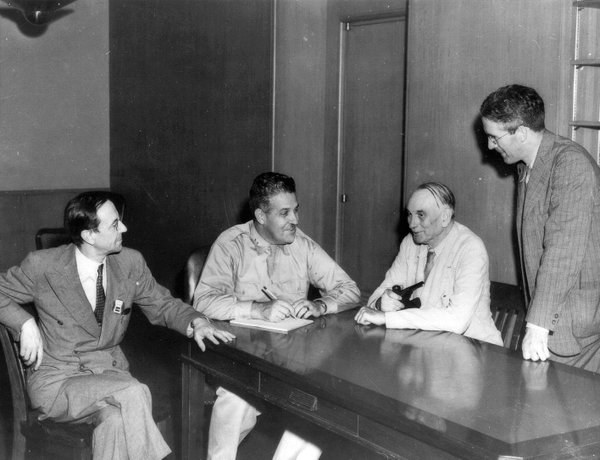
James Chadwick was an English physicist who studied under Ernest Rutherford in Manchester and followed him to the Cavendish Laboratory in Cambridge. Rutherford had suggested that the nucleus might contain a neutral particle, but nobody had found it. In 1932 Chadwick aimed the radiation from polonium and beryllium at paraffin wax and measured the protons that it knocked out. Only a neutral particle with about the mass of a proton explained the results. In February 1932 he reported "the possible existence of a neutron". He received the Nobel Prize in Physics in 1935.
Check your understanding
1. Concept: isotopes
2. Notation: uranium-235
3. Forces: heavy nuclei
4. Explain: tritium and helium-3
Tritium, $^{3}_{1}\text{H}$, and helium-3, $^{3}_{2}\text{He}$, have the same mass number. Your friend says they are isotopes. Do you agree? Explain with $Z$, $N$ and $A$, and say what would be an isotope of tritium.
Sentence starters
- I agree / I disagree, because …
- Tritium has … protons and … neutrons, while …
- The element is decided by …
- An isotope of tritium would be …
Model answer
I disagree. Tritium has $Z = 1$ and $N = 2$, while helium-3 has $Z = 2$ and $N = 1$. They have the same mass number $A = 3$, but the element is decided by the number of protons, so they are two different elements. An isotope of tritium must also have one proton, for example hydrogen-1, $^{1}_{1}\text{H}$, or deuterium, $^{2}_{1}\text{H}$.
Assess your own answer
Tick the points your own answer already contains.
Review the theory summary.
Summary
- A nucleus contains $Z$ protons and $N$ neutrons; the mass number is $A = Z + N$, written $^{A}_{Z}\text{X}$.
- $Z$ decides the element. Isotopes of an element have the same $Z$ but different $N$.
- Hydrogen-1, deuterium $^{2}_{1}\text{H}$ and tritium $^{3}_{1}\text{H}$ are the isotopes of hydrogen; tritium is radioactive.
- The nucleus is about $10^{-15}\text{–}10^{-14}\ \text{m}$ across, and nuclear matter has a density of about $2 \cdot 10^{17}\ \text{kg/m}^3$.
- The strong nuclear force attracts all nucleons but only over about $2.5\ \text{fm}$; the electric repulsion of protons reaches across the whole nucleus. That is why heavy nuclei need extra neutrons.
Le coin français
The nucleus is le noyau in French, the same word as the stone of a cherry. The particles are almost the same as in English: un proton, un neutron, un isotope. Listen, repeat, and say the last sentence to your partner.
Photographs and videos
- James Chadwick with Manhattan Project leaders. United States Army Signal Corps. source, Public domain
