
Mass defect and binding energy
Why can both joining nuclei and splitting nuclei release energy?
Prior knowledge
- A nucleus has $Z$ protons and $N$ neutrons, $A = Z + N$, written $^{A}_{Z}\text{X}$chapter Building nuclei: isotopes and nuclear notation
- The strong nuclear force attracts nucleons at short range; the protons repel each otherchapter Building nuclei: isotopes and nuclear notation
Core path: follow the steps in order. Tasks marked Optional give extra practice. Optional tasks: 2.
Think about it
Heat a cup of tea, $0.25\ \text{kg}$ of water, from $20\ ^\circ\text{C}$ to $80\ ^\circ\text{C}$. It takes about $63\ \text{kJ}$ of energy. According to Einstein, the hot tea is now heavier than the cold tea, by about $7 \cdot 10^{-13}\ \text{kg}$. No balance in the world can measure that. In chemistry, mass is always conserved in practice. But in nuclei, the energies are millions of times larger, and the change in mass can be measured.
Where does nuclear energy come from, if mass and energy are two sides of the same thing?
Review: inside helium-4
Predict
Make your predictions before investigating 2 questions
Prediction 1: the mass of helium-4
Prediction 2: fusing iron
Investigate
Investigation 1: weighing helium
Measured data · Atomic masses from the Atomic Mass Evaluation AME2020 (W. J. Huang et al. and M. Wang et al., Chinese Physics C 45, 030002 and 030003, 2021), rounded to six decimals.
Test prediction 1 with measured masses. Atomic masses include the electrons, so a hydrogen-1 atom counts as one proton with its electron, and the electrons of helium cancel.
| Particle | Mass (u) |
|---|---|
| hydrogen-1 atom, $^{1}_{1}\text{H}$ | $1.007825$ |
| neutron, $\text{n}$ | $1.008665$ |
| helium-4 atom, $^{4}_{2}\text{He}$ | $4.002603$ |
Calculate the total mass of $2$ hydrogen-1 atoms and $2$ neutrons, and subtract the mass of the helium-4 atom. Give the difference $\Delta m$ in $\text{u}$.
Hint 1: a guiding question
Helium-4 has $Z = 2$ and $N = 2$.
Hint 2: what is the connection
$m_\text{parts} = 2 \cdot 1.007825\ \text{u} + 2 \cdot 1.008665\ \text{u}$.
Hint 3: an intermediate step
$m_\text{parts} = 4.032980\ \text{u}$; now subtract $4.002603\ \text{u}$.
Show the solution
Given
$m_\text{H} = 1.007825\ \text{u}$, $m_\text{n} = 1.008665\ \text{u}$, $m_\text{He} = 4.002603\ \text{u}$; helium-4 has $Z = 2$, $N = 2$
Find
the mass difference $\Delta m$ between the free particles and the atom
Principle
The free particles and the atom contain the same nucleons and electrons, so any difference in mass belongs to the binding of the nucleus.
Formula
$$\Delta m = 2 m_\text{H} + 2 m_\text{n} - m_\text{He}$$
Unit conversions
None: all masses are in $\text{u}$.
Substitution
$$\begin{aligned} \Delta m &= 2 \cdot 1.007825\ \text{u} + 2 \cdot 1.008665\ \text{u} \\ &\quad - 4.002603\ \text{u} \\ &= 0.030377\ \text{u} \end{aligned}$$
Answer
$\Delta m = 0.030377\ \text{u}$
Six decimals as in the table.
Reasonableness
The difference is positive: the helium atom is lighter than its parts, by $0.75\ \%$. It is small compared with the masses, but far larger than the uncertainty of the table values, which is less than $10^{-9}\ \text{u}$.
Investigation 2: the Binding Energy Explorer
Test prediction 2. Choose nuclei from the list or click the points of the curve, and read $B/A$ in the panel. Then compare the reactions. Work in pairs: one of you operates the explorer, the other writes the numbers down.
Word bank
mass defect · binding energy · binding energy per nucleon · tightly bound · the peak of the curve · fusion · fission · products · fuel · to release · to climb towards · Q-value
Sentence starters
- The curve shows that …
- When … fuse, $B/A$ rises from … to …
- Fission releases energy because the products …
- The evidence suggests that …
- Compared with fission, fusion …
Conclusion: two ways to the peak
Discuss with a partner, then write four or five sentences of your own with numbers from the explorer.
Where on the curve are the most tightly bound nuclei? Would fusing two iron-56 nuclei release energy? In which direction does D–T fusion move on the curve, and in which direction does uranium fission move? Why do both release energy?
Model answer
The curve shows that the most tightly bound nuclei are near iron and nickel, with about $8.79\ \text{MeV}$ per nucleon. Silver-107 has only $8.55\ \text{MeV}$ per nucleon, so fusing two iron nuclei into $A \approx 112$ would go down the curve and need energy. In D–T fusion, the light nuclei deuterium ($1.11\ \text{MeV}$) and tritium ($2.83\ \text{MeV}$) form helium-4 ($7.07\ \text{MeV}$), so the reaction climbs the curve from the left and releases $Q = 17.6\ \text{MeV}$. In fission, uranium-235 ($7.59\ \text{MeV}$) splits into barium and krypton, which have about $8.3$ and $8.5\ \text{MeV}$, so it climbs from the right and releases $173\ \text{MeV}$. Both release energy because the products are more tightly bound than the fuel.
Assess your own answer
Tick the points your own answer already contains.
Review the theory summary.
Theory summary
Mass–energy equivalence
In 1905 Albert Einstein showed that mass and energy are two sides of the same quantity. If a system gives away the energy $E$, its mass decreases by $\Delta m$:
$$E = \Delta m \cdot c^2$$
where $c = 2.998 \cdot 10^{8}\ \text{m/s}$ is the speed of light. Because $c^2$ is so large, a tiny mass corresponds to a huge energy: $1\ \text{kg}$ corresponds to $9.0 \cdot 10^{16}\ \text{J}$.
In nuclear physics, masses are given in atomic mass units and energies in megaelectronvolts, $1\ \text{MeV} = 10^{6}\ \text{eV} = 1.602 \cdot 10^{-13}\ \text{J}$. The mass $1\ \text{u} = 1.661 \cdot 10^{-27}\ \text{kg}$ corresponds to the energy
$$1\ \text{u} \cdot c^2 = 931.5\ \text{MeV}$$
so a mass difference in $\text{u}$ times $931.5\ \text{MeV/u}$ gives the energy in $\text{MeV}$.
Key idea
A nucleus has less mass than the free protons and neutrons it is made of. The difference is the mass defect $\Delta m$. When nucleons join, the strong force pulls them together and energy is released, so the system loses mass. To pull the nucleus apart again, the same energy must be given back. This energy is the binding energy $B$:
$$B = \Delta m \cdot c^2$$
We calculate with the atomic masses of tables such as AME2020, which include the electrons. So for the protons we use the mass of a hydrogen-1 atom, $m_\text{H} = 1.007825\ \text{u}$, and the electrons cancel:
$$\Delta m = Z \cdot m_\text{H} + N \cdot m_\text{n} - m_\text{atom}$$
Here $m_\text{n} = 1.008665\ \text{u}$ is the mass of a neutron.
Binding energy per nucleon
To compare nuclei, we divide the binding energy by the number of nucleons. The binding energy per nucleon $B/A$ tells how tightly each nucleon is held on average. A large $B/A$ means a tightly bound nucleus.
The curve of $B/A$ rises steeply among the light nuclei: $1.11\ \text{MeV}$ for deuterium, $7.07\ \text{MeV}$ for helium-4. It reaches its peak near iron and nickel ($8.79\ \text{MeV}$ for $^{56}\text{Fe}$ and $^{62}\text{Ni}$) and then falls slowly to $7.59\ \text{MeV}$ for $^{235}\text{U}$. In light nuclei, every added nucleon finds more neighbours to bind to. In heavy nuclei, the electric repulsion of the many protons wins back part of the binding.
Fission and fusion
A nuclear reaction releases energy when its products are more tightly bound than the nuclei it starts from. The energy released, the Q-value, is
$$\begin{aligned} Q &= (m_\text{before} - m_\text{after}) \cdot c^2 \\ &= B_\text{after} - B_\text{before} \end{aligned}$$
Both sides of the peak can climb towards it:
- In fusion, two light nuclei join into a heavier one. Deuterium and tritium give helium-4 and a neutron, with $Q = 17.6\ \text{MeV}$.
- In fission, a heavy nucleus splits into two medium-sized ones. A uranium-235 nucleus that absorbs a neutron releases about $200\ \text{MeV}$ in all.
The figure shows one possible split of uranium-235, into barium-141, krypton-92 and three neutrons: it releases $173\ \text{MeV}$ at once, and the radioactive fragments release more later.
Fission was discovered in Berlin in December 1938 by Otto Hahn and Fritz Strassmann. Lise Meitner and Otto Frisch explained it at Christmas 1938 (published February 1939) and used $E = \Delta m \cdot c^2$ to estimate the energy. Fission gives about $0.85\ \text{MeV}$ per nucleon of fuel; D–T fusion gives $3.5\ \text{MeV}$ per nucleon, about four times more.
Words of the lesson
Back to your predictions
Compare your predictions with the masses, the explorer and the theory. Then answer the opening question in one or two sentences: why can joining light nuclei and splitting heavy nuclei both release energy?
Would you change your prediction?
Apply
Worked example
Problem
The atomic mass of helium-4 is $4.002603\ \text{u}$ (AME2020). Calculate the mass defect, the binding energy and the binding energy per nucleon of the helium-4 nucleus.
Step 1/7
Given: $m(^{4}\text{He}) = 4.002603\ \text{u}$, $Z = 2$, $N = 2$, $A = 4$; from AME2020, $m_\text{H} = 1.007825\ \text{u}$ and $m_\text{n} = 1.008665\ \text{u}$; ${1\ \text{u} \cdot c^2 = 931.5\ \text{MeV}}$. Find: the mass defect $\Delta m$, the binding energy $B$ and $B/A$.
Step 2/7
Principle: The nucleus has less mass than its free nucleons; the difference times $c^2$ is the energy needed to separate them. Atomic masses are used, so the two protons are counted as two hydrogen-1 atoms and the two electrons cancel.
Step 3/7
Formula: $$\begin{aligned} \Delta m &= Z \cdot m_\text{H} + N \cdot m_\text{n} \\ &\quad - m(^{4}\text{He}) \\ B &= \Delta m \cdot c^2 \\ \frac{B}{A} &= \frac{\Delta m \cdot c^2}{A} \end{aligned}$$
Step 4/7
Unit conversions: The mass defect stays in $\text{u}$, and ${1\ \text{u} \cdot c^2 = 931.5\ \text{MeV}}$ turns it into an energy in megaelectronvolts.
Step 5/7
Substitution: $$\begin{aligned} \Delta m &= 2 \cdot 1.007825\ \text{u} \\ &\quad + 2 \cdot 1.008665\ \text{u} \\ &\quad - 4.002603\ \text{u} \\ &= 4.032980\ \text{u} - 4.002603\ \text{u} \\ &= 0.030377\ \text{u} \\[4pt] B &= 0.030377\ \text{u} \cdot 931.5\ \text{MeV/u} \\ &= 28.30\ \text{MeV} \\[4pt] \frac{B}{A} &= \frac{28.30\ \text{MeV}}{4} = 7.074\ \text{MeV} \end{aligned}$$
Step 6/7
Answer: $\Delta m = 0.0304\ \text{u}$, $B = 28.3\ \text{MeV}$ and $B/A = 7.07\ \text{MeV}$ per nucleon. Three significant figures are enough, because $931.5\ \text{MeV/u}$ is given to four and the result is used only to three.
Step 7/7
Reasonableness: The mass defect is $0.030377 : 4.032980 = 0.75\ \%$ of the mass of the free particles: small, as expected, but far larger than in any chemical reaction. The value $7.07\ \text{MeV}$ is the point of $^{4}\text{He}$ on the binding energy curve.
The energy of D–T fusion
The fuel of future fusion power plants reacts as $^{2}_{1}\text{H} + {}^{3}_{1}\text{H} \to {}^{4}_{2}\text{He} + {}^{1}_{0}\text{n}$. The atomic masses (AME2020) are $m(^{2}\text{H}) = 2.014102\ \text{u}$, $m(^{3}\text{H}) = 3.016049\ \text{u}$, $m(^{4}\text{He}) = 4.002603\ \text{u}$, and the neutron has $m_\text{n} = 1.008665\ \text{u}$. Calculate the energy $Q$ released in one reaction, in $\text{MeV}$.
Hint 1: a guiding question
Energy is released because the products have less mass than the fuel: $Q = (m_\text{before} - m_\text{after}) \cdot c^2$.
Hint 2: what is the connection
$m_\text{before} = 5.030151\ \text{u}$. What is $m_\text{after}$?
Hint 3: an intermediate step
multiply by $931.5\ \text{MeV/u}$.
Show the solution
Given
$m(^{2}\text{H}) = 2.014102\ \text{u}$, $m(^{3}\text{H}) = 3.016049\ \text{u}$, $m(^{4}\text{He}) = 4.002603\ \text{u}$, $m_\text{n} = 1.008665\ \text{u}$, $1\ \text{u} \cdot c^2 = 931.5\ \text{MeV}$
Find
the energy $Q$ released in one D–T reaction
Principle
The products are more tightly bound than the fuel, so they have less mass; the lost mass leaves as kinetic energy, $Q = \Delta m \cdot c^2$. Atomic masses work, because there are two electrons on both sides.
Formula
$$\begin{aligned} Q = \big(&m(^{2}\text{H}) + m(^{3}\text{H}) \\ &- m(^{4}\text{He}) - m_\text{n}\big) \cdot c^2 \end{aligned}$$
Unit conversions
The mass difference in $\text{u}$ is multiplied by $931.5\ \text{MeV/u}$.
Substitution
$$\begin{aligned} m_\text{before} &= 2.014102\ \text{u} + 3.016049\ \text{u} \\ &= 5.030151\ \text{u} \\ m_\text{after} &= 4.002603\ \text{u} + 1.008665\ \text{u} \\ &= 5.011268\ \text{u} \\ \Delta m &= 0.018883\ \text{u} \\ Q &= 0.018883\ \text{u} \cdot 931.5\ \text{MeV/u} \\ &= 17.59\ \text{MeV} \end{aligned}$$
Answer
$Q \approx 17.6\ \text{MeV}$
Three significant figures.
Reasonableness
This is the value used for D–T fusion everywhere, $17.6\ \text{MeV}$. Check with binding energies:
the same within rounding.
Optional Find the error
Common misconception
"Binding energy is energy stored in the nucleus, and a nucleus with a large binding energy has a lot of energy to give." It is the other way round. Binding energy is the energy you must add to take a nucleus apart. A tightly bound nucleus has already given its energy away; energy is released when nuclei move towards larger $B/A$.
"In a nuclear reaction, protons and neutrons are destroyed and turned into energy." The number of nucleons stays the same before and after: in D–T fusion, $5$ nucleons go in and $5$ come out. Only the mass of the bound system changes.
Optional Lise Meitner and the explanation of fission
The people behind fission
Lise Meitner (1878–1968)
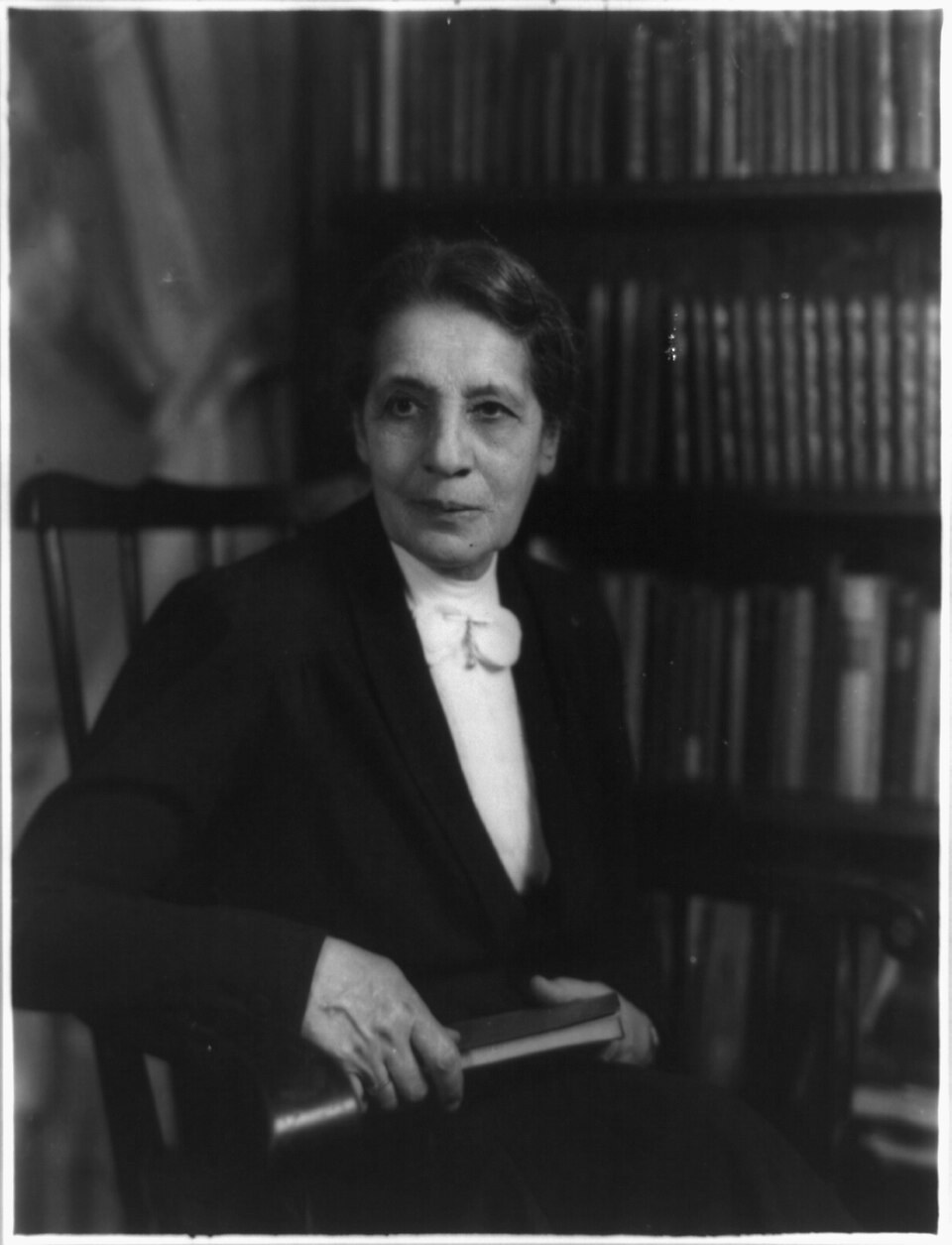
Lise Meitner was an Austrian physicist who worked for about thirty years in Berlin with the chemist Otto Hahn. In July 1938 she had to flee from Nazi Germany and moved to Sweden. In December Hahn wrote to her that uranium hit by neutrons gave barium, a much lighter element. Over Christmas 1938 Meitner and her nephew Otto Frisch worked out that the uranium nucleus had split in two, and with $E = \Delta m \cdot c^2$ they estimated about $200\ \text{MeV}$ per split. The Nobel Prize in Chemistry for 1944 went to Hahn alone, which many scientists see as unjust. Element 109, meitnerium, is named after her.
Check your understanding
1. Concept: why fission releases energy
2. Calculation: the deuteron
3. Graph: the most tightly bound
4. Explain: the end of a star
A massive star fuses lighter elements into heavier ones, step by step, until its core is mostly iron. Then the fusion stops. Explain with the binding energy curve why a star cannot get energy by fusing iron.
Sentence starters
- On the binding energy curve, iron …
- If iron nuclei fused, the product would …
- Energy is released only when …
- Therefore the star …
Model answer
On the binding energy curve, iron is at the peak: its nucleons are the most tightly bound, about $8.8\ \text{MeV}$ per nucleon. If iron nuclei fused, the product would be heavier and less tightly bound, so it would have more mass than the fuel. Energy is released only when a reaction moves towards larger $B/A$. Fusing iron would therefore take energy instead of giving it, and the star's core loses its source of energy.
Assess your own answer
Tick the points your own answer already contains.
Review the theory summary.
Summary
- Mass and energy are equivalent: $E = \Delta m \cdot c^2$, and $1\ \text{u} \cdot c^2 = 931.5\ \text{MeV}$.
- A nucleus has less mass than its free nucleons. The mass defect times $c^2$ is the binding energy $B$, the energy needed to take the nucleus apart.
- The binding energy per nucleon $B/A$ peaks near iron-56 and nickel-62 at about $8.8\ \text{MeV}$.
- Fusion of light nuclei and fission of heavy nuclei both move towards the peak, so both release energy: $Q = B_\text{after} - B_\text{before}$.
- D–T fusion releases $17.6\ \text{MeV}$; the fission of uranium-235 about $200\ \text{MeV}$, but fusion gives more energy per nucleon of fuel.
Le coin français
French scientists played a big part in the story of nuclear energy: Henri Becquerel discovered radioactivity in Paris in 1896. In French, binding energy is l'énergie de liaison, and the two reactions are la fusion and la fission. Listen, repeat, and say the last sentence to your partner.
Photographs and videos
- Lise Meitner. Harris & Ewing. source, Public domain