
Acceleration of free fall: $v = gt$
Why did the astronaut on the Moon drop a hammer and a feather at the same time and see them hit the ground together, even though on Earth a feather drifts slowly down?
Prior knowledge
- In uniform motion the distance is the product of speed and time, $s = vt$chapter Uniform motion: speed, position and graphs
- The slope of a straight-line graph tells how much the quantity on the vertical axis changes when the quantity on the horizontal axis increases by onechapter Graphing and fitting a straight line
Core path: follow the steps in order. Tasks marked Optional give extra practice. Optional tasks: 3.
Think about it
In 1971, on the Apollo 15 mission, astronaut David Scott held a hammer in one hand and a falcon feather in the other on the surface of the Moon and let them go at the same time. They hit the lunar surface at the same moment. At home the same experiment does not work: the hammer falls straight down, but the feather drifts slowly.
Does the speed of a falling object increase steadily, and does a heavy object fall faster than a light one?
Review the previous chapter
Predict
Make your predictions before investigating 2 questions
Prediction 1: how the speed increases
Prediction 2: does mass matter
Investigate
In the simulation two balls of the same size fall from rest, and their speeds are plotted on the $(t, v)$ graph.
Simulation
How to use
Press Drop or drag the Moment $t$ slider and watch how the balls fall and how the graph is drawn. Choose the Environment (vacuum or air) and adjust the masses of the balls. The length of the arrow is the speed, and the points mark whole seconds. The dashed line is the formula $v = gt$.
Assumptions of the model
The values are model values calculated by the simulation, not measurements. The balls are the same size, and they start from rest. In a vacuum only the acceleration of free fall $g = 9.81\,\text{m/s}^2$ acts. In air the diameter of the ball is $0.20\,\text{m}$, and the air slows the ball more the faster it moves. Wind and the rotation of the ball are ignored.
How the calculation works
In a vacuum the speed is calculated with the formula $v = gt$. The quotient $v : t$ tells how much the speed has increased per second on average since the ball started from rest. In air the increase in speed slows down as the speed grows, and the speed approaches a terminal speed. For a light ball the terminal speed is smaller than for a heavy one, so $v : t$ stays smaller for the light ball.
Experiment 1: does the speed increase steadily
Test prediction 1. The initial state selects a vacuum and sets the masses of the balls to $1.0\,\text{kg}$ and $8.0\,\text{kg}$. Press Drop and watch how the graph is drawn. Then stop the clock by dragging the Moment $t$ slider and record the speeds at three or more moments, for example $1.0\,\text{s}$, $2.0\,\text{s}$ and $3.0\,\text{s}$.
Initial state: air resistance = 0 (no air: vacuum), mass $m_\text{A}$ = $1\,\text{kg}$, mass $m_\text{B}$ = $8\,\text{kg}$, moment $t$ = $0\,\text{s}$. Kept constant: air resistance, mass $m_\text{A}$, mass $m_\text{B}$. Varied: moment $t$.
| moment $t$ | $v_\text{A}$ $(\text{m/s})$ | $v_\text{B}$ $(\text{m/s})$ |
|---|
Using two rows of the table, calculate the increase in the speed of ball A per second, $\dfrac{\Delta v}{\Delta t}$. Give the answer in $\text{m/s}^2$.
Hint 1: a guiding question
The increase in speed per second is the change in speed divided by the change in time. Choose two rows and read the speed and time of ball A from them.
Hint 2: what is the connection
Use the column $v_\text{A}$.
Hint 3: an intermediate step
If the rows are $t = 1.0\,\text{s}$ and $t = 3.0\,\text{s}$, then
Show the solution
Given
two rows of the table, for example $t_1 = 1.0\,\text{s}$, $v_1 = 9.81\,\text{m/s}$ and $t_2 = 3.0\,\text{s}$, $v_2 = 29.4\,\text{m/s}$ (model values for ball A in a vacuum)
Find
the increase in speed per second $\dfrac{\Delta v}{\Delta t}$ in $\text{m/s}^2$
Principle
If the speed increases by the same amount every second, any two rows of the table give the same quotient. This quotient is the change in speed divided by the change in time, that is, the acceleration.
Formula
Conversions
The speeds are in $\text{m/s}$ and the times in seconds, so the result comes directly in $\text{m/s}^2$. No conversions are needed.
Substitution
Answer
$9.8\,\text{m/s}^2$
Two significant figures, because the time interval $2.0\,\text{s}$ has two figures.
Reasonableness
Another pair of rows gives the same result: for example $t = 2.0\,\text{s}$ and $t = 4.0\,\text{s}$ give
The result is also the same for ball B, so mass does not affect the result. The positive sign fits the fact that the speed increases.
Experiment 2: does mass matter in a vacuum
Test prediction 2. The initial state selects a vacuum and the moment $t = 3.0\,\text{s}$ and sets the mass of ball A to $1.0\,\text{kg}$. Change the mass of ball B with the slider and record the speeds for at least three masses, for example $0.5\,\text{kg}$, $3.0\,\text{kg}$ and $8.0\,\text{kg}$.
Initial state: air resistance = 0 (no air: vacuum), moment $t$ = $3\,\text{s}$, mass $m_\text{A}$ = $1\,\text{kg}$, mass $m_\text{B}$ = $1\,\text{kg}$. Kept constant: air resistance, moment $t$, mass $m_\text{A}$. Varied: mass $m_\text{B}$.
| mass $m_\text{B}$ | $v_\text{A}$ $(\text{m/s})$ | $v_\text{B}$ $(\text{m/s})$ |
|---|
Experiment 3: what about in air
Now air is included. The initial state selects air and the moment $t = 4.0\,\text{s}$ and sets the mass of ball A to $1.0\,\text{kg}$. The balls are the same size. Change the mass of ball B and record the speeds for at least three masses, for example $0.1\,\text{kg}$, $1.0\,\text{kg}$ and $10\,\text{kg}$. Compare the numbers with the value $gt = 39.2\,\text{m/s}$.
Initial state: air resistance = 1 (air present), moment $t$ = $4\,\text{s}$, mass $m_\text{A}$ = $1\,\text{kg}$, mass $m_\text{B}$ = $1\,\text{kg}$. Kept constant: air resistance, moment $t$, mass $m_\text{A}$. Varied: mass $m_\text{B}$.
| mass $m_\text{B}$ | $v_\text{A}$ $(\text{m/s})$ | $v_\text{B}$ $(\text{m/s})$ |
|---|
Optional Example data: the speed of a ball from video frames
Simulated example data
The fall of a steel ball is filmed, and the speed of the ball is calculated from the frames at different moments. Every measurement has a small error, so the points do not fall exactly on the same straight line. The data is here as a table and as a $(t, v)$ graph (simulated example data, not a real experiment).
| $t$ (s) | $v$ (m/s) |
|---|---|
| 0.1 | 1.0 |
| 0.2 | 2.0 |
| 0.3 | 2.9 |
| 0.4 | 3.9 |
| 0.5 | 4.9 |
A straight line has been fitted to the points through the origin so that the points lie roughly evenly on both sides of it. Time is measured from the moment the ball was released from rest, so according to the model $v = gt$ the line passes through the origin.
Choose a point on the fitted line far from the origin and read its $t$ and $v$ from the graph. Calculate the slope of the line using this point and the origin. Give the answer in $\text{m/s}^2$.
Hint 1: a guiding question
Read the point from the line, not from the table. Choose a point far from the origin, for example near the moment $t = 0.5\,\text{s}$.
Hint 2: what is the connection
The other point is the origin $(0\,\text{s}$; $0\,\text{m/s})$.
Hint 3: an intermediate step
At the moment $t = 0.5\,\text{s}$ the line is slightly below the grid line $5\,\text{m/s}$, at about $4.9\,\text{m/s}$.
Show the solution
Given
two points on the fitted line: the origin $(t_1$; $v_1) = (0\,\text{s}$; $0\,\text{m/s})$ and a point read from the graph $(t_2$; $v_2) \approx (0.50\,\text{s}$; $4.9\,\text{m/s})$
Find
the slope of the line, that is, the acceleration of free fall $g$ in $\text{m/s}^2$
Principle
The ball is in free fall, so its $(t, v)$ graph is a straight line, and the slope of the line is the acceleration of free fall. The measurements contain error, so the slope is calculated from points on the fitted line and not from a single measurement.
Reading the graph
The origin is given. Read the other point at the moment $t = 0.50\,\text{s}$: from this position go up to the line and from there left to the $v$ axis. The line is slightly below the grid line $5\,\text{m/s}$, so we read $v_2 \approx 4.9\,\text{m/s}$. The grid lines are $1\,\text{m/s}$ apart, so the value can be read to about a tenth. For points far apart the reading error is small compared with the change.
Formula
Conversions
The speed is in $\text{m/s}$ and the time in seconds, so no conversions are needed.
Substitution
Answer
$9.8\,\text{m/s}^2$
Two significant figures, because the value read from the graph, $4.9\,\text{m/s}$, and the time $0.50\,\text{s}$ have two figures. The measured points deviate from the line by about $0.1\,\text{m/s}$, so as a rough estimate the uncertainty of the slope with this data is about $0.2\,\text{m/s}^2$.
Reasonableness
The result is close to the table value $9.81\,\text{m/s}^2$. Check from the table: the last measurement gives
and the middle one
which is the same order of magnitude. The slope is positive, because the graph rises.
Conclusion from the experiments
Write a conclusion based on your experiments: How does the speed of a falling object change in a vacuum? Does mass affect it? What does air change? Use the numbers from your tables.
Model answer
According to the values of the simulation model, in a vacuum the speed increases by the same amount every second: at the moments $1.0\,\text{s}$, $2.0\,\text{s}$ and $3.0\,\text{s}$ the speed was about $9.8\,\text{m/s}$, $19.6\,\text{m/s}$ and $29.4\,\text{m/s}$. The increase in speed per second is therefore constant, $g = 9.81\,\text{m/s}^2$, and the speed is $v = gt$. The mass of the ball did not matter: when the mass of ball B changed, its speed on every row was the same as the speed of ball A. In air the speed stayed smaller than $gt$: at the moment $4.0\,\text{s}$ the speed of the light ball ($0.1\,\text{kg}$) was only about $10.5\,\text{m/s}$, whereas that of the heavy ball ($10\,\text{kg}$) was about $37.5\,\text{m/s}$ and the value of the formula is $39.2\,\text{m/s}$. The difference comes from the air, not from mass as such. The numbers in experiments 1 and 2 are values of the simulation model, and they repeat the formula $v = gt$ rather than prove it; the effect of air shows only in experiment 3.
Assess your own answer
Tick the points your own answer already contains.
Review the theory summary and practise with the exercises.
Theory summary
Key idea
When an object is released from rest, its speed increases. Free fall is falling with no air resistance. Measurements show that in free fall the speed increases by the same amount every second: on the surface of the Earth by $9.81\,\text{m/s}$ per second. After one second the speed is $9.81\,\text{m/s}$, after two seconds $19.6\,\text{m/s}$ and after three seconds $29.4\,\text{m/s}$. So the object does not fall at a constant speed as in uniform motion (chapter Uniform motion: speed, position and graphs) but accelerates.
The change in speed per unit of time is called acceleration. The acceleration of a freely falling object is the acceleration of free fall $g = 9.81\,\text{m/s}^2$. The unit $\text{m/s}^2$ is read "metres per second per second": speed is measured in $\text{m/s}$, and it changes by this amount every second. So the number $g$ is not a speed but the rate at which the speed increases.
Mass does not affect falling
When there is no air resistance, all objects fall with the same acceleration regardless of their mass. In a vacuum a hammer and a feather fall equally fast, and a ball with a mass of $5\,\text{kg}$ has at every moment the same speed as a ball with a mass of $1\,\text{kg}$. The reason is explained later in connection with forces. In this chapter it is taken as an experimental result that you investigate yourself.
In air the situation is different. Air slows a light, wide object, such as a feather or a sheet of paper, clearly more than a small, dense object, such as a stone or a steel ball. This is why at home a feather falls more slowly than a hammer. The difference is caused by the air, not by mass as such.
Speed in free fall
Because the speed increases by the same amount every second, the speed is directly proportional to time. When the object starts from rest, its speed at the moment $t$ is
$$v = g\,t$$
where $v$ is the downward speed ($\text{m/s}$), $g = 9.81\,\text{m/s}^2$ is the acceleration of free fall and $t$ is the time from the start of the fall ($\text{s}$). The formula is a linear model $v = kt$ in which the slope $k$ is $g$. It holds when there is no air resistance.
So the $(t, v)$ graph of a falling object is a rising straight line through the origin. Its slope $\tfrac{\Delta v}{\Delta t}$ is the acceleration of free fall, so $g$ can be found from the graph by reading two points far apart. Because the acceleration is constant, $\Delta v = g\,\Delta t$ holds for any time interval: the speed increases by $9.81\,\text{m/s}$ every second even when the object did not start from rest.
Common misconception
A heavy object does not fall faster than a light one: when there is no air resistance, all objects have the same $g$. Everyday experience seems to show otherwise, because in air a light, wide object is slowed the most. Another mistake is to treat the number $g = 9.81\,\text{m/s}^2$ as a speed: it tells how much the speed increases every second, and the speed itself is $g\,t$.
Summary
- In free fall there is no air resistance. The speed of the object increases by the same amount every second.
- The acceleration of free fall on the surface of the Earth is $g = 9.81\,\text{m/s}^2$, and it is the same for all objects regardless of mass.
- The speed of an object that starts from rest is $v = g\,t$, and the $(t, v)$ graph is a straight line through the origin with slope $g$.
- In air a light, wide object is slowed the most, so $v = g\,t$ does not hold unless air resistance is ignored.
- Conversion: in an hour $3600\,\text{m} = 3.6\,\text{km}$, so $1\,\text{m/s} = 3.6\,\text{km/h}$.
Optional Return to your predictions
Compare your predictions with the tables and graphs. What did you find out about the increase in speed and the effect of mass? Go back also to the hammer and the feather at the start: why did they fall equally fast on the Moon but differently on Earth?
Would you change your prediction?
Apply
Worked example
Problem
A stone is dropped from rest from a bridge, and it hits the water $1.5\,\text{s}$ later. What is the speed of the stone when it hits the water, in $\text{m/s}$ and in $\text{km/h}$? Air resistance is ignored.
Step 1/7
Given and find. The duration of the fall is $t = 1.5\,\text{s}$, the stone starts from rest and the acceleration of free fall is $g = 9.81\,\text{m/s}^2$. We want the speed $v$ at the moment of impact, first in $\text{m/s}$ and then in $\text{km/h}$.
Step 2/7
Principle. The stone is in free fall, because air resistance is ignored, and it starts from rest. Then the speed increases by the same amount every second, so the speed is directly proportional to time: $v = g\,t$.
Step 3/7
Rearranged formula. The formula is already solved for the quantity we want:
$$v = g\,t$$
Step 4/7
Unit conversions. The time is in seconds and $g$ in $\text{m/s}^2$, so the result comes in $\text{m/s}$ without a conversion. To convert to kilometres per hour, think about what $1\,\text{m/s}$ means: in an hour ($3600\,\text{s}$) an object at this speed covers $3600\,\text{m} = 3.6\,\text{km}$, so $1\,\text{m/s} = 3.6\,\text{km/h}$. This is substituted in place of the unit.
Step 5/7
Substitution. $$\begin{aligned} v &= g\,t \\ &= 9.81\,\text{m/s}^2 \cdot 1.5\,\text{s} \\ &= 14.715\,\text{m/s} \\[4pt] v &= 14.715 \cdot 1\,\text{m/s} \\ &= 14.715 \cdot 3.6\,\text{km/h} \\ &= 52.97\,\text{km/h} \end{aligned}$$
Step 6/7
Result. The speed is $v \approx 15\,\text{m/s}$, that is, $v \approx 53\,\text{km/h}$. Two significant figures, because the time $1.5\,\text{s}$ is given with two figures. The conversion is made from the unrounded value, not from the rounded $15\,\text{m/s}$.
Step 7/7
Reasonableness. The graph shows the same: at the moment $1\,\text{s}$ the speed is $9.8\,\text{m/s}$ and at the moment $2\,\text{s}$ it is $19.6\,\text{m/s}$, so at the moment $1.5\,\text{s}$ it is about $15\,\text{m/s}$. A speed of $53\,\text{km/h}$ is a normal speed for a car in city traffic, and it is a reasonable result for a fall that lasts only one and a half seconds.
Optional Find the error
Apply to a new situation
A researcher drops a stone on an unknown planet that has no atmosphere. The stone starts from rest, and its speed after $2.0\,\text{s}$ is $7.4\,\text{m/s}$.
What is the speed of the stone after $3.0\,\text{s}$? Give the answer in $\text{m/s}$.
Hint 1: a guiding question
Which number tells how much the speed increases per second? Work it out from the given data.
Hint 2: what is the connection
The acceleration of free fall is $g = \dfrac{v}{t}$ and the speed later is $v = gt$. The $g$ of the planet is not the value for Earth.
Hint 3: an intermediate step
and then $v = g \cdot 3.0\,\text{s}$.
Show the solution
Given
the stone starts from rest, $v_1 = 7.4\,\text{m/s}$ at the moment $t_1 = 2.0\,\text{s}$, the desired moment is $t_2 = 3.0\,\text{s}$; there is no atmosphere
Find
the speed of the stone $v_2$ at the moment $t_2$ in $\text{m/s}$
Principle
With no atmosphere the stone is in free fall, so the speed is directly proportional to time: $v = gt$. The $g$ of the planet is not the value for Earth, but it is constant, so it can be found from the given measurement and used to calculate the speed at the second moment.
Formula
$g = \dfrac{v_1}{t_1}$ and $v_2 = g\,t_2$, so $v_2 = \dfrac{v_1}{t_1}\,t_2$
Conversions
The speeds are in $\text{m/s}$ and the times in seconds, so no conversions are needed.
Substitution
Answer
$11\,\text{m/s}$
Two significant figures as in the data $7.4\,\text{m/s}$ and $2.0\,\text{s}$.
Reasonableness
The speed is directly proportional to time, so $3.0\,\text{s}$ is one and a half times $2.0\,\text{s}$ and the speed must be one and a half times as large: $1.5 \cdot 7.4\,\text{m/s} = 11.1\,\text{m/s}$. The $g = 3.7\,\text{m/s}^2$ of the planet is smaller than the $9.81\,\text{m/s}^2$ of Earth, so the speed is smaller than on Earth in the same time ($29.4\,\text{m/s}$).
Check your understanding
Exit ticket
Answer on your own first and only then open the answer.
- On the Moon the acceleration of free fall is $1.62\,\text{m/s}^2$. What is the speed of a stone dropped from rest after $3.0\,\text{s}$, and how many times greater would the speed be on Earth in the same time?
Answer
On the Moon
$v$$= gt$$= 1.62\,\text{m/s}^2 \cdot 3.0\,\text{s}$$\approx 4.9\,\text{m/s}$On Earth
$v$$= 9.81\,\text{m/s}^2 \cdot 3.0\,\text{s}$$\approx 29\,\text{m/s}$The speed is directly proportional to the acceleration of free fall, so on Earth it is $9.81 : 1.62 \approx 6.1$ times greater.
1. Concept
2. What g tells us
3. Calculating
A ball is released from rest in a vacuum. After how many seconds is the speed of the ball $108\,\text{km/h}$? Give the answer in seconds.
Hint 1: a guiding question
What unit must the speed have so that it can be used together with the number $g$?
Hint 2: what is the connection
First convert $\text{km/h}$ to $\text{m/s}$ by substituting $1\,\text{km} = 1000\,\text{m}$ and $1\,\text{h} = 3600\,\text{s}$. Then solve the time from the formula $v = gt$.
Hint 3: an intermediate step
$t = \dfrac{v}{g}$, where
Show the solution
Given
the ball starts from rest, final speed $v = 108\,\text{km/h}$, $g = 9.81\,\text{m/s}^2$
Find
the time $t$ in $\text{s}$
Principle
The ball is in free fall in a vacuum and starts from rest, so the speed is directly proportional to time: $v = gt$. When the speed is known, the time is found by solving $t$ from the formula.
Formula
$v = g\,t$, so $t = \dfrac{v}{g}$
Conversions
The speed is converted to $\text{m/s}$, because $g$ is in $\text{m/s}^2$: substitute $1\,\text{km} = 1000\,\text{m}$ and $1\,\text{h} = 3600\,\text{s}$:
Substitution
Answer
$3.06\,\text{s}$
Three significant figures as in the speed $108\,\text{km/h}$.
Reasonableness
The speed increases by about $10\,\text{m/s}$ every second, so reaching $30\,\text{m/s}$ takes about $3\,\text{s}$, which matches the result. Check by back-calculation: $9.81\,\text{m/s}^2 \cdot 3.06\,\text{s} = 30.0\,\text{m/s}$, and the units $\text{m/s}^2 \cdot \text{s} = \text{m/s}$ agree.
Suggestion: one answer does not show everything you can do, but review the theory summary and do the core exercises.
4. Explain
Explain in your own words why a feather falls more slowly than a hammer in air but equally fast in a vacuum, and how the acceleration of free fall can be read from a $(t, v)$ graph.
Model answer
The acceleration of free fall $g = 9.81\,\text{m/s}^2$ is the same for all objects when there is no air resistance, so in a vacuum a feather and a hammer fall equally fast, as was seen on the Moon. In air the air slows a wide, light feather much more than a hammer, so the feather falls more slowly. The difference is caused by the air, not by mass as such. The acceleration of free fall is read from the $(t, v)$ graph as the slope of the line: choose two points on the line far apart from each other and calculate $g = \dfrac{\Delta v}{\Delta t}$. When the object starts from rest, the line starts from the origin.
Assess your own answer
Tick the points your own answer already contains.
Review the theory summary and practise with the exercises.
Review the chapter's concepts
Cards you mark Review later collect in your review deck.
- Acceleration
- The change in velocity per unit time.$$a = \dfrac{\Delta v}{\Delta t}$$
- Free fall
- Motion in which air resistance is neglected and only the weight acts on the object.
- Acceleration of free fall
- Near the Earth the speed changes by about $9.81\,\text{m/s}$ every second.$$g \approx 9.81\,\text{m/s}^2$$
Exercises
Level 1 · basic practice 8 exercises
One formula or one step of reasoning. Core exercises first, the rest is extra practice.
- Exercise 6-1Core
A ball is released from rest, and air resistance is ignored. What is the speed of the ball when $3.0\,\text{s}$ have passed since the start of the fall?
Answer
$29\,\text{m/s}$
Show the solution
Given
the ball starts from rest, $t = 3.0\,\text{s}$, acceleration of free fall $g = 9.81\,\text{m/s}^2$
Find
the speed of the ball $v$ in $\text{m/s}$
Principle
Air resistance is ignored, so the ball is in free fall. Then the speed increases by the same amount every second, and the speed of an object that starts from rest is directly proportional to time.
Formula
$v = g\,t$. The formula is already solved for the speed we want: $v = g\,t$
Conversions
The time is in seconds and $g$ in $\text{m/s}^2$, so the result comes directly in $\text{m/s}$. No conversions are needed.
Substitution
$v$$= 9.81\,\text{m/s}^2 \cdot 3.0\,\text{s}$$= 29.43\,\text{m/s}$Answer
$29\,\text{m/s}$
Two significant figures as in the time $3.0\,\text{s}$.
Reasonableness
The speed increases by about $10\,\text{m/s}$ every second, so in three seconds it is about $3 \cdot 10\,\text{m/s} = 30\,\text{m/s}$, which matches the result. In addition, $29\,\text{m/s} \approx 106\,\text{km/h}$ is a motorway speed, which is a reasonable result for a three-second free fall.
- Exercise 6-2Core
An apple comes off a branch and falls from rest to the ground in $0.80\,\text{s}$. Air resistance is ignored.
What is the speed of the apple when it hits the ground?
Answer
$7.8\,\text{m/s}$
Show the solution
Given
the apple starts from rest, $t = 0.80\,\text{s}$, $g = 9.81\,\text{m/s}^2$
Find
the speed of the apple $v$ when it hits the ground, in $\text{m/s}$
Principle
Air resistance is ignored, so the apple is in free fall and starts from rest. Then the speed is the product of the acceleration of free fall and the elapsed time.
Formula
$v = g\,t$. The formula is already solved for the speed we want: $v = g\,t$
Conversions
The time is given in seconds, so no conversions are needed.
Substitution
$v$$= 9.81\,\text{m/s}^2 \cdot 0.80\,\text{s}$$= 7.848\,\text{m/s}$Answer
$7.8\,\text{m/s}$
Two significant figures as in the time $0.80\,\text{s}$.
Reasonableness
In less than a second the speed has time to increase by less than $9.81\,\text{m/s}$, and $0.80 \cdot 9.81 \approx 8$ gives the same order of magnitude. A speed of $7.8\,\text{m/s} \approx 28\,\text{km/h}$ is reasonable after a fall of less than a second: it is faster than jogging but not yet the speed of cars.
- Exercise 6-3
On the surface of the Moon the acceleration of free fall is $1.62\,\text{m/s}^2$. An astronaut drops a stone, which falls from rest for $4.0\,\text{s}$.
What is the speed of the stone after this time?
Answer
$6.5\,\text{m/s}$
Show the solution
Given
the stone starts from rest, $t = 4.0\,\text{s}$, acceleration of free fall on the Moon $g_\text{Moon} = 1.62\,\text{m/s}^2$ (from the exercise)
Find
the speed of the stone $v$ in $\text{m/s}$
Principle
The Moon has no atmosphere, so the stone falls freely. The speed of a freely falling object that starts from rest is the product of the acceleration and the time, when the acceleration is the $g$ of the Moon.
Formula
$v = g_\text{Moon}\,t$. The formula is already solved for the speed we want: $v = g_\text{Moon}\,t$
Conversions
The time is in seconds and the acceleration in $\text{m/s}^2$, so the result comes in $\text{m/s}$. No conversions are needed.
Substitution
$v$$= 1.62\,\text{m/s}^2 \cdot 4.0\,\text{s}$$= 6.48\,\text{m/s}$Answer
$6.5\,\text{m/s}$
Two significant figures as in the time $4.0\,\text{s}$.
Reasonableness
The $g$ of the Moon is about a sixth of the value for Earth, so the speed must be about a sixth of the speed on Earth in the same time:
$\dfrac{9.81\,\text{m/s}^2 \cdot 4.0\,\text{s}}{6}$$\approx 6.5\,\text{m/s}$The result matches this.
- Exercise 6-4
The $(t, v)$ graph of a freely falling object is a straight line through the points $(0\,\text{s};\, 0\,\text{m/s})$ and $(5.0\,\text{s};\, 49\,\text{m/s})$. What is the acceleration of free fall?
Answer
$9.8\,\text{m/s}^2$
Show the solution
Given
the line of the $(t, v)$ graph passes through the points $(t_1$; $v_1) = (0\,\text{s}$; $0\,\text{m/s})$ and $(t_2$; $v_2) = (5.0\,\text{s}$; $49\,\text{m/s})$
Find
the acceleration of free fall $g$ in $\text{m/s}^2$
Principle
The speed of a freely falling object increases by the same amount every second, so the $(t, v)$ graph is a straight line. The slope of the line is the change in speed divided by the change in time, and it is the acceleration of free fall.
Reading the graph
The two given points are on the line. The rise $\Delta v = v_2 - v_1$ is read in the vertical direction and the run $\Delta t = t_2 - t_1$ in the horizontal direction. The points are far apart, so the reading error stays small.
Formula
$g$$= \dfrac{\Delta v}{\Delta t}$$= \dfrac{v_2 - v_1}{t_2 - t_1}$Conversions
The speeds are in $\text{m/s}$ and the times in seconds, so the result comes in $\text{m/s}^2$. No conversions are needed.
Substitution
$g$$= \dfrac{49\,\text{m/s} - 0\,\text{m/s}}{5.0\,\text{s} - 0\,\text{s}}$$= \dfrac{49\,\text{m/s}}{5.0\,\text{s}}$$= 9.8\,\text{m/s}^2$Answer
$9.8\,\text{m/s}^2$
Two significant figures as in the numbers $49\,\text{m/s}$ and $5.0\,\text{s}$.
Reasonableness
The result is close to the value for Earth, $9.81\,\text{m/s}^2$, so the graph belongs to an object falling on Earth. The slope is positive, because the speed increases with time.
- Exercise 6-5
On Mars the acceleration of free fall is $3.71\,\text{m/s}^2$. An object falls on Mars from rest for $6.0\,\text{s}$ without air resistance. What is the speed of the object?
Answer
$22\,\text{m/s}$
Show the solution
Given
the object starts from rest, $t = 6.0\,\text{s}$, acceleration of free fall on Mars $g_\text{Mars} = 3.71\,\text{m/s}^2$ (from the exercise)
Find
the speed of the object $v$ in $\text{m/s}$
Principle
There is no air resistance in the exercise, so the object is in free fall and the speed increases by the same amount every second. When the object starts from rest, the speed is $g\,t$ with the $g$ of Mars.
Formula
$v = g_\text{Mars}\,t$. The formula is already solved for the speed we want: $v = g_\text{Mars}\,t$
Conversions
The time is in seconds and the acceleration in $\text{m/s}^2$, so no conversions are needed.
Substitution
$v$$= 3.71\,\text{m/s}^2 \cdot 6.0\,\text{s}$$= 22.26\,\text{m/s}$Answer
$22\,\text{m/s}$
Two significant figures as in the time $6.0\,\text{s}$.
Reasonableness
The $g$ of Mars is smaller than that of Earth, so in the same time the speed is smaller than on Earth: $9.81\,\text{m/s}^2 \cdot 6.0\,\text{s} \approx 59\,\text{m/s}$. The result $22\,\text{m/s}$ is less than half of that, which fits the fact that $3.71$ is less than half of $9.81$.
- Exercise 6-6
An astronaut drops a hammer and a feather from rest at the same time from the same height on the surface of the Moon. The Moon has no atmosphere.
What happens?
Answer
The hammer and the feather hit the ground at the same time.
Show the solution
Find
which hits the ground first on the surface of the Moon, the hammer or the feather.
Principle
The Moon has no atmosphere, so there is no air resistance and the objects are in free fall. In free fall the speed of an object that starts from rest is $v = g\,t$, and the acceleration of free fall $g$ is the same for all objects regardless of mass.
Model answer
The hammer and the feather hit the ground at the same time. The speed of both increases by the same amount every second ($1.62\,\text{m/s}$ on the Moon), so they have the same speed the whole way. On Earth the feather falls more slowly only because air slows a light, wide object the most.
- Exercise 6-7
The $(t, v)$ graph of a freely falling object is a straight line through the origin with a slope of $9.8\,\text{m/s}^2$. What does the slope tell us?
Answer
The speed increases by $9.8\,\text{m/s}$ every second.
Show the solution
Find
what the slope $9.8\,\text{m/s}^2$ of the $(t, v)$ line tells.
Principle
The slope is $\dfrac{\Delta v}{\Delta t}$, that is, the change in speed per unit of time. The acceleration of free fall $g$ is thus the slope of the graph, and its unit $\text{m/s}^2$ means $\text{m/s}$ per second.
Model answer
The speed increases by $9.8\,\text{m/s}$ every second. The number is neither a speed nor a distance: the speed at the moment $t$ is $v = g\,t$, for example $9.8\,\text{m/s}$ only at the moment $1.0\,\text{s}$ and $19.6\,\text{m/s}$ at the moment $2.0\,\text{s}$.
Reading the graph
The slope is read from two points of the line: when the time increases by $\Delta t = 1\,\text{s}$, the line rises by $\Delta v = 9.8\,\text{m/s}$.
- Exercise 6-8
On the surface of the Earth the acceleration of free fall is $9.81\,\text{m/s}^2$. So the speed of a freely falling object increases by $9.81\,\text{m/s}$ every second.
By how many $\text{km/h}$ does the speed increase every second?
Answer
$35.3\,\text{km/h}$
Show the solution
Given
the increase in speed per second is $g = 9.81\,\text{m/s}^2$, that is, $9.81\,\text{m/s}$ every second
Find
the increase in speed per second in $\text{km/h}$
Principle
The acceleration of free fall tells the increase in speed per second. It is expressed in another unit by converting the speed from $\text{m/s}$ to $\text{km/h}$.
Formula
$\Delta v = g\,\Delta t$. The formula is already solved for the quantity we want.
Conversions
When $\Delta t = 1\,\text{s}$, the speed increases by the amount $g$. In an hour ($3600\,\text{s}$) $3600\,\text{m} = 3.6\,\text{km}$ accumulates, so $1\,\text{m/s} = 3.6\,\text{km/h}$.
Substitution
$\Delta v$$= 9.81\,\text{m/s}^2 \cdot 1\,\text{s}$$= 9.81 \cdot 1\,\text{m/s}$$= 9.81 \cdot 3.6\,\text{km/h}$$= 35.316\,\text{km/h}$Answer
$35.3\,\text{km/h}$
Per second, three significant figures as in the number $9.81$.
Reasonableness
The speed increases by about $10\,\text{m/s}$ every second and $10 \cdot 3.6 = 36\,\text{km/h}$, which matches the result. In three seconds the speed would already be about $106\,\text{km/h}$.
Level 2 · applied practice 7 exercises
Two steps, working with measured data, a unit conversion or rearranging a formula. Core exercises first, the rest is extra practice.
- Exercise 6-9Core
A ball is released from rest and hits the ground at a speed of $12.0\,\text{m/s}$. Air resistance is ignored. How long did the ball fall?
Answer
$1.22\,\text{s}$
Show the solution
Given
the ball starts from rest, final speed $v = 12.0\,\text{m/s}$, $g = 9.81\,\text{m/s}^2$
Find
the duration of the fall $t$ in $\text{s}$
Principle
Air resistance is ignored, so the ball is in free fall. The speed of an object that starts from rest is $v = g\,t$, and when the speed is known, the time is found by solving the formula for time.
Formula
$v = g\,t$, so $t = \dfrac{v}{g}$
Conversions
The speed is in $\text{m/s}$ and $g$ in $\text{m/s}^2$, so the unit of the quotient is
$\dfrac{\text{m/s}}{\text{m/s}^2}$$= \text{s}$No conversions are needed.
Substitution
$t$$= \dfrac{12.0\,\text{m/s}}{9.81\,\text{m/s}^2}$$= 1.223\,\text{s}$Answer
$1.22\,\text{s}$
Three significant figures as in the speed $12.0\,\text{m/s}$.
Reasonableness
The speed increases by about $10\,\text{m/s}$ every second, so reaching $12\,\text{m/s}$ takes a little over a second. Back-calculation: $9.81\,\text{m/s}^2 \cdot 1.22\,\text{s} = 12.0\,\text{m/s}$.
- Exercise 6-10Core
The figure shows the $(t, v)$ graphs of bodies dropped from rest on two planets without an atmosphere.
After how many seconds from the drop does the body on planet B have the same speed that the body on planet A has $5.0\,\text{s}$ after the drop?
Answer
$2.5\,\text{s}$
Show the solution
Given
graphs of bodies dropped from rest on two planets without an atmosphere, A and B; the time for the body on planet A $t_\text{A} = 5.0\,\text{s}$
Find
the time $t_\text{B}$ after which the body on planet B has the same speed that the body on planet A has after the time $t_\text{A}$
Principle
In free fall from rest the speed increases by the same amount every second, so the speed is $v = g\,t$ and the $(t, v)$ graph is a straight line from the origin whose slope is the $g$ of the planet. The same speed is found by first calculating the speed of A and then the time that B needs to reach it.
Reading the graph
The line of planet A passes through the grid crossing $(5.0\,\text{s}$; $20\,\text{m/s})$, so the body on A has $v_\text{A} = 20\,\text{m/s}$ after $5.0\,\text{s}$. The line of planet B passes through the crossing $(5.0\,\text{s}$; $40\,\text{m/s})$. The readings are exact from the grid, so an answer that differs by at most $3\,\%$ is accepted.
Formula
$g_\text{B}$$= \dfrac{v}{t}$$t_\text{B}$$= \dfrac{v_\text{A}}{g_\text{B}}$Conversions
Not needed: the speeds are in $\text{m/s}$ and the times in seconds.
Substitution
$g_\text{B}$$= \dfrac{40\,\text{m/s}}{5.0\,\text{s}}$$= 8.0\,\text{m/s}^2$$t_\text{B}$$= \dfrac{20\,\text{m/s}}{8.0\,\text{m/s}^2}$$= 2.5\,\text{s}$Answer
$2.5\,\text{s}$
Two significant figures as in the read values and in the time $5.0\,\text{s}$.
Reasonableness
The acceleration of planet B, $8.0\,\text{m/s}^2$, is twice that of A,
$\dfrac{20\,\text{m/s}}{5.0\,\text{s}}$$= 4.0\,\text{m/s}^2$so B reaches the same speed in half the time: $\tfrac{5.0\,\text{s}}{2} = 2.5\,\text{s}$. In the graph the line of B passes the $20\,\text{m/s}$ level between $2$ and $3\,\text{s}$, as it should.
- Exercise 6-11
The speed of a falling object is $12.0\,\text{m/s}$ at some moment, and there is no air resistance. How large is the speed $1.50\,\text{s}$ later?
Answer
$26.7\,\text{m/s}$
Show the solution
Given
initial speed $v_1 = 12.0\,\text{m/s}$, time interval $\Delta t = 1.50\,\text{s}$, $g = 9.81\,\text{m/s}^2$, no air resistance
Find
the speed $v_2$ in $\text{m/s}$ at the end of the time interval
Principle
Here the object does not start from rest, but the acceleration is still the constant $g$. So the speed increases by the same amount every second, and the change in speed over the interval is $\Delta v = g\,\Delta t$. The new speed is the old speed plus the change.
Formula
$v_2 = v_1 + \Delta v$ and $\Delta v = g\,\Delta t$, so $v_2 = v_1 + g\,\Delta t$
Conversions
The times are in seconds and the speeds in $\text{m/s}$, so no conversions are needed.
Substitution
$v_2$$= 12.0\,\text{m/s} + 9.81\,\text{m/s}^2 \cdot 1.50\,\text{s}$$= 12.0\,\text{m/s} + 14.715\,\text{m/s}$$= 26.715\,\text{m/s}$Answer
$26.7\,\text{m/s}$
Three significant figures as in the data $12.0\,\text{m/s}$ and $1.50\,\text{s}$.
Reasonableness
The speed increases, so the new speed must be larger than $12.0\,\text{m/s}$. Estimate: one and a half seconds adds about $15\,\text{m/s}$, and $12 + 15 = 27$ fits the result.
- Exercise 6-12
The speed of a freely falling object is measured at two moments: $9.7\,\text{m/s}$ at the moment $t = 1.0\,\text{s}$ and $29.3\,\text{m/s}$ at the moment $t = 3.0\,\text{s}$. Calculate the acceleration of free fall from these measurements.
Answer
$9.8\,\text{m/s}^2$
Show the solution
Given
measurements $(t_1$; $v_1) = (1.0\,\text{s}$; $9.7\,\text{m/s})$ and $(t_2$; $v_2) = (3.0\,\text{s}$; $29.3\,\text{m/s})$
Find
the acceleration of free fall $g$ in $\text{m/s}^2$
Principle
In free fall the speed increases by the same amount every second. So $g$ is the change in speed divided by the change in time, and it can be calculated from any two measurements, even when neither is at the moment zero.
Formula
$g$$= \dfrac{\Delta v}{\Delta t}$$= \dfrac{v_2 - v_1}{t_2 - t_1}$Conversions
The speeds are in $\text{m/s}$ and the times in seconds, so the result comes in $\text{m/s}^2$. No conversions are needed.
Substitution
$g$$= \dfrac{29.3\,\text{m/s} - 9.7\,\text{m/s}}{3.0\,\text{s} - 1.0\,\text{s}}$$= \dfrac{19.6\,\text{m/s}}{2.0\,\text{s}}$$= 9.8\,\text{m/s}^2$Answer
$9.8\,\text{m/s}^2$
Two significant figures, because the time interval $2.0\,\text{s}$ is given with two figures.
Reasonableness
The result is close to the table value $9.81\,\text{m/s}^2$. Calculating from the first measurement by simple division,
$\dfrac{9.7\,\text{m/s}}{1.0\,\text{s}}$$= 9.7\,\text{m/s}^2$and from the second,
$\dfrac{29.3\,\text{m/s}}{3.0\,\text{s}}$$= 9.8\,\text{m/s}^2$gives almost the same, so the measurements fit a straight line through the origin.
- Exercise 6-13
In a light gate measurement the speed $v$ of a small object was measured at different moments $t$ from the start of the fall, when the object was released from rest. Draw the $(t, v)$ graph from the measurement points, fit a straight line to the points and determine its slope.
What is the acceleration of free fall $g$ according to the measurement? Compare the result with the table value $9.81\,\text{m/s}^2$.
Speed of a falling object as a function of time $t\,(\text{s})$ $v\,(\text{m/s})$ 0.10 0.95 0.20 2.03 0.30 2.91 0.40 3.88 0.50 4.94 0.60 5.83 Answer
$g \approx 9.8\,\text{m/s}^2$
Show the solution
Given
the measurement points $(t$; $v)$ in the table: $(0.10\,\text{s}$; $0.95\,\text{m/s})$, $(0.20\,\text{s}$; $2.03\,\text{m/s})$, $(0.30\,\text{s}$; $2.91\,\text{m/s})$, $(0.40\,\text{s}$; $3.88\,\text{m/s})$, $(0.50\,\text{s}$; $4.94\,\text{m/s})$ and $(0.60\,\text{s}$; $5.83\,\text{m/s})$
Find
the acceleration of free fall $g$ in $\text{m/s}^2$ and its comparison with the table value $9.81\,\text{m/s}^2$
Principle
The object starts from rest and air resistance is small, so a straight line $v = g\,t$ fits the points. Its slope is the acceleration of free fall. The line is drawn through the middle of the set of points, and the slope is calculated from points of the line, not from measurement points.
Reading the graph
The points lie on a rising line with points on both sides of it, and the line passes almost through the origin. The fitted line passes approximately through the points $(0\,\text{s}$; $0\,\text{m/s})$ and $(0.60\,\text{s}$; $5.85\,\text{m/s})$. They are read from the line and chosen far apart from each other.
Formula
$g$$= \dfrac{\Delta v}{\Delta t}$$= \dfrac{v_2 - v_1}{t_2 - t_1}$Conversions
Not needed: the speed is in $\text{m/s}$ and the time in $\text{s}$.
Substitution
$g$$= \dfrac{5.85\,\text{m/s} - 0\,\text{m/s}}{0.60\,\text{s} - 0\,\text{s}}$$= 9.75\,\text{m/s}^2$Answer
$g \approx 9.8\,\text{m/s}^2$
Two significant figures, because the line is fitted by eye. A fit by eye varies, so about $9.3\text{–}10.2\,\text{m/s}^2$ is a good answer. The result $9.75\,\text{m/s}^2$ is $0.6\,\%$ smaller than the table value $9.81\,\text{m/s}^2$, that is, it deviates by less than one percent, so the measurement supports the model $v = g\,t$ and its scatter is random.
Reasonableness
According to the line, the speed at the moment $0.30\,\text{s}$ is $9.75 \cdot 0.30 \approx 2.9\,\text{m/s}$, which matches the third row of the table. The slope is close to the known value $9.81\,\text{m/s}^2$.
- Exercise 6-14
An object was released from rest, but the measurement was started only at the moment $t = 0$, when the object had already fallen for a while. The speed was measured at different moments.
Draw the $(t, v)$ graph from the measurement points and fit a straight line to the points. The line does not pass through the origin. How many seconds before the start of the measurement was the object released? Explain what the intercept of the line with the $v$ axis tells.
Speed of a falling object from the start of the measurement $t\,(\text{s})$ $v\,(\text{m/s})$ 0.0 1.97 0.1 2.93 0.2 3.95 0.3 4.89 0.4 5.90 0.5 6.86 Answer
$0.20\,\text{s}$
Show the solution
Given
the measurement points $(t$; $v)$ in the table: $(0.0\,\text{s}$; $1.97\,\text{m/s})$, $(0.1\,\text{s}$; $2.93\,\text{m/s})$, $(0.2\,\text{s}$; $3.95\,\text{m/s})$, $(0.3\,\text{s}$; $4.89\,\text{m/s})$, $(0.4\,\text{s}$; $5.90\,\text{m/s})$ and $(0.5\,\text{s}$; $6.86\,\text{m/s})$; the object was released from rest before the measurement started
Find
the time $t_0$ between the start of the fall and the start of the measurement, in $\text{s}$
Principle
The speed increases steadily, so a straight line $v = k\,t + b$ fits the points, and its slope $k$ is the acceleration of free fall $g$. The line does not pass through the origin, because the object was already moving at the moment $t = 0$: the constant term $b$ is the speed at the start of the measurement. An object that starts from rest reaches the speed $b$ in the time $\dfrac{b}{g}$, and this is the time from the start of the fall to the start of the measurement.
Reading the graph
The points lie on a rising line that cuts the $v$ axis at $b \approx 2.0\,\text{m/s}$. The fitted line passes approximately through the points $(0.0\,\text{s}$; $2.0\,\text{m/s})$ and $(0.5\,\text{s}$; $6.9\,\text{m/s})$, so
$k$$= \dfrac{6.9\,\text{m/s} - 2.0\,\text{m/s}}{0.5\,\text{s} - 0\,\text{s}}$$= 9.8\,\text{m/s}^2$Formula
$t_0 = \dfrac{b}{k}$, because $v = k\,t_0$ gives the time in which an object that starts from rest reaches the speed $b$
Conversions
Not needed: the speed is in $\text{m/s}$ and the slope in $\text{m/s}^2$.
Substitution
$t_0$$= \dfrac{2.0\,\text{m/s}}{9.8\,\text{m/s}^2}$$= 0.20\,\text{s}$Answer
$0.20\,\text{s}$
Two significant figures, because the constant term is read from the graph to a precision of two figures. The intercept of the line with the $v$ axis, $b \approx 2.0\,\text{m/s}$, is the speed of the object when the measurement starts. The line does not pass through the origin, because the time $t$ is counted from the start of the measurement and not from the start of the fall.
Reasonableness
The slope $9.8\,\text{m/s}^2$ is the acceleration of free fall, so the model is correct and only the zero point of the time has shifted. The object had fallen for $0.20\,\text{s}$, and the speed $9.8 \cdot 0.20 \approx 2.0\,\text{m/s}$ matches the first row of the table.
- Exercise 6-15
Students measure the acceleration of free fall with two light gates placed one below the other vertically. The speed of an object $5.0\,\text{cm}$ long, dropped from rest, is obtained at each gate from the length of the object and the time $\Delta t_\text{light}$ for which the light is blocked.
The moment of the drop is not known accurately, but a clock measures the moments $t$ when the blocking of the light is halfway, that is, when the middle of the object is at the gate.
Calculate the acceleration of free fall from the measurements in the table. Explain why $g$ can be obtained from the speeds at the two gates even though the moment of the drop is not known.
Measurement with two light gates Gate $\Delta t_\text{light}\,(\text{ms})$ $t\,(\text{s})$ 1 25.0 0.320 2 11.1 0.575 Answer
$g \approx 9.8\,\text{m/s}^2$
Show the solution
Given
length of the object $L = 5.0\,\text{cm}$; gate 1: $\Delta t_\text{light,1} = 25.0\,\text{ms}$ and the moment of the middle of the light blocking $t_1 = 0.320\,\text{s}$; gate 2: $\Delta t_\text{light,2} = 11.1\,\text{ms}$ and the moment of the middle of the light blocking $t_2 = 0.575\,\text{s}$
Find
the acceleration of free fall $g$ in $\text{m/s}^2$
Principle
The speed of the object at a gate is the length of the object divided by the time for which the light has been blocked: $v = \dfrac{L}{\Delta t_\text{light}}$. This is the average speed during the blocking, and in uniformly accelerated motion it equals the speed at the middle of the blocking, so the clock records the moment when the blocking is halfway. The speed increases steadily, so the acceleration is the change in speed divided by the change in time: $g = \dfrac{\Delta v}{\Delta t}$. The moment of the drop is not needed, because only the time difference $t_2 - t_1$ and the difference of the speeds affect the result. If the clock reading at the moment of the drop is wrong, it shifts both times by the same amount and cancels in the difference.
Formula
$v = \dfrac{L}{\Delta t_\text{light}}$ and $g = \dfrac{v_2 - v_1}{t_2 - t_1}$
Conversions
$L = 5.0\,\text{cm} = 0.050\,\text{m}$, because $1\,\text{cm} = 0.01\,\text{m}$.
$\Delta t_\text{light,1}$$= 25.0\,\text{ms}$$= 0.0250\,\text{s}$$\Delta t_\text{light,2}$$= 11.1\,\text{ms}$$= 0.0111\,\text{s}$because $1\,\text{ms} = 0.001\,\text{s}$.
Substitution
$v_1$$= \dfrac{0.050\,\text{m}}{0.0250\,\text{s}}$$= 2.00\,\text{m/s}$$v_2$$= \dfrac{0.050\,\text{m}}{0.0111\,\text{s}}$$= 4.50\,\text{m/s}$Then
$g$$= \dfrac{4.50\,\text{m/s} - 2.00\,\text{m/s}}{0.575\,\text{s} - 0.320\,\text{s}}$$= \dfrac{2.50\,\text{m/s}}{0.255\,\text{s}}$$= 9.8\,\text{m/s}^2$Answer
$g \approx 9.8\,\text{m/s}^2$
Two significant figures, because the length of the object $L = 5.0\,\text{cm}$ is given with two figures and limits the result. The $g$ obtained with two gates does not require knowing the moment of the drop: the speeds are obtained from the length of the object and the time for which the light is blocked, and the acceleration from the time difference $t_2 - t_1$.
Reasonableness
The result is close to the known value $9.81\,\text{m/s}^2$. The speed $2.00\,\text{m/s}$ requires a fall of only about $0.20\,\text{s}$, although the clock shows $0.320\,\text{s}$: the clock was started before the drop, which does not matter for the time difference. The speed $2.0\,\text{m/s}$ corresponds to a falling time of
$\dfrac{2.0}{9.8}$$\approx 0.20\,\text{s}$and the speed $4.5\,\text{m/s}$ to a time of $0.46\,\text{s}$, and their difference is $0.25\,\text{s}$, like the time difference of the clock.
Level 3 · challenging 5 exercises
Optional: application, two ideas together or a new situation where you reason for yourself.
- Exercise 6-16
In a vacuum chamber two balls with masses $0.50\,\text{kg}$ and $4.0\,\text{kg}$ are dropped from rest at the same time.
How many times as large is the speed of the heavier ball as the speed of the lighter ball when $1.5\,\text{s}$ have passed since the start of the fall?
Answer
$1.0$
Show the solution
Given
two balls in a vacuum, masses $m_1 = 0.50\,\text{kg}$ and $m_2 = 4.0\,\text{kg}$, both start from rest, $t = 1.5\,\text{s}$
Find
the ratio of the speeds $\dfrac{v_2}{v_1}$ (no unit)
Principle
In a vacuum there is no air resistance, so both balls are in free fall. The acceleration of free fall $g$ is the same for all objects regardless of mass, so the speed of each is $g\,t$.
Formula
$v_1 = g\,t$ and $v_2 = g\,t$, so $\dfrac{v_2}{v_1} = \dfrac{g\,t}{g\,t}$
Conversions
The times are in seconds, and the masses are not needed in the calculation. No conversions are needed.
Substitution
$v_1$$= v_2$$= 9.81\,\text{m/s}^2 \cdot 1.5\,\text{s}$$= 14.715\,\text{m/s}$so
$\dfrac{v_2}{v_1}$$= \dfrac{14.715\,\text{m/s}}{14.715\,\text{m/s}}$$= 1.0$Answer
$1.0$
Two significant figures as in the time $1.5\,\text{s}$. The ratio is exactly one, because the mass cancels out.
Reasonableness
If the heavier ball fell faster, mass would have to appear in the formula, but the formula $v = g\,t$ has no mass. This matches the hammer and feather experiment on the Moon, where the objects hit the ground at the same time.
- Exercise 6-17
An unknown planet has no atmosphere. There the speed of a stone dropped from rest is $14.8\,\text{m/s}$ after $4.0\,\text{s}$.
After how many seconds from the start of the fall is the speed of the stone $30.0\,\text{m/s}$?
Answer
$8.1\,\text{s}$
Show the solution
Given
the planet has no atmosphere, the stone starts from rest, $v_1 = 14.8\,\text{m/s}$ at the moment $t_1 = 4.0\,\text{s}$, desired speed $v_2 = 30.0\,\text{m/s}$
Find
the time $t_2$ in $\text{s}$ at which the speed is $30.0\,\text{m/s}$
Principle
With no atmosphere the stone is in free fall, so the speed is directly proportional to time: $v = g\,t$. The $g$ of the planet is not known, so it is first solved from the given measurement and then used to find the time.
Formula
$g = \dfrac{v_1}{t_1}$ and $t_2 = \dfrac{v_2}{g}$, so $t_2 = \dfrac{v_2\,t_1}{v_1}$
Conversions
The speeds are in $\text{m/s}$ and the times in seconds, so no conversions are needed.
Substitution
$g$$= \dfrac{14.8\,\text{m/s}}{4.0\,\text{s}}$$= 3.70\,\text{m/s}^2$$t_2$$= \dfrac{30.0\,\text{m/s}}{3.70\,\text{m/s}^2}$$= 8.108\,\text{s}$Answer
$8.1\,\text{s}$
Two significant figures, because the time $4.0\,\text{s}$ is given with two figures and limits the result.
Reasonableness
A speed of $30.0\,\text{m/s}$ is about twice the speed $14.8\,\text{m/s}$, so the time is about twice $4.0\,\text{s}$, that is, about $8\,\text{s}$. The result $8.1\,\text{s}$ matches the estimate. The planet's $g = 3.70\,\text{m/s}^2$ is similar to that of Mars.
- Exercise 6-18
A ball is dropped from rest in air, and its speed is measured to be $25.0\,\text{m/s}$ after $3.00\,\text{s}$.
By how many $\text{m/s}$ is the speed smaller than the speed the ball would have in free fall without air resistance?
Answer
$4.4\,\text{m/s}$
Show the solution
Given
measured speed in air $v_\text{measured} = 25.0\,\text{m/s}$ at the moment $t = 3.00\,\text{s}$, $g = 9.81\,\text{m/s}^2$
Find
the difference $\Delta v = v_\text{free} - v_\text{measured}$ in $\text{m/s}$
Principle
In free fall without air resistance the speed of an object that starts from rest would be $v_\text{free} = g\,t$. Air slows the ball, so the measured speed is smaller, and the difference tells the shortfall caused by air resistance.
Formula
$v_\text{free} = g\,t$ and $\Delta v = g\,t - v_\text{measured}$
Conversions
The time is in seconds and the speeds in $\text{m/s}$, so no conversions are needed.
Substitution
$\Delta v$$= 9.81\,\text{m/s}^2 \cdot 3.00\,\text{s} - 25.0\,\text{m/s}$$= 29.43\,\text{m/s} - 25.0\,\text{m/s}$$= 4.43\,\text{m/s}$Answer
$4.4\,\text{m/s}$
The time $3.00\,\text{s}$ gives the speed $29.43\,\text{m/s}$ three significant figures, but the difference has as many decimal places as the weakest number, that is, the measured value $25.0\,\text{m/s}$.
Reasonableness
The difference is positive, because air slows the ball, and it is a small part of the speed: $\dfrac{4.4}{29.4} \approx 15\,\%$. In a three-second fall air resistance is already significant but not dominant, which fits a ball.
- Exercise 6-19
The speeds of two objects, a small ball and a coffee filter paper, were measured from a video at moments $t$ from the start of the fall. The objects were released from rest in air.
Draw the $(t, v)$ graphs of both in the same coordinate system. At what point, and why, does the model $v = g\,t$ stop being valid for the filter paper but not yet for the ball? By what percentage is the speed of the filter paper smaller than the speed given by the model at the moment $0.40\,\text{s}$?
Speed of the ball and the filter paper in air $t\,(\text{s})$ $v_\text{ball}\,(\text{m/s})$ $v_\text{paper}\,(\text{m/s})$ 0.05 0.49 0.49 0.10 0.98 0.93 0.15 1.48 1.21 0.20 1.96 1.38 0.30 2.94 1.46 0.40 3.93 1.49 0.60 5.88 1.50 Answer
$62\,\%$
Show the solution
Given
the speeds of the ball and the filter paper are in the table at the moments $0.05\,\text{s}$–$0.60\,\text{s}$, the speed of the paper at the moment $0.40\,\text{s}$ is $1.49\,\text{m/s}$, $g = 9.81\,\text{m/s}^2$
Find
the point at which the model $v = g\,t$ stops being valid for the filter paper, and the shortfall of the speed of the filter paper from the model at the moment $t = 0.40\,\text{s}$ as a percentage
Principle
The model $v = g\,t$ is valid when there is no air resistance. The measurement points of the ball lie on a line through the origin with a slope of about $9.8\,\text{m/s}^2$, so for the ball air resistance is small here. The filter paper is light and wide, so air slows it: its graph first lies on the same line but then bends downward from it and levels off to an almost constant speed of $1.5\,\text{m/s}$, because air resistance grows as the speed grows and finally almost cancels the increase in speed.
Reading the graph
At the moment $0.05\,\text{s}$ the point of the paper is on the line of the ball, but at the moment $0.10\,\text{s}$ the speed of the paper $0.93\,\text{m/s}$ is already
$\dfrac{0.98 - 0.93}{0.98}$$\approx 5\,\%$below the value of the model $0.98\,\text{m/s}$. The criterion is taken to be a deviation of more than $5\,\%$. After the moment $0.30\,\text{s}$ the speed of the paper hardly increases any more, although the speed of the ball keeps increasing.
Formula
$v_\text{model} = g\,t$ and shortfall $= \dfrac{v_\text{model} - v_\text{paper}}{v_\text{model}} \cdot 100\,\%$
Conversions
Not needed: the speeds are in $\text{m/s}$ and the times in $\text{s}$.
Substitution
$v_\text{model}$$= 9.81\,\text{m/s}^2 \cdot 0.40\,\text{s}$$= 3.924\,\text{m/s}$The difference is $3.924\,\text{m/s} - 1.49\,\text{m/s} = 2.434\,\text{m/s}$, so
$$\begin{aligned} \text{shortfall} &= \dfrac{2.434\,\text{m/s}}{3.924\,\text{m/s}} \cdot 100\,\% \\ &= 62.0\,\% \end{aligned}$$Answer
At the moment $0.40\,\text{s}$ the speed of the filter paper is about $62\,\%$ smaller than the one given by the model. The model stops being valid for the paper at about the moment $0.10\,\text{s}$, when the deviation exceeds $5\,\%$ and grows from there on, because air resistance grows with the speed and the width of the object. Air resistance affects the ball little, so the model is valid for it over the whole measured interval.
Reasonableness
The speed of the ball $3.93\,\text{m/s}$ matches the model $3.924\,\text{m/s}$. The smaller speed of the paper fits a light and wide object in air.
- Exercise 6-20
A student dropped an object from rest and measured its speed at three clock readings $t$. The clock had been running already before the drop, but the student did not know for how long.
For each row the student calculated the quotient $\dfrac{v}{t}$ and got the values $7.5\,\text{m/s}^2$, $8.9\,\text{m/s}^2$ and $9.2\,\text{m/s}^2$. However, the acceleration of free fall is constant.
Explain why the quotients differ from each other and why they are too small. Calculate $g$ in another way so that the zero point of the clock does not affect the result, and justify the method. How many seconds before the drop had the clock been started?
Speed of a falling object at clock readings $t\,(\text{s})$ $v\,(\text{m/s})$ 0.65 4.9 1.65 14.7 2.65 24.5 Answer
$t_0 = 0.15\,\text{s}$
Show the solution
Given
clock readings and speeds: $(0.65\,\text{s}$; $4.9\,\text{m/s})$, $(1.65\,\text{s}$; $14.7\,\text{m/s})$ and $(2.65\,\text{s}$; $24.5\,\text{m/s})$; the object started from rest, the clock had been running already before the drop
Find
why the quotients $\dfrac{v}{t}$ differ, the acceleration of free fall $g$ in $\text{m/s}^2$ and the interval $t_0$ between starting the clock and the drop in $\text{s}$
Principle
The formula $v = g\,t$ is valid when $t$ is the time from the start of the fall. The clock reading is $t = t_0 + t_\text{fall}$, so the quotient $\dfrac{v}{t}$ is too small, and the error is proportionally largest at a short reading. The change in speed $\Delta v$ and the time difference $\Delta t$ do not depend on the zero point of the clock, because $t_0$ cancels in the difference. Therefore $g = \dfrac{\Delta v}{\Delta t}$ is the correct method.
Formula
$g$$= \dfrac{\Delta v}{\Delta t}$$= \dfrac{v_2 - v_1}{t_2 - t_1}$$t_0$$= t - t_\text{fall}$$= t - \dfrac{v}{g}$Conversions
Not needed: the speeds are in $\text{m/s}$ and the times in $\text{s}$.
Substitution
The quotients: $\dfrac{4.9}{0.65} = 7.5$, $\dfrac{14.7}{1.65} = 8.9$ and $\dfrac{24.5}{2.65} = 9.2$ (unit $\text{m/s}^2$); they approach the value $9.8$ as the clock reading grows. The slope:
$g$$= \dfrac{24.5\,\text{m/s} - 4.9\,\text{m/s}}{2.65\,\text{s} - 0.65\,\text{s}}$$= \dfrac{19.6\,\text{m/s}}{2.00\,\text{s}}$$= 9.8\,\text{m/s}^2$and the pairs $(1)$ and $(2)$ and also $(2)$ and $(3)$ give the same value. The real falling time in the first row is
$\dfrac{4.9\,\text{m/s}}{9.8\,\text{m/s}^2}$$= 0.50\,\text{s}$so
$t_0$$= 0.65\,\text{s} - 0.50\,\text{s}$$= 0.15\,\text{s}$Answer
$t_0 = 0.15\,\text{s}$
Two significant figures as in the clock readings. The acceleration of free fall is $9.8\,\text{m/s}^2$. The quotients $\dfrac{v}{t}$ are too small, because the clock reading is always $0.15\,\text{s}$ too large, and the error affects the short reading most. The slope works, because the change in speed and the time difference do not depend on the zero point of the clock.
Reasonableness
The clock error is the same in every row: the real falling times are $0.50\,\text{s}$, $1.50\,\text{s}$ and $2.50\,\text{s}$, and $9.8 \cdot 2.50 = 24.5\,\text{m/s}$ matches the third row. The result $9.8\,\text{m/s}^2$ is close to the known value $9.81\,\text{m/s}^2$.
Photographs
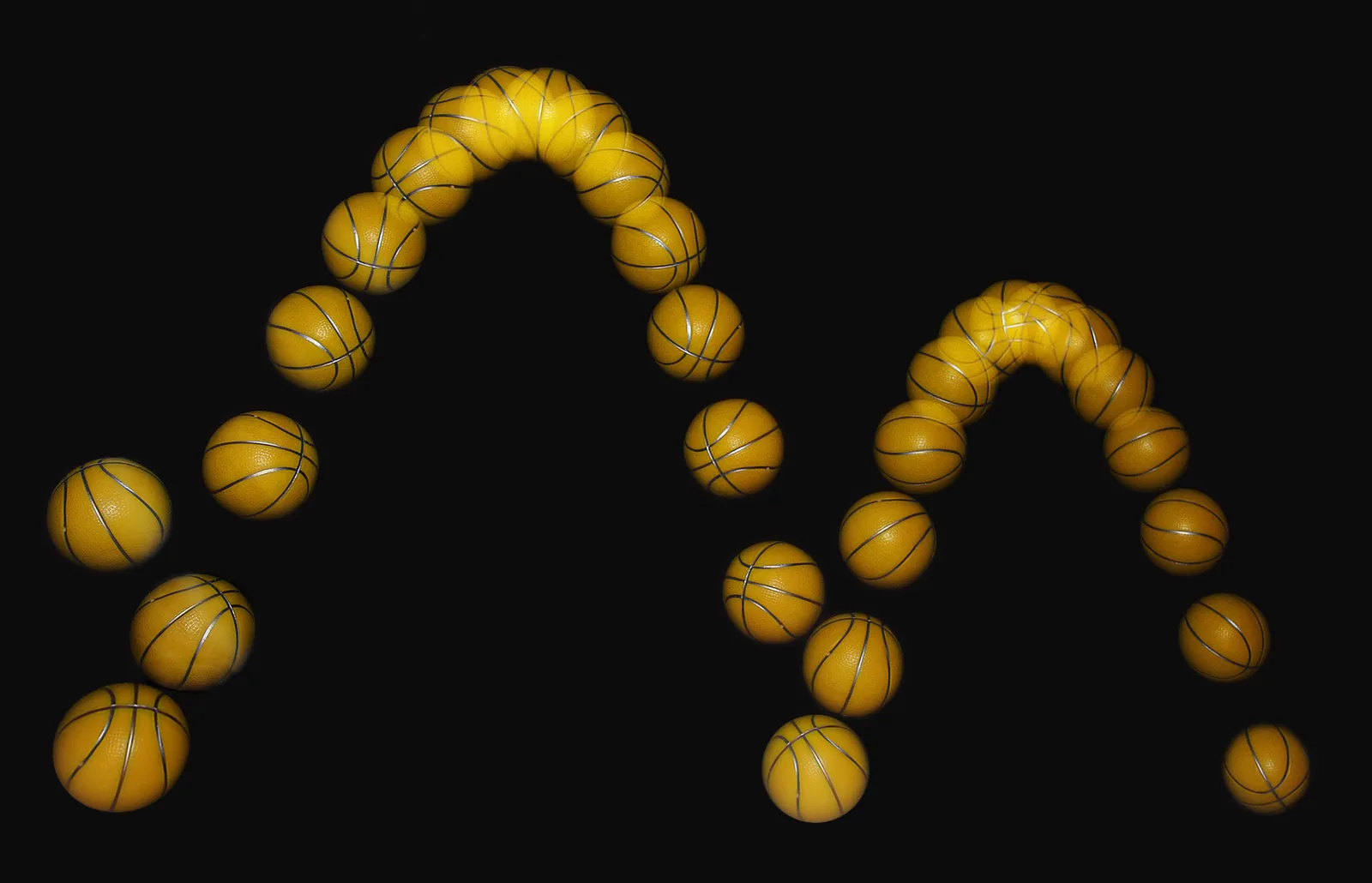
- Bouncing ball strobe edit. MichaelMaggs, Richard Bartz. source, CC BY-SA 3.0
