
Secret beginnings: fusion research to the 1950s
Why did governments hide research on a peaceful source of energy?
Prior knowledge
- Fusion joins light nuclei, and the repulsion of their charges must be overcome by high temperature and tunnellingchapter Fusion reactions: from the Sun to deuterium and tritium
- A magnetic field pushes moving charges sideways and can guide them along field lineschapter Charged particles and magnetic confinement
Core path: follow the steps in order. Tasks marked Optional give extra practice. Optional tasks: 2.
Think about it
In 1946 two physicists in London applied for a patent on a machine that would produce energy by fusion, the process that powers the stars. A few years later their work, and similar work in the United States and the Soviet Union, disappeared behind locked doors. Then, in March 1951, the President of Argentina told the world press that his country had already tamed fusion.
Nobody had built a fusion power plant. Nobody was close.
Why would governments hide research on a source of energy that might one day help everybody, and how could anyone know whether a fusion claim was true?
Think about it: secrets in science
Discuss with a partner for three minutes, then write two or three sentences together. What do you already know about the Cold War (about 1947–1991)? Can you think of a kind of research that a government might keep secret today? Give one reason why.
Word bank
the Cold War · the United States · the Soviet Union (the USSR) · a rival · a weapon · secret · a spy · an advantage
Sentence starters
- The Cold War was a rivalry between …
- A government might keep … secret, because …
- One reason for secrecy is …
Pair work: one of you starts with the Cold War, the other with research today; then write together.
Model answer
The Cold War was a long rivalry between the United States and its allies and the Soviet Union and its allies, from the late 1940s to 1991. They did not fight a direct war, but they competed in nuclear weapons, space and technology. Today a government might keep research on new weapons, codes or computer security secret, because an enemy could use it. A company might also keep research secret so that others cannot copy it.
Assess your own answer
Tick the points your own answer already contains.
Review the theory summary.
Hint 1: a guiding question
Think of the two superpowers after the Second World War.
Hint 2: what is the connection
Weapons, codes, medicines, computer chips: which of these might be secret, and for whom?
Predict
Make your predictions before investigating 2 questions
Prediction 1: the reason for secrecy
Prediction 2: testing a claim
Investigate
How to read: a jigsaw in groups of four
The story of fusion before 1958 is told in six short sections. Work in groups of four. Each of you reads one of the first four sections (From the stars to the laboratory, War, bombs and secrecy, An island in Patagonia, Pinches, stellarators and a Soviet ring) and becomes its expert. Take notes on three things: what happened, who was involved, and how governments, war or secrecy affected it. Then tell your group about your section in one minute each. After that, everyone reads ZETA and Geneva 1958.
Word bank
to classify (to make secret) · to declassify · a claim · evidence · to inspect · an accelerator · a beam · a plasma · a pinch · an instability · to confine · a neutron · the hydrogen bomb · funding
Sentence starters
- My section is about …
- The most important event was … in …
- The government (or the war) affected this because …
- This was important for fusion because …
- I was surprised that …
From the stars to the laboratory (1920–1939)
The story of fusion starts with a question about the stars. In August 1920 the British astronomer Arthur Eddington suggested in a lecture in Cardiff that the Sun shines by building helium out of hydrogen. Four hydrogen atoms have a little more mass than one helium atom, and the missing mass becomes energy, $E = mc^2$. Eddington even hoped that people might one day control this energy.
Physicists then had to explain how nuclei can join when their positive charges repel each other. In 1928 George Gamow showed with quantum mechanics that a particle can tunnel through such a barrier. In 1929 Robert Atkinson and Fritz Houtermans used this idea to calculate fusion rates inside stars. In 1938–1939 Hans Bethe worked out the reaction chains that power the Sun and heavier stars.
At the same time, particle accelerators brought nuclear reactions into the laboratory. In 1932 John Cockcroft and Ernest Walton at Cambridge fired fast protons at lithium. In 1934 Mark Oliphant, Paul Harteck and Ernest Rutherford fired deuterium nuclei at deuterium and saw the first fusion reactions made by people, producing tritium and helium-3. But a beam of fast particles mostly loses its energy in collisions, and only a tiny fraction of the nuclei fuse. In 1933 Rutherford called the idea of getting useful power from atoms "moonshine".
War, bombs and secrecy (1938–1952)
In December 1938 Otto Hahn and Fritz Strassmann in Berlin found that uranium nuclei can split. Lise Meitner and Otto Frisch explained this fission, and physicists soon saw that a chain reaction could make a bomb. During the Second World War the American Manhattan Project built the atomic bomb, which destroyed Hiroshima and Nagasaki in August 1945. From then on, nuclear physics was a matter of national security.
Fusion was part of this. A fission bomb can heat hydrogen isotopes so much that they fuse: this is the hydrogen bomb. The United States tested its first one, Ivy Mike, on 1 November 1952. Controlled fusion was a different aim, a slow and steady reaction for electricity, but it used the same nuclear physics. A fusion device also makes neutrons, and neutrons can turn uranium into plutonium, the fuel of bombs.
In Britain, George Paget Thomson and Moses Blackman applied in 1946 for a patent on a ring-shaped fusion reactor. Soon after 1950, when the physicist Klaus Fuchs admitted that he had passed atomic secrets to the Soviet Union, British fusion work became classified: secret, and open only to people with security clearance. In the Soviet Union, Igor Tamm and Andrei Sakharov, who worked on the Soviet hydrogen bomb, wrote a proposal in 1950 to hold a hot plasma in a ring of magnetic field. On 5 May 1951 Stalin signed the decision to start a fusion laboratory under Lev Artsimovich. In the United States, fusion research became a secret programme of the Atomic Energy Commission, later called Project Sherwood.
An island in Patagonia (1948–1952)
On 24 March 1951 the President of Argentina, Juan Perón, told the world press that his country had produced controlled fusion. The scientist behind the claim was Ronald Richter, an Austrian who had come to Argentina in 1948. Perón had given him a laboratory on Huemul Island, in a lake near San Carlos de Bariloche, and a very large budget. Perón even said that energy might one day be sold in bottles like milk.
The news reached newspapers everywhere. Most physicists were sceptical, because Richter gave almost no details and no measurements that others could check. In September 1952 a team of Argentine physicists led by José Antonio Balseiro inspected the laboratory. Their reports found no sign of a nuclear reaction, and in November 1952 the project was closed. Richter had probably seen hot gas in an electric arc, far too cold for fusion.
The claim was false, but it had real effects. It worried governments that another country might be ahead, and it helped to start fusion programmes in other countries. In the United States, it started the work of an astronomer at Princeton.
Pinches, stellarators and a Soviet ring
A fusion fuel must be heated to many millions of degrees, so it becomes a plasma of ions and electrons. No wall can touch it, but a magnetic field can push on moving charges. In the early 1950s three main ideas competed.
In a pinch, a strong current flows through the plasma itself. The current makes a magnetic field that circles around it, and the magnetic force on the moving charges squeezes the plasma towards the axis. In a Z-pinch the current flows along the plasma column. In a theta pinch a current in an outer coil flows around the column, and the field along the axis squeezes it. British teams at Harwell and Aldermaston built ring-shaped pinches, and James Tuck at Los Alamos built one he called the Perhapsatron. The squeezed column was unstable: it bent sideways (the kink instability) or narrowed in places like a chain of sausages (the sausage instability) and touched the wall in a tiny fraction of a second.
In 1951 Lyman Spitzer, a Princeton astronomer, read about Richter's claim and doubted it. He then designed a different magnetic bottle, the stellarator: a tube bent into a figure-eight, so that the slow sideways drift of the particles in one half of the loop cancels the drift in the other half. The Atomic Energy Commission gave him 50,000 dollars, and his secret Project Matterhorn later became the Princeton Plasma Physics Laboratory. Its first small machine, Model A, ran in 1953. In Moscow, Tamm and Sakharov's ring became the tokamak, a ring with both a strong magnetic field from outside coils and a current in the plasma. The first true tokamak, T-1, started at the end of 1958.
Expert notes: your section
After the jigsaw, write three sentences about your own section: what happened, who was involved, and how governments, the war or secrecy affected it. Then listen to your group and add one sentence about another section.
Sentence starters
- My section is about …
- In …, … happened.
- This was affected by the war (or by secrecy) because …
- From another expert I learned that …
Group work: each expert speaks for one minute; the others ask one question each.
Model answer
Stars: In 1920 Eddington suggested that the Sun turns hydrogen into helium, and in 1934 Oliphant, Harteck and Rutherford made the first fusion reactions with an accelerator. The scientists published openly in journals, because the work had no military use yet. But accelerator beams lose most of their energy, so Rutherford thought atomic power was impossible.
War: After fission was discovered in 1938, nuclear physics became part of the war and the atomic bomb. Fusion became secret around 1950–1951 in Britain, the Soviet Union and the United States, because of its links with the hydrogen bomb and because a fusion device makes neutrons. Governments started secret, state-funded programmes, such as the Soviet laboratory approved by Stalin in 1951 and Project Sherwood.
Huemul: In 1951 Perón announced that Ronald Richter had produced controlled fusion on Huemul Island. There was no checkable evidence, and an inspection by Balseiro's team in 1952 found no nuclear reactions. The false claim still pushed other governments to fund fusion.
Machines: In the early 1950s pinches, Spitzer's stellarator and the Soviet tokamak competed. Pinches were unstable (kink and sausage instabilities). The work was secret, so each country developed its ideas alone.
Assess your own answer
Tick the points your own answer already contains.
Review the theory summary.
Hint 1: a guiding question
Look again at the three things in your notes: what, who, how affected.
Hint 2: what is the connection
Use a sentence starter from the word bank above.
Investigate the evidence: ZETA's neutrons
Made-up example data · Numbers simplified for the lesson. They show the pattern that Basil Rose reported at Harwell in early 1958 (Wikipedia, ZETA (fusion reactor), checked 1 November 2026), not his raw data.
Early in 1958 Basil Rose at Harwell measured the neutrons from ZETA's pulses. He compared the neutrons that left the tube in the direction of the current with those that left it in the opposite direction. Then the current was reversed and he measured again. Look back at your Prediction 2 before you read the table.
| Current in the tube | Share of neutrons in the direction of the original current (%) | Share in the opposite direction (%) |
|---|---|---|
| one way | 70 | 30 |
| reversed | 30 | 70 |
ZETA: a headline and a correction
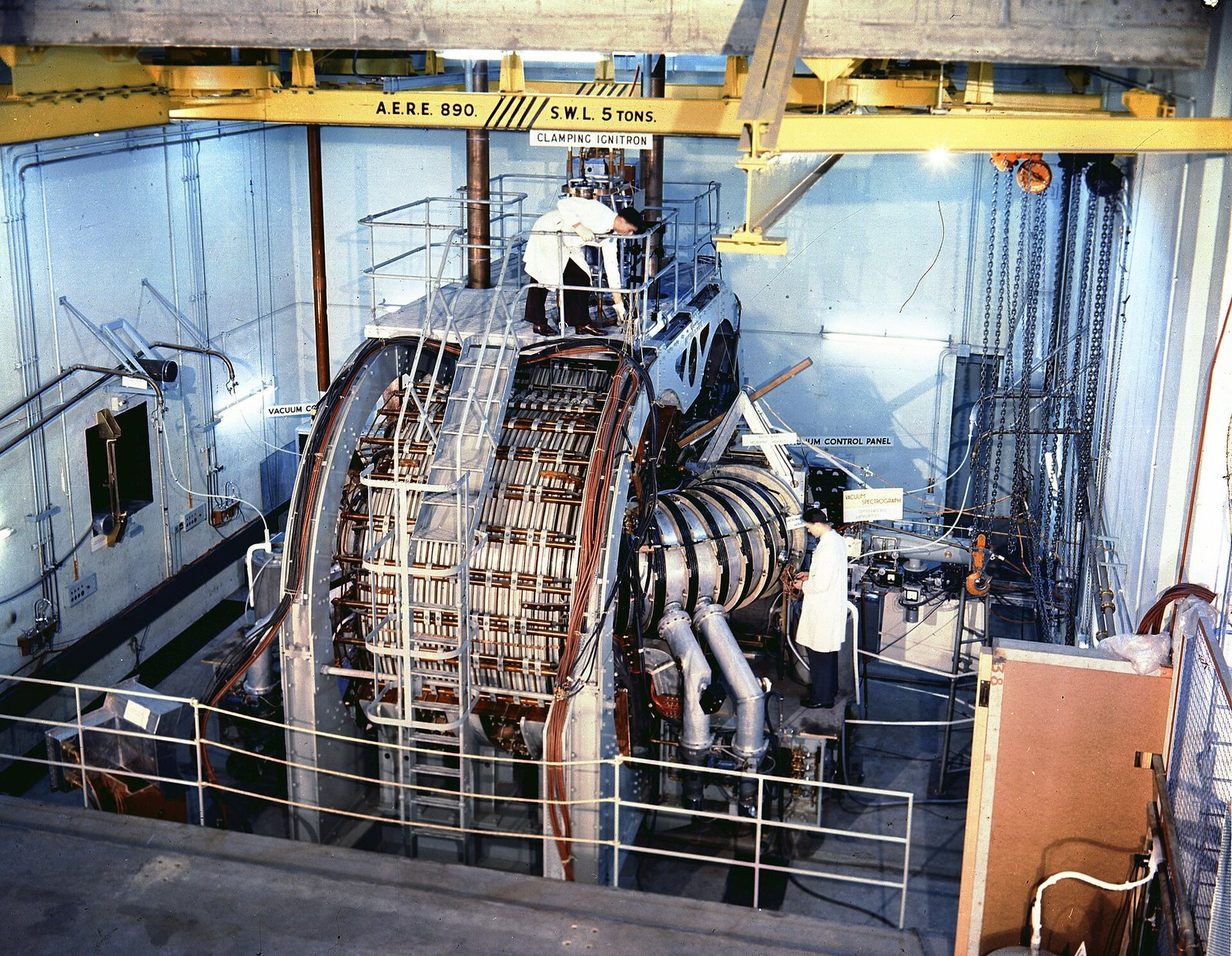
The largest fusion machine of the 1950s was ZETA, a ring-shaped pinch at Harwell in England. It started in August 1957, and within weeks it produced about a million neutrons in each pulse of deuterium plasma. Neutrons are made when two deuterium nuclei fuse, so many people hoped that ZETA had reached fusion. At a press conference on 24 January 1958, John Cockcroft, the director of Harwell, said he was "90 percent certain" that the neutrons came from fusion. Newspapers called it a breakthrough.
Neutrons can also come from a few ions that are accelerated by electric fields in an unstable plasma. Such fast ions all move in roughly the same direction, so the neutrons they make also fly out mostly in one direction. In a really hot plasma, ions move in all directions at random, and the fusion neutrons fly out equally in every direction. In early 1958 Basil Rose at Harwell measured the directions. The neutrons flew mostly one way, and the direction reversed when the current was reversed. The neutrons were not from a hot plasma. On 16 May 1958 Cockcroft published a correction.
Geneva 1958: the doors open
By 1958 all the secret programmes had met the same problem: their plasmas were unstable and lost heat much faster than expected. No country had a reactor to hide. From 1 to 13 September 1958 the second United Nations conference on the peaceful uses of atomic energy met in Geneva. The United States, the Soviet Union and Britain declassified their fusion research and presented it openly. Scientists from the rival countries found that they had tried many of the same ideas and met the same problems. From then on, controlled fusion became one of the most open fields of physics, with conferences and journals that everyone could read.
Put the story in order
Theory summary
Key idea
After 1945, governments treated controlled fusion as secret for several reasons at once:
- Weapons physics. The physics of hot fusion fuel is close to the physics of the hydrogen bomb.
- Neutrons. A fusion device makes neutrons, and neutrons can be used to make plutonium for bombs.
- Advantage and prestige. A country with fusion power would have cheap energy and be admired. False claims such as Huemul made governments fear that they were behind.
- Spies. After Klaus Fuchs admitted to spying, Britain and the United States trusted openness even less.
Secrecy had a cost. Teams in different countries repeated the same experiments, and few outside scientists could check a result. When results were finally shown, as with ZETA in January 1958, the pressure to announce success was strong, and a claim could reach the newspapers before it had been tested. In science, a result counts only when the evidence can be checked: Balseiro's inspection ended Huemul, and Rose's direction measurement ended the ZETA claim. In September 1958 the three nuclear powers declassified their work, because the plasma problems had turned out to be much harder than anyone had hoped, and openness now helped everyone more than secrecy.
Common misconception
"The research was secret because a fusion reactor could explode like a hydrogen bomb." This is not why. A controlled fusion device holds only a tiny amount of fuel, and when anything goes wrong the plasma cools and the reactions stop. The secrecy was about weapons knowledge, neutrons for bomb fuel, and national advantage.
A second mistake is to think that neutrons prove fusion in a hot plasma. A few fast ions can also make neutrons. The proof needs a test that tells the two causes apart, such as the directions of the neutrons or a direct measurement of the plasma temperature.
Back to your predictions
Compare your two predictions with the reading. Then answer the opening question in two sentences: why did governments hide research on a peaceful source of energy, and why did they stop hiding it in 1958?
Would you change your prediction?
Optional Three people of the secret years
The people of the secret years
Ronald Richter (1909–1991)
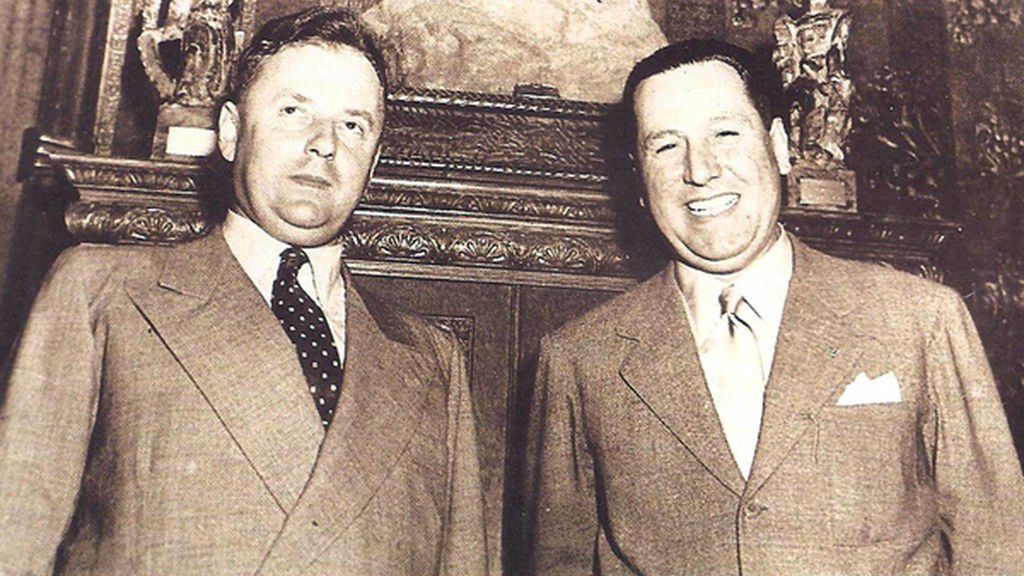
Ronald Richter was born in Falkenau in Bohemia, then part of Austria-Hungary, and studied at the German University of Prague. After the Second World War he came to Argentina and won the trust of President Perón, who gave him an island laboratory and a huge budget. His 1951 claim of controlled fusion was false: inspectors found temperatures far too low. Richter matters to this story because his claim pushed other countries into fusion research, and because it shows why a result must be checked by others.
Lyman Spitzer (1914–1997)
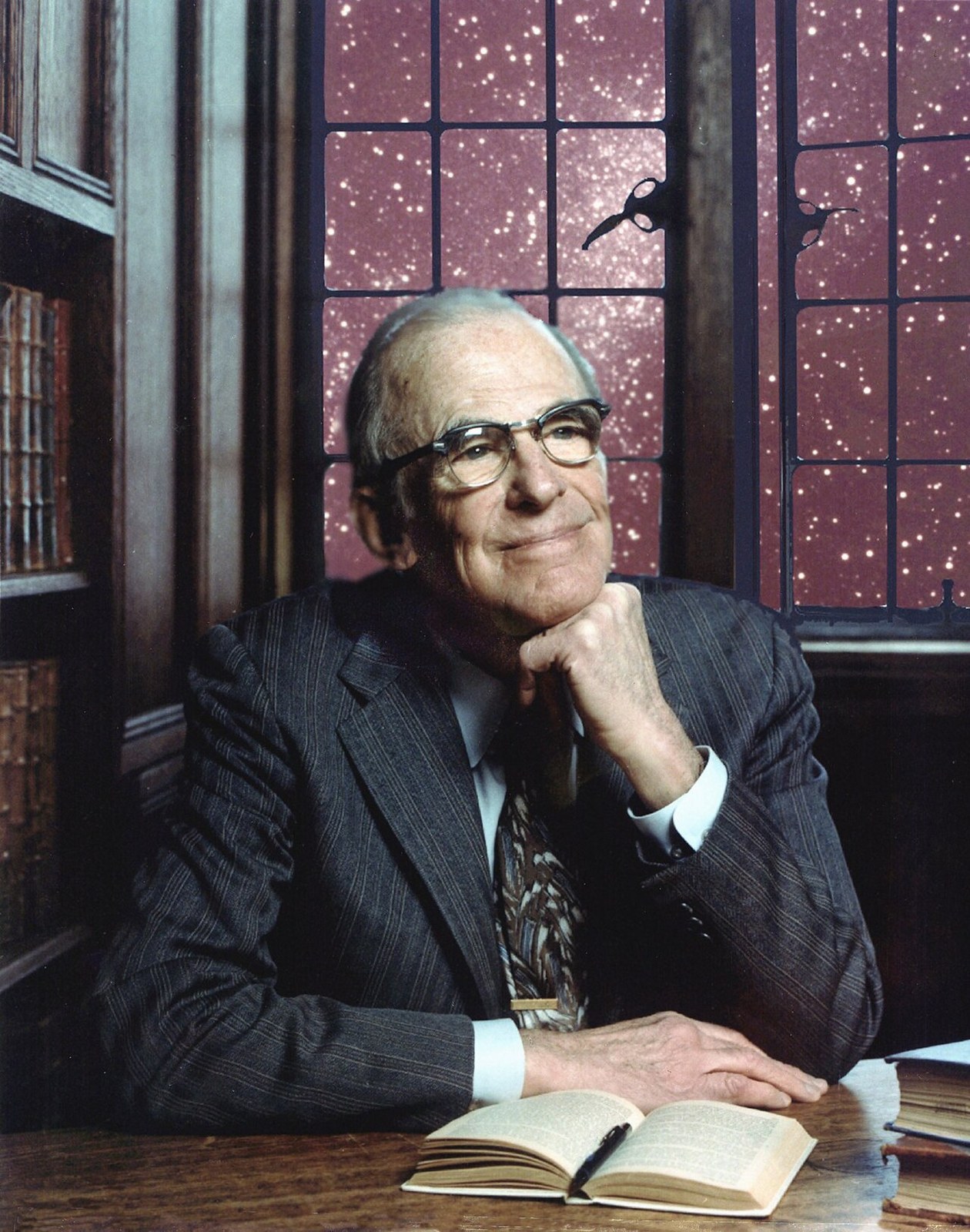
Lyman Spitzer was an American astronomer at Princeton University who studied the thin gas between the stars. In 1951, after reading about Richter's claim, he invented the stellarator and led the secret Project Matterhorn, which became the Princeton Plasma Physics Laboratory. He also argued for telescopes in space long before the Hubble Space Telescope was launched. Spitzer matters because he brought careful plasma physics into fusion research and started one of the two main machine designs still studied today.
Andrei Sakharov (1921–1989)
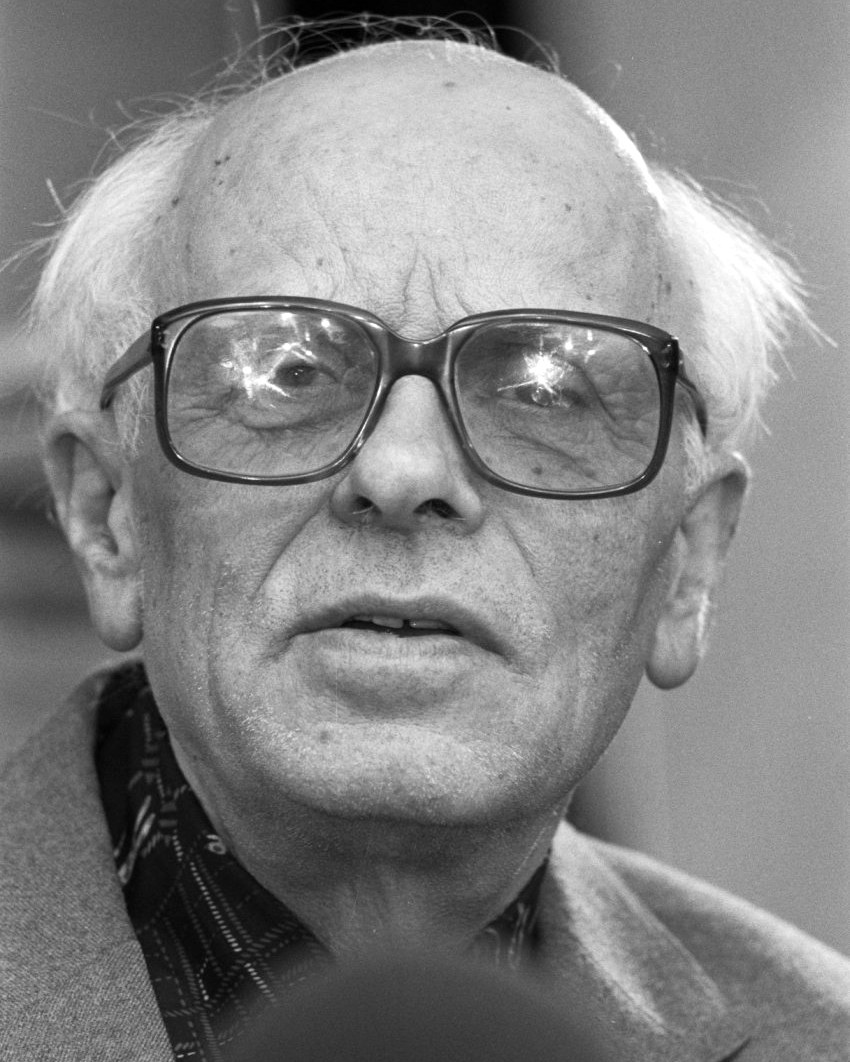
Andrei Sakharov was a Soviet physicist who helped to design the Soviet hydrogen bomb. In 1950, with his teacher Igor Tamm, he proposed holding a hot plasma in a ring-shaped magnetic field, the idea behind the tokamak. Later he turned against nuclear testing and became a defender of human rights; he received the Nobel Peace Prize in 1975 and was sent into internal exile in 1980. Sakharov matters because his life shows how closely weapons research, peaceful fusion and personal conscience were linked.
Optional Compare two lives
Read the biographies of Richter and Spitzer. Both reacted to the same event, the Huemul claim of 1951. Write three sentences: what each of them did, and what their stories teach about how science should work.
Sentence starters
- Richter claimed that …, but …
- Spitzer reacted by …
- Their stories show that a scientific claim …
Model answer
Richter announced controlled fusion in 1951 without evidence that others could check, and an inspection showed that his temperatures were far too low. Spitzer read about the claim, doubted it, and instead worked carefully on a new way to confine a plasma, the stellarator. Their stories show that a claim must be supported by measurements that others can test, and that doubt can lead to good new work.
Assess your own answer
Tick the points your own answer already contains.
Review the theory summary.
Apply
How hot was ZETA?
Spectroscopic measurements suggested that ZETA's plasma was at $1$ to $5$ million kelvin. A useful fusion plasma of deuterium and tritium needs an average particle energy of about $10\ \text{keV}$. The typical thermal energy of a particle is $E = k_\text{B} T$. Calculate this energy for the highest ZETA value, $T = 5.0 \cdot 10^{6}\ \text{K}$, in electronvolts.
Hint 1: a guiding question
Use $E = k_\text{B} T$ with the Boltzmann constant $k_\text{B} = 1.381 \cdot 10^{-23}\ \text{J/K}$.
Hint 2: what is the connection
The result in joules is very small. Divide by $1.602 \cdot 10^{-19}\ \text{J/eV}$ to get electronvolts.
Hint 3: an intermediate step
Show the solution
Given
the highest ZETA temperature $T = 5.0 \cdot 10^{6}\ \text{K}$; the Boltzmann constant $k_\text{B} = 1.381 \cdot 10^{-23}\ \text{J/K}$; $1\ \text{eV} = 1.602 \cdot 10^{-19}\ \text{J}$
Find
the typical thermal energy $E$ of one particle, in electronvolts
Principle
In a gas or a plasma at temperature $T$, the typical energy of one particle's random motion is about $k_\text{B} T$. Temperature is a measure of this energy, so this formula turns kelvins into an energy per particle.
Formula
$E = k_\text{B} T$, and in electronvolts
Unit conversions
None for the temperature, which is already in kelvins. The answer in joules is converted to electronvolts with $1\ \text{eV} = 1.602 \cdot 10^{-19}\ \text{J}$.
Substitution
$$\begin{aligned} E &= 1.381 \cdot 10^{-23}\ \text{J/K} \cdot 5.0 \cdot 10^{6}\ \text{K} \\ &= 6.905 \cdot 10^{-17}\ \text{J} \\ E_\text{eV} &= \frac{6.905 \cdot 10^{-17}\ \text{J}}{1.602 \cdot 10^{-19}\ \text{J/eV}} \\ &= 431\ \text{eV} \end{aligned}$$
Answer
$E \approx 430\ \text{eV}$
About $0.43\ \text{keV}$. The temperature is given to two significant figures, so the answer is too.
Reasonableness
A useful deuterium–tritium plasma needs about $10\ \text{keV}$, which is about $10\ 000 : 431 \approx 23$ times more, or about $120$ million kelvin. So even the highest ZETA value was far too cold for useful fusion, and it fits that ZETA's neutrons did not come from a hot plasma. As a check, $1\ \text{eV}$ corresponds to about $11\ 600\ \text{K}$, and $5.0 \cdot 10^{6} : 11\ 600 \approx 431$.
Claim, evidence or motive?
Find the error in a headline
Discuss: did secrecy help or harm?
Work in pairs. Partner A argues that secrecy helped fusion research in the 1950s, partner B that it harmed it. Each has one minute; then try to agree on a balanced answer. Use evidence from the reading.
Word bank
funding · duplication (doing the same work twice) · to check a result · to share · rivalry · pressure · progress · openness
Sentence starters
- Secrecy helped, because governments …
- Secrecy harmed research, because nobody outside could …
- The evidence suggests that …
- On the one hand …, on the other hand …
- I agree with you that …, but …
Write: did secrecy help or harm?
After the discussion, write a balanced paragraph of five or six sentences: did the secrecy of the 1950s help or harm fusion research? Give at least one argument on each side and one example from the reading, and end with your own conclusion.
Sentence starters
- On the one hand, …
- On the other hand, …
- For example, in 1958 …
- In my view, secrecy …, because …
Pair work: argue first (A: helped, B: harmed), then write on your own.
Model answer
On the one hand, secrecy came with a lot of government money. Because fusion was linked to national security, the United States, Britain and the Soviet Union all funded large programmes, and Spitzer received money only weeks after the Huemul claim. On the other hand, secrecy meant that teams in different countries repeated the same experiments without knowing it, and nobody outside could check a result. The ZETA announcement of 1958 shows the danger: the claim reached the newspapers before the neutron directions had been measured. When the work was declassified at Geneva in 1958, scientists found that they all faced the same unstable plasmas. In my view secrecy harmed the science more than it helped, because science depends on others checking results, but it helped to start the funding.
Assess your own answer
Tick the points your own answer already contains.
Review the theory summary.
Hint 1: a guiding question
Who paid for the research, and why?
Hint 2: what is the connection
What could not happen while results were secret?
Hint 3: an intermediate step
Use ZETA as an example of a claim that was not checked in time.
Check your understanding
1. Spitzer's figure-eight
2. Two pinches
3. Geneva 1958
4. Transfer: a new claim
In March 1989 two chemists announced at a press conference in Utah that they had made fusion at room temperature in a small glass cell. You are a science journalist. Using what you learned from Huemul and ZETA, write three or four sentences: what would you ask before you report it as a discovery, and why?
Sentence starters
- Before I report it, I would ask …, because …
- At Huemul (or ZETA), …
- A claim is not evidence until …
Model answer
Before I report it, I would ask whether other laboratories have repeated the experiment and found the same result, because Huemul and ZETA both looked like fusion until other people checked. I would ask what exactly was measured: are there neutrons, how many, and could they have another cause, as ZETA's neutrons did? I would also ask why the results were given at a press conference before they were published in a journal, because a claim that others cannot check is not yet evidence. (In 1989, laboratories around the world tried to repeat the cold fusion experiment and could not.)
Assess your own answer
Tick the points your own answer already contains.
Review the theory summary.
Hint 1: a guiding question
How was the Huemul claim shown to be false?
Hint 2: what is the connection
What did Rose measure at ZETA, and why?
Summary
- From 1920 to 1939 physicists explained the energy of the stars (Eddington, Gamow, Bethe) and made the first fusion reactions with accelerators (Oliphant, 1934), but in accelerator beams only a tiny fraction of the nuclei fuse, so they use far more energy than they give.
- After the atomic bomb, nuclear physics became secret. Around 1950–1951 Britain, the Soviet Union and the United States all started secret, government-funded programmes on controlled fusion.
- The reasons were the link with the hydrogen bomb, neutrons that can make bomb fuel, and the hope of an advantage; Richter's false Huemul claim of 1951 added pressure.
- Three designs competed: pinches (Z-pinch, theta pinch; kink and sausage instabilities), Spitzer's stellarator (1951) and the Soviet tokamak (Tamm and Sakharov, 1950; T-1 in 1958).
- ZETA's neutrons of 1957–1958 did not come from a hot plasma: they flew mostly in one direction, and the claim was corrected on 16 May 1958.
- In September 1958 at Geneva, the three countries declassified fusion research. Everyone faced the same unstable plasmas, and fusion became an open, international science.
Le coin français
Fusion research is a topic of every language. In French, the Cold War is la guerre froide, a secret is un secret, and controlled fusion is la fusion contrôlée. Listen, repeat, and then say the last sentence to your partner.
Photographs and videos
- ZETA seen from above, 1957. UKAEA (unknown photographer). source, Public domain
- Ronald Richter and Juan Perón. Unknown author. source, Public domain
- Lyman Spitzer. NASA APPEL Knowledge Services. source, Public domain
- Andrei Sakharov in 1989. Anefo / Croes, R.C.. source, CC0


