
Fusion reactions: from the Sun to deuterium and tritium
Why must a fusion reactor on Earth be hotter than the centre of the Sun?
Prior knowledge
- Fusion of light nuclei releases energy because the products are more tightly bound, and D–T fusion gives $Q = 17.6\ \text{MeV}$chapter Mass defect and binding energy
- A particle can tunnel through a barrier that it classically cannot crosschapter Waves, probability and quantum tunnelling
- Momentum $p = mv$ is conserved in a collision, and $E_\text{k} = \frac{1}{2}mv^2$ (earlier physics courses)
Core path: follow the steps in order. Tasks marked Optional give extra practice. Optional tasks: 4.
Think about it
The centre of the Sun has a temperature of about $15$ million kelvin. ITER, the international fusion experiment under construction in the south of France (as of November 2026), plans to heat its fuel to about $150$ million kelvin, ten times hotter. That sounds strange: the Sun has been fusing hydrogen for $4.6$ billion years at a much lower temperature. And in 1920, when Eddington proposed fusion in the Sun, his critics said that even the Sun was far too cold for it.
How can fusion happen at all, and why does a machine on Earth need so much more heat than the Sun?
Review: where the energy comes from
Predict
Make your predictions before investigating 3 questions
Prediction 1: over the barrier?
Prediction 3: why not copy the Sun?
Investigate
Investigation 1: the first fusion experiment, 1934
M. L. Oliphant, P. Harteck and Lord Rutherford, "Transmutation Effects observed with Heavy Hydrogen", letter to Nature 133, 413, dated 9 March 1934. What they reported, in our words:
- They fired a beam of deuterons, accelerated by a high voltage, at compounds that contained deuterium.
- Already at $20\,000$ volts they detected fast protons. At $100\,000$ volts the effects were too large for their amplifier and recorder to follow.
- They found two groups of particles with equal numbers: fast protons and a group of slow, singly charged particles, which they explained as a new hydrogen nucleus of mass $3$.
- They also found neutrons, which they explained by a second reaction that makes a helium nucleus of mass $3$.
- Beams of ordinary protons on the same targets gave no comparable effect.
- They wrote that "it is too early to draw definite conclusions".
Investigation 2: inside a D–T reaction
Test predictions 1 and 2. Step through the reaction with Next step and read each sentence aloud in your pair. Blue arrows show velocity $\overline{v}$, red arrows force $\overline{F}$. The arrows compare speeds within one step only; the line under the figure gives the real speeds.
Word bank
to approach · to repel · to slow down · Coulomb barrier · strong force · to fuse · to break up · alpha particle · neutron · momentum · kinetic energy · to share · lighter · faster
Sentence starters
- In the first step, …
- Then the electric force …
- When the nuclei are close enough, …
- The neutron moves faster because …
- The evidence from the diagram suggests that …
Describe the process
Discuss with a partner, then write a description of the D–T reaction in four or five steps, in your own words. Say what happens to the nuclei, which force wins at each moment, and how the energy is shared at the end.
Model answer
In the first step, a deuterium nucleus and a tritium nucleus move towards each other. Then the electric force pushes them apart, because both are positive, and they slow down: this is the Coulomb barrier. When the fastest nuclei are close enough, about $3 \cdot 10^{-15}\ \text{m}$, they tunnel through the rest of the barrier, the strong force wins, and they fuse into a very short-lived helium-5 nucleus. It breaks up at once into a helium-4 nucleus and a neutron, which have less mass than the fuel, so $17.6\ \text{MeV}$ is released. The products fly apart with equal and opposite momenta, so the lighter neutron moves faster and carries $14.1\ \text{MeV}$, while the helium nucleus carries $3.5\ \text{MeV}$.
Assess your own answer
Tick the points your own answer already contains.
Review the theory summary.
Theory summary
The proton–proton chain
The Sun turns hydrogen into helium in three steps, called the proton–proton chain. Hans Bethe and Charles Critchfield worked out its first step in 1938. Energies are from the AME2020 masses:
- Two protons fuse into a deuteron, $^{2}_{1}\text{H}$. One proton turns into a neutron, so a positron $\text{e}^+$ and a neutrino $\nu$ are emitted.
- The deuteron captures another proton and becomes helium-3; a gamma-ray photon $\gamma$ carries off energy.
- Two helium-3 nuclei, each from steps 1 and 2, fuse into helium-4 and give back two protons.
In total, four protons become one helium-4 nucleus, and $26.7\ \text{MeV}$ is released; about $2\ \%$ of it escapes with the neutrinos. The first step is extremely slow, because turning a proton into a neutron needs the weak interaction. An average proton in the Sun's core waits about $9$ billion years before it fuses. The Sun shines only because it holds an enormous number of protons.
Key idea
Two nuclei are both positive, so they repel each other. To fuse, they must come within about $3\ \text{fm}$ of each other, where the strong force takes over. At this distance their electric potential energy is about $0.5\ \text{MeV}$. This energy hill is the Coulomb barrier.
The temperature of the Sun's core is about $15.7$ million kelvin. There, the average kinetic energy of a nucleus is only $\frac{3}{2}kT \approx 2\ \text{keV}$, more than $200$ times too little. By classical physics, practically no nucleus would ever get over the barrier, and the Sun could not shine.
The answer is quantum tunnelling. A nucleus behaves partly like a wave, and it has a small probability of appearing on the other side of the barrier without having the energy to climb over it. George Gamow found this effect in 1928 for alpha decay, and in 1929 Robert Atkinson and Fritz Houtermans used it to calculate fusion in stars. Tunnelling is most likely for the fastest nuclei and for barriers that are low and thin, so fusion needs high temperatures, and it is easiest for the hydrogen isotopes, which have the smallest charge. Because of tunnelling, deuterium and tritium already fuse readily at collision energies of about $0.1\ \text{MeV}$, well below the $0.5\ \text{MeV}$ top of the barrier, and in a reactor plasma (about $15\ \text{keV}$) the fastest nuclei do most of the fusing.
Sharing the energy of D–T fusion
The easiest reaction for a reactor is the fusion of deuterium and tritium:
$${}^{2}_{1}\text{H} + {}^{3}_{1}\text{H} \to {}^{4}_{2}\text{He} + {}^{1}_{0}\text{n} + 17.6\ \text{MeV}$$
The reaction is balanced: $2 + 3 = 4 + 1$ nucleons and $1 + 1 = 2 + 0$ elementary charges. The energy appears as kinetic energy of the products. If the fuel nuclei are almost at rest, the total momentum is about zero, so the two products fly apart with equal and opposite momenta, $p_\alpha = p_\text{n} = p$. With $E_\text{k} = p^2/(2m)$, the lighter particle gets more energy:
$$\begin{aligned} \frac{E_\text{n}}{E_\alpha} &= \frac{m_\alpha}{m_\text{n}} \approx 4 \\ E_\text{n} &= \frac{m_\alpha}{m_\alpha + m_\text{n}} \cdot Q \end{aligned}$$
So the neutron carries $14.1\ \text{MeV}$ and the helium nucleus, the alpha particle, $3.5\ \text{MeV}$.
Words of the lesson
Back to your predictions
Compare your three predictions with the source, the reaction diagram and the theory. Which of them would you change, and why?
Would you change your prediction?
Apply
Worked example
Problem
This example repeats the calculation of the reaction diagram and the formula step by step, so that you can do it yourself. In D–T fusion, $Q = 17.6\ \text{MeV}$ is released. The nuclear masses are $m_\alpha = 4.0015\ \text{u}$ for the helium nucleus and $m_\text{n} = 1.0087\ \text{u}$ for the neutron. Calculate the kinetic energy of each product, assuming that the fuel nuclei are almost at rest.
Step 1/7
Given: $Q = 17.6\ \text{MeV}$, $m_\alpha = 4.0015\ \text{u}$, $m_\text{n} = 1.0087\ \text{u}$; the initial momentum is about zero. Find: $E_\text{n}$ and $E_\alpha$.
Step 2/7
Principle: Momentum is conserved: the products move in opposite directions with momenta of equal size $p$. Energy is conserved: $E_\text{n} + E_\alpha = Q$. The kinetic energy of a particle with momentum $p$ is $E_\text{k} = p^2/(2m)$.
Step 3/7
Formula: With the same $p$, the kinetic energies are inversely proportional to the masses, and they add up to $Q$:
$$\begin{aligned} E_\text{n} &= \frac{m_\alpha}{m_\alpha + m_\text{n}} \cdot Q \\ E_\alpha &= \frac{m_\text{n}}{m_\alpha + m_\text{n}} \cdot Q \end{aligned}$$
Step 4/7
Unit conversions: None: only the ratio of the masses is needed, so they can stay in $\text{u}$, and $Q$ stays in $\text{MeV}$. The sum of the masses is $4.0015\ \text{u} + 1.0087\ \text{u} = 5.0102\ \text{u}$.
Step 5/7
Substitution: $$\begin{aligned} E_\text{n} &= \frac{4.0015\ \text{u}}{5.0102\ \text{u}} \cdot 17.6\ \text{MeV} \\ &= 0.7987 \cdot 17.6\ \text{MeV} \\ &= 14.06\ \text{MeV} \\[4pt] E_\alpha &= \frac{1.0087\ \text{u}}{5.0102\ \text{u}} \cdot 17.6\ \text{MeV} \\ &= 0.2013 \cdot 17.6\ \text{MeV} \\ &= 3.54\ \text{MeV} \end{aligned}$$
Step 6/7
Answer: The neutron gets $E_\text{n} \approx 14.1\ \text{MeV}$ and the alpha particle $E_\alpha \approx 3.5\ \text{MeV}$, as precise as $Q$ allows.
Step 7/7
Reasonableness:
The neutron is about four times lighter, so it gets about four times as much energy: $14.06 : 3.54 = 3.97$. In a hot plasma the fuel nuclei are not quite at rest, so the measured neutron energies spread a little around $14.1\ \text{MeV}$.
Fusion in the laboratory
A power plant cannot simply copy the Sun:
| Sun's core | ITER (plan) | |
|---|---|---|
| fuel | protons | D and T |
| how hot | $1.6 \cdot 10^{7}\ \text{K}$ | $1.5 \cdot 10^{8}\ \text{K}$ |
| density | $150\ \text{g/cm}^3$ | $10^{-6}$ of air |
| held by | gravity | magnetic fields |
| power per $\text{m}^3$ | $280\ \text{W}$ | $0.6\ \text{MW}$ |
The Sun's reaction is far too slow for a machine, and its gravity holds a dense core for billions of years. A reactor must use the fastest reaction, D–T, in a thin plasma that it can hold only for seconds or less. To make enough nuclei tunnel in that short time, the plasma must be about ten times hotter than the Sun's core, which ITER plans at about $150$ million kelvin. "Hotter than the Sun" refers to the temperature only; the Sun's core has a far higher density and pressure.
The neutron has no charge, so magnetic fields cannot hold it: it leaves the plasma with $80\ \%$ of the energy and heats the wall around it, where its energy can be collected and where it can breed new tritium from lithium. The alpha particle is charged and stays in the plasma, keeping it hot.
Word bank
gravity · magnetic field · density · temperature · pressure · reaction rate · to hold (confine) · fuel · tritium · deuterium · plasma · beam · energy gain
Sentence starters
- The main difference between the Sun and a reactor is …
- The Sun can use a slow reaction because …
- A reactor cannot …, so it must …
- One limitation of a beam experiment is …
- "Hotter than the Sun" does not mean …
Compare: the Sun and a fusion reactor
Discuss with a partner, then write three or four sentences of your own that answers the opening question: why must a fusion reactor on Earth be hotter than the centre of the Sun? Compare the fuel, the density, how the plasma is held and for how long. Also say what "hotter than the Sun" does not mean.
Model answer
The main difference between the Sun and a reactor is how the fuel is held. The Sun's gravity holds a huge, dense core, $150\ \text{g/cm}^3$, for billions of years, so it can use the very slow proton–proton reaction. A reactor cannot do this: its magnetic fields hold only a thin plasma, about a million times thinner than air, for seconds or less. So it must use the fastest reaction, deuterium–tritium, and make the nuclei so fast that many of them tunnel through the Coulomb barrier in that short time. That needs about $150$ million kelvin, ten times the temperature of the Sun's core. "Hotter than the Sun" refers only to the temperature: the Sun's core has a far higher density and pressure.
Assess your own answer
Tick the points your own answer already contains.
Review the theory summary.
Optional extra information
Compare the energy released by chemical and nuclear fuels. The chart has a logarithmic axis: each step is ten times the one before.
Optional How much coal is one kilogram of D–T fuel?
One kilogram of D–T fuel releases $3.37 \cdot 10^{14}\ \text{J}$ by fusion, and one kilogram of anthracite coal releases $3.25 \cdot 10^{7}\ \text{J}$ by burning.
How many kilograms of coal give the same energy as one kilogram of D–T fuel?
Hint 1: a guiding question
The same energy: $m_\text{coal} \cdot q_\text{coal} = 1\ \text{kg} \cdot q_\text{DT}$.
Hint 2: what is the connection
Divide the two energies per kilogram.
Hint 3: an intermediate step
$3.37 \cdot 10^{14} : 3.25 \cdot 10^{7} = 1.04 \cdot 10^{7}$.
Show the solution
Given
$q_\text{DT} = 3.37 \cdot 10^{14}\ \text{J/kg}$, $q_\text{coal} = 3.25 \cdot 10^{7}\ \text{J/kg}$, $m_\text{DT} = 1\ \text{kg}$
Find
the mass of coal $m_\text{coal}$ that releases the same energy
Principle
Both fuels must release the same energy $E$; the energy is the mass times the energy per kilogram.
Formula
$$m_\text{coal} = \frac{q_\text{DT} \cdot m_\text{DT}}{q_\text{coal}}$$
Unit conversions
None: both energies are in $\text{J/kg}$.
Substitution
$$\begin{aligned} m_\text{coal} &= \frac{3.37 \cdot 10^{14}\ \text{J/kg} \cdot 1\ \text{kg}}{3.25 \cdot 10^{7}\ \text{J/kg}} \\ &= 1.04 \cdot 10^{7}\ \text{kg} \end{aligned}$$
Answer
about $10^{7}\ \text{kg}$, ten thousand tonnes of coal, three significant figures as in the data.
Reasonableness
A D–T reaction releases $17.6\ \text{MeV}$, while burning releases a few $\text{eV}$ per atom: the ratio per reaction is millions, and so is the ratio per kilogram. Ten thousand tonnes of coal fill more than a hundred railway wagons.
Optional Practice: the proton–proton chain
Common misconception
"The Sun fuses deuterium and tritium, like a fusion reactor." The Sun fuses ordinary hydrogen through the slow proton–proton chain. D–T fusion is chosen for reactors because it is the fastest reaction at reachable temperatures; tritium hardly exists in nature and must be made.
"A reactor plasma is hotter than the Sun, so it is more extreme in every way." Only the temperature is higher. The Sun's core, $150\ \text{g/cm}^3$, is more than a hundred billion times denser than a reactor plasma, which is about a million times thinner than air, and its pressure is far higher.
"Nuclei fuse when they have enough energy to get over the Coulomb barrier." At the temperatures of the Sun and of reactors, almost all fusions happen by tunnelling, below the top of the barrier.
Optional Mark Oliphant
The people behind the first fusion experiment
Mark Oliphant (1901–2000)
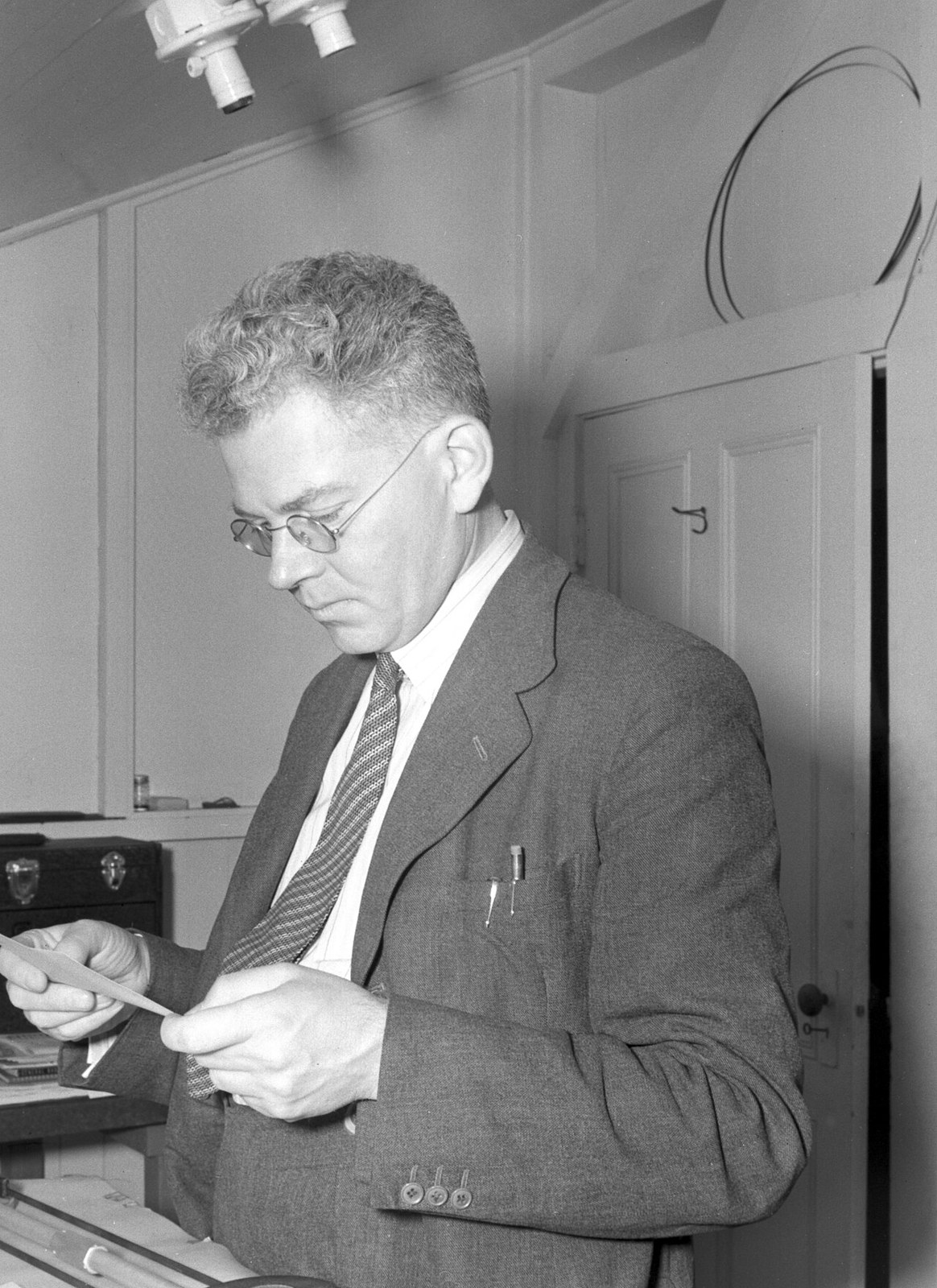
Mark Oliphant was an Australian physicist from Adelaide. In 1927 he came to the Cavendish Laboratory in Cambridge to work with Ernest Rutherford. When a small amount of heavy water became available, he, Paul Harteck and Rutherford fired deuterons at deuterium and observed the first fusion reactions made on purpose, discovering tritium and helium-3 in 1934. Later, in Birmingham, his group developed the cavity magnetron, which made microwave radar possible. Back in Australia he founded a research school of physics in Canberra and served as Governor of South Australia from 1971 to 1976.
Check your understanding
1. Concept: the neutron's energy
2. Representation: balance a reaction
3. Lab and Sun: the temperature
4. Transfer: what the neutrons do
In a D–T reactor, the plasma is held by magnetic fields. Explain what happens to the two products of the reaction, the alpha particle and the neutron, and why this matters for the design of a reactor.
Sentence starters
- The alpha particle is charged, so …
- The neutron has no charge, so …
- Because the neutron carries … of the energy, …
- This means that the wall of the reactor must …
Model answer
The alpha particle is charged, so the magnetic field keeps it in the plasma, and its $3.5\ \text{MeV}$ heats the plasma. The neutron has no charge, so the magnetic field cannot hold it, and it flies out of the plasma with $14.1\ \text{MeV}$. Because the neutron carries about $80\ \%$ of the energy, the wall around the plasma must catch the neutrons and turn their energy into heat, which could be used to make electricity. This means that the wall must also stand the neutron radiation, and it can contain lithium to breed new tritium.
Assess your own answer
Tick the points your own answer already contains.
Review the theory summary.
Summary
- The Sun fuses four protons into helium-4 through the proton–proton chain and releases $26.7\ \text{MeV}$; its first step is very slow, because it needs the weak interaction.
- Positive nuclei repel: the Coulomb barrier is about $0.5\ \text{MeV}$, far more than the thermal energy: a few keV in the Sun, about $10\text{–}20\ \text{keV}$ in a reactor. Fusion happens by quantum tunnelling, mostly for the fastest nuclei.
- Oliphant, Harteck and Rutherford made the first fusion reactions in a laboratory in 1934 (D–D), discovering tritium and helium-3.
- D–T fusion releases $17.6\ \text{MeV}$; by momentum conservation the neutron gets $14.1\ \text{MeV}$ and the alpha particle $3.5\ \text{MeV}$.
- A reactor uses the fastest reaction, D–T, in a thin plasma held by magnets, so it needs about ten times the temperature of the Sun's core.
Le coin français
ITER is being built at Saint-Paul-lez-Durance, next to the French research centre of Cadarache. The fuel there will be le deutérium and le tritium, and much of the energy will leave as la chaleur, heat. Listen, repeat, and say the last sentence to your partner.
Photographs and videos
- Mark Oliphant in 1941. Donald Cooksey, Lawrence Berkeley National Laboratory. source, Public domain
